


Simple Summary
Based on laboratory analyses of both vegan and meat-based pet foods, some studies have suggested pet food samples of either type to be nutritionally sound, while others have demonstrated nutritional flaws. However, a more systematic evaluation of the nutritional soundness of vegan and meat-based pet foods has been lacking. Consequently, this study sought to more comprehensively review relevant published studies to date. Overall, 54 suitable studies were located and assessed. In total, 81.5% of the studies (n = 44) found nutritional inadequacies in the pet foods they examined. These nutritional inadequacies spanned multiple pet food types—both vegan and meat-based, and both dog and cat food. The nutritional inadequacies concerned multiple nutrients. More testing is required to ensure that pet foods fulfil the nutritional needs of dogs and cats that they frequently claim to or are required to.
Abstract
Single studies are often cited to support claims of nutritional soundness or unsoundness regarding vegan or meat-based pet foods when compared to nutritional guidelines from authorities such as the Association of American Feed Control Officials (AAFCO), the European Pet Food Industry Federation (FEDIAF), and the National Research Council (NRC). However, there is little overarching evidence concerning the nutritional soundness of these different pet food types. Such overarching evidence is increasingly important as alternative vegan or meat-based pet food types become more available, such as insect-based, raw meat, and microbial protein-based pet foods. In this systematic review, 54 relevant studies examining the nutritional soundness of vegan, vegetarian, or meat-based dog or cat foods were descriptively analyzed. Only 10 (18.5%) studies found no nutritional deficiencies or excesses across their sampled pet foods relative to AAFCO, FEDIAF, or NRC guidelines. Numerous nutrient deficiencies and excesses were found across all pet food types. Most commonly, these included deficiencies in calcium, phosphorus, and zinc for both dog and cat food, as well as the amino acid taurine exclusively in cat food. The nutrients found to be most commonly in excess were also calcium and phosphorus, and copper—with the latter breaching not only FEDIAF requirements, but also EU legislative limits. Meat-based, insect-based, veterinary prescription, and vegan pet food types each had particularly at-risk nutrients that pet food companies should be aware of. For instance, vegan pet foods often performed well in terms of their fatty acid profile and selenium levels, but some had deficiencies in certain B vitamins. In contrast, some meat-based pet foods were prone to selenium deficiencies. Generally speaking, aside from such specific nutritional flaws, problems were observed across all pet food types. In fact, dog and cat foods (including wet and dry, growth and adult maintenance) of various types commonly failed to fulfil multiple nutritional requirements. To safeguard dog and cat health and welfare, urgent interventions are warranted to improve the nutritional soundness of many pet foods.
1. Introduction
Interest in nutritionally sound vegan pet food has risen exponentially over the last decade. The vegan pet food market was valued at nearly USD 10 billion in 2020 [1]. It rose to almost USD 27 billion in 2024 and has a forecasted value of over USD 57 billion by 2034, representing a compound annual growth rate of 7.8% [2]. Given this fast pace of growth, it is prudent to enquire about the nutritional soundness of vegan pet food, which was an aim of the present study. This would also provide guidance for guardians who may be interested in feeding their dogs and cats vegan pet food.
There are several key drivers of this rapid growth in vegan pet food. The first is the “animal lover’s paradox” [3], where dog and cat guardians and other animal advocates seek a solution to the dilemma of caring for one animal species whilst feeding them a different animal species most likely originating from intensive animal farms. Roughly 85% of UK animal farming is classed as intensive; in the USA, this figure rises to almost 100% of animal farming [4,5,6].
Second, there is increasing awareness of companion animals’ paw prints in terms of the environmental impacts created by conventional pet food. Notably, after calculating dietary energy requirements, we previously calculated that transitioning dogs and cats on to nutritionally sound vegan diets globally could save 0.3 billion hectares of land (an area larger than Mexico in the case of dogs and one larger than that of Germany in the case of cats), reduce greenhouse gases by 0.66 Gt of CO2 equivalents (a quantity greater than that emitted by the UK in the case of dogs and one greater than that by New Zealand in the case of cats), and spare 8.99 Gm3 of water (a volume greater than renewable freshwater supplies in Denmark in the case of dogs and one greater than that in Jordan in the case of cats) [7]. Third, amidst a pet obesity crisis and reduced trust in the pet food industry, many are seeking alternative options for their pets’ diets [8]. This includes 1.3% of pets being fed exclusively vegan pet food and almost 8% being fed vegan pet food intermittently [9] (p. 7). Dodd et al. [9] also found that a further 35% of pet guardians currently feeding meat-based diets were open to transitioning their pets to nutritionally sound vegan pet food, including 78% of vegan guardians. When considering more sustainable pet food options more broadly, the figure rises to between 43% and 51% of dog and cat guardians respectively being open to transitioning their pets’ diets [10,11].
At the time of writing in early 2026 there were numerous studies confirming good health outcomes in dogs and cats fed vegan diets [12,13,14,15,16,17,18,19,20,21,22]. Additionally, a systematic review of relevant studies suggested at the very least no adverse health consequences when nutritionally sound vegan pet foods are fed to dogs or cats, and maybe even some benefits [23]. Since the publication of that systematic review, there have been further studies, including a longer-term health study [24] and a clinical study focusing on vitamin D specifically [25], with none indicating health concerns when nutritionally sound vegan diets are fed to dogs or cats.
Very few contrary studies have been published. Almost 40 years ago Yamada et al. [26] subjected eight laboratory dogs to four hours daily of enforced running at 12 km/h for two weeks following six weeks of enforced rest. When compared to the four meat-based dogs, the four plant-based dogs had lower circulating free cholesterol and suffered anemia. However, this study was limited by a very small sample size and study conditions very distant from real-world conditions for companion dogs, and its results have not been confirmed by subsequent larger studies. Over thirty years ago, Leon et al. [27] observed hypokalemic episodic polymyopathy in cats fed a vegetarian diet. However, the diet fed was deficient in potassium, and cats that received the same diet supplemented with potassium did not develop hypokalemic polymyopathy. More recently, some cases of dilated cardiomyopathy (DCM) and related cardiac abnormalities were reported in association with pulses—which are often used in grain-free plant-based pet foods [28]. Detailed subsequent Food and Drug Administration (FDA) investigations were not able to establish any increased risks associated with pulses [29], and an investigation by 100 Reporters revealed that undeclared pet food industry interests appear to have influenced the case reports that initially led to these concerns [28]. However, some authors have continued to raise concerns or call for further evaluations of this issue [30,31].
In 2024, the British Veterinary Association [32] officially affirmed the healthfulness of nutritionally sound vegan diets for dogs, whilst UK Pet Food [33] did so for both dogs and cats in 2023.
Nevertheless, concerns remain for some regarding the healthfulness of commercial vegan pet foods. This is particularly the case following some studies (e.g., [34]) that have found certain commercial vegan pet foods to be deficient in nutrients at levels recommended by the European Pet Food Industry Federation (FEDIAF) and the Association of American Feed Control Officials (AAFCO). However, there are also studies (e.g., [35]) that have found conventional meat-based pet foods to likewise be nutritionally unsound. Hence, this study aimed to offer the first systematic review of the extant literature concerning the question: How nutritionally sound is commercially available vegan pet food relative to meat-based pet food?
2. Methodology
2.1. Research Design
A systematic review was chosen as the method for this study as, at the time of writing, no systematic reviews had been published focusing on the nutritional soundness of vegan and meat-based pet foods. Systematic reviews are often considered the “gold standard” in terms of the production of optimally reliable results. This is because they reduce remaining biases present in individual studies by pooling all results together to generate a clear picture of current evidence [36]. A preliminary review was conducted to ensure that there was a sufficient number of studies to warrant a systematic review and to guide the choice of the search terms.
The updated PRISMA 2020 guidelines for systematic reviews were consulted for this study and the PRISMA checklist completed [37]. Two research databases were used for this systematic review: (1) Scopus and (2) Web of Science (All Databases) as the two leading research databases [38]. The All Databases option within Web of Science integrates the Core Collection with Medline and various additional databases. Thus, this aligns with established guidance on database selection for systematic reviews, which recommends consulting at least three validated sources [39]. Moreover, Web of Science Core Collection, Medline, and Scopus have recently been identified as key databases recommended for systematic reviews [40]. Each of these resources is either multidisciplinary or focused on biomedical research. Topics and journals featured include animal nutrition. Thus, these databases are appropriate for the present research area.
These databases were searched on 14th June 2025 exclusively. As discussed by McGowan et al. [41], the same search string was used for each database, tailored to each database’s requirements. For instance, on Scopus, the search string was (without quotation marks): “(nutr* OR vitamin OR mineral OR chemical OR element) W/3 (analysis OR assay OR composition OR profile OR evaluation OR adequacy OR quality OR levels OR quantity OR concentrations OR content OR value OR estimation OR balance OR measure OR assessment OR comparison OR formulation) W/5 (pet OR dog OR cat OR feline OR canine OR puppies OR kittens OR “felix catus” OR “canis lupus familiaris”) W/3 (food OR diet OR feed)”. No other search limits were applied.
2.2. Selection Criteria
To be eligible for inclusion in the final shortlist of studies, studies needed to:
- (1)
- Collect novel empirical data regarding a nutrient analysis of commercially available pet food (i.e., of a finished product available to purchase);
- (2)
- Examine at least one nutrient;
- (3)
- Concern dog or cat food;
- (4)
- Concern vegan pet food or meat-based pet food (including raw; cultivated, i.e., laboratory-grown; or insect-based pet food);
- (5)
- Be published in a peer-reviewed journal, on a pre-print platform, or as a postgraduate thesis;
- (6)
- Be written in English or German;
- (7)
- Use AAFCO, FEDIAF, or National Research Council (NRC) nutrition guidelines as the comparator (given that most regions of the world defer to these bodies).
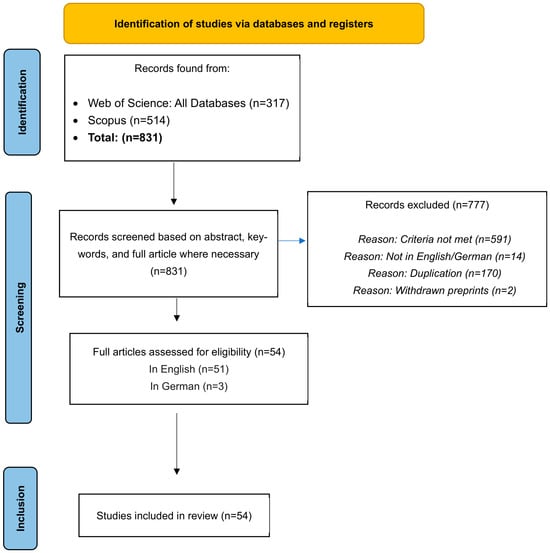
For a summary of the key methodological steps taken, please see Figure 1. The relevance of a study was ascertained from the title, abstract, and keywords. Where necessary, full studies were consulted. Studies focusing exclusively on nutrient analyses of new foods which were not yet commercially available were excluded, as were those focusing on the testing of new methods for nutrient analyses. Digestibility analyses were also excluded. However, if nutrient analyses were conducted prior to digestibility analyses, then the papers were still included, but only for the purpose of using the relevant data on nutritional soundness. Studies focusing on specialized diets (e.g., for senior pets) were included as these generally require good/increased nutrition, but restrictive diets (e.g., for losing weight, which may have opposite effects) were excluded. Nutritional analyses of supplements or treats were also excluded, as were studies focusing on toxins.
Figure 1.
PRISMA flow diagram for the systematic review. Note: After Page et al. [42].
Only analyses of actual commercially available pet food were included (e.g., excluding analyses based solely on labelling claims). The reason for this was that it is important to see how well pet food actually meets packaging claims of being “nutritionally complete” and fulfilling FEDIAF/AAFCO/NRC requirements.
Duplicate studies resulting from the different database searches were removed. The first author created the initial shortlist. The items removed by the first co-author were checked by the second author, as were the items retained. Brief discussion resolved initial disagreements concerning eight studies. The first author explained the reasoning for the initial inclusion/exclusion of these studies, and after further consideration, agreement was reached with the second author. No additional reviewer was required.
2.3. Nutritional Benchmarks
The nutritional guidelines provided by AAFCO, FEDIAF, and the NRC were chosen as the nutritional comparators for assessing the nutritional soundness of pet foods as these organizations are the leading pet nutrition advisors globally and their guidelines the ones most widely used in relevant scientific studies. Table 1 and Table 2 compare each of these institutions’ nutritional guidelines for dogs and cats, respectively. AAFCO and FEDIAF regulate pet food, while the NRC conducts research and is concerned exclusively with the physiological requirements of dogs and cats [43]. AAFCO and FEDIAF minimums are thus often higher than those of the NRC as they have to consider the practical implementation of nutritional advice across a broad range of pet food types, as well as digestibility and varying bioavailability [43]. However, there are occasions when NRC amounts are higher than those of FEDIAF and AAFCO, as with sodium, chloride, and magnesium. A lack of “safe upper limits” for all three institutions can indicate inconclusive research rather than no risk from excessive intake [43]. As can be seen from Table 1 and Table 2, FEDIAF requirements are generally more comprehensive and stricter than those of AAFCO. All institutions publish updates to their nutritional guidance, the most recent being issued in 2026 for AAFCO, 2025 for FEDIAF, and 2006 for the NRC.
Table 1.
Comparison between the latest official dog nutritional requirements from FEDIAF [44], AAFCO [45], and the NRC [46] for adult maintenance, based on unit of nutrient per 100 g of dry matter and assuming an energy density of 4000 kcal ME/kg DM.
Table 2.
Comparison between the latest official cat nutritional requirements from FEDIAF [44], AAFCO [45], and the NRC [46] for adult maintenance, based on unit of nutrient per 100 g of dry matter and assuming an energy density of 4000 kcal ME/kg DM.
2.4. Analysis
Following O’Connor and Sargeant [36] (p. 11) and Page et al. [37], key methodological and results data were extracted from the shortlisted papers and synthesized in two “summary of findings” tables according to the extent of the nutritional deficiencies or excesses found. Only nutrients that the FEDIAF, AAFCO, or NRC list in their respective tables of nutrient requirements were considered. If a study included both prescription and non-prescription foods, only the non-prescription foods were incorporated into the present analysis. This is because some veterinary pet foods have purposefully lowered nutrient levels, such as phosphorus in the case of renal diets [47]. A meta-analysis was not performed due to the heterogeneity of the studies (and the limited resources available). For instance, a whole range of different nutrients and different numbers of nutrients were assessed across different studies. Additionally, some different methods of nutrient analyses were used. Finally, the formats that nutrients were measured in varied and were not readily convertible—such as units per amount of dry matter, per kcal of ME, and per MJ of ME. No automation tools were used, and this protocol was not pre-registered in order to retain the ability to optimally and flexibly adapt our protocol where necessary to best answer the research questions. For instance, final decisions were not made regarding the precise data to extract, or how to analyze the data, until full knowledge of data types and units could be ascertained from the final shortlist. However, no refinements to the initial plan were required; hence, all pre-analysis protocol stages outlined above remained unchanged from the original plan prior to commencing the databases searches.
2.5. Minimizing Bias
Steps were taken to reduce reviewer bias during both study selection and the synthesis of results, and to assess the quality and level of bias in the studies reviewed. In accordance with Boutron et al. [48], to minimize reviewer bias, the main reviewer was independent and had no conflicts of interest. Additionally, the results in a study’s abstract did not influence the decision to include or exclude a study. Information missing from some papers was marked clearly as such, and the validity and biases of each study included were assessed in a specific “evidence profile” table tailored for animal welfare, animal health, and food safety studies [36] (p. 11) to assess the “certainty of evidence” [49]. Following O’Connor and Sargeant [36], this included assessments of studies’ risk of bias (design considerations), directness (the extent to which a study answered our research question), and risk of publication bias. Risk of bias was assessed by primarily considering sample size, directness was assessed by considering the number of nutrients assessed, and risk of publication bias was assessed by considering sources of funding and author conflicts of interest. Assessment of the precision of studies’ results—such as the extent of variation in a finding, as described by Page et al. [42]—was reserved for in-text discussion where relevant; we were chiefly concerned with individual products’ results within a study’s sample.
Designed primarily for use in clinical health random controlled trials, the Grading of Recommendations Assessment, Development, and Evaluation (GRADE) tool is a systematic method for assessing the reliability of studies in a systematic review and hence the certainty of the evidence that a systematic review produces [50]. What has been described here amounts to a bounded, transparent modified GRADE (M-GRADE) approach to certainty analysis—a pragmatic approach for studies with resource limitations and/or those that are not focused on random controlled trials for healthcare interventions. We stress that only exemplar criteria in this instance were used to evaluate certainty.
2.6. AI Use
During the preparation of this manuscript, the authors used the large language model Perplexity (Deep Research, free plan) to paraphrase certain parts of the methodology. This was done to avoid self-plagiarism with other systematic reviews published by the authors. Perplexity was again used to paraphrase parts of the abstract for inclusion in the conclusion. The authors have reviewed and edited the output and take full responsibility for the content of this publication.
3. Results and Discussion
3.1. Essential Characteristics of Shortlisted Studies
As can be seen from the methodological steps summarized by Figure 1 and the studies summarized in Table 3 and Table 4, the searches resulted in 831 initial results. These were filtered in accordance with our criteria down to a final shortlist of 54 studies. Table 5 lists the countries represented in the studies, with USA leading. However, Europe was the continent most commonly represented, with 27 studies (50%), and all continents were represented barring Africa and Antarctica. Regardless of the specific country a study was conducted in, Table 3 and Table 4 detail that the pet food included in some studies was an international brand or a brand that could be delivered to countries other than that of its origin if ordered online. Thus, the relevance of the findings may have a broader application than the countries in which these pet food companies were based.
Table 3.
Summary of 18 of the 54 shortlisted studies with the most favorable results.
Table 4.
Summary of 36 of the 54 shortlisted studies that found considerable deviations from the nutritional guidelines of AAFCO, FEDIAF, and/or the NRC.
Table 5.
Country setting of the shortlisted studies.
All of the 54 shortlisted studies were peer-reviewed published studies. Theses would have been included, but none were shortlisted. Of note is that one of the published studies was originally included as a preprint [71]; however, this study was subsequently published; thus, the preprint was replaced with the published version. Publication years spanned from 1989 to 2025, with the median being 2020. In what follows, percentages may not always total 100% due to rounding.
Five (9%) of the studies examined vegan (four) or vegetarian (one) pet foods, 49 (91%) examined meat-based pet foods (including raw meat, fish, and insect-based food), and one (2%) examined both vegan and meat-based pet foods. Dog food was the focus of 24 (44%) of the studies, cat food of 11 (20%)—including one of the vegan pet food studies—and both dog and cat food were the focus of 19 (35%) of the studies—including four of the five vegan or vegetarian pet food studies. Six (11%) of the studies focused on wet pet food, 27 (50%) on dry, 15 (28%) on both types, and six (11%) on “Other” (e.g., liquid, raw, or unclear). In terms of the nutrients examined, 36 studies (67%) focused on between six and 25 metrics, though the metrics studied ranged from one (e.g., [84]) to over 30 (e.g., [76]). Studies used recognized methods for their nutritional tests, as described by the Association of Official Analytical Chemists (AOAC International), AAFCO, and FEDIAF (e.g., see [44], pp. 33–35). Sample sizes ranged from two pet food products analyzed in a study (i.e., [99,103]) to 177 pet food products (i.e., [91]). A majority (n = 17, 31%) sampled between 10 and 29 pet food products.
Overall, 10 (19%) of the studies (in green in Table 3) found zero deficiencies and seven (13%) found only one deficiency—in terms of one nutrient metric—(in yellow in Table 3). It should be noted that if a study considered only one metric, then a deficiency also needed to be found in only one product in order to be listed (yellow) in Table 3. One additional study (2%), in blue in Table 3, found that nutrients met the minimum requirements of one nutritional body but not the other (e.g., either AAFCO or FEDIAF), though of course not all studies considered multiple nutritional bodies. These outcomes arose from the studies comparing their results to recommended minimum/maximum nutrient levels as detailed by AAFCO, FEDIAF, and/or the NRC for “complete” diets. Eighteen (33%) of the studies used the guidelines of the AAFCO, 15 (27%) used those of the FEDIAF, four (7%) used those of the NRC, and 17 (31%) used a combination of two or all three. However, the exact version (year of publication) of these institutions’ advisory documents that the studies used depended on the year studies were conducted in. There is no clear difference in the methodology of studies in Table 3 versus those in Table 4 that would explain the higher frequency of deficiencies/excesses found by studies in Table 4.
3.2. Certainty Analysis
Table 6 details the ultimate certainty M-GRADE for each of the 54 shortlisted studies. Two studies scored the highest M-GRADE of 5 [71,83], with two further studies scoring 4.5 [69,92]. Thus, these four studies are considered the most comprehensive and reliable from the shortlist and warrant particularly close attention. Conventional meat-based pet food, insect-based pet food, and vegan pet food featured across these studies, as well as both dog and cat food and both dry and wet food. All are in Table 4 (rather than Table 3), meaning that substantial deviations from recommendations were found. Similarly, pet foods for growth, adult, and “all” life stages also feature among these studies, as well as comparisons against both AAFCO and FEDIAF nutritional guidelines. Other studies boasted even higher sample sizes than these top four but were limited by a narrower scope of nutrient metrics. Conversely, some other studies shared a broad range of nutrient metrics akin to these top four but were weakened by very small sample sizes.
Table 6.
Modified GRADE reliability analysis for the 54 studies shortlisted using exemplar evaluation criteria.
3.3. Deficient and Excess Nutrients
Table 7 counts the number of studies that found certain nutrients to be deficient or in excess relative to AAFCO, FEDIAF, or NRC guidelines. It is clear that deviations are commonplace across all nutrient groups. Table 7 demonstrates that deficiencies were more common than excesses. This was expected due to the dearth of guidelines regarding maximum levels for most nutrients. Calcium, phosphorus, and zinc were the nutrients most commonly deficient across both dog and cat food within the studies reviewed, in addition to taurine for cat food. Interestingly, similar nutrients also featured most commonly as excess nutrients for dogs (zinc and phosphorus), as well as copper too, with the latter also being the nutrient most commonly found to be in excess for cats. The FEDIAF [44] notes that its maximum levels for all microminerals are in fact legal maxima. Thus, EU-based studies finding excesses of microminerals mean that pet food manufacturers are contravening not only FEDIAF requirements, but also EU legislative limits (Commission Implementing Regulation EU 2016/1095)—for example, the zinc and manganese excesses found by Kazimierska et al. [87].
Table 7.
Number of studies showing nutrient deficiencies or excesses when compared to FEDIAF, AAFCO, or NRC requirements.
Whilst not all nutrients featured were assessed in all studies, this general pattern is reinforced when we look at the most reliable studies mentioned previously, with these same nutrients being shown as deficient or in excess across all four top-scoring studies [69,71,83,92]. There are a minority of nutrients that were never found to be deficient or in excess in either species among the shortlisted studies—namely, the amino acid histidine, vitamin B1 (thiamine), vitamin B7 (biotin), choline, and vitamin K (menadione). At least one further nutrient from each nutrient group was not found to be deficient in cat food (e.g., a few amino acids such as valine, the omega 3 fatty acid alpha-linolenic acid, and the mineral chloride), but this may be due to the lower number of studies that focused on cat food. In studies that examined both dog and cat food, dog and cat foods generally performed similarly in terms of meeting AAFCO/FEDIAF guidelines. For instance, there were examples of cat food performing worse (e.g., [60,83,85,102]) and examples of dog food performing worse (e.g., [89,96,101]).
3.4. Different Types of Pet Food
3.4.1. Vegan Pet Food
Only six of the studies considered vegan pet food in their analyses. Four assessed vegan pet food for both dogs and cats [34,83,85,95], though it should be noted that one of the 24 samples in the study by Kanakubo et al. [95] was actually vegetarian, as it contained eggs. Another focused on vegan cat food only [99]. The sixth compared both meat-based and vegan pet food exclusively for dogs [71]. Ingredient lists were not always stated. However, most of these studies assessed plant-based vegan pet foods. None examined pet food based on microbial protein. The first diet based on fermented microbial protein became available in 2025 [104]. Nutritionally complete samples formulated to meet AAFCO requirements were tested for effects on feed digestibility, fecal microbiome, and health status and were found to be well tolerated in dogs by Longshaw et al. in 2025 [105]. Future research should be sure to include this novel alternative pet food option in regions where this is commercially available. The absence of any vegan pet food studies in Table 3 (studies finding no or only one deviation from nutritional requirements) is possibly a reflection of the imbalance of studies focusing on vegan pet food and the small number of articles found in Table 3. As discussed, the two studies that received the highest ratings (5) in the M-GRADE analysis (Table 6) focused on vegan pet food either solely or in combination with meat-based pet food [71,83]. Three of the others were graded 3 [34,85,99]. These were chiefly limited by their small sample sizes of two to four products. Kanakubo [95] was graded lower (2) due to measuring only a few nutrients.
The widespread nutrient deviations spanning all nutrient groups that are collectively evident (Table 4 and Table 7) persisted when considering vegan pet food specifically. Across both dogs and cats, dry and wet pet food, and pet food designed for growth or adult maintenance, recurring deviations included:
- Deficiency of crude protein;
- Deficiency of the amino acid methionine (+cystine);
- Deficiency of the fatty acid arachidonic acid;
- Deficiency of the minerals potassium and zinc;
- Imbalance of the Ca:P mineral ratio;
- Excess of the mineral copper;
- Deficiency of the vitamins A (retinol), B6 (pyridoxine), and B12 (cyanocobalamin or cobalamin).
The most notable negative difference was perhaps an overrepresentation of vitamin deficiencies. However, again mirroring the collective pattern across all 54 studies, it is of note that not all nutrients were consistently tested in the studies examining vegan pet food. Crude protein and amino acids were tested in all six of these studies (though not taurine in Starzonek et al. [85]). Crude fat and fatty acids were not tested in two studies; no minerals at all were tested in one study [95], while some minerals were not tested in others (e.g., selenium and iodine featured only in the analyses by Brociek et al. [71]); and only three of these studies considered vitamins [71,83,99].
The most notable beneficial difference between the findings of vegan pet food and the collective results (Table 7) is the absence of selenium deficiency, which ranks as the joint fifth most commonly deficient nutrient for dogs in Table 7. Selenium excesses may naturally be less of an issue in vegan pet food, as it is particularly found in offal. However, potential greater deficiency of this mineral in meat-based pet food could be due to a misplaced assumption of its automatic sufficiency in meat-based pet food, due to its greater presence in meat and its relative resistance to degradation when heated during processing [106].
The study by Brociek et al. [71] was graded the most highly (with the top score of 5)—jointly with Dodd et al. [83]. It was also the only study to have compared vegan and meat-based pet food. In contrast to the other vegan pet food studies, it actually found a higher average amino acid content in vegan pet food compared to meat-based pet food and no cases of crude protein deficiencies. The lowest case of crude protein occurred within a meat-based pet food. It also found significantly higher levels of unsaturated fats in the vegan pet food compared to the meat-based pet food.
3.4.2. Raw Meat and Insect-Based Pet Food
No studies included cultivated meat-based pet food among their pet food samples. This also became available in 2025 [107] and should similarly be incorporated into future research in regions where it is commercially available. Other subtypes of meat-based pet food did feature among the shortlisted studies, such as insect-based pet food and raw meat-based pet food. Similar to conventional meat-based and vegan pet food, nutritional inadequacies were also prevalent within these diet types. Low calcium, phosphorus, zinc, iron, copper, selenium, various amino acids, arachidonic acid, and crude protein have been reported in insect-based foods, in addition to Ca:P imbalances and excesses of zinc, selenium, and copper [69,72,73,74,87].
No notable differences between insect- and conventional meat-based pet food were observed, apart from manganese excesses in insect-based pet food [87]. One study that featured insect-based pet food is listed in Table 3 with zero deviations from guidelines found [57]. However, this study was very narrow, only assaying crude protein and crude fat. Additionally, only one out of 36 products was insect-based. Similarly, one out of 11 products sampled in the study by Choi et al. [76] was a raw meat-based pet food, and this performed better than most other products. However, considerable deficiencies were found in raw meat-based pet food in other studies that considered this pet food type [81,82,88].
3.5. Welfare Hazards
The nutrient deficiencies and excesses found in these studies are important as they can adversely impact dog and cat health and welfare. As discussed, across the shortlisted studies, the most commonly deficient nutrients in both dog and cat food were calcium, phosphorus, and zinc. Calcium deficiency, for example, can lead to bone demineralization and increased fracture risk; phosphorus deficiency can lead to impaired growth and impacts on bone metabolism; and zinc deficiency can lead to emesis (vomiting), wasting and keratitis (corneal inflammation) [108,109].
As noted, across both dog and cat foods, common excesses were calcium, phosphorus, and copper. These increase the risk of skeletal abnormalities, impaired calcium uptake, and liver damage [108,110]. The amino acid taurine, required within diets by cats but not dogs, was also found to be the most commonly deficient nutrient in both wet and dry cat food. This can lead to heart disease (e.g., dilated cardiomyopathy, which can cause heart failure), retinal degeneration (causing gradual vision loss and eventual blindness), reproductive failure, immunocompromisation and other problems [108,111]. As detailed above, other common deficiencies and excesses were also found, but it was beyond the scope of this study to document all of the potential veterinary medical implications.
Both vegan and meat-based commercial diets normally include a wide range of additives and other unnatural ingredients. These could represent additional welfare hazards if they result in compromises to physical health or other determinants of animal welfare, such as the opportunity to exercise normal feeding behaviors, or the experience of a positive mental state. However, vegan diets do not appear to deviate substantially from meat-based diets in these respects. As noted in the Introduction, one systematic review [23] and multiple additional studies have not demonstrated adverse health consequences when nutritionally sound vegan pet foods are fed to dogs or cats, and in some cases limited benefits have been documented. And several studies of feeding behavior have demonstrated little difference in behavioral indicators of palatability when vegan or meat-based diets are fed. After previously analyzing behavioral indicators of palatability in 2308 dogs and 1135 cats, we concluded that “vegan pet foods are generally at least as palatable to dogs and cats as conventional meat or raw meat diets, and do not compromise their welfare, when other welfare determinants, such as nutritional requirements, are adequately provided” [112]. These results were consistent with several prior studies in this field (e.g., [113,114,115,116]).
3.6. Study Limitations and Further Research Suggestions
The number of studies included in the final shortlist that focused on alternative pet foods, including vegan pet foods, was substantially lower than the number focused on conventional meat-based food. This is to be expected given the predominance of conventional meat-based pet diets and the recent development of many alternative diets. In time, nutritional evaluations of alternative diets should increase.
It is also possible that certain studies may have been missed due to the exclusion of all studies not in English or German. With additional research resources a full GRADE analysis (with two raters) and a meta-analysis could be conducted using multiple researchers. The current subjective assessment of certainty based on a partial GRADE analysis—with a reliance on narrative assessment—weakens the comparative power between the studies. More subtypes of pet food could also be considered, such as hypoallergenic, senior, premium, and grain-free products. Moreover, it cannot be ruled out that some relevant studies may have been excluded due to the favoring of a more specific search string; again, this is something that could be avoided with more resources. Outside of a meta-analysis, other quantitative/statistical assessments could also be pursued, such as inter-reviewer agreement metrics (e.g., Cohen’s kappa) to further evidence the high inter-reviewer reliability.
Similarly, future research could incorporate more inclusive search criteria, for instance, not limiting studies to those explicitly comparing their nutritional analyses to AAFCO/FEDIAF/NRC standards. Other regional nutritional comparators could instead be used with standardized benchmarking performed as part of the systematic review if the data enabled this. The impact of differing nutrient metrics (e.g., whether measuring nutrients as unit per amount of dry matter, per kcal of metabolizable energy, or per MJ of metabolizable energy) and of different methods of nutrient analyses could also be considered. Finally, this study adopted a descriptive, narrative, and broad overview approach. A more fine-grained analysis could generate more detailed results—including the extent of deficiencies/excesses, both in terms of the extent of the deviation from guidelines and the number of products exhibiting the deficiencies/excesses within each shortlisted study.
3.7. Recommendations
The results confirm nutrient deficiencies and excesses across all studied types of pet food. An intervention in the status quo is required to rectify this, safeguard companion animal welfare, and align with consumer rights/choice—currently, pet guardians are not getting what they believe they are buying. Interventions could include more frequent compulsory product testing (with improvements mandated where necessary). This would result in better enforcement of nutritional guidelines. Countries that do not as yet have legal minimum nutritional requirements for pet food should work towards that stage as an initial step. Future research should make every effort to test all nutrients required by the AAFCO and FEDIAF rather than just one nutrient (or group). Additionally, nutritional composition alone does not fully determine nutritional adequacy in vivo. This can also be affected by factors such as bioavailability, digestibility, and antagonistic interactions between ingredients or their metabolites. Hence, nutritional soundness confirmation, using methods such as feeding trials and holistic health assessments, remains important. Future research should also commence nutrient assessments of the latest novel pet foods—those based on cultivated meat and microbial proteins. From a methodological perspective, a key improvement would be consistent blinding of researchers to the pet foods being tested.
4. Conclusions
This systematic review identified and evaluated 54 studies assessing nutrient levels within commercially available dog and cat food. Adopting a largely descriptive, narrative-based analysis, we found that 44 (81.5%) of these studies revealed nutrient deficiencies or excesses among their sampled pet foods when compared with AAFCO, FEDIAF, or NRC standards. Widespread nutrient imbalances were observed across all studied categories of pet food and all categories of nutrient. The most common deficiencies observed were calcium, phosphorus, and zinc deficiencies for both dog and cat food, as well as taurine deficiency in cat food. Nutrient excesses were less commonly observed, but typically these concerned calcium, phosphorus, and copper for both species. Different formulations, including conventional and raw meat-based, insect-based, and vegan diets, may have distinct nutrients that are particularly vulnerable to deviation from required standards, warranting careful monitoring by pet food manufacturers. For example, the vegan pet foods assessed generally performed well with respect to fatty acid composition and selenium content but were sometimes deficient in some B vitamins. Conversely, meat-based pet food often fell short of meeting recommended concentrations of selenium. Considering the observed inadequacy of both dog and cat foods (wet and dry, designed for either growth or adult maintenance, and vegan or meat-based) in achieving required nutrient profiles, immediate improvements in pet food manufacturing are warranted to protect companion animal health and welfare.
Author Contributions
Conceptualization, A.K.; formal analysis, J.L.M. and B.N.; methodology, J.L.M. and A.K.; project administration, A.K.; resources, A.K.; supervision, A.K.; writing, original draft, J.L.M.; writing, review, and editing, J.L.M., A.K. and B.N. All authors have read and agreed to the published version of the manuscript.
Funding
This research received no external funding.
Institutional Review Board Statement
Not applicable.
Informed Consent Statement
Not applicable.
Data Availability Statement
No new data were created in this study. Data sharing is not applicable to this article.
Acknowledgments
The large language model Perplexity (Deep Research, free plan) was used for specific purposes, as described in the Methodology.
Conflicts of Interest
Mace Animal Welfare is the operational name of Jenny L. Mace’s freelance research services. Jenny L. Mace was commissioned by the Sustainable Pet Food Foundation to conduct this research. The Sustainable Pet Food Foundation is a UK-registered non-profit organization that advances animal health, welfare, and environmental sustainability by supporting research and education about sustainable pet food. Andrew Knight (third author) is affiliated with the Sustainable Pet Food Foundation. Billy Nicholles is a consultant for a pet food company and is affiliated with the Bryant Research company. However, these companies played no role in study design, data acquisition or analysis, authorship of the resultant manuscript, or decisions relating to publication. The authors declare that the research was conducted in the absence of any other commercial relationships that could be construed as a potential conflict of interest.
References
- Chauhan, S.; Prasad, E. Vegan Pet Food Market Size, Share, Competitive Landscape and Trend Analysis Report, by Form (Organic and Conventional), Pet Type (Dog Food, Cat Food, and Others), Pet Food Type (Dry Pet Food, Wet Pet Food, Treats & Snacks, and Others), and Distribution Channel (Hypermarket/Supermarket, Specialty Stores, Online Sales Channels, and Others): Global Opportunity Analysis and Industry Forecast 2021–2030; Allied Market Research: Wilmington, DE, USA, 2022; Available online: https://www.alliedmarketresearch.com/vegan-pet-food-market-A15847 (accessed on 1 February 2026).
- Choudhury, N.R. Plant-Based Pet Food Market Trends-Ethical & Nutritional Growth 2024 to 2034; Future Market Insights: Newark, DE, USA, 2024; Available online: https://www.futuremarketinsights.com/reports/plant-based-pet-food-market (accessed on 1 February 2026).
- Milburn, J. The animal lovers’ paradox? On the ethics of “pet food”. In Pets and People; Overall, C., Ed.; Oxford University Press: Oxford, UK, 2017; pp. 187–202. [Google Scholar]
- CIWF. Factory Farming Map. 2024. Available online: https://www.ciwf.org.uk/our-campaigns/factory-farming-map/ (accessed on 1 February 2026).
- Ritchie, H. How Many Animals Are Factory-Farmed? Our World in Data. 2023. Available online: https://ourworldindata.org/how-many-animals-are-factory-farmed (accessed on 1 February 2026).
- Sentience Institute. 99% of US Farmed Animals Live on Factory Farms, Study Shows. 2019. Available online: https://www.sentienceinstitute.org/us-factory-farming-estimates (accessed on 1 February 2026).
- Knight, A. The relative benefits for environmental sustainability of vegan diets for dogs, cats and people. PLoS ONE 2023, 18, e0291791. [Google Scholar] [CrossRef] [Scilit] [PubMed]
- Dodd, S.; Cave, N.; Abood, S.; Shoveller, A.K.; Adolphe, J.; Verbrugghe, A. An observational study of pet feeding practices and how these have changed between 2008 and 2018. Vet. Rec. 2020, 186, 643. [Google Scholar] [CrossRef] [Scilit] [PubMed]
- Dodd, S.A.S.; Cave, N.J.; Adolphe, J.L.; Shoveller, A.K.; Verbrugghe, A. Plant-based (vegan) diets for pets: A survey of pet owner attitudes and feeding practices. PLoS ONE 2019, 14, e0210806. [Google Scholar] [CrossRef] [Scilit] [PubMed]
- Mace, J.L.; Bauer, A.; Knight, A.; Nicholles, B. Consumer acceptance of sustainable cat diets: A survey of 1380 cat guardians. Animals 2025, 15, 2984. [Google Scholar] [CrossRef] [Scilit] [PubMed]
- Mace, J.L.; Bauer, A.; Knight, A.; Nicholles, B. Consumer acceptance of sustainable dog diets: A survey of 2639 dog guardians. Animals 2025, 15, 2988. [Google Scholar] [CrossRef] [Scilit] [PubMed]
- Brown, W.Y.; Vanselow, B.A.; Redman, A.J.; Pluske, J.R. An experimental meat-free diet maintained haematological characteristics in sprint-racing sled dogs. Br. J. Nutr. 2009, 102, 1318–1323. [Google Scholar] [CrossRef] [Scilit] [PubMed]
- Cavanaugh, S.M.; Cavanaugh, R.P.; Leavitt, E.L.; Gilbert, G.E.; Ketzis, J.K.; Vieira, A.B. Short-term amino acid, clinicopathologic, and echocardiographic findings in healthy dogs fed a commercial plant-based diet. PLoS ONE 2021, 16, e0258044. [Google Scholar] [CrossRef] [Scilit] [PubMed]
- Davies, M. Reported health benefits of a vegan dog food—A Likert scale-type survey of 100 guardians. Arch. Clin. Biomed. Res. 2022, 6, 889–905. [Google Scholar] [CrossRef] [Scilit]
- Dodd, S.; Khosa, D.; Dewey, C.; Verbrugghe, A. Owner perception of health of North American dogs fed meat- or plant-based diets. Res. Vet. Sci. 2022, 149, 36–46. [Google Scholar] [CrossRef] [Scilit] [PubMed]
- Dodd, S.A.S.; Dewey, C.; Khosa, D.; Verbrugghe, A. A cross-sectional study of owner-reported health in Canadian and American cats fed meat- and plant-based diets. BMC Vet. Res. 2021, 17, 53. [Google Scholar] [CrossRef] [Scilit] [PubMed]
- Kiemer, L.A. Vegan Diet and Its Effects on the Dog’s Health. Master’s Thesis, Lithuanian University of Health Sciences, Kaunas, Lithuania, 2019. [Google Scholar]
- Knight, A. Vegan diets for cats—A review of the evidence. Vet. Times 2023, 53, 31. Available online: https://www.andrewknight.info/technical-letter-vegan-cat-health/ (accessed on 1 February 2026).
- Knight, A.; Huang, E.; Rai, N.; Brown, H. Vegan versus meat-based dog food: Guardian-reported indicators of health. PLoS ONE 2022, 17, e0265662. [Google Scholar] [CrossRef] [Scilit] [PubMed]
- Knight, A.; Bauer, A.; Brown, H. Vegan versus meat-based cat food: Guardian-reported health outcomes in 1,369 cats, after controlling for feline demographic factors. PLoS ONE 2023, 18, e0284132. [Google Scholar] [CrossRef] [Scilit] [PubMed]
- Knight, A.; Bauer, A.; Brown, H. Vegan versus meat-based dog food: Guardian-reported health outcomes in 2,536 dogs, after controlling for canine demographic factors. Heliyon 2024, 10, e35578. [Google Scholar] [CrossRef] [Scilit] [PubMed]
- Semp, P.-G. Vegan Nutrition of Dogs and Cats. Master’s Thesis, University of Vienna, Vienna, Austria, 2014. [Google Scholar]
- Domínguez-Oliva, A.; Mota-Rojas, D.; Semendric, I.; Whittaker, A.L. The impact of vegan diets on indicators of health in dogs and cats: A systematic review. Vet. Sci. 2023, 10, 52. [Google Scholar] [CrossRef] [Scilit] [PubMed]
- Linde, A.; Lahiff, M.; Krantz, A.; Sharp, N.; Ng, T.T.; Melgarejo, T. Domestic dogs maintain clinical, nutritional, and hematological health outcomes when fed a commercial plant-based diet for a year. PLoS ONE 2024, 19, e0298942. [Google Scholar] [CrossRef] [Scilit] [PubMed]
- Dodd, S.A.S.; Adolphe, J.; Dewey, C.; Khosa, D.; Abood, S.K.; Verbrugghe, A. Efficacy of vitamin D 2 in maintaining serum total vitamin D concentrations and bone mineralisation in adult dogs fed a plant-based (vegan) diet in a 3-month randomised trial. Br. J. Nutr. 2023, 131, 391–405. [Google Scholar] [CrossRef] [Scilit] [PubMed]
- Yamada, T.; Tohori, M.; Ashida, T.; Kajiwara, N.; Yoshimura, H. Comparison of effects of vegetable protein diet and animal protein diet on the initiation of anemia during vigorous physical training (sports anemia) in dogs and rats. J. Nutr. Sci. Vitaminol. 1987, 33, 129–149. [Google Scholar] [CrossRef] [Scilit] [PubMed]
- Leon, A.; Bain, S.A.; Levick, W.R. Hypokalaemic episodic polymyopathy in cats fed vegetarian diet. Austr. Vet. J. 1992, 69, 249–254. [Google Scholar] [CrossRef] [Scilit] [PubMed]
- Santoro, H. Did Industry Funding Influence an FDA Investigation into Canine Heart Disease and Grain-Free Dog Food? 100 Reporters. 2026. Available online: https://100r.org/2022/07/did-industry-funding-influence-an-fda-investigation-into-canine-heart-disease-and-grain-free-dog-food/ (accessed on 25 March 2026).
- Wall, T. FDA Ends DCM Updates; No Causality Data with Dog Foods; Petfood Industry: Rockford, IL, USA, 2022; Available online: https://www.petfoodindustry.com/news-newsletters/pet-food-news/article/15469411/fda-ends-dcm-updates-no-causality-data-with-dog-foods (accessed on 25 March 2026).
- Karp, S.I.; Freeman, L.M.; Rush, J.E.; Karlin, E.T.; LaMastro, J.N.; Hicks, J.M. Comparison of echocardiography, biomarkers and taurine concentrations in cats eating high- or low-pulse diets. J. Feline Med. Surg. 2023, 25, 1098612X231154859. [Google Scholar] [CrossRef] [Scilit] [PubMed]
- Mornard, L.; Brasileiro, A.C.M.; Marcondes-Santos, M. Role of diet as a predisposing factor for dilated cardiomyopathy in dogs: A narrative review. Vet. Sci. 2025, 12, 1106. [Google Scholar] [CrossRef] [Scilit] [PubMed]
- British Veterinary Association. BVA Policy Position on Diet Choices for Cats and Dogs. 2024. Available online: https://www.bva.co.uk/media/5997/bva-policy-position-on-diet-choices-for-cats-and-dogs.pdf (accessed on 1 February 2026).
- UK Pet Food. Vegetarian and Vegan Diets Factsheet. 2023. Available online: https://www.ukpetfood.org/resource/uk-pet-food-nutrition-guide---veg-vegan-diets-pdf.html (accessed on 1 February 2026).
- Zafalon, R.V.A.; Risolia, L.W.; Vendramini, T.H.A.; Rodrigues, R.B.A.; Pedrinelli, V.; Teixeira, F.A.; Rentas, M.F.; Perini, M.P.; Alvarenga, I.C.; Brunetto, M.A. Nutritional inadequacies in commercial vegan foods for dogs and cats. PLoS ONE 2020, 15, e0227046. [Google Scholar] [CrossRef] [Scilit] [PubMed]
- German, K.; Melgoza, C.; Torres-Henderson, C. Exploratory analysis of nutrient composition of adult and senior dog diets. Front. Vet. Sci. 2025, 12, 1717409. [Google Scholar] [CrossRef] [Scilit] [PubMed]
- O’Connor, A.M.; Sargeant, J.M. An introduction to systematic reviews in animal health, animal welfare, and food safety. Anim. Health Res. Rev. 2014, 15, 3–13. [Google Scholar] [CrossRef] [Scilit] [PubMed]
- Page, M.J.; Moher, D.; Bossuyt, P.M.; Boutron, I.; Hoffmann, T.C.; Mulrow, C.D.; Shamseer, L.; Tetzlaff, J.M.; Akl, E.A.; Brennan, S.E.; et al. PRISMA 2020 explanation and elaboration: Updated guidance and exemplars for reporting systematic reviews. BMJ 2021, 372, n160. [Google Scholar] [CrossRef] [PubMed]
- Pranckutė, R. Web of Science (WoS) and Scopus: The titans of bibliographic information in today’s academic world. Publications 2021, 9, 12. [Google Scholar] [CrossRef] [Scilit]
- Mathew, M.J. Literature search in systematic reviews: How much is good enough? Clin. Epidemiol. Glob. Health 2024, 25, 101485. [Google Scholar] [CrossRef] [Scilit]
- Gusenbauer, M.; Haddaway, N.R. Which academic search systems are suitable for systematic reviews or meta-analyses? Evaluating retrieval qualities of Google Scholar, PubMed, and 26 other resources. Res. Synth. Meth. 2020, 11, 181–217. [Google Scholar] [CrossRef] [Scilit] [PubMed]
- McGowan, J.; Sampson, M.; Salzwedel, D.M.; Cogo, E.; Foerster, V.; Lefebvre, C. PRESS Peer Review of Electronic Search Strategies: 2015 Guideline Statement. J. Clin. Epid. 2016, 75, 40–46. [Google Scholar] [CrossRef] [Scilit] [PubMed]
- Page, M.J.; McKenzie, J.E.; Bossuyt, P.M.; Boutron, I.; Hoffmann, T.C.; Mulrow, C.D.; Shamseer, L.; Tetzlaff, J.M.; Akl, E.A.; Brennan, S.E.; et al. The PRISMA 2020 statement: An updated guideline for reporting systematic reviews. BMJ 2021, 372, n71. [Google Scholar] [CrossRef] [Scilit] [PubMed]
- Fahey, G.C.; Campion, M.; Collings, G.F.; Donadelli, R.; Lambrakis, L.; Panasevich, M.R.; Peters, J.C.; Templeman, J.R.; Hancock, L. The art of establishing mineral tolerances of dogs and cats. J. An. Sci. 2024, 102, skae132. [Google Scholar] [CrossRef] [Scilit] [PubMed]
- FEDIAF. Nutritional Guidelines for Complete and Complementary Pet Food for Cats and Dogs. 2025. Available online: https://europeanpetfood.org/wp-content/uploads/2025/09/FEDIAF-Nutritional-Guidelines_2025-ONLINE.pdf (accessed on 1 February 2026).
- AAFCO. 2026 Official Publication. 2026. Available online: https://www.aafco.org/resources/publications/ (accessed on 1 February 2026).
- NRC. Nutrient Requirements of Dogs and Cats. 2006. Available online: https://www.nationalacademies.org/read/10668 (accessed on 1 February 2026).
- Grauer, G. Treatment Guidelines for Chronic Kidney Disease in Dogs and Cats; Today’s Veterinary Practice: Gainesville, FL, USA, 2016; Available online: https://todaysveterinarypractice.com/urology-renal-medicine/treatment-chronic-kidney-disease-dogs-cats/ (accessed on 1 February 2026).
- Boutron, I.; Page, M.J.; Higgins, J.P.T.; Altman, D.G.; Lundh, A.; Hróbjartsson, A. Chapter 7: Considering bias and conflicts of interest among the included studies. In Cochrane Handbook for Systematic Reviews of Interventions (Version 6.4).; Higgins, J.P.T., Thomas, J., Chandler, J., Cumpston, M., Li, T., Page, M.J., Welch, V.A., Eds.; Wiley-Blackwell: Hoboken, NJ, USA, 2023. [Google Scholar]
- Hultcrantz, M.; Rind, D.; Akl, E.A.; Treweek, S.; Mustafa, R.A.; Iorio, A.; Alper, B.S.; Meerpohl, J.J.; Murad, M.H.; Ansari, M.T.; et al. The GRADE Working Group clarifies the construct of certainty of evidence. J. Clin. Epidemiol. 2017, 87, 4–13. [Google Scholar] [CrossRef] [Scilit] [PubMed]
- Prasad, M. Introduction to the GRADE tool for rating certainty in evidence and recommendations. Clin. Epidemiol. Glob. Health 2024, 25, 101484. [Google Scholar] [CrossRef] [Scilit]
- Hamdan, M.A.; Yusof, M.F.; Ahmad, H.F.; Musa, M.; Ramli, N.M.; Razali, M.N. Macronutrients comparison of commercial cat foods in Malaysia. Sarhad J. Agric. 2024, 40, 122–129. [Google Scholar] [CrossRef] [Scilit]
- Kazimierska, K.; Biel, W.; Witkowicz, R.; Kochel-Karakulska, J. The nutritional value adequacy and microbiological quality of canned foods for puppies and adult dogs. Appl. Sci. 2024, 14, 760. [Google Scholar] [CrossRef] [Scilit]
- Matúš, D.; Boglárka, B.; Daniel, B.; Milan, Š.; Branislav, G.; Michal, R.; Ondrej, H.; Mária, K.; Stanislava, D.; Andrej, D.; et al. Fatty acid profile of commercial dry puppies’ food. Acta Fytotech. Zootech. 2024, 27, 151–156. [Google Scholar] [CrossRef] [Scilit]
- Kępińska-Pacelik, J.; Biel, W.; Witkowicz, R.; Frączek, K.; Bulski, K. Assessment of the content of macronutrients and microbiological safety of dry dog foods. Res. Vet. Sci. 2023, 165, 105071. [Google Scholar] [CrossRef] [Scilit] [PubMed]
- Stercova, E.; Strakova, E.; Tsponova, J.; Grmelova, M.; Janacova, K.; Muchova, K. Nutritional evaluation of commercial dry dog foods available on the Czech market. J. Anim. Physiol. Anim. Nutr. 2022, 106, 614–621. [Google Scholar] [CrossRef] [Scilit] [PubMed]
- Gizzarelli, M.; Calabrò, S.; Vastolo, A.; Molinaro, G.; Balestrino, I.; Cutrignelli, M.I. Clinical findings in healthy dogs fed with diets characterized by different carbohydrates sources. Front. Vet. Sci. 2021, 8, 667318. [Google Scholar] [CrossRef] [Scilit] [PubMed]
- Kazimierska, K.; Biel, W.; Witkowicz, R.; Karakulska, J.; Stachurska, X. Evaluation of nutritional value and microbiological safety in commercial dog food. Vet. Res. Comms. 2021, 45, 111–128. [Google Scholar] [CrossRef] [Scilit] [PubMed]
- Macías-Montes, A.; Zumbado, M.; Luzardo, O.P.; Rodríguez-Hernández, Á.; Acosta-Dacal, A.; Rial-Berriel, C.; Boada, L.D.; Henríquez-Hernández, L.A. Nutritional evaluation and risk assessment of the exposure to essential and toxic elements in dogs and cats through the consumption of pelleted dry food: How important is the quality of the feed? Toxics 2021, 9, 133. [Google Scholar] [CrossRef] [Scilit] [PubMed]
- Summers, S.C.; Stockman, J.; Larsen, J.A.; Sanchez Rodriguez, A.; Zhang, L. Evaluation of nutrient content and caloric density in commercially available foods formulated for senior cats. J. Vet. Int. Med. 2020, 34, 2029–2035. [Google Scholar] [CrossRef] [Scilit] [PubMed]
- Leiva, A.; Molina, A.; Redondo-Solano, M.; Artavia, G.; Rojas-Bogantes, L.; Granados-Chinchilla, F. Pet food quality assurance and safety and quality assurance survey within the Costa Rican pet food industry. Animals 2019, 9, 980. [Google Scholar] [CrossRef] [Scilit] [PubMed]
- Burdett, S.W.; Mansilla, W.D.; Shoveller, A.K. Many Canadian dog and cat foods fail to comply with the guaranteed analyses reported on packages. Can. Vet. J. 2018, 59, 1181–1186. [Google Scholar] [PubMed]
- Paulelli, A.C.C.; Martins, A.C.; de Paula, E.S.; Souza, J.M.O.; Carneiro, M.F.H.; Júnior, F.B.; Batista, B.L. Risk assessment of 22 chemical elements in dry and canned pet foods. J. Cons. Prot. Food Saf. 2018, 13, 359–365. [Google Scholar] [CrossRef] [Scilit]
- Kritikos, G.; Weidner, N.; Atkinson, J.L.; Bayle, J.; van Hoek, I. Quantification of vitamin D3 in commercial dog foods and comparison with Association of American Feed Control Officials recommendations and manufacturer-reported concentrations. JAVMA 2018, 252, 1521–1526. [Google Scholar] [CrossRef] [Scilit] [PubMed]
- Pereira, A.M.; Pinto, E.; Matos, E.; Castanheira, F.; Almeida, A.A.; Baptista, C.S.; Segundo, M.A.; Fonseca, A.J.M.; Cabrita, A.R.J. Mineral composition of dry dog foods: Impact on nutrition and potential toxicity. J. Agric. Food Chem. 2018, 66, 7822–7830. [Google Scholar] [CrossRef] [Scilit] [PubMed]
- Elias, C.; De Nadai Fernandes, E.A.; Bacchi, M.A. Neutron activation analysis for assessing chemical composition of dry dog foods. J. Radioanal. Nucl. Chem. 2012, 291, 245–250. [Google Scholar] [CrossRef] [Scilit]
- Duran, A.; Tuzen, M.; Soylak, M. Trace element concentrations of some pet foods commercially available in Turkey. Food Chem. Toxicol. 2010, 48, 2833–2837. [Google Scholar] [CrossRef] [Scilit] [PubMed]
- Williams, P.A.; Hodgkinson, S.M.; Rutherfurd, S.M.; Hendriks, W.H. Lysine Content in Canine Diets Can Be Severely Heat Damaged 1–3. J. Nutr. 2006, 136, 1998S–2000S. [Google Scholar] [CrossRef] [Scilit] [PubMed]
- Huber, T.L.; Laflamme, D.P.; Medleau, L.; Comer, K.M.; Rakich, P.M. Comparison of procedures for assessing adequacy of dog foods. JAVMA 1991, 199, 731–734. [Google Scholar] [CrossRef] [Scilit]
- Baptista da Silva, C.; Santos Neto, E.L.; Vermeir, P.; De Leersnyder, I.; Eeckhout, M.; Hesta, M. Assessment of commercial insect-based pet food products: Nutrients’ concentration, labelling adequacy and determination of animal deoxyribonucleic acid (DNA). J. Insects Food Feed 2025, 11, 1843–1857. [Google Scholar] [CrossRef] [Scilit]
- Bilgiç, B.; Tarhan, D.; Ateş, F.; Parkan Yaramiş, Ç.; Koenhemsi, L.; Or, M.E. Investigation of trace and macro element contents in commercial cat foods. Vet. Med. Sci. 2025, 11, e70123. [Google Scholar] [CrossRef] [Scilit] [PubMed]
- Brociek, R.A.; Li, D.; Broughton, R.; Gardner, D.S. Nutritional analysis of commercially available, complete plant- and meat-based dry dog foods in the UK. PLoS ONE 2025, 20, e0328506. [Google Scholar] [CrossRef] [Scilit] [PubMed]
- Kępińska-Pacelik, J.; Biel, W.; Biernacka, P.; Tokarczyk, G.; Bienkiewicz, G. Assessment of macronutrients and fat quality in cat food. Vet. Res. Comms. 2025, 49, 171. [Google Scholar] [CrossRef] [Scilit] [PubMed]
- Ryu, M.O.; Lee, K.H.; Ha, H.M.; Kim, H.R.; Ahn, W.S.; Kim, S.H.; Seo, K.W. Proximate analysis and profiles of amino acids, fatty acids, and minerals in insect-based foods for dogs. Am. J. Vet. Res. 2025, 86, 1–9. [Google Scholar] [CrossRef] [Scilit] [PubMed]
- Jacuńska, W.; Biel, W.; Zych, K. Evaluation of the nutritional value of insect-based complete pet foods. Appl. Sci. 2024, 14, 10258. [Google Scholar] [CrossRef] [Scilit]
- Or, M.E.; Bilgiç, B.; Tarhan, D.; Ateş, F.; Dokuzeylül, B.; Gülyaşar, T. Evaluation of some element and mineral levels in prescription and non-prescription dog diets. Slov. Vet. Res. 2024, 61, 37–47. [Google Scholar] [CrossRef] [Scilit]
- Choi, B.; Kim, S.; Jang, G. Nutritional evaluation of new alternative types of dog foods including raw and cooked homemade-style diets. J. Vet. Sci. 2023, 24, e63. [Google Scholar] [CrossRef] [Scilit] [PubMed]
- Jacuńska, W.; Biel, W.; Witkowicz, R.; Maciejewska-Markiewicz, D.; Piątkowska, E. Comparison of key nutrient content of commercial puppy foods with canine dietary requirements. Appl. Sci. 2023, 13, 11791. [Google Scholar] [CrossRef] [Scilit]
- Kępińska-Pacelik, J.; Biel, W.; Witkowicz, R.; Podsiadło, C. Mineral and heavy metal content in dry dog foods with different main animal components. Sci. Rep. 2023, 13, 6082. [Google Scholar] [CrossRef] [Scilit] [PubMed]
- Alborough, R.; Graham, P.A.; Gardner, D.S. Estimating short and longer-term exposure of domestic cats to dietary iodine fluctuation. Sci. Rep. 2022, 12, 8987. [Google Scholar] [CrossRef] [Scilit] [PubMed]
- Sgorlon, S.; Sandri, M.; Stefanon, B.; Licastro, D. Elemental composition in commercial dry extruded and moist canned dog foods. Anim. Feed Sci. Technol. 2022, 287, 115287. [Google Scholar] [CrossRef] [Scilit]
- Summers, S.; Stockman, J.; Larsen, J.A. Evaluation of iron, copper and zinc concentrations in commercial foods formulated for healthy cats. J. Feline Med. Surg. 2022, 24, 366–372. [Google Scholar] [CrossRef] [Scilit] [PubMed]
- Vecchiato, C.G.; Schwaiger, K.; Biagi, G.; Dobenecker, B. From nutritional adequacy to hygiene quality: A detailed assessment of commercial raw pet-food for dogs and cats. Animals 2022, 12, 2395. [Google Scholar] [CrossRef] [Scilit] [PubMed]
- Dodd, S.A.S.; Shoveller, A.K.; Fascetti, A.J.; Yu, Z.Z.; Ma, D.W.L.; Verbrugghe, A. A comparison of key essential nutrients in commercial plant-based pet foods sold in Canada to American and European canine and feline dietary recommendations. Animals 2021, 11, 2348. [Google Scholar] [CrossRef] [Scilit] [PubMed]
- Guidi, D.; Russo, N.; Vergnano, D.; Pagani, E.; Prola, L. Investigation on iodine levels in canine and feline canned food products in Italy. Progr. Nutr. 2021, 23, e2021151. [Google Scholar] [CrossRef]
- Starzonek, J.; von Lindeiner, L.; Vervuert, I. Assessment of vegan complete diets for dogs and cats available in Germany [German]. Tierarztl. Praxis. Ausg. K. Kleintiere/Heimtiere 2021, 49, 262–271. [Google Scholar] [CrossRef] [Scilit] [PubMed]
- Kara, K. Determination of the in vitro digestibility and nutrient content of commercial premium extruded foods with different types of protein content for adult dogs. Vet. Med. 2020, 65, 233–249. [Google Scholar] [CrossRef] [Scilit]
- Kazimierska, K.; Biel, W.; Witkowicz, R. Mineral composition of cereal and cereal-free dry dog foods versus nutritional guidelines. Molecules 2020, 25, 5173. [Google Scholar] [CrossRef] [Scilit] [PubMed]
- Summers, S.C.; Stockman, J.; Larsen, J.A.; Zhang, L.; Rodriguez, A.S. Evaluation of phosphorus, calcium, and magnesium content in commercially available foods formulated for healthy cats. J. Vet. Int. Med. 2020, 34, 266–273. [Google Scholar] [CrossRef] [Scilit] [PubMed]
- Brunetto, M.A.; Zafalon, R.V.A.; Teixeira, F.A.; Vendramini, T.H.A.; Rentas, M.F.; Pedrinelli, V.; Risolia, L.W.; Macedo, H.T. Phosphorus and sodium contents in commercial wet foods for dogs and cats. Vet. Med. Sci. 2019, 5, 494–499. [Google Scholar] [CrossRef] [Scilit] [PubMed]
- Costa, S.S.L.; Pereira, A.C.L.; Passos, E.A.; Alves, J.P.H.; Garcia, C.A.B.; Araujo, R.G.O. Evaluation of the chemical composition of dry feeds for dogs and cats. J. Braz. Chem. Soc. 2018, 29, 2616–2625. [Google Scholar] [CrossRef] [Scilit]
- Davies, M.; Alborough, R.; Jones, L.; Davis, C.; Williams, C.; Gardner, D.S. Mineral analysis of complete dog and cat foods in the UK and compliance with European guidelines. Sci. Rep. 2017, 7, 17107. [Google Scholar] [CrossRef] [Scilit] [PubMed]
- Röckert, C.; Braun, C.; Vervuert, I. Evaluation of nutritional characteristics of commercial canned cat diets [German]. Tierarztl. Prax. Ausg. K. Kleintiere–Heimtiere 2017, 45, 219–225. [Google Scholar] [CrossRef] [Scilit] [PubMed]
- Gosper, E.C.; Raubenheimer, D.; Machovsky-Capuska, G.E.; Chaves, A.V. Discrepancy between the composition of some commercial cat foods and their package labelling and suitability for meeting nutritional requirements. Austr. Vet. J. 2016, 94, 12–17. [Google Scholar] [CrossRef] [Scilit] [PubMed]
- Prantil, L.R.; Markovich, J.E.; Heinze, C.R.; Linder, D.E.; Tams, T.R.; Freeman, L.M. Nutritional analysis and microbiological evaluation of commercially available enteral diets for cats. J. Vet. Em. Crit. Care 2016, 26, 254–261. [Google Scholar] [CrossRef] [Scilit] [PubMed]
- Kanakubo, K. Assessment of protein and amino acid concentrations and labeling adequacy of commercial vegetarian diets formulated for dogs and cats. JAVMA 2015, 247, 385–392. [Google Scholar] [CrossRef] [Scilit] [PubMed]
- Becker, N.; Kienzle, E. Vitamin A excess by feeding with horse meat products containing high levels of liver [German]. Tierarztl. Prax. Ausg. K. Kleintiere–Heimtiere 2013, 41, 31–36. [Google Scholar] [CrossRef] [Scilit] [PubMed]
- Da Costa, S.S.L.; Lima Pereira, A.C.; Andrade Passos, E.; Hora Alves, J.D.P.; Borges Garcia, C.A.; Oliveira Araujo, R.G. Multivariate optimization of an analytical method for the analysis of dog and cat foods by ICP OES. Talanta 2013, 108, 157–164. [Google Scholar] [CrossRef] [Scilit] [PubMed]
- Gagne, J.W.; Wakshlag, J.J.; Center, S.A.; Rutzke, M.A.; Glahn, R.P. Evaluation of calcium, phosphorus, and selected trace mineral status in commercially available dry foods formulated for dogs. JAVMA 2013, 243, 658–666. [Google Scholar] [CrossRef] [Scilit] [PubMed]
- Gray, C.M.; Sellon, R.K.; Freeman, L.M. Nutritional adequacy of two vegan diets for cats. JAVMA 2004, 225, 1670–1675. [Google Scholar] [CrossRef] [Scilit] [PubMed]
- Hegedüs, M.; Fekete, S.; Solti, L.; Andrásofszky, E.; Pallós, L. Assessment of nutritional adequacy of the protein in dog foods by trials on growing rats. Acta Vet. Hung. 1998, 46, 61–70. [Google Scholar] [PubMed]
- Brown, R.G. A comparison of certified and noncertified pet foods. Can. Vet. J. 1997, 38, 707–712. [Google Scholar] [PubMed]
- Heanes, D.L. Vitamin A concentrations in commercial foods for dogs and cats. Austr. Vet. J. 1990, 67, 291–294. [Google Scholar] [CrossRef] [Scilit] [PubMed]
- Czarnecki -Maulden, G.L.; Deming, J.G.; Izquierdo, J.V. Evaluation of practical dry dog foods suitable for all life stages. JAVMA 1989, 195, 583–590. [Google Scholar] [CrossRef] [Scilit]
- Rees, D. Marsapet Launches Dog Food Featuring Fermented Protein; PBW News: Uckfield, UK, 2025; Available online: https://www.petbusinessworld.co.uk/trade-news/international/marsapet-launches-dog-food-featuring-fermented-protein.html (accessed on 1 February 2026).
- Longshaw, M.; Quest, B.; Miller, W.; Oba, P.M.; Swanson, O.R.; Swanson, K.S.; Miller, K. The safety of FeedKind Pet® (Methylococcus capsulatus, bath) as a cultured protein source in the diet of adult dogs and its effect on feed digestibility, fecal microbiome, and health status. Animals 2025, 15, 1975. [Google Scholar] [CrossRef] [Scilit] [PubMed]
- Van Zelst, M.; Hesta, M.; Alexander, L.G.; Gray, K.; Bosch, G.; Hendriks, W.H.; Du Laing, G.; De Meulenaer, B.; Goethals, K.; Janssens, G.P.J. In vitro selenium accessibility in pet foods is affected by diet composition and type. Br. J. Nutr. 2015, 113, 1888–1894. [Google Scholar] [CrossRef] [Scilit] [PubMed]
- Rowlatt, J.; White, M. Lab-Grown Meat Goes on Sale in UK Dog Food; BBC News: London, UK, 2025; Available online: https://www.bbc.co.uk/news/articles/cwy12ejz0mwo (accessed on 1 February 2026).
- Sanderson, S.L. Nutritional Requirements of Small Animals. MSD Veterinary Manual. 2024. Available online: https://www.msdvetmanual.com/management-and-nutrition/nutrition-small-animals/nutritional-requirements-of-small-animals (accessed on 1 February 2026).
- Stockman, J.; Villaverde, C.; Corbee, R.J. Calcium, phosphorus, and vitamin D in dogs and cats: Beyond the bones. Vet. Clin. North Am. Small Anim. Pract. 2021, 51, 623–634. [Google Scholar] [CrossRef] [Scilit] [PubMed]
- Blakley, B.R. Copper Poisoning in Animals. 2024. Available online: https://www.msdvetmanual.com/toxicology/copper-poisoning/copper-poisoning-in-animals (accessed on 1 February 2026).
- Hayes, K.C.; Trautwein, E.A. Taurine deficiency syndrome in cats. Vet. Clin. North Am. Small Anim. Pract. 1989, 19, 403–413. [Google Scholar] [CrossRef] [Scilit] [PubMed]
- Knight, A.; Satchell, L. Vegan versus meat-based pet foods: Owner-reported palatability behaviours and implications for canine and feline welfare. PLoS ONE 2021, 16, e0253292. [Google Scholar] [CrossRef] [Scilit] [PubMed]
- Thompson, H.; Riemer, S.; Ellis, S.L.; Burman, O.H. Behaviour directed towards inaccessible food predicts consumption—A novel way of assessing food preference. Appl. An. Beh. Sci. 2016, 178, 111–117. [Google Scholar] [CrossRef] [Scilit]
- Callon, M.C.; Cargo-Froom, C.; DeVries, T.J.; Shoveller, A.K. Canine food preference assessment of animal and vegetable ingredient-based diets using single-pan tests and behavioral observation. Front. Vet. Sci. 2017, 4, 154. [Google Scholar] [CrossRef] [Scilit] [PubMed]
- Di Donfrancesco, B.; Koppel, K.; Aldrich, C.G. Pet and owner acceptance of dry dog foods manufactured with sorghum and sorghum fractions. J. Cer. Sci. 2018, 83, 42–48. [Google Scholar] [CrossRef] [Scilit]
- Sagols, E.; Hours, M.A.; Daniel, I.; Feugier, A.; Flanagan, J.; German, A.J. Comparison of the effects of different kibble shape on voluntary food intake and palatability of weight loss diets in pet dogs. Res. Vet. Sci. 2019, 124, 375–382. [Google Scholar] [CrossRef] [Scilit] [PubMed]

Disclaimer/Publisher’s Note: The statements, opinions and data contained in all publications are solely those of the individual author(s) and contributor(s) and not of MDPI and/or the editor(s). MDPI and/or the editor(s) disclaim responsibility for any injury to people or property resulting from any ideas, methods, instructions or products referred to in the content. |
© 2026 by the authors. Licensee MDPI, Basel, Switzerland. This article is an open access article distributed under the terms and conditions of the Creative Commons Attribution (CC BY) license.