


Simple Summary
Ensuring microbiological safety throughout the entire production process is one of the main ongoing challenges in the poultry industry. One of the limitations on poultry productivity is poultry mortality caused by microorganisms such as bacteria. Eggs are an important source of bacterial contamination. In this context, sanitizers act as key agents in bacterial control programs. This review synthesized evidence on the use of ultraviolet light (UV), hydrogen peroxide (H2O2), peracetic acid (PAA), and ozone (O3) for egg sanitization, with emphasis on their effects on eggshell bacterial load, eggshell structural integrity, and hatchability.
Abstract
Sanitizing hatching eggs has become increasingly recommended as a strategy to reduce infections, limit the spread of bacteria, and promote healthier conditions for developing embryos. The absence of this procedure can contribute to lower hatchability rates in commercial hatcheries. Therefore, investigating different sanitizers applied to hatching eggs is essential. This review synthesized evidence from Google Scholar up to June 2026, examining the effects of ultraviolet light (UV), hydrogen peroxide (H2O2), peracetic acid (PAA), and ozone (O3) on eggshell bacterial load, eggshell structural integrity, and hatchability. The findings reveal that these sanitizers have the potential to reduce eggshell bacterial load without apparently causing significant structural alterations or compromising hatchability. However, it also became clear that outcomes depend strongly on the protocol configuration, as adverse effects may occur under different conditions, such as concentration, exposure time, or application method. Overall, UV, H2O2, PAA, and O3 can be used to sanitize hatching eggs, if protocols prioritize microbiological safety without impairing embryonic performance, thereby avoiding negative impacts on hatchability rates.
1. Introduction
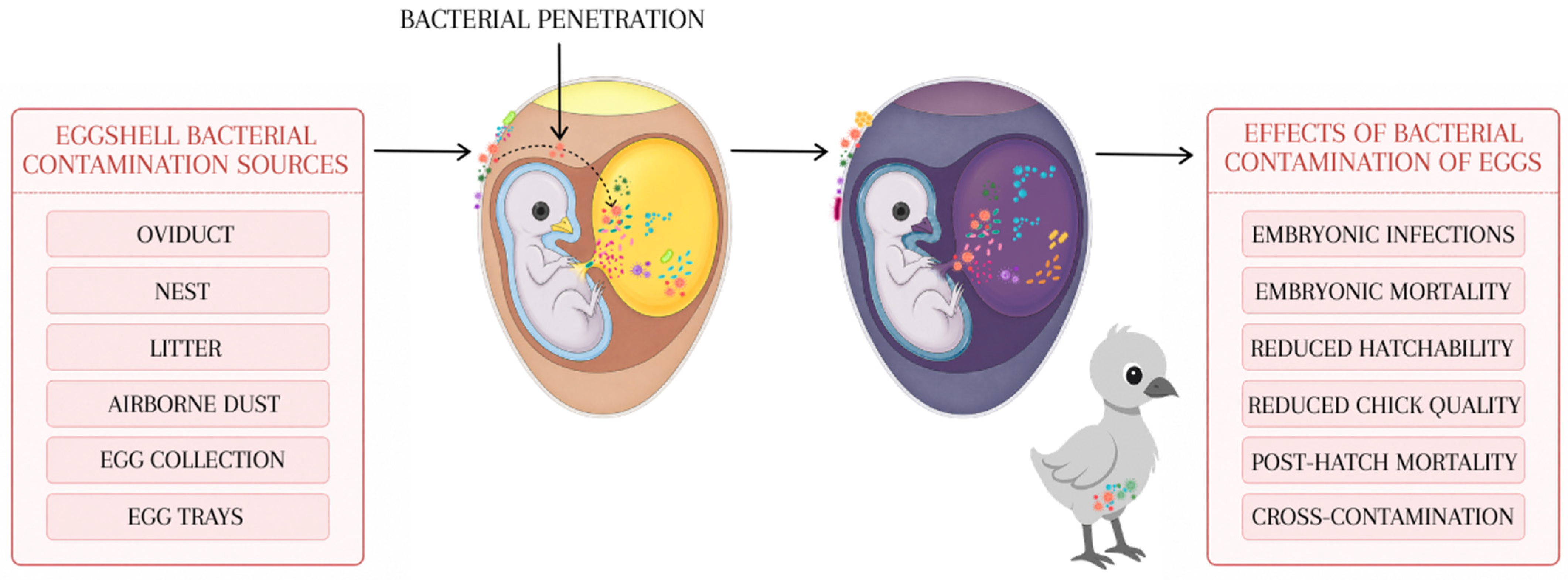
Bacterial contamination of hatching eggshells is recognized not only as a factor associated with embryonic mortality and reduced hatchability, but also as an important source of cross-transmission and compromised sanitary quality of chicks after hatching. This contamination is widely documented in poultry production, with studies reporting high total bacterial loads and the presence of Staphylococcus spp., Enterobacteriaceae, coliforms, and Salmonella spp. on the egg surface [1,2]. Evidence indicates that the presence of these microorganisms is directly associated with embryonic infections, a key factor contributing to embryonic mortality and reduced hatchery and farm performance [3]. Figure 1 illustrates the main sources of eggshell bacterial contamination, subsequent bacterial penetration through the eggshell, and the potential consequences for embryonic development and post-hatch performance. Therefore, bacterial contamination of hatching eggs remains a major concern in poultry production systems, despite significant advances in management practices, biosecurity barriers, and containment measures.
Figure 1.
Proposed pathway linking eggshell bacterial contamination originating from poultry production environments to adverse outcomes during incubation and the post-hatch period.
The bacterial control of the eggshell surface after collection using ultraviolet light (UV), hydrogen peroxide (H2O2), peracetic acid (PAA), and ozone (O3) has been proposed and suggested [4,5,6,7,8,9,10,11,12]. Understanding why these compounds have been proposed is essential for improving sanitization protocols and guiding professionals who wish to apply them safely and effectively to control losses from bacterial contamination of eggs. Studies typically assess the performance of sanitizers using parameters such as bacterial counts on the eggshell, which indicate the number of viable bacteria that may pose risks to the embryo, hatchability, which represents the proportion of fertile eggs that successfully produce chicks, and other aspects related to eggshell structure and poultry. Some reviews on sanitizing hatching eggs have addressed alternatives to formaldehyde. However, no review published in the last decade has provided a detailed, comparative discussion of the use of UV, H2O2, PAA, and O3 for hatching-egg sanitization, particularly regarding their effects on these factors. Therefore, this review aimed to synthesize the available findings on the effects of UV, H2O2, PAA, and O3 on eggshell bacterial load, eggshell structure, and hatchability.
2. Methods
A preliminary bibliographic search was conducted in Google Scholar on 5 October 2025, to identify the most appropriate keywords for the advanced search in the same database. After this step, the following keywords, in both English and Portuguese, were used in the advanced search: ultraviolet light, hydrogen peroxide, peracetic acid, ozone, UV, H2O2, PAA, O3, sanitization, sanitizers, disinfection, disinfectants, treatments, antibacterials, formaldehyde, eggshells, eggshell damage, eggshell structure, eggshell protein matrix, eggshell ultrastructure, eggshell quality, egg proteins, table eggs, hatching eggs, hatchability, embryo, poultry farm, and hatchery, employing the Boolean operators AND and OR. The search retrieved records based on the occurrence of these terms anywhere in the documents. The search strategy was last updated on 17 June 2026.
Research articles, conference papers, reviews, books, and book chapters published in English or Portuguese that addressed at least one of the predefined topics related to bacterial contamination of the eggshell, egg sanitization using UV, H2O2, PAA, or O3, and their effects on eggshell bacterial counts, eggshell structure, and hatchability were included with no restrictions on publication date. However, studies specifically focused on sanitizing eggs using UV, H2O2, PAA, or O3 were considered only if published from 2015 onward. An exception was made for studies addressing the effects of these sanitizers on eggshell structure, for which earlier publications were also considered to support the discussion. For studies focused on UV, only those evaluating UV-C wavelengths (200–280 nm) were considered, as this spectral range, unlike UV-A and UV-B, exhibits high antibacterial efficacy and is the form of UV most widely investigated and applied for egg sanitization. Therefore, whenever the term UV is used throughout this review, it refers exclusively to UV-C radiation unless otherwise specified.
Studies that assessed the use of sanitizers on table eggs were also considered to support the discussion on bacterial reduction and eggshell structure. The management of table eggs generally differs from that of hatching eggs within production systems. However, the inclusion of studies conducted on table eggs is justified by the structural similarity of the eggshell, which presents a comparable composition and physical organization regardless of its intended purpose. Furthermore, this discussion is not focused on differences in microbial load resulting from management practices, environmental conditions, or production systems, but rather on the direct effects of sanitizers on microorganisms present on the eggshell surface. Therefore, the mechanisms of interaction between sanitizers, the eggshell surface, and the microorganisms present on it are likely to be similar, allowing for a joint discussion of their effects.
The reference lists of the retrieved materials were also manually screened to identify additional relevant sources. The search process for each topic was concluded when sufficient information was obtained to adequately support and structure the proposed discussion. All selected materials were imported into Mendeley for organization and further review. The titles and abstracts of documents that potentially met the search criteria were assessed, and the selected materials were read in full. Materials that did not address at least one of the defined topics, were not available in Portuguese or English, or no longer contributed to the development of the topic after its main idea had been consolidated, were excluded.
3. Bacterial Contamination of Eggs
Under natural conditions, eggshell contamination does not originate solely from the hens themselves but also from the surfaces with which the eggs come into contact immediately after laying, such as litter. This material can significantly influence the bacterial composition of contamination [13]. The eggshell, therefore, can act as an essential vehicle for sanitary relevance. In an analysis conducted on eggs collected from poultry farms, the following bacteria were identified on the eggshell: Alcaligenes faecalis, Bacillus cereus, Bacillus megaterium, Bacillus polymyxa, Escherichia coli, Klebsiella oxytoca, Pseudomonas aeruginosa, Salmonella Typhimurium, Staphylococcus aureus, and Staphylococcus epidermidis [14]. Another study isolated Escherichia coli, Salmonella spp., Shigella spp., Staphylococcus spp., and Pseudomonas spp. from eggshells obtained from different poultry farms [15].
Previously, it was reported that the bacterial flora of embryos that died before hatching included members of the Enterobacteriaceae family, particularly Escherichia coli, Proteus spp., Salmonella spp., Citrobacter spp., and Klebsiella spp. The authors suggested that this contamination was associated with eggshell contamination, given that these bacteria can penetrate the shell and contaminate the embryo [16]. Oliveira et al. [17] reviewed the factors associated with bacterial penetration and observed that this process is associated with intrinsic egg characteristics as well as extrinsic factors related to egg handling, including the absence or incomplete deposition of the cuticle, eggshell pore diameter, exposure of eggs to temperature fluctuation regimes, eggshell dynamic stiffness, high levels of surface contamination, and the motility and non-clustering properties of certain bacteria. Therefore, sanitizing the eggshell surface after laying is essential to minimize embryonic infections and reduce incubation-related losses.
4. Sanitization of Hatching Eggs
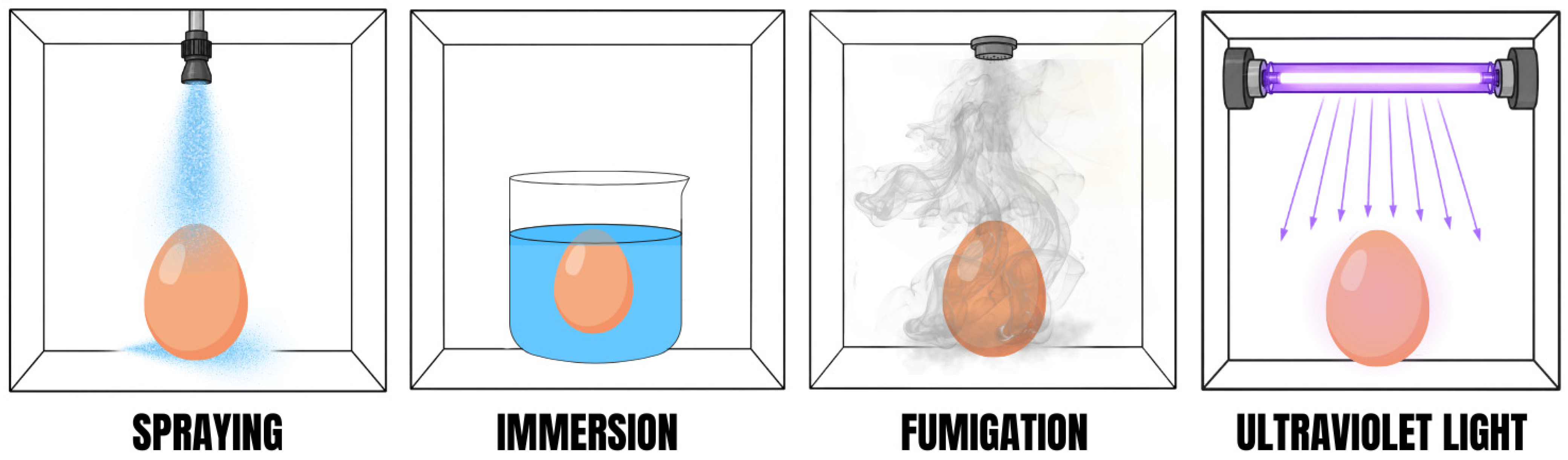
The sanitization of hatching eggs involves applying a synthetic chemical compound to the eggshell surface immediately after collection, in an appropriate environment, and in accordance with strict sanitary and safety protocols. However, plant-derived compounds have also been applied as sanitizing agents for this purpose at both laboratory and commercial levels [2,18,19,20]. Both nest- and floor-collected eggs should undergo sanitization. The effectiveness of sanitization depends on the application method [21]. The most used and tested methods for applying these compounds to eggs are spraying, immersion, and fumigation, although UV has also been well-tested (Figure 2) [22,23]. Each method has its own characteristics that may be beneficial or detrimental to the process (Table 1). Therefore, planning before sanitization is the best approach to identify the most appropriate method for applying sanitizers and to minimize their limitations.
Figure 2.
Main methods for sanitizing hatching eggs.
Table 1.
Main characteristics of the methods used to apply sanitizers to eggshell surfaces 1.
5. Formaldehyde as a Conventional Sanitizer for Hatching Eggs and Its Limitations
Formaldehyde is a broad-spectrum sanitizer that has been used in the poultry industry for many decades, mainly for bacterial control in eggs before and during incubation. It inhibits bacterial growth by disrupting protein structure and interacting with purine bases in DNA and RNA, ultimately resulting in bacterial death [26,27]. The expansion of the poultry industry and the increase in egg production intensified the need for practical, efficient, large-scale sanitary control methods, thereby promoting the widespread use of formaldehyde on poultry farms and in commercial hatcheries. Although formaldehyde fumigation aims to protect poultry production from a sanitary standpoint and ensure productivity, its extremely hazardous handling poses significant health risks, particularly under inadequate handling and application conditions [28]. For example, its use may cause respiratory and brain damage in poultry embryos [19,29] and cancer in humans [30]. Therefore, other products have been tested to reduce formaldehyde use without compromising poultry productivity.
6. Sanitizing Hatching Eggs Using Ultraviolet Light (UV), Hydrogen Peroxide (H2O2), Peracetic Acid (PAA), and Ozone (O3)
UV, H2O2, PAA, and O3 have also been used as poultry sanitizers for treating hatching eggs. UV in the 200–280 nm range of the electromagnetic spectrum represents the wavelength most used for antibacterial treatment [31], including for egg treatment [25]. H2O2 is a chemical compound composed of two hydrogen atoms and two oxygen atoms, commercially supplied as aqueous solutions in which the stated concentration reflects the percentage of H2O2 by weight [32]. PAA is a colorless solution consisting of a monoacetylated derivative of H2O2 and is commercially formulated as a mixture of PAA, acetic acid, H2O2, and water [33]. O3, a triatomic molecule and an allotropic form of oxygen (O2), can be generated by electrochemical processes, UV irradiation, corona discharge, or radiochemical methods [34].
Antibacterial action is a minimum requirement for a product to be considered suitable for application to hatching eggs. Salmonella spp. and Escherichia coli are among the bacteria susceptible to sanitization protocols involving UV, H2O2, PAA, and O3 (Table 2) and, as mentioned earlier, can be detected on eggshells and embryos, where they may pose risks to embryo survival. However, it is important to clarify that the susceptibility observed under in vitro conditions does not necessarily translate to the same level of efficacy when sanitizers are applied to eggshells. The antibacterial activity of these compounds arises from their absorption of UV light at 254 nm, which damages bacterial DNA, compromising replication and transcription and thereby interrupting the cell cycle and leading to bacterial death [35,36]. When bacteria are exposed to H2O2 or O3, an intense intracellular oxidative stress occurs, capable of damaging lipids, proteins, and DNA, thereby compromising bacterial survival [37,38]. Regarding PAA, its antibacterial mechanism may not directly involve DNA damage but is likely related to the damage it causes to membrane proteins [39].
Table 2.
In vitro antibacterial activity of ultraviolet light (UV), hydrogen peroxide (H2O2), peracetic acid (PAA), and ozone (O3).
6.1. Effects of Sanitizers on Bacterial Control of Eggshells
Branco et al. [57] evaluated the effectiveness of UV in reducing the bacterial load on the eggshell surface of hatching eggs, comparing exposure times (5–9 min) using a 254 nm UV lamp at an effective intensity of 0.23 mW/cm2. The results showed that all exposure times significantly reduced the bacterial load compared with the non-sanitized group, with greater efficiency as exposure time increased. The control treatment presented 3.26 log10 CFU/egg, while the values decreased to 2.58 log10 (5 min), 2.25 log10 (7 min), and 2.00 log10 CFU/egg (9 min) with varying exposure times. Mousa-Balabel et al. [58] reported that sanitizing hatching eggs with 1.4% H2O2 significantly reduced the total bacterial load on the eggshell, achieving an 84.08% reduction. Al-Ajeeli et al. [12] observed that spraying PAA at 135 ppm significantly reduced the mesophilic aerobic bacterial counts on the eggshell surface. Immediately after application (day 0), the bacterial load decreased from 3.17 to 2.60 log10 CFU/egg. After 7 days of application, it further declined to 1.83 log10 CFU/egg. Although a slight increase was recorded after 14 days (2.08 log10 CFU/egg), the values remained significantly lower than those of the control group across all evaluated periods. Koc and Aygun [59] evaluated O3 concentrations ranging from 1 to 7% applied to hatching eggs and found that only the 7% treatment significantly reduced total aerobic mesophilic bacteria throughout the incubation period. On the first day, the count of 2.89 log10 CFU/egg observed in the control group declined to 1.21 log10 CFU/egg in the 7% O3 group. This level of effectiveness persisted on day 7, when the treated eggs showed 1.28 log10 CFU/egg, compared with 3.04 log10 CFU/egg in the control group. By day 14, the difference persisted, with 1.48 log10 CFU/egg in the treated eggs and 3.07 log10 CFU/egg in the control group.
Other investigations have evaluated the effectiveness of UV, H2O2, PAA, and O3 in reducing eggshell bacterial load in both hatching and table eggs, as summarized in Table 3 and Table 4. Studies that tested UV show a considerable consistency in their results. Even with the heterogeneity among protocols, whether in exposure time or applied intensity, the evidence indicates substantial reductions in bacterial load. H2O2 and PAA, applied mainly by spraying, and O3, more frequently used through fumigation, also demonstrate a relevant ability to reduce eggshell bacterial contamination. However, these compounds show greater sensitivity to protocol variables such as concentration and exposure time. The results for all sanitizers were not limited to reductions in bacterial load (Table 3 and Table 4). In some studies, the observed effects were not significant, whereas in others, bacterial counts increased significantly. Therefore, all four sanitizers can be effective in reducing bacterial contamination on the eggshell surface, but their efficacy depends on the application plan adopted.
Table 3.
Effect of ultraviolet light (UV), hydrogen peroxide (H2O2), peracetic acid (PAA), and ozone (O3) on the total bacterial count of hatching eggshells.
Table 4.
Effect of ultraviolet light (UV), hydrogen peroxide (H2O2), peracetic acid (PAA), and ozone (O3) on the total bacterial count of table eggshells.
6.2. Effects of Sanitizers on Eggshell Structure
In addition to the antibacterial potential of sanitizers in controlling bacterial contamination on the eggshell, it is essential to understand how, and to what extent, these sanitizers may pose risks to the eggshell structure. The eggshell plays a well-established role as a primary support for proper embryonic development. In addition to its various functions, it acts as a natural barrier to bacterial penetration [86] and provides the necessary substrate for the calcification of the embryonic skeletal system [87]. For this reason, understanding how UV, H2O2, PAA, and O3 treatments interact with the eggshell is essential for designing protocols that preserve its structural integrity and, consequently, prevent significant negative impacts on the embryo in microbial terms and skeletal formation.
Avcilar and Yilmaz [88] reported that the application of UV at 254 nm for 3 min on eggs did not cause significant changes in shell-breaking strength or shell weight. However, the authors observed a significant reduction in shell thickness, suggesting that this decrease may be related to UV-induced damage to the cuticular layer on the shell surface. Nevertheless, Coulibaly et al. [62] evaluated egg sanitization using UV at 254 nm for 1 min and found no significant effects on eggshell characteristics, including overall shell thickness, the structure of the mammillary, palisade, and vertical layers (both thickness and relative proportion), and the morphology and arrangement of cones. Similarly, Holck et al. [70] used scanning electron microscopy and observed that eggs exposed to UV at 10 mW/cm2 for 1 min showed no visible alterations in the protein cuticle. In addition, Panini [83] observed that the eggshell color changed when eggs were exposed to UV for 10 min, suggesting that lower exposure levels are recommended to prevent alterations in shell pigmentation.
Spraying with 1.56% H2O2 did not affect the thickness or strength of hatching eggshells [61], a result similar to that observed by Melo et al. [22] when using a 3% concentration. However, after the eggs were immersed in a 5% H2O2 solution, Bekhet [89] observed a reduction in eggshell thickness. At the microscopic level, eggshell membranes immersed in a 35% H2O2 solution for 4–24 h exhibited structural alterations, characterized by changes in pore size, fiber cross-linking density, and surface topography, proportional to the exposure time [90]. Sheldon and Brake [91] reported that, despite the oxidative potential of H2O2 and the possibility of inducing effects on the eggshell cuticle, eggshell permeability was not affected after spraying a 5% H2O2 solution. However, at the same concentration but using immersion as the application method, Zeweil et al. [92] observed that H2O2 affected eggshell permeability.
The application of PAA at concentrations between 75 and 300 ppm, or in the commercial 15% formulation, caused evident structural alterations to the eggshell, including microfissures and microfragments in the cuticle, thereby increasing pore exposure [93]. Similarly, the spraying of PAA at a concentration of 355 ppm significantly reduced the thickness of the calcified region of the eggshell. According to the study, PAA also reduced the palisade and mammillary layers, although the effect was not statistically significant. This tendency toward thinning in these inner layers may help explain the overall decrease in total shell thickness observed after the sanitizing agent was applied [80]. However, alterations in shell thickness or strength were not observed by Melo et al. [22] after spraying a 0.3% PAA solution.
Soares et al. [94] reported that the extent of eggshell damage following O3 exposure was directly related to the degree of exposure. According to the authors, treating eggs with 60 ppm O3 for 120 min resulted in the formation of additional microfissures, while the pores remained intact and protected by the cuticle. After 300 min, however, these fissures became more extensive, and some regions began to exhibit exposed pores. Fuhrmann et al. [95] observed that applying O3 at 10 mL/L for 20 min destroyed cuticle proteins. Clímaco et al. [61] reported that eggshell thickness and shell strength, measured after sanitization with O3 gas at concentrations of 5–10 ppm for 20 min, did not undergo any detectable changes. Conversely, Yüceer et al. [96] reported that the breaking strength and puncture resistance of eggshells exposed to O3 at 2, 4, or 6 ppm were significantly reduced as both O3 concentration and exposure time (2 or 5 min) increased.
Based on the studies reviewed above, UV, H2O2, PAA, and O3 can, depending on the protocol used, trigger significant alterations in the eggshell’s structural integrity. Although macrostructural modifications, such as detectable variations in shell thickness, are not always evident, microstructural disturbances may occur silently and pose substantial risks to the mechanical stability of the egg. As the concentration of the sanitizer or the duration of exposure increases, progressively greater levels of shell damage are observed, ranging from subtle microfissures to more evident deterioration.
One possible explanation for the eggshell damage observed in some UV, H2O2, PAA, and O3 treatment protocols is the alteration of the eggshell protein matrix [90,95,97], which represents approximately 2% of the calcified eggshell and is composed of proteins, glycoproteins, phosphoproteins, and proteoglycans [98]. UV may induce protein photo-oxidation, resulting in protein fragmentation and aggregation [97]. H2O2 may promote structural modifications in proteins through the formation of disulfide bonds resulting from oxidative processes [90]. The action of PAA may be linked to the presence of H2O2 in its formulation, thereby promoting similar oxidative processes. O3 may promote the oxidation of sulfhydryl groups and extensive alterations in the three-dimensional structure of proteins [95,97]. These effects may compromise the integrity of the eggshell protein matrix, increasing its permeability, favoring microbial penetration, and dysregulating water loss during incubation. As a result, possible deleterious effects on hatchability and post-hatch survival may occur. Therefore, future studies must adopt standardized protocols that concomitantly integrate macro- and microstructural assessments to identify sanitization conditions that meet microbiological efficacy criteria without significantly compromising eggshell integrity at any structural level.
6.3. Effects of Sanitizers on Hatchability
Events that occur throughout embryonic development, mainly when triggered by external factors such as sanitizers, decisively influence hatchability rates. This productive indicator, measured only at the end of incubation, functions as a summary of what occurred with the embryo throughout development. It therefore reflects the accumulated effects that sanitizers may exert during this period. These effects can include alterations in the eggshell, interference with adequate egg weight loss, changes in embryonic body weight, levels of embryonic contamination, variations in blood biochemical parameters, differences in the physical quality of the embryo, and levels of absorption of essential nutrients. Therefore, hatchability is a criterion used to evaluate the efficiency of a poultry sanitizer for hatching eggs [3].
Al-Shammari et al. [99] evaluated a UV sanitization protocol at 262 nm, applied for 30 min at 10 mW/cm2, and found that the treatment did not significantly affect hatchability. Wang et al. [100] found that using 3% H2O2 by spraying did not affect hatchability compared with untreated eggs, but hatchability was significantly reduced when the product was sprayed at 6% H2O2. Melo et al. [22] evaluated spraying hatching eggs with 0.3% PAA and reported that hatchability rates did not differ significantly from those of the control treatments. In the study by Souza et al. [101], the hatchability of eggs treated with O3 at the evaluated concentrations of 1.6 and 3.2 mg/mL, via 60 min fumigation, was significantly higher than that of untreated eggs. Taken together, the available evidence indicates that hatchability may remain unchanged, decrease, or even increase depending on the sanitization protocol used (UV, H2O2, PAA, or O3; Table 5). These findings are important because hatchability provides an initial indication of the biological safety of the sanitization procedure. Changes in this parameter may reflect direct toxic effects on the embryo or indirect effects resulting from alterations in the structure and functions of the eggshell, thereby compromising the conditions necessary for normal embryonic development.
Table 5.
Effect of ultraviolet light (UV), hydrogen peroxide (H2O2), peracetic acid (PAA), and ozone (O3) on hatchability.
However, hatchability alone does not allow for a complete understanding of the mechanisms responsible for these effects. Damage to eggshell structure is one of the hypotheses frequently discussed in the literature, as previously described. Therefore, to gain a deeper understanding of the effects of sanitization protocols on embryonic development and poultry quality, additional analyses have been conducted in studies evaluating UV light, H2O2, PAA, and O3 (Table 6). In addition to hatchability, parameters such as embryonic mortality at different incubation stages, chick quality, hatch weight, organ development, physiological alterations, yolk sac bacterial colonization, post-hatch performance, and histopathological evaluations have been used to assess the potential effects of these sanitizers. As observed for hatchability, these compounds may have no significant effect on these parameters, but may also exert beneficial or detrimental effects depending on the application protocol adopted (Table 6). Therefore, although hatchability is the flagship parameter in evaluating the safety of sanitization protocols, a combined assessment of multiple parameters can provide a broader understanding of these compounds’ effects on poultry and support the selection of the most appropriate protocol for each sanitizer.
Table 6.
Effect of ultraviolet light (UV), hydrogen peroxide (H2O2), peracetic acid (PAA), and ozone (O3) on embryo, chick, and post-hatch performance 1.
It should be noted that the importance of sanitizing hatching eggs extends beyond hatchability and other incubation performance parameters, such as embryonic weight, chick weight at hatch, and chick quality, which are not always affected by sanitization protocols that employ UV light, H2O2, PAA, or O3. Its main objective is to provide a microbiologically safe environment for embryonic development by reducing the risk of contamination by potentially pathogenic bacteria. Embryos may develop normally and hatch without changes in hatchability, weight, or quality, even under conditions of bacterial contamination. However, this does not prevent them from carrying microorganisms that can compromise chick quality, post-hatch performance, flock health, and the biosecurity of production systems. Therefore, sanitization should be understood as part of a broader strategy to improve microbiological quality, protect embryonic health, and prevent the spread of bacteria throughout the poultry production chain.
6.4. Comparison of Sanitization Protocols Using UV, H2O2, PAA, and O3 with Formaldehyde
The comparison between protocols involving alternative sanitizing agents and those employing the reference sanitizer is necessary to determine the viability of these compounds for the intended purpose, thereby supporting their use and expanding the range of options available for hatching egg sanitization. Table 7 demonstrates that UV, H2O2, PAA, and O3 can reduce bacterial load on the eggshell and yield hatching results comparable to those obtained with formaldehyde. However, few comparative studies in the literature involve all these products, especially recent ones. These results suggest that protocols involving other products and methods may present productive potential similar to that of formaldehyde. As the effects of sanitizers on microbiological and productive parameters depend on several factors, such as concentration, application timing, exposure time, and product characteristics [108], it is essential to adopt previously tested protocols that provide results comparable to or superior to those obtained with formaldehyde, especially those using lower concentrations while maintaining similar efficacy. Such protocols are especially important for reducing the risk of potential toxic effects that may negatively affect hatchability.
Table 7.
Comparison of ultraviolet light (UV), hydrogen peroxide (H2O2), peracetic acid (PAA), and ozone (O3) with formaldehyde regarding eggshell bacterial load and hatchability.
7. Conclusions
In summary, the findings of this review indicate that UV, H2O2, PAA, and O3 can reduce bacterial contamination on the eggshell surface without necessarily compromising eggshell integrity, hatchability, or other incubation-related parameters. However, substantial variability was observed among the evaluated application protocols, and deleterious effects have been reported for all four sanitizers. These findings demonstrate that both antibacterial efficacy and embryonic safety are highly dependent on the application protocol employed. Therefore, the available evidence highlights the urgent need for standardized sanitization protocols that simultaneously ensure antibacterial efficacy, preserve eggshell structural integrity, and prevent adverse effects on embryonic development and hatchability. Such standardization should be supported by further investigations that address not only the traditional outcomes reviewed here but also embryonic bacterial load, detailed histological evaluations, and molecular-level studies of embryonic responses to these sanitizing agents, which remain limited in the current literature.
Author Contributions
Conceptualization, G.d.S.O. and V.M.d.S.; writing—original draft preparation, G.d.S.O.; writing—review and editing, G.d.S.O., I.R.R.V., V.M.d.S. and C.M.; visualization, G.d.S.O., I.R.R.V., V.M.d.S. and C.M.; supervision, C.M. All authors have read and agreed to the published version of the manuscript.
Funding
This study was funded by Conselho Nacional de Desenvolvimento Científico e Tecnológico (CNPq) and the Coordenação de Aperfeiçoamento de Pessoal de Nível Superior (CAPES; financing code 001). The APC was funded by Fundação de Apoio à Pesquisa do Distrito Federal (FAPDF).
Institutional Review Board Statement
Not applicable.
Informed Consent Statement
Not applicable.
Data Availability Statement
No new data were created or analyzed in this study. Data sharing is not applicable.
Acknowledgments
The authors thank CNPq, CAPES, and FAPDF for their support.
Conflicts of Interest
The authors declare no conflicts of interest.
References
- Dutra, D.R.; Carneiro, N.M.G.M.; Villegas-Cayllahua, E.A.; Fidelis, H.D.A.; Cavalcanti, É.N.F.; Rodrigues, R.A.; Bornatte, N.S.; Belo, M.A.D.A.; Borba, H. Microbiological quality of free-range eggs from nest boxes and litter in the late production stage in Southeastern Brazil. Animals 2025, 15, 2597. [Google Scholar] [CrossRef] [Scilit]
- Oliveira, G.D.S.; McManus, C.; Santos, P.H.G.D.S.; de Sousa, D.E.R.; Jivago, J.L.D.P.R.; de Castro, M.B.; Dos Santos, V.M. Hatching egg sanitizers based on essential oils: Microbiological parameters, hatchability, and poultry health. Antibiotics 2024, 13, 1066. [Google Scholar] [CrossRef] [Scilit] [PubMed]
- Oliveira, G.D.S.; McManus, C.; Salgado, C.B.; Dos Santos, V.M. Effects of sanitizers on microbiological control of hatching eggshells and poultry health during embryogenesis and early stages after hatching in the last decade. Animals 2022, 12, 2826. [Google Scholar] [CrossRef] [Scilit] [PubMed]
- Chavez, C.; Knape, K.D.; Coufal, C.D.; Carey, J.B. Reduction of eggshell aerobic plate counts by ultraviolet irradiation. Poult. Sci. 2002, 81, 1132–1135. [Google Scholar] [CrossRef] [Scilit] [PubMed]
- Cox, N.A.; Mauldin, J.M.; Kumararaj, R.; Musgrove, M.T. Ability of hydrogen peroxide and Timsen to eliminate artificially inoculated Salmonella from fertile broiler eggs. J. Appl. Poult. Res. 2002, 11, 266–269. [Google Scholar] [CrossRef] [Scilit]
- Coufal, C.D.; Chavez, C.; Knape, K.D.; Carey, J.B. Evaluation of a method of ultraviolet light sanitation of broiler hatching eggs. Poult. Sci. 2003, 82, 754–759. [Google Scholar] [CrossRef] [Scilit] [PubMed]
- Iordache, L.; Tofan, C. Study of the UV radiation effect on the inactivation of Salmonella enterica serovar Enteritidis on shell eggs. Ann. Suceava Univ.-Food Eng. 2007, 6, 74–79. [Google Scholar]
- Wells, J.B.; Coufal, C.D.; Parker, H.M.; McDaniel, C.D. Disinfection of eggshells using ultraviolet light and hydrogen peroxide independently and in combination. Poult. Sci. 2010, 89, 2499–2505. [Google Scholar] [CrossRef] [Scilit] [PubMed]
- Braun, P.G.; Fernandez, N.; Fuhrmann, H. Investigations on the effect of ozone as a disinfectant of egg surfaces. Ozone Sci. Eng. 2011, 33, 374–378. [Google Scholar] [CrossRef] [Scilit]
- Hrnčár, C.; Prachárová, S.; Bujko, J. The effect of disinfection of hatching eggs on hatchability of Oravka chickens. Sci. Pap. Anim. Sci. Biotechnol. 2012, 45, 411. [Google Scholar]
- Pasquali, F.; Roculli, P.; Cesare, A.; Bovo, F.; Olivi, P.; Lucchi, A.; Meluzzi, A. New technologies to enhance quality ans safety of table eggs: Ultraviolet treatments and modified atmosphere packaging. Ital. J. Food Saf. 2014, 3, 192–195. [Google Scholar] [CrossRef] [Scilit]
- Al-Ajeeli, M.N.; Taylor, T.M.; Alvarado, C.Z.; Coufal, C.D. Comparison of eggshell surface sanitization technologies and impacts on consumer acceptability. Poult. Sci. 2016, 95, 1191–1197. [Google Scholar] [CrossRef] [Scilit] [PubMed]
- Csitári, G.; Such, N.; Menyhárt, L.; Schermann, K.; Humpok, K.; Farkas, V.; Pál, L.; Dublecz, K. Effects of litter exposure and flock age of broiler breeders on hatchability and the microbial composition of eggshells, egg membranes, and egg contents. Front. Vet. Sci. 2025, 12, 1589607. [Google Scholar] [CrossRef] [Scilit] [PubMed]
- Chukwunwejim, C.R.; Ekpunobi, N.F.; Ogunmola, T.; Obidi, N.; Ajasa, O.S.; Obidi, N.L. Molecular identification of multidrug-resistant bacteria from eggshell surfaces in Nigeria: A growing threat to public health. Magna Sci. Adv. Biol. Pharm. 2025, 15, 21–28. [Google Scholar] [CrossRef] [Scilit]
- Hafez, E.; Nafei, E.; Abdallah, M.; El Akshar, E.A.; Elkattan, A.N.; Elkhayat, M.; El Daous, H. Evaluation of biosecurity measures and microbiological quality of table eggs in Egyptian layer farms. Vet. Ital. 2025, 61, 56. [Google Scholar] [CrossRef] [Scilit]
- Jahantigh, M.; Rashki, A.; Najimi, M. A study on bacterial flora and antibacterial resistance of yolk sac infection in Japanese quail (Coturnix japonica). Comp. Clin. Pathol. 2013, 22, 645–648. [Google Scholar]
- Oliveira, G.d.S.; McManus, C.; dos Santos, V.M. Control of Escherichia coli in poultry using the in ovo injection technique. Antibiotics 2024, 13, 205. [Google Scholar] [CrossRef] [Scilit] [PubMed]
- Taşdemir, A.N.; Onbaşılar, E.E.; Yalçın, S.; Boyalı, B.; Aygören, H.; Tülek, E.; Sarıçam, S.; Akan, M. Effects of oregano juice on eggshell microbial load, layer embryo development, hatching results, and growth at the first 2 weeks after hatch. Trop. Anim. Health Prod. 2021, 53, 404. [Google Scholar] [CrossRef] [Scilit] [PubMed]
- dos Santos, V.M.; Oliveira, G.D.S.; Santos, P.H.G.D.S.; Cerqueira, L.D.A.; Jivago, J.L.D.P.R.; Paixão, S.S.R.M.; de Castro, M.B.; McManus, C. Measuring contamination levels and incubation results of hatching eggs sanitized with essential oils. Antibiotics 2025, 14, 1076. [Google Scholar] [CrossRef] [Scilit] [PubMed]
- El-Sabrout, K.; Elahi, U.; Ahmad, S.; Vallone, L.; Buonaiuto, G. Sustainable biosecurity: Harnessing natural sanitisers for hatching egg sanitation. World’s Poult. Sci. J. 2026, 82, 651–679. [Google Scholar] [CrossRef] [Scilit]
- Musgrove, M.T.; Cox, N.A.; Berrang, M.E.; Buhr, R.J.; Richardson, L.J.; Mauldin, J.M. Effect of inoculation and application methods on the performance of chemicals used to disinfect Salmonella-contaminated broiler hatching eggs. J. Appl. Poult. Res. 2010, 19, 387–392. [Google Scholar] [CrossRef] [Scilit]
- Melo, E.F.; Clímaco, W.L.S.; Triginelli, M.V.; Vaz, D.P.; De Souza, M.R.; Baião, N.C.; Lara, L.J.C. An evaluation of alternative methods for sanitizing hatching eggs. Poult. Sci. 2019, 98, 2466–2473. [Google Scholar] [CrossRef] [Scilit] [PubMed]
- Saad, H.F. The Effect of exposing broiler hatching eggs to different periods of ozone dissolvedin wateron som hatching characters, productive performance of Hatvhed chicks. Eur. Sch. J. 2024, 5, 4–10. [Google Scholar]
- Turblin, V. Disinfection of Hatching Eggs Importance and Practical Aspects. Poultry Ceva Animal Health Asia. 2008. Available online: https://www.ceva.vn/en/Technical-Informations/Poultry/Ceva-Technical-Bulletin/C.H.I.C.K-Program-Online/C.H.I.C.K.-Program-Online-No.21 (accessed on 5 October 2025).
- Turtoi, M.; Borda, D. Decontamination of eggshells using ultraviolet light treatment. World’s Poult. Sci. J. 2014, 70, 265–278. [Google Scholar]
- McDonnell, G.; Russell, A.D. Antiseptics and disinfectants: Activity, action, and resistance. Clin. Microbiol. Rev. 1999, 12, 147–179. [Google Scholar] [CrossRef] [Scilit] [PubMed]
- McKeen, L. Introduction to food irradiation and medical sterilization. In The Effect of Sterilization on Plastics and Elastomers, 3rd ed.; McKeen, L., Ed.; Plastics Design Library, William Andrew Publishing: Boston, MA, USA, 2012; pp. 1–40. [Google Scholar]
- Santos, P.H.G.D.S.; Oliveira, G.D.S.; McManus, C.; Dos Santos, V.M. Use of formaldehyde in poultry production for the treatment of litter, hatching eggs, hatcheries, and feed: An updated mini review. Toxics 2025, 13, 1003. [Google Scholar] [CrossRef] [Scilit] [PubMed]
- Bekhet, G.; Khalifa, A.Y. Essential oil sanitizers to sanitize hatching eggs. J. Appl. Anim. Res. 2022, 50, 695–701. [Google Scholar] [CrossRef] [Scilit]
- Castellani, F.; Vitali, M.; Antonucci, A.; Cofone, L.; D’Ancona, G.; Pindinello, I.; Buomprisco, G.; Petyx, M.; Ursini, C.L.; Protano, C. Effective mitigation strategies for reducing workers’ exposure to formaldehyde: A systematic review. Air Qual. Atmos. Health 2024, 17, 877–890. [Google Scholar]
- Dai, T.; Vrahas, M.S.; Murray, C.K.; Hamblin, M.R. Ultraviolet C irradiation: An alternative antimicrobial approach to localized infections? Expert Rev. Anti-Infect. Ther. 2012, 10, 185–195. [Google Scholar] [CrossRef] [Scilit] [PubMed]
- Ukuku, D.O.; Bari, L.; Kawamoto, S. Hydrogen peroxide. In Decontamination of Fresh and Minimally Processed Produce; Wiley Online Library: Hoboken, NJ, USA, 2012; pp. 197–214. [Google Scholar]
- Cheng, C.; Li, H.; Wang, J.; Wang, H.; Yang, X. A Review of measurement methods for peracetic acid (PAA). Front. Environ. Sci. Eng. 2020, 14, 87. [Google Scholar] [CrossRef] [Scilit]
- Mottan, S.; Gupta, N.; Sood, M.; Bandral, J.D.; Anju Bhat, J.S. A review on ozone technology in food industry. Pharma Innov. J. 2022, 11, 759–764. [Google Scholar]
- Xu, L.; Zhang, C.; Xu, P.; Wang, X.C. Mechanisms of ultraviolet disinfection and chlorination of Escherichia coli: Culturability, membrane permeability, metabolism, and genetic damage. J. Environ. Sci. 2018, 65, 356–366. [Google Scholar] [CrossRef] [Scilit]
- Stange, C.; Sidhu, J.P.; Toze, S.; Tiehm, A. Comparative removal of antibiotic resistance genes during chlorination, ozonation, and UV treatment. Int. J. Hyg. Environ. Health 2019, 222, 541–548. [Google Scholar] [CrossRef] [Scilit] [PubMed]
- Linley, E.; Denyer, S.P.; McDonnell, G.; Simons, C.; Maillard, J.Y. Use of hydrogen peroxide as a biocide: New consideration of its mechanisms of biocidal action. J. Antimicrob. Chemother. 2012, 67, 1589–1596. [Google Scholar] [CrossRef] [Scilit] [PubMed]
- Rangel, K.; Cabral, F.O.; Lechuga, G.C.; Carvalho, J.P.; Villas-Bôas, M.H.; Midlej, V.; De-Simone, S.G. Detrimental effect of ozone on pathogenic bacteria. Microorganisms 2021, 10, 40. [Google Scholar] [CrossRef] [Scilit] [PubMed]
- Wang, D.; Yamaki, S.; Kawai, Y.; Yamazaki, K. Sanitizing efficacy and antimicrobial mechanism of peracetic acid against histamine-producing bacterium, Morganella psychrotolerans. LWT 2020, 126, 109263. [Google Scholar] [CrossRef] [Scilit]
- Escalona, V.H.; Aguayo, E.; Martínez-Hernández, G.B.; Artés, F. UV-C doses to reduce pathogen and spoilage bacterial growth in vitro and in baby spinach. Postharvest Biol. Technol. 2010, 56, 223–231. [Google Scholar] [CrossRef] [Scilit]
- Lorenzo-Leal, A.C.; Tam, W.; Kheyrandish, A.; Mohseni, M.; Bach, H. Antimicrobial activity of filtered far-UVC light (222 nm) against different pathogens. BioMed Res. Int. 2023, 2023, 2085140. [Google Scholar] [PubMed]
- Huang, J.R.; Yang, T.W.; Hsiao, Y.I.; Fan, H.M.; Kuo, H.Y.; Hung, K.H.; Chen, P.Y.; Tan, C.T.; Shao, P.L. Far-UVC light (222 nm) efficiently inactivates clinically significant antibiotic-resistant bacteria on diverse material surfaces. Microbiol. Spectr. 2024, 12, e04251-23. [Google Scholar] [PubMed]
- Palma, F.; Díaz-Navarro, M.; Visedo, A.; Sanz-Ruíz, P.; Brandi, G.; Schiavano, G.F.; Guembe, M. Assessment of the anti-biofilm effect of UV-C irradiation (254nm) against healthcare associated infections (HAI) related microorganisms. Front. Microbiol. 2025, 16, 1570334. [Google Scholar] [PubMed]
- Tascioglu, D.A.; Demir, D.; Ozturk, V.; Yetkin, G.; Umihani?, F.; Yolay, O. In Vitro Efficacy of 222 nm UV Light on antibiotic resistant bacteria isolated from patients and standart cultures standard bacterial strains. Adv. Microbiol. 2025, 15, 399–408. [Google Scholar]
- Ríos-Castillo, A.G.; González-Rivas, F.; Rodríguez-Jerez, J.J. Bactericidal efficacy of hydrogen peroxide-based disinfectants against Gram-positive and Gram-negative bacteria on stainless steel surfaces. J. Food Sci. 2017, 82, 2351–2356. [Google Scholar] [PubMed]
- Medina-Cordoba, L.K.; Valencia-Mosquera, L.L.; Tarazona-diaz, G.P.; Arias-Palacios, J.D.C. Evaluation of the efficacy of a hydrogen peroxide disinfectant. Int. J. Pharm. Pharm. Sci. 2018, 10, 104. [Google Scholar] [CrossRef] [Scilit]
- Raval, Y.S.; Flurin, L.; Mohamed, A.; Greenwood-Quaintance, K.E.; Beyenal, H.; Patel, R. In vitro antibacterial activity of hydrogen peroxide and hypochlorous acid, including that generated by electrochemical scaffolds. Antimicrob. Agents Chemother. 2021, 65, 10–1128. [Google Scholar] [CrossRef] [Scilit]
- Svidzinski, A.E.; Posseto, I.; Pádua, R.D.; Tavares, T.R.; Svidzinski, T.I.E. Eficiência do ácido peracético no controle de Staphylococcus aureus meticilina resistente. Cienc. Cuid Saude 2007, 6, 312–318. [Google Scholar]
- Molina, P.D.S.; Kindlein, L.; Bergmann, G.P.; Avancini, C.A.M. In vitro simulations of use conditions of disinfectants and evaluation of its efficacy on survivors bacteria to surfaces hygienization in bovine slaughterhouse. Rev. Bras. Ciênc. Vet. 2010, 17, 134–138. [Google Scholar]
- Fonseca, D.R.; Dumont, V.C.; Paiva, P.C.P.; Gonçalves, P.F.; Santos, M.H. Antimicrobial evaluation of peracetic acid as a disinfectant for dental impressions. Arq. Em Odontol. 2011, 47, 112–118. [Google Scholar]
- Vieira, R.G.L.; Moraes, T.D.S.; Silva, L.D.O.; Bianchi, T.C.; Veneziani, R.C.S.; Ambrósio, S.R.; Bastos, J.K.; Pires, R.H.; Martins, C.H.G. In vitro studies of the antibacterial activity of Copaifera spp. oleoresins, sodium hypochlorite, and peracetic acid against clinical and environmental isolates recovered from a hemodialysis unit. Antimicrob. Resist. Infect. Control 2018, 7, 14. [Google Scholar] [CrossRef] [Scilit] [PubMed]
- McMillan, E.A.; Read, Q.D.; Mitchell, T.R.; Harris, C.E.; Glenn, A.E.; Pokoo-Aikins, A.; Meinersmann, R.J.; Frye, J.G. In vitro synergistic effects of peracetic acid and biocides approved for use in poultry meat processing against four serotypes of non-typhoidal Salmonella enterica. Microbiol. Spectr. 2025, 13, e00652-25. [Google Scholar] [CrossRef] [Scilit] [PubMed]
- Alwi, N.A.; Ali, A. In vitro and microscopic analysis of ozone fumigation effects on Salmonella Typhimurium and Listeria monocytogenes. In Proceedings of the VII International Postharvest Symposium, Kuala Lumpur, Malaysia, 25–29 June 2012; pp. 1247–1254. [Google Scholar] [CrossRef] [Scilit]
- Agostini, F.; Faccini, M.; Fitarelli, F.; Ortiz, M.A.L.; Salmeron, S.; Oliveira, R.C.G.; Valarelli, F.P.; Oliveira, R.C.; Freitas, K.M.S. In vitro comparison of antibacterial effect of ozonated water and ozonated gas. Ozone Sci. Eng. 2021, 43, 394–400. [Google Scholar]
- Banerjee, B.; Thompson, C.; Nizet, V.; Bjånes, E. Bactericidal efficacy of low dose gaseous ozone against clinically relevant multidrug-resistant bacteria. Front. Microbiol. 2024, 15, 1480433. [Google Scholar] [CrossRef] [Scilit] [PubMed]
- Catania, A.M.; Dalmasso, A.; Morra, P.; Costa, E.; Bottero, M.T.; Di Ciccio, P.A. Effect of gaseous ozone treatment on cells and biofilm of dairy Bacillus spp. isolates. Front. Microbiol. 2025, 16, 1538456. [Google Scholar] [CrossRef] [Scilit] [PubMed]
- Branco, J.R.O.; Dallago, B.S.L.; Bernal, F.E.M. Efficiency of ultraviolet light for disinfection of fertile broiler eggs. Arq. Bras. Med. Vet. E Zootec. 2021, 73, 1137–1146. [Google Scholar] [CrossRef] [Scilit]
- Mousa-Balabel, T.M.; Al-Midani, S.A.; Al-Refaay, M.A.; Kerady, S.M. Coliform bacteria and hatching egg disinfectants. Int. J. Sci. Basic Appl. Res. 2017, 33, 151–163. [Google Scholar]
- Koc, S.; Aygun, A. Effects of ozone on eggshell microbial load, hatching traits and chick performance in quail eggs. Innoriginal Int. J. Sci. 2021, 8, 47–52. [Google Scholar]
- Pereira, F.M.A.M.; de Sousa, L.P.V.G.; Rama, J.D.; Dallago, B.S.L.; Perecmanis, S.; Bernal, F.E.M. Efeito da luz ultravioleta na eclodibilidade e viabilidade de pintos provenientes de ovos férteis sujos. Rev. Bras. Ciênc. Vet. 2018, 8, 87–92. [Google Scholar] [CrossRef] [Scilit]
- Clímaco, W.L.D.S.; Melo, É.D.F.; Vaz, D.P.; Saldanha, M.M.; Pinto, M.F.V.D.S.; Fernandes, L.C.C.; Baião, N.C.; Oliveira, L.G.D.; Sant’Anna, F.M.D.; Souza, M.R.D.; et al. Eggshell microbiology and quality of hatching eggs subjected to different sanitizing procedures. Pesqui. Agropecuária Bras. 2018, 53, 1177–1183. [Google Scholar] [CrossRef] [Scilit]
- Coulibaly, F.; Onbaşılar, E.E.; Bakır, B.; Sarıçam İnce, S. The effects of using UV light instead of formaldehyde in disinfection of hatching eggs on shell microbial load, embryo development, hatchability, and chick characteristics. Int. J. Environ. Health Res. 2024, 34, 2852–2862. [Google Scholar] [PubMed]
- Keita, A.; Huneau-Salaün, A.; Guillot, A.; Galliot, P.; Tavares, M.; Puterflam, J. A multi-pronged approach to the search for an alternative to formaldehyde as an egg disinfectant without affecting worker health, hatching, or broiler production parameters. Poult. Sci. 2016, 95, 1609–1616. [Google Scholar] [CrossRef] [Scilit] [PubMed]
- Badran, A.M. Comparative study of the effect of some disinfectants on embryonic mortality, hatchability, and some blood components. Egypt. Poult. Sci. J. 2018, 38, 1069–1081. [Google Scholar] [CrossRef] [Scilit]
- Elbayoumi, K.M.; Mekky, H.M.; Girh, Z.M.A.; Bosila, M.A. Effect of nano disinfectant and commercially available disinfectant classes on SPF-egg experimentally infected with E. coli and Salmonella species. Int. J. Vet. Sci. 2019, 8, 243–248. [Google Scholar]
- Wlazlo, L.; Drabik, K.; Al-Shammari, K.I.; Batkowska, J.; Nowakowicz-Debek, B.; Gryzińska, M. Use of reactive oxygen species (ozone, hydrogen peroxide) for disinfection of hatching eggs. Poult. Sci. 2020, 99, 2478–2484. [Google Scholar] [CrossRef] [Scilit] [PubMed]
- Motola, G.; Hafez, H.M.; Brüggemann-Schwarze, S. Assessment of three alternative methods for bacterial disinfection of hatching eggs in comparison with conventional approach in commercial broiler hatcheries. PLoS ONE 2023, 18, e0283699. [Google Scholar] [CrossRef] [Scilit] [PubMed]
- Dikmen, B.Y.; Sözcü, A.; İpek, A. Application of ozone during incubation period: Hatchability, chick quality and organ growth, bacterial load of feces, and first-week performance in broilers. Vet. Res. Commun. 2025, 49, 133. [Google Scholar] [CrossRef] [Scilit]
- Cilavdaroğlu, E.; Güngör, E.; Yamak, U.S. Effects of using O3 as sanitation of eggs on hatching results. Anadolu Tarım Bilim. Derg. 2026, 41, 133–142. [Google Scholar] [CrossRef] [Scilit]
- Holck, A.L.; Liland, K.H.; Drømtorp, S.M.; Carlehög, M.; Mcleod, A. Comparison of UV-C and pulsed UV light treatments for reduction of Salmonella, Listeria monocytogenes, and enterohemorrhagic Escherichia coli on eggs. J. Food Prot. 2018, 81, 6–16. [Google Scholar] [CrossRef] [Scilit] [PubMed]
- Mattioli, S.; Ortenzi, R.; Scuota, S.; Mancinelli, A.C.; Dal Bosco, A.; Cotozzolo, E.; Castellini, C. Impact of ozone and UV irradiation sanitation treatments on the survival of Salmonella and the physical–chemical characteristics of hen eggs. J. Appl. Poult. Res. 2020, 29, 409–419. [Google Scholar] [CrossRef] [Scilit]
- Rathod, A.; Waghamare, R.; Deshmukh, V.; Vaidya, M.; Londhe, S.; Gaikwad, S. Sanitization of table eggs with treatment of hydrogen peroxide and ultraviolet radiation. Int. J. Livest. Res. 2020, 10, 99–107. [Google Scholar]
- Hasani, N.R.; Hasani, G. The use different chemicals and uv radiation for the reduction of microorganism in the eggshell and their comparison. AJNTS 2022, 55, 79–89. [Google Scholar]
- Knežević, S.V.; Knežević, S.; Vranešević, J.; Pajić, M.; Ružić, Z.; Spiridonović, S.; Stojčić, M.Đ. Reduction of eggshell microbial load of table eggs by ultraviolet treatment. Sci. J. Meat Technol. 2023, 64, 397–400. [Google Scholar] [CrossRef] [Scilit]
- Maktabi, S.; Zarei, M.; Rashnavady, R. Effect of sequential treatments with sodium dodecyl sulfate and citric acid or hydrogen peroxide on the reduction of some foodborne pathogens on eggshell. Iran. J. Vet. Res. 2018, 19, 113–117. [Google Scholar] [PubMed]
- Hasani, N.R. Treatment of eggshells with hydrogen peroxide and sodium carbonate as a disinfectant with bactericidal effect to eliminate Salmonella Entereditis. Eurasia Proc. Sci. Technol. Eng. Math. 2021, 12, 1–6. [Google Scholar]
- Vinayananda, C.O.; Fairoze, N.; Madhavaprasad, C.B.; Byregowda, S.M.; Nagaraj, C.S.; Bagalkot, P.; Karabasanavar, N. Studies on occurrence, characterisation and decontamination of emerging pathogenic Escherichia coli (STEC, ETEC and EIEC) in table eggs. Br. Poult. Sci. 2017, 58, 664–672. [Google Scholar] [CrossRef] [Scilit] [PubMed]
- Jiang, W.; Etienne, X.; Li, K.; Shen, C. Comparison of the efficacy of electrostatic versus conventional sprayer with commercial antimicrobials to inactivate Salmonella, Listeria monocytogenes, and Campylobacter jejuni for eggs and economic feasibility analysis. J. Food Prot. 2018, 81, 1864–1870. [Google Scholar] [CrossRef] [Scilit] [PubMed]
- dos Santos Neto, J.P.; De Oliveira, C.C.; Silva, P.A.; Da Fonseca, C.R.; Ciabotti, E.D. Ocorrência de aeróbios mesófilos, coliformes e Salmonella sp., em ovos comerciais higienizados por diferentes métodos. Rev. Craibeiras Agroecol. 2019, 4, e7717. [Google Scholar]
- Triginelli, M.V. Efeitos da Lavagem e da Sanitização com Ácido Peracético ou luz Ultravioleta Sobre a Ultraestrutura da Casca e Características Microbiológicas de Ovos de Consumo. Universidade Federal de Minas Gerais. 2020. Available online: https://hdl.handle.net/1843/37826 (accessed on 5 October 2025).
- Jones, D.R.; Garcia, J.S.; Gast, R.K.; Ward, G.E. Equivalency of peroxyacetic acid to chlorine as a shell egg sanitizing rinse. Poult. Sci. 2021, 100, 101069. [Google Scholar] [CrossRef] [Scilit] [PubMed]
- Soares, A.C.B.; Brito, D.A.P.; Soares, S.C.P.; Gomes, K.S.; Saldanha, G.K.M.S.; Soares, V.D.S. Maintenance of quality of eggs submitted to treatment with propolis extract and sanitizers. Acta Sci. Anim. Sci. 2022, 44, e53584. [Google Scholar]
- Panini, A.R. Ozônio e Radiação Ultravioleta na Higienização da Casca de Ovos Comerciais [Universidade Estadual Paulista (Unesp)]. 2019. Available online: http://hdl.handle.net/11449/183079 (accessed on 5 October 2025).
- Yüceer, M.; Caner, C. The effects of ozone, ultrasound and coating with shellac and lysozyme–chitosan on fresh egg during storage at ambient temperature. Part II: Microbial quality, eggshell breaking strength and FT-NIR spectral analysis. Int. J. Food Sci. Technol. 2020, 55, 1629–1636. [Google Scholar]
- Meireles, I.M.F.; Dias-Martins, A.M.; Junior, W.J.F.L.; Minafra, C.; da Silva, M.A.P.; Cappato, L.P. Modeling the inactivation kinetics of Salmonella Typhimurium and Pseudomonas aeruginosa on eggshell surfaces using gaseous ozone. Food Microbiol. 2025, 132, 104845. [Google Scholar] [CrossRef] [Scilit] [PubMed]
- Gantois, I.; Ducatelle, R.; Pasmans, F.; Haesebrouck, F.; Gast, R.; Humphrey, T.J.; Van Immerseel, F. Mechanisms of egg contamination by Salmonella Enteritidis. FEMS Microbiol. Rev. 2009, 33, 718–738. [Google Scholar] [CrossRef] [Scilit] [PubMed]
- Halgrain, M.; Bernardet, N.; Crepeau, M.; Même, N.; Narcy, A.; Hincke, M.; Réhault-Godbert, S. Eggshell decalcification and skeletal mineralization during chicken embryonic development: Defining candidate genes in the chorioallantoic membrane. Poult. Sci. 2022, 101, 101622. [Google Scholar] [PubMed]
- Avcilar, Ö.V.; Yılmaz, E. Effects of ultraviolet and ultrasound treatments applied before the storage period on egg quality characteristics. Int. J. Agric. Environ. Food Sci. 2023, 7, 206–212. [Google Scholar] [CrossRef] [Scilit]
- Bekhet, G.M. Impact of hatching egg disinfection on hatching characteristics and chick embryos. Indian J. Anim. Res. 2021, 55, 353–358. [Google Scholar]
- Hsieh, S.; Chou, H.H.; Hsieh, C.W.; Wu, D.C.; Kuo, C.H.; Lin, F.H. Hydrogen peroxide treatment of eggshell membrane to control porosity. Food Chem. 2013, 141, 2117–2121. [Google Scholar] [CrossRef] [Scilit] [PubMed]
- Sheldon, B.W.; Brake, J. Hydrogen peroxide as an alternative hatching egg disinfectant. Poult. Sci. 1991, 70, 1092–1098. [Google Scholar] [CrossRef] [Scilit] [PubMed]
- Zeweil, H.S.; Rizk, R.E.; Bekhet, G.A.H.; Ahmed, M.R. Effect of egg disinfection on hatching performance for Bandarah chicken strain. Egypt. Poult. Sci. J. 2013, 33, 289–307. [Google Scholar]
- Soares, C.E.S.; Cartabiano-Leite, C.E.; Ferreira, W.X.; Maiorka, A.; Dahlke, F.; Scussel, V.M.; de Dea Lindner, J. Peracetic acid: Effect on the chicken eggshell cuticle and decontaminating action on filamentous fungi. Jokull J. 2021, 71, 82–96. [Google Scholar]
- Soares, C.E.D.S.; Eduardo Cartabiano Leite, C.; Dahlke, F.; Maiorka, A.; Miotto, M.; Scussel, V.; De Dea Lindner, J. Antifungal action of ozone on chicken eggshell cuticles: A Preliminary Study. Ozone Sci. Eng. 2022, 44, 407–412. [Google Scholar]
- Fuhrmann, H.; Rupp, N.; Büchner, A.; Braun, P. The effect of gaseous ozone treatment on egg components. J. Sci. Food Agric. 2010, 90, 593–598. [Google Scholar] [CrossRef] [Scilit] [PubMed]
- Yüceer, M.; Aday, M.S.; Caner, C. Ozone treatment of shell eggs to preserve functional quality and enhance shelf life during storage. J. Sci. Food Agric. 2016, 96, 2755–2763. [Google Scholar] [PubMed]
- Liu, Y.-F.; Oey, I.; Bremer, P.; Carne, A.; Silcock, P. Modifying the functional properties of egg proteins using novel processing techniques: A Review. Compr. Rev. Food Sci. Food Saf. 2019, 18, 986–1002. [Google Scholar] [CrossRef] [Scilit] [PubMed]
- Hincke, M.T.; Nys, Y.; Gautron, J.; Mann, K.; Rodriguez-Navarro, A.B.; McKee, M.D. The eggshell: Structure, composition and mineralization. Front. Biosci. 2012, 17, 1266–1280. [Google Scholar] [CrossRef] [Scilit]
- Al-Shammari, K.I.; Batkowska, J.; Gryzińska, M.M. Assessment of ultraviolet light effect in hatching eggs disinfection on hatchability traits of two breeds of quails and chickens. Acta Sci. Pol. Zootech. 2015, 14, 33–44. [Google Scholar]
- Wang, S.D.; Chiang, C.H.; Hsieh, S.C.; Hsiao, C.C.; Lien, C.Y. Scrubbing and hydrogen peroxide spray improve eggshell microbial hygiene and hatchability in goose eggs. J. Appl. Poult. Res. 2025, 35, 100640. [Google Scholar] [CrossRef] [Scilit]
- Souza, L.C.; Silva, J.L.D.; Rufino, J.P.F.; Nazaré, S.C.D.; Mendonça, M.A.D.F. Efficiency of ozone compared to commercial sanitizers for hatching eggs from older breeders. Acta Sci. Anim. Sci. 2024, 46, e65262. [Google Scholar] [CrossRef] [Scilit]
- Korowiecka, K.; Trela, M.; Tombarkiewicz, B.; Pawlak, K.; Niedziółka, J.W.; Swadźba, M.; Lis, M.W. Assessment of the effect of selected substances used for disinfection of hatching eggs on hatching results in chickens. Anim. Sci. Genet. 2017, 13, 25–35. [Google Scholar] [CrossRef] [Scilit]
- Al-Shemery, N.J.; Kamaluddin, Z.N. Effect of using different concentrations of hydrogen peroxide and formalin compared to formaldehyde evaporation in sterilization of hatching eggs of broiler. Euphrates J. Agric. Sci. 2018, 10, 36–41. [Google Scholar]
- Tebrun, W.; Motola, G.; Hafez, M.H.; Bachmeier, J.; Schmidt, V.; Renfert, K.; Reichelt, C.; Brüggemann-Schwarze, S.; Pees, M. Preliminary study: Health and performance assessment in broiler chicks following application of six different hatching egg disinfection protocols. PLoS ONE 2020, 15, e0232825. [Google Scholar] [CrossRef] [Scilit] [PubMed]
- Pees, M.; Motola, G.; Brüggemann-Schwarze, S.; Bachmeier, J.; Hafez, H.M.; Tebrün, W. Impact on hatchability and broiler performance after use of hydrogen peroxide nebulization versus formaldehyde fumigation as pre-incubation hatching egg disinfectants in field trial. Poultry 2022, 2, 1–11. [Google Scholar] [CrossRef] [Scilit]
- Hrnčár, C.; Hanusová, E.; Hanus, A.; Arpášová, H.; Kokoszyński, D.; Bujko, J. The effect of various disinfectants on hatching results in chickens. Sci. Pap. Anim. Sci. Biotechnol. 2021, 54, 193–196. [Google Scholar]
- Melo, E.F.; Clímaco, W.L.S.; Pompeu, M.A.; Vieira, M.C.; Figueiredo, H.C.P.; De Souza, M.R.; Araujo, I.C.S.; Lara, L.J.C. Alternative protocols for sanitizing hatching eggs and their effects on the microbiota of eggshell surface and chick yolk sac. Braz. J. Microbiol. 2026, 57, 72. [Google Scholar] [CrossRef] [Scilit] [PubMed]
- Cadirci, S. Disinfection of hatching eggs by formaldehyde fumigation—A review. Eur. Poult. Sci. 2009, 73, 116–123. [Google Scholar]

Disclaimer/Publisher’s Note: The statements, opinions and data contained in all publications are solely those of the individual author(s) and contributor(s) and not of MDPI and/or the editor(s). MDPI and/or the editor(s) disclaim responsibility for any injury to people or property resulting from any ideas, methods, instructions or products referred to in the content. |
© 2026 by the authors. Licensee MDPI, Basel, Switzerland. This article is an open access article distributed under the terms and conditions of the Creative Commons Attribution (CC BY) license.