


Simple Summary
A growing world population has increased the demand for animal protein, and the poultry industry is a major contributor to meeting this demand. Increasing feed costs and unreliable availability have prompted the poultry industry to identify and evaluate alternative feed ingredients. In this study, we evaluate the energy and amino acid availability of spirulina (Arthrospira platensis), a filamentous blue-green microalgae. The results show that spirulina is a high-quality feed ingredient for possible inclusion in poultry diets.
Abstract
Our study objective was to determine the apparent metabolizable energy (AME) and apparent ileal amino acid digestibility (AIAAD) of spirulina fed to broiler chickens and laying hens using the difference method. In both experiments, birds were either fed corn-soybean meal basal diets, containing no spirulina and formulated to provide the nutrient requirements of either broilers or layers, or fed test diets consisting of 25% spirulina and 75% of the appropriate basal diet. Titanium dioxide was added to all diets as an indigestible marker. The diets were fed to 10 replicate cages/treatment of broilers and 15 replicate cages/treatment of laying hens. The AME of spirulina for broilers was significantly lower (p < 0.05) (2368 ± 104 kcal/kg, as fed) than for laying hens (3144 ± 173 kcal/kg, as fed), suggesting bird type and age may influence energy utilization. The AIAAD of spirulina fed to broiler chickens did not differ from that of laying hens (p > 0.05), except for valine, alanine, and glycine, which were all significantly higher in laying hens (p < 0.05). Overall, the AIAAD for nonessential amino acids averaged 81.1%, with no significant difference between essential and nonessential amino acids. Differences in spirulina nutrient content cited in the literature support further research to determine the optimal inclusion of this alternative ingredient in broiler and layer diets.
1. Introduction
The growing world population has increased the demand for animal protein. The poultry industry is a major contributor to meeting this demand by providing high-quality protein (meat and eggs) with an efficient feed-to-product conversion ratio. However, feed cost is the largest single item in poultry production, typically accounting for 60–70% of the total production cost [1]. The poultry industry relies on a few major ingredients for feed formulation. Corn and other cereal grains, such as wheat and barley, are the main energy sources used, while soybean meal and canola meal are the major protein sources utilized [1]. However, increasing costs and competition with other sectors [2] have prompted the poultry industry to identify and evaluate alternative feed ingredients that meet the energy and nutritional requirements of poultry. In addition, the poultry industry is always seeking new feed ingredients or additives to improve profitability and product quality, such as by improving animal health, productivity, or adding value to the product. Many studies suggest that the addition of various microalgae species to diets can help achieve these goals [3,4,5,6,7].
One promising type of microalgae is spirulina (Arthrospira spp.), a filamentous blue-green microalgae that is an excellent source of energy, protein, and essential amino acids for poultry [8,9,10,11,12,13]. Spirulina is also a rich source of carotenoids and n-3 fatty acids [3] and may provide additional value in terms of improving health and immunity [7,14,15,16]. The fast growth rate and relative ease of cultivation has led to large scale production of spirulina in many parts of the world [17,18]. However, the nutrient composition of spirulina can vary [19] depending on the specific species and strain, cultivation method, growing conditions, and other factors [5,17,18]. Therefore, it is important to evaluate the nutritional value and feeding potential of spirulina from various sources for use in broiler and layer production.
Studies have examined the effects of dietary supplementation with spirulina on broiler growth performance and meat quality [6,20,21], and on laying hen performance and egg quality [22,23,24]. An accurate assessment of the energy and amino acid availability of spirulina when fed to poultry is vital to precise diet formulation, which is essential to an evaluation of the potential of spirulina for use in broiler and layer production. However, only a limited number of studies have been conducted on broilers [10,11,12,13], and these values have not been reported for laying hens. The objective of this study was to determine the apparent metabolizable energy (AME) and apparent ileal amino acid digestibility (AIAAD) of spirulina in broiler chicks and laying hens using the difference method [25].
2. Materials and Methods
2.1. Ethics
This study was conducted at the poultry facilities of the Animal Science Department, California Polytechnic State University. All experimental procedures were reviewed and approved by the California Polytechnic State University Institutional Animal Care and Use Committee (Protocol #1613, 1908).
2.2. Spirulina Production
The spirulina (Arthrospira platensis) used in this study were locally grown (MicroBio Engineering Inc., San Luis Obispo, CA, USA) in a 200 m2 paddle wheel-mixed raceway pond enclosed in a greenhouse. The growth medium was fresh water supplemented with bicarbonate alkalinity and chemical fertilizer for nitrogen and phosphorus. After screen harvesting, the spirulina was rinsed with fresh water, dewatered, and solar-dried. Spirulina was harvested during the day, and drying times were dependent on the ambient temperature and wind conditions, typically taking less than a week. The material was rotated daily to promote even drying and ensure proper air circulation. The dried spirulina was then ground to a particle size of ~1 mm using a Wiley mill.
2.3. Experiment 1—Broiler Chick Digestibility Trial
Day-old unsexed Ross 708 broiler chicks were obtained from a commercial hatchery (Foster Farms, Fresno, CA, USA) and reared in a floor pen (0.96 sq. ft./bird). All birds were vaccinated at hatching against Newcastle disease, Marek’s disease, and infectious bronchitis at the hatchery. Throughout the pre-experimental period, birds were offered a corn-soybean meal-based grower diet (Table 1) and water ad libitum.
Table 1.
Ingredient composition and calculated analysis of the basal diets used in the broiler chick (experiment 1) and laying hen (experiment 2) digestibility trials. Diets were fed as a mash.
At 25 days of age, 80 birds were weighed, sorted based on body weight, and placed into 20 wire cages (2′ × 2′, 4 birds/cage, 1.0 sq. ft./bird) with trough feeders and nipple drinkers. Cages of birds were allocated to one of two dietary treatments (10 cages/diet): (1) a control diet (Basal corn-soybean meal-based grower diet; Table 1) or (2) a test diet (75% basal grower diet +25% spirulina). The basal diet and spirulina were combined in a Hobart 60 Qt mixer. Titanium dioxide (TiO2; 5 g/kg) was added to both diets as an indigestible marker. Both diets were fed as a mash. The room temperature was maintained at 22 °C, and the lighting was 16 L:8 D.
After a 5-day diet adaptation period, excreta were collected daily from each cage over a 3-day period to evaluate the apparent metabolizable energy (AME). Daily excreta collections were pooled within a replicate cage. Birds were then euthanized by CO2 inhalation, and the digesta contents of the lower two-thirds of the ileum were collected and pooled by cage. The ileum was defined as the portion of small intestine extending from Meckel’s diverticulum to a point 40 mm proximal to the ileocecal junction.
2.4. Experiment 2—Laying Hen Digestibility Trial
Thirty Lohman LSL-Lite laying hens of 80-weeks of age were randomly selected from the California Polytechnic State University Layer flock. Hens were randomly assigned to individual wire cages (2′ × 2′) with trough feeders and nipple drinkers. Hens received one of two diets (15 cages/diet): (1) a control diet (basal corn-soybean meal-based layer diet) that was fed to the hens during the pre-experimental period; Table 1 or (2) a test diet (75% basal layer diet +25% spirulina). The basal diet and spirulina were combined in a Hobart 60 Qt mixer. Titanium dioxide (TiO2, 5 g/kg) was added to both diets as an indigestible marker. Both diets were fed as a mash. The room temperature was maintained at 22 °C, and the lighting was 16 L:8 D.
After a 5-day diet adaptation period, excreta were collected daily from each cage over a 24-h period to evaluate metabolizable energy. Daily excreta collections were pooled within a replicate cage. Birds were euthanized by CO2 inhalation, and their ileal contents were collected. The ileum was defined as that portion of small intestine extending from Meckel’s diverticulum to a point 40 mm proximal to the ileo-cecal junction.
2.5. Nutrient Analysis
Excreta and ileal samples from both trials were dried at 50 °C and ground to pass through a 0.5-mm sieve. To ensure an adequate amount of dried ileal sample for amino acid and titanium analysis, 3–4 cages per treatment were pooled, thus reducing the sample size for AIAAD analysis. All samples were stored at −20 °C for later nutrient analyses.
Gross energy was measured in the California Polytechnic Animal Science Nutrition Lab using an isoperiobol bomb calorimeter (model 6200, Parr Instrument Company, Moline, IL, USA) standardized with benzoic acid. All nutrient analyses (proximate analysis, amino acid content, and titanium) were conducted by the Agricultural Experiment Station Chemical Laboratories of the University of Missouri–Columbia, according to AOAC [26]. Titanium dioxide was measured and calculated using the methods described by Myers et al. [27]. Spirulina was analyzed for dry matter (method 934.01), crude protein (LECO, method 990.03), crude fat (method 920.39), ash (method 942.05), neutral detergent fiber (method 2002.04), acid detergent fiber (method 973.18), amino acid content (method 982.30), and gross energy. Samples of the diets and ileal digesta were analyzed for dry matter, titanium, and amino acid content. Samples of the diets and excreta were analyzed for dry matter, titanium, and gross energy.
2.6. Calculations and Statistical Analyses
The apparent metabolizable energy (AME, kcal/kg) value of the control diet (AMEControl diet) was calculated as:
where GE is the gross energy of the diet (GEcontrol diet) and excreta (GEexcreta), and [Ti] is the titanium concentration of the diet (([Ti]diet) and excreta ([Ti]excreata). The AME value of the spirulina (AMESpirulina) was then calculated as follows:
where AMETest diet and AMEControl diet are the AME of the test diet and control diet, respectively.
AMEcontrol diet = GEcontrol diet − (GEexcreta × ([Ti]diet/[Ti]excreta))
AMESpirulina = [AMETest diet − (AMEControl diet × 0.75)]/0.25
The apparent ileal amino acid digestibility (AIAAD) value of the diets (AIAADdiet) was based on the use of the indigestible marker and was calculated using the following formula:
where (AA/Ti)ileal digesta is the ratio of the amino acid and titanium concentrations in the ileal digesta and (AA/Ti)diet is the ratio of the amino acid and titanium concentrations in the diet. The apparent ileal amino acid digestibility value of the spirulina was calculated using the following formula:
AIAADdiet = {1 − [(AA/Ti)ileal digesta/(AA/Ti)diet]} × 100
AIAADSpirulina = [AIAADTest diet − (AIAADControl diet × 0.75)]/0.25.
All statistical analyses were performed using JMP Pro 17 (SAS Institute Inc., Cary, NC, USA). Data normality was verified using Shapiro–Wilk normality tests. Differences between the AME and AIAAD of spirulina fed to broilers and layers were determined using two-sample t-tests. Statistical significance was accepted at p < 0.05. The data are reported as means ± SEM and on an as fed basis.
3. Results
The energy and nutrient composition of spirulina used in the current broiler chicken and laying hen digestibility trials were similar and are presented in Table 2 and Table 3, respectively. The AME values of spirulina determined in this study were significantly lower for the broiler chicks (2368 ± 104 kcal/kg, As Fed; 52.2 ± 2.3% of GE) than for the laying hens (3144 ± 173 kcal/kg, As Fed; 68.8 ± 3.8% of GE; Table 4). The AIAAD (%) of spirulina did not differ between the broiler chickens and laying hens, except for valine, alanine, and glycine, which were all significantly higher in laying hens (Table 5). The AIAAD of indispensable amino acids (81.1 ± 1.9%) did not differ significantly from that of dispensable amino acids (78.3 ± 3.1%), averaging 79.9 ± 1.7%.
Table 2.
Analyzed energy and nutrient composition of the spirulina and experimental diets (as fed basis) used in the broiler chick digestibility trial. Diets were fed as a mash.
Table 3.
Analyzed energy and nutrient composition (as fed basis) of the spirulina and experimental diets used in the laying hen digestibility trial. Diets were fed as a mash.
Table 4.
Comparison of apparent metabolizable energy (AME) of spirulina (as fed basis) fed to broiler chicks and laying hens in this study. Values are presented as means ± SEM.
Table 5.
Comparison of apparent ileal digestibility of indispensable and dispensable amino acids of Spirulina (%) fed to broiler chicks and laying hens. Values are presented as means ± SEM.
4. Discussion
Interest in spirulina as a possible feed ingredient for use in the poultry industry has increased, due to its fast growth, relative ease of cultivation [17,18], and nutrient composition [5,10,11,12,13]. Spirulina can also provide additional value through its functional properties: improved health and immunity [7,15,16], improved production performance, and improved product quality [6,20,21,22,23,24]. However, the energy and amino acid composition and availability of spirulina needs to be determined if this ingredient is to be used in poultry diets. Therefore, the objective of this study was to determine the AME and AIAAD of spirulina for broiler chickens and laying hens.
4.1. Energy and Nutrient Composition
Overall, the gross energy and nutrient composition of spirulina used in the current study (Table 2 and Table 3) were within the range reported in previous poultry nutrient digestibility trials (Table A1). Spirulina (dried) has a dry matter content of 88.6 ± 0.9%, as fed. It has a high gross energy (4588 ± 121 kcal/kg, as fed), crude protein (58.6 ± 1.9%, as fed), and ash content (8.1 ± 0.4%, as fed), all with moderate levels of variation (CV < 12%). The lipid (crude fat) and complex carbohydrate (crude fiber, neutral detergent fiber) content are relatively low, but highly variable (CV > 50%).
4.2. Apparent Metabolizable Energy
The AME value of spirulina determined in this study for broiler chickens (Table 4) was lower than that determined in previous studies [10,12,13] (Table A2), despite similar gross energy and nutrient composition (Table A1). The broilers used in this study were 30 days old at the start of excreta collection, while those used in the previous studies were 18–19 days old [10,12,13], suggesting a possible age-related effect. Khalil et al. [28] found that the AME of soybean meal and canola meal for broilers decreased quadratically as the birds grew. The AME of spirulina determined for the adult 80-week-old laying hens (Table 4) in the present study was similar to that determined for 1-week old male Leghorn chicks [8]. Both values were greater than that determined for the broilers, suggesting possible differences between ‘Leghorn-type’ chickens and ‘broiler-type’ chickens. Future studies should examine the effects of age and chicken type on the AME of spirulina.
The variation in the AME of spirulina fed to chickens across the various studies was moderate (CV 13%; Table A2). In the absence of a more detailed examination of the effects of age, chicken type, and variation in nutrient composition on the AME of spirulina, we recommend using an average AME value of 2882 ± 153 kcal/kg, as fed, or 62.9 ± 3.3% of the gross energy in diet formulations. This is comparable to the average AME value of soybean meal determined across various studies: 2746 ± 40 kcal/kg, as fed or 63.6 ± 11.2% of gross energy (Bennett, unpublished meta-analysis).
4.3. Apparent Ileal Amino Acid Digestibility
The amino acid composition (Table 2 and Table 3) and availability (AIAAD; Table 5) of spirulina determined in this study indicate that spirulina is a high-quality protein source with a well-balanced amino acid profile, supporting the findings of previous studies [12,13]. The AIAAD of spirulina determined for broiler chickens in the present study were comparable to those of Tavernari et al. [12] and Mullenix [13]. There were discrepancies among the three studies (Table A3), possibly reflecting differences in the spirulina used, ages and genetics of the broiler chickens, or in the methods used to determine AIAAD. However, for most of the amino acids the variation among studies was low.
This study was the first to determine the AIAAD of spirulina using laying hens. We found that these values did not differ from those determined for broiler chickens, except for valine, alanine, and glycine, which were all significantly higher in laying hens (Table 5). We also found no overall statistical difference in the AIAAD of indispensable and dispensable amino acids, which averaged 79.9 ± 1.7%.
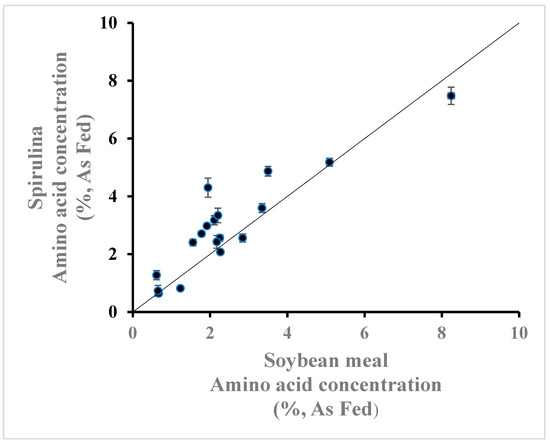
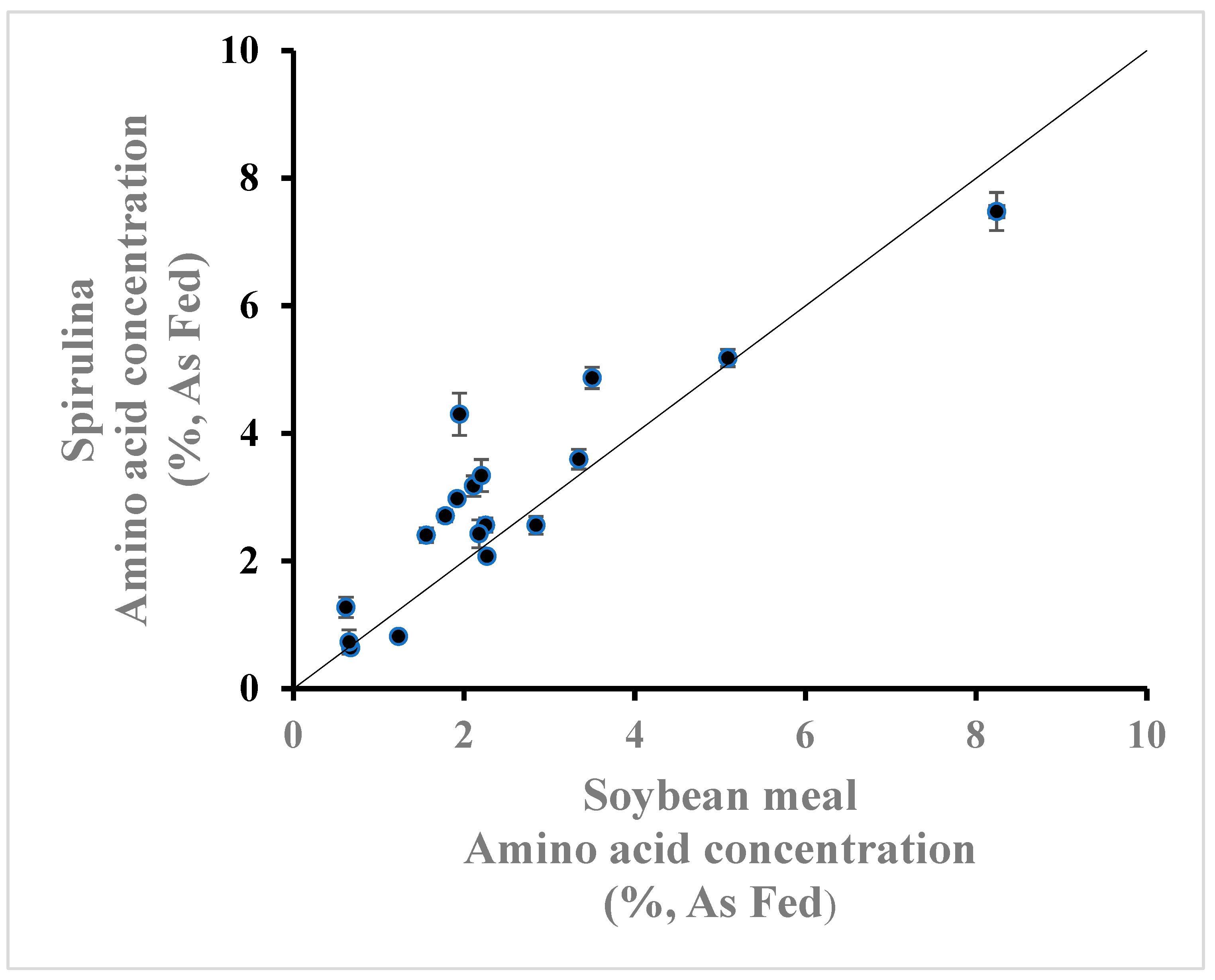
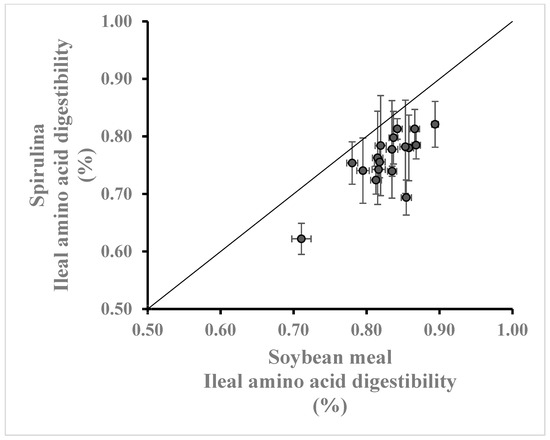
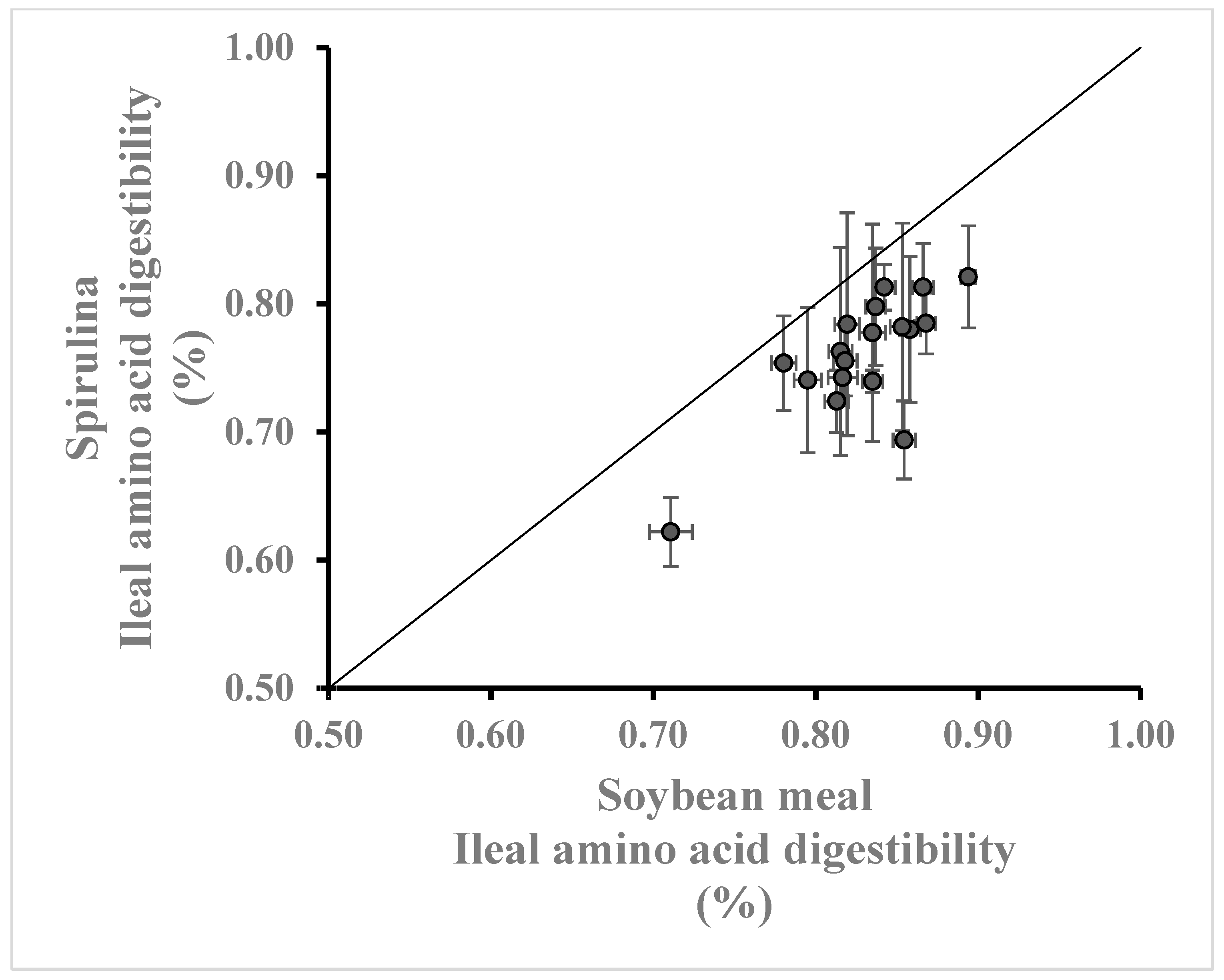
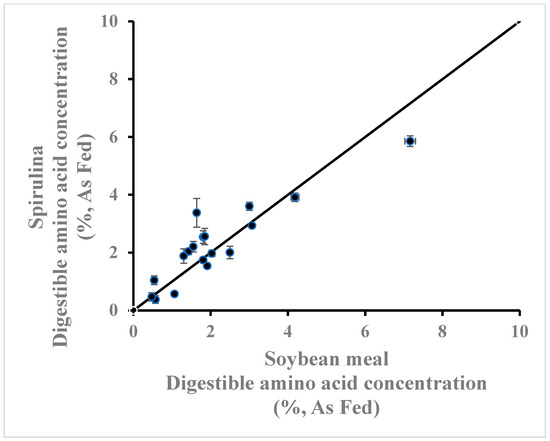
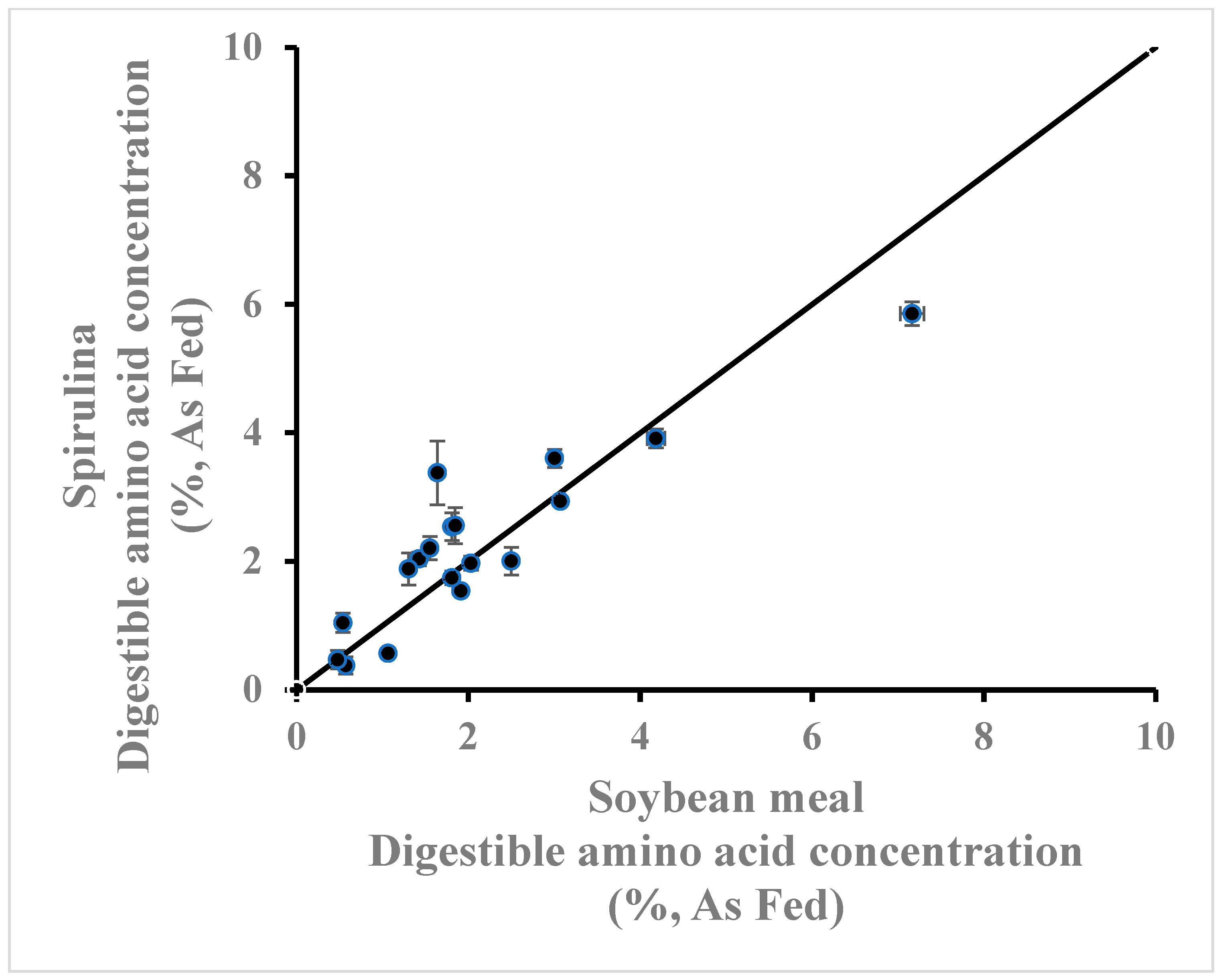
Many studies have suggested that spirulina has the potential to partially replace soybean meal, the major protein source used in poultry diets [29,30]. The results of the current study and those of previous digestibility studies support this conclusion. Comparing the amino acid composition and availability of spirulina (Table A1 and Table A3) to those of soybean meal (Bennett, unpublished meta-analysis containing 56 values from 31 studies published between 2012 and 2023), indicates that the amino acid concentration of spirulina is equal or greater than that of soybean meal (Figure 1), but with a lower IAAD (Figure 2). Consequently, the digestible amino acid concentration of spirulina is equal or greater to that of soybean meal (Figure 3).
Figure 1.
Total amino acid concentration (%, As Fed) of spirulina (Table A1) compared with that of soybean meal (Bennett, unpublished meta-analysis containing 56 values from 31 studies published between 2012 and 2023). Line of equality is provided.
Figure 2.
Apparent ileal amino acid digestibility (%) of spirulina (Table A3) compared with that of soybean meal fed to broiler chicks and laying hens (Bennett, unpublished meta-analysis containing 56 values from 31 studies published between 2012 and 2023). Line of equality is provided.
5. Conclusions
The AME and AIAAD of spirulina when fed to broiler chicks and laying hens were determined. These values are essential to formulate diets containing spirulina that meet the nutrient requirements of poultry. The results show that spirulina has an AME value and digestible amino acid concentration that is equal to or superior to that of soybean meal. These findings show that spirulina is a high-quality feed ingredient for possible inclusion in poultry diets.
Author Contributions
Conceptualization, D.C.B., M.S.E. and T.J.L.; methodology, D.C.B., T.K.O.R. and M.S.E.; validation, D.C.B. and T.K.O.R.; formal analysis, T.K.O.R. and D.C.B.; investigation, T.K.O.R., K.L.P., K.E.G., A.C.M.U., M.S.E. and D.C.B.; resources, D.C.B., R.E.S., T.J.L. and M.S.E.; data curation, D.C.B. and T.K.O.R.; writing—original draft preparation, T.K.O.R. and D.C.B.; writing—review and editing, M.S.E., T.J.L., Z.D.M., S.P., R.E.S., T.K.O.R. and D.C.B.; visualization, D.C.B., M.S.E. and T.K.O.R.; supervision, D.C.B., M.S.E., Z.D.M. and S.P.; project administration, D.C.B.; funding acquisition, D.C.B., M.S.E. and T.J.L. All authors have read and agreed to the published version of the manuscript.
Funding
Funding for this research were provided by United States Department of Energy National Energy Technologies Laboratory (DE-FE-0031717), under a subcontract from MicroBio Engineering Inc. to California Polytechnic State University, California State University Agriculture Research Institute (ARI 17-03-003), and internal funding (College of Agriculture Food and Environmental Science Summer Undergraduate Research Program).
Institutional Review Board Statement
All experimental procedures used in this study were reviewed and approved by the California Polytechnic State University Institutional Animal Care and Use Committee (Protocol #1613, 1908).
Informed Consent Statement
Not applicable.
Data Availability Statement
The original contributions presented in the study are included in the article and Appendix A, further inquiries can be directed to the corresponding author.
Acknowledgments
We sincerely thank the United States Department of Energy (National Energy Technologies Laboratory contract DE-FE0031717), the California State University Agriculture Research Institute, and the College of Agriculture Food and Environmental Science, California Polytechnic State University for funding. We thank Foster Farms for providing the broilers used in this study. We would also like to thank Steve Soderstrom, Brian Larson, the students of the Poultry Nutrition Research Enterprise, and MicroBio Engineering Inc. for all their contributions to this study. This report was prepared as an account of work sponsored by an agency of the United States Government. Neither the United States Government nor any agency thereof, nor any of their employees, makes any warranty, express or implied, or assumes any legal liability or responsibility for the accuracy, completeness, or usefulness of any information, apparatus, product, or process disclosed, or represents that its use would not infringe privately owned rights. Reference herein to any specific commercial product, process, or service by trade name, trademark, manufacturer, or otherwise does not necessarily constitute or imply its endorsement, recommendation, or favoring by the United States Government or any agency thereof. The views and opinions of authors expressed herein do not necessarily state or reflect those of the United States Government or any agency thereof.
Conflicts of Interest
The co-authors Ruth E Spierling and Tryg J. Lundquist are employees of MicroBio Engineering Inc. The remaining authors declare that the research was conducted in the absence of any commercial or financial relationships that could be construed as a potential conflict of interest.
Appendix A
Table A2.
Comparison of apparent metabolizable energy (AME) values of spirulina (as fed basis) fed to broiler chicks and laying hens.
Table A3.
Comparison of apparent ileal digestibility of indispensable and dispensable amino acids of spirulina (%) fed to broiler chicks and laying hens.
References
- Leeson, S.; Summers, J.D. Commercial Poultry Nutrition; Nottingham University Press: Nottingham, UK, 2005; p. 398. [Google Scholar]
- Donohue, M.; Cunningham, D.L. Effects of grain and oilseed prices on the costs of US poultry production. J. Appl. Poult. Res. 2009, 18, 325–337. [Google Scholar] [CrossRef] [Scilit]
- Świątkiewicz, S.; Arczewska-włosek, A.; Józefiak, D. Application of microalgae biomass in poultry nutrition. Worlds Poult. Sci. J. 2015, 71, 663–672. [Google Scholar] [CrossRef] [Scilit]
- Coudert, E.; Baeza, E.; Berri, C. Use of algae in poultry production: A review. Worlds Poult. Sci. J. 2020, 76, 767–786. [Google Scholar] [CrossRef] [Scilit]
- Kalia, S.; Andrew, D.M.; Liu, G.; Lei, X.G. Microalgae: A unique source of poultry feed protein. In Seaweed and Microalgae as Alternative Sources of Protein; Lei, X.G., Ed.; Burleigh Dodds Science Publishing Limited: Cambridge, UK, 2021; pp. 255–280. [Google Scholar]
- Spínola, M.P.; Costa, M.M.; Prates, J.A.M. Effect of cumulative Spirulina intake on broiler meat quality, nutritional and health-related attributes. Foods 2024, 13, 799. [Google Scholar] [CrossRef] [Scilit]
- Abdel-Wareth, A.A.A.; Williams, A.N.; Salahuddin, M.; Gadekar, S.; Lohakare, J. Algae as an alternative source of protein in poultry diets for sustainable production and disease resistance: Present status and future considerations. Front. Vet. Sci. 2024, 11, 1382163. [Google Scholar] [CrossRef] [Scilit]
- Yoshida, M.; Hoshi, H. Nutritive value of spirulina, green algae, for poultry feed. Jpn. Poult. Sci. 1980, 17, 27–30. [Google Scholar] [CrossRef] [Scilit]
- Ross, E.; Dominy, W. The nutritional value of dehydrated, blue-green algae (Spirulina platensis) for poultry. Poult. Sci. 1990, 69, 794–800. [Google Scholar] [CrossRef] [Scilit]
- Alvarenga, R.R.; Rodrigues, P.B.; Cantarelli, V.D.; Zangeronimo, M.G.; Júnior, J.W.; Silva, L.R.; Santos, L.M.; Pereira, L.J. Energy values and chemical composition of Spirulina (Spirulina platensis) evaluated with broilers. Rev. Bras. Zootec. 2011, 40, 992–996. [Google Scholar] [CrossRef] [Scilit]
- Evans, A.M.; Smith, D.L.; Moritz, J.S. Effects of algae incorporation into broiler starter diet formulations on nutrient digestibility and 3 to 21 d bird performance. J. Appl. Poult. Res. 2015, 24, 206–214. [Google Scholar] [CrossRef] [Scilit]
- Tavernari, F.C.; Roza, L.F.; Surek, D.; Sordi, C.; Silva, M.L.B.D.; Albino, L.F.T.; Migliorini, M.J.; Paiano, D.; Boiago, M.M. Apparent metabolisable energy and amino acid digestibility of microalgae Spirulina platensis as an ingredient in broiler chicken diets. Brit. Poult. Sci. 2018, 59, 562–567. [Google Scholar] [CrossRef] [Scilit]
- Mullenix, G.J. Efficacy of Spirulina (Arthrospira platensis) Utilization in Broiler Diets. Ph.D. Thesis, University of Arkansas, Fayetteville, AR, USA, 2021. [Google Scholar]
- Qureshi, M.A.; Garlich, J.D.; Kidd, M.T. Dietary Spirulina platensis enhances humoral and cell-mediated immune functions in chickens. Immunopharmacol. Immunotoxicol. 1996, 18, 465–476. [Google Scholar] [CrossRef] [Scilit] [PubMed]
- Bondar, A.; Horodincu, L.; Solcan, G.; Solcan, C. Use of Spirulina platensis and Curcuma longa as nutraceuticals in poultry. Agriculture 2023, 13, 1553. [Google Scholar] [CrossRef] [Scilit]
- El-Shall, N.A.; Jiang, S.; Farag, M.R.; Azzam, M.; Al-Abdullatif, A.A.; Alhotan, R.; Dhama, K.; Hassan, F.U.; Alagawany, M. Potential of Spirulina platensis as a feed supplement for poultry to enhance growth performance and immune modulation. Front. Immunol. 2023, 14, 1072787. [Google Scholar] [CrossRef] [Scilit] [PubMed]
- Spínola, M.P.; Costa, M.M.; Prates, J.A.M. Digestive constraints of Arthrospira platensis in poultry and swine feeding. Foods 2022, 11, 2984. [Google Scholar] [CrossRef] [Scilit] [PubMed]
- Loftus, S.E.; Johnson, Z.I. Developments in commercial scale farming of microalgae and seaweed. In Seaweed and Microalgae as Alternative Sources of Protein; Lei, X.G., Ed.; Burleigh Dodds Science Publishing Limited: Cambridge, UK, 2021; pp. 79–103. [Google Scholar]
- Manning, S.R.; Gol, R.D. Developments in algae processing. In Seaweed and Microalgae as Alternative Sources of Protein; Lei, X.G., Ed.; Burleigh Dodds Science Publishing Limited: Cambridge, UK, 2021; pp. 105–145. [Google Scholar]
- Martins, C.F.; Ribeiro, D.M.; Costa, M.; Coelho, D.; Alfaia, C.M.; Lordelo, M.; Almeida, A.M.; Freire, J.P.B.; Prates, J.A.M. Using microalgae as a sustainable feed resource to enhance quality and nutritional value of pork and poultry meat. Foods 2021, 10, 2933. [Google Scholar] [CrossRef] [Scilit] [PubMed]
- Herath, H.M.U.L.; Jayawardana, B.C.; Fernando, P.D.S.M.; Weththasinghe, P. A meta-analysis of the effects of dietary Spirulina on growth performance of broiler chicken. World’s Poult. Sci. J. 2023, 79, 497–511. [Google Scholar] [CrossRef] [Scilit]
- Zahroojian, N.; Moravej, H.; Shivazad, M. Effects of dietary marine algae (Spirulina platensis) on egg quality and production performance of laying hens. J. Agric. Sci. Technol. 2013, 15, 1353–1360. [Google Scholar]
- Omir, B.; Amraoui, M.; Tarek, A.; Lucarini, M.; Durazzo, A.; Cicero, N.; Santini, A.; Kamoun, M. Arthrospira platensis (Spirulina) supplementation on laying hens’ performance: Eggs physical, chemical, and sensorial qualities. Foods 2019, 8, 386. [Google Scholar] [CrossRef] [Scilit]
- Selim, S.; Hussein, E.; Abou-Elkhair, R. Effect of Spirulina platensis as a feed additive on laying performance, egg quality and hepatoprotective activity of laying hens. Eur. Poult. Sci. 2018, 82, 1–12. [Google Scholar] [CrossRef] [Scilit]
- Nalle, C.; Ravindran, V.; Ravindran, G. Nutritional value of faba beans (Vicia faba L.) for broilers: Apparent metabolisable energy, ileal amino acid digestibility and production performance. Anim. Feed Sci. Technol. 2010, 156, 104–111. [Google Scholar] [CrossRef] [Scilit]
- AOAC. Official Methods of Analysis of AOAC International; AOAC International: Gaithersburg, MD, USA, 2005. [Google Scholar]
- Myers, W.D.; Ludden, P.A.; Nayigihugu, V.; Hess, B.W. Technical note: A procedure for the preparation and quantitative analysis of samples for titanium dioxide. J. Anim. Sci. 2004, 82, 179–183. [Google Scholar] [CrossRef] [Scilit] [PubMed]
- Khalil, M.M.; Abdollahi, M.R.; Zaefarian, F.; Chrystal, P.V.; Ravindran, V. Broiler Age Influences the apparent metabolizable energy of soybean meal and canola meal. Animals 2023, 13, 219. [Google Scholar] [CrossRef] [Scilit] [PubMed]
- Neumann, C.; Velten, S.; Liebert, F. The graded inclusion of algae (Spirulina platensis) or insect (Hermetia illucens) meal as a soybean meal substitute in meat type chicken diets impacts on growth, nutrient deposition and dietary protein quality depending on the extent of amino acid Supple. Open J. Anim. Sci. 2018, 8, 163–183. [Google Scholar] [CrossRef]
- Velten, S.; Neumann, C.; Bleyer, M.; Gruber-Dujardin, E.; Hanuszewska, M.; Przybylska-Gornowicz, B.; Liebert, F. Effects of 50 percent substitution of soybean meal by alternative proteins from Hermetia illucens or Spirulina platensis in meat-type chicken diets with graded amino acid supply. Open J. Anim. Sci. 2018, 8, 119–136. [Google Scholar] [CrossRef]

Disclaimer/Publisher’s Note: The statements, opinions and data contained in all publications are solely those of the individual author(s) and contributor(s) and not of MDPI and/or the editor(s). MDPI and/or the editor(s) disclaim responsibility for any injury to people or property resulting from any ideas, methods, instructions or products referred to in the content. |
© 2024 by the authors. Licensee MDPI, Basel, Switzerland. This article is an open access article distributed under the terms and conditions of the Creative Commons Attribution (CC BY) license (https://creativecommons.org/licenses/by/4.0/).