


Abstract
Acinetobacter baumannii is a formidable nosocomial pathogen responsible for severe hospital-acquired infections. This study aimed to investigate the relationship between genotypic and phenotypic resistance profiles in 36 non-duplicate invasive A. baumannii isolates collected at a tertiary care hospital in Bulgaria over a six-year period (2019–2024). Identification was performed by MALDI-TOF MS and PCR-based detection of blaOXA-51-like and gyrB. Antimicrobial susceptibility testing to ten agents was performed by gradient diffusion and broth microdilution, and selected resistance genes were detected by conventional PCR. Whole-genome sequencing of 17 representative isolates was conducted to confirm the resistance genotype–phenotype associations and perform MLST. Carbapenem resistance was detected in 34/36 isolates (94.4%), mediated by blaOXA-23-like (29/34) or blaOXA-72 (5/34). The armA gene associated with high-level resistance to all three aminoglycosides was identified exclusively in blaOXA-23-like-positive isolates (18/29). In armA-negative isolates, gentamicin and tobramycin MICs decreased markedly, whereas amikacin MICs remained elevated. In addition, minocycline MICs ≥ 8 mg/L were observed in the presence of armA. Seven distinct genotypic–phenotypic profiles were defined based on these gene–MIC associations. Resistome and phylogenetic analyses confirmed these relationships, with MLST assigning the isolates to established clonal lineages ST2 and ST636 (International Clone II). These findings support the use of targeted genes, such as armA, combined with phenotypic testing to guide empirical therapy and strengthen local surveillance of high-risk A. baumannii clones in hospital settings.
1. Introduction
Acinetobacter baumannii has emerged over the past decade as a major nosocomial pathogen owing to its capacity to withstand last-line antimicrobials and disseminate clonally [1,2]. As a member of the ESKAPE group (Enterococcus faecium, Staphylococcus aureus, Klebsiella pneumoniae, A. baumannii, Pseudomonas aeruginosa, and Enterobacter spp.), it ranks among the most critical threats to global public health [3]. Its resistance to desiccation enables prolonged survival in the hospital environment, thereby facilitating endemic persistence [2].
The European Antimicrobial Resistance Surveillance Network (EARS-Net) data for 2024 indicate that carbapenem resistance in A. baumannii exceeds 90% in several Southeast European EU Member States, particularly in Balkan countries [4]. Moreover, the Balkan region showed the highest rates of combined resistance: Romania (89.5%), Croatia (89.0%), and Greece (87.9%) [4]. In Bulgaria, the proportion of invasive carbapenem-resistant A. baumannii (CRAB) isolates increased from 80% in 2022 to 90.5% in 2024, following the COVID-19 pandemic period [4]. During the same period, combined resistance rose from 75.0% to 86.7%, markedly exceeding the EU/EEA population-weighted mean of 30.2% in 2024 [4].
Antibiotic resistance in Gram-negative bacteria is mediated by three principal strategies: enzymatic inactivation or complete hydrolysis of the antimicrobial molecule, modification of the target, and reduced membrane permeability resulting from the loss or alteration of porins and/or the activity of efflux pumps [5,6]. These mechanisms operate in clinical A. baumannii isolates and are driven by well-defined genetic determinants or mutations. In this regard, it is important to highlight the remarkable genomic plasticity of this species, which facilitates chromosomal rearrangements and the integration of foreign genetic elements [7]. This intrinsic adaptability, coupled with antibiotic selective pressure, has contributed to the establishment of endemic multidrug-resistant A. baumannii strains in healthcare settings [8].
Since the introduction of sequencing technologies in microbiology, considerable efforts have been devoted to elucidating the mechanisms underlying multidrug resistance in A. baumannii. The genomes of both collection and endemic strains have been subjected to detailed comparative analysis [9,10,11]. Resistance islands, plasmids, and mobile genetic elements have been identified and characterized [9,10,11,12], while the genetic environment of resistance determinants has been studied in detail [11,13]. Based on these investigations, the authors have drawn conclusions regarding the dissemination of genetic determinants among strains and species.
Fournier et al. [9] reported the presence of genes within a resistance island acquired from Pseudomonas, Salmonella, and Escherichia species.
Zhu et al. [11] concluded that horizontal gene transfer of mobile genetic elements between chromosomes and plasmids may be a significant contributor to the rapid spread of resistance among A. baumannii strains.
Holt et al. [14] provided experimental evidence that natural transformation is a major driver of resistance gene acquisition in Global Clone 1.
Frenk et al. [8] observed that sequence type and clade distribution remained stable over time, suggesting that horizontal gene transmission and the de novo emergence of multidrug-resistant A. baumannii are rare events, yet crucial to the evolutionary success of specific clades and sequence types.
To date, large-scale systematic investigations of invasive A. baumannii isolates integrating phenotypic and genotypic data remain scarce in Bulgaria. The present study aimed to characterize the prevalent phenotypes and genotypes among 36 invasive A. baumannii isolates recovered from inpatients at a university hospital over a six-year period (2019–2024) and elucidate the relationships between phenotypic resistance profiles and the underlying genetic determinants.
2. Materials and Methods
2.1. Bacterial Isolates
During the study period (2019–2024), a total of 67 non-duplicate Acinetobacter calcoaceticus–baumannii complex (Acb) isolates were recovered from blood cultures at the University Hospital. The isolates were routinely identified to the Acb-complex level using the VITEK 2 Compact system (bioMérieux, Marcy-l’Étoile, France) and tested for antimicrobial susceptibility by disk diffusion and VITEK 2. They were then stored in skim-milk broth at −80 °C pending further study. From these 67 non-duplicate isolates, 36 (53.7%) were selected for further investigation. The selection was based on two criteria: (i) representation of every calendar year of the study period and (ii) coverage of defined susceptibility phenotypes, based on the routine susceptibility results for eight agents (MEM, IMI, GEN, AMK, TOB, CIP, LEV, and COL) (Supplementary Table S1). All rare phenotypes were retained, whereas the predominant phenotypes were proportionally subsampled to reduce their overrepresentation relative to the rarer phenotypes, resulting in the exclusion of 31 isolates from further analysis. One of the two isolates susceptible only to tobramycin and colistin was additionally excluded owing to non-viability, yielding a final collection of 36 isolates. For the cohort of 36 selected isolates, species-level identification was confirmed by MALDI-TOF MS (VITEK MS, bioMérieux, Marcy-l’Étoile, France) and two PCR-based methods targeting the blaOXA-51-like gene [15] and gyrB [16]. A. baumannii ATCC 19606 was used as the positive control strain for PCR-based species identification.
The study was approved by the Ethics Committee of the Medical University of Pleven (Approval No. 794, approved in June 2024) and conducted in accordance with the Declaration of Helsinki and its later amendments. As the research focused solely on bacterial isolates and no personal patient information was used, individual informed consent was not required.
2.2. Antimicrobial Susceptibility Testing
Minimum inhibitory concentrations (MICs) were determined by the gradient diffusion method (MIC Test Strip, Liofilchem, Roseto degli Abruzzi, Italy) for imipenem (IPM), meropenem (MEM), gentamicin (GEN), amikacin (AMK), tobramycin (TOB), levofloxacin (LEV), trimethoprim/sulfamethoxazole (SXT), and minocycline (MIN). MICs for cefiderocol (FDC) and colistin (COL) were determined by the broth microdilution method using ComASP™ Cefiderocol (0.008–128 mg/L) and ComASP™ Colistin (0.25–16 mg/L) panels (Liofilchem, Roseto degli Abruzzi, Italy), respectively. Escherichia coli ATCC 25922, P. aeruginosa ATCC 27853, and A. baumannii ATCC 19606 served as quality control strains. MICs were interpreted according to EUCAST clinical breakpoints (v16.0, 2026). For minocycline, CLSI criteria( M100, 35th edition, 2025) [17] were applied.
2.3. Definition for MDR-AB, XDR-AB, and PDR-AB
Multidrug-resistant (MDR) A. baumannii isolates were defined as non-susceptible to at least one agent in three or more antimicrobial categories, whereas extensively drug-resistant (XDR) isolates were defined as non-susceptible to at least one agent in all but two or fewer antimicrobial categories. Pandrug-resistant (PDR) isolates were defined as non-susceptible to all agents in all antimicrobial categories, according to previously described criteria [18].
2.4. DNA Isolation
Total DNA from all investigated strains was isolated using the DNeasy Blood and Tissue Kit (QIAGEN, Hilden, Germany), according to the manufacturer’s instructions, from 3 mL of overnight culture inoculated with a single colony.
2.5. PCR Screening for Antimicrobial Resistance Genes (ARGs)
Amplifications were performed on a qTOWER3 G touch thermal cycler (Analytik Jena, Jena, Germany). Genes encoding carbapenemase production (blaOXA-23-like, blaOXA-24/40-like, blaOXA-58-like, blaNDM-like, blaVIM-like, blaIMP-like, and blaKPC-like) were investigated. The specific allelic variant within the blaOXA-24/40-like group was subsequently determined by whole-genome sequencing (WGS) (see Section 3.7, Resistome Analysis). The association of ISAba1 with blaOXA-23-like was assessed by PCR using an ISAba1-specific forward primer and a blaOXA-23-like-specific reverse primer. In addition, PCR assays were performed for the armA gene, encoding a 16S rRNA methylase associated with high-level aminoglycoside resistance, and the sul1 gene, associated with sulfonamide resistance and located within class 1 integrons.
PCR assays were performed using previously described protocols with minor modifications, mainly to the annealing temperatures [18,19,20,21,22,23]. All reactions were carried out in a final volume of 20 µL containing OneTaq® 2× Master Mix (New England Biolabs, Ipswich, MA, USA) and 20 ng of template DNA. The class D carbapenemase genes were detected in a multiplex hot-start reaction (94 °C for 4 min; 36 cycles of 94 °C for 30 s, 52 °C for 35 s, 70 °C for 75 s; final extension 71 °C for 3 min). The blaVIM-, blaIMP-, blaNDM-, and blaKPC-like genes were amplified by touchdown PCR (95 °C for 3 min; 5 cycles with the annealing temperature decreasing by 1.6 °C per cycle from 63 °C, followed by 20–25 cycles at 54 °C; extension 70 °C for 1 min). The armA gene was amplified at an annealing temperature of 50 °C (30 cycles), and sul1 by touchdown PCR (62 °C decreasing by 1 °C per cycle for 7 cycles, followed by 25 cycles at 54 °C). The ISAba1–blaOXA-23-like assay was performed at 52 °C for 30 cycles. The expected amplicon size of the ISAba1–blaOXA-23-like PCR assay was verified in silico using Primer-BLAST (National Center for Biotechnology Information (NCBI), Bethesda, MD, USA; https://www.ncbi.nlm.nih.gov/tools/primer-blast/, accessed on 4 July 2025).
Primer sequences and expected amplicon sizes are provided in Table 1. PCR products were separated by agarose gel electrophoresis and visualized by ethidium bromide staining. The following strains were used as controls:
Table 1.
PCR primer sequences and expected amplicon sizes used for antimicrobial resistance gene detection in this study.
- P. aeruginosa 4782 (blaIMP-100/blaVIM-4)
- P. aeruginosa 1793 (blaNDM/blaGES)
- K. pneumoniae ATCC 2814 (blaKPC)
- A. baumannii strains (blaOXA23-like/blaOXA24/40-like)
- A. baumannii (blaOXA58)
The A. baumannii strains are in-house reference strains provided by the National Center of Infectious and Parasitic Diseases (NCIPD), Sofia, Bulgaria, previously characterized by PCR and sequencing.
2.6. Whole-Genome Sequencing (WGS)
Based on the combined phenotypic susceptibility and PCR screening results, seven distinct genotypic–phenotypic resistance profiles were defined. A subset of 17 isolates, representative of these profiles, was selected for WGS to enable comprehensive resistome analysis. Genomic DNA was randomly fragmented, size-selected, ligated to adapters, and PCR-amplified to generate sequencing libraries. The libraries were sequenced on an Illumina NovaSeq X Plus platform (Novogene, Cambridge, UK), producing 2 × 150 bp paired-end reads.
2.7. Draft Genome Assembly
The genome assembly procedure involved several steps: quality control (FastQC v0.12.1, https://www.bioinformatics.babraham.ac.uk/projects/fastqc/, accessed on 15 April 2026), raw read preprocessing (Trimmomatic v0.39) [25], and genome assembly (SPAdes v4.2.0; --isolate and --cov-cutoff 5.0 flags) [26]. The resulting scaffold sequences were uploaded to the Galaxy online platform [27], where draft genome metrics were evaluated (Galaxy v5.3.0). All software tools were run with default parameters unless otherwise specified.
2.8. Resistome and Multilocus Sequence Typing (MLST) Analyses
All uploaded draft genome sequences were screened for AMR genes using the ABRicate tool (Galaxy v1.4.0) with the following settings: the Comprehensive Antibiotic Resistance Database (CARD), minimum DNA identity of 70%, and minimum DNA coverage of 60%. In addition, the gyrA and parC coding sequences were manually analyzed for mutations in their quinolone resistance-determining regions (QRDRs).
Finally, MLST analysis was performed on the assembled scaffolds using the MLST tool (Galaxy v2.22.0, https://usegalaxy.eu/) and the two available A. baumannii schemes.
2.9. Phylogenomic Analysis
Clinical A. baumannii genomes were retrieved from the Isolates Browser integrated into the NCBI Pathogen Detection system for Albania, Bosnia and Herzegovina, Bulgaria, Croatia, Greece, Kosovo, Montenegro, North Macedonia, Romania, Serbia, and Turkey. To minimize sampling bias, a single representative genome was selected from each available single-nucleotide polymorphism (SNP) cluster for every country, preferentially choosing bloodstream isolates when available. All selected draft genome sequences were annotated using Prokka v1.14.6 [28].
Pangenome analysis was subsequently performed using Roary v3.13.0 [29] with a minimum BLASTP identity threshold of 95% and a core genome definition of 99%, generating a core gene alignment for downstream analyses. All SNPs were extracted from the resulting multi-FASTA alignment using the Find SNP Sites tool (Galaxy v2.5.1), and pairwise SNP distances were calculated using the SNP Distance Matrix tool (Galaxy v0.8.2). The resulting distance matrix was subjected to hierarchical clustering using the Python data visualization library seaborn (v0.13.2).
A phylogenetic tree was reconstructed from the core genome SNP alignment using RAxML v8.2.12 [30], with branch support estimated from 1000 bootstrap replicates. The resulting tree was visualized using the Interactive Tree of Life (iTOL) web server [31].
2.10. Statistical Analysis
Statistical analyses were conducted using jamovi (v2.7; The jamovi Project, 2025) [32], based on R (v4.5; R Core Team, 2025) [33]. Associations between the presence of resistance genes and antimicrobial susceptibility were assessed using Fisher’s exact test for categorical variables. Differences in MIC values between gene-positive and gene-negative groups were assessed using the Mann–Whitney U test. Differences among aminoglycosides within armA-negative, blaOXA-23-like-positive isolates were assessed using the Friedman test, with pairwise comparisons by Wilcoxon signed-rank test. A p-value < 0.05 was considered statistically significant. Genotype subgroups with very small sample sizes (n ≤ 4) were summarized descriptively, without formal statistical testing, owing to insufficient statistical power.
3. Results
3.1. Patient Demographic and Clinical Characteristics
Supplementary Table S2 presents the demographic and clinical characteristics of the 36 patients (16 men, 20 women). The age distribution by category was as follows: 0–18 years (1/36), 19–40 years (6/36), 41–65 years (17/36), and >65 years (12/36). Most patients (28/36) were treated in intensive care units, followed by surgical units (6/36), with one case each in the Gastroenterology Clinic and the Acute Cardiac Care Unit. The mean length of hospital stay was 22.6 days. Patients were diagnosed with polytrauma, including one case of second-degree burns and one of toxic gas exposure (8/36); acute abdominal disease, including peritonitis, pancreatitis, ileus, colon malignancies with complications, and liver failure (11/36); vascular and cardiac disease (5/36); pulmonary infections (6/36), five of them associated with COVID-19; soft-tissue infections (3/36); systemic lupus erythematosus (1/36); thrombocytopenia (1/36); and viral meningitis (1/36). Prior to the isolation of A. baumannii, broad-spectrum antibiotic therapy was documented in 32/36 patients. Mortality was high (26/36), with 10 patients discharged following clinical improvement.
3.2. Identification
A total of 36 invasive isolates were confirmed as A. baumannii by MALDI-TOF MS (VITEK MS) and PCR-based methods targeting the intrinsic blaOXA-51-like gene and the gyrB gene.
3.3. Antimicrobial Susceptibility
The results of antimicrobial susceptibility testing are presented in Table 2. Carbapenem resistance was observed in 34 of 36 isolates (94.4%), with MICs of ≥32 mg/L for both meropenem and imipenem. All isolates were susceptible to colistin. With respect to aminoglycosides, resistance rates varied by agent. Gentamicin showed the lowest resistance, with 16/36 isolates (44.4%) categorized as susceptible and 20/36 (55.6%) as resistant. In contrast, tobramycin and amikacin resistance was considerably higher, with only 6/36 (16.7%) and 2/36 (5.6%) isolates susceptible and 30/36 (83.3%) and 34/36 (94.4%) resistant, respectively. Resistance to trimethoprim/sulfamethoxazole was observed in 35/36 isolates (97.2%). Non-susceptibility (resistant plus intermediate) to levofloxacin was observed in 35/36 isolates (97.2%). Minocycline resistance (MIC range 8–24 mg/L) was observed in 18/36 isolates (50.0%), 10/36 (27.8%) showed intermediate susceptibility (MIC range 1.5–2 mg/L), and 8/36 (22.2%) were susceptible (MIC ≤ 1 mg/L).
Table 2.
Antimicrobial susceptibility of the 36 A. baumannii isolates, n (%).
As an exploratory sub-analysis, cefiderocol susceptibility testing was performed on a subset of nine isolates, selected to represent different genotypic profiles identified in this study. MIC values were interpreted using the non-species-specific PK/PD cutoff (S ≤ 2 mg/L, EUCAST v16.0). Seven of the nine isolates fell within this range, whereas two (MIC 4 mg/L) exceeded the PK/PD susceptibility cutoff.
Overall, 34/36 isolates (94.4%) met the criteria for XDR classification, remaining susceptible only to colistin. The findings regarding cefiderocol should be considered preliminary, given the limited number of isolates tested.
3.4. PCR Screening for Antimicrobial Resistance Genes
The intrinsic blaOXA51-like determinant was detected in all 36 isolates (100%), confirming their identification as A. baumannii. The prevalence of blaOXA23-like and blaOXA24/40-like was 80.6% (29/36) and 13.9% (5/36), respectively. Using a primer combination consisting of the forward primer targeting IsaAba1 and reverse primer specific for blaOXA23-like, all blaOXA23-like positive isolates yielded a 1404 bp amplicon, indicating the presence of ISAba1 upstream of the gene and suggesting promoter-mediated activation. No other bla genes were detected. The armA gene, encoding a 16S rRNA methylase, was identified in 50.0% (18/36) of the isolates. Notably, it was detected exclusively in combination with blaOXA23-like. No isolate simultaneously harbored blaOXA24/40-like and armA, and no isolate harbored armA as a sole resistance determinant. The sul1 gene, associated with resistance to sulfamethoxazole, was detected in 80.6% (29/36) of the isolates.
3.5. Association Between Resistance Phenotypes and Genotypes
Table 3 summarizes the relationship between antimicrobial resistance phenotypes and the detected resistance genes. The complete MIC values and detected resistance genes for all 36 isolates are provided in Table S2, and the detailed statistical output is in Table S3 (Supplementary Materials). The presence of either blaOXA-23-like or blaOXA-24/40-like was associated with high MIC values for meropenem and imipenem (≥32 mg/L), whereas their absence corresponded to MIC values within the susceptible range (Fisher’s exact test, p = 0.002).
Table 3.
Relationship between genotypic and phenotypic resistance profiles in the 36 A. baumannii isolates (MIC in mg/L).
The armA gene was associated with significantly higher MICs for all three aminoglycosides tested (Mann–Whitney U test, p < 0.001), with armA-positive isolates reaching 768–1024 mg/L for gentamicin, 256 mg/L for amikacin, and 512–1024 mg/L for tobramycin. In armA-negative, blaOXA-23-like-positive isolates, gentamicin MICs decreased to the susceptible or low-level resistance range (2–6 mg/L), and tobramycin MICs dropped markedly from ≥1024 to 12–24 mg/L (Mann–Whitney U test, p < 0.0001 for both). Amikacin MIC values, however, remained elevated compared with gentamicin and tobramycin (Friedman test, p < 0.0001; pairwise Wilcoxon signed-rank tests, p = 0.001 for all comparisons).
Notably, elevated minocycline MICs were also significantly associated with armA carriage (Mann–Whitney U test, p < 0.001; 8–24 mg/L), and a strong concordance was observed between armA carriage and minocycline resistance (Fisher’s exact test, p < 0.001), with susceptibility to minocycline observed only among armA-negative isolates. These findings suggest a potential co-linkage between armA and minocycline resistance determinants. Similar associations extended to fluoroquinolones: among the 29 blaOXA-23-like-positive isolates, those additionally carrying armA (18/29) showed significantly higher levofloxacin MICs (median 16, range 1–32 mg/L) than armA-negative blaOXA-23-like carriers (11/29; median 1, range 1–8 mg/L; Mann–Whitney U test, p < 0.001), with a corresponding significant association between armA carriage and levofloxacin resistance (Fisher’s exact test, p = 0.001).
A significant difference was also found between armA-negative isolates harboring blaOXA-23-like (11/29) and blaOXA-24/40-like-positive ones (5/36, all armA-negative). The former group showed significantly higher gentamicin MICs (median 4 vs. 2 mg/L; p = 0.003) and significantly higher tobramycin MICs (median 16 vs. 0.75 mg/L; p = 0.001). Amikacin MICs did not differ significantly between the two genotypes (p = 1.000), remaining elevated in both. Minocycline MICs were also significantly higher among blaOXA-23-like carriers than among blaOXA-24/40-like-positive isolates (median 1.5 vs. 0.5 mg/L; p = 0.002).
The isolate carrying only sul1 remained susceptible to carbapenems and amikacin and showed intermediate minocycline susceptibility and low-level resistance to gentamicin, tobramycin, and levofloxacin, but was highly resistant to trimethoprim/sulfamethoxazole (MIC ≥ 32 mg/L). The isolate lacking all screened genes was fully susceptible to all agents.
Among the nine isolates tested for cefiderocol, the armA-positive genotypes GT1 and GT3 showed MICs of 0.25–0.50 mg/L, whereas the armA-negative genotypes GT2, GT4, and GT6 showed higher values (1–4 mg/L). The gene-negative isolate (GT7) had the lowest MIC of the subset (0.125 mg/L). Given the limited size of the subset, this observation should be regarded as preliminary rather than a firm conclusion. In addition, these results were excluded from the general XDR susceptibility statement. Detailed cefiderocol MIC values by isolate and genotype are presented separately in Table S4 (Supplementary Materials).
3.6. Draft Genome Assembly and Evaluation
In total, 17 of the 36 isolates were subjected to whole-genome sequencing. The resulting data were used to perform MLST and resistome analysis. The draft genome assembly metrics are summarized in Table 4.
Table 4.
Draft genome assembly metrics of the studied A. baumannii isolates.
The genome sizes ranged from 3.93 to 4.42 Mbp, with a GC content of 39.01–41.25%. The N50 values ranged from 288,607 to 2,183,114 bp, and the number of contigs (≥1 kbp) varied from 15 to 97. Notably, isolate 120—the only susceptible isolate in the collection—exhibited markedly superior assembly metrics (only 15 contigs; N50 = 2,183,114 bp). This isolate could not be assigned to a sequence type by the Pasteur MLST scheme and was classified only by the Oxford MLST scheme as ST 1061.
3.7. Resistome Analysis
Table 5 presents the resistance determinants identified in the seven genotypes. blaOXA-72 was the only blaOXA-24/40-like variant detected. All armA-positive isolates also harbored tet(B), the main determinant for minocycline resistance. The blaOXA-23-like-positive isolates and the isolate positive only for sul1 and lacking armA carried aac(6′)-Ib7, aph(3′)-VIa. One of these additionally harbored aph(3′)-Ia. The blaOXA-24/40-like-positive isolates carried only aph(3′)-VIa.
Table 5.
Whole-genome sequencing data and genotype classification of the studied isolates.
Comparison of the QRDRs of the isolates with the corresponding region of A. baumannii ATCC 19606 revealed amino-acid substitutions previously reported to play a role in quinolone resistance [34]. All but one isolate possessed S81L substitution in GyrA. The single isolate lacking this mutation was also the only one negative for all resistance genes screened by PCR. Isolates co-harboring blaOXA-23-like and armA, as well as those positive for blaOXA-72, additionally carried S84L substitution in ParC.
3.8. MLST Analysis
MLST analysis (Pasteur scheme) assigned all but one of the sequenced isolates to either ST2 or its triple-locus variant ST636. Thirteen isolates were ST2, the globally dominant high-risk clone corresponding to International Clone II (IC2) [35,36,37], whereas three isolates, all harboring blaOXA-72 (a blaOXA-24/40-like variant), were ST636. The remaining isolate could not be classified by the Pasteur scheme but was assigned to ST1061 by the Oxford scheme. It was negative for all tested acquired resistance genes, susceptible to all antimicrobials tested, and harbored two distinct intrinsic β-lactamase genes: blaADC-7 and blaOXA-314.
3.9. Phylogenomic Analysis of Clinical A. baumannii Isolates from the Balkans
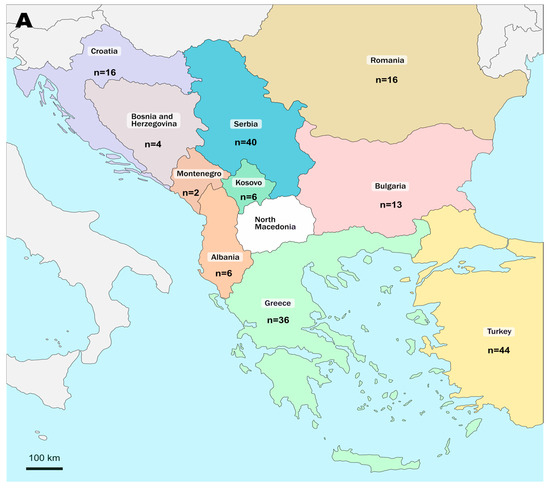
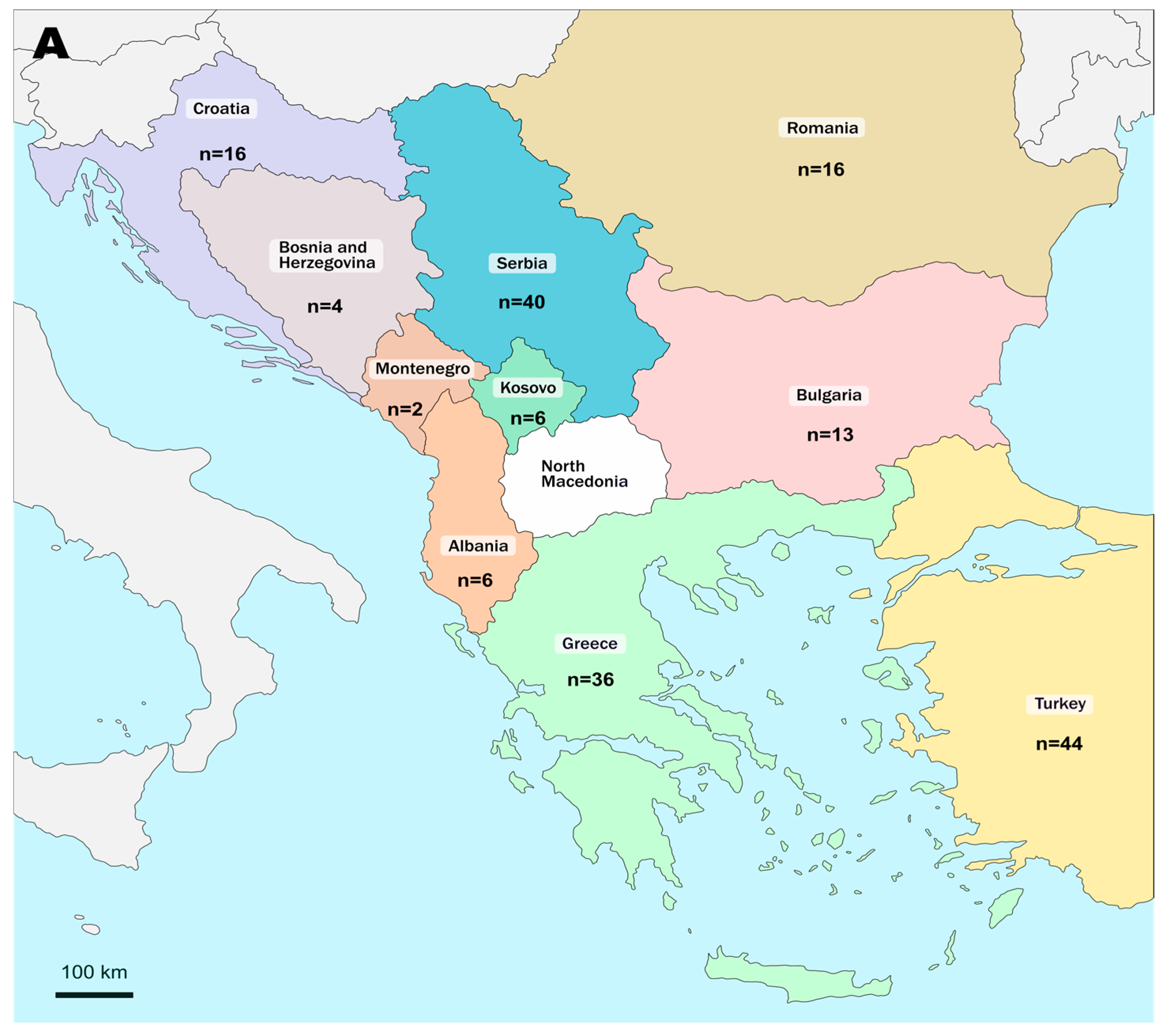
To investigate the epidemiological context of the studied isolates, a collection of 200 non-duplicate clinical A. baumannii genomes representing isolates recovered from 11 Balkan countries was assembled as described above. The geographic distribution of these strains is shown in Figure 1A.
Figure 1.
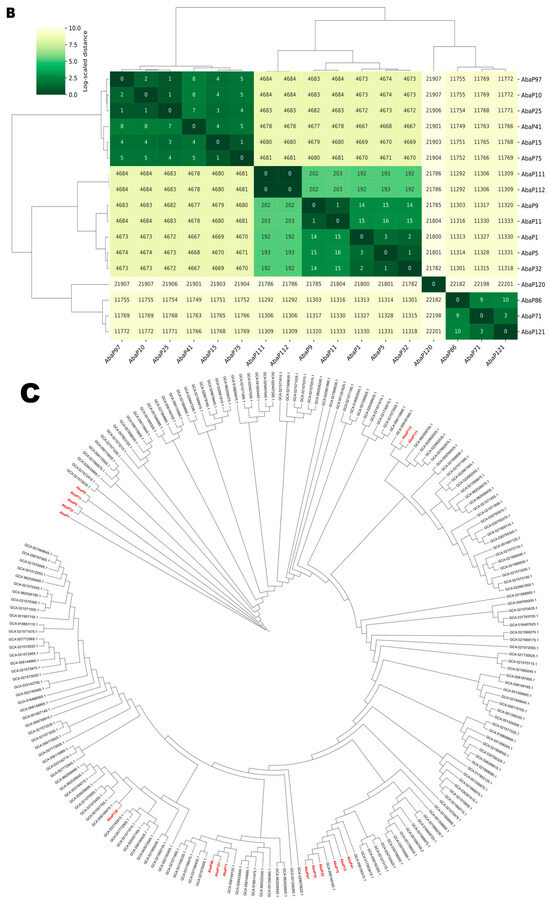
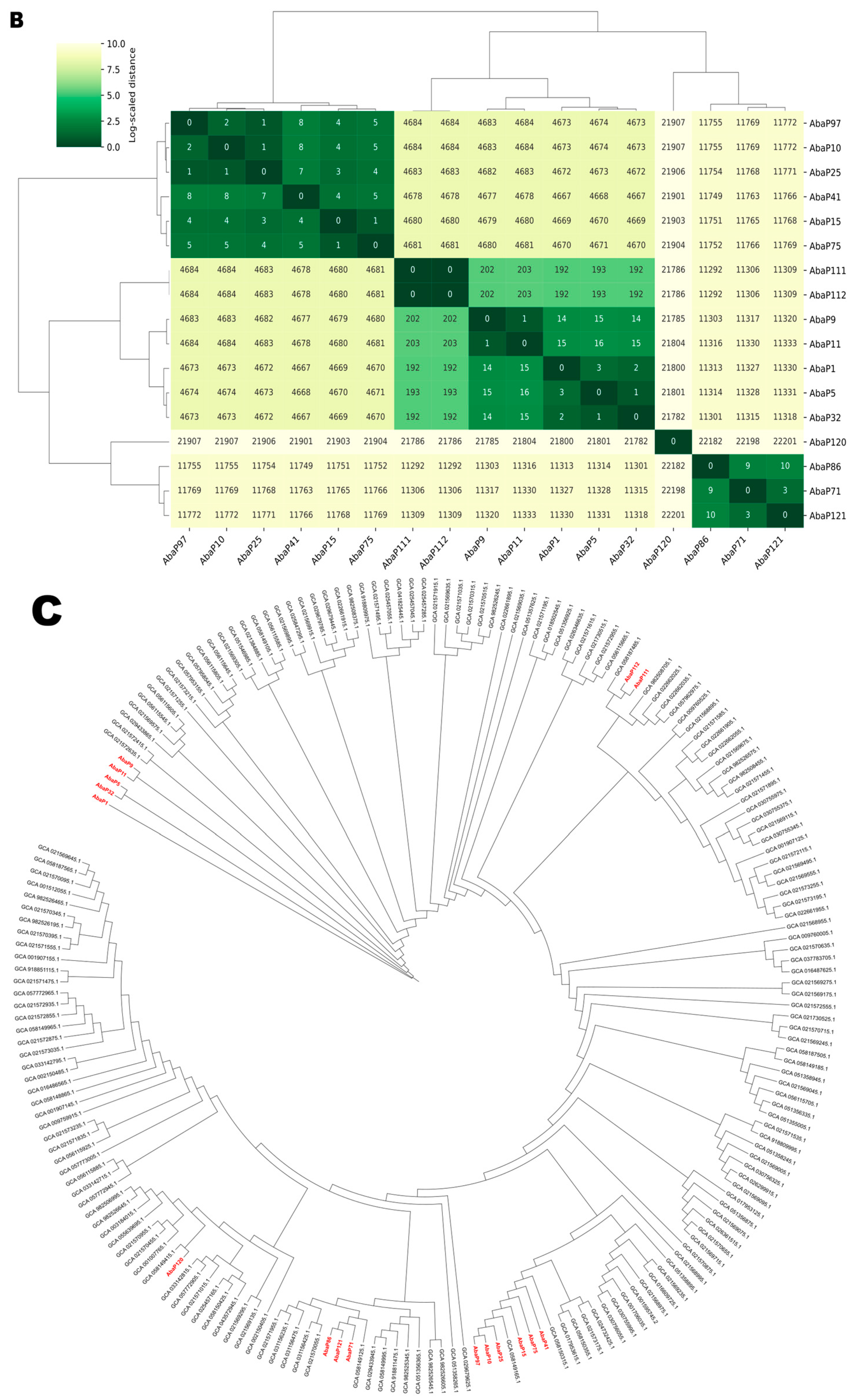
Phylogenomic analysis of clinical A. baumannii isolates from the Balkans retrieved from the NCBI Pathogen Detection system. (A) Geographic origins of the included isolates. (B) Hierarchical clustering based on the SNP distance matrix of the isolates analyzed in this study. (C) Maximum-likelihood phylogenetic tree reconstructed from single-nucleotide polymorphisms (SNPs) identified in the core genome alignment generated by pangenome analysis. Isolates sequenced in this study are highlighted in red.
Hierarchical clustering of the SNP distance matrix revealed that the isolates analyzed in this study formed three distinct clusters: cluster 1 (isolates 1, 5, 9, 11, 32, 111, and 112), cluster 2 (isolates 10, 15, 25, 41, 75, and 97), and cluster 3 (isolates 71, 86, and 121) (Figure 1B). Pairwise SNP differences within these clusters ranged from 1 to 16 SNPs, indicating close relatedness, with the exception of isolates 111 and 112, which were genetically identical in this assay (0 SNP differences) but differed from the remaining members of cluster 1 by up to 203 SNPs. Isolate 120 remained the only isolate separated by more than 20,000 SNPs from all other isolates, indicating that it is not closely related to any of them.
The phylogenetic tree (Figure 1C) revealed that the closest relative of cluster 1 was genome GCA_021572415, which was recovered from a patient at Henry Dunant Hospital in Athens, Greece. The closest relatives of clusters 2 and 3 were genomes GCA_058149165.1 and GCA_058149125.1, respectively. Both genomes were generated as part of the 2026 ECDC genomic survey of carbapenem-resistant A. baumannii in Europe; however, no additional epidemiological information is currently available.
4. Discussion
4.1. Carbapenem Resistance Associated with blaOXA-23-like and blaOXA-72
Our data revealed the relationship between genotypic and phenotypic resistance profiles of 36 Acinetobacter baumannii invasive isolates recovered from blood cultures. The tested isolates showed a high prevalence of carbapenem resistance (94.4%). They were positive for blaOXA-23-like (29/36) and blaOXA-72, a blaOXA24/40-like variant (5/36). No isolate harbored both genes simultaneously. The blaOXA-58-like, blaKPC-like, and metallo-β-lactamase genes (blaNDM, blaIMP, blaVIM) were not detected.
These findings are consistent with the increasing trend of carbapenem resistance observed in Bulgaria. The first identification of OXA-23-producing isolates from our hospital was documented by Stoeva et al. [38] among isolates recovered between 1999 and 2006. However, blaOXA-24/40-like genes were not detected during this period. Over approximately two decades, carbapenem resistance rose from 61.7% [39] to 94.4% within the same hospital setting. A similar increase from 59.4% (2004–2011) to 93–98.7% (2014–2022) was documented by Strateva et al. in a multicenter study [40]. The same authors reported a high prevalence of blaOXA-24/40-like as the sole acquired carbapenem-hydrolyzing class D β-lactamase (CHDL) in isolates from Varna and two Sofia university hospitals during 2014–2022, indicating expansion of strain lineages producing this enzyme. In addition, they identified strains co-producing both CHDLs, which were not observed in our study. Across the Balkans, various surveys report blaOXA-24/40-like (including blaOXA-72) and blaOXA-23-like occurring either as mutually exclusive determinants or in simultaneous co-occurrence [41,42,43]. These reports illustrate the dissemination of blaOXA-72 across the region.
Current ECDC surveillance data (2023) confirm a pronounced east–west gradient in carbapenem resistance among invasive A. baumannii isolates across Europe. Resistance rates exceed 50% throughout southern and eastern Europe (Italy 80.8%, Poland 78.2%), with striking data from the Balkans (Greece 94.6%, Romania 92.7%) compared with below 5% in northern and western Europe (Germany 3.5%, Norway 1.6%) [4].
Globally, blaOXA-23-like remains the most prevalent acquired CHDL gene, accounting for approximately 88% of carbapenemase genes in carbapenem-resistant A. baumannii, while blaOXA-24/40-like and blaOXA-58-like are detected less frequently [8,35,44,45]. Unlike Greece, Turkey, and other countries in the Mediterranean region, where a temporal shift from blaOXA-58 to blaOXA-23 predominance occurred between the first and second decades of the century [45,46,47,48], Bulgaria has consistently demonstrated blaOXA-23-like dominance throughout this period, with only sporadic detections of blaOXA-58-like [38,40].
4.2. Aminoglycoside Resistance Associated with armA
In the present study, gentamicin demonstrated the highest activity among the aminoglycosides. Isolates carrying armA exhibited high-level resistance to all three tested aminoglycosides. In armA-negative, blaOXA-23-like-positive isolates, MIC values for gentamicin and tobramycin decreased substantially, whereas amikacin MICs remained elevated. In blaOXA-72-positive isolates, gentamicin and tobramycin MICs fell within the susceptibility range. Notably, armA was detected exclusively in combination with the blaOXA-23-like gene. Multiple publications support the co-persistence of blaOXA-23-like and armA in MDR/XDR A. baumannii associated with ST2 (CC2/IC2) [49,50,51,52,53]. Co-occurrence of blaOXA-72 and armA was not observed. Although armA has been reported in combination with other carbapenemases, including blaOXA-72, blaNDM-1, and blaOXA-58, these associations remain rare compared with the armA–blaOXA-23-like combination [54].
APH(3′)-VIa is a highly prevalent aminoglycoside-modifying enzyme, conferring resistance to amikacin and kanamycin. In the present study, whole-genome sequencing confirmed the presence of the encoding gene, aph(3′)-VIa, in armA-negative isolates, which may explain the persistently elevated amikacin MICs despite susceptibility to gentamicin and tobramycin observed in this group. A study from Iran similarly reported a predominance of aph(3′)-VIa in sequence groups not carrying armA [55].
4.3. armA and Minocycline Resistance Association
A substantial revision of the CLSI breakpoints for minocycline was introduced in 2025. In the SENTRY study, the susceptibility rate of XDR A. baumannii isolates to minocycline was 72.7% according to the former breakpoints; re-evaluation using the updated CLSI criteria reduces this estimate to approximately 40% [56]. The impact of breakpoint revision is further illustrated in other studies [57,58].
To the best of our knowledge, this is the first study in Bulgaria reporting minocycline susceptibility data for A. baumannii. We observed resistance in half of our isolates, using CLSI M100, 35th edition (2025) [17] breakpoints, with a further 27.8% in the intermediate range.
Minocycline resistance in A. baumannii is primarily mediated by the narrow-spectrum efflux pump TetB, a member of the major facilitator superfamily. In our collection, all tet(B)-positive isolates exhibited high MIC values (≥8 mg/L), consistent with previous reports identifying tet(B) as a strong predictor of minocycline resistance [58]. Sequence analysis revealed that all armA-positive isolates also carried tet(B) and exhibited high MICs (8–24 mg/L), whereas armA-negative isolates uniformly lacked tet(B) and fell within the intermediate or susceptible range.
Applying the revised 2025 CLSI minocycline breakpoints to our isolates, the susceptibility rate fell from 50.0% to 22.2%: 10 isolates (27.8%) previously classified as susceptible were reclassified as intermediate, and one previously intermediate isolate became resistant, yielding 18 resistant (50.0%), 10 intermediate (27.8%), and 8 susceptible (22.2%). Because inappropriate initial therapy is an independent predictor of mortality in XDR A. baumannii, interpretation under the former breakpoints could have led to falsely reassuring susceptibility reports and inappropriate use of minocycline, with an attendant risk of treatment failure and poor outcome. Based on the aforementioned findings, armA may serve as a reliable surrogate marker for minocycline resistance in this hospital setting, given the clear delineation of the resistance category. Furthermore, the identification of genotypes 4 and 5, which carry the blaOXA-72 gene, may predict true susceptibility to the agent. However, this association reflects the clonal structure of the local A. baumannii population and may not be generalizable to other settings.
4.4. Determinants of Trimethoprim/Sulfamethoxazole and Fluoroquinolone Resistance
The sul1 gene, part of a class 1 integron, confers resistance to the sulfonamide component of trimethoprim/sulfamethoxazole [59]. The MIC variability among our trimethoprim/sulfamethoxazole-resistant isolates may be explained by additional mechanisms, including active efflux by RND- and MFS-type pumps, as well as multiple copies of sul1 [60,61,62]. The absence of all investigated resistance genes in one isolate corresponded to full susceptibility to trimethoprim/sulfamethoxazole.
Both blaOXA-23-like/armA-positive and blaOXA-24/40-like-positive isolates harbored dual QRDR mutations in gyrA and parC. However, the former exhibited markedly higher levofloxacin MICs. This discordance suggests the involvement of additional resistance mechanisms that may differ between the two clonal lineages, ST2 and ST636 [63].
4.5. Cefiderocol Susceptibility in a Subset of Nine Isolates
Five of the nine isolates tested exceeded the ECOFF (0.5 mg/L) and were therefore classified as non-wild-type, indicating reduced cefiderocol activity relative to the wild-type population. All five were armA-negative. Notably, only two of them (MIC 4 mg/L) exceeded the clinical resistance breakpoint (R > 2 mg/L), meaning the remaining three would be reported as susceptible despite already showing a non-wild-type phenotype, an early signal of emerging resistance that routine susceptibility reporting would not capture. Given the limited size of the subset, these observations remain preliminary and require confirmation in a larger series. Detailed values are presented in Table S4 (Supplementary Materials).
4.6. Genotypic–Phenotypic Profiles
By correlating detected resistance genes with the MIC values for each isolate, distinct genotypic–phenotypic resistance profiles were established (Table 3 and Table 5). The most prevalent genotypic profiles were as follows: GT1 (36.1%) > GT2 (30.6%) > GT3 (13.9%) > GT4 (11.1%), reflecting the composition of the diversity-selected cohort rather than natural clinical prevalence. Overall, blaOXA-23-like was present in 80.6% of isolates, the combination of blaOXA-23-like with armA in 50.0%, and blaOXA-23-like with sul1 in 66.7%.
4.7. Current Treatment Options for Multidrug-Resistant A. baumannii Infections
The present study comprised 34/36 XDR A. baumannii isolates. XDR A. baumannii is recognized as a WHO critical-priority pathogen, associated with high treatment failure rates and mortality ranging from 18% to 89%, depending on the infection source [64]. For this reason, it is worth noting that treatment options for infections caused by XDR strains remain limited. A few agents, mostly used in combination, have been proposed. Sulbactam–durlobactam combined with a carbapenem is now recommended as first-line therapy, whereas high-dose ampicillin–sulbactam represents an alternative combined with a second active agent such as polymyxin B, minocycline, tigecycline, or cefiderocol [65,66]. Colistin, although retaining full in vitro activity in our cohort, should likewise be used in combination rather than as a monotherapy, given the risk of resistance emergence and treatment failure [48]. The revised, more conservative CLSI (2025) [17] minocycline breakpoints support its use with optimized, PK/PD-guided dosing in combination regimens, thereby reducing the risk of treatment failure [67,68]. Given the severity of XDR A. baumannii infections and the need for individualized treatment regimens, the genotype–phenotype associations proposed in this study, combining blaOXA-23-like, blaOXA-24/40-like, and armA as markers for resistance to aminoglycosides and minocycline, may contribute to a better understanding of local epidemiology and support treatment decision-making within a hospital setting.
4.8. Practical Recommendations
Based on our findings, the following practical recommendations can be proposed. In settings with a high prevalence of blaOXA-23-like/armA co-carriage, empirical avoidance of minocycline may be warranted. Given colistin susceptibility in this cohort, colistin-based combination regimens remain a viable empirical option for XDR A. baumannii in this hospital setting. Combined PCR screening for blaOXA-23-like, blaOXA-24/40-like, and armA could serve as a practical tool to guide antibiotic selection in laboratories lacking full genomic sequence capacity.
4.9. Phylogenetic Analysis
Phylogenetic analysis identified three clusters, corresponding entirely to the proposed genotypes. Clusters 1 and 2 comprised genotypes 1–3. All belonged to ST2 and were blaOXA-23-like-positive, distinguished by armA presence, highlighting the value of armA as a sensitive marker for specific resistance phenotypes. The single genotype 6 isolate also clustered here as an ST2 member but was blaOXA-23-like-negative and carbapenem-susceptible (discussed below). Cluster 3, positive for blaOXA-72 and armA-negative, belonged to ST636, a triple-locus variant of ST2.
ST2 (CC2/IC2) is the dominant A. baumannii lineage worldwide [69,70], strongly linked to carbapenem resistance via blaOXA-23-like [69], and typically shows high multidrug/extensive drug resistance beyond carbapenems [49]. Notably, an Italian study of ST2 isolates causing bloodstream infections in COVID-19 patients found uniform resistance not only to carbapenems but also to colistin across all 43 strains [71]. In addition, all but one of the tested ST2 isolates from Ukrainian combat wounds were reported to be cefiderocol-resistant [72]. These two investigations highlight the potential of the clone to acquire a pan-resistant phenotype.
ST636 is mainly reported in Southeast Europe, ranking third among European STs after ST2 and ST1, and has not been reported outside Europe [73]. Furthermore, the clone is uniformly associated with blaOXA-72 production [37], consistent with our finding. In addition, plasmid localization of blaOXA-72 within ST636 has been reported [35,49]. In our collection, blaOXA-72 was confined to ST636 isolates lacking blaOXA-23-like, whereas blaOXA-23-like was restricted to ST2, with no co-occurrence of the two determinants. This contrasts with reports of blaOXA-23-like/blaOXA-72 co-occurrence within a single clone, described both in ST2 in neighboring Romania [41] and in an ST636 isolate from Varna, Bulgaria [49]. Our ST636/blaOXA-72 profile more closely resembles the OXA-72-producing ST636 lineage reported in Serbia, both in a neonatal ICU outbreak [74] and among nationally circulating isolates [75]. However, the isolates from the Serbian studies were not subjected to WGS and therefore could not be included in our phylogenomic comparison. This suggests that the ST636/blaOXA-72 combination has arisen independently in more than one genetic background across the region, rather than spreading from a single common ancestor. ST2 and ST636 co-circulate across the Balkans, sometimes within the same hospital [41,49,75], confirmed by the results of our study.
The close phylogenetic relation of our cluster 1 isolates to a reference genome from Athens, Greece, suggests regional spread of the resistant ST2 clone across the Balkans. Isolates 111 and 112, genetically identical, were collected from the abdominal surgery department (November 2024) and ICU1 (December 2024), respectively, suggesting strain transfer between these territorially close, patient-exchanging departments.
One of the two carbapenem-susceptible isolates, 15 (cluster 2, genotype 6), may be a variant or defective strain within the cluster, while the other, 120 (genotype 7), belongs to no cluster. The significance of such strains remains unclear within this study and requires investigation of a greater number of carbapenem-susceptible isolates.
4.10. Limitations of the Study
This study has several limitations. First, the small number of isolates, 36 with only 17 sequenced, limits the statistical power of the gene–phenotype associations. Second, isolate selection prioritized phenotypic diversity over random sampling, so the reported genotype frequencies (e.g., GT1–GT4) reflect this diversity-enriched subset rather than true prevalence among bloodstream A. baumannii isolates. Third, this was a single-center, retrospective study. Consequently, certain information regarding the clinical course of the disease and the precise duration of antibiotic exposure prior to isolate collection could not be reliably reconstructed from medical records. In addition, only bloodstream isolates were included, which may limit generalizability, although bloodstream infections represent the most life-threatening manifestation of A. baumannii resistance. Finally, the limited number of isolates tested for cefiderocol could not provide conclusive information regarding the susceptibility of isolates in our hospital setting to the agent. Larger, multicenter studies are needed to confirm and extend these findings.
5. Conclusions
At present, whole-genome sequencing remains predominantly a research tool, with limited implementation in routine clinical microbiology. Routine laboratory practice requires practical and accessible approaches that can inform individualized treatment decisions and facilitate the identification of clonal lineages during outbreak investigations and surveillance of endemic strains. The seven genotypic–phenotypic profiles proposed in this study, together with the role of armA as a potential marker for resistance phenotypes, including not only gentamicin and tobramycin but also minocycline, represent a new contribution to the existing data on A. baumannii clinical isolates in Bulgaria. Combined with susceptibility testing, they may serve as a practical tool for both clinical decision-making and local epidemiological practice. It is worth mentioning that cefiderocol, as one of the few treatment options for XDR A. baumannii infection, requires thorough investigations with clinical isolates. Future investigations addressing pathogenic potential, such as virulence factors, biofilm formation, and closer correlation with clinical data, may further expand the knowledge and practical application of these findings.
Supplementary Materials
The following supporting information can be downloaded at https://www.mdpi.com/article/10.3390/microorganisms14081618/s1: Table S1: Distribution of selected vs. non-selected Acb bloodstream isolates; Table S2: Demographic and clinical characteristics of the patients, MIC values, and detected resistance genes for the 36 A. baumannii isolates; Table S3: Statistical Analyses of Associations Between Resistance Genotypes and Antimicrobial Susceptibility Phenotypes; Table S4: Cefiderocol susceptibility results and armA status among the nine tested isolates.
Author Contributions
Conceptualization, T.M.-B. and H.H.; methodology, T.M.-B.; software, S.P.; validation, P.M., V.N., and S.P.; formal analysis, P.M. and V.N.; investigation, T.M.-B., H.H., P.M., P.H., V.N., S.P., and N.B.; resources, T.M.-B.; data curation, T.M.-B. and H.H.; writing—original draft preparation, T.M.-B.; writing—review and editing, H.H., S.P., and N.B.; visualization, T.M.-B. and H.H.; supervision, H.H. and S.P.; project administration, T.M.-B.; funding acquisition, T.M.-B. All authors have read and agreed to the published version of the manuscript.
Funding
This study was funded by the Medical University of Pleven under Intramural Research Project No. 7/2024.
Institutional Review Board Statement
The study was conducted in accordance with the Declaration of Helsinki, and approved by the Ethics Committee of the Medical University of Pleven (approval no. 794/14 June 2024).
Informed Consent Statement
Patient consent was waived because the study used only bacterial isolates and no identifiable personal data. All patients had signed the standard hospital admission consent form; no study-specific informed consent was required.
Data Availability Statement
The whole-genome shotgun sequencing project of 17 isolates of A. baumannii is deposited in GenBank under BioProject accession number PRJNA1479364.
Acknowledgments
The authors would like to thank the Medical University of Pleven for providing administrative, financial, and technical support. The authors also gratefully acknowledge the National Centre of Infectious and Parasitic Diseases, Sofia, for providing methodological guidance and reference strains. The authors declare that an artificial intelligence tool (OpenEvidence, Inc., Miami, FL, USA; https://www.openevidence.com, accessed on 30 May 2026) was used during manuscript preparation for text formatting and literature search assistance. The authors take full responsibility for the accuracy and integrity of the final manuscript content.
Conflicts of Interest
The authors declare no conflicts of interest.
References
- Peleg, A.Y.; Seifert, H.; Paterson, D.L. Acinetobacter baumannii: Emergence of a Successful Pathogen. Clin. Microbiol. Rev. 2008, 21, 538–582. [Google Scholar] [CrossRef] [Scilit] [PubMed]
- Müller, C.; Reuter, S.; Wille, J.; Xanthopoulou, K.; Stefanik, D.; Grundmann, H.; Higgins, P.G.; Seifert, H. A Global View on Carbapenem-Resistant Acinetobacter baumannii. mBio 2023, 14, e02260. [Google Scholar] [CrossRef] [Scilit] [PubMed]
- Miller, W.R.; Arias, C.A. ESKAPE Pathogens: Antimicrobial Resistance, Epidemiology, Clinical Impact and Therapeutics. Nat. Rev. Microbiol. 2024, 22, 598–616. [Google Scholar] [CrossRef] [Scilit] [PubMed]
- Surveillance Atlas of Infectious Diseases. Available online: https://atlas.ecdc.europa.eu/public/index.aspx (accessed on 14 July 2026).
- McGowan, J.E. Resistance in Nonfermenting Gram-Negative Bacteria: Multidrug Resistance to the Maximum. Am. J. Infect. Control 2006, 34, S29–S37. [Google Scholar] [CrossRef] [Scilit] [PubMed]
- Breijyeh, Z.; Jubeh, B.; Karaman, R. Resistance of Gram-Negative Bacteria to Current Antibacterial Agents and Approaches to Resolve It. Molecules 2020, 25, 1340. [Google Scholar] [CrossRef] [Scilit] [PubMed]
- Kyriakidis, I.; Vasileiou, E.; Pana, Z.D.; Tragiannidis, A. Acinetobacter baumannii Antibiotic Resistance Mechanisms. Pathogens 2021, 10, 373. [Google Scholar] [CrossRef] [Scilit] [PubMed]
- Frenk, S.; Temkin, E.; Lurie-Weinberger, M.N.; Keren-Paz, A.; Rov, R.; Rakovitsky, N.; Wullfhart, L.; Nutman, A.; Daikos, G.L.; Skiada, A.; et al. Large-Scale WGS of Carbapenem-Resistant Acinetobacter baumannii Isolates Reveals Patterns of Dissemination of ST Clades Associated with Antibiotic Resistance. J. Antimicrob. Chemother. 2022, 77, 934–943. [Google Scholar] [CrossRef] [Scilit] [PubMed]
- Fournier, P.-E.; Vallenet, D.; Barbe, V.; Audic, S.; Ogata, H.; Poirel, L.; Richet, H.; Robert, C.; Mangenot, S.; Abergel, C.; et al. Comparative Genomics of Multidrug Resistance in Acinetobacter baumannii. PLoS Genet. 2006, 2, e7. [Google Scholar] [CrossRef] [Scilit] [PubMed]
- Zhou, H.; Zhang, T.; Yu, D.; Pi, B.; Yang, Q.; Zhou, J.; Hu, S.; Yu, Y. Genomic Analysis of the Multidrug-Resistant Acinetobacter baumannii Strain MDR-ZJ06 Widely Spread in China. Antimicrob. Agents Chemother. 2011, 55, 4506–4512. [Google Scholar] [CrossRef] [Scilit] [PubMed]
- Zhu, L.; Yan, Z.; Zhang, Z.; Zhou, Q.; Zhou, J.; Wakeland, E.K.; Fang, X.; Xuan, Z.; Shen, D.; Li, Q.-Z. Complete Genome Analysis of Three Acinetobacter baumannii Clinical Isolates in China for Insight into the Diversification of Drug Resistance Elements. PLoS ONE 2013, 8, e66584. [Google Scholar] [CrossRef] [Scilit] [PubMed]
- Ou, H.-Y.; Kuang, S.N.; He, X.; Molgora, B.M.; Ewing, P.J.; Deng, Z.; Osby, M.; Chen, W.; Xu, H.H. Complete Genome Sequence of Hypervirulent and Outbreak-Associated Acinetobacter baumannii Strain LAC-4: Epidemiology, Resistance Genetic Determinants and Potential Virulence Factors. Sci. Rep. 2015, 5, 8643. [Google Scholar] [CrossRef] [Scilit] [PubMed]
- Karah, N.; Dwibedi, C.K.; Sjöström, K.; Edquist, P.; Johansson, A.; Wai, S.N.; Uhlin, B.E. Novel Aminoglycoside Resistance Transposons and Transposon-Derived Circular Forms Detected in Carbapenem-Resistant Acinetobacter baumannii Clinical Isolates. Antimicrob. Agents Chemother. 2016, 60, 1801–1818. [Google Scholar] [CrossRef] [Scilit] [PubMed]
- Holt, K.; Kenyon, J.J.; Hamidian, M.; Schultz, M.B.; Pickard, D.J.; Dougan, G.; Hall, R. Five Decades of Genome Evolution in the Globally Distributed, Extensively Antibiotic-Resistant Acinetobacter baumannii Global Clone 1. Microb. Genom. 2016, 2, e000052, Erratum in Microb. Genom. 2019, 5, e000280. [Google Scholar] [CrossRef] [Scilit] [PubMed]
- Turton, J.F.; Woodford, N.; Glover, J.; Yarde, S.; Kaufmann, M.E.; Pitt, T.L. Identification of Acinetobacter baumannii by Detection of the blaOXA-51-like Carbapenemase Gene Intrinsic to This Species. J. Clin. Microbiol. 2006, 44, 2974–2976. [Google Scholar] [CrossRef] [Scilit] [PubMed]
- Higgins, P.G.; Lehmann, M.; Wisplinghoff, H.; Seifert, H. gyrB Multiplex PCR to Differentiate between Acinetobacter calcoaceticus and Acinetobacter Genomic Species 3. J. Clin. Microbiol. 2010, 48, 4592–4594. [Google Scholar] [CrossRef] [Scilit] [PubMed]
- M100; Performance Standards for Antimicrobial Susceptibility Testing. Clinical and Laboratory Standards Institute: Wayne, PA, USA, 2025.
- Magiorakos, A.-P.; Srinivasan, A.; Carey, R.B.; Carmeli, Y.; Falagas, M.E.; Giske, C.G.; Harbarth, S.; Hindler, J.F.; Kahlmeter, G.; Olsson-Liljequist, B.; et al. Multidrug-Resistant, Extensively Drug-Resistant and Pandrug-Resistant Bacteria: An International Expert Proposal for Interim Standard Definitions for Acquired Resistance. Clin. Microbiol. Infect. 2012, 18, 268–281. [Google Scholar] [CrossRef] [Scilit] [PubMed]
- Woodford, N.; Ellington, M.J.; Coelho, J.M.; Turton, J.F.; Ward, M.E.; Brown, S.; Amyes, S.G.B.; Livermore, D.M. Multiplex PCR for Genes Encoding Prevalent OXA Carbapenemases in Acinetobacter Spp. Int. J. Antimicrob. Agents 2006, 27, 351–353. [Google Scholar] [CrossRef] [Scilit]
- Goudarzi, H.; Mirsamadi, E.S.; Ghalavand, Z.; Hakemi Vala, M.; Mirjalali, H.; Hashemi, A. Rapid Detection and Molecular Survey of blaVIM, blaIMP and blaNDM Genes among Clinical Isolates of Acinetobacter baumannii Using New Multiplex Real-Time PCR and Melting Curve Analysis. BMC Microbiol. 2019, 19, 122. [Google Scholar] [CrossRef] [Scilit] [PubMed]
- Poirel, L.; Walsh, T.R.; Cuvillier, V.; Nordmann, P. Multiplex PCR for Detection of Acquired Carbapenemase Genes. Diagn. Microbiol. Infect. Dis. 2011, 70, 119–123. [Google Scholar] [CrossRef] [Scilit] [PubMed]
- Cole, J.M.; Schuetz, A.N.; Hill, C.E.; Nolte, F.S. Development and Evaluation of a Real-Time PCR Assay for Detection of Klebsiella Pneumoniae Carbapenemase Genes. J. Clin. Microbiol. 2009, 47, 322–326. [Google Scholar] [CrossRef] [Scilit] [PubMed]
- Yamane, K.; Wachino, J.; Suzuki, S.; Shibata, N.; Kato, H.; Shibayama, K.; Kimura, K.; Kai, K.; Ishikawa, S.; Ozawa, Y.; et al. 16S rRNA Methylase–Producing, Gram-Negative Pathogens, Japan. Emerg. Infect. Dis. 2007, 13, 642–646. [Google Scholar] [CrossRef] [Scilit] [PubMed]
- Barbolla, R.; Catalano, M.; Orman, B.E.; Famiglietti, A.; Vay, C.; Smayevsky, J.; Centrón, D.; Piñeiro, S.A. Class 1 Integrons Increase Trimethoprim-Sulfamethoxazole MICs against Epidemiologically Unrelated Stenotrophomonas Maltophilia Isolates. Antimicrob. Agents Chemother. 2004, 48, 666–669. [Google Scholar] [CrossRef] [Scilit] [PubMed]
- Bolger, A.M.; Lohse, M.; Usadel, B. Trimmomatic: A Flexible Trimmer for Illumina Sequence Data. Bioinformatics 2014, 30, 2114–2120. [Google Scholar] [CrossRef] [Scilit] [PubMed]
- Bankevich, A.; Nurk, S.; Antipov, D.; Gurevich, A.A.; Dvorkin, M.; Kulikov, A.S.; Lesin, V.M.; Nikolenko, S.I.; Pham, S.; Prjibelski, A.D.; et al. SPAdes: A New Genome Assembly Algorithm and Its Applications to Single-Cell Sequencing. J. Comput. Biol. 2012, 19, 455–477. [Google Scholar] [CrossRef] [Scilit] [PubMed]
- Gurevich, A.; Saveliev, V.; Vyahhi, N.; Tesler, G. QUAST: Quality Assessment Tool for Genome Assemblies. Bioinformatics 2013, 29, 1072–1075. [Google Scholar] [CrossRef] [Scilit] [PubMed]
- Seemann, T. Prokka: Rapid Prokaryotic Genome Annotation. Bioinformatics 2014, 30, 2068–2069. [Google Scholar] [CrossRef] [Scilit] [PubMed]
- Page, A.J.; Cummins, C.A.; Hunt, M.; Wong, V.K.; Reuter, S.; Holden, M.T.G.; Fookes, M.; Falush, D.; Keane, J.A.; Parkhill, J. Roary: Rapid Large-Scale Prokaryote Pan Genome Analysis. Bioinformatics 2015, 31, 3691–3693. [Google Scholar] [CrossRef] [Scilit] [PubMed]
- Kozlov, A.M.; Darriba, D.; Flouri, T.; Morel, B.; Stamatakis, A. RAxML-NG: A Fast, Scalable and User-Friendly Tool for Maximum Likelihood Phylogenetic Inference. Bioinformatics 2019, 35, 4453–4455. [Google Scholar] [CrossRef] [Scilit] [PubMed]
- Letunic, I.; Bork, P. Interactive Tree of Life (iTOL) v6: Recent Updates to the Phylogenetic Tree Display and Annotation Tool. Nucleic Acids Res. 2024, 52, W78–W82. [Google Scholar] [CrossRef] [Scilit] [PubMed]
- Jamovi—Open Statistical Software. Available online: https://www.jamovi.org/index.html (accessed on 19 July 2026).
- The Comprehensive R Archive Network. Available online: https://cran.r-project.org/ (accessed on 19 July 2026).
- Park, S.; Lee, K.M.; Yoo, Y.S.; Yoo, J.S.; Yoo, J.I.; Kim, H.S.; Lee, Y.S.; Chung, G.T. Alterations of gyrA, gyrB, and parC and Activity of Efflux Pump in Fluoroquinolone-Resistant Acinetobacter baumannii. Osong Public. Health Res. Perspect. 2011, 2, 164–170. [Google Scholar] [CrossRef] [Scilit] [PubMed]
- Valcek, A.; Nesporova, K.; Whiteway, C.; De Pooter, T.; De Coster, W.; Strazisar, M.; Van der Henst, C. Genomic Analysis of a Strain Collection Containing Multidrug-, Extensively Drug-, Pandrug-, and Carbapenem-Resistant Modern Clinical Isolates of Acinetobacter baumannii. Antimicrob. Agents Chemother. 2022, 66, e0089222. [Google Scholar] [CrossRef] [Scilit] [PubMed]
- Shelenkov, A.; Akimkin, V.; Mikhaylova, Y. International Clones of High Risk of Acinetobacter baumannii-Definitions, History, Properties and Perspectives. Microorganisms 2023, 11, 2115. [Google Scholar] [CrossRef] [Scilit] [PubMed]
- Hummel, D.; Juhasz, J.; Kamotsay, K.; Kristof, K.; Xavier, B.B.; Koster, S.D.; Szabo, D.; Kocsis, B. Genomic Investigation and Comparative Analysis of European High-Risk Clone of Acinetobacter baumannii ST2. Microorganisms 2024, 12, 2474. [Google Scholar] [CrossRef] [Scilit] [PubMed]
- Stoeva, T.; Higgins, P.G.; Bojkova, K.; Seifert, H. Clonal Spread of Carbapenem-Resistant OXA-23-Positive Acinetobacter baumannii in a Bulgarian University Hospital. Clin. Microbiol. Infect. 2008, 14, 723–727. [Google Scholar] [CrossRef] [Scilit] [PubMed]
- Stoeva, T.J. Microbiological and Molecular-Genetic Investigations on the Epidemiology and Antimicrobial Resistance of Clinical A. baumannii Isolates. Doctoral Thesis, Medical University of Varna, Varna, Bulgaria, 2009. (In Bulgerian) [Google Scholar]
- Strateva, T.V. Antibiotic Resistance, Virulence and Epidemiology of Therapeutically Problematic Isolates from the Group of “Non-Glucose-Fermenting Gram-Negative Bacteria” (2004–2023). Habilitation Thesis, Medical University of Sofia, Sofia, Bulgaria, 2023. (In Bulgarian) [Google Scholar]
- Gheorghe-Barbu, I.; Surleac, M.; Barbu, I.C.; Paraschiv, S.; Bănică, L.M.; Rotaru, L.-I.; Vrâncianu, C.O.; Niță Lazăr, M.; Oțelea, D.; Chifiriuc, M.C. Decoding the Resistome, Virulome and Mobilome of Clinical versus Aquatic Acinetobacter baumannii in Southern Romania. Heliyon 2024, 10, e33372. [Google Scholar] [CrossRef] [Scilit] [PubMed]
- Goic-Barisic, I.; Kovacic, A.; Medic, D.; Jakovac, S.; Petrovic, T.; Tonkic, M.; Novak, A.; Rubic, Z.; Radic, M.; Milosavljević, B.; et al. Endemicity of OXA-23 and OXA-72 in Clinical Isolates of Acinetobacter baumannii from Three Neighbouring Countries in Southeast Europe. J. Appl. Genet. 2021, 62, 353–359. [Google Scholar] [CrossRef] [Scilit] [PubMed]
- Papadopoulou, M.; Deliolanis, I.; Polemis, M.; Vatopoulos, A.; Psichogiou, M.; Giakkoupi, P. Characteristics of the Genetic Spread of Carbapenem-Resistant Acinetobacter baumannii in a Tertiary Greek Hospital. Genes 2024, 15, 458. [Google Scholar] [CrossRef] [Scilit] [PubMed]
- Pournaras, S.; Dafopoulou, K.; Del Franco, M.; Zarkotou, O.; Dimitroulia, E.; Protonotariou, E.; Poulou, A.; Zarrilli, R.; Tsakris, A.; Greek Study Group on Acinetobacter Antimicrobial Resistance. Predominance of International Clone 2 OXA-23-Producing-Acinetobacter baumannii Clinical Isolates in Greece, 2015: Results of a Nationwide Study. Int. J. Antimicrob. Agents 2017, 49, 749–753. [Google Scholar] [CrossRef] [Scilit] [PubMed]
- Mugnier, P.D.; Poirel, L.; Naas, T.; Nordmann, P. Worldwide Dissemination of the blaOXA-23 Carbapenemase Gene of Acinetobacter baumannii1. Emerg. Infect. Dis. 2010, 16, 35–40. [Google Scholar] [CrossRef] [Scilit] [PubMed]
- Metan, G.; Sariguzel, F.; Sumerkan, B.; van der Reijden, T.; Dijkshoorn, L. Clonal Diversity and High Prevalence of OXA-58 among Acinetobacter baumannii Isolates from Blood Cultures in a Tertiary Care Centre in Turkey. Infect. Genet. Evol. 2013, 14, 92–97, Correction in Infect. Genet. Evol. 2013, 16, 447–448. [Google Scholar] [CrossRef] [Scilit] [PubMed]
- Ahmed, S.S.; Alp, E.; Ulu-Kilic, A.; Dinc, G.; Aktas, Z.; Ada, B.; Bagirova, F.; Baran, I.; Ersoy, Y.; Esen, S.; et al. Spread of Carbapenem-Resistant International Clones of Acinetobacter baumannii in Turkey and Azerbaijan: A Collaborative Study. Eur. J. Clin. Microbiol. Infect. Dis. 2016, 35, 1463–1468. [Google Scholar] [CrossRef] [Scilit] [PubMed]
- Karampatakis, T.; Tsergouli, K.; Behzadi, P. Carbapenem-Resistant Acinetobacter baumannii: Virulence Factors, Molecular Epidemiology, and Latest Updates in Treatment Options. Microorganisms 2025, 13, 1983. [Google Scholar] [CrossRef] [Scilit] [PubMed]
- Strateva, T.V.; Sirakov, I.; Stoeva, T.J.; Stratev, A.; Peykov, S. Phenotypic and Molecular Characteristics of Carbapenem-Resistant Acinetobacter baumannii Isolates from Bulgarian Intensive Care Unit Patients. Microorganisms 2023, 11, 875. [Google Scholar] [CrossRef] [Scilit] [PubMed]
- Hong, S.B.; Shin, K.S.; Ha, J.; Han, K. Co-Existence of blaOXA-23 and armA in Multidrug-Resistant Acinetobacter baumannii Isolated from a Hospital in South Korea. J. Med. Microbiol. 2013, 62, 836–844. [Google Scholar] [CrossRef] [Scilit] [PubMed]
- Lim, J.; Cho, H.H.; Kim, S.; Kim, J.; Kwon, K.C.; Park, J.W.; Koo, S.H. The Genetic Characteristics of Multidrug-resistant Acinetobacter baumannii Coproducing 16S rRNA MethylasearmAand Carbapenemase OXA-23. J. Bacteriol. Virol. 2013, 43, 27–36. [Google Scholar] [CrossRef] [Scilit]
- Palmieri, M.; D’Andrea, M.M.; Pelegrin, A.C.; Perrot, N.; Mirande, C.; Blanc, B.; Legakis, N.; Goossens, H.; Rossolini, G.M.; van Belkum, A. Abundance of Colistin-Resistant, OXA-23- and ArmA-Producing Acinetobacter baumannii Belonging to International Clone 2 in Greece. Front. Microbiol. 2020, 11, 668. [Google Scholar] [CrossRef] [Scilit] [PubMed]
- Findlay, J.; Nordmann, P.; Bouvier, M.; Kerbol, A.; Poirel, L. Dissemination of ArmA- and OXA-23-Co-Producing Acinetobacter baumannii Global Clone 2 in Switzerland, 2020–2021. Eur. J. Clin. Microbiol. Infect. Dis. 2023, 1–5. [Google Scholar] [CrossRef] [Scilit] [PubMed]
- Tada, T.; Miyoshi-Akiyama, T.; Shimada, K.; Shimojima, M.; Kirikae, T. Dissemination of 16S rRNA Methylase ArmA-Producing Acinetobacter baumannii and Emergence of OXA-72 Carbapenemase Coproducers in Japan. Antimicrob. Agents Chemother. 2014, 58, 2916–2920. [Google Scholar] [CrossRef] [Scilit] [PubMed]
- Hasani, A.; Sheikhalizadeh, V.; Ahangarzadeh Rezaee, M.; Rahmati-Yamchi, M.; Hasani, A.; Ghotaslou, R.; Goli, H.R. Frequency of Aminoglycoside-Modifying Enzymes and armA Among Different Sequence Groups of Acinetobacter baumannii in Iran. Microb. Drug Resist. 2016, 22, 347–353. [Google Scholar] [CrossRef] [Scilit] [PubMed]
- Gales, A.C.; Seifert, H.; Gur, D.; Castanheira, M.; Jones, R.N.; Sader, H.S. Antimicrobial Susceptibility of Acinetobacter calcoaceticus-Acinetobacter baumannii Complex and Stenotrophomonas Maltophilia Clinical Isolates: Results from the SENTRY Antimicrobial Surveillance Program (1997–2016). Open Forum Infect. Dis. 2019, 6, S34–S46. [Google Scholar] [CrossRef] [Scilit] [PubMed]
- Hsueh, S.-C.; Huang, Y.-T.; Ko, W.-C.; Liu, I.-M.; Hsieh, P.-C.; Jean, S.-S. In Vitro Antimicrobial Susceptibility Data of Global Meropenem-Resistant Acinetobacter baumannii Isolates Causing Pneumonia: Data from the Antimicrobial Testing Leadership and Surveillance Program, 2014–2021, and Re-Estimations of Susceptibility Breakpoints and Appropriate Dosages of Important Antibiotics for Pneumonia Treatment. J. Glob. Antimicrob. Resist. 2024, 36, 411–418. [Google Scholar] [CrossRef] [Scilit] [PubMed]
- Yu, X.; Liu, Y.; Du, J.; Hu, F.; Yin, D. Assessment of the Revision of the 2025 CLSI Breakpoints for the Interpretation of Minocycline Susceptibility for Acinetobacter baumannii Complex. Microbiol. Spectr. 2026, 14, e02700-25. [Google Scholar] [CrossRef] [Scilit] [PubMed]
- Bala, A.; Uhlin, B.E.; Karah, N. Insights into the Genetic Contexts of Sulfonamide Resistance among Early Clinical Isolates of Acinetobacter baumannii. Infect. Genet. Evol. 2023, 112, 105444. [Google Scholar] [CrossRef] [Scilit] [PubMed]
- Venkatesan, M.; Fruci, M.; Verellen, L.A.; Skarina, T.; Mesa, N.; Flick, R.; Pham, C.; Mahadevan, R.; Stogios, P.J.; Savchenko, A. Molecular Mechanism of Plasmid-Borne Resistance to Sulfonamide Antibiotics. Nat. Commun. 2023, 14, 4031. [Google Scholar] [CrossRef] [Scilit] [PubMed]
- Nowak, J.; Schneiders, T.; Seifert, H.; Higgins, P.G. The Asp20-to-Asn Substitution in the Response Regulator AdeR Leads to Enhanced Efflux Activity of AdeB in Acinetobacter baumannii. Antimicrob. Agents Chemother. 2016, 60, 1085–1090. [Google Scholar] [CrossRef] [Scilit] [PubMed]
- Gaona, M.; Corral, J.; Campoy, S.; Barbé, J.; Pérez−Varela, M.; Aranda, J. The Novel MFS Efflux Pump SxtP, Regulated by the LysR-Type Transcriptional Activator SxtR, Is Involved in the Susceptibility to Sulfamethoxazole/Trimethoprim (SXT) and the Pathogenesis of Acinetobacter baumannii. Antimicrob. Agents Chemother. 2024, 68, e00712-24. [Google Scholar] [CrossRef] [Scilit] [PubMed]
- Roy, S.; Chatterjee, S.; Bhattacharjee, A.; Chattopadhyay, P.; Saha, B.; Dutta, S.; Basu, S. Overexpression of Efflux Pumps, Mutations in the Pumps’ Regulators, Chromosomal Mutations, and AAC(6’)-Ib-Cr Are Associated With Fluoroquinolone Resistance in Diverse Sequence Types of Neonatal Septicaemic Acinetobacter baumannii: A 7-Year Single Center Study. Front. Microbiol. 2021, 12, 602724. [Google Scholar] [CrossRef] [Scilit] [PubMed]
- Dubey, V.; Reza, N.; Hope, W. Drug-Resistant Acinetobacter baumannii: Mortality, Emerging Treatments, and Future Pharmacological Targets for a WHO Priority Pathogen. Clin. Microbiol. Rev. 2025, 38, e00279-24. [Google Scholar] [CrossRef] [Scilit] [PubMed]
- Paul, M.; Carrara, E.; Retamar, P.; Tängdén, T.; Bitterman, R.; Bonomo, R.A.; de Waele, J.; Daikos, G.L.; Akova, M.; Harbarth, S.; et al. European Society of Clinical Microbiology and Infectious Diseases (ESCMID) Guidelines for the Treatment of Infections Caused by Multidrug-Resistant Gram-Negative Bacilli (Endorsed by European Society of Intensive Care Medicine). Clin. Microbiol. Infect. 2022, 28, 521–547. [Google Scholar] [CrossRef] [Scilit] [PubMed]
- Tamma, P.D.; Aitken, S.L.; Bonomo, R.A.; Mathers, A.J.; van Duin, D.; Clancy, C.J. Infectious Diseases Society of America 2023 Guidance on the Treatment of Antimicrobial Resistant Gram-Negative Infections. Clin. Infect. Dis. 2023, ciad428. [Google Scholar] [CrossRef] [Scilit] [PubMed]
- Kim, T.; Jeon, E.H.; Hong, Y.-K.; Jung, J.; Kim, M.J.; Sung, H.; Kim, M.-N.; Kim, S.-H.; Choi, S.-H.; Lee, S.-O.; et al. Minocycline Susceptibility of Carbapenem-Resistant Acinetobacter baumannii Blood Isolates from a Single Center in Korea: Role of tetB in Resistance. Infect. Chemother. 2025, 57, 111–118. [Google Scholar] [CrossRef] [Scilit] [PubMed]
- Shields, R.K.; Paterson, D.L.; Tamma, P.D. Navigating Available Treatment Options for Carbapenem-Resistant Acinetobacter baumannii-calcoaceticus Complex Infections. Clin. Infect. Dis. 2023, 76, S179–S193. [Google Scholar] [CrossRef] [Scilit] [PubMed]
- Hamidian, M.; Nigro, S.J. Emergence, Molecular Mechanisms and Global Spread of Carbapenem-Resistant Acinetobacter baumannii. Microb. Genom. 2019, 5, e000306. [Google Scholar] [CrossRef] [Scilit] [PubMed]
- Boutzoukas, A.; Doi, Y. The Global Epidemiology of Carbapenem-Resistant Acinetobacter baumannii. JAC Antimicrob. Resist. 2025, 7, dlaf134. [Google Scholar] [CrossRef] [Scilit] [PubMed]
- Cherubini, S.; Perilli, M.; Segatore, B.; Fazii, P.; Parruti, G.; Frattari, A.; Amicosante, G.; Piccirilli, A. Whole-Genome Sequencing of ST2 A. baumannii Causing Bloodstream Infections in COVID-19 Patients. Antibiotics 2022, 11, 955. [Google Scholar] [CrossRef] [Scilit] [PubMed]
- Kondratiuk, V.M.; Jones, B.T.; Luo, T.L.; Fomina, N.S.; Lebreton, F.; Bennett, J.W.; Mc Gann, P.; Kovalchuk, V.P. Phenotypic and Genotypic Analysis of Acinetobacter baumannii Isolated from Combat Wounds in Ukraine during 2022 and 2023. JAC Antimicrob Resist. 2025, 7, dlaf140. [Google Scholar] [CrossRef] [Scilit] [PubMed]
- Pearl, S.; Anbarasu, A. Genomic Landscape of Nosocomial Acinetobacter baumannii: A Comprehensive Analysis of the Resistome, Virulome, and Mobilome. Sci. Rep. 2025, 15, 18203. [Google Scholar] [CrossRef] [Scilit] [PubMed]
- Gajic, I.; Jovicevic, M.; Milic, M.; Kekic, D.; Opavski, N.; Zrnic, Z.; Dacic, S.; Pavlovic, L.; Mijac, V. Clinical and Molecular Characteristics of OXA-72-Producing Acinetobacter baumannii ST636 Outbreak at a Neonatal Intensive Care Unit in Serbia. J. Hosp. Infect. 2021, 112, 54–60. [Google Scholar] [CrossRef] [Scilit] [PubMed]
- Lukovic, B.; Gajic, I.; Dimkic, I.; Kekic, D.; Zornic, S.; Pozder, T.; Radisavljevic, S.; Opavski, N.; Kojic, M.; Ranin, L. The First Nationwide Multicenter Study of Acinetobacter baumannii Recovered in Serbia: Emergence of OXA-72, OXA-23 and NDM-1-Producing Isolates. Antimicrob. Resist. Infect. Control 2020, 9, 101. [Google Scholar] [CrossRef] [Scilit] [PubMed]

Disclaimer/Publisher’s Note: The statements, opinions and data contained in all publications are solely those of the individual author(s) and contributor(s) and not of MDPI and/or the editor(s). MDPI and/or the editor(s) disclaim responsibility for any injury to people or property resulting from any ideas, methods, instructions or products referred to in the content. |
© 2026 by the authors. Licensee MDPI, Basel, Switzerland. This article is an open access article distributed under the terms and conditions of the Creative Commons Attribution (CC BY) license.