


Abstract
Escherichia coli sequence type 1193 (ST1193) is an emerging global high-risk clone, but its mother–infant gut carriage remains poorly characterized. Using selective culture, antimicrobial susceptibility testing, and whole-genome sequencing, we analyzed 244 samples collected twice, 6 months apart, from 61 mother–infant dyads in Jinan, China, in 2025. Ciprofloxacin-resistant Enterobacterales were recovered from 55 samples (35/122 maternal [28.69%]; 20/122 infant [16.39%]), yielding 58 isolates because three samples contained two species; 54 were E. coli, and 57 were multidrug resistant. ST1193 was most frequent (17/54, 31.48%); all harbored GyrA S83L/D87N and ParC S80I substitutions, whereas none carried screened plasmid-mediated quinolone resistance (PMQR) determinants. Core-genome multilocus sequence typing identified 11 related clusters among 25 E. coli, involving four of eight positive dyads and seven of 13 longitudinally positive individuals, suggesting sharing or repeated detection without proving transmission or continuous carriage. PMQR genes occurred in 15 non-ST1193 isolates. Five closed circular PMQR-positive plasmids had diverse replicons and resistance cargoes; all contained IS26. Four donors yielded target-gene-positive J53 recipient-background colonies at apparent endpoint frequencies of 4.46 × 10⁻⁷–3.69 × 10⁻⁶. These findings distinguish QRDR-mediated resistance in ST1193 from PMQR-positive non-ST1193 backgrounds; selected PMQR elements showed in vitro transfer potential in this selectively cultured mother–infant cohort.
1. Introduction
Antimicrobial resistance (AMR) remains a major global public health challenge and is expected to contribute substantially to the infectious disease burden over the coming decades [1]. The gut microbiota assembles rapidly during early life. Maternal microbial communities contribute to microbial colonization across multiple sites in the infant, while perinatal factors, including mode of delivery, further shape this process [2]. Genomic studies have identified identical or closely related antimicrobial-resistant Enterobacterales in mothers and infants within some families [3,4]. Yet a larger cohort study has found that maternal intestinal carriage explains only a subset of neonatal acquisitions of extended-spectrum β-lactamase (ESBL)-producing Enterobacterales [5]. Genetic similarity can therefore support an inference of strain sharing without establishing the source or direction of acquisition. Mobile genetic elements add another layer of complexity: resistance determinants may move between bacteria in maternal and infant gut communities independently of strain exchange [6]. Distinguishing these processes requires analyses that address both bacterial relatedness and the genetic vehicles of resistance. This distinction matters particularly for dyad studies because related organisms recovered from two people can reflect a common source, more than one exposure event, or a lineage that is widespread in the surrounding population. Longitudinal observations help establish whether similar organisms recur, but sparse observations leave the intervening carriage history unresolved. Together, these considerations motivate a deliberately cautious interpretation of genomic similarity in family samples.
Fluoroquinolone resistance arises chiefly through amino acid substitutions in quinolone resistance-determining regions (QRDRs), together with acquired mechanisms involving target protection, antimicrobial modification, or efflux. Whole-genome sequencing (WGS) analyses of resistant Enterobacterales from children’s fecal samples have documented QRDR mutations alongside plasmid-mediated quinolone resistance (PMQR)-associated genes in individual strains [7]. Among these determinants, qnr genes encode target-protecting proteins, aac(6′)-Ib-cr modifies selected fluoroquinolones, and oqxAB encodes an efflux pump. Complete-genome comparisons reveal that these genes occupy diverse plasmid backbones and mobile-element-associated regions; some qnrS and aac(6′)-Ib-cr loci also occur on chromosomes [8]. A positive gene screen, therefore, cannot by itself establish plasmid location or transferability. Closed assemblies, local-context analysis, and experimental transfer assays are needed to assess how these determinants may spread.
Sequence type (ST) 1193 has emerged as a clinically consequential lineage among fluoroquinolone-resistant Escherichia coli. A global analysis of 707 ST1193 genomes has characterized this predominantly human-associated phylogroup B2 lineage by frequent O75 serotypes, the GyrA S83L/D87N QRDR signature, and diverse resistance gene complements [9]. ST1193 has also been recovered among ESBL-producing E. coli from pregnant or postpartum women and neonates [10] and has been implicated in neonatal early-onset infection and meningitis [11]. Compared with the long-established pandemic ST131-H30R lineage, ST1193 is a more recently emerged and comparatively homogeneous phylogroup B2 clone [12,13]. Other high-risk lineages, including ST648 and ST410, are notable for their broad ecological distributions and frequent acquisition of ESBL and/or carbapenemase determinants; ST1193 is particularly characterized by rapid human-associated clonal expansion, a conserved QRDR resistance signature, and extraintestinal pathogenic potential [12,14,15]. Most available evidence, however, comes from perinatal sampling or clinical infection isolates. How this lineage appears across successive mother–infant gut samples, how closely isolates from family members are related, and whether it co-occurs with mobile quinolone resistance determinants remain less clearly defined. An ST designation groups genomes by a small set of housekeeping loci and is not a substitute for higher-resolution genomic comparison. Thus, identifying ST1193 in both members of a dyad would not itself establish a shared strain; conversely, comparing core-genome profiles can refine the relationship between temporally separated or family-associated isolates. Linking lineage assignment to resistance mechanisms and plasmid structure may reveal whether the same resistant clone and mobile resistance determinants follow similar patterns.
Here, we analyzed paired fecal samples collected from 61 mother–infant dyads at two time points 6 months apart. Because this study specifically targeted viable ciprofloxacin (CIP)-resistant Enterobacterales rather than the total gut Enterobacterales population, we used CIP-selective culture to suppress susceptible background bacteria, facilitate the recovery of resistant organisms from the complex fecal microbiota, and obtain isolates for phenotypic and genomic characterization [16,17]. Accordingly, the reported recovery frequencies reflect the culturable CIP-resistant subpopulation recovered under the specified selection conditions and do not estimate the abundance or lineage distribution of the total gut Enterobacterales population. Specifically, the objectives were to (i) characterize sample-level recovery and isolate-level antimicrobial susceptibility profiles of CIP-resistant Enterobacterales across the two sampling points; (ii) investigate the occurrence and genomic epidemiology of the emerging high-risk Escherichia coli ST1193 lineage, including genomic relatedness within dyads and across sampling points; and (iii) determine the distribution of PMQR-associated determinants across the recovered isolates and, for selected representative isolates, characterize their genetic contexts and assess their in vitro transfer potential.
2. Materials and Methods
2.1. Study Design and Bacterial Isolation
This prospective observational study recruited 61 biological mother–infant dyads on a voluntary basis at a maternal and child health hospital in Jinan, Shandong Province, China, between January and June 2025. No formal a priori sample-size calculation was performed. The 61 dyads constituted a feasibility-based exploratory convenience sample of eligible dyads who volunteered and were enrolled during the recruitment period. One maternal and one infant fecal sample were collected from each dyad at enrollment and at the 6-month follow-up. All 61 dyads completed both sampling visits, yielding 244 samples in total (122 maternal and 122 infant samples). The inclusion criteria were enrollment as a biological mother–infant dyad and an infant age of ≤1 year at enrollment. Infants were excluded if they had a known underlying disease or congenital developmental abnormality, had been hospitalized, had attended daycare, or had been exposed to another healthcare or communal-living setting during the preceding 3 months. Mothers were excluded if they had a serious medical condition that precluded participation or a cognitive or communication impairment that prevented informed consent or completion of the study procedures. Recent antibiotic exposure was recorded as an epidemiological variable but was not used as an exclusion criterion. At enrollment, baseline demographic and epidemiological information was recorded, including maternal age, gestational age at delivery, infant age and sex, delivery mode, feeding practice, and maternal and infant antibiotic exposure during the preceding month. These characteristics are summarized in Supplementary Table S1. The Ethics Committee of the Shandong Center for Disease Control and Prevention approved the study (SDJK(K)2024-039-01). Written informed consent was obtained from the adult participants and the legal guardians of all infants.
Fecal samples were maintained at 2–8 °C during transport and inoculated within 6 h onto selective agar supplemented with CIP at a final concentration of 1 µg/mL; plates were incubated aerobically at 37 °C for 18 h. Colonies representing distinct morphologies were purified on brain heart infusion (BHI) agar and initially identified by matrix-assisted laser desorption/ionization time-of-flight mass spectrometry (MALDI-TOF MS). The number of colonies initially picked from each positive sample was not fixed and varied according to the number of visually distinct colony morphologies observed. When multiple colonies recovered from the same sample were identified as the same bacterial species, only one representative isolate was retained. When different bacterial species were recovered from the same sample, one representative isolate of each species was retained for subsequent analyses. This selection procedure yielded 58 isolates from 55 culture-positive samples. Species identification was subsequently confirmed by whole-genome sequencing (WGS). The purified isolates were then subjected to broth microdilution antimicrobial susceptibility testing as described in Section 2.2. Isolates with CIP MICs ≥1 µg/mL were classified as CIP resistant, retained for subsequent analyses, and stored at −80 °C in cryopreservation medium containing 30% glycerol.
2.2. Antimicrobial Susceptibility Testing
Broth microdilution MICs were determined for the purified isolates in accordance with CLSI M07, 12th edition [18]. Bacterial suspensions were adjusted to a turbidity equivalent to a 0.5 McFarland standard and subsequently diluted to achieve a final inoculum of approximately 5 × 10⁵ CFU/mL in each well. The microdilution panels were incubated aerobically at 37 °C for 18–24 h, and the MIC was recorded as the lowest antimicrobial concentration that completely inhibited visible bacterial growth. The antimicrobial panel comprised 17 agents: CIP, nalidixic acid (NAL), ampicillin (AMP), ampicillin/sulbactam (SAM), cefotaxime (CTX), ceftazidime (CAZ), ceftazidime/avibactam (CZA), ertapenem (ETP), meropenem (MEM), amikacin (AMK), streptomycin (STR), tetracycline (TET), tigecycline (TGC), trimethoprim/sulfamethoxazole (SXT), chloramphenicol (CHL), azithromycin (AZM), and colistin (COL). Escherichia coli ATCC 25922 served as the quality-control strain, and each test was considered valid only when the quality-control MICs were within the CLSI-specified ranges. All isolates initially categorized as resistant to CZA, ETP, or COL were independently retested by broth microdilution using freshly prepared inocula. Only resistance phenotypes reproduced upon repeat testing were included in the analysis. MICs were interpreted using species-appropriate breakpoints from CLSI M100, 36th edition, where such breakpoints were available [19]; TGC was interpreted using the US Food and Drug Administration (FDA) MIC breakpoints for Enterobacterales [20]. Agent-specific resistance rates included only isolates categorized as resistant (R). Multidrug resistance (MDR) was defined as acquired nonsusceptibility, whether intermediate (I) or resistant, to at least one agent in three or more antimicrobial categories [21]. STR, AZM, COL, and species-specific intrinsic resistance were excluded from MDR classification; for COL, only the resistant category was tabulated. Individual MIC values for all isolates are provided in Supplementary Table S2.
2.3. WGS and Bioinformatics Analysis
All isolates underwent short-read sequencing using the NovaSeq 6000 platform (Illumina, Inc., San Diego, CA, USA). Based on the PMQR-associated determinants identified by Illumina short-read sequencing, isolates were purposively selected for PacBio long-read sequencing according to the types and combinations of PMQR-associated genes they carried, rather than their bacterial STs. This targeted selection was intended to capture different PMQR gene profiles and resolve their genetic contexts. Accordingly, the five closed PMQR-positive plasmids represent selected examples from the larger group of 15 PMQR-positive isolates rather than a comprehensive or prevalence-based representation of all PMQR-bearing plasmids in the cohort. On the Microobench platform (Zhongwei Shuchuang Technology Co., Ltd., Beijing, China), FastQC v0.11.5 was used to assess read quality, Trimmomatic v0.36 to filter reads, and SPAdes v3.13.0 to assemble genomes. Genome assembly quality was evaluated using sequencing depth, contig number, N50, assembly size, GC content, completeness, and contamination, with completeness and contamination assessed using CheckM. Species assignments were based on average nucleotide identity using fastANI v1.31, OrthoANI v1.40, and OAU v1.2 with the gcType database. STs were assigned with mlst v2.23.0. Resistance genes were identified with RGI v5.2.0 against the Comprehensive Antibiotic Resistance Database (CARD). For the Escherichia coli isolates, chromosomal point mutations associated with antimicrobial resistance were identified using the PointFinder module implemented in ResFinder v4.7.2 (Center for Genomic Epidemiology, Technical University of Denmark), with E. coli specified as the species and default thresholds of 80% nucleotide sequence identity and a minimum breadth of coverage of 60%. Virulence-associated genes were screened with DIAMOND v0.9.19 against the Virulence Factor Database (VFDB), requiring ≥97% identity and ≥97% coverage. Following functional annotation of long-read assemblies, PlasmidFinder identified plasmid replicons [22]. ISfinder [23], BLASTn v2.17.0+ [24], and Proksee [25] supported structural analysis and visualization, and Easyfig [26] was used to compare regions flanking the target genes. The short-read analysis provided the common framework for species assignment, sequence typing, and gene detection across the full isolate collection, whereas long-read data were used to characterize selected plasmid structures. Accordingly, the five resolved plasmids describe a targeted subset rather than the full diversity of PMQR-bearing genetic elements in the cohort. Any conclusions concerning plasmid architecture or replicon composition are restricted to the assemblies for which complete sequence information was available.
2.4. cgMLST Analysis
We analyzed E. coli genomes in Ridom SeqSphere+ with the 2513-locus core-genome multilocus sequence typing (cgMLST) scheme, whose loci and reference gene sequences match the EnteroBase Escherichia/Shigella cgMLST v1 scheme [27]. Only genomes with valid allele calls for ≥95% of cgMLST targets entered the cgMLST analysis. Pairwise allelic distances were calculated using the ‘pairwise ignoring missing values’ option, so each comparison considered only loci with valid calls in both isolates. The resulting distance matrix was used to construct a minimum spanning tree with the modified Kruskal algorithm. We used ≤10 allelic differences as an operational criterion for close relatedness, consistent with thresholds applied in previous genomic epidemiological studies of E. coli [28,29]. Because the discriminatory meaning of a fixed allelic cutoff may vary with the cgMLST scheme, genome quality, population structure, sampling density, and epidemiological context, this threshold was used only to identify closely related isolates and not to establish direct transmission, its direction, or continuous carriage.
2.5. Conjugation Assay
BJY2025M36-1-2 and BJY2025M36-2-2 were recovered from the same participant at the two sampling points, and both carried a qnr family gene together with aac(6′)-Ib-cr. To avoid the duplicate inclusion of longitudinal isolates from the same participant, only BJY2025M36-1-2 was selected for the conjugation assay. This isolate and three other representative isolates subjected to long-read sequencing were used as donors, and sodium azide-resistant E. coli J53 served as the recipient. Each donor–recipient pairing was tested in three independent biological replicates, each initiated from separately prepared donor and recipient cultures. Donor and recipient cultures were grown separately in BHI broth at 37 °C and 180 rpm for 6.5 h, mixed at a donor-to-recipient volume ratio of 2:1, and incubated without shaking at 37 °C for a further 12 h. At the endpoint, 100 μL of the 10−5 dilution of each mating mixture was plated on agar containing sodium azide (200 μg/mL) to enumerate recipient-background cells, whereas 100 μL of the undiluted mating mixture was plated on agar containing sodium azide (200 μg/mL) plus CIP (1 μg/mL) to recover putative transconjugants. Colonies provisionally classified as transconjugants were purified and tested by PCR for the corresponding PMQR target genes. The apparent endpoint transfer frequency was calculated separately for each biological replicate as T/(TNaN3−T), where T was the dilution- and volume-adjusted concentration (CFU/mL) of PCR-confirmed transconjugants recovered on sodium azide-plus-CIP agar, and TNaN3 was the dilution- and volume-adjusted total concentration (CFU/mL) of sodium azide-resistant recipient-background cells, including recipients without a recovered target determinant and transconjugants, recovered on sodium azide-only agar. Thus, TNaN3-T represented the endpoint concentration of untransformed recipients. Because 100 μL of the undiluted mating mixture was plated on the dual-selection agar, recovery of one PCR-confirmed colony corresponded to an operational transconjugant detection limit of 10 CFU/mL. The frequency detection limit was calculated separately for each biological replicate as 10/(TNaN3 − 10). Experiments yielding no PCR-positive recipient-selected colonies were reported as below the corresponding detection limit rather than as zero. For each donor, the three replicate-specific frequencies were summarized as the arithmetic mean and standard deviation (mean ± SD); colony counts were not pooled across biological replicates. Because the recipient-selected colonies were verified only by PCR for the corresponding PMQR target gene(s) and were not subjected to plasmid-resolved sequencing, these findings did not confirm transfer of the complete PMQR-bearing donor plasmids.
3. Results
3.1. Detection, Species Composition, and Resistance Phenotypes
The baseline demographic and epidemiological characteristics of the 61 mother–infant dyads are summarized in Supplementary Table S1. The median maternal age was 30 years (IQR, 27–34; n = 60), and the median infant age at enrollment was 5 months (IQR, 3–9; n = 61). Of the 61 infants, 33 were male (54.1%) and 28 were female (45.9%). Among the 60 dyads with available delivery and feeding information, 31/60 infants (51.7%) were delivered vaginally and 29/60 (48.3%) by cesarean section; 28/60 (46.7%) were breastfed, 25/60 (41.7%) received mixed feeding, and 7/60 (11.7%) received formula feeding. None of the mothers or infants had received antibiotics during the month preceding enrollment.
Across 244 fecal samples from 61 dyads sampled twice, 55/244 samples yielded CIP-resistant Enterobacterales (22.54%). Detection occurred in 35/122 maternal samples (28.69%) and 20/122 infant samples (16.39%). Three maternal samples each yielded two distinct bacterial species, producing 58 isolates overall: 54/58 E. coli, 3/58 Klebsiella pneumoniae, and 1/58 Klebsiella oxytoca (Table 1).
Table 1.
Detection of CIP-resistant Enterobacterales in fecal samples and the species composition and AMR of 58 recovered isolates.
By design, all 58 isolates were CIP-resistant. Resistance to NAL, AMP, SXT, and TET was also common. CTX resistance occurred in 30 isolates (51.72%), whereas none were classified as resistant to TGC. Resistance to CZA, ETP, and COL was observed in 7/58 (12.07%), 6/58 (10.34%), and 6/58 (10.34%) isolates, respectively. The corresponding proportions were numerically higher among infant-derived isolates: 5/20 (25.00%) for each of the three agents, compared with 2/38 (5.26%), 1/38 (2.63%), and 1/38 (2.63%), respectively, among maternal isolates. Independent repeat broth microdilution testing confirmed the resistant phenotypes of all isolates initially identified as resistant to CZA, ETP, or COL. Individual MIC values for all isolates are provided in Supplementary Table S2. The MIC distributions were concentrated above the upper limits of the test panels for CIP [53/58 (91.38%) at >2 µg/mL], NAL [55/58 (94.83%) at >32 µg/mL], AMP [53/58 (91.38%) at >32 µg/mL], TET [47/58 (81.03%) at >16 µg/mL], and SXT [50/58 (86.21%) at >8/152 µg/mL]. Conversely, MICs were at or below the lower limits of the test panels for most isolates tested against MEM [51/58 (87.93%) at ≤0.12 µg/mL], ETP [49/58 (84.48%) at ≤0.25 µg/mL], TGC [57/58 (98.28%) at ≤0.25 µg/mL], and AMK [50/58 (86.21%) at ≤4 µg/mL]. Because MICs outside the tested concentration ranges were recorded as left-censored (≤the lower panel limit) or right-censored (>the upper panel limit) observations, conventional confidence intervals were not calculated for the MIC values; individual results and exact n/N proportions are reported descriptively. Fifty-seven isolates (98.28%), including all 20 infant-derived isolates, met the specified MDR definition (Table 1). These proportions describe isolates recovered through CIP-selective culture, rather than the unselected gut bacterial population.
3.2. Molecular Typing and Fluoroquinolone Resistance Determinants
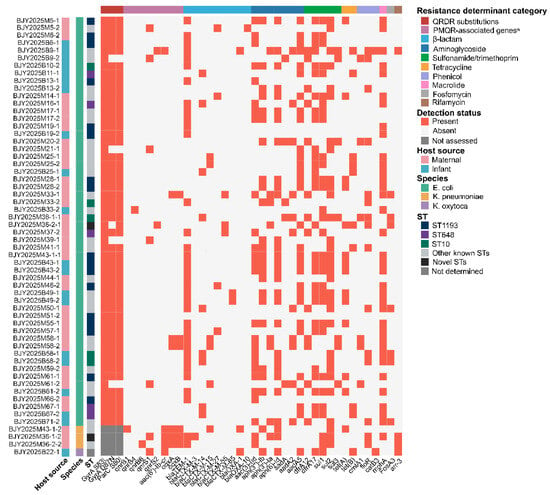
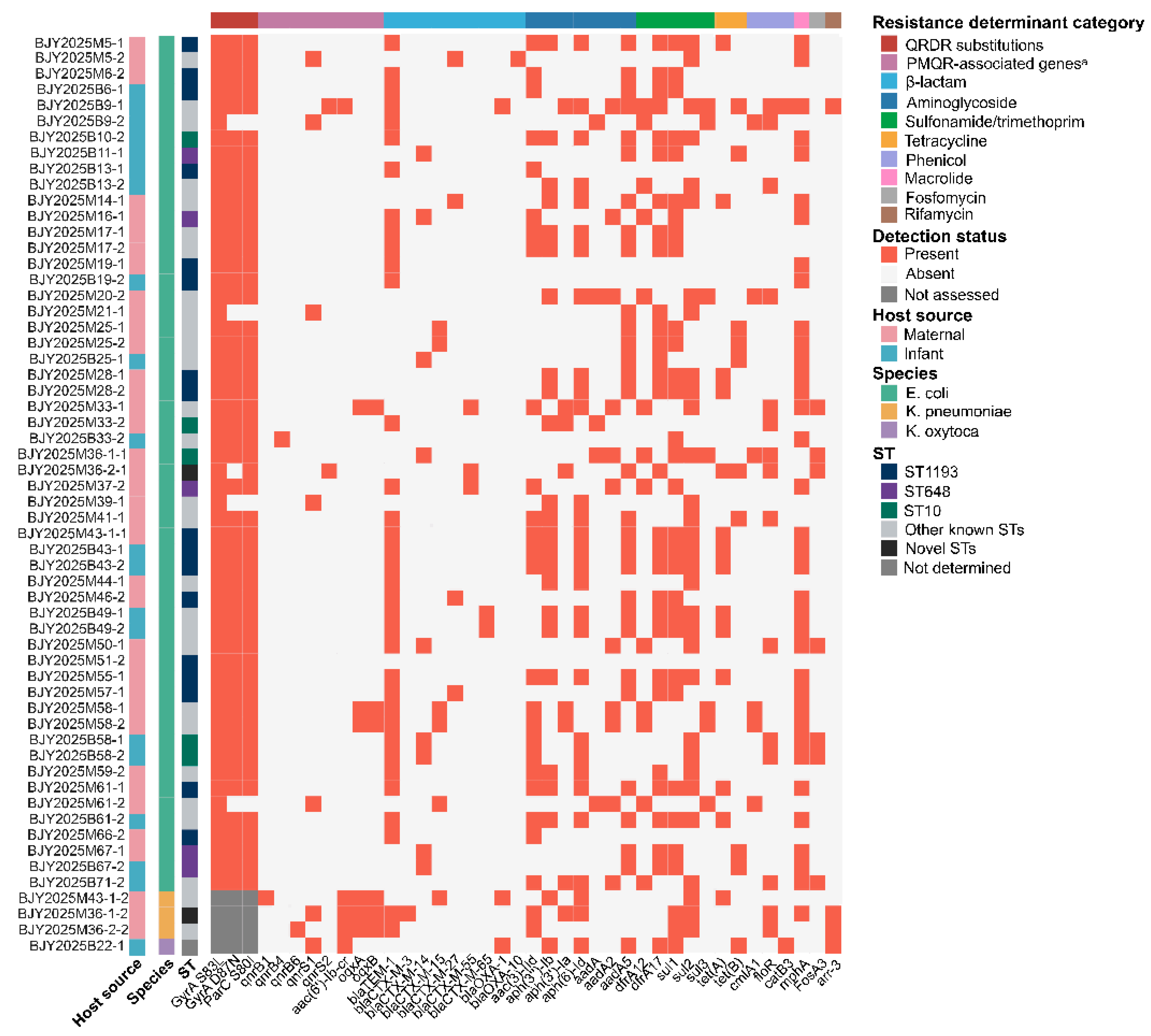
Isolate-level sequencing and assembly quality metrics for all 58 genomes, including estimated mean sequencing depth, contig number, N50, assembly size, GC content, completeness, and contamination, are provided in Supplementary Table S3. Across the 58 isolates, the most frequently detected resistance genes were associated with resistance to aminoglycosides, β-lactams, sulfonamides, and trimethoprim. No screened carbapenemase, mobile colistin resistance (mcr), or TGC resistance gene was identified. ESBL genes occurred in 27 isolates (46.55%). Of these, 26 (44.83% of all isolates) carried blaCTX-M family genes: blaCTX-M-14 in nine isolates, blaCTX-M-15 in six, blaCTX-M-27 and blaCTX-M-55 in four each, blaCTX-M-65 in two, and blaCTX-M-3 in one. One additional K. pneumoniae isolate carried blaSHV-28. Fifteen isolates (25.86%) met the study definition of PMQR positivity. For this classification, an isolate was considered PMQR positive if it carried at least one screened qnr determinant, aac(6′)-Ib-cr, or oqxAB. However, because oqxAB commonly occurs on the chromosome of K. pneumoniae, oqxAB alone was not considered sufficient to classify this species as PMQR positive. The detected determinants included qnrS1, qnrS2, qnrB1, qnrB4, qnrB6, aac(6′)-Ib-cr, and oqxAB. Nine maternal isolates (15.52% of all isolates) co-carried ESBL and PMQR-associated genes: eight combined a blaCTX-M family gene with a PMQR-associated determinant, and one combined blaSHV-28 with such a determinant. Eight infant-derived isolates carried blaCTX-M family genes and four carried PMQR-associated genes, but none carried both. Other frequent detections included mphA [36/58 (62.07%)], blaTEM-1 [35/58 (60.34%)], sul1 and sul2 [31/58 each (53.45%)], aadA5 and dfrA17 [30/58 each (51.72%)], aph(6)-Id [29/58 (50.00%)], and aac(3)-IId [26/58 (44.83%)] (Figure 1). The observed overlap between ESBL and PMQR-associated determinants was confined to maternal isolates in this collection. Because 38 maternal and 20 infant isolates were available and recovery was conditional on CIP selection, this difference was descriptive and did not establish a biological difference between mothers and infants. A comparison of acquisition risks would require a design that accounts for the number of samples, isolate selection, potential within-dyad correlation, and relevant exposures.
Figure 1.
Host sources, species, sequence types, and resistance determinants among 58 ciprofloxacin-resistant Enterobacterales isolates. Each row represents one isolate. The annotation bars on the left indicate host source, species, and sequence type (ST), whereas the upper annotation bar indicates resistance determinant categories. Red, white, and gray cells indicate that the corresponding determinant was present, absent, or not assessed, respectively. Quinolone resistance-determining region (QRDR) substitutions were assessed only in Escherichia coli. Because oqxAB is usually chromosomally encoded in Klebsiella pneumoniae, its detection in this species alone was not considered evidence of plasmid-mediated quinolone resistance (PMQR). Chromosomal oqxAB in K. pneumoniae is displayed for completeness but does not by itself confer PMQR-positive status; in this species, status was assigned using acquired determinants such as qnr or aac(6′)-Ib-cr.
The 54 E. coli isolates represented 23 assigned STs and one unassigned profile. ST1193 accounted for 17 isolates (31.48%; 12 maternal and five infant-derived), making it the most frequent lineage. Ten of the 17 ST1193 isolates (58.82%) belonged to serogroup O75. ST648 and ST10 each accounted for five isolates (9.26%). Every ST1193 isolate carried the GyrA S83L/D87N and ParC S80I substitutions; none carried a screened PMQR-associated gene. Conversely, all 15 PMQR-positive isolates belonged to non-ST1193 backgrounds; thus, the ST1193 and PMQR-positive isolate groups were non-overlapping in this cohort. The three K. pneumoniae isolates had ST–capsular-locus combinations ST2310–KL39.1, ST14–KL16.1, and unassigned ST–KL118, respectively (Figure 1).
All 54 E. coli isolates carried at least one of the prespecified QRDR substitutions. GyrA S83L occurred in 54/54 (100.00%), GyrA D87N in 49/54 (90.74%), and ParC S80I in 50/54 (92.59%); 49/54 (90.74%) carried the complete three-substitution pattern, including all 17 ST1193 isolates. Among the 15 isolates designated PMQR positive, seven carried a single qnr gene (qnrS1 in five, qnrS2 in one, and qnrB4 in one), three carried oqxAB alone, and two carried both a qnr gene and aac(6′)-Ib-cr (one qnrS1 and one qnrS2). Three further K. pneumoniae isolates carried a qnr gene plus aac(6′)-Ib-cr and were also oqxAB positive; the qnr variants were qnrB1, qnrS1, and qnrB6, respectively. Because oqxAB commonly occurs on the K. pneumoniae chromosome, that locus alone was not used to assign PMQR status in this species. Overall, the 15 PMQR-positive isolates comprised 11 E. coli and four Klebsiella spp.; all 11 PMQR-positive E. coli also carried QRDR substitutions (Figure 1).
3.3. Distribution of Selected Virulence-Associated Genes in CIP-Resistant E. coli
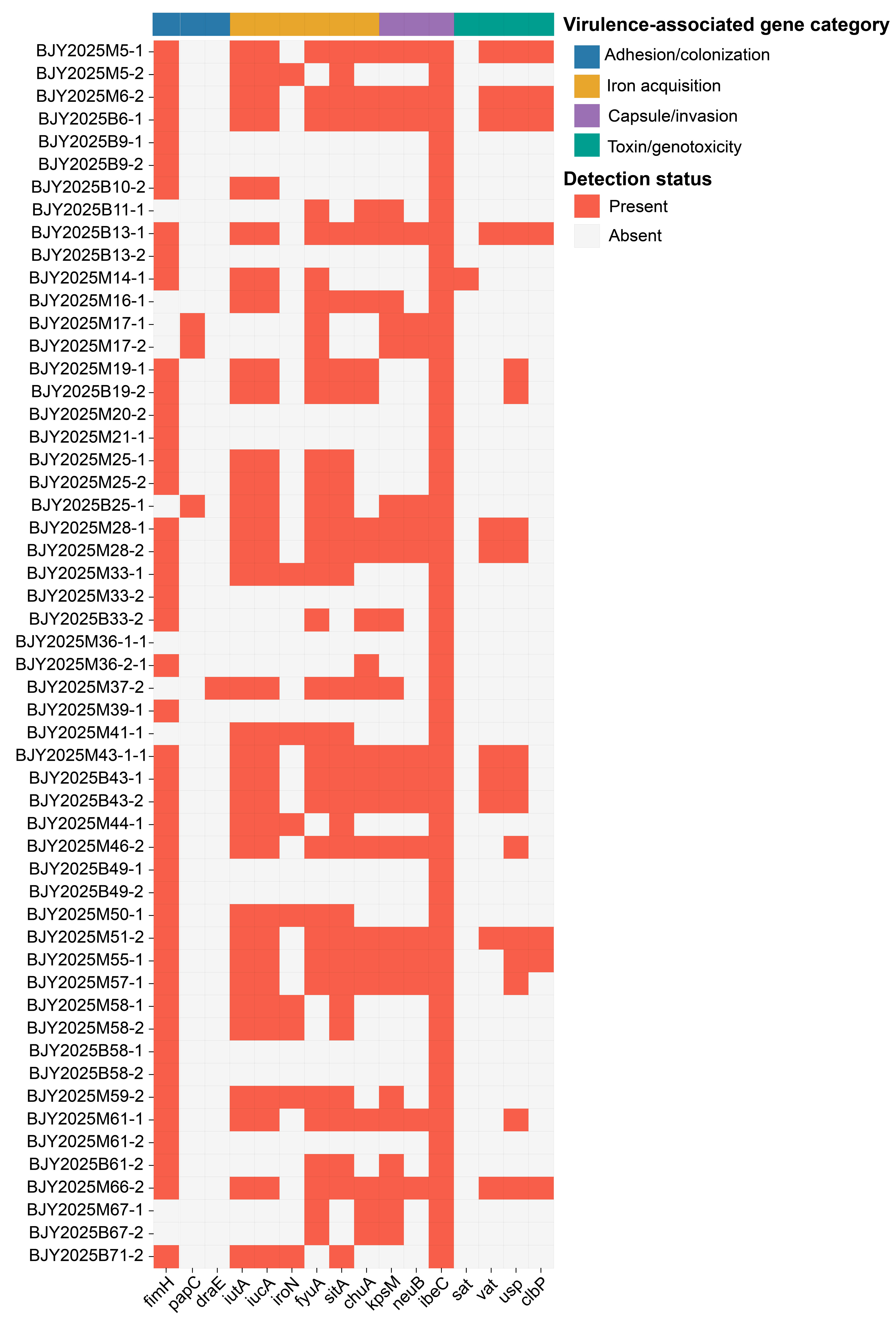
For visualization, we selected 16 virulence-associated genes detected among the 54 E. coli isolates and grouped them into four functional categories: adhesion and colonization, iron acquisition, capsule formation and invasion, and toxin production and genotoxicity.
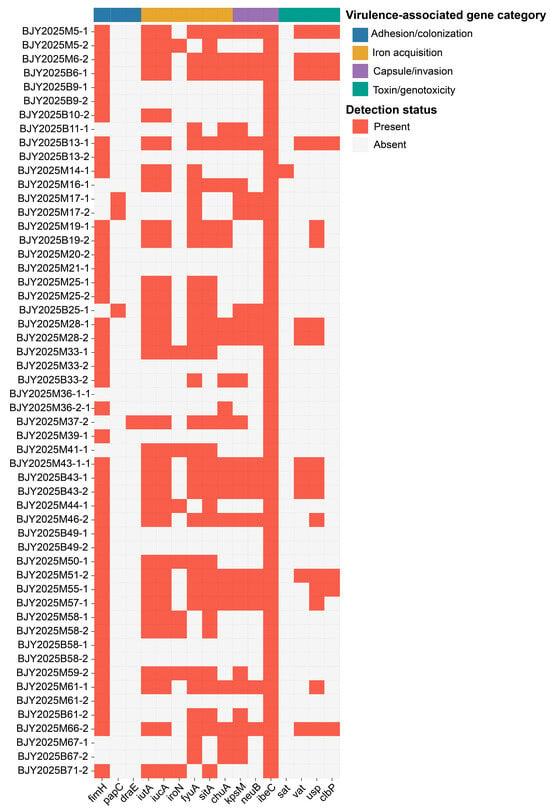
At least one selected adhesion or colonization gene (fimH, papC, or draE) was present in 48 isolates (88.89%), and at least one selected iron acquisition gene (fyuA, iutA, iucA, sitA, chuA, or iroN) was present in 41 (75.93%). Among adhesion genes, fimH predominated [44/54 (81.48%)], compared with papC [3/54 (5.56%)] and draE [1/54 (1.85%)]. Iron acquisition genes included fyuA [34/54 (62.96%)], iutA and iucA [33/54 each (61.11%)], sitA [32/54 (59.26%)], chuA [24/54 (44.44%)], and iroN [9/54 (16.67%)]. The capsule or invasion-associated gene ibeC was detected in all isolates, whereas kpsM and neuB were detected in 26/54 (48.15%) and 18/54 (33.33%), respectively. Eighteen isolates (33.33%) carried at least one selected toxin or genotoxicity gene. The individual frequencies were 17/54 (31.48%) for usp, 11/54 (20.37%) for vat, 7/54 (12.96%) for clbP, and 1/54 (1.85%) for sat; six isolates (11.11%) carried usp, vat, and clbP together (Figure 2). These figures describe the presence of selected annotated genes, not their expression, activity, or ability to produce clinical disease. Functional categories can overlap within an individual genome, and summing category counts would therefore overestimate the number of unique isolates with any selected virulence-associated gene. The gene-distribution visualization should be interpreted as a comparative gene-distribution profile rather than a direct measurement of pathogenic potential.
Figure 2.
Distribution of selected virulence-associated genes among 54 ciprofloxacin-resistant Escherichia coli isolates. Each row represents one isolate, and each column represents a selected virulence-associated gene. The annotation bar at the top indicates the functional category of each gene, including adhesion/colonization, iron acquisition, capsule/invasion, and toxin/genotoxicity. Red and light-gray cells indicate the presence and absence of the corresponding gene, respectively.
3.4. cgMLST Relatedness Within ST1193, Mother–Infant Pairs, and Longitudinal Samples
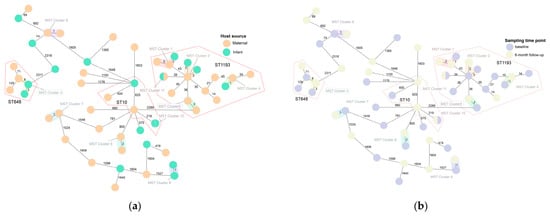
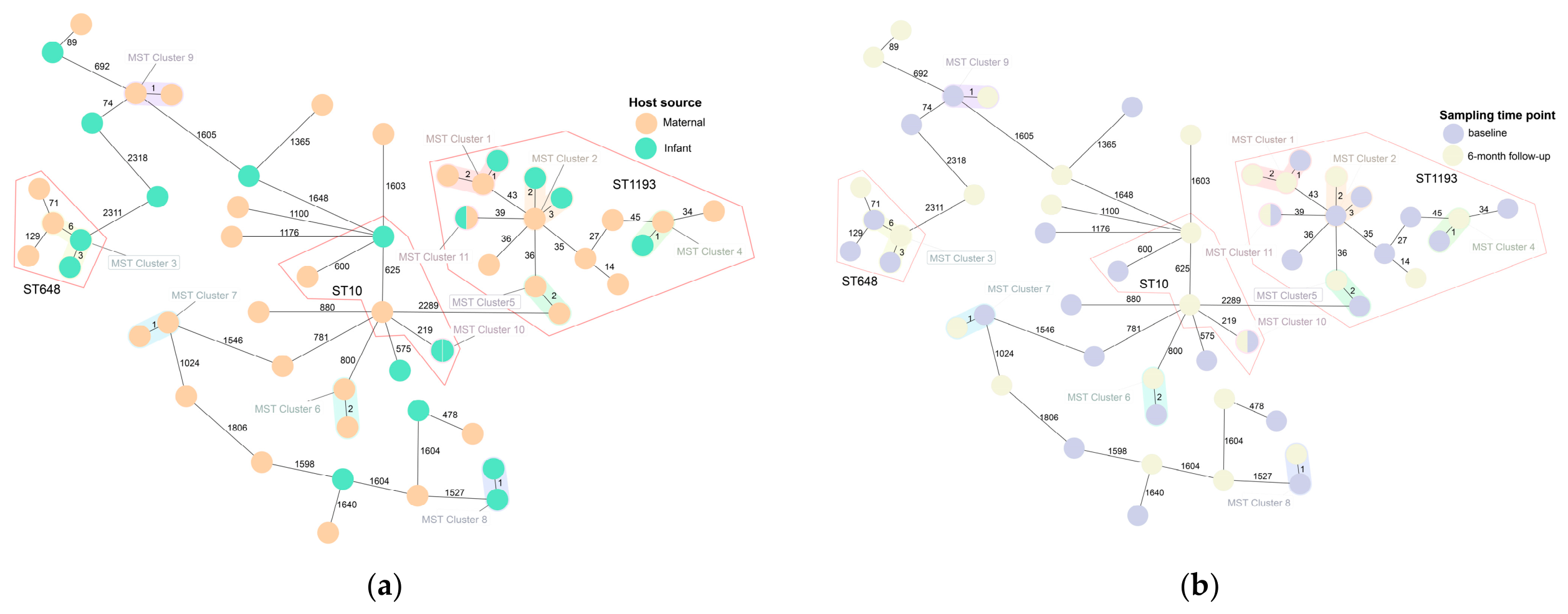
The 54 E. coli genomes yielded 52 distinct cgMLST allelic profiles. At the operational cutoff of ≤10 allele differences, 25 isolates (46.30%) belonged to 11 closely related clusters and 29 (53.70%) remained unclustered. Twelve of 17 ST1193 isolates (70.59%) were distributed among five such clusters; the other five were unclustered. Three of the five ST1193 clusters included isolates from a mother and infant in the same family, and one included isolates from the same participant at both sampling times. Thus, the ST1193 isolates appeared in several genetically distinct clusters rather than a single dominant cluster (Figure 3). The cutoff defines an analytical grouping rather than a biological boundary between transmitted and unrelated strains. Allelic distances can depend on the set of callable loci, assembly quality, sampling density, and the diversity of the circulating lineage. Consequently, even identical cgMLST profiles were interpreted as evidence of close genomic relatedness within this scheme rather than proof of direct transmission between hosts.
Figure 3.
Minimum spanning trees (MSTs) based on core-genome multilocus sequence typing (cgMLST) of 54 ciprofloxacin-resistant Escherichia coli isolates. (a) Nodes colored by host source (mother or infant). (b) Nodes colored by sampling time point (baseline or 6-month follow-up). Each node represents a unique cgMLST allelic profile and may contain one or more isolates; differently colored sectors within a node represent isolates sharing the same allelic profile but belonging to different groups. Numbers on the connecting edges indicate allelic differences. MST clusters 1–11 represent groups of closely related isolates defined using a cutoff of ≤10 allelic differences. Red frames enclose nodes assigned to the same sequence type (ST).
In eight families, E. coli was recovered from both the mother and infant. Four families (50.00%) had at least one mother–infant isolate pair in the same closely related cluster. The pair in one family had identical cgMLST allelic profiles (distance, 0); minimum pairwise distances in the other three families ranged from one to six alleles (Figure 3a).
E. coli was detected at both sampling times in 13 participants. Isolates from seven of these individuals (53.85%) belonged to the same closely related cluster. One pair had identical cgMLST profiles (distance, 0), while the remaining six pairs differed at one or more alleles (Figure 3b). The isolate identifiers, sampling points, sequence types, and pairwise cgMLST allelic distances for these mother–infant and longitudinal comparisons are summarized in Supplementary Table S4.
3.5. Genetic Context, Plasmid Architecture, and in Vitro Transfer of PMQR Determinants
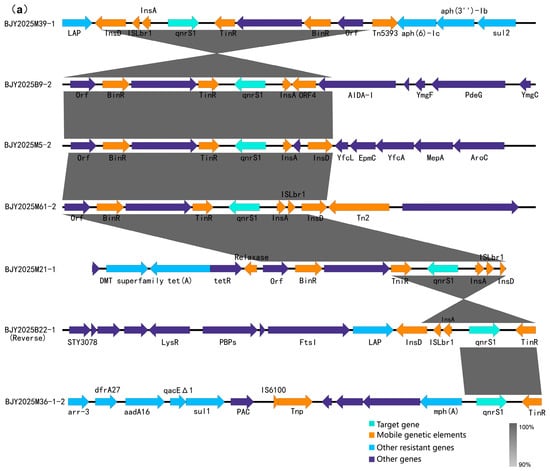
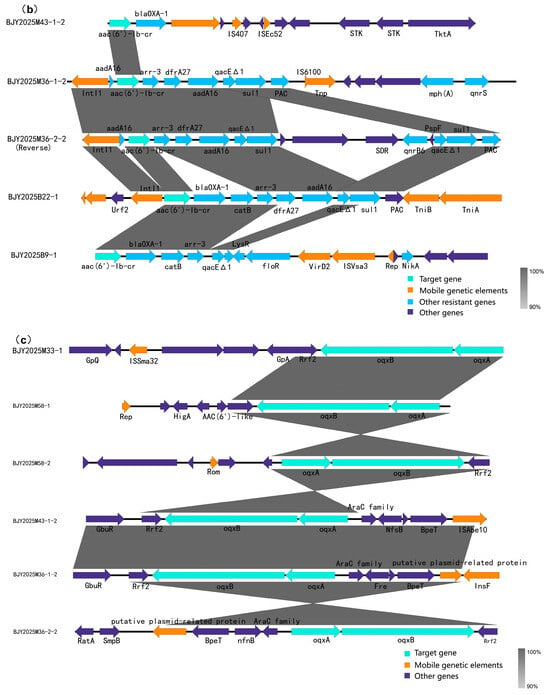
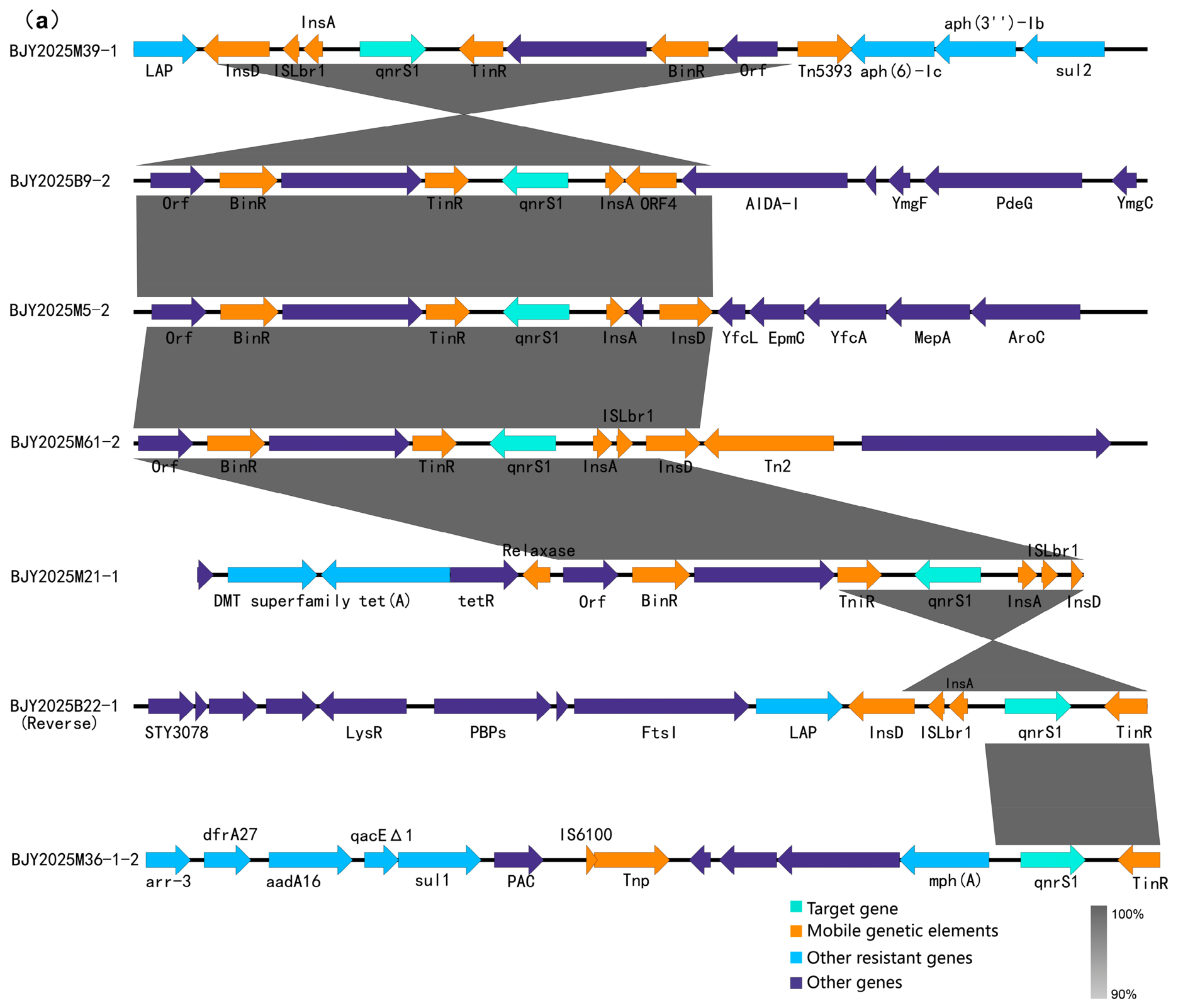
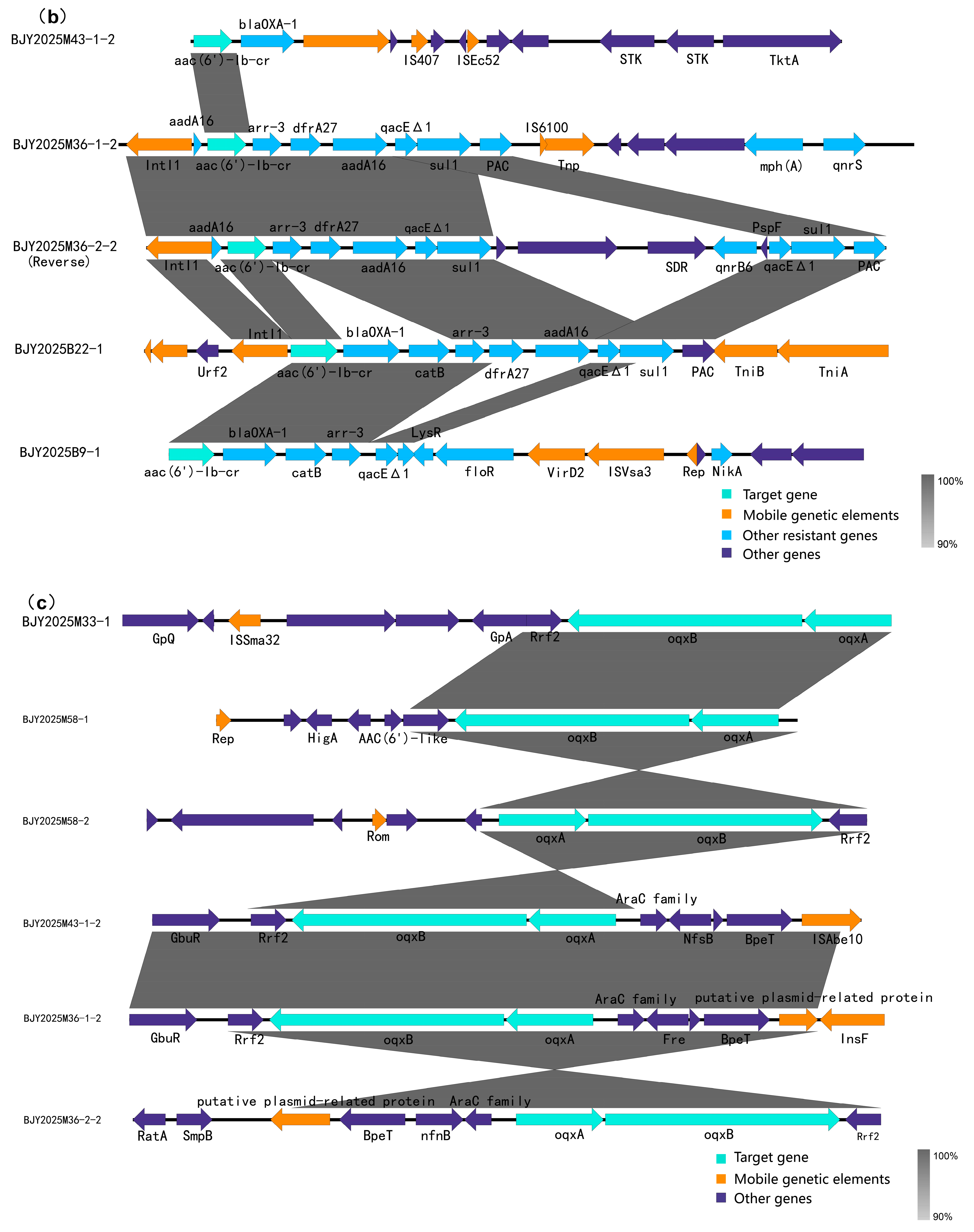
Across isolates, the qnrS1 neighborhood retained a core arrangement of recombinase genes, qnrS1, and insertion-sequence-associated genes, although adjacent resistance genes and mobile elements varied. The aac(6′)-Ib-cr locus frequently lay near blaOXA-1, catB, arr, and class 1 integron-associated structures. The oqxAB-containing core was more conserved, with most observed differences involving regulatory genes and flanking insertion sequences (Figure 4). These local similarities point to shared resistance-region architecture but cannot alone specify a route of dissemination.
Figure 4.
Comparative genetic contexts of representative plasmid-mediated quinolone resistance (PMQR)-associated genes. (a) qnrS1; (b) aac(6′)-Ib-cr; and (c) oqxAB. Arrows indicate genes and their orientations, with colors denoting functional categories. Gray shading indicates homologous regions, with shading intensity corresponding to 90–100% nucleotide sequence identity. “Reverse” indicates that the sequence is displayed in reverse-complement orientation. Because oqxAB is generally chromosomally encoded in Klebsiella pneumoniae, its presence alone was not considered evidence of PMQR positivity.
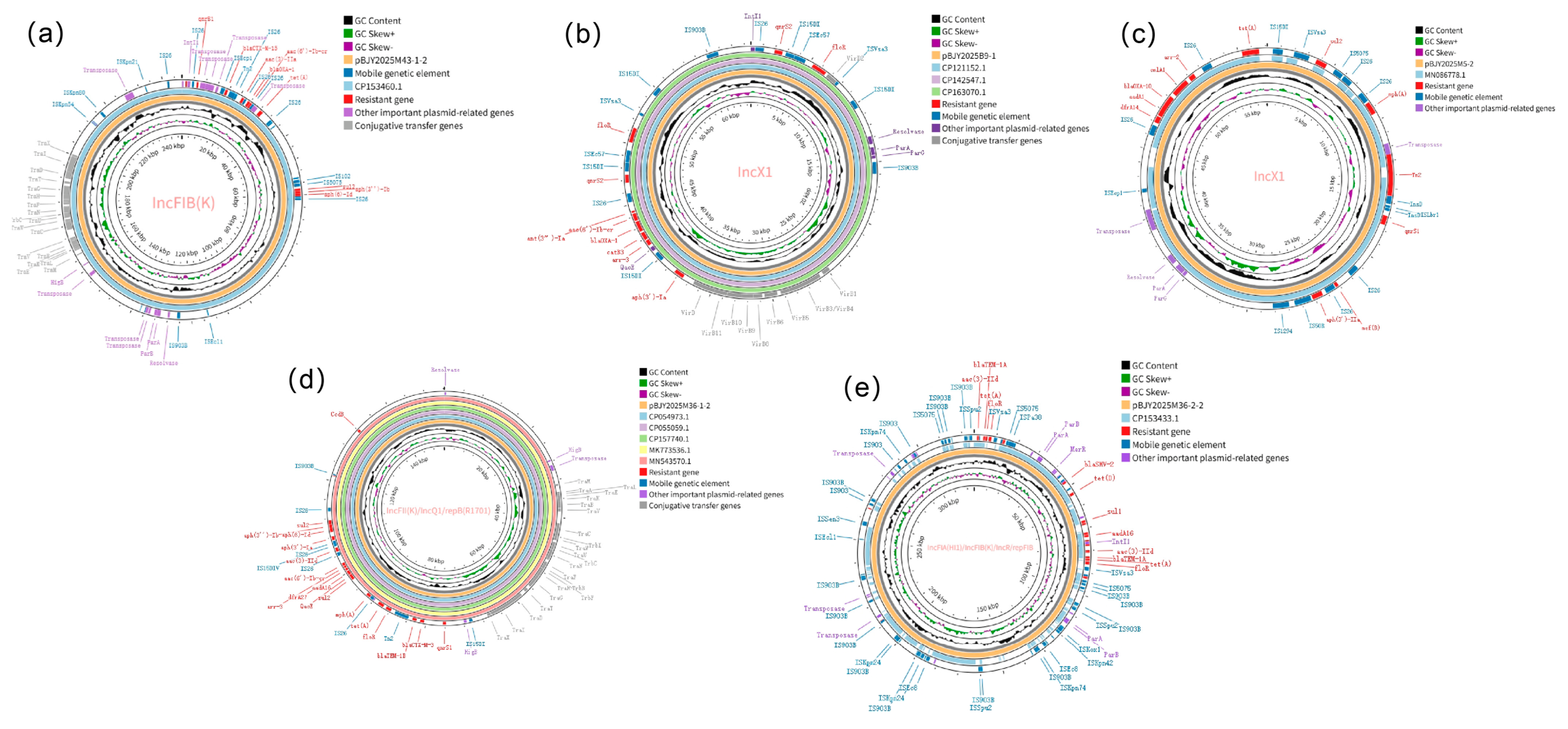
The 246,404 bp plasmid pBJY2025M43-1-2 carried an IncFIB(K) replicon and nine listed resistance genes: qnrB1, aac(6′)-Ib-cr, blaCTX-M-15, blaOXA-1, sul2, tet(A), aac(3)-IIa, aph(3″)-Ib, and aph(6)-Id. qnrB1 was adjacent to IS26 and transposase-coding sequences; aac(6′)-Ib-cr and blaOXA-1 shared a region rich in IS26. A largely contiguous tra/trb gene cluster occurred in the backbone. Comparison with pNK_H18_074.1 (CP153460.1), reported from a blood-derived K. pneumoniae isolate in Norway in 2018, yielded 100.00% query coverage and 100.00% nucleotide identity (Figure 5a). This sequence match established close plasmid similarity but could not establish a direct epidemiological linkage between the isolates.
Figure 5.
Structural features of five closed circular plasmids carrying PMQR-associated genes and sequence comparisons with reference plasmids. (a) pBJY2025M43-1-2; (b) pBJY2025B9-1; (c) pBJY2025M5-2; (d) pBJY2025M36-1-2; and (e) pBJY2025M36-2-2. Concentric rings show sequence similarity between the study and reference plasmids, and the inner plots show GC content and GC skew. Genes are colored according to functional category, as indicated in the legends.
The 63,503 bp IncX1 plasmid pBJY2025B9-1 carried both qnrS2 and aac(6′)-Ib-cr. Two sequence-identical 18,663 bp repeats each contained the arrangement qnrS2–IS26–IS15DI–ISEc57–floR, giving the plasmid two copies each of qnrS2 and floR. A separate resistance region contained aph(3′)-Ia, arr-3, catB3, blaOXA-1, aac(6′)-Ib-cr, and other genes. A virB/virD-related type IV secretion system gene cluster occurred in the backbone. Comparisons with three reference plasmids yielded 100.00% query coverage and 99.97% nucleotide identity in each case: pA409_p1 (CP142547.1) from a porcine heart sample in Hubei, pE47-1 (CP121152.1) from a bovine source in Hebei, and pW137_3 (CP163070.1) from a patient’s urine sample in Kunming (Figure 5b).
The 57.1 kb IncX1 plasmid pBJY2025M5-2 carried qnrS1 as its only identified PMQR-associated gene, together with blaOXA-10, sul2, tet(A), aph(3′)-IIa, dfrA14, aadA1, cmlA1, and arr-2. The larger plasmid pBJY2025M36-1-2 (152,226 bp) carried IncFII(K), IncQ1, and repB(R1701) replicon markers, as well as qnrS1, aac(6′)-Ib-cr, blaCTX-M-3, blaTEM-1B, aph(3′)-Ia, aph(6)-Id, aph(3″)-Ib, aac(3)-IId, floR, tet(A), sul2, and arr-3. Its backbone also contained a largely contiguous tra/trb cluster associated with conjugative transfer (Figure 5c,d).
The 325,510 bp plasmid pBJY2025M36-2-2 carried IncFIA(HI1), IncFIB(K), IncR, and repFIB replicon markers. Its resistance gene complement included qnrB6, aac(6′)-Ib-cr, blaTEM-1A, blaSHV-2, aph(3″)-I, aac(3)-IId, aadA16, tet(A), tet(D), floR, and sul2. IS903/IS903B, IS26, and class 1 integron-associated structures were abundant in its resistance regions. Against the K. pneumoniae plasmid pNK_H22_027.1 (CP153433.1), recovered from a patient’s blood in Norway in 2017, it showed 54% query coverage and 99.99% nucleotide identity across the aligned portion (Figure 5e).
After mating each of four representative donor isolates with sodium azide-resistant E. coli J53, colonies positive by PCR for the respective PMQR target gene were recovered in all four donor–recipient pairings. Each donor–recipient pairing was tested in three independent biological replicates. Donor-level mean apparent endpoint transfer frequencies ranged from 4.46 × 10⁻⁷ to 3.69 × 10⁻⁶. Mean frequencies were (3.69 ± 1.39) × 10−6 for BJY2025M43-1-2, (7.89 ± 1.81) × 10−7 for BJY2025M36-1-2, (5.21 ± 1.82) × 10−7 for BJY2025M5-2, and (4.46 ± 1.23) × 10−7 for BJY2025B9-1. Values represent the arithmetic mean ± standard deviation of the three replicate-specific frequencies. Across the 12 independent mating experiments, the replicate-specific frequency detection limits ranged from 3.37 × 10⁻⁸ to 1.64 × 10⁻⁷, and all 12 replicate-specific frequencies exceeded their corresponding detection limits. For each donor, the reported value represents the arithmetic mean of the three replicate-specific frequencies. These results demonstrate recovery of the corresponding PMQR target genes in PCR-positive recipient-selected colonies obtained under J53-selective conditions. However, target-gene PCR does not establish intact transfer of the complete PMQR-bearing plasmid(s) present in the tested donors. The reported apparent endpoint target-gene recovery frequencies therefore refer to target-gene recovery from the four donor–recipient pairings rather than plasmid-specific transfer events. Where a donor carried multiple plasmids or other potential genetic contexts, PCR alone could not assign the recovered determinant to a specific plasmid. Plasmid profiling or plasmid-resolved sequencing of representative recipient-selected colonies would be required to determine whether complete plasmids were transferred and to resolve the structures of the transferred genetic elements.
4. Discussion
The phenotypic and genomic data were broadly concordant for several antimicrobial classes, while also exposing important limits of gene-based prediction. Frequently detected β-lactamase genes accompanied the high AMP and CTX resistance rates, and the distributions of sulfonamide resistance (sul) and trimethoprim resistance (dfrA) genes were consistent with resistance to the combination agent. At the isolate level, 33/43 isolates with STR MICs ≥32 µg/mL carried at least one of aph(3″)-Ib, aph(6)-Id, or aadA5. Because no applicable clinical MIC breakpoint was available for STR in the E. coli and Klebsiella isolates, this MIC category was used descriptively and was not interpreted as clinical resistance. Four of five AMK-resistant isolates carried at least one screened aminoglycoside-modifying enzyme gene, although gene presence alone did not establish the mechanism underlying the AMK phenotype. Among the 47 TET-resistant isolates, 22 carried tet(A) and/or tet(B), whereas 25 carried neither gene; one TET-susceptible isolate carried tet(A). These incomplete genotype–phenotype correspondences may reflect differences in gene expression and substrate specificity, as well as resistance mechanisms not captured by the genomic analysis. A WGS study of 234 E. coli isolates has also documented genotype–phenotype discordance [30]. Accordingly, genomic resistance profiles describe the potential resistance repertoire but should be interpreted alongside measured susceptibility to each drug. This distinction is relevant to the aggregate resistance patterns in Table 1 and the isolate-level MIC data in Supplementary Table S2: the relative scarcity of AMK resistance cannot be inferred from the number of annotated aminoglycoside-related genes alone, because gene family names do not specify activity against every member of the class. Similarly, the absence of a cataloged resistance gene does not exclude uncharacterized regulatory changes. Investigating discordant isolates individually, with their MICs and genome assemblies available, would sharpen the mechanistic account. Resistance to CZA, ETP, and COL was confirmed by repeat broth microdilution testing, although some resistant isolates lacked corresponding acquired resistance determinants. Altered β-lactamase expression or efflux may contribute to CZA resistance [31], whereas ETP resistance may result from β-lactamase activity combined with the loss of outer-membrane porins [32]. COL resistance in the absence of an mcr gene may be mediated by chromosomal alterations affecting lipid A modification pathways, including mutations in pmrB in E. coli [33]. Because these mechanisms were not experimentally tested in the present study, they remain possible explanations rather than established mechanisms.
The fluoroquinolone data point to a prominent chromosomal resistance background. QRDR substitutions can confer substantial CIP resistance in E. coli, whereas PMQR-associated genes generally produce smaller effects when present alone [7,8]. Every E. coli isolate in this selected collection carried a prespecified QRDR substitution, and all 11 E. coli isolates with PMQR-associated genes also carried such substitutions. This combination is consistent with QRDR changes contributing to the observed resistant phenotype and PMQR determinants providing an additional potential mechanism; the relative contribution of each determinant cannot be established without isogenic or expression-based experiments. In fecal isolates from hospitalized children, all 17 E. coli isolates with fluoroquinolone MICs >32 μg/mL carried multiple QRDR substitutions, and 14 also carried PMQR-associated genes; isolates with PMQR-associated genes alone had lower MICs [7]. Although that study selected ESBL-positive isolates and our study selected CIP-resistant isolates from mother–infant dyads, both document the coexistence of chromosomal and acquired quinolone resistance mechanisms in the gut. Their frequencies should not be assumed comparable across these different sampling frames.
The interpretation of oqxAB illustrates why gene presence must be separated from genomic location. The oqxAB efflux locus is ordinarily chromosomal in K. pneumoniae, and its detection alone neither indicates plasmid acquisition nor proves a contribution to the CIP phenotype. Effects on susceptibility may depend on regulators, including oqxR and rarA, as well as coexisting QRDR substitutions. Nonetheless, IS26-associated capture of chromosomal oqxABR, formation of a Tn6010-like unit bounded by IS26, and incorporation of this region into a conjugative plasmid have previously been reported [34]. This provides a relevant structural precedent but does not demonstrate that the same process occurred in the isolates examined here. Determining whether an oqxAB locus is mobilized thus requires complete-sequence localization, examination of its IS26 and Tn6010-like boundaries, and, where appropriate, functional evidence. This distinction is especially important when classifying PMQR positivity in Klebsiella.
ST1193 represented nearly one-third of the CIP-resistant E. coli isolates in this cohort [17/54 (31.48%)], making it the most frequent ST under the study’s selection conditions. Every ST1193 isolate shared GyrA S83L/D87N and ParC S80I substitutions, whereas none carried a screened PMQR-associated determinant. This genomic pattern is consistent with a chromosomally encoded basis for CIP resistance in the sampled ST1193 isolates, although it does not establish the contribution of each substitution experimentally. Nor does their frequency among selectively recovered isolates estimate ST1193 prevalence in the wider mother–infant gut microbiota. Longitudinal work in healthy women has linked ST1193 intestinal carriage to persistence and increased bacteriuria incidence [35]. In a global analysis, 339 of 707 ST1193 genomes originated from extraintestinal infection sites [9], and neonatal early-onset infections, including meningitis, have also involved this lineage [11]. Together, these findings make intestinal carriage clinically relevant as a potential source of exposure to an infection-associated lineage; they do not imply that the carriers in this cohort developed infection. The selection medium further enriches for organisms that meet the CIP resistance criterion; the proportion of ST1193 among recovered E. coli should therefore be described in relation to that selected set. Whether ST1193 is similarly frequent among all E. coli carried by these participants cannot be answered without parallel nonselective culture or culture-independent lineage quantification. This sampling distinction is essential when placing the finding beside carriage estimates from other settings.
The family-level genomic relationships suggest opportunities for strain sharing, but their interpretation requires care. Four of eight families with E. coli recovered from both members had at least one mother–infant pair within the study’s ≤10-allele cgMLST threshold, including one pair indistinguishable at the typed loci. Close contact plausibly facilitates exchange, while strain-specific capacity to colonize the gut may determine whether exposure leads to detectable carriage. In longitudinal work, maternally derived strains persist more often in infants, and persistent E. coli are enriched for adhesion and iron-acquisition functions [36]. Yet maternal intestinal carriage explains only some infant acquisitions of ESBL-producing Enterobacterales in another cohort [5]. The related pairs observed here are therefore compatible with household sharing, acquisition from another family member or a shared environment, and independent acquisition of a circulating clone. Because neither other household members nor environmental sources were sampled, and only two sampling rounds were available, the data cannot resolve source or direction. The strongest supported conclusion is that closely related resistant E. coli occurred within several dyads.
Repeated recovery from the same individual supplies a complementary temporal view: seven of 13 participants with E. coli at both sampling points yielded isolates in the same closely related cgMLST cluster. These observations are compatible with carriage of a related strain across 6 months, but clearance followed by reacquisition remains possible. Prior longitudinal work has associated the initial abundance of resistant bacteria and strain genetic background with detection at six months [37]; another study has linked maternal carriage with later CIP-resistant E. coli detection in children without finding a corresponding association for recent antimicrobial use [38]. Both results support the plausibility of sustained or renewed household exposure, rather than determining which occurred here. Serial samples at shorter intervals, together with household and environmental sampling, would distinguish sustained colonization from repeated introduction more reliably. Until then, the finding is best described as longitudinal detection of closely related isolates.
Across the five resolved PMQR-bearing plasmids, replicon composition varied, whereas IS26 occurred in each and mobile-element-associated resistance regions were prominent. These are structural genomic observations that document the co-occurrence of IS26 and resistance determinants on different plasmid backbones; they do not independently demonstrate that IS26 mobilized these determinants or generated the observed arrangements. On pBJY2025B9-1, two identical 18,663 bp segments each contained qnrS2 and floR, documenting two copies of the same resistance-containing segment in the resolved plasmid sequence without identifying the mechanism or timing by which they arose. An earlier report has described three tandem copies of an IS26-associated qnrB19-bearing composite transposon in an E. coli plasmid [39], offering a structural precedent for a similar architecture but not evidence that the same mechanism operated here. The colocation of aac(6′)-Ib-cr with blaOXA-1, catB3, and arr-3 also raises the possibility that selection by other antimicrobial classes could maintain a PMQR-bearing region. Some database matches cover nearly an entire plasmid, whereas others cover only local resistance regions. Thus, both intact-plasmid circulation and movement or rearrangement of smaller modules remain alternative hypotheses compatible with the sequence data, but sequence similarity alone cannot distinguish them or establish epidemiological transmission. IS26 is a recurrent feature of the resolved plasmids, but observing it in every sequence does not establish that IS26 generated each present-day arrangement. Likewise, recovery of target-gene-positive recipient-background colonies in the conjugation assays supports in vitro transfer of the assayed PMQR determinants but neither identifies IS26 as the mediator nor confirms transfer of an entire donor plasmid. Comparative boundaries, target-site signatures, and experimentally resolved rearrangements would be needed to test specific pathways. Equally, similarity to animal- or human-derived reference sequences across distant locations identifies shared genetic material but does not establish when or through which hosts that material circulated. These limits make the structural observations informative without requiring an unsupported source attribution.
The mating experiments provide functional evidence that the targeted PMQR-associated determinants can be recovered in a recipient background under the conditions tested. PCR-positive colonies followed mating with each of four donors, and apparent endpoint frequencies were on the order of 10−7–10−6, near the lower end of the range reported by Chen et al. [40]. These endpoints reflect more than transfer initiation: recipient survival, establishment and maintenance of acquired DNA, selective culture, and the calculation denominator can all affect their values. They should therefore not be interpreted as intrinsic plasmid conjugation rates. Target genes were recovered in recipient-selected colonies after matings involving K. pneumoniae donors and the E. coli J53 recipient, but this observation alone does not establish the structure or extent of the genetic material recovered. Target-gene PCR cannot determine whether an intact annotated donor plasmid, a complete resistance region, or only a smaller genetic fragment was present, nor can it establish whether neighboring resistance genes were co-transferred or whether subsequent recombination occurred. Plasmid-resolved sequencing of representative recipient-selected colonies would be required to define the recovered genetic contexts and determine whether complete plasmids, complete resistance regions, or linked resistance determinants were present.
5. Limitations
Several limitations should be acknowledged. First, the single-center design, ciprofloxacin-selective culture, and limited number of colonies analyzed per positive sample may have underestimated within-sample clonal diversity and limited the generalizability of the findings. Because this approach intentionally enriched for CIP-resistant organisms and did not include parallel nonselective culture, the reported resistance profiles and MDR prevalence apply only to the selectively recovered isolate collection and should not be extrapolated to the overall intestinal Enterobacterales population. Likewise, the observed proportion of ST1193 applies only to the recovered CIP-resistant E. coli isolates and does not estimate its prevalence among all intestinal E. coli carried by the participants. Second, sampling at only two time points and the use of an operational, scheme- and context-dependent ≤10-allele cgMLST threshold allowed identification of closely related isolates but could not distinguish persistent colonization from reacquisition or establish direct transmission or its direction within families. Because complementary reference-based SNP analysis was not performed, the identified clusters should be interpreted as evidence of close genomic relatedness rather than confirmed transmission. Higher-resolution SNP analysis, denser longitudinal sampling, and more detailed epidemiological contact data would strengthen these inferences. Finally, PCR-based testing documented recovery of the target PMQR genes in recipient-selected colonies but did not establish the identity of those colonies independently of selection or confirm transfer of the complete plasmids or associated resistance regions.
6. Conclusions
In this selectively cultured mother–infant cohort, ST1193 was the most frequently recovered ST among the CIP-resistant E. coli isolates, and all recovered ST1193 isolates shared a characteristic three-substitution QRDR pattern. Closely related E. coli appeared within some mother–infant pairs and were detected at both sampling points in some individuals, documenting closely related strains within families and across the two sampling points without establishing transmission direction or uninterrupted carriage. The five closed PMQR-positive plasmids showed replicon and resistance-cargo diversity but all contained IS26, and four donors yielded target-gene-positive recipient-background colonies in vitro. Together, these results define two complementary but distinct findings in the mother–infant gut: frequent recovery of ST1193 with a conserved QRDR pattern and PMQR determinants in non-ST1193 backgrounds, some showing in vitro transfer potential. Expanded household sampling and whole-genome sequencing of the recipient-background colonies will be necessary to clarify strain movement and determine whether complete PMQR-positive plasmids were transferred.
Supplementary Materials
The following supporting information can be downloaded at: https://www.mdpi.com/article/10.3390/microorganisms14112540/s1, Table S1A: Individual-level baseline demographic and epidemiological characteristics of the 61 participating mothers; Table S1B: Individual-level baseline demographic and epidemiological characteristics of the 61 participating infants; Table S2: Isolate-level minimum inhibitory concentrations of 17 antimicrobial agents for the 58 ciprofloxacin-resistant Enterobacterales isolates; Table S3: Isolate-level Illumina sequencing depth and draft genome assembly quality metrics for the 58 ciprofloxacin-resistant Enterobacterales isolates; Table S4: Isolate identifiers, sampling time points, sequence types, and pairwise cgMLST allelic distances for closely related mother–infant and longitudinal Escherichia coli isolate pairs.
Author Contributions
Y.W.: Sample collection, experimental work, original draft preparation. X.Y.: Manuscript review and editing. Z.L. and G.S.: Field investigation, sample collection, and experimental procedures. L.L. and Y.C.: Sample collection, methodology. S.W. (Shaoshuai Wu) and D.Q.: Field investigation, sample collection. S.W. (Shuang Wang) and Z.K.: Conceptualization, manuscript review and editing. All authors have read and agreed to the published version of the manuscript.
Funding
This work was supported by the Medical and Health Development Plan of Shandong Province (Grant Nos. 202312050986, 202412051230, and 202012051035), and the Natural Science Foundation of Shandong Province (Grant No. ZR2024MH289).
Institutional Review Board Statement
The study was conducted in accordance with the Declaration of Helsinki, and approved by the Ethics Committee of the Shandong Center for Disease Control and Prevention (Approval No. SDJK(K)2024-039-01; 2024-12-20).
Informed Consent Statement
Informed consent was obtained from all subjects involved in the study.
Data Availability Statement
The genomic data associated with this study are available from the NCBI under BioProject accession PRJNA1491628. The corresponding isolate records are registered under BioSample accession numbers SAMN61467969–SAMN61468040. The five PMQR-positive plasmid sequences are available in GenBank under accession numbers PZ735748–PZ735749 and PZ748760–PZ748762.
Conflicts of Interest
The authors declare no conflicts of interest.
References
- GBD 2021 Antimicrobial Resistance Collaborators. Global burden of bacterial antimicrobial resistance 1990–2021: A systematic analysis with forecasts to 2050. Lancet 2024, 404, 1199–1226. [Google Scholar] [CrossRef] [Scilit] [PubMed]
- Bogaert, D.; van Beveren, G.J.; de Koff, E.M.; Lusarreta Parga, P.; Balcazar Lopez, C.E.; Koppensteiner, L.; Clerc, M.; Hasrat, R.; Arp, K.; Chu, M.L.J.N.; et al. Mother-to-infant microbiota transmission and infant microbiota development across multiple body sites. Cell Host Microbe 2023, 31, 447–460.e6. [Google Scholar] [CrossRef] [Scilit] [PubMed]
- Carvalho, M.J.; Sands, K.; Thomson, K.; Portal, E.; Mathias, J.; Milton, R.; Gillespie, D.; Dyer, C.; Akpulu, C.; Boostrom, I.; et al. Antibiotic resistance genes in the gut microbiota of mothers and linked neonates with or without sepsis from low- and middle-income countries. Nat. Microbiol. 2022, 7, 1337–1347. [Google Scholar] [CrossRef] [Scilit] [PubMed]
- Chomkatekaew, C.; Thaipadungpanit, J.; Hearn, P.; Soeng, S.; Pol, S.; Neou, L.; Hopkins, J.; Turner, P.; Batty, E.M. Detection of maternal transmission of resistant Gram-negative bacteria in a Cambodian hospital setting. Front. Microbiol. 2023, 14, 1158056. [Google Scholar] [CrossRef] [Scilit] [PubMed]
- Beaumont, A.L.; de Lauzanne, A.; Criscuolo, A.; Fabre, L.; Rabenandrasana, M.A.N.; Randriamanga, N.F.; Bernabeu, S.; Harimanana, A.; Randremanana, R.V.; Herindrainy, P.; et al. Contribution of maternal gut carriage to neonatal acquisition of extended-spectrum beta-lactamase-producing Enterobacterales in Madagascar and Cambodia. Nat. Commun. 2025, 16, 10399. [Google Scholar] [CrossRef] [Scilit] [PubMed]
- Vatanen, T.; Jabbar, K.S.; Ruohtula, T.; Honkanen, J.; Avila-Pacheco, J.; Siljander, H.; Stražar, M.; Oikarinen, S.; Hyöty, H.; Ilonen, J.; et al. Mobile genetic elements from the maternal microbiome shape infant gut microbial assembly and metabolism. Cell 2022, 185, 4921–4936.e15. [Google Scholar] [CrossRef] [Scilit] [PubMed]
- Kibwana, U.O.; Manyahi, J.; Sandnes, H.H.; Blomberg, B.; Mshana, S.E.; Langeland, N.; Roberts, A.P.; Moyo, S.J. Fluoroquinolone resistance among fecal extended spectrum β-lactamase-positive Enterobacterales isolates from children in Dar es Salaam, Tanzania. BMC Infect. Dis. 2023, 23, 135. [Google Scholar] [CrossRef] [Scilit] [PubMed]
- Gomi, R.; Adachi, F. Quinolone resistance genes qnr, aac(6′)-Ib-cr, oqxAB, and qepA in environmental Escherichia coli: Insights into their genetic contexts from comparative genomics. Microb. Ecol. 2025, 88, 6. [Google Scholar] [CrossRef] [Scilit] [PubMed]
- Wyrsch, E.R.; Bushell, R.N.; Marenda, M.S.; Browning, G.F.; Djordjevic, S.P. Global phylogeny and F virulence plasmid carriage in pandemic Escherichia coli ST1193. Microbiol. Spectr. 2022, 10, e02554-22. [Google Scholar] [CrossRef] [Scilit] [PubMed]
- Wei, L.; Chen, Q.; Yang, L.; Ji, T.; Peng, W.; Shao, B.; Li, H. Emergence of ST1193 clone in maternal and neonatal ESBL-producing Escherichia coli isolates. Infect. Drug Resist. 2023, 16, 6681–6689. [Google Scholar] [CrossRef] [Scilit] [PubMed]
- Malaure, C.; Geslain, G.; Birgy, A.; Bidet, P.; Poilane, I.; Allain, M.; Liberge, M.; Khattat, N.; Sikias, P.; Bonacorsi, S. Early-onset infection caused by Escherichia coli sequence type 1193 in late preterm and full-term neonates. Emerg. Infect. Dis. 2024, 30, 20–28. [Google Scholar] [CrossRef] [Scilit] [PubMed]
- Pitout, J.D.D.; Peirano, G.; Chen, L.; DeVinney, R.; Matsumura, Y. Escherichia coli ST1193: Following in the footsteps of E. coli ST131. Antimicrob. Agents Chemother. 2022, 66, e00511-22. [Google Scholar] [CrossRef] [Scilit] [PubMed]
- Price, L.B.; Johnson, J.R.; Aziz, M.; Clabots, C.; Johnston, B.; Tchesnokova, V.; Nordstrom, L.; Billig, M.; Chattopadhyay, S.; Stegger, M.; et al. The epidemic of extended-spectrum-β-lactamase-producing Escherichia coli ST131 is driven by a single highly pathogenic subclone, H30-Rx. mBio 2013, 4, e00377-13. [Google Scholar] [CrossRef] [Scilit] [PubMed]
- Schaufler, K.; Semmler, T.; Wieler, L.H.; Trott, D.J.; Pitout, J.; Peirano, G.; Bonnedahl, J.; Dolejska, M.; Literak, I.; Fuchs, S.; et al. Genomic and functional analysis of emerging virulent and multidrug-resistant Escherichia coli lineage sequence type 648. Antimicrob. Agents Chemother. 2019, 63, e00243-19. [Google Scholar] [CrossRef] [Scilit] [PubMed]
- Roer, L.; Overballe-Petersen, S.; Hansen, F.; Schønning, K.; Wang, M.; Røder, B.L.; Hansen, D.S.; Justesen, U.S.; Andersen, L.P.; Fuglsang-Damgaard, D.; et al. Escherichia coli sequence type 410 is causing new international high-risk clones. mSphere 2018, 3, e00337-18. [Google Scholar] [CrossRef] [Scilit] [PubMed]
- Johnson, J.R.; Clabots, C.; Porter, S.B.; Bender, T.; Johnston, B.D.; Thuras, P. Intestinal persistence of colonizing Escherichia coli strains, especially ST131-H30, in relation to bacterial and host factors. J. Infect. Dis. 2022, 225, 2197–2207. [Google Scholar] [CrossRef] [Scilit] [PubMed]
- Lee, Z.Z.; Abraham, R.; O’Dea, M.; Harb, A.; Hunt, K.; Lee, T.; Abraham, S.; Jordan, D. Validation of selective agars for detection and quantification of Escherichia coli strains resistant to critically important antimicrobials. Microbiol. Spectr. 2021, 9, e00664-21. [Google Scholar] [CrossRef] [Scilit] [PubMed]
- Clinical and Laboratory Standards Institute. Methods for Dilution Antimicrobial Susceptibility Tests for Bacteria That Grow Aerobically, 12th ed.; CLSI Standard M07; Clinical and Laboratory Standards Institute: Wayne, PA, USA, 2024. [Google Scholar]
- Clinical and Laboratory Standards Institute. Performance Standards for Antimicrobial Susceptibility Testing, 36th ed.; CLSI Supplement M100; Clinical and Laboratory Standards Institute: Wayne, PA, USA, 2026. [Google Scholar]
- U.S. Food and Drug Administration. Tigecycline—Injection Products: FDA-Identified Interpretive Criteria. Available online: https://www.fda.gov/drugs/development-resources/tigecycline-injection-products (accessed on 9 October 2026).
- Magiorakos, A.P.; Srinivasan, A.; Carey, R.B.; Carmeli, Y.; Falagas, M.E.; Giske, C.G.; Harbarth, S.; Hindler, J.F.; Kahlmeter, G.; Olsson-Liljequist, B.; et al. Multidrug-resistant, extensively drug-resistant and pandrug-resistant bacteria: An international expert proposal for interim standard definitions for acquired resistance. Clin. Microbiol. Infect. 2012, 18, 268–281. [Google Scholar] [CrossRef] [Scilit]
- Carattoli, A.; Hasman, H. PlasmidFinder and in silico pMLST: Identification and typing of plasmid replicons in whole-genome sequencing. Methods Mol. Biol. 2020, 2075, 285–294. [Google Scholar] [CrossRef] [Scilit] [PubMed]
- Siguier, P.; Perochon, J.; Lestrade, L.; Mahillon, J.; Chandler, M. ISfinder: The reference centre for bacterial insertion sequences. Nucleic Acids Res. 2006, 34, D32–D36. [Google Scholar] [CrossRef] [Scilit] [PubMed]
- Camacho, C.; Coulouris, G.; Avagyan, V.; Ma, N.; Papadopoulos, J.; Bealer, K.; Madden, T.L. BLAST+: Architecture and applications. BMC Bioinform. 2009, 10, 421. [Google Scholar] [CrossRef] [Scilit] [PubMed]
- Grant, J.R.; Enns, E.; Marinier, E.; Mandal, A.; Herman, E.K.; Chen, C.Y.; Graham, M.; Van Domselaar, G.; Stothard, P. Proksee: In-depth characterization and visualization of bacterial genomes. Nucleic Acids Res. 2023, 51, W484–W492. [Google Scholar] [CrossRef] [Scilit] [PubMed]
- Sullivan, M.J.; Petty, N.K.; Beatson, S.A. Easyfig: A genome comparison visualizer. Bioinformatics 2011, 27, 1009–1010. [Google Scholar] [CrossRef] [Scilit] [PubMed]
- Zhou, Z.; Alikhan, N.F.; Mohamed, K.; Fan, Y.; Achtman, M. The EnteroBase user’s guide, with case studies on Salmonella transmissions, Yersinia pestis phylogeny, and Escherichia core genomic diversity. Genome Res. 2020, 30, 138–152. [Google Scholar] [CrossRef] [Scilit] [PubMed]
- Kurittu, P.; Khakipoor, B.; Jalava, J.; Karhukorpi, J.; Heikinheimo, A. Whole-genome sequencing of extended-spectrum beta-lactamase-producing Escherichia coli from human infections in Finland revealed isolates belonging to internationally successful ST131-C1-M27 subclade but distinct from non-human sources. Front. Microbiol. 2022, 12, 789280. [Google Scholar] [CrossRef] [Scilit] [PubMed]
- Aguilar-Bultet, L.; García-Martín, A.B.; Vock, I.; Maurer Pekerman, L.; Stadler, R.; Schindler, R.; Battegay, M.; Stadler, T.; Gómez-Sanz, E.; Tschudin-Sutter, S. Within-host genetic diversity of extended-spectrum beta-lactamase-producing Enterobacterales in long-term colonized patients. Nat. Commun. 2023, 14, 8495. [Google Scholar] [CrossRef] [Scilit] [PubMed]
- Vanstokstraeten, R.; Piérard, D.; Crombé, F.; De Geyter, D.; Wybo, I.; Muyldermans, A.; Seyler, L.; Caljon, B.; Janssen, T.; Demuyser, T. Genotypic resistance determined by whole genome sequencing versus phenotypic resistance in 234 Escherichia coli isolates. Sci. Rep. 2023, 13, 449. [Google Scholar] [CrossRef] [Scilit] [PubMed]
- Xiong, L.; Wang, Y.; Wang, X.; Zhou, Y.; Chi, X.; Chen, T.; Lu, P.; Chen, Y.; Ji, J.; Xiao, Y. Mechanisms of ceftazidime/avibactam resistance in drug-naïve bacteraemic Enterobacterales strains without metallo-beta-lactamase production: Associated with ceftazidime impedance. Int. J. Antimicrob. Agents 2023, 62, 106877. [Google Scholar] [CrossRef] [Scilit] [PubMed]
- Doumith, M.; Ellington, M.J.; Livermore, D.M.; Woodford, N. Molecular mechanisms disrupting porin expression in ertapenem-resistant Klebsiella and Enterobacter spp. clinical isolates from the UK. J. Antimicrob. Chemother. 2009, 63, 659–667. [Google Scholar] [CrossRef] [Scilit] [PubMed]
- Lin, J.-C.; Siu, L.-K.K.; Chang, F.-Y.; Wang, C.-H. Mutations in the pmrB gene constitute the major mechanism underlying chromosomally encoded colistin resistance in clinical Escherichia coli. J. Glob. Antimicrob. Resist. 2024, 38, 275–280. [Google Scholar] [CrossRef] [Scilit] [PubMed]
- Yuan, J.; Xu, X.; Guo, Q.; Zhao, X.; Ye, X.; Guo, Y.; Wang, M. Prevalence of the oqxAB gene complex in Klebsiella pneumoniae and Escherichia coli clinical isolates. J. Antimicrob. Chemother. 2012, 67, 1655–1659. [Google Scholar] [CrossRef] [Scilit] [PubMed]
- Tchesnokova, V.L.; Rechkina, E.; Chan, D.; Haile, H.G.; Larson, L.; Ferrier, K.; Schroeder, D.W.; Solyanik, T.; Shibuya, S.; Hansen, K.; et al. Pandemic uropathogenic fluoroquinolone-resistant Escherichia coli have enhanced ability to persist in the gut and cause bacteriuria in healthy women. Clin. Infect. Dis. 2020, 70, 937–939. [Google Scholar] [CrossRef] [Scilit] [PubMed]
- Lou, Y.C.; Olm, M.R.; Diamond, S.; Crits-Christoph, A.; Firek, B.A.; Baker, R.; Morowitz, M.J.; Banfield, J.F. Infant gut strain persistence is associated with maternal origin, phylogeny, and traits including surface adhesion and iron acquisition. Cell Rep. Med. 2021, 2, 100393. [Google Scholar] [CrossRef] [Scilit] [PubMed]
- Gurnee, E.A.; Ndao, I.M.; Johnson, J.R.; Johnston, B.D.; Gonzalez, M.D.; Burnham, C.A.D.; Hall-Moore, C.M.; McGhee, J.E.; Mellmann, A.; Warner, B.B.; et al. Gut colonization of healthy children and their mothers with pathogenic ciprofloxacin-resistant Escherichia coli. J. Infect. Dis. 2015, 212, 1862–1868. [Google Scholar] [CrossRef] [Scilit] [PubMed]
- van Duijkeren, E.; Wielders, C.C.H.; Dierikx, C.M.; van Hoek, A.H.A.M.; Hengeveld, P.; Veenman, C.; Florijn, A.; Lotterman, A.; Smit, L.A.M.; van Dissel, J.T.; et al. Long-term carriage of extended-spectrum β-lactamase-producing Escherichia coli and Klebsiella pneumoniae in the general population in the Netherlands. Clin. Infect. Dis. 2018, 66, 1368–1376. [Google Scholar] [CrossRef] [Scilit] [PubMed]
- Argueta, F.; Tatarenkov, A.; Mota-Bravo, L. Multiple copies of a qnrB19 gene are carried by tandem repeats of an IS26 composite transposon in an Escherichia coli plasmid. Microbiol. Resour. Announc. 2022, 11, e00661-22. [Google Scholar] [CrossRef] [Scilit] [PubMed]
- Chen, X.; Zhang, W.; Pan, W.; Yin, J.; Pan, Z.; Gao, S.; Jiao, X. Prevalence of qnr, aac(6′)-Ib-cr, qepA, and oqxAB in Escherichia coli isolates from humans, animals, and the environment. Antimicrob. Agents Chemother. 2012, 56, 3423–3427. [Google Scholar] [CrossRef] [Scilit] [PubMed]

Disclaimer/Publisher’s Note: The statements, opinions and data contained in all publications are solely those of the individual author(s) and contributor(s) and not of MDPI and/or the editor(s). MDPI and/or the editor(s) disclaim responsibility for any injury to people or property resulting from any ideas, methods, instructions or products referred to in the content. |
© 2026 by the authors. Licensee MDPI, Basel, Switzerland. This article is an open access article distributed under the terms and conditions of the Creative Commons Attribution (CC BY) license.