


Abstract
Antimicrobial resistance represents a major global health challenge, and hospital-based antimicrobial stewardship programs (ASPs) are essential for promoting appropriate antibiotic use. This study aimed to introduce and implement an ASP in a university hospital and to assess its impact on antibiotic prescribing patterns and patient outcomes. We conducted a single-center study including infectious disease (ID) consultations performed before ASP introduction (2023), during implementation (2024), and after full implementation (December 2024–February 2025). Primary outcomes were carbapenem prescriptions and antimicrobial stewardship interventions, while secondary outcomes included in-hospital mortality, 30-day in-hospital mortality, and length of hospital stay (LOS). A total of 1673 ID consultations involving 975 patients in pre- and post-interventional phases were analyzed. Carbapenem prescriptions progressively and significantly declined over the study phases (from 32.1% to 18.6%; adjusted OR 0.57 [95% CI 0.35–0.92] in Phase II and 0.39 [95% CI 0.22–0.70] in Phase III compared to Phase I). Antimicrobial stewardship interventions increased significantly over time (reaching 54.0% in Phase III; adjusted OR 1.94, 95% CI 1.40–2.69). No significant differences in 30-day in-hospital mortality or LOS were detected across the study phases. In conclusion, a structured ASP was associated with improved antibiotic prescribing practices, supporting its role as a key strategy for optimizing antimicrobial use in hospital settings.
1. Introduction
Antimicrobial resistance (AMR) represents a major threat to global health and sustainable development. The Review on Antimicrobial Resistance, commissioned by the United Kingdom government, estimated that bacterial antimicrobial resistance could be responsible for up to 10 million deaths annually worldwide by 2050 [1,2]. According to data from the European Antimicrobial Resistance Surveillance Network (EARS-Net), coordinated by the European Centre for Disease Prevention and Control (ECDC), more than 35,000 people in the EU/EEA (European Union/European Economic Area) died annually as a direct consequence of infections caused by antimicrobial-resistant pathogens in 2020 [3]. Barrasa-Villar et al. reported that the risk of all-cause in-hospital mortality was 1.7 times higher in infections caused by multidrug-resistant (MDR) organisms compared with those caused by susceptible microorganisms [4]. The World Health Organization (WHO) One Health joint plan of action (2022–2026) refers to AMR as a “silent pandemic” and emphasizes the need for globally coordinated plans to contain its spread [5,6]. This “silent pandemic” is associated with prolonged hospital stays, increased need for more intensive care, and rising healthcare costs worldwide [7,8].
In Italy, MDR bacteria have increased over recent decades. Data from the antibiotic resistance surveillance system coordinated by the Istituto Superiore di Sanità showed that, after an overall decline in carbapenem resistance observed between 2020 and 2022 for Klebsiella pneumoniae and between 2019 and 2022 for Escherichia coli, a subsequent increase was reported in 2023 for both species. Additionally, a sustained upward trend has been observed in the proportion of Enterococcus faecium isolates resistant to vancomycin, rising from 11.1% in 2015 to 32.5% in 2023 [9]. According to the 2023 Surveillance Report on carbapenem-resistant Enterobacterales (CRE) bloodstream infections (BSIs), Italy reported 3867 cases of CRE BSIs, corresponding to an age-standardized incidence rate (IRst) of 5.4 per 100,000 population. These findings highlight the increasing burden and severity of CRE infections within the Italian healthcare system [10]. Moreover, the WHO has developed a priority pathogens list to guide research and development of new antibiotics aimed at reducing AMR. This list categorizes pathogens into three priority levels: critical, high and medium. Carbapenem-resistant Acinetobacter baumannii, carbapenem-resistant and third-generation cephalosporin-resistant Enterobacterales and rifampicin-resistant Mycobacterium tuberculosis are classified as critical priority pathogens. High-priority pathogens include E. faecium vancomycin-resistant (VRE), S. aureus methicillin- and vancomycin-resistant (MRSA and VRSA), fluoroquinolone-resistant Salmonella enterica serotype Typhi and fluoroquinolone-resistant Shigella spp., carbapenem-resistant Pseudomonas aeruginosa, fluoroquinolone-resistant non-typhoidal Salmonella, third-generation cephalosporin- and fluoroquinolone-resistant Neisseria gonorrhoeae [11].
Rational antibiotic use should be a core component of high-quality clinical practice. Inappropriate antibiotic use and inadequate infection prevention and control (IPC) measures significantly contribute to the emergence and dissemination of AMR [12,13,14].
Hospital-based ASPs are a key strategy to combat AMR [15]. The term “antimicrobial stewardship” was first introduced in 1996 by McGowan and Gerding to emphasize the need for programs promoting appropriate antibiotic use and evaluating the long-term consequences of antimicrobial selection, dosing, and treatment duration [16]. Since then, the concept has expanded across hospital, community, veterinary and One Health settings and no universally accepted definition currently exists [17]. One of the most widely cited definitions was published by the Infectious Diseases Society of America (IDSA) in 2012, defining antimicrobial stewardship as “coordinated interventions designed to improve and measure the appropriate use of antimicrobial agents by promoting the selection of the optimal antimicrobial drug regimen, including dosing, duration of therapy, and route of administration” [18]. The principles of antimicrobial stewardship have often been summarized as the “four Ds”: right drug, dose, duration and de-escalation of therapy [19]. This framework was later expanded to the “six Ds” to include appropriate diagnosis and debridement/drainage to highlight the importance of diagnostic stewardship and source control [20,21].
Moreover, a comprehensive ASP requires a multidisciplinary approach involving microbiologists [22,23], pharmacists [24], ID consultants [25], and hospital hygienists [26]. Hospital hygienists and IPC programs are essential to reduce the incidence of healthcare-associated infections [27]. Such a multidisciplinary strategy is crucial to limit antimicrobial resistance and improve patient outcomes [28].
The aim of this study was to introduce and implement an ASP in a university hospital and to compare the pre- and post-intervention phases to assess its impact on carbapenem use and stewardship interventions. Additionally, we evaluated its effects on clinical outcomes, including in-hospital mortality, 30-day in-hospital mortality and LOS.
2. Materials and Methods
2.1. Study Endpoints and Design
The aim of this study was to develop and implement an ASP in a university hospital and to assess its impact.
The primary outcomes were carbapenem prescriptions associated with ID consultations and the number of antimicrobial stewardship interventions. Secondary outcomes included patient in-hospital mortality, 30-day in-hospital mortality and LOS.
We conducted a single-center, quasi-experimental study at Sant’Andrea University Hospital of Rome, comparing the pre-intervention period with subsequent ASP phases. -Eligible consultations involved adult patients receiving antibacterial therapy before the ID consultation and/or prescribed antibacterial therapy during the consultation.
The study consisted of three phases:
- Phase I (pre-intervention): a retrospective phase, including ID consultations performed prior to ASP introduction, covering March 2023 and the period from June to August 2023.
- Phase II (ASP introduction): a prospective phase including ID consultations performed after ASP implementation, from March to July 2024.
- Phase III (full ASP implementation): a prospective phase including ID consultations performed between December 2024 and February 2025, after ASP consolidation.
The ASP service differed from conventional ID consultations because it was delivered by a dedicated team of consultants sharing antimicrobial stewardship principles rather than by the consultant on duty. Prior to the implementation of the ASP (Phase I), ID consultations were delivered on a rotational basis by all department infectious disease specialists (n = 9) according to standard shift scheduling. During this pre-intervention phase, consultations were available during morning hours, with afternoons and Saturdays reserved strictly for urgent, on-call requests.
Following ASP and its implementation (Phases II and III), consultations were primarily assigned to a core team of 3 dedicated ID specialists, while operational hours were expanded to 12 h daily (Monday through Saturday). Furthermore, a subspecialty-dedicated consultation model was established to address high-complexity patient populations: one dedicated ID consultant was assigned to Hematology and Thoracic Surgery; a second consultant was dedicated to Neurology, Neurosurgery, and Cardiac Surgery; a third specialist was dedicated to bone and joint/prosthetic joint infections.
In addition to bedside consultations, the ASP team conducted periodic clinical audits and educational sessions with physicians across medical and surgical wards to promote appropriate antimicrobial prescribing practices.
Finally, a proactive consultation model was established, including patient reassessment 48–72 h after the initial evaluation, even in the absence of a formal request.
Each ID consultation was assessed for eligibility with the following criteria, applied in sequence: age ≥ 18 years; consultation not performed in the intensive care unit. Moreover, the study included ID consultations involving adult patients who were receiving at least one antibacterial agent before consultation or for whom at least one antibacterial agent was prescribed during consultation.
Consultations in which only antifungal, antiviral or antiparasitic agents were administered or prescribed were therefore excluded. Excluded and included consultations are compared in Table S1.
Thirty-day in-hospital mortality was defined as death in hospital within 30 days of the first ID consultation of the patient’s first admission; patients discharged alive within 30 days were classified as survivors. Overall in-hospital mortality was defined as death at any time during the same admission. LOS was calculated as the number of days from emergency department admission to discharge, transfer or death.
Carbapenem prescribing was assessed at the consultation level and included meropenem, meropenem–vaborbactam, imipenem-–relebactam, and ertapenem. Both newly prescribed carbapenem regimens and the continuation of carbapenem-based treatments previously initiated by the treating ward physicians were included, provided that continuation was considered clinically and microbiologically appropriate by the ID specialist. Prescribing outcomes reflected the antibiotic regimens documented during ID consultations rather than independently verified antibiotic administration. Although treatment recommendations were recorded in the hospital’s electronic prescribing system, their subsequent implementation was not systematically verified immediately after each consultation. Antibiotic therapy was reassessed during subsequent ID consultations, when performed.
Hospital-wide microbiological surveillance data were collected during selected observation periods to provide epidemiological context for the interpretation of carbapenem prescribing trends. The frequency of positivity for ESBL-producing and carbapenemase-producing organisms was expressed per 1000 patient-days and calculated as the number of patients testing positive divided by the total number of patient-days in each observation period, multiplied by 1000.
2.2. Participants and Antimicrobial Stewardship Actions
For each consultation included in the study, the following data were collected:
- age;
- sex;
- comorbidities (cardiovascular diseases, diabetes, chronic pulmonary diseases, chronic kidney disease, hematologic malignancies and others);
- emergency department admission date;
- ward of admission;
- ID diagnosis;
- antibiotic therapy administered before consultation;
- antibiotic therapy prescribed during the consultation;
- infection acquisition (community-acquired vs. nosocomial);
- outcome (discharge or death) and date of discharge or death;
- prescribing actions.
Prescribing actions were classified into two mutually exclusive categories: empirical therapy and antimicrobial stewardship interventions. Targeted therapy was considered a subset of antimicrobial stewardship interventions and was also analyzed separately as a secondary outcome. Targeted therapy, carbapenem-sparing interventions, intravenous-to-oral switch, and treatment discontinuation were considered components of the broader antimicrobial stewardship category. These subcategories described different aspects of antimicrobial optimization and were not necessarily mutually exclusive. Therefore, their frequencies should not be interpreted as independent categories that necessarily sum to the total number of stewardship interventions.
Definitions of antimicrobial stewardship actions:
- Therapeutic de-escalation: for many infectious syndromes with high mortality and morbidity, it is recommended to start empiric antibiotic therapy within the first few hours of clinical suspicion. For instance, in cases of sepsis and septic shock, guidelines recommend empiric antimicrobials within 1 h for septic shock or high-probability sepsis, and within 3 h for possible sepsis without shock if infection remains likely [29]. However, empiric therapy should later be de-escalated, based on clinical response and microbiological findings [30].
- Carbapenem-sparing is defined as the discontinuation of an antibiotic regimen based on carbapenems in favor of a non-carbapenem antimicrobial regimen. Carbapenem-sparing strategies were evaluated as an important component of antimicrobial stewardship, consistent with literature recognizing their role in promoting appropriate antibiotic use [31].
- Switch to oral therapy: it applies when intravenous antibiotic treatment is transitioned to oral administration. This approach has implications not only for reducing LOS but also for reducing the risk of healthcare-associated infections and is therefore considered one of the goals of ASPs [32].
- Treatment discontinuation: cessation of antibiotic therapy after completion of the recommended duration.
- Targeted therapy: antimicrobial prescription based on microbiological results.
- Targeted therapy was classified as a specific nested subset within the broader stewardship macro-category and was evaluated both as part of overall stewardship actions and through a dedicated sub-analysis to evaluate its trend across the study phases.
Conversely, the following actions were classified as non-stewardship actions:
- continuation of empiric therapy despite relevant microbiological or clinical evidence supporting de-escalation;
- failure to de-escalate antibiotic therapy despite clinical or microbiological evidence.
- Moreover, continuation of clinically appropriate empirical antibiotic therapy, when the patient’s clinical condition or the absence of conclusive microbiological findings did not support therapeutic de-escalation, was classified as empirical therapy rather than as an active antimicrobial stewardship intervention.
In addition, antibiotics were stratified into Access, Watch and Reserve categories following the AWaRe classification [33].
This quasi-experimental study was conducted using retrospectively and prospectively collected routine clinical data. The ASP was implemented as part of standard clinical care and did not involve additional interventions. This study was approved by the Ethics Committee Lazio 1 (protocol number 8000/2025), as established by the Ministry of Health of the Italian Government. Patient data were anonymized in accordance with the Declaration of Helsinki and the EU General Data Protection Regulation (GDPR).
During the preparation of this work, the authors used ChatGPT (GPT-6, OpenAI) to create the graphical abstract.
2.3. Statistical Analysis
Unit of analysis. Prescribing outcomes were analyzed at the consultation level. Baseline characteristics and clinical outcomes were analyzed at the patient level, using the first admission of each patient in the earliest phase in which the patient appeared. Baseline characteristics were taken from the first ID consultation of that admission; a comorbidity was considered present if it was recorded in any consultation of the admission.
Descriptive statistics. Continuous variables are reported as median and interquartile range (IQR) and categorical variables as counts and percentages. Patient characteristics were compared across phases with the Kruskal–Wallis test for continuous variables and the chi-squared test for categorical variables. Comorbidities were recorded in a risk-factor field, completed by the ID consultant when at least one risk factor (a comorbidity or another risk factor, such as age > 65 years) was present; an empty field indicates that no risk factor was recorded, and the corresponding comorbidities were coded as absent. Comorbidity percentages were calculated on all patients in each phase. Prescribing outcomes per consultation are reported descriptively, without statistical tests, because consultations of the same patient are not independent.
Prescribing outcomes. The primary outcomes were carbapenem prescription and antimicrobial stewardship actions. The secondary outcomes were targeted therapy and the prescription of at least one Access, Watch or Reserve agent. The AWaRe outcomes were assessed among consultations in which an antibacterial agent was prescribed. Consultations with no prescribing action recorded were excluded from the analysis of empiric therapy, stewardship actions and targeted therapy. Phases were compared with logistic mixed-effects models with a random intercept for patient, which account for repeated consultations of the same patient. Results are reported as odds ratios (ORs) with 95% confidence intervals (CIs), with Phase I as the reference. For each outcome, an unadjusted model and an adjusted model were fitted. The adjusted model included age, diabetes, cardiovascular disease, chronic kidney disease, onco-hematological disease, chronic pulmonary disease, an indicator for patients with no risk factor recorded, sepsis/bacteremia and community-acquired pneumonia (CAP) or hospital-acquired pneumonia (HAP). To express the differences between phases on the absolute scale, we also report covariate-standardized risk differences (percentage points, 95% CI).
Sensitivity analyses. For the primary outcomes, the adjusted model was repeated (i) on the first consultation of each patient (logistic regression); (ii) on the consultations of each patient’s first admission; (iii) on the consultations of patients with at least one risk factor recorded; (iv) with additional adjustment for ward (medical; surgical and procedural; emergency and critical care; other); (v) on the months shared by Phases I and II (March, June and July), to assess the influence of seasonality; and (vi) on all consultations, without the eligibility criteria.
Clinical outcomes. Thirty-day in-hospital mortality was compared across phases with logistic regression, unadjusted and adjusted for the same covariates as the prescribing models. Results are reported as ORs and covariate-standardized risk differences with 95% CIs. Sensitivity analyses repeated the adjusted model on patients with at least one risk factor recorded, with additional adjustment for ward, on the months shared by Phases I and II, and with the 30-day window starting at emergency department admission. Overall in-hospital mortality was analyzed with the same adjusted model. Length of stay was analyzed as the time from emergency department admission to discharge alive, with in-hospital death as a competing event. The cumulative incidence of discharge alive was compared across phases with Gray’s test, and the subdistribution hazard ratio (sHR) of discharge alive was estimated with a Fine–Gray model adjusted for the same covariates as the mortality models (sHR > 1 indicates earlier discharge alive); a cause-specific Cox model was fitted as a sensitivity analysis.
General. All models used complete cases. All tests were two-sided, with a significance level of 0.05. Analyses were performed with R (version 4.3.1) and the lme4, survival and cmprsk packages.
3. Results
3.1. Study Population
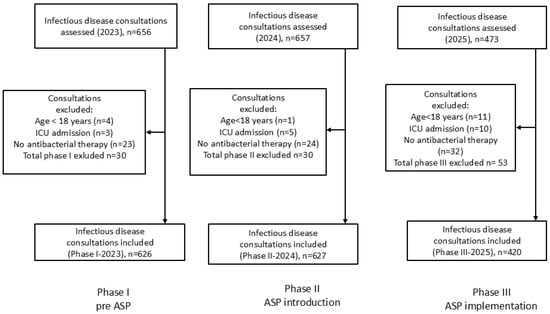
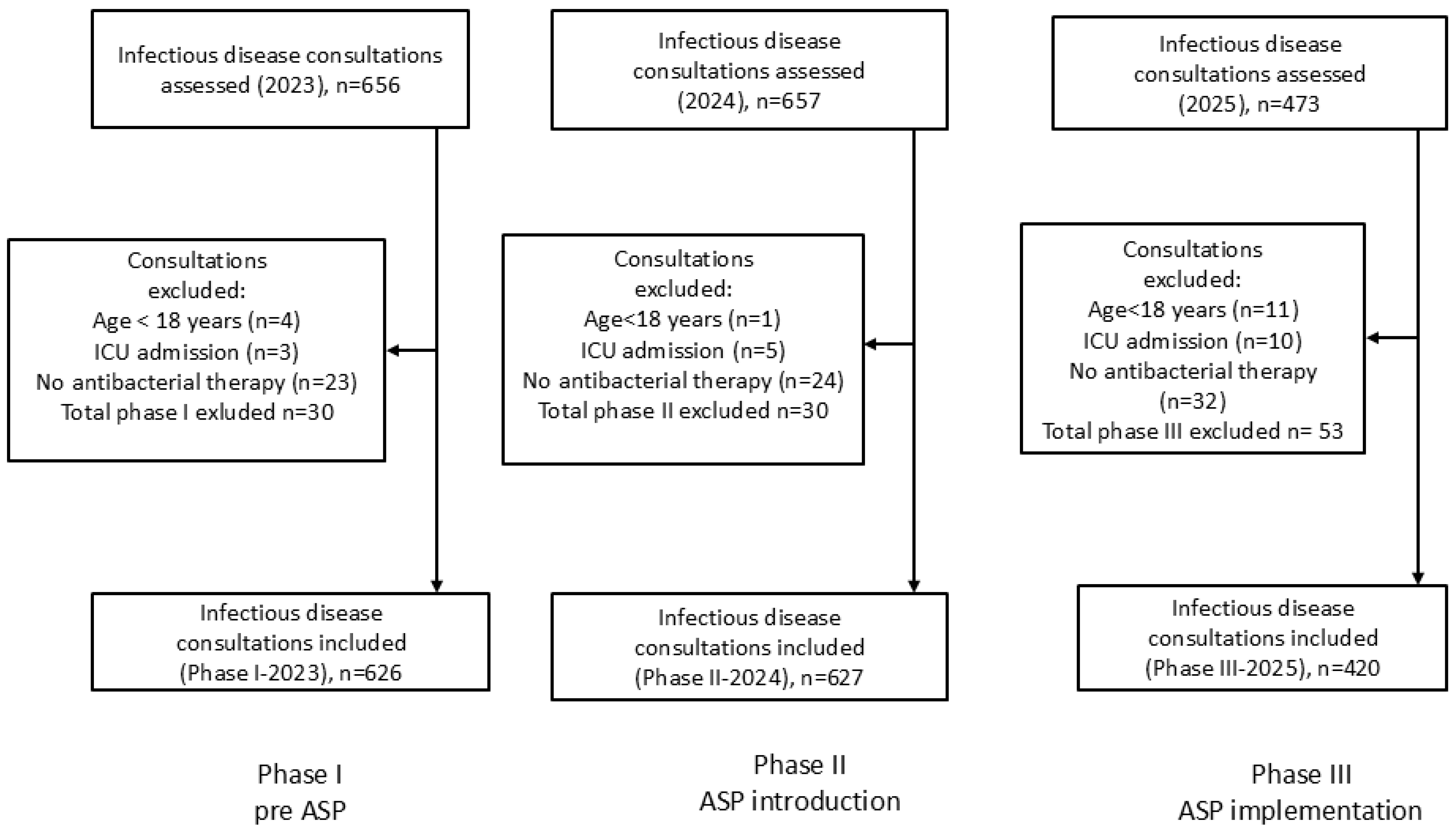
A total of 1786 ID consultations of 1036 patients were screened. Applying the eligibility criteria in sequence, we excluded 16 consultations in patients younger than 18 years, 18 consultations in the intensive care unit and 79 consultations without antibacterial therapy (Figure 1; Supplementary Table S1). The analysis included 1673 consultations of 975 patients: 626 consultations of 351 patients in Phase I, 627 of 370 patients in Phase II and 420 of 264 patients in Phase III (10 patients had consultations in more than one phase), with a mean of 1.78, 1.69 and 1.59 consultations per patient, respectively. No prescribing action was recorded in 2 Phase II consultations, which were excluded from the analyses of empiric therapy, stewardship actions and targeted therapy. In-hospital mortality was 35.3% (6/17) among the excluded ICU consultations and 13.7% (230/1673) among the included consultations.
Figure 1.
Flowchart of infectious disease consultations included in the study. The arrows illustrate the consultation selection process: horizontal arrows indicate exclusions based on the predefined criteria, while vertical arrows indicate the progression from the initial consultations assessed to the final study population included in each phase.
For patient-level analyses, each patient was assigned to the phase of their first admission: 351 patients in Phase I, 366 in Phase II and 258 in Phase III. Thirty-day in-hospital mortality could be assessed in 973 patients: one patient had no valid date of the first consultation and one had a recorded date of death preceding the first consultation.
3.2. Baseline Characteristics
Patient characteristics at the first consultation of the first admission are shown in Table 1. Age was similar across phases, with a median of 70 years in Phase I and 71 years in Phases II and III (p = 0.853); 60.4%, 61.5% and 64.3% of patients were older than 65 years (p = 0.602). The proportion of women was 36.5%, 42.6% and 39.5% (p = 0.242). The type of infection did not differ significantly between phases (all p ≥ 0.055), nor did the distribution across wards (p = 0.207).
Table 1.
Characteristics of patients at the first consultation of the first admission, by phase.
At least one risk factor was recorded for 70.1% of patients in Phase I, 63.9% in Phase II and 89.5% in Phase III (p < 0.001). Diabetes (17.7%, 8.7% and 21.3%; p < 0.001), cardiovascular disease (37.0%, 19.4% and 57.8%; p < 0.001), chronic kidney disease (9.7%, 5.2% and 11.2%; p = 0.015) and chronic pulmonary disease (8.0%, 4.6% and 19.8%; p < 0.001) differed between phases, with the lowest frequency in Phase II and the highest in Phase III. Onco-hematological disease did not differ (19.9%, 21.6% and 22.5%; p = 0.735).
3.3. Prescribing Outcomes
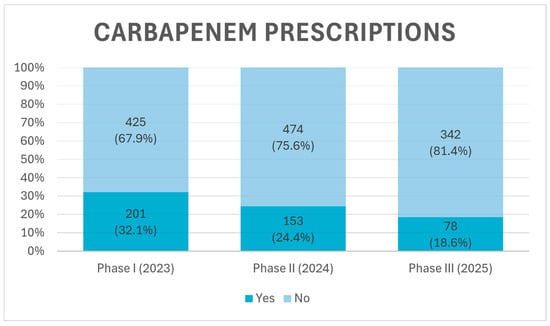
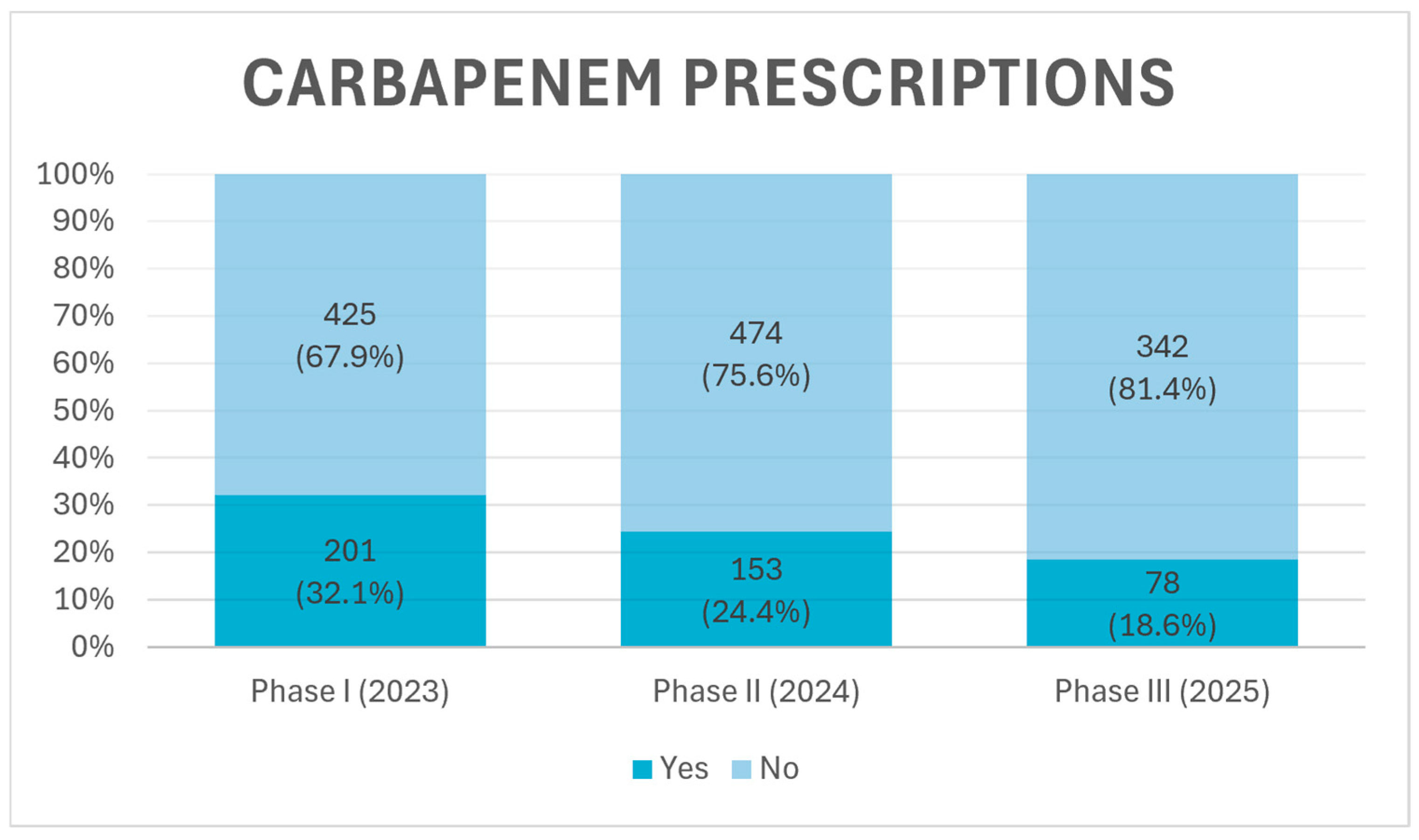
Carbapenems were prescribed in 32.1% of consultations in Phase I, 24.4% in Phase II and 18.6% in Phase III (Figure 2).
Figure 2.
Comparison of carbapenem prescriptions in Phase I (2023), Phase II (2024) and Phase III (December 2024–February 2025).
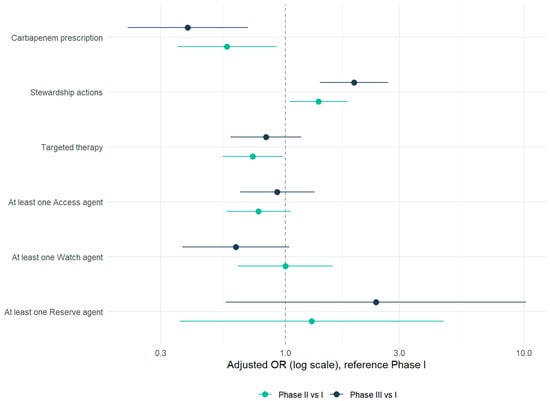
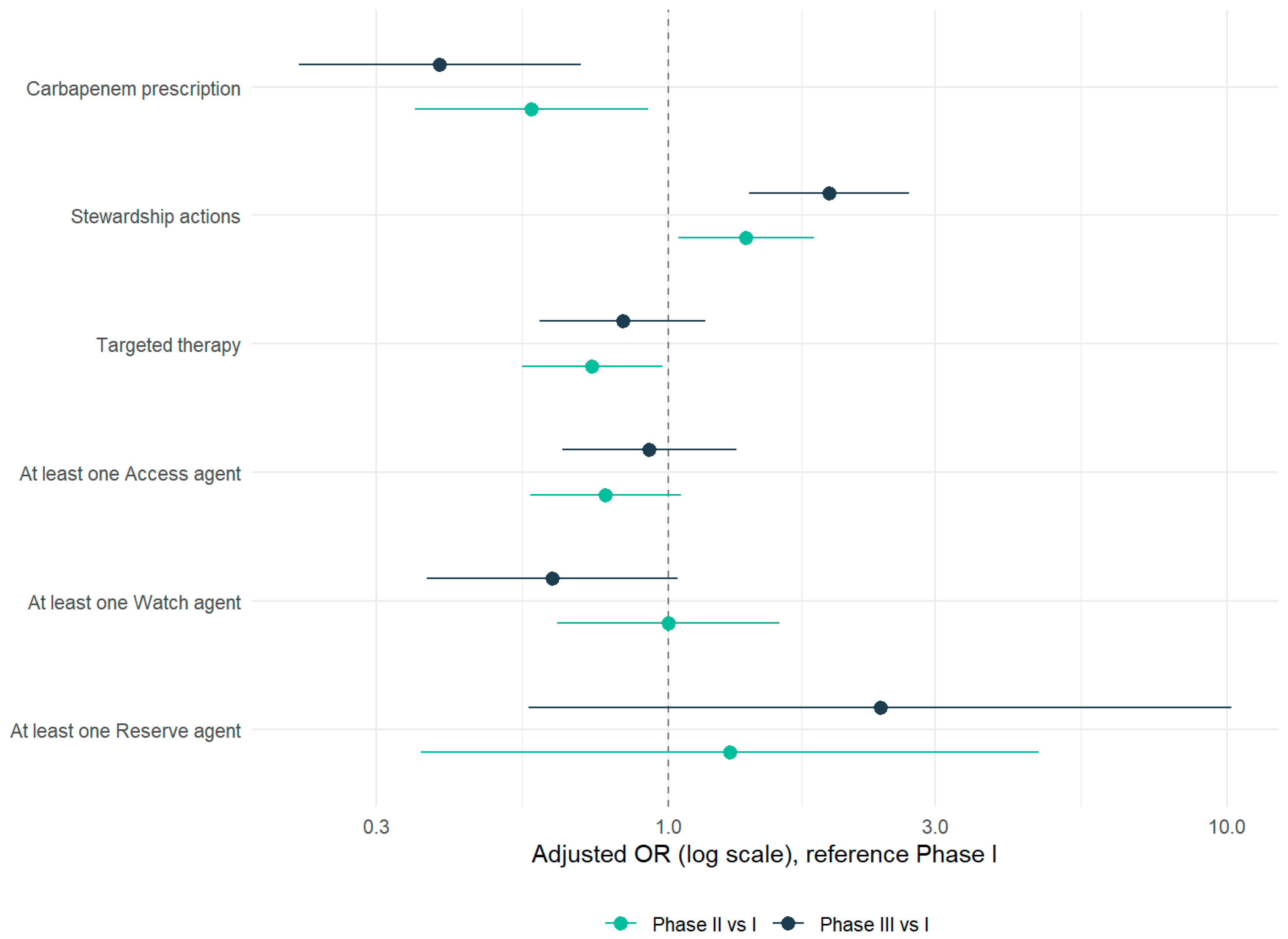
After adjustment, the odds of carbapenem prescription were lower than in Phase I both in Phase II (OR 0.57, 95% CI 0.35–0.92) and in Phase III (OR 0.39, 95% CI 0.22–0.70). The corresponding covariate-standardized risk differences were −6.3 (−11.7 to −1.0) and −10.1 (−16.0 to −4.1) percentage points. Prescribing outcomes per consultation are shown in Table 2 and Figure 3.
Table 2.
Prescribing outcomes per consultation across the three study phases and corresponding comparisons with Phase I.
Figure 3.
Forest plot showing adjusted odds ratios (ORs) and 95% confidence intervals for prescribing outcomes across study phases, with Phase I as the reference group.
Stewardship actions were recorded in 48.1%, 54.1% and 54.0% of consultations. The adjusted OR versus Phase I was 1.38 (1.04–1.82) in Phase II and 1.94 (1.40–2.69) in Phase III, corresponding to risk differences of +6.5 (0.9–12.1) and +13.4 (6.9–19.8) percentage points. In Phase III, the adjusted OR was higher than the unadjusted OR (1.31, 0.97–1.76).
Targeted therapy was prescribed in 39.1%, 32.5% and 33.8% of consultations. The adjusted OR was 0.73 (0.55–0.97) in Phase II and 0.83 (0.59–1.17) in Phase III. Empiric therapy was prescribed in 51.9%, 45.9% and 46.0% of consultations.
Among the consultations in which an antibacterial agent was prescribed, at least one Access agent was prescribed in 40.1%, 34.9% and 38.0% of consultations, at least one Watch agent in 82.4%, 81.9% and 76.1%, and at least one Reserve agent in 6.5%, 8.3% and 8.5%. None of the adjusted comparisons excluded the null value; for Watch agents, the adjusted OR in Phase III was 0.62 (0.37–1.04). The estimates for Reserve agents were imprecise because of the small number of prescriptions.
Among consultations of patients already receiving a carbapenem, a carbapenem-sparing action was recorded in 27.7%, 44.7% and 51.2% of consultations; among consultations of patients receiving an antibacterial, all antibacterials were discontinued in 11.1%, 9.5% and 9.2%. Among consultations involving antimicrobial stewardship actions, intravenous-to-oral switch was recorded in 31/301 consultations (10.3%) in Phase I, 25/338 (7.4%) in Phase II, and 32/227 (14.1%) in Phase III.
Meropenem was prescribed in 31.6%, 19.3% and 17.0% of consultations with an antibacterial and teicoplanin in 21.8%, 14.3% and 9.3%.
3.4. Sensitivity Analyses
The sensitivity analyses for the primary outcomes are reported in Supplementary Table S2. The reduction in carbapenem prescription in Phase III was observed in all analyses (ORs 0.40–0.67). In Phase II, the estimates were similar to the main analysis when the consultations of the first admission were used, when ward was added to the covariates and when no exclusion criteria were applied (ORs 0.54–0.59), but were closer to the null with wider CIs when only the first consultation of each patient (0.80, 0.56–1.14), the months shared by Phases I and II (0.66, 0.39–1.13) or the patients with at least one risk factor recorded (0.96, 0.59–1.55) were analyzed.
The increase in stewardship actions in Phase III was observed in all analyses (ORs 1.82–1.98) except the analysis of the first consultation of each patient (1.29, 0.91–1.82). In Phase II, the ORs ranged from 1.35 to 1.72, except among patients with at least one risk factor recorded (1.06, 0.73–1.53) and in the first-consultation analysis (1.30, 0.95–1.77).
3.5. Clinical Outcomes
Thirty-day in-hospital mortality was 12.0% (42/350) in Phase I, 10.4% (38/366) in Phase II and 10.9% (28/257) in Phase III (Table 3). No difference between phases was demonstrated: the adjusted OR versus Phase I was 0.83 (0.50–1.39) in Phase II and 0.88 (0.50–1.53) in Phase III, with risk differences of −1.6 (−6.1 to 2.9) and −1.2 (−6.2 to 3.8) percentage points. The CIs were compatible with both potential benefit and harm. The sensitivity analyses yielded broadly similar estimates (Table 3).
Table 3.
In-hospital mortality by phase: logistic regression.
Overall in-hospital mortality was 14.0% (49/351), 13.1% (48/366) and 12.4% (32/258), with adjusted ORs of 0.93 (0.58–1.50) in Phase II and 0.82 (0.48–1.38) in Phase III. The median length of stay was 24 days (IQR 13–42) in Phase I, 24 days (14–43) in Phase II and 22 days (12–36) in Phase III. With in-hospital death as a competing event, the cumulative incidence of discharge alive by day 30 was 54.6%, 54.6% and 57.0% (Gray’s test p = 0.370), and the adjusted sHR of discharge alive versus Phase I was 1.01 (95% CI 0.86–1.19) in Phase II and 1.12 (0.93–1.34) in Phase III.
4. Discussion
In this quasi-experimental single-center study, the introduction and implementation of an ASP were associated with a progressive and significant reduction in carbapenem use, accompanied by a parallel increase in stewardship interventions, without statistically significant differences in in-hospital mortality, 30-day in-hospital mortality, and LOS. These findings were observed during the transition from pre-intervention to post-intervention phases and persisted after full ASP implementation.
A key finding of this study is the marked decline in carbapenem prescriptions, which decreased from 32.1% in Phase I to 18.6% in Phase III. Furthermore, among consultations of patients already receiving a carbapenem, active carbapenem-sparing strategies increased substantially across the study stages (from 27.7% to 51.2%). Notably, this reduction occurred despite a concurrent and significant shift toward a clinically more complex patient population in Phase III, characterized by a higher burden of underlying comorbidities (p < 0.001). These results are consistent with previous studies showing that ASP implementation is associated with reductions in overall antibiotic consumption and decreased use of broad-spectrum agents [34,35,36,37]. Targeted interventions promoting carbapenem-sparing strategies and de-escalation have been shown to reduce inappropriate use without compromising clinical outcomes [38,39,40,41,42].
In parallel, ASP implementation was associated with a significant increase in antimicrobial stewardship interventions and the proportion of consultations involving empiric therapy was lower in Phases II and III than in Phase I.
These findings are consistent with prior evidence demonstrating that ASPs improve the appropriateness of antibiotic selection and duration [43,44]. For example, stewardship interventions in urinary tract infections (UTIs) in hospital settings have been shown to reduce empiric broad-spectrum antibiotic use while maintaining clinical safety [45]. Similarly, ASPs have also been associated with increased rates of de-escalation, shorter treatment duration and therapy discontinuation [43].
Overall, ASPs have been associated with substantial reductions in antibiotic use and antimicrobial resistance, without a corresponding increase in all-cause or infection-related mortality [46,47]. ASPs have not been associated with significant differences in in-hospital mortality, 30-day mortality, or ICU length of stay among patients with HAP and ventilator-associated pneumonia (VAP) [47]. Pooled analyses reported a 19% reduction in antimicrobial consumption and a 33.9% decrease in antimicrobial-related costs following ASP implementation, with no statistically significant impact on 30-day mortality [48].
Previous studies have associated antimicrobial stewardship interventions with reduced Watch antibiotic consumption and, in some settings, increased Access use [36,49]. However, we did not observe a comparable shift towards Access prescribing across study phases. Throughout the study stages, Watch antibiotics remained the predominant prescribing category. This pattern may reflect the clinical complexity of our study population, which comprised highly multimorbid and severely ill hospitalized patients frequently requiring empirical broad-spectrum coverage for healthcare-associated infections or MDR pathogens. Future ASP priorities will therefore include reducing avoidable Watch exposure and promoting Watch-to-Access transitions where clinically appropriate. Strategies will include structured antibiotic reassessment at 48–72 h, rapid diagnostics integrated with timely stewardship review, and prospective audit and feedback to support discontinuation or targeted de-escalation according to microbiological findings and clinical response.
Regarding clinical outcomes, 30-day in-hospital mortality was numerically lower in Phases II and III compared with Phase I (12.0%, 10.4%, and 10.9%, respectively). However, these differences were not statistically significant, and the numerical variation should be interpreted as descriptive rather than evidence of a mortality benefit attributable to ASP implementation. Similarly, no statistically significant differences were observed in overall in-hospital mortality or LOS. Moreover, the proportion of patients with at least one recorded risk factor differed across the study phases (70.1% in Phase I, 63.9% in Phase II and 89.5% in Phase III; ), and recorded comorbidities were most frequent in Phase III. Differences in patient characteristics and comorbidity burden across study phases may have influenced these outcomes, and the observational design does not allow causal conclusions regarding the clinical effects of the intervention.
ASPs have been associated with reductions in MDR and ESBL-producing Gram-negative bacteria, MRSA, and C. difficile infections [46]. Given that MDR infections are linked to worse outcomes and increased mortality, stewardship interventions may contribute to improved 30-day outcomes and shorter treatment duration in high-risk patients [50,51]. Overall, ASPs do not consistently reduce mortality across hospital populations; however, selected stewardship interventions have been associated with improved outcomes in high-risk bloodstream infections, including MDR Enterobacterales and methicillin-resistant Staphylococcus aureus bacteremia [34,47,50,51].
The reduction in carbapenem prescribing should also be interpreted in the context of local antimicrobial resistance trends. The frequency of patients testing positive for ESBL-producing Enterobacterales varied across observation periods, increasing from 1.56 per 1000 patient-days in March 2023 to 2.71 in June–August 2023 and 2.82 in March–July 2024, followed by a slight decrease to 2.61 in December 2024–February 2025 (Table S3).
Conversely, hospital-wide microbiological surveillance data collected during selected periods between 2023 and 2025 showed a progressive numerical decrease in the frequency of patients testing positive for carbapenemase-producing organisms (CPO), from 3.91 per 1000 patient-days in March 2023 to 3.72 in June–August 2023, 3.28 in March–July 2024, and 3.15 in December 2024–February 2025 (Table S4).
These findings indicate that the reduction in carbapenem prescribing during ASP implementation occurred in a hospital setting characterized by a persistent burden of ESBL positivity, although the epidemiological pattern was not uniform across periods. Given that carbapenems remain an important therapeutic option for severe infections caused by ESBL-producing Enterobacterales [52,53], the observed reduction in prescriptions is consistent with more selective carbapenem prescribing practices during ASP implementation. However, microbiological positivity does not necessarily indicate clinically significant infection, and the non-continuous surveillance periods, together with the observational study design, preclude causal conclusions regarding the relationship between ASP implementation, carbapenem prescribing, and antimicrobial resistance trends. Additional information on the most frequently identified pathogens according to resistance mechanism is provided in Supplementary Tables S3 and S4.
Sensitivity analyses showed that the association between ASP implementation and reduced carbapenem prescribing in Phase III was consistent in direction and remained statistically significant across all analytical approaches (ORs 0.40–0.67). In Phase II, however, the association was attenuated in some analyses, particularly when restricting the sample to first consultations or patients with at least one recorded risk factor, with confidence intervals including the null value. For stewardship actions, the estimated associations generally remained positive, although their magnitude and statistical significance varied. Notably, the Phase III association was attenuated and was no longer statistically significant when the analysis was restricted to the first consultation of each patient (OR 1.29, 95% CI 0.91–1.82).
Nevertheless, this study has several limitations. First, data from 2023 were collected retrospectively, which may have introduced information bias. Second, the single-center design and the heterogeneity of the study population may limit generalizability. Third, antibiotic consumption was not quantified using Defined Daily Doses (DDD) or Days of Therapy (DOT). Consequently, our findings describe ID consultation-associated prescribing practices rather than overall hospital-wide antibiotic consumption. Fourth, the three study phases covered different and partially non-contiguous time periods; therefore, seasonal fluctuations cannot be entirely excluded, although adjusted models controlled for key clinical drivers (e.g., pneumonia and sepsis) and a sensitivity analysis restricted to shared calendar months between Phases I and II yielded consistent results (OR for stewardship actions: 1.72, 95% CI 1.20–2.48). Ongoing data collection spanning 2025–2026 will further balance seasonal representation. Fifth, because some patients underwent multiple consultations, consultation-level analyses may have included non-independent observations. Additional limitations concern the assessment of antimicrobial prescribing and stewardship interventions. The prescribing outcomes were based on antibiotic regimens and therapeutic recommendations documented during ID consultations rather than independently verified antibiotic administration. Although treatment could be reassessed during subsequent consultations, systematic verification of recommendation implementation was not performed, and acceptance by the treating ward physicians was not formally measured. Furthermore, detailed counts and eligible denominators were not available for all individual stewardship subtypes, limiting the interpretation and comparison of their descriptive frequencies across study phases. Future studies should incorporate systematic assessment of recommendation acceptance, treatment implementation, and subtype-specific stewardship outcomes.
Despite these limitations, this study provides real-world evidence supporting the role of hospital-based ASPs in optimizing antibiotic use. The observed reduction in carbapenem use, together with the increase in stewardship interventions, underscores the clinical value of structured, multidisciplinary antimicrobial stewardship in routine practice.
5. Conclusions
In this single-center quasi-experimental study, the implementation of a structured ASP was associated with a substantial reduction in carbapenem prescriptions and an increase in stewardship interventions. These findings support ASPs as a key strategy to optimize antimicrobial therapy in complex hospitalized patients. Larger multicenter studies with longer follow-up and integrated microbiological data are needed to further define the impact of ASPs on clinical outcomes.
Supplementary Materials
The following supporting information can be downloaded at: https://www.mdpi.com/article/10.3390/microorganisms14112509/s1, Table S1: Consultations excluded by reason and phase (criteria applied in sequence), comparison of excluded and included consultations, and denominators of the analyses by phase; Table S2: Sensitivity analyses for the primary outcomes (adjusted models); Table S3: Distribution of ESBL-producing organisms; Table S4: Distribution of carbapenemase-producing organisms (CPO).
Author Contributions
Conceptualization, S.D.B., F.T., M.L. and S.V.; methodology, S.D.B., M.L., P.D. and D.I.; validation, S.D.B., F.T., M.L. and P.V.; data curation, S.D.B., F.T., C.T. D.B., V.K., V.S., C.P., C.D.B., G.M., I.S., M.S., L.B., and S.I.; formal analysis P.D. and D.I.; writing—original draft preparation, S.D.B., L.B., C.T., F.T., P.V., V.S., D.B., V.K., C.P., C.D.B., G.M., I.S., M.S. and S.I.; writing—review and editing, S.D.B., L.B., M.L., S.V., P.V. and C.D.B.; visualization, S.D.B., S.V. and M.L.; supervision, M.L. and S.V. All authors have read and agreed to the published version of the manuscript.
Funding
This research received no external funding.
Institutional Review Board Statement
The study was conducted in accordance with the Declaration of Helsinki and approved by the Ethics Committee Lazio 1 (protocol code 8000/2025), 9 July 2025.
Informed Consent Statement
Written informed consent was obtained from all participants involved in the study. Regarding informed consent, all patients were asked to sign the hospital’s general informed consent form upon admission. This form explicitly authorizes the anonymized use of clinical data for research, educational, and scientific publication purposes, in compliance with applicable data-protection regulations (covering all enrolled participants, including deceased patients). This study was conducted in accordance with the principles of the Declaration of Helsinki.
Data Availability Statement
The data sets used and analyzed in this study are available from the corresponding author on reasonable request.
Acknowledgments
During the preparation of this manuscript, the authors used ChatGPT for the purposes of creating the graphical abstract. The authors have reviewed and edited the output and take full responsibility for the content of this publication. The authors would like to thank the Hospital Pharmacy Department for its valuable contribution and support in the implementation of the antimicrobial stewardship program.
Conflicts of Interest
The authors declare no conflicts of interest.
Abbreviations
The following abbreviations are used in this manuscript:
| AMR | Antimicrobial resistance |
| ASP | Antimicrobial stewardship program |
| BSI | Bloodstream infection |
| CAP | Community-acquired pneumonia |
| CI | Confidence Interval |
| CPO | Carbapenemase-producing Organisms |
| CRE | Carbapenem-resistant Enterobacterales |
| DDD | Defined daily dose |
| DOT | Days of therapy |
| EARS-Net | European Antimicrobial Resistance Surveillance Network |
| ECDC | European Centre for Disease Prevention and Control |
| EEA | European Economic Area |
| ESBL | Extended-spectrum beta-lactamase |
| EU | European Union |
| HAP | Hospital-acquired pneumonia |
| ICU | Intensive Care Unit |
| ID | Infectious disease |
| IDSA | Infectious Diseases Society of America |
| IPC | Infection prevention and control |
| IQR | Interquartile range |
| LOS | Length of hospital stay |
| MDR | Multidrug-resistant |
| MRSA | Methicillin-resistant Staphylococcus aureus |
| OR | Odds Ratio |
| RD | Risk difference |
| sHR | Subdistribution hazard ratio |
| UTI | Urinary tract infections |
| VAP | Ventilator-associated pneumonia |
| VRE | Vancomycin resistant Enterococcus faecium |
| VRSA | Vancomycin-resistant Staphylococcus aureus |
| WHO | World Health Organization |
References
- O’Neill, J. Tackling Drug-Resistant Infections Globally: Final Report and Recommendations; Wellcome Trust: London, UK, 2016. [Google Scholar]
- Antimicrobial Resistance Collaborators. Global burden of bacterial antimicrobial resistance in 2019: A systematic analysis. Lancet 2022, 399, 629–655, Erratum in Lancet 2022, 400, 1102. [Google Scholar] [CrossRef] [Scilit]
- ECDC. Antimicrobial Resistance in the EU/EEA (EARS-Net)—Annual Epidemiological Report 2023. Available online: https://www.ecdc.europa.eu/en/publications-data/antimicrobial-resistance-eueea-ears-net-annual-epidemiological-report-2023 (accessed on 17 December 2025).
- Barrasa-Villar, J.I.; Aibar-Remón, C.; Prieto-Andrés, P.; Mareca-Doñate, R.; Moliner-Lahoz, J. Impact on Morbidity, Mortality, and Length of Stay of Hospital-Acquired Infections by Resistant Microorganisms. Clin. Infect. Dis. 2017, 65, 644–652. [Google Scholar] [CrossRef] [Scilit]
- World Health Organization; UNEP United Nations Environment Programme; World Organisation for Animal Health. One Health Joint Plan of Action (2022–2026): Working Together for the Health of Humans, Animals, Plants and the Environment; World Health Organization: Geneva, Switzerland, 2022; Available online: https://www.who.int/publications/i/item/9789240059139 (accessed on 31 January 2026).
- WHO. Antimicrobial Resistance. 2023. Available online: https://www.who.int/news-room/fact-sheets/detail/antimicrobial-resistance (accessed on 5 November 2025).
- Oterino-Moreira, I.; Pérez-Encinas, M.; Candel-González, F.J.; Lorenzo-Martínez, S. Impact of Antimicrobial-Resistant Bacterial Pneumonia on In-Hospital Mortality and Length of Hospital Stay: A Retrospective Cohort Study in Spain. Antibiotics 2025, 14, 1006. [Google Scholar] [CrossRef] [Scilit]
- Dadgostar, P. Antimicrobial Resistance: Implications and Costs. Infect. Drug Resist. 2019, 12, 3903–3910. [Google Scholar] [CrossRef] [Scilit]
- Iacchini, S.; Boros, S.; Pezzotti, P.; Errico, G.; Del Grosso, M.; Camilli, R.; Giufrè, M.; Pantosti, A.; Maraglino, F.; Palamara, A.T.; et al. Rapporto ISS Sorveglianza RIS-5/2024—AR-ISS: Sorveglianza Nazionale dell’Antibiotico-Resistenza. Dati 2023; Istituto Superiore di Sanità: Rome, Italy, 2024; Available online: https://www.iss.it/-/rapporto-iss-sorveglianza-ris-5/2024-ar-iss-sorveglianza-nazionale-dell-antibiotico-resistenza-dati-2023-simone-iacchini-stefano-boros-patrizio-pezzotti-giulia-errico-maria-del-grosso-romina-camilli-maria-giufre-annalisa-pantosti-francesco-maraglino-ann-1 (accessed on 29 January 2026).
- Iacchini, S.; Fadda, G.; Monaco, M.; Errico, G.; Del Grosso, M.; Giufrè, M.; Pantosti, A.; Sabbatucci, M.; Maraglino, F.; Palamara, A.T.; et al. CRE: Sorveglianza Nazionale delle Batteriemie da Enterobatteri Resistenti ai Carbapenemi Dati 2023; Istituto Superiore di Sanità: Rome, Italy, 2024; Available online: https://www.epicentro.iss.it/antibioticoresistenza/ cpe/RIS-4_2024.pdf (accessed on 13 November 2025).
- Sati, H.; Carrara, E.; Savoldi, A.; Hansen, P.; Garlasco, J.; Campagnaro, E.; Boccia, S.; Castillo-Polo, J.A.; Magrini, E.; Garcia-Vello, P.; et al. The WHO Bacterial Priority Pathogens List 2024: A prioritisation study to guide research, development, and public health strategies against antimicrobial resistance. Lancet Infect. Dis. 2025, 25, 1033–1043. [Google Scholar] [CrossRef] [Scilit]
- Cunha, C.B. Antimicrobial Stewardship Programs: Principles and Practice. Med. Clin. North Am. 2018, 102, 797–803. [Google Scholar] [CrossRef] [Scilit]
- Belvisi, V.; Del Borgo, C.; Vita, S.; Redaelli, P.; Dolce, P.; Pacella, D.; Kertusha, B.; Carraro, A.; Marocco, R.; De Masi, M.; et al. Impact of SARS CoV-2 pandemic on carbapenemase-producing Klebsiella pneumoniae prevention and control programme: Convergent or divergent action? J. Hosp. Infect. 2021, 109, 29–31. [Google Scholar] [CrossRef] [Scilit]
- Meschiari, M.; Segala, F.V.; Gallerani, A.; Di Gennaro, F.; Esposito, N.; Tanzilli, P.; Prozzo, A.; Pan, A.; Lupi, M.G.; Brambilla, P.; et al. Implementation of infection prevention and control components in Italian hospitals based on a nationwide survey on behalf of INSIEME project. Sci. Rep. 2025, 15, 36977. [Google Scholar] [CrossRef] [Scilit]
- Nathwani, D.; Varghese, D.; Stephens, J.; Ansari, W.; Martin, S.; Charbonneau, C. Value of hospital antimicrobial stewardship programs [ASPs]: A systematic review. Antimicrob. Resist. Infect. Control 2019, 8, 35. [Google Scholar] [CrossRef] [Scilit]
- McGowan, J.E., Jr.; Gerding, D.N. Does antibiotic restriction prevent resistance? New Horiz. 1996, 4, 370–376. [Google Scholar] [PubMed]
- Dyar, O.J.; Huttner, B.; Schouten, J.; Pulcini, C.; ESGAP (ESCMID Study Group for Antimicrobial stewardshiP). What is antimicrobial stewardship? Clin. Microbiol. Infect. 2017, 23, 793–798. [Google Scholar] [CrossRef] [Scilit]
- Society for Healthcare Epidemiology of America; Infectious Diseases Society of America; Pediatric Infectious Diseases Society. Policy Statement on Antimicrobial Stewardship by the Society for Healthcare Epidemiology of America (SHEA), the Infectious Diseases Society of America (IDSA), and the Pediatric Infectious Diseases Society (PIDS). Infect. Control Hosp. Epidemiol. 2012, 33, 322–327. [Google Scholar] [CrossRef] [Scilit]
- Thakur, L.; Singh, S.; Singh, R.; Kumar, A.; Angrup, A.; Kumar, N. The potential of 4D’s approach in curbing antimicrobial resistance among bacterial pathogens. Expert Rev. Anti-Infect. Ther. 2022, 20, 1401–1412. [Google Scholar] [CrossRef] [Scilit]
- Dyar, O.; Beović, B.; Pulcini, C.; Tacconelli, E.; Hulscher, M.; Cookson, B.; Ashiru-Oredope, D.; Barcs, I.; Blix, H.; Buyle, F.; et al. ESCMID generic competencies in antimicrobial prescribing and stewardship: Towards a European consensus. Clin. Microbiol. Infect. 2019, 25, 13–19. [Google Scholar] [CrossRef] [Scilit]
- Morency-Potvin, P.; Schwartz, D.N.; Weinstein, R.A. Antimicrobial Stewardship: How the Microbiology Laboratory Can Right the Ship. Clin. Microbiol. Rev. 2017, 30, 381–407. [Google Scholar] [CrossRef] [Scilit]
- Pierce, V.M.; Bhowmick, T.; Simner, P.J. Guiding antimicrobial stewardship through thoughtful antimicrobial susceptibility testing and reporting strategies: An updated approach in 2023. J. Clin. Microbiol. 2023, 61, e0007422. [Google Scholar] [CrossRef] [Scilit]
- Di Marcello, A.; Santoro, A.; Todisco, V.; Franceschini, E.; Orlando, G.; Casolari, S.; Cervo, A.; Menozzi, M.; Bedini, A.; Chemello, D.; et al. Proactive antimicrobial stewardship with real-time microbiological alerts improves management of bloodstream infections. JAC-Antimicrob. Resist. 2025, 7, dlaf182. [Google Scholar] [CrossRef] [Scilit]
- Garau, J.; Bassetti, M. Role of pharmacists in antimicrobial stewardship programmes. Int. J. Clin. Pharm. 2018, 40, 948–952. [Google Scholar] [CrossRef] [Scilit]
- Rieg, S.; Küpper, M.F. Infectious diseases consultations can make the difference: A brief review and a plea for more infectious diseases specialists in Germany. Infection 2016, 44, 159–166. [Google Scholar] [CrossRef] [Scilit]
- Zhou, S.; Nagel, J.L.; Kaye, K.S.; LaPlante, K.L.; Albin, O.R.; Pogue, J.M. Antimicrobial Stewardship and the Infection Control Practitioner: A Natural Alliance. Infect. Dis. Clin. North Am. 2021, 35, 771–787. [Google Scholar] [CrossRef] [Scilit]
- Alhumaid, S.; Al Mutair, A.; Al Alawi, Z.; Alsuliman, M.; Ahmed, G.Y.; Rabaan, A.A.; Al-Tawfiq, J.A.; Al-Omari, A. Knowledge of infection prevention and control among healthcare workers and factors influencing compliance: A systematic review. Antimicrob. Resist. Infect. Control 2021, 10, 86. [Google Scholar] [CrossRef] [Scilit]
- Worldwide Antimicrobial Resistance National/International Network Group (WARNING) Collaborators. Ten golden rules for optimal antibiotic use in hospital settings: The WARNING call to action. World J. Emerg. Surg. 2023, 18, 50. [Google Scholar] [CrossRef] [Scilit]
- Evans, L.; Rhodes, A.; Alhazzani, W.; Antonelli, M.; Coopersmith, C.M.; French, C.; Machado, F.R.; Mcintyre, L.; Ostermann, M.; Prescott, H.C.; et al. Surviving sepsis campaign: International guidelines for management of sepsis and septic shock 2021. Intensive Care Med. 2021, 47, 1181–1247. [Google Scholar] [CrossRef] [Scilit]
- Kollef, M.H.; Shorr, A.F.; Bassetti, M.; Timsit, J.-F.; Micek, S.T.; Michelson, A.P.; Garnacho-Montero, J. Timing of antibiotic therapy in the ICU. Crit. Care 2021, 25, 360. [Google Scholar] [CrossRef] [Scilit]
- Corcione, S.; Lupia, T.; Maraolo, A.E.; Pinna, S.M.; Gentile, I.; De Rosa, F.G. Carbapenem-sparing strategy: Carbapenemase, treatment, and stewardship. Curr. Opin. Infect. Dis. 2019, 32, 663–673. [Google Scholar] [CrossRef] [Scilit]
- Iversen, K.; Ihlemann, N.; Gill, S.U.; Madsen, T.; Elming, H.; Jensen, K.T.; Bruun, N.E.; Høfsten, D.E.; Fursted, K.; Christensen, J.J.; et al. Partial Oral versus Intravenous Antibiotic Treatment of Endocarditis. N. Engl. J. Med. 2019, 380, 415–424. [Google Scholar] [CrossRef] [Scilit]
- WHO. The Selection and Use of Essential Medicines, 2025: WHO AWaRe (Access, Watch, Reserve) Classification of Antibiotics for Evaluation and Monitoring of Use; WHO: Geneva, Switzerland, 2025; Available online: https://www.who.int/publications/i/item/B09489 (accessed on 6 January 2026).
- Lee, C.F.; Cowling, B.J.; Feng, S.; Aso, H.; Wu, P.; Fukuda, K.; Seto, W.H. Impact of antibiotic stewardship programmes in Asia: A systematic review and meta-analysis. J. Antimicrob. Chemother. 2018, 73, 844–851. [Google Scholar] [CrossRef] [Scilit]
- Katsios, C.M.; Burry, L.; Nelson, S.; Jivraj, T.; Lapinsky, S.E.; Wax, R.S.; Christian, M.; Mehta, S.; Bell, C.M.; Morris, A.M. An antimicrobial stewardship program improves antimicrobial treatment by culture site and the quality of antimicrobial prescribing in critically ill patients. Crit. Care 2012, 16, R216. [Google Scholar] [CrossRef] [Scilit]
- Ya, K.Z.; Win, P.T.N.; Bielicki, J.; Lambiris, M.; Fink, G. Association Between Antimicrobial Stewardship Programs and Antibiotic Use Globally: A Systematic Review and Meta-Analysis. JAMA Netw. Open 2023, 6, e2253806. [Google Scholar] [CrossRef] [Scilit]
- Giovannenze, F.; Del Vecchio, P.; Frondizi, F.; Rando, E.; Leanza, G.; Gross, M.; Frater, A.; Magrini, E.; Liguoro, B.; Sangiorgi, F.; et al. Effect of an educational antimicrobial stewardship programme on antibiotic prescriptions’ appropriateness in three medical units of a large university hospital: An interrupted time series analysis. J. Hosp. Infect. 2025, 162, 127–135. [Google Scholar] [CrossRef] [Scilit]
- Yoo, J.S.; Park, J.Y.; Chun, H.-J.; Kim, Y.R.; Kim, E.J.; Choi, Y.H.; Ha, K.H.; Heo, J.Y. Impact of prolonged carbapenem use-focused antimicrobial stewardship on antimicrobial consumption and factors affecting acceptance of recommendations: A quasi-experimental study. Sci. Rep. 2023, 13, 14501. [Google Scholar] [CrossRef] [Scilit]
- Faraone, A.; Poggi, A.; Cappugi, C.; Tofani, L.; Riccobono, E.; Giani, T.; Fortini, A. Inappropriate use of carbapenems in an internal medicine ward: Impact of a carbapenem-focused antimicrobial stewardship program. Eur. J. Intern. Med. 2020, 78, 50–57. [Google Scholar] [CrossRef] [Scilit]
- Gardner, A.; Nieberg, P.; Sakoulas, G.; Wong-Beringer, A. Carbapenem de-escalation as an antimicrobial stewardship strategy: A narrative review. JAC-Antimicrob. Resist. 2025, 7, dlaf022. [Google Scholar] [CrossRef] [Scilit]
- Sangiorgi, F.; Del Vecchio, P.; Magrini, E.; Rando, E.; Liguoro, B.; Frater, A.; Giovannenze, F.; Fantoni, M.; Torti, C.; Murri, R. Impact of a post-prescription audit and feedback antimicrobial stewardship intervention on inappropriate carbapenem prescribing: An interrupted time series analysis. JAC-Antimicrob. Resist. 2025, 7, dlaf236. [Google Scholar] [CrossRef] [Scilit]
- Bedini, A.; De Maria, N.; Del Buono, M.; Bianchini, M.; Mancini, M.; Binda, C.; Brasacchio, A.; Orlando, G.; Franceschini, E.; Meschiari, M.; et al. Antimicrobial stewardship in a Gastroenterology Department: Impact on antimicrobial consumption, antimicrobial resistance and clinical outcome. Dig. Liver Dis. 2016, 48, 1142–1147. [Google Scholar] [CrossRef] [Scilit][Green Version]
- del Arco, A.; Tortajada, B.; de la Torre, J.; Olalla, J.; Prada, J.L.; Fernández, F.; Rivas, F.; García-Alegría, J.; Faus, V.; Montiel, N. The impact of an antimicrobial stewardship programme on the use of antimicrobials and the evolution of drug resistance. Eur. J. Clin. Microbiol. Infect. Dis. 2015, 34, 247–251. [Google Scholar] [CrossRef] [Scilit]
- Barlam, T.F.; Cosgrove, S.E.; Abbo, L.M.; MacDougall, C.; Schuetz, A.N.; Septimus, E.J.; Srinivasan, A.; Dellit, T.H.; Falck-Ytter, Y.T.; Fishman, N.O.; et al. Implementing an Antibiotic Stewardship Program: Guidelines by the Infectious Diseases Society of America and the Society for Healthcare Epidemiology of America. Clin. Infect. Dis. 2016, 62, e51–e77. [Google Scholar] [CrossRef] [Scilit]
- Gohil, S.K.; Septimus, E.; Kleinman, K.; Varma, N.; Avery, T.R.; Heim, L.; Rahm, R.; Cooper, W.S.; Cooper, M.; McLean, L.E.; et al. Stewardship Prompts to Improve Antibiotic Selection for Urinary Tract Infection: The INSPIRE Randomized Clinical Trial. JAMA 2024, 331, 2018–2028. [Google Scholar] [CrossRef] [Scilit]
- Baur, D.; Gladstone, B.P.; Burkert, F.; Carrara, E.; Foschi, F.; Döbele, S.; Tacconelli, E. Effect of antibiotic stewardship on the incidence of infection and colonisation with antibiotic-resistant bacteria and Clostridium difficile infection: A systematic review and meta-analysis. Lancet Infect. Dis. 2017, 17, 990–1001. [Google Scholar] [CrossRef] [Scilit]
- Ablakimova, N.; Rachina, S.; Strelkova, D.; Suvorov, A.; Smagulova, G. Antimicrobial Stewardship Interventions in Adults with Hospital-Acquired Pneumonia: A Systematic Review and Meta-Analysis. J. Hosp. Infect. 2026, 169, 176–192. [Google Scholar] [CrossRef] [Scilit]
- Karanika, S.; Paudel, S.; Grigoras, C.; Kalbasi, A.; Mylonakis, E. Systematic Review and Meta-analysis of Clinical and Economic Outcomes from the Implementation of Hospital-Based Antimicrobial Stewardship Programs. Antimicrob. Agents Chemother. 2016, 60, 4840–4852. [Google Scholar] [CrossRef] [Scilit]
- Abu-Ajaleh, S.; Elhajji, F.D.; Al-Bsoul, S.; Abu Farha, R.; Al-Hammouri, F.; Amer, A.; Al Rusasi, A.; Al-Azzam, S.; Araydah, M.; Aldeyab, M.A. An Evaluation of the Impact of Increasing the Awareness of the WHO Access, Watch, and Reserve (AWaRe) Antibiotics Classification on Knowledge, Attitudes, and Hospital Antibiotic Prescribing Practices. Antibiotics 2023, 12, 951. [Google Scholar] [CrossRef] [Scilit]
- Huang, B.-M.; Lo, C.-L.; Lin, W.-L.; Li, M.-C.; Weng, T.-P.; Jan, H.-E.; Tseng, P.-H.; Yeh, S.-J.; Ko, W.-C.; Lee, N.-Y. Application of antimicrobial stewardship interventions improves outcomes in adults with bloodstream infection caused by multidrug-resistant Enterobacteriaceae. J. Microbiol. Immunol. Infect. 2026, 59, 85–90. [Google Scholar] [CrossRef] [Scilit]
- Ohashi, K.; Matsuoka, T.; Shinoda, Y.; Fukami, Y.; Shindoh, J.; Yagi, T.; Yoshimura, T.; Sugiyama, T. Evaluation of treatment outcomes of patients with MRSA bacteremia following antimicrobial stewardship programs with pharmacist intervention. Int. J. Clin. Pract. 2018, 72, e13065. [Google Scholar] [CrossRef] [Scilit]
- Paul, M.; Carrara, E.; Retamar, P.; Tängdén, T.; Bitterman, R.; Bonomo, R.A.; de Waele, J.; Daikos, G.L.; Akova, M.; Harbarth, S.; et al. European Society of Clinical Microbiology and Infectious Diseases (ESCMID) guidelines for the treatment of infections caused by multidrug-resistant Gram-negative bacilli (endorsed by European society of intensive care medicine). Clin. Microbiol. Infect. 2022, 28, 521–547. [Google Scholar] [CrossRef] [Scilit]
- Harris, P.N.A.; Tambyah, P.A.; Lye, D.C.; Mo, Y.; Lee, T.H.; Yilmaz, M.; Alenazi, T.H.; Arabi, Y.; Falcone, M.; Bassetti, M.; et al. Effect of Piperacillin-Tazobactam vs Meropenem on 30-Day Mortality for Patients with E. coli or Klebsiella pneumoniae Bloodstream Infection and Ceftriaxone Resistance: A Randomized Clinical Trial. JAMA 2018, 320, 984–994, Erratum in JAMA 2019, 321, 2370. https://doi.org/10.1001/jama.2018.12163. [Google Scholar] [CrossRef] [Scilit]

Disclaimer/Publisher’s Note: The statements, opinions and data contained in all publications are solely those of the individual author(s) and contributor(s) and not of MDPI and/or the editor(s). MDPI and/or the editor(s) disclaim responsibility for any injury to people or property resulting from any ideas, methods, instructions or products referred to in the content. |
© 2026 by the authors. Licensee MDPI, Basel, Switzerland. This article is an open access article distributed under the terms and conditions of the Creative Commons Attribution (CC BY) license.