


Abstract
Cadmium (Cd) contamination accelerates soil degradation and threatens the safe utilization of agricultural land, making sustainable remediation strategies urgently needed. To evaluate the remediation efficacy of a microbial inoculant (MI) composed of Bacillus subtilis, Bacillus thuringiensis, and Bacillus amyloliquefaciens in Cd-contaminated wheat soils, we conducted a field experiment. The results showed that, compared with the control (CK), MI treatments increased soil pH and soil organic matter (SOM) and enhanced the activities of urease, sucrase, dehydrogenase, and alkaline phosphatase by 3.83–249.28%, 0.54–1.08%, 5.61–109.68%, and 2.76–13.38%, respectively. With MI application, Cd shifted from the exchangeable and Fe-Mn oxide-bound fractions to the residual fraction, a key pathway reducing Cd bioavailability. At the wheat maturity stage, MI treatments reduced Cd content in wheat grains by 12.83–33.15% compared with CK. High-throughput sequencing revealed increased relative abundances of bacteria tolerant to heavy metals and bacteria associated with heavy metal remediation, including the phyla Pseudomonadota, Acidobacteriota, Bacillota, and Actinomycetota and the genera Pseudomonas, Arthrobacter, and Bacillus. Mantel tests indicated that soil pH, SOM, enzyme activities, and Cd accumulation were most strongly correlated with bacterial community composition. Overall, MI demonstrates practical feasibility for remediating Cd-contaminated wheat-field soils.
1. Introduction
Heavy metal contamination represents a major driver of soil degradation by impairing soil quality, disrupting ecological functions, and threatening the safe utilization of agricultural land [1,2]. Among these pollutants, cadmium (Cd) contamination has emerged as a critical environmental concern due to its high toxicity, persistence, and strong tendency to accumulate in crops, threatening the safe utilization of approximately 13 million hectares of agricultural land in China [3]. Cd is a highly toxic environmental contaminant classified as a Group 1 carcinogen [4]. Industrial activities and agricultural practices have contributed to the accumulation of Cd in soils, where its bioavailable forms can be absorbed by plants and subsequently enter the food chain, threatening agroecosystem health and food safety [5]. Excessive accumulation of Cd in the human body can damage various systems of the human body, such as immunity, respiration, reproduction, endocrine, cardiovascular, digestive, urinary and nervous systems [6]. Wheat is the second largest staple food crop worldwide and exhibits a significant Cd bioconcentration factor [7]. Cd in the soil will be absorbed by wheat roots, transported to the aboveground part, and accumulated in wheat grains. Therefore, reducing soil Cd bioavailability and restricting its uptake and translocation in wheat are essential for improving the safety of wheat production in Cd-contaminated farmland.
Recently, in situ immobilization through the application of various soil amendments has attracted increasing attention due to its potential to reduce Cd mobility and bioavailability in soils, thereby limiting Cd uptake and accumulation in plants [8]. Compared with conventional remediation approaches, microbial bioremediation is regarded as a cost-effective and environmentally friendly strategy for remediating contaminated agricultural soils [9]. Heavy metal contamination can be effectively remediated by microorganisms through various mechanisms, including biosorption, biotransformation, and biomineralization [10]. Microorganisms primarily restrict heavy metal migration through biosorption mediated by extracellular polymers, such as phosphopeptides and extracellular polysaccharides, which play a key role in heavy metal immobilization [11]. Microbial inoculant (MI) is composed of one or more beneficial microbial species or strains [12]. Bacillus spp., widely commercialized for plant growth promotion and biological control, possess the ability to survive for extended periods, produce various secondary metabolites, and reduce the toxicity and bioavailability of heavy metals [13,14]. It has been reported that Bacillus directly reduces Cr (VI) to stable Cr (III) precipitates or minerals in vivo by secreting extracellular enzymes or reductases [15,16]. Many Bacillus thuringiensis have tolerance to heavy metal pollution [17]. Furthermore, the ability of B. thuringiensis to produce spores and crystals is considered to have a positive effect on its adsorption of heavy metals [18].
MI application can contribute to reducing heavy metal content and promoting crop growth. As a biological fertilizer, MI offers greater safety and lower environmental risks than chemical fertilizers while promoting plant growth and improving soil health, thereby contributing to sustainable agriculture [19]. Microorganisms can decrease heavy metal bioavailability by converting metals into less active forms, thereby restricting their uptake by plants. In particular, Bacillus spp. exhibit strong tolerance to heavy metals and can grow in contaminated environments, as well as remove, detoxify, and neutralize these pollutants [13]. Previous studies have demonstrated that MI application can decrease soil Cd availability and Cd accumulation in whea [20]. Inoculation with Bacillus subtilis has been reported to stabilize soil physicochemical properties, promote Cd mineralization, and reduce Cd accumulation in rice [21]. Han et al. [22] reported that B. thuringiensis could alleviate Cd toxicity in rapeseed by immobilizing soil Cd and limiting its translocation from roots to other plant tissues, thereby reducing Cd uptake, with extracellular adsorption and intracellular accumulation contributing to Cd immobilization. Cao et al. [23] reported that the application of a poly-γ-glutamic acid microbial inoculant significantly decreased As content in the roots of Panax quinquefolium by 43.48%. Furthermore, previous studies have shown that Bacillus amyloliquefaciens W25 can immobilize Cd and reduce diethylenetriaminepentaacetic acid (DTPA)-extractable Cd in wheat rhizosphere soil and Cd accumulation in wheat grains, indicating its potential for Cd remediation [24]. Previous studies have investigated the effects of individual Bacillus strains or their combined application with other soil amendments on Cd immobilization in soil and Cd accumulation in wheat [24,25,26]. However, field-scale evidence regarding the comprehensive effects of compound Bacillus inoculants on soil Cd bioavailability, Cd fractionation, soil biochemical properties, and bacterial community structure remains limited.
In our previous research, we revealed that a MI composed of B. subtilis, B. thuringiensis and B. amyloliquefaciens exhibited remarkable Cd adsorption performance in aqueous systems [27]. However, its remediation effectiveness and potential mechanisms under field conditions remain unclear. Therefore, this study applied this liquid MI to Cd-contaminated wheat soil to evaluate its potential for reducing Cd bioavailability and restoring the safe production function of contaminated farmland. Specifically, this study aimed to: (i) evaluate the immobilization potential of MI in Cd-contaminated wheat soil; (ii) determine the effects of MI on Cd accumulation in wheat; and (iii) clarify the responses of soil bacterial community composition and structure to MI application. By linking Cd immobilization, wheat Cd accumulation, soil biochemical properties, and bacterial community responses, this study provides field-based evidence for microbial remediation as a sustainable strategy to mitigate Cd-induced soil degradation and improve the safe utilization of Cd-contaminated agricultural soils.
2. Material and Methods
2.1. Description of MI
MI supplied by Shandong Yizhonghe Biotechnology Co., Ltd., (Jining, China) was used in the experiment. According to the manufacturer, the MI was formulated primarily from microbial preparations. According to the manufacturer’s specifications, MI contained three bacterial species: Bacillus subtilis (50%), Bacillus amyloliquefaciens (40%), and Bacillus thuringiensis (10%). The product label indicated that MI was a liquid formulation containing 2 billion living bacteria per milliliter.
2.2. Field Experiment
The field experiment was conducted in April 2021 in Renxiaoying Village, Xinxiang City, Henan Province, China (35°14′ N, 113°48′ E). The initial soil properties were as follows: pH, 7.63; total Cd, 0.92 mg kg−1; soil organic matter (SOM), 27.25 g kg−1; electrical conductivity (EC), 2362 μS cm−1; and cation exchange capacity (CEC), 69.3 cmol kg−1. The soil Cd content in the experimental farmland reached 0.92 mg kg−1, equivalent to 1.53 times the risk screening value of 0.6 mg kg−1 established by the Soil Environmental Quality Risk Control Standard for Soil Contamination of Agricultural Land (GB 15618–2018) [28]. Meanwhile, the Cd content in wheat grains under CK was 0.16 mg kg−1, exceeding the food safety limit of 0.1 mg kg−1 specified in GB 2762–2022 [29]. Therefore, it is necessary to implement remediation measures for this farmland to mitigate contamination. Five treatments were designed, comprising a control (CK) and MI applied at 100, 300, 450, and 600 g per plot (15 m2, 5 m × 3 m), designated B100, B300, B450, and B600, with three replicates per treatment. The MI had a density of 1.02 g mL−1. At each application, the required amount of MI was accurately weighed according to the designated treatment rates of 100, 300, 450, and 600 g per plot (approximately 98.04, 294.12, 441.18, and 588.24 mL, respectively). Each dose of MI was separately diluted in 90 L of water and thoroughly mixed. The entire prepared suspension was then uniformly applied to the wheat root zone in the corresponding 15 m2 plot using a backpack sprayer. For the CK, 90 L of water was applied to each plot at each application using the same method as that employed for the MI treatments. A buffer strip measuring 0.5 m in width was established between adjacent plots to prevent cross-contamination caused by irrigation or soil movement. The wheat cultivar Bainong AK58 was used. MI was applied as a root drench at the regreening stage and reapplied at the same dose two weeks after the initial application. Plots were irrigated as needed, no pesticides or herbicides were used, and all other agronomic practices followed local conventions in Henan. In June 2021, wheat plants were harvested at maturity and divided into roots, straw, and grains for Cd content analysis. Soil samples were collected at the same time, cleared of stones and plant residues, air-dried, gently crushed, sieved through a nylon mesh, and sealed for storage.
2.3. Samples Analysis
2.3.1. Determination of Soil Chemical Properties
Weigh 10.0 g of soil, add 25 mL of deionized water (soil:water = 1:2.5), shake vigorously on a horizontal shaker for 2 min, let it stand for 30 min, and measure the pH within 1 h using a calibrated pH meter. SOM content was measured by potassium dichromate (K2Cr2O7) volumetric titration [30].
2.3.2. Determination of Cd Content in Soil and Wheat
Soil samples were digested with 8 mL of HNO3 and 4 mL of HF acid in a microwave digestion furnace to determine total Cd content. Soil available Cd was extracted with diethylenetriaminepentaacetic acid (DTPA) at an extractant-to-soil ratio of 5:1 [31]. Soil Cd fractions were sequentially extracted following the Tessier method [32]. Total Cd c content measured in soil samples without sequential extraction were used as reference values to calculate the recovery of Cd fractions as follows: recovery (%) = (sum of Cd fractions/total Cd) × 100 [33]. The recovery ranged from 93.92% to 106.23%. Wheat tissues were digested with HNO3 for Cd analysis. Wheat flour (Academy of State Administration of Grain, GBW08503c, Beijing, China) was used for quality control. Cd content were determined by inductively coupled plasma mass spectrometry (ICP-MS, iCAP Q, Thermo Scientific, Waltham, MA, USA). Analytical quality was assessed using the soil reference material SRM 2586 (National Institute of Standards and Technology, Gaithersburg, MD, USA) and the wheat flour reference material GBW08503c (Academy of State Administration of Grain). The recovery of GBW08503c was 80–105%. The Cd recovery of the soil standard reference material SRM 2586 was 102.09–103.03%.
2.3.3. Determination of Soil Enzyme Activity
Soil urease activity was determined from the NH3-N released during urea hydrolysis using indophenol blue colorimetry. Absorbance was recorded at 578 nm, and activity was expressed in μg g−1 d−1. Alkaline phosphatase activity was quantified by measuring the phenol released from the hydrolysis of disodium phenyl phosphate under alkaline conditions, with absorbance recorded at 660 nm and activity expressed as μmol g−1 d−1. The electron acceptor 2,3,5-triphenyl tetrazolium chloride accepts hydrogen during cellular respiration and is reduced to triphenyl formazan, which has a maximal absorbance at 485 nm. Soil dehydrogenase activity was therefore determined spectrophotometrically by measuring absorbance at 485 nm. Sucrase activity was evaluated using the 3,5-dinitrosalicylic acid colorimetric method, in which reducing sugars released from sucrose hydrolysis react with 3,5-dinitrosalicylic acid to produce a brown-red compound, with absorbance measured at 510 nm and the increase in absorbance proportional to sucrase activity [34]. The enzyme assay kit was obtained from Suzhou Keming Biotechnology Co., Ltd., (Suzhou, China).
2.3.4. Analysis of Soil Microorganism
Total soil Deoxyribonucleic acid (DNA) was extracted by the cetyltrimethylammonium bromide (CTAB) method. The complete DNA extraction methods are provided in Supplementary Text S2. DNA purity and concentration were then assessed by agarose gel electrophoresis. An aliquot of extracted DNA was transferred to a centrifuge tube and diluted to 1 ng/μL with sterile water. Polymerase chain reaction (PCR) was conducted with diluted genomic DNA as the template, barcoded primers, and Phusion® High-Fidelity PCR Master Mix with GC Buffer (New England Biolabs, Ipswich, MA, USA). The V4–V5 region of the 16S ribosomal RNA (rRNA) gene was amplified with primers 515F (5′-GTGCCAGCMGCCGCGGTAA-3′) and 907R (5′-CCGTCAATTCCTTTGAGTTT-3′).
Agarose gels (2%) were used for the initial electrophoretic examination of PCR products. The qualified PCR products were purified by magnetic beads, quantified by enzyme labeling, and mixed with the same amount of samples according to the concentration of PCR products. After full mixing, the PCR products were detected by 2% agarose gel electrophoresis, and the target bands were recovered using a Qiagen Gel Extraction Kit (QIAGEN, Hilden, Germany).
Library construction employed the TruSeq® DNA PCR-Free Sample Preparation Kit. The resulting libraries underwent quantification using Qubit and quantitative PCR (qPCR). Libraries that passed quality control were sequenced on the NovaSeq 6000 platform Sequencing was performed by Novogene Co., Ltd., (Beijing, China).
2.4. Statistical Analysis
Data processing was carried out in Microsoft Excel 2019. Treatment differences were evaluated in IBM SPSS Statistics 27.0 through one-way analysis of variance (ANOVA). The variables examined included soil chemical properties, soil enzyme activities, DTPA-extractable Cd, wheat yield, Cd content in wheat tissues, and bacterial diversity indices. Normality was examined with the Shapiro–Wilk test, whereas Levene’s test assessed the homogeneity of variances. Figures were generated using Origin 2020 (9.7), GraphPad Prism 10.2.0, and RStudio 2026.05.1+225, while co-occurrence networks were visualized using Gephi 0.10.1 based on Pearson correlation (|r| > 0.7, p < 0.05).
3. Results and Discussion
3.1. Effects of MI on Soil pH, SOM, and Enzyme Activities
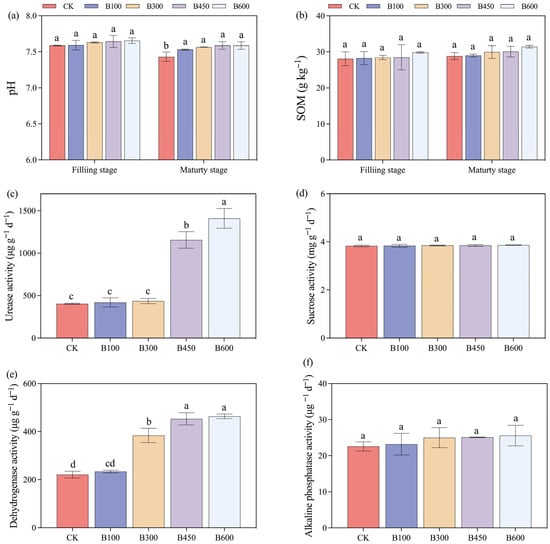
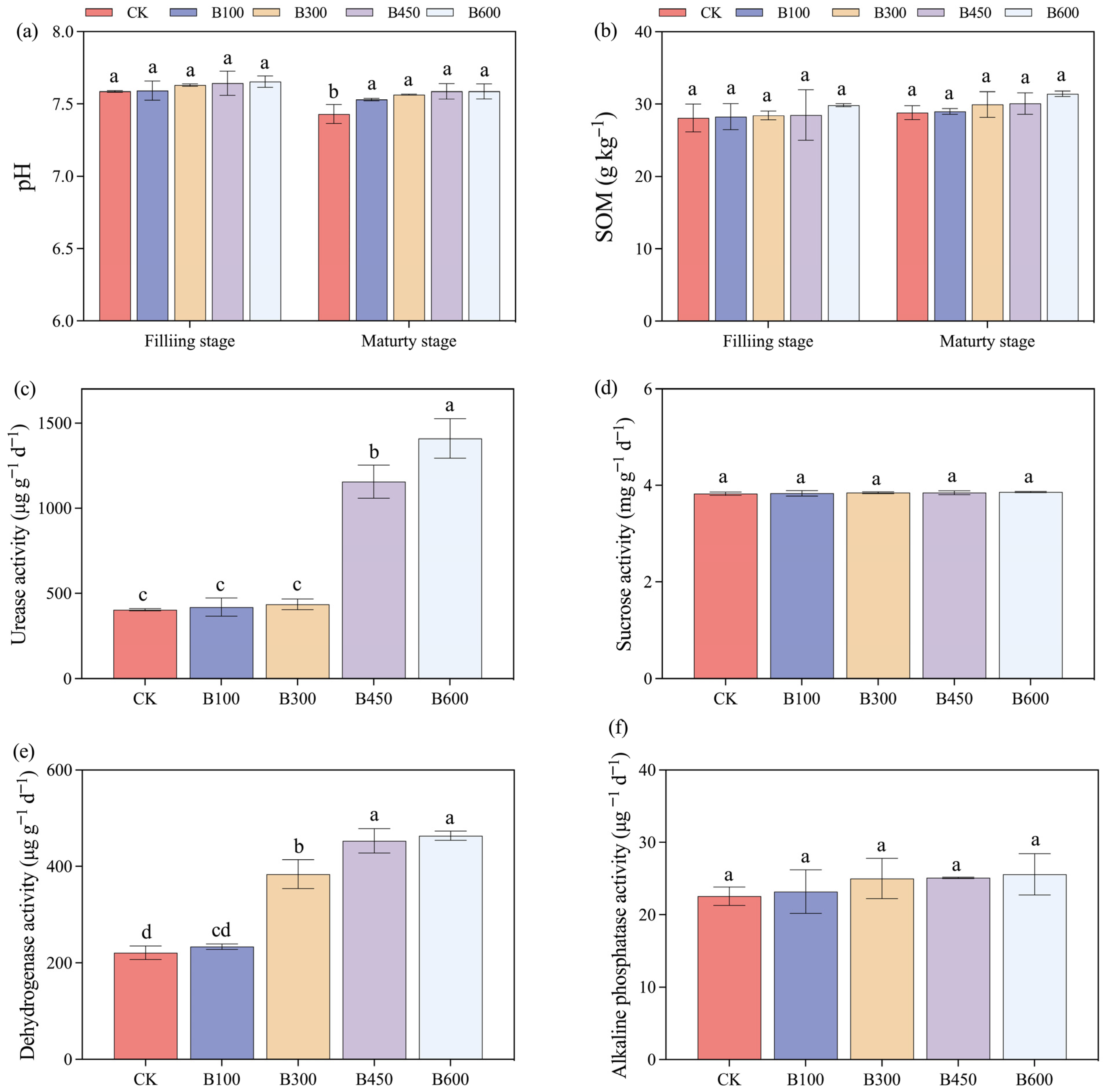
The application of compound Bacillus biofertilizer can increase soil pH. As shown in Figure 1, soil pH increased with increasing MI application rates at both the filling and maturity stages. At the filling stage, soil pH increased under all MI treatments, although the differences were not significant compared with CK. Among these treatments, B600 exhibited the highest soil pH, with an increase of 0.90% relative to CK. At maturity, all MI treatments significantly increased soil pH relative to CK. The corresponding increases were 1.35%, 1.82%, 2.11%, and 2.11% for B100, B300, B450, and B600, respectively. This result is consistent with the findings by Zhu et al. [35], who reported that the application of compound Bacillus biofertilizer increased soil pH. Similarly, inoculation with B. subtilis, B. amyloliquefaciens, or B. thuringiensis has been reported to significantly increase the pH of heavy metal-contaminated soils planted with wheat [24,36]. The application of MI as an organic input was beneficial to the increase in SOM content. Exudates from bacteria and decomposed cells are responsible for boosting the SOM [37]. In this study, SOM content showed a nonsignificant increasing trend with increasing MI application rates at both the grain-filling and maturity stages, reaching its maximum under B600, with increases of 6.23% and 9.11%, respectively, compared with CK.
Figure 1.
Effects of microbial inoculant (MI) application on soil chemical properties at the wheat filling and maturity stages and soil enzyme activities at the wheat maturity stage. (a) pH; (b) soil organic matter (SOM); (c) urease activity; (d) sucrase activity; (e) dehydrogenase activity; and (f) alkaline phosphatase activity. CK, B100, B300, B450, and B600 represent MI application rates of 0, 100, 300, 450, and 600 g per 15 m2 plot, respectively. Data are expressed as the mean ± standard deviation (SD) of three replicates (n = 3). Significant differences between treatments within each wheat growth stage are denoted by distinct lowercase letters (p < 0.05). The same applies to subsequent figures.
The application of MI can enhance soil urease activity (Figure 1c). Compared with CK, soil urease activity increased significantly by 186.38% and 249.28% under B450 and B600 treatments (p < 0.05). MI application increased soil sucrase activity by 0.54–1.08% (p > 0.05). Soil dehydrogenase activity increased with increasing MI application rates, with significant increases of 73.66%, 104.96%, and 109.68% under B300, B450, and B600, respectively (p < 0.05). In addition, soil alkaline phosphatase activity increased by 2.76–13.38% under MI treatments compared with CK. Soil enzymes are important indicators for reflecting the negative effects caused by heavy metal pollution [38]. Bacteria such as a certain amount of Bacillus can increase the activity of soil urease, sucrase, dehydrogenase and alkaline phosphatase [39,40,41,42]. Previous studies have reported that exogenous substances can directly or indirectly increase microbial abundance and root exudation in rhizosphere soil, thereby contributing to enhanced soil enzyme activities [43]. The introduction of Cd-tolerant strains can modify soil microbial communities and alter the number and properties of soil enzymes, thereby enhancing their resistance to heavy metal contamination [44]. The increase in soil enzyme activity following MI application may be attributed to the ability of bacteria to produce extracellular enzymes in response to environmental conditions [45]. Moreover, lower heavy metal bioavailability may reduce the extent to which Cd suppresses the activity of certain soil enzymes [46]. MI application may therefore enhance soil enzyme activities by decreasing heavy metal bioavailability. This result is consistent with the findings by Garau et al. [47], who reported that soils with lower levels of heavy metal contamination may exhibit higher enzyme activities.
3.2. Effects of MI on Soil DTPA–Cd and Cd Fraction
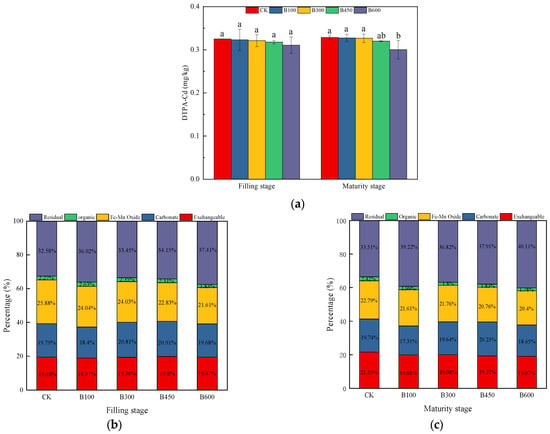
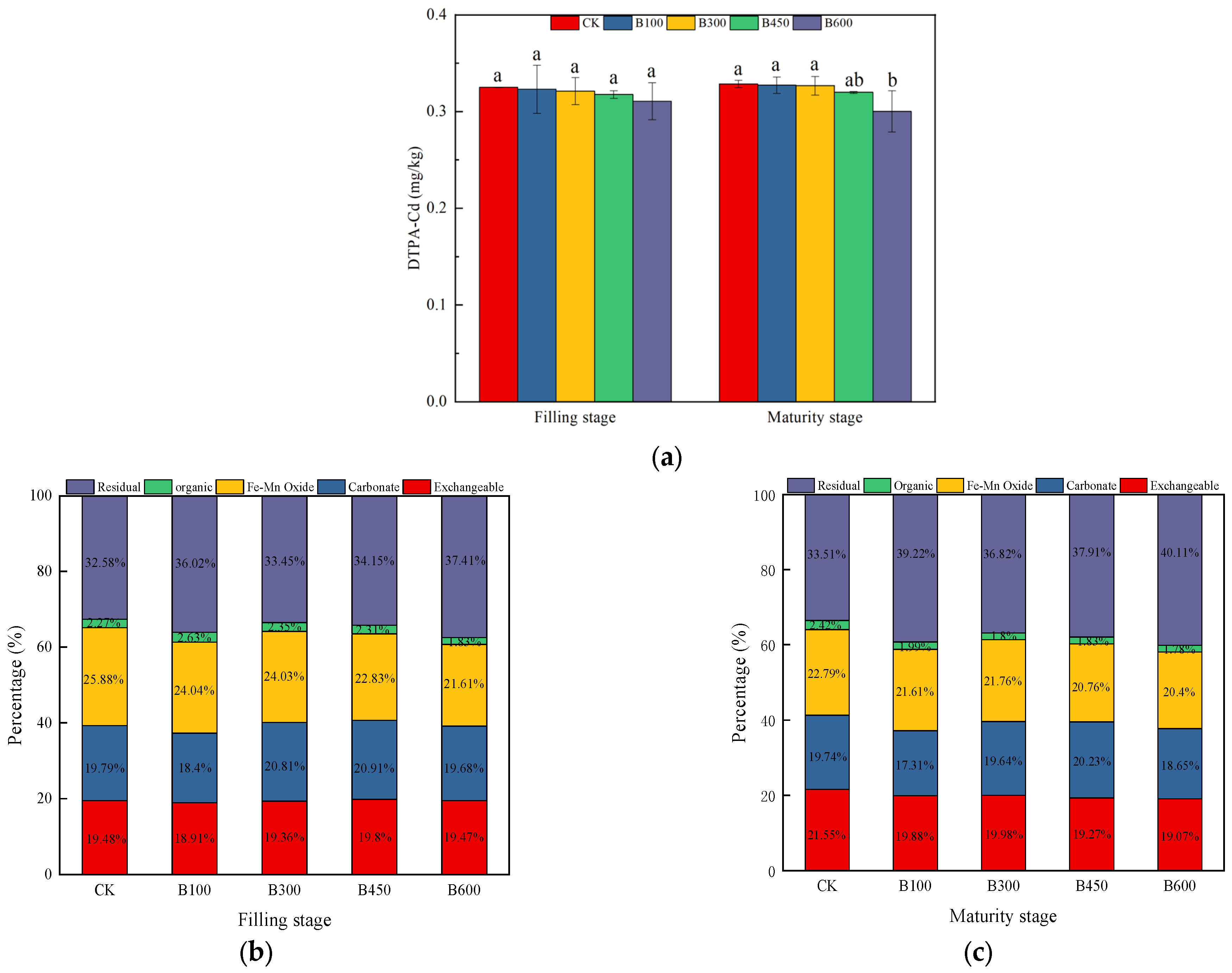
According to Figure 2, the content of DTPA-Cd in soil decreased with the increase in MI addition during wheat filling stage. At the filling stage, soil DTPA-Cd content was lowest under the B600 treatment, decreasing by 4.39% compared with CK, although the difference was not statistically significant (p > 0.05). The difference trend of soil DTPA-Cd content among different MI treatments at wheat maturity stage was basically consistent with that at wheat filling stage, DTPA-Cd content in soils under MI treatment showed a downward trend. Compared with CK, B100, B300, and B450 showed no significant reductions in soil DTPA-Cd content, whereas B600 significantly decreased it by 8.64% (p < 0.05). Furthermore, soil DTPA-Cd content under B600 was significantly reduced by 8.15% relative to B300 (p < 0.05). Among all treatments, B600 exhibited the lowest soil DTPA-Cd content, but it was significantly lower than CK only at the maturity stage. This result may be partially attributed to changes in soil pH. Previous studies have shown that an increase in soil pH can increase negative surface charges on soil particles, thereby reducing the bioavailability of heavy metals [48]. In this study, soil pH under the B600 treatment did not differ significantly from CK at the filling stage but was significantly higher than CK at the maturity stage. Therefore, the significant increase in soil pH at the maturity stage may be one of the reasons for the further reduction in soil DTPA-Cd content under the B600 treatment. MI effectively reduced the bioavailability and mobility of Cd in soil. Heavy metals in soil could be biosorbed or precipitated by living or dead bacterial cells, and the bioavailability of heavy metals in soil will be reduced by the combination of anionic functional groups with heavy metals [49]. A variety of Bacillus spp. such as B. subtilis and B. thuringiensis have been found to have the ability to produce siderophores [50]. Siderophores might reduce heavy metal availability in soil through metal binding and chelation [51]. MI contains Bacillus subtilis and Bacillus thuringiensis, which may produce siderophores that reduce soil Cd availability through metal binding and chelation. In addition, B. amyloliquefaciens has been reported to remove heavy metals through biosorption, precipitation, and cell-surface complexation [52]. Therefore, B. subtilis, B. thuringiensis, and B. amyloliquefaciens in MI may reduce soil Cd bioavailability through processes such as cell-surface adsorption, chelation, and precipitation. Our previous adsorption experiments provided indirect support for these mechanisms [27]. Scanning electron microscopy coupled with energy-dispersive X-ray spectroscopy (SEM-EDS) and X-ray diffraction (XRD) analyses showed that MI interacted with Cd2+ through precipitation and ion-exchange processes and converted Cd2+ into CdCO3 with greater stability and lower toxicity. Results from Fourier transform infrared spectroscopy (FTIR) identified -OH, C-H, and -NH as the principal functional groups participating in Cd2+ adsorption by MI.
Figure 2.
The content of DTPA-Cd (a) and the distribution of Cd fraction in soil at filling stage (b) and maturity stage (c) under different treatments. Cd fractions include exchangeable fraction (Exchangeable), carbonate-bound fraction (Carbonate), Fe and Mn oxide bounded fraction (Fe-Mn oxide), organic matter bound fraction (Organic), and residual fraction (Residual). Different lowercase letters indicate significant differences among treatments (p < 0.05).
The migration and toxicity of Cd in soil can be evaluated by the fractionation of Cd in soil [53]. At the wheat filling stage, the soil Cd in the control group was mainly in the residual Cd fraction (32.58%) and the Fe-Mn oxide bound Cd fraction (25.88%), the organic Cd fraction only accounted for 2.27%, and the exchangeable Cd fraction accounted for 19.79% (Figure 2b). MI application increased the proportion of the residual Cd fraction while decreasing that of the Fe–Mn oxide-bound Cd fraction in soil. The B600 treatment increased the proportion of the residual Cd fraction by 4.83%, while reducing that of the Fe–Mn oxide bound Cd fraction by 4.27%. At wheat maturity, soil Cd in the CK treatment was mainly present in the exchangeable (21.55%), Fe-Mn oxide bound (22.79%), and residual (33.51%) fractions (Figure 2c). After the application of MI, the proportions of the exchangeable Cd fraction decreased by 1.67%, 2.00%, 2.28%, and 2.48% under B100, B300, B450, and B600, respectively. Corresponding reductions of 1.18%, 1.03%, 2.03%, and 2.39% were observed in the Fe–Mn oxide bound Cd fraction, whereas the residual Cd fraction increased by 5.71%, 3.32%, 4.40%, and 6.60%, respectively. As the most threatening fraction, the exchangeable Cd fraction is considered to be an important index to measure the harm of heavy metal pollution and is easily absorbed by plants [54,55]. The organic Cd fraction and Fe-Mn oxide bound Cd fraction cannot be directly taken up by plants but may become bioavailable under certain redox conditions [56]. In contrast, the residual Cd fraction is regarded as the most stable Cd fraction in soil, with limited potential for release and subsequent plant uptake [57]. Based on the observed changes in the exchangeable Cd fraction, Fe-Mn oxide bound Cd fraction, and residual Cd fraction, it can be inferred that MI application may promote the transformation of the exchangeable Cd fraction and Fe-Mn oxide bound Cd fraction into the residual Cd fraction, potentially reducing Cd bioavailability. This inference is consistent with the findings by Li et al. [58], who reported that the application of passivating agents promoted the transformation of exchangeable Cd fraction into less exchangeable fractions, thereby reducing Cd accumulation in plants.
3.3. Effect of MI on Wheat Yield and Cd Accumulation
The average wheat yield across treatments ranged from 0.85 to 0.98 kg m−2 (Figure S2). Previous studies have suggested that inoculant application rates should be carefully considered to avoid exceeding the dose threshold at which plant growth stimulation shifts to inhibition [59]. In this study, compared with CK, wheat yield under the B100, B300, B450, and B600 treatments increased by 4.31%, 11.37%, 7.65%, and 15.00%, respectively. However, no statistically significant differences were observed among treatments (p > 0.05). Previous research has shown that MI application reduced Cd content in wheat, alleviated Cd stress, and increased wheat yield in Cd-contaminated soil [60]. In addition, many Bacillus species are recognized as plant growth-promoting rhizobacteria and may contribute to crop yield maintenance [61,62]. In this study, MI application resulted in numerically higher wheat yield, but the differences were not statistically significant, suggesting that MI may help maintain wheat yield in Cd-contaminated soil.
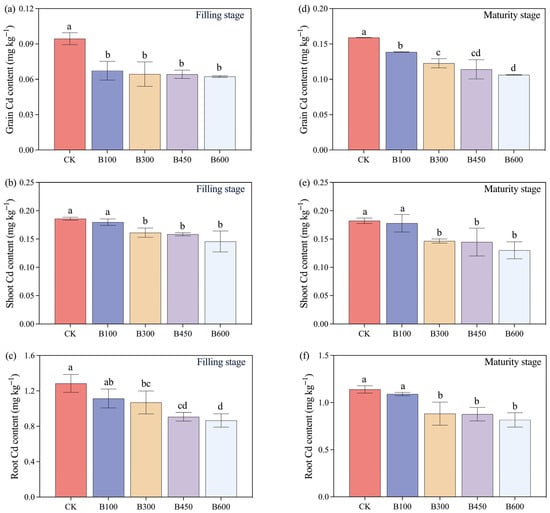
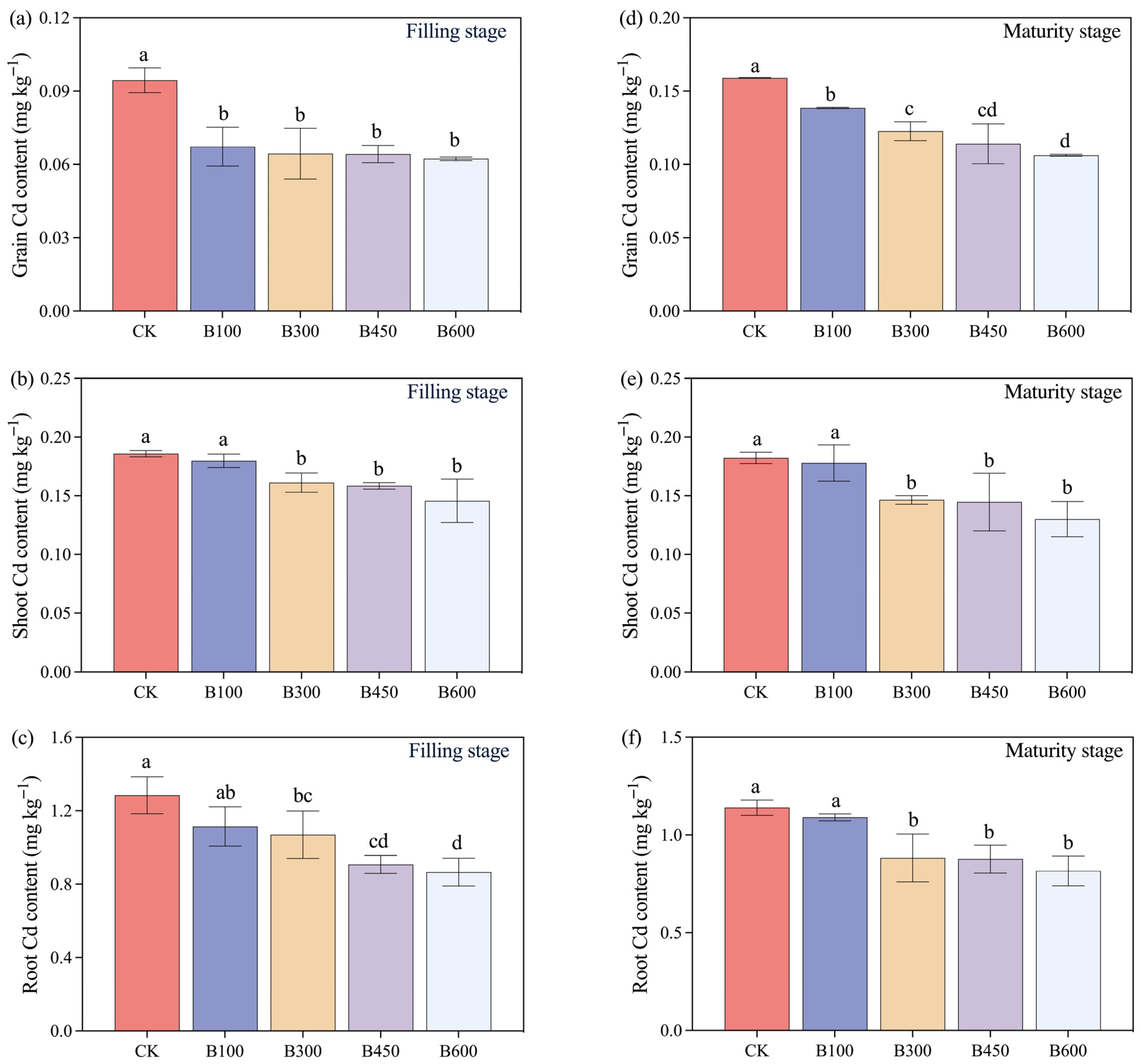
Cd content varied among wheat tissues, following the order of root > straw > grain (Figure 3). At the filling stage, Cd content in wheat roots under B450 and B600 treatments decreased significantly by 29.39% and 32.60%, respectively, compared with CK (p < 0.05). At the maturity stage, MI application reduced Cd content in wheat roots by 4.30–28.38%. Cd contents in wheat roots decreased significantly under B300, B450, and B600 relative to both CK and B100 (p < 0.05). Moreover, MI reduced the bioaccumulation factor of Cd in wheat at filling stage and maturity stage (Figure S3). At the filling stage, Cd content in wheat shoots decreased by 3.26–21.63% following MI application. Compared with CK and B100, Cd content in wheat shoots under B300, B450, and B600 treatments decreased significantly (p < 0.05). At maturity, shoot Cd content decreased by 2.93–28.65%. The reductions under B300, B450, and B600 were significant when compared with both CK and B100 (p < 0.05). After MI application, the Cd content in wheat grain at filling stage decreased significantly compared with CK, with a decrease of 28.78–34.01% (p < 0.05). However, the grain Cd content at maturity was higher than that measured at the filling stage. Cd in root, stem and leaf was transported to grain during grain filling, which may be the reason why Cd content in grain at maturity stage was higher than that at grain filling stage [63]. Root Cd uptake capacity and the efficiency of shoot-to-grain Cd retranslocation influence Cd content in wheat grains [64]. As the main absorbing organ of wheat, roots can absorb nutrients and heavy metals in soil and transport them to the aboveground parts. Therefore, the reduction in Cd bioavailability is an important means to alleviate Cd uptake by roots and reduce Cd accumulation in crops. Exchangeable Cd can be absorbed and accumulated by plants because Cd2+ is easily released from the exchangeable Cd and then transported to the surface of the root tissue and into the root cells [65]. The application of MI reduced the content of exchangeable Cd fraction, which may lead to the decrease in Cd content in wheat roots. In addition, MI application reduced soil DTPA-Cd content, with the greatest reduction of 8.64% observed under B600 compared with CK (p < 0.05). Similar findings were reported by Lu et al. [66] who observed reductions of 3.8–9.5% in soil DTPA-Cd content and 40.1–57.2% in wheat grain Cd content, with a significant positive correlation between grain Cd and soil DTPA-Cd contents. In this study, the Cd content in wheat grains at maturity was significantly reduced by 12.83–33.15% under MI treatments compared with CK (p < 0.05). Among all treatments, B600 resulted in the lowest grain Cd content, at 0.106 mg kg−1. Although this value remained slightly above the food safety limit of 0.10 mg kg−1 (GB 2762-2022) [29], these results demonstrate the potential of MI application to reduce soil Cd bioavailability and Cd accumulation in wheat grains. Therefore, MI application shows potential to reduce soil Cd bioavailability and Cd accumulation in wheat grains, thereby contributing to the mitigation of Cd contamination risks in wheat grains [67].
Figure 3.
Effects of MI on Cd accumulation in wheat grains (a), shoots (b), and roots (c) at the filling stage, and in wheat grains (d), shoots (e), and roots (f) at the maturity stage. Different lowercase letters indicate significant differences among treatments (p < 0.05).
3.4. Assembly and Structural Feature of Bacterial Community
3.4.1. Soil Bacterial Communities
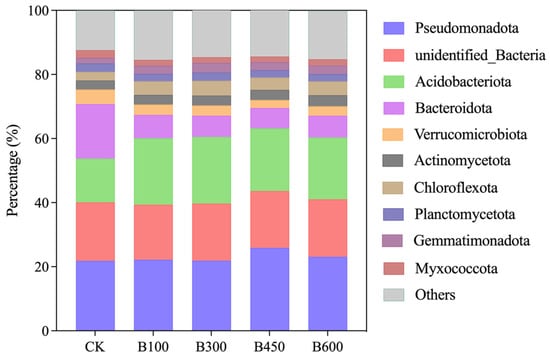
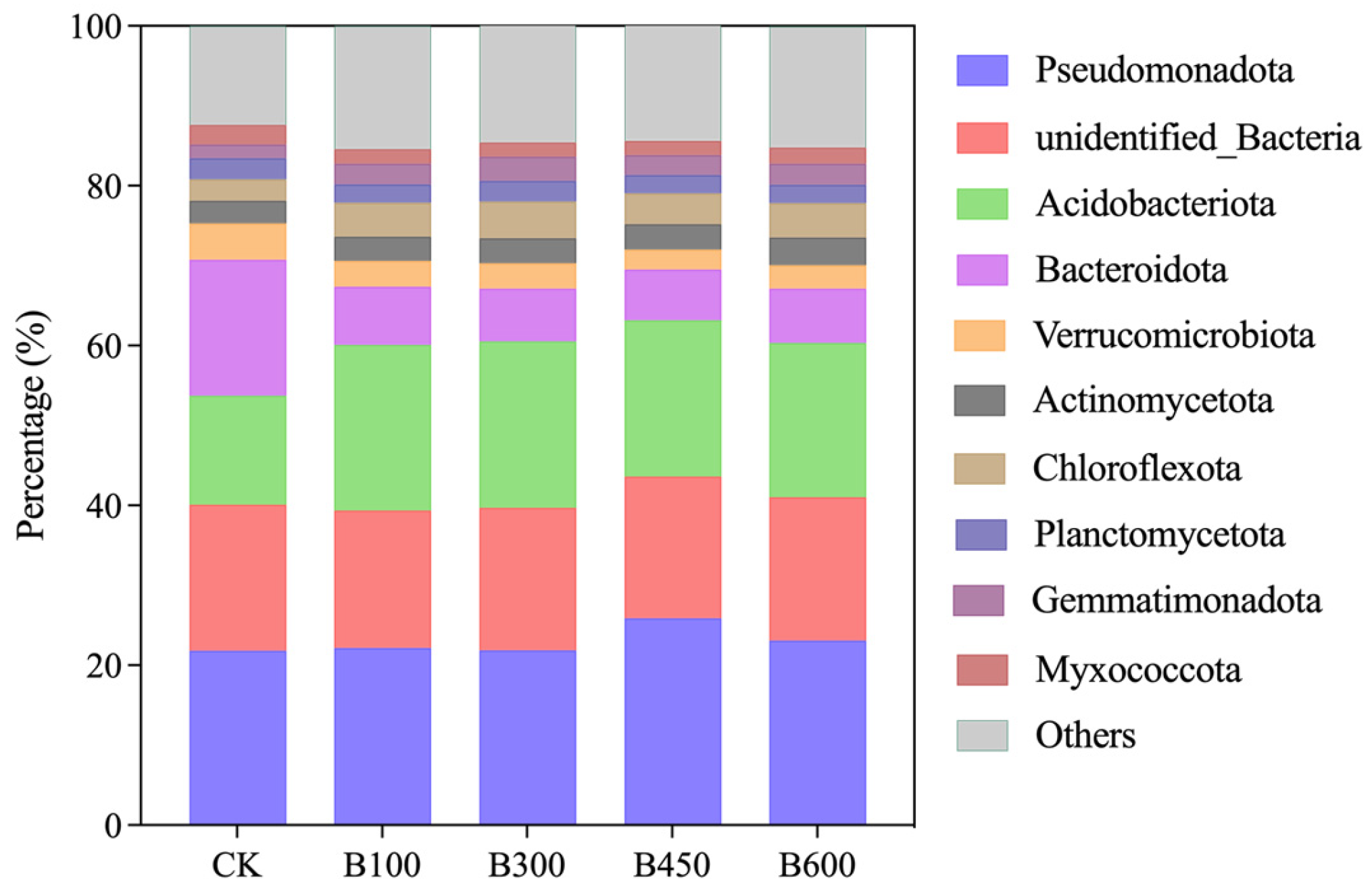
As shown in Figure S4, the Shannon index of soil bacterial communities increased by 6.53%, 6.23%, 5.70%, and 7.12% under the B100, B300, B450, and B600 treatments, respectively, compared with CK. The highest Shannon index was observed under B600 and was significantly higher than that under CK. No significant differences in the Simpson index were observed between any MI treatment and CK. MI application significantly increased Pielou’s evenness index, with increases of 4.19%, 3.94%, 3.42%, and 4.65% under B100, B300, B450, and B600, respectively, compared with CK. This finding is consistent with the results reported by Patyka et al. [68], who found that inoculant application significantly increased the Shannon and Pielou’s evenness indices of soil bacterial communities in wheat fields. The relative abundance of the top 10 phyla and the top 40 genera of soil prokaryotes was analyzed to explore the changes in soil bacterial community structure after MI application. As shown in Figure 4, Pseudomonadota and Acidobacteriota exhibited relatively high abundances. Application of MI increased the relative abundance of Pseudomonadota by 0.23–18.51%. Since several heavy metal oxidase genes encoded by Pseudomonadota members are related to heavy metal toxicity resistance or immobilization, the enhancement of the dominant position of Pseudomonadota can effectively optimize the composition of soil bacterial communities to promote the remediation of Cd-contaminated soil [69,70]. The relative abundance of Acidobacteriota in MI treatment increased by 41.72–52.62%. In contrast, the relative abundance of Bacteroidota and Verrucomicrobiota decreased under MI treatment. The application of MI increased the relative abundance of Actinomycetota in heavy metal contaminated soil by 4.71–20.53%. MI was prepared by Bacillus belonging to Bacillota, and the relative abundance of Bacillota increased by 30.1–100.79% after application of MI. Actinomycetota and Bacillota have heavy metal tolerance [71]. It has been reported that Actinomycetota can secrete siderophores and chelating agents to reduce the bioavailability of Cd in soil and alleviate Cd pollution [72,73]. The increase in the relative abundance of Bacillota may promote the adsorption, chelation or precipitation of Cd in soil, thereby alleviating the negative effects of Cd pollution and further reducing the absorption of Cd by crops [74]. Clustered heatmap analysis was performed to characterize microbial community composition at the genus level (Figure S5). The relative abundance of Chroococcidiopsis_SAG_2023 was highest under B100 treatment, whereas those of Luteimonas and Arthrobacter were highest under B450 and B600 treatments, respectively. Furthermore, following MI application, the relative abundances of Pseudomonas, Arthrobacter, and Bacillus increased by 61.10–197.55%, 3.00–43.93%, and 31.03–96.93%, respectively. Previous studies have shown that these bacteria can be effectively applied to the bioremediation of heavy metal pollution [13,75,76]. Collectively, these findings suggest that MI application altered soil bacterial community composition at both the phylum and genus levels and increased the relative abundances of bacterial genera associated with heavy metal remediation, potentially contributing to the bioremediation of Cd-contaminated soil.
Figure 4.
Relative abundance of soil bacteria at the phylum level.
3.4.2. Co–Occurrence Network Analysis
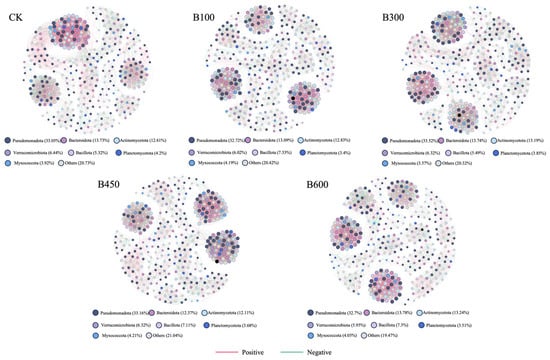
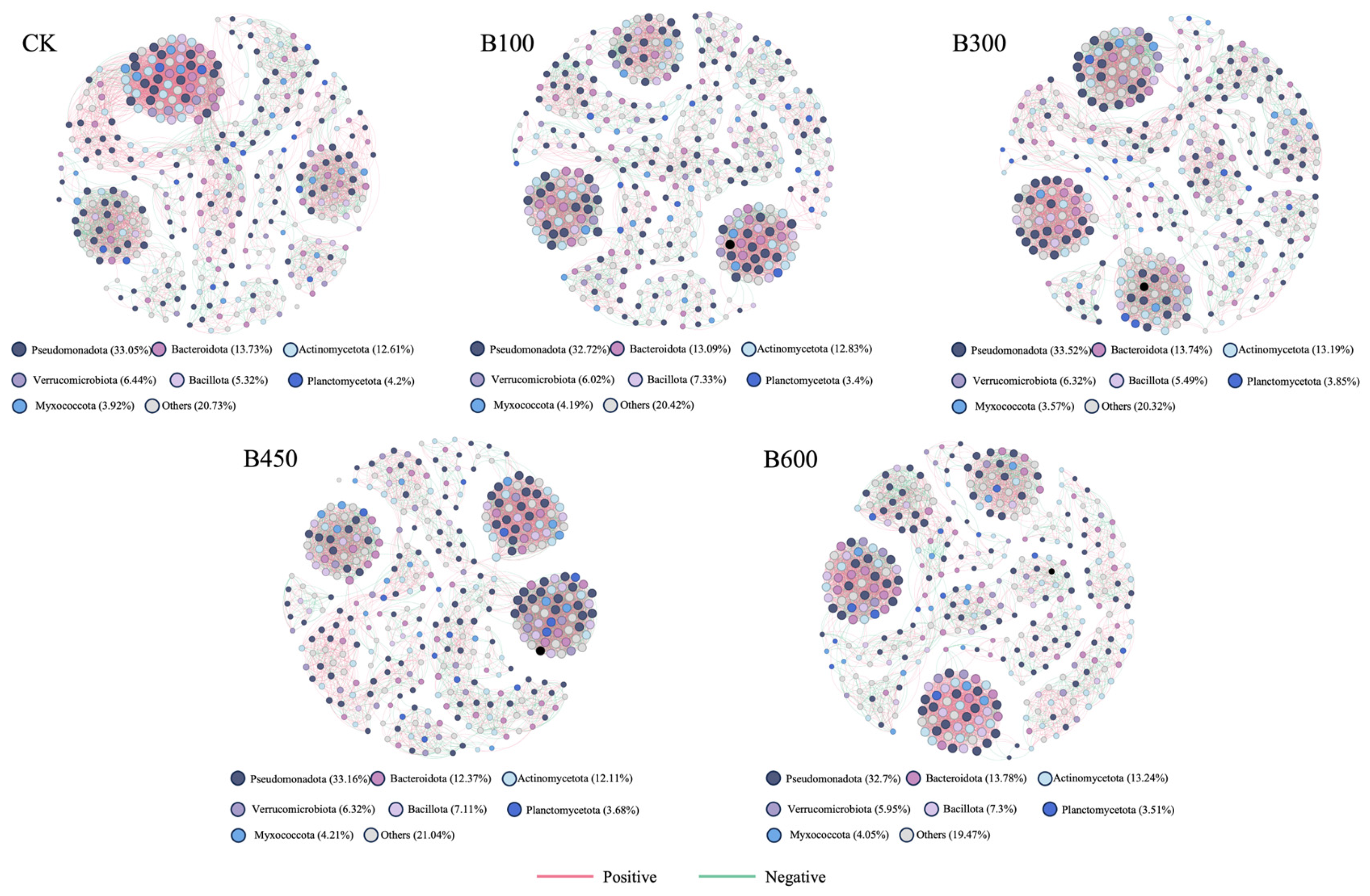
Bacterial co-occurrence networks at the genus level were established using Pearson correlation analysis (Figure 5). In these networks, bacterial genera were represented by nodes, with different colors indicating their respective phyla. The higher clustering coefficients (0.828, 0.853, 0.862, 0.868 and 0.857) and modularity indexes (0.735, 0.838, 0.83, 0.811 and 0.833) (Table 1) of the networks under each treatment indicated that the bacterial networks consisted of highly interconnected genera [77]. The network modularity index of each treatment exceeded 0.4, indicating that the network exhibited a modular structure [78]. Most of the nodes in the co-occurrence network of each treatment belonged to Pseudomonadota, Bacteroidota, Actinomycetota, Bacillota and Verrucomicrobiota. These phyla played important roles in the overall network structure, with Pseudomonadota emerging as the dominant phylum across all five treatment networks. MI increased the proportion of Bacillota-affiliated nodes in the bacterial co-occurrence network, which may be due to the introduction of high concentrations of Bacillus through MI. In addition, positive correlations outnumbered negative correlations in all co-occurrence networks, indicating that significant positive correlations predominated across the networks. Previous studies have reported that microorganisms in polluted soils may exhibit more positive correlations in response to environmental stress, whereas microbial networks in less polluted soils tend to exhibit more negative correlations [79,80,81]. In this study, the number of negative correlations in the networks of all MI treatments was higher than that of CK, with increases of 20.03%, 25.92%, 42.93%, and 1.64% under the B100, B300, B450, and B600 treatments, respectively. In addition, we identify the nodes with the top 10% degree in the network as keystone taxa [82]. It can be seen from Table S1 that compared with CK, the key groups of MI treatment changed significantly, and these key genera (such as RB41, Opitutus, and Aeromonas) may play a role in the remediation of soil heavy metal pollution [83,84,85].
Figure 5.
The co-occurrence network of bacterial communities in different treatments.
Table 1.
Topological properties of bacterial community co-occurrence network.
3.5. Correlation Analysis
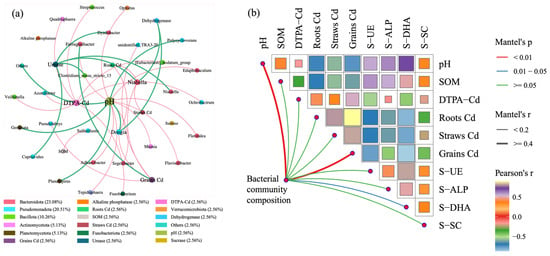
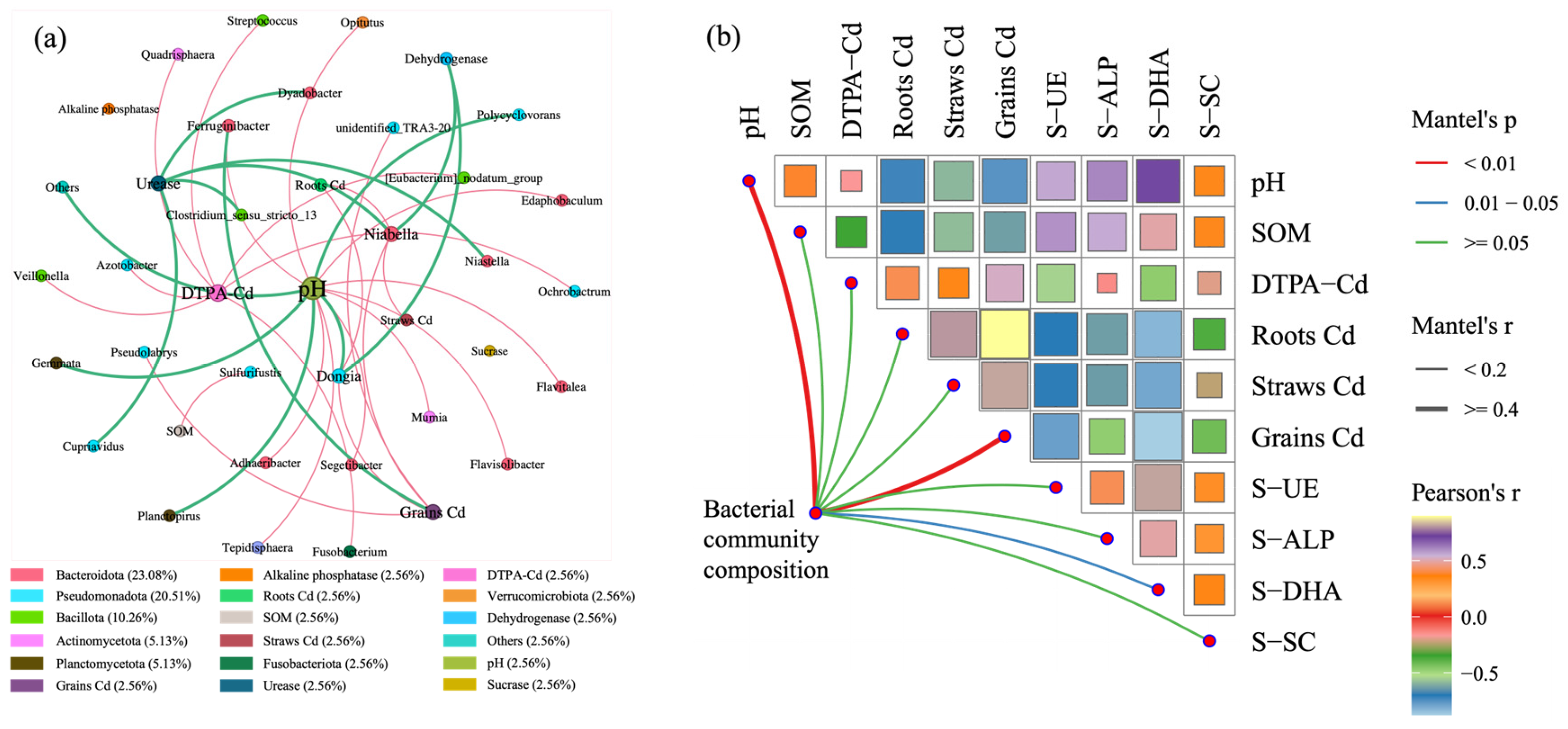
Correlations among bacterial phyla, soil enzyme activities, soil chemical properties, DTPA-Cd, and Cd content in wheat tissues were further explored through co-occurrence network analysis (Figure 6a). The network was constructed by 37 points and 37 edges (24 negative correlations and 13 positive correlations). Bacteroidota (23.08%), Pseudomonadota (20.51%) and Bacillota (10.26%) were the most important phyla to construct the network. DTPA-Cd was significantly negatively correlated with bacteria (e.g., Azotobacter and Ochrobactrum). Ochrobactrum possesses metal chelating properties, and its dominance in cathode biofilms suggests a potential role in heavy metal removal [86]. It has been confirmed that heavy metal resistant Azotobacter spp. exhibit a strong capacity to bind Cd both in vitro and in vivo, thereby reducing heavy metal uptake by wheat [87]. Mantel test results indicated that soil pH and grain Cd content exhibited the strongest correlations with bacterial community composition. Previous studies have identified soil pH as an important factor influencing bacterial community composition, potentially due to the narrow optimal pH ranges for bacterial growth and the regulation of soil nutrient availability by pH [88,89,90]. Soil urease activity was significantly positively correlated with soil bacteria. Urease is widely distributed in plants and bacteria, and increased urease activity may accelerate the rise in soil pH, thereby creating favorable conditions for bacterial growth [91,92]. Mantel test results also revealed a significant correlation between soil dehydrogenase activity and bacterial community composition. Dehydrogenase is an indispensable oxidoreductase secreted by active microorganisms [93]. As dehydrogenase activity is primarily associated with intact living cells, it can serve as an indicator of microbial viability and activity [94,95]. In addition, as shown in Figure 6, Cd-related indicators (DTPA-Cd and Cd contents in roots, straw, and grains) were negatively correlated with soil pH. This finding further supports our hypothesis that MI may reduce Cd bioavailability by increasing soil pH. Soil pH plays a crucial role in regulating biogeochemical processes and influencing heavy metal bioavailability in soils [96]. Previous studies have demonstrated that soil pH plays an important role in influencing Cd partitioning and mobility [97]. An increase in soil pH may promote the precipitation of Cd2+ as CdCO3, thereby reducing Cd mobility and bioavailability [98]. Cd contents in wheat roots, shoots, and grains were negatively correlated with soil pH and soil enzyme activities (sucrase, dehydrogenase, urease, and alkaline phosphatase), suggesting that MI application may reduce Cd uptake and accumulation in wheat by improving these soil properties.
Figure 6.
Co-occurrence network (a) and Mantel test (b) illustrating the correlations between bacterial community composition and environmental factors. Notes: S-UE, soil urease activity; S-ALP, soil alkaline phosphatase activity; S-DHA, soil dehydrogenase activity; S-SC, soil sucrase activity. Bacterial community data were derived from the relative abundances of the top 10 bacterial phyla.
Taken together, the findings of this field experiment suggest that the reduction in soil Cd bioavailability following MI application may be primarily associated with increased soil pH, which could facilitate Cd immobilization and its transformation into more stable forms. In addition, MI altered the soil bacterial community composition by increasing the relative abundances of several heavy metal-tolerant and remediation-associated taxa, including the phyla Pseudomonadota, Actinomycetota, and Bacillota, as well as the genera Pseudomonas, Arthrobacter, and Bacillus. Moreover, RB41, Opitutus, and Aeromonas, which have potential roles in heavy metal remediation, were identified as keystone taxa in the bacterial co-occurrence network of MI-treated soils. These findings suggest that changes in bacterial community composition following MI application may contribute to soil Cd immobilization. The Bacillus strains in MI may also immobilize Cd through adsorption, ion exchange, and precipitation. However, this interpretation is mainly based on indirect evidence from our previous adsorption experiments and published studies. Under field conditions, the specific roles and relative contributions of these processes, as well as whether intracellular Cd sequestration occurs in the inoculated strains, require further validation in future studies.
4. Conclusions
In summary, we investigated the effects of different application rates of MI on the remediation of Cd-contaminated wheat field soil and the changes in bacterial community structure. The results suggested that the content of DTPA-Cd in soil decreased with the increase in MI application, and the Cd fraction was converted into a residual fraction that was not conducive to plant utilization. Moreover, MI application significantly reduced Cd content in wheat grains by 12.83–33.15%, indicating its potential to mitigate Cd accumulation in wheat. MI regulated the bacterial community structure at the phylum and genus levels and increased the relative abundance of microorganisms related to heavy metal remediation. Network analysis showed that MI changed the key taxa, which may play an important role in the remediation of Cd-contaminated soil. Therefore, the MI application represents a promising approach to reducing soil Cd bioavailability and Cd accumulation in wheat grain, with potential applications in the management of Cd-contaminated agricultural soils.
Supplementary Materials
The following supporting information can be downloaded at: https://www.mdpi.com/article/10.3390/microorganisms14112502/s1, Text S1: Details of wheat bioaccumulation analysis; Text S2: Soil DNA Extraction; Figure S1: Effects of MI application on the concentrations of different Cd fractions in soil at the wheat filling and maturity stages; Figure S2: Effects of different MI treatments on wheat yield; Figure S3: Effects of different MI treatments on the bioaccumulation factor of wheat; Figure S4: Effects of different MI treatments on the Shannon, Simpson, and Pielou’s evenness indices of soil bacterial communities; Figure S5: Heatmap of the relative abundance of the top 40 bacterial genera in soil; Table S1: The top 10 key genera of bacterial co-occurrence network.
Author Contributions
Conceptualization, W.Y. and Y.S.; methodology, W.Y. and T.S.; software, T.S.; validation, W.Y., T.S. and Y.S.; formal analysis, W.Y.; investigation, W.Y.; resources, B.J.; data curation, T.S.; writing—original draft preparation, W.Y.; writing—review and editing, T.S.; visualization, W.Y.; supervision, B.J.; project administration, Y.S.; funding acquisition, B.J. All authors have read and agreed to the published version of the manuscript.
Funding
This work was supported by the Technical Services for Soil Physicochemical Property Testing and Formula Fertilization with Zinc and Sulfur Application Testing in Maize (86021600) and Tianjin Natural Science Foundation Project (25JCZDJC00370), the Innovation Program of the Chinese Academy of Agricultural Sciences (CAAS-AEPI-2026-1), and the Key Technology Research Project for Mountain Agriculture of Guizhou Province (GZNYGJHK-2025005).
Institutional Review Board Statement
Not applicable.
Informed Consent Statement
Not applicable.
Data Availability Statement
The original contributions presented in this study are included in the article/Supplementary Material. Further inquiries can be directed to the corresponding authors.
Acknowledgments
All individuals included in this section have consented to the acknowledgement.
Conflicts of Interest
The authors declare no conflicts of interest.
References
- Brunetti, G.; Ruta, C.; Traversa, A.; D’Ambruoso, G.; Tarraf, W.; De Mastro, F.; De Mastro, G.; Cocozza, C. Remediation of a heavy metals contaminated soil using mycorrhized and non-mycorrhized Helichrysum italicum(Roth) Don. Land Degrad. Dev. 2017, 29, 91–104. [Google Scholar] [CrossRef] [Scilit]
- Ahmad, H.; Lu, J.; Shah, M.A.; Jan, M.F.; Ali, S.; Lv, J.Z.; He, R. Seed Inoculation with Bacillus subtilis Mitigates Cadmium Stress in Maize by Remodelling the Soil Microbiome and Ionome. Land Degrad. Dev. 2026, 37, 6912–6932. [Google Scholar] [CrossRef] [Scilit]
- Feng, W.; Guo, Z.; Xiao, X.; Peng, C.; Shi, L.; Ran, H.; Xu, W. Atmospheric deposition as a source of cadmium and lead to soil-rice system and associated risk assessment. Ecotoxicol. Environ. Saf. 2019, 180, 160–167. [Google Scholar] [CrossRef] [Scilit]
- Li, R.; Xu, J.; Luo, J.; Yang, P.; Hu, Y.; Ning, W. Spatial distribution characteristics, influencing factors, and source distribution of soil cadmium in Shantou City, Guangdong Province. Ecotoxicol. Environ. Saf. 2022, 244, 114064. [Google Scholar] [CrossRef] [Scilit]
- Deng, S.; Wan, X.; Zhou, X.; Yuan, S.W.; Chen, X.; Wang, Y.F.; Chen, P. Dual Effects of PVC Microplastics on Cd Mobility in Red Soil: Enhanced Aqueous Concentration Versus Reduced Soil Bioavailability. Land Degrad. Dev. 2025, 36, 5976–5986. [Google Scholar] [CrossRef] [Scilit]
- Suhani, I.; Sahab, S.; Srivastava, V.; Singh, R.P. Impact of cadmium pollution on food safety and human health. Curr. Opin. Toxicol. 2021, 27, 1–7. [Google Scholar] [CrossRef] [Scilit]
- Hu, P.; Tu, F.; Li, S.; Pan, Y.; Kong, C.; Zhang, X.; Wang, S.; Sun, Y.; Qiu, D.; Wu, L.; et al. Low-Cd wheat varieties and soil Cd safety thresholds for local soil health management in south Jiangsu province, east China. Agric. Ecosyst. Environ. 2023, 341, 108211. [Google Scholar] [CrossRef] [Scilit]
- Li, Y.; Gao, C.; Rong, S.; Gu, J.; Zhao, H.; Su, S.; Liu, W. Combining mercapto-functionalized palygorskite with zinc affect cadmium phytoavailability and soil microbial activity in rhizosphere soil. Land Degrad. Dev. 2021, 33, 193–203. [Google Scholar] [CrossRef] [Scilit]
- Xia, X.; Wu, S.; Zhou, Z.; Wang, G. Microbial Cd(II) and Cr(VI) resistance mechanisms and application in bioremediation. J. Hazard. Mater. 2021, 401, 123685. [Google Scholar] [CrossRef] [Scilit]
- Huang, Y.; Liu, T.; Liu, J.; Xiao, X.; Wan, Y.; An, H.; Luo, X.; Luo, S. Exceptional anti-toxic growth of water spinach in arsenic and cadmium co-contaminated soil remediated using biochar loaded with Bacillus aryabhattai. J. Hazard. Mater. 2024, 469, 133966. [Google Scholar] [CrossRef] [Scilit]
- Peng, C.; Zhao, X.; Ji, X.; Wu, J.; Liang, W.; Song, H.; Zhang, W.; Wang, X. Mixed bacteria passivation for the remediation of arsenic, lead, and cadmium: Medium optimization and mechanisms. Process Saf. Environ. Prot. 2023, 170, 720–727. [Google Scholar] [CrossRef] [Scilit]
- Wei, X.; Cao, P.; Wang, G.; Han, J. Microbial inoculant and garbage enzyme reduced cadmium (Cd) uptake in Salvia miltiorrhiza (Bge.) under Cd stress. Ecotoxicol. Environ. Saf. 2020, 192, 110311. [Google Scholar] [CrossRef] [Scilit]
- Schommer, V.A.; Vanin, A.P.; Nazari, M.T.; Ferrari, V.; Dettmer, A.; Colla, L.M.; Piccin, J.S. Biochar-immobilized Bacillus spp. for heavy metals bioremediation: A review on immobilization techniques, bioremediation mechanisms and effects on soil. Sci. Total Environ. 2023, 881, 163385. [Google Scholar] [CrossRef] [Scilit]
- Sarawaneeyaruk, S.; Lorliam, W.; Krajangsang, S.; Pringsulaka, O. Enhancing plant growth under municipal wastewater irrigation by plant growth promoting rhizospheric Bacillus spp. J. King Saud Univ. Sci. 2019, 31, 384–389. [Google Scholar] [CrossRef] [Scilit]
- Gao, Y.; Wang, H.; Xu, R.; Wang, Y.N.; Sun, Y.; Bian, R.; Li, W. Remediation of Cr(VI)-contaminated soil by combined chemical reduction and microbial stabilization: The role of biogas solid residue (BSR). Ecotoxicol. Environ. Saf. 2022, 231, 113198. [Google Scholar] [CrossRef] [Scilit]
- Wani, P.A.; Wahid, S.; Khan, M.S.A.; Rafi, N.; Wahid, N. Investigation of the role of chromium reductase for Cr (VI) reduction by Pseudomonas species isolated from Cr (VI) contaminated effluent. Biotechnol. Res. Innov. 2019, 3, 38–46. [Google Scholar] [CrossRef] [Scilit]
- Zuo, W.; Li, J.; Zheng, J.; Zhang, L.; Yang, Q.; Yu, Y.; Zhang, Z.; Ding, Q. Whole genome sequencing of a multidrug-resistant Bacillus thuringiensis HM-311 obtained from the Radiation and Heavy metal-polluted soil. J. Glob. Antimicrob. Resist. 2020, 21, 275–277. [Google Scholar] [CrossRef] [Scilit]
- Huang, T.-P.; Xiao, Y.; Pan, J.-R.; Chen, Z.; Li, L.-F.; Xu, L.; Zhang, L.-L.; Guan, X. Aerobic Cr(VI) Reduction by an Indigenous Soil Isolate Bacillus thuringiensis BRC-ZYR2. Pedosphere 2014, 24, 652–661. [Google Scholar] [CrossRef] [Scilit]
- Shahwar, D.; Mushtaq, Z.; Mushtaq, H.; Alqarawi, A.A.; Park, Y.; Alshahrani, T.S.; Faizan, S. Role of microbial inoculants as bio fertilizers for improving crop productivity: A review. Heliyon 2023, 9, e16134. [Google Scholar] [CrossRef] [Scilit]
- Xu, T.; Xi, J.; Ke, J.; Wang, Y.; Chen, X.; Zhang, Z.; Lin, Y. Deciphering soil amendments and actinomycetes for remediation of cadmium (Cd) contaminated farmland. Ecotoxicol. Environ. Saf. 2023, 249, 114388. [Google Scholar] [CrossRef] [Scilit]
- Mo, A.; Li, H.; Zhai, Y.; Yang, H.; Wang, J.; Wang, Y.; Yi, L.; Guo, W.; Yuan, Y. Assessment of Bacillus subtilis applied in rice-crayfish coculture system on physicochemical properties, microbial sulfur cycling, Cd accumulation and bioavailability. J. Clean. Prod. 2022, 381, 135158. [Google Scholar] [CrossRef] [Scilit]
- Han, H.; Wang, Q.; He, L.Y.; Sheng, X.F. Increased biomass and reduced rapeseed Cd accumulation of oilseed rape in the presence of Cd-immobilizing and polyamine-producing bacteria. J. Hazard. Mater. 2018, 353, 280–289. [Google Scholar] [CrossRef] [Scilit]
- Cao, P.; Wei, X.; Wang, G.; Chen, X.; Han, J.; Li, Y. Microbial inoculants and garbage fermentation liquid reduced root-knot nematode disease and As uptake in Panax quinquefolium cultivation by modulating rhizosphere microbiota community. Chin. Herb. Med. 2022, 14, 58–69. [Google Scholar] [CrossRef] [Scilit]
- Wang, X.; Liu, X.; Ji, H.; Xia, T. Poly-γ-glutamic acid-producing bacteria reduce wheat Cd uptake by promoting Cd transfer from macro-to micro-aggregates in Cd-contaminated soil. Front. Environ. Sci. 2023, 10, 1097865. [Google Scholar] [CrossRef] [Scilit]
- Han, H.; Wu, X.; Hui, R.; Xia, X.; Chen, Z.; Yao, L.; Yang, J. Synergistic effects of Cd-loving Bacillus sp. N3 and iron oxides on immobilizing Cd and reducing wheat uptake of Cd. Environ. Pollut. 2022, 305, 119303. [Google Scholar] [CrossRef] [Scilit]
- Yan, M.; Li, Q.; Tian, Z.; He, Q.; Xu, Y.; Liu, X.; Chen, Q.; Gu, Y.; Zou, L.; Zhao, K.; et al. Co-application of cadmium-immobilizing bacteria and organic fertilizers alter the wheat root soil chemistry and microbial communities. Ecotoxicol. Environ. Saf. 2024, 287, 117288. [Google Scholar] [CrossRef] [Scilit]
- Yang, W.; Sun, T.; Sun, Y. Adsorption mechanism of Cd(2+) on microbial inoculant and its potential for remediation Cd-polluted farmland soils. Chemosphere 2024, 352, 141349. [Google Scholar] [CrossRef] [Scilit]
- GB 15618-2018; Soil Environmental Quality—Risk Control Standard for Soil Contamination of Agricultural Land. China Environmental Science Press: Beijing, China, 2018.
- GB 2762-2022; National Food Safety Standard—Maximum Levels of Contaminants in Foods. Standards Press of China: Beijing, China, 2022.
- Yeomans, J.C.; Bremner, J.M. A rapid and precise method for routine determination of organic carbon in soil. Commun. Soil Sci. Plant Anal. 1988, 19, 1467–1476. [Google Scholar] [CrossRef] [Scilit]
- Norvell, W.A. Comparison of Chelating Agents as Extractants for Metals in Diverse Soil Materials. Soil Sci. Soc. Am. J. 1984, 48, 1285–1292. [Google Scholar] [CrossRef] [Scilit]
- Tessier, A.; Campbell, P.G.C.; Bisson, M. Sequential Extraction Procedure for the Speciation of Particulate Trace Metals. Anal. Chem. 1979, 51, 844–851. [Google Scholar] [CrossRef] [Scilit]
- Wang, J.; Lu, X.; Zhang, J.; Ouyang, Y.; Wei, G.; Xiong, Y. Rice intercropping with alligator flag (Thalia dealbata): A novel model to produce safe cereal grains while remediating cadmium contaminated paddy soil. J. Hazard. Mater. 2020, 394, 122505. [Google Scholar] [CrossRef] [Scilit]
- Ji, Y.; Wang, N.; Xu, Y.; Wang, R.; Sun, Y. Effect of inorganic-organic compound mixtures on the immobilization remediation of Cd contaminated soil. Environ. Chem. 2017, 36, 2333–2340. [Google Scholar]
- Zhu, Y.; Lv, X.; Song, J.; Li, W.; Wang, H. Application of cotton straw biochar and compound Bacillus biofertilizer decrease the bioavailability of soil cd through impacting soil bacteria. BMC Microbiol. 2022, 22, 35. [Google Scholar] [CrossRef] [Scilit]
- Zhu, X.; Beiyuan, J.; Ju, W.; Qiu, T.; Cui, Q.; Chen, L.; Chao, H.; Shen, Y.; Fang, L. Inoculation with Bacillus thuringiensis reduces uptake and translocation of Pb/Cd in soil-wheat system: A life cycle study. Sci. Total Environ. 2024, 945, 174032. [Google Scholar] [CrossRef] [Scilit]
- Rashid, M.I.; Mujawar, L.H.; Shahzad, T.; Almeelbi, T.; Ismail, I.M.; Oves, M. Bacteria and fungi can contribute to nutrients bioavailability and aggregate formation in degraded soils. Microbiol. Res. 2016, 183, 26–41. [Google Scholar] [CrossRef] [Scilit]
- Li, Q.; Xing, Y.; Fu, X.; Ji, L.; Li, T.; Wang, J.; Chen, G.; Qi, Z.; Zhang, Q. Biochemical mechanisms of rhizospheric Bacillus subtilis-facilitated phytoextraction by alfalfa under cadmium stress—Microbial diversity and metabolomics analyses. Ecotoxicol. Environ. Saf. 2021, 212, 112016. [Google Scholar] [CrossRef] [Scilit]
- Li, Q.; Xing, Y.; Huang, B.; Chen, X.; Ji, L.; Fu, X.; Li, T.; Wang, J.; Chen, G.; Zhang, Q. Rhizospheric mechanisms of Bacillus subtilis bioaugmentation-assisted phytostabilization of cadmium-contaminated soil. Sci. Total Environ. 2022, 825, 154136. [Google Scholar] [CrossRef] [Scilit]
- Chen, Y.; Li, S.; Chen, X.; Li, Y.; Yan, C.; Wang, C.; Wang, Y.; Xu, H. Enhanced Cd activation by Coprinus comatus endophyte Bacillus thuringiensis and the molecular mechanism. Environ. Pollut. 2024, 342, 123052. [Google Scholar] [CrossRef] [Scilit]
- Peng, H.; Liang, K.; Luo, H.; Huang, H.; Luo, S.; Zhang, A.; Xu, H.; Xu, F. A Bacillus and Lysinibacillus sp. bio-augmented Festuca arundinacea phytoremediation system for the rapid decontamination of chromium influenced soil. Chemosphere 2021, 283, 131186. [Google Scholar] [CrossRef] [Scilit]
- Islam, F.; Yasmeen, T.; Arif, M.S.; Ali, S.; Ali, B.; Hameed, S.; Zhou, W. Plant growth promoting bacteria confer salt tolerance in Vigna radiata by up-regulating antioxidant defense and biological soil fertility. Plant Growth Regul. 2015, 80, 23–36. [Google Scholar] [CrossRef] [Scilit]
- Cui, X.; Cao, X.; Xue, W.; Xu, L.; Cui, Z.; Zhao, R.; Ni, S.Q. Integrative effects of microbial inoculation and amendments on improved crop safety in industrial soils co-contaminated with organic and inorganic pollutants. Sci. Total Environ. 2023, 873, 162202. [Google Scholar] [CrossRef] [Scilit]
- Ma, B.; Song, W.; Zhang, X.; Chen, M.; Li, J.; Yang, X.; Zhang, L. Potential application of novel cadmium-tolerant bacteria in bioremediation of Cd-contaminated soil. Ecotoxicol. Environ. Saf. 2023, 255, 114766. [Google Scholar] [CrossRef] [Scilit]
- Jeyasundar, P.; Ali, A.; Azeem, M.; Li, Y.; Guo, D.; Sikdar, A.; Abdelrahman, H.; Kwon, E.; Antoniadis, V.; Mani, V.M.; et al. Green remediation of toxic metals contaminated mining soil using bacterial consortium and Brassica juncea. Environ. Pollut. 2021, 277, 116789. [Google Scholar] [CrossRef] [Scilit]
- Wang, F.; Zhang, W.; Miao, L.; Ji, T.; Wang, Y.; Zhang, H.; Ding, Y.; Zhu, W. The effects of vermicompost and shell powder addition on Cd bioavailability, enzyme activity and bacterial community in Cd-contaminated soil: A field study. Ecotoxicol. Environ. Saf. 2021, 215, 112163. [Google Scholar] [CrossRef] [Scilit]
- Garau, G.; Porceddu, A.; Sanna, M.; Silvetti, M.; Castaldi, P. Municipal solid wastes as a resource for environmental recovery: Impact of water treatment residuals and compost on the microbial and biochemical features of As and trace metal-polluted soils. Ecotoxicol. Environ. Saf. 2019, 174, 445–454. [Google Scholar] [CrossRef] [Scilit]
- Hamid, Y.; Tang, L.; Hussain, B.; Usman, M.; Gurajala, H.K.; Rashid, M.S.; He, Z.; Yang, X. Efficiency of lime, biochar, Fe containing biochar and composite amendments for Cd and Pb immobilization in a co-contaminated alluvial soil. Environ. Pollut. 2020, 257, 113609. [Google Scholar] [CrossRef] [Scilit]
- Han, H.; Sheng, X.; Hu, J.; He, L.; Wang, Q. Metal-immobilizing Serratia liquefaciens CL-1 and Bacillus thuringiensis X30 increase biomass and reduce heavy metal accumulation of radish under field conditions. Ecotoxicol. Environ. Saf. 2018, 161, 526–533. [Google Scholar] [CrossRef] [Scilit]
- Prasad, B.; Sharma, D.; Kumar, P.; Chandra Dubey, R. Biocontrol potential of Bacillus spp. for resilient and sustainable agricultural systems. Physiol. Mol. Plant Pathol. 2023, 128, 102173. [Google Scholar] [CrossRef] [Scilit]
- Wang, Q.; Zhang, W.J.; He, L.Y.; Sheng, X.F. Increased biomass and quality and reduced heavy metal accumulation of edible tissues of vegetables in the presence of Cd-tolerant and immobilizing Bacillus megaterium H3. Ecotoxicol. Environ. Saf. 2018, 148, 269–274. [Google Scholar] [CrossRef] [Scilit]
- Shaaban Emara, N.; Elwakil, B.H.; Zakaria, M.; Olama, Z.A. Mechanistic action of lead removal by the native isolate Bacillus amyloliquefaciens ON261680.1. Arab. J. Chem. 2023, 16, 104962. [Google Scholar] [CrossRef] [Scilit]
- Yong, Y.; Yang, T.; Wang, Y.; Xu, Y.; Huang, Q.; Liang, X.; Sun, Y.; Wang, L. Mercapto–palygorskite decreases the Cd uptake of wheat by changing Fe and Mn fraction in Cd contaminated alkaline soil. Geoderma 2024, 441, 116751. [Google Scholar] [CrossRef] [Scilit]
- Sugathas, S.; Neththasinghe, N.A.S.A.; Sirisena, D.N.; Thilakasiri, R.; Ariyarathna, M.; Kadupitiya, H.K.; Chandrajith, R.; Suriyagoda, L.D.B. Effects of agro-climatic zones, soil orders, and irrigation types on the exchangeable cadmium in paddy soils. Soil Environ. Health 2024, 2, 100078. [Google Scholar] [CrossRef] [Scilit]
- Wu, Y.; Yang, H.; Wang, M.; Sun, L.; Xu, Y.; Sun, G.; Huang, Q.; Liang, X. Immobilization of soil Cd by sulfhydryl grafted palygorskite in wheat-rice rotation mode: A field-scale investigation. Sci. Total Environ. 2022, 826, 154156. [Google Scholar] [CrossRef] [Scilit]
- Zuo, W.; Song, B.; Shi, Y.; Zupanic, A.; Guo, S.; Huang, H.; Jiang, L.; Yu, Y. Using Bacillus thuringiensis HM-311@hydroxyapatite@biochar beads to remediate Pb and Cd contaminated farmland soil. Chemosphere 2022, 307, 135797. [Google Scholar] [CrossRef] [Scilit]
- Sarkodie, E.K.; Jiang, L.; Li, K.; Guo, Z.; Yang, J.; Shi, J.; Peng, Y.; Wu, X.; Huang, S.; Deng, Y.; et al. The influence of cysteine in transformation of Cd fractionation and microbial community structure and functional profile in contaminated paddy soil. Sci. Total Environ. 2024, 906, 167535. [Google Scholar] [CrossRef] [Scilit]
- Li, H.; Liu, Y.; Zhou, Y.; Zhang, J.; Mao, Q.; Yang, Y.; Huang, H.; Liu, Z.; Peng, Q.; Luo, L. Effects of red mud based passivator on the transformation of Cd fraction in acidic Cd-polluted paddy soil and Cd absorption in rice. Sci. Total Environ. 2018, 640–641, 736–745. [Google Scholar] [CrossRef] [Scilit]
- Fukami, J.; Nogueira, M.A.; Araujo, R.S.; Hungria, M. Accessing inoculation methods of maize and wheat with Azospirillum brasilense. AMB Express 2016, 6, 3. [Google Scholar] [CrossRef] [Scilit]
- Wang, Y.; Xing, W.; Liang, X.; Xu, Y.; Wang, Y.; Huang, Q.; Li, L. Effects of exogenous additives on wheat Cd accumulation, soil Cd availability and physicochemical properties in Cd-contaminated agricultural soils: A meta-analysis. Sci. Total Environ. 2022, 808, 152090. [Google Scholar] [CrossRef] [Scilit]
- Li, H.; Qiu, Y.; Yao, T.; Ma, Y.; Zhang, H.; Yang, X. Effects of PGPR microbial inoculants on the growth and soil properties of Avena sativa, Medicago sativa, and Cucumis sativus seedlings. Soil Tillage Res. 2020, 199, 104577. [Google Scholar] [CrossRef] [Scilit]
- Poulaki, E.G.; Tjamos, S.E. Bacillus species: Factories of plant protective volatile organic compounds. J. Appl. Microbiol. 2023, 134, lxad037. [Google Scholar] [CrossRef] [Scilit]
- Cheng, Y.; Yang, T.; Xiang, W.; Li, S.; Fan, X.; Sha, L.; Kang, H.; Wu, D.; Zhang, H.; Zeng, J.; et al. Ammonium-nitrogen addition at the seedling stage does not reduce grain cadmium concentration in two common wheat (Triticum aestivum L.) cultivars. Environ. Pollut. 2021, 286, 117575. [Google Scholar] [CrossRef] [Scilit]
- Shi, G.L.; Zhu, S.; Bai, S.N.; Xia, Y.; Lou, L.Q.; Cai, Q.S. The transportation and accumulation of arsenic, cadmium, and phosphorus in 12 wheat cultivars and their relationships with each other. J. Hazard. Mater. 2015, 299, 94–102. [Google Scholar] [CrossRef] [Scilit]
- Xu, J.; Hu, C.; Wang, M.; Zhao, Z.; Zhao, X.; Cao, L.; Lu, Y.; Cai, X. Changeable effects of coexisting heavy metals on transfer of cadmium from soils to wheat grains. J. Hazard. Mater. 2022, 423, 127182. [Google Scholar] [CrossRef] [Scilit]
- Lu, T.; Zheng, S.; Zhang, Y.; Wang, Z.; Min, T.; Huang, H.; Qiu, G. Supplemental carbonate enhances MnCO(3)-mediated mitigation of Cd accumulation in wheat plants. J. Environ. Manag. 2026, 417, 130899. [Google Scholar] [CrossRef] [Scilit]
- Wang, J.F.; Li, W.L.; Ahmad, I.; He, B.Y.; Wang, L.L.; He, T.; Wang, F.P.; Xu, Z.M.; Li, Q.S. Biomineralization of Cd2+ and inhibition on rhizobacterial Cd mobilization function by Bacillus Cereus to improve safety of maize grains. Chemosphere 2021, 283, 131095. [Google Scholar] [CrossRef] [Scilit]
- Patyka, M.; Wang, R.; Honchar, A.; Patyka, T.; Khablak, S. Modulation of the rhizosphere microbiome structure and optimization of beneficial functions in winter wheat induced by Bacillus subtilis: A metagenomic and phenotypic study. FEMS Microbiol. Ecol. 2025, 101, fiaf097. [Google Scholar] [CrossRef] [Scilit]
- Lang, D.; Hu, Y.; Zhang, W.; Hao, F.; Zhou, R.; Zhang, P. Organic matter and Bacillus niescheri amendments mitigate cadmium toxicity by regulating physiology and transcription of Diospyros lotus L., and soil bio-chemical properties. Environ. Technol. Innov. 2024, 33, 103527. [Google Scholar] [CrossRef] [Scilit]
- Altimira, F.; Yáñez, C.; Bravo, G.; González, M.; Rojas, L.A.; Seeger, M. Characterization of copper-resistant bacteria and bacterial communities from copper-polluted agricultural soils of central Chile. BMC Microbiol. 2012, 12, 193. [Google Scholar] [CrossRef] [Scilit]
- Karelová, E.; Harichová, J.; Stojnev, T.; Pangallo, D.; Ferianc, P. The isolation of heavy-metal resistant culturable bacteria and resistance determinants from a heavy-metal-contaminated site. Biologia 2010, 66, 18–26. [Google Scholar] [CrossRef] [Scilit]
- Wu, B.; Li, J.; Kuang, H.; Shangguan, Y.; Chen, J. Mercapto-based palygorskite modified soil micro-biology and reduced the uptake of heavy metals by Salvia miltiorrhiza in cadmium and lead co-contaminated soil. J. Environ. Manag. 2023, 345, 118859. [Google Scholar] [CrossRef] [Scilit]
- Alvarez, A.; Saez, J.M.; Davila Costa, J.S.; Colin, V.L.; Fuentes, M.S.; Cuozzo, S.A.; Benimeli, C.S.; Polti, M.A.; Amoroso, M.J. Actinobacteria: Current research and perspectives for bioremediation of pesticides and heavy metals. Chemosphere 2017, 166, 41–62. [Google Scholar] [CrossRef] [Scilit]
- Li, Q.; Chang, J.; Li, L.; Lin, X.; Li, Y. Soil amendments alter cadmium distribution and bacterial community structure in paddy soils. Sci. Total Environ. 2024, 924, 171399. [Google Scholar] [CrossRef] [Scilit]
- Bafana, A.; Krishnamurthi, K.; Patil, M.; Chakrabarti, T. Heavy metal resistance in Arthrobacter ramosus strain G2 isolated from mercuric salt-contaminated soil. J. Hazard. Mater. 2010, 177, 481–486. [Google Scholar] [CrossRef] [Scilit]
- Adhikary, A.; Kumar, R.; Pandir, R.; Bhardwaj, P.; Wusirika, R.; Kumar, S. Pseudomonas citronellolis; a multi-metal resistant and potential plant growth promoter against arsenic (V) stress in chickpea. Plant Physiol. Biochem. 2019, 142, 179–192. [Google Scholar] [CrossRef] [Scilit]
- Hu, Y.; Liu, T.; Chen, N.; Feng, C. Changes in microbial community diversity, composition, and functions upon nitrate and Cr(VI) contaminated groundwater. Chemosphere 2022, 288, 132476. [Google Scholar] [CrossRef] [Scilit]
- Jiao, S.; Liu, Z.; Lin, Y.; Yang, J.; Chen, W.; Wei, G. Bacterial communities in oil contaminated soils: Biogeography and co-occurrence patterns. Soil Biol. Biochem. 2016, 98, 64–73. [Google Scholar] [CrossRef] [Scilit]
- Li, J.; Gao, Y.; Li, C.; Wang, F.; Chen, H.; Yang, X.; Jeyakumar, P.; Sarkar, B.; Luo, Z.; Bolan, N.; et al. Pristine and Fe-functionalized biochar for the simultaneous immobilization of arsenic and antimony in a contaminated mining soil. J. Hazard. Mater. 2024, 469, 133937. [Google Scholar] [CrossRef] [Scilit]
- Yan, K.; You, Q.; Wang, S.; Zou, Y.; Chen, J.; Xu, J.; Wang, H. Depth-dependent patterns of soil microbial community in the E-waste dismantling area. J. Hazard. Mater. 2023, 444, 130379. [Google Scholar] [CrossRef] [Scilit]
- Hernandez, D.J.; David, A.S.; Menges, E.S.; Searcy, C.A.; Afkhami, M.E. Environmental stress destabilizes microbial networks. ISME J. 2021, 15, 1722–1734. [Google Scholar] [CrossRef] [Scilit]
- Xiong, X.; Xing, Y.; He, J.; Wang, L.; Shen, Z.; Chen, W.; Huang, Q. Keystone species determine the “selection mechanism” of multispecies biofilms for bacteria from soil aggregates. Sci. Total Environ. 2021, 773, 145069. [Google Scholar] [CrossRef] [Scilit]
- Li, Q.; Xiang, P.; Zhang, T.; Wu, Q.; Bao, Z.; Tu, W.; Li, L.; Zhao, C. The effect of phosphate mining activities on rhizosphere bacterial communities of surrounding vegetables and crops. Sci. Total Environ. 2022, 821, 153479. [Google Scholar] [CrossRef] [Scilit]
- Wang, X.; Dai, Z.; Zhao, H.; Hu, L.; Dahlgren, R.A.; Xu, J. Heavy metal effects on multitrophic level microbial communities and insights for ecological restoration of an abandoned electroplating factory site. Environ. Pollut. 2023, 327, 121548. [Google Scholar] [CrossRef] [Scilit]
- Wu, Y.; Wang, S.; Xu, J.; Zang, F.; Long, S.; Wu, Y.; Wang, Y.; Nan, Z. Simultaneous immobilization of multiple heavy metal(loid)s in contaminated water and alkaline soil inoculated Fe/Mn oxidizing bacterium. J. Environ. Sci. 2025, 147, 370–381. [Google Scholar] [CrossRef] [Scilit]
- Singh, A.; Kaushik, A. Removal of Cd and Ni with enhanced energy generation using biocathode microbial fuel cell: Insights from molecular characterization of biofilm communities. J. Clean. Prod. 2021, 315, 127940. [Google Scholar] [CrossRef] [Scilit]
- Joshi, P.M.; Juwarkar, A.A. In Vivo Studies to Elucidate the Role of Extracellular Polymeric Substances from Azotobacter in Immobilization of Heavy Metals. Environ. Sci. Technol. 2009, 43, 5884. [Google Scholar] [CrossRef] [Scilit]
- Li, H.Q.; Shen, Y.J.; Wang, W.L.; Wang, H.T.; Li, H.; Su, J.Q. Soil pH has a stronger effect than arsenic content on shaping plastisphere bacterial communities in soil. Environ. Pollut. 2021, 287, 117339. [Google Scholar] [CrossRef] [Scilit]
- Rousk, J.; Baath, E.; Brookes, P.C.; Lauber, C.L.; Lozupone, C.; Caporaso, J.G.; Knight, R.; Fierer, N. Soil bacterial and fungal communities across a pH gradient in an arable soil. ISME J. 2010, 4, 1340–1351. [Google Scholar] [CrossRef] [Scilit]
- Zhalnina, K.; Dias, R.; de Quadros, P.D.; Davis-Richardson, A.; Camargo, F.A.; Clark, I.M.; McGrath, S.P.; Hirsch, P.R.; Triplett, E.W. Soil pH determines microbial diversity and composition in the park grass experiment. Microb. Ecol. 2015, 69, 395–406. [Google Scholar] [CrossRef] [Scilit]
- Oliyaei, N.; Hashempur, M.H.; Zomorodian, K.; Tanideh, N.; Noori, M.; Abbasi, A.; Mahdavi, M.; Iraji, A. An overview of potential algae-derived bioactive compounds against urease-positive microorganisms. Algal Res. 2024, 77, 103372. [Google Scholar] [CrossRef] [Scilit]
- Lapierre, F.M.; Huber, R. Revisiting the urease production of MICP-relevant bacterium Sporosarcina pasteurii during cultivation. Biocatal. Agric. Biotechnol. 2024, 55, 102981. [Google Scholar] [CrossRef] [Scilit]
- Li, M.; Zhang, J.; Yang, X.; Zhou, Y.; Zhang, L.; Yang, Y.; Luo, L.; Yan, Q. Responses of ammonia-oxidizing microorganisms to biochar and compost amendments of heavy metals-polluted soil. J. Environ. Sci. 2021, 102, 263–272. [Google Scholar] [CrossRef] [Scilit]
- Piotrowska-Długosz, A.; Długosz, J.; Frąc, M.; Gryta, A.; Breza-Boruta, B. Enzymatic activity and functional diversity of soil microorganisms along the soil profile—A matter of soil depth and soil-forming processes. Geoderma 2022, 416, 115779. [Google Scholar] [CrossRef] [Scilit]
- Brookes, P.C. The use of microbial parameters in monitoring soil pollution by heavy metals. Biol. Fertil. Soils 1995, 19, 269–279. [Google Scholar] [CrossRef] [Scilit]
- Li, Y.; Jiao, R.; Dong, Y.; Wang, Q.; Liu, J.; Liu, H.; Xu, H. Plant Growth Promoting Bacteria Enhance the Phytoremediation Process of Cadmium-Polluted Soil and Improve Soil Quality: A Meta-Analysis. Land Degrad. Dev. 2026, 37, 8240–8252. [Google Scholar] [CrossRef] [Scilit]
- Ardestani, M.M.; van Gestel, C.A. Sorption and pH determine the long-term partitioning of cadmium in natural soils. Environ. Sci. Pollut. Res. 2016, 23, 18492–18501. [Google Scholar] [CrossRef] [Scilit]
- Hong, C.O.; Owens, V.N.; Kim, Y.G.; Lee, S.M.; Park, H.C.; Kim, K.K.; Son, H.J.; Suh, J.M.; Kim, P.J. Soil pH effect on phosphate induced cadmium precipitation in Arable soil. Bull. Environ. Contam. Toxicol. 2014, 93, 101–105. [Google Scholar] [CrossRef] [Scilit]

Disclaimer/Publisher’s Note: The statements, opinions and data contained in all publications are solely those of the individual author(s) and contributor(s) and not of MDPI and/or the editor(s). MDPI and/or the editor(s) disclaim responsibility for any injury to people or property resulting from any ideas, methods, instructions or products referred to in the content. |
© 2026 by the authors. Licensee MDPI, Basel, Switzerland. This article is an open access article distributed under the terms and conditions of the Creative Commons Attribution (CC BY) license.