


Abstract
Untreated wastewater carries pathogenic and antibiotic-resistant bacteria into the environment, and current treatment processes may not completely remove these bacteria. One possible biological control comes from Bdellovibrio and like organisms (BALOs), predatory bacteria known to prey on Gram-negative bacteria. Here, we isolated, identified, and phylogenetically characterized BALOs from municipal wastewater in Türkiye and examined their predatory potential. Using the double-layer agar plate method, we recovered nine isolates belonging to the genus Bdellovibrio from wastewater samples. We tested their predatory activity against eight Gram-negative bacterial strains, including Escherichia coli and Pseudomonas spp., and scanning electron microscopy (SEM) revealed qualitative differences in biofilm organization and cell-surface morphology following exposure of E. coli ML35 biofilms to the BALO lysate. PCR amplification and 16S rRNA gene sequencing detected a total of 29 BALO sequence records, nine of which were also recovered by culture. Peredibacter-related sequences made up the largest proportion (51.7%), followed by B. bacteriovorus-related sequences (20.7%), Bdellovibrio sp. (20.7%), and BALO-associated sequences with unresolved genus-level affiliation (6.9%). To our knowledge, this is the first report of BALOs isolated from wastewater in Türkiye. Overall, our results show that diverse BALOs occur in municipal wastewater and that several isolates can prey on Gram-negative bacteria associated with wastewater systems.
1. Introduction
Municipal wastewater treatment plants (WWTPs) form an important connection between human activities and aquatic environments [1]. In addition to their role in wastewater treatment, WWTPs contain complex microbial communities involved in the biological processes occurring within these systems [2]. Nutrients, chemical contaminants, residual antibiotics, and high microbial densities can create conditions that favor antimicrobial resistance (AMR) development and transfer and can also affect microbial community composition [3,4]. For this reason, the ecological interactions occurring among microorganisms in wastewater have become an important area of investigation [4,5].
Predation is one of these microbial interactions and contributes to bacterial population dynamics and nutrient cycling in different environments [6,7]. Bdellovibrio and like organisms (BALOs) are bacterial predators with a characteristic biphasic life cycle [8]. They occur as highly motile, free-living cells during the attack phase. After encountering susceptible Gram-negative prey, the predator enters the periplasm, grows and replicates, and eventually lyses the prey cell [8,9]. Through this mode of growth, BALOs can contribute to the regulation of bacterial populations [10].
The effects of BALOs are not necessarily restricted to the lysis of individual prey cells. Their predatory activity can also affect biofilm-associated microbial populations and interactions [11]. BALOs have been reported in freshwater, marine environments, soils, and engineered systems [7,12]. Wastewater therefore represents an especially relevant environment for studying these predators because it contains dense and diverse bacterial populations under variable nutrient and chemical conditions [2].
BALOs are also being investigated for possible applications beyond their ecological role [13]. Experimental studies have examined their activity against pathogenic and multidrug-resistant Gram-negative bacteria, their effects on biofilms, and their possible use in aquaculture and other biocontrol applications [14,15,16]. These properties are relevant to wastewater systems because pathogenic and antibiotic-resistant bacteria can persist during treatment and subsequently reach receiving environments [17]. Predatory bacteria have consequently been considered as possible biological complements to conventional control approaches [15]. Further investigation of BALOs in wastewater may therefore help clarify both their ecological role and their potential contribution to biologically based wastewater management [13].
Molecular detection alone does not establish whether BALOs can be recovered in culture or which bacterial strains they can prey on. Although BALOs are widely distributed, important gaps remain in our understanding of their diversity and predator-prey interactions, including their ecological roles in wastewater environments [18]. Wastewater microbial communities provide conditions in which horizontal gene transfer, antimicrobial resistance, and biofilm formation frequently occur [3]. However, the ecological relationships between BALOs and these processes r emain poorly understood.
For this reason, we examined BALOs in untreated municipal wastewater using both culture-dependent and molecular approaches. The study had two main objectives: (i) to isolate BALOs and determine their phylogenetic relationships and (ii) to examine the predatory activity of the recovered isolates against selected Gram-negative bacteria. Combining these approaches allowed us to characterize BALO diversity in untreated municipal wastewater using both culture-dependent and molecular methods and to demonstrate differences in the predatory activity of the cultivable isolates against Gram-negative prey.
2. Materials and Methods
Raw municipal wastewater samples were collected from the Saruhanlı Wastewater Treatment Plant located in Manisa, Türkiye (38°43′10.1″ N, 27°32′21.8″ E) which covers an area of 12,879 m2 with a daily flow rate ranging from 3000 to 5040 m3/d. The treatment process employed is a long-aeration activated sludge system. A total of 30 influent samples were collected from the Saruhanlı Wastewater Treatment Plant using sterile 1000 mL borosilicate bottles, comprising one preliminary sample collected in 2017 and 29 samples collected during 2018–2019. Isolate SAT17-02-14 originated from the preliminary sample and was included in the subsequent laboratory assays; its recovery was considered separately from the main sampling campaign when interpreting temporal patterns. Samples were generally processed on the day of collection. When immediate processing was not possible, samples were stored at 4 °C and processed within a maximum of 48 h. Table 1 presents the monthly physicochemical characteristics of the wastewater samples, including chemical oxygen demand (COD), total suspended solids (TSS), pH, and temperature. The physicochemical measurements presented in Table 1 were obtained from the routine monitoring records of the wastewater treatment plant.
Table 1.
Monthly physicochemical characteristics of raw wastewater and BALO plaque counts measured over a 12-month period.
2.1. Prey Bacteria
Eight Gram-negative bacterial strains were used as prey for the isolation and predation assays of Bdellovibrio and like organisms (BALOs). These strains included Escherichia coli ML35 (ATCC 43827) and Escherichia coli S17 (ATCC 47055) (kindly provided by the Hebrew University, Israel, and Gebze Technical University, Türkiye, respectively), E. coli DH5α, E. coli Stbl3 (Manisa Celal Bayar University, Türkiye), E. coli ATCC 29998, Pseudomonas aeruginosa ATCC 27853 (Ege University, İzmir, Türkiye), Pseudomonas syringae pv. morsprunorum ICMP 567, and Erwinia amylovora RK228 (Anadolu University, Eskişehir, Türkiye).
2.1.1. Preparation of Prey Bacteria
Prey bacteria were incubated on Luria–Bertani (LB) (Fisher BioReagents, Fair Lawn, NJ, USA; Cat. No. BP9723-500) agar at 28 °C for 24 h, after which a single colony was transferred into 50 mL of LB broth. The cultures were incubated at 28 °C for 24 h in a shaking incubator (180 rpm) (WiseCube, DAIHAN Scientific Co., Ltd., Wonju, Republic of Korea). Subsequently, the cells were harvested by centrifugation (5000× g, 10 min, 4 °C), and the supernatant was discarded. The resulting pellet was washed twice and resuspended in cold HM buffer (25 mM N-[2-hydroxyethyl]piperazine-N′-[2-ethanesulfonic acid] (HEPES; Fisher Scientific, Fair Lawn, NJ, USA; Cat. No. BP310-500), 3 mM CaCl2 (BioShop Canada Inc., Burlington, ON, Canada; Cat. No. CCL302.1), and 2 mM MgCl2 (Merck, Darmstadt, Germany; Cat. No. 8.14733.0100), adjusted to pH 7.4). The cell suspensions were then standardized to an OD600 of 0.75–0.85, corresponding to approximately 107–1010 CFU/mL, depending on the bacterial species. Prey stocks were stored at 4 °C for up to two weeks [19].
2.1.2. Predator Strain and Preparation
Bdellovibrio bacteriovorus HD100, used as a positive control, was kindly provided by the Hebrew University (Israel) and Gebze Technical University (Türkiye). HD100 was propagated separately using Escherichia coli ML35 and E. coli S17 as prey in diluted nutrient broth (DNB; 0.08% nutrient broth (Merck, Darmstadt, Germany), 3 mM CaCl2, 2 mM MgCl2; pH 7.4) at 28 °C for 48 h with shaking at 50 rpm. The predator-prey cultures were filtered through 0.45 µm syringe filters (Sartorius, Göttingen, Germany), and the filtrates were centrifuged at 13,000 rpm for 10 min at 4 °C. The resulting predator-containing pellets were resuspended in HM buffer and stored at 4 °C for up to one week [19]. In this study, “predator lysate” refers to the 0.45 µm-filtered liquid obtained following predator-prey co-cultivation; it contained free predatory cells while most residual intact prey cells and larger cellular debris were removed.
For the activity assays, 1 mL of each HD100 preparation was co-cultured with 10 mL of its corresponding prey culture in DNB medium at 28 °C for 72 h with shaking at 180 rpm. The HD100 preparation propagated with E. coli ML35 was tested against ML35, whereas the preparation propagated with E. coli S17 was tested against S17. OD600 was measured daily to monitor changes in culture turbidity. All experiments were performed in triplicate [20].
2.1.3. Enrichment of Predatory Bacteria
In order to increase the likelihood of isolating predatory bacteria, 10 mL of wastewater sample was inoculated with prey bacteria (~1010 CFU/mL) and incubated at 28 °C for 24 h (180 rpm). The enriched samples were filtered (0.45 µm) for removal of the prey cells and cellular debris [19].
2.2. Isolation of BALOs
Enriched samples were sequentially centrifuged at 500× g for 5 min and 27,000× g for 20 min at 4 °C. Pellets were resuspended in HM buffer and filtered (1.2 µm) (Sartorius, Göttingen, Germany). Serial dilutions of the filtrates were mixed at a 1:1 ratio with prey bacterial suspensions and plated using the double-layer agar method on yeast extract peptone (YP) medium (Merck, Darmstadt, Germany), (top agar: 0.3% yeast extract, 0.06% peptone, 0.6% agar; bottom agar: 1.2% agar; pH 7.4). The plates were incubated at 28 °C for 2–7 days. Plaques indicative of predatory activity were counted and subcultured [19,21].
Purification of BALOs
Individual plaques were excised with sterile scalpels and inoculated into 70 mL DNB medium containing 1 mL of prey bacteria. After incubation at 28 °C (180 rpm), serial dilutions were plated again using the double-layer agar technique to obtain pure isolates. Each experiment was performed in duplicate [22].
2.3. Molecular Identification
DNA was extracted from two types of starting material using the Presto Mini gDNA Bacteria Kit (Geneaid, New Taipei City, Taiwan), following the manufacturer’s instructions. For the nine maintained cultured isolates and the plaque-derived sequence records SAT18-01-15 and SAT18-01-16, cells from liquid cultures were harvested according to the Gram-negative bacterial-cell protocol by centrifugation at 14,000–16,000× g for 1 min. For the remaining 18 direct molecular detections, 2 mL aliquots of untreated wastewater were processed according to the biological-fluid protocol. The samples were processed in two sequential 1 mL volumes, each centrifuged at 14,000–16,000× g for 5 min to concentrate the microbial cells. After removal of the supernatant, the resulting pellet was resuspended in 200 µL of GT Buffer, treated with 20 µL of Proteinase K, and incubated at 60 °C for at least 10 min. DNA purification was subsequently completed using the manufacturer’s spin-column binding, washing, and elution procedure. DNA quality and concentration were assessed using a NanoDrop 2000/2000c spectrophotometer (Thermo Fisher Scientific, Wilmington, DE, USA) and by 1% agarose (Merck, Darmstadt, Germany) gel electrophoresis in 1× TAE buffer (Invitrogen, Carlsbad, CA, USA) at 100 V for 45 min [23].
Four primer pairs were used for PCR amplification of 16S rRNA gene fragments specific to Bdellovibrio, Bacteriovorax, Peredibacter, and Micavibrio spp. (BbsF216F: 5′-TTCGCTCTAAGATGAGTCCGCGT-3′, BbsR707R: 5′-TTCGCCTCCGGTATTCCTGTGTTGAT-3′, Bac676F: 5′-ATTTCGCATGTAGGGGTA-3′, Bac1442R: 5′-GCCACGGCTTCAGGTAAG-3′, Per676F: 5′-ATTTCACGTGTAGGGGTA-3′, Per1443R: 5′-AGTCACGTCTTAAAATGAAA-3′, Mic431F: 5′-AAGCTCTTTAGGTGTGTGAAA-3′, Mic996R: 5′-TGAAAGTCAAAAGGAGGAT-3′) [24,25].
PCR reactions were performed in a final volume of 50 μL containing 1× reaction buffer, 3 mM MgCl2, 0.2 mM dNTPs, 0.5 μM each primer (Triogen, İstanbul, Türkiye), 2 U Taq polymerase (Thermo Fisher Scientific, Waltham, MA, USA), and 1 μL of template DNA. The thermal cycling conditions (Veriti 96-Well Thermal Cycler, Applied Biosystems, Waltham, MA, USA) were as follows: an initial denaturation step at 94 °C for 4 min; 35 cycles of denaturation at 94 °C for 1 min, annealing at 50 °C for 1 min, and extension at 72 °C for 1 min; followed by a final extension at 72 °C for 5 min [19]. An extraction blank containing nuclease-free water instead of sample material was processed alongside the samples to monitor potential contamination during DNA extraction. DNA from Escherichia coli ML35 was included as a non-target negative control in the BALO-specific PCR assays. No amplification was observed in either negative control.
PCR amplicons were visualized on 1% agarose gels stained with a safe DNA dye (Invitrogen, Carlsbad, CA, USA). Before sequencing, the PCR products were purified using a commercial Qiagen spin-column PCR purification system (QIAGEN, Hilden, Germany) and subjected to bidirectional Sanger sequencing by GATC Biotech/Eurofins Genomics (Konstanz, Germany). Amplicon cloning was not performed. The sequencing provider supplied chromatograms, base calls, and per-base Phred quality values; however, the provider did not specify a single Q20 or Q30 acceptance threshold. The forward and reverse chromatograms were visually inspected using BioEdit v7.2.5 (Tom Hall, Ibis Biosciences, Carlsbad, CA, USA) and low-quality regions at the 5′ and 3′ ends were trimmed. Where suitable forward and reverse reads were available, consensus sequences were generated from the overlapping readable regions of the forward and reverse reads and subsequently compared with sequences available in the GenBank database using the NCBI BLAST web interface (National Center for Biotechnology Information, Bethesda, MD, USA). Following reassessment of the archived read quality, a reconstructed 326-nt sequence for SAT18-01-16 and a reverse-read-derived 439-nt sequence for SAT19-00-20 were used in the revised analyses; quality-filtering and reconstruction details are provided in the Supplementary Materials. Because the PCR products were sequenced directly without cloning, potentially co-amplified sequence variants could not be separated. Therefore, the resulting sequences were interpreted as selected readable amplicon records rather than as a comprehensive representation of BALO community diversity.
Because the primer pairs targeted largely different regions of the 16S rRNA gene, the sequences were analyzed in two separate region-specific datasets rather than being combined into a single alignment. Study sequences were aligned with selected type-strain and reference sequences using FAMSA. For the Bdellovibrio-region analysis, alignment columns containing unambiguous nucleotides in all non-reconstructed study and reference sequences were retained, while missing or unresolved positions in SAT18-01-16 and SAT19-00-20 were treated as missing data. Complete deletion of positions containing gaps or missing data was applied to the separate Peredibacter-Bacteriovorax-region analysis. The final Bdellovibrio-region alignment contained 15 sequences and 439 homologous nucleotide positions, including 52 variable and 7 parsimony-informative sites. The final Peredibacter-Bacteriovorax-region alignment contained 22 sequences and 477 homologous positions, including 111 variable and 86 parsimony-informative sites. Maximum-likelihood trees were inferred using IQ-TREE v2.4.0. The best-fitting substitution models were selected using ModelFinder according to the Bayesian information criterion and were K2P + I and TPM3 + G4 for the two datasets, respectively. Branch support was evaluated using 1000 ultrafast bootstrap replicates and 1000 SH-aLRT replicates. The trees were rooted using Pseudobdellovibrio exovorus JSS (NR_116108.1) and Halobacteriovorax marinus SJ (NR_115141.1), respectively. The 16S rRNA gene sequences generated in this study were deposited in the GenBank database.
2.4. Prey Range Determination
Predatory activity was evaluated against eight Gram-negative bacterial strains. Prey cultures were adjusted to an OD600 of approximately 1.0. Purified predatory suspensions obtained from individual plaques were mixed with each prey suspension at a 1:1 volumetric ratio (v/v) and co-cultured in DNB medium at 28 °C for 48 h (180 rpm). Following incubation, the cultures were filtered (0.45 µm) and plated using the double-layer agar method. Plaque formation was monitored for up to seven days. All experiments were performed in duplicate [14,26]. A positive prey-range result was defined as reproducible plaque formation in both replicate assays after the filtered predator-prey co-culture was plated using the double-layer agar method. The absence of detectable plaques during the seven-day observation period was recorded as a negative result.
2.5. Predation Assay in Liquid Culture
Predator-prey dynamics were assessed using E. coli ML35 as the prey organism. Prey cultures were adjusted to an optical density at 600 nm (OD600) of approximately 1.0 and mixed with each of the nine predatory suspensions at a 1:1 volumetric ratio (v/v) in a final volume of 50 mL of DNB medium. The co-cultures were incubated at 28 °C for 72 h (180 rpm). Absorbance at 600 nm was measured in the same cultures at 0, 24, 48, and 72 h to monitor changes in culture turbidity. Each experiment was conducted in triplicate [27]. Prey-only cultures prepared and incubated under the same conditions served as negative controls for changes in OD600 unrelated to predator addition. Although the predator and prey suspensions were combined at a 1:1 volumetric ratio, initial viable prey counts and predator titres were not determined specifically for the liquid-culture assay; therefore, a viable predator-to-prey ratio based on PFU and CFU could not be calculated. In addition, prey viability and predator multiplication were not quantified by CFU or PFU enumeration during this assay. Accordingly, the OD600 measurements were used to evaluate changes in culture turbidity and were not interpreted alone as direct quantitative evidence of prey killing or predator multiplication.
2.6. Preparation of Stock Lysates
For stock lysate preparation, purified predator plaques were co-cultured with prey bacteria in DNB medium at 28 °C for 24 h (180 rpm). The resulting co-cultures were filtered (0.45 µm) [28] and stored at 4 °C for up to 15 days or at −80 °C in 50% glycerol (Merck, Darmstadt, Germany) for long-term preservation.
2.7. Scanning Electron Microscopy (SEM)
Biofilms of E. coli ML35 were grown on glass coverslips placed in glass Petri dishes using 1 mL of an E. coli ML35 culture diluted 1:100 in DNB medium and incubated at 28 °C for 18 h. The biofilms were then divided into lysate-exposed and untreated control groups. Before treatment, the biofilm-bearing coverslips were rinsed with sterile saline. The treatment group received 1 mL of SAT17-02-14 BALO lysate, whereas the untreated control received 1 mL of sterile DNB medium; both groups were incubated for an additional 24 h under identical conditions. Thus, both groups were maintained for the same total experimental duration of 42 h before SEM preparation. The biofilm-bearing coverslips were processed directly for SEM without scraping or separately collecting the attached material. Samples were fixed overnight in 2.5% glutaraldehyde (Merck, Darmstadt, Germany), washed with sterile saline followed by distilled water, dehydrated through a graded ethanol series (30–100%) (Merck, Darmstadt, Germany), dried at 35 °C, mounted on aluminum stubs, and coated with gold [16,29]. SEM observations were performed using a Thermo Scientific Apreo S microscope (Thermo Fisher Scientific, Brno, Czech Republic) at an accelerating voltage of 7.5 kV at the Central Research and Analysis Laboratory, Ege University, İzmir, Türkiye. Multiple fields of each prepared SEM specimen were visually examined. The micrographs presented were selected as representative fields based on image quality, focus, and the visibility of cell-surface and biofilm-associated morphology. Field selection was not randomized, and the SEM observations were evaluated qualitatively rather than by quantitative image analysis. The SEM comparison comprised one control biofilm specimen and one SAT17-02-14 lysate-exposed biofilm specimen, with multiple fields examined per specimen; observations were qualitative, and no independent biological replication was performed.
2.8. Statistical Analysis
Experiments were performed in duplicate or triplicate as indicated in the relevant sections. For the 72-h liquid-culture predation assay, three independent cultures per group were followed longitudinally, and OD600 was measured in the same cultures at 0, 24, 48, and 72 h. To account for differences in baseline OD600, the change from the corresponding 0-h value was calculated for each independent culture at 24, 48, and 72 h. Baseline-adjusted values were analyzed using a mixed repeated-measures analysis of variance (ANOVA), with time as the within-subject factor and treatment group (prey-only control or one of nine BALO isolates) as the between-subject factor. Mauchly’s test was used to assess sphericity. At each time point, each BALO-treated group was compared with the shared prey-only control using Dunnett-adjusted comparisons. Effect sizes are reported as partial eta squared, together with exact p values where applicable. Statistical analyses were performed using SPSS v20 (IBM Corp., Armonk, NY, USA) and p < 0.05 was considered statistically significant. To explore potential environmental associations, monthly BALO plaque counts obtained using Escherichia coli ML35 as prey (one PFU/mL measurement per month; n = 12 months) were evaluated in relation to the corresponding monthly mean pH, temperature, total suspended solids (TSS), and chemical oxygen demand (COD) values obtained from the wastewater treatment plant records. Because of the small sample size and the use of single monthly plaque-count measurements, associations were assessed as an exploratory analysis using two-sided Spearman’s rank correlation.
3. Results
3.1. Predator Bacteria Activity
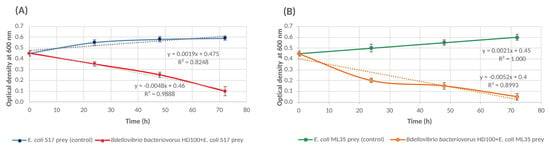
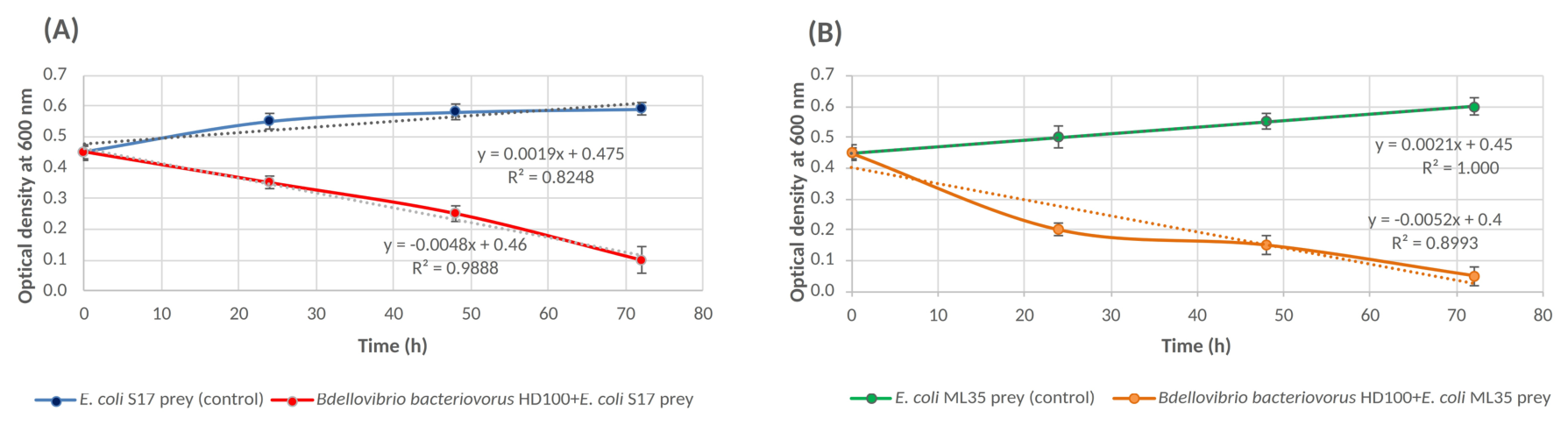
The predator bacterium Bdellovibrio bacteriovorus HD100 effectively exhibited lytic activity against both E. coli ML35 and E. coli S17 in DNB medium after 72 h of incubation at 28 °C (180 rpm). A marked decrease in optical density (OD600) was observed in the HD100-prey co-cultures relative to the corresponding prey-only controls, consistent with lytic activity under the tested conditions (Figure 1A,B). The OD600 of E. coli ML35 decreased from 0.45 to 0.05, while that of E. coli S17 decreased from 0.45 to 0.10 following predation.
Figure 1.
(A) Changes in OD600 of Escherichia coli S17 cultured alone (control) and in co-culture with Bdellovibrio bacteriovorus HD100 over a 72-h incubation period. The coefficients of determination (R2) were 0.9888 for the co-culture group and 0.8248 for the control group. (B) Changes in OD600 of Escherichia coli ML35 cultured alone (control) and in co-culture with B. bacteriovorus HD100 over a 72-h incubation period. The coefficients of determination (R2) were 0.8993 for the co-culture group and 1.000 for the control group. Values are expressed as mean ± SD of three independent cultures per group (n = 3); the HD100 positive-control data are presented descriptively. Solid lines represent the observed data, whereas dotted lines indicate the linear regression trend lines.
In both positive-control assays, OD600 increased in the prey-only cultures but decreased progressively in the HD100-prey co-cultures over 72 h. These data were used as descriptive confirmation of HD100 activity under the assay conditions and were not included in the inferential analysis of the nine wastewater BALO isolates.
3.2. Isolation of BALOs
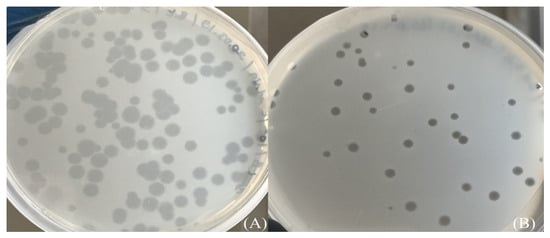
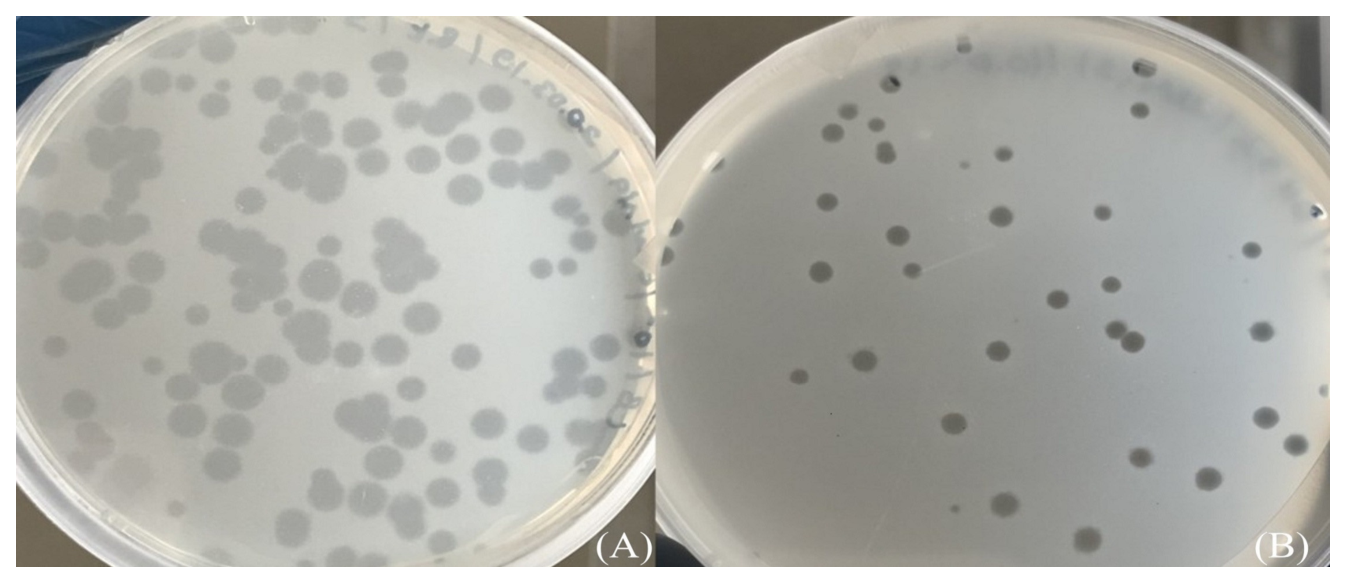
From the 30 wastewater samples screened, nine Bdellovibrio and like organisms (BALOs) were recovered using the double-layer agar method against a panel of Gram-negative prey that included E. coli ML35, E. coli S17, E. coli ATCC 29998, and Erwinia amylovora. Plaques became visible within 48 h of incubation at 28 °C and continued to expand before stabilizing after 72 h. Clear, circular plaques with well-defined edges were selected for purification (Figure 2).
Figure 2.
Representative lytic plaques produced by a Bdellovibrio and like organism (BALO) isolate SAT17-02-14 on Escherichia coli ML35 using the double-layer agar technique. (A) Numerous plaques observed on the prey bacterial lawn. (B) Well-isolated plaques suitable for purification and further characterization.
Six isolates were obtained using E. coli strains as prey. Three Bdellovibrio strains (SAT17-02-14, SAT18-01-14, and SAT19-01-26) were recovered using E. coli ML35, one Bdellovibrio isolate (SAT19-01-27) was recovered using E. coli S17, and two Bdellovibrio isolates (SAT19-01-28 and SAT19-01-29) were recovered using E. coli ATCC 29998. In addition, three Bdellovibrio isolates (SAT19-02-26, SAT19-05-28, and SAT19-05-29) were obtained using Erwinia amylovora RK228 as the prey bacterium.
The number of plaques formed by each predator isolate was quantified, and the statistical results are presented in Table 2. Among all isolates, SAT17-02-14 exhibited the highest plaque-forming ability (5.23 ± 1.08 log10 PFU/mL), whereas SAT19-01-29 showed the lowest plaque-forming ability (2.60 ± 0.56 log10 PFU/mL).
Table 2.
Plaque counts of cultured BALO isolates.
Exploratory Spearman’s rank correlation analysis showed a strong negative association between monthly BALO plaque counts and COD (ρ = −0.830, p = 0.001, n = 12). No statistically significant associations were detected between monthly BALO plaque counts and pH (ρ = −0.250, p = 0.434), temperature (ρ = 0.421, p = 0.173), or TSS (ρ = −0.167, p = 0.603). Because BALO plaque abundance was represented by a single measurement per month, these findings are interpreted as exploratory associations rather than evidence of causal environmental effects.
3.3. Identification of BALOs
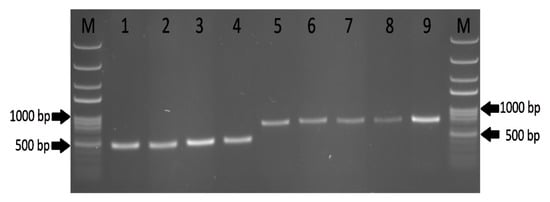
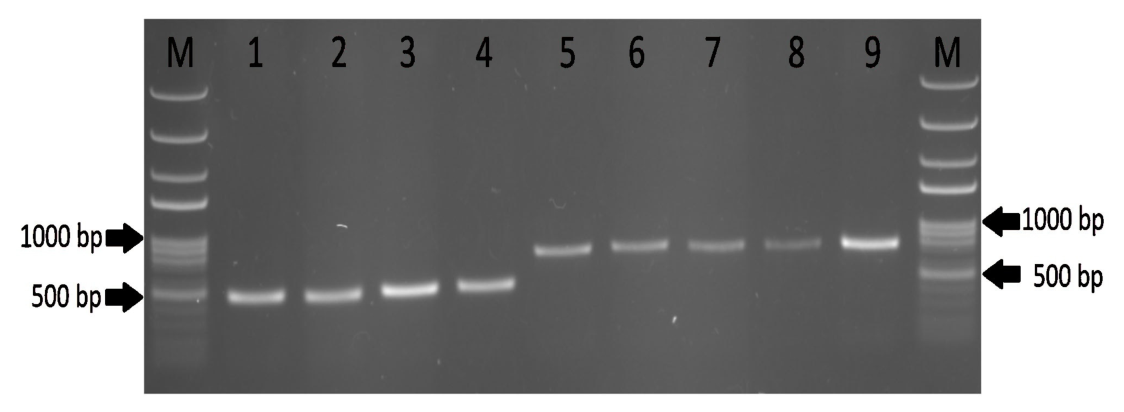
A total of 29 BALO sequence records were obtained using culture-dependent and direct molecular approaches. Nine isolates (SAT17-02-14, SAT18-01-14, SAT19-01-26, SAT19-01-27, SAT19-01-28, SAT19-01-29, SAT19-02-26, SAT19-05-28, and SAT19-05-29) were successfully maintained in culture and used in the subsequent predation assays. SAT18-01-15 and SAT18-01-16 produced plaques, and their sequences were obtained from liquid cultures established from the plaques; however, these cultures were subsequently lost during purification or propagation and were not included in the subsequent predation assays. The remaining 18 records, including SAT19-00-20, were direct molecular detections obtained by PCR from wastewater DNA and were not cultured. PCR amplification was successful with the primer sets targeting Bdellovibrio, Bacteriovorax, and Peredibacter, whereas no amplification was detected with the Micavibrio-specific Mic431F/Mic996R primer set. PCR products were visualized using a UV transilluminator (Figure 3). The samples shown were selected as representative positive detections because they produced clearly visible amplicons of the expected size and were included to illustrate the PCR results obtained with the corresponding taxon-specific primer pairs.
Figure 3.
Agarose gel electrophoresis of PCR products amplified using genus-specific 16S rRNA gene primers for BALOs. Lanes M: 100-bp DNA ladder (Invitrogen, Carlsbad, CA, USA); lanes 1–9: SAT19-02-26, SAT19-01-28, SAT18-01-15, SAT18-01-16, SAT19-04-27, SAT19-00-28, SAT19-04-30, SAT19-06-29, and SAT19-00-19, respectively. Amplicons of approximately 500 bp (lanes 1–4) and 780 bp (lanes 5–9) were observed.
BLAST comparisons of the partial 16S rRNA gene sequences against the GenBank database showed identities ranging from 91.63% to 100%, with query coverage ranging from 90% to 100% for the reported closest non-self matches (Table 3). Thirteen sequence records showed ≥97% identity, whereas sixteen showed <97% identity. However, partial 16S rRNA gene sequence similarity alone was not considered sufficient to establish species identity. Only six sequence records showed ≥98.65% identity to their closest non-self BLAST matches, a threshold proposed as an approximate indicator for further species-level genomic evaluation [30]. Accordingly, taxonomic assignments were interpreted together with the type/reference-strain phylogenetic analyses and are reported provisionally. Based on the combined BLAST and phylogenetic evidence, among the 29 selected BALO sequence records, fifteen (51.7%) were provisionally classified as Peredibacter-related sequences, six (20.7%) as B. bacteriovorus-related sequences, six (20.7%) as Bdellovibrio sp., and two (6.9%) as BALO-associated sequences with unresolved genus-level affiliation. These percentages describe the distribution of the selected sequence records and do not represent the relative abundance of these taxa within the wastewater microbial community. The corresponding sequence identities, query coverage values, culture statuses, assay participation, and GenBank accession numbers are presented in Table 3.
Table 3.
Molecular identification, sequence characteristics, culture status, and provisional taxonomic assignments of BALO records obtained from untreated municipal wastewater.
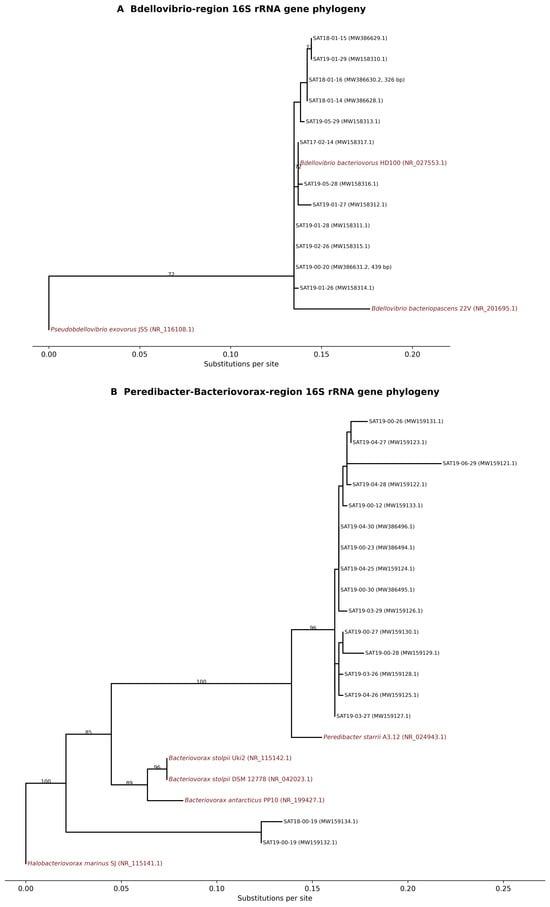
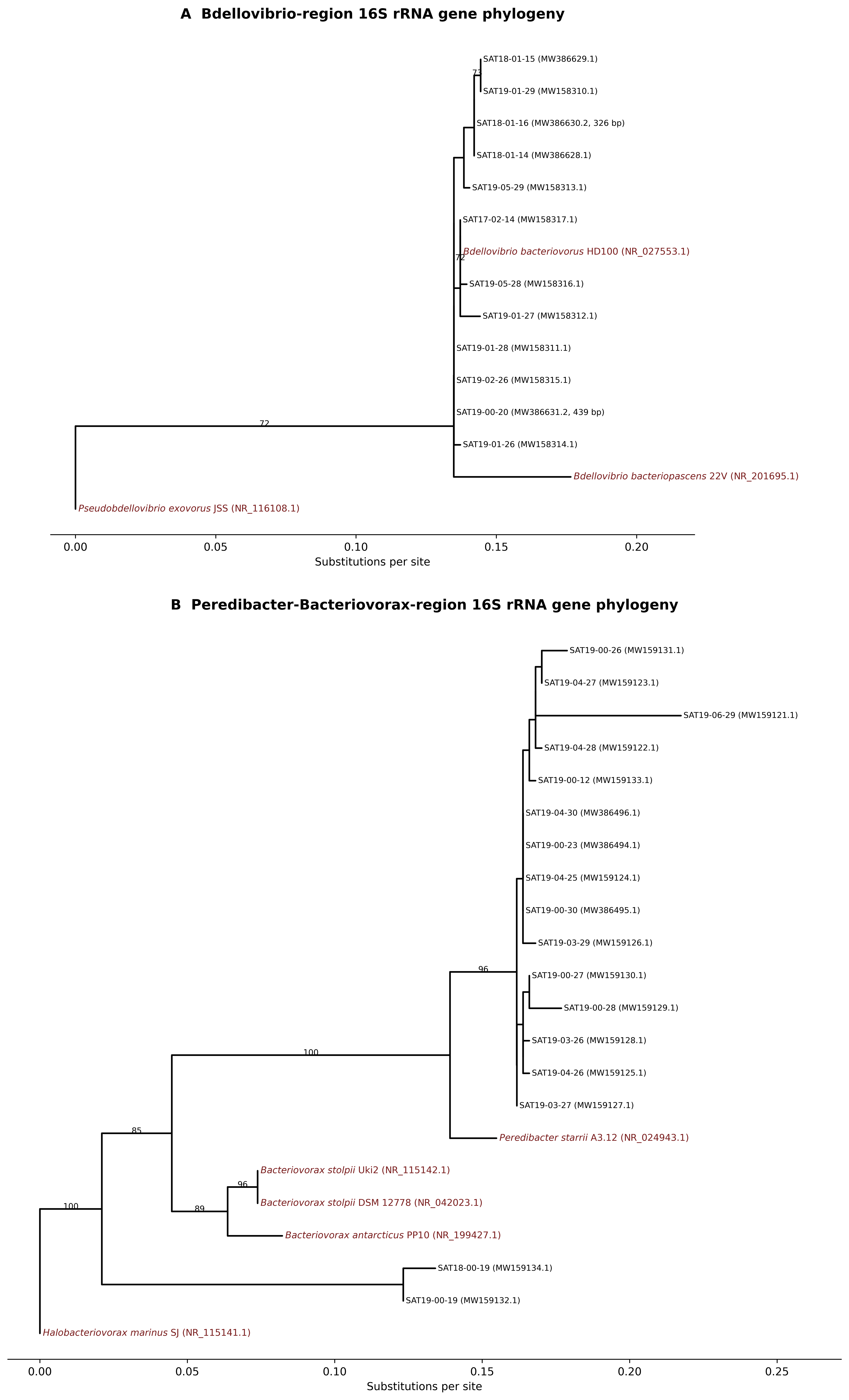
Because the two primer sets covered largely non-overlapping regions of the 16S rRNA gene, separate maximum-likelihood analyses were performed (Figure 4A,B). In the Bdellovibrio-region tree, the study sequences were positioned within the Bdellovibrio-associated lineage together with the reference sequences. The 439-position alignment contained seven parsimony-informative sites; missing or unresolved positions in the reconstructed SAT18-01-16 and SAT19-00-20 sequences were treated as missing data. Consequently, the internal relationships among closely related sequences received limited resolution and should not be interpreted as definitive evidence of species identity. The second analysis used a 477-position alignment containing 86 parsimony-informative sites and supported a Peredibacter-associated lineage. SAT18-00-19 and SAT19-00-19 grouped outside the clade containing the included Bacteriovorax reference sequences; their genus-level affiliation therefore remains unresolved. Overall, the trees did not provide sufficient resolution for definitive species-level identification.
Figure 4.
Maximum-likelihood phylogenetic trees based on partial 16S rRNA gene sequences. (A) Bdellovibrio-region dataset comprising 15 sequences and 439 homologous nucleotide positions, with missing or unresolved positions in the reconstructed SAT18-01-16 and SAT19-00-20 sequences treated as missing data. The tree was inferred using the K2P + I model and rooted with Pseudobdellovibrio exovorus JSS (NR_116108.1). (B) Peredibacter-Bacteriovorax-region dataset comprising 22 sequences and 477 homologous nucleotide positions after complete deletion. The tree was inferred using the TPM3 + G4 model and rooted with Halobacteriovorax marinus SJ (NR_115141.1). Branch support was assessed using 1000 ultrafast bootstrap replicates and 1000 SH-aLRT replicates; ultrafast-bootstrap values ≥ 70% are shown at the nodes. Study sequences are shown in black and reference sequences in dark red. The scale bars indicate substitutions per site.
3.4. Prey Range Determination
Most isolates showed broad predatory spectra in the prey range assays (Table 4). SAT17-02-14 lysed 7 of 8 prey strains (87.5%), whereas six isolates (SAT19-05-28, SAT19-01-27, SAT18-01-14, SAT19-05-29, SAT19-01-28, and SAT19-02-26) lysed 6 of 8 strains (75%). SAT19-01-26 and SAT19-01-29 showed more limited prey ranges, lysing 5 (62.5%) and 4 (50%) strains, respectively.
Table 4.
Prey range of the cultured BALO isolates against eight Gram-negative bacterial strains.
All isolates formed plaques on E. coli ML35; however, none showed lytic activity against Pseudomonas aeruginosa. Plaques generally became visible within three days and appeared as smooth, medium-sized, clear zones.
3.5. Predation in Liquid Culture
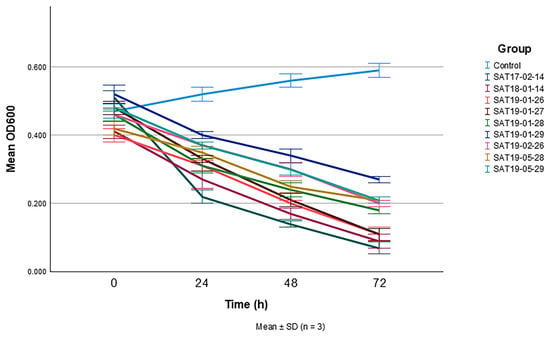
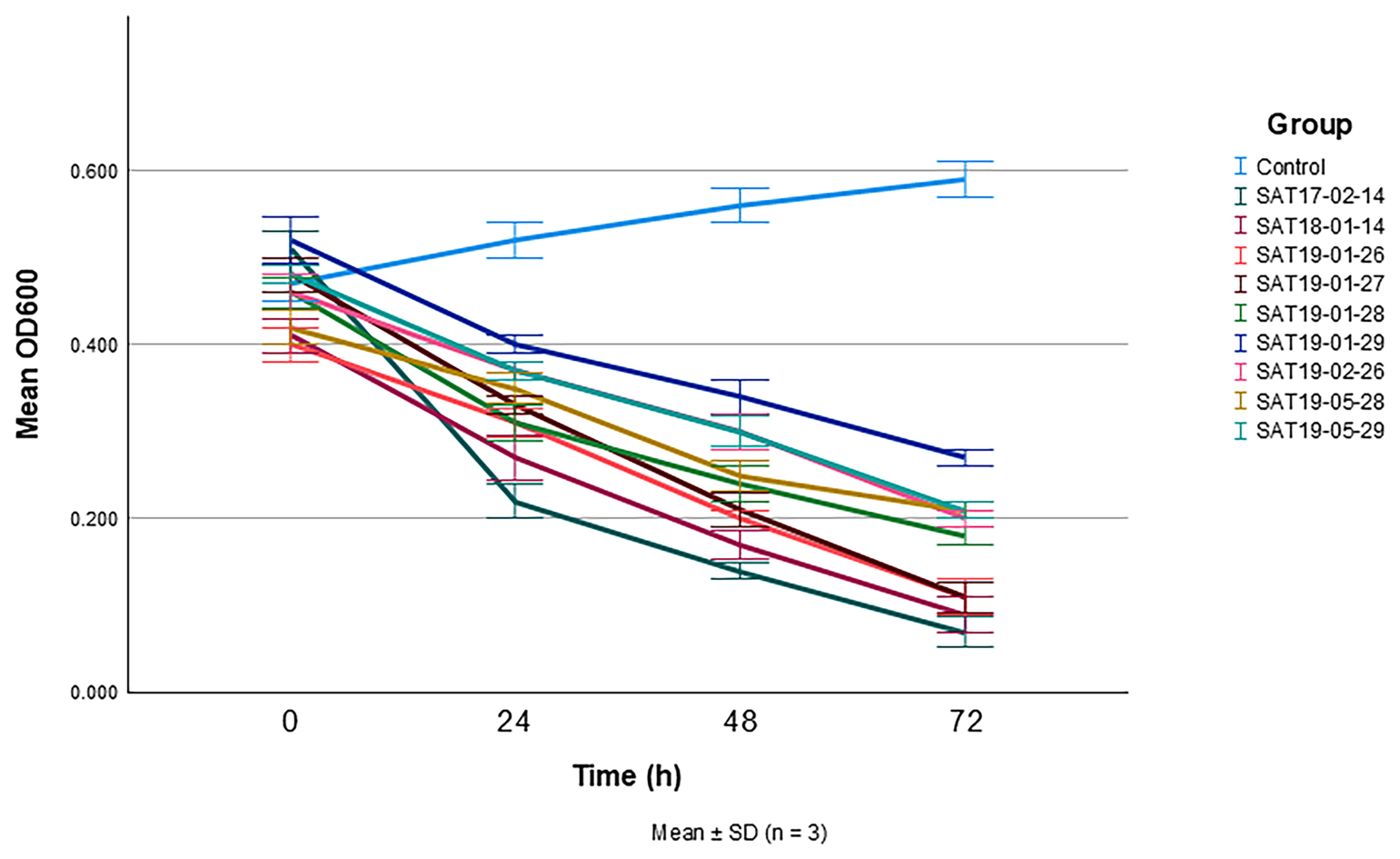
In the liquid co-culture assays, all nine BALO-treated groups showed progressive reductions in OD600 relative to the prey-only control, consistent with the plaque-based evidence of predatory activity against E. coli ML35 (Figure 5). Mauchly’s test indicated that the sphericity assumption was met (W = 0.942, χ2(2) = 1.132, p = 0.568). Mixed repeated-measures ANOVA of the baseline-adjusted OD600 values showed significant effects of time (F(2, 40) = 4069.909, p < 0.001, partial η2 = 0.995) and treatment group (F(9, 20) = 630.720, p < 0.001, partial η2 = 0.996), together with a significant time × group interaction (F(18, 40) = 134.758, p < 0.001, partial η2 = 0.984). Dunnett-adjusted comparisons showed that all nine BALO-treated groups differed significantly from the shared prey-only control at 24, 48, and 72 h (all p < 0.001).
Figure 5.
Changes in OD600 of Escherichia coli ML35 cultured alone (control) and in co-culture with BALO isolates SAT17-02-14, SAT18-01-14, SAT19-01-26, SAT19-01-27, SAT19-01-28, SAT19-01-29, SAT19-02-26, SAT19-05-28, and SAT19-05-29 at 0, 24, 48, and 72 h. Values are expressed as mean ± SD of three independent cultures per group (n = 3). Statistical analysis was performed on baseline-adjusted OD600 values using mixed repeated-measures ANOVA, followed by Dunnett-adjusted comparisons with the shared prey-only control. All nine BALO-treated groups differed significantly from the control at 24, 48, and 72 h (all p < 0.001).
3.6. Scanning Electron Microscopy
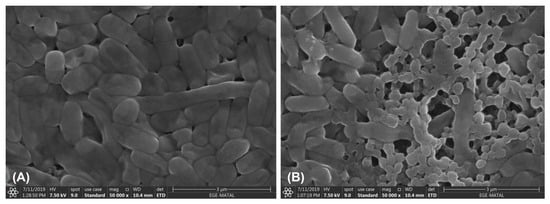
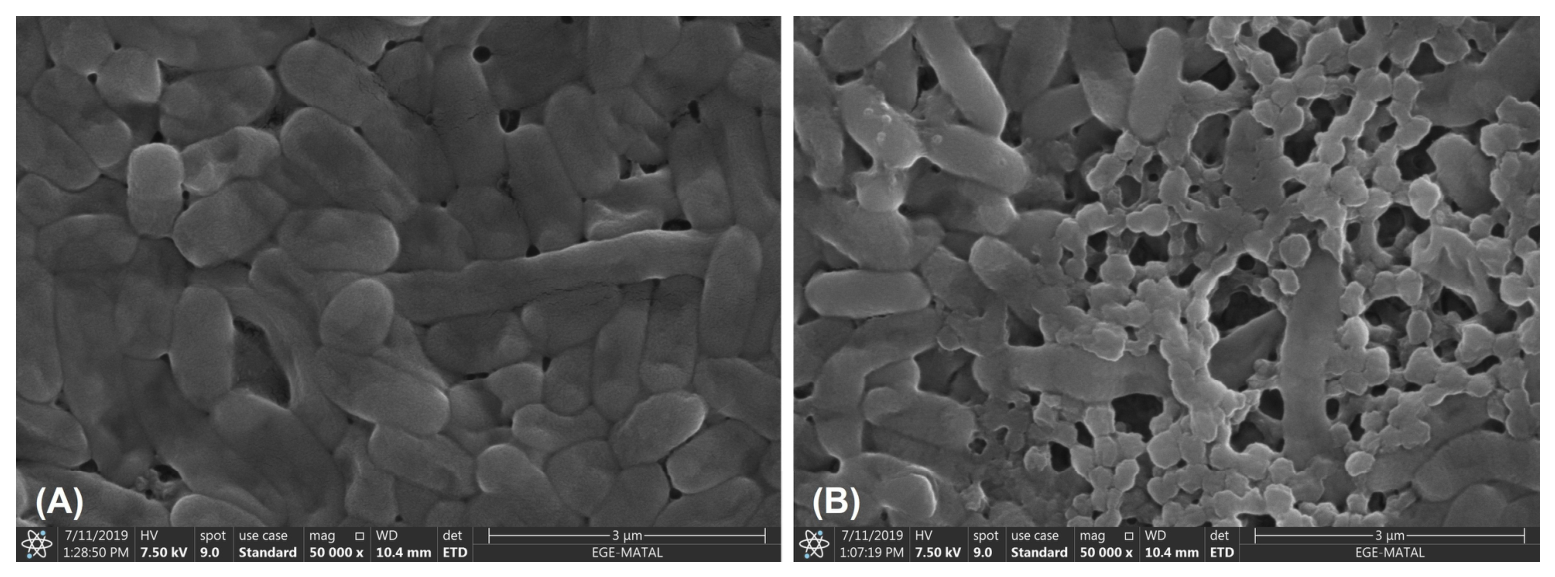
SEM imaging revealed marked differences between untreated E. coli ML35 biofilms and those exposed to the SAT17-02-14 BALO lysate. The untreated control biofilm (Figure 6A) consisted of densely packed cells forming relatively continuous microcolonies. Following 24 h of exposure to the BALO lysate (Figure 6B), the specimen showed irregular biofilm organization and visible alterations in cell-surface morphology. These observations describe qualitative morphological differences in the representative SEM fields; biofilm biomass and the extent of biofilm removal were not quantified.
Figure 6.
Scanning electron micrographs of untreated and lysate-exposed Escherichia coli ML35 biofilms. (A) Untreated E. coli ML35 control biofilm developed for 18 h and maintained without BALO lysate for an additional 24 h. (B) E. coli ML35 biofilm developed for 18 h and subsequently exposed to the SAT17-02-14 BALO lysate for 24 h. Both specimens were fixed after a total incubation period of 42 h. Scale bar = 3 μm; magnification = ×50,000.
4. Discussion
Wastewater treatment plants (WWTPs) connect human activities with receiving aquatic environments [1]. At the same time, they support complex microbial communities whose interactions are relevant to ecosystem functioning and public health [4]. Predation is one of these interactions. Bdellovibrio and like organisms (BALOs), in particular, can regulate bacterial populations through their predatory lifestyle [7]. This characteristic has also prompted interest in BALOs in the context of biologically based wastewater management [31].
In this study, BALOs were recovered and characterized from untreated municipal wastewater in Türkiye. To our knowledge, this is the first culture-based characterization of wastewater-associated BALOs reported from Türkiye. Nine BALO isolates were obtained by the double-layer agar method, whereas molecular analysis identified 29 BALO sequence records in total. Thus, the culture and molecular results did not provide the same picture of BALO occurrence. Cultivation yielded a smaller group of recoverable predators, while the molecular approach revealed additional BALO taxa that were not obtained in culture.
Recovering BALOs from wastewater is not straightforward because cultivation depends on both the predator and a suitable prey bacterium. In our experiments, BALOs were recovered after prey enrichment, sequential centrifugation and filtration, followed by double-layer agar cultivation. The importance of prey availability, predator-prey ratios, nutrient conditions, and cultivation procedures has also been noted in previous environmental studies of BALOs [32,33]. The difference observed here between the culture and molecular results may therefore reflect, at least in part, the selectivity of the cultivation procedure.
The cultured isolates were exclusively associated with Bdellovibrio. This agrees with reports from wastewater-related environments in Singapore, South Africa, and Iran, where Bdellovibrio has also been recovered from activated sludge or sewage-associated samples [32,34,35]. B. bacteriovorus is highly motile and can prey on a range of Gram-negative bacteria [8]. Such characteristics may favor its recovery in culture-based studies, although this exclusivity should also be considered in relation to the prey and cultivation conditions used.
A different pattern emerged from the molecular analysis. In addition to Bdellovibrio, Peredibacter-related sequences and two BALO-associated sequences with unresolved genus-level affiliation were detected. Because the primer pairs covered largely different regions of the 16S rRNA gene, the sequences were evaluated using two separate region-specific phylogenetic analyses. These analyses supported affinities with Bdellovibrio- and Peredibacter-associated lineages, whereas SAT18-00-19 and SAT19-00-19 grouped outside the included Bacteriovorax reference clade and could not be assigned confidently to this genus. However, the Bdellovibrio-region alignment contained only seven parsimony-informative sites, limiting the resolution of relationships among closely related sequences. Sixteen sequence records had less than 97% identity to their closest GenBank matches. These relatively low identities are not sufficient to define novel species based on partial 16S rRNA gene sequences alone. In particular, SAT18-01-15 cannot be assigned confidently to B. bacteriovorus based on its 96.81% sequence identity. Therefore, the taxonomic assignments reported in this study should be regarded as provisional. Whole-genome sequencing followed by average nucleotide identity and digital DNA-DNA hybridization analyses would be required to determine whether these sequences represent recognized species or potentially novel taxa. The taxonomic percentages reported in this study represent the distribution of the 29 selected BALO sequence records obtained through culture-dependent isolation and targeted PCR rather than the relative abundance of these taxa within the wastewater microbial community. Culture-based recovery may have been influenced by the prey organisms and cultivation conditions used during enrichment, whereas molecular detection may have been affected by differences in primer specificity and amplification efficiency. In addition, direct sequencing of selected PCR products did not provide a comprehensive community profile. Therefore, the reported proportions should not be interpreted as quantitative estimates of BALO community composition in untreated wastewater.
The prey range experiments also showed clear differences among the bacteria tested. All nine cultured isolates preyed on E. coli ML35, whereas no detectable predatory activity against Pseudomonas aeruginosa was observed under the same assay conditions. Responses of the other prey strains fell between these two extremes, and individual isolates lysed four to seven of the eight strains tested. Previous studies have associated reduced susceptibility of P. aeruginosa to bacterial predation with several possible factors, including stress responses, biofilm-associated defenses, and changes in physiological state [32]. In contrast, E. coli has frequently been reported as a suitable prey for Bdellovibrio spp. [36]. The contrasting responses observed here emphasize that BALO predation is prey dependent and that broad activity against one bacterial group cannot be generalized to all Gram-negative pathogens.
The liquid co-culture experiments further demonstrated the predatory activity of the recovered isolates against E. coli ML35. OD600 values in cultures containing BALO isolates decreased over the 72-h incubation period relative to the prey-only control, supporting continued predatory activity under liquid culture conditions. These turbidity changes complement the plaque-based prey-range results and are consistent with predator-associated effects in liquid co-culture. However, because viable prey counts and predator titres were not measured during the liquid assay, the OD600 reductions alone cannot establish the magnitude of prey killing or confirm predator multiplication. The observed differences in turbidity changes may reflect variation in predator-prey interactions, but differences in viable inoculum levels or other culture-related factors cannot be excluded. Future studies using standardized viable predator inocula and measurements of prey survival are needed to determine whether these patterns correspond to differences in predation efficiency.
SEM observations provided additional morphological evidence of the effects of the SAT17-02-14 BALO lysate on E. coli ML35 biofilms. Compared with the densely packed and relatively continuous structure of the untreated biofilm, the lysate-exposed specimen showed altered biofilm organization and visible differences in cell-surface morphology. Previous studies have also demonstrated that Bdellovibrio predators can affect established bacterial biofilms [16]. However, SEM provides morphological rather than direct mechanistic evidence, and these observations alone cannot establish how BALOs interact with or penetrate the biofilm matrix.
The cultured-isolate collection included one isolate from preliminary sampling in 2017 and eight from the 2018–2019 sampling campaign; this collection was therefore not used to infer seasonal differences in BALO recovery. Physicochemical characteristics of the wastewater varied throughout the 12-month sampling period, with monthly variation observed in temperature, pH, total suspended solids (TSS) and chemical oxygen demand (COD) (Table 1). Exploratory correlation analysis showed that monthly BALO plaque counts were strongly and negatively associated with COD (Spearman’s ρ = −0.830, p = 0.001), whereas no statistically significant associations were detected with pH, temperature, or TSS. However, the COD association was based on a single plaque-count measurement per month and does not establish a causal relationship. BALO occurrence and recovery may also be influenced by prey availability and interactions among environmental factors [37]. Seasonal variation in predatory bacterial populations associated with environmental conditions and prey availability has also been reported in aquatic systems [35]. Further studies integrating quantitative BALO abundance and prey-community composition with physicochemical parameters would help determine the factors associated with temporal variation in BALO occurrence.
Several limitations should be considered when interpreting these findings. First, all influent samples were collected from a single municipal wastewater treatment plant. Therefore, the observed BALO occurrence, diversity, and temporal observations reflect the conditions of the investigated facility and may not be representative of municipal wastewater systems in other geographical regions or with different influent characteristics and treatment configurations. Comparative studies involving multiple wastewater treatment plants across different climatic and operational settings are needed to determine the broader distribution of BALOs and the environmental factors shaping their occurrence and diversity. The prey-range experiments were also limited to eight Gram-negative bacterial strains. Moreover, several of the tested prey were laboratory strains of Escherichia coli, and the prey panel did not include clinically relevant multidrug-resistant isolates, wastewater-derived pathogens, a broader range of environmental bacteria, or Gram-positive bacteria. Therefore, the observed prey range should be interpreted as activity against the eight bacterial strains tested under the specified laboratory conditions rather than as evidence of broad-spectrum predatory activity. Future studies should evaluate these isolates using larger and more ecologically representative prey panels. Culture-based recovery is also inherently influenced by the prey organisms and cultivation conditions used during enrichment and isolation. In addition, taxonomic assignments were primarily based on partial 16S rRNA gene sequences; therefore, isolates showing low sequence identity to available reference sequences require further genomic and phenotypic characterization before their taxonomic status can be resolved. The SEM analysis was performed using a single BALO isolate and E. coli ML35 biofilms and should therefore be interpreted as evidence of the interaction observed in this specific predator-prey system rather than as a general property of all BALOs. Although associations between the physicochemical parameters and monthly BALO plaque counts were examined using Spearman’s rank correlation, plaque abundance was represented by only one measurement per month. Therefore, this analysis should be considered exploratory and does not permit robust causal inference regarding the environmental drivers of BALO occurrence.
Taken together, the culture-based and molecular findings reveal a diverse assemblage of BALOs in untreated municipal wastewater and demonstrate substantial variation in prey susceptibility. The recovery of cultivable predators together with the detection of additional BALO diversity by molecular methods highlights the value of combining both approaches when investigating predatory bacterial communities. Predatory activity against several Gram-negative bacteria, together with the structural alterations observed in E. coli ML35 biofilms, supports further investigation of BALOs as potential biological components of wastewater management strategies. However, these experiments were conducted in defined laboratory media and did not reproduce untreated wastewater microcosms, mixed microbial communities, treatment reactors, or the variable physicochemical and operational conditions of full-scale wastewater treatment. Consequently, the present findings do not demonstrate the practical efficacy of these isolates in wastewater treatment or biocontrol applications. At the same time, the absence of detectable predation against P. aeruginosa ATCC 27853 and the differences observed among isolates indicate that their potential application will depend strongly on predator-prey specificity. Future studies integrating genomic characterization, broader prey panels, microbial community analyses, and controlled wastewater experiments will be necessary to determine how these predators function within complex wastewater communities and whether their activity can be translated into practical biocontrol applications.
5. Conclusions
To the best of our knowledge, this study provides the first culture-based isolation and molecular characterization of Bdellovibrio and like organisms (BALOs) from municipal wastewater in Türkiye. Using culture-based methods, molecular identification, phylogenetic analysis, predation assays, and scanning electron microscopy (SEM), we detected substantial diversity among wastewater-associated BALOs and confirmed the predatory activity of the cultured isolates against several Gram-negative bacteria.
Detecting BALOs by both culture-based and molecular methods revealed a broader diversity than cultivation alone. The phylogenetic diversity and differences in predatory activity observed among the cultured isolates further indicate that BALOs represent a heterogeneous group of bacterial predators in wastewater systems.
Under the tested laboratory conditions, the predatory activity of the cultured BALOs indicates that these bacteria warrant further investigation; however, the present results do not establish their effectiveness for microbial control in operational wastewater treatment systems. Their activity was strongly prey dependent, as illustrated by predation against several Gram-negative strains but the absence of detectable activity against P. aeruginosa ATCC 27853. Further studies using genomic analyses, broader and more representative prey panels, wastewater microcosms, mixed microbial communities, and controlled treatment-system experiments are required before the potential application of BALOs in wastewater treatment or biocontrol can be determined.
Supplementary Materials
The following supporting information can be downloaded at https://www.mdpi.com/article/10.3390/microorganisms14112499/s1, File S1: Revised phylogenetic supporting files, including sequence alignments, tree files, IQ-TREE reports, reference sequences, and analysis notes; File S2: Available raw BALO sequencing reads; File S3: Original agarose gel and SEM images; Table S1: OD600 measurements obtained from the prey-only control and nine BALO-treated groups during the 72-h liquid-culture predation assay.
Author Contributions
Conceptualization, A.U.T., M.O. and D.S.; Methodology, A.U.T., M.O. and D.S.; Data curation, M.O. and D.S.; Visualization, D.S.; Investigation, D.S.; Formal Analysis, D.S.; Writing—Original Draft Preparation, D.S.; Writing—Review and Editing, D.S., M.O. and A.U.T. All authors have read and agreed to the published version of the manuscript.
Funding
This study was supported by the Scientific Research Projects Coordination Unit of Manisa Celal Bayar University under grant numbers BAP-2015-102 and BAP-2017-230.
Institutional Review Board Statement
Not applicable.
Informed Consent Statement
Not applicable.
Data Availability Statement
The nucleotide sequences generated in this study have been deposited in GenBank under the accession numbers listed in Table 3. Available supporting data are provided in the article and Supplementary Materials, including replicate-level OD600 measurements, statistical outputs, available sequencing reads, and phylogenetic alignments and tree files.
Conflicts of Interest
The authors declare no conflicts of interest.
References
- Rizzo, L.; Manaia, C.; Merlin, C.; Schwartz, T.; Dagot, C.; Ploy, M.C.; Michael, I.; Fatta-Kassinos, D. Urban wastewater treatment plants as hotspots for antibiotic resistant bacteria and genes spread into the environment: A review. Sci. Total Environ. 2013, 447, 345–360. [Google Scholar] [CrossRef] [Scilit]
- Ferrera, I.; Sánchez, O. Insights into microbial diversity in wastewater treatment systems: How far have we come? Biotechnol. Adv. 2016, 34, 790–802. [Google Scholar] [CrossRef] [Scilit]
- Bengtsson-Palme, J.; Kristiansson, E.; Larsson, D.G.J. Environmental factors influencing the development and spread of antibiotic resistance. FEMS Microbiol. Rev. 2018, 42, fux053. [Google Scholar] [CrossRef] [Scilit]
- Ju, F.; Beck, K.; Yin, X.; Maccagnan, A.; McArdell, C.S.; Singer, H.P.; Johnson, D.R.; Zhang, T.; Bürgmann, H. Wastewater treatment plant resistomes are shaped by bacterial composition, genetic exchange, and upregulated expression in the effluent microbiomes. ISME J. 2019, 13, 346–360. [Google Scholar] [CrossRef] [Scilit]
- Larsson, D.G.J.; Flach, C.-F. Antibiotic resistance in the environment. Nat. Rev. Microbiol. 2022, 20, 257–269. [Google Scholar] [CrossRef] [Scilit]
- Pernthaler, J. Predation on prokaryotes in the water column and its ecological implications. Nat. Rev. Microbiol. 2005, 3, 537–546, Erratum in Nat. Rev. Microbiol. 2005, 3, 739. [Google Scholar] [CrossRef] [Scilit]
- Pérez, J.; Moraleda-Muñoz, A.; Marcos-Torres, F.J.; Muñoz-Dorado, J. Bacterial predation: 75 years and counting! Environ. Microbiol. 2016, 18, 766–779. [Google Scholar] [CrossRef] [Scilit]
- Sockett, R.E. Predatory lifestyle of Bdellovibrio bacteriovorus. Annu. Rev. Microbiol. 2009, 63, 523–539. [Google Scholar] [CrossRef] [Scilit]
- Herencias, C.; Salgado-Briegas, S.; Prieto, M.A.; Nogales, J. Providing new insights on the biphasic lifestyle of the predatory bacterium Bdellovibrio bacteriovorus through genome-scale metabolic modeling. PLoS Comput. Biol. 2020, 16, e1007646. [Google Scholar] [CrossRef] [Scilit]
- Cohen, Y.; Pasternak, Z.; Müller, S.; Hübschmann, T.; Schattenberg, F.; Sivakala, K.K.; Abed-Rabbo, A.; Chatzinotas, A.; Jurkevitch, E. Community and single cell analyses reveal complex predatory interactions between bacteria in high diversity systems. Nat. Commun. 2021, 12, 5481. [Google Scholar] [CrossRef] [Scilit]
- Mookherjee, A.; Jurkevitch, E. Interactions between Bdellovibrio and like organisms and bacteria in biofilms: Beyond predator-prey dynamics. Environ. Microbiol. 2022, 24, 998–1011. [Google Scholar] [CrossRef] [Scilit]
- Williams, H.N.; Piñeiro, S. Ecology of the predatory Bdellovibrio and like organisms. In Predatory Prokaryotes: Biology, Ecology and Evolution; Jurkevitch, E., Ed.; Microbiology Monographs; Springer: Berlin/Heidelberg, Germany, 2006; Volume 4, pp. 213–248. [Google Scholar]
- Alexakis, K.; Baliou, S.; Ioannou, P. Predatory bacteria in the treatment of infectious diseases and beyond. Infect. Dis. Rep. 2024, 16, 684–698. [Google Scholar] [CrossRef] [Scilit]
- Kongrueng, J.; Mitraparp-Arthorn, P.; Bangpanwimon, K.; Robins, W.; Vuddhakul, V.; Mekalanos, J. Isolation of Bdellovibrio and like organisms and potential to reduce acute hepatopancreatic necrosis disease caused by Vibrio parahaemolyticus. Dis. Aquat. Organ. 2017, 124, 223–232. [Google Scholar] [CrossRef] [Scilit]
- Kadouri, D.E.; To, K.; Shanks, R.M.Q.; Doi, Y. Predatory bacteria: A potential ally against multidrug-resistant Gram-negative pathogens. PLoS ONE 2013, 8, e63397. [Google Scholar] [CrossRef] [Scilit]
- Kadouri, D.; O’Toole, G.A. Susceptibility of biofilms to Bdellovibrio bacteriovorus attack. Appl. Environ. Microbiol. 2005, 71, 4044–4051. [Google Scholar] [CrossRef] [Scilit]
- Karkman, A.; Do, T.T.; Walsh, F.; Virta, M.P.J. Antibiotic-resistance genes in waste water. Trends Microbiol. 2018, 26, 220–228. [Google Scholar] [CrossRef] [Scilit]
- Ezzedine, J.A.; Desdevises, Y.; Jacquet, S. Bdellovibrio and like organisms: Current understanding and knowledge gaps of the smallest cellular hunters of the microbial world. Crit. Rev. Microbiol. 2022, 48, 428–449. [Google Scholar] [CrossRef] [Scilit]
- Jurkevitch, E. Isolation and classification of Bdellovibrio and like organisms. Curr. Protoc. Microbiol. 2012, 26, 7B.1.1–7B.1.17. [Google Scholar] [CrossRef] [Scilit]
- Caulton, S.G.; Lambert, C.; Tyson, J.; Radford, P.; Al-Bayati, A.; Greenwood, S.; Banks, E.J.; Clark, C.; Till, R.; Pires, E.; et al. Bdellovibrio bacteriovorus uses chimeric fibre proteins to recognize and invade a broad range of bacterial hosts. Nat. Microbiol. 2024, 9, 214–227. [Google Scholar] [CrossRef] [Scilit]
- Koval, S.F. The search for hunters: Culture-dependent and -independent methods for analysis of Bdellovibrio and like organisms. In Predatory Prokaryotes: Biology, Ecology and Evolution; Jurkevitch, E., Ed.; Microbiology Monographs; Springer: Berlin/Heidelberg, Germany, 2007; Volume 4, pp. 193–203. [Google Scholar]
- Yu, R.; Zhang, S.; Chen, Z.; Li, C. Isolation and application of predatory Bdellovibrio-and-like organisms for municipal waste sludge biolysis and dewaterability enhancement. Front. Environ. Sci. Eng. 2017, 11, 10. [Google Scholar] [CrossRef] [Scilit]
- Voytas, D. Agarose gel electrophoresis. Curr. Protoc. Mol. Biol. 2000, 51, 2.5A.1–2.5A.9. [Google Scholar] [CrossRef] [Scilit]
- Davidov, Y.; Friedjung, A.; Jurkevitch, E. Structure analysis of a soil community of predatory bacteria using culture-dependent and culture-independent methods reveals a hitherto undetected diversity of Bdellovibrio-and-like organisms. Environ. Microbiol. 2006, 8, 1667–1673. [Google Scholar] [CrossRef] [Scilit]
- Van Essche, M.; Sliepen, I.; Loozen, G.; Van Eldere, J.; Quirynen, M.; Davidov, Y.; Jurkevitch, E.; Boon, N.; Teughels, W. Development and performance of a quantitative PCR for the enumeration of Bdellovibrionaceae. Environ. Microbiol. Rep. 2009, 1, 228–233. [Google Scholar] [CrossRef] [Scilit]
- Oyedara, O.O.; De Luna-Santillana, E.J.; Olguin-Rodriguez, O.; Guo, X.; Mendoza-Villa, M.A.; Menchaca-Arredondo, J.L.; Elufisan, T.O.; Garza-Hernandez, J.A.; Leon, I.G.; Rodriguez-Perez, M.A. Isolation of Bdellovibrio sp. from soil samples in Mexico and their potential applications in control of pathogens. MicrobiologyOpen 2016, 5, 992–1002. [Google Scholar] [CrossRef] [Scilit]
- Inoue, D.; Hiroshima, N.; Nakamura, S.; Ishizawa, H.; Ike, M. Characterization of two novel predatory bacteria, Bacteriovorax stolpii HI3 and Myxococcus sp. MH1, isolated from a freshwater pond: Prey range, and predatory dynamics and efficiency. Microorganisms 2022, 10, 1816. [Google Scholar] [CrossRef] [Scilit]
- Dashiff, A.; Junka, R.A.; Libera, M.; Kadouri, D.E. Predation of human pathogens by the predatory bacteria Micavibrio aeruginosavorus and Bdellovibrio bacteriovorus. J. Appl. Microbiol. 2011, 110, 431–444. [Google Scholar] [CrossRef] [Scilit]
- Chanyi, R.M.; Koval, S.F. Role of type IV pili in predation by Bdellovibrio bacteriovorus. PLoS ONE 2014, 9, e113404. [Google Scholar] [CrossRef] [Scilit]
- Kim, M.; Oh, H.S.; Park, S.C.; Chun, J. Towards a taxonomic coherence between average nucleotide identity and 16S rRNA gene sequence similarity for species demarcation of prokaryotes. Int. J. Syst. Evol. Microbiol. 2014, 64, 346–351. [Google Scholar] [CrossRef] [Scilit]
- Waso, M.; Reyneke, B.; Havenga, B.; Khan, S.; Khan, W. Insights into Bdellovibrio spp. mechanisms of action and potential applications. World J. Microbiol. Biotechnol. 2021, 37, 85. [Google Scholar] [CrossRef] [Scilit]
- Waso, M.; Khan, S.; Khan, W. Assessment of predatory bacteria and prey interactions using culture-based methods and EMA-qPCR. Microbiol. Res. 2019, 228, 126305. [Google Scholar] [CrossRef] [Scilit]
- Mohsenipour, Z.; Arazi, P.; Skurnik, M.; Jahanbin, B.; Abtahi, H.R.; Edalatifard, M.; Feizabadi, M.M. Predation on bacterial pathogens by predatory bacteria of sewage origin: Three days prey-predator interactions. BMC Microbiol. 2024, 24, 516. [Google Scholar] [CrossRef] [Scilit]
- Feng, S.; Tan, C.H.; Cohen, Y.; Rice, S.A. Isolation of Bdellovibrio bacteriovorus from a tropical wastewater treatment plant and predation of mixed species biofilms assembled by the native community members. Environ. Microbiol. 2016, 18, 3923–3931. [Google Scholar] [CrossRef] [Scilit]
- Jafarian, N.; Sepahi, A.A.; Naghavi, N.S.; Hosseini, F.; Nowroozi, J. Using autochthonous Bdellovibrio as a predatory bacterium for reduction of Gram-negative pathogenic bacteria in urban wastewater and reuse it. Iran. J. Microbiol. 2020, 12, 556–564. [Google Scholar] [CrossRef] [Scilit]
- Xi, Y.; Pan, Y.; Li, M.; Zeng, Q.; Wang, M. Evaluation of the application potential of Bdellovibrio sp. YBD-1 isolated from Yak faeces. Sci. Rep. 2024, 14, 13010. [Google Scholar] [CrossRef] [Scilit]
- Paix, B.; Ezzedine, J.A.; Jacquet, S. Diversity, dynamics, and distribution of Bdellovibrio and like organisms in peri-alpine lakes. Appl. Environ. Microbiol. 2019, 85, e02494-18. [Google Scholar] [CrossRef] [Scilit]

Disclaimer/Publisher’s Note: The statements, opinions and data contained in all publications are solely those of the individual author(s) and contributor(s) and not of MDPI and/or the editor(s). MDPI and/or the editor(s) disclaim responsibility for any injury to people or property resulting from any ideas, methods, instructions or products referred to in the content. |
© 2026 by the authors. Licensee MDPI, Basel, Switzerland. This article is an open access article distributed under the terms and conditions of the Creative Commons Attribution (CC BY) license.