


Abstract
Cowpea root rot severely constrains the development of the cowpea industry in Hainan Province, China. However, effective control is hindered by the unclear population structure of the causal pathogens and prominent field fungicide resistance in this region. In this study, 282 isolates were obtained from diseased plants collected across various production areas in Hainan. ITS sequence analysis revealed that Fusarium spp. was the dominant genus, accounting for 78.7% of the isolates. Based on colony morphology, representative isolates were selected for multilocus phylogenetic analysis, which classified them into four species complexes: Fusarium oxysporum, F. fujikuroi, F. solani, and F. incarnatum-equiseti, with the F. oxysporum species complex being the predominant group. Pathogenicity tests confirmed that all four species complexes are causal agents of cowpea root rot. Fungicide sensitivity assays indicated that these isolates exhibited widespread resistance to fludioxonil, azoxystrobin, carbendazim, phenamacril, and pydiflumetofen. Notably, isolate FIEHN13 displayed resistance to all tested fungicides, posing a severe risk of multiple-fungicide resistance. Given that tebuconazole retained high activity against most isolates, this study evaluated its potential for combination with phenamacril or pydiflumetofen. The optimized combinations exhibited synergistic or additive effects in vitro. Greenhouse pot trials further demonstrated that seed coating with phenamacril + tebuconazole (1.74:1) or pydiflumetofen + tebuconazole (2.76:1) reduced disease incidence to 0–50%, achieving control efficacies of 75–100%. These treatments were significantly superior to single-agent applications, indicating considerable application potential. Collectively, these results indicate that cowpea root rot in Hainan Province is caused by multiple-fungicide-resistant Fusarium species complexes, and rational tebuconazole-based combination strategies can provide an effective approach for managing fungicide resistance.
1. Introduction
Cowpea [Vigna unguiculata (L.) Walp] is an important leguminous vegetable and a valuable source of plant-based protein in tropical and subtropical regions worldwide. In Hainan Province, China, it serves as a key winter vegetable crop, playing a critical role in ensuring regional vegetable supply and increasing farmers’ income, with an annual output value exceeding 2 billion RMB (data from the Hainan Provincial Bureau of Statistics) [1,2,3]. However, with prolonged cultivation and the increasing severity of continuous cropping obstacles, cowpea root rot has become one of the major soil-borne diseases constraining the sustainable development of this industry. Typical symptoms of the disease include root browning, rotting, and vascular necrosis, leading to plant wilting and even death, which severely affects cowpea yield and quality [4,5]. Multiple pathogenic fungi have been confirmed to infect cowpea roots, such as Fusarium spp., Macrophomina phaseolina, Phytophthora vignae, and Ectophoma multirostrata [6,7,8]. Among them, the most important are Fusarium spp., which are soilborne pathogens capable of causing yield losses ranging from 30% to 100%. Their highly resilient resting spores (chlamydospores), which are thick-walled survival structures that allow the pathogen to persist under unfavorable conditions, can remain viable in soil for several years, thereby exacerbating disease incidence [9]. Identifying pathogen species and their pathogenic characteristics is a prerequisite for formulating scientific control strategies. Although various Fusarium species have been reported to cause cowpea root rot, systematic knowledge regarding the population structure of Fusarium spp. associated with this disease in major cowpea-producing areas of Hainan remains lacking, posing significant challenges to accurate diagnosis and targeted disease management.
Fusarium spp. are renowned for their exceptionally broad host range, with individual species complexes capable of infecting dozens to hundreds of plant species across multiple families and causing opportunistic infections in animals and humans [10]. Meanwhile, as China’s National Seed Breeding Base, Hainan undertakes the multiplication and screening of crop breeding materials transported from across the country. The frequent cross-regional movement of seeds through this platform may inadvertently facilitate the long-distance dissemination of Fusarium spp., particularly those that have developed fungicide resistance, thereby transforming local disease problems into regional or even global threats.
Chemical control remains the primary strategy for managing Fusarium spp. diseases. Fungicide classes such as triazoles, phenylpyrroles, and novel succinate dehydrogenase inhibitors (SDHIs) have been widely applied in the field with demonstrated efficacy [11,12,13,14]. However, prolonged reliance on single fungicides and irrational application practices have led to increasingly severe resistance problems in field pathogen populations. Studies have shown that multiple Fusarium species have developed resistance to fungicides including pydiflumetofen, tebuconazole and fluopyram [15,16,17]. Therefore, monitoring fungicide sensitivity and rationally selecting fungicides are essential for maintaining control efficacy and reducing unnecessary fungicide input and associated environmental risks [18,19]. For resistance management, fungicide combination is an effective strategy to delay resistance development and enhance control efficacy. Rational combinations of fungicides with different modes of action can broaden the antifungal spectrum and produce synergistic effects, while also reducing the selection pressure exerted by individual fungicides, thereby delaying the enrichment of resistant mutants and enhancing inhibitory activity against resistant isolates [20,21]. Nevertheless, systematic studies on combination control using mainstream fungicides against Fusarium spp. causing cowpea root rot remain lacking, which hinders the development and promotion of precision fungicide application strategies.
The tropical climate of Hainan, characterized by high temperatures and humidity throughout the year, facilitates the multiplication and dissemination of pathogens, resulting in persistently high disease pressure in the field. Under such conditions, frequent and intensive fungicide applications exert strong selection pressure on pathogen populations, favoring the emergence and enrichment of fungicide-resistant mutants [22]. Given the unclear pathogen composition and undefined resistance risks of cowpea root rot in Hainan, this study aimed to identify the causal Fusarium species complexes, characterize their fungicide resistance profiles, and develop synergistic fungicide mixtures for controlling multiple-fungicide-resistant strains.
2. Materials and Methods
2.1. Field Survey and Isolation of Pathogens
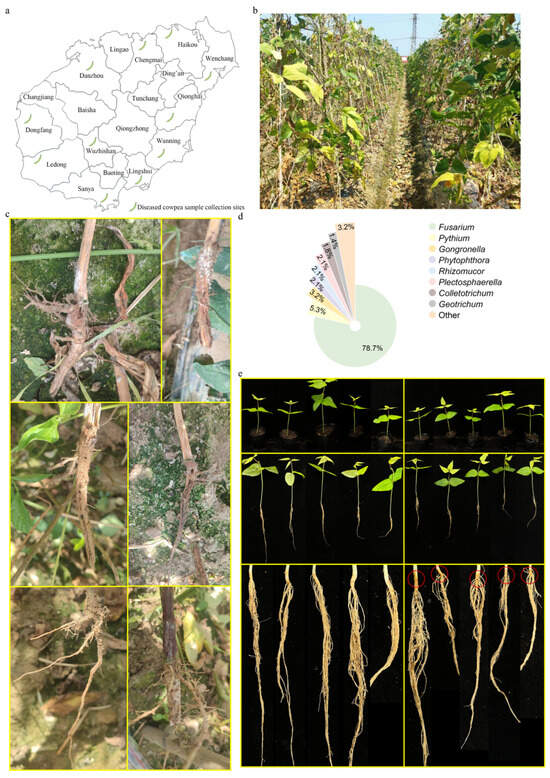
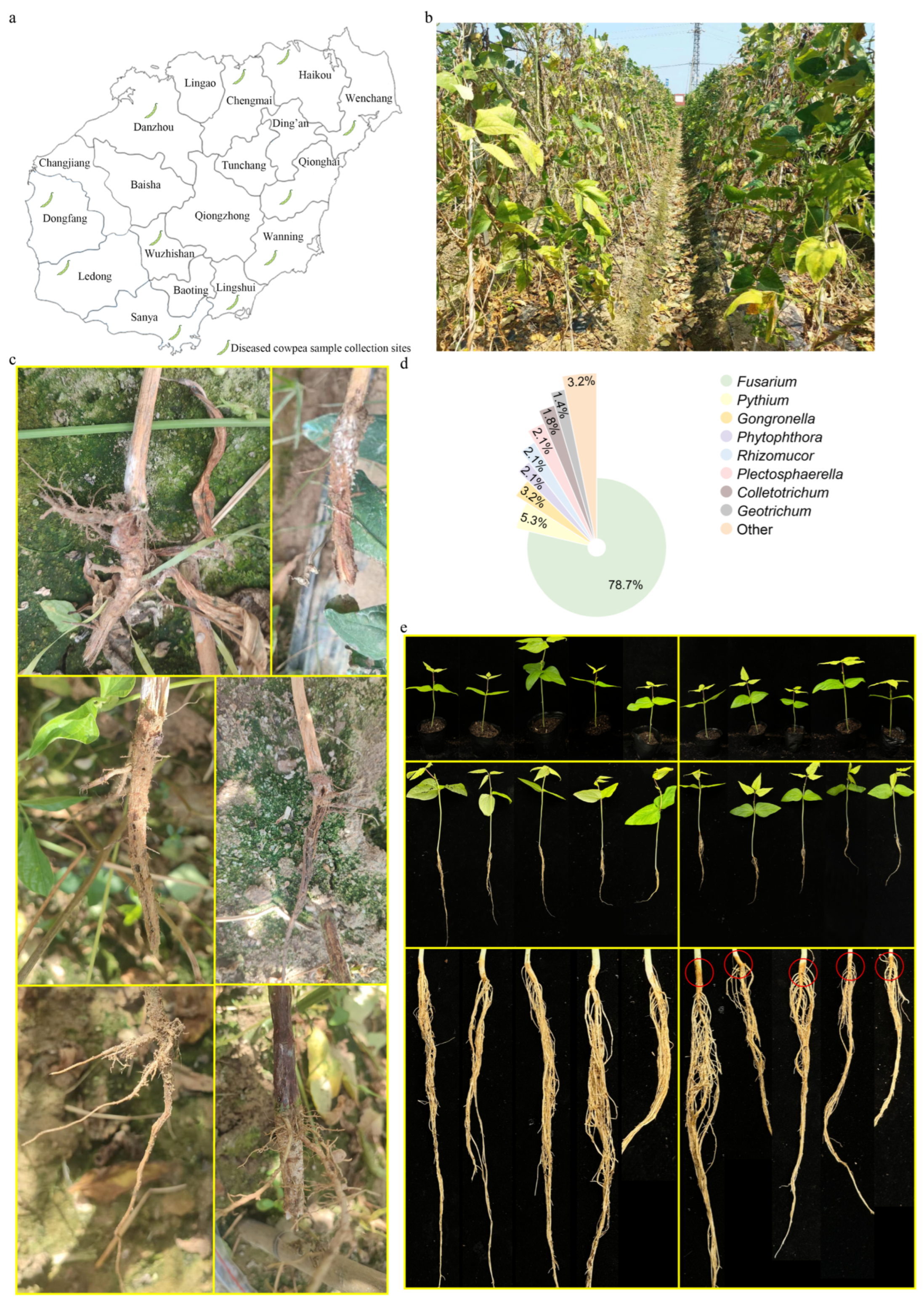
Field surveys on cowpea root rot were conducted from November 2022 to May 2023 across three counties and eight county-level or prefecture-level cities in major cowpea-producing areas of Hainan Province (Figure 1a). At each survey site, fields with visible root rot symptoms were selected (Figure 1b), and diseased plants were collected by random sampling: approximately 8–12 diseased plants showing typical symptoms (root browning and decay) were randomly collected per site. Using conventional tissue isolation methods, the roots of diseased plants were washed thoroughly under running water, surface-sterilized with 75% ethanol, and rinsed with sterile water. Tissues at the margin between healthy and diseased areas were excised and plated onto potato dextrose agar (PDA) medium (potato 200 g/L, dextrose 20 g/L, agar powder 15 g/L). The plates were incubated in darkness at 25 °C. A small mycelial plug was cut from the edge of each colony and transferred to fresh PDA plates. To ensure genetic uniformity, all isolates were purified by monohyphal isolation: a single hypha was excised from the margin of each actively growing colony and transferred to fresh PDA, and this purification process was repeated for two consecutive generations. The purified isolates were preserved in PDA slants for subsequent use.
Figure 1.
Survey, pathogen isolation, and pathogenicity validation of cowpea root rot in Hainan Province. (a) Geographic distribution of sampling sites. (b) Field cultivation of cowpea. (c) Root symptoms of cowpea root rot. (d) Detection frequency of isolated pathogens associated with cowpea root rot. (e) Symptoms of cowpea seedlings after inoculation (red circles indicate disease lesions).
2.2. Morphological Identification
Fifty-three representative Fusarium isolates, selected based on differences in colony morphology, were inoculated onto solid PDA plates and cultured at 25 °C to observe colony growth characteristics, morphological features, and color changes. Mycelia were inoculated into mung bean (MB) medium (mung bean 30 g/L) and incubated at 25 °C with shaking at 150 rpm for 5 days to prepare spore suspensions. The morphology of mycelia and conidia was observed under an optical microscope, and their dimensions were measured for preliminary morphological identification of the pathogens.
2.3. Molecular Identification
The same 53 representative Fusarium isolates were used for multilocus molecular identification. Cultured mycelia were scraped into sterile mortars, ground thoroughly in liquid nitrogen, and genomic DNA was extracted using the CTAB method [23]. The internal transcribed spacer (ITS), translation elongation factor 1-α (tef1), RNA polymerase II second largest subunit (rpb2), and calmodulin (CaM) regions were amplified using the universal fungal primer pairs ITS4/ITS5 [24], EF-1/EF-2 [25], RPB2-5F2/fRPB2-7cR [26,27], and CAL-CL1/CAL-CL2A [28], respectively. The primer sequences used in this study are listed in Table 1. PCR amplification was performed in a 50 μL reaction mixture containing 25 μL of 2 × Es Taq MasterMix (CWBIO, Jiangsu, China), 2 μL each of forward and reverse primers (10 μmol/L), 200 ng of genomic DNA, and ddH2O to a final volume of 50 μL. The conditions were as follows: initial denaturation at 94 °C for 2 min; 30 cycles of denaturation at 94 °C for 30 s, annealing at 55 °C for 30 s, and extension at 72 °C for 30 s; and a final extension at 72 °C for 2 min. PCR products were verified by 1% agarose gel electrophoresis and sequenced by Beijing Tsingke Biotech Co., Ltd. Sequences of ITS, tef1, rpb2, and CaM from closely related species complexes were downloaded from NCBI (https://www.ncbi.nlm.nih.gov/) and the FUSARIOID-ID database (https://www.fusarium.org) [29]. The species names and GenBank accession numbers of all reference sequences used for phylogenetic analysis are listed in Table S1. Using Alternaria alternata as the outgroup, sequences of each locus were aligned using MUSCLE [30], manually trimmed, and concatenated. A maximum-likelihood phylogenetic tree was inferred using IQ-TREE 2, with the best-fit substitution model selected by the program and node support evaluated by 1000 bootstrap replicates [31]. The taxonomic status of the isolates was determined based on phylogenetic analysis in conjunction with morphological characteristics.
Table 1.
The primers used in this study.
2.4. Pathogenicity Test
Representative isolates for pathogenicity testing were selected from the 53 molecularly identified Fusarium isolates. The selection criterion was to represent each of the four identified species complexes, namely the Fusarium oxysporum species complex (FOSC), Fusarium fujikuroi species complex (FFSC), Fusarium solani species complex (FSSC), and Fusarium incarnatum-equiseti species complex (FIESC). Where possible, the selected isolates also covered the observed variation in colony morphology and sampling origin. Five isolates were selected from each species complex, except for FFSC, for which only four isolates were available, giving 19 isolates in total. To determine an appropriate inoculum concentration, preliminary inoculation tests were performed on ten randomly selected Fusarium isolates using spore suspensions adjusted with sterile distilled water to 104, 105, 106, and 107 spores/mL based on hemocytometer counts. A concentration of 1 × 10⁵ spores/mL was selected because it produced typical and stable root rot symptoms with minimal seedling death, whereas lower and higher concentrations caused weak symptoms or excessive seedling mortality, respectively. Nutrient soil and vermiculite were mixed uniformly at a ratio of 1:1 (V/V), moistened with an appropriate amount of water, and loaded into disposable plastic pots (10 cm × 10 cm). Plump, uniform-sized, and pest-free cowpea seeds were sown and cultivated in a greenhouse at 28 °C. Seven days after emergence, healthy seedlings with uniform growth were selected for inoculation via root drenching. Each pot received 20 mL of spore suspension. This volume was selected based on the capacity of the disposable plastic pots used in this study and was sufficient to evenly apply the spore suspension to the root zone without causing runoff or waterlogging. Sterile water was used as the control (CK). Each treatment consisted of three replicates, with three plants per replicate. Plant wilting and root rot symptoms were evaluated at 7 days post-inoculation and documented photographically. In this pathogenicity test, seedlings were assessed only for the presence or absence of typical root rot symptoms; disease severity was not quantified because the purpose was to confirm pathogenicity and fulfill Koch’s postulates. Pathogens were re-isolated from the diseased tissues and subjected to morphological and molecular identification to confirm Koch’s postulates.
2.5. Fungicide Sensitivity Assay and Resistance Classification
Among the 19 pathogenic isolates tested in Section 2.4, three representative isolates were selected from each of the four Fusarium species complexes (FOSC, FFSC, FSSC, and FIESC) for fungicide sensitivity assays. The sensitivity to eight fungicides, including fludioxonil, difenoconazole, mefentrifluconazole, tebuconazole, azoxystrobin, carbendazim, phenamacril, and pydiflumetofen (companies and countries listed in Table S2), was determined using the mycelial growth rate method. For azoxystrobin, salicylhydroxamic acid (SHAM) was added to the fungicide-amended medium at a final concentration of 50 μg/mL to suppress the alternative oxidase pathway. Stock solutions of each fungicide were prepared in dimethyl sulfoxide (DMSO) and then added to PDA medium to prepare plates with serial concentration gradients. PDA with an equal volume of solvent served as the control. A 5 mm diameter mycelial plug was placed at the center of each plate. Each treatment consisted of three replicates, with three plates per replicate, and the plates were incubated in darkness at 25 °C for 5 days. Colony diameters were measured and the inhibition rate relative to the control was calculated. EC50 values were computed using DPS data processing software [32].
Because species-specific baseline sensitivities have not yet been established for the Fusarium species complexes associated with cowpea root rot, published baseline EC50 values for Fusarium spp. (Table 2) were adopted as provisional references for resistance factor (RF) calculation. Based on previously reported baseline sensitivities (Table 2) and resistance risk categories (from FRAC, https://www.frac.info/, accessed on 13 October 2026) to fungicides for Fusarium spp., the RF was calculated using Formula (1) [15,33]. Resistance levels were classified according to the resistance factor thresholds described in an unpublished technical guideline developed by agricultural experts in China specifically for fungicide resistance monitoring in plant pathogens. The criteria were as follows: for triazole fungicides with medium resistance risk and other fungicides with low-to-medium resistance risk, RF < 3 indicates sensitive, 3 ≤ RF < 10 indicates low resistance, 10 ≤ RF < 50 indicates moderate resistance, and RF ≥ 50 indicates high resistance. For fungicides with medium-to-high or high resistance risk, RF < 5 indicates sensitive, 5 ≤ RF < 20 indicates low resistance, 20 ≤ RF < 100 indicates moderate resistance, and RF ≥ 100 indicates high resistance.
Table 2.
Reference baseline sensitivity (EC50) and resistance risk classification of the eight fungicides against Fusarium spp.
2.6. Joint Toxicity Assay of Fungicide Combinations
Based on the sensitivity assay results, one representative isolate from each species complex (FIEHN13, FOHN22, FFHN2, and FSHN3) was selected for joint toxicity testing. Two combinations were evaluated: phenamacril + tebuconazole and pydiflumetofen + tebuconazole. The final concentrations of the mixtures were set at 0.2, 2, 5, 15, and 50 μg/mL. These concentrations were selected based on the EC50 values of the individual fungicides obtained in the sensitivity assays described in Section 2.5, so that the tested range covered the effective concentration ranges of the single agents. For each combination, five mixing ratios were tested, designed to span the range between the upper and lower limits of the recommended field application rates of the respective fungicides. The tested ratios were as follows: phenamacril:tebuconazole at 1.74:1, 3.34:1, 5.80:1, 10.11:1, and 19.38:1; and pydiflumetofen:tebuconazole at 0.70:1, 1.09:1, 1.69:1, 2.76:1, and 5.03:1. Single-agent controls were included simultaneously. EC50 values were determined following the method described in Section 2.5. The synergistic ratio (SR) was calculated using Wadley’s method as shown in Formula (2) [38]. SR > 1.5 indicates synergistic effect, 0.5 ≤ SR ≤ 1.5 indicates additive effect, and SR < 0.5 indicates antagonistic effect. The optimal mixing ratio for each combination was screened accordingly.
Note: EC50(th) is the theoretical EC50 value, EC50(ob) is the observed EC50 value, a and b are the proportions of fungicide A and fungicide B in the mixture.
2.7. Validation of Greenhouse Pot Disease Control Efficacy
The optimal mixing ratios identified in the joint toxicity assay were selected to validate the disease control efficacy against the four representative isolates in a pot experiment conducted in a greenhouse. Fungicides were applied as seed coatings at a rate of 4 mg a.i./g seed, based on recommended field application rates. The seed coating formulation was prepared according to a previously described method [39] with modifications and consisted of 4.5% active ingredient, 8% dimethyl sulfoxide (DMSO), 1.5% sodium lignosulfonate, 2% xanthan gum, 1% organosilicon defoamer, and water to volume. Six treatments were established: a blank formulation control (CK), with the active ingredient replaced by sterile water, phenamacril, pydiflumetofen, tebuconazole, and the two optimized combinations, all prepared using the same seed coating formulation. Four plants were included in each treatment. The plants were arranged randomly in the greenhouse. Coated seeds were sown and cultivated following the protocol described in Section 2.4. Seven days after emergence, seedlings were inoculated by root drenching using the spore suspension concentration and inoculation protocol described in Section 2.4. Fourteen days post-inoculation, root phenotypes were observed and recorded. Disease severity was assessed using a rating scale adapted from the Chinese national standard GB/T 17980.88-2004 (Pesticide—Guidelines for the Field Efficacy Trials (II), Part 88: Fungicides against Soybean Root Rot) [40]. The disease index (DI) was calculated using Formula (3) [41], which was then used to determine control efficacy by applying Formula (4) [42].
Disease rating scale:
0: No lesions on the stem base or taproot;
1: Few small lesions on the stem base and taproot;
3: Numerous lesions on the stem base and taproot, covering 1/4–1/2 of the total area;
5: Many large lesions on the stem base and taproot, covering 1/2–3/4 of the total area;
7: Coalescent lesions forming girdling on the stem base or taproot, but roots remain viable;
9: Complete root necrosis; above-ground parts wilted or dead.
Note: ni is the number of plants at each disease grade, vi is the corresponding disease grade value, N is the total number of plants assessed, Vmax is the maximum disease grade value, DICK is the disease index of the blank control, and DIT is the disease index of the treatment group.
Because Fusarium spp. are necrotrophic pathogens, disease incidence was recorded in addition to disease severity to describe disease occurrence. Plants with a disease rating ≥ 1 were considered diseased, and disease incidence was calculated using Formula (5).
2.8. Statistical Analysis
Statistical analyses and data processing were performed using SPSS v27.0 (IBM Corp., Armonk, NY, USA) and GraphPad Prism v9.5 (GraphPad Software, San Diego, CA, USA). Statistical significance was set at p < 0.05. Figures were generated using GraphPad Prism v9.5 and R v4.5.2 (R Core Team, Vienna, Austria).
3. Results
3.1. Pathogen Isolation and Composition Associated with Cowpea Root Rot in Hainan Province
The roots of diseased cowpea plants exhibited obvious rotting symptoms, characterized by root browning, slightly sunken or cracked lesions, sparse or absent fibrous roots, and overall poor root development, which are consistent with the typical morphological features of root rot (Figure 1c). Through isolation and culturing of the collected samples, combined with preliminary identification based on morphology and ITS sequence analysis of an approximately 600 bp fragment, a total of 282 suspected pathogenic isolates were obtained and classified into eight major groups. Among them, Fusarium spp. showed the highest detection frequency at 78.7% (222 isolates), followed by Pythium spp. (5.3%), Gongronella spp. (3.2%), Phytophthora spp. (2.1%), Rhizomucor spp. (2.1%), Plectosphaerella spp. (2.1%), Colletotrichum spp. (1.8%), and Geotrichum spp. (1.4%) (Figure 1d). Notably, in preliminary pathogenicity tests, only representative Fusarium isolates selected by morphology, growth rate, and origin induced typical root rot symptoms (Figure 1e); the other seven groups were non-pathogenic. These results suggest that, although diverse fungal species were isolated from diseased plants, Fusarium spp. may be directly associated with cowpea root rot in Hainan Province.
3.2. Morphological and Phylogenetic Identification of Fusarium Species Complexes
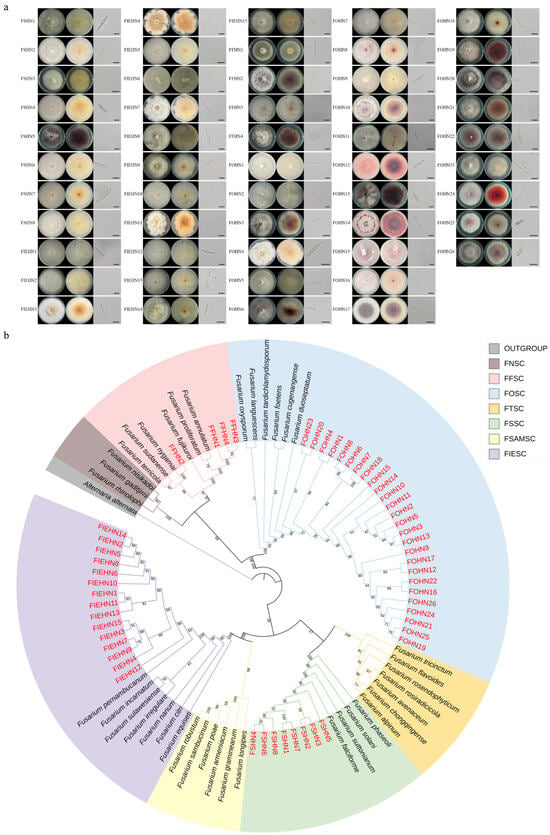
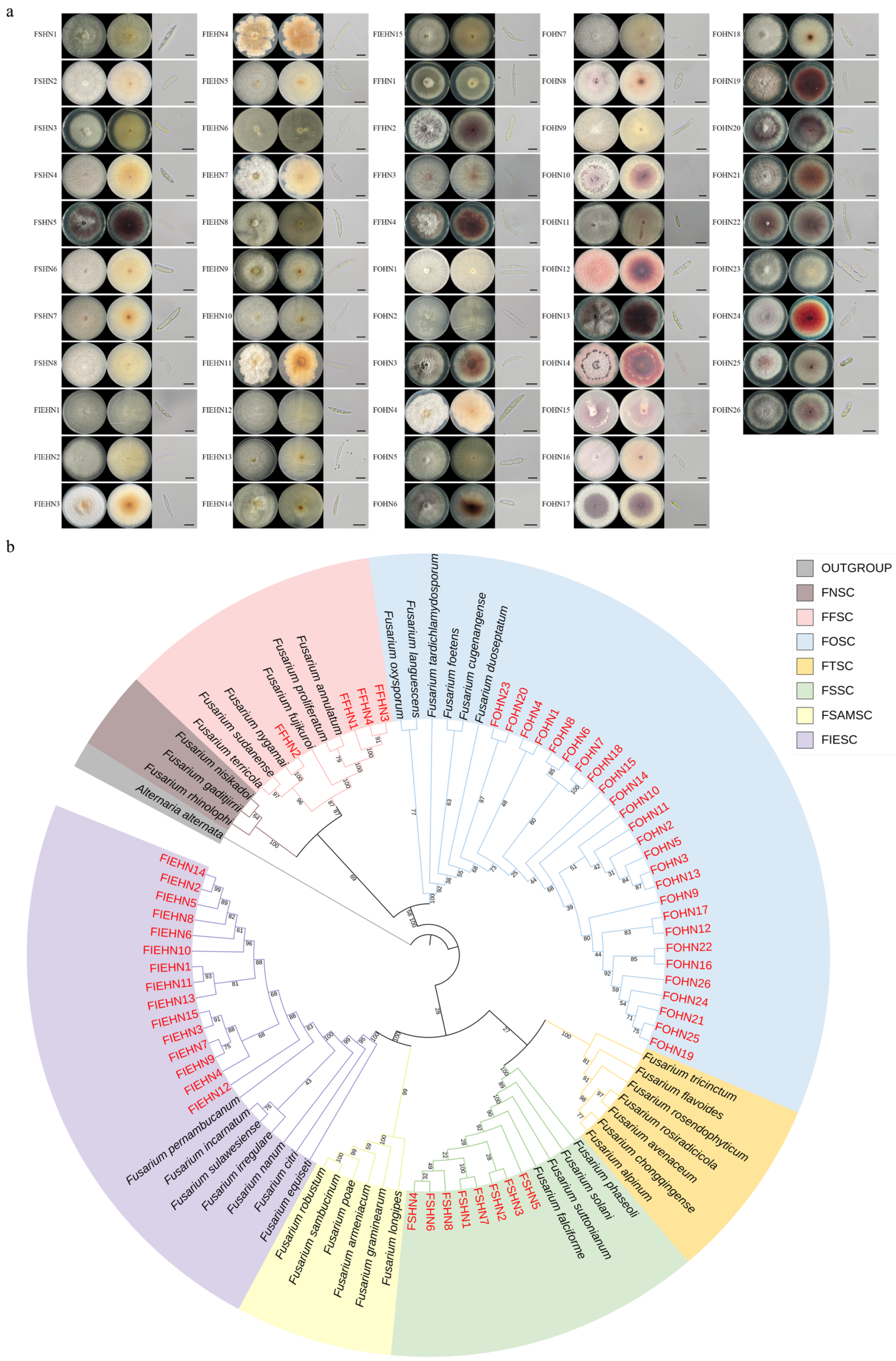
Given that many of the 222 Fusarium isolates were expected to be conspecific duplicates, 53 representative isolates (listed in Table S3) were selected based on differences in colony morphology (Figure 2a) for multilocus sequence analysis (MLSA). Phylogenetic analysis based on the concatenated sequences of ITS, tef1, rpb2, and CaM (Figure 2b; Table S3) revealed that these 53 representative isolates clustered into four distinct species complexes: Fusarium oxysporum species complex (FOSC), Fusarium fujikuroi species complex (FFSC), Fusarium solani species complex (FSSC), and Fusarium incarnatum-equiseti species complex (FIESC). The morphological characteristics of the four species complexes are summarized in Table 3. Integrating morphological and molecular phylogenetic analyses, the 53 representative isolates were accurately assigned to the aforementioned four species complexes. Among them, FOSC comprised the largest number of isolates and represents the predominant Fusarium lineage associated with cowpea root rot in Hainan Province.
Figure 2.
Morphological characteristics and phylogenetic analysis of Fusarium isolates from cowpea root rot in Hainan Province. (a) Colony morphology (front and reverse views on PDA) and microscopic conidial structures of representative Fusarium isolates. Scale bars = 10 μm. (b) Phylogenetic tree of representative Fusarium isolates based on ITS, tef1, rpb2, and CaM concatenated sequences. Bootstrap support values are indicated at branches. Isolates from this study are labeled in red font, and reference strains are labeled in black font. Alternaria alternata was used as an outgroup. The colored fan-shaped areas correspond to different Fusarium species complexes: FOSC (Fusarium oxysporum species complex), FFSC (Fusarium fujikuroi species complex), FSSC (Fusarium solani species complex), FSAMSC (Fusarium sambucinum species complex), FTSC (Fusarium tricinctum species complex), FNSC (Fusarium nisikadoi species complex), and FIESC (Fusarium incarnatum-equiseti species complex).
Table 3.
Morphological characteristics of the four Fusarium species complexes.
3.3. Pathogenicity of Representative Fusarium Isolates on Cowpea
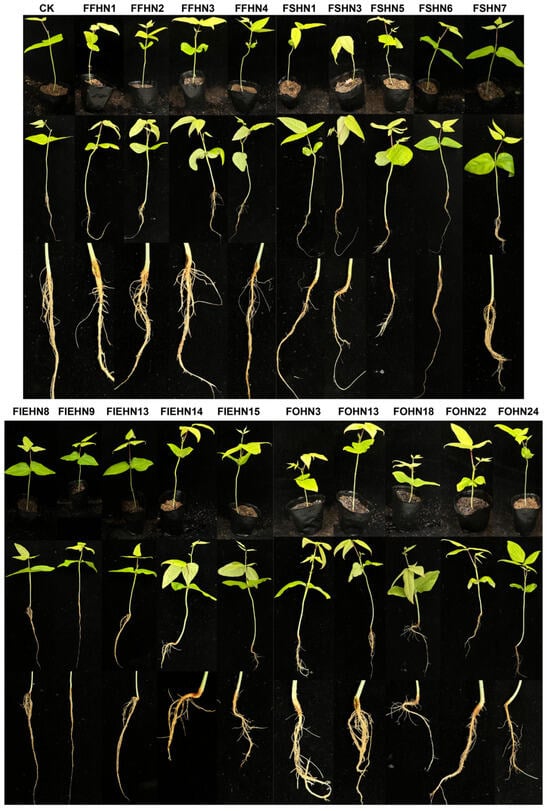
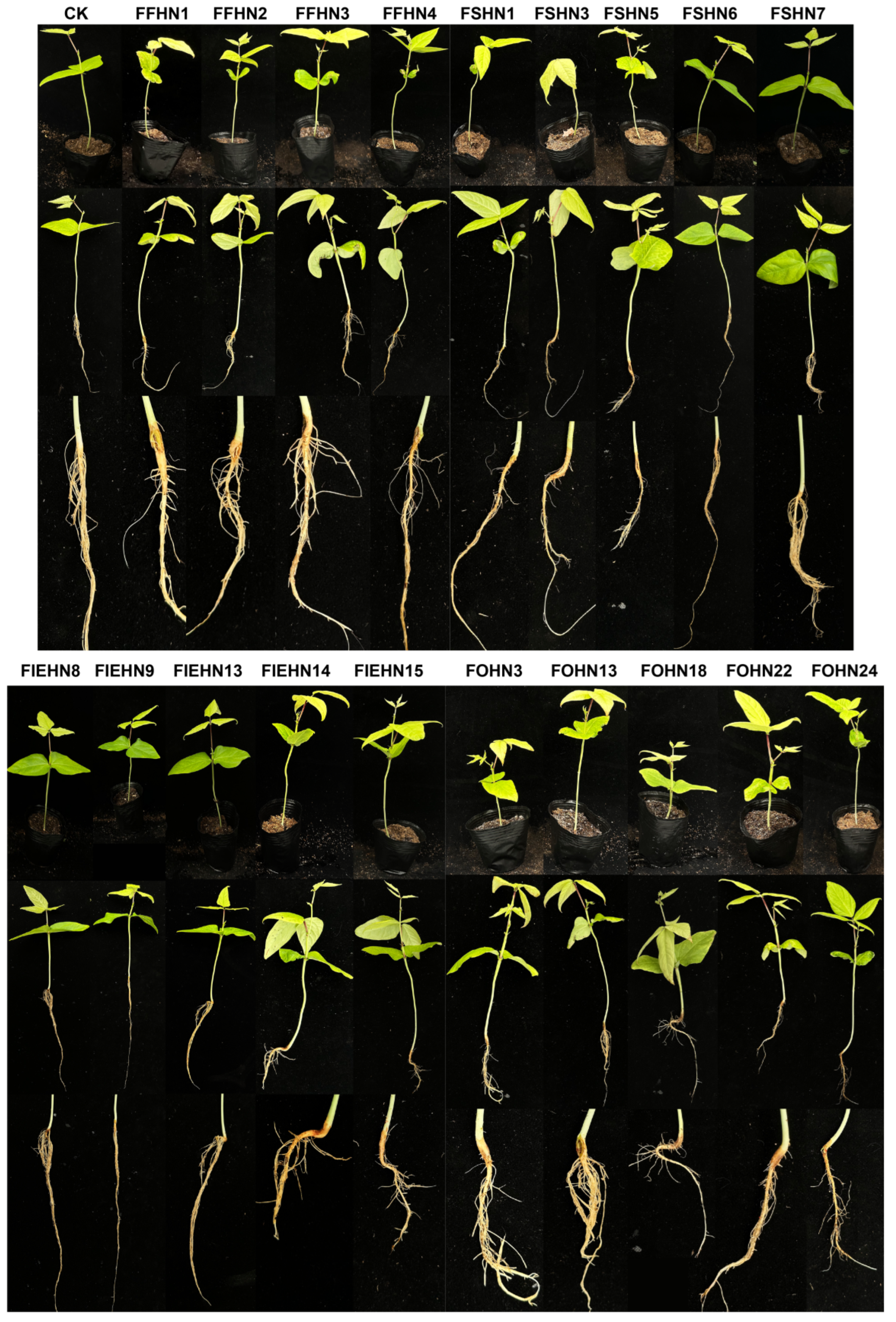
Five representative isolates were selected from each of the four Fusarium species complexes (only four isolates were available for FFSC) and inoculated onto healthy cowpea seedlings for pathogenicity testing, with sterile water inoculation serving as the control. Post-inoculation observations revealed that all treatment groups exhibited varying degrees of disease symptoms, which were consistent with those observed under natural field conditions. Symptoms included stunting and leaf wilting in some plants; upon uprooting, root browning and rotting, as well as the reduction or complete necrosis of lateral roots, were observed (Figure 3). In contrast, the sterile water control plants remained vigorous with normal leaf color and well-developed white roots, showing no disease symptoms. Fungi were re-isolated from the artificially inoculated diseased seedlings and confirmed to be identical to the original inoculated isolates through morphological and molecular identification, thereby fulfilling Koch’s postulates and confirming that the selected representative Fusarium isolates are the causal agents of cowpea root rot in Hainan Province. Furthermore, significant differences in pathogenicity were observed among the isolates: some caused severe wilting and complete root necrosis, while weakly pathogenic isolates induced only mild root browning, indicating substantial variation in pathogenicity within the tested Fusarium population.
Figure 3.
Pathogenicity assay of representative Fusarium isolates on cowpea seedlings. Top: Overall phenotype of potted seedlings. Middle: Morphology of whole plants after uprooting. Bottom: Root close-up. CK: sterile water-inoculated control.
3.4. Sensitivity and Resistance Profiles of Representative Fusarium Isolates to Eight Fungicides
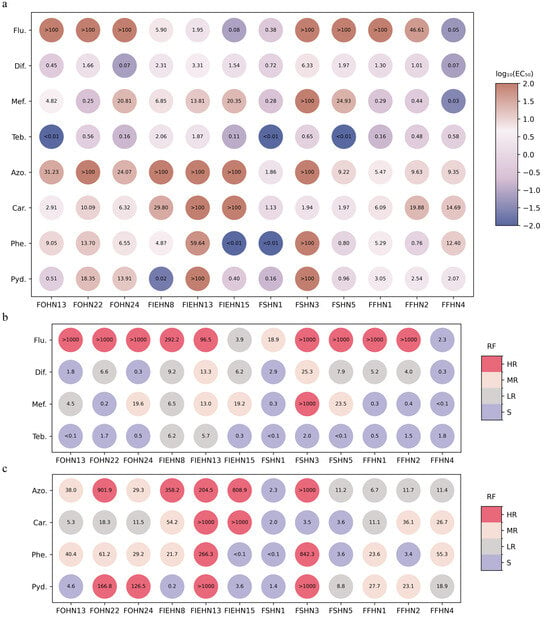
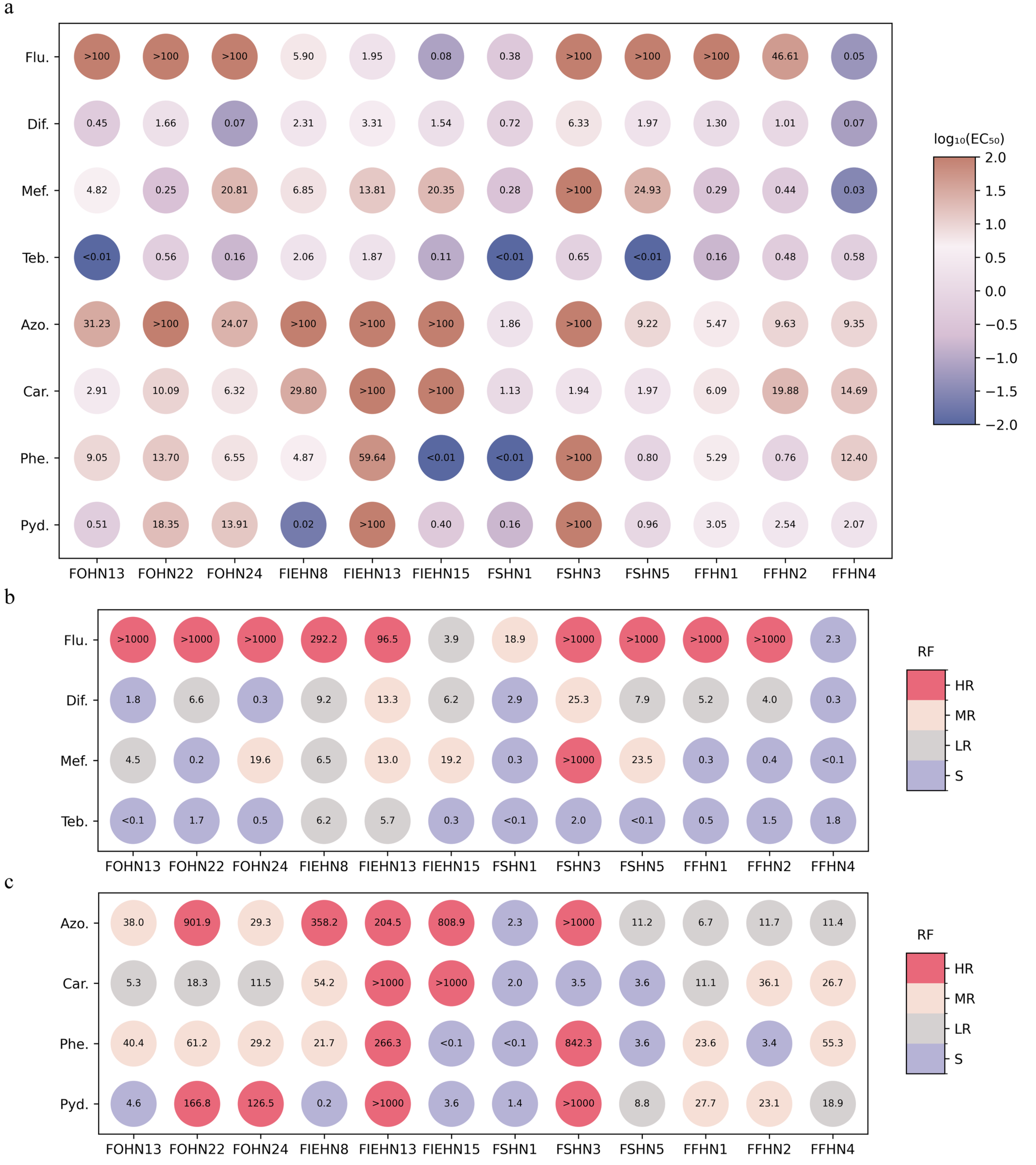
To systematically evaluate the sensitivity profiles and resistance evolution potential of the different Fusarium species complexes to commonly used fungicides, three representative isolates were selected from each of the four species complexes. Their sensitivities to eight commonly used fungicides (fludioxonil, difenoconazole, mefentrifluconazole, tebuconazole, azoxystrobin, carbendazim, phenamacril, and pydiflumetofen) were determined (Figure 4a). Based on the baseline sensitivities for Fusarium spp. to each fungicide and the corresponding resistance risk classifications, resistance factors (RFs) were calculated for the 12 representative isolates, and resistance levels were assigned accordingly (Figure 4b,c). The results revealed significant heterogeneity in isolate sensitivity across fungicides with different modes of action, with EC50 values spanning four orders of magnitude. Furthermore, resistance profiles exhibited pronounced species complex-specific and isolate-specific patterns.
Figure 4.
Sensitivity assays and resistance classification of 12 representative Fusarium isolates against eight fungicides. (a) EC50 values (μg/mL) of the 12 Fusarium isolates against eight fungicides: fludioxonil (Flu.), difenoconazole (Dif.), mefentrifluconazole (Mef.), tebuconazole (Teb.), azoxystrobin (Azo.), carbendazim (Car.), phenamacril (Phe.), pydiflumetofen (Pyd.). (b) Resistance factors (RFs) for 12 representative Fusarium isolates to triazole fungicides with medium resistance risk and other fungicides with low-to-medium resistance risk. Resistance levels are classified as S (sensitive; RF < 3), LR (low resistance; 3 ≤ RF < 10), MR (moderate resistance; 10 ≤ RF < 50), and HR (high resistance; RF ≥ 50). (c) RFs for 12 representative Fusarium isolates to fungicides with medium-to-high or high resistance risk. Resistance levels are classified as S (sensitive; RF < 5), LR (low resistance; 5 ≤ RF < 20), MR (moderate resistance; 20 ≤ RF < 100), and HR (high resistance; RF ≥ 100).
With regard to specific resistance profiles, fludioxonil presented the most severe resistance problem: only FFHN4 (RF = 2.3) remained sensitive, whereas all other representative isolates were resistant, predominantly at the high-resistance level, suggesting a high risk of control failure if this fungicide is used as a single agent against cowpea root rot in Hainan. Triazole fungicides overall retained relatively good efficacy. Tebuconazole demonstrated the strongest inhibitory activity, with only FIEHN8 (RF = 6.2) and FIEHN13 (RF = 5.7) reaching low resistance; all remaining isolates were fully sensitive. For difenoconazole and mefentrifluconazole, only four and five isolates, respectively, remained sensitive, and the majority exhibited low-to-moderate resistance, with only one isolate classified as highly resistant to mefentrifluconazole.
Among medium-to-high-risk fungicides, phenamacril resistance was particularly notable: FSHN3 (RF = 842.3) and FIEHN13 (RF = 266.3) exhibited high-level resistance; only four tested isolates remained sensitive, and the rest displayed moderate resistance. In the pydiflumetofen sensitivity assay, FSHN3 (RF > 1000), FIEHN13 (RF > 1000), FOHN22 (RF = 166.8), and FOHN24 (RF = 126.5) were classified as highly resistant; an additional four isolates showed low-to-moderate resistance, while the remainder were sensitive.
The resistance situation for high-risk fungicides was equally concerning. Only three FSSC isolates (FSHN1, RF = 2.0; FSHN3, RF = 3.5; and FSHN5, RF = 3.6) remained sensitive to carbendazim; all other tested isolates had developed varying degrees of resistance. Azoxystrobin resistance was second only to fludioxonil in severity: only FSHN1 (RF = 2.3) remained sensitive, while all other isolates were resistant, with as many as five reaching the high-resistance level.
In summary, resistance to the eight tested fungicides in the Fusarium population associated with cowpea root rot in Hainan exhibits strong species complex-specific and isolate-specific differentiation. FOSC isolates are universally highly resistant to fludioxonil and partially highly resistant to pydiflumetofen but remain highly sensitive to tebuconazole. FIESC isolates are universally highly resistant to azoxystrobin. FSSC isolates retain sensitivity to both tebuconazole and carbendazim, while FFSC isolates are sensitive to mefentrifluconazole and tebuconazole. Strikingly, most representative isolates simultaneously exhibit resistance to more than three fungicides with distinct modes of action, representing typical multiple-fungicide-resistant (MFR) strains. Among them, FIEHN13 and FSHN3 display high-level resistance to as many as five fungicides. Of particular concern was FIEHN13, which had developed resistance to all eight tested fungicides, posing an extremely high risk of field pathogenicity and control failure. Conversely, isolates such as FFHN4 and FSHN1 still maintain good sensitivity to most fungicides. Overall, fungicide resistance has become widespread at both the individual isolate and population levels among Fusarium pathogens causing cowpea root rot in Hainan Province, underscoring the urgent need for targeted management strategies against resistant strains.
3.5. Joint Toxicity of Selected Fungicide Mixtures Against Representative Isolates
Based on the results of sensitivity assays, one representative isolate with severe resistance issues was selected from each Fusarium species complex (FIEHN13, FOHN22, FFHN2, and FSHN3) for joint toxicity testing of fungicide mixtures. Phenamacril and pydiflumetofen were selected to be combined with tebuconazole for two reasons: tebuconazole retained excellent inhibitory activity against nearly all isolates tested, while the resistance to phenamacril and pydiflumetofen, although present in many isolates, was comparatively less severe than that observed for fludioxonil and azoxystrobin.
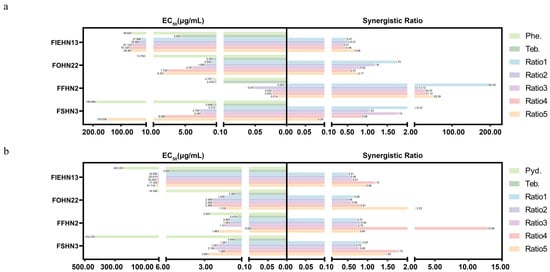
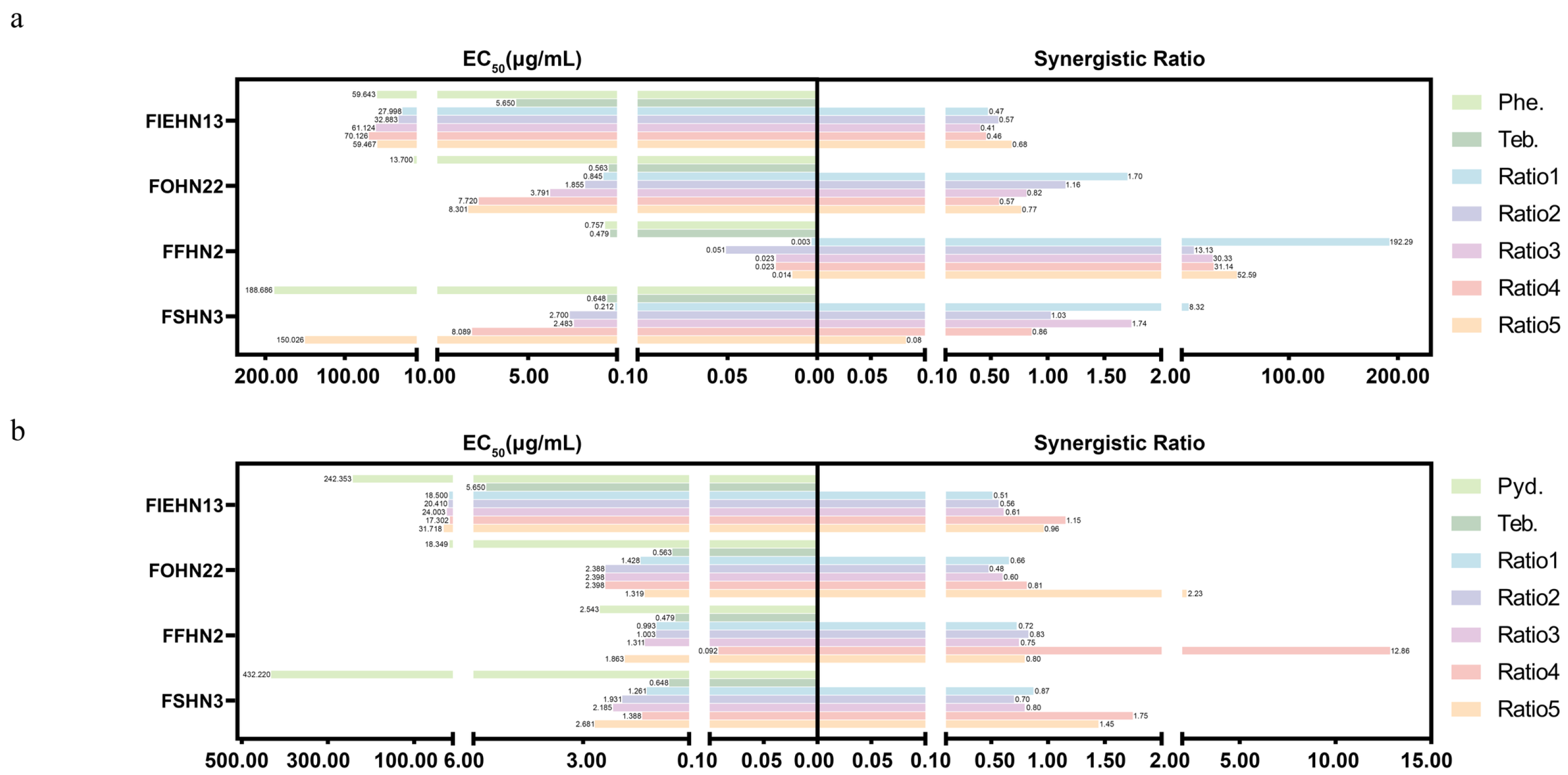
The joint toxicity of the phenamacril + tebuconazole mixture against the four representative Fusarium isolates exhibited significant isolate specificity and ratio dependence (Figure 5a). In terms of EC50 values, FFHN2 was the most sensitive to this combination, with an EC50 of only 0.003 μg/mL at Ratio1 (1.74:1), which was substantially lower than that of either fungicide applied alone. In contrast, FSHN3 and FIEHN13 were relatively insensitive, and their EC50 values increased to varying degrees at higher proportions of phenamacril, indicating strong tolerance to this combination. The SR values further revealed this disparity: the combination exhibited a highly significant synergistic effect against FFHN2 across all tested ratios, with SR values ranging from 13.13 to 192.29 and peaking at Ratio1. The FSHN3 group exhibited a synergistic effect only at Ratio1 and Ratio3 (SR = 8.32 and 1.74, respectively); the FOHN22 group showed a marginal synergistic effect solely at Ratio1 (SR = 1.70); whereas the FIEHN13 group predominantly displayed an antagonistic effect at various ratios. Overall, the phenamacril + tebuconazole mixture at a ratio of 1.74:1 demonstrated the most significant synergistic effect against the representative isolates.
Figure 5.
Joint toxicity of fungicide mixtures against four representative Fusarium isolates. (a) Phenamacril + tebuconazole mixture. Ratio1 = 1.74:1; Ratio2 = 3.34:1; Ratio3 = 5.80:1; Ratio4 = 10.11:1; Ratio5 = 19.38:1. (b) Pydiflumetofen + tebuconazole mixture. Ratio1 = 0.70:1; Ratio2 = 1.09:1; Ratio3 = 1.69:1; Ratio4 = 2.76:1; Ratio5 = 5.03:1. The left panels show the EC50 values for individual fungicides and each mixture ratio, while the right panels display the corresponding synergistic ratios.
The joint toxicity profile of the pydiflumetofen + tebuconazole mixture differed markedly from that of the former combination. EC50 values for the four isolates fluctuated relatively less across different ratios. The SR values indicated that a significant synergistic effect occurred only at specific ratios: the FFHN2 group achieved the highest SR value of 12.86 at Ratio4 (2.76:1); the FOHN22 group reached an SR of 2.23 at Ratio5 (5.03:1), and the FSHN3 group attained an SR of 1.75 at Ratio4, both meeting the threshold for a synergistic effect; the FIEHN13 group exhibited an additive effect at Ratio4 (SR = 1.15). Notably, apart from the aforementioned specific combinations, SR values for most ratios ranged from 0.51 to 0.96, suggesting that the pydiflumetofen + tebuconazole mixture primarily exerts an additive effect under most mixing ratios. In summary, the pydiflumetofen + tebuconazole mixture at a ratio of 2.76:1 exhibited optimal synergistic toxicity against the representative isolates.
3.6. Greenhouse Control Efficacy of Optimized Fungicide Mixtures
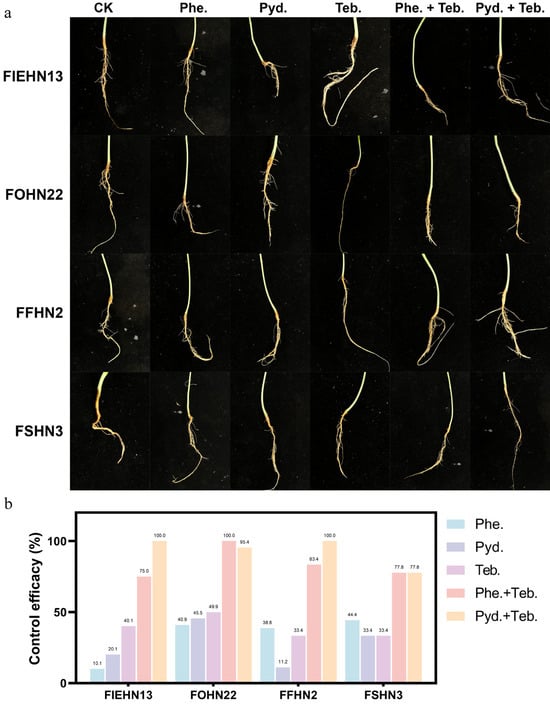
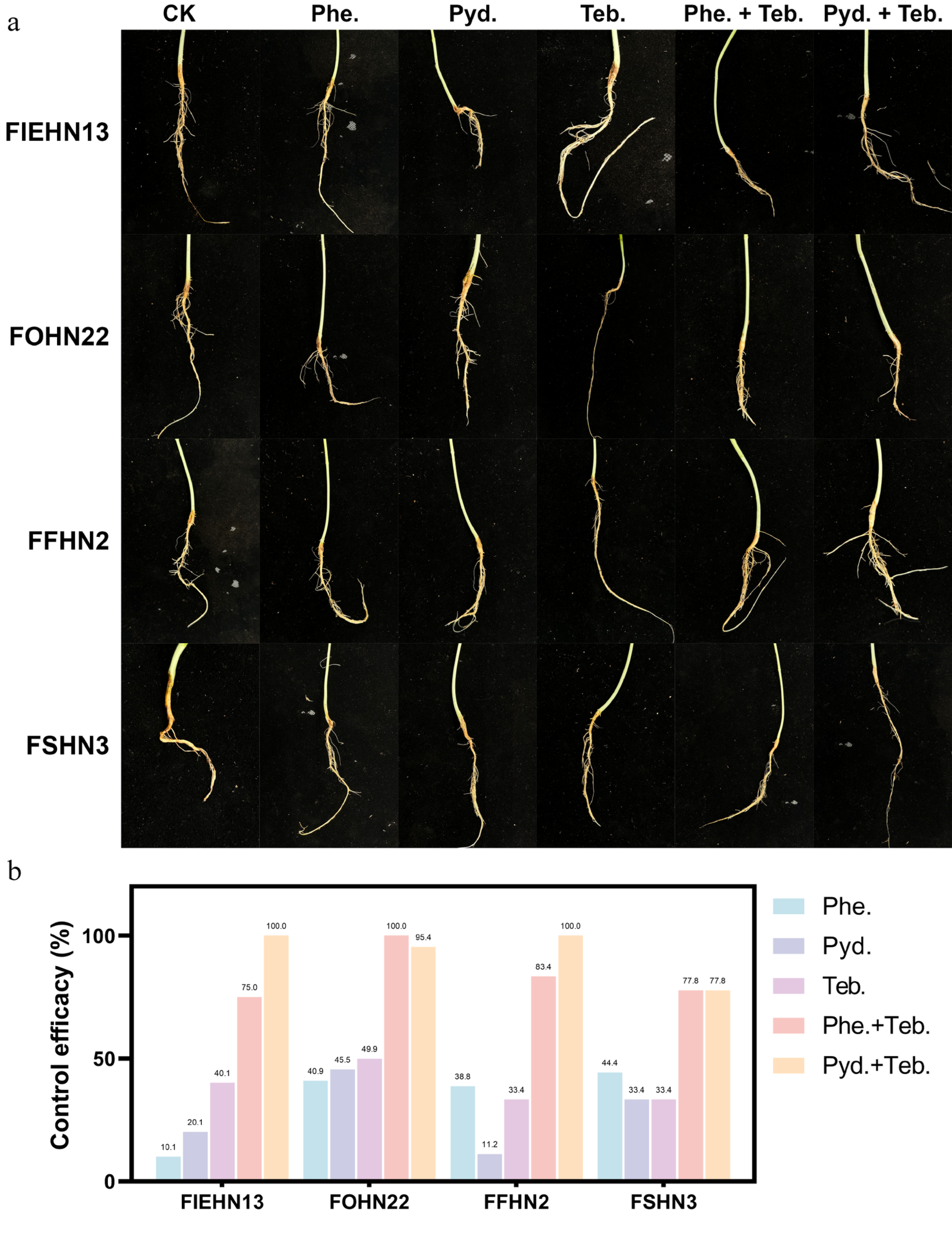
Based on the optimal ratios identified from the joint toxicity assays, the two fungicide combinations were evaluated for greenhouse control efficacy against the four representative Fusarium isolates. At 14 days post-inoculation, cowpea seedlings in the sterile water control (CK) group exhibited typical root rot symptoms, characterized by root browning, decay, and constriction, whereas all fungicide treatments alleviated root damage to varying degrees (Figure 6a). Because Fusarium spp. are necrotrophic pathogens, disease incidence was recorded as the primary parameter for disease occurrence (Table S4). Disease incidence in the CK group reached 100% for all four isolates. Among the single-fungicide treatments, only phenamacril (against FOHN22 and FFHN2) and tebuconazole (against FOHN22) reduced incidence to 75%, whereas incidence remained at 100% in all remaining single-fungicide treatments, indicating that single agents could not effectively prevent infection. In contrast, the two optimized combinations markedly suppressed disease occurrence: the phenamacril + tebuconazole mixture reduced incidence to 0% for FOHN22 and to 25% for FIEHN13 and FFHN2, whereas the pydiflumetofen + tebuconazole mixture reduced incidence to 0% for FIEHN13 and FFHN2 and to 25% for FOHN22; for FSHN3, both combinations reduced incidence to 50%.
Figure 6.
Greenhouse control efficacy of two fungicide combinations against four representative Fusarium isolates. (a) Root phenotypes of cowpea seedlings inoculated with FIEHN13, FOHN22, FFHN2, or FSHN3 following different treatments (photographed at 14 days post-inoculation). (b) Control efficacy of each fungicide treatment against FIEHN13, FOHN22, FFHN2, and FSHN3. Treatments included: sterile water control (CK), phenamacril, pydiflumetofen, tebuconazole, phenamacril + tebuconazole (Phe. + Teb., 1.74:1), and pydiflumetofen + tebuconazole (Pyd. + Teb., 2.76:1).
Disease severity was then assessed to calculate the DI and control efficacy (Table S4; Figure 6b). Although the single-fungicide treatments provided some protection, the overall root health was markedly inferior to that of the corresponding combination treatments; the control efficacy of all single-fungicide treatments did not exceed 50%, and the lowest was only 10.1% (phenamacril against FIEHN13). Both combinations exhibited substantially higher control efficacy against all four isolates than their respective single-agent counterparts, with treated roots remaining largely healthy. The phenamacril + tebuconazole treatment demonstrated the most prominent protective effect against FOHN22, achieving 100% control efficacy, consistent with its 0% incidence; against FFHN2 and FIEHN13, its efficacy was 83.4% and 75%, respectively. The pydiflumetofen + tebuconazole treatment exhibited excellent protection against FIEHN13 and FFHN2, reaching 100% control efficacy and 0% incidence for both isolates, and 95.4% efficacy (25% incidence) against FOHN22. For FSHN3, the two combinations showed comparable protective effects, each yielding a control efficacy of 77.8% and an incidence of 50%. Overall, the severity-based DI and control efficacy were fully consistent with the incidence data, further confirming that the application of phenamacril combined with tebuconazole or pydiflumetofen combined with tebuconazole can serve as precise management strategies for controlling Fusarium-induced cowpea root rot in Hainan Province.
4. Discussion
Hainan Province is a major winter vegetable production base in China, with an annual planting area of over 200,000 ha. Cowpea, as one of the primary winter vegetables, is widely cultivated across multiple cities and counties in the province, forming large-scale production zones particularly in Haikou, Sanya, Dongfang, Danzhou, Ledong, and Lingshui. Crucially, Hainan also serves as China’s National Seed Breeding Base, where substantial quantities of crop seeds, including cowpea, are annually transported from across the country for winter multiplication and subsequently redistributed to various regions within China. This intensive seed exchange network poses a unique epidemiological risk: pathogenic Fusarium could be disseminated across national or even international boundaries through this pathway, potentially escalating local disease problems into global threats. Against the backdrop that expanding cultivation areas and intensified continuous cropping have already made cowpea root rot a critical soil-borne disease, the potential spread of Fusarium via seeds further exacerbates this threat. Beyond the risks associated with seed-borne dissemination, members of the genus Fusarium are also renowned for their remarkable host-range plasticity [43]. Armer et al. [10] reviewed the extraordinary diversity of ecological niches and hosts exploited by Fusarium species, which collectively infect hundreds of plant species spanning monocots, dicots, and gymnosperms, and are also capable of causing diseases in humans, livestock, marine animals, and insects. This broad host plasticity implies that Fusarium species disseminated from Hainan via seeds would not only threaten cowpea production but could also cause diseases in multiple staple and cash crops across China and beyond.
In this study, a systematic survey of cowpea root rot in the major cowpea-producing areas of Hainan Province yielded 282 isolates, among which Fusarium spp. accounted for 78.7% and represented the dominant pathogen group. The remaining isolates were assigned to Pythium, Gongronella, Phytophthora, and other groups; however, preliminary pathogenicity tests showed that none of these groups induced typical root rot symptoms, suggesting that they were more likely secondary colonizers or saprophytes on diseased tissues rather than primary causal agents.
Through combined morphological and phylogenetic analyses, four species complexes were identified: FOSC, FFSC, FSSC, and FIESC, with FOSC being the dominant lineage. This multi-species etiology is consistent with the growing recognition that root rot in cowpea and other crops is a disease complex caused by diverse Fusarium spp. In Brazil, multiple species within the FSSC, including Fusarium paranaense and Fusarium brasiliense, have also been confirmed as pathogens causing root rot on common bean and cowpea [44]. Furthermore, in Jiangxi Province, China, Fusarium concentricum, F. fujikuroi, and F. incarnatum were first reported in 2024 as novel causal agents of cowpea root rot, highlighting the expanding diversity of Fusarium pathogens associated with this crop [45], and neither study identified FOSC as the dominant lineage. These regional differences may be related to geographic and climatic conditions, cropping systems and continuous cropping history, host cultivar origins, and differences in sampling or taxonomic resolution; in addition, the frequent cross-regional movement of seeds through the Hainan National Seed Breeding Base may introduce external Fusarium lineages, contributing to the more diverse population structure observed in this study.
Pathogenicity tests confirmed that representative isolates from all four species complexes caused typical root rot symptoms and fulfilled Koch’s postulates, indicating that cowpea root rot in Hainan is a disease complex caused by multiple Fusarium lineages rather than a single-pathogen disease. The marked differences in virulence among isolates suggest that pathogenic potential is not uniform within a species complex or among different species complexes. These differences may be related to host adaptation, virulence factors, or secondary metabolites [10,43], although this was not further verified in the present study. These results also indicate that the diversity of the pathogen population should be considered in diagnostic and management strategies, and that cowpea root rot should not be regarded as a single disease caused by a uniform pathogen.
Because species-specific sensitivity baselines have not yet been established for these species complexes, published Fusarium baseline values were adopted as provisional references in this study; however, the resistance factors observed for several fungicides far exceed the plausible range of baseline variation, and this limitation therefore does not affect the main conclusions. Sensitivity assays revealed a concerning resistance landscape in the Hainan Fusarium population: fludioxonil resistance was nearly universal, consistent with increasing reports of FfOs1-mediated resistance in Fusarium [46]. Although tebuconazole resistance has been reported in other Fusarium populations such as Fusarium graminearum [15,47,48,49], tebuconazole retained strong activity in this study, indicating that DMI fungicide resistance has not yet become widespread in the cowpea root rot pathogens of Hainan; however, the low-to-moderate resistance to difenoconazole and mefentrifluconazole suggests emerging selection pressure on the CYP51 target [50,51]. The high-level resistance to azoxystrobin, carbendazim, phenamacril, and pydiflumetofen may be consistent with target-site mutation mechanisms reported in other Fusarium species, including cytb, β-tubulin (tub), and Myo5 mutations [34,52,53,54,55,56,57], as well as Sdh mutations associated with SDHI resistance [19,46]. The detection of MFR isolates, especially isolate FIEHN13, which was resistant to all eight tested fungicides, highlights the risk of control failure and underscores the urgent need to establish resistance monitoring at the species-complex level [18,54,58].
The eight fungicides evaluated in this study are commonly used against Fusarium diseases and represent different modes of action [11,12,13,14]. The observed differences in sensitivity and resistance among isolates may therefore reflect differences in mode of action, resistance risk, field selection pressure, and species-specific genetic backgrounds. Combining fungicides with distinct target sites may reduce selection pressure on single targets and suppress resistant subpopulations, although the observed joint toxicity varied among isolates according to their resistance profiles. Given the widespread occurrence of resistance, the combined application of fungicides provides a viable strategy for disease control. The phenamacril + tebuconazole mixture (1.74:1 ratio) and the pydiflumetofen + tebuconazole mixture (2.76:1 ratio) both exhibited significant synergistic or additive effects against representative MFR isolates. The principle of combining fungicides with different modes of action to delay resistance development is well supported. For example, Li et al. [46] demonstrated that a binary mixture of fludioxonil and the novel SDHI cyclobutrifluram significantly suppressed resistance development in F. fujikuroi compared to single-fungicide treatments. Zhou et al. [59] also showed that the combination of fluazinam with triazole fungicides such as flutriafol produced synergistic activity against F. pseudograminearum in vitro and in greenhouse pot assays.
Greenhouse pot trials further validated the practical control efficacy of the fungicide combinations. Seed coating with the optimized combinations reduced disease incidence to 0–50% and achieved control efficacies of 75–100%, markedly outperforming the corresponding single-fungicide seed-coating treatments, indicating that rational combinations can effectively suppress the disease even when high-level resistance is present in vitro. The relatively lower control efficacy against FSHN3 (77.8%) suggests that further optimization of mixture ratios or exploration of application rotation strategies is still needed for isolates with distinct resistance characteristics. Unlike foliar sprays or soil drenches, seed treatment is applied before crop establishment and delivers active ingredients directly to the seed surface, enabling precise intervention at the earliest stage of Fusarium infection [60], and helping to reduce the risk of introducing resistant isolates into new regions through the seed trade. Collectively, the combination of rational fungicide selection, resistance monitoring, and synergistic mixtures not only helps maintain control efficacy but also reduces unnecessary fungicide input and the associated environmental residue risk [18,19].
5. Conclusions
This study demonstrates that cowpea root rot in Hainan Province is associated with multiple Fusarium species complexes rather than a single pathogen, and that field populations have developed widespread resistance to several commonly used fungicides. The occurrence of multi-fungicide-resistant isolates indicates that continued reliance on single-mode-of-action fungicides is unsustainable. Rational combinations of fungicides with different modes of action, especially tebuconazole-based mixtures, provide an effective strategy for managing resistant Fusarium populations. Long-term resistance monitoring and field validation of combination strategies will be important for the sustainable management of cowpea root rot.
Supplementary Materials
The following supporting information can be downloaded at: https://www.mdpi.com/article/10.3390/microorganisms14112413/s1, Table S1: Species and GenBank accession numbers of reference sequences used for phylogenetic analysis; Table S2: Companies and countries of fungicides and related reagents used in this study; Table S3: Representative Fusarium isolates used for multilocus phylogenetic analysis and their sequencing results; Table S4: Disease incidence and disease index of four representative Fusarium isolates causing cowpea root rot under different fungicide treatments in greenhouse assays.
Author Contributions
Conceptualization, Z.W. and X.L.; methodology, T.W. (Taorui Wu), J.Z., X.W., H.W., Z.W.; validation, T.W. (Taorui Wu); formal analysis, T.W. (Taorui Wu), Y.X., C.L., T.W. (Ting Wei), S.C., Y.D.; investigation, T.W. (Taorui Wu), J.Z., X.W., H.W., Y.X., C.L., T.W. (Ting Wei), S.C., Y.D.; resources, Z.W.; data curation, T.W. (Taorui Wu), J.Z., X.W., H.W.; writing—original draft preparation, T.W. (Taorui Wu); writing—review and editing, Z.W., X.L., T.W. (Taorui Wu); visualization, T.W. (Taorui Wu); supervision, Z.W., X.L.; project administration, Z.W.; funding acquisition, Z.W., T.W. (Taorui Wu), Y.X. All authors have read and agreed to the published version of the manuscript.
Funding
The research was supported by the Project of Sanya Yazhou Bay Science and Technology City (Grant No: SKJC-JYRC-2025-57), Hainan Provincial Natural Science Foundation of China (Grant No: 325MS103), the Ph.D. Research and Innovation Fund (Joint Project), Education Department of Hainan Province and Sanya Yazhou Bay Science and Technology City Administration (Grant No: Hyb2025-215 and HSPHDSRF-2024-05-008), and the Administrative Bureau of Sanya Yazhou Bay Science & Technology City (Grant No: SYND-QDJF-03).
Institutional Review Board Statement
Not applicable.
Informed Consent Statement
Not applicable.
Data Availability Statement
The original contributions presented in this study are included in the article/Supplementary Materials. Further inquiries can be directed to the corresponding author.
Acknowledgments
The authors sincerely thank the Sanya Institute of China Agricultural University for providing the platform and equipment support.
Conflicts of Interest
The authors declare no conflicts of interest.
References
- Shevkani, K. Structure, technofunctionality and bioactivities of cowpea proteins—A review. Int. J. Biol. Macromol. 2025, 333, 148980. [Google Scholar] [CrossRef] [Scilit]
- Zolqadri, R.; Li, Y. A Comprehensive Review of Cowpea Proteins: Chemistry, Extraction, Techno-Functionality, Modification, and Food Applications. Compr. Rev. Food Sci. Food Saf. 2025, 24, e70218. [Google Scholar] [CrossRef] [Scilit]
- Gjindali, A.; Page, R.; Ashton, C.J.; Robertson, I.; Page, M.T.; Bloemers, D.; Gould, P.D.; Worrall, D.; Orr, D.J.; Carmo-Silva, E. Two cowpea Rubisco activase isoforms for crop thermotolerance. New Phytol. 2025, 247, 1199–1217. [Google Scholar] [CrossRef] [Scilit]
- Long, J.; Wu, W.; Sun, S.; Shao, Y.; Duan, C.; Guo, Y.; Zhu, Z. Berkeleyomyces rouxiae is a causal agent of root rot complex on faba bean (Vicia faba L.). Front. Plant Sci. 2022, 13, 989517. [Google Scholar] [CrossRef] [Scilit]
- Yang, C.; Lin, L.; Bao, J.; Wang, Z.; Li, Z.; Guo, H.; Lv, L.; Yu, D.; Chen, Q. Genome Sequence Resource of Phytophthora vignae, the Causal Agent of Stem and Root Rot of Cowpea. Mol. Plant Microbe Interact. 2021, 34, 862–865. [Google Scholar] [CrossRef] [Scilit]
- Lamini, S.; Kusi, F.; Cornelius, E.W.; Danquah, A.; Attamah, P.; Mukhtaru, Z.; Awuku, F.J.; Owusu, E.Y.; Acheampong, M.; Mensah, G. Identification of sources of resistance in cowpea lines to Macrophomina root rot disease in Northern Ghana. Heliyon 2022, 8, e12217. [Google Scholar] [CrossRef] [Scilit]
- Horn, L.N.; Shimelis, H. Production constraints and breeding approaches for cowpea improvement for drought prone agro-ecologies in Sub-Saharan Africa. Ann. Agric. Sci. 2020, 65, 83–91, Erratum in Ann. Agric. Sci. 2021, 66, 95. [Google Scholar] [CrossRef] [Scilit]
- Al-Jaradi, A.; Al-Mahmooli, I.; Janke, R.; Maharachchikumbura, S.; Al-Saady, N.; Al-Sadi, A.M. Isolation and identification of pathogenic fungi and oomycetes associated with beans and cowpea root diseases in Oman. PeerJ 2018, 6, e6064. [Google Scholar] [CrossRef] [Scilit]
- Zhu, Q.; Ma, Y.; Zhang, T.; Liu, W.; Zhang, S.; Chen, Y.; Peng, D.; Zhang, X. Biocontrol Potential of Rhizosphere Bacteria Against Fusarium Root Rot in Cowpea: Suppression of Mycelial Growth and Conidial Germination. Biology 2025, 14, 921. [Google Scholar] [CrossRef] [Scilit]
- Armer, V.J.; Kroll, E.; Darino, M.; Smith, D.P.; Urban, M.; Hammond-Kosack, K.E. Navigating the Fusarium species complex: Host-range plasticity and genome variations. Fungal Biol. 2024, 128, 2439–2459. [Google Scholar] [CrossRef] [Scilit]
- Wang, C.; Hao, D.; Jiao, W.; Li, J.; Yuan, J.; Ma, Y.; Wang, X.; Xu, A.; Wang, M.; Wang, Y. Identification and Fungicide Sensitivity of Fusarium spp. Associated with Root Rot of Scutellaria baicalensis in Shanxi Province, China. Phytopathology 2024, 114, 1533–1541. [Google Scholar] [CrossRef] [Scilit]
- Gachango, E.; Hanson, L.E.; Rojas, A.; Hao, J.J.; Kirk, W.W. Fusarium spp. Causing Dry Rot of Seed Potato Tubers in Michigan and Their Sensitivity to Fungicides. Plant Dis. 2012, 96, 1767–1774. [Google Scholar] [CrossRef] [Scilit]
- Hamilton, R.; Jacobs, J.L.; McCoy, A.G.; Kelly, H.M.; Bradley, C.A.; Malvick, D.K.; Rojas, J.A.; Chilvers, M.I. Multistate Sensitivity Monitoring of Fusarium virguliforme to the SDHI Fungicides Fluopyram and Pydiflumetofen in the United States. Plant Dis. 2024, 108, 1602–1611. [Google Scholar] [CrossRef] [Scilit]
- Zhou, F.; Cui, Y.X.; Wang, B.L.; Zhou, Y.D.; Li, S.W.; Zhang, Y.T.; Zhang, K.; Chen, Z.Y.; Hu, H.Y.; Li, C.W. Baseline Sensitivity and Potential Resistance Mechanisms for Fusarium pseudograminearum to Fludioxonil. Plant Dis. 2022, 106, 2138–2144. [Google Scholar] [CrossRef] [Scilit]
- Zhang, N.; Xu, Y.; Zhang, Q.; Zhao, L.; Zhu, Y.; Wu, Y.; Li, Z.; Yang, W. Detection of fungicide resistance to fludioxonil and tebuconazole in Fusarium pseudograminearum, the causal agent of Fusarium crown rot in wheat. PeerJ 2023, 11, e14705. [Google Scholar] [CrossRef] [Scilit]
- Wang, J.; Bradley, C.A.; Stenzel, O.; Pedersen, D.K.; Reuter-Carlson, U.; Chilvers, M.I. Baseline Sensitivity of Fusarium virguliforme to Fluopyram Fungicide. Plant Dis. 2017, 101, 576–582. [Google Scholar] [CrossRef] [Scilit]
- Zhou, F.; Cui, Y.X.; Zhou, Y.D.; Duan, S.T.; Wang, Z.Y.; Xia, Z.H.; Hu, H.Y.; Liu, R.Q.; Li, C.W. Baseline Pydiflumetofen Sensitivity of Fusarium pseudograminearum Isolates Collected from Henan, China, and Potential Resistance Mechanisms. Plant Dis. 2023, 107, 2417–2423. [Google Scholar] [CrossRef] [Scilit]
- Jayawardana, M.A.; Fernando, W.G.D. The Mechanisms of Developing Fungicide Resistance in Fusarium graminearum Causing Fusarium Head Blight and Fungicide Resistance Management. Pathogens 2024, 13, 1012. [Google Scholar] [CrossRef] [Scilit]
- Naqvi, S.A.H.; Farhan, M.; Ahmad, M.; Kiran, R.; Shahbaz, M.; Abbas, A.; Hakim, F.; Shabbir, M.; Tan, Y.S.; Sathiya Seelan, J.S. Fungicide resistance in Fusarium species: Exploring environmental impacts and sustainable management strategies. Arch. Microbiol. 2025, 207, 31. [Google Scholar] [CrossRef] [Scilit]
- Zhang, Y.; Zhou, L.; Wang, C.; Liu, S. Synergistic antifungal effect and potential mechanism of Dimethomorph combined with Pyrimethanil against Phytophthora capsici. Food Chem. 2024, 457, 140158. [Google Scholar] [CrossRef] [Scilit]
- Ma, D.; Jiang, J.; Zhu, J.; Zhang, L.; Li, B.; Mu, W.; Liu, F. Evaluation of Sensitivity and Resistance Risk of Corynespora cassiicola to Isopyrazam and Mefentrifluconazole. Plant Dis. 2020, 104, 2779–2785. [Google Scholar] [CrossRef] [Scilit]
- An, S.; Kim, H.T. Shifting Populations and Increasing Diversity of Colletotrichum Species Causing Pepper Anthracnose Under Rising Temperatures and Fungicide Selection Pressure. Plant Pathol. J. 2026, 42, 508–523. [Google Scholar] [CrossRef] [Scilit]
- Fauchery, L.; Uroz, S.; Buée, M.; Kohler, A. Purification of Fungal High Molecular Weight Genomic DNA from Environmental Samples. Methods Mol. Biol. 2018, 1775, 21–35. [Google Scholar] [CrossRef] [Scilit]
- White, T.J.; Bruns, T.; Lee, S.; Taylor, J. Amplification and Direct Sequencing of Fungal Ribosomal RNA Genes for Phylogenetics; Academic Press: Cambridge, MA, USA, 1990; pp. 315–322. [Google Scholar] [CrossRef] [Scilit]
- O’Donnell, K.; Kistler, H.C.; Cigelnik, E.; Ploetz, R.C. Multiple evolutionary origins of the fungus causing Panama disease of banana: Concordant evidence from nuclear and mitochondrial gene genealogies. Proc. Natl. Acad. Sci. USA 1998, 95, 2044–2049. [Google Scholar] [CrossRef] [Scilit]
- Sung, G.H.; Sung, J.M.; Hywel-Jones, N.L.; Spatafora, J.W. A multi-gene phylogeny of Clavicipitaceae (Ascomycota, Fungi): Identification of localized incongruence using a combinational bootstrap approach. Mol. Phylogenet. Evol. 2007, 44, 1204–1223. [Google Scholar] [CrossRef] [Scilit]
- Liu, Y.J.; Whelen, S.; Hall, B.D. Phylogenetic relationships among ascomycetes: Evidence from an RNA polymerse II subunit. Mol. Biol. Evol. 1999, 16, 1799–1808. [Google Scholar] [CrossRef] [Scilit]
- O’Donnell, K.; Nirenberg, H.I.; Aoki, T.; Cigelnik, E. A multigene phylogeny of the Gibberella fujikuroi species complex: Detection of additional phylogenetically distinct species. Mycoscience 2000, 41, 61–78. [Google Scholar] [CrossRef] [Scilit]
- Crous, P.W.; Lombard, L.; Sandoval-Denis, M.; Seifert, K.A.; Schroers, H.J.; Chaverri, P.; Gené, J.; Guarro, J.; Hirooka, Y.; Bensch, K.; et al. Fusarium: More than a node or a foot-shaped basal cell. Stud. Mycol. 2021, 98, 100116. [Google Scholar] [CrossRef] [Scilit]
- Edgar, R.C. MUSCLE: Multiple sequence alignment with high accuracy and high throughput. Nucleic Acids Res. 2004, 32, 1792–1797. [Google Scholar] [CrossRef] [Scilit]
- Minh, B.Q.; Schmidt, H.A.; Chernomor, O.; Schrempf, D.; Woodhams, M.D.; von Haeseler, A.; Lanfear, R. IQ-TREE 2: New Models and Efficient Methods for Phylogenetic Inference in the Genomic Era. Mol. Biol. Evol. 2020, 37, 1530–1534, Correction in Mol. Biol. Evol. 2020, 37, 2461. https://doi.org/10.1093/molbev/msaa131. [Google Scholar] [CrossRef] [Scilit]
- Tang, Q.Y.; Zhang, C.X. Data Processing System (DPS) software with experimental design, statistical analysis and data mining developed for use in entomological research. Insect Sci. 2013, 20, 254–260. [Google Scholar] [CrossRef] [Scilit]
- Song, Y.; Chen, X.; Sun, J.; Bai, Y.; Jin, L.; Lin, Y.; Sun, Y.; Cao, H.; Chen, Y. In Vitro Determination of Sensitivity of Fusarium fujikuroi to Fungicide Azoxystrobin and Investigation of Resistance Mechanism. J. Agric. Food Chem. 2022, 70, 9760–9768. [Google Scholar] [CrossRef] [Scilit]
- Liu, S.; Fu, L.; Wang, S.; Chen, J.; Jiang, J.; Che, Z.; Tian, Y.; Chen, G. Carbendazim Resistance of Fusarium graminearum From Henan Wheat. Plant Dis. 2019, 103, 2536–2540. [Google Scholar] [CrossRef] [Scilit]
- Xu, C.; Guo, M.; Han, X.; Ren, C.; Liu, C.; Fu, W.; Qi, J.; Ge, Z.; Ma, Z.; Chen, Y. Fungal Pathogen Diversity and Fungicide Resistance Assessment in Fusarium Crown Rot of Wheat in the Huanghuai Region of China. J. Agric. Food Chem. 2025, 73, 2299–2311. [Google Scholar] [CrossRef] [Scilit]
- Li, G.; Ru, B.; Zhang, L.; Li, Y.; Gao, X.; Peng, Q.; Miao, J.; Liu, X. Mefentrifluconazole-Resistant Risk and Resistance-Related Point Mutation in FpCYP51B of Fusarium pseudograminearum. J. Agric. Food Chem. 2024, 72, 1516–1526. [Google Scholar] [CrossRef] [Scilit]
- Zhou, F.; Zhou, X.; Yan, J.; Han, A.; Zhou, H.; Chen, Z.; Li, W.; Liu, R. Baseline tebuconazole sensitivity and potential resistant risk in Fusarium graminearum. BMC Plant Biol. 2024, 24, 789. [Google Scholar] [CrossRef] [Scilit]
- Wadley, F.M. Experimental Statistics in Entomology; Graduate School Press: Washington, DC, USA, 1967. [Google Scholar]
- Zhang, Y.; Li, Y.; Liang, S.; Zheng, W.; Chen, X.; Liu, J.; Wang, A. Study on the Preparation and Effect of Tomato Seedling Disease Biocontrol Compound Seed-Coating Agent. Life 2022, 12, 849. [Google Scholar] [CrossRef] [Scilit]
- GB/T 17980.88-2004; Pesticide—Guidelines for the Field Efficacy Trials (II)—Part 88: Fungicides against Soybean Root Rot. Standards Press of China: Beijing, China, 2004.
- Abdelaziz, A.M.; Elrefaey, A.A.; Sharaf, M.H.; Al-Qthanin, R.N.; Attia, M.S. Enhancing tomato plant immune responses to Fusarium wilt disease by red seaweed Jania sp. Sci. Rep. 2024, 14, 18052, Correction in Sci. Rep. 2024, 14, 20217. https://doi.org/10.1038/s41598-024-71361-y. [Google Scholar] [CrossRef] [Scilit]
- You, J.; Tang, T.; Wang, F.; Mao, T.; Yuan, B.; Guo, J.; Guo, X.; Duan, Y.; Huang, J. Baseline Sensitivity and Control Efficacy of Strobilurin Fungicide Pyraclostrobin Against Sclerotium rolfsii. Plant Dis. 2021, 105, 3503–3509. [Google Scholar] [CrossRef] [Scilit]
- Ma, L.J.; Geiser, D.M.; Proctor, R.H.; Rooney, A.P.; O’Donnell, K.; Trail, F.; Gardiner, D.M.; Manners, J.M.; Kazan, K. Fusarium pathogenomics. Annu. Rev. Microbiol. 2013, 67, 399–416. [Google Scholar] [CrossRef] [Scilit]
- Sousa, J.M.; Costa, M.M.; Moreira, G.M.; Menezes, A.S.; Lima, C.S.; Pfenning, L.H. Members of the Fusarium solani species complex causing root rot of common bean and cowpea in Brazil. Trop. Plant Pathol. 2025, 50, 23. [Google Scholar] [CrossRef] [Scilit]
- Luo, Q.; Lai, J.H.; Zhou, T.F.; Yang, Y.X.; Liu, B. First Report of Three Fusarium spp. Causing Root Rot of Cowpea (Vigna unguiculata) in China. J. Phytopathol. 2024, 172, e13413. [Google Scholar] [CrossRef] [Scilit]
- Li, Y.; Wang, Y.; Li, F.; Lu, L.; Miao, J.; Liu, X. The Combined Application of Fludioxonil and Cyclobutrifluram Delays the Development of Fungicide Resistance in Fusarium fujikuroi. J. Agric. Food Chem. 2025, 73, 27405–27414. [Google Scholar] [CrossRef] [Scilit]
- Hellin, P.; King, R.; Urban, M.; Hammond-Kosack, K.E.; Legrève, A. The adaptation of Fusarium culmorum to DMI Fungicides Is Mediated by Major Transcriptome Modifications in Response to Azole Fungicide, Including the Overexpression of a PDR Transporter (FcABC1). Front. Microbiol. 2018, 9, 1385. [Google Scholar] [CrossRef] [Scilit]
- Qian, H.; Du, J.; Chi, M.; Sun, X.; Liang, W.; Huang, J.; Li, B. The Y137H mutation in the cytochrome P450 FgCYP51B protein confers reduced sensitivity to tebuconazole in Fusarium graminearum. Pest Manag. Sci. 2018, 74, 1472–1477. [Google Scholar] [CrossRef] [Scilit]
- Khudhair, M.; Obanor, F.; Kazan, K.; Gardiner, D.M.; Aitken, E.; McKay, A.; Giblot-Ducray, D.; Simpfendorfer, S.; Thatcher, L.F. Genetic diversity of Australian Fusarium pseudograminearum populations causing crown rot in wheat. Eur. J. Plant Pathol. 2021, 159, 741–753. [Google Scholar] [CrossRef] [Scilit]
- Wang, L.; Wang, H.; Liu, Z.; Chen, Y.; Ma, Z. Priming enhances tolerance of Fusarium graminearum to triazole. Pestic. Biochem. Physiol. 2025, 209, 106333. [Google Scholar] [CrossRef] [Scilit]
- Zhang, C.; Liu, Z.; Yang, Y.; Ma, Q.; Zheng, Y.; Xu, C.; Gao, X.; Gao, W.; Huang, Z.; Liu, X. Characterization of Fusarium species causing soybean root rot in Heilongjiang, China, and mechanism underlying the differences in sensitivity to DMI fungicides. Pestic. Biochem. Physiol. 2024, 200, 105828. [Google Scholar] [CrossRef] [Scilit]
- Wu, J.Y.; Sun, Y.N.; Zhou, X.J.; Zhang, C.Q. A New Mutation Genotype of K218T in Myosin-5 Confers Resistance to Phenamacril in Rice Bakanae Disease in the Field. Plant Dis. 2020, 104, 1151–1157. [Google Scholar] [CrossRef] [Scilit]
- Hou, Y.P.; Qu, X.P.; Mao, X.W.; Kuang, J.; Duan, Y.B.; Song, X.S.; Wang, J.X.; Chen, C.J.; Zhou, M.G. Resistance mechanism of Fusarium fujikuroi to phenamacril in the field. Pest Manag. Sci. 2018, 74, 607–616. [Google Scholar] [CrossRef] [Scilit]
- Zhang, Z.; Li, Y.; Xu, J.; Zou, H.; Guo, Y.; Mao, Y.; Zhang, J.; Cai, Y.; Wang, J.; Zhu, C.; et al. The G143S mutation in cytochrome b confers high resistance to pyraclostrobin in Fusarium pseudograminearum. Pest Manag. Sci. 2024, 80, 4941–4949. [Google Scholar] [CrossRef] [Scilit]
- Mao, Y.; Qiu, H.; Gao, X.; Li, Y.; Zheng, X.; Cai, Y.; Sheng, G.; Shen, Y.; Wang, J.; Zhou, M.; et al. Resistance Risk and Molecular Mechanism of Tomato Wilt Pathogen Fusarium oxysporum f. sp. lycopersici to Pyraclostrobin. J. Agric. Food Chem. 2024, 72, 3998–4007. [Google Scholar] [CrossRef] [Scilit]
- Xu, S.; Wang, J.; Wang, H.; Bao, Y.; Li, Y.; Govindaraju, M.; Yao, W.; Chen, B.; Zhang, M. Molecular characterization of carbendazim resistance of Fusarium species complex that causes sugarcane pokkah boeng disease. BMC Genom. 2019, 20, 115. [Google Scholar] [CrossRef] [Scilit]
- Yang, Y.; Li, M.X.; Duan, Y.B.; Li, T.; Shi, Y.Y.; Zhao, D.L.; Zhou, Z.H.; Xin, W.J.; Wu, J.; Pan, X.Y.; et al. A new point mutation in β(2)-tubulin confers resistance to carbendazim in Fusarium asiaticum. Pestic. Biochem. Physiol. 2018, 145, 15–21, Corrigendum in Pestic. Biochem. Physiol. 2019, 154, 97. https://doi.org/10.1016/j.pestbp.2018.11.015. [Google Scholar] [CrossRef] [Scilit]
- Matelionienė, N.; Žvirdauskienė, R.; Kadžienė, G.; Zavtrikovienė, E.; Supronienė, S. In Vitro Sensitivity Test of Fusarium Species from Weeds and Non-Gramineous Plants to Triazole Fungicides. Pathogens 2024, 13, 160. [Google Scholar] [CrossRef] [Scilit]
- Zhou, F.; Li, G.L.; Li, J.B.; Zhang, S.; Liang, Y.H.; Gui, Y.J.; Li, W.G.; Liu, R.Q. Combined Application of Fluazinam With Triazole Fungicides Results in Synergistic Activity Against Fusarium Crown Rot. Plant Pathol. 2025, 74, 1560–1569. [Google Scholar] [CrossRef] [Scilit]
- Addrah, M.E.; Zhang, Y.; Zhang, J.; Liu, L.; Zhou, H.; Chen, W.; Zhao, J. Fungicide Treatments to Control Seed-borne Fungi of Sunflower Seeds. Pathogens 2019, 9, 29. [Google Scholar] [CrossRef] [Scilit]

Disclaimer/Publisher’s Note: The statements, opinions and data contained in all publications are solely those of the individual author(s) and contributor(s) and not of MDPI and/or the editor(s). MDPI and/or the editor(s) disclaim responsibility for any injury to people or property resulting from any ideas, methods, instructions or products referred to in the content. |
© 2026 by the authors. Licensee MDPI, Basel, Switzerland. This article is an open access article distributed under the terms and conditions of the Creative Commons Attribution (CC BY) license.