


Abstract
Heterotrophic nitrification–aerobic denitrification (HNAD) bacteria enable nitrogen removal under aerobic conditions and have attracted increasing attention in wastewater treatment. Although numerous studies have enriched HNAD strains and explored their nitrogen removal performance, the environmental responses and metabolic mechanisms underlying nitrogen transformation remain insufficiently evaluated. In this review, the ecological distribution and physiological characteristics of HNAD bacteria are summarized, followed by a systematic elaboration of the effects of nitrogen sources, carbon sources, C/N ratio, and environmental factors (e.g., temperature, pH, dissolved oxygen and salinity) on nitrogen removal and transformation performance. In addition, nitrogen depletion from the aqueous phase is likely to reflect both conversion to gaseous nitrogen products and assimilatory uptake into biomass, which may account for a non-negligible proportion of the apparent nitrogen removal in some strains. Accordingly, the nitrogen transformation mechanisms, encompassing nitrite/nitrate-mediated pathways, proposed hydroxylamine-associated pathways, and nitrogen assimilation, are critically examined, with attention to the strength and limitations of the available evidence. Furthermore, the regulatory roles of intracellular redox balance and electron allocation in mediating the interplay among nitrification, denitrification, and cellular respiration are addressed. Finally, the key challenges and future prospects of HNAD research and applications are highlighted. This review provides mechanistic insights into the metabolic versatility of HNAD bacteria and supports the development and evaluation of nitrogen removal strategies in advanced biological nitrogen removal systems.
1. Introduction
In recent years, water pollution caused by excessive nitrogen emissions, including municipal sewage, industrial wastewater, livestock breeding wastewater, and agricultural non-point source pollution, has emerged as a critical environmental concern and attracted increasing attention worldwide [1,2]. Among inorganic nitrogen pollutants, ammonia nitrogen warrants particular attention due to its greater acute toxicity to aquatic organisms compared with nitrate. Its toxicity mainly depends on the equilibrium between ammonium (NH4+) and the toxic free ammonia (NH3), which varies with pH and temperature [3]. Effective ammonium removal is therefore particularly important for mitigating the immediate ecological risks of nitrogen-rich effluents. Biological nitrogen removal (BNR) has been widely applied due to the advantages of high nitrogen removal efficiency, low cost and low secondary pollution when compared to the physical-chemical nitrogen removal processes [4,5]. In the mainstream wastewater treatment plants (WWTPs), BNR processes mainly include aerobic nitrification and anoxic denitrification, where ammonia is oxidized to nitrate by autotrophic nitrifiers under aerobic conditions and nitrate is subsequently reduced to nitrogen gas by heterotrophic microorganisms under anoxic conditions [6].
Nowadays, several new nitrogen biotransformation processes have emerged to overcome the deficiencies in the conventional BNR systems, mainly including simultaneous nitrification and denitrification (SND), endogenous denitrification (ED), anaerobic ammonium oxidation (Anammox), partial nitrification/denitrification (PN/D), sulfur autotrophic denitrification (SADN), hydrogen autotrophic denitrification (HD) and Heterotrophic nitrification–aerobic denitrification (HNAD) [7]. Among these processes, HNAD enables nitrification and denitrification to occur within a single organism/system under aerobic conditions [7,8], which provides opportunities to integrate nitrogen and organic matter removal in a single aerated system and therefore eliminates the need for separate oxic and anoxic treatment stages [8]. Heterotrophic nitrification (HN) generally refers to the oxidation of reduced nitrogen compounds, including ammonium and certain organic nitrogen compounds, to nitrite and/or nitrate by heterotrophic microorganisms [9], and this process may not be directly coupled to energy conservation for driving ammonia oxidation. Aerobic denitrification (AD), by contrast, is the reduction of nitrate or nitrite to gaseous nitrogen products under aerobic conditions [10], where organic carbon may serve as an electron donor, an energy source, and a carbon source for biomass synthesis [11]. At the enzymatic level, ammonia monooxygenase (AMO) and hydroxylamine oxidase (HAO) activities have been reported in individual HNAD strains [12], while enzyme purification and characterization in Thiosphaera pantotropha identified a hydroxylamine oxidase enzyme distinct from those of autotrophic nitrifiers [13]. Aerobic denitrification mainly involves nitrate reductases (Nar/Nap), nitrite reductases (NirK/NirS), nitric oxide reductase (Nor), and nitrous oxide reductase (NosZ), and the activity is linked to carbon availability and cellular redox balance through electron partitioning between oxygen respiration and nitrogen oxide reduction [14,15]. However, the involvement of canonical nitrification enzymes or genes cannot be assumed for all HNAD strains. For example, genomic analysis of Pseudomonas stutzeri UFV5 identified denitrification genes but failed to identify genes encoding the canonical autotrophic nitrification enzymes [16], which suggests the potential existence of alternative ammonia-oxidizing functional genes or pathways in HNAD strains.
The occurrence of HNAD has overcome the limitations of the conventional BNR process. Compared with autotrophic nitrifiers, HNAD bacteria have been reported to grow faster, exhibit greater adaptability to environmental fluctuations, and utilize organic substrates more efficiently [17,18]. By combining heterotrophic nitrification and aerobic denitrification, HNAD enables simultaneous nitrogen and COD removal in a single aerobic system [19], although the performance strongly depends on bacterial strain, nitrogen substrate, carbon source and availability, and environmental conditions, particularly dissolved oxygen (DO) [16,19]. Compared with anaerobic ammonium removal (e.g., anammox) systems, HNAD offers distinct process advantages, particularly for wastewater containing organic carbon [20]. For example, HNAD enables simultaneous nitrification and denitrification, providing simpler operation, faster start-up, and greater adaptability to environmental fluctuations, as well as enhanced robustness toward organic carbon loading [21,22]. These characteristics offer potential advantages for treating wastewaters containing both ammonium and biodegradable organic matter and may reduce reactor footprint and operational complexity.
Currently, various HNAD bacteria have been reported in multiple environments, including landfill leachate [23,24], wastewater treatment plants [25,26], activated sludge [17], soil [27], rivers [28], marine aquaculture systems [29], and coking wastewater [30], with reported isolates belonging to genera such as Acinetobacter, Bacillus, Cuprobacter, Halomonas, Klebsiella, Marinobacter, Pseudomonas, and Photobacterium [31]. However, these HNAD strains exhibit distinct responses to environmental conditions and often require specific physiological settings for optimal performance. In addition, the colonization potential and competitive fitness of individual strains within complex microbial communities remain poorly understood. Recent studies have suggested that different HNAD bacteria may adopt distinct nitrogen metabolism strategies, reflecting the complexity of HNAD pathways. Although several representative metabolic pathways of HNAD have been proposed, the exact nitrogen transformation routes and their regulatory mechanisms remain to be fully elucidated. Accordingly, a systematic understanding of bacteria-mediated HNAD processes is still needed, particularly regarding the nitrogen transformation pathways and the underlying metabolic mechanisms.
Previous reviews have summarized HAND strain diversity, environmental influences, metabolic pathways, and key enzymes [32], as well as the coupling of organic carbon metabolism and nitrogen conversion through electron transport [8]. Building on these syntheses, integrating strain-specific physiological responses with experimental evidence for nitrogen transformation pathways is essential to explain variation in reported HNAD performance. Recent findings have also highlighted the need to reassess proposed nitrogen removal pathways: isotope-based and transcriptomic analyses of Alcaligenes faecalis identified hydroxylamine as the primary nitrification product and detected no denitrification under the conditions tested [10]. An updated synthesis is therefore needed to link environmental responses to strain-specific metabolic evidence and distinguish shared physiological features from mechanisms established only in individual isolates.
This review focuses on HNAD bacterial isolates characterized in pure culture and comprehensively summarizes their distribution and physiological characteristics. The key environmental factors affecting the performance of HNAD bacteria are also systematically evaluated. Furthermore, the HNAD metabolic mechanisms are examined in terms of electron transfer and nitrogen transformation. Building on previous reviews, particular attention is given to the relationships among strain characteristics, cultivation conditions, and proposed nitrogen transformation pathways. Finally, critical challenges and future prospects for HNAD research and application are highlighted. This review aims to provide a clear framework for understanding the physiological characteristics and metabolic mechanisms of HNAD strains, which could thereby support the development and optimization of efficient biological nitrogen removal processes in wastewater treatment systems.
2. Distribution and Enrichment of HNAD Bacteria
2.1. The Discovery and Progress
In 1983, Robertson and Kuenen reported the isolation of Thiosphaera pantotropha, later reclassified as Paracoccus pantotrophus, from a desulfurizing and denitrifying effluent-treatment system [33]. A subsequent study demonstrated that this bacterium could simultaneously perform heterotrophic nitrification and aerobic denitrification in aerobic chemostat cultures [34]. Since then, extensive research has focused on the isolation of various HNAD strains and evaluation of their nitrogen removal performance under different environmental conditions [31,35]. Table 1 summarizes 22 taxonomic genera of representative HNAD strains isolated in pure culture, together with their isolation sources and characterization methods. These strains have been experimentally shown to exhibit both HN and AD activities to remove ammonium, nitrite, and nitrate effectively.
Table 1.
Representative HNAD-capable bacterial isolates, their isolation sources, and the methods used to assess their nitrogen-transforming activities.
HNAD strains have been isolated from a wide range of environments, including activated sludge, wastewater, soil, and freshwater lakes [32], as shown in Figure 1. Organic carbon utilization and aerobic nitrogen transformation provide a physiological basis for HNAD bacteria to exploit habitats containing suitable carbon and nitrogen substrates [58]. In some isolates, tolerance to a wide range of salinity and pH may further facilitate their occurrence or persistence in particular habitats [40]. However, enrichment and screening inherently select for strains capable of both growth and nitrogen removal under the selected substrate and cultivation conditions [59]. Therefore, the isolates obtained may not fully represent the natural HNAD community.
Figure 1.
Distribution of isolation environments of HNAD bacteria.
Moreover, numerous studies have reported HNAD-associated genera in specific engineered treatment systems. For example, in marine aquaculture wastewater treatment systems, Bacillus and Halomonas were identified as keystone genera associated with HNAD activity [60]. In wastewater treatment plants, the putative HNAD-associated genera Denitratisoma, Dechloromonas, and Comamonas showed their highest combined relative abundance in the A/O process, accounting for 7.69% of the microbial community [61]. In addition, Acinetobacter was reported to dominate the putative HNAD-associated community in MBR sewage treatment systems [62]. These community profiles suggest the occurrence of potentially relevant taxa. However, the contribution of these taxa to HNAD still requires functional verification. The reported isolation sources in Table 1 provide a basis for selecting samples for further enrichment, purification, and characterization.
2.2. The Enrichment and Purification
In existing studies, HNAD bacteria are generally isolated through selective enrichment and subsequent purification [63,64]. Most previously reported HNAD strains have been enriched under aerobic conditions in chemically defined media, where ammonium, nitrite, or nitrate serves as the sole/mixture nitrogen source, with an organic carbon source provided to support heterotrophic metabolism [65,66,67]. These conditions impose selective pressure by favoring microorganisms capable of nitrogen transformation under simultaneous aerobic, heterotrophic conditions. Nevertheless, evidence of nitrogen removal obtained solely during enrichment is insufficient to establish an HNAD phenotype, as the disappearance of inorganic nitrogen may also reflect assimilation or other nitrogen-transforming processes [68]. In addition, HNAD activity may be attributed to a single strain or to community-level cooperation [69,70]. Community-level nitrogen removal alone is, therefore, insufficient to establish that individual members perform both heterotrophic nitrification and aerobic denitrification, nor does it indicate which members contribute to these processes. After purification, strain-specific assessment should distinguish ammonium assimilation from heterotrophic nitrification and evaluate nitrate and/or nitrite reduction under aerobic conditions [27]. Analysis of nitrogen transformation products and nitrogen mass balances [71,72], supplemented by enzyme assays or genetic evidence, can further help substantiate the proposed pathways.
A wide range of HNAD strains affiliated with genera such as Alcaligenes, Pseudomonas, and Acinetobacter have been successfully isolated and purified as shown in Table 1. For example, Li et al. enriched HNAD bacteria from activated sludge in an MBR wastewater treatment system and isolated 53 HNAD strains, among which Acinetobacter was the dominant genus [62]. Previous studies have demonstrated that enrichment under specific selection pressures (e.g., high salinity, high nitrogen loading and low C/N ratio) may favor the isolation of HNAD strains capable of growth and nitrogen removal under the selected conditions. For instance, enrichment under saline conditions yielded halotolerant strains such as Halomonas venusta TJPU05, which achieved over 80% removal of multiple nitrogen species (NH4+, NO3− and NO2−) at high salinity (8%) [73]. Alcaligenes faecalis TF-1, isolated from landfill leachate with a strategy of gradual increase in nitrogen loading, was reported to tolerate an extremely high concentration of NH4+-N at 2000 mg N L−1 and achieved 94.6% NH4+-N removal under optimized conditions [74]. Similarly, Acinetobacter sp. WZ-1, obtained under low C/N enrichment conditions, removed 47–88% of NH4+-N at C/N ratios of 4–8 [75]. Collectively, these examples suggest that tailoring enrichment conditions to the target environment may help obtain HNAD strains with the desired physiological and nitrogen-removal characteristics. The microbial responses of HNAD strains to specific environmental factors are further discussed in Section 4.
3. Physiological Characteristics of HNAD Bacteria
3.1. Morphological Diversity of Reported Isolates
Bacteria capable of HNAD belong to diverse taxonomic groups, and this taxonomic diversity is usually reflected in varying morphological features. Among the reported isolates, rod-shaped and short-rod forms predominate, although coccoid and pleomorphic forms have also been documented, which is dependent on taxonomic affiliation and cultivation conditions [64]. In addition, reported cells typically measure 0.5–1.0 μm in width and 1.0–3.0 μm in length [27].
3.2. Kinetic Parameters
The maximum specific growth rate () and apparent half-saturation coefficient () are commonly used to describe the growth kinetics of HNAD bacteria. In a Monod growth model, represents the maximum specific growth rate under the specified conditions, whereas is the concentration of the growth-limiting substrate at which the growth rate reaches half of [76]. is an apparent, model-dependent coefficient specific to the substrate, process, and experimental conditions, rather than a direct measure of intrinsic biochemical affinity [77]. Apparent values estimated for ammonium, nitrite, nitrate, or other growth-limiting substrates are therefore not directly interchangeable. Reported values for the HNAD strains summarized in Table 2 range from approximately 0.18 to 0.60 h−1, with variation reflecting both strain characteristics and cultivation conditions. Comparisons of kinetic parameters require sufficiently comparable substrates, processes, and experimental conditions. These growth parameters help characterize growth potential for the specific HNAD strains under their respective cultivation conditions, but may not establish a competitive advantage in the mixed communities.
Table 2.
Comparison of between HNAD bacteria and autotrophic nitrifiers.
3.3. Nitrogen Source Selectivity
HNAD bacteria can utilize diverse inorganic nitrogen sources, including NH4+-N, NO2−-N and NO3−-N under aerobic conditions [32]. However, substrate preferences vary among strains and can influence growth and nitrogen removal performance (Table 3) [55]. Generally, NH4+ is more readily utilized than NO2− or NO3− [83], although substrate preference may vary depending on microbial species and environmental conditions.
Table 3.
Nitrogen source preference and removal characteristics of representative HNAD bacteria.
When NH4+-N was provided as the sole nitrogen source, most HNAD strains often exhibited comparable or improved nitrogen removal performance and growth behavior when compared with the oxidized nitrogen sources (e.g., NO2−-N and NO3−-N), although this response was highly strain-dependent. This preference may partly reflect that NH4+ can be directly utilized in HN or directly assimilated into biomass, whereas oxidized nitrogen forms require additional reduction steps before incorporation into cellular biomass [89]. For example, Pseudomonas stutzeri YG-24 exhibited average NH4+-N, NO2−-N and NO3−-N removal rate of 8.8, 7.5 and 7.7 mg N L−1 h−1, respectively [90]. In addition, ammonium has also been demonstrated to be incorporated into biomass through assimilation pathways such as the glutamine synthetase-glutamate synthase (GS-GOGAT) system, thereby contributing to cellular nitrogen incorporation during the HNAD process [91]. Moreover, nitrogen balance analysis using isotope tracing method showed that 62.4% of the converted ammonium was assimilated into biomass in Corynebacterium glutamicum WN1, while 33.79%, 0.13%, and 0.04% were recovered as N2-N, N2O-N, and NH2OH, respectively [21]. These findings indicate that assimilation contributes substantially to ammonium removal. The direct assimilation of ammonium may therefore partly explain the favorable growth and efficient substrate removal observed when ammonium is used as the sole nitrogen source. However, ammonium disappearance alone does not demonstrate heterotrophic nitrification. Distinguishing assimilatory uptake from other nitrogen transformations requires additional evidence, such as nitrogen-product measurements, isotope tracing, and nitrogen mass balances, depending on the experimental system.
NO3−-N utilization may involve enzyme induction and sequential reduction. During complete aerobic denitrification, nitrate is reduced through nitrite, NO, and N2O to N2 by the corresponding reductases [92]. This process requires organic electron donors, making carbon availability and the C/N ratio important factors affecting nitrate removal [93]. An adaptation phase may occur when nitrate is supplied as the sole nitrogen source [94]. For example, Acinetobacter sp. HA2 exhibited a lag phase of approximately 8 h when switching from NH4+-N to NO3−-N as the sole nitrogen source, which was attributed to the induction of nitrate reductase synthesis [67].
NO2−-N, an intermediate in both nitrification and denitrification, can exert concentration-dependent effects on HNAD activity. At relatively low concentrations, NO2−-N can be rapidly transformed and may support denitrification [95,96]. At elevated concentrations, nitrite and its protonated form, free nitrous acid (FNA), may inhibit nitrogen-metabolizing enzyme activity and compromise cellular integrity, with their relative importance depending on pH and other cultivation conditions [97,98]. Nevertheless, some HNAD strains retain nitrogen-removal activity at elevated nitrite concentrations. For instance, Alcaligenes faecalis WT14 exhibited rapid growth and nearly complete removal of an initial NO2−-N concentration of 100 mg N L−1 within 24 h when nitrite was supplied as the sole nitrogen source at an initial pH of 7.0 and 30 °C [99]. Collectively, these findings indicate that some specific HNAD strains can efficiently utilize nitrite even at elevated concentrations; however, nitrite tolerance and inhibition should be evaluated in terms of both NO2−-N concentration and pH-dependent FNA formation rather than nitrite concentration alone.
4. Environmental Responses of HNAD Bacteria
4.1. Effects of Carbon Source and C/N Ratio
Organic carbon availability is an important factor influencing nitrogen removal by HNAD bacteria, as organic carbon can provide energy, reducing power, and carbon skeletons for cell synthesis [8,100]. Under heterotrophic nitrification conditions, organic carbon supports biomass synthesis and cellular metabolism, but may not directly drive ammonia oxidation as an electron donor [34,45]. During aerobic denitrification, organic substrates can serve as electron donors for nitrate or nitrite reduction, support energy generation, and provide carbon for biomass synthesis [33,101,102]. Nevertheless, the extent of dependence on external organic carbon may vary among strains and experimental conditions [103,104]. Generally, carbon source type and C/N ratio jointly influence HNAD performance by modulating central carbon metabolism and the generation and partitioning of reducing equivalents, as schematically illustrated in Figure 2.
Figure 2.
Conceptual framework illustrating carbon source and C/N ratio-regulated electron partitioning in HNAD bacteria.
4.1.1. Influence of Carbon Source on Heterotrophic Nitrification
Heterotrophic nitrification in HNAD bacteria is closely linked to intracellular carbon metabolism. The reducing power (e.g., nicotinamide adenine dinucleotide, NADH) and ATP, could be generated via glycolysis and the tricarboxylic acid (TCA) cycle during ammonium and carbon metabolism, which supports cellular growth and maintains redox balance [94]. The optimal carbon sources for different HNAD bacteria and the nitrogen removal rates were shown in Table 4.
Table 4.
The optimal carbon source and C/N ratio for representative HNAD bacteria.
Existing research have shown that small organic acid salts generally outperform carbohydrates in promoting ammonium removal. For instance, in Pseudomonas sp. B-1, sodium succinate resulted in the highest ammonium removal efficiency (ARE) value of 57.5%, whereas glucose yielded only 16.1% [114]. Similar trends were observed in Acinetobacter tandoii MZ-5 [115] and Halomonas campislis ha3 [72], which exhibited enhanced ammonium removal when low-molecular-weight organic acids were used as carbon sources. This metabolic advantage can be attributed to the direct incorporation of substrates such as succinate and acetate into the TCA cycle, bypassing glycolysis and reducing metabolic burden, which ultimately leads to enhanced energy generation and stable redox conditions [23,44,116,117]. In contrast, carbohydrates typically undergo glycolysis and, in some cases, extracellular hydrolysis before entering central metabolism [23,118]. The additional enzyme-mediated reactions not only delay electron release but also divert carbon flux toward biomass synthesis [119]. Consequently, carbon source type regulates carbon flux distribution and electron availability within central metabolism, thereby influencing ammonium oxidation efficiency. Furthermore, different carbon sources might occupy distinct positions in cellular metabolic networks, influencing redox balance and enzyme regulation [120]. Accordingly, carbon sources that sustain continuous ATP generation and stabilize NADH/NAD+ balance are more favorable for efficient nitrogen transformation.
Overall, carbon sources can significantly influence HN through their effects on carbon flux, energy supply, and redox balance. In addition, low-molecular-weight organic acid salts usually favor ammonium removal despite of the different preferences among individual strains.
4.1.2. Influence of Carbon Source on Aerobic Denitrification
Unlike HN, AD is a reductive pathway that directly depends on intracellular reducing equivalents [96]. During aerobic denitrification, reducing equivalents generated through organic carbon metabolism can supply electrons for nitrate and nitrite reduction via electron-transfer components [15,101]. Therefore, carbon sources with high reducing power yield are expected to enhance denitrification efficiency.
Readily biodegradable carbon sources (e.g., acetate, citrate, succinate and other organic acid salts) have been reported to typically enhance aerobic denitrification rates by rapidly generating reducing power and promoting electron transfer to NO3−/NO2− reductases [121]. For example, strain Acinetobacter Y1 exhibited significantly higher nitrogen removal efficiencies when utilizing sodium pyruvate, citrate, or acetate when compared with sucrose and glucose [122], which is similar to the strain Acinetobacter sp. ND7 [70]. In addition, carbon metabolism-derived ATP plays a crucial role in cellular energy metabolism and the activation of denitrification processes. In Acinetobacter johnsonii WGX-9, sodium acetate enhanced ATP synthesis and membrane transport activity, achieving an NO3− removal efficiencies around 86.6% at a rate of 0.2 mg N L−1h−1 [123]. A similar effect was also observed in Acinetobacter sp. TAC-1 [124]. It can therefore be inferred that carbon sources not only supply electrons but also influence enzyme synthesis through cellular energy status, thereby supporting efficient denitrification performance.
4.1.3. Effect of C/N Ratio on Nitrogen Removal Performance
Moderate-to-high C/N ratios (commonly 8–15) have been frequently reported to favor HNAD performance [31]. As shown in Table 4, increased carbon availability with increasing ratios generally enhances NADH and ATP production, thereby sustaining simultaneous oxygen respiration and aerobic denitrification [8,105]. Under carbon-limited conditions, the supply of reducing equivalents became insufficient to support both oxygen respiration and aerobic denitrification pathways, which usually resulted in incomplete denitrification or reduced ammonium oxidation efficiency.
Nevertheless, several HNAD strains maintain high nitrogen removal efficiencies even at low C/N ratios (≤3–4), including Janthinobacterium svalbardensis F19 (2) [125], Acinetobacter sp. Y16 (2) [126], and Acinetobacter haerbinensis HITLi7T (3–4) [127]. These findings suggest that high carbon availability is not a universal prerequisite for efficient HNAD metabolism and that carbon requirements may vary with strain-specific differences in intracellular electron allocation and nitrogen transformation strategies [8,75]. In terms of electron and energy allocation, carbon-sensitive strains such as Acinetobacter junii ZHG-1 were strongly inhibited under carbon limitation due to decreased NADH/NAD+ ratios and reduced electron transport system activity (ETSA) [105]. In contrast, Bacillus thuringiensis WXN-23 maintained a high specific nitrogen removal rate under a relatively low C/N ratio (5.9), possibly by preferentially allocating available reducing equivalents toward nitrogen reduction rather than biomass synthesis [128]. The mechanistic basis underlying strain-specific electron allocation patterns and nitrogen transformation pathways in HNAD bacteria is further discussed in Section 5.2.
Overall, C/N dependency should not be interpreted solely as a preference for higher organic loading. It more fundamentally reflects the balance between electron generation and electron consumption within the cell [105]. When electron production exceeds respiratory demand, nitrogen removal is enhanced. While electron supply is limiting, oxygen respiration may outcompete denitrification [96]. In addition, strain-specific differences in this balance account for the observed variability in optimal C/N ratios. Understanding of the distinct metabolic patterns could provide new insights into the design of low-carbon nitrogen removal systems.
4.2. Effects of Environmental Factors
Environmental parameters can significantly influence enzyme activity and the allocation of intracellular reducing equivalents [129]. This section evaluated how key environmental factors, including temperature, pH, and DO, influence metabolic flux and electron transfer. The environmental characteristics and nitrogen removal performance of representative HNAD bacteria reported in previous studies were summarized in Table 5.
Table 5.
Environmental characteristics and nitrogen removal performance of representative HNAD bacteria.
4.2.1. Temperature
Temperature strongly regulates the metabolic activity and nitrogen removal performance of HNAD bacteria. The majority of documented HNAD strains exhibited a clear mesophilic preference, with optimal nitrogen removal typically occurring at 25–37 °C [135]. For example, Delftia tsuruhatensis SDU2 achieved the highest ammonia removal efficiency (93.7%) at 30 °C, whereas both cell growth and nitrogen removal decreased significantly at lower (20 °C) or higher (>35 °C) temperatures [51]. Similarly, Pseudomonas putida ZN1 showed negligible growth and denitrification activity at 10 °C or above 40 °C, whereas nitrogen removal efficiency exceeded 90% between 15 °C and 30 °C [88]. In general, nitrogen removal performance increased with temperature up to the optimum range (typically 25–37 °C), mainly owing to enhanced enzyme activity and microbial growth rates [136].
Although most HNAD bacteria exhibited mesophilic characteristics, growing evidence suggests that specific HNAD strains possess remarkable cold-tolerance capabilities and maintain efficient nitrogen removal performance. Cold-tolerant strains such as Janthinobacterium sp. J1-1 were able to achieve high removal of NH4+-N (around 89.2%) and NO3−-N (around 68.2%) at 8 °C [53]. In addition, psychrotolerant strains such as Bacillus simplex H-b and Priestia aryabhattai KX-3 have been reported to exhibit high ammonium removal efficiencies of 82.2% and 92.5%, respectively, even at 10 °C [101,137]. Strain-specific physiological and biochemical responses may contribute to cold tolerance in HNAD bacteria. In Acinetobacter calcoaceticus TY1, transcriptomic and biochemical analyses identified changes in fatty-acid composition, extracellular polysaccharide production, and antioxidant responses under cold stress [138]. These observations support a proposed role for membrane-related and oxidative-stress responses in maintaining cellular function at low temperatures. In Pseudomonas indoloxydans YY-1, increased ATP levels and extracellular polysaccharide content were reported following a temperature decrease, together with changes in the expression of genes involved in energy metabolism [139]. These measurements provide experimental evidence of cold-associated physiological responses. However, the contributions of individual responses to sustained nitrogen removal require further validation and should not be assumed to apply to all HNAD strains.
It is worth noting that thermophilic HNAD bacteria have also been identified. For instance, Anoxybacillus contaminans HA was reported to survive at temperatures up to 60 °C and exhibits optimal denitrification activity at 55 °C, with NH4+-N and NO3−-N removal efficiencies exceeding 70% [140]. However, the molecular mechanisms underlying temperature tolerance in HNAD bacteria remain insufficiently understood and require further investigation. The coexistence of psychrotolerant and thermophilic HNAD bacteria indicates substantial physiological plasticity in their nitrogen transformation pathways.
4.2.2. pH Value
pH is another critical environmental factor regulating the growth and nitrogen transformation activity of HNAD bacteria. Current studies have shown that HNAD bacteria can survive within a relatively wide pH range of 4–10 [141]. However, such viability does not necessarily imply comparable growth or nitrogen transformation activity throughout this range. In general, most strains exhibit optimal growth and nitrogen removal efficiency under neutral to slightly alkaline conditions [142,143]. For example, the ammonium removal efficiency of Pseudomonas mosselii K17 exceeded 85% within an initial pH range of 6–9 and reached approximately 95% at pH 7 [133].
Despite this general preference, several acid-tolerant HNAD bacteria have also been reported. For example, Acinetobacter sp. JR1 isolated from acidic pharmaceutical wastewater achieved a high ammonia removal efficiency of 97.9% at an initial pH of 4.5 [144]. In addition, Pseudomonas fragi EH-H1 was found to exhibit complete ammonium removal within 20 h at an initial pH of 6.2 [145]. These findings demonstrate that certain HNAD strains can retain ammonium removal activity under acidic initial conditions, although they do not by themselves establish sustained performance under fluctuating pH conditions.
The reported pH optima are generally condition- and strain-dependent, and multiple mechanisms may contribute to the pH response. Firstly, pH can influence membrane potential and proton gradients, thereby affecting ATP generation and nutrient transport [146,147]. In addition, extreme pH conditions can alter enzyme conformation and catalytic activity, thereby affecting nitrogen transformation activity [148]. Moreover, microorganisms may maintain intracellular pH homeostasis through proton transport systems and stress-response regulation [146]. These mechanisms may support pH tolerance, but do not necessarily preserve growth or nitrogen removal efficiency. Therefore, the observed pH optimum may be shaped by multiple interacting factors, including nitrogen speciation, membrane energetics, enzyme activity, substrate transport, and pH-dependent free-ammonia toxicity, with their relative contributions likely depending on the strain and cultivation conditions [149]. These mechanisms should be viewed as possible contributors to pH responses and tolerance, rather than as a complete explanation for the observed pH optimum of a given strain.
4.2.3. Dissolved Oxygen
DO is acknowledged to serve as a critical regulatory switch governing the HNAD process by directly mediating the cellular redox environment and intracellular electron distribution. Appropriate DO levels are essential to sustain the metabolic coupling between HN and AD; they provide sufficient oxygen for aerobic respiration and ammonia oxidation while ensuring that nitrogen oxides (NO2− and NO3−) can still efficiently compete for electrons [150]. Driven by their rapid heterotrophic metabolism, many HNAD bacteria can quickly consume oxygen to create localized microaerobic niches within cellular aggregates, thereby enabling the concurrent operation of HN and AD pathways [151].
Changes in oxygen availability can affect nitrogen removal by altering the balance between aerobic respiration and nitrogen transformation. Low DO may limit oxygen-dependent ammonium oxidation and respiratory energy generation [152]. In contrast, high DO may favor oxygen respiration and reduce the availability of electrons for denitrification, particularly when the supply of reducing equivalents is limited [105,153]. The resulting effects on ammonium removal and denitrification depend on the strain, carbon availability, and cultivation conditions. DO should therefore be evaluated together with these factors when identifying suitable conditions for nitrogen removal.
Recent studies have underscored that the balance between oxygen utilization and electron allocation is maintained through diverse strain-specific physiological characteristics. For example, Pseudomonas sp. AND-42 exhibited the highest ammonium removal performance at a DO concentration of approximately 3.0 mg·L−1, whereas higher DO levels (>8.0 mg·L−1) resulted in a decline in NH4+-N removal efficiency, indicating the existence of a strain-specific oxygen optimum for coupled nitrogen conversion [154]. Similarly, Pseudomonas putida ZN1 achieved maximum ammonium removal (97.5%) at a shaking speed of 120 rpm corresponding to a DO concentration of 4.67 mg·L−1, while either increasing or decreasing oxygen availability significantly reduced nitrogen removal performance [88]. In contrast, Pseudomonas stutzeri KTB exhibited a preference for relatively high oxygen availability and achieved complete nitrogen removal within 18 h at a shaking speed of 160 rpm [81]. Such tolerance to elevated oxygen availability may be associated with strong self-aggregation and rapid oxygen consumption, which have been reported to facilitate the formation of localized microaerobic niches and protect oxygen-sensitive denitrification enzymes in HNAD bacteria [155,156]. Overall, DO regulates both HN and AD processes by influencing oxygen availability and electron allocation. Effective DO control should therefore accommodate strain-specific physiological characteristics to support aerobic respiration and ammonia oxidation as well as maintaining sufficient electron availability for denitrification.
4.2.4. Interactive Effects of the Environmental Factors
The nitrogen source serves as a critical nexus linking carbon availability, oxygen supply, and the effects of pH and temperature. Assimilation of nitrate or nitrite imposes a higher reducing-equivalent demand than ammonium assimilation [157], thereby rendering the C/N response partly contingent on the nitrogen substrate. Given that reducing equivalents derived from carbon metabolism are also utilized by aerobic respiration, an elevated DO level may impose a constraint on denitrification when carbon availability is limiting [105,153]. The nitrogen source further governs the relevance of pH-dependent speciation: elevated pH and temperature raise the free ammonia fraction in ammonium-containing media, whereas reduced pH increases the free nitrous acid fraction in the presence of nitrite [98,158]. Thus, nitrogen removal reflects both the availability of electrons for the relevant pathways and the chemical forms of nitrogen under the cultivation conditions. Operating optima should therefore be evaluated for specific combinations of nitrogen source, C/N, DO, pH, and temperature.
4.3. Effects of Extreme Conditions on HNAD Bacteria
Extreme environmental conditions, particularly high salinity and heavy metal stress, can significantly affect the nitrogen removal performance of HNAD bacteria. Salinity imposes osmotic stress that disrupts cellular metabolism, whereas heavy metals may inhibit key enzymes involved in nitrogen transformation. Nevertheless, several HNAD strains have been reported to sustain efficient nitrogen removal activity under high salinity and heavy metal stress conditions as summarized in Table 6.
Table 6.
Nitrogen removal performance of HNAD bacteria under high salinity and heavy metal stress.
4.3.1. Effect of High Salt on HNAD Bacteria
High-salinity wastewater, typically defined as wastewater containing NaCl concentrations exceeding 3% (w/v) [162], is widely generated from industrial processes such as petroleum exploitation, marine aquaculture, food processing, pharmaceutical manufacturing, and landfill leachate concentration processes [163,164]. Elevated salt concentrations could impose osmotic stress on microbial cells, which can lead to cellular dehydration, disruption of membrane integrity, and reduced enzyme activity [165]. For HNAD bacteria, salinity stress significantly affected both HN and AD processes through alterations in cellular metabolism and osmotic balance [166]. Under high salinity conditions, the increase in extracellular osmotic pressure can cause water efflux through cell membrane, resulting in reduced metabolic activity and slower growth rates [167]. In addition, salinity might suppress the activity of key enzymes such as ammonia monooxygenase (AMO) and nitrate reductase (NR), thereby limiting nitrogen conversion efficiency [166].
Despite the inhibitory effects, a number of HNAD bacteria have demonstrated remarkable tolerance potentials under saline environments. Several salt-tolerant HNAD strains isolated from marine sediments, saline soils, and aquaculture systems with remarkable nitrogen removal capacity have been identified in recent years [8,89], mainly including genus Acinetobacter, Halomonas, Zobellella, Bacillus, Pseudomonas, Alcaligenes, and Flavobacterium (Table 6). For instance, Zobellella endophytica W14, isolated from hypersaline wastewater by Hu et al., was able to grow and efficiently remove ammonium in environments with salinity ranging from 0 to 11% (w/v) [43]. Similarly, Yao et al. reported that Bacillus cereus X7 achieved an ammonium removal efficiency exceeding 97.6% at NaCl concentrations ranging from 0 to 40·g L−1 [168]. Similar salt-tolerant characteristics have also been observed in HNAD-based microbial communities operating under saline conditions. Zhang et al. have developed a HNAD bacteria-functionalized biocathode for treating high-salinity ammonium-rich wastewater and reported the TN removal efficiency of 92.5% with stable operation over 350 days [169]. Microbial community analysis revealed the enrichment of salt-tolerant electroactive HNAD bacteria, particularly the genus Vitellibacter, which suggested that the coexistence of halotolerance and extracellular electron transfer capability contributed to the sustained nitrogen removal performance under saline conditions [169].
Several protective mechanisms have been proposed to explain salt tolerance in HNAD bacteria. Under saline conditions, the accumulation of compatible solutes, such as ectoine, trehalose, glycine betaine, and proline, may support osmotic balance and help stabilize cellular structures and enzymes in salt-tolerant HNAD strains [8,170]. Hu et al. obtained Halomonas salifodinae cultures with different salt tolerances after three cultivation cycles at different salinities [171], indicating that tolerance depended on cultivation history. Metabolite analysis suggested that compatible-solute accumulation contributed to this acclimation response [171]. High salinity may also induce the formation of reactive oxygen species (ROS); therefore, enhanced antioxidant defense systems may contribute to alleviating oxidative damage and maintaining cellular metabolism [160]. In addition, regulation of key nitrogen metabolism enzymes, including AMO and NR, may help certain strains sustain active HNAD pathways under saline conditions [172]. For instance, intracellular ectoine concentrations in Halomonas sp. B01 increased with rising NaCl concentrations, while superoxide dismutase (SOD) activity increased significantly at 120 g L−1 NaCl [160]. These observations suggest that osmotic regulation and antioxidant responses may contribute to salt tolerance in this strain.
4.3.2. Effect of Heavy Metals on HNAD Bacteria
Heavy metal contamination is another important environmental stressor. Heavy metals such as Cu, Zn, Cr, and Ni are commonly present in industrial effluents generated by metallurgy, electroplating, printing and dyeing, and tanning industries [88]. These metals may bind to cellular proteins and enzymes, disrupt membrane permeability, and interfere with electron transport chains, thereby affecting microbial metabolism [173]. In addition, heavy metals may directly inhibit key enzyme activities involved in nitrogen transformation. Enzymes responsible for aerobic denitrification, including NR and nitrite reductase, can be inhibited through metal binding to active sites or through the generation of reactive oxygen species. As a result, the overall nitrogen removal efficiency may decline under elevated metal concentrations.
Nevertheless, certain HNAD bacteria have demonstrated notable tolerance to heavy metal stress and can maintain efficient nitrogen removal performance in metal-contaminated environments, as summarized in Table 6. For example, Pseudomonas aeruginosa P-1 was reported to achieve an ammonia removal efficiency above 80% at Cr6+ concentration of 50.0 mg·L−1, with negligible nitrite accumulation [161]. Similarly, Pseudomonas putida ZN1 was observed to obtain average NH4+-N removal efficiency of 94.9% and 92.1% under 60 mg·L−1 Cr6+ and 8.0 mg·L−1 Cu2+ stress conditions, respectively [88].
Several protective mechanisms have been proposed to explain heavy metal tolerance in HNAD bacteria. Extracellular polymeric substances (EPS) can adsorb and immobilize metal ions, thereby reducing their direct toxicity to cells [36]. In addition, metal resistance systems, detoxification pathways, and antioxidant defenses may help alleviate metal-induced stress and maintain cellular homeostasis [174]. However, their contribution to nitrogen removal during stress exposure and recovery remains to be further elucidated for individual strains. Moreover, current insights into salinity and metal tolerance may be insufficient to fully determine the rate and extent to which nitrogen transformation activity recovers after stress relief, or whether prior exposure alters subsequent stress responses. These uncertainties may currently constrain predictions of treatment stability under fluctuating conditions.
5. Nitrogen Metabolic Mechanism of HNAD Bacteria
5.1. Nitrogen Transformation Pathways
Enzymes implicated in reported or proposed HNAD pathways mainly include AMO, hydroxylamine oxidase (HAO), nitrite oxidoreductase (NXR), nitrate reductases, NirK/NirS, Nor, and NosZ. However, their occurrence and functional characterization vary among strains. Direct biochemical evidence, including protein purification, has been obtained for AMO and hydroxylamine oxidase in selected heterotrophic nitrifiers. For example, an active ammonia monooxygenase was purified from Paracoccus denitrificans [175], whereas a hydroxylamine oxidase distinct from that of autotrophic nitrifiers was purified from Thiosphaera pantotropha [13]. The biochemical basis of ammonia and hydroxylamine oxidation is not yet fully understood across HNAD bacteria, with enzyme assignments in many strains based on genomic annotation or indirect physiological evidence [10]. Similarly, nitrate reduction may involve membrane-bound nitrate reductase (Nar), periplasmic nitrate reductase (Nap), or assimilatory nitrate reductase (Nas), depending on the organism and physiological context. Nas is generally considered to participate in nitrogen assimilation and is therefore distinguished from nitrate reductases associated with denitrification [157].
During nitrogen metabolism, nitrogen may occur as NH4+, NO2−, NO3−, NH2OH, NO, N2O and N2 [8]. Reported HNAD pathways can be broadly grouped into two representative categories. One involves coupled nitrification and denitrification through NO2−/NO3− intermediates [34,126]. The other comprises proposed NH2OH-mediated routes to gaseous nitrogen products without NO3− or NO2− as obligatory intermediates [176,177,178]. These categories reflect the transformation patterns currently reported, although the underlying reactions and enzymes have not yet been equally well resolved across strains. In addition to these pathways, nitrogen assimilation contributes to ammonium removal through incorporation into biomass. Reported or proposed HNAD pathways, representative strains, and their ammonium removal efficiencies are summarized in Table 7.
Table 7.
Reported or proposed nitrogen transformation pathways in bacteria described as HNAD strains and their ammonium removal performance.
5.1.1. NO3−/NO2−-Mediated Pathways
Wehrfritz et al. proposed a model linking heterotrophic nitrification to aerobic denitrification through shared electron-transfer components in 1993 [13]. A proposed NO3−/NO2− -mediated pathway is illustrated in Figure 3, in which ammonium is oxidized to nitrite via hydroxylamine, with subsequent oxidation to nitrate in some strains. AMO and HAO have been reported in T. pantotropha [45], while NXR activity has been reported in Glutamicibacter arilaitensis EM-H8 [189]. These observations provide biochemical context for the model rather than verification of the complete pathway within a single strain. In the denitrification module, NO3− is reduced to NO2− by a dissimilatory nitrate reductase, such as Nap or Nar, depending on the strain and environmental conditions (Equation (1)). NO-forming NirK/NirS subsequently reduce NO2− to NO (Equation (2)), Nor reduces NO to N2O (Equation (3)), and NosZ catalyzes the reduction of N2O to N2 (Equation (4)) [190,191]. When all these denitrification steps occur in coupling with the upstream nitrification steps, the overall nitrogen removal sequence can be represented as NH4+ → NH2OH → NO2− → NO3− → NO2−→ NO → N2O→N2. This integrated sequence provides a framework for the reported HNAD pathways, although the specific enzymes and intermediates may vary among strains.
Figure 3.
Schematic overview of reported and proposed nitrogen transformation pathways in HNAD bacteria.
NO3−/NO2− -mediated pathways have been reported or proposed for several HNAD strains exhibiting high ammonia removal efficiencies. For example, Delftia sp. B7 achieved an NH4+-N removal efficiency of 98.7 ± 0.2%, and a removal rate of 4.1 ± 0.04 mg N·L−1h−1 [179]. Nitrogen transformation experiments and genomic analyses supported a proposed NO3−/NO2−-mediated pathway in this strain. However, canonical amoCBA and hao genes were not identified in the available genome annotation; consequently, the genetic and enzymatic basis of the initial ammonia oxidation steps remains to be further elucidated [179].
2NO3− + 4H+ + 4e− → 2NO2− + 2H2O
2NO2− + 4H+ + 2e− → 2NO + 2H2O
2NO + 2H+ + 2e− → N2O + H2O
N2O + 2H+ + 2e− → N2 + H2O
In addition, variations of the NO3−/NO2−-mediated pathways have been reported, differing mainly in the involvement of NO3− and the intermediates included in the proposed sequences (Table 7). These variants can be generally grouped into (i) pathways involving NO3− formation before denitrification, (ii) pathways in which NO2− enters denitrification without prior oxidation to NO3−, and (iii) abbreviated reported sequences in which intermediates such as NO or N2O are not explicitly represented. Importantly, the omission or non-detection of an intermediate might not be taken as evidence that the corresponding biochemical step is bypassed. The observed diversity in nitrogen transformation pathways suggests that nitrogen transformation varies among HNAD strains [8].
5.1.2. Proposed NH2OH-Associated Pathways
In the proposed NH2OH-associated pathways, NH2OH serves as a putative intermediate linking ammonium oxidation to gaseous nitrogen formation. Several NH2OH-associated routes involving NO and/or N2O have been reported and are summarized in Figure 3, with representative strains listed in Table 7. The proposed routes mainly include NH4+ → NH2OH → NO → N2O →N2, NH4+ → NH2OH → N2O→N2 and NH4+ → NH2OH → N2, differing in the intermediates proposed between NH2OH and N2.
For Alcaligenes faecalis TF-1, a route involving NO and N2O as intermediates was proposed based on PCR detection of amoA, hao, norB, and nosZ, together with substrate-utilization experiments, which exhibited ammonium removal but no detectable aerobic denitrification when nitrate or nitrite was supplied as the sole nitrogen source [74]. These results support a proposed route but do not, by themselves, establish NH2OH, NO, or N2O as intermediates or demonstrate the activities of the corresponding enzymes. In Photobacterium sp. NNA4, NH2OH consumption accompanied by N2O production was observed in cell-suspension experiments with uninoculated and heat-inactivated controls, and HAO activity was detected in cell-free extracts. These findings supported the proposed conversion of NH2OH to N2O. Separate experiments with 15N-labeled nitrate and nitrite further demonstrated aerobic production of N2O and N2 [135], but did not directly establish the complete route from ammonium through NH2OH to gaseous nitrogen. For Corynebacterium glutamicum WN1, the NH4+ → NH2OH → N2 route was proposed by combining NH2OH measurements, 15NH4+ tracing, gaseous-product analysis, and genomic and transcriptomic analyses [21]. The direct NH4+ → NH2OH → N2 route is proposed but not yet experimentally verified. Trace NH2OH and ammonium-derived 15N2 were detected, and genes annotated as dnfB and dnfC were upregulated following ammonium addition [21]. However, the absence of detectable NO2−, NO3−, or N2O does not rule out their involvement in the proposed routes, as rapid formation and consumption may maintain their concentrations below analytical detection limits.
The proposed NH2OH-associated pathways may provide alternative routes for nitrogen removal under aerobic conditions. By limiting accumulation of potentially toxic intermediates such as NO2− and NO, these pathways may help alleviate cellular stress [93]. Overall, the proposed NH2OH-associated pathways highlight the potential diversity of nitrogen metabolism in HNAD bacteria.
5.1.3. Nitrogen Assimilation
While the previous sections primarily focus on dissimilatory pathways that convert inorganic nitrogen into gaseous products, HNAD bacteria can also assimilate inorganic nitrogen into cellular biomass [19,192]. The assimilation process represents an important nitrogen retention mechanism in HNAD bacteria. Therefore, nitrogen transformation in HNAD bacteria is expected to be governed by the balance between assimilatory nitrogen uptake and dissimilatory nitrogen loss. In most bacteria, ammonium assimilation primarily occurs via the glutamine synthetase-glutamate synthase (GS-GOGAT) pathway [193]. The relevant enzymes involved in nitrogen assimilation include glutamine synthase (GS), glutamate synthase (GOGAT) and glutamate dehydrogenase (GDH) [194,195]. In this process, ammonium is first incorporated into glutamine via glutamine synthetase and subsequently converted into glutamate through glutamate synthase. Glutamate then serves as a central nitrogen donor for the biosynthesis of amino acids, nucleotides, and other nitrogen-containing cellular components as illustrated in Figure 3 [91]. Through the assimilatory pathway, inorganic nitrogen can be effectively incorporated into microbial biomass, thereby supporting cellular growth and metabolic activity.
The contribution of nitrogen assimilation varies from different HNAD strains and the representative strains and their reported assimilation contributions are summarized in Table 8. For instance, nitrogen assimilation was the dominant nitrogen removal pathway in Klebsiella sp. under aerobic condition [196], as well as Pseudomonas putida NP5 can assimilate up to 61.8% of ammonia nitrogen [17]. In contrast, only 24.0% of nitrogen is removed via assimilation in Rhodococcus sp. CPZ24 [57]. Therefore, the balance between nitrogen assimilation and dissimilatory nitrogen removal is highly strain-dependent, reflecting the allocation of nitrogen metabolic flux between biosynthetic demand and energy-conserving dissimilatory processes.
Table 8.
Contribution of assimilatory nitrogen metabolism in reported HNAD bacteria.
The relative contribution of assimilatory nitrogen metabolism in HNAD bacteria is significantly influenced by environmental conditions, particularly the C/N ratio and nitrogen sources. Several studies have suggested that elevated C/N ratios could promote nitrogen assimilation and biomass formation under carbon-sufficient conditions, thereby increasing nitrogen retention within microbial cells [197]. For example, at a C/N ratio of 20, the marine bacterium Halomonas sp. DN3 exhibited dominant nitrogen assimilation, with 75.0–85.8% of the removed nitrogen assimilated into cellular biomass [201]. From a metabolic perspective, the assimilatory shift under high C/N ratios is associated with increased availability of carbon skeletons, reducing equivalents (NADH/NADPH), and ATP generated through enhanced carbon oxidation [105]. These metabolic resources might facilitate ammonium incorporation through key assimilation pathways, including the GDH and GS-GOGAT routes, thereby promoting intracellular nitrogen retention rather than extracellular nitrogen transformation [202].
The type of nitrogen source is a critical determinant of assimilatory nitrogen metabolism in HNAD bacteria, owing to differences in energetic requirements and enzymatic regulation. For example, for Halomonas sp. B01, nitrogen assimilation accounted for 39.4%, 59.4%, and 56.2% of nitrogen removal when NH4+-N, NO3−-N, NO2−-N were used as the sole nitrogen sources, respectively [160]. Such variation reflects not only strain-specific metabolic characteristics but also the different energetic costs associated with assimilation of reduced and oxidized nitrogen compounds [203]. NH4+ is generally considered the most energetically favorable nitrogen source because it can be directly incorporated into cellular metabolites without prior reduction [201]. In contrast, the assimilation of NO3− and NO2− requires additional reduction steps mediated by assimilatory nitrate and nitrite reductases (Nas systems), consuming reducing equivalents and metabolic energy [204]. Under carbon-rich conditions, sufficient electron and energy availability may facilitate these reductive assimilation processes and increase nitrogen retention in biomass.
Finally, assimilatory nitrogen metabolism may enhance the adaptability of HNAD bacteria to environments with elevated ammonium availability. Compared with dissimilatory pathways, ammonium assimilation involves fewer reaction steps, which may facilitate rapid nitrogen incorporation into cellular biomass [40].
5.2. The Proposed Nitrogen Metabolic Pathways
The ability of HNAD bacteria to couple HN and AD under aerobic conditions is closely associated with the coordination of carbon metabolism, electron transport processes, and nitrogen transformation pathways [8]. A conceptual framework of this integrated metabolic network is presented in Figure 4, illustrating the proposed distribution of electron flux between oxygen respiration and nitrogen oxide reduction, as well as its linkage to carbon metabolism and enzymatic nitrogen conversions.
Figure 4.
Proposed mechanistic model of nitrogen metabolism in HNAD bacteria.
During carbon metabolism, organic substrates are oxidized via glycolysis and the tricarboxylic acid (TCA) cycle, generating ATP through aerobic respiration and reducing equivalents (e.g., NADH and FADH2) that support cellular metabolism and nitrogen transformation [119]. The intracellular NADH/NAD+ ratio reflects cellular redox status and may be associated with changes in respiratory and nitrogen transformation activities [205]. The reducing equivalents subsequently supply electrons (e−) to the respiratory ETC, which may link carbon oxidation with nitrogen transformation [206]. Within the ETC, electrons derived from NADH can be partitioned among multiple terminal electron acceptors. Under aerobic conditions, O2 typically functions as the primary electron acceptor [129], whereas nitrogen oxides such as NO3− and NO2− can serve as alternative acceptors in HNAD bacteria [95]. Consequently, reducing equivalents generated through organic carbon oxidation may also support denitrification in the presence of oxygen [93]. The proposed allocation of electrons between oxygen respiration and nitrogen oxide reduction provides a possible explanation for aerobic denitrification (Figure 4). Within this framework, carbon metabolism and electron transport may help coordinate the oxidative reactions of heterotrophic nitrification with the reductive reactions of denitrification.
As described in Section 5.1, enzymes associated with HNAD pathways have been reported in individual strains, although their functional characterization varies. For example, nitrogen balance analysis and enzyme assays in Paracoccus versutus LYM supported a proposed pathway linking heterotrophic nitrification with aerobic denitrification [183]. Heterotrophic carbon metabolism provides reducing equivalents that may support both respiratory oxygen reduction and nitrogen oxide reduction. The proposed allocation of reducing equivalents, together with the potential coexistence of enzymes involved in nitrification and denitrification, may support concurrent oxidative and reductive nitrogen transformations under aerobic conditions [105].
6. Challenges and Future Perspectives
Although environmental factors, including DO, carbon source type, temperature, salinity, and heavy metal stress, are well recognized as key regulators of HNAD activity, how these factors reshape intracellular redox balance, enzyme activity, and pathway selection remains insufficiently understood. In particular, identifying the conditions that drive shifts in the relative contributions of nitrification, denitrification, and assimilation pathways is essential for developing control strategies to improve system performance and maintain stable operation. The extent and timescale of activity recovery after salinity returns to baseline or inhibitory metals are removed also remain insufficiently characterized in HNAD isolates. Controlled exposure-recovery and re-exposure experiments are needed to assess recovery kinetics, prior exposure effects, and potential irreversible activity loss.
In addition, nitrogen transformation in HNAD bacteria is intimately coupled with carbon metabolism and electron transport. Nevertheless, how electrons are allocated among biomass synthesis, respiratory energy conservation, and nitrogen conversion pathways remains poorly quantified, especially under variable environmental conditions. To address this knowledge gap, future studies should couple measurements of substrate utilization kinetics, carbon consumption, oxygen uptake, and key enzyme activities with nitrogen mass balances that encompass dissolved, biomass-associated, and gaseous nitrogen. Such integrated analyses would distinguish assimilatory nitrogen retention from gaseous nitrogen production and help constrain electron allocation among competing metabolic processes.
Furthermore, although the major nitrogen conversion pathways in HNAD systems—encompassing ammonia oxidation, nitrate/nitrite reduction, and assimilation—have been postulated, their enzymatic underpinnings and relative contributions under aerobic conditions remain poorly characterized. The observation of ammonia oxidation activity in certain strains lacking canonical amo and hao genes suggests the possible involvement of alternative enzymatic systems or unidentified routes. Hence, future studies should prioritize the elucidation of key functional enzymes and intermediate metabolites, especially those involved in the hydroxylamine-mediated pathways. The integration of enzyme activity assays with time-resolved nitrogen transformation rates would facilitate linking biochemical functions to in situ pathway activities under variable environmental conditions.
Finally, although HNAD bacteria have been applied in laboratory-scale treatment of real wastewater, including livestock-farm and aquaculture wastewater using Pseudomonas stutzeri AY4 and Pseudomonas putida 4-HYK, respectively [90,207], these demonstrations have yet to establish reliable full-scale performance. Wider application requires addressing carbon and aeration demands, population stability under fluctuating conditions, and potential nitrite accumulation or N2O emissions. For example, although HNAD can simplify treatment by integrating nitrogen and COD removal in a single aerobic system compared with conventional nitrification-denitrification [90], realizing this advantage requires optimization of C/N ratio and DO to sustain nitrogen removal rates without excessive carbon inputs or aeration [208]. In addition, key functional enzymes in HNAD, such as nitrate reductase, are oxygen-sensitive, and DO levels strongly affect nitrogen removal and N2O emissions [209]. Compared with anaerobic denitrification processes, HNAD exhibits faster growth and greater environmental adaptability, particularly in high-organic-strength wastewater; however, competition for carbon sources among functional microbial groups and N2O release have yet to be fully resolved [210]. Furthermore, although the kinetics of pure HNAD strains can be described by Monod or Haldane models, the kinetic parameters of HNAD and the microbial community stability in pilot-scale or full-scale treatment systems still need to be further addressed, particularly the specific nitrogen removal rate and yield coefficients of HNAD bacteria. Overall, HNAD shows considerable promise for treating wastewater with a high C/N ratio in single-reactor systems under energy-efficient operation. Nevertheless, further studies are required to address strain screening, process control, kinetic modeling, N2O emission mitigation, and the long-term stability of both strains and microbial communities.
7. Conclusions
HNAD bacteria constitute a diverse and functionally distinct microbial guild capable of simultaneous HN and AD, with potential for biological nitrogen removal in wastewater treatment. This review systematically summarizes the current understanding of HNAD bacteria from the perspectives of distribution, physiological characteristics, environmental responses, nitrogen transformation pathways, and metabolic mechanisms. Bacterial isolates reported to exhibit HNAD activity have been successfully isolated from diverse natural and engineered environments, exhibiting considerable physiological versatility across strains. The nitrogen removal performance of HNAD bacteria is governed by the interplay between nitrogen sources, carbon sources, C/N ratio, and environmental conditions (e.g., temperature, pH, dissolved oxygen, salinity, and heavy metals). Reported nitrogen transformation routes include NO3−/NO2−-mediated pathways, NH2OH-associated pathways, and nitrogen assimilation. Assimilation can contribute substantially to inorganic nitrogen removal through biomass incorporation, and the fate of nitrogen is governed by the balance between dissimilatory transformation and assimilation. Collectively, the physiological versatility and metabolic flexibility of HNAD bacteria highlight their potential for application in sustainable biological nitrogen removal systems. Future research should quantify assimilatory and dissimilatory contributions through comprehensive nitrogen mass balances, identify key enzymes or genes involved, elucidate electron allocation mechanisms, and validate long-term treatment performance under conditions representative of real wastewater.
Author Contributions
Conceptualization, Y.Y.; writing—original draft preparation, Y.Y. and J.W.; writing—review and editing, Y.Y., J.W. and Z.J.; visualization, Y.Y.; supervision, J.W.; project administration, J.W.; funding acquisition, J.W. All authors have read and agreed to the published version of the manuscript.
Funding
This research was funded by the Natural Science Research of Jiangsu Higher Education Institutions of China (No. 20KJB560035), Natural Science Foundation of Jiangsu Province, China (No. BK20200778), and the Scientific Research Foundation for High-level Returned Scholars of Nanjing Forestry University.
Institutional Review Board Statement
Not applicable.
Informed Consent Statement
Not applicable.
Data Availability Statement
No new data were created or analyzed in this study. Data sharing is not applicable to this article.
Conflicts of Interest
The authors declare no conflicts of interest.
References
- Zhang, M.; Li, A.; Yao, Q.; Wu, Q.; Zhu, H. Nitrogen removal characteristics of a versatile heterotrophic nitrifying-aerobic denitrifying bacterium, Pseudomonas bauzanensis DN13-1, isolated from deep-sea sediment. Bioresour. Technol. 2020, 305, 122626. [Google Scholar] [CrossRef] [Scilit] [PubMed]
- Jiang, P.; Zhou, T.; Bai, J.; Zhang, Y.; Li, J.; Zhou, C.; Zhou, B. Nitrogen-containing wastewater fuel cells for total nitrogen removal and energy recovery based on Cl•/ClO• oxidation of ammonia nitrogen. Water Res. 2023, 235, 119914. [Google Scholar] [CrossRef] [Scilit] [PubMed]
- Schuytema, G.S.; Nebeker, A.V. Comparative toxicity of ammonium and nitrate compounds to pacific treefrog and african clawed frog tadpoles. Environ. Toxicol. Chem. 1999, 18, 2251–2257. [Google Scholar] [CrossRef] [PubMed]
- Ye, Q.; Li, K.; Li, Z.; Xu, Y.; He, T.; Tang, W.; Xiang, S. Heterotrophic Nitrification-Aerobic Denitrification Performance of Strain Y-12 under Low Temperature and High Concentration of Inorganic Nitrogen Conditions. Water 2017, 9, 835. [Google Scholar] [CrossRef] [Scilit]
- Khin, T.; Annachhatre, A.P. Novel microbial nitrogen removal processes. Biotechnol. Adv. 2004, 22, 519–532. [Google Scholar] [CrossRef] [Scilit] [PubMed]
- Arumugham, T.; Khudzari, J.; Abdullah, N.; Yuzir, A.; Iwamoto, K.; Homma, K. Research trends and future directions on nitrification and denitrification processes in biological nitrogen removal. J. Environ. Chem. Eng. 2024, 12, 111897. [Google Scholar] [CrossRef] [Scilit]
- Hu, K.Y.; Li, W.X.; Wang, Y.N.; Wang, B.; Mu, H.; Ren, S.; Zeng, K.X.; Zhu, H.J.; Liang, J.M.; Wang, Y.E.; et al. Novel biological nitrogen removal process for the treatment of wastewater with low carbon to nitrogen ratio: A review. J. Water Process Eng. 2023, 53, 103673. [Google Scholar] [CrossRef] [Scilit]
- Hu, B.; Lu, J.; Qin, Y.; Zhou, M.; Tan, Y.; Wu, P.; Zhao, J. A critical review of heterotrophic nitrification and aerobic denitrification process: Influencing factors and mechanisms. J. Water Process Eng. 2023, 54, 103995. [Google Scholar] [CrossRef] [Scilit]
- Castignetti, D.; Hollocher, T.C. Heterotrophic nitrification among denitrifiers. Appl. Environ. Microbiol. 1984, 47, 620–623. [Google Scholar] [CrossRef] [Scilit] [PubMed]
- Lenferink, W.B.; Bakken, L.R.; Jetten, M.S.M.; van Kessel, M.A.H.J.; Luecker, S. Hydroxylamine production by Alcaligenes faecalis challenges the paradigm of heterotrophic nitrification. Sci. Adv. 2024, 10, eadl3587. [Google Scholar] [CrossRef] [Scilit] [PubMed]
- Ma, B.; Yang, W.; Li, N.; Kosolapov, D.B.; Liu, X.; Pan, S.; Liu, H.; Li, A.; Chu, M.; Hou, L.; et al. Aerobic Denitrification Promoting by Actinomycetes Coculture: Investigating Performance, Carbon Source Metabolic Characteristic, and Raw Water Restoration. Environ. Sci. Technol. 2023, 58, 683–694. [Google Scholar] [CrossRef] [Scilit] [PubMed]
- Zhang, M.; He, T.; Wu, Q.; Chen, M. Efficient detoxication of hydroxylamine and nitrite through heterotrophic nitrification and aerobic denitrification by Acinetobacter johnsonii EN-J1. Front. Microbiol. 2023, 14, 1130512. [Google Scholar] [CrossRef] [Scilit] [PubMed]
- Wehrfritz, J.M.; Reilly, A.; Spiro, S.; Richardson, D.J. Purification of hydroxylamine oxidase from Thiosphaera pantotropha. Identification of electron acceptors that couple heterotrophic nitrification to aerobic denitrification. FEBS Lett. 1993, 335, 246–250. [Google Scholar] [CrossRef] [Scilit] [PubMed]
- Sears, H.J.; Sawers, G.; Berks, B.C.; Ferguson, S.J.; Richardson, D.J. Control of periplasmic nitrate reductase gene expression (napEDABC) from Paracoccus pantotrophus in response to oxygen and carbon substrates. Microbiology 2000, 146, 2977–2985. [Google Scholar] [CrossRef] [Scilit] [PubMed]
- Yang, J.; Feng, L.; Pi, S.; Cui, D.; Ma, F.; Zhao, H.-p.; Li, A. A critical review of aerobic denitrification: Insights into the intracellular electron transfer. Sci. Total Environ. 2020, 731, 139080. [Google Scholar] [CrossRef] [Scilit] [PubMed]
- Silva, L.C.F.; Lima, H.S.; Mendes, T.A.d.O.; Sartoratto, A.; Sousa, M.P.; de Souza, R.S.; de Paula, S.O.; de Oliveira, V.M.; Silva, C.C. Physicochemical characterization of Pseudomonas stutzeri UFV5 and analysis of its transcriptome under heterotrophic nitrification/aerobic denitrification pathway induction condition. Sci. Rep. 2020, 10, 2215. [Google Scholar] [CrossRef] [Scilit] [PubMed]
- Yang, L.; Wang, X.-H.; Cui, S.; Ren, Y.-X.; Yu, J.; Chen, N.; Xiao, Q.; Guo, L.-K.; Wang, R.-H. Simultaneous removal of nitrogen and phosphorous by heterotrophic nitrification-aerobic denitrification of a metal resistant bacterium Pseudomonas putida strain NP5. Bioresour. Technol. 2019, 285, 121360. [Google Scholar] [CrossRef] [Scilit] [PubMed]
- Zhang, L.; Huang, X.; Chen, W.; Fu, G.; Zhang, Z. Microalgae-assisted heterotrophic nitrification-aerobic denitrification process for cost-effective nitrogen and phosphorus removal from high-salinity wastewater: Performance, mechanism, and bacterial community. Bioresour. Technol. 2023, 390, 129901. [Google Scholar] [CrossRef] [Scilit] [PubMed]
- Lou, L.; Luo, H.; Fang, J.; Liu, G. The advance of heterotrophic nitrification aerobic denitrification microorganisms in wastewater treatment. Bioresour. Technol. Rep. 2023, 22, 101495. [Google Scholar] [CrossRef] [Scilit]
- Strous, M.; Kuenen, J.G.; Jetten, M.S. Key physiology of anaerobic ammonium oxidation. Appl. Environ. Microbiol. 1999, 65, 3248–3250. [Google Scholar] [CrossRef] [Scilit] [PubMed]
- Wang, N.; Zhou, Z.; Sun, D.; Liu, X. Effective nitrogen removal by heterotrophic nitrification aerobic denitrification of a high free ammonia-tolerant bacterium, Corynebacterium glutamicum WN1. Bioresour. Technol. 2025, 437, 133154. [Google Scholar] [CrossRef] [Scilit] [PubMed]
- Lyu, P.; Li, X.; Luo, X.; Liu, Y.; Lin, D. Heterotrophic nitrifying and aerobic denitrifying microorganisms in extreme environments. Acta Microbiol. Sin. 2024, 64, 4681–4700. [Google Scholar] [CrossRef]
- Chen, Q.; Ni, J. Ammonium removal by Agrobacterium sp. LAD9 capable of heterotrophic nitrification–aerobic denitrification. J. Biosci. Bioeng. 2012, 113, 619–623. [Google Scholar] [CrossRef] [Scilit] [PubMed]
- Chen, X.; Li, S.; Zhang, W.; Li, S.; Gu, Y.; Ouyang, L. A Newly Isolated Rhodococcus sp. S2 from Landfill Leachate Capable of Heterotrophic Nitrification and Aerobic Denitrification. Water 2024, 16, 431. [Google Scholar] [CrossRef] [Scilit]
- Liang, S.C.; Zhao, M.; Lu, L.; Wang, C.L.; Zhao, L.Y.; Liu, W.J. Isolation and characteristic of an aerobic denitrifier with high nitrogen removal efficiency. Afr. J. Biotechnol. 2011, 10, 10648–10656. [Google Scholar] [CrossRef] [Scilit]
- Huang, M.-Q.; Cui, Y.W.; Huang, J.-L.; Sun, F.-L.; Chen, S. A novel Pseudomonas aeruginosa strain performs simultaneous heterotrophic nitrification-aerobic denitrification and aerobic phosphate removal. Water Res. 2022, 221, 118823. [Google Scholar] [CrossRef] [Scilit] [PubMed]
- He, T.; Li, Z.; Sun, Q.; Xu, Y.; Ye, Q. Heterotrophic nitrification and aerobic denitrification by Pseudomonas tolaasii Y-11 without nitrite accumulation during nitrogen conversion. Bioresour. Technol. 2016, 200, 493–499. [Google Scholar] [CrossRef] [Scilit] [PubMed]
- Zheng, H.; Liu, Y.; Sun, G.; Gao, X.; Zhang, Q.; Liu, Z. Denitrification characteristics of a marine origin psychrophilic aerobic denitrifying bacterium. J. Environ. Sci. 2011, 23, 1888–1893. [Google Scholar] [CrossRef] [Scilit] [PubMed]
- Zheng, H.-Y.; Liu, Y.; Gao, X.-Y.; Ai, G.-M.; Miao, L.-L.; Liu, Z.-P. Characterization of a marine origin aerobic nitrifying–denitrifying bacterium. J. Biosci. Bioeng. 2012, 114, 33–37. [Google Scholar] [CrossRef] [Scilit] [PubMed]
- Sun, Z.; Lv, Y.; Liu, Y.; Ren, R. Removal of nitrogen by heterotrophic nitrification-aerobic denitrification of a novel metal resistant bacterium Cupriavidus sp. S1. Bioresour. Technol. 2016, 220, 142–150. [Google Scholar] [CrossRef] [Scilit] [PubMed]
- Song, T.; Zhang, X.; Li, J.; Wu, X.; Feng, H.; Dong, W. A review of research progress of heterotrophic nitrification and aerobic denitrification microorganisms (HNADMs). Sci. Total Environ. 2021, 801, 149319. [Google Scholar] [CrossRef] [Scilit] [PubMed]
- Fu, W.; Song, G.; Wang, Y.; Wang, Q.; Duan, P.; Liu, C.; Zhang, X.; Rao, Z. Advances in Research Into and Applications of Heterotrophic Nitrifying and Aerobic Denitrifying Microorganisms. Front. Environ. Sci. 2022, 10, 887093. [Google Scholar] [CrossRef] [Scilit]
- Robertson, L.A.; Kuenen, J.G. Aerobic denitrification: A controversy revived. Arch. Microbiol. 1984, 139, 351–354. [Google Scholar] [CrossRef] [Scilit]
- Robertson, L.A.; Van Niel, E.W.; Torremans, R.A.; Kuenen, J.G. Simultaneous nitrification and denitrification in aerobic chemostat cultures of Thiosphaera pantotropha. Appl. Environ. Microbiol. 1988, 54, 2812–2818. [Google Scholar] [CrossRef] [Scilit] [PubMed]
- Xiang, Z.; Chen, X.; Bai, J.; Li, B.; Li, H.; Huang, X. Bioaugmentation performance for moving bed biofilm reactor (MBBR) treating mariculture wastewater by an isolated novel halophilic heterotrophic nitrification aerobic denitrification (HNAD) strain (Zobellella B307). J. Environ. Manag. 2023, 325, 116566. [Google Scholar] [CrossRef] [Scilit] [PubMed]
- Yang, L.; Lu, H.; Wang, Y.; Liu, Y.; Tu, L.; Meng, H.; Ren, Y.; Lan, J. Nitrogen removal characteristics and Cr(VI) tolerance mechanisms of heterotrophic nitrifying bacterium Pseudomonas putida strain LX1. J. Water Process Eng. 2024, 64, 105647. [Google Scholar] [CrossRef] [Scilit]
- Zhou, X.; Wang, Y.; Tan, X.; Sheng, Y.; Li, Y.; Zhang, Q.; Xu, J.; Shi, Z. Genomics and nitrogen metabolic characteristics of a novel heterotrophic nitrifying-aerobic denitrifying bacterium Acinetobacter oleivorans AHP123. Bioresour. Technol. 2023, 375, 128822. [Google Scholar] [CrossRef] [Scilit] [PubMed]
- Li, Q.; He, Y.; Wang, B.; Weng, N.; Zhang, L.; Wang, K.; Tian, F.; Lyu, M.; Wang, S. Heterotrophic Nitrification–Aerobic Denitrification by Bacillus sp. L2: Mechanism of Denitrification and Strain Immobilization. Water 2024, 16, 416. [Google Scholar] [CrossRef] [Scilit]
- Li, D.; Liang, X.; Jin, Y.; Wu, C.; Zhou, R. Isolation and nitrogen removal characteristics of an aerobic heterotrophic nitrifying-denitrifying bacterium, Klebsiella sp. TN-10. Appl. Biochem. Biotechnol. 2019, 188, 540–554. [Google Scholar] [CrossRef] [Scilit] [PubMed]
- Huang, M.-Q.; Cui, Y.-W.; Yang, H.-J.; Xu, M.-J.; Cui, Y.; Chen, Z. A halophilic aerobic-heterotrophic strain Halomonas venusta SND-01: Nitrogen removal by ammonium assimilation and heterotrophic nitrification-aerobic denitrification. Bioresour. Technol. 2023, 374, 128758. [Google Scholar] [CrossRef] [Scilit] [PubMed]
- Wu, M.R.; Hou, T.T.; Liu, Y.; Miao, L.L.; Ai, G.M.; Ma, L.; Zhu, H.Z.; Zhu, Y.X.; Gao, X.Y.; Herbold, C.W. Novel Alcaligenes ammonioxydans sp. nov. from wastewater treatment sludge oxidizes ammonia to N2 with a previously unknown pathway. Environ. Microbiol. 2021, 23, 6965–6980. [Google Scholar] [CrossRef] [Scilit] [PubMed]
- Wang, L.; Fu, Y.; Wang, S.; Ye, F.; Cui, E.; Sun, Q. Domesticating a halotolerant bacterium of Vibrio sp. LY1024 with Heterotrophic nitrification–aerobic denitrification property for efficient Nitrogen removal in mariculture wastewater treatment. Coatings 2022, 12, 1786. [Google Scholar] [CrossRef] [Scilit]
- Hu, N.; Li, Y.; Yin, J.; Ren, Z.; Li, J.; Zhao, J.; Wang, L.; Wu, L. A novel Zobellella endophytica W14 strain for nitrogen removal from hypersaline wastewater through simultaneous nitrification and denitrification. J. Environ. Manag. 2024, 371, 123171. [Google Scholar] [CrossRef] [Scilit] [PubMed]
- Silva, L.C.F.; Lima, H.S.; Mendes, T.A.D.; Sartoratto, A.; Sousa, M.D.; de Souza, R.S.; de Paula, S.O.; de Oliveira, V.M.; da Silva, C.C. Heterotrophic nitrifying/aerobic denitrifying bacteria: Ammonium removal under different physical-chemical conditions and molecular characterization. J. Environ. Manag. 2019, 248, 109294. [Google Scholar] [CrossRef] [Scilit] [PubMed]
- Robertson, L.A.; Kuenen, J.G. Heterotrophic nitrification in Thiosphaera pantotropha: Oxygen uptake and enzyme studies. Microbiology 1988, 134, 857–863. [Google Scholar] [CrossRef] [Scilit]
- Chen, M.; Wang, W.; Feng, Y.; Zhu, X.; Zhou, H.; Tan, Z.; Li, X. Impact resistance of different factors on ammonia removal by heterotrophic nitrification-aerobic denitrification bacterium Aeromonas sp. HN-02. Bioresour. Technol. 2014, 167, 456–461. [Google Scholar] [CrossRef] [Scilit] [PubMed]
- Ye, J.; Zhao, B.; An, Q.; Huang, Y.-S. Nitrogen removal by Providencia rettgeri strain YL with heterotrophic nitrification and aerobic denitrification. Environ. Technol. 2016, 37, 2206–2213. [Google Scholar] [CrossRef] [Scilit] [PubMed]
- Lu, J.; Jin, Q.; He, Y.; He, X.; Zhao, J. Simultaneous Removal of Phenol and Ammonium Using Serratia sp. LJ-1 Capable of Heterotrophic Nitrification-Aerobic Denitrification. Water Air Soil Pollut. 2014, 225, 2125. [Google Scholar] [CrossRef] [Scilit]
- He, T.; Zhang, M.; Ding, C.; Wu, Q.; Chen, M.; Mou, S.; Cheng, D.; Duan, S.; Wang, Y. New insight into the nitrogen removal capacity and mechanism of Streptomyces mediolani EM-B2. Bioresour. Technol. 2022, 348, 126819. [Google Scholar] [CrossRef] [Scilit] [PubMed]
- Ge, Q.; Yue, X.; Wang, G. Simultaneous heterotrophic nitrification and aerobic denitrification at high initial phenol concentration by isolated bacterium Diaphorobacter sp. PD-7. Chin. J. Chem. Eng. 2015, 23, 835–841. [Google Scholar] [CrossRef] [Scilit]
- Chen, L.F.; Chen, L.X.; Pan, D.; Ren, Y.L.; Zhang, J.; Zhou, B.; Lin, J.Q. Ammonium removal characteristics of Delftia tsuruhatensis SDU2 with potential application in ammonium-rich wastewater treatment. Int. J. Environ. Sci. Technol. 2023, 20, 3911–3926. [Google Scholar] [CrossRef] [Scilit]
- Gui, M. Effect of humic acid on aerobic denitrification by Achromobacter sp. strain GAD-3. J. Biosci. Bioeng. 2024, 138, 338–344. [Google Scholar] [CrossRef] [Scilit] [PubMed]
- Yang, J.; Xie, X.; Miao, Y.; Dong, Z.; Zhu, B. Isolation and characterization of a cold-tolerant heterotrophic nitrification–aerobic denitrification bacterium and evaluation of its nitrogen-removal efficiency. Environ. Res. 2024, 242, 117674. [Google Scholar] [CrossRef] [Scilit] [PubMed]
- Lei, X.; Jia, Y.; Chen, Y.; Hu, Y. Simultaneous nitrification and denitrification without nitrite accumulation by a novel isolated Ochrobactrum anthropic LJ81. Bioresour. Technol. 2019, 272, 442–450. [Google Scholar] [CrossRef] [Scilit] [PubMed]
- Kundu, P.; Pramanik, A.; Dasgupta, A.; Mukherjee, S.; Mukherjee, J. Simultaneous Heterotrophic Nitrification and Aerobic Denitrification by Chryseobacterium sp. R31 Isolated from Abattoir Wastewater. BioMed Res. Int. 2014, 2014, 436056. [Google Scholar] [CrossRef] [Scilit] [PubMed]
- Kundu, P.; Pramanik, A.; Mitra, S.; Choudhury, J.D.; Mukherjee, J.; Mukherjee, S. Heterotrophic nitrification by Achromobacter xylosoxidans S18 isolated from a small-scale slaughterhouse wastewater. Bioprocess Biosyst. Eng. 2012, 35, 721–728. [Google Scholar] [CrossRef] [Scilit] [PubMed]
- Chen, P.; Li, J.; Li, Q.X.; Wang, Y.; Li, S.; Ren, T.; Wang, L. Simultaneous heterotrophic nitrification and aerobic denitrification by bacterium Rhodococcus sp. CPZ24. Bioresour. Technol. 2012, 116, 266–270. [Google Scholar] [CrossRef] [Scilit] [PubMed]
- Duan, J.; Fang, H.; Su, B.; Chen, J.; Lin, J. Characterization of a halophilic heterotrophic nitrification–aerobic denitrification bacterium and its application on treatment of saline wastewater. Bioresour. Technol. 2015, 179, 421–428. [Google Scholar] [CrossRef] [Scilit] [PubMed]
- Li, X.; Wu, S.; Shen, Y.; Ning, Y.; Zhang, X.; Sun, X.; Zhang, B.; Chen, J. Heterotrophic Nitrification and Aerobic Denitrification by Four Novel Isolated Bacteria. Pol. J. Environ. Stud. 2015, 24, 1677–1682. [Google Scholar] [CrossRef] [Scilit] [PubMed][Green Version]
- Ning, M.; Li, X.; Lu, Z.; Yang, Y.; Liu, W. Heterotrophic nitrification-aerobic denitrification (HNAD) in marine aquaculture wastewater treatment: Nitrogen removal performance, mechanism and microbial community characteristics. J. Water Process Eng. 2025, 70, 107006. [Google Scholar] [CrossRef] [Scilit]
- Yang, R.-C.; Cui, Y.-W.; Li, Z.-Y.; Li, M.-T.; Sui, Y. Comprehensive evaluation on potentiality and key bacterial community of heterotrophic nitrification and aerobic denitrification in real wastewater treatment plants. Process Saf. Environ. Prot. 2026, 208, 108509. [Google Scholar] [CrossRef] [Scilit]
- Li, Y.; Yu, X.; Liu, H.; Gong, S.; Gong, Z. Screening and diversity of culturable HNAD bacteria in the MBR sewage treatment system. PLoS ONE 2024, 19, e0293136. [Google Scholar] [CrossRef] [Scilit] [PubMed]
- Robertson, L.; Kuenen, J. Aerobic denitrification—Old wine in new bottles? Antonie Van Leeuwenhoek 1984, 50, 525–544. [Google Scholar] [CrossRef] [Scilit] [PubMed]
- Joo, H.-S.; Hirai, M.; Shoda, M. Characteristics of ammonium removal by heterotrophic nitrification-aerobic denitrification by Alcaligenes faecalis No. 4. J. Biosci. Bioeng. 2005, 100, 184–191. [Google Scholar] [CrossRef] [Scilit] [PubMed]
- Kim, J.K.; Park, K.J.; Cho, K.S.; Nam, S.W.; Park, T.J.; Bajpai, R. Aerobic nitrification-denitrification by heterotrophic Bacillus strains. Bioresour. Technol. 2005, 96, 1897–1906. [Google Scholar] [CrossRef] [Scilit] [PubMed]
- Zhang, Q.-L.; Liu, Y.; Ai, G.-M.; Miao, L.-L.; Zheng, H.-Y.; Liu, Z.-P. The characteristics of a novel heterotrophic nitrification–aerobic denitrification bacterium, Bacillus methylotrophicus strain L7. Bioresour. Technol. 2012, 108, 35–44. [Google Scholar] [CrossRef] [Scilit] [PubMed]
- Yao, S.; Ni, J.; Ma, T.; Li, C. Heterotrophic nitrification and aerobic denitrification at low temperature by a newly isolated bacterium, Acinetobacter sp. HA2. Bioresour. Technol. 2013, 139, 80–86. [Google Scholar] [CrossRef] [Scilit] [PubMed]
- Li, Y.; Wang, Y.; Fu, L.; Gao, Y.; Zhao, H.; Zhou, W. Aerobic-heterotrophic nitrogen removal through nitrate reduction and ammonium assimilation by marine bacterium Vibrio sp. Y1-5. Bioresour. Technol. 2017, 230, 103–111. [Google Scholar] [CrossRef] [Scilit] [PubMed]
- Fan, C.; Hou, D.; Zhang, L.; Li, C.; Chen, L.; Zhang, P.; Wu, Y.; Zou, J. Bioaugmentation using HN-AD consortia for high salinity wastewater treatment: Synergistic effects of halotolerant bacteria and nitrogen removal bacteria. J. Environ. Manag. 2025, 381, 125355. [Google Scholar] [CrossRef] [Scilit] [PubMed]
- Xia, L.; Li, X.; Fan, W.; Wang, J. Heterotrophic nitrification and aerobic denitrification by a novel Acinetobacter sp. ND7 isolated from municipal activated sludge. Bioresour. Technol. 2020, 301, 122749. [Google Scholar] [CrossRef] [Scilit] [PubMed]
- Huang, F.; Pan, L.; Lv, N.; Tang, X. Characterization of novel Bacillus strain N31 from mariculture water capable of halophilic heterotrophic nitrification–aerobic denitrification. J. Biosci. Bioeng. 2017, 124, 564–571. [Google Scholar] [CrossRef] [Scilit] [PubMed]
- Guo, Y.; Zhou, X.; Li, Y.; Li, K.; Wang, C.; Liu, J.; Yan, D.; Liu, Y.; Yang, D.; Xing, J. Heterotrophic nitrification and aerobic denitrification by a novel Halomonas campisalis. Biotechnol. Lett. 2013, 35, 2045–2049. [Google Scholar] [CrossRef] [Scilit] [PubMed]
- Man, Q.; Zhang, P.; Huang, W.; Zhu, Q.; He, X.; Wei, D. A heterotrophic nitrification-aerobic denitrification bacterium Halomonas venusta TJPU05 suitable for nitrogen removal from high-salinity wastewater. Front. Environ. Sci. Eng. 2021, 16, 69. [Google Scholar] [CrossRef] [Scilit]
- Zhang, Q.; Zhu, Y.; Yuan, C.; Zhang, C.; Cui, M.; Zhao, T. Nitrogen removal and mechanism of an extremely high-ammonia tolerant heterotrophic nitrification-aerobic denitrification bacterium Alcaligenes faecalis TF-1. Bioresour. Technol. 2022, 361, 127643. [Google Scholar] [CrossRef] [Scilit] [PubMed]
- Wang, H.; Wu, P.; Chen, L.; Wang, L.; Zheng, D.; Wang, W.; Deng, L. A heterotrophic nitrification-aerobic denitrification bacterium Acinetobacter sp. WZ-1: The superior stress resistance and the unconventional nitrogen metabolic pathways. Water Res. X 2025, 29, 100422. [Google Scholar] [CrossRef] [Scilit]
- Monod, J.L. The Growth of Bacterial Cultures. Annu. Rev. Microbiol. 1949, 3, 371–394. [Google Scholar] [CrossRef] [Scilit]
- Button, D.K. Biochemical Basis for Whole-Cell Uptake Kinetics: Specific Affinity, Oligotrophic Capacity, and the Meaning of the Michaelis Constant. Appl. Environ. Microbiol. 1991, 57, 2033–2038. [Google Scholar] [CrossRef] [Scilit] [PubMed]
- Chen, Q.; Ni, J. Heterotrophic nitrification–aerobic denitrification by novel isolated bacteria. J. Ind. Microbiol. Biotechnol. 2011, 38, 1305–1310. [Google Scholar] [CrossRef] [Scilit] [PubMed]
- Medhi, K.; Singhal, A.; Chauhan, D.K.; Thakur, I.S. Investigating the nitrification and denitrification kinetics under aerobic and anaerobic conditions by Paracoccus denitrificans ISTOD1. Bioresour. Technol. 2017, 242, 334–343. [Google Scholar] [CrossRef] [Scilit] [PubMed]
- Padhi, S.K.; Tripathy, S.; Sen, R.; Mahapatra, A.S.; Mohanty, S.; Maiti, N.K. Characterisation of heterotrophic nitrifying and aerobic denitrifying Klebsiella pneumoniae CF-S9 strain for bioremediation of wastewater. Int. Biodeterior. Biodegrad. 2013, 78, 67–73. [Google Scholar] [CrossRef] [Scilit]
- Zhou, M.; Ye, H.; Zhao, X. Isolation and characterization of a novel heterotrophic nitrifying and aerobic denitrifying bacterium Pseudomonas stutzeri KTB for bioremediation of wastewater. Biotechnol. Bioprocess Eng. 2014, 19, 231–238. [Google Scholar] [CrossRef] [Scilit]
- Thandar, S.M.; Ushiki, N.; Fujitani, H.; Sekiguchi, Y.; Tsuneda, S. Ecophysiology and Comparative Genomics of Nitrosomonas mobilis Ms1 Isolated from Autotrophic Nitrifying Granules of Wastewater Treatment Bioreactor. Front. Microbiol. 2016, 7, 1869. [Google Scholar] [CrossRef] [Scilit] [PubMed]
- Zhang, S.; Sun, X.; Fan, Y.; Qiu, T.; Gao, M.; Wang, X. Heterotrophic nitrification and aerobic denitrification by Diaphorobacter polyhydroxybutyrativorans SL-205 using poly (3-hydroxybutyrate-co-3-hydroxyvalerate) as the sole carbon source. Bioresour. Technol. 2017, 241, 500–507. [Google Scholar] [CrossRef] [Scilit] [PubMed]
- Wu, S.; Lv, N.; Zhou, Y.; Li, X. Simultaneous nitrogen removal via heterotrophic nitrification and aerobic denitrification by a novel Lysinibacillus fusiformis B301. Water Environ. Res. 2023, 95, e10850. [Google Scholar] [CrossRef] [Scilit] [PubMed]
- Xie, Z.; Wang, Y.; Jiang, G.; Li, Y.; Li, W.; Liu, Y.; Wu, Z.; Huang, Y.; Tang, S. Isolation and nitrogen transformation characterization of a moderately halophilic nitrification-aerobic denitrification strain Halomonas sp. 5505. Chin. J. Biotechnol. 2025, 41, 2467–2482. [Google Scholar] [CrossRef] [Scilit] [PubMed]
- Fan, X.; Nie, L.; Chen, Z.; Zheng, Y.; Wang, G.; Shi, K. Simultaneous removal of nitrogen and arsenite by heterotrophic nitrification and aerobic denitrification bacterium Hydrogenophaga sp. H7. Front. Microbiol. 2023, 13, 1103913. [Google Scholar] [CrossRef] [Scilit] [PubMed]
- Huan, C.; Lyu, Q.; Wang, Z.; Tian, X.; Yan, Z.; Ji, G. Conversion behavior of heterotrophic nitrification-aerobic denitrification bacterium Paracoccus denitrificans HY-1 in nitrogen and phosphorus removal. J. Water Process Eng. 2024, 62, 105347. [Google Scholar] [CrossRef] [Scilit]
- Zhang, N.; Chen, H.; Lyu, Y.; Wang, Y. Nitrogen removal by a metal-resistant bacterium, Pseudomonas putida ZN1, capable of heterotrophic nitrification-aerobic denitrification. J. Chem. Technol. Biotechnol. 2019, 94, 1165–1175. [Google Scholar] [CrossRef] [Scilit]
- Xi, H.; Zhou, X.; Arslan, M.; Luo, Z.; Wei, J.; Wu, Z.; El-Din, M.G. Heterotrophic nitrification and aerobic denitrification process: Promising but a long way to go in the wastewater treatment. Sci. Total Environ. 2022, 805, 150212. [Google Scholar] [CrossRef] [Scilit] [PubMed]
- Li, C.; Yang, J.; Wang, X.; Wang, E.; Li, B.; He, R.; Yuan, H. Removal of nitrogen by heterotrophic nitrification–aerobic denitrification of a phosphate accumulating bacterium Pseudomonas stutzeri YG-24. Bioresour. Technol. 2015, 182, 18–25. [Google Scholar] [CrossRef] [Scilit] [PubMed]
- Flores, E.; Herrero, A. Nitrogen assimilation and nitrogen control in cyanobacteria. Biochem. Soc. Trans. 2005, 33, 164–167. [Google Scholar] [CrossRef] [Scilit] [PubMed]
- Yang, R.C.; Cui, Y.W.; Li, Z.Y.; Li, M.T.; Jiang, L.X.; Mi, Y.N.; Sui, Y.; Liang, H.K. Molecular identification of heterotrophic nitrification and aerobic denitrification bacteria: From methods development to application demonstration. Water Res. 2025, 280, 123542. [Google Scholar] [CrossRef] [Scilit] [PubMed]
- Lu, J.; Tan, Y.; Tian, S.; Qin, Y.; Zhou, M.; Hu, H.; Zhao, X.; Wang, Z.; Hu, B. Effect of carbon source on carbon and nitrogen metabolism of common heterotrophic nitrification-aerobic denitrification pathway. Chemosphere 2024, 361, 142525. [Google Scholar] [CrossRef] [Scilit] [PubMed]
- Robertson, L.A.; Dalsgaard, T.; Revsbech, N.-P.; Kuenen, J.G. Confirmation of ‘aerobic denitrification’ in batch cultures, using gas chromatography and 15N mass spectrometry. FEMS Microbiol. Ecol. 1995, 18, 113–119. [Google Scholar] [CrossRef] [Scilit]
- Zheng, C.; Zhang, X.; He, T.; Wu, P.; Wu, W.; Zhang, M.; Zhao, H. New Insight Into the Mechanism of Nitrite Enhancement on Heterotrophic Nitrification and Aerobic Denitrification Bacterium in Gene Expression. Environ. Microbiol. 2025, 27, e70080. [Google Scholar] [CrossRef] [Scilit] [PubMed]
- Zumft, W.G. Cell biology and molecular basis of denitrification. Microbiol. Mol. Biol. Rev. 1997, 61, 533–616. [Google Scholar] [CrossRef] [Scilit] [PubMed]
- Zhou, Y.; Oehmen, A.; Lim, M.; Vadivelu, V.; Ng, W.J. The role of nitrite and free nitrous acid (FNA) in wastewater treatment plants. Water Res. 2011, 45, 4672–4682. [Google Scholar] [CrossRef] [Scilit] [PubMed]
- Anthonisen, A.C.; Loehr, R.C.; Prakasam, T.B.; Srinath, E.G. Inhibition of nitrification by ammonia and nitrous acid. J.–Water Pollut. Control Fed. 1976, 48, 835–852. Available online: http://www.jstor.org/stable/25038971 (accessed on 21 September 2026). [PubMed]
- Chen, J.; Xu, J.; Zhang, S.; Liu, F.; Peng, J.; Peng, Y.; Wu, J. Nitrogen removal characteristics of a novel heterotrophic nitrification and aerobic denitrification bacteria, Alcaligenes faecalis strain WT14. J. Environ. Manag. 2021, 282, 111961. [Google Scholar] [CrossRef] [Scilit] [PubMed]
- Yang, Q.; Yang, T.; Shi, Y.; Xin, Y.; Zhang, L.; Gu, Z.; Li, Y.; Ding, Z.; Shi, G. The nitrogen removal characterization of a cold-adapted bacterium: Bacillus simplex Hb. Bioresour. Technol. 2021, 323, 124554. [Google Scholar] [CrossRef] [Scilit] [PubMed]
- Chen, J.; Strous, M. Denitrification and aerobic respiration, hybrid electron transport chains and co-evolution. Biochim. Biophys. Acta-Bioenerg. 2013, 1827, 136–144. [Google Scholar] [CrossRef] [Scilit] [PubMed]
- Ji, B.; Yang, K.; Zhu, L.; Jiang, Y.; Wang, H.; Zhou, J.; Zhang, H. Aerobic denitrification: A review of important advances of the last 30 years. Biotechnol. Bioprocess Eng. 2015, 20, 643–651. [Google Scholar] [CrossRef] [Scilit]
- Huang, T.; Guo, L.; Zhang, H.; Su, J.; Wen, G.; Zhang, K. Nitrogen-removal efficiency of a novel aerobic denitrifying bacterium, Pseudomonas stutzeri strain ZF31, isolated from a drinking-water reservoir. Bioresour. Technol. 2015, 196, 209–216. [Google Scholar] [CrossRef] [Scilit] [PubMed]
- Kim, M.; Jeong, S.Y.; Yoon, S.J.; Cho, S.J.; Kim, Y.H.; Kim, M.J.; Ryu, E.Y.; Lee, S.J. Aerobic denitrification of Pseudomonas putida AD-21 at different C/N ratios. J. Biosci. Bioeng. 2008, 106, 498–502. [Google Scholar] [CrossRef] [Scilit] [PubMed]
- Gu, X.; Leng, J.; Zhu, J.; Zhang, K.; Zhao, J.; Wu, P.; Xing, Q.; Tang, K.; Li, X.; Hu, B. Influence mechanism of C/N ratio on heterotrophic nitrification-aerobic denitrification process. Bioresour. Technol. 2022, 343, 126116. [Google Scholar] [CrossRef] [Scilit] [PubMed]
- Zhang, Y.; Shi, Z.; Chen, M.X.; Dong, X.Y.; Zhou, J.T. Evaluation of simultaneous nitrification and denitrification under controlled conditions by an aerobic denitrifier culture. Bioresour. Technol. 2015, 175, 602–605. [Google Scholar] [CrossRef] [Scilit] [PubMed]
- Rout, P.R.; Bhunia, P.; Dash, R.R. Simultaneous removal of nitrogen and phosphorous from domestic wastewater using Bacillus cereus GS-5 strain exhibiting heterotrophic nitrification, aerobic denitrification and denitrifying phosphorous removal. Bioresour. Technol. 2017, 244, 484–495. [Google Scholar] [CrossRef] [Scilit] [PubMed]
- Abu Hasan, H.; Abdullah, S.R.S.; Kofli, N.T.; Kamarudin, S.K. Removal of NH4+-N ion in drinking water treatment using locally isolated heterotrophic nitrifier. Desalin. Water Treat. 2012, 50, 294–301. [Google Scholar] [CrossRef] [Scilit]
- Wang, Q.; He, J. Complete nitrogen removal via simultaneous nitrification and denitrification by a novel phosphate accumulating Thauera sp. strain SND5. Water Res. 2020, 185, 116300. [Google Scholar] [CrossRef] [Scilit] [PubMed]
- Zhao, B.; He, Y.L.; Zhang, X.F. Nitrogen removal capability through simultaneous heterotrophic nitrification and aerobic denitrification by Bacillus sp. LY. Environ. Technol. 2010, 31, 409–416. [Google Scholar] [CrossRef] [Scilit] [PubMed]
- Bai, J.; Chen, L.; Huang, X.; Hu, C.-H.; Zhao, Y.-G.; Li, K.-R. Isolation and Nitrogen Removal Characteristics of Salt-tolerant Heterotrophic Nitrification and Aerobic Denitrification Bacteria Zobellella sp. B307. Environ. Res. 2018, 39, 4793–4801. [Google Scholar] [CrossRef] [Scilit] [PubMed]
- Zhang, Y.F.; Sun, Y.T.; Xu, Y.W.; Zhang, Y.Q.; Wang, X.Y.; Tang, J.; Zhao, L. Isolation and characterization of a potential heterotrophic nitrifying-aerobic denitrifying and phosphorus-accumulating bacterium Pseudomonas putida S3 and its nutrient removal performance. Water Sci. Technol. 2026, 93, 332–345. [Google Scholar] [CrossRef] [Scilit] [PubMed]
- Fu, W.; Li, X.; Duan, P.; Zhao, Y. Characterization of Pseudomonas stutzeri strain AY4 with nitrogen removal and application in wastewater treatment. Microbiol. Spectr. 2025, 13, e0335624. [Google Scholar] [CrossRef] [Scilit] [PubMed]
- Lan, M.; Yin, Q.; Wang, J.; Li, M.; Li, Y.; Li, B. Heterotrophic nitrification-aerobic denitrification performance of a novel strain, Pseudomonas sp. B-1, isolated from membrane aerated biofilm reactor. Environ. Res. 2023, 220, 115199. [Google Scholar] [CrossRef] [Scilit] [PubMed]
- Ouyang, L.; Wang, K.; Liu, X.; Wong, M.H.; Hu, Z.; Chen, H.; Yang, X.; Li, S. A study on the nitrogen removal efficacy of bacterium Acinetobacter tandoii MZ-5 from a contaminated river of Shenzhen, Guangdong Province, China. Bioresour. Technol. 2020, 315, 123888. [Google Scholar] [CrossRef] [Scilit] [PubMed]
- Yang, L.; Ren, Y.-X.; Zhao, S.-Q.; Liang, X.; Wang, J.-p. Isolation and characterization of three heterotrophic nitrifying-aerobic denitrifying bacteria from a sequencing batch reactor. Ann. Microbiol. 2016, 66, 737–747. [Google Scholar] [CrossRef] [Scilit]
- Lei, Y.; Wang, Y.; Liu, H.; Xi, C.; Song, L. A novel heterotrophic nitrifying and aerobic denitrifying bacterium, Zobellella taiwanensis DN-7, can remove high-strength ammonium. Appl. Microbiol. Biotechnol. 2016, 100, 4219–4229. [Google Scholar] [CrossRef] [Scilit] [PubMed]
- Li, W. Study on characteristics in the removal process of ammonia nitrogen and nitrate nitrogen by an isolated heterotrophic nitrification-aerobic denitrification strain Rhodococcus sp. J. Environ. Prot. 2013, 4, 74. [Google Scholar] [CrossRef]
- Leng, J.; Lu, J.; Hai, C.; Liu, X.; Wu, P.; Sun, Y.; Yuan, C.; Zhao, J.; Hu, B. Exploring influence mechanism of small-molecule carbon source on heterotrophic nitrification-aerobic denitrification process from carbon metabolism, nitrogen metabolism and electron transport process. Bioresour. Technol. 2023, 387, 129681. [Google Scholar] [CrossRef] [Scilit] [PubMed]
- Huan, C.; Yan, Z.; Sun, J.; Liu, Y.; Zeng, Y.; Qin, W.; Cheng, Y.; Tian, X.; Tan, Z.; Lyu, Q. Nitrogen removal characteristics of efficient heterotrophic nitrification-aerobic denitrification bacterium and application in biological deodorization. Bioresour. Technol. 2022, 363, 128007. [Google Scholar] [CrossRef] [Scilit] [PubMed]
- James, S.N.; Vijayanandan, A. Recent advances in simultaneous nitrification and denitrification for nitrogen and micropollutant removal: A review. Biodegradation 2023, 34, 103–123. [Google Scholar] [CrossRef] [Scilit] [PubMed]
- Liu, Y.; Hu, T.; Song, Y.; Chen, H.; Lv, Y. Heterotrophic nitrogen removal by Acinetobacter sp. Y1 isolated from coke plant wastewater. J. Biosci. Bioeng. 2015, 120, 549–554. [Google Scholar] [CrossRef] [Scilit] [PubMed]
- Wen, G.; Wang, T.; Li, K.; Wang, H.; Wang, J.; Huang, T. Aerobic denitrification performance of strain Acinetobacter johnsonii WGX-9 using different natural organic matter as carbon source: Effect of molecular weight. Water Res. 2019, 164, 114956. [Google Scholar] [CrossRef] [Scilit] [PubMed]
- Zhao, T.; Chen, P.; Zhang, L.; Zhang, L.; Gao, Y.; Ai, S.; Liu, H.; Liu, X. Heterotrophic nitrification and aerobic denitrification by a novel Acinetobacter sp. TAC-1 at low temperature and high ammonia nitrogen. Bioresour. Technol. 2021, 339, 125620. [Google Scholar] [CrossRef] [Scilit] [PubMed]
- Chen, Y.; Jin, P.; Cui, Z.; Xu, T.; Zhao, R.; Zheng, Z. Identification and Characterization of Janthinobacterium svalbardensis F19, a Novel Low-C/N-Tolerant Denitrifying Bacterium. Appl. Sci. 2019, 9, 1937. [Google Scholar] [CrossRef] [Scilit]
- Huang, X.; Li, W.; Zhang, D.; Qin, W. Ammonium removal by a novel oligotrophic Acinetobacter sp. Y16 capable of heterotrophic nitrification-aerobic denitrification at low temperature. Bioresour. Technol. 2013, 146, 44–50. [Google Scholar] [CrossRef] [Scilit] [PubMed]
- Zheng, Z.; Zhang, D.; Li, W.; Qin, W.; Huang, X.; Lv, L. Substrates removal and growth kinetic characteristics of a heterotrophic nitrifying-aerobic denitrifying bacterium, Acinetobacter harbinensis HITLi7T at 2 C. Bioresour. Technol. 2018, 259, 286–293. [Google Scholar] [CrossRef] [Scilit] [PubMed]
- Xu, N.; Liao, M.; Liang, Y.; Guo, J.; Zhang, Y.; Xie, X.; Fan, Q.; Zhu, Y. Biological nitrogen removal capability and pathways analysis of a novel low C/N ratio heterotrophic nitrifying and aerobic denitrifying bacterium (Bacillus thuringiensis strain WXN-23). Environ. Res. 2021, 195, 110797. [Google Scholar] [CrossRef] [Scilit] [PubMed]
- Wu, Y.; Cui, Y.; Li, D.; Yin, M.; Pei, Y.; Wang, X.; Li, J.; Zhu, Y. Fulvic acid mediated highly efficient heterotrophic nitrification-aerobic denitrification by Paracoccus denitrificans XW11 with reduced C/N ratio. Water Res. 2024, 267, 122557. [Google Scholar] [CrossRef] [Scilit] [PubMed]
- Dong, Y.; Wang, Z.; Li, L.; Zhang, X.; Chen, F.; He, J. Heterotrophic nitrification and aerobic denitrification characteristics of the psychrotolerant Pseudomonas peli NR-5 at low temperatures. Bioprocess Biosyst. Eng. 2023, 46, 693–706. [Google Scholar] [CrossRef] [Scilit] [PubMed]
- Zheng, L.; Li, B.; Yin, T.; Liu, C.; Lin, H. Simultaneous removal of high concentrations of ammonia nitrogen and calcium by the novel strain Paracoccus denitrificans AC-3 with good environmental adaptability. Bioresour. Technol. 2022, 359, 127457. [Google Scholar] [CrossRef] [Scilit] [PubMed]
- An, Q.; Zhou, Y.; Zhao, B.; Huang, X.L. Efficient ammonium removal through heterotrophic nitrification-aerobic denitrification by Acinetobacter baumannii strain AL-6 in the presence of Cr(VI). J. Biosci. Bioeng. 2020, 130, 622–629. [Google Scholar] [CrossRef] [Scilit] [PubMed]
- Hu, J.; Yang, X.; Deng, X.; Liu, X.; Yu, J.; Chi, R.; Xiao, C. Isolation and Nitrogen Removal Efficiency of the Heterotrophic Nitrifying-Aerobic Denitrifying Strain K17 From a Rare Earth Element Leaching Site. Front. Microbiol. 2022, 13, 905409. [Google Scholar] [CrossRef] [Scilit] [PubMed]
- Yang, M.; Lu, D.; Qin, B.; Liu, Q.; Zhao, Y.; Liu, H.; Ma, J. Highly efficient nitrogen removal of a coldness-resistant and low nutrient needed bacterium, Janthinobacterium sp. M-11. Bioresour. Technol. 2018, 256, 366–373. [Google Scholar] [CrossRef] [Scilit] [PubMed]
- Liu, Y.; Ai, G.-M.; Wu, M.-R.; Li, S.-S.; Miao, L.-L.; Liu, Z.-P. Photobacterium sp. NNA4, an efficient hydroxylamine-transforming heterotrophic nitrifier/aerobic denitrifier. J. Biosci. Bioeng. 2019, 128, 64–71. [Google Scholar] [CrossRef] [Scilit] [PubMed]
- Wang, H.; Zeng, S.; Du, H.; Xie, H.; Igarashi, Y.; Luo, F. The changes of microbial abundance and functional genes in bioelectrochemistry at 15°C. J. Environ. Chem. Eng. 2022, 10, 106996. [Google Scholar] [CrossRef] [Scilit]
- Kang, X.; Zhao, X.; Song, X.; Wang, D.; Shi, G.; Duan, X.; Chen, X.; Shen, G. Nitrogen removal by a novel strain Priestia aryabhattai KX-3 from East Antarctica under alkaline pH and low-temperature conditions. Process Biochem. 2023, 130, 674–684. [Google Scholar] [CrossRef] [Scilit]
- Yin, J.; Li, J.; Xie, H.; Wang, Y.; Zhao, J.; Wang, L.; Wu, L. Unveiling cold Code: Acinetobacter calcoaceticus TY1′s adaptation strategies and applications in nitrogen treatment. Bioresour. Technol. 2024, 413, 131449. [Google Scholar] [CrossRef] [Scilit] [PubMed]
- Guo, Y.; Wang, Y.; Zhang, Z.; Huang, F.; Chen, S. Physiological and transcriptomic insights into the cold adaptation mechanism of a novel heterotrophic nitrifying and aerobic denitrifying-like bacterium Pseudomonas indoloxydans YY-1. Int. Biodeterior. Biodegrad. 2018, 134, 16–24. [Google Scholar] [CrossRef] [Scilit]
- Chen, J.; Zheng, J.; Li, Y.; Hao, H.-h.; Chen, J.-m. Characteristics of a novel thermophilic heterotrophic bacterium, Anoxybacillus contaminans HA, for nitrification-aerobic denitrification. Appl. Microbiol. Biotechnol. 2015, 99, 10695–10702. [Google Scholar] [CrossRef] [Scilit] [PubMed]
- Zhang, N.; Zhang, Y.; Bohu, T.; Wu, S.; Bai, Z.; Zhuang, X. Nitrogen removal characteristics and constraints of an alphaproteobacteria with potential for high nitrogen content heterotrophic nitrification-aerobic denitrification. Microorganisms 2022, 10, 235. [Google Scholar] [CrossRef] [Scilit] [PubMed]
- Nancharaiah, Y.V.; Kiran Kumar Reddy, G. Aerobic granular sludge technology: Mechanisms of granulation and biotechnological applications. Bioresour. Technol. 2018, 247, 1128–1143. [Google Scholar] [CrossRef] [Scilit] [PubMed]
- Zeng, X.; Huang, J.J.; Hua, B.; Champagne, P. Nitrogen removal bacterial strains, MSNA-1 and MSD4, with wide ranges of salinity and pH resistances. Bioresour. Technol. 2020, 310, 123309. [Google Scholar] [CrossRef] [Scilit] [PubMed]
- Yang, J.-R.; Wang, Y.; Chen, H.; Lyu, Y.-K. Ammonium removal characteristics of an acid-resistant bacterium Acinetobacter sp. JR1 from pharmaceutical wastewater capable of heterotrophic nitrification-aerobic denitrification. Bioresour. Technol. 2019, 274, 56–64. [Google Scholar] [CrossRef] [Scilit] [PubMed]
- Wu, Q.; He, T.; Chen, M.; Zhang, M. Elucidating the mechanisms underlying heterotrophic nitrification-aerobic denitrification and cold tolerance in Pseudomonas fragi EH-H1 under weakly acidic conditions. Int. Biodeterior. Biodegrad. 2025, 200, 106046. [Google Scholar] [CrossRef] [Scilit]
- Jin, Q.; Kirk, M.F. pH as a primary control in environmental microbiology: 1. thermodynamic perspective. Front. Environ. Sci. 2018, 6, 21. [Google Scholar] [CrossRef] [Scilit]
- Felle, H.; Porter, J.S.; Slayman, C.L.; Kaback, H.R. Quantitative measurements of membrane potential in Escherichia coli. Biochemistry 1980, 19, 3585–3590. [Google Scholar] [CrossRef] [Scilit] [PubMed]
- Albina, P.; Durban, N.; Bertron, A.; Schiettekatte, M.; Albrecht, A.; Robinet, J.-C.; Erable, B. Adaptation of neutrophilic Paracoccus denitrificans to denitrification at highly alkaline pH. Environ. Sci. Pollut. Res. 2020, 27, 22112–22119. [Google Scholar] [CrossRef] [Scilit] [PubMed]
- Yang, Y.; Xie, L.; Tao, X.; Hu, K.; Huang, S. Municipal wastewater treatment by the bioaugmentation of Bacillus sp. K5 within a sequencing batch reactor. PLoS ONE 2017, 12, e0178837. [Google Scholar] [CrossRef] [Scilit] [PubMed]
- Layer, M.; Villodres, M.G.; Hernandez, A.; Reynaert, E.; Morgenroth, E.; Derlon, N. Limited simultaneous nitrification-denitrification (SND) in aerobic granular sludge systems treating municipal wastewater: Mechanisms and practical implications. Water Res. X 2020, 7, 100048. [Google Scholar] [CrossRef] [Scilit] [PubMed]
- Rodríguez Simón, C.N.; Pedetta, A.; Busalmen, J.P.; Bonanni, S. Aerobic denitrification with an electrode as the sole electron and energy source. Environ. Sci. Water Res. Technol. 2024, 10, 498–509. [Google Scholar] [CrossRef] [Scilit]
- Xiang, Z.; Chen, X.; Li, H.; Zhu, B.; Chen, X.; Chen, T. A novel process based on marine heterotrophic nitrification and aerobic denitrification bacteria for treating mariculture wastewater: Performance, biofilm characteristics and microbiome responses to dissolved oxygen. Aquaculture 2025, 595, 741498. [Google Scholar] [CrossRef] [Scilit]
- Feng, L.; Sun, F.-y.; Yang, J.; Cui, D.; Li, Z.-h.; Pi, S.; Zhao, H.-P.; Li, A. Intracellular electron competition in response to the oxygen pressure of the aerobic denitrification process in an O2-based membrane biofilm reactor (MBfR) for nitrate removal. Sci. Total Environ. 2023, 875, 162592. [Google Scholar] [CrossRef] [Scilit]
- Jin, R.; Liu, T.; Liu, G.; Zhou, J.; Huang, J.; Wang, A. Simultaneous Heterotrophic Nitrification and Aerobic Denitrification by the Marine Origin Bacterium Pseudomonas sp. ADN-42. Appl. Biochem. Biotechnol. 2015, 175, 2000–2011. [Google Scholar] [CrossRef] [Scilit] [PubMed]
- Yang, K.; Bu, H.; Zhang, Y.; Yu, H.; Huang, S.; Ke, L.; Hong, P. Efficacy of simultaneous hexavalent chromium biosorption and nitrogen removal by the aerobic denitrifying bacterium Pseudomonas stutzeri YC-34 from chromium-rich wastewater. Front. Microbiol. 2022, 13, 961815. [Google Scholar] [CrossRef] [Scilit] [PubMed]
- Wang, J.; Ran, B.; Peng, Y.; An, Q.; Zhao, B. Evaluation of aerobic granulation performance bioaugmented with the auto-aggregating bacterium Pseudomonas stutzeri strain XL-2 with heterotrophic nitrification-aerobic denitrification capacity. Bioresour. Technol. 2024, 403, 130869. [Google Scholar] [CrossRef] [Scilit]
- Luque-Almagro, V.M.; Manso, I.; Sullivan, M.J.; Rowley, G.; Ferguson, S.J.; Moreno-Vivián, C.; Richardson, D.J.; Gates, A.J.; Roldán, M.D. Transcriptional and translational adaptation to aerobic nitrate anabolism in the denitrifier Paracoccus denitrificans. Biochem. J. 2017, 474, 1769–1787. [Google Scholar] [CrossRef] [Scilit] [PubMed]
- Emerson, K.; Russo, R.C.; Lund, R.E.; Thurston, R.V. Aqueous Ammonia Equilibrium Calculations: Effect of pH and Temperature. J. Fish. Res. Board Can. 1975, 32, 2379–2383. [Google Scholar] [CrossRef] [Scilit]
- Huang, G.; Ou, L.; Pan, F.; Wang, Y.; Fan, G.; Liu, G.; Wang, W. Isolation of a Novel Heterotrophic Nitrification–Aerobic Denitrification Bacterium Serratia marcescens CL1502 from Deep-Sea Sediment. Environ. Eng. Sci. 2017, 34, 453–459. [Google Scholar] [CrossRef] [Scilit]
- Wang, T.; Jiang, Z.; Dong, W.; Liang, X.; Zhang, L.; Zhu, Y. Growth and nitrogen removal characteristics of Halomonas sp. B01 under high salinity. Ann. Microbiol. 2019, 69, 1425–1433. [Google Scholar] [CrossRef] [Scilit]
- Wei, R.; Hui, C.; Zhang, Y.; Jiang, H.; Zhao, Y.; Du, L. Nitrogen removal characteristics and predicted conversion pathways of a heterotrophic nitrification–aerobic denitrification bacterium, Pseudomonas aeruginosa P-1. Environ. Sci. Pollut. Res. 2021, 28, 7503–7514. [Google Scholar] [CrossRef] [Scilit] [PubMed]
- Pernetti, M.; Di Palma, L. Experimental Evaluation of Inhibition Effects of Saline Wastewater on Activated Sludge. Environ. Technol. 2005, 26, 695–703. [Google Scholar] [CrossRef] [Scilit] [PubMed]
- Liang, Y.; Zhu, H.; Banuelos, G.; Yan, B.; Shutes, B.; Cheng, X.; Chen, X. Removal of nutrients in saline wastewater using constructed wetlands: Plant species, influent loads and salinity levels as influencing factors. Chemosphere 2017, 187, 52–61. [Google Scholar] [CrossRef] [Scilit] [PubMed]
- Zhang, L.; Huang, X.; Fu, G.; Zhang, Z. Aerobic electrotrophic denitrification coupled with biologically induced phosphate precipitation for nitrogen and phosphorus removal from high-salinity wastewater: Performance, mechanism, and microbial community. Bioresour. Technol. 2023, 372, 128696. [Google Scholar] [CrossRef] [Scilit]
- Goszcz, A.; Furtak, K.; Stasiuk, R.; Wójtowicz, J.; Musiałowski, M.; Schiavon, M.; Dębiec-Andrzejewska, K. Bacterial osmoprotectants—A way to survive in saline conditions and potential crop allies. FEMS Microbiol. Rev. 2025, 49, fuaf020. [Google Scholar] [CrossRef] [Scilit]
- He, H.; Chen, Y.; Li, X.; Cheng, Y.; Yang, C.; Zeng, G. Influence of salinity on microorganisms in activated sludge processes: A review. Int. Biodeterior. Biodegrad. 2017, 119, 520–527. [Google Scholar] [CrossRef] [Scilit]
- Chen, Q.; Liu, C.; Liu, X.; Sun, D.; Li, P.; Qiu, B.; Dang, Y.; Karpinski, N.A.; Smith, J.A.; Holmes, D.E. Magnetite enhances anaerobic digestion of high salinity organic wastewater. Environ. Res. 2020, 189, 109884. [Google Scholar] [CrossRef] [Scilit]
- Yao, R.; Qiu, L.; Zhang, W.; Gong, A.; Wang, Z.; Cai, H. Isolation and Characteristics of Heterotrophic Nitrification-Aerobic Denitrification Bacterium, Bacillus cereus X7 at High Salinity. Adv. Mater. Res. 2013, 864–867, 111–114. [Google Scholar] [CrossRef] [Scilit]
- Zhang, L.; Xu, Y.; Zhuang, Q.; Feng, H.; Fu, G.; Zhang, Y.; Cao, S. Long-term enhanced nitrogen removal and power generation in high-salinity ammonium-rich wastewater treatment via heterotrophic nitrifying-aerobic denitrifying bacteria-functionalized biocathodes. Bioresour. Technol. 2026, 441, 133554. [Google Scholar] [CrossRef] [Scilit]
- Liu, J.; He, T.; Chen, M.; Zheng, C.; Wang, C.; Zhang, M.; Tian, Y. Research progress on nitrogen-removal characteristics and mechanisms in salt-tolerant microorganisms. Biol. Rev. 2025, 100, 2285–2298. [Google Scholar] [CrossRef] [Scilit] [PubMed]
- Hu, J.; Yan, J.; Wu, L.; Bao, Y.; Yu, D.; Li, J. Insight into halotolerance of a robust heterotrophic nitrifying and aerobic denitrifying bacterium Halomonas salifodinae. Bioresour. Technol. 2022, 351, 126925. [Google Scholar] [CrossRef] [Scilit]
- Dong, L.; Ge, Z.; Qu, W.; Fan, Y.; Dai, Q.; Wang, J. Characteristics and mechanism of heterotrophic nitrification/aerobic denitrification in a novel Halomonas piezotolerans strain. J. Basic Microbiol. 2022, 62, 124–134. [Google Scholar] [CrossRef] [Scilit] [PubMed]
- Feng, B.; Fang, Z.; Hou, J.; Ma, X.; Huang, Y.; Huang, L. Effects of heavy metal wastewater on the anoxic/aerobic-membrane bioreactor bioprocess and membrane fouling. Bioresour. Technol. 2013, 142, 32–38. [Google Scholar] [CrossRef] [Scilit] [PubMed]
- Abuladze, M.; Asatiani, N.; Kartvelishvili, T.; Krivonos, D.; Popova, N.; Safonov, A.; Sapojnikova, N.; Yushin, N.; Zinicovscaia, I. Adaptive Mechanisms of Shewanella xiamenensis DCB 2-1 Metallophilicity. Toxics 2023, 11, 304. [Google Scholar] [CrossRef] [Scilit] [PubMed]
- Moir, J.W.B.; Crossman, L.C.; Spiro, S.; Richardson, D.J. The purification of ammonia monooxygenase from Paracoccus denitrficans. FEBS Lett. 1996, 387, 71–74. [Google Scholar] [CrossRef] [Scilit] [PubMed]
- Ren, Y.-X.; Yang, L.; Liang, X. The characteristics of a novel heterotrophic nitrifying and aerobic denitrifying bacterium, Acinetobacter junii YB. Bioresour. Technol. 2014, 171, 1–9. [Google Scholar] [CrossRef] [Scilit] [PubMed]
- Zhao, B.; An, Q.; He, Y.L.; Guo, J.S. N2O and N2 production during heterotrophic nitrification by Alcaligenes faecalis strain NR. Bioresour. Technol. 2012, 116, 379–385. [Google Scholar] [CrossRef] [Scilit] [PubMed]
- Zhao, B.; He, Y.L.; Hughes, J.; Zhang, X.F. Heterotrophic nitrogen removal by a newly isolated Acinetobacter calcoaceticus HNR. Bioresour. Technol. 2010, 101, 5194–5200. [Google Scholar] [CrossRef] [Scilit] [PubMed]
- Ouyang, L.; Zhang, W.; Chen, X.; Huang, Q.; Wang, H.; Li, S. Insights into the Nitrogen Removal Mechanism of Heterotrophic Nitrification and Aerobic Denitrification Bacterium Delfitia sp. B7. Water 2024, 16, 3042. [Google Scholar] [CrossRef] [Scilit]
- Wang, X.; Wang, W.; Zhang, Y.; Sun, Z.; Zhang, J.; Chen, G.; Li, J. Simultaneous nitrification and denitrification by a novel isolated Pseudomonas sp. JQ-H3 using polycaprolactone as carbon source. Bioresour. Technol. 2019, 288, 121506. [Google Scholar] [CrossRef] [Scilit]
- Yao, S.; Hu, C.; Ou, X.; Xiu, Q.; He, H.; Hou, Y.; Zhang, X.; Ma, T.; Gu, J.; Xia, W. Synergistic nitrogen removal by robust heterotrophic nitrification-aerobic denitrification and substantial assimilation in a novel Zobellella sp. Water Res. 2026, 296, 125652. [Google Scholar] [CrossRef] [Scilit]
- Zhang, S.; Sha, C.; Jiang, W.; Li, W.; Zhang, D.; Li, J.; Meng, L.; Piao, Y. Ammonium removal at low temperature by a newly isolated heterotrophic nitrifying and aerobic denitrifying bacterium Pseudomonas fluorescens wsw-1001. Environ. Technol. 2015, 36, 2488–2494. [Google Scholar] [CrossRef] [Scilit] [PubMed]
- Shi, Z.; Zhang, Y.; Zhou, J.; Chen, M.; Wang, X. Biological removal of nitrate and ammonium under aerobic atmosphere by Paracoccus versutus LYM. Bioresour. Technol. 2013, 148, 144–148. [Google Scholar] [CrossRef] [Scilit] [PubMed]
- Yang, X.-P.; Wang, S.-M.; Zhang, D.-W.; Zhou, L.-X. Isolation and nitrogen removal characteristics of an aerobic heterotrophic nitrifying–denitrifying bacterium, Bacillus subtilis A1. Bioresour. Technol. 2011, 102, 854–862. [Google Scholar] [CrossRef] [Scilit] [PubMed]
- Neerackal, G.M.; Ndegwa, P.M.; Joo, H.-S.; Wang, X.; Frear, C.S.; Harrison, J.H.; Beutel, M.W. Potential application of Alcaligenes faecalis strain No. 4 in mitigating ammonia emissions from dairy wastewater. Bioresour. Technol. 2016, 206, 36–42. [Google Scholar] [CrossRef] [Scilit] [PubMed]
- Zhao, B.; Tian, M.; An, Q.; Ye, J.; Guo, J.S. Characteristics of a heterotrophic nitrogen removal bacterium and its potential application on treatment of ammonium-rich wastewater. Bioresour. Technol. 2017, 226, 46–54. [Google Scholar] [CrossRef] [Scilit] [PubMed]
- Huang, X.; Xu, Y.; He, T.; Jia, H.; Feng, M.; Xiang, S.; Wang, S.; Ni, J.; Xie, D.; Li, Z. Ammonium transformed into nitrous oxide via nitric oxide by Pseudomonas putida Y-9 under aerobic conditions without hydroxylamine as intermediate. Bioresour. Technol. 2019, 277, 87–93. [Google Scholar] [CrossRef] [Scilit] [PubMed]
- He, T.; Xie, D.; Ni, J.; Li, Z.; Li, Z. Nitrous oxide produced directly from ammonium, nitrate and nitrite during nitrification and denitrification. J. Hazard. Mater. 2020, 388, 122114. [Google Scholar] [CrossRef] [Scilit]
- Chen, M.; He, T.; Wu, Q.; Zhang, M.; He, K. Enhanced heterotrophic nitrification and aerobic denitrification performance of Glutamicibacter arilaitensis EM-H8 with different carbon sources. Chemosphere 2023, 323, 138266. [Google Scholar] [CrossRef] [Scilit]
- Hino, T.; Matsumoto, Y.; Nagano, S.; Sugimoto, H.; Fukumori, Y.; Murata, T.; Iwata, S.; Shiro, Y. Structural Basis of Biological N2O Generation by Bacterial Nitric Oxide Reductase. Science 2010, 330, 1666–1670. [Google Scholar] [CrossRef] [Scilit] [PubMed]
- Zhang, L.; Wüst, A.; Prasser, B.; Müller, C.; Einsle, O. Functional assembly of nitrous oxide reductase provides insights into copper site maturation. Proc. Natl. Acad. Sci. USA 2019, 116, 12822–12827. [Google Scholar] [CrossRef] [Scilit] [PubMed]
- Merrick, M.; Edwards, R. Nitrogen control in bacteria. Microbiol. Rev. 1995, 59, 604–622. [Google Scholar] [CrossRef] [PubMed]
- Luque-Almagro, V.M.; Gates, A.J.; Moreno-Vivián, C.; Ferguson, S.J.; Richardson, D.J.; Roldán, M.D. Bacterial nitrate assimilation: Gene distribution and regulation. Biochem. Soc. Trans. 2011, 39, 1838–1843. [Google Scholar] [CrossRef] [Scilit] [PubMed]
- Wang, P.; Tan, Z. Ammonia Assimilation in Rumen Bacteria: A Review. Anim. Biotechnol. 2013, 24, 107–128. [Google Scholar] [CrossRef] [Scilit] [PubMed]
- Jin, P.; Chen, Y.; Yao, R.; Zheng, Z.; Du, Q. New insight into the nitrogen metabolism of simultaneous heterotrophic nitrification-aerobic denitrification bacterium in mRNA expression. J. Hazard. Mater. 2019, 371, 295–303. [Google Scholar] [CrossRef] [Scilit] [PubMed]
- Ju, C.-j.; Niyazi, S.; Cao, W.-y.; Wang, Q.; Chen, R.-p.; Yu, L. Characteristics and comparisons of the aerobic and anaerobic denitrification of a Klebsiella oxytoca strain: Performance, electron transfer pathway, and mechanism. J. Environ. Manag. 2023, 338, 117787. [Google Scholar] [CrossRef] [Scilit]
- Tao, W.; Wang, Y.; Lin, J.; Wang, W.; Li, S. Novel heterotrophic nitrification-aerobic denitrification strain Acinetobacter haemolyticus JS-1 mediates assimilation-dominated nitrogen removal: Performance, mechanism, and application. Bioresour. Technol. 2026, 444, 133958. [Google Scholar] [CrossRef] [Scilit]
- Xu, T.; Song, S.; Ren, B.; Li, J.; Yang, J.; Bai, L.; Piao, Z. Fungus Pichia kudriavzevii XTY1 and heterotrophic nitrifying bacterium Enterobacter asburiae GS2 cannot efficiently transform organic nitrogen via hydroxylamine and nitrite. Front. Microbiol. 2022, 13, 1038599. [Google Scholar] [CrossRef] [Scilit] [PubMed]
- Liu, Y.; Wang, Y.; Li, Y.; An, H.; Lv, Y. Nitrogen removal characteristics of heterotrophic nitrification-aerobic denitrification by Alcaligenes faecalis C16. Chin. J. Chem. Eng. 2015, 23, 827–834. [Google Scholar] [CrossRef] [Scilit]
- Ren, J.; Bai, X.; Liu, Y.; Huang, X. Simultaneous nitrification and aerobic denitrification by a novel isolated Ochrobactrum anthropi HND19. Bioresour. Technol. 2021, 340, 125582. [Google Scholar] [CrossRef] [Scilit]
- Xie, Y.; Tian, X.; He, Y.; Dong, S.; Zhao, K. Nitrogen removal capability and mechanism of a novel heterotrophic nitrification–aerobic denitrification bacterium Halomonas sp. DN3. Bioresour. Technol. 2023, 387, 129569. [Google Scholar] [CrossRef] [Scilit]
- Muro-Pastor, M.I.; Florencio, F.J. Regulation of ammonium assimilation in cyanobacteria. Plant Physiol. Biochem. 2003, 41, 595–603. [Google Scholar] [CrossRef] [Scilit]
- Dunn-Coleman, N.S.; Smarrelli, J.; Garrett, R.H. Nitrate Assimilation in Eukaryotic Cells. In International Review of Cytology; Bourne, G.H., Danielli, J.F., Jeon, K.W., Eds.; Academic Press: Cambridge, MA, USA, 1984; Volume 92, pp. 1–50. [Google Scholar]
- Jeter, R.M.; Sias, S.R.; Ingraham, J.L. Chromosomal location and function of genes affecting Pseudomonas aeruginosa nitrate assimilation. J. Bacteriol. 1984, 157, 673–677. [Google Scholar] [CrossRef] [Scilit] [PubMed]
- Li, K.; Xia, J.; Mehmood, M.A.; Zhao, X.-Q.; Liu, C.-G.; Bai, F.-W. Extracellular redox potential regulation improves yeast tolerance to furfural. Chem. Eng. Sci. 2019, 196, 54–63. [Google Scholar] [CrossRef] [Scilit]
- Madigan, M.; Martinko, J.; Bender, K.; Buckley, D.; Stahl, D. Viral Genomes and Diversity. In Brock Biology of Microorganisms; Global Edition, 14. Utgave; Pearson: Harlow, UK, 2014. [Google Scholar]
- Wang, L.; Li, S.; Wang, X.; Du, W.; Feng, S.; Wang, L.; Wang, Y.; Gu, J.; Cong, Y.; Lu, Y.; et al. Rapid and complete inorganic nitrogen removal from real aquaculture wastewater via heterotrophic nitrification–aerobic denitrification by Pseudomonas putida 4-HYK. Environ. Technol. 2026, 47, 2954–2968. [Google Scholar] [CrossRef] [Scilit]
- Chen, L.; Lin, J.; Pan, D.; Ren, Y.; Zhang, J.; Zhou, B.; Chen, L.; Lin, J. Ammonium Removal by a Newly Isolated Heterotrophic Nitrification–Aerobic Denitrification Bacteria Pseudomonas stutzeri SDU10 and Its Potential in Treatment of Piggery Wastewater. Curr. Microbiol. 2020, 77, 2792–2801. [Google Scholar] [CrossRef] [Scilit] [PubMed]
- Bonin, P.; Gilewicz, M.; Bertrand, J.C. Effects of oxygen on Pseudomonas nautica growth on n-alkane with or without nitrate. Arch. Microbiol. 1992, 157, 538–545. [Google Scholar] [CrossRef] [Scilit]
- Zhang, J.; Wu, P.; Hao, B.; Yu, Z. Heterotrophic nitrification and aerobic denitrification by the bacterium Pseudomonas stutzeri YZN-001. Bioresour. Technol. 2011, 102, 9866–9869. [Google Scholar] [CrossRef] [Scilit] [PubMed]
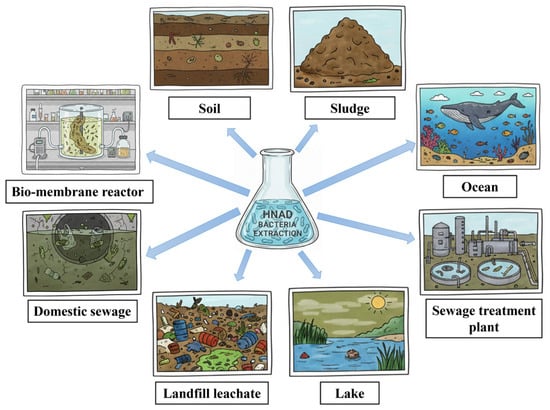
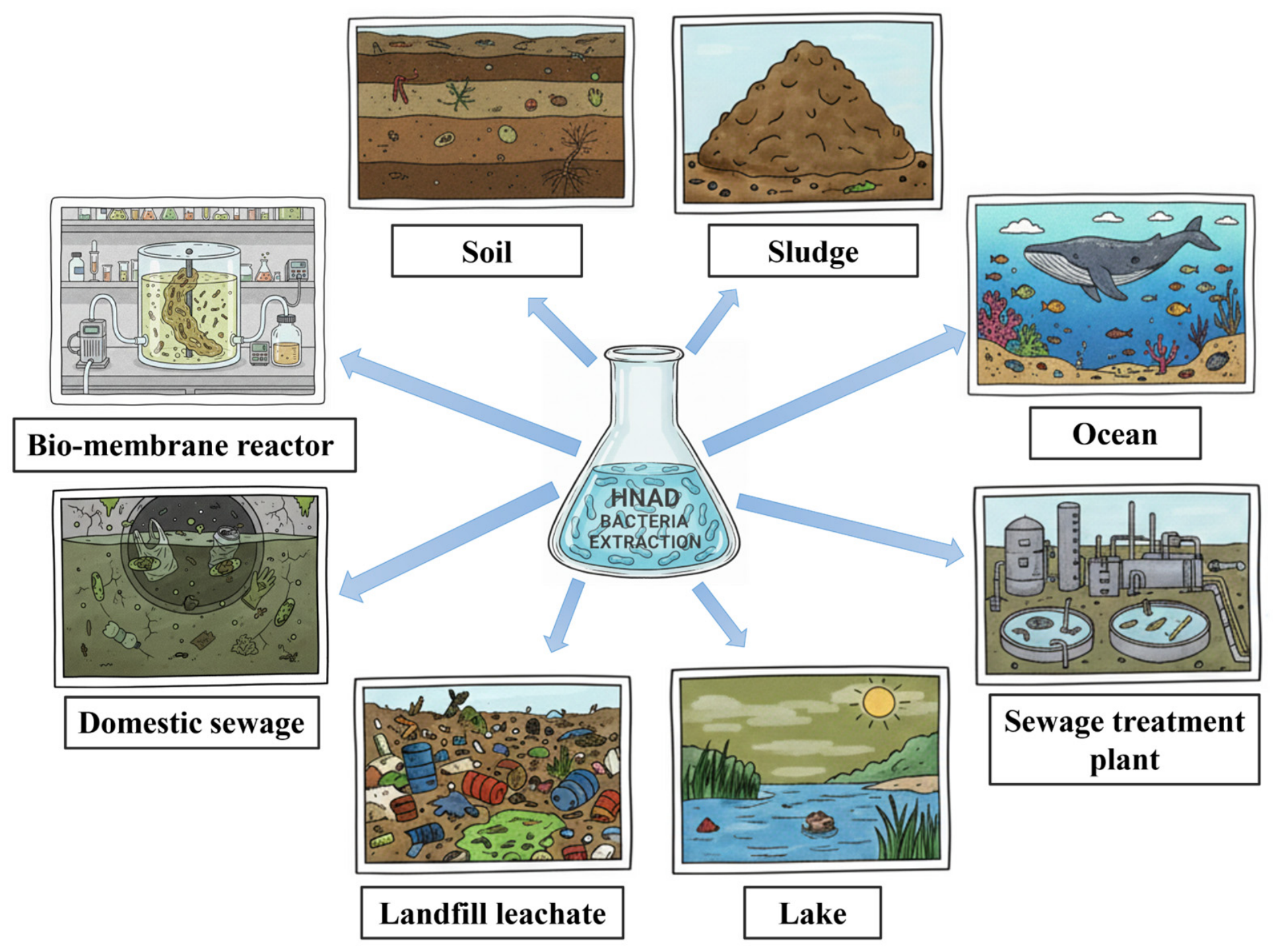
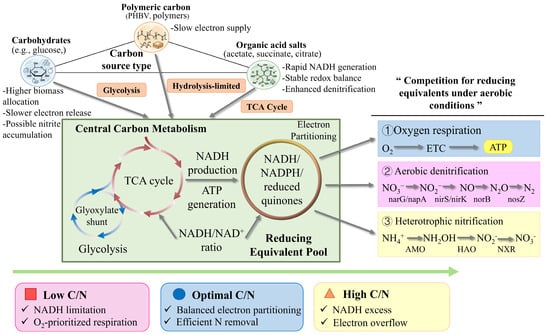
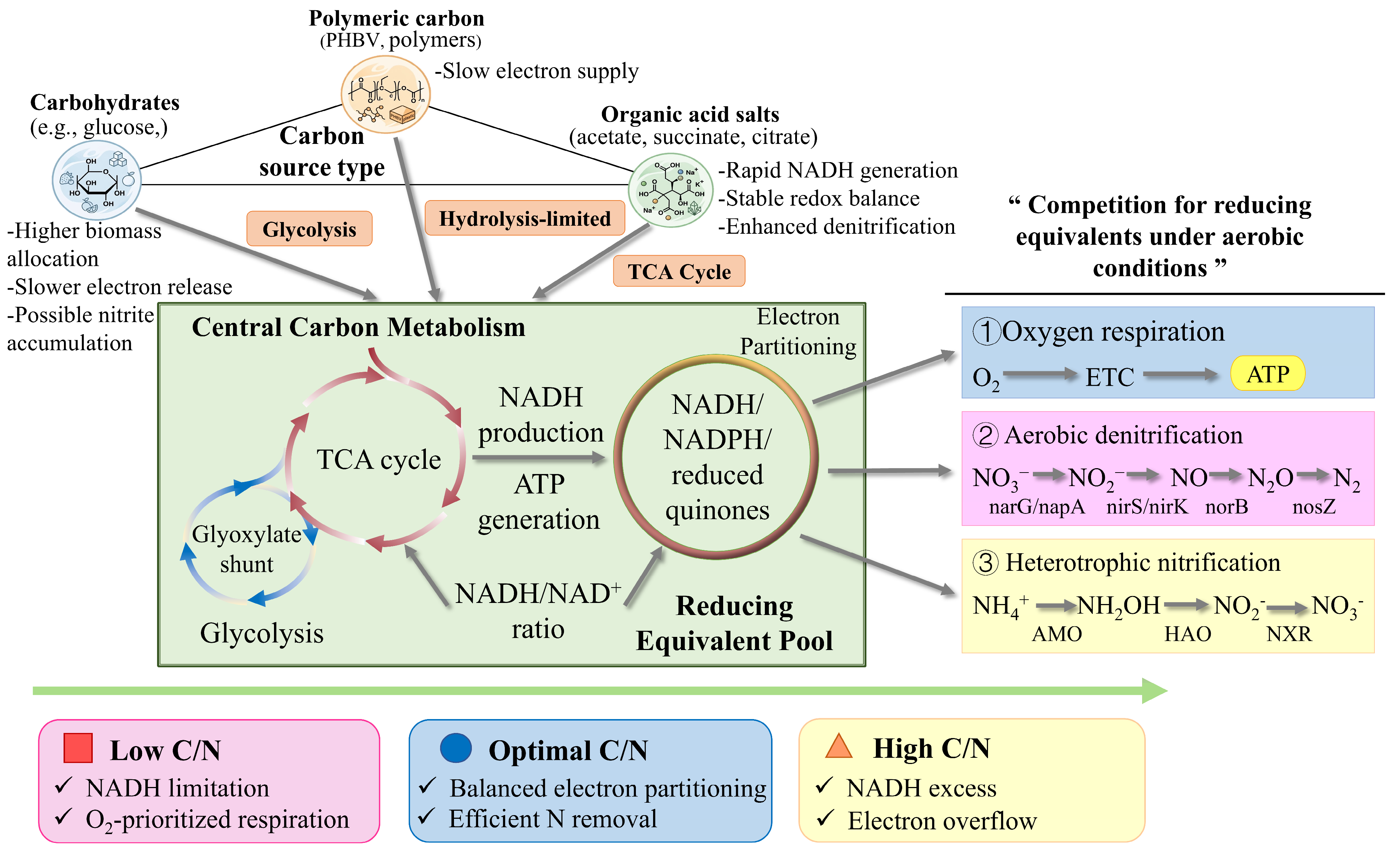
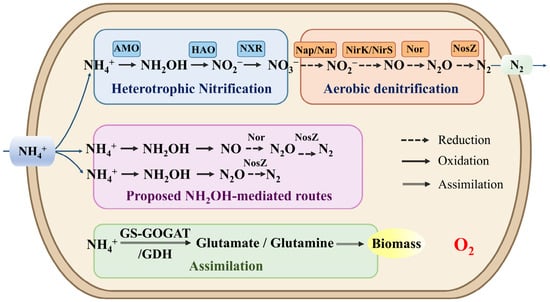
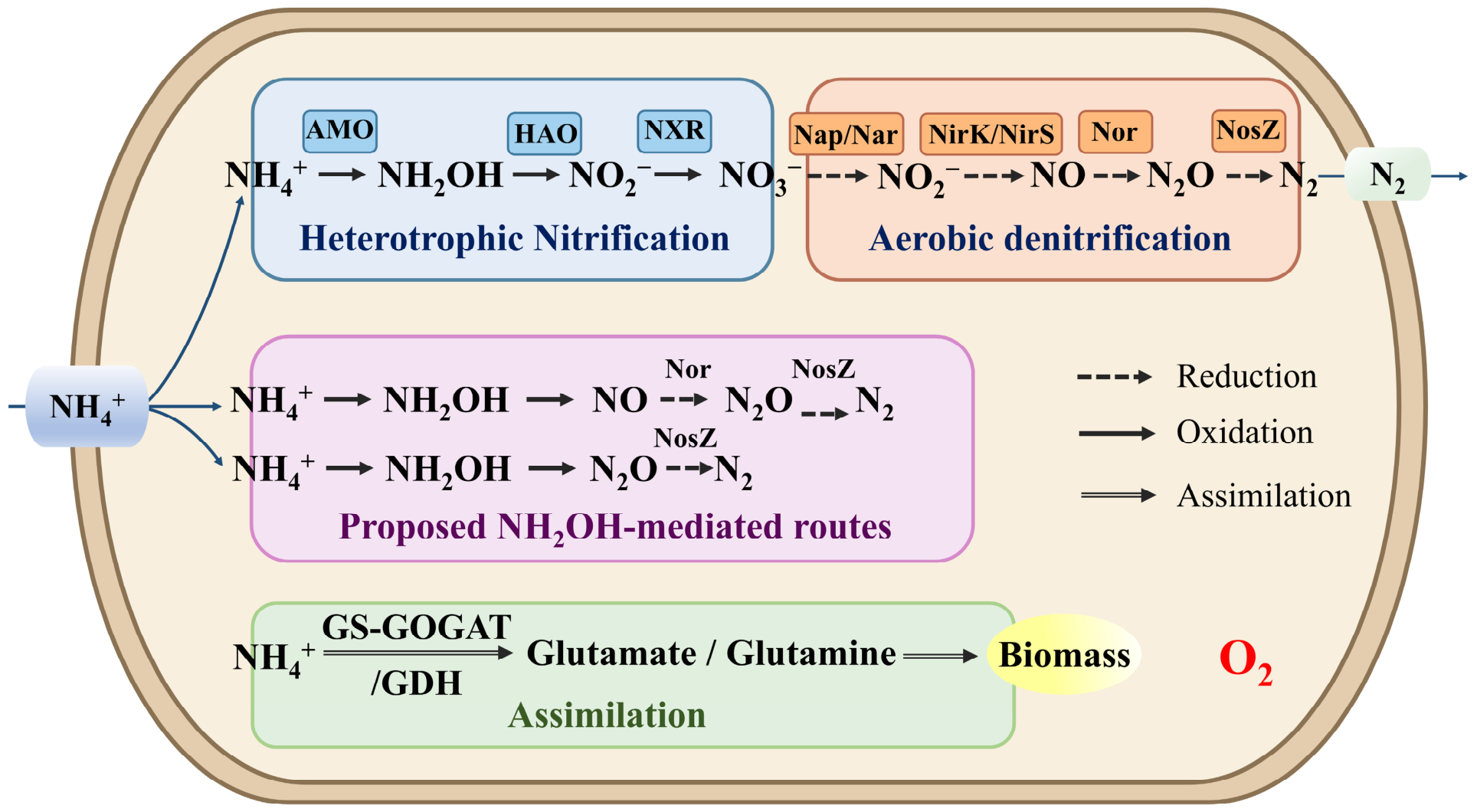
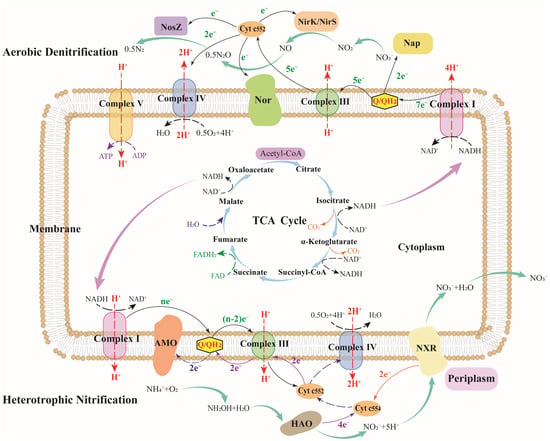
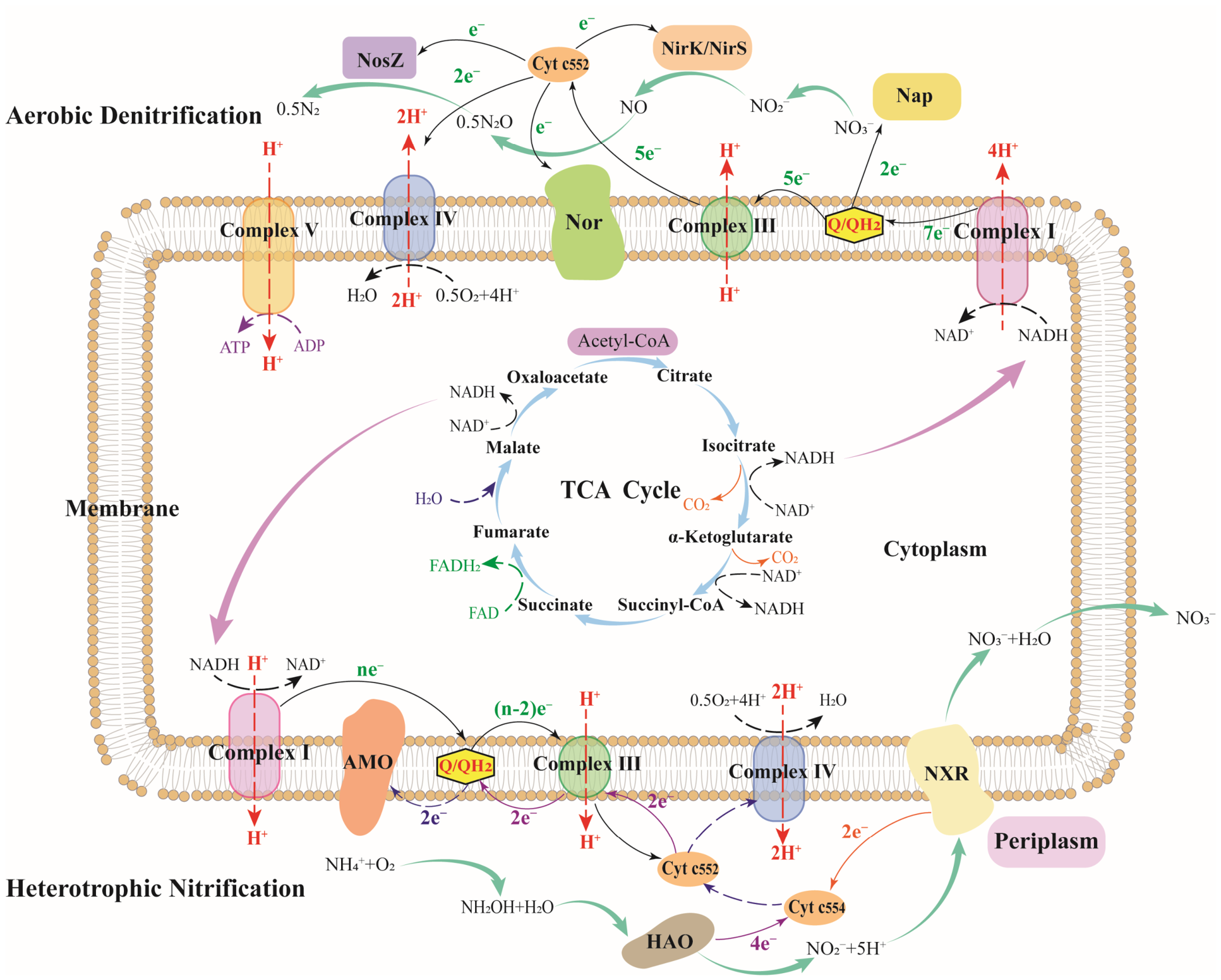

Disclaimer/Publisher’s Note: The statements, opinions and data contained in all publications are solely those of the individual author(s) and contributor(s) and not of MDPI and/or the editor(s). MDPI and/or the editor(s) disclaim responsibility for any injury to people or property resulting from any ideas, methods, instructions or products referred to in the content. |
© 2026 by the authors. Licensee MDPI, Basel, Switzerland. This article is an open access article distributed under the terms and conditions of the Creative Commons Attribution (CC BY) license.