You are currently viewing a new version of our website. To view the old version click .

Microorganisms, Volume 11, Issue 7

July 2023 - 246 articles

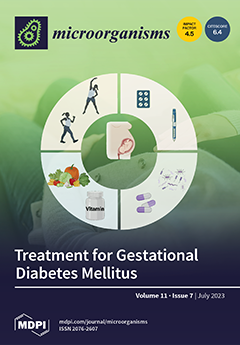
Cover Story: Gestational diabetes mellitus (GDM) is the most common metabolic complication of pregnancy, becoming a major health burden for both mothers and children. Studies have indicated that women with GDM have significantly distinct gut microbiota and gut metabolites compared to healthy pregnant women. The alerted gut microecology and related metabolites substantially impact inflammation, insulin signaling, glucose metabolism, lipid metabolism, and energy accumulation. In turn, hyperglycemia, IR, compensatory hyperinsulinism, and obesity-related chronic inflammation in GDM patients can also damage the intestinal barrier, exacerbate the gut dysbiosis, and disrupt the profile of related metabolites. Hence, the gut–metabolism link plays a significant role in both the pathogenesis and progression of GDM. View this paper
  • Issues are regarded as officially published after their release is announced to the table of contents alert mailing list .
  • You may sign up for email alerts to receive table of contents of newly released issues.
  • PDF is the official format for papers published in both, html and pdf forms. To view the papers in pdf format, click on the "PDF Full-text" link, and use the free Adobe Reader to open them.

Articles (246)

  • Article
  • Open Access
5 Citations
2,725 Views
18 Pages

Enhancing 1,3-Propanediol Productivity in the Non-Model Chassis Clostridium beijerinckii through Genetic Manipulation

  • Jonatã Bortolucci,
  • María-Eugenia Guazzaroni,
  • Teresa Schoch,
  • Peter Dürre and
  • Valeria Reginatto

Biotechnological processes at biorefineries are considered one of the most attractive alternatives for valorizing biomasses by converting them into bioproducts, biofuels, and bioenergy. For example, biodiesel can be obtained from oils and grease but...

  • Article
  • Open Access
2,891 Views
12 Pages

Bacterial Flora on Mist Outlet Surfaces in 4D Theaters and Suspended Particle Concentration Characteristics during 4D Movie Screenings

  • U Yanagi,
  • Noriko Kaihara,
  • Dai Simazaki,
  • Kanae Bekki,
  • Yoshinori Homma,
  • Chiemi Iba,
  • Atsuto Asai and
  • Motoya Hayashi

In this study, we measured suspended particle concentrations during the screening of 4D movies (3 screens and 15 movies) and 2D movies (9 screens and 9 movies) in 3 movie theaters to obtain a more detailed understanding of the situation of suspended...

  • Article
  • Open Access
2 Citations
2,264 Views
16 Pages

Pectobacterium carotovorum subsp. carotovorum (Pcc) is known to produce different types of bacteriocins, active protein substances that inhibit or kill related strains and are known to be induced by several factors. In this paper, we report the disco...

  • Article
  • Open Access
2 Citations
2,002 Views
9 Pages

Strong Evidence of the Role of Donkeys in the Epidemiology of Leptospira spp. in Semiarid Conditions

  • Davidianne de Andrade Morais,
  • Bruno Cesar Nunes,
  • Rafael Rodrigues Soares,
  • Murilo Duarte de Oliveira,
  • Diego Figueiredo da Costa,
  • Hosaneide Gomes de Araújo,
  • João Pessoa Araújo Júnior,
  • Camila Dantas Malossi,
  • Maria Luana Cristiny Rodrigues Silva and
  • Sérgio Santos de Azevedo
  • + 1 author

Donkeys (Equus asinus) are historically known for their close relationship to humanity, which raises the need to study zoonotic diseases that affect them. In this perspective, leptospirosis stands out as a disease with an economic and public health i...

  • Article
  • Open Access
3 Citations
2,831 Views
17 Pages

A new member of the DegP-type periplasmic serine endoproteases of the S1C family from the marine bacterium Cobetia amphilecti KMM 296 (CamSP) was expressed in Escherichia coli cells. The calculated molecular weight, number of amino acids, and isoelec...

  • Review
  • Open Access
14 Citations
6,522 Views
20 Pages

Multifaceted Nature of Lipid Droplets in Viral Interactions and Pathogenesis

  • Luis Herrera-Moro Huitron,
  • Luis Adrián De Jesús-González,
  • Macario Martínez-Castillo,
  • José Manuel Ulloa-Aguilar,
  • Carlos Cabello-Gutierrez,
  • Cecilia Helguera-Repetto,
  • Julio Garcia-Cordero and
  • Moisés León Juárez

Once regarded as inert organelles with limited and ill-defined roles, lipid droplets (LDs) have emerged as dynamic entities with multifaceted functions within the cell. Recent research has illuminated their pivotal role as primary energy reservoirs i...

  • Article
  • Open Access
5 Citations
2,439 Views
14 Pages

Pseudorabies virus (PRV) is considered to be a promising oncolytic virus that has potential as a cancer gene therapy drug. In this study, PRV-DCD-1-70 was used as a vector to carry exogenous genes IL-18, IFN-γ and PH20 to construct novel recomb...

  • Review
  • Open Access
53 Citations
11,509 Views
19 Pages

The Role of Gut Dysbiosis in the Loss of Intestinal Immune Cell Functions and Viral Pathogenesis

  • Farzaneh Fakharian,
  • Siva Thirugnanam,
  • David A. Welsh,
  • Woong-Ki Kim,
  • Jay Rappaport,
  • Kyle Bittinger and
  • Namita Rout

The gut microbiome plays a critical role in maintaining overall health and immune function. However, dysbiosis, an imbalance in microbiome composition, can have profound effects on various aspects of human health, including susceptibility to viral in...

  • Article
  • Open Access
7 Citations
3,483 Views
18 Pages

Flavonoid Synthesis by Deinococcus sp. 43 Isolated from the Ginkgo Rhizosphere

  • Jin Zhou,
  • Kai Zou,
  • Shaodong Fu,
  • Zhenchun Duan,
  • Guoqing Zhang,
  • Xinhong Wu,
  • Jingwen Huang,
  • Shihui Li,
  • Xueduan Liu and
  • Shuangfei Zhang
  • + 1 author

Flavonoids are crucial in physiological and pharmaceutical processes, especially the treatment of cancer and the prevention of cardiovascular and cerebrovascular diseases. Flavonoid-producing plants and fungi have been extensively reported, but bacte...

  • Article
  • Open Access
6 Citations
2,256 Views
16 Pages

Optimizing Crop Production with Bacterial Inputs: Insights into Chemical Dialogue between Sphingomonas sediminicola and Pisum sativum

  • Candice Mazoyon,
  • Stéphane Firmin,
  • Lamine Bensaddek,
  • Audrey Pecourt,
  • Amélie Chabot,
  • Michel-Pierre Faucon,
  • Vivien Sarazin,
  • Fréderic Dubois and
  • Jérôme Duclercq

The use of biological inputs is an interesting approach to optimize crop production and reduce the use of chemical inputs. Understanding the chemical communication between bacteria and plants is critical to optimizing this approach. Recently, we have...

of 25

Get Alerted

Add your email address to receive forthcoming issues of this journal.

XFacebookLinkedIn
Microorganisms - ISSN 2076-2607