


Abstract
This article settles a new multi-fault-tolerant control problem of an Euler–Bernoulli beam system (EBBS) in the existence of multiplicative faults, additive faults, and control-matched disturbances simultaneously, using the direct adaptive learning control technique. Such an EBBS can be employed to model the vibration of flexible vehicles and flexible manipulators in the actual engineering control. An original hierarchical adaptive boundary control strategy is developed to compensate for multiplicative and additive faults and to reject control-matched disturbances. The classical Lyapunov direct method, together with the variation of Wirtinger’s inequality is utilized to demonstrate the closed-loop system performance. The modified -semigroup frame is exploited to certify the well-posedness of its solution under the designed controller. Simulation study on a simply supported beam is demonstrated to verify the validity of the evolved multi-fault-tolerant boundary control algorithm.
1. Introduction
Most physical phenomenon or processes in the real world, such as power systems, chemical processes, aerospace vehicles, have distributed features. This means that their energy or mass varies not only continuously in time but also distributedly in space. One system with such characteristics is usually called a distributed parameter system (DPS), for example, flexible manipulators [1], flexible flapping wings vehicles [2], multi-agent systems [3], etc. One of the most widely used DPSs in reality is EBBS, which describes some flexible vibrations [4,5,6]. Research on such a system has been conducted in recent decades. Various boundary control designs have been developed, such as the adaptive control framework [7], active disturbance rejection method [8,9], sliding mode control algorithm [10], bilinear matrix inequality-based control method [11], iterative learning control strategy [12,13], Riesz basis theory-based control approach [14,15], and backstepping control mechanism [16,17], to name a few. It should be worth noting that these works in the literature have dealt with the following control issues:
- Stabilization control designs without uncertainties;
- Active disturbance rejection control designs under boundary control-matched disturbances;
- Output tracking control designs under boundary mismatched disturbances;
- Adaptive control designs under system parameter uncertainties.
Also note that all the above results do not consider any faults, such as actuator faults, sensor faults, distributed faults, etc. This implies that achieving fault compensation of such a system is an open problem and needs further investigation.
In addition, fault-tolerant control (FTC) aims at keeping or maintaining the closed-loop system performance under some actuator/sensor/component faults. Such a control direction on the systems described by ordinary differential equations has attracted much attention for about the past fifty years, and fruitful FTC schemes have been proposed for different applications; see [18,19,20,21,22,23,24,25,26] and the references therein. However, these algorithms cannot be directly applied to the DPSs, especially for Euler–Bernoulli beam systems. This is because systems described by ordinary differential equations possess finite dimensional features, while DPSs have infinite dimensional properties. Such a difference implies that FTC designs for DPSs need to be payed some other attention. In the past twenty years, there have been some results on FTC designs of DPSs, such as [27,28,29,30,31]. These results aim at parabolic and hyperbolic DPSs, which are first/second-order partial differential equations. For EBBSs, there are also some achievements, such as [32,33,34,35,36,37]. In [32,34,36], the bilinear matrix inequality-based FTC algorithms and backstepping-based FTC scheme was proposed for EBBSs to compensate for distributed faults. In [35], a backstepping-based sliding mode FTC framework was put forward to accommodate the boundary actuator additive faults. In the above articles, FTC designs were developed to solve only the single fault compensation issue. Realizing boundary multi-fault compensation for EBBSs is still unclear and needs in-depth study.
In this article, an original adaptive fault-tolerant boundary control strategy is brought forward for EBBSs to settle both the boundary multiplicative and additive faults and matched disturbances, simultaneously. As far as we know, until now barely any results have been reported in this research field. This is because there is still no solution for dealing with the multiplicative uncertainties for DPSs, especially for the EBBS. Hence, the contributions of this article can be summarized as the following three aspects:
- A novel adaptive multi-fault-tolerant boundary control scheme is developed in the presence of both the boundary multiplicative and additive faults and control-matched disturbances, simultaneously.
- New parameter updating laws are designed to handle both the multiplicative and additive uncertainties.
- The complete performance analysis is provided by using the Lyapunov direct method to ensure the asymptotical stability and using the modified -semigroup theory to guarantee the well-posedness of the solution.
The organization of the rest of the article is as follows. The control plant with both the boundary multiplicative and additive faults and control-matched disturbances is described and control difficulties are further examined in Section 2. A solution to the adaptive multi-fault compensation problem is figured out in Section 3. Simulation study on a simply supported beam is presented in Section 4. Some discussions are concluded in Section 5.
Notation: In this paper, the following subscripts are used.
2. Problem Statement
This section provides the system model described by an EBBS, parameterizes multi-faults and control-matched disturbance, and condenses the difficulties in the fault-tolerant boundary control design.
2.1. Model Description
The specific system internal dynamics considered in this paper can be depicted by
confined by three zero boundary conditions
and the following terminal boundary control actuation:
where represents the EBBS deflection, denotes the actuator output signal, means the control-matched disturbances, is a known positive parameter related to the mass density and flexural rigidity of this considered Euler–Bernoulli beam, and denotes the length of the considered Euler–Bernoulli beam. The initial conditions of (1)–(3) are and .
Taking both the multiplicative faults and additive faults into consideration, the actuator fault model can be built by
where represents the actuator input signal which should be designed later, denotes the uncertain actuator failure factor with being a known positive parameter, which reflects the maximum fault reconfigurability capability, and represents the uncertain actuator drift faults.
Generally speaking, the actuator fault model (4) has the following physical meaning:
- and : actuator is healthy;
- and : actuator drift faults (additive faults);
- and : actuator partial loss of effectiveness faults (multiplicative faults);
- and : actuator multi-faults (both multiplicative and additive faults).
Without loss of generality, we presume that the actuator drift faults and control-matched disturbances satisfy
where and represent unknown constant vectors respectively, and and denote known basis functions respectively, which are generated from
with known matrices and . It can be seen from condition (5) that the actuator drift faults and control-matched disturbances can be parameterized as
where represents the unknown constant vector and denotes the known basis function, which meets
with .
Remark 1.
The additive fault and control-matched disturbance considered in this paper is linear parametrized. However, these signals may be nonlinear parametrized or non-parametrized in practical engineer applications. Here we present basic ideas to compensate for the uncertainties described by nonlinear parametrization condition and non-parametrized condition.
- If the additive fault and control-matched disturbance with finite energy can be nonlinear parametrized, the inclusion principle developed in [38] can be used such that additive fault and control-matched disturbance satisfyUnder this nonlinear parametrized condition, the asymptotic stability can also be ensured by modifying the parameter update laws, which indicates the adaptive control scheme developed under linear parametrization remains valid.
- If the additive fault and control-matched disturbance with finite energy cannot be parametrized, the RBF neural network developed in [4] can be used such that additive fault and control-matched disturbance satisfywhere and are weight factors, and are Gaussian basic functions. Their components and are as follows:where and represent the center of the Gaussian basis functions, and represent the width of Gaussian basis function, and and are bounded approximation errors within the compact set. Under this condition, the uniform ultimate boundness can be achieved by modifying the parameter update laws, which means that the developed adaptive control scheme is still valid.
2.2. Control Difficulties
In the existing literature, the internal system dynamics (1) has been well investigated [5,7,12,13,14,15]; however, different boundary conditions have not been fully studied, especially for the boundary condition (2)–(3). This indicates that the control design of an EBBS with boundary conditions (2)–(3) is still an open problem.
While taking the actuator fault into consideration, there are also some results, such as [32,33,34,35,36,37] to name a few. In [33,35,37], only the additive fault compensation issue is solved. In [32,34,36], only the distributed fault accommodation problem is settled. These imply that achieving the multi-fault compensation still needs further and in-depth discussion.
Based on the above overview of the stabilization control and FTC of the EBBS, the control goal of this work is to devise a new adaptive multi-fault-tolerant boundary compensator for (1)–(3) under the condition (4) to ensure the asymptotical stability in the norm , i.e.,
To fulfill this control objective, the following lemmas are quite essential:
Lemma 1
([11]). Let be an absolutely continuous scalar function with square integrable derivative . The following inequality
holds for . This inequality is also called the variation of the Wirtinger’s inequality.
Lemma 2
([11]). For any scalar function , the following variant Agmon’s inequality
holds for all , if satisfies.
3. Adaptive Multi-Fault Compensation Strategy
This section is devoted to the adaptive learning control technique to achieve the multi-fault-tolerant control design. This controller, together with adaptive updating laws, guarantees the closed-loop asymptotical stability. In view of the obtained closed-loop system, the well-posedness of its solution is analyzed by adopting the modified -semigroup framework.
3.1. Adaptive Learning Control Design
In order to deal with the multiplicative faults, here we introduce an auxiliary signal, which is designed
where are pending parameters satisfying
Let . Let and denote the estimates of unknown parameter and unknown vector , respectively. Defining the parameter estimate error as
and we select the following Lyapunov functional candidate
where
where are positive parameters to be determined and are arbitrary positive scalars.
First of all, the positive definiteness of functional (21) should be proven. It follows from (22) and (23) that
These inequalities, together with (24) and (25), lead to
The parameters are chosen to meet
Such an inequality indicates that the functional (21) is positive definite.
Next, the multi-fault-tolerant boundary control law can be designed as
where with being pending design parameters, and is a positive scalar, which determines the convergence rate.
Substituting (33) into (31) yields
We select some proper parameters and such that
where elements and are defined as
with parameters being related to parameters , , and .
Under condition (35), (34) can be rewritten as
In order to deal with the term , letting parameters and , we have
These three inequalities imply
Hereafter, the parameter updating laws are designed as
Under (43) and (44), the derivative of w.r.t. t can be represented as
where
According to Lemma 1, Lemma 2, and the well-known Young inequality, we have
where
Substituting these inequalities (47) and (48) into (45), we have
On the basis of fulfilling the inequality (28), parameters should also satisfy
Based on the above design and analysis, we can concentrate on the first significant outcome of this study.
Theorem 1.
Regarding the internal and boundary dynamics described by (1)–(3) with multi-fault and disturbance satisfying (4)–(6), designing fault tolerant boundary control law as
with , , and meeting (28) and (51), and parameter update laws as
with and , for any initial condition, the system states are asymptotically stable, i.e.,
Proof.
It follows from (50) that the derivative of the Lyapunov functional (21) w.r.t t is a non-increasing function. This indicates that the states and are asymptotically converging to zero when t goes to infinity in the sense of -norm, i.e.,
In view of the variation of the Wirtinger’s inequality in Lemma 1, together with the zero boundary conditions and , we have
These two inequalities imply that
Taking the limit when and utilizing the condition (56), one has
This relationship, together with (56) evinces that the asymptotical stability of the system states and is guaranteed in the sense of -norm for any initial condition. This completes the proof. □
Remark 2.
It should be noticed that all the signals used in the fault tolerant boundary controller (52) can be metered or calculated. The boundary velocity can be measured by velocity transducers. The boundary rotation can be obtained by inclinometers. The parameter estimates and can be generated from (53) and (54), respectively. The boundary shear force can be achieved by shear force transducers. The boundary angular velocity can be calculated by utilizing a backward difference algorithm due to the acquired boundary rotation angular .
Analysis of measurement noise in high-order partial differential terms. In the control signal (52) and parameter update law (53), the high-order partial deferential terms may be very sensitive to noise. In order to compensate for the effect caused by the measurement noise, an adaptive observer mechanism is designed as follows.
Consider a system described by
where the measurement signals are defined by
with being the bounded measurement noise in high-order partial differential term and being a known scalar. Then an adaptive observer is designed as
where is the observer gain and
Define the estimate error as
then the error dynamics can be expressed by
Select a positive definite function as
Taking the time derivative along the error dynamics yields
The positive definite property of , together with the negative definite property of its time derivative, indicates that is decreasing. Taking the integration of with respect to time from zero to infinity and using the comparison principle, one has
which indicate that the proposed adaptive observer can effectively compensate for the effect caused by the measurement noise.
3.2. Well-Posedness Analysis
After proving the closed-loop system stability, this section supplies a detailed well-posedness analysis of the solution under the control law (52). Define a Hilbert space
where and its inner product norm is equipped with
with .
In view of these presentations, the closed-loop form of (1)–(3) under the fault tolerant boundary control law (52) and parameter updating laws (53) and (54) can be expressed by
where and the system operator can be defined by
with
The domain of can be defined by
Since the inner product norm of is equivalent to Lyapunov functional , this implies that the system operator is dissipative.
Then the invertibility of system operator is proved. Letting in view of (71)
we can acquire the following relationship:
with respect to the boundary conditions
Solving the differential Equations (75)–(79) subject to (80) and (81) yields
where
with and .
The relationship (82)–(86) declares that the system operator is invertible. It follows from the contraction mapping theory that the operator is also invertible for all . This indicates that there exists an independent positive scalar such that
This inequality implies that the invertible system operator is bounded and . It follows from the Lumer–Phillips theorem, the invertible and dissipative properties of , that the system operator generates a -semigroup on the Hilbert space .
Based on the above analysis, we can concentrate on the second significant outcome of this study.
Theorem 2.
Remark 3.
Note that the well-posedness analysis for a DPS is as important as its closed-loop system stability analysis. They explain the essential characteristics of the closed-loop system from two different perspectives. The well-posedness analysis aims at certifying the existence and uniqueness of the closed-loop system solution, while closed-loop system stability analysis shows the convergence property of the closed-loop system from the energy point of view.
4. Simulation Study
This section provides a simulation study on a simply supported beam to illustrate the validity of the developed adaptive multi-fault-tolerant boundary control algorithm.
The system parameters are shown as and . The multi-fault signals are selected as and
with and .
The disturbance signal is chosen as
with and .
In order to maintain conditions (19), (39)–(41), and inequalities (28), (51), the parameters in the controller (52) and updating laws (53)–(54) are designed as , , , , , , , , , , . The initial conditions are presented as , , , , .
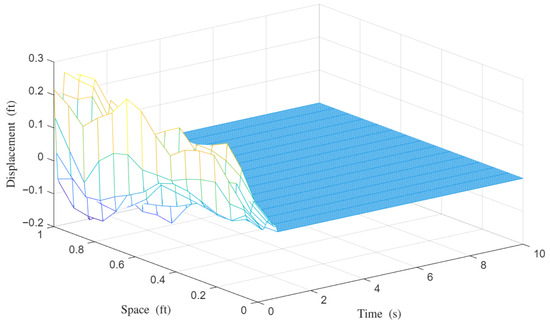
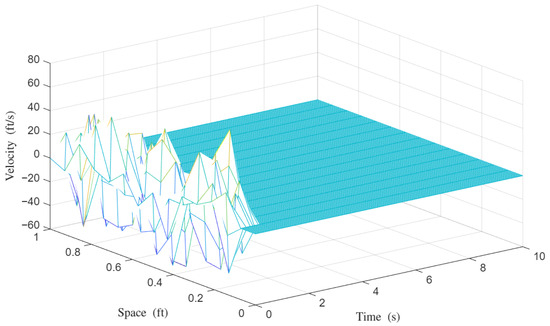
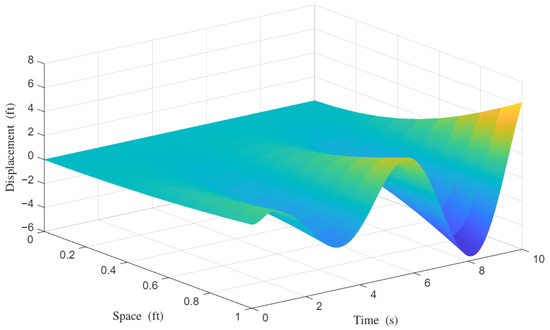
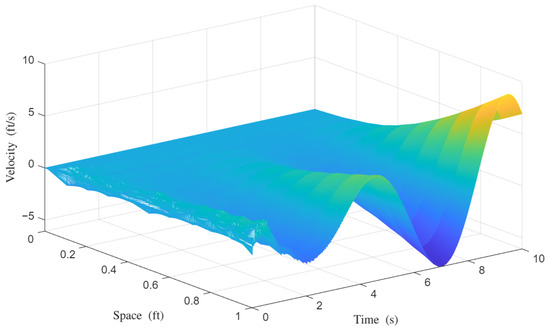
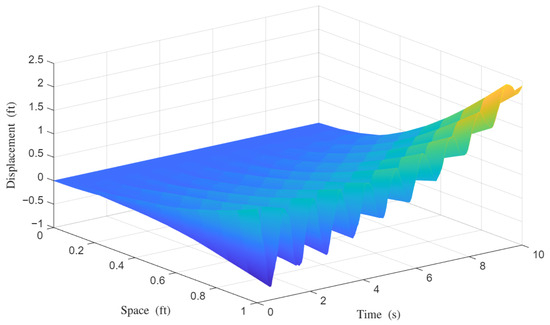
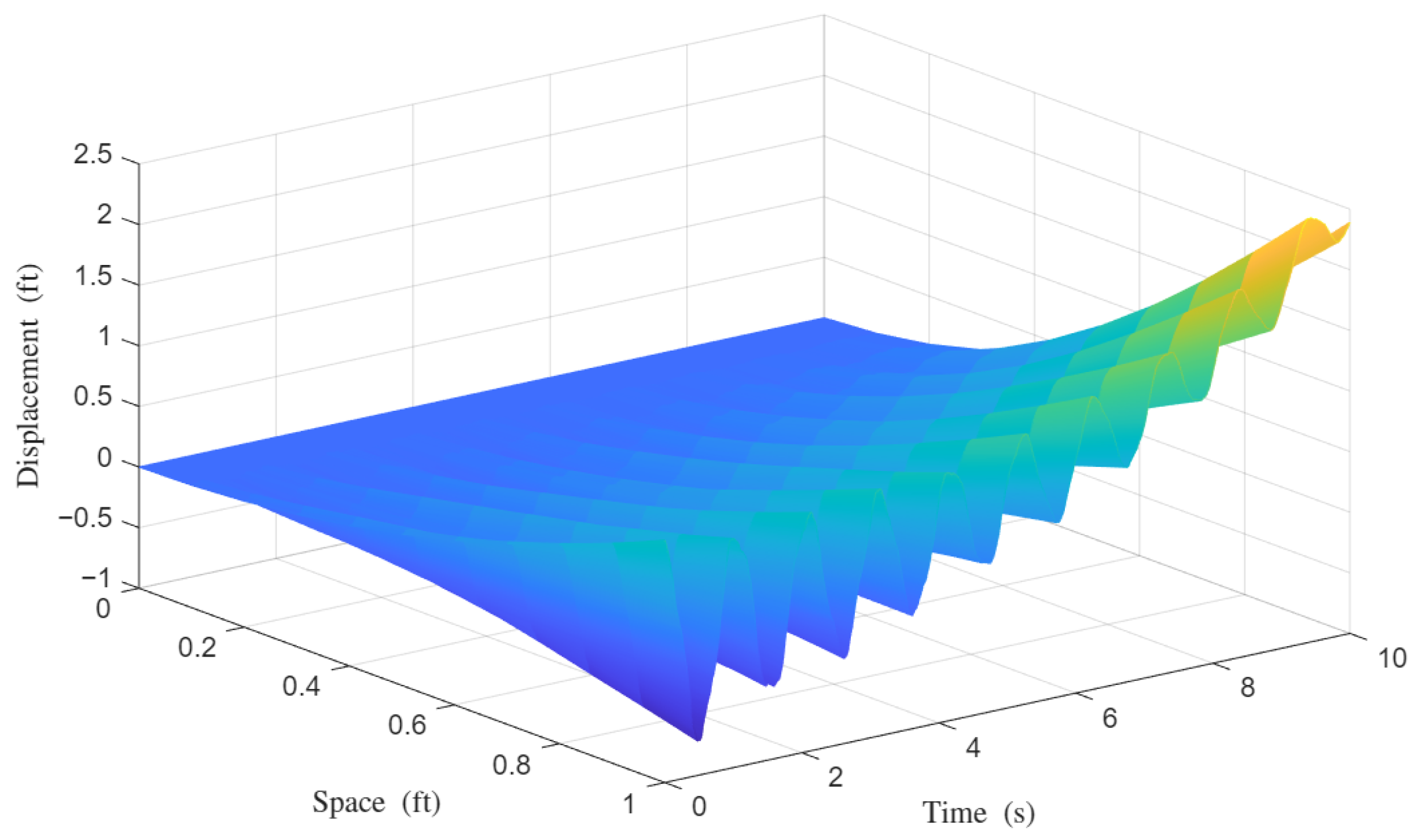
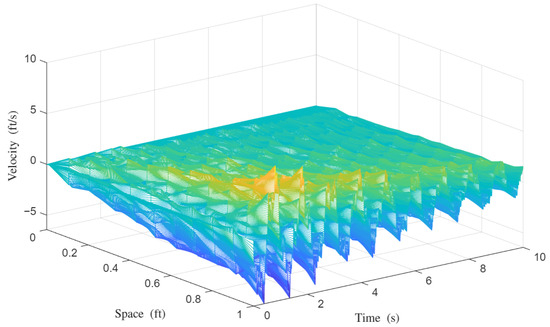
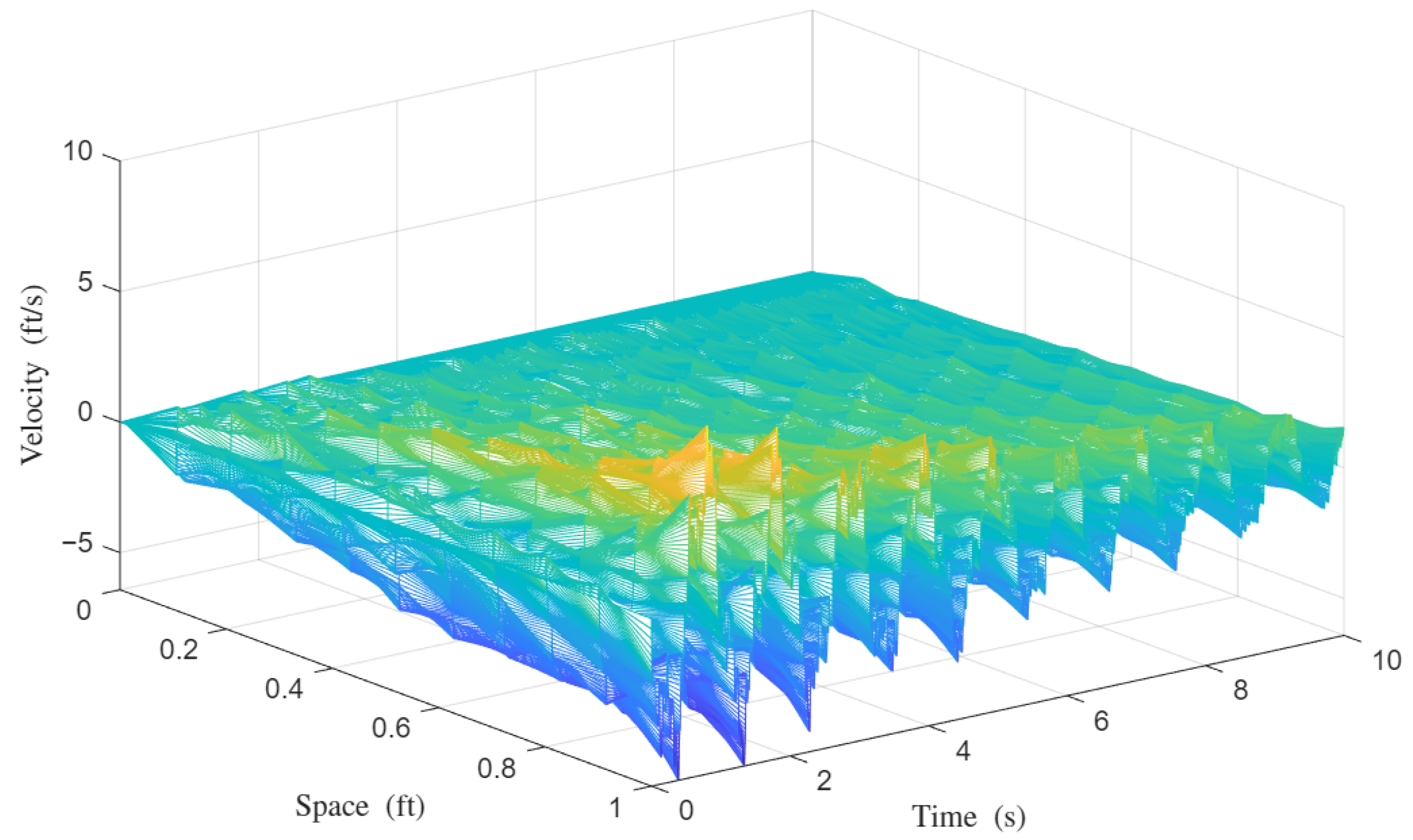
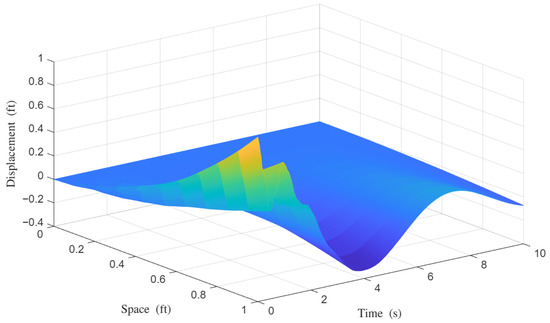
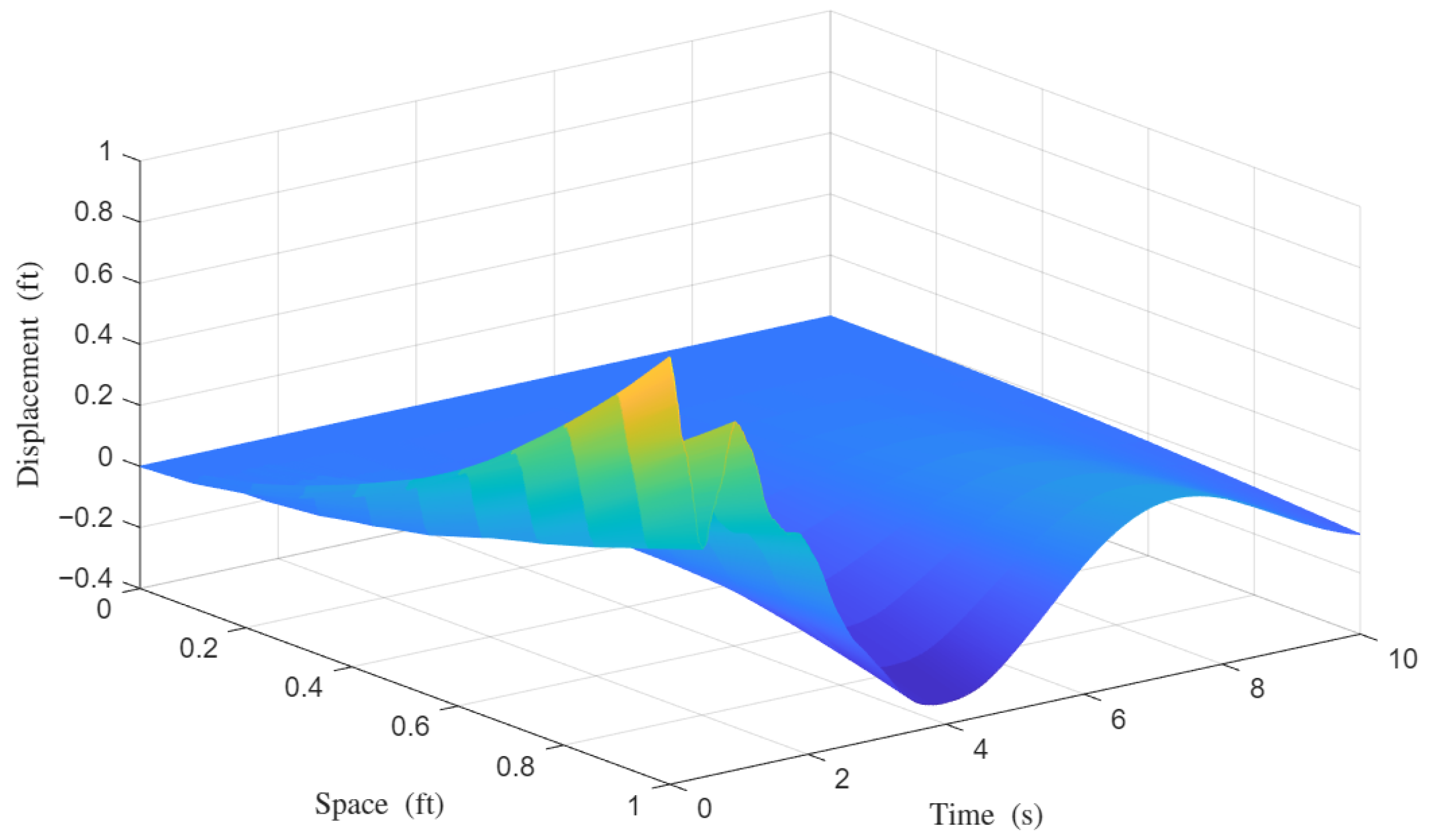
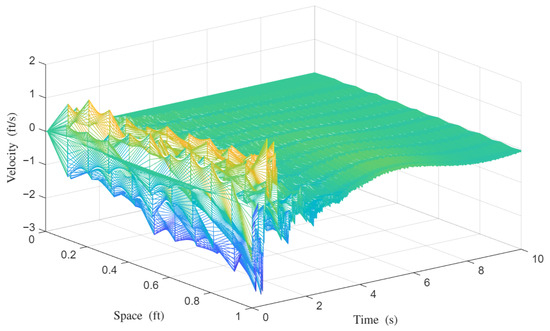
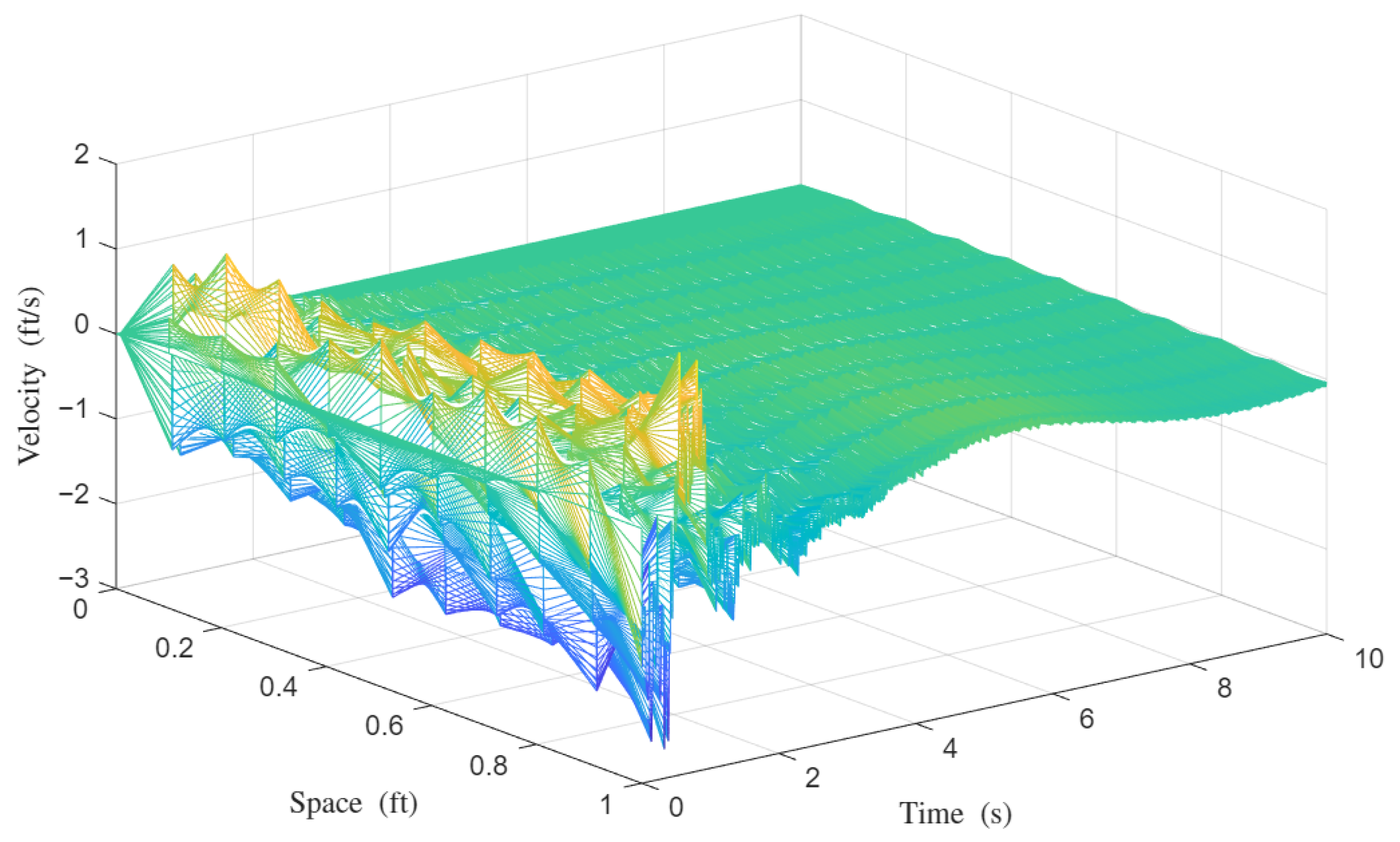
Applying this adaptive multi-fault tolerant control law to the system (1)–(3), the closed-loop system responses are shown in Figure 1 and Figure 2. It can be easily perceived from these two curves that the displacement and velocity are asymptotically converging to zero. This phenomenon is consistent with our theoretical results.
Figure 1.
The closed-loop system state response under the developed control scheme.
Figure 2.
The closed-loop system state response under the developed control scheme.
In order to show the advantages of the proposed control scheme compared with the existing works, the following simulation results are provided. It follows from Figure 3 and Figure 4 that the system states and cannot achieve the asymptotical stability under the backstepping control scheme. Figure 5 and Figure 6 shows that the system states and also cannot achieve the asymptotical stability under the sliding mode control scheme.
Figure 3.
The closed-loop system state response under backstepping control scheme.
Figure 4.
The closed-loop system state response under backstepping control scheme.
Figure 5.
The closed-loop system state response under sliding mode control scheme.
Figure 6.
The closed-loop system state response under sliding mode control scheme.
In order to show the robustness of the developed control scheme under the measurement noise, two simulation results are also provided. It follows from the Figure 7 and Figure 8 that the system states and remain the uniform ultimate bounded under the measurement noise.
Figure 7.
The closed-loop system state response under measurement noise.
Figure 8.
The closed-loop system state response under measurement noise.
5. Conclusions
This article has found a complete solution to a new boundary multi-fault compensation problem of an EBBS in the presence of matched disturbances, simultaneously. A novel direct adaptive fault-tolerant boundary control frame has been developed, in which a new auxiliary control signal has been constructed to settle the multiplicative boundary fault. The closed-loop system stability has been analyzed by using the Lyapunov direct method with the help of the devised parameter updating laws. The well-posedness of the closed-loop system solution has been certificated by using the modified -semigroup framework. A numerical simulation study has also been provided to show the effectiveness of the developed adaptive multi-fault-tolerant boundary control algorithm.
Author Contributions
Conceptualization, W.R.; methodology, W.R. and D.Z.; software, D.Z. and L.Y.; validation, W.R., D.Z. and L.Y.; formal analysis, D.Z. and L.Y.; investigation, W.R.; Resources, L.Y.; Data curation, L.Y.; writing—original draft preparation, W.R. and D.Z.; writing—review and editing, W.R. and L.Y.; visualization, L.Y.; supervision, L.Y.; project administration, L.Y.; funding acquisition, W.R. and L.Y. All authors have read and agreed to the published version of the manuscript.
Funding
This research was funded in part by the National Natural Science Foundation of China under grant number 62203148 and 62203002, and in part by the Joint Funds of the National Natural Science Foundation of China under grant number U24A20266, and in part by the Natural Science Foundation of Anhui Provincial under grant number 2408085MF161.
Institutional Review Board Statement
Not applicable.
Informed Consent Statement
Not applicable.
Data Availability Statement
Data is contained within the article. The simulation results are derived from the mathematical models described in the article.
Conflicts of Interest
The authors declare no conflicts of interest.
Abbreviations
The following abbreviations are used in this manuscript:
| EBBS | Euler–Bernoulli beam system |
| DPS | distributed parameter system |
| FTC | fault-tolerant control |
References
- Liu, J.; He, W. Distributed Parameter Modeling and Boundary Control of Flexible Manipulators; Tsinghua University Press: Beijing, China; Springer Nature: Singapore, 2018. [Google Scholar]
- Gao, H.; He, W.; Zhang, Y.M.; Sun, C.Y. Adaptive finite-time fault-tolerant control for uncertain flexible flapping wings based on rigid finite element method. IEEE Trans. Cybern. 2022, 52, 9036–9047. [Google Scholar] [CrossRef] [Scilit]
- Man, J.; Zeng, Z.; Sheng, Y.; Sun, J. Adaptive Neural Finite-Time Deployment of Nonlinear Heterogeneous Multi-Agent Systems With Inconsistent Semi-Markov Topologies: An ODE–PDE Approach. IEEE Trans. Syst. Man Cybern. Syst. 2025, 55, 9371–9384. [Google Scholar] [CrossRef] [Scilit]
- Sun, C.-Y.; Gao, H.; He, W.; Yu, H. Fuzzy neural network control of a flexible robotic manipulator using assumed mode method. IEEE Trans. Neural Netw. Learn. Syst. 2018, 29, 5214–5227. [Google Scholar] [CrossRef] [Scilit] [PubMed]
- He, W.; Nie, S.; Meng, T.; Liu, Y. Modeling and vibration control for a moving beam with application in a drilling riser. IEEE Trans. Control Syst. Technol. 2017, 25, 1036–1043. [Google Scholar] [CrossRef] [Scilit]
- He, W.; Ge, S.; How, B.; Hong, K. Robust adaptive boundary control of a flexible marine riser with vessel dynamics. Automatica 2011, 47, 722–732. [Google Scholar] [CrossRef] [Scilit]
- Wang, J.W.; Liu, Y.; Sun, C.Y. Adaptive neural boundary control design for nonlinear flexible distributed parameter systems. IEEE Trans. Control Syst. Technol. 2019, 27, 2085–2099. [Google Scholar] [CrossRef] [Scilit]
- Jin, F.; Guo, B.-Z. Boundary output tracking for an Euler-Bernoulli beam equation with unmatched perturbations from a known exosystem. Automatica 2019, 109, 108507. [Google Scholar] [CrossRef] [Scilit]
- Guo, B.Z.; Kang, W. Lyapunov approach to the boundary stabilization of a beam equation with boundary disturbance. Int. J. Control 2014, 87, 925–939. [Google Scholar] [CrossRef] [Scilit]
- Guo, B.-Z.; Jin, F. The active disturbance rejection and sliding mode control approach to the stabilization of Euler-Bernoulli beam equation with boundary input disturbance. Automatica 2013, 49, 2911–2918. [Google Scholar] [CrossRef] [Scilit]
- Wu, H.N.; Wang, J.W. Static output feedback control via PDE boundary and ODE measurements in linear cascaded ODE-beam systems. Automatica 2014, 50, 2787–2798. [Google Scholar] [CrossRef] [Scilit]
- He, W.; Meng, T.; Huang, D.; Li, X. Adaptive boundary iterative learning control for an Euler-Bernoulli beam system with input constraint. IEEE Trans. Neural Netw. Learn. Syst. 2018, 29, 1539–1549. [Google Scholar] [CrossRef] [Scilit] [PubMed]
- He, W.; Meng, T.; He, X.; Ge, S. Unified iterative learning control for flexible structures with input constraints. Automatica 2018, 96, 326–336. [Google Scholar] [CrossRef] [Scilit]
- Guo, B.Z. Riesz basis property and exponential stability of controlled Euler-Bernoulli beam equations with variables coefficients. SIAM J. Control Optim. 2002, 40, 1905–1923. [Google Scholar] [CrossRef] [Scilit]
- Jin, F.; Guo, B.Z. Lyapunov approach to output feedback stabilization for the Euler-Bernoulli beam equation with boundary input disturbance. Automatica 2015, 52, 95–102. [Google Scholar] [CrossRef] [Scilit]
- Karagiannis, D.; Radisavljevic-Gajic, V. Sliding mode boundary control of an Euler-Bernoulli beam subject to disturbances. IEEE Trans. Autom. Control 2018, 63, 3442–3448. [Google Scholar] [CrossRef] [Scilit]
- Krstic, M.; Smyshlyaev, A. Boundary Control of PDEs: A Course on Backstepping Designs; SIAM: Philadelphia, PA, USA, 2008. [Google Scholar]
- Zhang, Y.M.; Jiang, J. Bibliographical review on reconfigurable fault-tolerant control systems. Annu. Rev. Control 2008, 32, 229–252. [Google Scholar] [CrossRef] [Scilit]
- Jiang, B.; Staroswiecki, M.; Cocquempot, V. Fault accommodation for nonlinear dynamic systems. IEEE Trans. Autom. Control 2006, 51, 1578–1583. [Google Scholar] [CrossRef] [Scilit]
- Jin, L.; Jin, B.; Huang, Y.; Zhang, Q.; Yi, H.; Li, R. Fault tolerant control of integrated autonomous wheel module vehicle subject to independent steering actuator degradation. Actuators 2025, 14, 603. [Google Scholar] [CrossRef] [Scilit]
- Zhu, Y.; Xu, N.; Basin, M.; Zhou, D.H.; Chen, X.K. Stability and tracking recovery of continuous-time markov jump piecewise affine systems using virtual-sensor-based reconfiguration. IEEE Trans. Autom. Control 2024, 69, 2705–2712. [Google Scholar] [CrossRef] [Scilit]
- Wang, X.; Yang, G.H. Fault-tolerant consensus tracking control for linear multiagent systems under switching directed network. IEEE Trans. Cybern. 2020, 50, 1921–1930. [Google Scholar] [CrossRef] [Scilit]
- Cai, M.; He, X.; Zhou, D.H. An active fault tolerance framework for uncertain nonlinear high-order fully-actuated systems. Automatica 2023, 152, 110969. [Google Scholar] [CrossRef] [Scilit]
- Cai, M.; He, X.; Zhou, D.H. Finite-time fault-tolerant control via fully actuated system approaches. IEEE Trans. Cybern. 2024, 54, 5506–5517. [Google Scholar] [CrossRef] [Scilit]
- Gao, Q.; Qiu, J.; Ding, S.X. Fault diagnosis and fault tolerant control for a class of re-entrant manufacturing systems. IEEE Trans. Circuits Syst. 2026, 73, 1356–1366. [Google Scholar] [CrossRef] [Scilit]
- Jin, Z.; Li, H.; Qin, Z.; Wang, Z. Gradient-free cooperative source-seeking of quadrotor under disturbances and communication constraints. IEEE Trans. Ind. Electron. 2025, 72, 1969–1979. [Google Scholar] [CrossRef] [Scilit]
- Ghantasala, S.; El-Farra, Z. Robust actuator fault isolation and management in constrained uncertain parabolic PDE systems. Automatica 2009, 45, 2368–2373. [Google Scholar] [CrossRef] [Scilit]
- Han, Z.; Liu, Z.; Wang, J.; He, W. Fault-tolerant control for flexible structures with partial output constraint. IEEE Trans. Autom. Control 2024, 69, 2668–2675. [Google Scholar] [CrossRef] [Scilit]
- Liu, Z.; Han, Z.; He, W. Adaptive fault-tolerant boundary control of an autonomous aerial refueling hose system with prescribed constraints. IEEE Trans. Autom. Sci. Eng. 2022, 19, 2678–2688. [Google Scholar] [CrossRef] [Scilit]
- Zhao, Z.; Liu, Z.; He, W.; Hong, K.; Li, H. Boundary adaptive fault-tolerant control for a flexible Timoshenko arm with backlash-like hysteresis. Automatica 2021, 130, 109690. [Google Scholar] [CrossRef] [Scilit]
- Xu, Y.; Yang, H.; Jiang, B. Model decomposition-based fault-tolerant control for interconnected wave partial differential equation systems. Int. J. Control 2024, 97, 784–795. [Google Scholar] [CrossRef] [Scilit]
- Zhao, D.; Jiang, B.; Yang, H.; Tao, G. Fault-tolerant control of flexible air-breathing hypersonic vehicles in linear ODE-beam systems. Int. J. Control 2020, 93, 820–831. [Google Scholar] [CrossRef] [Scilit]
- Zhao, D.; Jiang, B.; Yang, H.; Tao, G. A backstepping-based fault compensation scheme for a class of Euler-Bernoulli beam-ODE cascade systems. Int. J. Control 2021, 94, 2072–2084. [Google Scholar] [CrossRef] [Scilit]
- Zhao, D.; Jiang, B.; Yang, H.; Tao, G. Control separation based fault accommodation for flexible hypersonic vehicles. Int. J. Syst. Sci. 2021, 52, 2020–2033. [Google Scholar] [CrossRef] [Scilit]
- Zhao, D.; Jiang, B.; Yang, H.; Tao, G. A sliding mode fault compensation scheme for a coupled rigid-flexible system in PDE-ODE form. J. Frankl. Instit. 2020, 357, 9174–9194. [Google Scholar] [CrossRef] [Scilit]
- Zhao, D.; Jiang, B.; Yang, H. Backstepping-based decentralized fault-tolerant control of hypersonic vehicles in PDE-ODE form. IEEE Trans. Autom. Control 2022, 67, 1210–1225. [Google Scholar] [CrossRef] [Scilit]
- Liu, Z.; Liu, J.; He, W. Robust adaptive fault tolerant control for a linear cascaded ODE-beam system. Automatica 2018, 98, 42–50. [Google Scholar] [CrossRef] [Scilit]
- Yang, S.; Tao, G.; Jiang, B.; Zhang, Y.; Lin, W. Modeling and adaptive control of air vehicles with partial nonlinear parametrization. Automatica 2023, 149, 110805. [Google Scholar] [CrossRef] [Scilit]
Disclaimer/Publisher’s Note: The statements, opinions and data contained in all publications are solely those of the individual author(s) and contributor(s) and not of MDPI and/or the editor(s). MDPI and/or the editor(s) disclaim responsibility for any injury to people or property resulting from any ideas, methods, instructions or products referred to in the content. |
© 2026 by the authors. Licensee MDPI, Basel, Switzerland. This article is an open access article distributed under the terms and conditions of the Creative Commons Attribution (CC BY) license.