


Abstract
Reduced levels of vitamin D are associated with increased incidence and mortality of sepsis. Nonetheless, the effectiveness of vitamin D supplementation in improving sepsis patients’ outcomes continues to be debated. In this research, which was conducted as a retrospective cohort analysis, data obtained from the Medical Information Mart for Intensive Care IV (MIMIC-IV 3.0) were used. The focus of the study was on vitamin D3 administration to sepsis patients while in the ICU. The primary outcome measurement was 28-day ICU mortality, with secondary outcomes of mechanical ventilation duration, percentage of patients receiving mechanical ventilation, and ICU stay length. The Kaplan–Meier curve analysis, Cox regression analysis, and subgroup analyses were performed to explore the link between vitamin D3 supplementation and sepsis prognosis. A 1:1 propensity score matching (PSM) approach was used to strengthen the reliability of the results. Before matching, the cohort comprised 28,524 patients, which was reduced to 4,856 after PSM. The analysis revealed that vitamin D3 supplementation was associated with a lower 28-day ICU mortality rate (HR = 0.71, 95% CI: 0.64–0.78, p < 0.001). Kaplan–Meier curve analysis revealed significantly greater survival probabilities in the group receiving vitamin D3 than in the group not receiving vitamin D3 (p < 0.001). Subgroup analysis showed that total cumulative exposure to vitamin D3 was more strongly associated with 28-day ICU mortality (p < 0.001), whereas daily dose and dosing frequency showed no significant association. The results after PSM and subgroup analysis were consistent with those of the original cohort study, further confirming the robustness of the results. Overall, vitamin D3 supplementation is associated with lower 28-day ICU mortality and better outcomes in patients with sepsis. However, given the retrospective observational design, large-scale prospective randomized controlled trials are warranted to validate these observational associations and establish causal effects.
1. Introduction
Given the high rates of illness and death linked to sepsis [1,2,3], the World Health Organization (WHO) has identified sepsis as a critical global health issue. The defining feature of sepsis is a dysregulated immune response of the host to infection [4]. This immune dysregulation might persist throughout the entire course of the disease and even continue for weeks or months after recovery [5]. Immune dysregulation prevents the clearance of the primary infection and increases the risk of subsequent secondary/opportunistic infections, which contributes to poor outcomes for sepsis patients [5]. Therefore, identifying immune modulation strategies, alongside antibiotic therapy, resuscitation, and organ support, plays a vital role in improving outcomes for sepsis patients.
Traditionally, vitamin D functions primarily to regulate calcium and phosphate metabolism. The active form, 1,25-dihydroxyvitamin D, is crucial for both sustaining healthy mineralized bones and functioning as an immune regulator [6,7]. Immunoregulation includes stimulating various immune cells, such as T lymphocytes, B lymphocytes, macrophages, and dendritic cells, and increasing the generation of antimicrobial peptides while improving neutralization ability [8,9,10]. Vitamin D deficiency leads to immune system dysfunction, which might trigger or exacerbate autoimmune diseases, including type 1 diabetes, autoimmune adrenal diseases, multiple sclerosis [11], and Hashimoto’s thyroiditis [8,12,13], and increase susceptibility to bacterial and viral infections [7]. Multiple studies have demonstrated that reduced serum 25(OH)D levels correlate with higher incidence of sepsis, higher mortality rates, and extended ICU stays among sepsis and critically ill patients [14,15,16,17,18]. Vitamin D supplementation might have positive preventive effects on sepsis occurrence [19] and the prognosis of acute respiratory failure and sepsis-associated acute kidney injury [20,21]. Although findings from a recent study indicated that vitamin D treatment might decrease the mortality rate in patients with sepsis [22], its clinical efficacy is still a matter of debate. Consequently, we employed extensive clinical data to clarify the connection between vitamin D3 therapy and sepsis patient outcomes. This study suggests that vitamin D3 supplementation is associated with better outcomes in sepsis patients, generating the hypothesis of a potential beneficial effect that warrants confirmation in future randomized controlled trials.
2. Method
2.1. Data Source
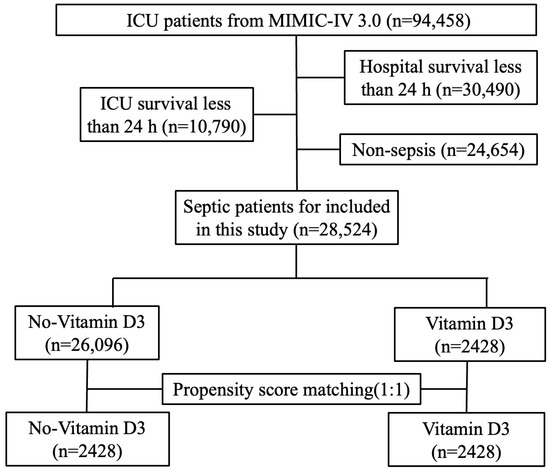
In this study, version 3.0 of the Medical Information Mart for Intensive Care IV (MIMIC-IV) database was utilized. The MIMIC-IV 3.0 database contains the data of over 90,000 patients from the intensive care unit (ICU) of the Beth Israel Deaconess Medical Center, Boston, Massachusetts, between 2008 and 2022. The database is normatively administered and contains high-quality data on demographics, laboratory tests, vital signs, disease diagnoses and survival status. In total, 94,458 patients with first-time cases of sepsis treated in the ICU were included in the MIMIC-IV 3.0 database. Patients were excluded if they met the following criteria: (1) were younger than 18 years; (2) had an ICU stay shorter than 24 h; and (3) were not diagnosed with sepsis. The relevant data were subsequently obtained by one of the authors (Xiaofei Huang), and the author obtained the necessary certification (certification number: 59248579). Informed consent from individuals was not needed, as patient privacy in this database is maintained through the anonymization of data. The flowchart of patient selection is shown in Figure 1.
Figure 1.
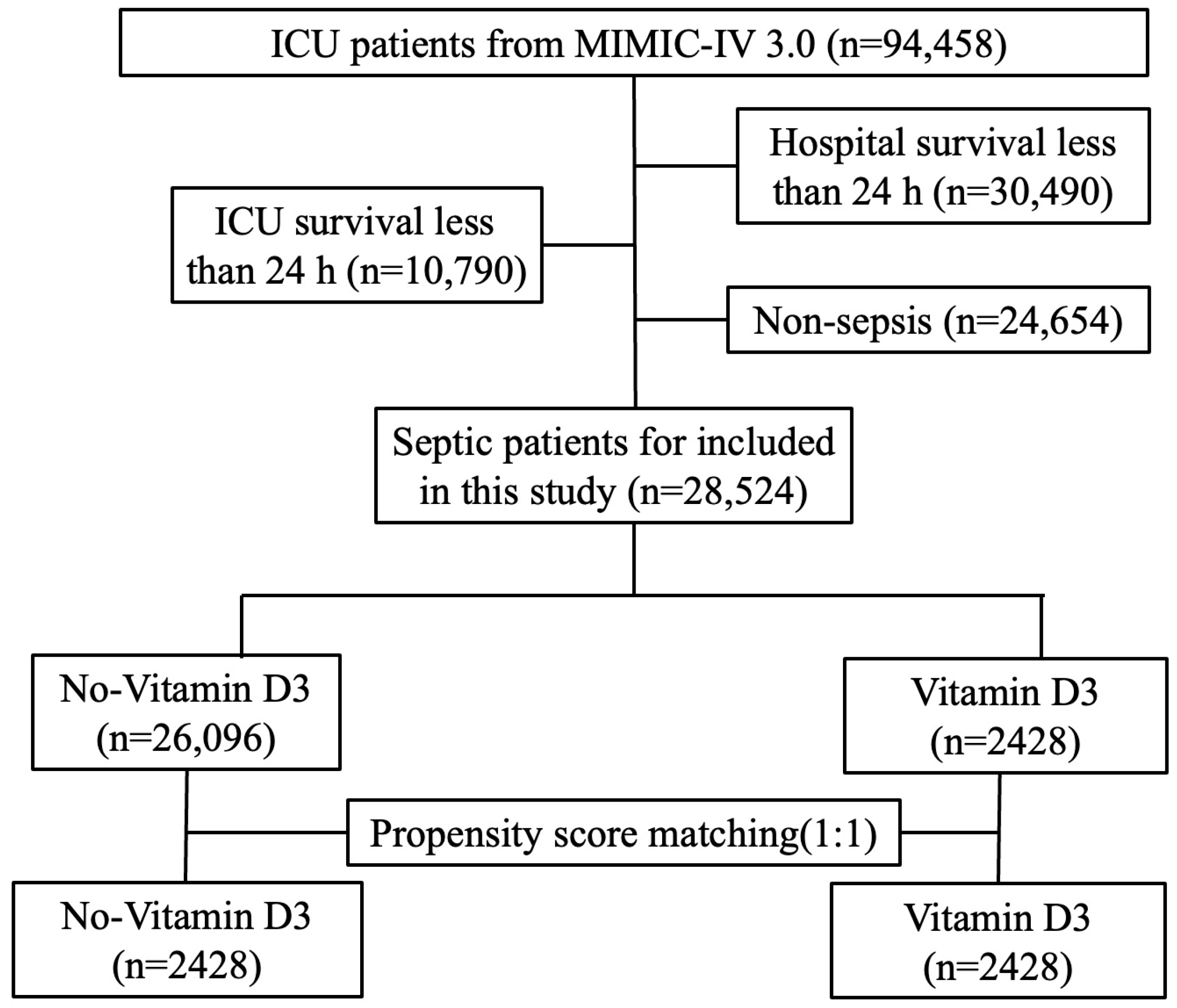
Flowchart of patient selection. After excluding patients with ICU or hospital stay less than 24 h and non-septic patients, 28,524 septic patients were included. Following 1:1 propensity score matching, 2428 patients receiving Vitamin D3 treatment were matched with 2428 controls without Vitamin D3.
2.2. Data Extraction
Data gathered during the first 24 h following ICU admission for each patient were retrieved from the MIMIC-IV 3.0 database. The demographic data, vital signs, laboratory test results, clinical scores, and medical history were extracted, and vitamin D3 therapy was provided during the ICU stay. In addition, comorbidity data were extracted by identifying the related International Classification of Diseases codes. Variables with less than 20% missing data were retained and imputed using multiple imputation methods.
2.3. Exposure and Outcomes
The exposure was vitamin D3 supplementation during the ICU stay, with no restrictions. Vitamin D3 was administered via enteral routes (oral, nasogastric tube, gastrostomy tube) and parenteral routes (intravenous injection). Data regarding vitamin D3 exposure were extracted from the prescription tables. Patients who had missing data regarding vitamin D3 supplementation exposure were not included in the analysis. The primary endpoint was 28-day ICU mortality. The secondary endpoints included the duration of mechanical ventilation, the percentage of patients receiving mechanical ventilation, and the length of ICU stay.
2.4. Statistical Analysis
Continuous data were presented as medians with interquartile ranges (IQRs), and group differences were analyzed using the Mann–Whitney U test. Categorical variables were presented as frequencies or percentages and were assessed with the chi-square test. The association between vitamin D3 supplementation and mortality in sepsis patients was evaluated via a Cox regression model. Kaplan–Meier (KM) curves were analyzed to assess the impact of vitamin D3 on survival. Subgroup analyses were also performed to explore the effect of vitamin D3 supplementation on 28-day mortality, considering variables such as age, sex, hypertension, diabetes, chronic obstructive pulmonary disease (COPD), and malignancies. All the statistical analyses were carried out with R software (R version 4.2.2, Austria), along with Zstats v0.90 www.medsta.cn/software (accessed on 15 November 2025) and MSTATA software v0.92 www.mstata.com/ (accessed on 23 November 2025).
2.5. Propensity Score Matching
To minimize confounding bias caused by differences in baseline characteristics between the vitamin D3 supplementation group and the non-supplementation group, 1:1 propensity score matching (PSM) was performed to balance the baseline characteristics of the two groups. Propensity scores were calculated using a multivariable logistic regression model. Covariates included potential confounders that may affect the use of vitamin D3 and the prognosis of sepsis, such as age, sex, hypertension, diabetes, COPD, and malignancies. The balance of baseline characteristics between the two groups was assessed using standardized mean differences (SMD), with an SMD < 0.1 considered indicative of adequate balance. The original cohort included 28,524 patients before matching. After 1:1 PSM, 2428 patients were included in each group, which improved the reliability and comparability of the study results.
2.6. Subgroup Analyses
To investigate the association between vitamin D3 supplementation and 28-day ICU mortality in patients with sepsis, we performed subgroup analyses in the pre-matching and post-matching cohorts according to age (<65 years, ≥65 years), sex, hypertension, diabetes, COPD, malignancy, serum vitamin D level, and year of admission. Serum vitamin D levels were classified based on the definition used in the MIMIC IV database: deficient (<30 ng/mL), normal (30–60 ng/mL), and sufficient (>60 ng/mL). However, due to the limited number of patients in the sufficient group (n = 5), subgroup analysis was performed only for the deficient and normal groups. Based on the key updates of the Surviving Sepsis Campaign guidelines in 2012 and 2016 [23,24,25,26], patients were stratified by admission year into early, middle, and recent periods.
To further investigate the effect of vitamin D3 dosing regimens on study outcomes, we performed additional stratified analyses among treated patients, with stratification criteria based on prior literature [27] and actual vitamin D3 administration records from the MIMIC-IV 3.0 database. Specifically, patients were stratified into three subgroups: by cumulative dose (low cumulative dose ≤ 25,000 IU vs. high cumulative dose > 25,000 IU), by daily dose (low daily dose ≤ 2000 IU/day vs. high daily dose > 2000 IU/day), and by dosing frequency (infrequent dosing 1/day vs. frequent dosing > 1/day). All analyses were adjusted for age, sex, mechanical ventilation status, diabetes mellitus, SOFA (Sequential Organ Failure Assessment) score, and Charlson comorbidity index.
3. Results
3.1. Patient Selection
The patient selection process is illustrated in Figure 1. From the MIMIC-IV database, 94,458 patients were initially selected. After 30,490 patients whose hospital stay was less than 24 h and 10,790 patients whose ICU stay was less than 24 h were excluded, 53,178 patients remained. Subsequently, 24,654 nonseptic patients were excluded. Finally, a cohort of 28,524 patients was considered for this study. Among these patients, 2428 received vitamin D3 treatment during their ICU stay. After 1:1 propensity score matching, 4856 patients were included (2428 in each group).
3.2. Cohort Characteristics
The baseline demographic characteristics, vital signs, laboratory indicators, and comorbidity details are presented in Table 1. In the pre-matched cohort, the median age of patients receiving vitamin D3 treatment was 71 years (62–81), with a median body weight of 77.53 kg (64.70–93.40), and 51.57% were male. Compared with patients who did not receive vitamin D3, those who received vitamin D3 were older, had a higher body weight, and included a higher percentage of males. Additionally, patients treated with vitamin D3 presented with lower heart rates (HR); white blood cell (WBC) counts; red blood cell (RBC) counts; and hemoglobin, sodium, chloride, and lactate levels. In contrast, patients treated with vitamin D3 showed higher red cell distribution width (RDW), total calcium, prothrombin time (PT), international normalized ratio (INR), and creatinine levels than those not treated with vitamin D3. Moreover, the incidence of comorbidities such as hypertension, diabetes, myocardial infarction, and COPD was lower in the treated group. After PSM, all SMDs for the covariates were less than 0.1, with no notable differences in baseline characteristics observed between the groups, confirming adequate balance post-matching. The distributions of the SMD and probability density after PSM matching are presented in Supplemental Figures S1 and S2.
Table 1.
Characteristics of the study population before and after propensity score matching.
3.3. Clinical Outcomes
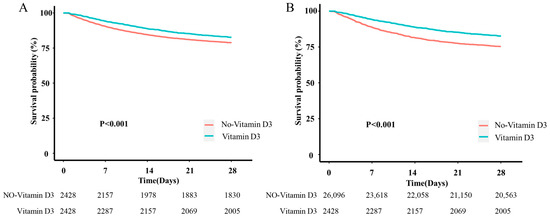
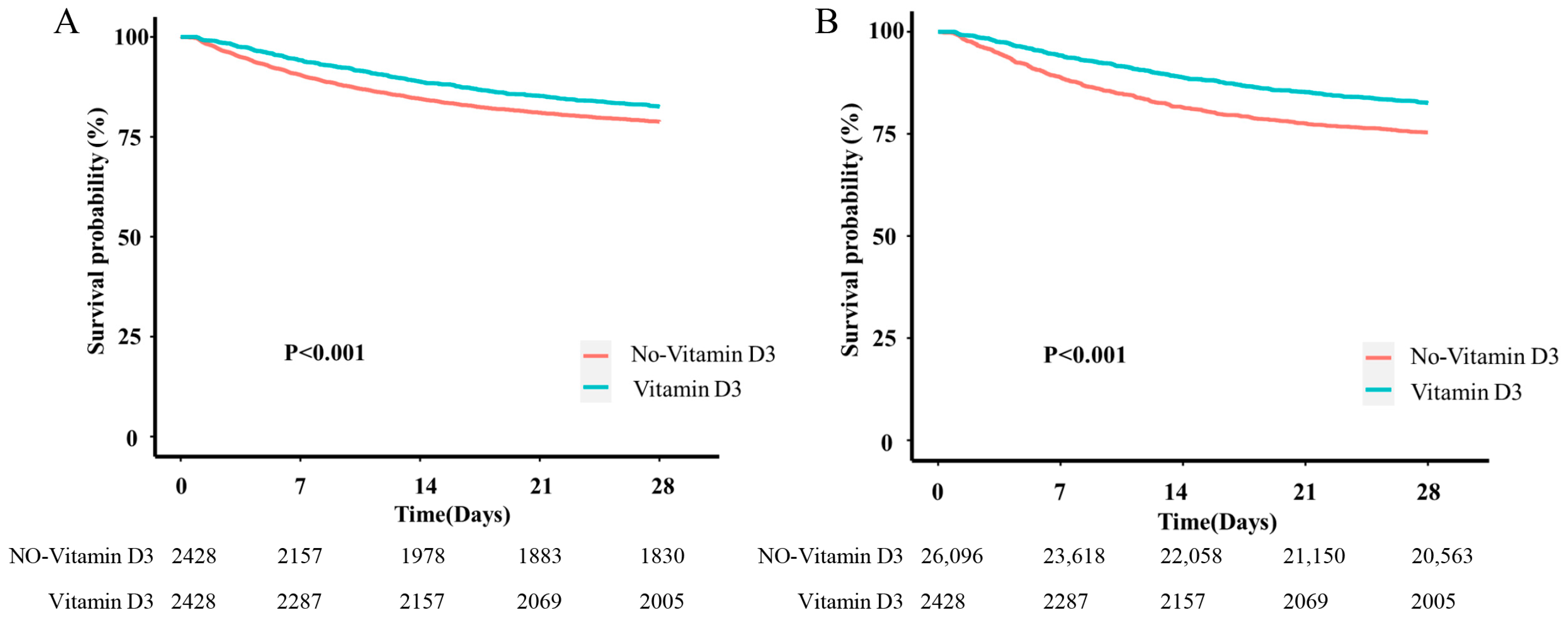
As shown in Table 2, patients receiving vitamin D3 had a lower 28-day ICU mortality rate (17.42%, 423/2428) than those not receiving vitamin D3 (21.20%, 5533/26,096). After 1:1 PSM, both cohorts comprised 2428 patients. The 28-day ICU mortality rate was 17.42% (423/2428) in the vitamin D3 group and 24.63% (598/2428) in the non-vitamin D3 group. Univariate Cox proportional hazards regression analysis revealed that the hazard ratio (HR) for vitamin D3 therapy was 0.79 (95% CI: 0.72–0.87, p < 0.001) before matching and 0.66 (95% CI: 0.59–0.75, p < 0.001) after matching, suggesting that vitamin D3 therapy was associated with lower 28-day ICU mortality among sepsis patients. The multivariate Cox proportional hazards regression analysis yielded consistent results, with an HR of 0.71 (95% CI: 0.64–0.78, p < 0.001) before matching and 0.66 (95% CI: 0.58–0.75, p < 0.001) after matching (Table 3). The Kaplan–Meier curves for 28-day ICU mortality in the pre- and post-matching cohorts on the basis of vitamin D3 usage are shown in Figure 2A,B, respectively. The results indicated that vitamin D3 treatment was associated with significantly higher survival rates in patients with sepsis (p < 0.001).
Table 2.
Outcomes of the study population before and after propensity score matching.
Table 3.
Cox proportional hazards models for 28-day ICU mortality.
Figure 2.
Survival probability trends for patients who received and did not receive vitamin D3 treatment. (A) Survival probability trends in the original cohort before PSM. (B) Survival probability trends after PSM. Patients receiving Vitamin D3 exhibited significantly improved survival compared to matched controls.
For the secondary outcomes, a lower percentage of patients receiving mechanical ventilation was observed in the vitamin D3 group (84.1% vs. 87.7%, p < 0.001). Moreover, the median duration of mechanical ventilation was 37.0 (IQR, 11.6–92.3) hours, which was significantly shorter than that of patients who did not receive vitamin D3 (41.0 (IQR, 16.8–96.0) (p = 0.002)). In the PSM cohort, similar results were observed for the duration (37.0 (IQR, 11.6–92.3) vs. 42.0 (IQR, 17.3–93.8); p = 0.012) and percentage of patients receiving (84.1% vs. 87.7%, p < 0.001) mechanical ventilation. However, the ICU length of stay was not significantly different between the groups before and after matching (Table 2).
3.4. Vitamin D3 Regimen
To further investigate the effect of vitamin D3 dosing regimens on study outcomes, we conducted stratified analyses among patients who received treatment based on the cumulative dose, daily dose, and dosing frequency. Results indicated that, when stratified by cumulative dose, both the unadjusted analysis (HR = 0.41, 95% CI: 0.27–0.64, p < 0.001) and the adjusted analysis (HR = 0.37, 95% CI: 0.24–0.58, p < 0.001) indicated that the high-dose group was significantly associated with a reduced risk of 28-day ICU mortality. By contrast, stratified analyses according to daily dose or dosing frequency revealed no significant differences in mortality risk between different levels within each indicator, regardless of adjustment. In the daily dose analysis, the unadjusted HR was 0.77 (95% CI: 0.40–1.49, p = 0.441) and the adjusted HR was 0.68 (95% CI: 0.35–1.32, p = 0.257). In the dosing frequency analysis, the unadjusted HR was 0.80 (95% CI: 0.41–1.56, p = 0.516) and the adjusted HR was 0.77 (95% CI: 0.40–1.50, p = 0.444). These results indicated that, within the study cohort, the total cumulative exposure to vitamin D3 showed a more pronounced association with clinical outcomes, whereas daily dose and dosing frequency were not significantly associated with outcomes (Table 4).
Table 4.
Hazard ratios for 28-day ICU mortality according to vitamin D3 administration regimens in critically ill patients.
3.5. Subgroup Analysis
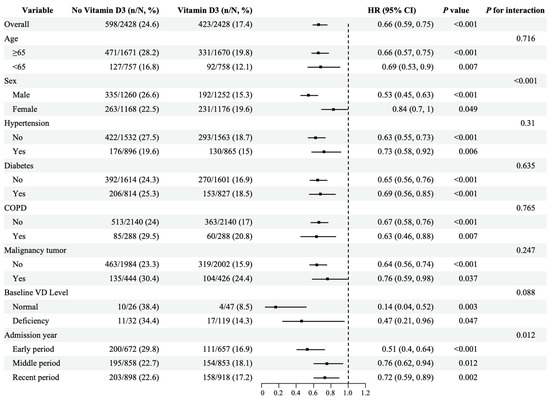
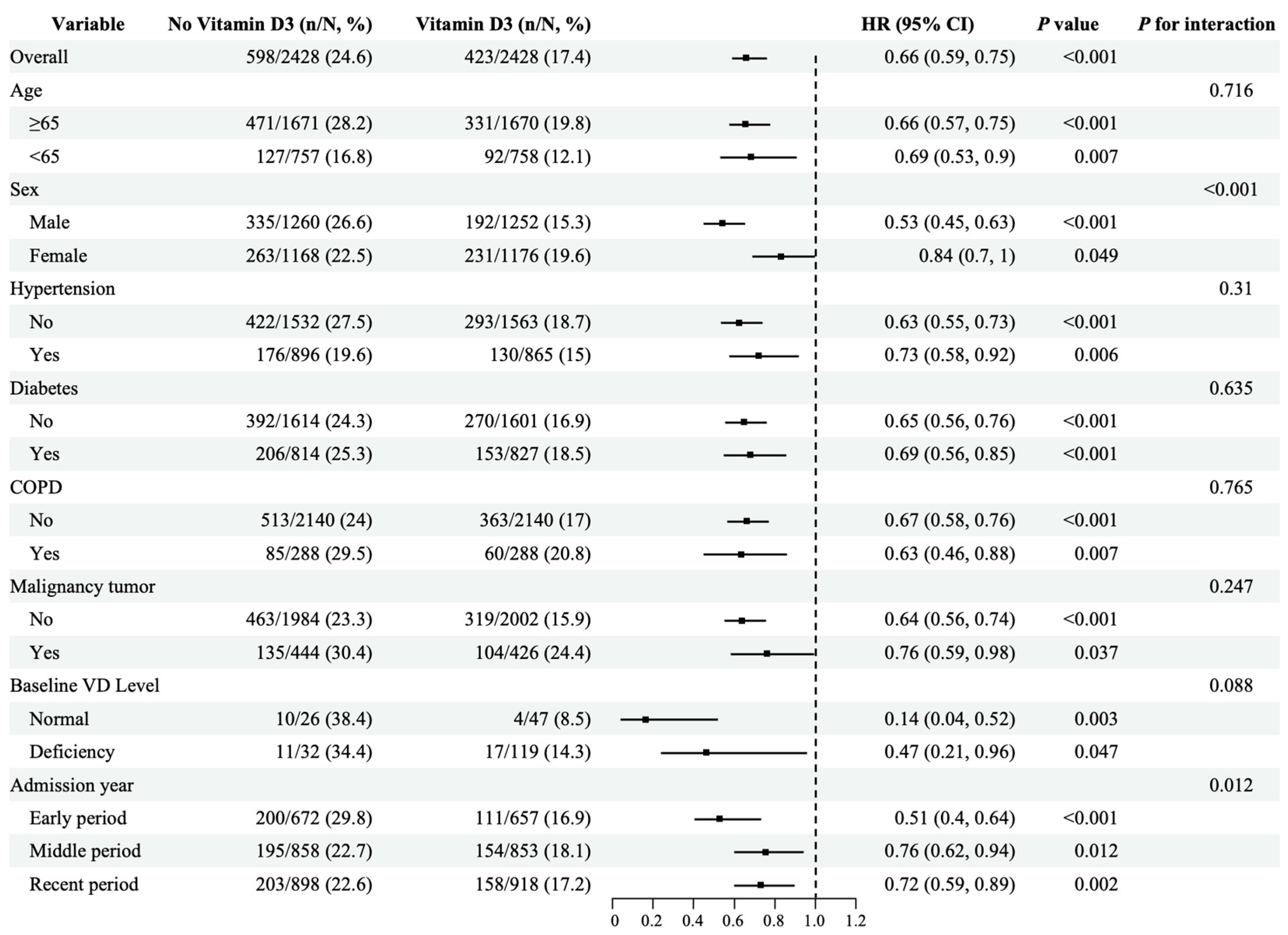
To explore the association between vitamin D3 administration and 28-day ICU mortality in sepsis patients, we conducted subgroup analyses stratified by age (<65 years, ≥65 years), sex, hypertension, diabetes, COPD, malignancy, baseline serum 25-hydroxyvitamin D level, and year of admission. As shown in Figure 3, statistically significant interactions were observed only in the sex subgroup (p < 0.001) and the admission year subgroup (p = 0.012), while no significant interactions were detected in the other subgroups after PSM. In the stratification by baseline vitamin D level, vitamin D3 supplementation was associated with reduced mortality in both the normal vitamin D subgroup (HR = 0.14, 95% CI: 0.04–0.52, p = 0.003) and the deficient vitamin D subgroup (HR = 0.47, 95% CI: 0.21–0.96, p = 0.047), with a borderline significant interaction between the two groups (p = 0.088). Furthermore, across all three admission year subgroups, sepsis patients who received vitamin D3 supplementation exhibited significantly lower 28-day ICU mortality than those who did not: early period (HR = 0.51, 95% CI: 0.40–0.64, p < 0.001), middle period (HR = 0.76, 95% CI: 0.62–0.94, p = 0.012), and recent period (HR = 0.72, 95% CI: 0.59–0.89, p = 0.002). Although a significant interaction was observed across different time subgroups (p = 0.012), vitamin D3 supplementation was consistently associated with lower 28-day ICU mortality across all time subgroups. These findings suggested that the protective association of vitamin D3 supplementation with lower 28-day ICU mortality among sepsis patients is consistent in direction across various clinical subgroups, supporting the robustness of the main conclusions.
Figure 3.
Subgroup analysis results after propensity score matching. The vertical dashed line represents the reference line at a HR of 1.0, indicating no difference in risk between groups. The protective association of vitamin D3 with lower 28-day ICU mortality persisted across nearly all subgroups, with statistically significant interactions observed for sex and admission year.
4. Discussion
In this study, vitamin D3 supplementation was associated with lower 28-day ICU mortality in critically ill patients with sepsis. Similar associations were observed across subgroup and sensitivity analyses.
Vitamin D is an important immune modulator and is associated with susceptibility to infections. The kidneys are the main site where vitamin D is activated to 1,25(OH)2D [28]. In cases of acute kidney injury linked to sepsis, a decline in renal function results in a notable decrease in 1,25(OH)2D levels. Administering exogenous vitamin D has been shown to increase the 28-day survival rate of patients with sepsis-induced acute kidney injury [21]. Vitamin D deficiency is present not only in patients with kidney injury but also in the majority of severely ill individuals. Studies have shown that up to 77% of individuals with severe illness suffer from vitamin D deficiency, which might be due to insufficient sunlight exposure and malnutrition, leading to reduced epidermal vitamin D production, as well as the conversion of 25(OH)D to active 1,25(OH)2D to meet the increased demand of the body, especially for the immune-modulating effects mediated by 1,25(OH)2D [29]. As mentioned earlier, several studies reported that reduced serum 25(OH)D levels are correlated with increased incidence of sepsis, increased mortality rates, and prolonged ICU stays in sepsis patients and critically ill patients. Earlier research has indicated that administering exogenous vitamin D3 does not significantly improve outcomes for ICU patients with sepsis [30]. However, a recent study evaluated the efficacy and safety of small and large doses of vitamin D3 administered enterally to 80 septic patients requiring mechanical ventilation. The results revealed that early high-dose vitamin D3 given enterally reduced serum procalcitonin levels, elevated serum IL-37 levels, and increased disease severity scores [31]. Differences in research findings, apart from patient heterogeneity, might also be attributed to variations in administration methods. An animal study revealed that both oral cholecalciferol and intravenous calcitriol alleviated sepsis-induced acute lung injury in obese mice. However, oral cholecalciferol had a more pronounced effect on regulating the Th/Treg cell balance and was more likely to affect anti-inflammatory pathways associated with the renin–angiotensin system in the lungs [32]. In this study, large-scale clinical data were analyzed, which revealed that the use of vitamin D3 was linked to lower 28-day ICU mortality among patients with severe sepsis, which aligns with findings from Li et al. [33]. Notably, we found that the total cumulative exposure to vitamin D3 was more strongly associated with 28-day ICU mortality (p < 0.001), whereas daily dose and dosing frequency showed no significant association. This finding is consistent with previous literature, suggesting that achieving sufficient cumulative exposure, rather than adhering to a specific dosing schedule, may be more relevant to the observed association in ICU patients with sepsis [34,35]. In addition, vitamin D3 supplementation was associated with a lower incidence and shorter duration of mechanical ventilation. Mechanistically, previous studies have indicated that vitamin D may alleviate lung injury by modulating inflammatory responses, preserving the integrity of the pulmonary epithelial barrier, and promoting epithelial repair [36]. Furthermore, our findings showed that the association between vitamin D3 supplementation and lower 28-day ICU mortality appeared more pronounced in female patients than in male patients, suggesting a potential sex-based difference in this observed association. The potential biological basis of this sex difference remained incompletely understood, but accumulating evidence indicated that sex hormones, especially estrogen, modulated vitamin D metabolism and signaling pathways in a sex-dependent manner. The biologically active form of vitamin D, 1α,25-dihydroxyvitamin D3 [1,25-(OH)2D3], exerted its effects mainly by binding to the vitamin D receptor (VDR) and initiated downstream transcriptional regulation. Prior studies indicated that estrogen may augment vitamin D signaling and increased its availability through dual regulatory mechanisms: on the one hand, estrogen upregulated VDR expression in various tissues of humans and rats, and enhanced cellular responsiveness to 1,25-(OH)2D3 [37,38,39]. In addition, CYP24A1—the cytochrome P450 subunit of 25-hydroxyvitamin D3-24-hydroxylase—was a key enzyme mediating vitamin D degradation and clearance. Estrogen had been shown to suppress CYP24A1 expression, thereby reducing vitamin D catabolism [40,41,42]. Therefore, future prospective, multicenter studies should be conducted to increase the accuracy of the findings. In the study design, the dosage, administration route, and duration of vitamin D3 treatment should be clearly defined, and participants’ serum 25(OH)D levels should be regularly monitored to ensure that these levels remain within the effective range.
The protective association of vitamin D3 supplementation with lower 28-day ICU mortality in sepsis patients may be mediated by several mechanisms: First, the immune-modulating effects of vitamin D might play a key role. Animal studies have suggested that vitamin D regulates the Th/Treg balance in T cells during sepsis, thereby alleviating lung [32] and intestinal inflammation [43]. Second, this effect might be related to the VDR and its genetic polymorphisms. Studies have revealed that 1,25(OH)2D affects target tissues by binding to nuclear VDR, which is expressed in lymphocytes, monocytes, macrophages, and dendritic cells [44]. A prospective study revealed that the Fokl polymorphism of the VDR gene influences immune cell function in sepsis, particularly the CC genotype, which is linked to a reduced mortality rate in ICU patients [45]. Ahmad et al. [46] found that the serum levels of vitamin D-binding protein (VDBP), 25(OH)D3, and 1,25(OH)2D3 were markedly lower in sepsis patients than in healthy individuals. Similarly, a decrease in serum VDBP levels was observed five days after cecal ligation and puncture in mice, supporting a potential a protective role of VDBP in sepsis-induced liver injury. In addition to these immune- and receptor-related mechanisms, vitamin D supplementation might also protect the body by regulating stress and inhibiting cell death. Studies have shown that vitamin D alleviates sepsis-induced acute lung injury by increasing miR-149-5p expression and reducing endoplasmic reticulum stress [47]. Vitamin D also provides neuroprotective effects by inhibiting exogenous histone-induced apoptosis and ferroptosis [48].
This study was based on the large, well-standardized MIMIC-IV database, which includes a substantial sample size, high-quality data, and comprehensive records covering demographics, vital signs, laboratory examinations, medication regimens, disease diagnoses, and outcomes. With standardized and traceable data acquisition, the database offers robust support for real-world studies, thereby enhancing the clinical representativeness and persuasiveness of our findings. Despite these strengths, several limitations of the present study should be acknowledged. First, vitamin D is not a routine test in critically ill patients; therefore, the MIMIC-IV database contains limited relevant measurement data, and the incomplete data may have affected the robustness of the results to some extent. Second, after PSM, some patients with sepsis who received vitamin D therapy lacked complete records of the administration regimen. Therefore, these patients were excluded from the analysis of the association between administration regimens and 28-day ICU mortality, which reduced the sample size and may have introduced some bias into the stability of the results. Third, MIMIC-IV is a single-center retrospective database, and all study participants were derived from a single center; therefore, caution is warranted when generalizing the findings to other regions or different populations, and further validation is needed in specific settings. Fourth, as a retrospective database, MIMIC-IV cannot capture all potential confounding factors, such as the specific reasons why physicians chose to administer vitamin D, the actual timing of administration, and the status of nutritional support; thus, unmeasured confounding may exist. Furthermore, even though we employed PSM to reduce confounding bias, treatment allocation remained inherently non-randomized; therefore, residual confounding and indication bias cannot be completely eliminated. Based on the above limitations, the associations observed in this study still require causal confirmation through prospective randomized controlled trials. Fifth, the database primarily records in-hospital and short-term outcome data and lacks long-term follow-up outcomes after vitamin D intervention, such as long-term mortality and organ function recovery, making it difficult to comprehensively evaluate its long-term benefits.
5. Conclusions
In conclusion, this retrospective cohort study suggests that vitamin D3 supplementation is associated with lower 28-day ICU mortality and better outcomes in patients with sepsis. Further large-scale prospective randomized controlled trials are warranted to validate these observational associations and establish causal effects.
Supplementary Materials
The following supporting information can be downloaded at: https://www.mdpi.com/article/10.3390/pathogens15040433/s1. Figure S1: Distribution of propensity scores before and after 1:1 PSM in the study cohort; Figure S2: Covariate balance before and after propensity score matching, assessed by absolute SMDs.
Author Contributions
The study design was conceived by X.H. and A.Z.; X.H., A.Z. and D.W. organized the data, conducted the analyses, and drafted and edited the manuscript. L.Z. and H.L. contributed to the interpretation of the results, as well as the revision and finalization of the manuscript. All authors have read and agreed to the published version of the manuscript.
Funding
This work is supported by Guizhou Provincial Basic Research Program (Natural Science) ([2025] 387).
Institutional Review Board Statement
This study was conducted in accordance with the ethical principles of the Declaration of Helsinki. It utilized the publicly available, de-identified data from the MIMIC IV 3.0 database. The use of this database was approved by the institutional review boards (IRBs) of the Massachusetts Institute of Technology (MIT) and Beth Israel Deaconess Medical Center. The MIMIC-IV database was approved by the institutional review boards of Beth Israel Deaconess Medical Center (IRB No. 2001-P-001699/14) and the Massachusetts Institute of Technology (IRB No. 0403000206), USA.
Informed Consent Statement
The requirement for informed consent was waived due to the retrospective nature and de-identification of the data. The author (Xiaofei-Huang) completed the Collaborative Institutional Training Initiative (CITI) program course on human subject research and data privacy before accessing the database.
Data Availability Statement
The original contributions presented in this study are included in the article/Supplementary Materials. Further inquiries can be directed to the corresponding authors.
Acknowledgments
The authors gratefully acknowledge the MIMIC-IV database, the PhysioNet platform, and all data contributors for making this study possible. Special thanks are due to Shuaifeng Ma and Hongxiang Lu for their valuable input during data analysis. They are not responsible for the final content of this paper, nor do they qualify for authorship.
Conflicts of Interest
The authors declare that the research was conducted in the absence of any commercial or financial relationships that could be construed as potential conflicts of interest.
Abbreviations
| MIMIC-IV | Medical Information Mart for Intensive Care-IV |
| ICU | intensive care unit |
| PSM | propensity score matching |
| COPD | chronic obstructive pulmonary disease |
| HR | heart rate |
| WBC | white blood cell |
| RBC | red blood cell |
| RDW | red cell distribution width |
| PT | prothrombin time |
| INR | international normalized ratio |
References
- Rudd, K.E.; Johnson, S.C.; Agesa, K.M.; Shackelford, K.A.; Tsoi, D.; Kievlan, D.R.; Colombara, D.V.; Ikuta, K.S.; Kissoon, N.; Finfer, S.; et al. Global, regional, and national sepsis incidence and mortality, 1990–2017: Analysis for the Global Burden of Disease Study. Lancet 2020, 395, 200–211. [Google Scholar] [CrossRef] [Scilit]
- Weng, L.; Xu, Y.; Yin, P.; Wang, Y.; Chen, Y.; Liu, W.; Li, S.; Peng, J.-M.; Dong, R.; Hu, X.-Y.; et al. National incidence and mortality of hospitalized sepsis in China. Crit. Care 2023, 27, 84. [Google Scholar] [CrossRef] [Scilit] [PubMed]
- Rhee, C.; Jones, T.M.; Hamad, Y.; Pande, A.; Varon, J.; O’brien, C.; Anderson, D.J.; Warren, D.K.; Dantes, R.B.; Epstein, L.; et al. Prevalence, Underlying Causes, and Preventability of Sepsis-Associated Mortality in US Acute Care Hospitals. JAMA Netw. Open 2019, 2, e187571. [Google Scholar] [CrossRef] [Scilit]
- Singer, M.; Deutschman, C.S.; Seymour, C.W.; Shankar-Hari, M.; Annane, D.; Bauer, M.; Bellomo, R.; Bernard, G.R.; Chiche, J.-D.; Coopersmith, C.M.; et al. The Third International Consensus Definitions for Sepsis and Septic Shock (Sepsis-3). JAMA 2016, 315, 801–810. [Google Scholar] [CrossRef] [Scilit] [PubMed]
- van der Poll, T.; Shankar-Hari, M.; Wiersinga, W.J. The immunology of sepsis. Immunity 2021, 54, 2450–2464. [Google Scholar] [CrossRef] [Scilit] [PubMed]
- Holick, M.F. Vitamin D Deficiency. N. Engl. J. Med. 2007, 357, 266–281. [Google Scholar] [CrossRef] [Scilit]
- Wimalawansa, S.J. Infections and Autoimmunity-The Immune System and Vitamin D: A Systematic Review. Nutrients 2023, 15, 3842. [Google Scholar] [CrossRef] [Scilit]
- McGregor, R.; Chauss, D.; Freiwald, T.; Yan, B.; Wang, L.; Nova-Lamperti, E.; Afzali, B. An autocrine Vitamin D-driven Th1 shutdown program can be exploited for COVID-19. bioRxiv 2020. [Google Scholar] [CrossRef] [Scilit] [PubMed]
- Chauss, D.; Freiwald, T.; McGregor, R.; Yan, B.; Wang, L.; Nova-Lamperti, E.; Kumar, D.; Zhang, Z.; Teague, H.; West, E.E.; et al. Autocrine vitamin D signaling switches off pro-inflammatory programs of TH1 cells. Nat. Immunol. 2022, 23, 62–74. [Google Scholar] [CrossRef] [Scilit]
- Aygun, H. Vitamin D can prevent COVID-19 infection-induced multiple organ damage. Naunyn-Schmiedeberg’s Arch. Pharmacol. 2020, 393, 1157–1160. [Google Scholar] [CrossRef] [Scilit] [PubMed]
- Tuohimaa, P.; Keisala, T.; Minasyan, A.; Cachat, J.; Kalueff, A. Vitamin D, nervous system and aging. Psychoneuroendocrinology 2009, 34, S278–S286. [Google Scholar] [CrossRef] [Scilit] [PubMed]
- Sîrbe, C.; Rednic, S.; Grama, A.; Pop, T.L. An Update on the Effects of Vitamin D on the Immune System and Autoimmune Diseases. Int. J. Mol. Sci. 2022, 23, 9784. [Google Scholar] [CrossRef] [Scilit] [PubMed]
- Gallo, D.; Baci, D.; Kustrimovic, N.; Lanzo, N.; Patera, B.; Tanda, M.L.; Piantanida, E.; Mortara, L. How Does Vitamin D Affect Immune Cells Crosstalk in Autoimmune Diseases? Int. J. Mol. Sci. 2023, 24, 4689. [Google Scholar] [CrossRef] [Scilit] [PubMed]
- Gu, W.J.; Duan, X.J.; Liu, X.Z.; Cen, Y.; Tao, L.-Y.; Lyu, J.; Yin, H.-Y. Association of magnesium sulfate use with mortality in critically ill patients with sepsis: A retrospective propensity score-matched cohort study. Br. J. Anaesth. 2023, 131, 861–870. [Google Scholar] [CrossRef] [Scilit] [PubMed]
- Vipul, P.; Shuchi, C.; Avinash, A.; Manish, G.; Sukriti, K.; Ved, P. Correlation of Serum Vitamin D Level with Mortality in Patients with Sepsis. Indian J. Crit. Care Med. 2017, 21, 199–204. [Google Scholar] [CrossRef] [Scilit]
- Seok, H.; Kim, J.; Choi, W.S.; Park, D.W. Effects of Vitamin D Deficiency on Sepsis. Nutrients 2023, 15, 4309. [Google Scholar] [CrossRef] [Scilit] [PubMed]
- Delrue, C.; Speeckaert, R.; Delanghe, J.R.; Speeckaert, M.M. Vitamin D Deficiency: An Underestimated Factor in Sepsis? Int. J. Mol. Sci. 2023, 24, 2924. [Google Scholar] [CrossRef] [Scilit]
- Malinverni, S.; Ochogavia, Q.; Lecrenier, S.; Scorpinniti, M.; Preiser, J.-C.; Cotton, F.; Mols, P.; Bartiaux, M. Severe vitamin D deficiency in patients admitted to the emergency department with severe sepsis is associated with an increased 90-day mortality. Emerg. Med. J. 2023, 40, 36–41. [Google Scholar] [CrossRef] [Scilit]
- Guan, J.; Shichen, M.; Liang, Z.; Yu, S.; Zhao, M.; Zhang, L.; Lv, R.; Liu, Y.; Chang, P.; Liu, Z. Potential benefits of vitamin D for sepsis prophylaxis in critical ill patients. Front. Nutr. 2023, 10, 1073894. [Google Scholar] [CrossRef] [Scilit]
- Hu, S.; He, Q.; Xie, J.; Liu, H.; Zhou, R.; Li, C. Vitamin D supplementation is beneficial in improving the prognosis of patients with acute respiratory failure in the intensive care unit: A retrospective study based on the MIMIC-IV database. Front. Med. 2023, 10, 1271060. [Google Scholar] [CrossRef] [Scilit] [PubMed]
- Chen, L.; Zhou, T.; Lv, C.; Ni, H.; Zhao, Z.; Zhou, H.; Hu, X. Vitamin D supplementation can improve the 28-day mortality rate in patients with sepsis-associated acute kidney injury. Ren. Fail. 2024, 46, 2431632. [Google Scholar] [CrossRef] [Scilit]
- Bhattacharyya, A.; Subramaniam, R.; Baidya, D.K.; Aggarwal, P.; Wig, N. Effect of Early Administration of Vitamin D on Clinical Outcome in Critically Ill Sepsis Patients: A Randomized Placebo-controlled Trial. Indian J. Crit. Care Med. 2021, 25, 1147–1154. [Google Scholar] [CrossRef] [Scilit] [PubMed]
- Evans, L.; Rhodes, A.; Alhazzani, W.; Antonelli, M.; Coopersmith, C.M.; French, C.; Machado, F.R.; Mcintyre, L.; Ostermann, M.; Prescott, H.C.; et al. Surviving sepsis campaign: International guidelines for management of sepsis and septic shock 2021. Intensive Care Med. 2021, 47, 1181–1247. [Google Scholar] [CrossRef] [Scilit] [PubMed]
- Rhodes, A.; Evans, L.E.; Alhazzani, W.; Levy, M.M.; Antonelli, M.; Ferrer, R.; Kumar, A.; Sevransky, J.E.; Sprung, C.L.; Nunnally, M.E.; et al. Surviving Sepsis Campaign: International Guidelines for Management of Sepsis and Septic Shock: 2016. Intensive Care Med. 2017, 43, 304–377. [Google Scholar] [CrossRef] [Scilit] [PubMed]
- Dellinger, R.P.; Levy, M.M.; Rhodes, A.; Annane, D.; Gerlach, H.; Opal, S.M. Surviving Sepsis Campaign Guidelines Committee including the Pediatric Subgroup. Surviving sepsis campaign: International guidelines for management of severe sepsis and septic shock: 2012. Crit. Care Med. 2013, 41, 580–637. [Google Scholar] [CrossRef]
- Dellinger, R.P.; Carlet, J.M.; Masur, H.; Gerlach, H.; Calandra, T.; Cohen, J.; Gea-Banacloche, J.; Keh, D.; Marshall, J.C.; Parker, M.M.; et al. Surviving Sepsis Campaign guidelines for management of severe sepsis and septic shock. Crit. Care Med. 2004, 32, 858–873. [Google Scholar] [CrossRef] [Scilit] [PubMed]
- Amrein, K.; Papinutti, A.; Mathew, E.; Vila, G.; Parekh, D. Vitamin D and critical illness: What endocrinology can learn from intensive care and vice versa. Endocr. Connect. 2018, 7, R304–R315. [Google Scholar] [CrossRef] [Scilit]
- Huang, H.Y.; Lin, T.W.; Hong, Z.X.; Lim, L.M. Vitamin D and Diabetic Kidney Disease. Int. J. Mol. Sci. 2023, 24, 3751. [Google Scholar] [CrossRef] [Scilit]
- Lee, P.; Nair, P.; Eisman, J.A.; Center, J.R. Vitamin D deficiency in the intensive care unit: An invisible accomplice to morbidity and mortality? Intensive Care Med. 2009, 35, 2028–2032. [Google Scholar] [CrossRef] [Scilit]
- Amrein, K.; Schnedl, C.; Holl, A.; Riedl, R.; Christopher, K.B.; Pachler, C.; Dobnig, H. Effect of high-dose vitamin D3 on hospital length of stay in critically ill patients with vitamin D deficiency: The VITdAL-ICU randomized clinical trial. JAMA 2014, 312, 1520–1530. [Google Scholar] [CrossRef] [Scilit]
- Ashoor, T.M.; Abd Elazim, A.E.H.; Mustafa, Z.A.E.; Anwar, M.A.; Gad, I.A.; Mamdouh Esmat, I. Outcomes of High-Dose Versus Low-Dose Vitamin D on Prognosis of Sepsis Requiring Mechanical Ventilation: A Randomized Controlled Trial. J. Intensive Care Med. 2024, 39, 1012–1022. [Google Scholar] [CrossRef] [Scilit]
- Yeh, C.L.; Wu, J.M.; Chen, K.Y.; Wu, M.-H.; Yang, P.-J.; Lee, P.-C.; Chen, P.-D.; Yeh, S.-L.; Lin, M.-T. Effects of different routes and forms of vitamin D administration on CD4+ T cell homeostasis and renin-angiotensin system-associated lung injury in obese mice complicated with polymicrobial sepsis. Biomed. Pharmacother. 2022, 156, 113961. [Google Scholar] [CrossRef] [Scilit]
- Li, C.; Zhao, K.; Ren, Q.; Chen, L.; Zhang, Y.; Wang, G.; Xie, K. Vitamin D supplementation during intensive care unit stay is associated with improved outcomes in critically Ill patients with sepsis: A cohort study. Front. Cell. Infect. Microbiol. 2024, 14, 1485554. [Google Scholar] [CrossRef] [Scilit]
- Shen, H.; Mei, Y.; Zhang, K.; Xu, X. The Effect of Vitamin D Supplementation on Clinical Outcomes for Critically Ill Patients: A Systemic Review and Meta-Analysis of Randomized Clinical Trials. Front. Nutr. 2021, 8, 664940. [Google Scholar] [CrossRef] [Scilit]
- Padhy, S.S.; Malviya, D.; Harjai, M.; Tripathi, M.; Das, P.K.; Rastogi, S. A Study of Vitamin D Level in Critically Ill Patients and Effect of Supplementation on Clinical Outcome. Anesth. Essays Res. 2020, 14, 474–477. [Google Scholar] [PubMed]
- Shi, Y.Y.; Liu, T.J.; Fu, J.H.; Xu, W.; Wu, L.-L.; Hou, A.-N.; Xue, X.-D. Vitamin D/VDR signaling attenuates lipopolysaccharide-induced acute lung injury by maintaining the integrity of the pulmonary epithelial barrier. Mol. Med. Rep. 2016, 13, 1186–1194. [Google Scholar] [CrossRef] [Scilit] [PubMed]
- Escaleira, M.T.; Sonohara, S.; Brentani, M.M. Sex steroids induced up-regulation of 1,25-(OH)2 vitamin D3 receptors in T 47D breast cancer cells. J. Steroid Biochem. Mol. Biol. 1993, 45, 257–263. [Google Scholar] [CrossRef] [Scilit]
- Liel, Y.; Shany, S.; Smirnoff, P.; Schwartz, B. Estrogen increases 1,25-dihydroxyvitamin D receptors expression and bioresponse in the rat duodenal mucosa. Endocrinology 1999, 140, 280–285. [Google Scholar] [CrossRef]
- Schwartz, B.; Smirnoff, P.; Shany, S.; Liel, Y. Estrogen controls expression and bioresponse of 1,25-dihydroxyvitamin D receptors in the rat colon. Mol. Cell. Biochem. 2000, 203, 87–93. [Google Scholar] [CrossRef] [Scilit] [PubMed]
- Spanier, J.A.; Nashold, F.E.; Mayne, C.G.; Nelson, C.D.; Hayes, C.E. Vitamin D and estrogen synergy in Vdr-expressing CD4+ T cells is essential to induce Helios+FoxP3+ T cells and prevent autoimmune demyelinating disease. J. Neuroimmunol. 2015, 286, 48–58. [Google Scholar] [CrossRef] [Scilit]
- Spach, K.M.; Hayes, C.E. Vitamin D3 confers protection from autoimmune encephalomyelitis only in female mice. J. Immunol. 2005, 175, 4119–4126. [Google Scholar] [CrossRef] [Scilit] [PubMed]
- Correale, J.; Ysrraelit, M.C.; Gaitán, M.I. Gender differences in 1,25 dihydroxyvitamin D3 immunomodulatory effects in multiple sclerosis patients and healthy subjects. J. Immunol. 2010, 185, 4948–4958. [Google Scholar] [CrossRef] [Scilit]
- Yeh, C.L.; Wu, J.M.; Chen, K.Y.; Wu, M.-H.; Yang, P.-J.; Lee, P.-C.; Chen, P.-D.; Yeh, S.-L.; Lin, M.-T. Effects of Different Routes and Forms of Vitamin D Administration on Mesenteric Lymph Node CD4+ T Cell Polarization and Intestinal Injury in Obese Mice Complicated with Polymicrobial Sepsis. Nutrients 2022, 14, 3557. [Google Scholar] [CrossRef] [Scilit] [PubMed]
- Battault, S.; Whiting, S.J.; Peltier, S.L.; Sadrin, S.; Gerber, G.; Maixent, J.M. Vitamin D metabolism, functions and needs: From science to health claims. Eur. J. Nutr. 2013, 52, 429–441. [Google Scholar] [CrossRef] [Scilit] [PubMed]
- Bozgul, S.M.K.; Emecen, D.A.; Akarca, F.K.; Bozkurt, D.; Aydin, O.; Koca, D.; Can, O.; Unalp, O.V.; Atik, T. Association between vitamin D receptor gene FokI polymorphism and mortality in patients with sepsis. Mol. Biol. Rep. 2023, 51, 44. [Google Scholar] [CrossRef] [Scilit]
- Xiao, K.; Zhang, D.C.; Hu, Y.; Song, L.-C.; Xu, J.-Q.; He, W.-X.; Pan, P.; Wang, Y.-W.; Xie, L.-X. Potential roles of vitamin D binding protein in attenuating liver injury in sepsis. Mil. Med. Res. 2022, 9, 4. [Google Scholar] [CrossRef] [Scilit]
- Ahmad, S.; Zaki, A.; Manda, K.; Mohan, A.; Syed, M.A. Vitamin-D ameliorates sepsis-induced acute lung injury via augmenting miR-149-5p and downregulating ER stress. J. Nutr. Biochem. 2022, 110, 109130. [Google Scholar] [CrossRef] [Scilit]
- Sun, Y.; Pu, Z.; Zhao, H.; Deng, Y.; Zhang, J.; Li, S.; Jiang, Y.; Sun, M.; Zhu, J.; Alam, A.; et al. Vitamin D can mitigate sepsis-associated neurodegeneration by inhibiting exogenous histone-induced pyroptosis and ferroptosis: Implications for brain protection and cognitive preservation. Brain Behav. Immun. 2024, 124, 40–54. [Google Scholar] [CrossRef] [Scilit]

Disclaimer/Publisher’s Note: The statements, opinions and data contained in all publications are solely those of the individual author(s) and contributor(s) and not of MDPI and/or the editor(s). MDPI and/or the editor(s) disclaim responsibility for any injury to people or property resulting from any ideas, methods, instructions or products referred to in the content. |
© 2026 by the authors. Licensee MDPI, Basel, Switzerland. This article is an open access article distributed under the terms and conditions of the Creative Commons Attribution (CC BY) license.