


Abstract
The co-evolution of hosts and pathogens has led to the emergence of multiple sensors of pathogen-associated molecular patterns and defense-associated signaling and effector proteins that control innate immunity. However, in several lineages of vertebrates, the repertoire of sensors and downstream signaling proteins has decreased, suggesting that the loss of certain immunity-related genes has not been counter-selected or may have even provided an advantage to the host. Here, we review examples of gene loss and pseudogenization affecting sensors of viral nucleic acids, such as AIM2 in carnivorans, RIG-I in birds, and cyclic GMP-AMP synthase (cGAS), Z-DNA-binding protein 1 (ZBP1), and interferon-induced with helicase C domain 1 (IFIH1)/MDA5 in pangolins. We discuss the loss of innate immunity-related genes in the context of a general model of host–pathogen interactions, which considers the costs of immune responses to the host and the potential role of pathogen-specific tolerance as an adaptive strategy. Further, we explore the limitations in understanding the causes and consequences of gene loss during the evolution of the immune system and suggest potential directions of future research in this field.
1. Introduction
The immune system has been shaped by evolution. In particular, innate immunity is the product of an evolutionary arms race between pathogen and host [1,2,3,4]. The spectrum of defense molecules and regulatory pathways is vast, with even unicellular organisms such as bacteria utilizing multiple types of innate immune reactions [5,6,7]. While a major focus of research in evolutionary immunology is the emergence of new molecular mechanisms to sense and eliminate invading pathogens [4], the present paper aims to highlight examples of contractions in the genetically determined anti-pathogen defense, focusing on vertebrates and particularly mammals.
Innate immunity involves various mechanisms, which typically include pattern recognition receptors (PRRs) that sense pathogen-associated molecular patterns (PAMPs) and/or danger-associated molecular patterns (DAMPs) [8,9], signaling pathways, and effector molecules [5,10]. Innate immunity-related genes are differentially expressed across cell types, and some of the complexity in innate immune responses arises from the interplay of cells, such as macrophages, dendritic cells, neutrophils, natural killer cells, epithelial cells, and others, with different sensor and signaling capacities. Furthermore, epigenetic regulation is implicated in the control of innate immunity over time [10]. This review discusses some representative examples of pathogen detection and the first steps of the host response to pathogens.
The biological and medical importance of innate immunity is primarily centered on the defense against pathogens. Innate immune reactions are critical during the first encounter with a pathogen but also contribute to defense when adaptive immunity has been activated by previous exposures to pathogens. In addition, pathways of innate immunity contribute to sterile inflammation either caused by genetic defects or abiotic triggers such as asbestos fibers [11].
In the context of this paper, the following features of innate immunity are of particular importance. First, innate immunity is the evolutionarily most ancient part of host defense against pathogens [6]. Co-evolution with pathogens has modified it, and its components and functions in modern species depend on its evolutionary past. Second, the mechanisms of innate immunity are partially redundant, meaning that more than one way of sensing and responding to a particular pathogen is used in many cases. Nevertheless, the speed and strength of a response are often determined by one or a few pathways. Third, compared to most other genes of an organism, the genes controlling the immune system undergo rapid evolution [12]. This suggests that host–pathogen interactions are a significant driver of evolutionary change besides sexual selection, competition for food and habitat, and predator–prey interactions.
2. Evolutionary Gain and Loss of Genes
The evolution of species, organs, and cells depends on changes in the genome. New genes originate de novo at low frequency but much more commonly by the duplication of existing genes, gene fusions, combinations of exons from different genes, horizontal transfer of genes, retrotransposition, or the domestication of transposable elements [13], whereby each of these processes is followed by the accumulation of sequence changes [14]. The opposite process of gene loss also contributes to changes in the genome during evolution and thereby determines some of the genetic differences between phylogenetic lineages [15,16]. Whether a difference in gene content of two species is caused by a gain of the gene in one species or the loss of the gene in the other species can be inferred from the distribution of the gene across the phylogenetic tree. If the distribution of the gene among species, in combination with the known relationship of species, indicates that the common ancestor of the two species in question had the gene, gene loss must have occurred during the evolution of the gene-deficient daughter species. If phylogenetic inferences about the gene status in the common ancestor are not stringent, both subsequent gene gain and parallel gene loss in more than one lineage need to be considered. However, the strongest evidence for the loss of a functional gene, that is, a gene encoding a functional protein, comes from the identification of gene remnants (unitary pseudogenes), which can be viewed as “genetic fossils” [17].
Gene loss is generally counterselected if the gene provides an advantage to the carrier. The strength of the selective constraints and the size of the population determine the efficiency of selection for gene maintenance, with elevated rates of gene loss occurring during evolutionary population bottlenecks [18]. In the absence of this selection, random mutagenesis and recombination events drive the decay of genes. Point mutations and segmental deletions or duplications result in pseudogenization of the protein-coding sequences. Even if the capacity to encode a protein of full length is maintained, missense mutations can lead to the loss of function, which, however, may be difficult to identify by sequence comparisons. Recombination events affecting larger genome segments can lead to the deletion of entire genes or arrays of genes.
While the lack of negative selection (neutral evolution) is the most common cause of gene loss, positive selection for gene loss does also occur [19,20]. In this case, the absence of a gene (actually the absence of the corresponding gene product, which typically is a protein) confers an advantage under the conditions of selection. Natural selection for gene loss may be driven by reducing the “metabolic” costs of expression of a particular gene. Alternatively, selection for gene loss is driven by disadvantages of genes in new ecological contexts or after organismal adaptations. This hypothesis is consistent with the evolutionary history of chemosensory genes in herbivorous insects [21]. Another example of potentially adaptive gene loss is the pseudogenization of uricase in early primates, which is hypothesized to have increased the efficiency of fructose metabolism and the maintenance of fat stores during a period of lower temperature climate [22]. Yet another, however disputed, example is the high prevalence of loss-of-function variants of the histidine-rich protein filaggrin (FLG) in northern European populations, which leads to reduced skin concentrations of the UV-absorbing metabolite urocanic acid and thereby allows for higher rates of vitamin D synthesis [23,24]. The evidence for positive selection of gene loss/pseudogenization is incomplete in the examples from natural selection.
Strong support for adaptive gene loss is provided by breeding of domestic animals [25]. The selection for high yields of meat has resulted in the loss of the myostatin gene, a negative regulator of skeletal muscle growth, in cattle of the double-muscled phenotype [26,27]. An out-of-frame deletion in the Agouti-signaling-protein (ASIP) gene leads to the recessive black coat color of horses [28], which has been selected during breeding. Similar loss-of-function mutations in ASIP cause melanism in leopards [29], and putative loss-of-function mutations are present in melanistic individuals of two species of South American felids, the Pampas cat (Leopardus colocolo) and the kodkod (Leopardus guigna) [30]. Natural selection for melanism in wild species is possible, but effects of genetic drift and heterozygote deficiency in small populations cannot be excluded [30,31].
Further insights into the evolution of gene loss derive from the epidemiology and molecular medicine [32]. Absence of Duffy antigen receptor for chemokine (DARC), the key receptor for erythrocyte invasion by Plasmodium vivax, confers resistance to infection with this malaria parasite [33,34,35]. Homozygous carriers of loss-of-function mutations of C-C chemokine receptor type 5 (CCR5) are resistant to infection with macrophage-tropic strains of human immunodeficiency virus (HIV)-1 [36]. Loss-of-function alleles in the FUT2 gene encoding galactoside 2-alpha-L-fucosyltransferase 2 protect against infections with rotaviruses and noroviruses, which cause viral gastroenteritis [37]. These examples illustrate that gene losses in receptors (proteins targeted by the pathogen) or regulators of infection-related metabolic reactions are protection strategies in host–pathogen co-evolution. Comparative genomics studies have shown that gene loss has affected not only the innate but also the adaptive immune system in various lineages of vertebrates [38,39,40]. In addition, there are multiple examples of positive selection of certain MHC-idiotypes, thus lowering the degree of multiple allelism but at the same time conferring increased resistance against specific pathogens in farm animal breeding [41,42].
3. Evidence for Loss of Immunity-Related Genes in the Evolution of Vertebrates
3.1. Rationale for the Selection of Examples of Gene Loss
The immune system differs among vertebrates because of lineage-specific changes in genes that control host–pathogen interactions. Modifications of gene regulation, gene gain, and gene loss have contributed to the emergence of these differences during evolution. Here, we provide examples of gene loss or pseudogenization affecting the repertoire of genes in the control of innate immunity in vertebrates. We focus on a few species that have been investigated in detail because of their potential roles as carriers of zoonotic pathogens [43,44], their importance in veterinary medicine, or their roles as biomedical models. The discussion of existing evidence for immunity-related gene loss is intended to provide a basis for hypotheses on the underlying evolutionary drivers of gene loss and the consequences of gene loss on host–pathogen interactions in vertebrates. Insights from evolutionary studies may also help to guide the search for therapeutic targets, for example, among cytosolic nucleic acid sensors that will be highlighted in the following paragraphs [45].
3.2. Loss of Innate Immunity-Related Genes in Birds
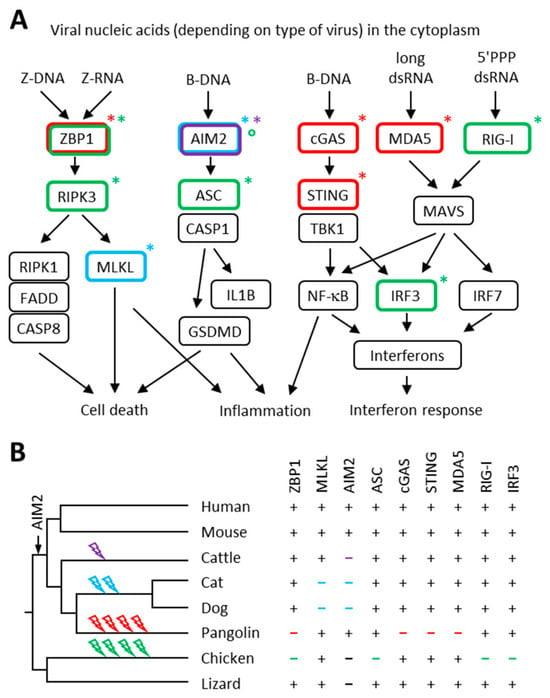
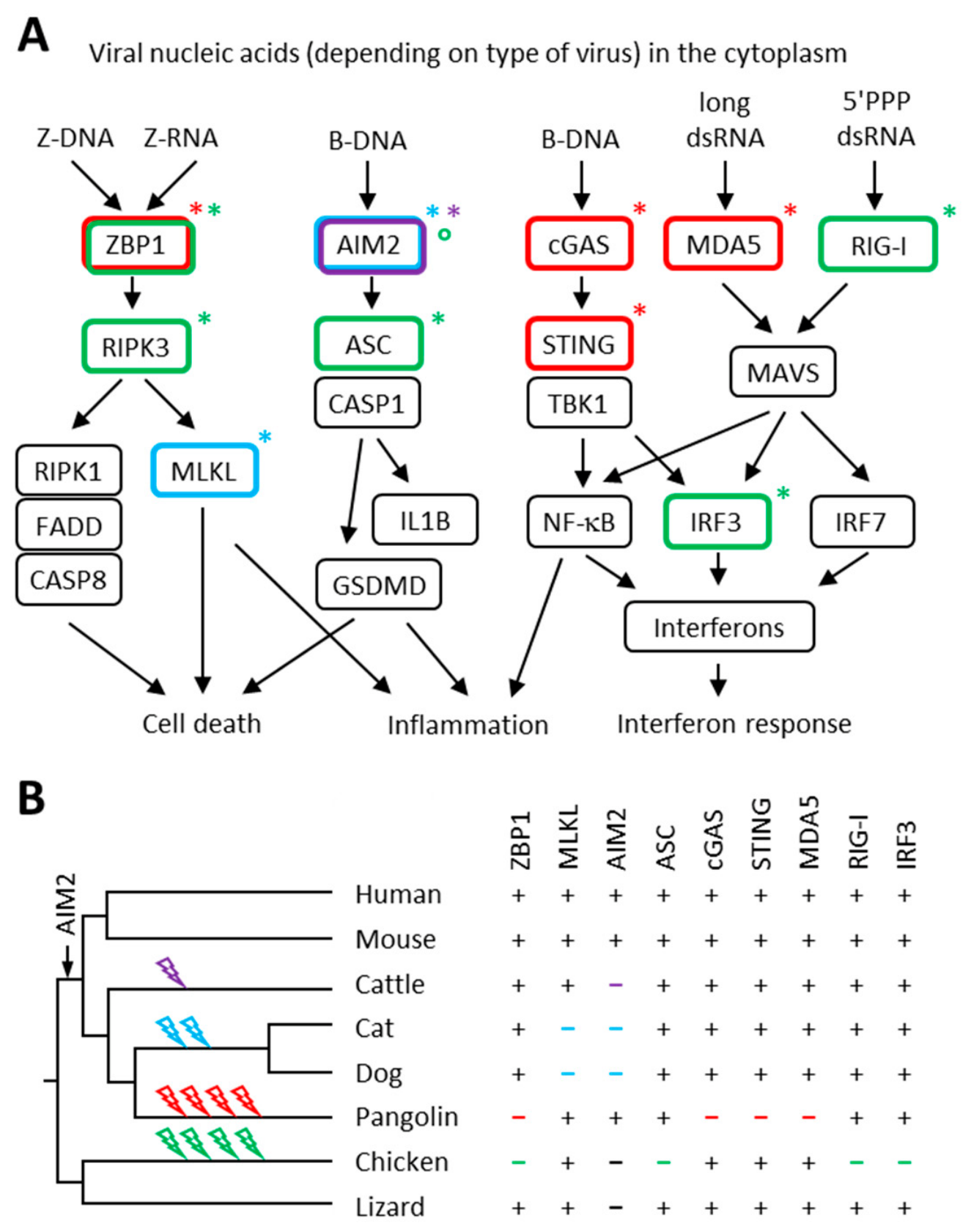
In addition to mammals, birds have long been investigated in immunology. Recent advances in genome sequencing have allowed insights into the genetics of avian immunology. Surprisingly, many cases of gene loss relevant for innate immunity have been detected in birds [46]. In the toll-like receptor (TLR) family of pattern recognition factors, TLR8 and TLR9 have been lost in chickens [47]. TLR8 is an endosomal receptor that binds single-stranded RNA (ssRNA), whereas TLR9 binds DNA in the endosome. TLR5, a receptor for bacterial flagellin, has been repeatedly lost in birds, for example, in the ground finch (Geospiza fortis) and the kea (Nestor notabilis) [48]. Similarly, the cytoplasmic double-stranded RNA (dsRNA) sensor RIG-I has been lost in landfowl, penguins, and other orders of birds [46,49,50,51] (Figure 1). Another sensor for dsRNA, interferon-induced with helicase C domain 1 (IFIH1)/MDA5, has been lost in cranes, auks, and other groups of birds [51]. Likewise, the sensor of the Z conformation of RNA and DNA, ZBP1 (also known as DAI), and a central protein of the downstream signaling and major regulator of necroptotic cell death, RIPK3, have been lost in all birds [52,53].
Figure 1.
Examples of gene loss in viral nucleic acid sensing pathways. (A) The diagram summarizes interactions between sensors, signaling, and effector proteins in pathways activated by the presence of viral nucleic acids in the cytoplasm of host cells. Proteins lost due to phylogenetic lineage-specific pseudogenization or complete gene loss are indicated by colored frames. *, absence of protein due to gene loss in cattle (purple), dog (light blue), pangolin (red), chicken (green). °, origin in mammals. (B) From the presence (+) or absence (−) of genes in modern species, gene loss (lightening symbol) during evolution was inferred. A vertical arrow indicates the evolutionary origin of AIM2. This figure is adapted from papers published by us under a Creative Commons CC-BY 4.0 license (open access) [54,55].
In contrast to mammals, birds appear to lack an inflammasome-dependent pathway responding to viral DNA in the cytoplasm. In mammals, AIM2 binds cytoplasmic DNA, initiates the formation of a large protein complex involving the adapter ASC (PYCARD) and caspase-1, which catalyzes the proteolytic maturation of interleukin-1 beta. AIM2 is absent in birds because it evolved in the mammalian lineage after the divergence from sauropsids (birds and reptiles). By contrast, ASC (PYCARD) has existed in the last common ancestor of mammals and birds, whereas it is absent in most species of birds that have been investigated [56]. Remarkably, the distribution of retained PYCARD genes among birds suggests that the gene has been lost repeatedly and independently in several lineages. Caspase-1 is conserved in the chicken and many other birds, but not in the most species-rich order, the songbirds [56]. The report on the loss of many inflammasome genes in birds acknowledged the possibility that the lack of a gene in a genome sequence “could occur if this region is particularly difficult to sequence” [56]. Indeed, this point is valid especially in birds. Sequence features, such as the expansion of short repeat sequences within intronic regions, complicate the sequencing of many avian genes [57]. However, recent high-quality genome sequences support the faithful detection of gene loss [58].
3.3. Loss of Innate Immunity-Related Genes in Bats
Bats are important reservoirs of multiple viruses with zoonotic potential. Accordingly, their immune system has attracted significant research interest. Studies have pointed to enhanced infection tolerance as a strategy of bats to control viruses [59,60]. At the genetic level, several immunogenetic peculiarities of bats have been reported and reviewed [61]. Notably, the loss of immunity-related genes has been detected in subgroups or the entire clade of bats. The PYRIN and HIN domain (PYHIN) gene family, which is largely conserved in mammals and comprises AIM2, IFI16, PYHIN1, POP3 and NMDA, is missing in bats [62,63], suggesting a decrease in the ability to sense and respond to cytoplasmic DNA. Bats have also lost OAS4 [64], an evolutionarily ancient member of the 2′-5′-oligoadenylate synthetase gene family [64,65]. However, some genes have bat-specific functions in the control of innate immunity. Retroposition of an OAS gene has generated OAS5, which is conserved in a subgroup of bats [64]. ASC2 (official gene symbol: PYDC1), a negative regulator of inflammasomes [66], is mainly expressed in differentiated keratinocytes of the human epidermis [67], whereas the ASC2/PYDC1 homolog of bats is expressed in macrophages and dendritic cells [66]. Due to four putative gain-of-function mutations, it inhibits inflammasomes more potently than human ASC2/PYDC1 [66]. Interestingly, bats manage to differentially induce specific interferon subtypes in the course of viral infections, thus mounting an effective immune response without becoming clinically ill [68,69,70].
3.4. Loss of Innate Immunity-Related Genes in Pangolins
Pangolins were suspected as a potential source of SARS-CoV2 during the early phase of the COVID pandemic [71]. This putative role, which was not confirmed later, triggered studies of antiviral genes in pangolins in comparison to other mammals. Strikingly, many genes implicated in antiviral defense have been either lost or pseudogenized in pangolins. Among cytoplasmic nucleic acid sensors, ZBP1, cGAS, MDA5, and the OAS family proteins OAS3, OAS4, OASL, and OASL2 have been lost during the evolution of pangolins [54,55,64]. In particular, the loss of cGAS is remarkable because this gene originated in a common ancestor of metazoans and remained intact in all mammalian species investigated so far, with the exception of pangolins. Furthermore, the adaptor protein STING, which functions downstream of cGAS, is absent in pangolins [55]. Pangolins have also lost NOD2, which is implicated in the response to several PAMPs, including nucleic acids [72]. Likewise, the sensors for the presence of bacterial flagellin in the cytoplasm, NLRC4 and NAIP, are inactivated by mutations in pangolins [72]. Interestingly, the sensor for the presence of bacterial flagellin in the endosome, TLR5, has also been lost in pangolins [73]. It has been hypothesized that gene losses may contribute to tolerance against infections or to putative adaptations related to the specialized insectivorous diet of pangolins. However, pangolins are susceptible to infectious diseases caused by various viral and bacterial pathogens and are able to transmit zoonotic pathogens [74].
3.5. Loss of Innate Immunity-Related Genes in Carnivorans
Carnivorans, comprising Feliformia (cats and related species) and Caniformia (canids and relatives), are phylogenetically closely related to pangolins and have also lost several immunity genes. They lack functional NLRC4 and NAIP [75]. The DNA sensor AIM2 and the cell death-inducing protein mixed lineage kinase domain-like pseudokinase (MLKL) have been lost in the dog and other carnivorans [52] (Figure 1). The fusion of the genes encoding caspase-1 and caspase-4 leading to a single caspase-1/4 gene [76] and domain duplications in caspase-12 [75] have altered the repertoire of proinflammatory caspases in carnivorans.
3.6. Loss of Innate Immunity-Related Genes in Other Vertebrates Including Humans
Gene loss has affected the control of innate immunity also in other phylogenetic lineages of amniotes and other vertebrates [77,78,79,80]. Here, we provide only a few further examples. Marsupials lack the central proteins of necroptosis, namely ZBP1, RIPK3 and MLKL [52]. Camelids have lost OAS2, OAS3 and one of two OASL paralogs [64]. Antiviral SAMD9 has been lost in bonobos (Pan paniscus), possibly in association with the evolution of resistance to lentiviruses [81].
In humans, loss-of-function alleles of DARC (Duffy antigen/chemokine receptor), encoded by the gene ACKR1, are present in populations exposed to the malaria pathogen Plasmodium vivax [35]. The loss of function of human caspase-12 (CASP12) was attributed to positive selection due to protection against sepsis [82]. However, the inactivation of CASP12 may have occurred earlier in evolution [83]. Caspase-16, which is related to the inflammatory caspases-1, -4 and -5 and the epidermal differentiation-associated caspase-14, has undergone pseudogenization in humans after their evolutionary divergence from other primates [84]. Caspase-15, the only pyrin domain-containing caspase of mammals, has been lost in Euarchontoglires (primates, treeshrews, colugos, lagomorphs, and rodents) [85]. The functions of CASP15 and CASP16 have not been determined yet and cannot be investigated by targeted gene deletion in the classical biomedical model species, the mouse, because the latter lacks both genes.
A medically important case of pseudogenization is the loss of functional interferon lambda 4 (IFN-λ4), which is associated with improved clearance of hepatitis C virus (HCV) [86,87]. Large-scale studies of gene polymorphisms have shown that IFNL4, belonging to the IFN-λ family of cytokines [88], has undergone adaptive pseudogenization in human populations [87]. Recently, viral RNA-induced IFN-λ was reported to cause damage to the lung barrier, increasing the susceptibility to bacterial superinfections [89]. Yet, IFN-λ has many protective effects against several pathogens [88]. Further investigation of the consequences of IFNL4 pseudogenization may help to design novel treatment approaches.
4. Models of Host–Pathogen Interaction Provide the Context for the Function of Immunity-Related Genes
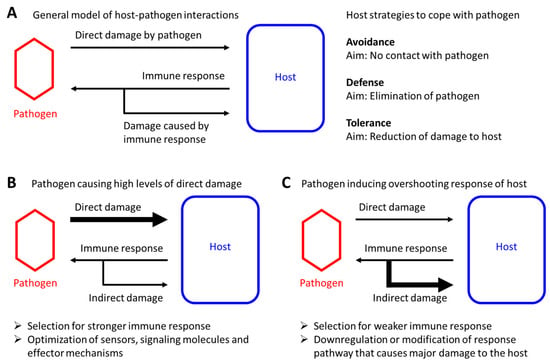
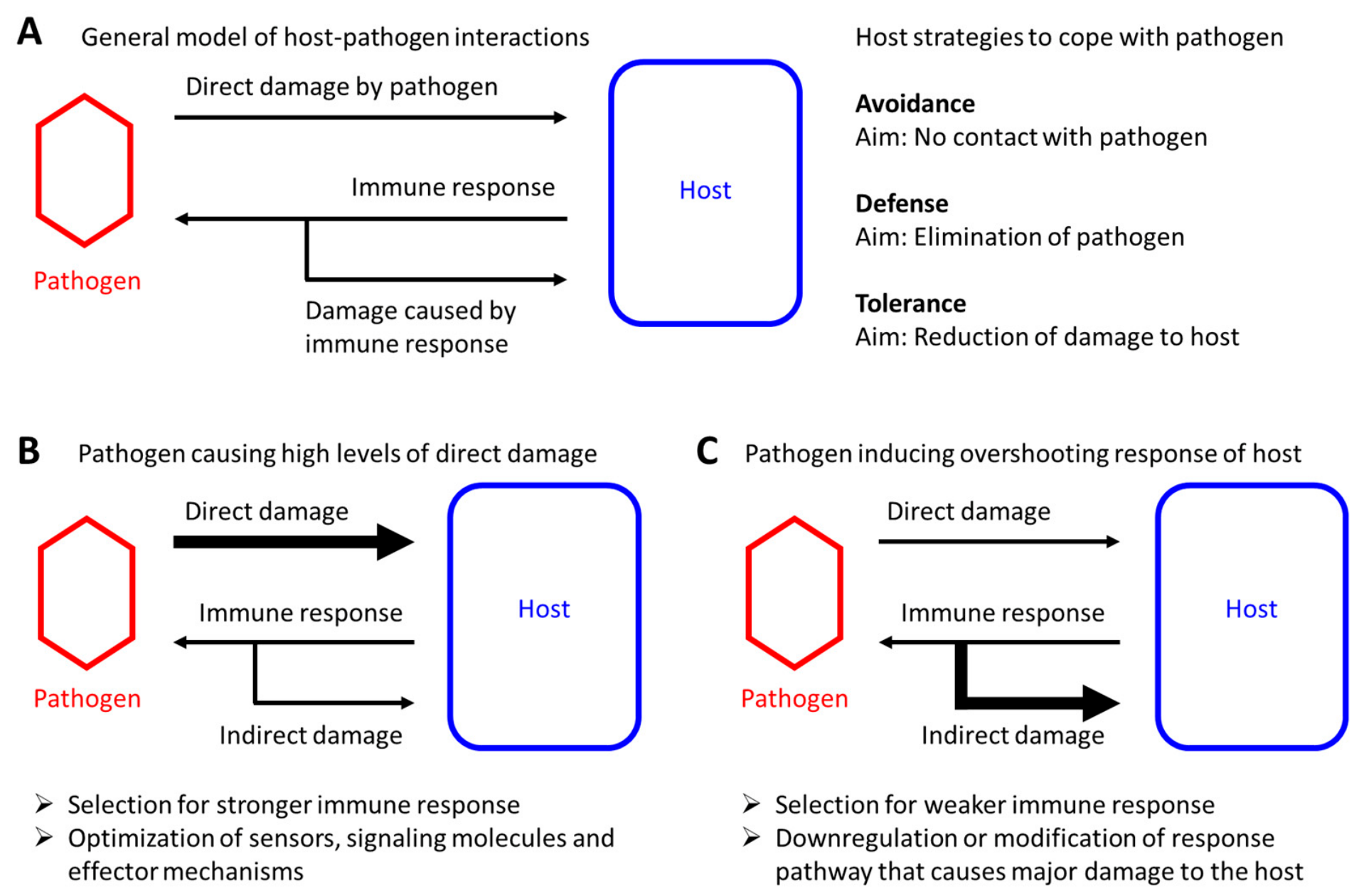
The triggers and consequences of immunity-related gene loss can be interpreted in the context of a generalized model of host–pathogen interactions. According to this simplistic model, pathogens cause damage to the host, manifesting in disease. The host mounts an immune response aimed at the elimination or containment of the pathogen in order to reduce the pathogen-induced damage. However, the host response also affects the host itself and often causes significant damage to host tissues (Figure 2A). The host response to the pathogen is complex at the molecular level, with many genes contributing to both the defense against the pathogen and to immunity-induced damage to the host as a side effect.
Figure 2.
Host–pathogen interactions as drivers of host evolution. (A) A general model of host–pathogen interactions has been modified from a published model for “Two types of fitness costs associated with infections” [90]. (B) Host–pathogen interactions involving pathogens that cause high levels of direct damage to the host. (C) Host–pathogen interactions involving high levels of damage to the host caused by an overshooting immune response. Hypotheses about evolutionary consequences are indicated below the diagrams in panels (B,C).
The main strategy of the host encountering a pathogen is aimed at the elimination of the pathogen [91,92]. For this strategy, we use the term “defense”. Several other publications use the term “resistance” [90,93], which, however, typically, i.e., in the vocabulary of clinicians, refers to the inability of a pathogen to attach to and/or enter the host organism due to anatomical and chemical barriers and genetic mutations in adequate receptors.
Alternative strategies to cope with pathogens are avoidance and tolerance. Avoidance reduces the exposure to the pathogen and the actual infection. It depends largely on sensors for carriers of pathogens and the behavior of the host. Genes controlling olfaction and the nervous system play critical roles in avoidance [94].
Tolerance allows the host to survive and to maintain or rapidly restore health despite infection with the pathogen [95,96,97,98]. It is important to note that, in this context, “tolerance” does not mean immunological tolerance to self-antigens or tolerance to some toxins upon repeated exposure. The genetic control of “clinical tolerance” involves both professional immune genes (here called “immunity-related genes”), which also control the defense/resistance against pathogens, and other physiologically important genes.
The interplay of defense, tolerance and avoidance is complex, and the distinction between “immunity-related genes” and other genes is ambiguous [99,100,101]. A complete coverage of all these aspects is beyond the scope of this review. We focus our discussion on genes that control the intensity and dynamics of the innate immune response of the host. In the evaluation of host–pathogen co-evolution we consider two situations, which can occur when a pathogen meets an individual or population that is not yet adapted to it. In the first extreme situation, the pathogen causes high levels of direct damage to the host, reducing survival and proliferation capacities, while the indirect damage mediated by the immune response of the host is low (Figure 2B). In the second situation, the pathogen causes a low level of direct damage to the host but triggers an overshooting immune response, which does cause severe damage (e.g., systemic inflammatory response syndrome) (Figure 2C). In both cases, there are strong constraints on the evolution of the host. In the first case, selection for a stronger immune response is a likely (though not necessary) scenario (Figure 2B), whereas selection for a weaker immune response is a likely scenario in the second case (Figure 2C). These changes can be achieved via different adaptations, for example, by the optimization of sensors, signaling molecules, and effector mechanisms (Figure 2B) or by downregulation or modification of the immune response pathway that damages the host (Figure 2C). At the level of host genes, these scenarios manifest in different types of sequence changes, as will be discussed in the next section. At the level of host–pathogen interaction strategies, these changes will have an impact on the balance between defense and tolerance.
5. Scenarios for Gene Loss in the Evolution of the Immune System
Innate immunity-related genes have appeared early in the evolution of life, as can be inferred from their presence in both prokaryotes and eukaryotes. Many of these genes have been conserved over hundreds of millions of years, demonstrating that they provided an advantage to the host and evolutionary selection acted against their loss. Gene duplication, recombination, and mutation have greatly increased the diversity of immune genes. However, specific immune genes have also been lost in some of the phylogenetic lineages, as we have discussed in Section 3.
While the conservation of immunity-related genes can be generally explained by negative selection against loss-of-function mutations in the presence of pathogens, gene duplications can occur under neutral evolution or under positive selection for higher expression levels, subfunctionalization, or neofunctionalization of the daughter genes [102]. Gene loss occurs when the selection for gene maintenance vanishes due to lack of exposure to the pathogen. This may be relevant during the evolutionary transition into life within a new environment (e.g., water-to-land or land-to-water transitions). If defense mechanisms against a pathogen are redundant, the cost of losing one mechanism may be low or zero, so that functionally redundant genes may be lost under neutral evolution. Finally, gene loss may be the result of positive selection, meaning that the absence of a gene provides an advantage and carriers of loss-of-function mutations are more successful in evolution.
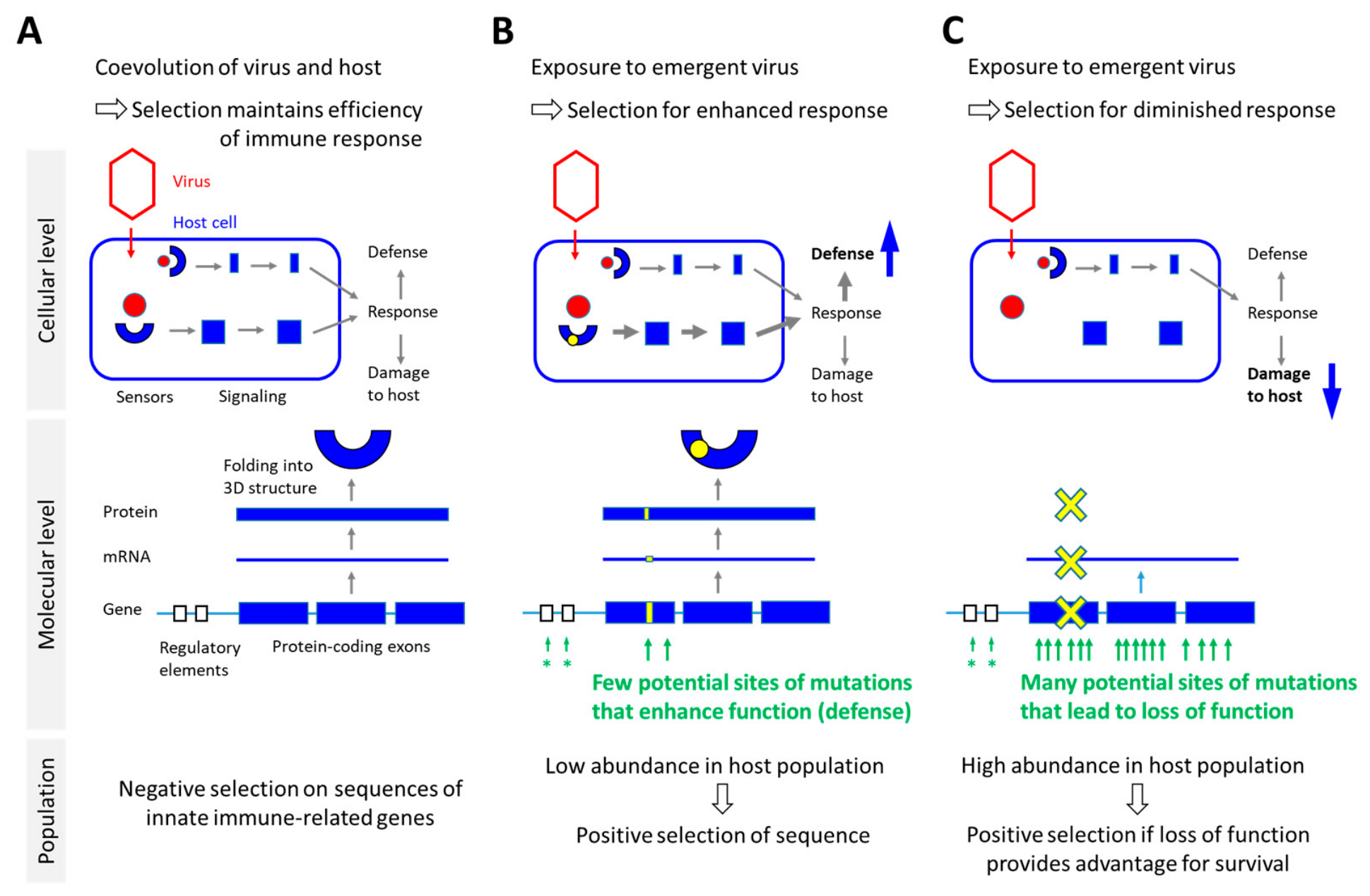
The observation of many examples of loss-of-function mutations of innate immunity-related genes (Figure 1) is compatible with the assumption that this is an important adaptation strategy in host–pathogen co-evolution. Based on the current literature, we cannot faithfully estimate the frequency of gene loss in immune genes, but we assume that this frequency is biologically significant. We propose the following model to explain the probably frequent occurrence of gene loss in the evolution of innate immunity (Figure 3).
Figure 3.
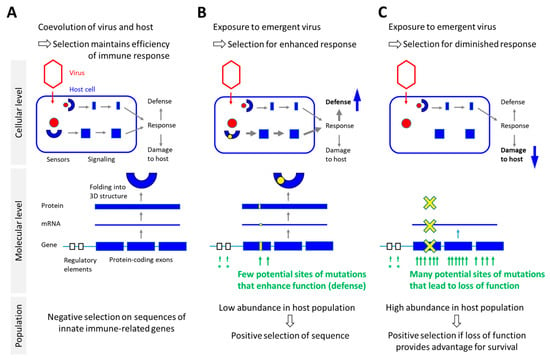
Gene loss as a potential mechanism of adaptation in the evolution of host–pathogen interactions. Three scenarios for the evolution of the host in response to exposure to pathogens are schematically depicted. (A) Co-evolution of hosts and established pathogens typically manifests in the maintenance of efficient defense due to negative selection on innate immunity-related and other genes. Two pathways of sensing viral molecules (red circles) in a host cell (blue oval) are schematically depicted. The selection disfavors gene loss. (B) Emergent, highly pathogenic virus strains can induce selection promoting an enhanced immune response that more efficiently eliminates the pathogen. The efficiency and speed of positive selection are limited by the pool of favorable gene variants (mutations) in the host population. We hypothesize that only a few new gene variants are associated with enhanced defense functions. Mutations (*) in regulatory elements change the expression level of the gene. (C) Emergent pathogens induce the selection for a diminished immune response if the original response excessively damages the host. One way to reduce or shut off a harmful response pathway is the selection for loss-of-function mutations in critical genes of the pathway. We hypothesize that more gene variants associated with decreased function than variants associated with enhanced function are present (in homozygous, heterozygous, or compound heterozygous states) in the host population. Loss-of-function is positively selected if it confers an advantage upon exposure to a particular pathogen.
In the basic scenario (Figure 3A), coevolution of a virus (or other pathogen) and a host over longer periods of time leads to selection that maintains the efficiency of the immune response. At the cellular level, typically more than one PAMP sensor and downstream signaling pathway initiate an immune response, leading to defense against the pathogen and a low level of damage to the host. Within the given population of hosts, negative selection acts on the sequences of innate immunity-related genes (Figure 3A).
Evolutionary change in host genes is triggered by exposure to an emergent virus or a new virus variant (Figure 3B). If the virus is sufficiently different from established viruses, its spread in the population cannot be efficiently controlled, and the infection exerts strong selective pressure on the host. As outlined in Figure 2, selection may support an enhanced immune response (either due to better sensing of the pathogen or better signaling and effector functions) to increase the defense. Given the optimization of immune defense proteins during previous evolution in the presence of various pathogens, it appears likely that only a few sites within these proteins are suitable for improving the function of the protein. Such alleles are rare in the host population. Positive selection will be successful if the host population is large (Figure 3B).
However, an emergent virus may exert its deleterious effects also primarily through indirect damage, which is inflicted by an overshooting or inappropriate immune response (Figure 2C). In that case, selection favors a diminished response, so that the damage to the host is reduced (Figure 3C). The maximal genetic suppression of an immune response is achieved by the loss of genes. Importantly, the number of sites suitable for gene-disrupting mutations is large, because a frameshift mutation or the conversion of a codon into a premature stop codon at any position of the gene, with the exception of positions close to the 3’-end of the coding sequence, will lead to the loss of function. In addition, many missense mutations lead to unfavorable changes in amino acid residues essential for protein function. It can be assumed that a large portion of loss-of-function alleles do not have deleterious effects in heterozygous carriers (besides a wild-type allele) [101,103]. Accordingly, the total abundance of loss-of-function alleles is relatively high in comparison to alleles enhancing the response to a given pathogen (Figure 3B,C). Thus, even small populations are likely to comprise loss-of-function alleles [103]. As essentially any combination of two loss-of-function alleles leads to the loss of the gene product, compound heterozygotes lacking the protein of interest are also expected to be frequent in many populations. If the loss of an innate immune response pathway provides an advantage upon the encounter with a pathogen and if the infection exerts strong constraints, positive selection for gene loss is predicted in this scenario (Figure 3C).
While this model illustrates the conditions of positive selection for immunity-related gene loss, it can be extended to include, for example, the following important aspects: First, regulatory elements of genes play important roles in the evolution of genes. Mutations of these promoter and enhancer elements contribute to the disruption of innate immunity pathways, and loss-of-function mutations are more likely than function-enhancing mutations, leading to similar considerations as those discussed for the coding sequence of immunity-related genes (Figure 3). Second, as schematically indicated in Figure 3, more than one response pathway is typically activated by a virus, so that the impact of mutations in one pathway depends on the efficiency of other pathways and possible interdependencies of pathways. Third, while the model focuses on a single emergent virus exerting strong selective constraints, the fixation of gene loss or other mutations in a population is also affected by the presence of other relevant pathogens, possible roles of pathways and genes in the control of host processes such as the replication of endogenous mobile genetic elements, and selective pressure over multiple generations. Fourth, the model shown in Figure 3 needs to incorporate further aspects of selection at the population level. In contrast to dominant alleles that enhance the function of a defense-related protein and provide an advantage already to the heterozygous carrier, loss-of-function alleles are typically recessive. According to the concept known as Haldane’s sieve, recessive alleles are less likely to fix in a population. However, this may not apply to adaptation from standing variation, population bottlenecks, and other conditions [104]. The theoretical background for the evolution of defense and tolerance has been reviewed previously [105,106,107,108].
6. Limitations and Perspectives
6.1. Limitations of Evidence and Evolutionary Models of Gene Loss
The current understanding of gene loss in the evolution of host immune systems has important limitations. The examples of gene loss discussed in Section 3 illustrate mutations that have occurred millions of years ago. It is largely unknown which pathogens were present at that time. However, comparative genomics facilitates the rapid identification of immune gene loss and the estimation of its time of occurrence in phylogeny. This information is valuable, but should be combined with the estimation of loss of genes unrelated to immunity.
Another major limitation is the incomplete knowledge of the immune system and infectious diseases in non-model species. For example, pangolins are wild animals that have only recently attracted much research interest when they were suspected to transmit SARS-CoV-2 [71]. Ongoing and future research needs to explore viral infections, interferon responses, and other relevant aspects of pangolins and other species of wildlife. To consider the pleiotropic functions of immunity-related genes, potential interactions with endogenous retroviral elements should be investigated also in non-model species. In this regard, it is interesting that pangolins have a reduced content of short interspersed nuclear elements (SINEs) [109], which potentially activate innate immune responses in other mammals [110].
6.2. Research Approaches for the Study of Gene Loss in Innate Immunity
Many comparative studies involving genomics, transcriptomics, and quantitative analyses of pathogen loads yield correlations. It is desirable to add investigations on selection at the population level and in experimental studies. The study of host populations before, during, and after exposure to pathogens may allow determination of the frequency of loss-of-function alleles [111]. However, as discussed above (Section 5), gene loss is selected only in specific situations, and the observation of gene loss in field studies may be a rare event. Population genetics in non-mammalian species promises to yield fundamental insights [112,113,114]. Notably, a study of bacterial infection of Drosophila flies did not detect selection for tolerance [115]. The potential benefit of immune gene loss in models of infectious diseases has been demonstrated in mice. For example, the deletion of ZBP1 protected against influenza virus-induced mortality at least under certain experimental conditions [116]. Mice lacking TLR9 showed reduced mortality in a model of polymicrobial sepsis [117]. Targeted deletions of caspase-11 or gasdermin D genes allowed mice to survive lethal doses of lipopolysaccharide (LPS), the bacterial cell wall component responsible for endotoxin shock [118,119]. Genetic inactivation of several pathways was required to block lethality due to overactivation of the NLRC4 inflammasome [120].
Human epidemiology in combination with genome sequence analysis is a promising field for testing the role of loss-of-function mutations in host–pathogen interactions. Human population genetics and paleogenomics might provide evidence for or against roles of gene loss in the evolution of the immune system [121,122,123]. Similarly, datasets from veterinary medicine should be considered for studies. In the context of wildlife medicine and species conservation, zoological institutions can provide valuable contributions to the characterization of species-specific immune responses and the underlying genetic factors [124,125,126,127].
The detection of evolutionary loss of cytosolic nucleic acid sensing and response pathways (Figure 1) may help to identify potential clinical treatment strategies for diseases that involve overreactions of innate immunity, such as acute respiratory distress syndrome, COVID-19 and sepsis. Assuming adaptive gene loss has occurred during the evolution of other species, the blockade of the corresponding human proteins may be beneficial in specific disease contexts. Chemical inhibitors targeting, for example, STING, RIG-I, or TLRs are under development [45]. However, the main aim of evolutionary immunology is not the definition of specific therapies but the improvement of the understanding of immune responses and host–pathogen interactions in general.
7. Conclusions
Loss-of-function mutations in genes of the innate immune system have occurred in many phylogenetic lineages. Evolutionary scenarios suggest that positive selection can drive the loss of immunity-related genes. Loss of genes appears to be most advantageous if it dampens or shuts off a pathway that is activated by a pathogen but causes severe damage to the host itself. Despite widespread occurrence of immunity-related gene loss, its role in the evolution of hosts has remained unclear. The collection of more genome data and knowledge about host–pathogen interactions in non-model species, studies in population genetics, and human and veterinary molecular epidemiology are likely to provide important insights relevant for immunology and its applications in medicine and public health.
Author Contributions
L.E.: Writing—original draft preparation; L.E., H.F. and W.S.: writing—review and editing. All authors have read and agreed to the published version of the manuscript.
Funding
This research received no external funding.
Institutional Review Board Statement
Not applicable.
Informed Consent Statement
Not applicable.
Data Availability Statement
No new data were created or analyzed in this study. Data sharing is not applicable to this article.
Acknowledgments
This work was supported by COST Action CA24133 (EVIM-NET, European network for animal evolutionary immunology), supported by COST (European Cooperation in Science and Technology).
Conflicts of Interest
The authors declare no conflicts of interest.
References
- Duggal, N.K.; Emerman, M. Evolutionary Conflicts Between Viruses and Restriction Factors Shape Immunity. Nat. Rev. Immunol. 2012, 12, 687–695. [Google Scholar] [CrossRef] [Scilit] [PubMed]
- Bolnick, D.I.; Fuess, L.E.; Graham, A.L.; Khan, I.; Steinel, N.C.; Vaziri, G.J. Evolutionary Immunology. Annu. Rev. Ecol. Evol. Syst. 2025, 56, 27–51. [Google Scholar] [CrossRef] [Scilit]
- Boehm, T. Understanding Vertebrate Immunity Through Comparative Immunology. Nat. Rev. Immunol. 2025, 25, 141–152. [Google Scholar] [CrossRef] [Scilit] [PubMed]
- Martín-González, L.; Ramos, B.; Huang, Y.; Thurston, T.; Towers, G.; Lobato-Márquez, D. Cell-Autonomous Immunity as an Integrated Immune Network Against Bacterial and Viral Pathogens. Nat. Microbiol. 2026, 11, 2098–2111. [Google Scholar] [CrossRef] [Scilit] [PubMed]
- Laub, M.T.; Typas, A. Principles of Bacterial Innate Immunity Against Viruses. Curr. Opin. Immunol. 2024, 89, 102445. [Google Scholar] [CrossRef] [Scilit] [PubMed]
- Ledvina, H.E.; Whiteley, A.T. Conservation and Similarity of Bacterial and Eukaryotic Innate Immunity. Nat. Rev. Microbiol. 2024, 22, 420–434. [Google Scholar] [CrossRef] [Scilit] [PubMed]
- Lee, H.; Luengo-Woods, S.; Zhang, J.; Makarova, K.S.; Wolf, Y.I.; Chiu, C.; Evans, S.A.; Chen, J.; Xiao, H.; Feng, L.; et al. Diverse Bacterial Pattern Recognition Receptors Sense the Core Phage Proteome. Nature 2026, 657, 735–743. [Google Scholar] [CrossRef] [Scilit] [PubMed]
- Huang, Y.; Jiang, W.; Zhou, R. DAMP Sensing and Sterile Inflammation: Intracellular, Intercellular and Inter-Organ Pathways. Nat. Rev. Immunol. 2024, 24, 703–719. [Google Scholar] [CrossRef] [Scilit] [PubMed]
- Kroemer, G.; Montégut, L.; Kepp, O.; Zitvogel, L. The Danger Theory of Immunity Revisited. Nat. Rev. Immunol. 2024, 24, 912–928. [Google Scholar] [CrossRef] [Scilit] [PubMed]
- Zou, C.; Ma, T.; Li, J.; Zhou, X. Innate Immunity: Current Understandings and Future Perspectives. Signal Transduct. Target. Ther. 2026, 11, 321. [Google Scholar] [CrossRef] [Scilit] [PubMed]
- Dostert, C.; Pétrilli, V.; Van Bruggen, R.; Steele, C.; Mossman, B.T.; Tschopp, J. Innate Immune Activation Through Nalp3 Inflammasome Sensing of Asbestos and Silica. Science 2008, 320, 674–677. [Google Scholar] [CrossRef] [Scilit] [PubMed]
- Vinkler, M.; Fiddaman, S.R.; Těšický, M.; O’Connor, E.A.; Savage, A.E.; Lenz, T.L.; Smith, A.L.; Kaufman, J.; Bolnick, D.I.; Davies, C.S.; et al. Understanding the Evolution of Immune Genes in Jawed Vertebrates. J. Evol. Biol. 2023, 36, 847–873. [Google Scholar] [CrossRef] [Scilit] [PubMed]
- Modzelewski, A.J.; Gan Chong, J.; Wang, T.; He, L. Mammalian Genome Innovation Through Transposon Domestication. Nat. Cell Biol. 2022, 24, 1332–1340. [Google Scholar] [CrossRef] [Scilit] [PubMed]
- Kaessmann, H. Origins, Evolution, and Phenotypic Impact of New Genes. Genome Res. 2010, 20, 1313–1326. [Google Scholar] [CrossRef] [Scilit] [PubMed]
- Albalat, R.; Cañestro, C. Evolution by Gene Loss. Nat. Rev. Genet. 2016, 17, 379–391. [Google Scholar] [CrossRef] [Scilit] [PubMed]
- Sharma, V.; Hecker, N.; Roscito, J.G.; Foerster, L.; Langer, B.E.; Hiller, M. A Genomics Approach Reveals Insights Into the Importance of Gene Losses for Mammalian Adaptations. Nat. Commun. 2018, 9, 1215. [Google Scholar] [CrossRef] [Scilit] [PubMed]
- Salmena, L. Pseudogenes: Four Decades of Discovery. Methods Mol. Biol. 2021, 2324, 3–18. [Google Scholar] [CrossRef] [Scilit] [PubMed]
- Dobrynin, P.; Liu, S.; Tamazian, G.; Xiong, Z.; Yurchenko, A.A.; Krasheninnikova, K.; Kliver, S.; Schmidt-Küntzel, A.; Koepfli, K.P.; Johnson, W.; et al. Genomic Legacy of the African Cheetah, Acinonyx jubatus. Genome Biol. 2015, 16, 277. [Google Scholar] [CrossRef] [Scilit] [PubMed]
- Olson, M.V. When Less Is More: Gene Loss as an Engine of Evolutionary Change. Am. J. Hum. Genet. 1999, 64, 18–23. [Google Scholar] [CrossRef] [Scilit] [PubMed]
- Helsen, J.; Voordeckers, K.; Vanderwaeren, L.; Santermans, T.; Tsontaki, M.; Verstrepen, K.J.; Jelier, R. Gene Loss Predictably Drives Evolutionary Adaptation. Mol. Biol. Evol. 2020, 37, 2989–3002. [Google Scholar] [CrossRef] [Scilit] [PubMed]
- Peláez, J.N.; Gloss, A.D.; Goldman-Huertas, B.; Kim, B.; Lapoint, R.T.; Pimentel-Solorio, G.; Verster, K.I.; Aguilar, J.M.; Nelson Dittrich, A.C.; Singhal, M.; et al. Evolution of Chemosensory and Detoxification Gene Families Across Herbivorous Drosophilidae. G3 Genes Genomes Genet. 2023, 13, jkad133. [Google Scholar] [CrossRef] [Scilit] [PubMed]
- Kratzer, J.T.; Lanaspa, M.A.; Murphy, M.N.; Cicerchi, C.; Graves, C.L.; Tipton, P.A.; Ortlund, E.A.; Johnson, R.J.; Gaucher, E.A. Evolutionary History and Metabolic Insights of Ancient Mammalian Uricases. Proc. Natl. Acad. Sci. USA 2014, 111, 3763–3768. [Google Scholar] [CrossRef] [Scilit] [PubMed]
- Thyssen, J.P.; Bikle, D.D.; Elias, P.M. Evidence That Loss-of-Function Filaggrin Gene Mutations Evolved in Northern Europeans to Favor Intracutaneous Vitamin D3 Production. Evol. Biol. 2014, 41, 388–396. [Google Scholar] [CrossRef] [Scilit] [PubMed]
- Khatib, C.M.; Klein-Petersen, A.W.; Rønnstad, A.T.M.; Egeberg, A.; Christensen, M.O.; Silverberg, J.I.; Thomsen, S.F.; Irvine, A.D.; Thyssen, J.P. Increased Loss-of-Function Filaggrin Gene Mutation Prevalence in Atopic Dermatitis Patients Across Northern Latitudes Indicates Genetic Fitness: A Systematic Review and Meta-Analysis. Exp. Dermatol. 2024, 33, e15130. [Google Scholar] [CrossRef] [Scilit] [PubMed]
- Balatsky, V.; Saienko, A.; Peka, M. Causal Variants in Animal Genomes: Approaches to Identification, Phenotypic Impact, and Implications for Selective Breeding. BMC Genom. 2026, 27, 712. [Google Scholar] [CrossRef] [Scilit] [PubMed]
- Grobet, L.; Martin, L.J.; Poncelet, D.; Pirottin, D.; Brouwers, B.; Riquet, J.; Schoeberlein, A.; Dunner, S.; Ménissier, F.; Massabanda, J.; et al. A Deletion in the Bovine Myostatin Gene Causes the Double-Muscled Phenotype in Cattle. Nat. Genet. 1997, 17, 71–74. [Google Scholar] [CrossRef] [Scilit] [PubMed]
- McPherron, A.C.; Lee, S.J. Double Muscling in Cattle Due to Mutations in the Myostatin Gene. Proc. Natl. Acad. Sci. USA 1997, 94, 12457–12461. [Google Scholar] [CrossRef] [Scilit] [PubMed]
- Rieder, S.; Taourit, S.; Mariat, D.; Langlois, B.; Guérin, G. Mutations in the Agouti (ASIP), the Extension (MC1R), and the Brown (TYRP1) Loci and Their Association to Coat Color Phenotypes in Horses (Equus caballus). Mamm. Genome 2001, 12, 450–455. [Google Scholar] [CrossRef] [Scilit] [PubMed]
- Schneider, A.; David, V.A.; Johnson, W.E.; O’Brien, S.J.; Barsh, G.S.; Menotti-Raymond, M.; Eizirik, E. How the Leopard Hides Its Spots: ASIP Mutations and Melanism in Wild Cats. PLoS ONE 2012, 7, e50386. [Google Scholar] [CrossRef] [Scilit] [PubMed]
- Schneider, A.; Henegar, C.; Day, K.; Absher, D.; Napolitano, C.; Silveira, L.; David, V.A.; O’Brien, S.J.; Menotti-Raymond, M.; Barsh, G.S.; et al. Recurrent Evolution of Melanism in South American Felids. PLoS Genet. 2015, 11, e1004892. [Google Scholar] [CrossRef] [Scilit] [PubMed]
- Tensen, L.; Fischer, K. Heterozygosity Is Low Where Rare Color Variants in Wild Carnivores Prevail. Ecol. Evol. 2024, 14, e10881. [Google Scholar] [CrossRef] [Scilit] [PubMed]
- Casanova, J.L.; Abel, L. Human genetics of infectious diseases: Unique insights into immunological redundancy. Semin. Immunol. 2018, 36, 1–12. [Google Scholar] [CrossRef] [Scilit] [PubMed]
- Miller, L.H.; Mason, S.J.; Dvorak, J.A.; McGinniss, M.H.; Rothman, I.K. Erythrocyte Receptors for (Plasmodium knowlesi) Malaria: Duffy Blood Group Determinants. Science 1975, 189, 561–563. [Google Scholar] [CrossRef] [Scilit] [PubMed]
- Tournamille, C.; Colin, Y.; Cartron, J.P.; Le Van Kim, C. Disruption of a GATA Motif in the Duffy Gene Promoter Abolishes Erythroid Gene Expression in Duffy-Negative Individuals. Nat. Genet. 1995, 10, 224–228. [Google Scholar] [CrossRef] [Scilit] [PubMed]
- Hamblin, M.T.; Thompson, E.E.; Di Rienzo, A. Complex Signatures of Natural Selection at the Duffy Blood Group Locus. Am. J. Hum. Genet. 2002, 70, 369–383. [Google Scholar] [CrossRef] [Scilit] [PubMed]
- Samson, M.; Libert, F.; Doranz, B.J.; Rucker, J.; Liesnard, C.; Farber, C.M.; Saragosti, S.; Lapoumeroulie, C.; Cognaux, J.; Forceille, C.; et al. Resistance to HIV-1 Infection in Caucasian Individuals Bearing Mutant Alleles of the CCR-5 Chemokine Receptor Gene. Nature 1996, 382, 722–725. [Google Scholar] [CrossRef] [Scilit] [PubMed]
- Nordgren, J.; Ågren, R.; Hu, D.Z.; Neijd, M.; Childebayeva, A.; Prüfer, K.; Hagbom, M.; Svensson, L.; Zeberg, H. Natural Selection of a Virus-Protective FUT2 Variant Following the Transition to Agriculture. Mol. Biol. Evol. 2025, 42, msaf243. [Google Scholar] [CrossRef] [Scilit] [PubMed]
- Morrissey, K.A.; Sampson, J.M.; Rivera, M.; Bu, L.; Hansen, V.L.; Gemmell, N.J.; Gardner, M.G.; Bertozzi, T.; Miller, R.D. Comparison of Reptilian Genomes Reveals Deletions Associated With the Natural Loss of γδ T Cells in Squamates. J. Immunol. 2022, 208, 1960–1967. [Google Scholar] [CrossRef] [Scilit] [PubMed]
- Martinez-Barnetche, J.; Godoy-Lozano, E.E.; Saint Remy-Hernández, S.; Pacheco-Olvera, D.L.; Téllez-Sosa, J.; Valdovinos-Torres, H.; Pastelin-Palacios, R.; Mena, H.; Zambrano, L.; López-Macías, C. Characterization of Immunoglobulin Loci in the Gigantic Genome of Ambystoma mexicanum. Front. Immunol. 2023, 14, 1039274. [Google Scholar] [CrossRef] [Scilit] [PubMed]
- Solbakken, M.H.; Tørresen, O.K.; Tooming-Klunderud, A.; Skage, M.; Bakken, T.; Jakobsen, K.S. Loss of Major Histocompatibility Complex I and II Function in the Genome of Glacier Lanternfish Provides Insight Into Evolution of Vertebrate Immune Systems. Genome Biol. Evol. 2026, 18, evag154. [Google Scholar] [CrossRef] [Scilit] [PubMed]
- Sipos, W.; Schmoll, F.; Wimmers, K. Selection for Disease Resistance in Domestic Ruminants and Swine by Indicator Traits as Well as Marker and Causal Genes—A Review. Part 1: Short Introduction to Immunogenetics of MHC and Non-MHC Genes and Special Immunogenetics of Cattle and Swine. Dtsch. Tierärztliche Wochenschr. 2002, 109, 470–480. [Google Scholar]
- Sipos, W.; Schmoll, F.; Wimmers, K. Selection for Disease and Epidemic Resistance in Domestic Ruminants and Swine by Indicator Traits, Marker and Causal Genes—A Review. Part 2: Special Immunogenetics of Sheep and Goats With Particular Regard for Endoparasitoses, Scrapie, Foot Rot and Maedi-Visna Virus Infection. Dtsch. Tierärztliche Wochenschr. 2003, 110, 3–10. [Google Scholar]
- Bean, A.G.; Baker, M.L.; Stewart, C.R.; Cowled, C.; Deffrasnes, C.; Wang, L.F.; Lowenthal, J.W. Studying Immunity to Zoonotic Diseases in the Natural Host—Keeping It Real. Nat. Rev. Immunol. 2013, 13, 851–861. [Google Scholar] [CrossRef] [Scilit] [PubMed]
- Mandl, J.N.; Ahmed, R.; Barreiro, L.B.; Daszak, P.; Epstein, J.H.; Virgin, H.W.; Feinberg, M.B. Reservoir Host Immune Responses to Emerging Zoonotic Viruses. Cell 2015, 160, 20–35. [Google Scholar] [CrossRef] [Scilit] [PubMed]
- Chen, Z.; Behrendt, R.; Wild, L.; Schlee, M.; Bode, C. Cytosolic Nucleic Acid Sensing as Driver of Critical Illness: Mechanisms and Advances in Therapy. Signal Transduct. Target. Ther. 2025, 10, 90. [Google Scholar] [CrossRef] [Scilit] [PubMed]
- Magor, K.E.; Miranzo Navarro, D.; Barber, M.R.; Petkau, K.; Fleming-Canepa, X.; Blyth, G.A.; Blaine, A.H. Defense Genes Missing From the Flight Division. Dev. Comp. Immunol. 2013, 41, 377–388. [Google Scholar] [CrossRef] [Scilit] [PubMed]
- Temperley, N.D.; Berlin, S.; Paton, I.R.; Griffin, D.K.; Burt, D.W. Evolution of the Chicken Toll-Like Receptor Gene Family: A Story of Gene Gain and Gene Loss. BMC Genom. 2008, 9, 62. [Google Scholar] [CrossRef] [Scilit] [PubMed]
- Velová, H.; Gutowska-Ding, M.W.; Burt, D.W.; Vinkler, M. Toll-Like Receptor Evolution in Birds: Gene Duplication, Pseudogenization, and Diversifying Selection. Mol. Biol. Evol. 2018, 35, 2170–2184. [Google Scholar] [CrossRef] [Scilit] [PubMed]
- Barber, M.R.; Aldridge, J.R., Jr.; Webster, R.G.; Magor, K.E. Association of RIG-I With Innate Immunity of Ducks to Influenza. Proc. Natl. Acad. Sci. USA 2010, 107, 5913–5918. [Google Scholar] [CrossRef] [Scilit] [PubMed]
- Krchlíková, V.; Hron, T.; Těšický, M.; Li, T.; Hejnar, J.; Vinkler, M.; Elleder, D. Repeated MDA5 Gene Loss in Birds: An Evolutionary Perspective. Viruses 2021, 13, 2131. [Google Scholar] [CrossRef] [Scilit] [PubMed]
- Krchlíková, V.; Hron, T.; Těšický, M.; Li, T.; Ungrová, L.; Hejnar, J.; Vinkler, M.; Elleder, D. Dynamic Evolution of Avian RNA Virus Sensors: Repeated Loss of RIG-I and RIPLET. Viruses 2022, 15, 3. [Google Scholar] [CrossRef] [Scilit] [PubMed]
- Dondelinger, Y.; Hulpiau, P.; Saeys, Y.; Bertrand, M.J.M.; Vandenabeele, P. An Evolutionary Perspective on the Necroptotic Pathway. Trends Cell Biol. 2016, 26, 721–732. [Google Scholar] [CrossRef] [Scilit] [PubMed]
- Lv, S.; Jiang, Y.; Li, Y.; Huang, R.; Peng, L.; Ma, Z.; Lu, N.; Lin, X.; Yan, J. Comparative and Evolutionary Analysis of RIP Kinases in Immune Responses. Front. Genet. 2022, 13, 796291. [Google Scholar] [CrossRef] [Scilit] [PubMed]
- Fischer, H.; Tschachler, E.; Eckhart, L. Pangolins Lack IFIH1/MDA5, a Cytoplasmic RNA Sensor That Initiates Innate Immune Defense Upon Coronavirus Infection. Front. Immunol. 2020, 11, 939. [Google Scholar] [CrossRef] [Scilit] [PubMed]
- Fischer, H.; Tschachler, E.; Eckhart, L. Cytosolic DNA Sensing Through cGAS and STING Is Inactivated by Gene Mutations in Pangolins. Apoptosis 2020, 25, 474–480. [Google Scholar] [CrossRef] [Scilit] [PubMed]
- Billman, Z.P.; Hancks, D.C.; Miao, E.A. Unanticipated Loss of Inflammasomes in Birds. Genome Biol. Evol. 2024, 16, evae138. [Google Scholar] [CrossRef] [Scilit] [PubMed]
- Hron, T.; Miklík, D.; Pačes, J.; Pajer, P.; Pečenka, V.; Hejnar, J.; Nehyba, J.; Elleder, D. Decoding the Avian Missing Gene Mystery: Dot Chromosomes Unmask Extensive Gene Loss and Novel Genetic Instability. Genome Biol. Evol. 2026, 18, evag038. [Google Scholar] [CrossRef] [Scilit] [PubMed]
- Formenti, G.; Jain, N.; Medico, J.A.; Sollitto, M.; Antipov, D.; Barcellos, S.; Biegler, M.; Borges, I.; Chang, J.K.; Chen, Y.; et al. The Complete Genome of a Songbird. Cell 2026, 189, 4922–4945.e12. [Google Scholar] [CrossRef] [Scilit] [PubMed]
- Pavlovich, S.S.; Lovett, S.P.; Koroleva, G.; Guito, J.C.; Arnold, C.E.; Nagle, E.R.; Kulcsar, K.; Lee, A.; Thibaud-Nissen, F.; Hume, A.J.; et al. The Egyptian Rousette Genome Reveals Unexpected Features of Bat Antiviral Immunity. Cell 2018, 173, 1098–1110.e18. [Google Scholar] [CrossRef] [Scilit] [PubMed]
- Morales, A.E.; Dong, Y.; Brown, T.; Baid, K.; Kontopoulos, D.-G.; Gonzalez, V.; Huang, Z.; Ahmed, A.W.; Bhuinya, A.; Hilgers, L.; et al. Bat Genomes Illuminate Adaptations to Viral Tolerance and Disease Resistance. Nature 2025, 638, 449–458. [Google Scholar] [CrossRef] [Scilit] [PubMed]
- Irving, A.T.; Ahn, M.; Goh, G.; Anderson, D.E.; Wang, L.F. Lessons From the Host Defences of Bats, a Unique Viral Reservoir. Nature 2021, 589, 363–370. [Google Scholar] [CrossRef] [Scilit] [PubMed]
- Cridland, J.A.; Curley, E.Z.; Wykes, M.N.; Schroder, K.; Sweet, M.J.; Roberts, T.L.; Ragan, M.A.; Kassahn, K.S.; Stacey, K.J. The Mammalian PYHIN Gene Family: Phylogeny, Evolution and Expression. BMC Evol. Biol. 2012, 12, 140. [Google Scholar] [CrossRef] [Scilit] [PubMed]
- Ahn, M.; Cui, J.; Irving, A.T.; Wang, L.F. Unique Loss of the PYHIN Gene Family in Bats Amongst Mammals: Implications for Inflammasome Sensing. Sci. Rep. 2016, 6, 21722. [Google Scholar] [CrossRef] [Scilit] [PubMed]
- Eckhart, L.; Sipos, W. Differential Loss of OAS Genes Indicates Diversification of Antiviral Immunity in Mammals. Vaccines 2023, 11, 419. [Google Scholar] [CrossRef] [Scilit] [PubMed]
- Wang, X.; Hu, J.; Song, L.; Rong, E.; Yang, C.; Chen, X.; Pu, J.; Sun, H.; Gao, C.; Burt, D.W.; et al. Functional Divergence of Oligoadenylate Synthetase 1 (OAS1) Proteins in Tetrapods. Sci. China Life Sci. 2022, 65, 1395–1412. [Google Scholar] [CrossRef] [Scilit] [PubMed]
- Ahn, M.; Chen, V.C.; Rozario, P.; Ng, W.L.; Kong, P.S.; Sia, W.R.; Kang, A.E.Z.; Su, Q.; Nguyen, L.H.; Zhu, F.; et al. Bat ASC2 Suppresses Inflammasomes and Ameliorates Inflammatory Diseases. Cell 2023, 186, 2144–2159.e22. [Google Scholar] [CrossRef] [Scilit] [PubMed]
- Lachner, J.; Mlitz, V.; Tschachler, E.; Eckhart, L. Epidermal cornification is preceded by the expression of a keratinocyte-specific set of pyroptosis-related genes. Sci. Rep. 2017, 7, 17446. [Google Scholar] [CrossRef] [Scilit] [PubMed]
- Shankar, E.M.; Che, K.F.; Yong, Y.K.; Girija, A.S.S.; Velu, V.; Ansari, A.W.; Larsson, M. Asymptomatic SARS-CoV-2 Infection: Is It All About Being Refractile to Innate Immune Sensing of Viral Spare-Parts?-Clues From Exotic Animal Reservoirs. Pathog. Dis. 2021, 79, ftaa076. [Google Scholar] [CrossRef] [Scilit] [PubMed]
- Al-Eitan, L.; Mihyar, A.; Zhang, L.; Bisht, P.; Jaenisch, R. Genomic and Biological Variation in Bat IFNs: An Antiviral Treatment Approach. Rev. Med. Virol. 2024, 34, e2488. [Google Scholar] [CrossRef] [Scilit] [PubMed]
- Pei, G.; Balkema-Buschmann, A.; Dorhoi, A. Disease Tolerance as Immune Defense Strategy in Bats: One Size Fits All? PLoS Pathog. 2024, 20, e1012471. [Google Scholar] [CrossRef] [Scilit] [PubMed]
- Lam, T.T.; Jia, N.; Zhang, Y.W.; Shum, M.H.; Jiang, J.F.; Zhu, H.C.; Tong, Y.G.; Shi, Y.X.; Ni, X.B.; Liao, Y.S.; et al. Identifying SARS-CoV-2-Related Coronaviruses in Malayan Pangolins. Nature 2020, 583, 282–285. [Google Scholar] [CrossRef] [Scilit] [PubMed]
- Salova, M.; Sipos, W.; Tschachler, E.; Eckhart, L. NOD2 and Reproduction-Associated NOD-Like Receptors Have Been Lost During the Evolution of Pangolins. Immunogenetics 2022, 74, 261–268. [Google Scholar] [CrossRef] [Scilit] [PubMed]
- Sharma, V.; Hecker, N.; Walther, F.; Stuckas, H.; Hiller, M. Convergent Losses of TLR5 Suggest Altered Extracellular Flagellin Detection in Four Mammalian Lineages. Mol. Biol. Evol. 2020, 37, 1847–1854. [Google Scholar] [CrossRef] [Scilit] [PubMed]
- Lin, X.-D.; Quan, S.-W.; Lv, J.-X.; Liu, M.-Q.; Pei, Y.-Y.; Liu, X.; Luo, X.-Q.; Meng, H.-F.; Chen, Y.-M.; Zhang, Y.-Z. Multiple Etiological Agents Associated With the Deaths of Trafficked Pangolins. Zool. Res. 2026, 47, 279–288. [Google Scholar] [CrossRef] [Scilit] [PubMed]
- Eckhart, L.; Ballaun, C.; Uthman, A.; Gawlas, S.; Buchberger, M.; Fischer, H.; Tschachler, E. Duplication of the Caspase-12 Prodomain and Inactivation of NLRC4/IPAF in the Dog. Biochem. Biophys. Res. Commun. 2009, 384, 226–230. [Google Scholar] [CrossRef] [Scilit] [PubMed]
- Eckhart, L.; Ballaun, C.; Hermann, M.; VandeBerg, J.L.; Sipos, W.; Uthman, A.; Fischer, H.; Tschachler, E. Identification of Novel Mammalian Caspases Reveals an Important Role of Gene Loss in Shaping the Human Caspase Repertoire. Mol. Biol. Evol. 2008, 25, 831–841. [Google Scholar] [CrossRef] [Scilit] [PubMed]
- Wang, X.; Grus, W.E.; Zhang, J. Gene Losses During Human Origins. PLoS Biol. 2006, 4, e52. [Google Scholar] [CrossRef] [Scilit] [PubMed]
- van der Loo, W.; Magalhaes, M.J.; de Matos, A.L.; Abrantes, J.; Yamada, F.; Esteves, P.J. Adaptive Gene Loss? Tracing Back the Pseudogenization of the Rabbit CCL8 Chemokine. J. Mol. Evol. 2016, 83, 12–25. [Google Scholar] [CrossRef] [Scilit] [PubMed]
- Solbakken, M.H.; Rise, M.L.; Jakobsen, K.S.; Jentoft, S. Successive Losses of Central Immune Genes Characterize the Gadiformes’ Alternate Immunity. Genome Biol. Evol. 2016, 8, 3508–3515. [Google Scholar] [CrossRef] [Scilit] [PubMed]
- Schelle, L.; Côrte-Real, J.V.; Fayyaz, S.; Del Pozo Ben, A.; Shnipova, M.; Petersen, M.; Lotke, R.; Menon, B.; Matzek, D.; Pfaff, L.; et al. Evolutionary and Functional Characterization of Lagomorph Guanylate-Binding Proteins: A Story of Gain and Loss and Shedding Light on Expression, Localization and Innate Immunity-Related Functions. Front. Immunol. 2024, 15, 1303089. [Google Scholar] [CrossRef] [Scilit] [PubMed]
- Legrand, A.; Demeure, R.; Chantharath, A.; Rey, C.; Baltenneck, J.; Gilchrist, C.L.M.; Rocha, J.L.; Loyer, C.; Picard, L.; Cimarelli, A.; et al. Evolutionary Characterization of Antiviral SAMD9/9L Across Kingdoms Supports Ancient Convergence and Lineage-Specific Adaptations. Nat. Ecol. Evol. 2025, 9, 2206–2222. [Google Scholar] [CrossRef] [Scilit] [PubMed]
- Xue, Y.; Daly, A.; Yngvadottir, B.; Liu, M.; Coop, G.; Kim, Y.; Sabeti, P.; Chen, Y.; Stalker, J.; Huckle, E.; et al. Spread of an Inactive Form of Caspase-12 in Humans Is Due to Recent Positive Selection. Am. J. Hum. Genet. 2006, 78, 659–670. [Google Scholar] [CrossRef] [Scilit] [PubMed]
- Holland, M.; Rutkowski, R.; Levin, T.C. Evolutionary Dynamics of Proinflammatory Caspases in Primates and Rodents. Mol. Biol. Evol. 2024, 41, msae220. [Google Scholar] [CrossRef] [Scilit] [PubMed]
- Eckhart, L.; Sachslehner, A.P.; Steinbinder, J.; Fischer, H. Caspase Domain Duplication During the Evolution of Caspase-16. J. Mol. Evol. 2025, 93, 395–405. [Google Scholar] [CrossRef] [Scilit] [PubMed]
- Eckhart, L.; Uthman, A.; Sipos, W.; Tschachler, E. Genome Sequence Comparison Reveals Independent Inactivation of the Caspase-15 Gene in Different Evolutionary Lineages of Mammals. Mol. Biol. Evol. 2006, 23, 2081–2089. [Google Scholar] [CrossRef] [Scilit] [PubMed]
- Thomas, D.L.; Thio, C.L.; Martin, M.P.; Qi, Y.; Ge, D.; O’Huigin, C.; Kidd, J.; Kidd, K.; Khakoo, S.I.; Alexander, G.; et al. Genetic Variation in IL28B and Spontaneous Clearance of Hepatitis C Virus. Nature 2009, 461, 798–801. [Google Scholar] [CrossRef] [Scilit] [PubMed]
- Key, F.M.; Peter, B.; Dennis, M.Y.; Huerta-Sánchez, E.; Tang, W.; Prokunina-Olsson, L.; Nielsen, R.; Andrés, A.M. Selection on a Variant Associated With Improved Viral Clearance Drives Local, Adaptive Pseudogenization of Interferon Lambda 4 (IFNL4). PLoS Genet. 2014, 10, e1004681. [Google Scholar] [CrossRef] [Scilit] [PubMed]
- Ye, L.; Schnepf, D.; Staeheli, P. Interferon-λ Orchestrates Innate and Adaptive Mucosal Immune Responses. Nat. Rev. Immunol. 2019, 19, 614–625. [Google Scholar] [CrossRef] [Scilit] [PubMed]
- Broggi, A.; Ghosh, S.; Sposito, B.; Spreafico, R.; Balzarini, F.; Lo Cascio, A.; Clementi, N.; De Santis, M.; Mancini, N.; Granucci, F.; et al. Type III Interferons Disrupt the Lung Epithelial Barrier Upon Viral Recognition. Science 2020, 369, 706–712. [Google Scholar] [CrossRef] [Scilit] [PubMed]
- Medzhitov, R.; Schneider, D.S.; Soares, M.P. Disease Tolerance as a Defense Strategy. Science 2012, 335, 936–941. [Google Scholar] [CrossRef] [Scilit] [PubMed]
- Kimbrell, D.A.; Beutler, B. The Evolution and Genetics of Innate Immunity. Nat. Rev. Genet. 2001, 2, 256–267. [Google Scholar] [CrossRef] [Scilit] [PubMed]
- Pradeu, T.; Thomma, B.P.H.J.; Girardin, S.E.; Lemaitre, B. The Conceptual Foundations of Innate Immunity: Taking Stock 30 Years Later. Immunity 2024, 57, 613–631. [Google Scholar] [CrossRef] [Scilit] [PubMed]
- Schneider, D.S.; Ayres, J.S. Two Ways to Survive Infection: What Resistance and Tolerance Can Teach Us About Treating Infectious Diseases. Nat. Rev. Immunol. 2008, 8, 889–895. [Google Scholar] [CrossRef] [Scilit] [PubMed]
- Cantini, D.; Choleris, E.; Kavaliers, M. Neurobiology of Pathogen Avoidance and Mate Choice: Current and Future Directions. Animals 2024, 14, 296. [Google Scholar] [CrossRef] [Scilit] [PubMed]
- Medzhitov, R. Damage Control in Host–Pathogen Interactions. Proc. Natl. Acad. Sci. USA 2009, 106, 15525–15526. [Google Scholar] [CrossRef] [Scilit] [PubMed]
- Ayres, J.S.; Schneider, D.S. Tolerance of Infections. Annu. Rev. Immunol. 2012, 30, 271–294. [Google Scholar] [CrossRef] [Scilit] [PubMed]
- Soares, M.P.; Gozzelino, R.; Weis, S. Tissue Damage Control in Disease Tolerance. Trends Immunol. 2014, 35, 483–494. [Google Scholar] [CrossRef] [Scilit] [PubMed]
- Soares, M.P.; Teixeira, L.; Moita, L.F. Disease Tolerance and Immunity in Host Protection Against Infection. Nat. Rev. Immunol. 2017, 17, 83–96. [Google Scholar] [CrossRef] [Scilit] [PubMed]
- Martins, R.; Carlos, A.R.; Braza, F.; Thompson, J.A.; Bastos-Amador, P.; Ramos, S.; Soares, M.P. Disease Tolerance as an Inherent Component of Immunity. Annu. Rev. Immunol. 2019, 37, 405–437. [Google Scholar] [CrossRef] [Scilit] [PubMed]
- Florsheim, E.B.; Bachtel, N.D.; Cullen, J.L.; Lima, B.G.C.; Godazgar, M.; Carvalho, F.; Chatain, C.P.; Zimmer, M.R.; Zhang, C.; Gautier, G.; et al. Immune Sensing of Food Allergens Promotes Avoidance Behaviour. Nature 2023, 620, 643–650. [Google Scholar] [CrossRef] [Scilit] [PubMed]
- Narasimhan, V.M.; Xue, Y.; Tyler-Smith, C. Human Knockout Carriers: Dead, Diseased, Healthy, or Improved? Trends Mol. Med. 2016, 22, 341–351. [Google Scholar] [CrossRef] [Scilit] [PubMed]
- Warwick Vesztrocy, A.; Glover, N.; Thomas, P.D.; Dessimoz, C.; Julca, I. Unveiling the Functional Fate of Duplicated Genes Through Expression Profiling and Structural Analysis. Genome Res. 2025, 35, 2273–2284. [Google Scholar] [CrossRef] [Scilit] [PubMed]
- MacArthur, D.G.; Balasubramanian, S.; Frankish, A.; Huang, N.; Morris, J.; Walter, K.; Jostins, L.; Habegger, L.; Pickrell, J.K.; Montgomery, S.B.; et al. A Systematic Survey of Loss-of-Function Variants in Human Protein-Coding Genes. Science 2012, 335, 823–828. [Google Scholar] [CrossRef] [Scilit] [PubMed]
- Orr, H.A.; Betancourt, A.J. Haldane’s Sieve and Adaptation From the Standing Genetic Variation. Genetics 2001, 157, 875–884. [Google Scholar] [CrossRef] [Scilit] [PubMed]
- Restif, O.; Koella, J.C. Concurrent Evolution of Resistance and Tolerance to Pathogens. Am. Nat. 2004, 164, E90–E102. [Google Scholar] [CrossRef] [Scilit] [PubMed]
- Miller, M.R.; White, A.; Boots, M. Host Life Span and the Evolution of Resistance Characteristics. Evolution 2007, 61, 2–14. [Google Scholar] [CrossRef] [Scilit] [PubMed]
- Carval, D.; Ferriere, R. A Unified Model for the Coevolution of Resistance, Tolerance, and Virulence. Evolution 2010, 64, 2988–3009. [Google Scholar] [CrossRef] [Scilit] [PubMed]
- Ruden, R.M.; Adelman, J.S. Modulating Disease Phenotype in a Songbird: A Role for Inflammation in Disease Tolerance? J. Exp. Zool. A Ecol. Integr. Physiol. 2023, 339, 83–91. [Google Scholar] [CrossRef] [Scilit] [PubMed]
- Choo, S.W.; Rayko, M.; Tan, T.K.; Hari, R.; Komissarov, A.; Wee, W.Y.; Yurchenko, A.A.; Kliver, S.; Tamazian, G.; Antunes, A.; et al. Pangolin Genomes and the Evolution of Mammalian Scales and Immunity. Genome Res. 2016, 26, 1312–1322. [Google Scholar] [CrossRef] [Scilit] [PubMed]
- Schmidleithner, L.; Stüve, P.; Feuerer, M. Transposable Elements as Instructors of the Immune System. Nat. Rev. Immunol. 2025, 25, 696–706. [Google Scholar] [CrossRef] [Scilit] [PubMed]
- Whiting-Fawcett, F.; Blomberg, A.S.; Troitsky, T.; Meierhofer, M.B.; Field, K.A.; Puechmaille, S.J.; Lilley, T.M. A Palearctic View of a Bat Fungal Disease. Conserv. Biol. 2025, 39, e14265. [Google Scholar] [CrossRef] [Scilit] [PubMed]
- Mullinax, S.R.; Darby, A.M.; Gupta, A.; Chan, P.; Smith, B.R.; Unckless, R.L. A Suite of Selective Pressures Supports the Maintenance of Alleles of a Drosophila Immune Peptide. eLife 2025, 12, RP90638. [Google Scholar] [CrossRef] [PubMed]
- Paulo, T.F.; Akyaw, P.A.; Paixão, T.; Sucena, É. Evolution of Resistance and Disease Tolerance Mechanisms to Oral Bacterial Infection in Drosophila melanogaster. Open Biol. 2025, 15, 240265. [Google Scholar] [CrossRef] [Scilit] [PubMed]
- Pianezza, R.; Saadain, S.; Beaumont, M.; Signor, S.; Kofler, R. The Ongoing Invasion of the Endogenous Retrovirus Kuruka in Natural Drosophila melanogaster Populations. Nat. Commun. 2026, 17, 10789. [Google Scholar] [CrossRef] [Scilit] [PubMed]
- Basu, A.; Tekade, K.; Singh, A.; Das, P.N.; Prasad, N.G. Experimental Evolution for Improved Postinfection Survival Selects for Increased Disease Resistance in Drosophila melanogaster. Evolution 2024, 78, 1831–1843. [Google Scholar] [CrossRef] [Scilit] [PubMed]
- Kuriakose, T.; Man, S.M.; Malireddi, R.K.; Karki, R.; Kesavardhana, S.; Place, D.E.; Neale, G.; Vogel, P.; Kanneganti, T.D. ZBP1/DAI Is an Innate Sensor of Influenza Virus Triggering the NLRP3 Inflammasome and Programmed Cell Death Pathways. Sci. Immunol. 2016, 1, aag2045. [Google Scholar] [CrossRef] [Scilit] [PubMed]
- Plitas, G.; Burt, B.M.; Nguyen, H.M.; Bamboat, Z.M.; DeMatteo, R.P. Toll-Like Receptor 9 Inhibition Reduces Mortality in Polymicrobial Sepsis. J. Exp. Med. 2008, 205, 1277–1283. [Google Scholar] [CrossRef] [Scilit] [PubMed]
- Kayagaki, N.; Stowe, I.B.; Lee, B.L.; O’Rourke, K.; Anderson, K.; Warming, S.; Cuellar, T.; Haley, B.; Roose-Girma, M.; Phung, Q.T.; et al. Caspase-11 Cleaves Gasdermin D for Non-Canonical Inflammasome Signalling. Nature 2015, 526, 666–671. [Google Scholar] [CrossRef] [Scilit] [PubMed]
- Kayagaki, N.; Warming, S.; Lamkanfi, M.; Vande Walle, L.; Louie, S.; Dong, J.; Newton, K.; Qu, Y.; Liu, J.; Heldens, S.; et al. Non-Canonical Inflammasome Activation Targets Caspase-11. Nature 2011, 479, 117–121. [Google Scholar] [CrossRef] [Scilit] [PubMed]
- Zhang, P.; Liu, Y.; Hu, L.; Huang, K.; Hong, M.; Wang, Y.; Fan, X.; Ulevitch, R.J.; Han, J. NLRC4 Inflammasome-Dependent Cell Death Occurs by a Complementary Series of Three Death Pathways and Determines Lethality in Mice. Sci. Adv. 2021, 7, eabi9471. [Google Scholar] [CrossRef] [Scilit] [PubMed]
- Quintana-Murci, L.; Clark, A.G. Population Genetic Tools for Dissecting Innate Immunity in Humans. Nat. Rev. Immunol. 2013, 13, 280–293. [Google Scholar] [CrossRef] [Scilit] [PubMed]
- Quintana-Murci, L. Human Immunology Through the Lens of Evolutionary Genetics. Cell 2019, 177, 184–199. [Google Scholar] [CrossRef] [Scilit] [PubMed]
- Liston, A.; Humblet-Baron, S.; Duffy, D.; Goris, A. Human Immune Diversity: From Evolution to Modernity. Nat. Immunol. 2021, 22, 1479–1489. [Google Scholar] [CrossRef] [Scilit] [PubMed]
- Futas, J.; Oppelt, J.; Jelinek, A.; Elbers, J.P.; Wijacki, J.; Knoll, A.; Burger, P.A.; Horin, P. Natural Killer Cell Receptor Genes in Camels: Another Mammalian Model. Front. Genet. 2019, 10, 620. [Google Scholar] [CrossRef] [Scilit] [PubMed]
- Sipos, W.; Lutonsky, C. Amendments Suggested for Zoo Medical Research Strategies With Focus on the D-A-CH Region. Tierarztl. Prax. Ausg. G Grosstiere Nutztiere 2021, 49, 256–260. [Google Scholar] [CrossRef] [Scilit] [PubMed]
- Fiddaman, S.R.; Vinkler, M.; Spiro, S.G.; Levy, H.; Emerling, C.A.; Boyd, A.C.; Dimopoulos, E.A.; Vianna, J.A.; Cole, T.L.; Pan, H.; et al. Adaptation and Cryptic Pseudogenization in Penguin Toll-Like Receptors. Mol. Biol. Evol. 2022, 39, msab354. [Google Scholar] [CrossRef] [Scilit] [PubMed]
- Barua, S.; Gunawan, A.; Kayan, A.; Tenaya, M.; Cinar, M.U.; Kardena, M.; Akter, S.H.; Mat Isa, N.; Annandale, H.; Sarker, S.; et al. Current Insights Into the Epidemiology and Transmission Dynamics of African Swine Fever Virus and Future Control Perspectives. Pathogens 2026, 15, 586. [Google Scholar] [CrossRef] [Scilit] [PubMed]
Disclaimer/Publisher’s Note: The statements, opinions and data contained in all publications are solely those of the individual author(s) and contributor(s) and not of MDPI and/or the editor(s). MDPI and/or the editor(s) disclaim responsibility for any injury to people or property resulting from any ideas, methods, instructions or products referred to in the content. |
© 2026 by the authors. Licensee MDPI, Basel, Switzerland. This article is an open access article distributed under the terms and conditions of the Creative Commons Attribution (CC BY) license.