


Abstract
Background: Malaria remains a major vector-borne disease worldwide. Oman interrupted endemic malaria transmission in 2010, but imported infections and occasional locally acquired cases continue to require sustained surveillance. This study evaluated national malaria epidemiology and surveillance patterns across the complete 2005–2024 period. Materials and Methods: We conducted a retrospective observational analysis of aggregated malaria surveillance indicators reported by the Oman Ministry of Health and linked national surveillance sources. The analytical series comprised 20 consecutive annual observations (2005–2024). Indicators included Annual Parasite Incidence (API), Slide Positivity Rate (SPR), Annual Blood Examination Rate (ABER), blood slides examined, case origin, surveillance approach, Plasmodium species distribution, and 2024 governorate-level case counts. Descriptive analyses, linear temporal models, robust Poisson rate models, regression diagnostics with Newey–West sensitivity analyses, and a 2024 population-referenced geographic analysis were performed. Results: Across all 20 years, 17,080 malaria cases were reported; 16,905 (98.98%) were imported, 174 (1.02%) were autochthonous, and one case was unclassified by origin. API declined from 0.217 per 1000 population in 2005 to 0.064 in 2024. ABER and annual blood-slide examination volume declined, whereas SPR increased over time. The temporal slope for blood slides examined was strongly negative (standardized β = −0.907, p < 0.001). The annual testing-volume–SPR association was inverse and statistically significant in the restored 20-year series (B = −0.00000147, 95% CI −0.00000254 to −0.00000040, p = 0.010; R2 = 0.317); the association remained significant with Newey–West lag-1 standard errors (p = 0.019). Among the two principal species, the relative annual rate of P. falciparum increased (aRR = 1.142, 95% CI 1.068–1.221, p < 0.001), whereas that of P. vivax decreased (aRR = 0.952, 95% CI 0.919–0.987, p = 0.007). In 2024, crude reported case rates varied across governorates, but these rates combine imported and locally acquired cases and therefore do not represent local transmission incidence. Conclusion: Surveillance during 2005–2024 was characterized by persistent predominance of imported malaria, sparse autochthonous cases, changing species composition, and declining testing-volume indicators. The findings support continued diagnostic readiness and surveillance for imported infection and possible re-establishment, without implying effectiveness of any specific intervention.
1. Introduction
Malaria remains a major global public-health challenge despite substantial progress in control and elimination [1]. The continuing movement of infected travellers and migrants means that countries with interrupted endemic transmission can still diagnose imported malaria and remain at risk of re-establishment when competent vectors and receptive conditions are present [2,3]. Consequently, elimination settings require surveillance systems that can rapidly detect, classify, investigate, and manage imported and locally acquired infections [4].
Oman launched its national malaria eradication programme in 1991 and subsequently achieved a marked reduction in indigenous transmission. The World Health Organization reported interruption of endemic malaria transmission in 2010; this status does not mean that all malaria diagnoses ceased, because imported infections have continued to be detected [5,6]. The national programme combines vector control, early case detection, prompt treatment, and intense treatment (which includes prompt diagnosis and radical curative treatment with artemisinin-based combination therapy followed by primaquine to clear sequestered blood-stage parasites and eliminate hypnozoites, thereby interrupting parasite transmission chains).
Case detection includes passive detection through routine presentation to health facilities and active approaches such as epidemiological contact surveys, targeted community screening, school screening, and screening of selected travellers or residents from malaria-endemic areas [7,8,9].
Laboratory quality assurance is an integral component of this surveillance system. Reported quality-control procedures in Oman include monthly cross-checking at regional and central laboratories of all positive slides and a sample of negative slides, immediate review of doubtful results, periodic supervisory visits to facilities providing malaria microscopy, and training or refresher activities for laboratory personnel [10]. These procedures are intended to support reliable species identification and parasite detection and are not an intervention outcome evaluated in the present study.
Microscopy of thick and thin blood films remains central to malaria diagnosis, with rapid diagnostic tests and molecular methods used in selected circumstances [11]. In Oman, once a test is positive, clinicians aim to identify the species and to begin the required treatment, which the state provides free of charge, on the same day. The case is then immediately reported to the disease surveillance system [12].
In an elimination setting, the epidemiological classification of every confirmed infection is also important because imported and autochthonous cases have different implications for re-establishment risk [13]. Oman nevertheless faces continuing surveillance challenges, including imported infections, occasional local transmission events, changing Plasmodium species patterns, and the need to maintain diagnostic capacity when malaria burden is low [14].
The present study therefore examined long-term changes in malaria burden and surveillance indicators across the 2005–2024 period using the annual observations available in the compiled national dataset. Specifically, it evaluated Annual Parasite Incidence (API), Slide Positivity Rate (SPR), Annual Blood Examination Rate (ABER) testing volume, case origin, Plasmodium species composition, and passive versus active testing. Oman comprises 11 governorates; because a complete longitudinal set of governorate-specific denominators was not available for the full study period, geographic comparison was restricted to 2024, for which reported case counts were contextualized using end-2024 registered governorate populations from the National Centre for Statistics and Information. This approach provides a population-referenced descriptive comparison while avoiding unsupported inferences about the causes of geographic differences.
2. Materials & Methods
2.1. Study Design
This retrospective observational study analysed aggregated malaria surveillance information from the Oman Ministry of Health annual health-report series and related national surveillance publications [15]. The study window and analytical series both spanned 20 consecutive calendar years from 2005 through 2024. The 2006–2009 observations were restored from the original 20-year source data rather than treated as missing. For these years, national totals for blood slides, positive cases, and species were taken from the original annual records; API and ABER were calculated using the same definitions and annual population denominators applied across the series, and case-origin classifications were restored from national surveillance reporting. The calendar year was the unit of analysis for national temporal analyses. The indicators were API (confirmed malaria cases per 1000 population under surveillance), SPR (malaria-positive blood slides divided by all blood slides examined × 100), ABER (blood slides examined divided by the population under surveillance × 100), total blood slides examined, total reported cases, case origin (imported, autochthonous, or unclassified where applicable), Plasmodium species, and passive/active testing counts. Imported cases were those classified by the surveillance source as acquired outside Oman; autochthonous cases were classified as locally acquired. Passive testing represented testing initiated through routine presentation to health facilities, whereas active testing represented targeted screening and surveillance activities. These definitions follow the national reporting framework and WHO malaria-surveillance terminology [16]. The Ministry of Health Annual Health Reports page was used as the report-series reference. For the 2024 geographic comparison, end-2024 registered populations for all 11 governorates were obtained from the Oman National Centre for Statistics and Information Statistical Year Book 2025 [17]. Monthly data, complete year-by-governorate denominators for the full period, individual-level records, and species-by-origin cross-tabulations were not consistently available and were not reconstructed or imputed.
2.2. Statistical Analysis Plan
Descriptive statistics summarized each calendar year using counts, percentages, and reported or consistently derived rates. Linear temporal models used calendar year as a continuous predictor for API, SPR, ABER, and blood slides examined (n = 20 annual observations for each model). The unstandardized coefficient (B) therefore represents average annual change rather than comparison with a reference year. The association between annual testing volume and SPR was examined by simple linear regression (n = 20), with SPR as the outcome and blood slides examined as the predictor. For each linear model, residual normality, variance pattern, and residual dependence were evaluated using Q–Q plots/Shapiro–Wilk tests, residual-versus-fitted plots/Breusch–Pagan tests, and Durbin–Watson statistics, respectively. Heteroscedasticity- and autocorrelation-consistent Newey–West (lag 1) standard errors were used as a sensitivity analysis because residual dependence could not be excluded for some annual series.
Case-origin and species comparisons were analysed using log-link Poisson generalized linear models rather than logistic odds models. For each analysis, the data were placed in long format with two outcome categories observed in each of the 20 calendar years. Thus, the term “40 category-year observations” refers to 20 years × 2 categories; calendar year was not treated as a 40-level categorical variable. The models included category, centered calendar year, and the category × year interaction, with the log of the relevant annual classified total as an offset and robust sandwich standard errors. The interaction term directly tested whether the temporal rate of change differed between the two categories. For case origin, 40 category-year observations (imported and autochthonous across 20 years) were analysed; one unclassified-origin case in 2022 was retained in descriptive totals but excluded from the two-category rate model. For species, 40 category-year observations representing P. vivax and P. falciparum across 20 years were analysed; infections attributed to other or unclassified species were not included in that two-species model. Exponentiated coefficients are reported as adjusted rate ratios (aRRs) with 95% confidence intervals. Passive/active testing was analysed descriptively because the available values represent slides tested rather than confirmed malaria-positive cases by detection approach; approach-specific counts for 2006–2009 were not available in the compiled workbook, although those years remained included in all analyses for which the relevant national indicators were available.
The 2024 geographic analysis included all 11 governorates (n = 11) and calculated a crude reported malaria case rate per 100,000 registered population as follows: reported 2024 malaria cases ÷ end-2024 registered population × 100,000. This is a descriptive population-referenced case rate, not a measure of locally acquired transmission. The available governorate cross-tabulation contained total reported malaria cases but did not separately identify imported and autochthonous cases by governorate. Accordingly, a governorate-level correlation between imported and autochthonous cases could not be calculated without reconstructing or imputing data that were not present in the source dataset. Joinpoint analysis was re-evaluated after restoration of all 20 annual observations. Although the longer series resolves the prior observation-count concern, autochthonous counts remain sparse and include multiple zero-count years. Alternative segmented specifications were sensitive to the treatment of zero counts and produced unstable change-point locations; therefore, Joinpoint was not used for primary inferential conclusions. The robust Poisson rate model across all 20 years was retained as the principal analysis of case-origin trends. For inferential models, two-sided t or Wald tests evaluated H0: coefficient = 0 at α = 0.05, with corresponding 95% confidence intervals. Analyses of aggregated surveillance data were interpreted as ecological temporal associations and not as individual-level or causal effects.
3. Results
Across the complete 20-year series (2005–2024), national surveillance showed a broad decline in API, ABER, and blood-slide examination volume, alongside an overall increase in SPR (Table 1). API fell from 0.217 per 1000 population in 2005 to 0.064 in 2024, while ABER declined from 10.32% to 0.67%. The highest API was 0.566 in 2012. The restored 2006–2009 observations show the expected transition between the 2005 and 2010 values rather than a four-year gap in the time series. The marked reduction in testing volume after 2019 coincided with higher SPR values in several later years, but this temporal co-occurrence does not establish causation.
Table 1.
National Malaria Surveillance Indicators in Oman (2005–2024).
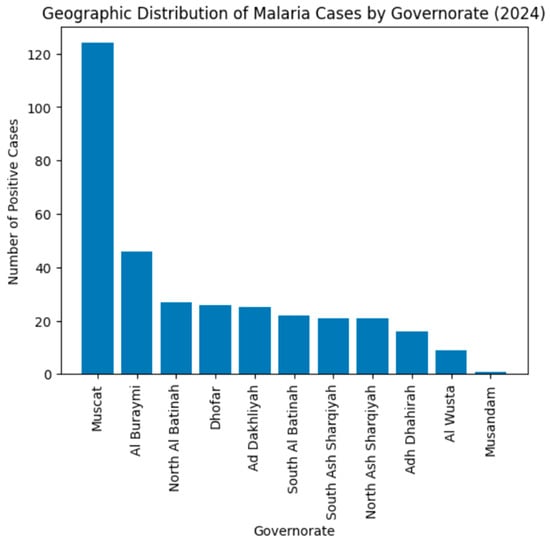
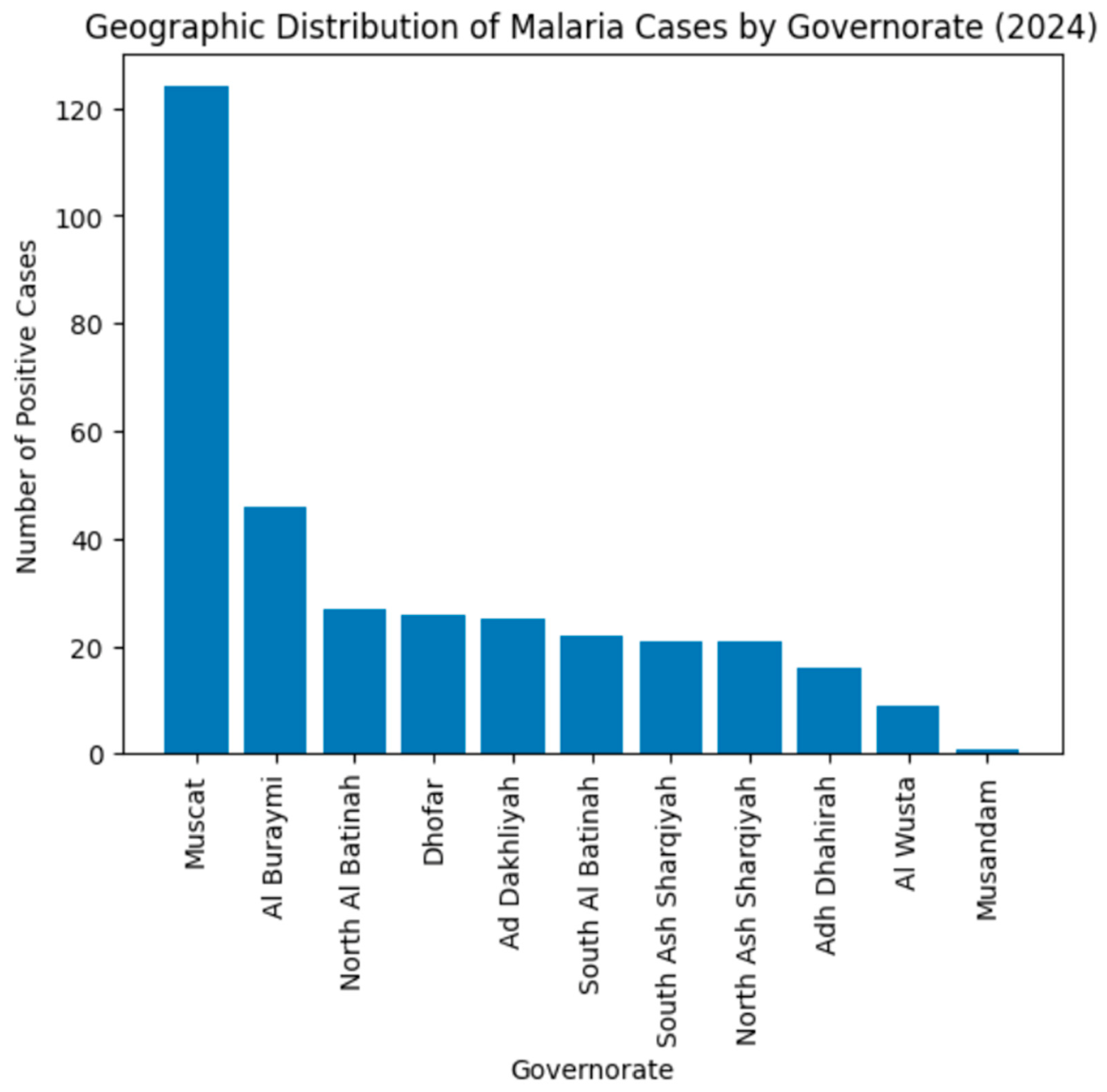
Geographic comparison for 2024 showed substantial variation in both absolute counts and population-referenced crude rates (Figure 1 and Table 2). Muscat recorded the largest absolute number of cases (124), whereas Al Buraymi had the highest crude reported case rate (33.9 per 100,000), followed by Al Wusta (14.7 per 100,000) and Muscat (8.3 per 100,000). Musandam recorded one case (1.8 per 100,000). These values describe where cases were reported and should not be interpreted as governorate-specific local transmission incidence because case origin was not available within the geographic cross-tabulation.
Figure 1.
Reported malaria case counts by governorate, Oman, 2024. Note: Values are absolute reported case counts, not population-adjusted incidence.
Table 2.
Geographic Distribution of Reported Malaria Cases and Crude Population-Referenced Case Rates, Oman, 2024.
In the restored 20-year dataset, annual blood-slide examination volume was significantly and inversely associated with SPR. The estimated coefficient was B = −0.00000147 per additional slide (95% CI −0.00000254 to −0.00000040, p = 0.010; R2 = 0.317; n = 20), corresponding to a standardized β = −0.563 (Table 3). The residual diagnostics did not indicate non-normality or heteroskedasticity (Shapiro–Wilk p = 0.378; Breusch–Pagan p = 0.860), although modest residual dependence remained possible (Durbin–Watson = 1.21). The association remained statistically significant using Newey–West lag-1 standard errors (p = 0.019). This ecological association does not establish that lower testing volume caused higher positivity.
Table 3.
Temporal Relationship Between Malaria Testing Intensity and Slide Positivity Rate in Oman (20 years, 2005–2024).
Case-origin composition remained overwhelmingly imported throughout the complete series (Table 4). In the robust Poisson rate model using all 20 years, the annual relative rate of autochthonous cases did not show a statistically significant linear change (aRR = 1.048 per year, 95% CI 0.984–1.116, p = 0.148), and the imported-case rate was essentially stable relative to the classified annual total (aRR = 1.000, 95% CI 0.999–1.000, p = 0.170). The category-by-year interaction was also not significant (ratio of rate ratios = 1.048, 95% CI 0.984–1.116, p = 0.144). Thus, restoration of 2006–2009 did not support a simple monotonic increase or decrease in case-origin composition. These fluctuations are not interpreted as evidence of interruption, persistence, or resurgence of local transmission.
Table 4.
Origin of Malaria Cases in Oman (20 years, 2005–2024).
Species composition changed substantially over the 20-year period (Table 5). P. vivax predominated among the two principal species through 2017, whereas P. falciparum predominated from 2018 through 2021 before the relative balance shifted again in 2022–2024. In the robust Poisson rate model using all 20 years, the relative annual rate of P. falciparum increased (aRR = 1.142, 95% CI 1.068–1.221, p < 0.001), while that of P. vivax decreased (aRR = 0.952, 95% CI 0.919–0.987, p = 0.007). The species-by-year interaction was significant (falciparum-to-vivax ratio of rate ratios = 1.199, 95% CI 1.112–1.293, p < 0.001). These results describe species composition among the two principal species and cannot identify whether the shift arose within imported or locally acquired infections because species-by-origin cross-tabulations were unavailable.
Table 5.
Longitudinal Distribution of Plasmodium Species in Oman (2005–2024).
The balance between passive and active testing also varied over time (Table 6). Approach-specific passive/active counts were available for 2005 and 2010–2024 in the compiled workbook; 2006–2009 are displayed as not reported rather than being removed from the study period. Active testing accounted for the larger recorded share of classified testing in several years from 2012 to 2019, while passive testing again predominated from 2020 onward. These are testing-volume data only; confirmed malaria-positive cases were not cross-tabulated by surveillance approach, so the table cannot be used to compare the effectiveness or diagnostic yield of passive versus active strategies.
Table 6.
Passive and Active Malaria Testing in Oman (2005–2024).
The linear temporal models using all 20 annual observations confirmed significant downward trends in API, ABER, and blood slides examined and a significant upward trend in SPR (Table 7). API decreased by an estimated 0.0142 per 1000 population per year (β = −0.597, p = 0.005), SPR increased by 0.0283 percentage points per year (β = 0.732, p < 0.001), ABER decreased by 0.537 percentage points per year (β = −0.985, p < 0.001), and blood-slide volume decreased by approximately 13,425 slides per year (β = −0.907, p < 0.001). Residual normality was acceptable for all four models (Shapiro–Wilk p ≥ 0.369), and Breusch–Pagan tests did not indicate heteroskedasticity (all p ≥ 0.215). Durbin–Watson statistics ranged from 0.56 to 1.59, indicating possible positive residual dependence in some series. Newey–West lag-1 sensitivity analyses retained the same direction and statistical-significance conclusions for all four trend models (API p = 0.014; all other p < 0.001).
Table 7.
Linear Regression Analysis of Malaria Indicator Trends (2005–2024).
As a secondary sensitivity analysis, Joinpoint regression of the complete 20-year series identified one joinpoint for API (2012) and SPR (2010) and two joinpoints for ABER and blood slides examined (2018 and 2021) (Table 8). API increased by 13.74% per year during 2005–2012 (95% CI 3.44–25.08; p = 0.011) and then decreased by 17.96% per year during 2012–2024 (95% CI −22.06 to −13.64; p < 0.001). SPR increased by 22.98% per year during 2005–2010 (95% CI 12.10–34.92; p < 0.001), whereas the subsequent 2010–2024 increase was smaller and not statistically significant (APC = 2.62%, 95% CI −0.26 to 5.58; p = 0.072). ABER and blood-slide examination volume showed their steepest declines during 2018–2021; neither indicator showed a statistically significant APC after 2021. These segmented estimates are interpreted as changes in temporal slope and do not imply effects of specific surveillance or control interventions.
Table 8.
Joinpoint Sensitivity Analysis of National Malaria Indicators, Oman, 2005–2024.
4. Discussion
The principal observed pattern was a decline in several national malaria-burden and surveillance-volume indicators across the available annual observations. API decreased from 0.217 per 1000 population in 2005 to 0.064 in 2024, and both ABER and blood-slide examination volume declined over time. These findings document temporal change but do not, by themselves, demonstrate the effectiveness of specific malaria-control activities. Oman’s broader elimination programme and surveillance infrastructure provide relevant context [6,12,18], but causal attribution would require intervention-specific or individual-level designs.
Imported malaria was the dominant origin category throughout the observed series, while autochthonous cases remained uncommon. The Poisson model did not detect a significant annual change in the relative rate of either origin category. This pattern is compatible with the continuing importance of importation in an elimination setting, as described in Oman and other malaria-free or near-elimination contexts [2,3,19]. Potential explanations involving labour migration, travel volume, or source-country epidemiology are plausible hypotheses, but the present aggregated dataset did not contain traveller-level or migration data and therefore cannot test those mechanisms [20].
The 2024 geographic analysis adds population context to the absolute case-count figure. Although Muscat had the largest number of reported cases, Al Buraymi had the highest crude reported case rate per 100,000 registered population. This distinction illustrates why absolute counts alone should not be interpreted as regional burden. The reviewer-requested correlation between imported and autochthonous cases by governorate could not be estimated because the source geographic table does not cross-classify case origin by governorate. The geographic analysis therefore remains descriptive and combines imported and locally acquired infections.
Several mechanisms could plausibly contribute to geographic variation, but they are hypotheses rather than findings of the present dataset. Imported cases may cluster in governorates with greater international travel, migrant-worker residence, or movement from malaria-endemic countries, while locally acquired cases may depend additionally on ecological receptivity, vector presence, exposure around an imported index case, and the intensity and timeliness of surveillance and response. Oman’s elimination literature and the documented locally acquired P. vivax outbreak among migrant workers illustrate the importance of importation and subsequent local exposure in receptive settings [6,9]. However, because the present aggregated data do not link case origin, travel history, vector indicators, or individual exposures to governorate, these explanations cannot be tested here and should not be interpreted as causal explanations of the observed 2024 geographic differences.
Autochthonous case counts remained sparse and included several zero-count years even after restoration of the complete 20-year series. The robust Poisson rate model did not detect a statistically significant linear annual change in the relative autochthonous rate. For this reason, Joinpoint regression was not applied to case-origin counts. The secondary Joinpoint analysis was restricted to the positive continuous national indicators (API, SPR, ABER, and blood slides examined), where it identified changes in temporal slope that are reported as sensitivity results rather than as evidence of interruption, persistence, resurgence, or intervention effects. The World Health Organization’s report that Oman interrupted endemic malaria transmission in 2010 is a historical surveillance classification and is not inferred from the temporal models in the present study [5].
A marked change in the relative composition of P. vivax and P. falciparum was also observed, with P. falciparum becoming predominant during 2018–2021 before P. vivax again represented the larger share in 2022–2024. The rate model confirmed opposing temporal directions for the two species. However, species-by-origin information was unavailable, so the analysis cannot determine whether this pattern reflects changes among imported cases, local cases, or both. Shifts in countries of infection or migrant/traveller composition are possible explanations reported in the wider literature, but they remain hypotheses rather than conclusions from this study [21]. Although malaria is no longer endemic in Oman, the mosquitoes that transmit it remain widespread. The risk of malaria transmission depends on the mosquitoes’ geographic distribution, ecology, and vector competence, as well as favourable environmental conditions. This means the country is still vulnerable to malaria transmission. If an imported case introduces P. vivax or P. falciparum into an area where these mosquitoes are present, a localized outbreak may occur [9].
The composition of surveillance testing changed over time, with active testing representing a larger share of recorded examinations during several pre-2020 years and passive testing predominating after 2020. Because the source data provide numbers of slides tested rather than numbers of positive cases detected by each approach, these changes should be interpreted as surveillance-volume patterns only. They do not establish that one approach was more effective than another. Similar active case-detection programmes have been described in other elimination settings [22], but direct effectiveness comparisons require detection yields, target-population denominators, and programme-level covariates.
From a surveillance perspective, the findings support continued attention to imported malaria, maintenance of diagnostic readiness, and species-specific monitoring. The observed decline in testing-volume indicators is particularly relevant in a low-transmission setting because diagnostic capacity must remain sufficient to identify imported infections and investigate possible local transmission. These are programmatic implications derived from the surveillance patterns; they should not be read as evidence that any particular intervention caused the observed national trends. Notably, no recent documented policy changes have altered the testing-volume indicators.
Several limitations should be considered. First, the analysis used aggregated annual surveillance reports and cannot assess individual-level risk factors or causal relationships. Second, although all 20 calendar years from 2005 through 2024 were restored for the principal national analyses, autochthonous counts remained sparse with multiple zero-count years, precluding a stable Joinpoint analysis of case-origin counts, and possible residual dependence remained in some linear series. Third, monthly data were unavailable, preventing seasonal analysis. Fourth, complete longitudinal governorate-specific denominators and origin-stratified geographic data were not available; the geographic analysis was therefore limited to crude 2024 rates using end-2024 registered populations. Fifth, species-by-origin cross-tabulations were unavailable, and the two-species rate model excluded other or unclassified species. Sixth, passive/active surveillance counts for 2006–2009 were not available in the compiled approach-specific table, although these years were retained in the other 20-year analyses. Finally, the ecological testing-volume–SPR association is vulnerable to changes in testing indications and case mix. Future studies using line-list data, travel history, complete population denominators, and linked geographic, species, origin, and detection-method variables could evaluate seasonality, spatial patterns, importation pathways, and determinants of re-establishment risk more directly.
5. Conclusions
This retrospective national surveillance analysis across the complete 2005–2024 period (20 consecutive years) found persistent predominance of imported malaria, sparse autochthonous cases, substantial temporal change in the relative distribution of P. vivax and P. falciparum, declining API and testing-volume indicators, and geographic variation in crude 2024 reported case rates. The results are surveillance signals rather than evidence of the effectiveness of specific control interventions. Continued diagnostic capacity, prompt investigation and management of imported infections, and surveillance for possible re-establishment of local transmission remain important in Oman’s elimination setting.
Author Contributions
B.A. and M.A., formal analysis and manuscript writing; R.A.K. and O.A.F., validation & critical review. All authors have read and agreed to the published version of the manuscript.
Funding
This research received no external funding.
Institutional Review Board Statement
Not applicable.
Informed Consent Statement
Not applicable.
Data Availability Statement
No new primary data were generated. The study analysed aggregated, publicly available malaria surveillance information reported by the Oman Ministry of Health and population statistics published by the Oman National Centre for Statistics and Information. The annual report series is available through the Ministry of Health statistics portal; availability of individual-level or additional disaggregated surveillance data remains subject to the original data custodians.
Acknowledgments
The researchers would like to thank Oman College of Health Sciences (www.ochs.edu.om) for its contribution toward the publication fees.
Conflicts of Interest
The authors declare no conflicts of interest.
References
- World Health Organization. World Malaria Report 2025. Available online: https://www.who.int/teams/global-malaria-programme/reports/world-malaria-report-2025 (accessed on 1 June 2026).
- Lu, G.; Zhang, D.; Chen, J.; Cao, Y.; Chai, L.; Liu, K.; Chong, Z.; Zhang, Y.; Lu, Y.; Heuschen, A.; et al. Predicting the risk of malaria re-introduction in countries certified malaria-free: A systematic review. Malar. J. 2023, 22, 175. [Google Scholar] [CrossRef] [Scilit] [PubMed]
- Lusiyana, N.; Ahmad, R.A.; Elyazar, I.; Murhandarwati, E.E.H. Imported malaria: A silent and forgotten threat in malaria-free zones? Malar. J. 2025, 24, 421. [Google Scholar] [CrossRef] [Scilit] [PubMed]
- Jiram, A.; Jelip, J.; Noordin, R.; Musa, K.; Azian Yusuf, N.; Amir, N.; Rasyidina, A.; Ismail, N.; Hussin, Z.; Ismail, A. Persistent low-density infection in areas at risk of malaria reintroduction in Malaysia. PLoS ONE 2025, 20, e0329219. [Google Scholar] [CrossRef] [Scilit] [PubMed]
- World Health Organization. World Malaria Report 2010. Available online: https://www.who.int/publications/i/item/9789241564106 (accessed on 5 June 2026).
- Al Mukhaini, S.K.; Mohammed, O.A.; Gerbers, S.; Al Awaidy, S.T. The progress towards national malaria elimination: The experience of Oman. Oman Med. J. 2023, 38, e500. [Google Scholar] [CrossRef] [Scilit] [PubMed]
- Snow, R.W.; Amratia, P.; Zamani, G.; Mundia, C.W.; Noor, A.M.; Memish, Z.A.; Zahrani, M.; Al Jasari, A.; Fikri, M.; Atta, H. The malaria transition on the Arabian Peninsula: Progress toward a malaria-free region between 1960–2010. Adv. Parasitol. 2013, 82, 205–251. [Google Scholar] [CrossRef] [Scilit] [PubMed]
- Singh, N.; Bharti, P.K.; Kumre, N.S. Active v. passive surveillance for malaria in remote tribal belt of Central India: Implications for malaria elimination. Pathog. Glob. Health 2016, 110, 178–184. [Google Scholar] [CrossRef] [Scilit] [PubMed]
- Simon, B.; Sow, F.; Al Mukhaini, S.K.; Al-Abri, S.; Ali, O.A.; Bonnot, G.; Bienvenu, A.; Petersen, E.; Picot, S. An outbreak of locally acquired Plasmodium vivax malaria among migrant workers in Oman. Parasite 2017, 24, 25. [Google Scholar] [CrossRef] [Scilit] [PubMed]
- World Health Organization, Regional Office for the Eastern Mediterranean. Report on the Regional Workshop on Strengthening Quality Management Systems for Parasitological Diagnosis of Malaria, Muscat, Oman, 17–21 September 2011; World Health Organization, Regional Office for the Eastern Mediterranean: Cairo, Egypt, 2012. [Google Scholar]
- Kaur, J.; Baharia, R.; Dattani, M. Assessment of the quality of malaria surveillance and laboratory services for diagnosis in three districts of Gujarat state, India. Front. Public Health 2024, 12, 1465228. [Google Scholar] [CrossRef] [Scilit] [PubMed]
- Al-Awadhi, M.; Ahmad, S.; Iqbal, J. Current status and the epidemiology of malaria in the Middle East region and beyond. Microorganisms 2021, 9, 338. [Google Scholar] [CrossRef] [Scilit] [PubMed]
- Alharbi, B.F.; Ahmed, M.A. Malaria in the 21st century: Global disease burden, epidemiological insights, and strategic control approaches. Biology 2026, 15, 575. [Google Scholar] [CrossRef] [Scilit] [PubMed]
- Feachem, R.G.A.; Phillips, A.A.; Hwang, J.; Cotter, C.; Wielgosz, B.; Greenwood, B.M.; Sabot, O.; Rodriguez, M.H.; Abeyasinghe, R.R.; Ghebreyesus, T.A.; et al. Shrinking the malaria map: Progress and prospects. Lancet 2010, 376, 1566–1578. [Google Scholar] [CrossRef] [Scilit] [PubMed]
- Directorate General of Planning and Studies, Ministry of Health, Sultanate of Oman. Annual Health Reports, 2005–2024. Available online: https://www.moh.gov.om/en/statistics/annual-health-reports/ (accessed on 20 August 2026).
- World Health Organization. Disease Surveillance for Malaria Elimination: An Operational Manual; World Health Organization: Geneva, Switzerland, 2012; Available online: https://iris.who.int/server/api/core/bitstreams/c3f30459-ffbc-47db-a6de-d2327f55eb41/content (accessed on 12 August 2026).
- National Centre for Statistics and Information, Sultanate of Oman. Statistical Year Book 2025: Population Registered by Governorate at the End of 2024; National Centre for Statistics and Information: Bousher, Oman, 2025.
- Hadi, A.H.A.; Sharwani, A.O.M.; Madkhali, A.M.A.; Khamjan, A.A.N.; Ghazwi, A.M.A.; Ahmed, A.B.M.Q. Epidemiological profile and current trends of malaria in the Middle East: An updated review. Saudi J. Med. Public Health 2025, 2, 3603–3614. [Google Scholar] [CrossRef] [Scilit]
- World Health Organization. World Malaria Report 2024; World Health Organization: Geneva, Switzerland, 2024. [Google Scholar]
- Alharbi, B.F.; Ahmed, M.A. Malaria in travelers and local populations: Comprehensive study of incidence patterns and origin-based classification in Saudi Arabia. PLoS ONE 2026, 20, e0335137. [Google Scholar] [CrossRef] [Scilit] [PubMed]
- Cao, Y.; Wu, H.; Zhang, Y.; Wu, X.; Li, J.; Chen, H.; Gao, W. Time trends in malaria incidence from 1992 to 2021 in high-risk regions: An age-period-cohort analysis based on the Global Burden of Disease Study 2021. Int. J. Infect. Dis. 2025, 153, 107770. [Google Scholar] [CrossRef] [Scilit] [PubMed]
- Tseroni, M.; Georgitsou, M.; Baka, A.; Pinaka, O.; Pervanidou, D.; Tsironi, M.; Bleta, P.; Charvalakou, M.; Psinaki, I.; Dionysopoulou, M.; et al. The importance of an active case detection (ACD) programme for malaria among migrants from malaria-endemic countries: The Greek experience in a receptive and vulnerable area. Int. J. Environ. Res. Public Health 2020, 17, 4080. [Google Scholar] [CrossRef] [Scilit] [PubMed]

Disclaimer/Publisher’s Note: The statements, opinions and data contained in all publications are solely those of the individual author(s) and contributor(s) and not of MDPI and/or the editor(s). MDPI and/or the editor(s) disclaim responsibility for any injury to people or property resulting from any ideas, methods, instructions or products referred to in the content. |
© 2026 by the authors. Licensee MDPI, Basel, Switzerland. This article is an open access article distributed under the terms and conditions of the Creative Commons Attribution (CC BY) license.