
Article

Biological Control of Stem Rot of Groundnut Induced by Sclerotium rolfsii sacc.

by
Prabhu Narayan Meena
1,2,3,*,
Ashok Kumar Meena
3,
Rahul Kumar Tiwari
4,
Milan Kumar Lal
5 and
Ravinder Kumar
6,*
1
ICAR—National Research Centre for Integrated Pest Management, Indian Agricultural Research Institute, New Delhi 110012, India
2
ICAR—Central Research Institute for Jute and Allied Fibres, Kolkata 700120, India
3
Department of Plant Pathology, College of Agriculture, Swami Keshwanand Rajasthan Agricultural University, Bikaner 334006, India
4
ICAR—Indian Institute of Sugarcane Research, Lucknow 226002, India
5
ICAR—National Rice Research Institute, Cuttack 753006, India
6
ICAR—Indian Agricultural Research Institute, New Delhi 110012, India
*
Authors to whom correspondence should be addressed.
Pathogens 2024, 13(8), 632; https://doi.org/10.3390/pathogens13080632

Submission received: 25 May 2024 / Revised: 18 July 2024 / Accepted: 25 July 2024 / Published: 28 July 2024
(This article belongs to the Special Issue Soil Borne Pathogens)

Abstract

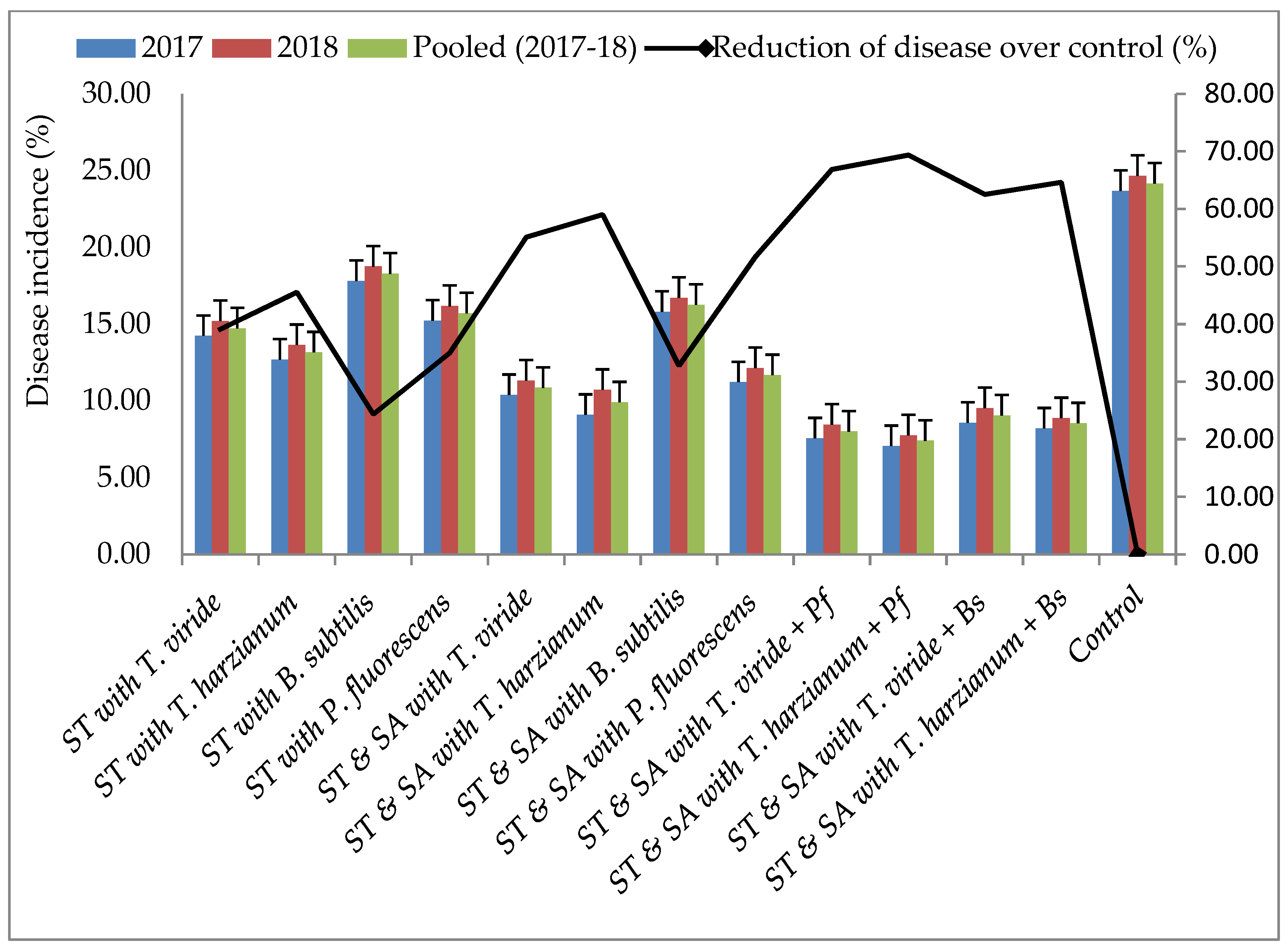
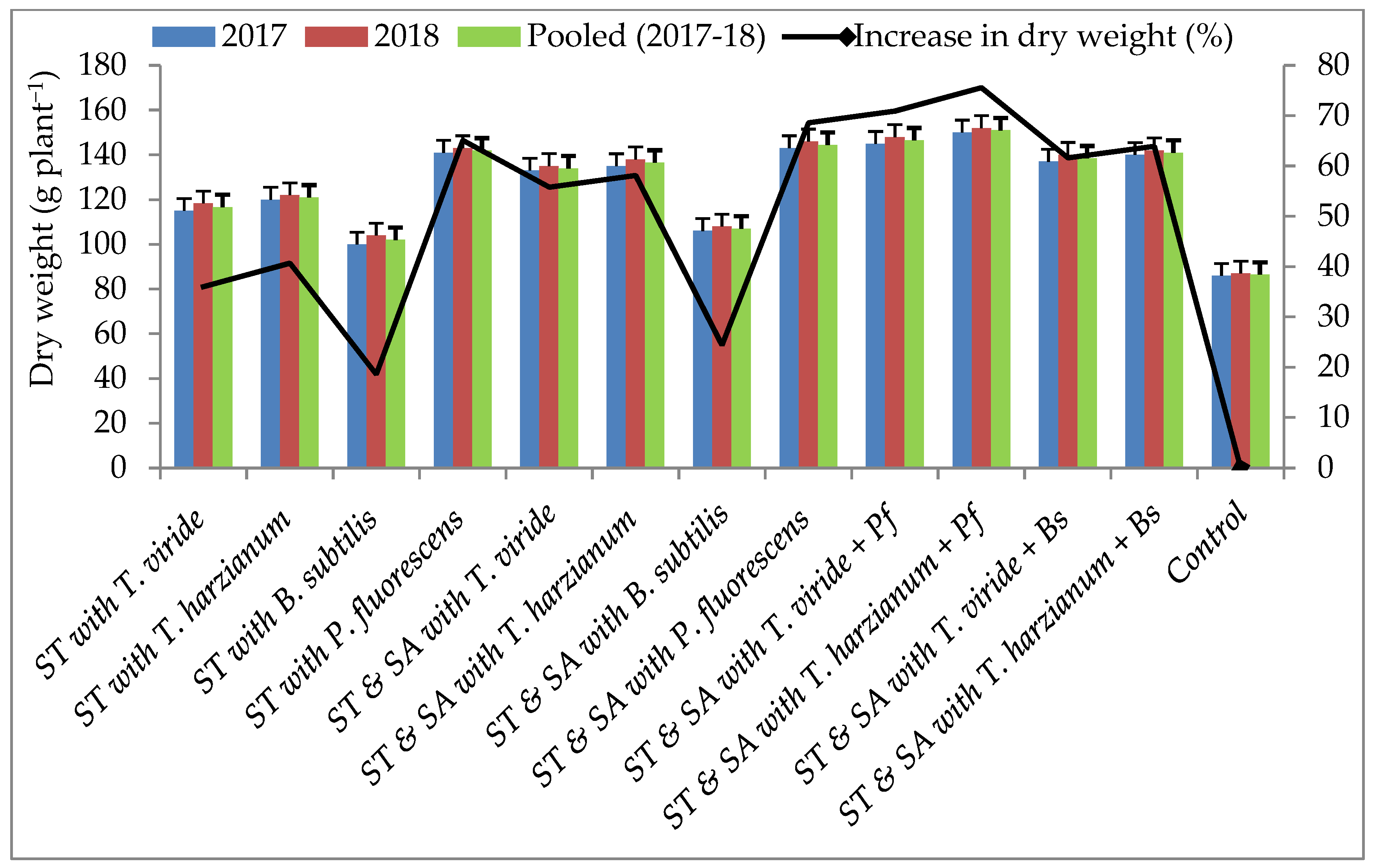
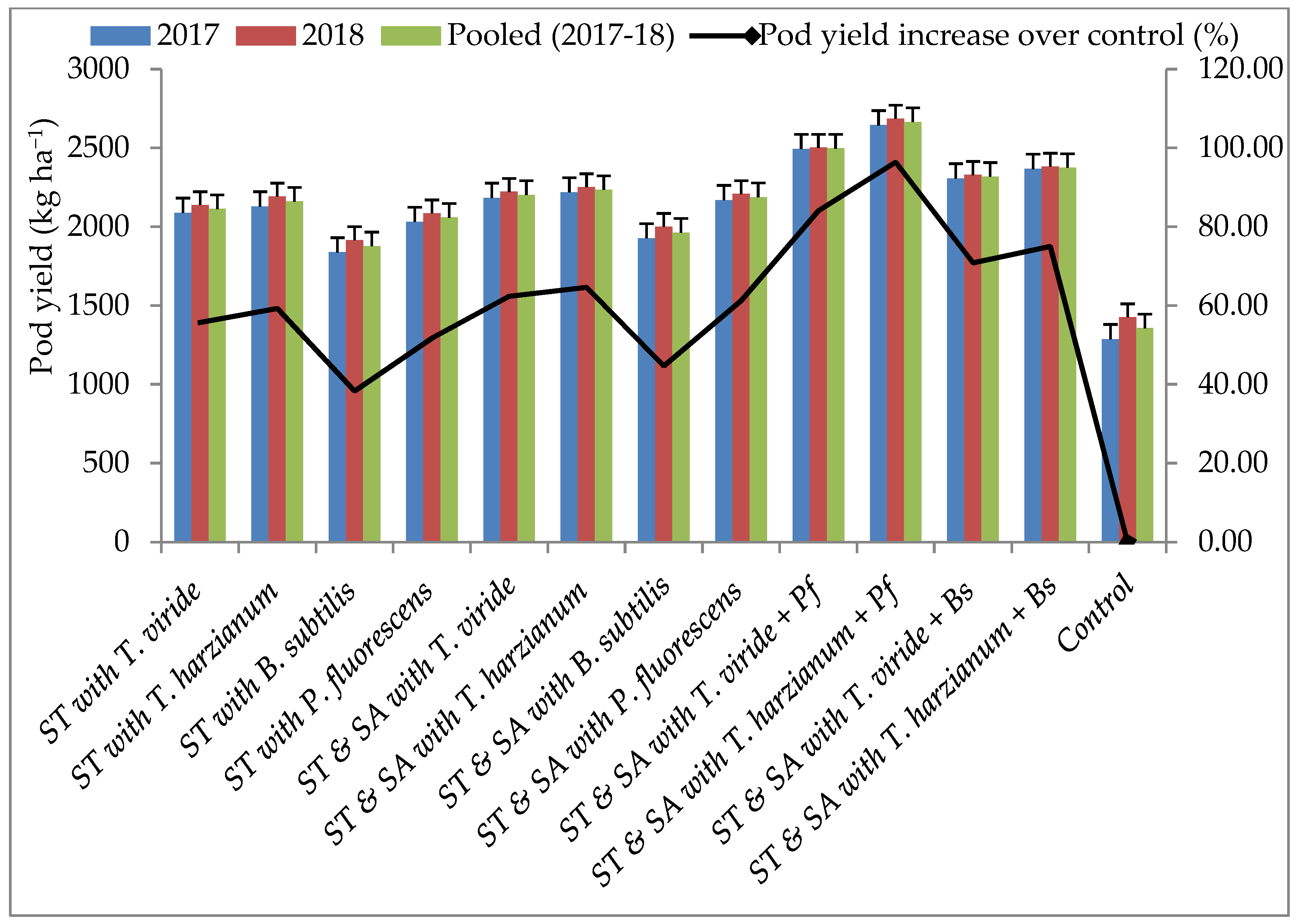
Stem rot of groundnut (Arachis hypogaea L.) caused by Scelrotium rolfsii is the main threat to groundnut production, causing significant economic losses. The present study aims to provide an overview of the potentiality of Trichoderma viride (Tv), Trichoderma harzianum (Th), Pseudomonas fluorescens (Pf), and Bacillus subtilis (Bs), applied either individually or in mixed combination, against Sclerotium rolfsii (isolate SrBKN). The treatment with T. harzianum and P. fluorescens resulted in the highest mycelial growth inhibition (79.61, 83.51, and 86.77%), followed by T. viride and P. fluorescens (75.74, 79.63, and 83.14%). Under in vitro conditions, the combination of bio-agents at 5% culture filtrate proved to be superior against the test pathogen. Seed treatment and soil application of T. harzianum and Pf at 10 (5 + 5) g kg−1 + 10 (5 + 5) kg ha−1, followed by seed treatment and soil application of T. viride and Pf at 10 (5 + 5) g kg−1 + 10 (5 + 5) kg ha−1, resulted in the lowest disease incidence (7.40 and 8.0%), highest disease control (69.37 and 66.88%), maximum dry weight (151 and 147 g plant−1), highest increase in dry weight (75.58 and 70.93), highest pod yield (2665 and 2498 kg ha−1), and highest increase in pod yield (96.38 and 84.08%) under in vivo conditions. We present an effective bio-control-based management module from the lab to the field for the successful control of groundnut stem rot caused by S. rolfsii. Based on the results, it is concluded that the dual formulation of T. harzianum and P. fluorescens, followed by T. viride and P. fluorescens, were the most effective BCAs in suppressing the S. rolfsii. Therefore, an integrated disease management module with these BCAs needs to be developed and validated with a farmers’ participatory mode under field conditions.
Keywords: Arachis hypogaea; Trichoderma viride; Trichoderma harzianum; Pseudomonas fluorescens; Bacillus subtilis Arachis hypogaea; Trichoderma viride; Trichoderma harzianum; Pseudomonas fluorescens; Bacillus subtilis