


Abstract
This article examines the Popcretos, a series of collage works by Brazilian concrete poet Augusto de Campos, situating them within the broader trajectory of his experimental poetics and the political context of Brazil’s military dictatorship. While existing scholarship has focused primarily on the series’s visual and semiological dimensions, this article argues that sound operates as a structuring element across the Popcretos, shaping how images are arranged and meanings emerge. Drawing on sound studies scholarship and critic Carrie Noland’s concept of sound-sensitive visuality, the article traces how the tension between noise and silence informs de Campos’s work from his earliest poems through the concrete poetry movement’s political turn in the early 1960s. Close readings of three works from the series (“The Anti-Noise,” “An Eye for an Eye,” and “Hush!”) reveal how sonic categories are mobilized to critique cultural imperialism, mass media spectacle, and authoritarian censorship. The article concludes that the Popcretos exceed ocularcentrism, functioning also as a multisensorial form of “auditory writing” within its sonic–visual materiality.
1. Introduction
If I can see it, do I have to hear it too?—John Cage, “Composition as Process” (Cage 1961)
Augusto de Campos (b. 1931, São Paulo) had not yet come of age when he published his first poem in the Sunday edition of Jornal de Notícias, on 27 June 1948. In the same year that Brazilian industrialist and patron of the arts Ciccillo Matarazzo (1898–1977) founded the Museum of Modern Art of São Paulo (MAM-SP), the young Campos was introduced in the Sunday edition as “o novo valor da poesia paulista” (the new value of São Paulo’s poetry; emphasis mine) (Barros and Bandeira 2002, p. 9). The seventeen-year-old poet debuted with a disturbing poem, in which the poetic persona deals with the sensorial perceptions of their own demise. Titled “Fuga” (Escape, or Fugue—a pun drawing on both the psychological notion of withdrawal and the baroque contrapuntal technique in music), the poem is a short lyric piece that Campos would later omit from his books and self-edited anthologies. With strict formal rigor, it unfolds a gloomy scene culminating in a detached account of the speaker’s own suicide. Distributed across three quintets composed of regular pentameters, the poem’s themes would accompany Campos throughout his long creative journey. These themes include the appreciation of metalanguage, the search for evasion, the concern with death, and, notably, the opposition and/or composition of the visual with the auditory:
Decepo as palavrasEsqueço as palavraspara sempre mortas.Ausculto o silêncio:ainda tenho eco.Corro sutilmente,sabiamente voosem roçar areia.Olho para trás:ainda deixo rastro.Me fecho no quartoRevólver no ouvidomorro sem (um) grito.Olho para o chão:ainda tenho sombra.(I severn the words/Forget them/forever dead./Auscultate the silence:/Still, my echo remains.//I run subtly,/wisely I fly/without brushing the sand./I look back:/I still leave a trace.//I shut myself in the room/Revolver to my ear/I die without (a) cry./I look at the floor:/I still have a shadow.) 1
The poem’s persona turns to listening in its most subtle form, expressed through the verb “auscultar” (to auscultate), as it examines “silence” only to discover the lingering echo within. Seeking refuge in their room, the speaker delivers a final blow with a “revolver to the ear,” a death as deaf as it is definitive, extinguishing the subject without utterance or cry. The uncanny quality of this nightmarish passage lies in how it frames suicide as a perceptual event: stripped of speech and sound, the subject can still verify their own existence through the shadow their body casts—the obstruction of light that persists as a last trace of presence. Beginning with the loss of language and ending with the silence of a shadow, Campos’s first poem is already staking out the central tension of his work: between sound and its absence, vision and its negation.
Critics have noted how Augusto de Campos’s early poems already take sound, and the voice in particular, as a central thematic element (Süssekind 2002; Sterzi 2004; Bessa 2026).2 Eduardo Sterzi draws attention to the “obstinate coherence” of Campos’s poetic trajectory, which from “Fuga” onward returns persistently to silence, echo, listening, and the voice (Sterzi 2004, p. 102). Flora Süssekind goes further, characterizing his poetry as a phonovisual experience and arguing that “from the earliest poems published by Augusto de Campos, there has indeed been a concern with the possibilities of sound projection of a vocalization implicit in the graph-enunciative structures of texts” (Süssekind 2002, p. 41). This preoccupation with the voice, she notes, runs through his pre-concrete period in many forms, including as absence (Süssekind 2002, p. 41). Antonio Sergio Bessa, for his part, observes that Campos’s work “has persistently pursued a kind of writing fused with music,” pointing to the multi-colored series Poetamenos (1953) as an early instance of this convergence (Bessa 2026, p. 26). Taken together, these readings suggest that sound is not an incidental concern in Campos’s poetry but a constitutive dimension of his poetics from the very outset.
Throughout this article, I argue that the trajectory of experimental poetics in Augusto de Campos is deeply embedded in what I call—following critic Carrie Noland—a sound-sensitive visuality: a poetics in which visual imagery is shaped by sonic and aural processes that in turn define its polysemic, multisensorial materiality.3 Within this conceptual framework, I focus on Campos’s critical engagement with sound as a key generative element of his visual writing, arguing that the dialectical tension between noise and silence orients much of his poems’ visual composition and informs the meanings of his poetic formulations. Attentive to the material qualities of sound, Campos produced a body of visual poetry that shares much with the most radical innovations in experimental music practice and theory of his era. To this end, I concentrate on the concrete poetry period of his work, and in particular on a 1960s series called Popcretos—produced at the moment when the poet most openly embraced a left-oriented, anti-imperialist political stance and began pushing his craft toward new formal possibilities in which experimentalism and political critique could converge. As a result, his poems began to exceed the strict confines of the so-called “orthodox period” of concrete poetry, opening onto a more profound integration of physical and perceptual dimensions and foregrounding the material and sensorial existence of the poem as an object in the world.
2. Concrete Poetry: Sight, Sound, Political Critique
The Popcretos series is a unique collection within the framework of concrete poetry. This genre of visual poetry, first characterized by its geometric visual formulations in Futura typeface, stood out for the immediate and lasting international impact since its emergence as a movement in the mid-1950s, both in Brazil and Europe. With a clean, balanced, and minimalistic arrangement of words on basic grid structures, concrete poetry highlighted the spatiality of the page from a constructivist perspective and provoked controversy among intellectual circles, particularly for bold proclamations such as declaring “the end of the historical cycle of verse,” (Campos et al. 1975, p. 156) and other provocations that led to its characterization by the Brazilian press as the “rock and roll of poetry,” as noted in the March 1957 issue of O Cruzeiro. Yet through poems, manifestos, translations, and critical texts, the movement went on to exert tremendous influence across generations and across fields well beyond literature, including the visual arts, popular songwriting, theater, and cinema.
The movement also sought to give aesthetic expression to Brazil’s modernization drive at the height of developmentalism, responding not only to São Paulo’s rapid transformation into a cosmopolitan megalopolis but also to the construction of Brasília. Indeed, it was in design and architectural magazines that the group published some of their first manifestos, and their most important programmatic text, the “Pilot Plan for Concrete Poetry,” makes explicit their affiliation with the State sponsored modernist project for the new capital and its urban plan, created by architect Lucio Costa, the “Pilot Plan for Brasília” (Costa 1957). In dialogue with the industrial, technological, and theoretical perspectives that were emerging in the 1950s, they set out to refuse what was seen as a romantic lyric subjectivity in favor of an intent to a rigorous, rationalist approach to poetry-making.4 To do so, they revised procedures from the historic avant-garde and high Modernist authors such as Oswald de Andrade’s flash poems, Mallarmé’s structural organization, Ezra Pound’s ideogrammatic method, and James Joyce’s synesthetic verbivocovisual imperative. The idea of parasyntatic arrangements over traditional lyrical verse-line redefines the poem as an object that integrates language’s verbal, vocal, and visual elements—i.e., text, sound, and sight—into a unified entity charged with poetic and semantic meaning. So when Campos sets out to formulate his “new theory of form—or, an organoform—“he argues for poems in which “traditional notions such as beginning-middle-end, syllogism, verse, tend to disappear and be surpassed by a poetic-gestaltian, poetic-musical, poetic-ideogramic structure,” which he called “concrete” (Campos et al. 1975, p. 25).
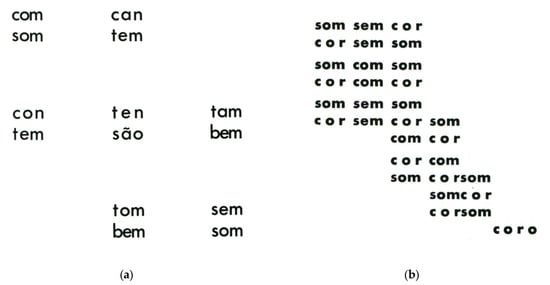
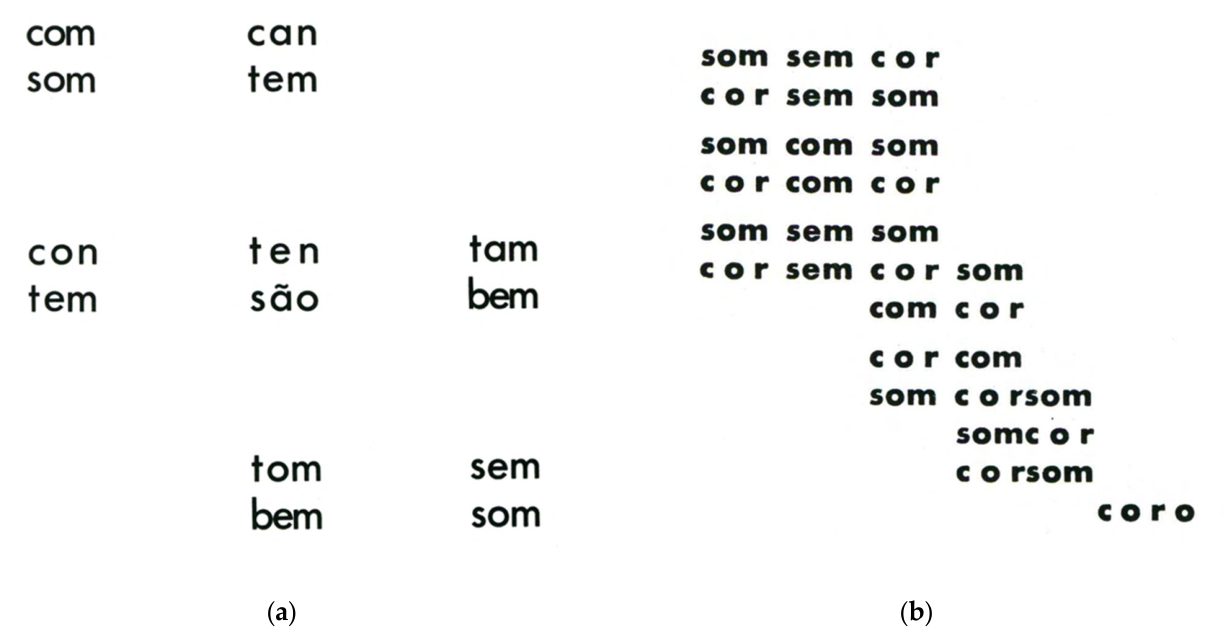
To illustrate this structural dimension, it is worth turning to two of Campos’s poems: “Tensão” (Tension), published in 1956, and “Corsom” (Colorsound) from 1958 (Figure 1). In “Tensão,” words are broken into three-character segments and displayed in quadrilateral squares, inviting multidirectional readings. At the center, the word “tension” gains both semantic and material significance by juxtaposing the oppositional acoustic concepts along the poem’s diagonal axis: “with sound” at the upper left and “without sound” at the bottom right. That this movement between sonic opposites remains a defining feature of the poem is confirmed by Nancy Perloff, who selected the piece for her twenty-first-century anthology of concrete poetry, noting that “under tension, and between opposite poles, the rhyming morphemes move temporally, from sound to silence” (Perloff 2021, p. 46). In “Corsom,” quadrilateral shapes feature a combinatory exploration of the nouns “color” and “sound,” linked by the prepositions “with” and “without.” The reading narrows within the shrinking squares until the poem culminates in the word “choir,” suggesting choral singing.
Figure 1.
(a) Augusto de Campos, “tensão” (1956). (b) Augusto de Campos, “corsom” (1958). Images courtesy of the author.
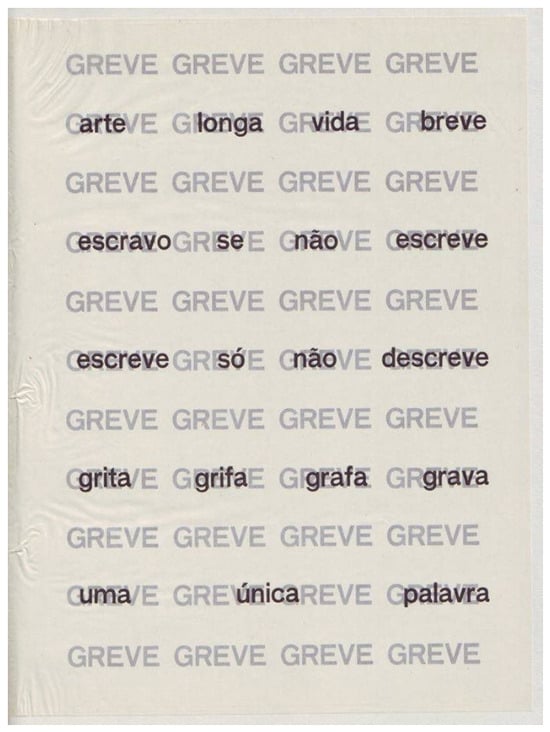
Both poems exemplify the so-called “orthodox phase” of concrete poetry and its strictly geometric designs. I have chosen them from among many possible examples because they demonstrate how sound functioned as both a thematic and structural presence in the movement’s early phase during the 1950s—a presence that would continue to shape even the most radical visual experiments of the following decade. In 1962, seeking to expand the movement’s reach to a wider circle of collaborators, the broader group associated with concrete art and poetry launched a new magazine, Invenção. With Décio Pignatari as chief editor and an editorial board that included the Campos brothers, Ronaldo Azeredo, José Lino Grünewald, Cassiano Ricardo, Edgard Braga, and Pedro Xisto, among others, the magazine ran for five volumes between 1962 and 1967. This period marked a turning point in which political engagement became an integral part of the group’s creative practice (Aguilar 2005, p. 90). It is in this context that Campos produced his first overtly political poems—“Cubagramma” (1960), “Plusvalia” (1961), and “Greve” (1961)—all presented in the second volume of Invenção, published in 1962. Of these, only “Greve” (Strike) was included by the poet in his collected volume Viva Vaia: Poetry 1949–1979 (A. de Campos 1979, p. 110) (Figure 2).5
Figure 2.
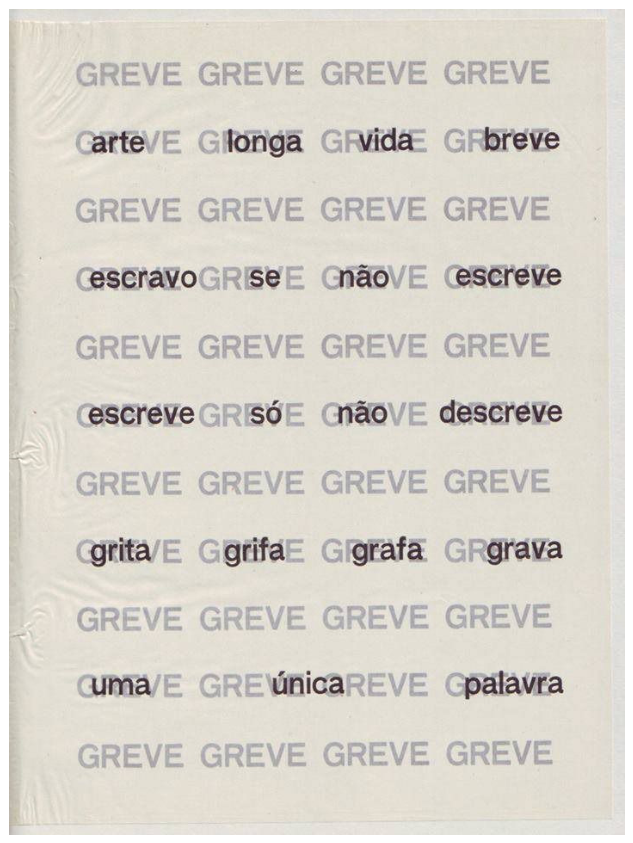
Augusto de Campos, “Greve” (1961). First published in Invenção 2, 1962. Image courtesy of the author.
The 1962 audio recording of “Greve”, performed by Campos and the poet José Lino Grünewald (1931–2000), brings out the double-layered relationship between the written text and its vocal projection.6 Grünewald voices the multitude calling for a strike (“Greve!”) in the background, while Campos delivers the foregrounded verse in the first layer of the poem: “arte longa vida breve/escravo se não escreve/escreve só não descreve/grita grifa grafa grava/uma única palavra: GREVE.” (art long, life short/a slave if you don’t write/write but don’t describe/shout, highlight, write, engrave/a single word: Strike). The word “greve” saturates the background while a series of verses—beginning with Hippocrates’s aphorism (Ars longa, vita brevis)—unfold in compressed, asyndetically coordinated phrases that modulate the rhythmic composition of the whole. Gonzalo Aguilar suggests that, in “Greve,” the poet is present in a space of conflict as a subject (Aguilar 2005, p. 96). A terminological shift accompanied concrete poetry’s political turn in the 1960s. As Fredric Jameson says of the 1960s in North America, “the new binary opposite to the term ‘bourgeois’ will no longer be ‘proletarian’ but rather ‘revolutionary,’ and the new qualifications for political judgements of this kind are no longer made in terms of class or party affiliation but rather in terms of personal life—your relationship to special privileges, to middle-class luxuries” (Jameson 1984, p. 189). In 1961, Décio Pignatari announced a similar outcome for concrete poetry, calling it “o pulo conteudístico semântico-participante” or “salto participante” (the content-based semantic-participating leap, or simply the participating leap)—a development that would result in a new stage and a renewed focus on the concept of “revolution,” an idea that had been absent from the movement’s programmatic texts until then (Pignatari [1971] 2004, pp. 104, 117). To mark this political turn, in 1961 concrete poets added a postscript to the “pilot plan,” finding in a sentence credited to the Russian poet Vladimir Mayakovsky (1893–1930) a way to reposition the movement’s formalist principles toward political engagement: “Without revolutionary form, there is no revolutionary art” (Campos et al. 1975, p. 158).
The formal procedures of “Greve”—the layering of voices, the tension between foreground and background, the poem’s insistence on being heard as much as read—crystallize the defining problem that concrete poetry faced as it moved into the 1960s: how to reconcile the movement’s inherited commitment to formal rigor with the demands of an increasingly volatile political moment. The answer, for Campos, was never to abandon one in favor of the other, but to push both simultaneously to their limits. Sound, in this regard, was not incidental to the political turn but constitutive of it: the collective voice implicit in “Greve” attests to a poetics in which the sensorial and the political are inseparable. It is precisely this inseparability that the Popcretos series would bring to its most critical formulation.
3. Popcretos
Produced between 1964 and 1966, the Popcretos series consists of five collage works made from magazine and newspaper clippings, as well as debris taken from product packaging, carefully assembled on wood boards: “Olho por olho,” “SS,” “O anti-ruído,” “goldWeater” (all made between October and November of 1964), and “Psiu!” (from 1966).7 In each piece, the clippings are arranged deliberately according to semantically related fields of meaning, poised to be activated by the reader. The mimetic relation to an eroded world of objects, written language, images, and sounds responds to the multisensorial media ecology of mass communication accelerated by television as the dominant new platform of the 1960s. The series stands as a sociopolitical commentary responding to pop culture, the printing press, post-war United States imperialism, and Brazil’s censorship and political unrest following the 1964 coup d’état. Often studied for its pronounced visual aspect, I argue that sound acts as a core element in this series—one that structures both how images are arranged and how meanings emerge.
Right from its portmanteau title, the fleeting sensorial experience of adding POP to CONCRETE conjures synesthetic imagery, simultaneously visual and sonic, through the onomatopoeic disruption of the word “concrete” by the term “pop.” With a light bilabial plosive sound, the author describes the series as made of “ex-poems” in an “explosition,” a portmanteau of explosion and exhibition, found at the “aleatory of the ready-made” under a “concrete” ambition, acknowledging the influence of Kurt Schwitters’s Dada and Duchamp’s readymades in his use of collage, chance, and probability amidst the concrete rational and constructivist method (A. de Campos 1964). Augusto de Campos’s early adoption of the term “pop” in Brazil speaks to the commodification of art and the dominance of spectacle as a force in cultural experience; it also anticipates a critique of the neo-colonial nature of mass-produced imagery and consumer culture, heralding a trend that would come to define the ways Latin American artists engaged with such concepts from 1965 onward (Gabara 2018).8 Yet while the “eye” is explicitly positioned as the pathway for converting the new bombardment of external stimuli into meaningful poetic experience, I will show that the Popcretos is significantly structured by sonic categories, which ultimately function as a form of auditory writing.
The earliest popcreto poems were first presented in December of 1964. Campos conceived the idea of hosting a joint exhibition with Italo-Brazilian artist Waldemar Cordeiro (1924–1973) who was also experimenting with collage under a programmatic perspective. Cordeiro, who would soon pioneer computer-generated art in Latin America, was developing in parallel with Campos the concept of a “semantic concrete art,” exploring semantic processes against the backdrop of consumer society and the commodification of art (Cordeiro [1964] 2014, pp. 426–28). According to Cordeiro, using the multimedia languages of advertising and mass media while also applying geometric principles to visual icons invites a transition from the ‘pure’ stimulus to the ‘associated’ stimulus (Cordeiro [1964] 2014, p. 427). The idea was that this art sought to reveal the ‘infrastructure of semantics’ by deconstructing it (Cordeiro [1964] 2014, p. 427). Interviewed by Hans Ulrich Obrist in 2003, Campos recalled the exhibition in light of the political moment, impelled by the military coup launched earlier that same year: “Cordeiro’s works,” Campos remembers, “were very aggressive [with mutilated objects spiked in the paintings]” while the poet’s own works “were full of ironic and offensive phrases towards the military” (Obrist 2018, p. 125). Indeed, fragments of political utterances and heavily loaded words with a clear critical position are present throughout the series, but the fragments of printing press culture evoking a new multisensorial media ecology of mass communication, in which television is the dominant platform, go further still: they make concrete poetry’s characteristic aesthetic—clean, minimalistic typeface, balanced and sober tones—reemerge in a profuse textual matter assembled into larger geometrical forms such as pyramidal structures, circles, and rectangles.
For the exhibition’s opening, the composer Damiano Cozzella (1929–2018) organized a musical happening “deconstructing” the popcretos. No audio recordings or photographs of the performance were made, just reports in the media, and those who witnessed the event give us hints of how the popcretos were sonically perceived and first articulated. The score was a wearable black cardboard sheet with cut-up instructions pasted on it. Turned into a sandwich-board man, Cozzella led a group of volunteers in a 13 min performance of what was described in newspapers as a “collective ‘popcrete’ composition.” The participants “played” such instruments as “a shaving device, a vacuum cleaner, a saw, and a typewriter” (Correio da Manhã). The soundscape included performers “noisily eating carrots,” “loudly reading newspapers,” and even an individual reciting poems in Russian. Cozzella, who co-authored along with Rogério Duprat and other Brazilian composers the “Manifesto Música Nova” (New Music Manifesto) published in 1963, insisted that their new music should be created according to a “total commitment to the contemporary world” (Duprat et al. 1963, p. 5). Sound was defined in this context as a “complex auditory phenomenon involving both nature and human,” and they advocated for the replacement of traditional music parameters with “an analog-synthetic approach that reflects a new dialectical perspective of humanity and the world” (Duprat et al. 1963, p. 6). By contrast with the minimalism of early concrete poetry, the Popcretos presents its audience with profuse forms of textualities. For Campos, the objects of this presentation, the poems signal the demolition of a language under siege, filled with loud noises, yet searching for absolute silence.
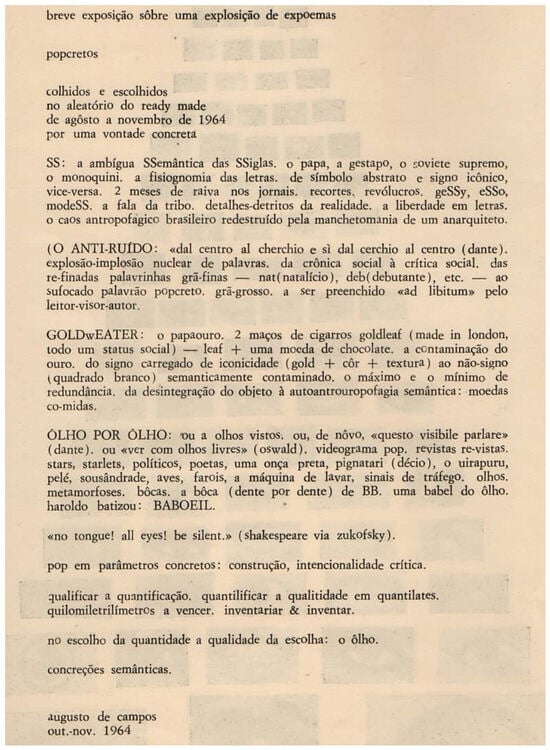
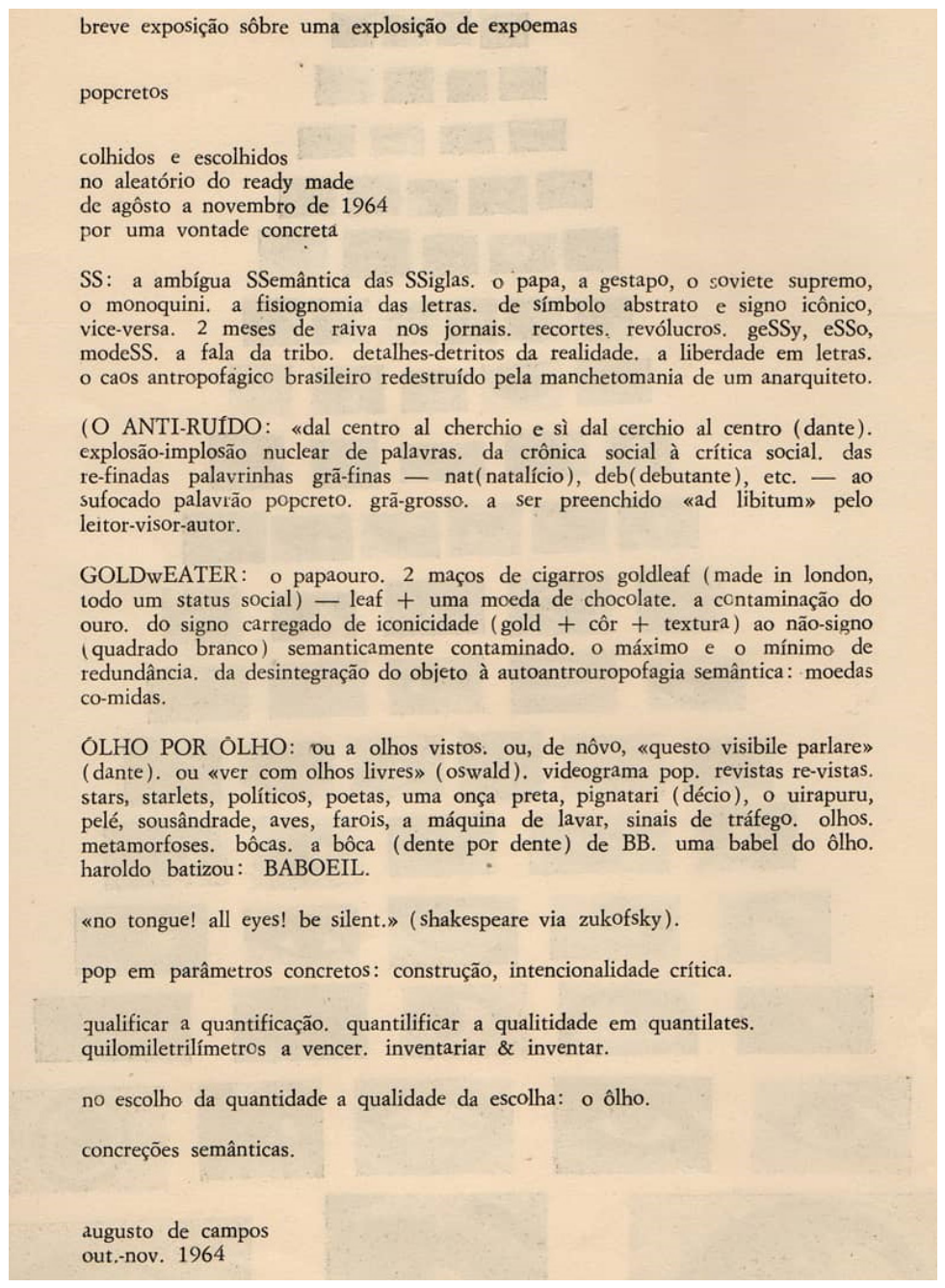
The emphasis on working with materials taken from mass media and popular culture is combined with the author’s interest in historical avant-garde techniques and procedures as methods for investigating the limits of language. Within this tradition, a fundamental part of the artist’s sensory relationship with the social and technological environment is enacted through the critique of the social function of language, using visuality, active listening, and linguistic performance as instruments. This is a procedure that art historian Trevor Stark calls a “total expansion of the letter,” taking up Mallarmé’s utopian vision of the act of writing as “a reduction of language to [a nothing], to the equivalent of silence or noise”—a critique of instrumental communication that served as a touchstone for historical avant-gardes (Stark 2020, p. 7). Inspired by the sardonic character of Marcel Duchamp’s readymades and Kurt Schwitters’s Dadaist collages, the series departs from Campos’s earlier work centered on verbal materiality, in which word units occupied a central position.9 Focusing on “the details-detritus of reality,” the poet assembles his composition out of iconic rhymes and broken morphemes atomized from the vexed headlines of magazines and newspapers (A. de Campos 1964). With a renewed impulse toward destruction, the poet who sought to propose a “pilot-plan” for the construction of a new poetic form—inspired by Brasília—now presents himself as an “anarchitect” (combining “anarchy” and “architecture”) in search of the freedom to use alphabetical characters as he pleases. Comments from the leaflet distributed on the opening night of the exhibition hold cryptic and elliptical keys to the author’s intentions (see Figure 3), presenting the poems in the series as being “colhidos e escolhidos no aleatório do ready-made […] por uma vontade concreta” (gathered and chosen in the randomness of the ready-made […] by a concrete will) (A. de Campos 1964). However, the selection of word fragments is not merely accidental but plays deliberately with entropy. According to Campos, the intention is to “qualify quantification,” while the general direction is “inventorying & inventing” (A. de Campos 1964). In this process of selection, the conflict between the notions of quantity and quality is to be resolved by what he calls “pop in concrete parameters”: that is, the creative process embedded with critical intentionality (A. de Campos 1964). At the end of his presentation, Campos places “the eye” at the center of his selection and compositional processes. Nevertheless, the ocularcentrism he acknowledges exists in tension with the aural dimension that the poems convey.
Figure 3.
Augusto de Campos, Popcretos exhibit leaflet, Galeria Atrium, São Paulo, 1964. Image courtesy of the author.
Critical engagement with the Popcretos has centered on the series’s interrogation of sign, value, and subjectivity under late capitalism and political repression. Antonio Sergio Bessa brings up the concept of “semiological disorder,” and situates the works within a tradition of poets using collage to address economic changes and “to provide us with an image of this uncharted situation from within” (Bessa 2021, p. 155). The devaluation of language mirrors the logic of commodification—a parallel most forcefully dramatized in “GOLDwEATER,” in which Campos transforms commercial packaging “into a mock-up of a religious icon” (Bessa 2021, p. 158). Gonzalo Aguilar, approaching the series through the concept of “palavras-coisas” (word-things), explores how Campos repurposed the “detalhes-detritos” (details-detriti) of consumer culture against the spectacle of the authoritarian government, making the poetic word a thing that resists codification and signals a crisis of the human subject, just like the semantic instability of “SS”—oscillating among the Gestapo, the Pope, and the monokini—makes clear (Aguilar 2021, p. 87). Together, Bessa and Aguilar demonstrate that the popcretos operate simultaneously as semiological critique and political act, mobilizing the disorder and the waste of consumer culture to expose both the capitalist system and authoritarian rule.
With sound in mind, I wish to focus on the remaining three of the five pieces: “The Anti-Noise,” which explores sound and the anxiety of the atomic age; “An Eye for an Eye,” an entirely non-verbal visual piece that suggests an intersection between sight and silence while engaging with mass consumption and spectacle society, and which serves as a commentary on Brazil’s authoritarian turn; and “Hush!,” which protests the silencing of political dissidents and the hardening of dictatorship through the late 1960s.
3.1. “O ANTI-RUÍDO” [The Anti-Noise]
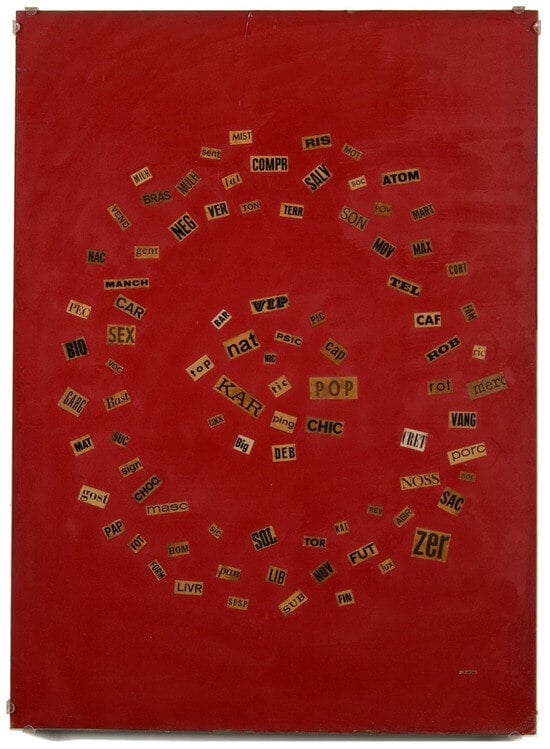
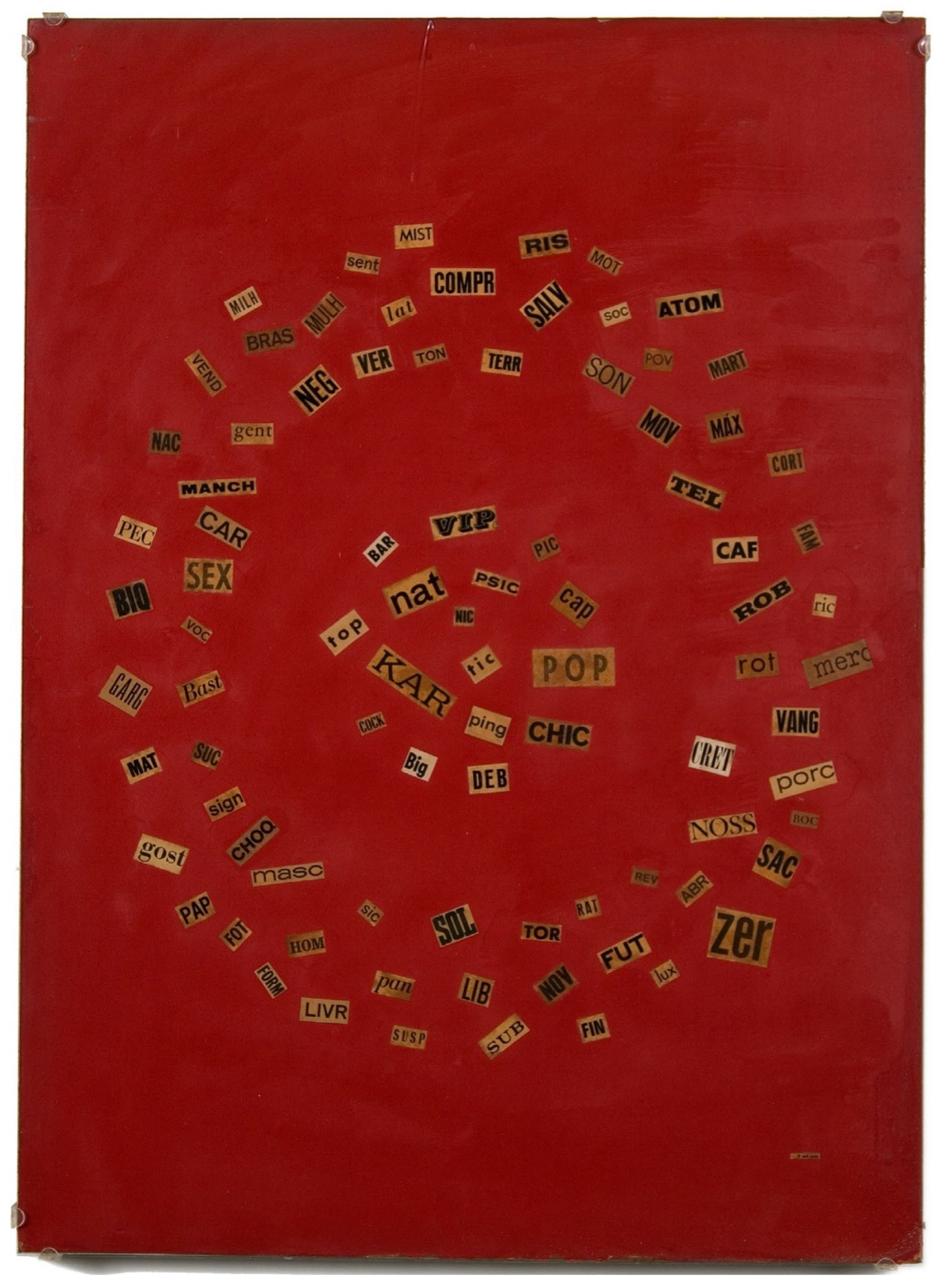
In “The Anti-Noise” (Figure 4), presented in the 1964 exhibition, words and word fragments are arranged on a deep red background to suggest a multisensorial blast, juxtaposing concepts of center and periphery. Mined from magazines and newspapers, the cut-ups comprise various typefaces and fonts and are laid out in two concentric circles: a condensed center functioning as a kind of nucleus, and an external halo of dispersed fragments. These zones of seemingly random lexical units create a tension between order and disorder. In part, these lexical pieces and their arrangement index their own atomization, offering clues to several derivative words. Yet while they exist apart from linear discourse, several broken words offer partial meanings that must be completed by the reader.
Figure 4.
Augusto de Campos, “O anti-ruído” (1964). Collage on wood panel, 50 × 70 cm. Image courtesy of the author.
Campos describes the poem as a “nuclear explosion-implosion of words” (A. de Campos 1964), evoking the sustained tensions of the Cold War and the looming threat of total war at a moment of unprecedented nuclear escalation, when the United States alone possessed more than 30,000 nuclear warheads.10 In this context, the title’s prefix “anti-“conveys the idea of opposing, preventing, suppressing, reversing, or undoing the “noise” produced by the poem’s visual blast. In Portuguese, the term “ruído” shares etymological roots with “rugir” (roar),11 referencing loud, heavy sounds that echo a thunder or explosion. Historian Hillel Schwartz notes that noise consists of “unwanted sounds” that, while potentially incomprehensible, are never devoid of significance. They are by definition “what breaks through and becomes obvious” (Schwartz 2011, p. 28). Moreover, ethnomusicologist David Novak defines noise as “an essentially relational concept”; it is not merely a type of sound, Novak argues, but instead “a metadiscourse of sound and its social interpretation” (Novak 2015, p. 126). In a broader sense, as a discursive element, noise is “a powerful antisubject of culture, raising essential questions about the staging of human expression, socialization, individual subjectivity, and political control” (Novak 2015, p. 133). The perception of a particular sound as noise is thus shaped by its cultural context. As John Cage asserts in his seminal work Silence—published three years prior to the Popcretos—, “wherever we are, what we hear is mostly noise. When we ignore it, it disturbs us. When we listen to it, we find it fascinating” (Cage 1961, p. 3). This new perspective on the acoustic phenomenon, to which Cage responded by emphasizing the value of random sounds as musical elements, represented not merely a provocation but a fundamental change in perception that profoundly influenced the work of experimental artists in the 1960s. Campos, who translated Cage’s works into Portuguese, was deeply engaged with this discussion. In Popcretos, the tangible prospect of an extremely saturated soundscape merges with a spectrum of images produced under a mixture of fascination and horror.
In “The Anti-Noise,” Campos draws upon a longstanding historical tradition encompassing poetry and philosophy, positing a direct relation to the opening line of Canto Fourteen in Dante’s Paradiso: “Dal centro al cerchio, e sì dal cerchio al centro” (From the center to the rim, and so from the rim to the center) (Alighieri [1321] 1975, pp. 152–53).12 The line introduces a dialogue between Beatrice and St. Thomas Aquinas, linked to the image of the circular flow of water within a vessel, and sets the stage for King Solomon’s recounting of an intense vision of light originating from the Resurrection of the Dead. Anchored in the Neoplatonic Catholic tradition of apophatic (negative) theology—which emphasizes silence—Dante’s allegorical use of the circle to navigate the dialectic between unity and multiplicity, center and periphery, serves as an archetype for Campos’s structural approach in his collage.13 While Dante employs the circle metaphor to situate the sonic interchange between voices and discourses in Paradiso’s “heaven of the sun,” representing the realm of wisdom, “The Anti-Noise” employs the circle to inscribe a language that has failed, in the realm of the unwise. The concrete poet negatively defines his object, silence, by its qualitative difference, using noise as the semantic instability of a conflicted language. In describing his poem as a “noiseless explosion” (A. de Campos 1964), Campos mirrors John Hersey’s famous depiction of the Hiroshima atomic bomb as a “noiseless flash”: survivors reported that the intense, bright light that immediately followed the bomb’s detonation spread in an unsettling silence (Hersey 1946). Given the different propagation speeds of light and sound—where the perception of sound trails that of light but aligns with the arrival of the shockwave—the explosion’s intensity significantly hindered auditory perception, rendering its sound effectively unheard.
Drawing on the metaphor of an atomic explosion, “The Anti-Noise” depicts a kind of internal chain reaction through the fission of English and Portuguese vocabularies, entangled in an asymmetrical power dynamic. Complete monosyllabic words in English permeate the printed area—words like “top,” “big,” “cap,” “sex,” “cock,” “car,” “sign,” “pop,” and, of course, “atom,”—set against fractured Portuguese words such as “compr-,” “bras-,” “terr-,” “milh-,” “salv-,” “pov-,” “livr-,” “merc-,” “caf-.” My hypothesis is that the meticulously designed entropy embedded within the spherical shape takes Portuguese language as a fissile material into which competing English words, like atoms, collide. The Cold War nuclear threat that motivates, and to some extent structures, the piece intersects with a critique of the cultural domination between the center and the periphery. Like the unstable atom broken apart in a nuclear reaction, the splintered Portuguese words appear corrupted while the stronger, condensed monosyllabic English words maintain a sonorously disruptive integrity. The English lexicon, borrowed from advertising jargon, thus serves a dual function in the poem: it operates both as material in its sonic dimension and as a symbol of cultural dominance and neo-colonial power. As readers wade through the scattered text, the incomplete Portuguese morphemes acquire an additional function, demanding the reader’s active engagement in this “open work” (Eco/Haroldo)—a process Campos describes as moving “from social chronicle to social critique. From the re-fined, high-class little words… to a suppressed popcrete expletive… to be filled in ‘ad libitum’ by the reader-viewer-author” (A. de Campos 1964, p. 105). The “reader-viewer-author” must therefore play a collaborative role in the process of creation. For instance, the fragment “compr-“could expand to comprar (to buy), comprovar (to prove), or comprimir (to compress). Similarly, “terr-“could unfold into terra (land/earth/soil) or terror (terror); “livr-“might yield livro (book) or livre (free). The reader’s mental engagement is essential to navigating the diverse semantic territories that these partial words open up—inflected by an unequal power dynamic in which the mass of intact English words stands out for their onomatopoeic qualities, facing the broken pieces of a fractured and unstable Portuguese language.
3.2. “OLHO POR OLHO” [An Eye for an Eye]
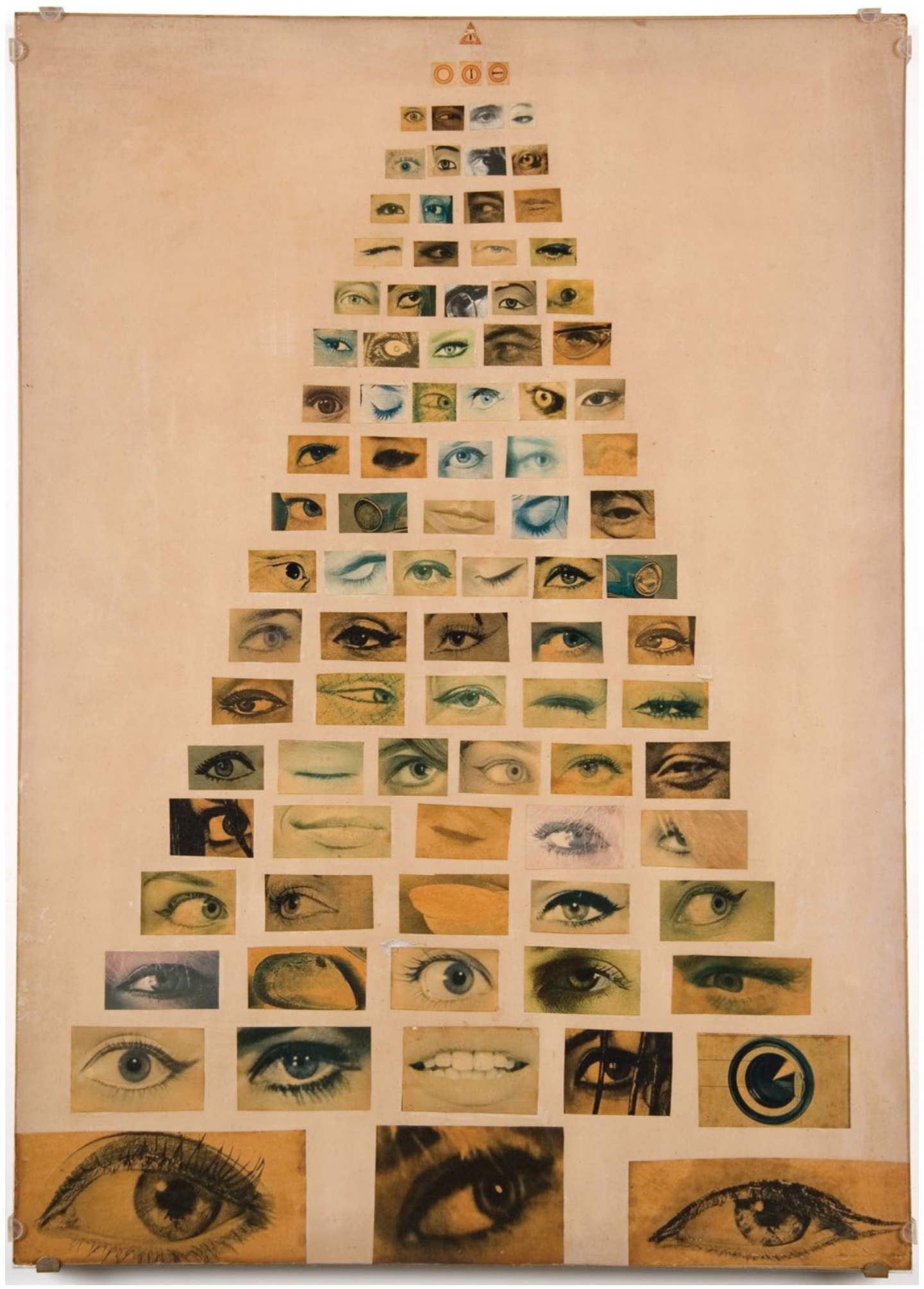
In the following poem, “An Eye for an Eye (Babœil)” (Figure 5), Augusto de Campos intensifies the collage procedure, pushing the dialectical relationship between the sonic and the visual even further. Moving beyond noise, Campos departs from phonetic alphabet to explore iconographic expression, replacing the written word with images, and thereby removing speech from the poetic object to create a construction centered on sight and, by extension, silence. Like “The Anti-Noise,” “An Eye for an Eye” encodes its cultural and political critiques through an array of allusions spanning from twentieth-century mass culture to antiquity, referencing at once contemporary politics and the long-standing of Judeo-Christian tradition.14
Figure 5.
Augusto de Campos, “Olho por olho (Babœil)” (1964). Collage on wood panel, 50 × 70 cm. Image courtesy of the author.
The poem foregrounds a relationship between sight and silence, image in lieu of verbal writing. In the earliest version for the introductory notes to the series—originally a leaflet distributed at the Galeria Atrium exhibition in 1964—, Campos references the Objectivist poet Louis Zukofsky (1904–1978), taken from his extraordinary poetics treatise Bottom: On Shakespeare (1963). The book’s generative premise is drawn from what is arguably a most far-reaching scene in A Midsummer Night’s Dream, in which the character Nick Bottom attempts to recount a dream marked by the tangle of sensory boundaries. In his account, Bottom describes an experience in which the conventional faculties of perception have been radically transposed; sight, hearing, taste, touch, and cognition rendered interchangeable in a moment of synesthetic dissolution: “The eye of man hath not heard, the ear of man hath not seen, man’s hand is not able to taste, his tongue to conceive, nor his heart to report what my dream was” (MND, Act 4, Scene 1, lines 220–224). It is from this scene that the book develops its central inquiry into the relationship between the eye, sound, and language. While navigating Shakespeare’s work, Zukofsky orbits around a line from The Tempest in which Campos finds a connection to his own poem: “no tongue! all eyes! be silent” (T, Act 4, scene 1, line 66). In Zukofsky’s interpretation, this directive poses a challenge to writers—whom he refers to as “artists in words”—since, for a writer to follow it, would be to choose to “not exist” as an artist in words (Zukofsky 1963, p. 77). This allusion not only serves Campos’s broader poetic project, characterized by his engagement with negative categories (the minus, the anti-, the des-, the word no), but also sustain the mechanism behind “An Eye for an Eye.” All these negative markers that appear throughout Campos’s work as indices of an apophatic approach, are here, however, to foreground visuality and place it in dialectical opposition to sound, positing the image in parallel to silence: the wordless poem in which the images’ iconicity establishes the resulting semantic relationship. Notably, the reference made by Campos to “Shakespeare via Zukofsky” in the original leaflet and published at Invenção n. 4 (1964, p. 105)—right after his commentary to this particular poem—would later be excluded from the versions presented in collections such as Viva Vaia: Poesia 1949–1979 (1979).
Clippings of eyes—alongside images of lips and traffic signs, a fingernail, car headlights, a mussel, and the door of a front-loading washing machine—are arranged in a triangular polygon suggestive of a pyramid or an ascending stairway. Apart from the title, no linguistic elements are present, yet the title itself proves to be key for interpretation. It evokes the lex talionis—the principle of retaliation by equitable retribution found in the Babylonian codes of justice—and thereby gives a framework for interpreting the poem’s visual structure through ancient Mesopotamian culture and, by extension, the Tower of Babel (Genesis 11:1–9). The title’s pun, casting the poem as a contemporary Babel of eyes, the “Babœil,” plays with the biblical myth of confusio linguarum (the confusion of languages), which narrates the splintering of human languages as divine retribution for the hubris of constructing a tower tall enough to reach the heavens.15
In Campos’s tower, the polysemic semiotics of images draw on the forceful immediacy of the contemporary moment, exemplifying a procedure characteristic of the author: the deliberate juxtaposition of present-day emblems with tropes drawn from cultural history, the latter serving as interpretive test cases for the former. The biblical resonances of the title and the architectural arrangement of the images stand in tension with the pop cultural references embedded within them. A multitude of eyes and a couple of lustful lips from public and media personalities of the day invites the reader into a game of visual speculation and identification. The eyes depicted in the artwork belong to political leaders of the era, among them Fidel Castro, John F. Kennedy, and the former Brazilian president Juscelino Kubitschek, who made Brasília. Additionally, emerging media icons—like Brazilian soccer player Pelé and international film stars such as Elizabeth Taylor and Brigitte Bardot—situate the work within the iconography of a modern-day Babylon, where the violent logic of reciprocity, an eye for an eye, inevitably prevails. In this babœil, so to speak, the viewer’s own gaze is ultimately caught within the very web of representations it seeks to read.
The poem functions as an acerbic monument to the rise of a visually dominant cultural industry, raised out of a pile of eyes from individuals whose livelihoods depend on being seen. At the pyramid’s summit, a cluster of road signs not only references the automotive industry—which notably established its presence in Brazil concurrently with the beginning of the concrete poetry movement in 1956—but also makes a veiled political statement. A “no left turn” sign occupies the left side of the composition, while a “turn right” sign on the right prescribes the only legally sanctioned direction. Positioned between them, a sign pointing straight ahead directs the viewer’s gaze toward the pyramid’s apex, where a “general danger” warning sign counsels extreme caution in proceeding forward. This progression from iconographic imagery at the base to symbolic road signs at the summit shapes the poem’s semiotic architecture, gradually unveiling what the author intends as a sustained exercise in social and political critique. The work’s capacity to provoke was confirmed in a pointed, if destructive, manner: during the final days of the Popcretos public exhibition of 1964, all original pieces were subjected to an act of vandalism, defaced with derogatory inscriptions. Far from diminishing the work’s significance, this act attests to the degree to which the exhibition’s aesthetic and political provocations had struck a somewhat resonant chord with its audience.
3.3. “PSIU!” [Hush!]
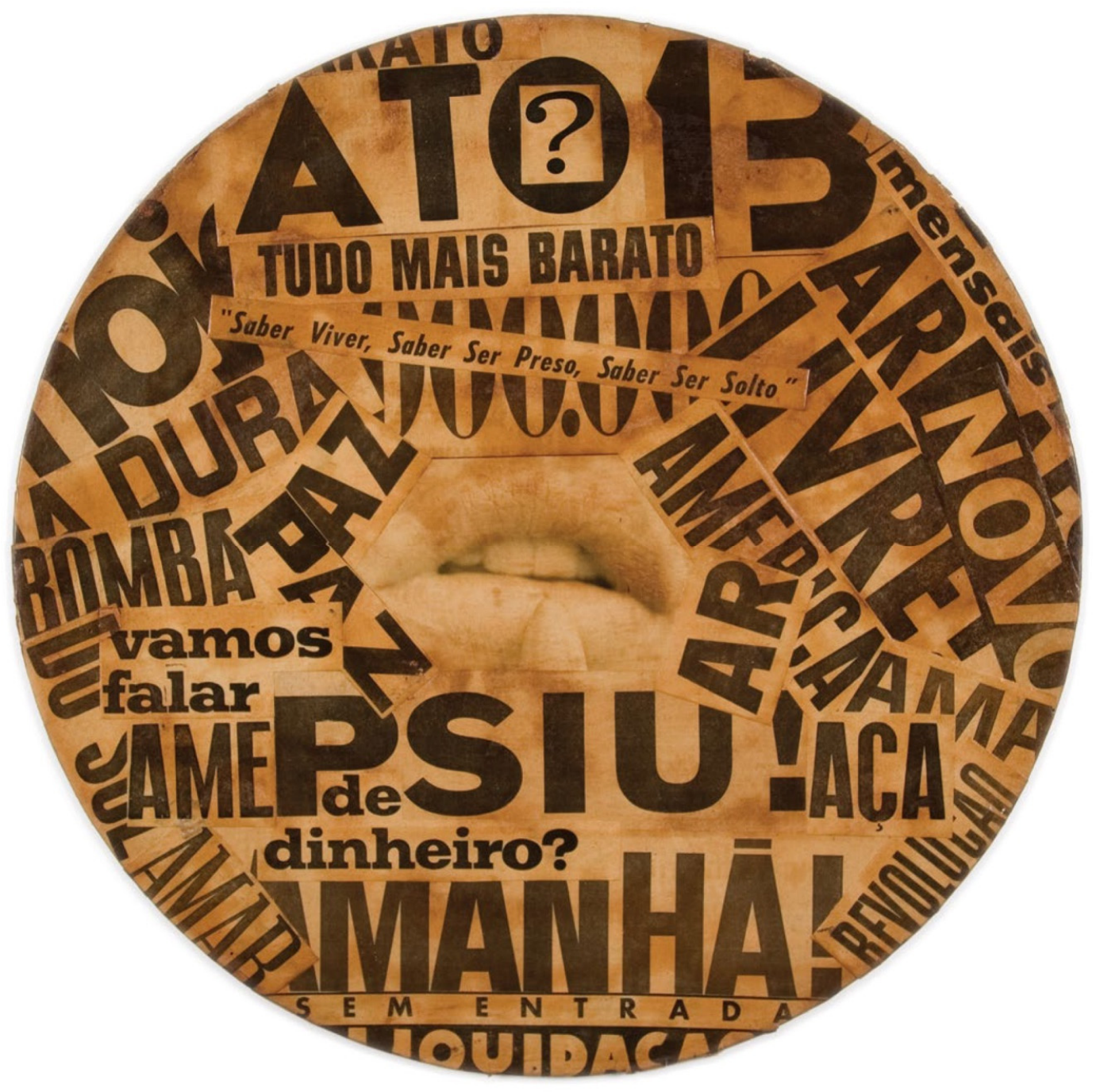
Two years later, in 1966, Augusto de Campos presented his fifth and final popcreto (Figure 6). The work titled “Psiu!”—a nuanced onomatopoeic interjection commonly used in Brazilian Portuguese to discreetly attract someone’s attention, as a cue to flirting, or to request silence, roughly analogous to “hey!,” “psst!,” or “hush!,” the last of which the author himself adopted as his English translation—centers on the image of a set of enticing, slightly parted, large lips painted red. An index finger resting on the lower lip gives the piece a distinctly erotic undertone. Surrounding this central image, a collage of words, sentences, and excerpts drawn from commercial advertisements and newspapers’ political quotes threatens to engulf it entirely. The interjection “HUSH!,” rendered in capital letters beneath the lower lip, operates with dual meaning: it functions simultaneously as an inviting signal to draw the observer closer and as a silencing gesture commanding restraint. Once again, the dynamic interplay between sound and silence constitutes the central tension of the composition. In this case, however, a less elliptical and more openly confrontational Campos moves to address directly the fraught political atmosphere of the early years of the Brazilian military dictatorship—a shift in register that marks the Popcretos in its political expression.
Figure 6.
Augusto de Campos, “Psiu!” (1966). Collage on wood panel, circular, 60 cm diameter. Image courtesy of the author.
João Bandeira observes that the poem is structured around two distinct semantic fields, corresponding to dimensions of Brazilian social life: the political and the economic (Bandeira 2017, p. 156). Notably, the selection of words and phrases embedded within the composition explicitly engages with the state of exception inaugurated by the military coup of 1964. Terms such as BOMB, PEACE, and REVOLUTION appear prominently, while others are strategically positioned to convey dual meanings. The word hoje (today), for instance, is visually arranged to resemble nojo (disgust or revulsion); the fragment “-A DURA” implies ditadura (dictatorship); and so forth. The term AR (air), when combined with AZ, yields AZAR (chance, but also misfortune or bad luck). The word AME-AÇA (menace, threat) is bisected by the poem’s title, while AMERICA in isolation invites an association with North America before it can be completed by DO SUL to form AMÉRICA DO SUL (South America). Similarly, what begins as a casual invitation to dialogue—“let’s talk”—shifts register abruptly when completed by the fragment below it: “shall we talk about money?” Perhaps the most striking instance of layered meaning is the enigmatic formulation ATO 13 (?), which, in hindsight, reads as an unwitting harbinger of the notorious Institutional Act No. 5 (AI-5). Decreed in 1968, the AI-5 suspended political rights and provided the legal scaffolding for systematic state-sponsored crimes against humanity, including the torture and assassinations that intensified dramatically in the years that followed. That the poem gestures, however obliquely, toward such institutional violence lends it a retrospective weight that transcends its immediate context.
The progressive state governor Miguel Arraes (1916–2005), who was immediately deposed following the military takeover and was being held as a political prisoner at the time the Popcretos was first conceived, appears in both “Olho por olho” and “Psiu!” In the latter, he merits a complete quotation, drawn from the speech he delivered upon his release from prison before departing into exile in Algeria: “Saber viver, saber ser preso, saber ser solto” (To know how to live, to know how to be imprisoned, to know how to be released). The left-wing governor of the state of Pernambuco, whose administration had advanced a politics of social justice and redistribution—notably compelling landowners to pay the minimum wage to workers in the sugarcane fields—has his name partially obscured within the composition. The word novo (new) superimposes the newspaper headline “ARRAES LIVRE!” (Free Arraes!) in the upper-right section of the poem, an act of visual layering that condenses the longing for his freedom. The case of Arraes had by then become emblematic of the injustices operated after the 1964 coup d’état and a powerful symbol of leftist resistance. By incorporating his name and words into the poem, Campos transforms the work into both testimony and denunciation—a poetic indictment of military authoritarianism. “Psiu!” thus stands not only as one of the author’s most celebrated works, but as a striking example of politically engaged art produced under conditions of repression.
Whether this cacophony of alarming assertions emanates from what appears to be a pair of lips engaged in sensual whispering, or whether those same lips are, on the contrary, deflecting from the urgent realities of an oppressed political situation, is a determination left entirely to the reader. Once again, the concept of the “open work” governs the poem’s interpretive logic, refusing closure in favor of productive ambiguity.16 Ultimately, the piece conveys a compelling message of political resistance and denunciation through the central image of the human mouth—the anatomical site of speech production—which figuratively whispers to the viewer’s eye what one is literally prohibited from saying aloud. The hidden acoustic dimension of “Psiu!” as a written inscription thus reframes the surrounding collage of linguistic materials as a sonic archive of multiple voices, entextualized within the sound-sensitive visuality of the Popcretos as a whole. The poem does not merely depict silence or speech—it enacts the precarious threshold between them, rendering visible the very suppression it seeks to resist.
4. Conclusions
The pronounced visuality of the works analyzed in this article traces a trajectory from suggestive auditory backgrounds toward what Ana María Ochoa Gautier defines as “specific legible sound objects of expressive culture” (Ochoa Gautier 2014, p. 3). The sonic dimension of these visual poems rests on the seemingly aporetic relation between sound and vision that is inscribed into the form and materiality of the works themselves. As such, the popcretos articulate the multisensorial dimension of an immanent visual and auditory world. In 2018, MALBA—the Museum of Latin American Art of Buenos Aires—started acquiring the complete Popcretos series originals, adding them to its permanent collection alongside works such as the Abaporu (1928), Tarsila do Amaral’s landmark painting and the defining work of Brazilian modernism. This institutional recognition places the series within the most consequential works of art produced in Latin America, affirming their enduring cultural and art-historical significance.
Throughout his life, both as an author and as an interpreter of the avant-gardes, Campos also produced a substantial corpus of critical writings on the most radical and inventive music of the twentieth century, which he characterized as the “adventure of sound” (emphasis mine; A. de Campos 1998, p. 239). His essays on composers such as Anton Webern, Pierre Boulez, Luciano Berio, and John Cage among many others were compiled into volumes that offer a sustained record of his auditory sensibility and critical perspective. Above all, Campos was drawn to music liberated from the conventional parameters of melody, harmony, and rhythm, turning instead toward atonality, serialism, and indeterminacy as pathways to what he described as “experiences with sounds as sounds” (A. de Campos 1998, p. 242). Campos charts several “explorations at the limits of sonority,” foregrounding composers whose “noisy conglomerates tend to shift the focus from structure to the very materiality of sound as the core of the musical experience,” calling for “sonic adventures of perceptual experiences… in favor of re-generating listening, from sound-silence, sound-breath, sound-voice, to the primal sound” (A. de Campos 1998, pp. 243–44). In sharing his experiences as a listener, Campos furnishes us with a set of interpretive coordinates for listening to his own sonic–visual poetic objects, directing our attention toward images that emerge from a world of generative sounds. One of noisy visualities and virtual silences. The world of popcretos.
Funding
This research received no external funding.
Data Availability Statement
No new data were created or analyzed in this study.
Acknowledgments
The author wishes to thank Augusto de Campos for his generous permission to reproduce the works discussed in this article.
Conflicts of Interest
The author declares no conflicts of interest.
Notes
| 1 | Unless otherwise stated, all translations are mine. |
| 2 | For international scholarship on concrete poetry, see Bessa (2026); Wolfson (2025); Shellhorse (2017; 2020); Jackson (2005); Aguilar (2003); Franchetti ([1989] 2012). |
| 3 | Carrie Noland proposes a “sound-sensitive approach” to sound poetry’s phonic materials “develop[ing] a sensitivity to sound as sound before it becomes caught in the web of signification.” (see Noland 1999; 2005, p. 120). |
| 4 | This was a practice (and an ethics) that concrete poets also recognized in other poets like João Cabral de Melo Neto; see (H.d. Campos 2006). |
| 5 | Gonzalo Aguilar identifies a second period to concrete poetry that covers the years from 1960 to 1966 and is characterized by the “ideologema of the ‘revolution’,” during which the modernist criteria that guided the first phase were expanded into political engagement (see Aguilar, 23). The so-called “salto participante” of the movement comprises the materials published in the Invenção magazine (1962–1967). |
| 6 | The original recording was first released in Grupo Noigandres, edited by Barros and Bandeira 2002, on the accompanying audio CD, track 19. |
| 7 | Antonio Sergio Bessa includes yet another two additional collage pieces made in the same period but not grouped by the poet under that designation: “Luxo” (1965) and “F(J)(Y)EUX” (1965) (see Bessa 2026, p. 68). |
| 8 | The term was used by the Museum of Modern Art in the occasion of the “Symposium on Pop Art,” December 1962. In Brazil, however, the term would be consecrated with the 9th Bienal de São Paulo, known as the “Pop Art Biennial” from 1967. |
| 9 | The incorporation of categories such as the precarious, the transitory and above all chance would be theoretically elaborated by Haroldo de Campos in two essays written at the time: “Kurt Schwitters ou o júbilo do objeto” (1956), and “A arte no horizonte do provável” (1963). |
| 10 | See numbers of the Estimated Global Nuclear Warhead Stockpiles according to the Federation of American Scientists in “Status of World Nuclear Forces”: https://fas.org/initiative/status-world-nuclear-forces/ (accessed 11 May 2025). |
| 11 | Despite the differences in meaning between its Latin and Greek roots—the word noise from Latin nausĕa (which in turn was imported from the Greek nautia, meaning seasickness) and ruído from rugītus, a bellowing or roaring, which in English is the source of the word rutting—contemporary English and Portuguese uses converge in meaning. |
| 12 | “Dal centro al cerchio, e sì dal cerchio al centro/movesi l’acqua in un ritondo vaso/secondo ch’è percosso fuori o dentro” (From the center to the rim, and so from the rim to the center, the water in a round vessel moves, according as it is struck from without or within), Paradiso, Canto XIV, lines 1–3 (Alighieri [1321] 1975, pp. 152–53). |
| 13 | A perspective originally developed in the writings of Pseudo-Dionysius the Areopagite, a sixth-century Christian philosopher and theologian, whom sound poetry pioneer and Dada founder Hugo Ball (1886–1927) named in his diary as the inspiration for the movement’s name: da-da is Dionysius Areopagite’s initials repeated, a coinage inspired by Ball’s reading of Pseudo-Dionysius and his interest “in the alchemy of letters and words.” The writings of the mystical philosopher informed Ball’s literary and metaphysical project: “it is rather the case of a circle. The center point of the circle is shared by the surrounding radii.” See (Ball 1996); and the treatise “On the Divine Names,” (Pseudo-Dionysius the Areopagite 1987, p. 62). |
| 14 | On a similar note, Rachel Price reflects on “Código” (1973), a poem in which Augusto de Campos would also combine early the Christian tradition with a commentary on pressing contemporary issues, such as the rise of cybernetics and the dematerialization of the object-oriented materiality that characterized concrete poetry, moving toward semiotic conceptualizations of language. See (Price 2014). |
| 15 | “Come, let us go down, and confuse their language there, so that they will not understand one another’s speech.” Genesis 11:7 (Coogan et al. 2018, p. 26). |
| 16 | It is worth noting that Augusto’s brother, Haroldo de Campos, had independently formulated a parallel conception of obra aberta some years prior to Umberto Eco’s influential and lengthy own theorization of the Opera Aperta—a precedence that has not always received the critical recognition it deserves, and one that situates concrete poets within a broader international intellectual tradition of thinking through indeterminacy and reader participation as constitutive features of the literary work. |
References
- Aguilar, Gonzalo. 2003. Poesía Concreta Brasileña: Las Vanguardias En La Encrucijada Modernista. Rosario: Beatriz Viterbo Editora. [Google Scholar]
- Aguilar, Gonzalo. 2005. Poesia Concreta Brasileira: As Vanguardas Na Encruzilhada Modernista. São Paulo: Editora da Universidade de São Paulo. [Google Scholar]
- Aguilar, Gonzalo. 2021. Espetáculo Popcreto: A Política Das Coisas. Santa Barbara Portuguese Studies 8: 75–88. [Google Scholar]
- Alighieri, Dante. 1975. The Divine Comedy. Vol. III, Part 1: Paradiso. Translated by Charles S. Singleton. Princeton: Princeton University Press. First published 1321. [Google Scholar]
- Ball, Hugo. 1996. Flight out of Time: A Dada Diary. Edited by John Elderfield. Berkeley: University of California Press, p. 210. [Google Scholar]
- Bandeira, João. 2017. O País Num PSIU! In Serrote. São Paulo: IMS, pp. 148–58. [Google Scholar]
- Barros, Lenora de, and João Bandeira, eds. 2002. Grupo Noigandres. São Paulo: Cosac & Naify. [Google Scholar]
- Bessa, Antonio Sergio. 2021. Poetics of the Un-Poetic: Semiological Disorder in Augusto de Campos’ Popcretos. Santa Barbara Portuguese Studies 8: 152–66. [Google Scholar]
- Bessa, Antonio Sergio. 2026. Noigandres: Poetry Made New in Brazil. New York: Fordham University Press. [Google Scholar]
- Cage, John. 1961. Silence; Lectures and Writings, 1st ed. Middletown: Wesleyan University Press. [Google Scholar]
- Coogan, Michael D., Marc Z. Brettler, Carol A. Newsom, and Pheme Perkins, eds. 2018. The New Oxford Annotated Bible: New Revised Standard Version, 5th ed. Oxford: Oxford University Press. [Google Scholar]
- Cordeiro, Waldemar. 2014. Arte Concreta Semântica. In Waldemar Cordeiro: Fantasia Exata. Edited by Analivia Cordeiro. São Paulo: Itaú Cultural, pp. 426–28, First publihsed 1964. [Google Scholar]
- Costa, Lúcio. 1957. Relatório do Plano Pilôto de Brasília=Beschreibung Des Orientierungs Fuer Brasilia. Módulo 3: 33–48. [Google Scholar]
- de Campos, Augusto. 1964. Breve Exposição Sobre Uma Explosição de Expoemas Popcretos. Invenção: Revista de Arte de Vanguarda n. 4: 105. [Google Scholar]
- de Campos, Augusto. 1979. Viva Vaia: Poesia 1949–1979. São Paulo: Duas Cidades. [Google Scholar]
- de Campos, Augusto. 1998. Música de Invenção. São Paulo: Editora Perspectiva. [Google Scholar]
- de Campos, Augusto, Haroldo De Campos, and Décio Pignatari. 1975. Teoria Da Poesia Concreta: Textos Críticos e Manifestos, 1950–1960, 2nd ed. São Paulo: Livraria Duas Cidades. [Google Scholar]
- De Campos, Haroldo. 2006. O geômetra engajado. In Metalinguagem e outras metas: Ensaios de teoria e crítica literária. São Paulo: Perspectiva, pp. 77–88. [Google Scholar]
- Duprat, Rogério, Damiano Cozzella, Willy Correia de Oliveira, Gilberto Mendes, Régis Duprat, Júlio Medaglia, Sandino Hohagen, and Alexandre Pascoal. 1963. Manifesto Música Nova. Invenção: Revista de Arte de Vanguarda 3: 5–6. [Google Scholar]
- Franchetti, Paulo. 2012. Alguns Aspectos da Teoria da Poesia Concreta. Campinas: Editora da Unicamp. First published 1989. [Google Scholar]
- Gabara, Esther. 2018. Contesting Freedom. In Pop América, 1965–1975. Edited by Esther Gabara. Durham: Nasher Museum of Art/McNay Art Museum, pp. 10–19. [Google Scholar]
- Hersey, John. 1946. Hiroshima. The New Yorker, August 31, pp. 15–68.
- Jackson, Kenneth David, ed. 2005. Haroldo de Campos: A Dialogue with the Brazilian Concrete Poet. Oxford: Centre for Brazilian Studies. [Google Scholar]
- Jameson, Fredric. 1984. Postmodernism, or the Cultural Logic of Late Capitalism. New Left Review 146: 53–92. [Google Scholar] [CrossRef] [Scilit]
- Noland, Carrie. 1999. Poetry at Stake: Lyric Aesthetics and the Challenge of Technology. Princeton: Princeton University Press. [Google Scholar]
- Noland, Carrie. 2005. Phonic Matters: French Sound Poetry, Julia Kristeva, and Bernard Heidsieck. PMLA: Publications of the Modern Language Association of America 120: 108–27. [Google Scholar] [CrossRef] [Scilit]
- Novak, David. 2015. Noise. In Keywords in Sound. Edited by David Novak and Matt Sakakeeny. Durham: Duke University Press, pp. 125–38. [Google Scholar]
- Obrist, Hans Ulrich. 2018. Hans Ulrich Obrist: Entrevistas Brasileiras. Rio de Janeiro: Cobogó, vol. 1. [Google Scholar]
- Ochoa Gautier, Ana María. 2014. Aurality: Listening and Knowledge in Nineteenth-Century Colombia. Durham: Duke University Press. [Google Scholar]
- Perloff, Nancy, ed. 2021. Concrete Poetry: A 21st-Century Anthology. London: Reaktion Books. [Google Scholar]
- Pignatari, Décio. 2004. A situação atual da poesia no Brasil. In Contracomunicação. Cotia: Ateliê Editorial, pp. 99–119. First published 1971. [Google Scholar]
- Price, Rachel. 2014. The Object of the Atlantic: Concrete Aesthetics in Cuba, Brazil, and Spain, 1868–1968. Evanston: Northwestern University Press, p. 94. [Google Scholar]
- Pseudo-Dionysius the Areopagite. 1987. On the Divine Names (644A). In Pseudo-Dionysius: The Complete Works. Translated by Colm Luibheid. New York: Paulist Press, p. 62. [Google Scholar]
- Schwartz, Hillel. 2011. Making Noise: From Babel to the Big Bang & Beyond. Brooklyn: Zone Books. Cambridge: MIT Press. [Google Scholar]
- Shellhorse, Adam Joseph. 2017. Anti-Literature: The Politics and Limits of Representation in Modern Brazil and Argentina. Pittsburgh: University of Pittsburgh Press. [Google Scholar]
- Shellhorse, Adam Joseph. 2020. The Verbivocovisual Revolution: Anti-Literature, Affect, Politics, and World Literature in Augusto de Campos. CR: The New Centennial Review 20: 147–84. [Google Scholar] [CrossRef] [Scilit]
- Stark, Trevor. 2020. Total Expansion of the Letter: Avant-Garde Art and Language After Mallarmé. Cambridge: MIT Press. [Google Scholar]
- Sterzi, Eduardo. 2004. Todos Os Sons, Sem Som. In Sobre Augusto de Campos. Edited by Flora Süssekind and Júlio Castañon Guimarães. Rio de Janeiro: 7Letras, Fundação Casa de Rui Barbosa. pp. 95–115. [Google Scholar]
- Süssekind, Flora. 2002. Coro a Um—Notas Sobre a ‘Cançãonoturnadabaleia’. Gragoatá Niterói 12: 23–46. [Google Scholar]
- Wolfson, Nathaniel. 2025. Concrete Encoded: Poetry, Design, and the Cybernetic Imaginary in Brazil. Austin: University of Texas Press. [Google Scholar]
- Zukofsky, Louis. 1963. Bottom: On Shakespeare. Austin: Ark Press. University of Texas Press. [Google Scholar]
Disclaimer/Publisher’s Note: The statements, opinions and data contained in all publications are solely those of the individual author(s) and contributor(s) and not of MDPI and/or the editor(s). MDPI and/or the editor(s) disclaim responsibility for any injury to people or property resulting from any ideas, methods, instructions or products referred to in the content. |
© 2026 by the author. Licensee MDPI, Basel, Switzerland. This article is an open access article distributed under the terms and conditions of the Creative Commons Attribution (CC BY) license.