


Abstract
The Chinese state-owned enterprise (SOE) reform at the end of the twentieth century displaced millions of workers into a rapidly shifting market. How do displaced workers navigate the coexistence of historical structures, of relations of production and social reproduction, both old and new? This article takes up these questions through two films by director Zhang Meng—Piano in a Factory and Lucky Dog—that center on former SOE workers amidst postsocialist China’s new economic order. In both films, characters navigate life outside the SOE structure by improvising with limited resources and repurposing what remains available, by way of both creativity and constraint. Reading these acts, this article proposes the term labor of making-do to name a practical, creative activity through which subjects navigate limited material conditions, competing subjectivities, and disrupted social relations in the shifting reality. Drawing on embodied socialist skills and memory, making-do as a particular form of labor reproduces subjects in a new historical structure. In the face of the market, it sometimes functions outside market logics. While informed by the historical legacy of the socialist ideology of labor, the labor of making-do is not primarily a nostalgic attempt to restore socialist ideals; nor is it a deliberate resistance to capitalism. Rather, it demonstrates a lived, spontaneous and often unglamorous process by which precarious subjects negotiate sustenance and survival, and through which revised subjectivities are produced. It is through such contradictory and quotidian processes that social reproduction unfolds across coexisting historical structures.
1. Introduction
The Chinese state-owned enterprise (SOE) reform at the end of the twentieth century displaced millions of workers into a rapidly shifting market through a broad spectrum of measures such as layoffs and early retirement. How do displaced workers live through different historical structures, of relations of production and social reproduction, both old and new? While we often understand historical shifts as ruptures, what forms of labor constitute these actually continual, lived and living processes? This article takes up these questions through two films by director Zhang Meng—Piano in a Factory (Gang de qin, M. Zhang 2010) and Lucky Dog (Erduoda youfu, M. Zhang 2007)—that center on former SOE workers amidst postsocialist China’s new economic order. In both films, characters navigate life outside the SOE structure by improvising with limited resources, by way of both creativity and constraint. Reading these practices, this article proposes the term labor of making-do to name a practical, creative activity through which subjects navigate material limitations, competing subjectivities, and disrupted social relations. Drawing on embodied socialist skills and memory, making-do as a particular form of labor reproduces subjects in a new historical structure. In the face of the market, it sometimes functions outside market logics. While informed by the historical legacy of the socialist ideology of labor, the labor of making-do is not primarily a nostalgic attempt to restore socialist ideals; nor is it a deliberate resistance to capitalism. Rather, it demonstrates a lived, spontaneous and often unglamorous process by which precarious subjects negotiate sustenance and survival, and through which revised subjectivities are produced. It is through such contradictory and quotidian processes that social reproduction unfolds across historical structures.
Set in a town in Liaoning during the 1990s, Piano in a Factory tells the story of a laid-off worker named Chen Guilin finding means to build his daughter a piano so that she would choose to live with him over her mother following their divorce. What director Zhang Meng sets out to convey, as he describes it, are “individual lives amid social transformation and their inner psyche” during China’s Reform and Opening-up when the nation changed from a state-planned economy to an open-market one (M. Zhang 2011). While waves of layoffs from state-owned enterprises (xiagang, literally off-post) swept the entire country, one region that took the hardest blow was Northeast China (a region known as Dongbei), formerly the central region of China’s socialist industrial economy. As Ching Kwan Lee writes, “laid-off and retired workers in China’s industrial rustbelt” largely absorbed the costs of the market reform (C. K. Lee 2007, p. ix). It is in the region of Dongbei that Zhang’s hometown Tieling, Liaoning, is located.1 Growing up in a family of state-owned enterprise workers, Zhang frequently incorporates the rustbelt SOE setting into his films: Piano in a Factory (M. Zhang 2010) was preceded by Lucky Dog (M. Zhang 2007), his first feature film, about how a former railroad and train mechanic who retired amid the reform struggles to make ends meet. Although the film leaves the circumstances of his retirement ambiguous, many details of the story suggest that the retirement may have been early or compulsory, one of the many euphemistic forms of layoff during the reform.
In the 1990s, China saw widespread downsizing or closing of SOEs in favor of partial or complete privatization.2 Previously under the planned economy, workers at SOEs were thought to have an “iron rice bowl” (tie fan wan)—a lifelong job guarantee offered by the state, which at one point could even be passed down to one’s child. The province of Liaoning, in particular, was the socialist heartland of heavy industry production that contained “10 percent of the nation’s large and medium-sized SOEs, an industrial structure that has proved crippling to the province’s development under the market economy,” according to Ching Kwan Lee (C. K. Lee 2007, p. 70). SOE employment not only promised financial stability but more importantly conferred social status and pride. One telling expression of this sense of pride is the popular circulation of the song “We Workers Are Powerful” (“Zanmen Gongren You Liliang”), which was originally composed on the eve of CCP’s victory in the Chinese civil war at a recently liberated factory in Northeast China. The song was inspired by workers who asked the musician Ma Ke to compose a song about workers’ uprising that would express their enthusiasm for the revolution (Lao 2022, pp. 75–77). As the anecdote reveals, from the outset of socialist China, industrial and manual labor were deeply intertwined with active and prideful participation in the proletarian self-liberation, especially among Dongbei workers given their strategic location. Therefore, the SOE reform released workers not simply from a privileged system of employment that promised subsistence; it was also a system through which workers derived a distinct subjectivity from what Koji Hirata calls “an ideology of masters” (Hirata 2025, p. 208). What followed thus was a drastic and atomizing process of subject formation that entailed both material and affective precarity. Whereas the previous subjectivity was cultivated through manual participation in collective projects of industrial development, labor of making-do demonstrates how laid-off workers used the skills and sometimes values of manual labor to cope with subject formation within changing social relations, where manual labor no longer occupied the same social and ideological position. By asking what happens to subjectivity in a time of structural reform, the term labor of making-do also highlights the continuities and porousness between socialist and postsocialist China.
Truthfully, former SOE workers make up only one part of the manifold forms of precarity at this historical juncture. Among the rich scholarship studying precarity and the market economy in China, this article follows a few strands of inquiry. First, Margaret Hillenbrand’s recent work provides a helpful clarification on precarity as a useful concept to study postsocialist China. Precarity, as Hillenbrand points out, has its roots in the European context of “incinerated sureties” associated with post-Fordism (Hillenbrand 2023, p. 26). Despite emerging from different geopolitics, this experience of risk “against a long backdrop of stability” nevertheless resonates with the “mood of change” in reform-period China (Hillenbrand 2023, p. 26). Another scholar that expands on precarity’s conceptual purchase in China is Ching Kwan Lee, arguing that it is the “relational and relative” outcome of multifarious struggles such as the politics of recognition and politics of social reproduction (C. K. Lee 2019, p. 138). Inspired by these scholars, my article hopes to add to this ongoing conversation through an examination of precarious subject formation in Dongbei, or Northeast China. This examination elucidates that precarity is not only an outcome but can also function as a key condition of labor’s social reproduction.
It is important to acknowledge Lee’s insight that former SOE workers, the subject of this article, had enjoyed unparallelled prestige before being affected by the institutional reform. They “represented only a small minority of the Chinese workforce” and “were found only in the urban, state-owned, heavy industry sector” (C. K. Lee 2019, p. 139).3 Bearing this distinction in mind, we may borrow Lee’s scholarship to highlight the uniqueness of Dongbei SOE workers. Precisely given its leading status within socialist China’s industrial infrastructure, the region is distinctively shaped by this material history’s long-lasting imprints. As Xuying Yu writes, “The working class of Dongbei, once lauded for the ‘Iron Man’ and ‘Daqing Spirit,’ faced significant hardships during this transition as they grappled with impoverishment, a decline in class identity, and marginalization. Meanwhile, Dongbei itself underwent a dramatic transformation, evolving from a symbol of national pride to China’s rust belt” (Yu 2024, p. 224). At the same time, these repercussions draw out over decades, during which individuals must grapple with the continuing decline, stagnation, and outflow of their communities.4 This historical specificity makes Dongbei a particularly compelling site to examine precarious subject formation.
My argument, that labor of making-do sheds light on a mechanism of precarious subject formation, is not intended as an umbrella term that overgeneralizes all forms of postsocialist subject formation. Even among Dongbei SOE workers, experiences of making do were highly differentiated. Women experienced the restructuring differently as a result of the gendered division of labor and often faced different post-layoff trajectories, including different types of informal work. The present account of labor of making-do is grounded primarily in the experiences of male former SOE workers as represented by the protagonists in the films. However, the films also open up important questions about the role of gendered labor in sustaining social reproduction. From the protagonists’ daughter, wife, ex-wife to girlfriend, women in the films are positioned to narratively facilitate the protagonists’ subject formation. The distinct forms of precarious subject formation the women experience require further analysis beyond the scope of this article.
Dongbei SOE workers’ special ties to socialist history offer exemplary cases to study how socialist subjectivity is adapted into new relations of production and reproduction, as seen in the films. In both films, the former SOE workers become part of what Marx calls the reserve army of labor in an informal economy (Marx 1976). In reality, repercussions of the structural reform also eventually led many Chinese northeasterners, including children of former SOE families, to join the migrant labor force. The historical context ultimately lends the term its central concern with the relationship between the reproduction of subjects and historical change. In any capacity beyond the scope of this article, this term hopes to gesture toward how subjects complete historical change as much as historical change makes subjects. Marxist theory has laid bare how the production of capital, which Marx called “dead labor,” relies on living labor and its creativity. The labor of making-do thus extends the Marxian insight by revealing the constant struggle between the subject’s contrived strategies of survival and capital’s subsumption of this creativity into production and reproduction. Labor of making-do is common, vernacular, lowbrow, intentional but not always entirely voluntary. It can be a last resort as much as a clever short-cut. At the same time, this labor extends the practical and emotional logics of informal, precarious, transitional work that can be found in postsocialist China but are also characteristic of the capitalist lived reality. Lastly, as seen in the films, labor of making-do grapples with embodied memories of socialism to mediate a heterogeneous ontological terrain.
2. Making Do, Making Films
The labor of making-do is postsocialist insofar as it draws from the skills, memories, knowledge and feelings from the lived socialist past to mediate present relations and conditions. This labor carries over the socialist logic of manual labor into newly reformed relations of production and reproduction. In fact, the labor of making-do appears at the very inception of Piano. In 1999, while searching for lumber to help with his aunt’s shop renovation, Zhang encountered a handmade, barely functional piano originally built by a folk arts troupe for model-opera training during the socialist period. Later, he learned that his own father had participated in the troupe and the construction of this piano. Cracked on the surface, the piano’s keys no longer bounced back after being struck and could each sound only once. This object became the prototype for the piano in the film Piano. It was also during this search that Zhang came across a steel market primarily run by laid-off steelworkers. He learned that the steelworkers had rejected governmental subsidies in cash form post-layoff in favor of machine tools, which would allow them to produce small commodities for sale and sustain livelihoods through their own labor (M. Zhang 2011).
The labor of making-do that inspired Zhang to write the film also becomes part of the film’s own making. Rather than a painted, bought piano, the steel piano that Piano’s protagonist Chen Guilin builds for his daughter in the film was welded from real steel (M. Zhang 2011). Zhang explains that since the film’s production faced severe budget constraints and “a single furnace of molten steel cost five-thousand yuan,” the scene had to be filmed within minutes. In response to a critic’s comment that the film would be more interesting if it had shown the details of making the steel piano, Zhang responds bitterly that “of course it would be better with another million in funding.” The film’s modest funding was scraped together from a film festival development grant and the personal support of Qin Hailu, a well-known actress who stars in the film as Chen Guilin’s new girlfriend (Sohu Entertainment 2011). Even so, at one point the crew could not afford to buy film stock and had to borrow a “considerable amount” from the nearby production of Love for Life (Zui Ai) (Sohu Entertainment 2011). What Zhang and the crew are forced to navigate, like the protagonists in his films, is a Chinese film industry drastically affected by ongoing marketization. As Yingjin Zhang’s research indicates, since all who have the capacity to produce are now in direct competition with each other (such as domestic film studios, private corporations, and overseas capital), producers now look for clear commercial profitability (Y. Zhang 2007, p. 72). Competition weighs heavily on creatives, leaving independently working filmmakers such as Zhang Meng to fend for themselves to survive. The creativity and constraints in Zhang’s own labor of making-do thus share the same soil as his films’ diegetic world.
Zhang Meng receives less critical attention compared to his coeval Sixth-Generation filmmakers, some of whom film even more independently to portray the lives of the marginalized individual or the minor figure (xiaorenwu) of history.5 Within relevant scholarship, Zhang’s films are often praised for their attention to the particular group affected by Dongbei SOE reform. In an interview with Zhang, a film scholar observes that Piano displaces abstract discussions of industrial tradition into the personal realm, zooming in on the “fate of the underclass xiaorenwu who struggle under capital and the market” (M. Zhang 2011). Lucky Dog has also been read as “an ode to xiaorenwu’s long march” or “an elegy of the common people [xiao min]” (Sun 2008; Li and Xu 2008). Another line of scholarship on Zhang’s films situates these minor figures within a nostalgic longing for the socialist past.6 The films are seen to manifest the “aura and value” of the bygone era, according to Dai Jinhua, which are “especially luxurious in this fickle age” (Dai 2018). As Ban Wang and Xueping Zhong’s interpretation of Piano similarly suggests, workers’ glory is at best briefly recycled in moments of dignity and creativity before being subsumed again into informal and precarious relations (Zhong and Wang 2014, p. 8).
However, neither reading former SOE workers through a Benjaminian dialectical image of the glorious socialist past nor essentializing their merits as a minor figure fully answers how the minor figure comes to be, or what it means to be a minor figure in relation to their material circumstances.7 Understanding labor as a site of subject formation thus seeks to explain how individuals reproduce memories and skills from a different system toward transformed means and ends, which they are simultaneously learning to grasp in real time. Labor, considered philosophically, is the practical activity that allows the “formation or transformation of self” in concrete relations with others (Balibar 1995, p. 25). For former SOE workers in what was once the country’s leading province in terms of industrial production, Liaoning, the SOE industrial infrastructure is at once an infrastructure of social relations and feelings. Ching Kwan Lee writes, “nowhere are institutional legacies and liabilities of the command economy more pronounced and the Maoist habitus of workers more entrenched than in the many old industrial towns in the province” (C. K. Lee 2007, p. 70). In this case, as former SOE workers developed a subjectivity through industrial labor, they now face a similar task, only that the meaning of labor rests in a different ideology; labor now has to make do with its own afterlife. As Pun Ngai puts it, “[e]verything that could fit into the market economy has to be rebuilt from the sods of socialist soil” (Pun 2016, p. 31).
That the discourse of postsocialist transformation borrows from a socialist vocabulary of emancipation is apparent in Piano. The main character Chen Guilin echoes Deng Xiaoping’s call to “emancipate the mind” (jiefang sixiang): “if you’re afraid of being laughed at today, you won’t make any money. You have to emancipate your mind before you can emancipate yourself.” (M. Zhang 2010) Chen’s line reflects Deng’s famous speech in 1978 at the start of the reform, in which Deng explicitly grounded the Maoist idea of emancipation in a “new historical condition” of the Four Modernizations. In the film, Chen’s line is in response to him learning that his brother-in-law, also a former SOE worker, remains out of work due to his unwillingness to pick up temporary work, or dagong. Pun Ngai writes that “in contrast to the term gongren, state worker, which carried the highest status in the socialist rhetoric of Mao’s day, the new word dagong signifies a lesser status—that of a hired hand—in a new context shaped by the rise of market factors in labor relations and hierarchy” (Pun 2016, p. 41). The various types of informal work seen in the film can all be generally referred by the word dagong. Citing Deng, Chen’s line thus uses an officially endorsed justification to rhetorically make do with his transition from gongren to dagong, and his current situation as a xiagang SOE worker.
3. From Cardboard Piano to Steel Piano
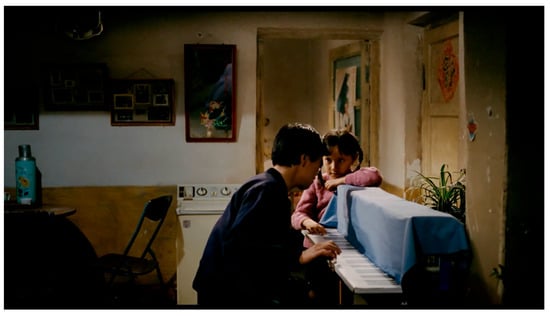
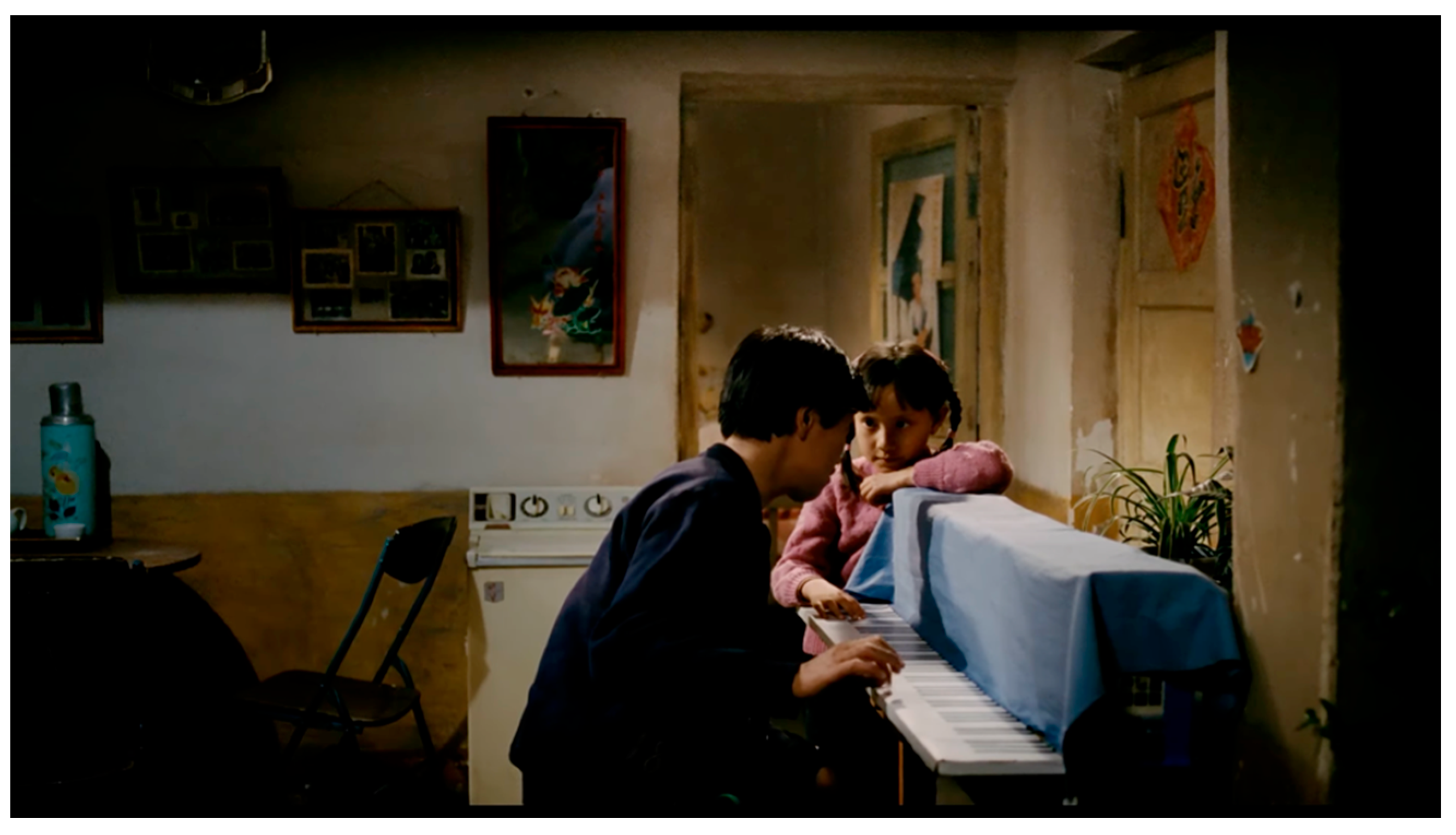
In Piano, Chen Guilin, an off-posted worker from a state-owned iron-and-steel enterprise, faces the undecided custody of his daughter after his divorce. Following his daughter’s announcement that she will stay with whichever parent buys her a piano, the financially strained Chen goes through a series of quests to meet her demand. His first experimentation is a cardboard piano: keys are painted on a cardboard with a covered shelf of books mimicking the top part of the piano’s body (Figure 1). The scene’s dialog is as follows (M. Zhang 2010):
Daughter: Dad, can I really play this?Chen: Of course, just wait for it to dry.Daughter: But it won’t make a sound even if it dries.Chen: Didn’t I tell you about Uncle Beethoven? He has bad hearing. He can’t hear.Daughter: He can’t hear, but other people can.Chen: I will play something for you, and you will be able to hear it too.
Figure 1.
Chen Guilin pretends to play the cardboard piano.
Chen goes on to pretend-play while humming Beethoven’s Für Elise. The daughter first hesitates, then joins him in singing as well. The makeshift piano fails its purpose as a musical instrument and is comically lacking in use value. Nevertheless, Chen still takes pride in this product of the creative labor of making-do. Such labor is not limited to the physical work of measuring, cutting, painting and lifting seen in the minute-long montage leading up to the conversation scene. Of course, the piano also literally makes do with repurposed household items. While these acts contribute to the ‘making’ of the piano but not its ‘doing’, what really rescues the piano that is practically bound to fail is Chen’s emotional and intellectual labors: handling the daughter’s questions with quick wit and grace, utilizing a combination of reason, repartee, reference and performance. As such, Chen turns the useless piano into an instrument that generates an endearing, bonding moment and allows an affective exchange. If the daughter’s demand for a piano in exchange for custody reflects a “new symbolic order” that equates the parental status with a “thing-y” exchange value (Dai 2018, p. 99), displacing the demanded piano with a makeshift one momentarily disrupts the symbolic order of commodity fetish and mediates a shift toward collaborative imagination. Dai Jinhua’s astute analysis of the film locates in Chen Guilin’s character an interconnected crisis between both the patriarchal status of the father and the old working class as “the Republic’s eldest son.” Amid the reforms, “not only ideology but also laborers’ property rights created different subject positions and different relations of production” (Dai 2018, p. 101). Chen Guilin’s labor of making-do may be insufficient to subvert the transformed relations of production that constrain him, but by making a piano that creates sound through imagination, his labor produces a postsocialist subjectivity that makes do with both aesthetic agency and limited means to adapt to a new reality.
What I call ‘labor of making-do’ is thus not a flattened, reactionary subversion; sometimes, it may not subvert at all, or it may lack a clear target for subversion. It draws attention to a mechanism of subjectivity and power that deserves as much attention as those that originate from the so-called political center. As workers become off-posted, they do not cease laboring simply because they cease to work at the SOE. The activity of labor as a crucial subjective and social practice extends itself in impromptu, transitory, and even playful ways, recycling remembered or imagined cultural logics of the socialist or collective past to meet present needs. Thus, the term offers a productive method of analysis.
The makeshift piano reflects characteristics of the labor of making-do. Even when it is mobilized ad hoc for a specific material purpose and fails in that purpose, it may still be productive in an affective and less alienated sense. However, this fragile sense of what Ban Wang might read as “dignity” is soon undermined when the daughter, in frustration, gives up practicing on the cardboard keyboard (Wang 2022). Soon, Chen’s ex-wife mocks him for the fake piano, motivating him to embark on a journey of borrowing money from friends and family. In this process, viewers are given a brief view of the new types of work and livelihood created under the economic reform. For example, the former peasant butcher Big Liu is now a business owner, “the only one with an enterprise”(M. Zhang 2010). Less fortunate is Chen’s brother-in-law, who is implied to have also been laid off from an SOE and is too proud to dagong and take up informal, artisanal work such as carpentry. The film is sprinkled all over with such acts, including when a drunken Chen and his friends attempt to steal a piano from a nearby school’s music classroom.
Eventually, Chen decides to gather his former co-workers from the factory to build a steel piano from scratch. Laid-off and aimless, the group of xiagang workers recycle their various skills from steelmaking such as iron-smithing toward making the steel piano. The most grandiose act of making-do, the piano is made literally inside the deserted factory space, and enters the final showcase lifted by an industrial hoist. Shortly following the scene of the detonation of deserted chimneys, the sequence is not simply elegiac but magnificently ritualistic. First, Chen plays “Moscow Nights,” a Soviet song widely known in socialist China on the accordion and announces to his girlfriend Shuxian that he is now ready to marry her. What follows is a musicalesque theatrical performance to the music of the “March of the Toreadors” while Shuxian and Chen are dollied into the factory in a flamenco dress and suit. Next, the rest of Chen’s piano-making team, the former steelworkers, march in on foot, followed by a montage of tinkering, welding, and painting the piano. The cinematic grammar of these two sequences displaces linearity into a blend of ends and beginnings that cannot be told apart: the end of Chen’s marriage and the loss of his daughter’s custody are juxtaposed with the announcement to marry Shuxian; the detonation of the steel factory chimneys happens next to the continuation of steelmaking labor, although toward a different cause. This grammar opens the film up for a new understanding beyond “a politics of tragedy” that operates through iniquity and misery as Dai Jinhua observes (Dai 2018, p. 98). Rather than simply “[harking back to] a bygone past” when former SOE-based collective lifestyles “call[ed] for new attempts by a new generation of socialism,” the sequence also critically reflects on what such signifiers as socialism or the reform mean for the individual, by placing them in tandem with transnational references, such as the two pieces of Soviet and Spanish music, and exploding this juxtaposition through the surreal musical form. Instead of merely consolidating an unexamined socialist–postsocialist periodization by way of nostalgia, the film illuminates how the subject repurposes these signifiers through labor. For the characters, both memories and activities of labor outlive a specific mode of production. In this process, imposing a teleology may be inaccurate or questionable.
It is tempting to read the film as grieving for a nostalgic socialist past, as the directorial language gestures toward a melancholia predicated upon a linear temporality. For example, the film ends with the daughter playing the steel piano inside the deserted factory as the camera slowly and shakily exits as if pulled by an aging hand. Writing on the film, Erin Y. Huang observes that “the ruinous remains of industrial socialism become an object of mourning, evoking and producing feelings of loss, desire, and sadness from the perspective of a temporality beyond socialism” (Huang 2020, p. 34). However, I hope to propose a reading through the labor of making-do that unsettles the capitalist teleology implied by a rhetoric of ruination.
The idea of ruination carries with it a set purpose and the failure to meet that purpose. Associated with it is a progressive and linear temporality and its desertion as something ceases to be useful. However, the labor of making-do extracts from these ostensible ruins of socialism the raw materials as well as the embodied skills, for a project with a different and seemingly trivial purpose: building a piano for a child so that she would stay. However, this seeming triviality successfully creates another time-space out of the discursively closed, nominally deserted chronoscope of the socialist factory. The skills that the workers utilize are embodied, physical memories from a lived socialist past, standing in contrast with the grand, imagined nostalgia and a socialist totality that the director seems to be intentionally creating with the repeated use of elegiac Soviet music and melodramatic cinematic techniques. Eventually, even this trivial purpose is abandoned: Chen makes up his mind to give up custody before finishing the piano. The sentiment of making-do, of putting in labor towards something that might not meet its intended purpose, reinterrogates any performance-driven, teleological narrative of historical progress.
The cardboard piano and steel piano are in fact both projects that fail to realize their teloi. The cardboard piano falls short of allowing meaningful piano practice, while the steel piano fails to keep the daughter’s custody. For Marx, the labor process entails work as a “purposeful activity” (Marx 1976, p. 284). If what distinguishes human labor is a pre-imposed purpose, as illustrated by Marx’s architect and bee example, one could say that human labor is at least in some sense teleological, as a known purpose guides the “mode of his activity with the rigidity of a law” (Marx 1976, p. 284). However, here Marx is discussing a context in which the end product is immediate use-value (Marx 1976, p. 287). Piano leads one to contemplate Marx’s formulation of the labor process by asking what happens when the labor knowingly produces an end product devoid of use-value or when the intended purpose is not contingent upon the object’s immediate use-value.
Marx specifies that, in addition to the purposeful activity of work, the labor process includes two other elements: “the object on which that work is performed” and “the instruments of that work” (Marx 1976, p. 284). The latter further encompasses “all the objective conditions necessary for carrying on the labor process” (Marx 1976, p. 286). The film develops making-do as a kind of labor when such objective conditions for carrying on the labor process are strained, the object and instruments limited. As a result, the lack of use or exchange value may be a consequence of practical constraints, but this does not deny the labor’s subjectively creative capacity. As an aspect of postsocialist subjectivity, the labor of making-do continues the socialist legacy of privileging labor as a symbolic activity, while in effect responding to the co-presence of satisfaction and hindrance, fragmented means and pluralized goals. Made up of a pair of verbs, the phrase “labor of making-do” signifies the conscious and even strategic actions that link the opposite poles. The labor that these actions entail—the very labor of making-do—may be so economically unproductive that it does not make a fetishized commodity opposed to the worker. Nevertheless, it could still be the natural and inevitable event for the self to move and be moved, inevitable because one is always-already a relationally constituted subject. It is precisely in this permanent self-creation that the Marxist hope for revolution finds its recourse.
4. Lucky Dog
Labor of making-do in Piano reclaims labor from the teleology that haunts both postsocialist and capitalist temporality and allows the subject to work in diverse, creative, and sometimes unproductive ways. In comparison, Zhang Meng’s first film Lucky Dog presents making-do more candidly as a means to survive, which is often disappointingly unproductive. In the meantime, it also understands making-do as wrestling with precarious forms of subjectivity amid historical transformations. Precarity is often understood to be a material state of predicament. In the face of struggles to survive, it sometimes seems negligent to instead consider the realm of subjectivity, affect, or ontological being. The following section not only defends the mutual embeddedness of the subjective and material conditions of precarity, but also shows how the two mutually constitute each other through the subjective and symbolic activity of labor in Lucky Dog. Read in this way, the film troubles smoothened historical narratives by foregrounding both the incapacity and reluctance to readily make do.
Similarly to Chen Guilin, Lucky Dog’s protagonist Wang Kangmei is a former state-owned enterprise worker, a train mechanic. The film opens with the end of Wang Kangmei’s “honored retirement” (guangrong tuixiu) party and follows him over the next few days as he traverses the city in search of work (M. Zhang 2007). It is worth noting that retirement from SOEs during the SOE reform did not equal a well-compensated, stable welfare system. Instead, workers were released, often prematurely, into an uncertain and struggling market. Unlike coastal regions such as Shenzhen where the reform brought rapid growth, Dongbei faced stagnation, decline, and hence scarce opportunities to offer the unemployed. Wang Kangmei’s retirement may be understood as part of a broad spectrum of measures undertaken to reduce the SOE workforce, including but not limited to layoff and reallocation (xiagang fenliu), internal and early retirement (neitui), buying out years of service and one-time compensation packages (maiduan gongliu).8 Despite their nominal differences, these programs often led similarly to precarious subject positions as a result.
While the film opens with an interior scene set inside the work unit building, exterior scenes of Wang out on the streets constitute the majority of what ensues. In the opening scene, the viewer glimpses Wang in his well-kept SOE uniform; in contrast, the rest of the film often presents him wearing the same reused face mask as he walks and coughs. The shift in Wang’s appearance symbolizes his departure from the state-owned system, which physically ejects him into a transformed reality outside of the SOE system. In this new reality, as Ong and Zhang write of China during the reform era, “individuals are obliged to exercise diligence, cunning, talents, and social skills to navigate ever-shifting networks of goods, relationships, knowledge, and institutions in the competition for wealth and personal advantage” (Ong and Zhang 2008, p. 8). Like Piano, Lucky Dog contains a multitude of informal, even illegal work that seems to confront Wang everywhere he goes: a computer-generated fortune-telling photo booth, a pyramid scheme from which he is rescued, bicycle repair, shoe shining, rickshaw pulling, and a dart-throwing lottery stall. As he scouts the town, Wang is physically separated from it by the mask that he wears for his tracheal disease which, as we learn in the opening scene, fails to qualify as a work-related injury despite resulting from his train work. Symbolized by the mask, the embodied history now places him at a disadvantage, as he proves unfit for the physical demands of rickshaw pulling and his voice fails him during his audition for the art troupe. Compared to Chen Guilin’s wit and ease in making do, Wang appears awkwardly opposed to and uncomfortably situated in the new informal economy.
Wang’s struggle in the new economy is the struggle to navigate a new logic of social relations: the logic of commodity and consumption. My analysis finds that the film’s dramatic conflict fundamentally comes from the following paradox: Wang pretends to be a consumer of informal work to scout for informal work, but he does so precisely out of a prideful inability to accept this new omnipresence of consumption as well as his impotence to consume.
In Marx’s theory, market activities of exchange and consumption are what valorize product into commodity, completing “its last finish.”9 Miranda Joseph develops this process and observes that consumption thus becomes a form of labor that is “procured and exploited through active subjection:” “in consumption, exploitation occurs insofar [as] the consumer who is free of, short of, the means to meet her needs without choosing a commodity contributes to the accumulation of capital” (Joseph 2002, p. 43). While Joseph discusses consumptive labor primarily in the context that multiculturalism furnishes identities as sites of consumption, Lucky Dog reveals the curious connections between consumption and postsocialist subjectivities.
In this sense, understanding Wang’s labor of consumption as making do entails several layers. Pressed for means, Wang makes do through consumption insofar as consumption is the prerequisite to enter the workforce: in his search for a job, he rides his bicycle to the point of breakdown; to repair the bike, Wang makes a purchase at a dart-throwing lottery stall in order to break his bill, and he exposes the game as offering no real prizes beyond cheap shampoo samples. These unexpected expenses appear painfully unlucky, an intended irony that contrasts with the film’s title. Yet what they really reflect is a society increasingly structured by commodity as the new social relation. Meanwhile, he also makes do with consuming as little as possible. These instances often overlap with consumption in the physical, embodied sense: Wang purchase the cheapest cigarette and a pack of instant noodles for his dinner to budget for a more nutritious diet for his bedridden wife. Both senses of making do strains Wang to the point of despair when he says “go ahead, kill me–please, please kill me” at the film’s end (M. Zhang 2007). The labor of consumption seen in this analysis is thus multifarious; it includes mental and intellectual work of budgeting and improvising, as well as the more fragmented yet prolonged physical labor necessitated in the processes of consumption. Reading consumptive labor as a form of labor of making-do shifts attention from production to social formation, from waged work to everyday practices. Consumption, in this context, becomes a compulsory form of labor and a growing site of precarity, one that is only “productive of future constraints” (Joseph 2002, p. 42).
Wang’s struggle and breakdown in the end are rendered particularly sympathetic to the viewer precisely because, by following Wang’s perspective throughout, we see what happens behind the look of optimism that he effortfully maintains to his family and acquaintances. To save face before acquaintances and to relieve his wife of concern, Wang repeatedly relies on wit or endurance in addition to acts of consumption that momentarily mask or make do with precarity. In response to the shop owner trying to upsell him a more expensive brand of cigarettes, Wang makes up a story about Chairman Mao smoking the brand he chooses so that the leader could be among the people. When the owner states that he has never heard of such a thing, Wang answers quickly that it is because “Chairman Mao shared all the cigarettes with the comrades; that’s always how things go with cigarettes.” (M. Zhang 2007) Here, one is reminded of Chen Guilin’s witty remark to his daughter that Beethoven also plays a piano that he cannot hear. Again, intellectual and creative labor is used to make do with constrained means.
Unlike Chen who ultimately builds a piano, however, Wang barely reaches any of the ends he sets out to achieve. After Wang misses one job opportunity after another, the film ends ambiguously with him leaving a note to the previous bike-repair workman asking for contact, implying that he plans to take over the street stall. Wang Kangmei’s transition from a proud state-employed train mechanic to a precarious bicycle repair stall owner can hardly pass as a satisfying transfer of skills. His acceptance in the end is thus not only a choiceless choice, but a resignation to precarity as the new social position.
One scene in particular captures how entangled forms of consumptive labor together confront, however uselessly, the mutually intertwined material and subjective precarity. Pressured by his wife, Wang invites to dinner his well-off son-in-law and daughter hoping to seek help. To prepare for the visit, Wang spends money buying beer to offer his son-in-law even whilst the financially strained Wang eats a meatless fish bone for his own dinner. One recalls Chen Guilin bringing a dead fish that he pulled from a deserted pond when he invites the old factory’s engineer to join his piano-building project. Gift-giving is a common gesture of hospitality and social currency in large parts of Chinese culture, particularly when asking for favors. Yet the difference between Wang’s and Chen’s choices is noteworthy. Obviously, picking up a suspicious fish adds a touch of comedy to the film while buying a half dozen beers is more realistic. However, Wang’s unnecessary expenditure reflects an added desire to hold onto his past identity as SOE worker as well as dignify himself as the father-in-law even when, in effect, he is seeking help from his son-in-law as a last resort. This is further proven by his verbose way of starting the dinner with a prepared speech about how time has flown leading up to his retirement. Nevertheless, Wang fails to carry on as planned as his speech is repeatedly interrupted by the son-in-law’s ringing phone, which he turns off only to silence calls from another woman. What Wang initially understands as the in-law’s respect for him turns out to be a means of preventing the wife from discovering the affair. The couple’s ugly quarrel right in front of Wang, customarily considered disrespectful, challenges his patriarchal authority as the father-in-law. It is no coincidence that both Chen Guilin’s and Wang’s losses of their status as proud socialist subjects overlap with the crisis of patriarchal authority as the respected father figure. This attention to the inability to provide for the family as a patriarchal crisis reveals the implicit gendered logic of the subjective experience of precarity presented by Zhang Meng. The scene ends with Wang cleaning up the beer bottles shattered during the quarrel, a metaphor for Wang’s unuttered request for help. Wang’s labor fails to produce for him any relief from his financial desperation; further still, it shatters his old subjectivity as a revered socialist worker and leaves him affectively precarious, as illustrated by the sequence’s ending close-ups on his defeated, nearly tearful expression.
In Piano, Chen Guilin is first presented as already marginalized, slacking on the streets and bouncing between gigs. By contrast, Wang Kangmei is established at the outset as a respectable, exemplary socialist subject, but this status appears distinctly incongruous with the reality he faces. That Wang’s quest for sustenance amid the new economy is simultaneously his personal journey to navigate the “ever-shifting networks” in which he himself faces new social relations illustrates what Ong and Zhang call the “subjectivating aspect of privatization.”10 His quest for a job is thus also a process of desubjectivating from the former system. More importantly, it exposes that the labor of subjectivation amid historical transformation falls on the individual as imminent precarity in material and affective ways. One key feature of postsocialist subjecthood is, according to Lisa M. Hoffman, self-governing through self-enterprising, which thus facilitates the formation of the new professional in cooperation with the market economy (Ong and Zhang 2008, p. 170). Whether Wang can become a proper postsocialist subject oriented toward self-enterprise is inseparable from both his lived conditions and his efforts to make sense of a new, and in many ways disrupted, selfhood.
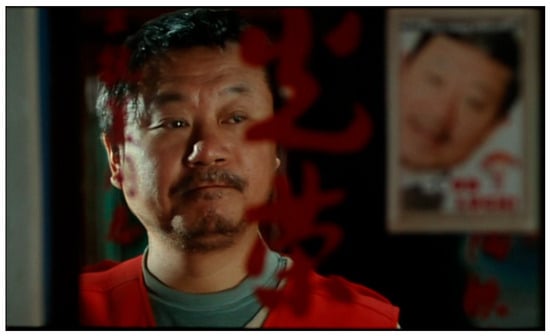
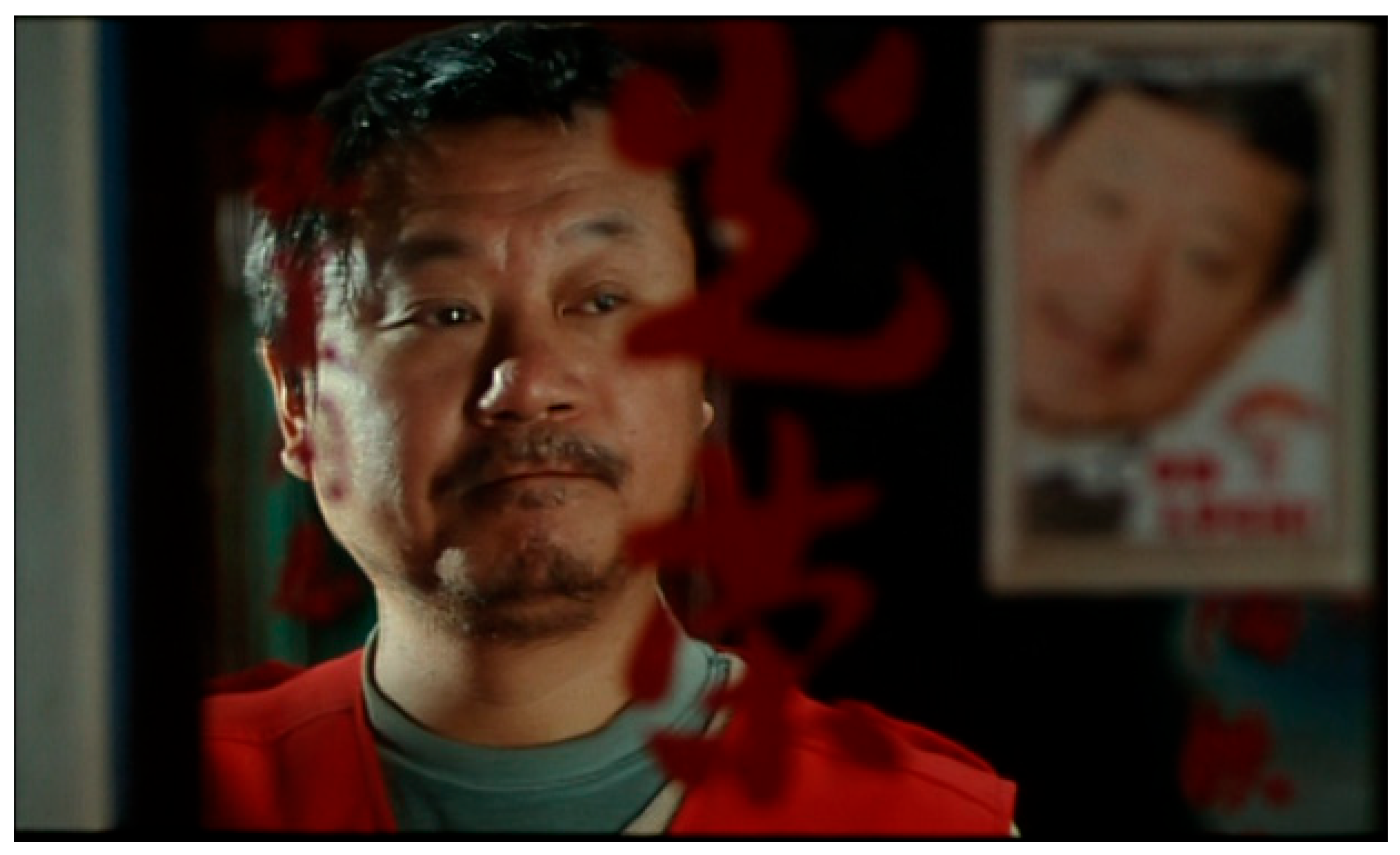
One of Wang’s earliest interactions with the informal economy illustrates the struggle of making-do on a subjective level. Walking past the fortune-telling photo booth, Wang is drawn to the advertisement being broadcasted: “Do you want to know whether your life will be blessed or cursed, rich or poor? Xiao Mei’s computer fortune-telling predicts your future.” (M. Zhang 2007) What eventually persuades him to make the purchase is that along with the fortune-reading, he also receives a photoshopped self-portrait or “personal image design.” The overlaid beauty filters and computer-generated auspicious reading clearly are no more than a fraudulent placebo, as a drunken Wang later angrily admits to his friend. Nonetheless, they reflect Wang’s genuinely felt uncertainty about his life outside the SOE system, an uncertainty that induces his desire to see and know himself and his future. Not coincidentally, Wang hangs the printed self-portrait over the commemorative plaque gifted to him at his work unit retirement party, which has his name and “honored retirement” written over a mirror (Figure 2). The plaque-mirror-portrait gathers, in one object, a selfhood that contains experiences of different histories of subject formation in tension. Looking into the mirror for a moment, Wang sees before his face literal layers of signs. The portrait is eventually taken off and carried with him before he uses it as a name card for his bike-repair business in the film’s end. From work unit plaque to street stall, the literal, physical relocation of self-portrait symbolizes Wang’s transition into a set of precarious social relations reproduced by the new economy.
Figure 2.
Wang Kangmei stares at his reflection partially obscured by the pasted portrait and handwritten characters on the mirror plaque.
Lucky Dog’s tragedy stems from the subjective and practical difficulties of making do with memories of a prior socialist subjectivity and resignifying it, in whatever creative or compelled fashion, into a postsocialist one. This cultural logic is signaled a few times throughout the film. Earlier, following his auspicious fortune reading, Wang recites cheerfully an excerpt from the Songs of the Long March in the bath alone. Yet later, during an interview for a position in a folk arts troupe, he sings the same excerpt again, only with his voice breaking and he concedes in defeat that he is not up for the job. The process of subjectivation is itself precarious—struggles and failures in it have at once subjective and material consequences.
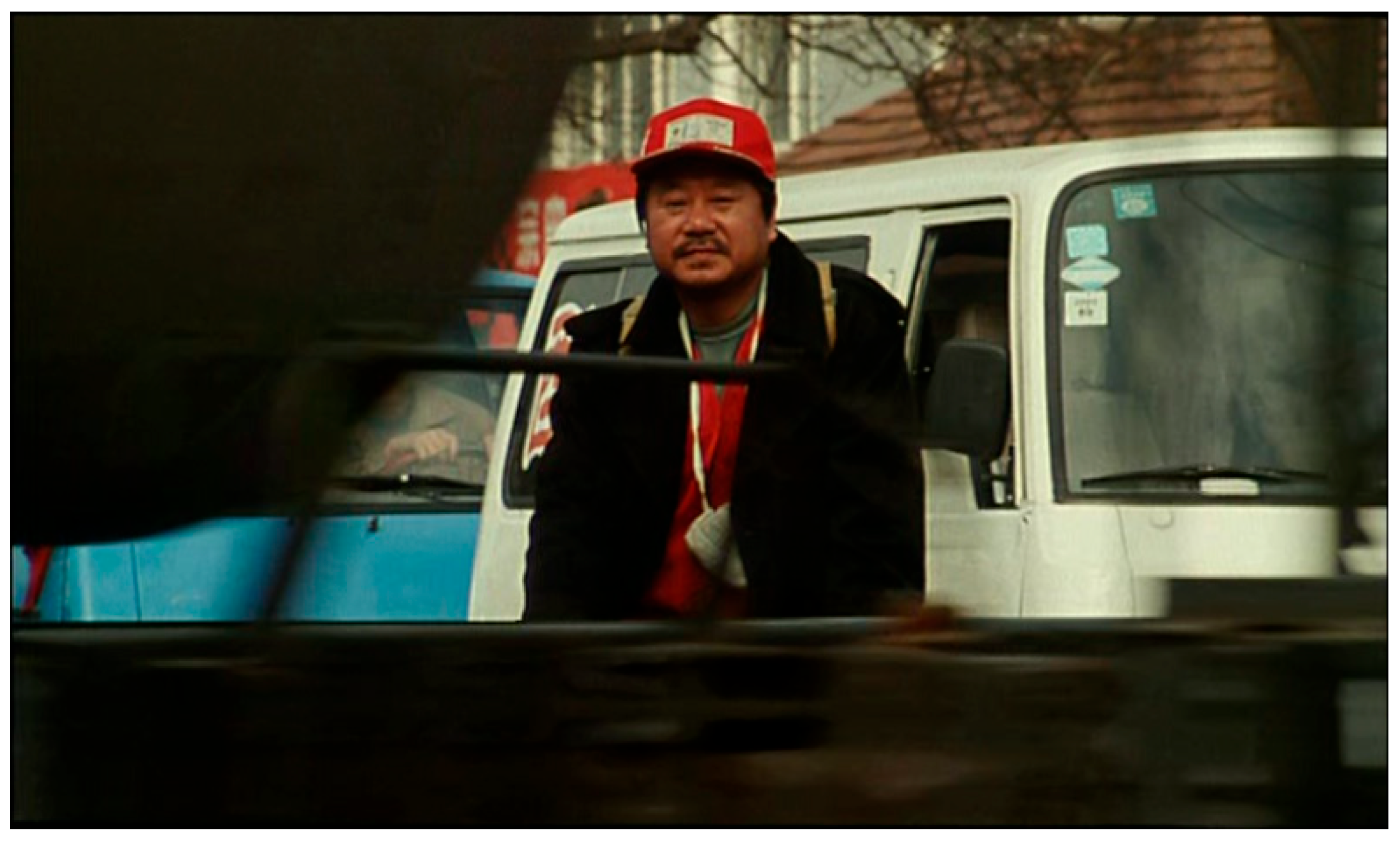
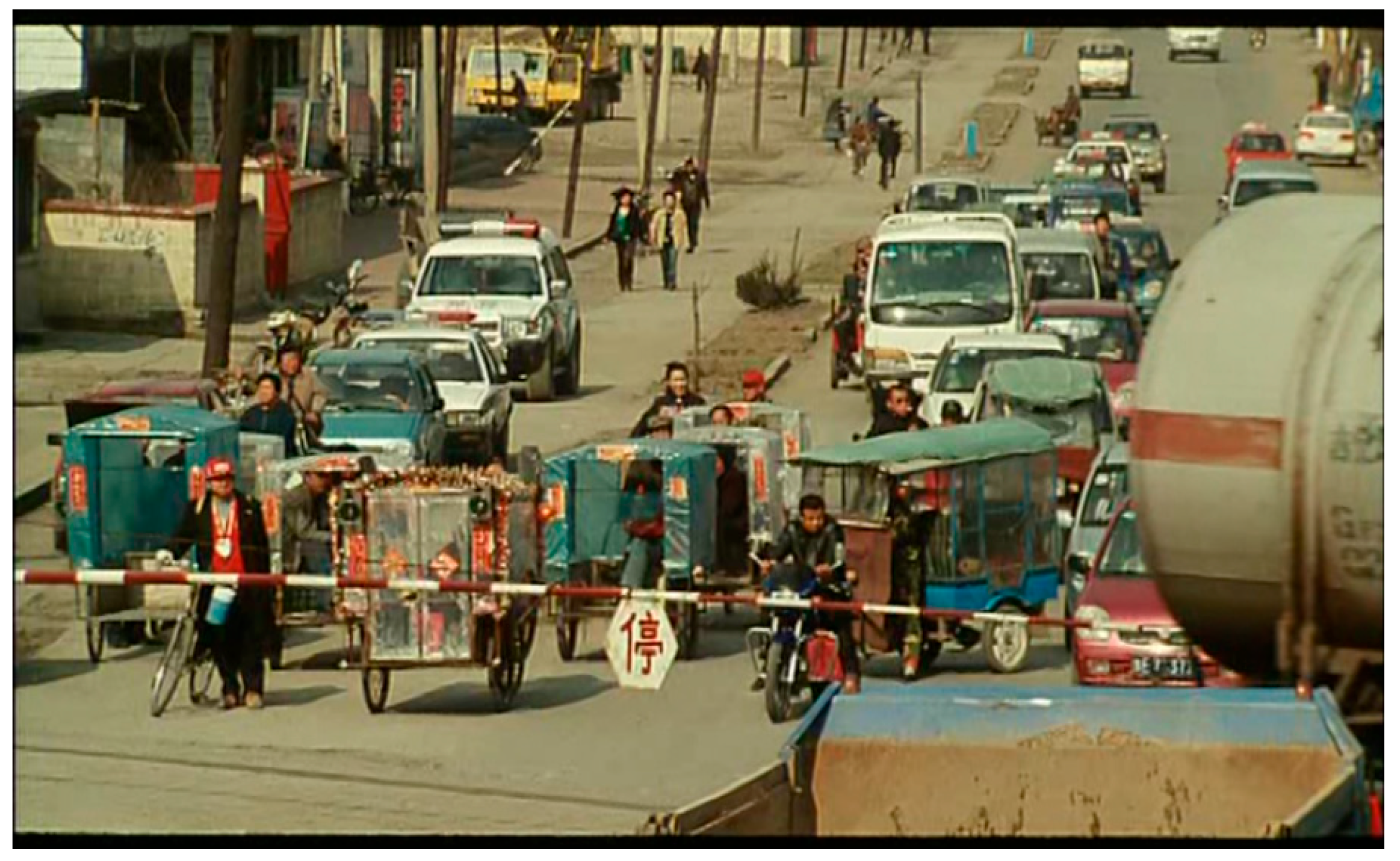
Comparative analysis of the two films returns us to the significance of precarity as a critical aspect of postsocialist subjectivity. The labor of making-do that runs through the seams of both films illuminates the added and often neglected layer of labor surrounding subjectivation that intimately interacts with new and precarious forms of material labor. In both films, horizontal tracking shots are used to capture Chen and Wang meandering through the cities. As Dai Jinhua writes, the use of such shots in Piano “[visualizes] the working class’s experience of marginalization” as they walk in and out of frame (Dai 2018, p. 95). The horizontal movement of the camera or characters cuts a right angle with the front-to-back, depth-oriented camera or character movement. According to Dai, the depth-oriented, deep-focus shots recenter the marginalized as historical subjects, occupying the position of “the miracle of labor and creation.” If we borrow Dai’s analysis and read deep focus as the filmmaker’s metaphor for the temporal axis of the socialist past, the films offer another intriguing point of comparison. Piano begins with the camera often capturing Chen in profile, but toward the end it increasingly presents him facing forward. Chen thus shifts from moving from one margin of the frame to another, to occupying its central axis, endowing the temporal axis of the socialist past with a renewed meaning. Conversely, Lucky contains multiple reappearances of one similarly composed shot: Wang waits at or pushes his bike toward a railroad crossing, facing the camera, as the train moves horizontally across the frame (Figure 3). Wang appears along the depth axis of the image, either intermittently blocked by the train or small in the background. In this case, we are presented once again with the cinematographic language of a right, perpendicular angle. However, unlike in Piano where the subject appears moving along either axis, Wang’s predicament is visually conveyed by his loss in the camera’s cinematographic space (Figure 4). That the train’s movement along the horizontal axis blocks the train mechanic renders a compelling metaphor: the laid-off worker pedaling along a foreclosed temporality finds himself suspended and obscured by the historical movement of market reform.
Figure 3.
Wang stands amid moving traffic framed by a passing train.
Figure 4.
Wang Kangmei waits alongside other rickshaw drivers at a railroad crossing.
5. Conclusions
In her work, Margaret Hillenbrand notes that our understanding of the ambient feelings of precarity in contemporary China was quickly absorbed into the somewhat elastic term “postsocialism” before it could yield further insight (Hillenbrand 2023, p. 26). Building on Nancy Fraser’s argument that the condition of postsocialism “goes far beyond the Soviet Union and other former communist states in its scope—that we are all postsocialist now,” Hillenbrand argues that postsocialism is a “twin condition” to precarity, the “threat or reality of the cliff edge” (Hillenbrand 2023, p. xix). However, pairing postsocialism with precarity risks becoming entangled in the sticky project of defining both terms, which are themselves characterized by a sense of instability and elusiveness. Instead, this article provides a case of reading how exactly postsocialism is lived by the individual.
One broader intervention of this article is therefore to think on the question: exactly how do the historical shifts such as those indicated by the term postsocialism, between modes of governance, production and reproduction, take place by way of individual subjects? My conclusion is that the latter should be considered not merely as effected by historical shifts a posteriori, but propel these very historical motions. In this vein, the article hopes to further discussions about Chinese postsocialism in regard to subjectivity: what are some key characteristics of the postsocialist subject? What are the motions of subjectivation specific to postsocialist Chinese history? Such an approach may lead to more historically concrete problematics of the relationship between shifting modes of governances and the laboring subject. In Piano, Chen Guilin’s line that “if you’re afraid of being laughed at today, you won’t make any money” demonstrates how precarity becomes an ineluctable force for one to resubjectivate oneself in accordance with different ideologies (M. Zhang 2010). For the individual, interpretations of these shifting ideologies can flexibly hold a variety of emergent, dominant and residual values at once.
The present investigation of Zhang Meng’s two films has deployed labor, specifically the labor of making-do, as an analytic to trace the often-occluded processes of subject formation and show the precarity of these processes. In considering the subject formation and social reproduction of precarious labor, the case study offered in this article opens labor beyond the economistic tendencies that the term often bears and offers it as a critical lens. It also furnishes another way of studying postsocialist China beyond what Erin Huang observes as “the conceptions of socialism as a cultural site for imagining Capital’s other, whether this is a duplicate or a romanticized alternative” (Huang 2020, p. 44). One finds in this case study such entanglements between ideology (in different forms), subjectivity, and the individual experience of history, that demand a more diversified approach and understanding beyond labeling modes of governances—postsocialist, neoliberal, or else—in order to reach a satisfying explanation.
Funding
This research received no external funding.
Data Availability Statement
No new data were created or analyzed in this study. Data sharing is not applicable to this article.
Conflicts of Interest
The authors declare no conflict of interest.
Notes
| 1 | A number of contemporary writers, filmmakers, and artists from Northeast China (Dongbei) have recently gained scholarly attention, whose works explore the experience of dislocation and stagnation following the state-owned enterprise (SOE) reforms and the region’s ensuing economic decline. For notable writers, see, for example, Ban Yu, Shuang Xuetao, and Zheng Zhi. |
| 2 | The arduous decision to turn to privatization in the 1990s was preceded by attempts to sustain the coexistence of public and private ownership before they appeared to have reached a dead end. See (Gallagher 2005, p. 134). |
| 3 | For example, Hillenbrand’s work focuses on the new urban workforce and floating population who did not enjoy the same level of institutional privilege. Another work to reference on precarity and migrant labor in postsocialist China is Pun Ngai, Migrant Labor in China: Post-Socialist Transformation (Pun 2016). |
| 4 | I would like to gratefully acknowledge an anonymous reviewer for their insight on the region’s long trajectory of stagnation and exhaustion, which helped me clarify my argument: “Dongbei’s specificity [is] marked not only by the historical shock of SOE restructuring but also by a prolonged and continuing sense of decline.” |
| 5 | The Sixth Generation usually refers to a group of Chinese filmmakers who emerged in the early 1990s, following the Fifth-Generation auteurs such as Zhang Yimou and Chen Kaige. Working largely outside state studios and often with low budgets, Sixth-Generation directors like Jia Zhangke, Wang Xiaoshuai, and Zhang Yuan turned toward the marginalized and neglected in the postsocialist urban life, such as migrant labor, unemployment, and youth culture. |
| 6 | For English-language scholarships on the films, see, for example, (Wang 2022; Z. Zhang 2016). For Chinese scholarships, see (Dai 2018; L. Zhang 2013). |
| 7 | The dialectical image, according to Walter Benjamin, exceeds the linearity often associated with time: from the present, the dialectical image sees the past in a flash. See Walter Benjamin, The Arcades Project or Theses on the Philosophy of History. |
| 8 | On the varied administrative programs and euphemistic measures through which SOE workforce reduction was carried out, see (H. Y. Lee 2000, pp. 914–37; Solinger 2002, pp. 304–26; Hurst 2009). |
| 9 | In Grundrisse, Marx writes, “The product only obtains its “last finish” in consumption… Consumption produces production.” See (Marx 1973, p. 91). |
| 10 | In the introduction to their edited volume, the scholars write, “in the 1990s citizens were urged to “free up” (jiefang) their individual capacities to confront dynamic conditions in all areas of life without seeking guidance from the state, society, or family.” See (Ong and Zhang 2008, p. 7). |
References
- Balibar, Étienne. 1995. The Philosophy of Marx. Translated by Chris Turner. London: Verso. [Google Scholar]
- Dai, Jinhua. 2018. The Piano in a Factory Class, in the Name of the Father. In After the Post–Cold War. Edited by Lisa Rofel. Durham: Duke University Press, p. 91. [Google Scholar] [CrossRef] [Scilit]
- Gallagher, Mary Elizabeth. 2005. Contagious Capitalism: Globalization and the Politics of Labor in China. Princeton: Princeton University Press. [Google Scholar]
- Hillenbrand, Margaret. 2023. On the Edge: Feeling Precarious in China. New York: Columbia University Press. [Google Scholar]
- Hirata, Koji. 2025. Making Mao’s Steelworks: Industrial Manchuria and the Transnational Origins of Chinese Socialism. Cambridge: Cambridge University Press. [Google Scholar]
- Huang, Erin Y. 2020. Urban Horror: Neoliberal Post-Socialism and the Limits of Visibility. Durham: Duke University Press. [Google Scholar] [CrossRef] [Scilit]
- Hurst, William. 2009. The Chinese Worker After Socialism. Cambridge: Cambridge University Press. [Google Scholar]
- Joseph, Miranda. 2002. Against the Romance of Community. Minneapolis: University of Minnesota Press. [Google Scholar]
- Lao, Xuan 老轩. 2022. A Stirring Battle Song of the Chinese Working Class: The Story behind the Song ‘We Workers Are Powerful’. Fendou 奋斗 Struggle 2: 75–77. [Google Scholar] [CrossRef]
- Lee, Ching Kwan. 2007. The Unmaking of Mao’s Working Class in the Rustbelt. In Against the Law: Labor Protests in China’s Rustbelt and Sunbelt. Oakland: University of California Press, p. 70. [Google Scholar]
- Lee, Ching Kwan. 2019. China’s Precariats. Globalizations 16: 137–54. [Google Scholar] [CrossRef] [Scilit]
- Lee, Hong Yung. 2000. Xiagang, the Chinese Style of Laying Off Workers. Asian Survey 40: 914–37. [Google Scholar] [CrossRef] [Scilit]
- Li, Ren, and Jin Xu. 2008. Erduodayoufu–yishou xiaomin de aige 耳朵大有福—一首小民的哀歌 [Lucky Dog: An elegy of the minor citizen]. Movie Literature, 25–26. Available online: https://oversea-cnki-net.us1.proxy.openathens.net/knavi/detail?p=g5SLPZecrG_618X3-G7gdZ8nLWKH-xPOEcC53F29PyW2fvJ6qfUZ7wC52HSi-WwwJhViPZNf2fhA3X7ytbp7EtwE06CJx4PukJzEdbDv9Cc=&uniplatform=OVERSEA&language=EN (accessed on 30 April 2026).
- Marx, Karl. 1973. Grundrisse. Translated by Martin Nicolaus. New York: Vintage. [Google Scholar]
- Marx, Karl. 1976. Capital: A Critique of Political Economy. Translated by Ben Fowkes. London: Penguin Books, vol. 1. [Google Scholar]
- Ong, Aihwa, and Li Zhang, eds. 2008. Privatizing China: Socialism from Afar. Ithaca: Cornell University Press. [Google Scholar]
- Pun, Ngai. 2016. Migrant Labor in China: Post-Socialist Transformation. Cambridge: Polity Press. [Google Scholar]
- Sohu Entertainment. 2011. Qin Hailu zixin Gang de qin bu hui pei, bao zui qiong shi jie jiaopian 秦海璐自信钢的琴不会赔,曝最穷时借胶片 [Qin Hailu Says Piano in a Factory Won’t Flop Financially; Recalls Borrowing Film Stock When Production Was Short of Funds]. July 12. Available online: https://yule.sohu.com/20110712/n313128026.shtml (accessed on 30 April 2026).
- Solinger, Dorothy J. 2002. Labour Market Reform and the Plight of the Laid-off Proletariat. The China Quarterly 170: 304–26. [Google Scholar] [CrossRef] [Scilit]
- Sun, Huiling. 2008. Xiaorenwu de Changzheng Zuge: Ping Erduoda Youfu 小人物的长征组歌:评耳朵大有福 [Odes to the xiaorenwu’s Long March: Commentary on Lucky Dog]. Movie Literature, 70. [Google Scholar]
- Wang, Ban. 2022. Dignity and Misery of Labor. Prism 19: 106–18. [Google Scholar] [CrossRef] [Scilit]
- Yu, Xuying. 2024. Crime as Historical Testimony: Narrative Suspense in Neo-Dongbei Literature. In Identity, Space, and Everyday Life in Contemporary Northeast China. Edited by Zhen Troy Chen, Jiawen Han, Xianwen Kuang and Xi Liu. Singapore: Springer Nature. [Google Scholar]
- Zhang, Lijie. 2013. A Tragic Carnival of Little People: On Zhang Meng’s Piano in a Factory and Lucky Dog. Movie Review (Dianying pingjie) 5: 8–10. [Google Scholar]
- Zhang, Meng. 2007. Erduoda youfu 耳朵大有福 [Lucky Dog]. Beijing: China Film Group Corporation and Beijing Forbidden City Sanlian Film Distribution. [Google Scholar]
- Zhang, Meng. 2010. Gang de qin 钢的琴 [Piano in a Factory]. Beijing: Liaoning Film Studio, Perfect World Pictures, and Dalian Hongyuan Film & Media. [Google Scholar]
- Zhang, Meng. 2011. Gangdeqin daoyan guanzhong sirentan [Director and Audience Discussion on Piano in a Factory]. Shiguangwang. Interview. August 17. Available online: https://m.wyzxwk.com/content.php?classid=23&id=247134 (accessed on 10 June 2026).
- Zhang, Yingjin. 2007. Rebel without a Cause? China’s New Urban Generation and Postsocialist Filmmaking. In The Urban Generation: Chinese Cinema and Society at the Turn of the Twenty-First Century. Edited by Zhen Zhang. Durham: Duke University Press, pp. 49–80. [Google Scholar] [CrossRef] [Scilit]
- Zhang, Zhen. 2016. Carrying on Memories of Dignified Labor: Reading Na’er, Heroes Everywhere, and The Piano in a Factory. Frontiers of Literary Studies in China 10: 234–54. [Google Scholar] [CrossRef]
- Zhong, Xueping, and Ban Wang, eds. 2014. Debating the Socialist Legacy and Capitalist Globalization in China, 1st ed. London: Palgrave Macmillan. [Google Scholar] [CrossRef] [Scilit]
Disclaimer/Publisher’s Note: The statements, opinions and data contained in all publications are solely those of the individual author(s) and contributor(s) and not of MDPI and/or the editor(s). MDPI and/or the editor(s) disclaim responsibility for any injury to people or property resulting from any ideas, methods, instructions or products referred to in the content. |
© 2026 by the author. Licensee MDPI, Basel, Switzerland. This article is an open access article distributed under the terms and conditions of the Creative Commons Attribution (CC BY) license.