


Abstract
‘Analog horror’ is a subgenre of internet and media horror, beginning c.2015. Its texts use late 20th-century analogue technology as a locus of horror, both narratively and aesthetically, expressing contemporary technophobia and existential anxieties of the first quarter of the 21st century, using a deliberate and anarchic a-historicity to represent concerns surrounding techno-capitalism and its attendant ‘polycrisis’. This irreverent attitude to historical cause and effect, and technological progress, in subgenre texts such as “The Nixonverse” by creator Eve Casanas represents our modern-day conflict between the digital, techno-capitalist online world, and the corporeal crisis events affecting the real world. This diametric in analog horror expresses the central tenet of Mark Fisher’s concept of ‘capitalist realism’, the idea that capitalist ideology makes it appear that there are no viable alternatives to capitalism. In analog horror narratives, analogue–digital hybrid technologies channel techno-organic monster-figures, with the helplessness of the individual and/or groups to defeat these monstrosities being expressive of this capitalist realist impression that capitalism cannot be overcome, and its polycrisis avoided, enacting fantasies of societal destruction to alleviate this suspended state of anxious helplessness, in the tone of Freud’s ‘death drive’ wish fulfilment fantasies.
1. Introduction
‘Analog horror’ is a subgenre of internet and media horror, beginning in approximately 2015, when the term was first used in horror YouTube series “Local58TV” (created by Straub 2015–present). The texts broadly identified as ‘analog horror’ (the American spelling of ‘analog’ denoting the cycle’s US origins) are centred around the use of late 20th-century analogue technology as a locus of horror, both narratively and aesthetically, expressing contemporary technophobia and existential anxieties of the first quarter of the 21st century.
The core texts of the analog horror subgenre are independently made and uploaded to social media sites for free access, most often to the video hosting service YouTube. These texts generally take the form of a series of videos, ranging from under one minute to over an hour each, which heavily reference found footage and surveillance horror tropes, and utilise ‘aesthetics of distortion’ and ‘the glitch’ (Daniel 2021, p. 11), albeit with the aesthetic pretence of using dated analogue technology. The video series cryptically reveal narratives centred around the dissolution of the individual in the face of technology, and the destruction of the world by monstrous, techno-organic forces. Ultimately, analog horror presents a-historical, hybrid manifestations of analogue technologies in its textual worlds, with these faux technologies also acting as the aesthetics of the texts themselves. They further act as powerful, symbolic manifestations of 21st-century techno-capitalism and its attendant ‘polycrisis’, within the internet subgenre’s texts.
The term ‘polycrisis’ describes the complex socio-political moment, c.2016–present, where several serious, interlinked structural crises have appeared simultaneously, globally, which all require immediate action: ‘issues such as climate change… pandemics… distinctive immediate and geographically specific phenomena, such as Russia’s invasion of Ukraine, US election results, and European sovereign debt crises’, etc. (Helleiner 2024, p. 2). The analog horror genre specifically represents cultural and societal fears, throughout this time frame, that techno-capitalism has/is enacting a fundamental separation of humanity from reality, into a postmodern hyperreal-space, especially through the internet and social media. Furthermore, it bases its texts around fears that capitalist, ‘techno-feudalist’ (Varoufakis 2023, p. 1) companies, who increasingly control these spaces, have gained more and more control over the user, depowering them in the face of real-world existential threats such as climate collapse, unregulated capitalism’s sway in politics, and growing inequality: all expressions of the ongoing polycrisis.
The key theme arising here in analog horror, is the representation of the conflict between the corporeal and the intangible/digital, in this case between the techno-capitalist online world, and the polycrisis affecting the real world. This diametric in analog horror expresses the central tenet of Mark Fisher’s concept of ‘capitalist realism’ (Fisher 2009, p. 1), the idea that capitalist ideology makes it seem, to its subjects, that there is no viable alternative to capitalism. Despite mass dissatisfaction with the capitalist system and its limiting effects, these very limiting effects make solutions difficult to conceive and implement. The primary, horror-generic expression of analog horror’s resultant tone of pessimist, capitalist realism, is the symbolisation of the analogue technologies in the texts as, or as channelling, techno-organic monster-figures. The helplessness of the individual or groups in the texts to defeat these monstrosities demonstrates the capitalist realist impression that capitalism cannot be overcome; and because of this, its attendant ecological and social disasters cannot be avoided, resulting inevitably in humanity’s destruction. Analog horror repeatedly enacts fantasies of societal destruction to this end, in the tone of Freud’s ‘death drive’ (Freud [1920] 2015) wish fulfilment, which we will discuss in detail.
We will firstly introduce these two important concepts from Freud and Fisher, before demonstrating how they illuminate the fantasy role of analog horror in modern horror culture, through key analog horror series “The Nixonverse” (created by Casanas 2022). This YouTube analog horror series deals explicitly with the modern polycrisis moment in a direct, semi-satirical and highly historically and culturally referential fashion, weaving a narrative wherein American president Richard Nixon is reborn as a god-like figure in an alternate universe, controlling and observing the destiny of 20th- and 21st-century Earth, from the moon. Casanas’ text, as a creator from the United States, directly engages with the issues of American identity, c.2022, from the inside, and the place that the post-Trump era country has in intensifying many of the issues perceived to be part of the ‘polycrisis’ moment, especially through Trumpian, post-truth politics and fake news, leading to the potential intensification of serious existential threats such as global warming and worldwide war. The series has a bleak affective, emotional and philosophical tone, wherein humanity is ‘tested’ by the omnipotent Nixon, who is overseeing and interjecting into major historical events such as WWII, the Vietnam and Korean wars, the American nuclear programme and several American presidencies; ultimately humanity is deemed by him to be ‘not worth saving’, and he ‘removes’ the entire fictional universe. This final judgement by Nixon is deeply expressive of the nihilism of our capitalist realist present, and the feeling that there are ‘no alternatives’, and no better futures for humanity, leaving us only with the possibility of change through annihilation, as we will discuss. Furthermore, the consistent focus in the series on humanity ‘needing’ to be destroyed or neutralised, to in some sense ‘save us’ from ourselves and our aptitude towards such war, self-destruction, suffering, hatred, etc., is expressive of the Freudian ‘death drive’ in fiction, and the fantasies associated with this concept of the ending and abatement of all difficulty and suffering, through the fantasised peace of death, or non-existence.
2. The Death Drive
The death drive is a psychoanalytic concept, originating from Freud’s major work Beyond the Pleasure Principle (Freud [1920] 2015), in which the author tries to account for the human proclivity to willingly and/or compulsively undertake activities that will lead, eventually or immediately, to its own destruction or seeming displeasure, as well as examining the widespread enjoyment of fantasies and fiction expressing these paradoxical desires. Freud’s given examples of the ‘death drive’, include casual or serious suicidal ideations, masochistic desires, and gaining enjoyment or pleasure from consuming fiction with dark or distressing subject matter.
The primary reason for Freud’s theorising on the subject comes from his study of ‘traumatic neuroses’ (Freud [1920] 2015, p. 6), now known as post-traumatic stress disorder, and the patient’s ‘compulsion to repeat’ (p. 13) traumatic events, despite this being consciously ‘un-wished for’ (p. 13) and seemingly against the patient’s best interests. As Freud describes, this relatively common behaviour complicated his original formation of a primarily pleasure-driven subject (p. 4). Despite the ambiguity Freud expresses in his own thinking about the concept, however, even the simplest example, and one highly relevant to the field of cultural study, demonstrates the everyday prevalence of the ‘death drive’:
the artistic play and artistic imitation carried out by adults, which, unlike children’s, are aimed at an audience, do not spare the spectator (for instance in tragedy) the most painful experiences and can yet be felt by them as highly enjoyable. This is convincing proof that, even under the dominance of the pleasure principle, there are ways and means enough of making what is in itself unpleasurable into a subject to be worked over and recollected by the mind.(Freud [1920] 2015, p. 17)
The central question surrounding analog horror and its key case study here, “The Nixonverse”, and their pervasive use of nihilistic, world-ending narratives, concerns the text’s mirroring and seeming address of, in some manner, modern, socio-cultural anxieties about the ‘end of the world’, and how the community-made texts reformat these fears into series that are willingly consumed by the public, in the manner Freud describes. This seemingly evokes the death-drive proclivity for pleasurably consuming ‘painful experiences’. The act of enjoying the apparently unpleasurable in fiction is further evoked by Sederholm and Weinstock (2016) in relation to the entire appeal of the gothic/horror modes. Specifically discussing the appeal of cosmic horror, a subgenre rooted in existential anxieties about human insignificance (and especially relevant here as it forms a key generic inspiration for “The Nixonverse”), and how these texts focus on both the viscerally and philosophically ‘distasteful’, he notes:
The appeal of the gothic as an artistic mode that depicts or relates violent or macabre scenes or events is a curious thing—after all, when you think about it, why would anyone care to linger over (much less savour) horrific images or accounts of murder, mutilation, monsters, and mayhem?(Sederholm and Weinstock 2016, p. 62)
This seeming paradox is present in Freud’s Beyond the Pleasure Principle, and reads as a self-questioning by the author, as Rowland Smith highlights in their metanalysis of the concept and its increasingly relevant place in 21st-century culture: ‘Freud himself, with whom “the death drive” is most closely associated… sought, even as he proposed it, to distance himself somewhat [from it]’ (Rowland Smith 2010, p. 1). Rowland Smith summarises the past century of theorising around the difficult concept by multiple psychoanalytic theorists, offering a definition of the theory as, broadly, the shared, human psychological drive not for literal death and self-obliteration, but our propensity towards creating and consuming fantasies of death, destruction, obliteration and desubjectification, this behaviour in reality expressing desire for the removal of all inconvenience, challenge and issue for the human being.
In pursuing such abatement—in seeking stillness in seeking pleasure—we are craving something that begins to look like nothing less than death. It’s the inertia that comes with the wish’s fulfilment that we covet, the emptying out of energies that brings a serene calm.(Rowland Smith 2010, p. 4)
Apocalyptic fantasies, cosmic horror planet-wide destruction/infection, and subjective destitution are central events in popular analog horror series such as “Local58TV”, “Gemini Home Entertainment” (created by Abode 2019–present) and “The Monument Mythos” (created by Casanas 2020–present). This demonstrates how the subgenre could be expressing cultural ‘death drive fantasies’, a wish for an end for everything, masking a deeper feeling of dissatisfaction and want for change. Again, as we shall see in the close textual analysis sections of this essay, this idea of species/planet-wide destruction being a kind of abject ‘relief’ from the difficulties of human existence is a major thematic throughline in “The Nixonverse”.
We will now unpack and establish the importance of Mark Fisher’s concept of ‘capitalist realism’ to this abject, fantasy-fulfilment aspect of analog horror, allowing us to understand what kind of emotional–cultural circumstances might generate a popular horror subgenre expressing such dark fantasies.
3. Capitalist Realism
Fisher defines ‘capitalist realism’ as ‘the widespread sense that not only is capitalism the only viable political and economic system, but also that it is now impossible to even imagine a coherent alternative to it’ (Fisher 2009, p. 8), modifying a quote originally from Fredric Jameson: ‘it seems to be easier for us today to imagine the thoroughgoing deterioration of the Earth and of nature than the breakdown of late capitalism’ (Jameson 1994, p. xii). Fisher uses the term ‘capitalist realism’ to describe all of the consciousness-limiting ways that capitalist ideology makes itself seem an immovable and unchangeable fact, interpolating every subject in our society on all unconscious and conscious levels. For example, for Fisher, many if not the majority of subjects in capitalist society actively hold anti-capitalist fantasies and beliefs, albeit without taking significant anti-capitalist social and political action. This outward inertia maintains the relative comfort and surety of the established order, which, although inaction is plainly not preferable, demands seemingly the least amount of effort: ‘so long as we believe (in our hearts) that capitalism is bad, we are free to continue to participate in capitalist exchange’ (Fisher 2009, p. 19).
It is evident how this state of long-term, lived-in disavowal fantasy, working to limit action, or excitation, even at the cost of the desirer’s quality of life (i.e., finding better alternatives to capitalism), links to the death drive, especially in an era when capitalism directly contributes to the polycrisis in our world. In our age, the continued, disavowed-but-lived-in practice of capitalism may be literally causing the long-term extinction of the human race, through exacerbating issues such as climate change, as Helleiner contests (p. 25). Both Freud and Fisher’s theories are intrinsically linked to the obliteration fantasies we see in the popular internet horror subgenre of analog horror, where there is a clear, run-through theme, in many of the cycle’s major texts, of inaction and the limitation of force and movement in the face of seemingly unconquerable forces; as well as the abject wish for an end to struggle against such forces by submitting to them, and even more abjectly, in finding a subversive freedom in such obliteration.
“Local58TV”, for example, utilises throughout the horror theme of abject, subversive joy and faux-religious worship in moments where the series’ central, cosmic horror monstrosity afflicts the Earth with its evidently transformative, destructive influence. In the episode ‘LOCAL58TV—Skywatching’ (1 November 2019), we watch an uploaded, distorted (faux-) VHS tape recording of an episode of a community skywatching programme. As the episode continues, the camera man zooms in on the moon, which then suddenly shifts and warps organically, as if it is a giant, living entity. Air raid sirens sound, indicating the hazardous nature of the event, as the cameraman, in chiaroscuro outline, steps out from behind the camera and walks into frame, raising his arms to the sky in worship as the text ‘REJOICE’ appears on screen in sinister, red VHS lettering. Evidently the world-ending/transforming power of the entity hidden in the VHS tapes of “Local58TV” is associated with an abject, transgressive death-drive revelry: the ushering in of a new world, even if it is through apocalyptic means. As we will discuss further in greater detail, an aspect making “The Nixonverse” such a useful case study for unpacking the role of the death drive fantasy in the analog horror subgenre is how Casanas’ series operates as a moral-judgement narrative, forming a kind of ‘answer’ or ‘fulfilment’ of the ‘hopeless’, ‘trapped’ tone of capitalist realist culture. Herein, the alternate historical events of the ‘Nixonverse’ Earth throughout the 20th and 21st centuries, which are highly referential to contemporary events of our polycrisis moment, are ‘weighed’ by the Nixon figure, a stand in for the capitalist realist subject, who understands on some level that the modern capitalist realist world is, as Fisher states in multivalent ways, ‘wrong’ in some sense. However, while the capitalist realist subject is or more accurately perceives themselves to be powerless to evoke change, in a moment of death drive fantasy fulfilment, God-Nixon fulfils the power fantasy of the subject, and is able to destroy the universe, thus ending the painful suspension of the modern world in this staid state of hopelessness. Herein, “The Nixonverse” directly creates, and then destroys, a mirror image of our modern world as such an abatement fantasy.
Fisher infamously quoted ‘it is easier to imagine the end of the world than it is to imagine the end of capitalism’ (Fisher 2009, p. 1) in the wake of the 2008 financial collapse, again a sentiment modifying Jameson’s earlier saying. Similarly, multiple theorists such as Fojas (2017), and Lauro and McNally in 2017’s Zombie Theory: A Reader (Juliet Lauro 2017) tie this concept of ‘unkillable’ or ‘undying’ capitalism directly to the widespread and popular emergence of zombie-centric horror media, post-2008 financial crisis. Writing in 2017 of the zombie’s proliferation over 21st-century culture, Fojas explicitly ties capitalist ideology with alleviating fantasy, exploring hugely successful television shows such as The Walking Dead (developed by Darabont 2010–2022) as expressing mass-cultural anxieties around the polycrisis developing throughout its twelve-year run:
The zombie is an overarching metaphor whose presence across the popular culture landscape lends insight into our most abiding fears and preoccupations, particularly about the end-times, the apocalypse, and the current state of capitalism in crisis.(Fojas 2017, p. 61)
Luckhurst expands on the link between the 21st-century, widespread interest in the zombie fantasy, and capitalism:
Now that contemporary capitalism has become both massively more extensive (reaching around the globe) and intensive (penetrating and commodifying body and mind), this seems to make the zombie horde the privileged emblem of globalized hyper-capitalism, a runaway world always on the brink of apocalypse.(Luckhurst 2015, p. 11)
As, according to Fisher and Jameson, it is easier to imagine the end of the world than it is the end of capitalism, the zombie fantasy subverts this ideological deadlock by imagining situations where capitalism has ended in conjunction with the world, imagining a post-capitalist dys/utopia which grants relief to the viewer from the Sisyphean pressure of capitalist existence: a fantasy allowed due to the caveat that this relief can only occur at the same time as a complete, metaphorical, worldwide ‘death’. This exemplifies capitalist realist ‘precorporation: the pre-emptive formatting and shaping of desires, aspirations and hopes by capitalist culture’ (Fisher 2009, p. 15), wherein the subject can only imagine the end of capitalism by imagining the end to everything, as the ideology is so written into our world.
Typical of the complicated and multifaceted desires informing the zombie text, McNally (2017; in Juliet Lauro, ed.) offers an even more radical and subversive reading of the zombie fantasy, wherein the viewer can find abject fantasy in themselves becoming a zombie, a being entirely free, in the sense of the cessation of all worldly responsibilities, and a complete allegiance with annihilation, from the banalities of capitalist living:
zombies possess the capacity to awaken, to throw off their bonds, to reclaim life amid the morbid ruins of late capitalism. As much as they move slowly and clumsily through the routinized motions of deadened life, zombies also possess startling capacities for revelry and revolt, latent energies that can erupt in riotous nights of the living dead.(Juliet Lauro 2017, p. 124)
This fantasy of being a kind of libidinally liberated, anti-capitalist-through-death revenant expresses the ideological power of capitalism over our society, wherein a fantasy can be concocted that it is better to be (un)dead than to continue to live under such a system: a perfect expression of the conjunction of the death drive and capitalist realism in modern horror fiction. Certainly the multifaceted examples of infection, desubjectification, enslavement to cosmic horror forces, and characters being revived as revenant machines and interdimensional monsters (all different forms of the zombie fantasy) in key analog horror series such as “The Nixonverse”, “Local58TV” and others including “The Walten Files” (created by Walls 2020–present), and “The Mandela Catalogue” (created by Kister 2021–present) can be read as transgressive, death drive fantasies around being ‘freed’ through obliteration: completely destroyed and remade to live a changed existence. Dehumanisation and de-individualisation are central themes shared by cosmic horror and zombie fiction, and adopted by analog horror in its referentiality to these preceding genres, as part of its expression of modern fears surrounding the individual in a techno-capitalist society.
However, as we will highlight often with analog horror, transgressive fantasy potential, in wishing to overcome stifling ideology, is also interpretable as a resignation, or giving up, in the face of adversity. Fisher would likely find a more direct and un-transgressive metaphor for the zombie figure in the conformist, capitalist realist subject, suggesting a less revolutionary side to the fantasy: ‘capitalism is what is left when beliefs have collapsed at the level of ritual or symbolic elaboration, and all that is left is the consumer-spectator, trudging through the ruins and the relics’ (Fisher 2009, p. 10). Therein, perhaps the zombie/revenant figure found in 21st-century culture, and so frequently present in analog horror in multivalent forms, is simply a symbolic reflection of the emptied state we already find ourselves in, and the potentially ‘transgressive’ fantasies it suggests are simply more inaction and conformity: a way to find enjoyment in submission.
Ultimately, the forces of capitalist society, and a tone of increasing existential anxiety in the face of the polycrisis, are expressed in analog horror’s emotional and existential tone, shaping the subgenre as a series of death drive fantasies around the extinction of the human race: a transgressive, fantasised event that is simultaneously dreaded and desired. Again, as we have presaged, this is a central dichotomy to Casanas’ “The Nixonverse”. The series’ major symbolic figure, ‘God-Nixon’, views the diegetic world as ‘not good enough’, and therefore deserving destruction. This implies, through absence, a world that is ‘good enough’, and therein the series forms a complex and self-thwarting wish-fulfilment for the present polycrisis moment to ‘be better’. This same, constant focus on the themes of being trapped, overwhelmed and powerless to change is prevalent in analog horror texts. Fisher describes this tone as inevitable in our society wherein, in our polycrisis state, ‘nostalgia for the context in which the old types of praxis operated is plainly useless’ (Fisher 2009, p. 32), yet still in the capitalist realist mode of ‘no alternatives… the new… looms up as hostile, fleeting, unnavigable, and the sufferer is drawn back to the security of the old’ (p. 66). Revenant history freezes us in place as we seek comfort and escape through it.
Once again here, “The Nixonverse” series dramatises this paradoxical position of the defeated desirer in capitalist realist society, wherein Casanas’ series can only draw a wished-for ‘saviour’ figure from the dredges of the (by the text’s own contention) corrupt, capitalist 20th century; ironically and powerfully choosing the infamously corrupt president Richard Nixon as the sign for this seemingly impossible position: a saviour who cannot save us. Typical to analog horror’s generally ambiguous philosophy, aligned with its decentralised modes of viewing and creation, the subgenre also expresses ambiguity, ambivalence and dissatisfaction exactly with our society’s own immersion in death drive fantasy over real political and social change, even as it creates these disavowal fantasies. Analog horror’s critique of its society’s disavowal fantasy practices, and its own place within them, is at the root of its complex relationship with 21st-century nostalgia.
4. Affective Flatness and Analog Horror Transgression
In multivalent ways, analog horror expresses contemporary anxieties surrounding the intertwined, limiting effects of capitalism, capitalist realism and nostalgia, on dealing with the ever-intensifying effects of the polycrisis, caused largely by the very system that, as Fisher describes, limits our ability to find alternatives to it. Eve Casanas’ “The Nixonverse”, even more explicitly than most analog horror series, relates the contemporary polycrisis moment and its socio-political events to the nihilistic, capitalist realist tone of the subgenre, helping us to uncover and explore potential causal links between the fiction and the reality it mirrors. The capitalist realist deadlock of seemingly ‘no alternatives’ is ultimately responsible for the affective tone of anxious helplessness and nihilism generally constituting the analog horror subgenre, symbolising a society caught between a postmodern field of stifled equivalency, and an emotional-affective charge imbued with this state of being trapped or helpless. The death-drive-fantasy-embodying analogue media, and their attendant cosmic horrors, then act as a symbolic stand-in for a real transgressive force: a desperate call for some past, subversive remnant from history that can break the ideological and emotional-affective stalemate of the present, brought about by capitalist realism.
The centrality of affect theory to modern internet horror is discussed at length in Daniel’s work (Daniel 2021) on the emotional charge of the scene and image, and how certain horror techniques create pre- or ‘paraconcious’ (Schaefer 2019, p. 1) reactions in the viewer through disorienting sound and image techniques, something which is evident in analog horror’s expression of the bleak emotional tone of the modern, capitalist realist age. To conclude this discussion on how analog horror uses dead media and a-historical references to explore modern existential anxieties, we will discuss how “The Monument Mythos” (created by Casanas 2020–present) spin-off series “The Nixonverse” (created by Casanas 2022) creates a nostalgic fantasy space, epitomising analog horror’s philosophical-affective theme of ‘flattened affect’: an emotional emptiness when confronted with extreme or overwhelming horror in a context of pervasive banality. Here, the emotional tone of the death drive is mirrored in creations that evoke fantasies of obliteration as respite from exhaustive anxiety.
As highlighted, Casanas’ (2022) series is highly significant in that, unlike how the majority of analog horror series enact social commentary in abstract and general terms, focussing on issues of contemporary existential anxiety in a largely tonal and non-specific sense, “The Nixonverse” explicitly relates itself to modern-day American politics, and that country’s specific role in the polycrisis, allowing us to extrapolate the relationship of analog horror writ-large to the modern, capitalist realist world, and subsequently examine the subgenre’s use of abatement, death drive fantasies to address consequent fears and anxieties. The text furthermore achieves this tone, expressive of our modern, capitalist realist world and its information/sensory overwhelm, through using affective, sensorily assaultive techniques in the vein of Daniel’s research into internet horror affective techniques. Casanas uses these devices to evoke themes of historical trauma and helplessness, again explicitly relating these themes to modern-day life.
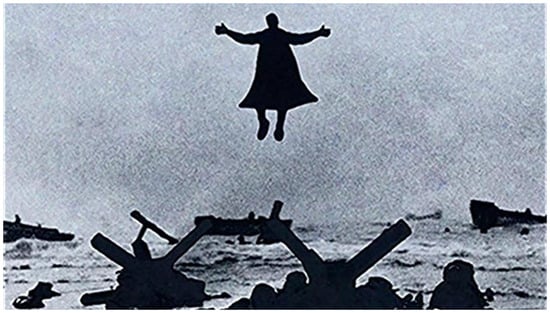
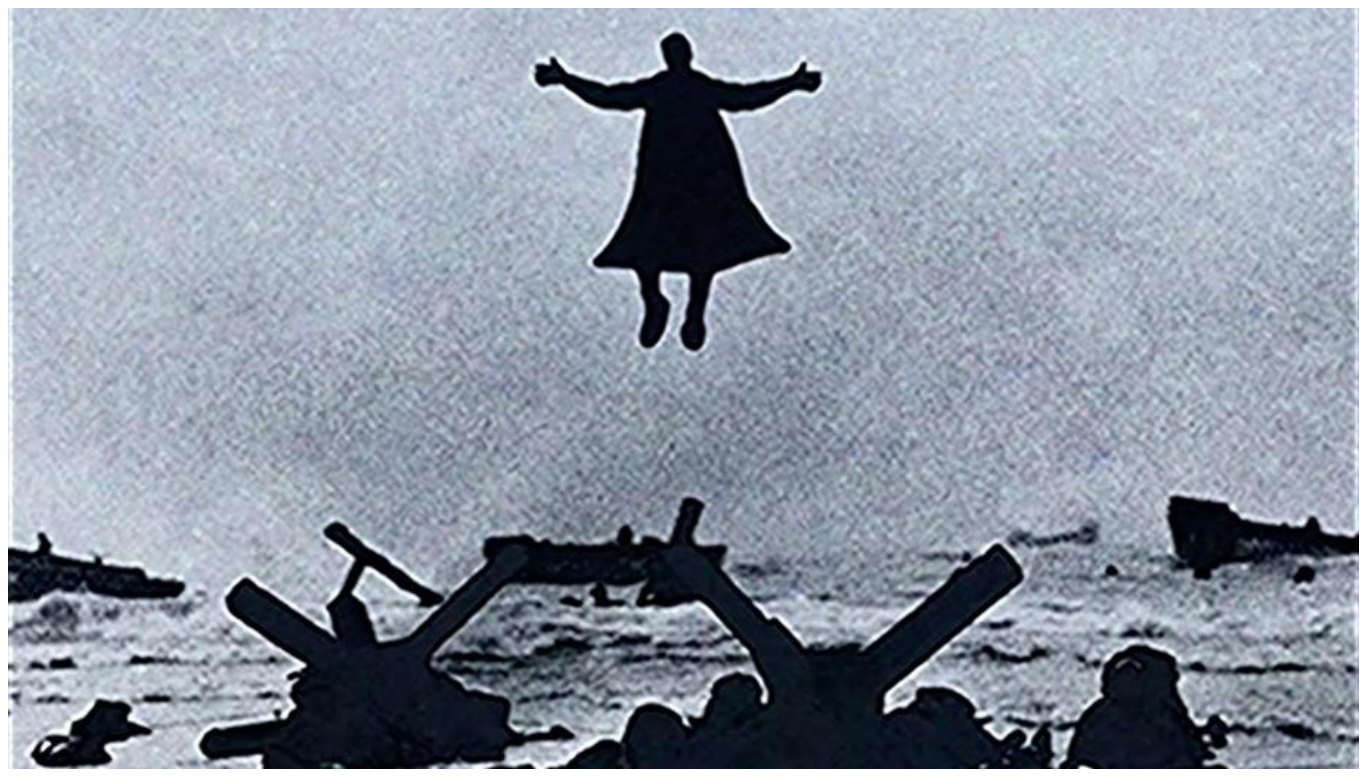
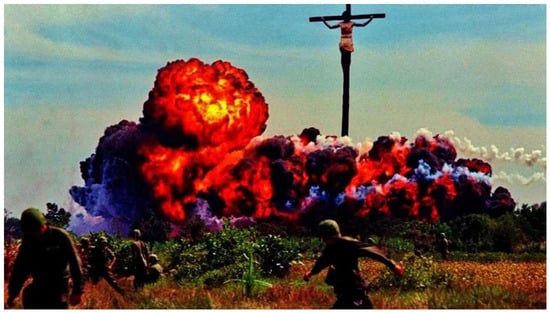
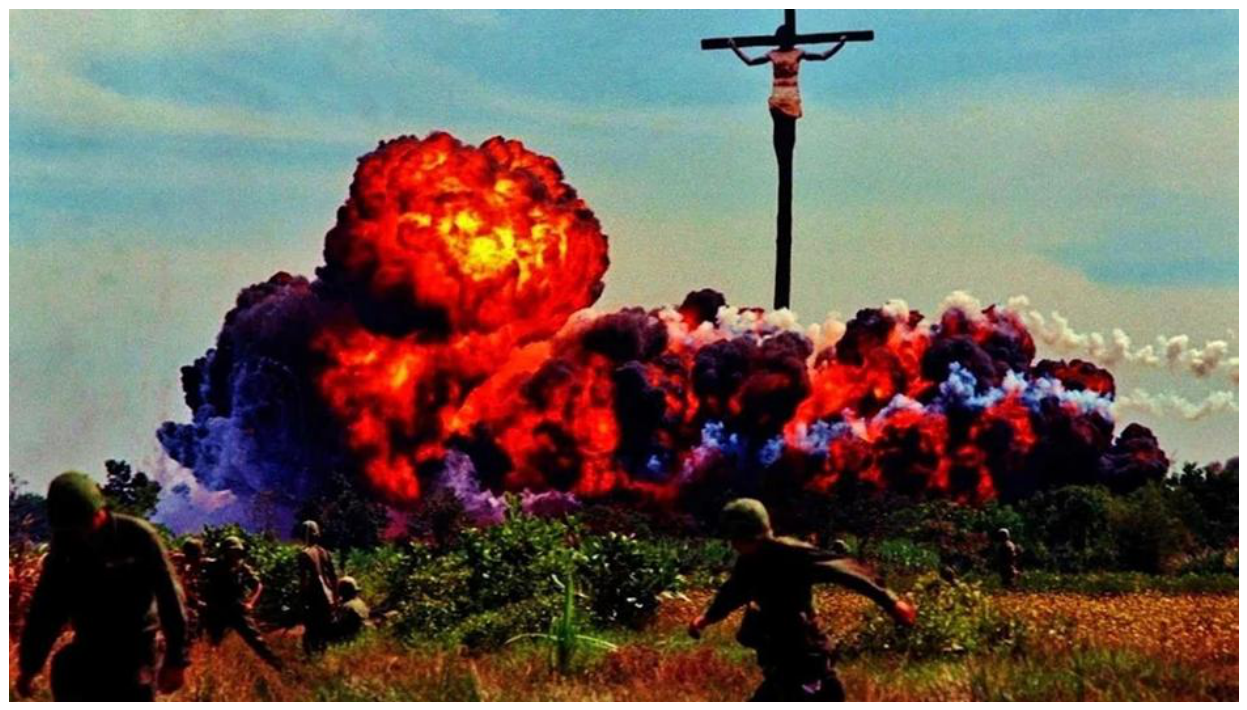
In “The Nixonverse”, Richard Nixon is rebirthed in another dimension as a god-like, cosmic horror figure, who orchestrates and observes historical events on Earth throughout the 21st century. In episode two of “The Nixonverse”, ‘THE D-DAY KNIGHT’ (24 May 2022), we see a montage of digitally mocked-up, era-imitative photos of one of Richard Nixon’s cosmic-horror offspring, ‘The D-Day Knight’, a bizarre, polymorphic figure aiding the D-Day landings (Figure 1). Later, in episode five, ‘Jesus in Vietnam’ (17 June 2022), we see his other son, ‘The Last Son of Alcatraz’, shaped into a flying Jesus on the Cross, invading Vietnam as soldiers flee from plumes of napalm (Figure 2).
Figure 1.
Still from ‘THE D-DAY KNIGHT’ (created by Eve Casanas, “The Nixonverse”, 24 May 2022).
Figure 2.
Still from ‘Jesus in Vietnam’ (created by Eve Casanas, “The Nixonverse”, 17 June 2022).
These montages are horrifying in their execution, and demonstrate the central use of historical referentiality in “The Nixonverse” to confront the difficult politics, and existential tone, of the modern polycrisis moment, especially mimicking our social media-enabled exposure to our socio-cultural reality, and the affective, emotional and information overwhelm this entails on the subject. The first image (Figure 1) achieves a great deal of convincing verisimilitude to contemporary WWII-era photography, generating uncanniness in this act of defamiliarizing a familiar mode of historical documents. As Royle states, the uncanny is generated through ‘a mixing of what is at once old and long familiar with what is strangely ‘fresh’ and new; pervasively linking death, mourning and spectrality, especially in terms of storytelling, transgenerational inheritance and knowledge’ (Royle 2003, p. 12). This is certainly present in the two images (Figure 1 and Figure 2), evoking established, shared international history and media to horror affect, typical of “The Nixonverse” series. These images create a historical unease, making the viewer playfully imagine, ‘what if this were real?’, and maybe even, importantly, question how this highly symbolic image of Christ invading Vietnam relates to the modern and historical realities of American foreign policy.
A key site of media trauma that the second image (Figure 2) obviously references is the intense and disruptive media coverage of the Vietnam War, where for the first time in history satellite technology and portable cameras allowed rapid, and importantly independent, decentralised, filmed coverage of events on the ground. Small (in Anderson 2011) discusses the impact of televised news coverage and photography of the Vietnam War, for example noting: ‘Americans were shocked to see news photos and television news film of Buddhist monks burning themselves to death on the streets of Saigon’ (p. 334). Affective images such as these contradicted the popular, societal-paternalistic American view of the war, and ‘the conflict between the media and presidents would intensify through-out the war to a point where the myth developed that the media, and not the military or the presidents, had lost the war’ (Anderson 2011, p. 334). Plainly then, the Vietnam War was a key site of struggle in American self-image, brought about by new technology decreasing media control, making the period ripe as a historical-site metaphor for analog horror’s discussion of similar issues in the modern internet era. Casanas’ “The Nixonverse” here draws clear comparison between the new, decentralised mode of information technology (the portable camera and satellite technology) and the loss of faith in American politics and identity in the Vietnam War era, using these media-historical realities in order to comment on how similarly, in the polycrisis era, the new, decentralised media forms of the internet era are exacerbating this loss of faith in American identity and politics, as well as the widespread, postmodern, capitalist realist ‘loss of faith in grand narratives’ (Jameson 1997, p. 1). Casanas is, here, very cleverly relating two key historical moments wherein a wave of overwhelming and shocking affective information entering and changing the media landscape, namely 1960s Vietnam War footage and the contemporary social media-filtered experience of our polycrisis present, have resulted in mass disruption of the subject’s normative relationship to established systems of power on multiple levels, including our attitudes towards government, the reliability of news broadcasters, ‘expertise’ in general, etc., as we will further unpack shortly.
The weight of history on the present, demonstrated in “The Nixonverse” through its perceptive juxtaposition of socio-cultural historical moments, is a pervasive theme in analog horror generally, and a strong connector to its gothic roots. The gothic, after all, is consistently focused since its conception on history and legacy, return and reanimation. As Spooner describes, ‘undead revenants, ancient curses, outmoded belief systems, hauntings, trauma—all are central to Gothic narrative’, and even more significantly to the systems of reanimation at work in analog horror, ‘perversely, what comes back— what returns— is determined by the concerns of the present’ (Spooner 2014, p. 184). “The Nixonverse” exacerbates the weight of 20th-century history on the modern day, through achieving a verisimilitude to historical documents, rendering this link between the two eras more uncannily tangible. As McMurdo notes, horror that imitates real-life documents, such as in the found footage horror subgenre, are designed to generate an illusory sense of ‘reality’ in the viewer and exploit it: this creation for the viewer of a faux position of ‘real spectatorship’ is easy to disturb, even slightly, for uncanny effect (McMurdo 2023, p. 5). Again here, we encounter this uncomfortable confrontation with the short-fallings of the past, something which Fisher mentions in the key relationship of capitalist realist cultural products to the uncanny, highlighting some of its key texts as ‘unheimlich, unhomely, fundamentally tied up with an environment that had been invaded by media’ (Fisher 2013, p. 126). This is certainly an apt statement in relation to the above images from “The Nixonverse”, literally collapsing the boundaries between real, past, just and unjust American conflicts of the 20th century, in a kind of affective media-invasion onto the present, by an imagined past. The intrusion of uncanny, historical-media-disrupting, cosmic horror beings brings back, ironically, an appropriate emotional charge to historical moments and images which, through constant, empty repetition, have lost their significance. At the very least, by uncannying our perception of historical media, this series draws attention to the affective loss we now suffer when approaching past events. The gothic, fantastical elements which “The Nixonverse” introduces into its retelling of American 20th-century history, and its relaying of this imaginary to the troubled present, then allows us to regain an emotional reality, something lost in the media-saturated overwhelm of modern, capitalist realist living.
The cultural interest in ‘uncannied’ history, which is used as a central device in “The Nixonverse” to comment on the modern polycrisis world, is highly prevalent in the 21st century, well documented for example in the Scarred for Life book series (Brotherstone and Lawrence 2017, 2020), recounting the ‘traumatic’ media children were exposed to in the 1970s and 1980s. Whole YouTube channels (Blameitonjorge 2013–present; The Internet Investigator 2020; Nick Crowley 2018), and an entire internet-native online community, the ‘lost media’ community (Lostmediawiki.com 2025), are further following this obsession with finding and archiving disturbing, rumoured or half-remembered television shows, commercials or animated shorts from our cross-generational, mass-cultural, collective childhoods, from the 1980s to the 2010s. This community is, of course, highly intersective with the analog horror community, which creates horror fiction based on these real-life, lost media ‘deep dives’. Just a few analog horror series that mimic explicitly the lost media, ‘deep-dive’ investigation format, where a single person or group search the internet for information about an obscure text, include “Gilbert Garfield” (created by Simonet 2022), “The Walten Files” (created by Walls 2020–present), and “Petscop” (created by Domenico 2017–2019). This device is used frequently in the subgenre, a trope rooted in earlier internet horror such as ‘creepypastas’, user-generated horror stories which ‘alienates the nature of nostalgia intrinsic to our presumptions of safety and subjecthood’ (Cooley and Milligan 2018, p. 194), especially focused around familiar childhood intellectual properties such as SpongeBob SquarePants (created by Hillenburg 1999–present) or The Simpsons (created by Groening 1989–present).
“The Nixonverse” similarly utilises a form of the lost media ‘deep dive’ narrative device, wherein the series is presented as footage compiled by the Avenue family, documenting the events that occurred in their world, which is then, through God-Nixon’s uncanny media power, ‘transmitted’ cross-dimensionally onto YouTube in our diegetic world. Therein, in the diegetic play of the series’ framing conceit, it is ‘lost media’ from another dimension, a dimension which is entirely ‘lost’ itself at the end of the series; more specifically, the universe which “The Nixonverse” takes place in is turned into a fictional story in a comic book series, in a move of metafictional omnipotence by God-Nixon, the only reminder of its existence in ‘reality’ the footage we have seen. In this sense, even further, the series is a kind of cautionary tale about human cruelty, which the God-Nixon figure wants us to see as an example, and in this way even the extra-diegetic purpose of the series, to use uncanny history to comment on our modern polycrisis moment, is cleverly written into the diegesis itself.
We are seemingly experiencing, in this analog horror-adjacent cultural trend of the lost media community, an expression of ‘digital archive fever’, which O’Gorman describes as a cultural/social ‘symptom of a desire for immortality, the results of a human compulsion for self-externalisation’ (O’Gorman 2015, p. 15). The mass collation of digital archives certainly relates to cultural fantasies around time and history, likely rooted in the diametric-opposite aspect of death drive compulsion towards fantasies of death/destruction. Rowland Smith describes this antithetical compulsion towards ‘deathlessness’, again a perfect fantasy state which suspends all desire and movement:
Since actuality vanishes at death, destroyed by death, the only character available to death can be that of possibility. Death bears the force of the entirely non-actual… [this] anticipation anticipates nothing actual, belonging rather to a structure of time that opens elsewhere than into the actual, and thus once more pre-empts any psychological apprehension thereof.(Rowland Smith 2010, p. 38)
In the face of the existential threat of the polycrisis in the real world, the archival cultural fantasies examined in analog horror evoke the eternity of possibility associated with death/destruction, achieved in the faux-spiritual, ‘eternal’ legacies left in digital archives that will outlive the subject like techno-cultural mirrors of the soul. The fact that these very communities online, creating digital archives as a kind of secularised, faux-immortality, simultaneously encounter the very media-archaeological acts they undertake as (to a varyingly lesser or greater degree) uncannily disturbing demonstrates the difficult relationship which the 21st century has to history, time and nostalgia. God-Nixon, in Casanas’ series, literally enacts this death drive diametric in a sense, when he uses his uncanny, reality-warping power to simultaneously destroy and forever preserve “The Nixonverse” universe in the form of a fictional story within our reality. This movement presents the ‘deathless’ and ‘deathful’ possibility of preserving human life or existence in archiving, a movement which, very much in the self-defeating tone of capitalist realism, only achieves a shallow feeling of existential relief, with no real, consequential effects. On some level we know instinctively that if the human world is archived, after we are gone, only lifeless images will remain.
Deeply entwined with these disturbing possibilities of uncannied historical images, and their playing with these death-drive, archival themes, is the second photo from “The Nixonverse” episode ‘Jesus in Vietnam’ (Figure 2). This image evokes arguably more of a disturbing effect/affect in conflict with an allegiance to verisimilitude, through its irksome, slightly unconvincing photoshopping, over-saturated colour, and hugely iconic imagery paired with dark subject matter. This forms an affective horror in the vein of Daniel’s ‘sensory assault’ technique, common in contemporary digital horror, wherein ‘the somatic elements of experience are intensified in relation to a reduction in the semantic content… undermining… the viewer’s process of meaning making’ (Daniel 2021, p. 12). Cognition of the second image and its iconoclastic historical abjectness is accompanied by a horror rooted in physical reaction, as the promise of the safety of the archive is uprooted, with this strange image throwing into question the diegetic play of “The Nixonverse” series as an archive—highlighting the text’s brazen uncanniness as almost mocking the hubris, or ultimate pointlessness, of the human urge to archive and achieve this faux-immortality.
As Powell (2005) describes it, discussing the intimate interlinking of the cinematic apparatus and the viewer:
Editing can startle us by jump cuts or induce a haptic sense of pain by rapid-fire intercutting… the use of light and shade, and saturated colour stock, initially affects the nerves of the eye, then spreads through the body’s neuronal network via tonal vibrations… Cinema is capable of inducing perceptual thoughts of a philosophical kind on the nature of time, space and motion. It also offers a self-reflexive exploration of perception itself(pp. 201–2)
These two, mocked-up photographs from “The Nixonverse” generate, through an interweaving of semantic content and execution, ‘tonal vibrations’ mirroring the modern era and its constant confrontation with nostalgia: an uneasy existence trapped in the tomb of history. Our seeming inability to move on from the 20th century and the ‘failures’ associated with it leaves us almost feeling, in the polycrisis era, trapped in a kind of uncannied archive of our own creation: something which is designed to make us feel ‘deathless’, while dooming us. This is the situation that “The Nixonverse” mirrors, as both biting satire, and a bitter moral example.
5. The Trump Era and Reality Fatigue
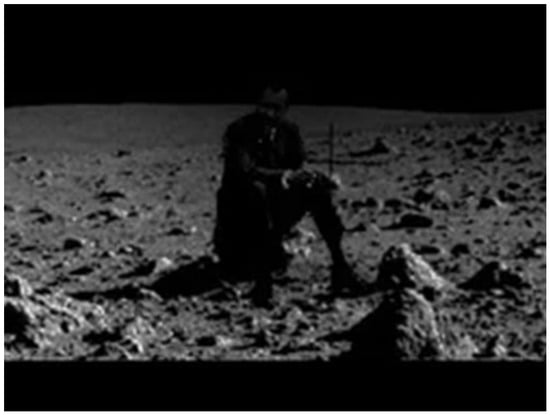
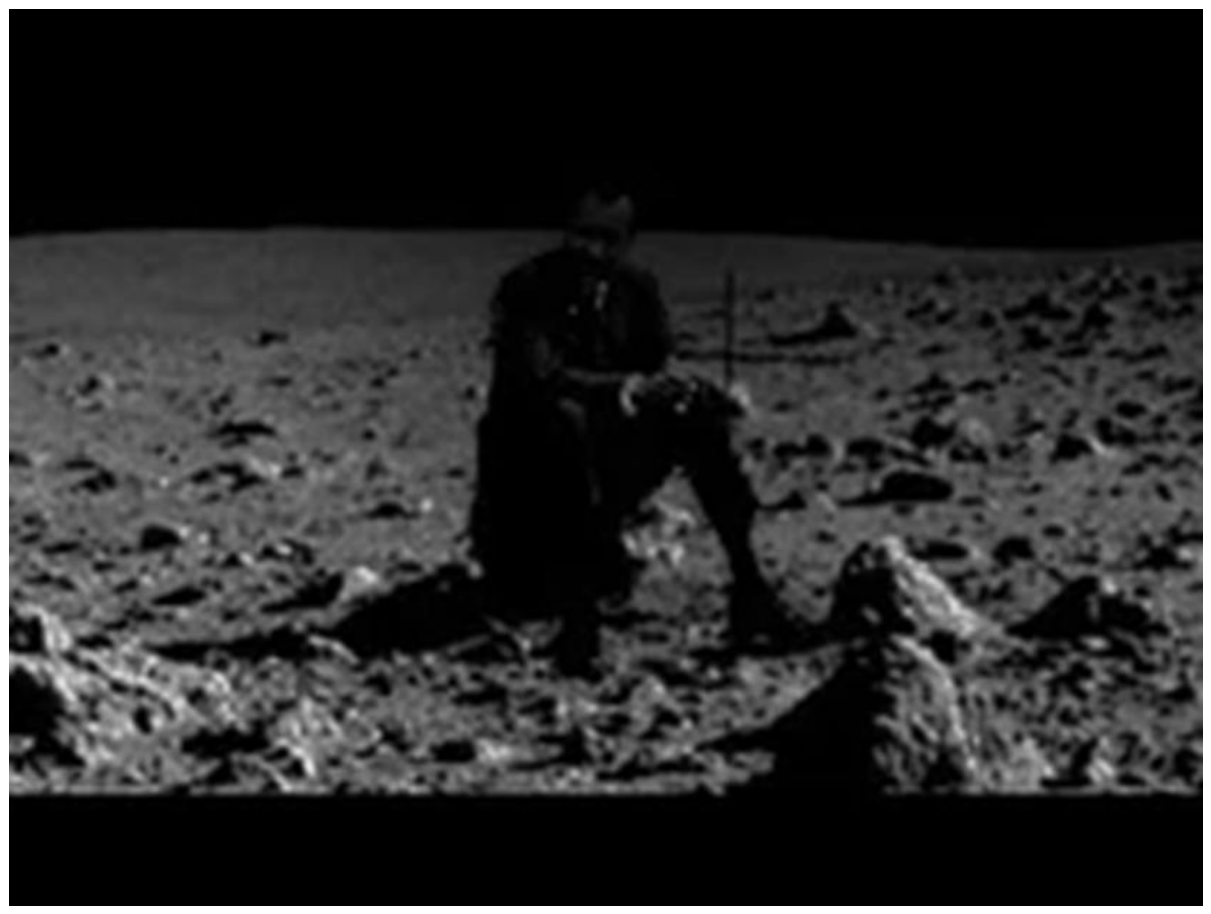
A different series of documents we see in the tenth episode (‘NIXON IS GOD’, 4 August 2022) of “The Nixonverse”, made to imitate real historical space photography and audio recordings of the Apollo 11 moon landings, show Richard Nixon sitting sinisterly on the moon, without a space helmet (Figure 3).
Figure 3.
Still from ‘NIXON IS GOD’ (created by Eve Casanas, “The Nixonverse”, 24 August 2022).
Again, this demonstrates the uncanniness that can be created in analog horror through using historical iconography to evoke uneasy confrontation with real, shared history in a fantasy space, something which the subgenre does centrally through creating a-historical, analogue tech worlds. This image from Casanas’ series is viscerally affective, and there is furthermore an evident subtextual association made in scenes such as this, between the god-like Nixon, an infamously corrupt 20th-century president forced to concede office, being imbued here with the power to warp reality—evoking through historical metaphor the clear mirror-image of Donald Trump, whose first term had ended two years before this episode’s creation (and his second term would start just over two years later in 2025), himself the focus of several criminal investigations, and central to the cultural, consensus-reality warping tendency of ‘fake news’.
Lifton (2019) describes the affective aura of the ‘end-time’ crisis-point that Trump evokes through his political persona:
Trump does not directly express an apocalyptic narrative, but his presence has an apocalyptic aura. He tells us that, as not only a “genius” but a “very stable genius”, he alone can fix the terrible problems of our society. To be sure these are bizarre expressions of his extreme grandiosity, but also of a man who would be a saviour to a disintegrating world(p. 152)
In this way Trump finds a near-literal comparison in President/God-Nixon, who is the saviour and damn-er of “The Nixonverse”’s world. Herein, Trump, and God-Nixon as his thematic stand-in in the series, also both mirror thematically the capitalist realist, death drive anxieties evoked by our modern crisis: exactly this fear of living in an era constantly suspended between ‘death’ and ‘deathlessness’, doom or salvation. It could be argued, in line with Lifton’s extensive relation of Trump to the modern socio-cultural and political moment, that this is no accident, with the 45th and 47th president being in a sense a symptom of the polycrisis, a figure elected due to his embodiment of this diametric, just as God-Nixon is the alpha and omega of his fictional universe.
In this episode of Casanas’ series, directly before seeing the above image (Figure 3) from the moon, we are given the warning, ‘The following audio contains ideas that may be harmful or traumatising to some viewers. Viewer discretion is advised’, increasing the apprehensive, horror-affective charge of this moment, by giving the extra-diegetic viewer the playful impression they could be literally mentally affected by what they see. This trope of negatively affective media/information is frequent in analog horror, expressive of anxieties around harm caused by the modern media landscape and social media on the user. The association of the horrific over-presence of history, and its power over our perception, which is evoked in this episode of “The Nixonverse”, clearly evokes the memetic power of Trumpian ‘fake news’ and its cultural associations with ‘end times’ anxieties, this in itself tied into the polarising politics and unreliability of social media in the 21st century.
Arising in popularity throughout Donald Trump’s first term, analog horror is deeply tied into the socio-cultural shifts occurring in the post-2016 period, it being no coincidence that the subgenre, beginning ‘officially’ in 2015, rose to prominence in the years following Trump’s first election. The subgenre’s expression of a loss of faith in traditional channels of information and mainstream establishments, and playing with the idea of these previously trustworthy sources as potentially harmful or hazardous, plainly evokes Trumpian populist politics, and its active contribution to a ‘reality fatigue’, as Lifton puts it, revolving around a deliberate irreverence for reality initiated by the president and then widely adopted across culture and social media:
The drumbeat of falsehoods and lies continues even as we expose them as such: we are thrust into a realm in which a major segment of our society ignores or defies the principles of reason, evidence, and shared knowledge that are required for the function of a democracy(Lifton 2019, p. 160)
The past which “The Nixonverse” presents is certainly haunted by the remnants of real, avoidable historical failures, and horrors of the 21st century, such as Watergate, the collapse of the American space programme, the Vietnam War, and, in the links drawn by Casanas in her series between Nixon and Trump, the continued election of right-wing and/or criminal presidents. The series’ use of historical referencing strongly evokes Spooner’s prementioned quote, showing that in analog horror, as in the gothic mode, ‘what comes back— what returns— is determined by the concerns of the present’. Casanas’ series is a fictional or simulated example of ‘fake news’, in its construction of an entirely false history through a series of documents uncannying our relationship to history, the archive, and documental verisimilitude, as we have discussed. In creating an extremely (and largely obviously) fake history, especially centred around America and American presidents, “The Nixonverse” once again holds up a mirror to our polycrisis present, and how developing cultural forces such as fake news may even further exacerbate the postmodern ‘loss of faith’ effects of our capitalist realist world.
Popular horror Netflix show Stranger Things (created by the Duffer Brothers 2016–present) is a major example of modern media directly creating a historical, hauntological space, a ‘fake history’ based in Reagan’s America in the 1980s—the era which Trump’s ‘Make America Great Again’ campaign directly references—to address concerns of the modern day. As Mollet (in Shimabukuro and Clayton 2024) identifies, in a way deeply similar to analog horror and Casanas’ “The Nixonverse”: ‘Stranger Things… illuminates the inherent malaise of twenty first century America and the current status of the American dream, and by extension facilitates a critique of the present for not learning from the mistakes of the past’ (p. 17). Mollet describes a deeply, and deliberately referentially, Spielbergian (i.e., positive and hopeful) ‘rallying’ against the oppressive patriarchal forces of Stranger Things by the ‘tweens and teens… armed with liberal twenty first century values that allow them to highlight the problematic nature of nostalgic sentiment for this era’ (p. 17), forefronting emotional connections and ‘found family’.
Analog horror series generally offer none of this comforting, emotional buffer of transgression through friendship or valiant struggle, however. The emotional tone of exhausted over-exposure to horror, evoked by the barrage of real and imagined historical traumas in “The Nixonverse”, is certainly an affective charge influenced by its socio-historical context, and one that is central to the existential pain being expressed in analog horror. Casanas’ series achieves the ‘tonal vibration’ of a kind of bewildered exhaustion, a ‘reality fatigue’ at the extent of suffering being presented in its mock-archival montages of bizarre atrocities, presented one after the other in an information-video-style format, mimicking the banal, flattened information mode of the social media feed, or the twenty-four-hour news cycle.
As JG Ballard says in the introduction to the French edition of the classic, transgressive novel Crash (Ballard [1973] 1974):
Voyeurism, self-disgust, the infantile basis of our dreams and longings—these diseases of the psyche have now culminated in the most terrifying casualty of the century: the death of affect. This demise of feeling and emotion has paved the way for all our most real and tender pleasures—in the excitements of pain and mutilation… in our moral freedom to pursue our own psychopathology as a game; and in our apparently limitless powers for conceptualisation(Ballard [1973] 1974, p. 1)
(Ballard’s ([1973] 1974) critique of the oncoming techno-postmodernism he describes in texts such as Crash is chillingly prescient of the capitalist realist, emotional/technological landscape that we are examining as symptomized in analog horror, and used to such effective political comment in “The Nixonverse”. The analog horror subgenre is birthed from a socio-cultural context, especially in online subcultural spaces, of increasingly seeking and rallying around the taboo, unacceptable, and immoral, as Nagle (2017) unpacks in her in-depth analysis of the influence of 4chan culture on the modern age, especially epitomised in Trumpism and the ‘alt-right’ (p. 28):
The throwing off of the id that characterised this transgressive countercultural traditional… characterises sites like 4chan, and its culture of trolling and taboo-breaking anti-moral humour, which is often described as insane or unhinged to baffled outsiders. This [idolising] view of psychopathy and rejection of imposed morality runs through the ethos and aesthetic of right wing trolling culture(Nagle 2017, p. 31)
This veneration of the psychopathic, and transgression for transgression’s sake, combines with, and contributes to, a differing attitude to emotional affect itself, and an emptying out of traditional, ‘acceptable’ emotional reactions to the stream of extreme content we can now all access. This trend, while beginning in subculture, has become mainstream, for example with over-present media coverage of real-world tragedies erupting in the polycrisis, and the ‘post-truth’ (Lifton 2019, p. 159) presidencies of Donald Trump.
“The Nixonverse” mirrors, inverts and satirises the election of Trump as the political embodiment of ‘this [idolising] view of psychopathy and rejection of imposed morality’ in the alt-right, this ‘death drive’ towards the harmfully transgressive, by cleverly reappropriating the socio-cultural image of Richard Nixon: before Trump, considered to be one of the most controversial presidents, due to his associations with the Watergate scandal. “The Nixonverse” makes Nixon into a frighteningly powerful but ultimately benevolent figure, who is ultimately fairly judging humanity as ‘not worth saving’, due to their protracted cruelty throughout the series towards his ‘offspring’ whom he sends to Earth. Far from dooming humanity unfairly, God-Nixon gives us a chance to be better, which we do not rise to. On a surface level, Casanas here highlights that, by comparison to Trump, who was elected for his very ‘anti-morality’, the formerly infamous Nixon seems tame in comparison. In a secondary sense, by creating an inversion of the idish Trump, in the moral, ‘super-ego’ (Freud [1920] 2015) figure of God-Nixon, Casanas implies, perhaps most troublingly, that the capitalist realist, polycrisis state of inaction we find ourselves in is not caused by single leaders, but by the public who either elect them, or do little or nothing to change the world for the better, trapped in this very capitalist realist malaise which Fisher so powerfully describes. As an inverse sign for Trump, God-Nixon, in “The Nixonverse”, reminds us that the troubled state of the modern world is due to the cruelty, indifference and inaction of the entire human race: saviour figures cannot break our existential deadlock, for better or worse.
This broader question, of why the human being gravitates towards the transgressive, even in its most traumatic and harmful aspects, was posed by Freud over a hundred years ago in Beyond the Pleasure Principle, and appears to be a fundamental mystery of our social structure as human beings. What is present in analog horror and its destructive fantasies, then, is a modern sign of the current state of this long-held process.
6. Conclusions: Analogue Destruction and Fantasy Fulfilment
The idea of the exhaustion of affect, the removal of genuine force and response/drive in the face of an ouroboros media landscape, as demonstrated throughout “The Nixonverse”, is certainly tied to what Derrida described as the ‘haunting’ of history (Derrida 2001, p. 4), his work being a major influence on Mark Fisher’s theory of capitalist realism. The act of looking back into the past, Derrida states, inherently turns it into a structure, objectifying it so its ‘content’, i.e., the force of human activity and life that created this structure, is ‘neutralised’, leaving this picture of history like a ‘city no longer inhabited, not simply left behind, but haunted by meaning and culture’ (p. 4). Here we find the historical tomb that analog horror represents, this mass, uncanny archive mirroring the seeming hopelessness of modern culture. Casanas’ images from “The Nixonverse” represent the 20th century as a flattened structure, where what are usually disparate elements (a superman-esque hero and World War II, Jesus and Vietnam, Nixon and the moon landings) are presented in uncomfortable proximity. This uncannying, a-historical act of cultural contamination highlights key contradictions in modern-day society, especially American society, and its movements towards a toxic and revisionist death-drive nostalgia. “The Nixonverse” and its archive of fake history acts as a bizarre and unforgiving mirror for the self-defeating, death drive fantasies of our modern capitalist realist world.
Derrida describes the great goal of this structuralist viewing of history, a banal, equivalent view, as exactly removing the power of history’s contents: history becomes a series of isolated moments, loosely connected through context, losing their ‘force’ or their true human meaning. In a sense, like the death drive instinct, we remove anxiety through removing all emotion in the freezing act of ‘looking back’. The uncanny power of an image such as the ‘The D-Day Knight’ from Casanas’ series, lies precisely in how it highlights to the viewer the affective dampening we now experience our history with through its constant over-presence, and the tired horror at the uncomfortable, cultural contradictions we ignore: such as how, in reality, the country that believed in Jesus invaded Vietnam; the country that created Superman was involved in WWII, and ended it with the use of nuclear weapons on civilian populations; the same president in office during the moon landings was involved in the Watergate scandal. Whilst analog horror’s political compass is generally opaque, Eve Casanas’ series are bitterly confrontational to the idea of the American dream, and to the idea that there ever was a ‘great’ America to get back to; an almost direct, if tonally hopeless confrontation with Trumpian populist politics, this anger at pervasive toxic nostalgia is expressed with a numbness born from the limiting effects of capitalist realism on achieving any such change, and the affective exhaustion of the social media era.
Certainly the central choice in Casanas’ series of Richard Nixon as symbolically representing the entire text’s themes, namely the loss of faith in modern (specifically American) self-narratives due to changes in media and its control systems, is incredibly apt. Nixon was involved in the heavily publicised Watergate scandal from 1972 to 1974, leading to Nixon’s (essentially forced) resignation, and as Graff (2022) describes:
“Watergate” has become the scandal that has defined all other scandals, “gate” the suffix of choice to denote a scandal of epic proportions. It fundamentally upended American’s relationship with their government and revealed a cynical abuse of power that fuelled a decade-long epic loss of trust and faith in the institutions that had long led American life(p. xvii)
In short, prior to Trump, Nixon is the 20th-century American figure perhaps most associated with disillusionment with grand narratives surrounding American identity, and the reliability of paternal institutions.
The flattened affect of modern culture relates strongly to the work of Fredric Jameson, a major theoriser of postmodernism, whose work Postmodernism, or, The Cultural Logic of Late Capitalism (Jameson 1997) lays the foundation for Fisher’s description of our 21st-century, capitalist realist society. Analog horror’s conception of the past as a kind of graveyard structure, increasingly devoid of its own significance despite its constant presence, is expressive of Jameson’s concept of the postmodern ‘crisis of historicity’, wherein ‘there no longer does seem to be any organic relationship between the American history we learn from schoolbooks and the lived experience of the current multinational, highrise, stagflated city of the newspapers and of our own everyday life’ (p. 21).
This occurs in tandem, in the postmodern field’s broad devaluing of traditional modes of relating to cultural signs and symbols, to a general loss of faith in the social and personal concepts which created consensus in the past, atomising society into smaller and smaller sections, dislocating traditional concepts of the self and generating, in the field of over-present and increasingly irrelevant history, a desperate existential search for ‘selfhood’, something which was once a given. This is especially relevant in the context of what we were discussing with Trump, Nixon, and analog horror. It is in the midst of this postmodern, flattened structure of modern-society/media-landscape that analog horror’s reviving of analogue technology and aesthetics to create modern horror texts clearly takes on its full fantasy significance. It is entirely logical, if tragic, that a society both devoid of forward momentum and trapped in a feedback loop of nostalgia would attempt to resurrect past cultural technologies and transgressive figures, which changed and reshaped society in the 20th century, in order to form fictional symbols expressing this paradoxical desire for change and the new, while simultaneously embodying the old and the safe. “The Nixonverse” plays out this capitalist realist fantasy practice, where we search for either a ‘death’ or a ‘deathless’ conclusion to our modern, suspended state, in the flattened archives of 20th-century history, and ultimately find no answers there—this very act of looking back ensuring we cannot deal with the present or future. The historical god of “The Nixonverse” reality cannot save us, as we, looking to him and therein ignoring opportunities to ‘be better’, have in reality failed to save ourselves.
Baudrillard (1994) describes the hyperreal media landscape and its effects, characterising it as, similarly to Derrida and Jameson, emptied of all momentum for change, a plane where our culture will simply resign itself to a self-referential existence that does not progress, but slowly self-recycles at the exponentially reductive cost of ‘true’ content and relation to reality:
It is no longer a question of imitation, nor duplication, nor even parody. It is a question of substituting the signs of the real for the real… deterring every real process via its operational double… Never again will the real have the chance to produce itself—such is the vital function of the model in a system of death, or rather of anticipated resurrection, that no longer even gives the event of death a chance(Baudrillard 1994, p. 2)
The idea of a denied ‘death’ of culture and history, a natural and constant process that has been interrupted by endless self-referential repetition, then creating an affectively drained ‘system of death’, instantly speaks to the modern, pervasive, cultural death drive system of reanimating history rather than achieving forward momentum. This is the exact motion “The Nixonverse” undertakes, reviving the legacy of Nixon and demonstrating in a fictional simulation its total inability to save or destroy us, to achieve change—this constant referral of the present to the past precisely the practice which analog horror harbours desperate fantasies of destroying, even as it symptomizes it. And the end goals of these destructive fantasies, of course, are as Jameson describes, wishing for new ways of being: new differences, new consensus, new formulations to have faith in.
Writing on the gothic in 2008, Botting wonders if there will in the future be, in horror texts and culture:
A nostalgia for objects terrifying enough to testify to the unrepresentable, sublime enough to stimulate the recuperation of a sense of a self-become dissipated and fragmented, intense enough to ensure the restoration of symbolic structures that are cracked if not already in ruins: here monsters and horrors would call for institutions and figures of authority strong enough to expel them(Botting 2008, p. 28)
Symptomatic of a society removed of all force of signification, analog horror and its anarchic reanimation of historical icons from the 20th century, as epitomised in “The Nixonverse”, confrontationally evoke the over-present past in the 21st century, expressing an anxious wish to overcome ‘the “viral” transversal realm of Baudrillardian hyperreality, a realm… without a preceding unifying or organising metaphor’ (Botting 2008, pp. 25–26): reanimating past figures associated with watershed moments, such as Richard Nixon, or the VHS tape, as simulated icons, images of this wished-for invigorating force.
Weinstock specifically highlights how the horror lexicon is an ideal space for formulating these socio-cultural fantasies of searching for better alternatives, finding ways to culturally encounter the sublime and numinous possibility beyond our stifled, equivalent realm, precisely because the genre’s dark subject matter and tone mirror the existential nihilism of modern, capitalist realist living:
[the] Gothic aura of dread and despair may be particularly well suited to contemporary sensibilities because it fuses magic with postmodern cynicism. Gothic horror reintroduces a sense of the numinous into an allegedly disenchanted landscape, but in such a way that human hubris is chastened and egotism upbraided(Sederholm and Weinstock 2016, p. 63)
In analog horror narratives, we initially seek this return of structure and fixed meaning through a nostalgic return to the past, an attempt to avoid postmodern equivalency via analogue technologies, archives and the format nostalgia of defunct media. Characters in analog horror series often seek comfort or wistful discovery through investigating childhood texts or lost media, in attempts to find refuge from the difficult present. But, in most of the subgenre’s texts, the consumer/protagonist uncovers the troubling fact that the analogue-soaked past in which they sought comfort is now just as compromised as the modern-day world—the analog horror genre subsequently expressing an intense anxiety for other alternatives, through hopeless repetition of total destruction fantasies of both intertwined realms. The compulsive re-enactment of this violent fantasy is symbolic of the bewilderment at this very lack of clear alternatives. Casanas’ “The Nixonverse” perfectly encapsulates this practice, in its masterful philosophical move of masking the series initially as the comfort-nostalgia practice of an (admittedly horror-tinged) lost media deep dive, before revealing itself to be a harsh, affective moral statement on humanity’s exact, self-soothing addiction to history. We may be drawn to the series on the surface by its seemingly novel, strange remixing of history, promising entertainment based in the ease of familiar forms, before finding ourselves confronted with reminders of the real-world consequences of running from the present, into nostalgic fantasy.
To painfully self-aware analog horror texts such as “The Nixonverse”, neither the nostalgic past nor the media-saturated present are viable, safe alternatives to our contemporary world in crisis; and whilst texts in the subgenre do not generally provide a clear way out for their protagonists, the will and the force, the technophobic anxiety for want of something different is there, trapped in the labyrinthine media narratives of the fictional, uncanny archives. The use of reanimated icons of 20th-century history to create death drive fantasies becomes analog horror’s grand signifier for capitalist realism and its existential deadlock: the problems are clear but the solutions are opaque, elusive or absent. The systems that offer us escape also deny us hope. Ultimately, God-Nixon cannot even truly destroy or save the universe he has created; he can only turn it into a comic book series in yet another fictional universe, a final example of his true, total lack of real power. The message here is plain: there is no real change or salvation for the present to be found in history; it is already a structure fixed in place, nothing more than a ‘city no longer inhabited’.
Funding
This research received no external funding.
Data Availability Statement
No new data was created.
Conflicts of Interest
The author declares no conflicts of interest.
References
- Abode, Remy. November 17, 2019–present. “Gemini Home Entertainment”. YouTube Series. Available online: https://www.youtube.com/GEMINIHOMEENTERTAINMENT (accessed on 2 June 2026).
- Anderson, David L., ed. 2011. The Columbia History of the Vietnam War. New York: Columbia University Press. [Google Scholar]
- Ballard, James G. 1974. Crash. Paris: Calmann Levy. First published 1973. [Google Scholar]
- Baudrillard, Jean. 1994. Simulacra and Simulation. Ann Arbor: University of Michigan Press. [Google Scholar]
- Blameitonjorge. 2013–present. YouTube Channel. Available online: https://www.youtube.com/channel/UCU3oAyhHDXjgbxazqOEG2UA (accessed on 14 February 2026).
- Botting, Fred. 2008. Limits of Horror: Technology, Bodies, Gothic. Manchester: Manchester University Press. [Google Scholar]
- Brotherstone, Stephen, and Dave Lawrence. 2017. Scarred for Life Volume One: The 1970s. Morrisville: Lulu. [Google Scholar]
- Brotherstone, Stephen, and Dave Lawrence. 2020. Scarred for Life Volume Two: Television in the 1980s. Morrisville: Lulu. [Google Scholar]
- Casanas, Eve. September 26, 2020–present. “The Monument Mythos”. YouTube Series. Available online: https://www.youtube.com/@evecasanas/videos (accessed on 2 June 2026).
- Casanas, Eve. 2022. “The Nixonverse”. YouTube Series. May 14–August 13. Available online: https://www.youtube.com/@evecasanas/videos (accessed on 2 June 2026).
- Cooley, Kevin, and Caleb Andrew Milligan. 2018. Haunted objects, networked subjects: The nightmarish nostalgia of creepypasta. Horror Studies 9: 193–213. [Google Scholar] [CrossRef] [Scilit] [PubMed]
- Daniel, Adam. 2021. Affective Intensities and Evolving Horror Forms: From Found Footage to Virtual Reality. Edinburgh: Edinburgh University Press. [Google Scholar]
- Darabont, Frank. 2010–2022. The Walking Dead. Television series; New York: AMC Studios. [Google Scholar]
- Derrida, Jacques. 2001. Writing and Difference, 2nd ed. Translated by Alan Bass. London: Routledge. [Google Scholar]
- Domenico, Tony. March 12 2017–September 2 2019. “Petscop”. YouTube Series. Available online: https://www.youtube.com/petscop (accessed on 2 June 2026).
- Duffer Brothers. 2016–present. Stranger Things. Streaming Series; Los Gatos: Netflix. [Google Scholar]
- Fisher, Mark. 2009. Capitalist Realism: Is There No Alternative? London: Zero Books. [Google Scholar]
- Fisher, Mark. 2013. Ghosts of My Life: Writings on Depression, Hauntology and Lost Futures. London: Zero Books. [Google Scholar]
- Fojas, Camilla. 2017. Zombies, Migrants, and Queers: Race and Crisis Capitalism in Pop Culture. Champaign: University of Illinois Press. [Google Scholar]
- Freud, Sigmund. 2015. Beyond the Pleasure Principle. Translated by James Strachey. Dover Thrift Editions. Garden City: Dover Publications. First published 1920. [Google Scholar]
- Graff, Garrett M. 2022. Watergate: A New History. New York: Avid Reader Press. New York: Simon & Schuster. [Google Scholar]
- Groening, Matt. 1989–present. The Simpsons. Television Series; Los Angeles: Fox. Burbank: Disney+. [Google Scholar]
- Helleiner, Eric. 2024. Economic Globalization’s Polycrisis. International Studies Quarterly 68: sqae024. [Google Scholar] [CrossRef] [Scilit]
- Hillenburg, Stephen. 1999–present. SpongeBob SquarePants. Television Series; New York: Nickelodeon. [Google Scholar]
- Jameson, Fredric. 1994. The Seeds of Time: The Wellek Library Lectures at the University of California, Irvine. New York: Columbia University Press. [Google Scholar]
- Jameson, Fredric. 1997. Postmodernism, or, The Cultural Logic of Late Capitalism, 7th ed. Durham: Duke University Press. [Google Scholar]
- Juliet Lauro, Sarah, ed. 2017. Zombie Theory: A Reader. Minneapolis: University of Minnesota Press. [Google Scholar]
- Kister, Alex. June 9, 2021–present. “The Mandela Catalogue”. YouTube Series. Available online: https://www.youtube.com/@AlexxKister (accessed on 2 June 2026).
- Lifton, Robert. 2019. Losing Reality: On Cults, Cultism, and the Mindset of Political and Religious Zealotry. New York: The New Press. [Google Scholar]
- Lostmediawiki.com. 2025. Online Database. Available online: https://lostmediawiki.com/Home (accessed on 2 June 2025).
- Luckhurst, Roger. 2015. Zombies: A Cultural History. London: Reaktion Books Limited. [Google Scholar]
- McMurdo, Shellie. 2023. Blood on the Lens: Trauma and Anxiety in American Found Footage Horror Cinema. Edinburgh: Edinburgh University Press. [Google Scholar]
- Nagle, Angela. 2017. Kill All Normies: Online Culture Wars from 4chan and Tumblr to Trump and the Alt-Right. London: Zero Books. [Google Scholar]
- Nick Crowley. 2018. YouTube Channel. Available online: https://www.youtube.com/NickCrowley (accessed on 4 May 2026).
- O’Gorman, Marcel. 2015. Necromedia. Posthumanities. Minneapolis: University of Minnesota Press, vol. 33. [Google Scholar]
- Powell, Anna. 2005. Deleuze and the Horror Film. Edinburgh: Edinburgh University Press. [Google Scholar]
- Rowland Smith, Robert. 2010. Death-Drive: Freudian Hauntings in Literature and Art. Frontiers of Theory. Edinburgh: Edinburgh University Press. [Google Scholar]
- Royle, Nicholas. 2003. The Uncanny. Manchester: Manchester University Press. [Google Scholar]
- Schaefer, Donovan O. 2019. The Evolution of Affect Theory: The Humanities, the Sciences, and the Study of Power. Cambridge: Cambridge University Press. [Google Scholar]
- Sederholm, Carl H., and Jeffrey Andrew Weinstock, eds. 2016. The Age of Lovecraft. Minneapolis: University of Minnesota Press. [Google Scholar]
- Shimabukuro, Karrȧ, and Wickham Clayton, eds. 2024. Horror That Haunts Us: Nostalgia, Revisionism and Trauma in Contemporary American Horror Film and Television. Liverpool: Liverpool University Press. [Google Scholar]
- Simonet, Max. 2022. “Gilbert Garfield”. YouTube Series. May 24–December 25. Available online: https://www.youtube.com/@FaraoneProductions (accessed on 2 June 2026).
- Spooner, Catherine. 2014. Twenty-First-Century gothic. In Terror and Wonder: The Gothic Imagination. Edited by Dale Townshend. London: The British Library, pp. 180–207. [Google Scholar]
- Straub, Kris. October 26, 2015–present. “Local58TV”. YouTube Series. Available online: https://www.youtube.com/c/LOCAL58TV (accessed on 2 June 2026).
- The Internet Investigator. 2020. YouTube Channel. Available online: https://www.youtube.com/@TheInternetInvestigator/featured (accessed on 14 February 2026).
- Varoufakis, Yanis. 2023. Technofeudalism: What Killed Capitalism. Sydney: Vintage Digital. [Google Scholar]
- Walls, Martin. April 26, 2020–present. “The Walten Files”. YouTube Series. Available online: https://www.youtube.com/@thewaltenfiles (accessed on 2 June 2026).
Disclaimer/Publisher’s Note: The statements, opinions and data contained in all publications are solely those of the individual author(s) and contributor(s) and not of MDPI and/or the editor(s). MDPI and/or the editor(s) disclaim responsibility for any injury to people or property resulting from any ideas, methods, instructions or products referred to in the content. |
© 2026 by the author. Licensee MDPI, Basel, Switzerland. This article is an open access article distributed under the terms and conditions of the Creative Commons Attribution (CC BY) license.