1. Introduction
Over the past two decades, representations of mental health in screen culture have become increasingly visible, reflecting the growing public attention given to psychological suffering and the broader cultural negotiation of normality, deviance, stigma and recovery. Narrative film—understood here as fictional feature-length or short-form cinematic storytelling—occupies a privileged position within this field because it translates mental suffering into images, characters, plots and affective situations that can circulate beyond clinical contexts. At the same time, this study uses the term “cinema” in a focused but not entirely exclusive sense; in particular, the main analytical emphasis is on narrative film, while the bibliometric corpus also captures adjacent screen media terms, including television, video and visual media, when they appear in the PubMed-indexed medical literature. This distinction is important because the article does not analyze films themselves, nor does it offer a history of cinematic representation. Rather, it examines how medical academic discourse names, classifies and interprets mental health when it encounters film and related screen media.
Visual representations of mental illness are not neutral. They may contribute to stigma reduction, mental health literacy and empathic understanding, but they may also reinforce stereotypes, especially when mental illness is associated with danger, unpredictability or social threat. Earlier scholarship has shown that media representations have played a major role in shaping public perceptions of mental illness, often through simplified or distorted images (
Wahl 2003;
Stuart 2006;
Corrigan and Watson 2002). More recent studies have also indicated that certain screen narratives may have measurable behavioral consequences, including the risk of imitation in the context of suicide representation (
Bridge et al. 2020). These findings suggest that visual culture does not merely reflect social attitudes toward mental health but also actively participates in their formation.
Medical language is part of this process. Scientific articles do not simply describe representations from an external, neutral position. Through their terminology, classifications and interpretive frameworks, they help to define which images of mental suffering become legitimate objects of knowledge, which pathologies attract attention, and which social dimensions remain marginal. Just as films may teach audiences what depression, psychosis or trauma are supposed to “look like,” the medical literature may influence how professionals and students understand the cultural visibility of psychological suffering. The relationship between medical discourse and screen representation is therefore bidirectional: clinical categories shape the interpretation of visual narratives, while visual narratives provide culturally powerful forms through which mental illness is imagined, taught and discussed.
This interface has become especially relevant within the Medical Humanities, where film has increasingly been used as a pedagogical resource for ethical reflection, narrative competence and empathy-based learning. Approaches such as cinemeducation and film-based medical training treat film not only as illustration, but as a space in which students and professionals can encounter complex experiences of vulnerability, stigma, suffering and care.
Bleakley (
2015) argued that the arts and humanities are essential to the education of empathy and to the cultivation of tolerance toward otherness. Similarly,
Ureczky (
2023) conceptualized film as a form of “empathy training”, capable of reconnecting clinical education with narrative, emotion and social context. In this sense, narrative film may function as a pedagogical laboratory not because it replaces clinical experience, but because it allows future professionals to observe how illness is embedded in biography, relationships, institutions and visual codes.
At the same time, mental health literacy remains an important bridge between medical knowledge and public culture. Jorm’s concept of mental health literacy refers to the knowledge and beliefs that facilitate the recognition, management, and prevention of mental disorders (
Jorm et al. 1997;
Jorm 2012). From this perspective, screen representations can influence not only attitudes but also recognition, help-seeking behaviors and public understanding of mental illness. Yet, the medical literature on film and mental health has often been approached through qualitative readings of individual productions, such as
A Beautiful Mind,
Joker or
Silver Linings Playbook, rather than through systematic mapping of the terminology used in medical academic discourse (
David 2002;
Das et al. 2017;
Skryabin 2021;
Shafarini 2022). This leaves a methodological gap: we know much about selected films, but less about the broader lexical structures through which the PubMed-indexed medical literature discusses mental health and screen media.
This study addresses that gap through a descriptive–interpretative bibliometric analysis of the PubMed-indexed literature published between 2010 and 2025. PubMed was selected as the purpose of the study was not to map the entire interdisciplinary field of film, media and mental health, but to specifically examine the language used in medical and health-related academic publications. The corpus therefore reflects medical discourse as indexed in PubMed, not the totality of film studies, cultural studies or humanities scholarship on the topic. The 2010–2025 interval was chosen because it captures a period marked by the expansion of streaming culture and digital media, increased public visibility of mental health, and the terminological effects of DSM-5 after 2013 (
American Psychiatric Association 2013;
Regier et al. 2013;
First et al. 2022). The study analyses titles and abstracts, using VOSviewer to identify co-occurrence networks and dominant semantic clusters. These clusters are generated through bibliometric mapping and subsequently interpreted by the author through concepts drawn from the Medical Humanities field, representation theory, visual culture and intersectionality.
This study is guided by the three following research questions:
- (1)
What dominant themes and term networks structure the PubMed-indexed medical literature on mental health and narrative film or related screen media between 2010 and 2025?
- (2)
Which social and cultural dimensions—especially gender, race, class, sexuality and identity—appear to be marginal or insufficiently visible in this metadata-level discourse?
- (3)
How might these findings inform future educational uses of film in medical training, particularly through empathy-oriented pedagogical formats?
By combining bibliometric mapping with interpretive analysis, this study argues that medical academic language is not only a technical vehicle of knowledge, but also a cultural site where mental suffering is classified, visualized and made more or less visible. Its contribution is therefore twofold: empirically, it maps the dominant lexical organization of a PubMed corpus; conceptually, it shows how medical discourse can illuminate and narrow the cultural understanding of mental health in screen representation.
2. Theoretical Framework
Understanding how mental health is represented in relation to cinema requires a framework capable of linking language, images, power and social difference within a single analytical horizon. Rather than treating medical discourse and visual culture as separate domains, this study approaches them as co-constitutive: systems of meaning that interact, overlap and mutually shape what becomes visible, intelligible and legitimate as “mental illness.” In this sense, bibliometric analysis provides not only a technical mapping of terms, but also a way of observing how knowledge, representation and cultural visibility are structured within medical academic language.
At the core of this framework lies the idea that representation is not a passive reflection of reality, but an active process through which meaning is produced and circulated. In the tradition of cultural studies, representation operates through systems of encoding and decoding, where meanings are shaped by institutional contexts, discursive conventions and audience interpretations (
Hall 1980,
1997). Applied to the present study, this perspective suggests that medical terminology—appearing in titles and abstracts—is not merely descriptive but participates in defining how mental suffering is conceptualized and communicated. The terms that dominate a bibliometric network do not simply reflect existing realities, organize them by privileging certain categories (e.g., diagnosis, physiology, risk) while marginalizing others (e.g., narrative, identity, lived experience). In this way, the absence of certain terms is as analytically meaningful as their presence.
This representational process is inseparable from relations of power. Following Foucault, discourse is understood as a regime that defines what can be said, seen, and known about a given phenomenon (
Foucault 1973,
1977). Medical language, in particular, operates as a powerful classificatory system that transforms subjective experience into observable, measurable and comparable categories. Through this process, mental suffering becomes visible primarily in forms that can be stabilized within institutional knowledge, including diagnoses, symptoms, measurable affect or behavioral indicators. The well-known concept of the “medical gaze” captures this transformation: the body and its experiences are reorganized as objects of knowledge, detached from biography and context, and re-inscribed within clinical visibility. In the context of this study, bibliometric clusters can be interpreted as traces of such regimes of visibility, where certain forms of knowledge (e.g., neurobiological or epidemiological language) acquire centrality while others remain peripheral or absent.
At the same time, visual culture introduces an additional layer of complexity, because images do not merely illustrate knowledge; rather, they act within it. Mitchell’s concept of “image acts” emphasizes that images have the capacity to produce emotional and cognitive responses, shaping perception and behavior rather than simply representing them (
Mitchell 2005). Similarly, Mirzoeff’s notion of the “right to look” frames visuality as an ethical and political field in which visibility is negotiated, contested and distributed unequally (
Mirzoeff 2011). When these perspectives are brought into dialog with medical discourse, an important tension emerges: while visual media (including cinema) may offer complex, narrative and affective representations of mental illness, medical language often translates these into simplified, standardized categories. Bibliometric analysis makes this tension visible by showing how terms related to perception, emotion or visual stimuli may appear without corresponding concepts of representation, narrative or ethics, suggesting a reduction of visual experience to measurable signals.
The contemporary media environment further complicates this relationship by embedding representations within an economy of attention. In digital culture, as Manovich has argued, images circulate as dynamic, software-mediated objects that compete for visibility and engagement (
Manovich 2013). Within this context, mental health becomes not only a clinical or cultural issue but also a mediated phenomenon shaped by platforms, formats and algorithms. Terms such as “screen time,” “social media” or “internet” reflect this shift, indicating that mental health is increasingly studied through its relationship to mediated environments; however, this perspective often remains focused on effects (e.g., risk, behavior, exposure), rather than on meaning (e.g., representation, narrative, interpretation), reinforcing a gap between biomedical and humanistic approaches.
The framework also incorporates sociological perspectives on stigma and social identity, particularly those developed by Goffman and Becker. Stigma is understood not simply as an attribute of individuals, but as a relational and institutional process through which certain characteristics are defined as deviant or undesirable (
Goffman 1964;
Becker 1966). In medical discourse, stigma is often addressed in terms of attitudes, education and public perception; yet, the language used may itself reproduce forms of labeling and normalization. Bibliometric patterns can therefore reveal not only how stigma is discussed (e.g., through terms such as “attitude” or “social stigma”), but also how it is implicitly embedded in classificatory categories that define normality and deviance.
A crucial dimension of this analysis is provided by intersectionality. Crenshaw’s framework highlights how experiences are shaped by the interaction of multiple axes of difference, including gender, race, class and sexuality (
Crenshaw 1991). Within the context of medical discourse, the absence or marginality of such terms does not indicate neutrality but rather a structural limitation in how knowledge is organized. If bibliometric networks show a strong presence of biological markers (e.g., “female”, “young adult”) alongside the absence of concepts such as “gender” or “race”, this suggests that difference is recognized physiologically but not culturally. Intersectionality thus becomes a tool for interpreting thematic silences, revealing how certain dimensions of experience remain underrepresented not because they are irrelevant, but because they fall outside dominant epistemic frameworks.
These perspectives converge in the concept of co-production, which emphasizes that scientific knowledge and social order are produced together (
Jasanoff 2004). Medical discourse does not operate in isolation; it is shaped by cultural practices, institutional norms and broader social imaginaries, while simultaneously contributing to them. In the case of mental health and cinema, this means that the categories used in the medical literature respond to and influence how mental illness is represented in visual culture. Bibliometric clusters can therefore be read as sites where these processes of co-production become visible, showing not only what is studied but also how it is framed, connected and prioritized.
Finally, the concept of mental health literacy provides an important link between knowledge production and its social implications. Defined as the knowledge and beliefs that facilitate the recognition, management and prevention of mental disorders (
Jorm et al. 1997;
Jorm 2012), mental health literacy highlights the roles of medical and cultural discourses in shaping public understanding. From this perspective, the relationship between the medical literature and cinema is not merely analytical but also pedagogical. Film-based approaches, including proposals such as “empathy labs,” can be understood as attempts to reconnect clinical knowledge with narrative and affective experience. However, the effectiveness of such approaches depends on recognizing the limits of existing discourse: if medical language remains dominated by biomedical or behavioral frameworks, its capacity to engage with narrative, identity and ethical complexity may be constrained.
Taken together, this integrated framework allows for the study to move beyond a purely descriptive account of bibliometric data. By combining theories of representation, power, visuality and intersectionality, it becomes possible to interpret term co-occurrence networks as structured fields of meaning, where visibility, absence and hierarchy reflect broader epistemological orientations. In the analysis that follows, clusters are not treated as neutral groupings of words, but as configurations of discourse that reveal how mental health is conceptualized at the intersection of medicine and visual culture.
3. Methodology
This study uses a descriptive interpretative bibliometric design to examine how the PubMed-indexed medical and health-related literature discusses mental health in relation to narrative film and adjacent screen media between 1 January 2010 and 29 May 2025. The purpose of the analysis is not to evaluate cinematic works themselves, nor to reconstruct the entire interdisciplinary field of film, media and mental health; rather, this study investigates the lexical and thematic structure of medical academic discourse as it appears in PubMed metadata, especially titles and abstracts. In this sense, PubMed is treated as a deliberately delimited site of medical discourse, not as a comprehensive database of humanities, film studies or cultural studies scholarship.
PubMed was selected because the research question concerns the ways in which medical and health-related publications conceptualize mental health when engaging with cinema, film, television, visual media and related forms of screen culture. This choice necessarily introduces disciplinary and epistemological limits; in particular, the corpus reflects what is made visible in medical indexing practices, not the full range of perspectives produced by clinicians, scholars or cultural critics in other publication venues. This limitation is methodologically significant, because one of the aims of the study is precisely to identify which terms and dimensions become central or marginal within the medical literature.
The search was conducted in PubMed on 29 May 2025 using a structured query combining three semantic fields: mental health, screen media and publication date. The following search syntax was used:
((“mental health”[MeSH Terms] OR “mental illness”[All Fields] OR “psychiatric disorder”[All Fields] OR “depression”[All Fields] OR “schizophrenia”[All Fields] OR “anxiety”[All Fields]) AND (“cinema”[All Fields] OR “film”[All Fields] OR “motion pictures”[MeSH Terms] OR “television”[All Fields] OR “media”[All Fields] OR “visual media”[All Fields] OR “popular culture”[All Fields]) AND (“1 January 2010”[Date—Publication]: “31 December 2025”[Date—Publication])).
The inclusion of terms such as “television,” “media” and “visual media” reflects the fact that the PubMed-indexed literature does not always isolate narrative film from other screen formats. However, the interpretive focus of this article remains narrative film and its adjacent screen-media contexts. A broader search strategy was therefore used to capture the lexical field through which the medical literature connects mental health to screen representation, while the analysis distinguishes between cinema/film and other screen media whenever relevant.
The initial search returned 1689 records. After removing duplicates and screening titles and abstracts for relevance, approximately 1500 records were retained for bibliometric mapping. A smaller set of 113 articles was selected for narrative interpretation to contextualize the bibliometric patterns and connect them with the study’s theoretical framework. The inclusion criteria were as follows: English-language publications; original articles, reviews, theoretical analyses or educational studies addressing mental health in relation to film, television, visual media, popular culture or screen-based representation. The exclusion criteria were as follows: non-human experimental studies with no representational or media component; isolated case reports unrelated to screen media; editorials without analytical relevance; and records in which the terms retrieved by the query did not substantively refer to mental health representation, medical education or screen culture.
The bibliographic data were exported from PubMed in .nbib format and processed using the VOSviewer software, version 1.6.20. The analysis focused on the title and abstract fields, as these metadata elements provide the most standardized and comparable textual layer across records. This choice not only allowed for the mapping of visible lexical patterns in medical academic discourse but also imposed an important limitation: the analysis captures what is visible at the metadata level and cannot determine whether concepts such as gender, race, class, sexuality or empathy are discussed in the full text of articles. Therefore, absences identified in the co-occurrence maps should be interpreted as metadata-level invisibilities, not as definitive proof of complete absence from the articles themselves.
The bibliometric procedure identified 5292 unique terms. Of these, 530 terms occurred at least five times, 91 terms occurred at least 25 times, and 39 terms occurred at least 50 times. These thresholds were used to generate maps at different levels of granularity. The lower threshold (≥5 occurrences) allowed for a broad view of lexical diversity and peripheral themes, while the higher threshold (≥50 occurrences) highlighted the dominant semantic core of the corpus. The comparison between these levels made it possible to observe the richness of the wider discourse and the consolidation of a more restricted biomedical vocabulary.
Clusters were generated algorithmically using VOSviewer through term co-occurrence analysis. This software groups terms according to their patterns of association within the corpus, and does not assign substantive conceptual labels to these clusters. Therefore, the labels used in this article are interpretive labels proposed by the author after examining the internal composition, central terms, peripheral terms and inter-cluster relations. This distinction is important: while the clusters are software-generated, their conceptual naming and theoretical interpretation are authorial and hermeneutic. The interpretive labels were assigned through triangulation between the lexical structure of the maps and the theoretical framework of the article, especially concepts of representation, medical gaze, visuality, stigma, attention, mental health literacy and intersectionality.
The analysis followed four steps. First, the lexical structure of the corpus was mapped through co-occurrence networks. Second, the most frequent and most connected terms were identified to establish the dominant semantic areas of the corpus. Third, the broader and condensed maps were compared to distinguish between peripheral diversity and dominant conceptual consolidation. Fourth, the clusters were interpreted in relation to the theoretical framework, with particular attention to the relationship between biomedical classification, screen representation, educational uses of film, and the visibility or marginality of social categories.
The indicators considered in the analysis were term frequency, link strength, cluster membership and the relative centrality or peripherality of terms within the network. Particular attention was given not only to dominant terms but also to absent or marginal terms. In line with the theoretical framework, these absences were treated cautiously as signs of reduced visibility within the PubMed metadata rather than as total exclusions from the broader field. Thus, the absence or weak presence of terms such as “gender,” “race,” “class,” “LGBTQ+,” “representation” or “empathy” is interpreted as evidence of limited visibility in the indexed medical literature analyzed here.
Therefore, the utilized methodological design combines quantitative mapping with interpretive reading. The bibliometric analysis provides the empirical structure of the study, while the theoretical interpretation explains how this structure may reflect broader epistemological tendencies in medical discourse. The aim is not to infer the intentions of individual authors or to generalize to all medical, cinematic or cultural scholarship, but to identify how the PubMed-indexed literature organizes the relationships between mental health and screen media at the level of visible academic language. In this sense, the method is deliberately positioned between bibliometrics and the Medical Humanities, using lexical mapping to identify dominant discursive patterns and interpretive analysis to understand their cultural, pedagogical and ethical implications.
4. Results
4.1. Corpus Overview and Lexical Structure
The bibliometric analysis included approximately 1500 PubMed-indexed articles (from an initial 1689 records) published between 2010 and 2025. The corpus generated 5292 unique terms, of which 530 appeared at least five times, 91 at least 25 times, and 39 at least 50 times.
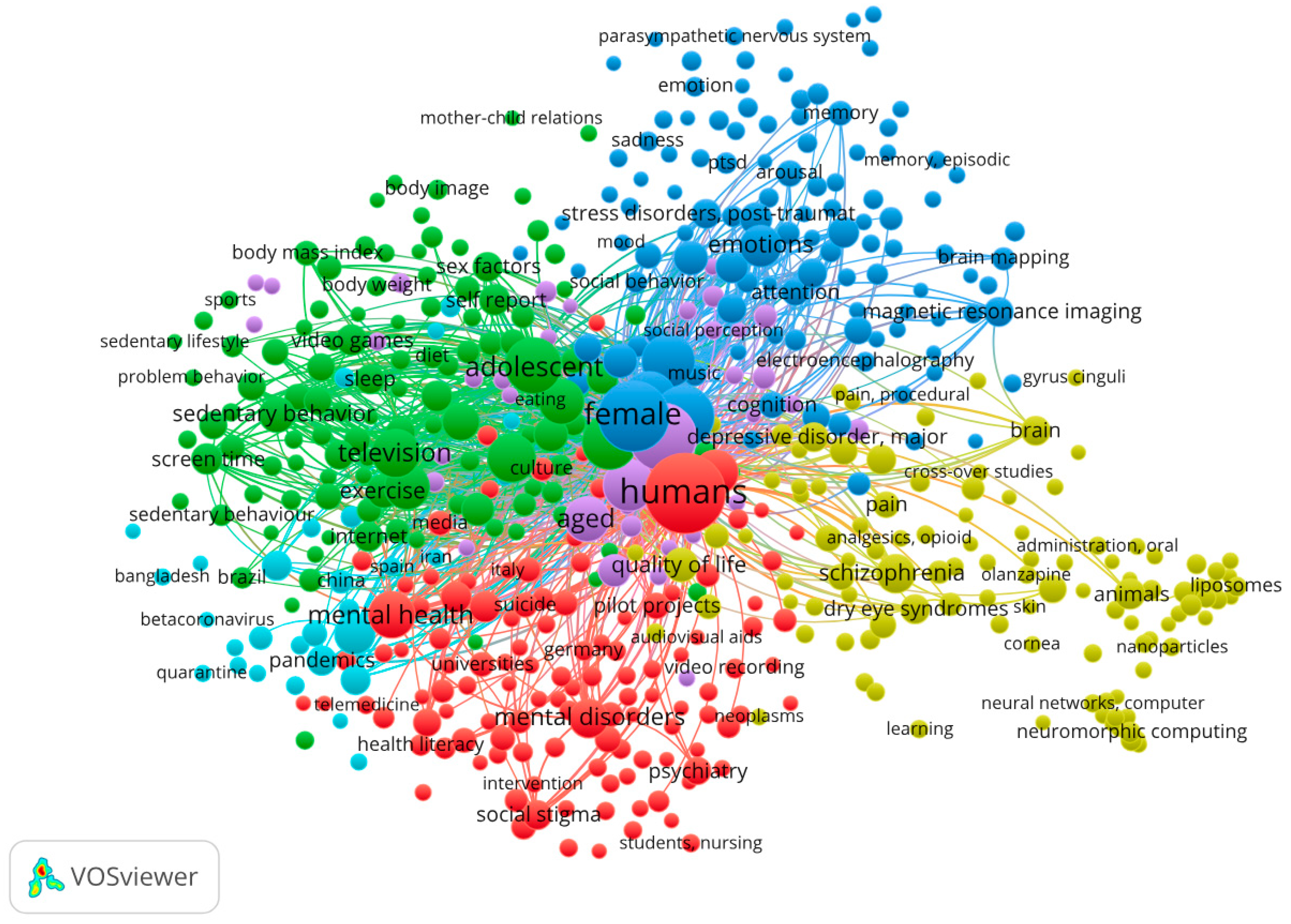
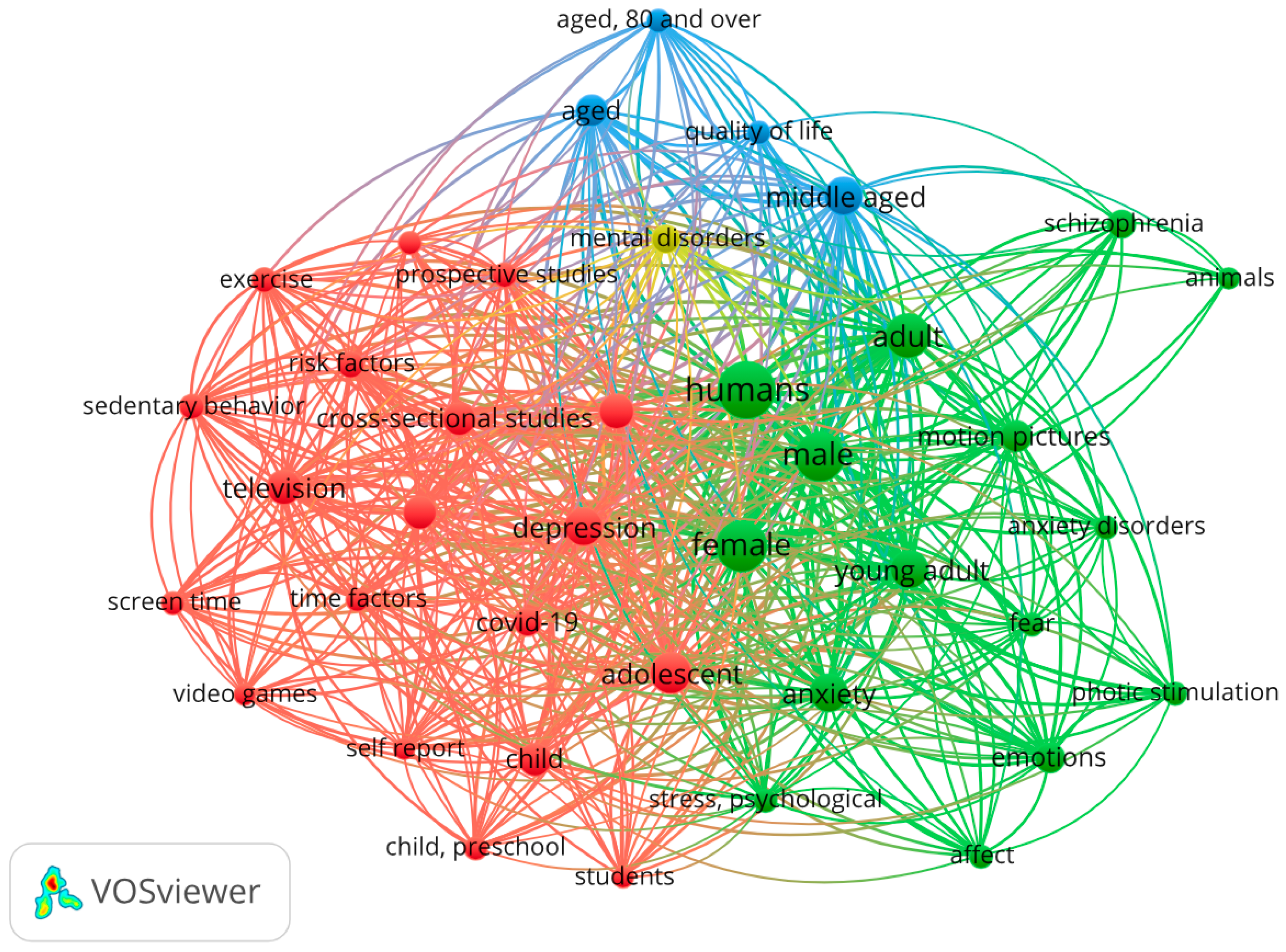
Two co-occurrence maps were constructed using VOSviewer: a broader map (≥5 occurrences,
Figure 1), capturing lexical diversity; and a condensed map (≥50 occurrences,
Figure 2), highlighting dominant conceptual cores. The comparison between these thresholds shows a clear pattern: as frequency increases, lexical diversity decreases and a more standardized biomedical vocabulary becomes dominant (e.g., humans, female, mental disorders, depression, television).
Across the corpus, six clusters were identified, comprising four major clusters (neuro-affective, educational stigma, media–behavioral, neuropharmacological–technological) and two minor clusters (perceptual–emotional and pandemic-related). These clusters do not function as isolated domains, but as interconnected semantic fields structuring how the medical literature relates mental health to screen media.
4.2. Cluster 1 (Blue)—Neuro-Affective (Biological Mapping of Emotion)
What it contains: This cluster groups terms related to emotion, cognition and neurophysiology, including emotions, memory, cognition, depressive disorder and PTSD, alongside technological terms such as MRI, EEG and brain mapping. The frequent presence of female and young adult indicates the dominant experimental subject profile.
What it shows: The cluster reflects a strong tendency to translate emotional experience into measurable biological processes. Emotion appears as a physiological signal that can be observed, quantified and correlated with neural activity. This aligns with a “medical gaze” perspective, in which affect becomes visible primarily through technological mediation. At the same time, the dominance of demographic markers such as female suggests a standardized model of the subject, rather than a differentiated one.
Key terms: female, young adult, emotions, cognition, memory, depressive disorder, PTSD, MRI, EEG, and brain mapping.
What is missing: Notably absent are terms related to cultural or narrative dimensions of emotion, such as representation, film, story or experience. Similarly, while biological sex is present, concepts such as gender, identity, or social context are absent. This suggests a reduction of emotion to physiology, without integration into broader frameworks of meaning or lived experience.
4.3. Cluster 2 (Red)—Educational Stigma (Medical Pedagogy and Social Perception)
What it contains: This cluster centers on terms such as education, psychiatry, mental disorders, health literacy, social stigma, students, patients and intervention. It also includes references to audiovisual tools (video recording, audiovisual aids, drama), indicating the use of media in medical training.
What it shows: The cluster reflects an educational and communicative dimension of medical discourse, where mental health is framed in terms of teaching, awareness and stigma reduction. It suggests that film and media are primarily used instrumentally—as tools for conveying information or shaping attitudes—rather than as objects of critical or cultural analysis. The presence of health literacy indicates an attempt to translate clinical knowledge into public understanding, but this remains largely cognitive and prescriptive.
Key terms: education, psychiatry, mental disorders, health literacy, social stigma, students, patients, intervention, and media.
What is missing: Despite its focus on communication and stigma, this cluster shows a limited presence of concepts such as empathy, representation, visual culture or ethics. Film appears as a pedagogical resource, but not as a site of meaning-making. This indicates a gap between educational practice and critical engagement with how mental health is represented in visual media.
4.4. Cluster 3 (Green)—Media–Behavioral (Screen Exposure and Everyday Life)
What it contains: This cluster includes terms related to digital media and behavior, such as television, internet, screen time, video games, social media, sedentary behavior, exercise, sleep deprivation and body image. It is strongly associated with adolescents and lifestyle variables.
What it shows: The cluster positions media primarily as a risk factor influencing mental health through behavioral exposure. Screen use is associated with physical and psychological outcomes, such as inactivity, sleep disruption and body dissatisfaction. This reflects an epidemiological approach, in which media are analyzed in terms of measurable effects rather than symbolic content. The focus is on what media do to individuals, not on how individuals interpret or engage with media.
Key terms: television, internet, screen time, social media, adolescent behavior, sedentary behavior, body image, and sleep deprivation.
What is missing: Concepts such as narrative, representation, agency or meaning are largely absent. Users are treated as passive recipients of media influence, rather than active interpreters. In addition, social differentiation (e.g., gender, race, class) is weakly represented, suggesting a generalized model of the media user that overlooks structural differences in experience.
4.5. Cluster 4 (Yellow)—Neuropharmacological–Technological (Experimental and Computational Models)
What it contains: This cluster brings together clinical, pharmacological and technological terms, including brain, pain, bipolar disorder, quality of life, olanzapine, aripiprazole, nanoparticles, neural networks and neuromorphic computing. It also includes references to experimental models (animals, rats).
What it shows: The cluster represents the most material and experimental dimension of medical discourse, where mental health is studied through pharmacology, biological substrates and computational simulation. It reflects a shift from observing emotion to modeling and manipulating it. The presence of terms related to artificial intelligence and computation suggests an emerging convergence between biological and digital models of the mind.
Key terms: brain, pain, bipolar disorder, quality of life, pharmacology, neural networks, nanoparticles, and animals.
What is missing: There is a complete absence of cultural, narrative or representational concepts. Mental suffering is treated as a biological or technical problem, detached from social context or subjective experience. Even quality of life appears primarily as an outcome variable rather than as a lived condition. This marks a strong epistemological distance from the humanistic dimensions of mental health.
4.6. Cluster 5 (Purple)—Perceptual–Emotional (Visual Recognition of Affect)
What it contains: This smaller cluster includes terms such as facial expression, emotion recognition, visual perception, attention, arousal, fear, happiness and empathy, often linked to experimental studies on perception and cognition.
What it shows: The cluster focuses on how emotions are detected and processed visually, especially through facial cues and attention mechanisms. Emotion is treated as a signal that can be recognized, classified and measured. Although empathy appears, it is peripheral, suggesting that it is conceptualized as a cognitive process rather than a relational or ethical one.
Key terms: facial expression, emotion recognition, visual perception, attention, arousal, and empathy.
What is missing: The absence of terms such as context, narrative, culture or representation indicates that emotional perception is studied in isolation from meaning. Visuality is reduced to perception rather than interpretation, reinforcing a gap between seeing and understanding.
4.7. Cluster 6—Pandemic-Related (Media and Collective Anxiety)
What it contains: This minor cluster includes terms such as pandemics, quarantine, social media, anxiety, stress and knowledge, reflecting research on mental health during COVID-19.
What it shows: The cluster illustrates the convergence of medical, social and media discourse during a global crisis. Social media emerge as key channels for information and emotional circulation, while mental health is framed in terms of collective stress and uncertainty. The emphasis is on epidemiological patterns and communication, rather than on representation or narrative.
Key terms: pandemics, quarantine, social media, anxiety, stress, and knowledge.
What is missing: Despite the centrality of images and media during the pandemic, terms related to visual culture, representation or narrative are largely absent. This suggests that even in contexts where media visibility is high, medical discourse remains primarily descriptive and informational, rather than interpretive.
4.8. Summary of Patterns
Across all clusters, a consistent pattern emerges: medical discourse tends to prioritize measurable, observable and standardized aspects of mental health, while underrepresenting cultural, narrative and intersectional dimensions. The dominance of biomedical and behavioral language coexists with a relative absence of terms related to representation, identity and meaning. These patterns do not indicate a total absence of such concerns in the broader field but rather reduced visibility within PubMed-indexed metadata, which has important implications for how mental health is conceptualized at the intersection of medicine and screen media.
4.9. Co-Occurrence Maps and Threshold Comparison
The bibliometric analysis is based on two co-occurrence maps generated with different frequency thresholds. The first map (≥5 occurrences,
Figure 1) captures the broader lexical field of the corpus, including central and peripheral terms. The second map (≥50 occurrences,
Figure 2) isolates the most frequent and strongly connected terms, revealing the dominant semantic core of the literature.
Figure 1 and
Figure 2 present these two levels of analysis, respectively. Rather than representing two separate datasets, the maps illustrate different levels of granularity within the same corpus. The lower threshold allows for a more heterogeneous and dispersed structure, while the higher threshold produces a more compact and centralized configuration.
This comparison is analytically significant. The transition from the broader map to the condensed map reveals a reduction in lexical diversity and the consolidation of a limited number of highly recurrent biomedical and demographic terms (e.g., humans, female, mental disorders, depression, television). In other words, as the threshold increases, peripheral and context-specific vocabulary disappears, while standardized clinical language becomes dominant.
From a theoretical perspective, this shift can be interpreted as a movement from representational diversity to epistemic consolidation. The broader map reflects multiple ways of linking mental health to screen media, including educational, behavioral and perceptual approaches. The condensed map, by contrast, highlights the stabilization of a biomedical core that structures the field’s most visible discourse. This pattern suggests that while the literature contains diverse thematic directions, its dominant vocabulary remains relatively narrow and standardized.
4.10. Narrative Reading of the Corpus
In addition to the bibliometric mapping, a subset of 113 articles was examined through narrative reading to contextualize the lexical patterns identified in the co-occurrence analysis. This interpretive step does not aim to provide a systematic qualitative synthesis of the corpus but rather to identify recurrent thematic orientations that support and nuance the bibliometric findings.
Across this subset, three broad tendencies can be observed. First, a significant proportion of the literature focuses on the analysis of individual films as case studies of mental illness representation. Studies examining films such as
A Beautiful Mind emphasize the tension between subjective experience and clinical interpretation, often highlighting the narrative construction of schizophrenia and the selective visibility of symptoms (
David 2002;
Shafarini 2022). Similarly, analyses of
Joker interpret the character’s trajectory through frameworks of trauma, marginalization and social exclusion, illustrating how cinematic narratives can complicate or extend clinical categories (
Skryabin 2021). These studies align with the bibliometric clusters by showing that narrative film frequently operates at the intersection of clinical language and cultural meaning, even when this complexity is only partially reflected in the dominant lexical structures.
Second, another group of studies addresses film within educational and stigma-related contexts. Research on films such as
Silver Linings Playbook explores how cinematic representation may influence understanding of affective disorders and contribute to stigma reduction or public awareness (
Das et al. 2017). These approaches correspond to the educational stigma cluster, where film is used as a pedagogical tool, often within frameworks of mental health literacy (
Jorm et al. 1997;
Jorm 2012). However, the narrative reading suggests that while these studies acknowledge the importance of representation, they tend to prioritize informational and attitudinal outcomes over deeper interpretive engagement.
Third, a more limited set of studies engages with media environments and behavioral effects, particularly in relation to screen exposure, digital platforms, and adolescent mental health. These contributions resonate with the media–behavioral cluster, where the focus shifts from narrative meaning to measurable outcomes such as screen time, behavioral change or psychological risk. In this strand of the literature, film and media are less frequently analyzed as narrative forms and are more often treated as components of a broader media ecology.
Taken together, the narrative reading confirms the main patterns identified in the bibliometric analysis, while also highlighting a structural tension. On one hand, individual studies often engage with narrative complexity, subjectivity and cultural meaning. On the other hand, these dimensions are only partially visible in the aggregated lexical structure of the corpus. This suggests that the reduction observed in the co-occurrence maps—from diverse terminology to a condensed biomedical core—does not eliminate narrative approaches but rather limits their visibility at the level of indexed academic language.
In this sense, the narrative analysis does not contradict the bibliometric findings but complements them by showing how interpretive richness persists at the level of individual studies, even when it is not fully captured by metadata-level analysis.
Comparison between the maps obtained under low- and high-frequency thresholds does not simply reflect differences in term distribution but further reveals a structural tendency of the field: as lexical visibility increases, discursive diversity decreases and a standardized biomedical vocabulary becomes dominant. This layered mapping approach allows the study to move beyond static description and capture how epistemic hierarchies emerge within the corpus.
5. Discussion
5.1. Biomedical Dominance and Epistemic Consolidation
Comparison of the low- and high-frequency co-occurrence maps reveals a consistent structural tendency: as lexical visibility increases, discursive diversity decreases and a relatively narrow biomedical vocabulary becomes dominant. Terms such as humans, female, mental disorders, depression and television form a stable semantic core, suggesting that the most visible layer of PubMed-indexed discourse is organized around classification, diagnosis, and measurable affect, rather than cultural or narrative meaning.
This pattern can be interpreted through the lens of Foucault’s concept of the medical gaze, understood as a regime in which subjective experience is transformed into observable and standardized categories (
Foucault 1973,
1977). Within this framework, mental suffering becomes legible primarily through what can be measured, classified and reproduced. The neuro-affective and neuropharmacological–technological clusters illustrate this dynamic by privileging physiological processes and experimental models over experiential or narrative accounts.
At the same time, the transition from broader to condensed lexical maps indicates a process of epistemic consolidation. While the wider corpus contains heterogeneous approaches to mental health and screen media, the dominant vocabulary stabilizes around a biomedical core. From a representation perspective (
Hall 1980,
1997), this reflects not only meaning production but also meaning selection: certain discursive forms become central, while others remain peripheral.
Importantly, this does not imply that medical discourse ignores experiential dimensions but, instead, that these dimensions have reduced visibility at the level of indexed language. The findings suggest a structural asymmetry between the diversity of possible representations and the standardization of those that achieve prominence within medical academic discourse.
5.2. Intersectional Absence and the Limits of Visibility
A second major finding concerns the limited visibility of intersectional categories. While demographic descriptors such as female or young adult appear frequently, terms such as gender, race, class or LGBTQ+ are largely absent at the level of titles and abstracts.
From an intersectional perspective (
Crenshaw 1991), this absence is not neutral. It reflects a structural limitation in how mental health is framed, where biological differences are recognized but social differences remain underarticulated. The results do not demonstrate a complete absence of such dimensions in the full literature but rather their reduced visibility in metadata, which plays a crucial role in knowledge retrieval and dissemination.
This pattern can be further understood through co-production (
Jasanoff 2004): if knowledge and social order are produced together, then the absence of intersectional language may contribute to the reproduction of simplified models of the subject. The recurrent presence of biological markers without corresponding social frameworks suggests that difference is measured but not interpreted.
The implications are significant. First, limited intersectional visibility may constrain the capacity of medical discourse to engage with lived experience, particularly in relation to inequality and structural vulnerability. Second, it suggests that what is not named risks remaining analytically and pedagogically marginal. The findings therefore point to a partial visibility of mental health within the PubMed-indexed literature, shaped by disciplinary and epistemic priorities.
5.3. Visuality Without Narrative: Between Perception and Meaning
A third key pattern concerns the relationship between visuality and narrative. Although visual processes are present through terms such as visual perception, facial expression, attention and screen time across multiple clusters, these terms are rarely accompanied by concepts such as representation, narrative or interpretation.
From the perspective of visual culture, this distinction is crucial. Mitchell’s concept of “image acts” emphasizes that images shape emotional and cognitive responses (
Mitchell 2005), while Mirzoeff framed visuality as an ethical field of recognition and power (
Mitchell 2005). However, the patterns observed here suggest that medical discourse tends to treat visual material as a source of stimuli or behavioral effects, rather than as a site of meaning-making.
This gap can be further interpreted through Hall’s encoding/decoding model (
Hall 1980), which highlights the role of interpretation in transforming images into meaning. The limited presence of such interpretive frameworks suggests that the analyzed discourse prioritizes what media do (effects, risks, exposure) over what they mean.
The contrast becomes clearer when considering how specific films are addressed in the literature; for instance,
A Beautiful Mind has been analyzed as a representation of schizophrenia that oscillates between subjective experience and clinical framing (
David 2002;
Shafarini 2022). Similarly,
Joker has been interpreted in relation to trauma and social marginalization, illustrating how narrative can complicate clinical categorization (
Skryabin 2021). These examples show that cinematic representation operates at the level of narrative and meaning, while medical discourse tends to translate these dimensions into diagnostic or behavioral frameworks.
The findings therefore indicate a structural gap: visuality is present but largely reduced to perception and effect, while narrative complexity remains underrepresented in the dominant lexical structure.
5.4. Educational Implications and the Role of Film
The educational dimension of the corpus suggests that film is already present within medical training, particularly in relation to stigma reduction and mental health literacy. Terms such as education, health literacy, intervention and students indicate a growing interest in how mental health knowledge is communicated.
Studies analyzing films such as
Silver Linings Playbook have shown how cinematic narratives can contribute to discussions about affective disorders and public understanding (
Das et al. 2017). These approaches align with frameworks of mental health literacy (
Jorm et al. 1997;
Jorm 2012), where audiovisual materials support recognition and attitude change.
However, the analysis also indicates that this use remains largely instrumental. Film is often treated as a vehicle for illustrating concepts rather than as a medium that enables critical reflection on representation, identity and ethics. In this context, the proposal of “empathy labs” can be reframed as a conceptual pedagogical model grounded in the findings of this study.
Rather than presenting film as an empirically validated intervention, the model can be understood as a structured approach that aligns different types of film material with distinct epistemic domains identified in the cluster analysis: neuro-affective perspectives → films foregrounding subjective experience (A Beautiful Mind); stigma and education → films addressing social perception (Silver Linings Playbook); social marginalization and trauma → narrative complexity (Joker).
In line with Bleakley’s argument that the humanities are essential for the development of empathy and critical awareness (
Bleakley 2015), such an approach moves beyond information transmission toward interpretive and relational learning.
Importantly, the need for such approaches emerges from the internal limitations of the discourse itself. The relative absence of narrative, intersectional and representational language suggests that existing frameworks may not fully capture the complexity of mental health as lived experience. Film, as a narrative medium, offers a complementary form of knowledge that can reintroduce context, ambiguity, and ethical reflection into medical education.
Taken together, the findings reveal a central tension between standardization and diversity in medical discourse on mental health and screen media. Biomedical dominance, intersectional absence and the reduction of visuality to perception all contribute to a narrowing of visible academic language, even as the broader field remains heterogeneous. At the same time, the presence of educational initiatives and film-based approaches indicates a shift toward more integrative frameworks. By combining bibliometric mapping with an integrated theoretical perspective, this study shows that medical discourse is structured not only by what it includes but also by what remains marginal. Understanding these dynamics is essential for developing more reflexive and interdisciplinary approaches at the intersection of medicine, visual culture and education, where narrative film can function not only as illustration, but as a medium for rethinking how mental health is understood, represented and taught.
6. Limitations and Contributions
6.1. Limitations
This study should be interpreted in light of several methodological and epistemological limitations, many of which are directly related to the scope and design of the analysis. First, the corpus was restricted to the PubMed-indexed literature. This choice was deliberate, as the aim of the study was to examine how medical and health-related academic discourse engages with mental health in relation to film and screen media. However, this also introduces a disciplinary bias. The findings reflect the structure of medical discourse as represented in PubMed, and do not capture the full range of perspectives developed in film studies, cultural studies, sociology or interdisciplinary humanities research. As such, the results should be understood as an analysis of medical academic language, not of the broader field of scholarship on cinema and mental health.
Second, the analysis was based on titles and abstracts, rather than full-text articles. This methodological decision allows for large-scale comparability and standardized bibliometric mapping, but also limits the depth of interpretation. The absence or marginality of certain terms—particularly those related to gender, race, class, identity or representation—should therefore be interpreted as reduced visibility at the level of metadata, rather than as definitive absence from the research itself. Some of these dimensions may be present in the body of the articles but remain underrepresented in indexed language.
Third, the corpus was predominantly composed of English-language publications and reflects, to a large extent, Global North academic production. Although this is a common feature of the PubMed-indexed literature, it introduces a geographic and cultural bias that may influence the terminology used and the themes prioritized. The reference to DSM-5 (
American Psychiatric Association 2013) as a terminological benchmark further reinforces this orientation, as it reflects a specific clinical and cultural framework that is not universally applicable.
Fourth, the study combined bibliometric mapping with interpretive analysis. While this integration allows for a richer understanding of the data, it also introduces a degree of subjectivity in the interpretation of clusters and their theoretical significance. Although the clusters were generated algorithmically through co-occurrence analysis, their labeling and conceptual interpretation were performed by the author and, therefore, were influenced by the theoretical framework adopted. Finally, the narrative reading of a subset of articles was not intended as a systematic qualitative synthesis, but as a complementary interpretive layer. Its role was to contextualize the bibliometric findings, rather than to provide exhaustive coverage of the literature.
Taken together, these limitations do not invalidate the findings but define their scope: the study identifies patterns of visibility and organization within a specific corpus and methodological framework, rather than offering a complete account of how mental health is represented in all forms of academic or cultural discourse.
6.2. Contributions
Within these limits, the study makes several contributions at the intersection of medical discourse, visual culture and education.
First, it provides a large-scale bibliometric mapping of the PubMed-indexed literature on mental health and screen media between 2010 and 2025. While previous research has focused primarily on qualitative analyses of individual films, this study identifies the broader lexical structures that organize the field, offering a complementary perspective on how medical knowledge is articulated at scale.
Second, the study contributes methodologically by combining co-occurrence analysis with an interpretive framework drawn from the Medical Humanities field, cultural studies and visual theory. By explicitly distinguishing between algorithmically generated clusters and their interpretive labeling, it clarifies the relationship between quantitative mapping and qualitative analysis, addressing a common limitation in bibliometric studies.
Third, the concept of metadata-level visibility is introduced as an analytical tool. By focusing on titles and abstracts, this study highlights how certain dimensions of mental health—particularly intersectional and narrative aspects—may be present in the literature but remain marginal in indexed language. This distinction offers a more nuanced understanding of absence and avoids overgeneralization.
Fourth, the study advances a theoretically integrated interpretation of medical discourse by linking patterns of lexical organization to concepts of representation (Hall), power and visibility (Foucault), visuality (Mitchell; Mirzoeff) and intersectionality (Crenshaw). This allows the findings to be situated within broader debates on how knowledge is produced and structured.
Fifth, the study proposes a cluster-informed conceptual model for film-based medical education. By aligning different types of cinematic material with distinct epistemic domains (neuro-affective, educational, behavioral and perceptual), it moves beyond the general use of film as a pedagogical tool and suggests a more structured approach. This model, including the notion of “empathy labs,” is presented as a theoretically grounded framework that requires further empirical validation.
Finally, the study contributes to ongoing discussions in the Medical Humanities field by highlighting the tension between standardized biomedical language and the narrative complexity of mental health representation. In this regard, it is suggested that interdisciplinary approaches—particularly those involving narrative film—may play an important role in expanding the conceptual and pedagogical horizons of medical education.
7. Conclusions
This study set out to examine how the PubMed-indexed medical literature conceptualizes the relationship between mental health and narrative film and related screen media published between 2010 and 2025. By combining bibliometric mapping with interpretive analysis, a structured set of lexical patterns that organize this field at the level of visible academic language was identified.
The findings indicate that medical discourse in this area is characterized by a dual dynamic. On one hand, the broader lexical field reveals a heterogeneous set of connections linking mental health to emotion, education, media environments and perceptual processes; on the other hand, as term frequency increases, this diversity contracts into a more standardized biomedical core centered on classification, diagnosis and measurable affect. This shift suggests that while multiple approaches coexist within the literature, the most visible layer of indexed discourse remains relatively narrow and stabilized.
A second key finding concerns the uneven visibility of social and cultural dimensions. Although demographic descriptors are present, intersectional categories such as gender, race or identity are only weakly represented at the level of titles and abstracts. This does not imply their absence from the literature as a whole but indicates a limited presence within the metadata that structures academic retrieval and circulation. In this sense, the study highlights a distinction between what is researched and what becomes visible in indexed language.
The analysis also points to a gap between visuality and narrative. While visual processes and media exposure are well-represented, the narrative and interpretive dimensions of film are less visible in the dominant lexical structure. This suggests that cinematic representations of mental health are often translated into biomedical or behavioral frameworks, with reduced attention to their symbolic and experiential complexity.
At the same time, the presence of educational and media-related clusters indicates an ongoing effort to integrate film into medical discourse, particularly in relation to stigma reduction and mental health literacy. Building on these findings, this study proposes a cluster-informed conceptual framework for film-based medical education, in which different types of cinematic material can support complementary forms of learning. This proposal, including the notion of “empathy labs,” is presented as a theoretically grounded direction that requires further empirical exploration.
Overall, the key contribution of the study lies in demonstrating that medical academic language functions not only as a vehicle of knowledge but also as a site of selection and visibility. By making these patterns explicit, the analysis suggests that interdisciplinary approaches—especially those engaging with narrative film—may help to expand the ways in which mental health is conceptualized, represented and taught, while remaining attentive to the limits imposed by disciplinary frameworks and indexing practices.