1. Memes—New Stories, Old Thoughts, Recycled Templates
Contemporary digital communication has changed how narratives are created and shared, pushing them toward short, multimodal formats that explain situations through compression rather than detail. Memes are one of the clearest examples of this shift. They bring together image, text, and familiar cultural references, giving users a quick way to comment on everyday life without needing an elaborate structure. While their circulation, remixing and humour have been widely analysed in digital media studies, their narrative role remains insufficiently explored, especially when it comes to how they shape cultural scripts or emotional reactions in particular social contexts.
This gap becomes even more visible in post-communist settings, where public discourse often mixes irony, distrust and constant references to institutional failures. In such environments, memes tend to work on two levels at once: they offer commentary on ongoing issues, but they also act as a way of managing and making sense of them.
Romanian memes provide a particularly clear example: through familiar templates, abrupt contrasts and recognisable symbolic cues, they reflect collective frustrations and social tensions while also framing them in a manageable, often humorous way. Yet the narrative structures that make this possible—the roles assigned, the implicit scenarios activated, and the shortcuts that enable rapid interpretation—have not been sufficiently explored in existing research. Much of the literature focuses on political communication or humour, leaving aside the small narrative mechanisms that anchor meaning in these artefacts.
This study approaches Romanian memes as narrative units and not merely as humorous visual fragments. Using a selection of items from the RoMEMESv2 (2024) corpus, it combines narrative analysis with basic sentiment and thematic coding to identify the recurrent patterns through which memes distribute roles, evoke conflicts and signal culturally embedded evaluations. By examining how these elements interact within a compressed multimodal frame, the study aims to clarify the narrative principles that structure Romanian memetic discourse and to outline the cultural implications of these patterns.
2. Memetic Narrativity in Cultural Context
The concept of meme, originally formulated by
Dawkins (
1976) as a cultural self-replicator, has gradually expanded as digital communication environments have grown more complex. In participatory online spaces shaped by speed, visibility and continuous remixing, memes no longer function as simple imitative units. They have become multimodal artefacts that combine text, image and intertextual cues, producing compact forms of social commentary, affective positioning, and cultural evaluation. This shift has been well documented in digital media research, where scholars emphasize the hybrid and dense nature of memetic communication (
Shifman 2013,
2014;
Milner 2016).
Shifman’s proposal that memes operate as groups of related digital items linked by content, form, and stance moves the discussion toward the relational logics that sustain memetic circulation. Meaning is constructed through iteration, not through isolated artefacts. This perspective aligns with semiotic approaches that highlight layered signification and the interaction between anchorage, connotation, and contextual inference (
Cannizzaro 2016;
Wiggins 2019). Interpretation, from this perspective, depends less on the intrinsic properties of an image or caption and more on culturally embedded reading practices that stabilise or deliberately unsettle meaning.
Recent research reinforces this point through case-based analyses of how communities transform major events into stories. For instance, research on pandemic-related memes shows how users draw on familiar symbolic resources to organise uncertainty into recognisable narrative patterns, using repetition and variation to make sense of a changing public sphere (
Risi et al. 2022). Other studies approach memes from a pragmatic perspective, treating them as small discourse performances shaped by stance, irony and affect (
Bou-Franch and Yus 2025). The humorous frame often mitigates or intensifies ideological content, allowing sensitive or contentious topics to circulate in socially acceptable ways. This dual capacity explains why memes can both challenge dominant narratives and reinforce stereotypes or polarising positions (
Phillips and Milner 2017;
Laineste and Voolaid 2016).
Within this broader framework, the growing focus on narrative structures has opened a productive analytical direction.
de Saint Laurent et al. (
2021) describe memes as “partial stories” that compress recognisable narrative elements, thus hinting at their ability to evoke roles, conflicts, and implied resolutions through minimal cues.
Denisova’s (
2019) argument that memes combine entertainment, ironic distance, and ideological anchoring is consistent with narrative psychology approaches that treat storytelling as a basic mechanism of collective sense-making (
László 2008). Memes do not develop full plots but activate narrative fragments that audiences can easily complete. Their reliance on stable dramatis personae makes paradigmatic narrative models particularly useful. Consequently, this study adapts Propp’s role-based morphology as an analytical heuristic rather than a sequential template.
At the same time, computational work supports this view by showing that memes frequently attribute narrative roles such as hero, villain or victim, although these roles are difficult for models to identify when cultural references are implicit or embedded in code-mixed language (
Sharma and Chakraborty 2025). These findings emphasise the need for culturally grounded, context-sensitive approaches that can account for how narrative meaning is condensed rather than fully articulated.
Additional contributions come from research in cognitive linguistics, where memes are considered to rely on conceptual blending and viewpoint integration to link fictional frames with real-world concerns (
Ostanina-Olszewska and Majdzińska-Koczorowicz 2019). This mechanism helps explain their effectiveness during crisis moments, when the public seeks narrative coherence. In political communication studies, memes and other viral digital forms are described as tools for producing simplified political storylines that support mobilisation and shape public sentiment (
Mesario et al. 2025).
In Romanian digital culture, where irony, scepticism and historical memory frequently intersect, memes provide a useful lens for examining how communities condense experience into short-form, story-like representations that reflect ongoing social concerns. Romanian humour has already been documented as an indirect mode of expression shaped by political constraints, institutional disillusionment, and daily negotiation with authority. Irony, understatement and coded allusion have been pinpointed as key humorous devices in the communist period, reflecting an adaptation strategy that allowed critique to circulate in contexts where direct expression was ill-advised (
Glăvan 2013). In this sense, Romanian humour is traditionally less an explicit opposition and more a shared interpretative space where scarcity, absurdity, and power imbalance are acknowledged. These traits persist in post-communism, as Romanian humorous patterns distinctly rely on self-irony, ambivalence and preference for recognisable scenarios over explicit commentary (
Constantinescu et al. 2020). As
Constantinescu and Rus (
2020) note, Romanian humor has historically functioned as a form of resistance and subversion. In Romanian cultural discourse, the dynamic is often associated with the cultural trope of
haz de necaz (making fun of trouble), allowing communities to process trauma and institutional failure, thus providing a means of coping with adversity.
Furthermore,
Chefneux’s (
2020) analysis of institutional discourse highlights recurrent practices of mocking authority figures in Romanian institutional contexts, anticipating patterns comparable to the archetypes identified in our corpus. The transition from these traditional forms to the digital sphere is not a rupture but a remediation, in which the pictorial-verbal interplay analysed by
Constantinescu (
2020) in static cartoons is reconfigured within the multimodal dynamics of the internet meme.
In digital contexts, such mechanisms are reformulated, not replaced. The prominence of irony, negative affect, and recurrent narrative roles in Romanian memes can therefore be read against this broader cultural background, where humour operates as a resource for managing frustration, articulating critique and sustaining shared interpretative frameworks (
Glăvan 2013;
Constantinescu and Rus 2020).
Romanian researchers tend to approach memes less as abstract digital units and more as socially consequential forms of discourse.
Stancea et al. (
2024) treat memes as instruments of political framing in election times, exploring how humour and negativity can shape candidates into recognisable public figures. In their analysis of the 2019 presidential campaign, the authors’ focus falls upon circulation, engagement and sentiment, depicting memes as vectors of political perception. Taking this avenue a step further,
Mihăilescu (
2024) unpacks “political narratives in Romanian context”, placing emphasis on the role of creators, communities and platform logics in shaping political visibility and antagonism. This creator-focused angle helps explain why Romanian meme culture can function simultaneously as commentary, mobilisation and identity work, against the background of fragile institutional trust.
Ungureanu (
2025) shifts the perspective to crisis communication, treating pandemic-themed memes as a dual mechanism: collective coping and emotional amplification, thus arguing that humour does not simply relieve fear, but can also normalize and circulate it, by embedding anxiety in familiar and shareable templates. This approach raises broader questions of discourse ethics, which are tackled by
Sălcudean (
2020). Examining cases that generated public controversy in Romania, she explores how memes can function as instruments of exclusion or stigmatization, demonstrating that they not only encode ideological positions but also circulate them socially through the legitimizing frame of humour.
Taken together, these studies converge on the idea that Romanian memes operate as compressed narrative devices that translate political distrust, crisis experience and social tension into emotionally rich, shareable forms. This study advances existing Romanian meme research by analysing memes as condensed narrative artefacts organized around recurrent role patterns and affective scripts. By integrating narratology with corpus-based sentiment analysis in a culturally grounded framework, it offers a structured model for understanding how narrative compression operates in Romanian memetic discourse.
3. Methodology
This study uses a mixed-method design that combines qualitative narrative analysis with quantitative sentiment metrics extracted from the RoMEMESv2 corpus (
Păiș et al. 2024). The aim is to examine the narrative, symbolic, and affective structures embedded in Romanian internet memes and to do so through a procedure that remains transparent and replicable.
3.1. Corpus and Sampling
The analysis uses the RoMEMESv2 dataset (2024), a multimodal annotated collection of 983 Romanian-language memes. Each entry includes the image itself, the extracted text, and an extensive set of metadata: primary sentiment, secondary emotion, political or non-political classification, thematic clusters, and selected linguistic markers. The corpus was chosen because it offers a relatively balanced distribution of political and non-political material, and because its annotation scheme allows both qualitative reading and quantitative comparisons.
Given the focus on narrative mechanisms, a stratified purposive sampling strategy was used. Memes were selected according to four criteria reflecting the main structural and emotional distinctions in the dataset: political vs. non-political content; primary sentiment (negative, positive, neutral); secondary emotions (surprise, joy, sadness, anger); and the major thematic clusters.
A subset of 100 memes was then selected to represent the range of the corpus while allowing qualitative depth. The main criteria included:
Narrative clarity: identifiable roles, conflicts, or minimal scenarios;
Multimodal cohesion: image and text working together in a way that enables a narrative reading;
Cultural relevance: recurrent motifs in Romanian public discourse (bureaucracy, corruption, public infrastructure, etc.);
Representativeness: a proportional reflection of the corpus’s thematic distribution.
Each meme in the qualitative subsample was coded for several dimensions:
Narrative roles: hero, victim, villain, trickster, observer/resigned actor (adapted from Propp to reflect the reduced and often ironic structure of memetic storytelling);
Plot elements: conflict, trigger and forms of closure where present;
Multimodal strategies: anchorage/relay relations between text and image, as well as composition, colour and symbolic or intertextual cues;
Affective framing: alignment (or mismatch) between the corpus sentiment tags and the emotional orientation of the narrative.
The sentiment layer comes from the RoMEMESv2 authors, whose coding is documented in the original corpus description. This study relies on those annotations without recalculating sentiment. The thematic and narrative clustering, however, was developed specifically for this analysis. Because qualitative categorisation depends on interpretative clarity rather than statistical precision, consistency was ensured through iterative coding. An initial set of memes was coded twice, at two different points in time, to test category stability. Definitions were refined until labels could be applied consistently. Although statistical intercoder reliability is not applicable here, the coding scheme is transparent, stable and replicable.
3.2. Quantitative Component
The quantitative layer uses the metadata already embedded in the RoMEMESv2 corpus. No categories were altered; instead, the existing sentiment and classification tags were examined to identify patterns linking sentiment, emotional orientation, and political status to the narrative categories established in the qualitative phase.
Three procedures were applied:
Descriptive statistics: overall distribution of sentiment and emotion;
Inferential testing: chi-square tests comparing political and non-political memes;
Cross-tabulation: narrative roles (qualitative coding) paired with sentiment/emotion (corpus metadata).
The quantitative component is therefore complementary rather than predictive: it contextualises the qualitative interpretation rather than replacing it.
3.3. Analytical Framework
The study integrates findings through a narrative–semiotic framework combining narrative morphology, multimodal discourse analysis and digital culture theory. This approach allows movement between broad corpus trends and the local, often playful details of individual memes.
The analysis remains constrained by the available metadata: meme popularity, authorship, circulation dynamics and temporal variation are not included in the corpus, and the qualitative sample represents only part of the dataset. The focus on Romanian-language memes limits comparative scope. Even so, the stratified sampling strategy and transparent coding procedure ensure methodological soundness within these parameters.
4. Sentiment and Political Orientation
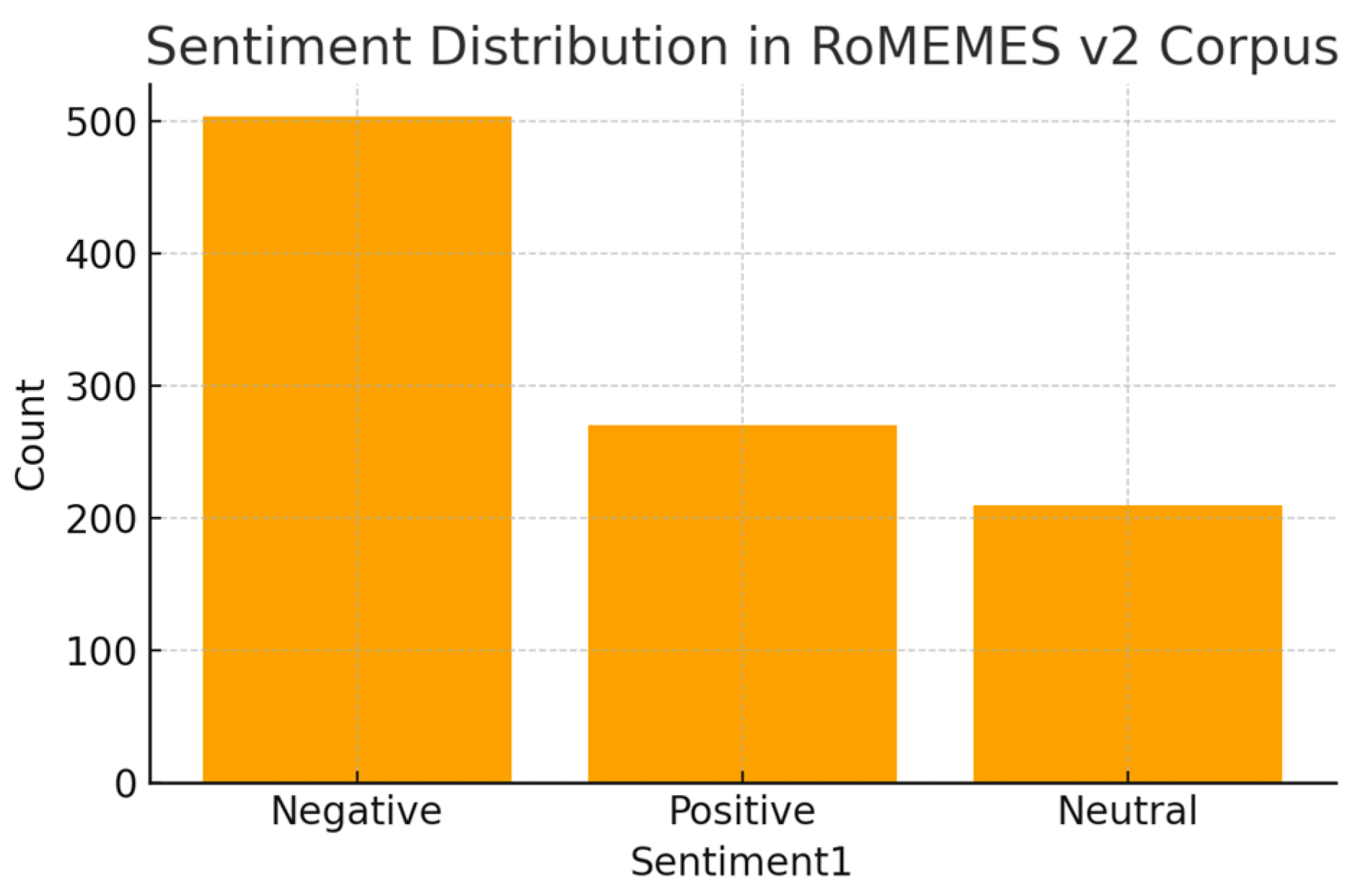
The quantitative layer of the RoMEMESv2 corpus sketches a fairly telling image of the emotional climate circulating through Romanian digital discourse. The dataset categorises primary sentiment into three broad groups: negative, positive and neutral, which serve as the first indicator of how memes frame everyday experience. The results point to a pronounced dominance of negative sentiment, well over half of all memes, suggesting that dissatisfaction, irony or frustration remain the most common affective registers online. Positive sentiment forms the second-largest group, while neutral items occupy a noticeably smaller space in the corpus, almost as if emotional detachment is the least favoured option in the memetic ecosystem.
Figure 1 below illustrates this distribution.
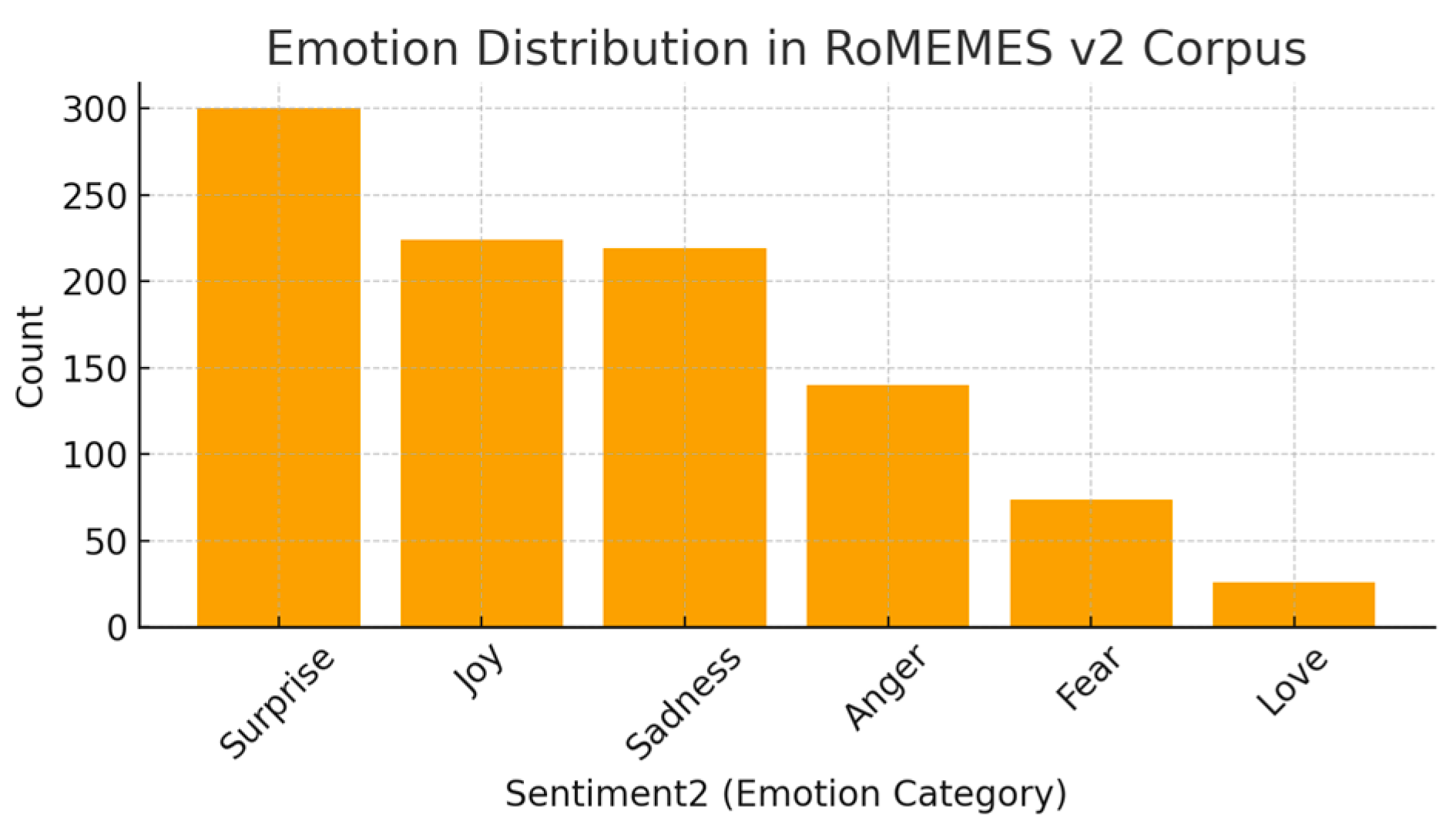
The secondary emotion categories add another layer of nuance to this landscape (
Figure 2). “Surprise” stands out as the most frequent label, a pattern that reinforces how much Romanian memetic communication relies on incongruity, exaggeration, and the quiet work of irony to generate meaning. Joy and sadness appear in roughly similar proportions, reflecting the double movement of Romanian humour: on the one hand, the impulse to defuse tension, and on the other, a kind of acknowledgment of collective fatigue. Anger and fear, although less prominent overall, cluster more visibly around political or socio-economic material, where emotional stakes are higher. Love is the rarest category in the dataset, which is hardly surprising given the corpus’s clear preference for critique, irony, and cultural commentary over sentimental expression.
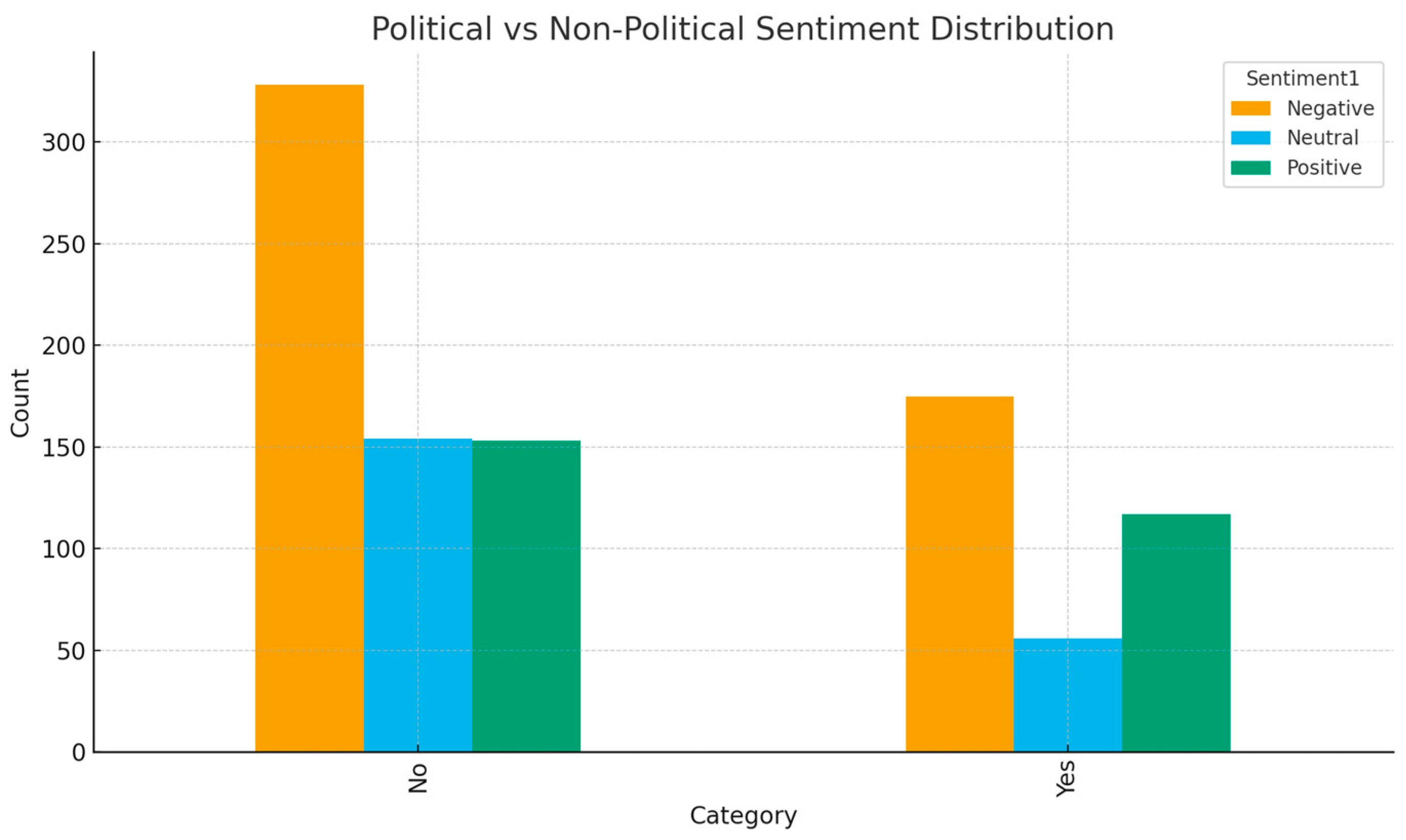
To explore how sentiment interacts with political content, the corpus’s political/non-political classification was treated as a grouping variable. A chi-square test confirms a statistically significant difference in sentiment distribution between the two categories (χ2 = 14.52, p < 0.001). Political memes display a more polarised emotional profile, with elevated proportions of both negative and positive sentiment. The negative items typically revolve around familiar topics: corruption, ineffective governance, economic frustration or chronic failures in public services. Positive political memes appear less frequently, but, when they do, they often refer to moments of shared relief, electoral humour or the ironic celebration of political events.
Non-political memes, by contrast, reveal a more balanced emotional repertoire, including a neutral sentiment and subtler shades of affect. These items are based upon everyday experiences: interpersonal dynamics, cultural routines, rural–urban contrasts, and the small absurdities of daily life. Their emotional tone leans less on indignation and more on observational humour or quiet relatability, producing a softer and more varied affective palette. The sentiment distribution is best described by
Figure 3.
Most computational studies approach meme sentiment as a classification task rather than a cultural object worth interpreting. Work based on the English-language Memotion dataset (
Velmala et al. 2025) consistently reports a predominantly positive meme environment, with roughly 60% of items labelled as positive. Negative sentiment is usually treated as a class imbalance problem, something to be corrected through resampling rather than understood. In such studies, sentiment is reduced to a handful of discrete tags and evaluated exclusively through accuracy or F1 scores, as if the emotional texture of the memes were an incidental technical detail.
The Romanian RoMEMESv2 corpus, however, shifts the picture quite a bit. Here, negative sentiment is dominant, especially in political memes, where irony and sarcasm are the default way of speaking about anything remotely public. Neutral sentiment barely exists, and when it does appear, it usually reads like mild sarcasm rather than actual neutrality. In this context, negativity stops functioning as a simple emotional label and becomes an interpretive clue in itself. It mirrors a very familiar post-communist atmosphere: the scepticism that never goes away, the ongoing institutional exhaustion, and the habit of using humour not as entertainment, but as a survival tactic.
The Indonesian study by
Asmawati et al. (
2025) comes somewhat closer to the Romanian case, reporting 47.7% negative sentiment, yet sentiment is treated there almost entirely as a computational extraction task, relying heavily on facial key points for images and language models for text, with no attention to cultural framing. Across these studies, multimodality tends to be understood as feature fusion, a technical merge of inputs. By contrast, this study examines sentiment as something woven into the narrative architecture itself, shaping how Romanian memes encode affective scripts linked to identity, politics and the recurring absurdities of everyday life. In this sense, negativity is not noise in the system—it is the story being told.
Taken together, these quantitative findings show that sentiment is unevenly distributed across memes. Political memes are more emotionally polarised and reflect the heightened affective stakes of political discourse. Non-political memes display greater emotional variety, while still retaining the ironic, sceptical tone that characterises much of Romanian online culture. Such tendencies provide the basis for the narrative and symbolic analysis developed in the following section.
5. Semiotics and Multimodal Patterns
Understanding Romanian memes means looking closely at how they weave together multiple modes to produce compact, culturally rich narratives. In
Barthes’ (
1977) terms, memes move back and forth between anchorage, where the text pins down or limits the image’s possible meanings, and relay, where text and image work together to push a small story forward. The corpus repeatedly plays on this tension. Images showing infrastructural decay, dreary bureaucratic interiors or familiar everyday irritations are often matched with celebratory or patriotic captions, creating a sharp ironic contrast. This dissonance becomes one of the most recognisable narrative strategies in Romanian memetic communication.
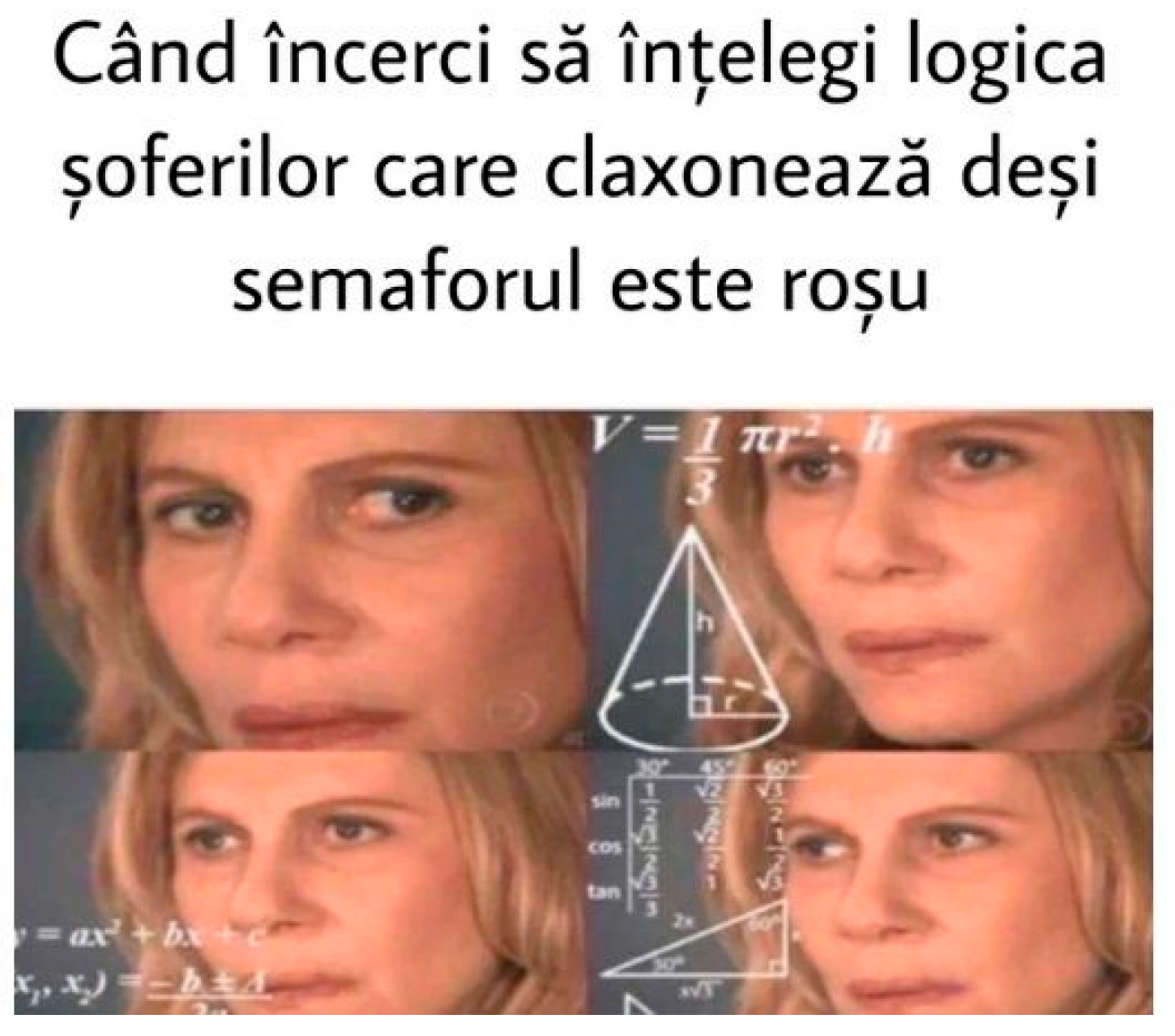
As an example, anchorage operates through the caption, which fixes the interpretative frame before the viewer even processes the image. The text names the scenario directly, the absurd logic of drivers honking at a red light and pushes the image into the realm of social commentary rather than pure confusion. Relay, however, does most of the narrative work. The series of mathematical formulas layered over the woman’s bewildered expression (see
Figure 4) collaborates with the caption to build a micro-story of cognitive overload. Together, the two modes create a compact narrative of frustration and incredulity, typical of Romanian memetic irony, where irritation triggered by mundane events is elevated to theatrical overthinking, and humour emerges precisely from the mismatch between the trivial situation and the exaggerated cognitive effort.
From a multimodal point of view, Romanian memes function as strikingly economical meaning-generation units. Drawing on
Kress and van Leeuwen’s (
2006) framework, the corpus shows how elements such as colour, composition, texture and even the smallest typographic choices work together to sharpen the intended commentary and push the viewer toward a particular reading. For instance, bureaucratic interiors often appear in muted colours: washed-out greys and tired beiges, visually echoing the emotional exhaustion associated with such spaces. Fonts that imitate official correspondence lend even the most absurd captions institutional weight. Stacks of folders, stamped papers, and overworked clerks constitute an imagery that operates as an immediate narrative shorthand, signalling not only the setting but the general mood of resignation.
These multimodal choices draw on imagery that is already familiar within Romanian cultural memory. Certain figures recur because they have become stable reference points: the overworked clerk surrounded by papers, the elderly woman shaped by years of scarcity, the rural peasant associated with resilience, or the schoolchild linked to rehearsals of national identity. In the memes, these figures do not operate as individual characters but as recognisable cultural types. They anchor interpretation by signalling broader narratives of endurance, routine hardship or identity formation that Romanian audiences immediately understand.
In the meme from
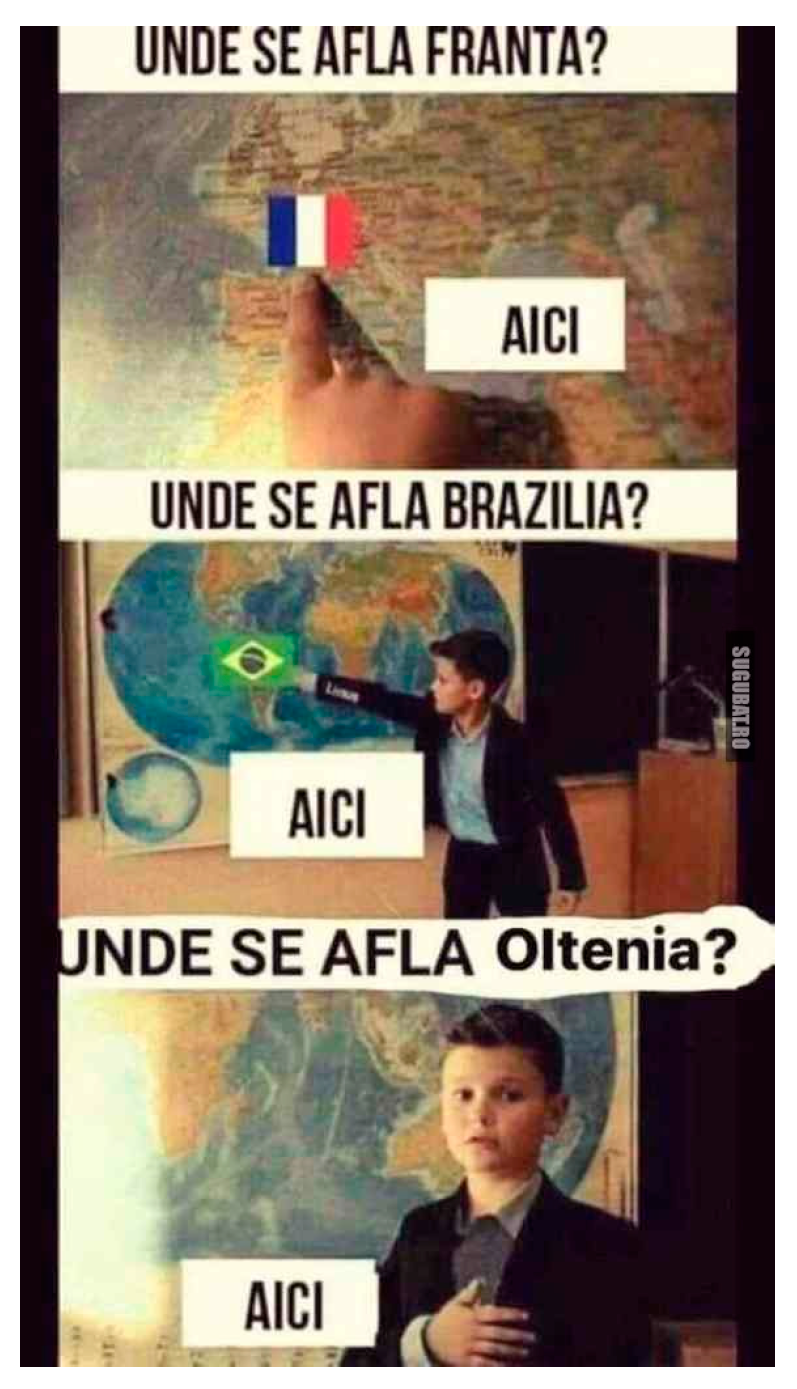
Figure 5, the interplay between text and image leans heavily on the symbolic force of the schoolchild figure. The first two frames follow a predictable didactic routine: national geography as a simple pointing exercise, a child marking France and Brazil with the expected performative confidence. The final frame abruptly shifts into another register. When asked where Oltenia is, the child places a hand over his chest instead of pointing at the map. The gesture transforms him from a mere pupil completing a school assignment into a symbol of pride related to regional identity.
Crucially, memes thrive on layered intertextuality.
Wiggins (
2019, p. 35) argues that intertextuality in memes should not be reduced to isolated pop-culture references but understood as an inherent condition of all texts. Since works like
Star Wars are themselves built from mythic templates, genre conventions, and prior cultural materials, every meme in the corpus operates as an intertext by default. From this perspective, the Romanian memes in the dataset do not merely
use intertextual cues; they are embedded in continuous cycles of citation, parody and cultural recycling that shape their narrative and symbolic meaning, as in
Figure 6.
To show how intertextuality works in practice, the meme above relies on a double reference. Visually, it uses the well-known image of George Costanza from Seinfeld, a character already associated with constant irritation, social awkwardness, and general discomfort. This familiar persona shapes the emotional frame of the meme: the oversized winter jacket is not just clothing but a sign of exaggerated, almost defensive preparedness. The caption then brings this global reference into a Romanian everyday context, where Costanza becomes an ordinary Bucharest resident dealing with cold apartments and unreliable winter infrastructure. The humour comes from the link between the two layers: a global pop-culture figure and a very local seasonal reality. In this combination, Costanza’s neurotic self-protection blends with Romanian winter habits, creating a small, culturally recognisable narrative.
Through their compact but carefully assembled combination of image, text, colour, composition and reference, Romanian memes in this corpus can be described as functioning in ways analogous to digital folklore. The term is not used to imply a direct continuity with traditional folklore genres, nor to suggest that their narrative structures are inherently folkloric. Instead, it refers to a shared mode of production and circulation. Like folklore, these memes are vernacular, created and disseminated by ordinary users rather than institutional actors. They are polyphonic, lacking a single, stable authorial voice, and they are defined by variation, existing only through repetition and modification rather than as fixed originals. From this perspective, the relevance of folklore lies not in genre or function, but in process: the memes in the RoMEMESv2 corpus preserve relatively stable narrative roles while continuously adapting their content to immediate social and political circumstances. In doing so, they integrate social critique, cultural memory and everyday emotional experience into a multimodal form that is collectively recognisable and easily circulated.
6. Narrative Roles in Romanian Memes
The narrative dimension of Romanian memes becomes clearer when we stop looking for full stories and instead examine the reduced traces of narrative structure that remain. Propp’s roles or Campbell’s heroic sequence do not appear in their complete form, but elements of them persist in simplified ways. Even in very compressed digital formats, we still encounter protagonists, antagonists, conflicts and outcomes, although these are reduced to what can fit within the limits of a meme. The medium does not allow for extended narrative development, so what remains are minimal narrative cues rather than full arcs.
Romanian memes follow this logic consistently. Rather than building quests or transformations, they present short scenes of everyday endurance: the citizen dealing with bureaucracy, the driver navigating infrastructural problems, the employee moving through a predictable and tiring workweek. The antagonist is rarely personalised; it is usually a structural or environmental factor such as institutional inefficiency, weather, economic pressure or the familiar experience of waiting. Outcomes tend to be modest. Instead of resolution, the emphasis falls on coping, small adjustments or ironic acceptance. Humour functions as the main way of managing these situations, offering a form of closure that is not transformative but recognisable.
What results is not a lack of narrative, but a form of narrative compression. Romanian memes condense widely shared cultural scripts into very brief, immediately recognisable formats. They rely on stable roles and situations rather than full progression, producing fragments that resonate because they mirror familiar patterns: the protagonist who rarely succeeds, the systemic challenge that persists, and situations that repeat with little change. These elements give the corpus coherence even in the absence of extended storytelling.
6.1. Narrative Roles as Cultural Archetypes
Across the RoMEMESv2 corpus, several recurring narrative roles can be identified, adapted from Propp’s functional categories and transposed into ironic or culturally contextualized equivalents. These roles form the basic building blocks of memetic storytelling, providing narrative coherence even in single-frame formats.
Before turning to the analysis of narrative roles, a clarification regarding the use of Propp’s framework is necessary. This study does not approach memes as complete narrative sequences comparable to folktales, nor does it apply Propp’s morphology in its original, linear form. Rather, it draws selectively on Propp’s typology of dramatis personae as a paradigmatic analytical tool suited to the compressed and multimodal nature of memetic discourse. Although memes lack extended plot development, they frequently rely on the immediate recognisability of roles such as hero, villain or donor to stabilise meaning and orient interpretation. In this sense, Propp’s categories are employed not as rigid templates, but as flexible descriptors of recurring narrative functions that allow brief, single-frame artefacts to be read in narrative terms. Within this framework, the selective adaptation of Propp’s taxonomy—however unexpected in the context of digital media—helps illuminate the underlying structural logics of memetic storytelling.
The roles highlighted in
Table 1 appear not as developed character arcs, but as symbolic functions that reflect familiar cultural expectations. The villain, in particular, is rarely personalised or dramatic. In Romanian memes, this role is usually institutional rather than individual: the inattentive clerk, the office worker surrounded by papers but doing little, or the political actor portrayed through predictable stereotypes of incompetence or self-interest. Unlike the folktale antagonist, the meme-villain is neither exceptional nor threatening. He represents ordinary, routine forms of systemic neglect.
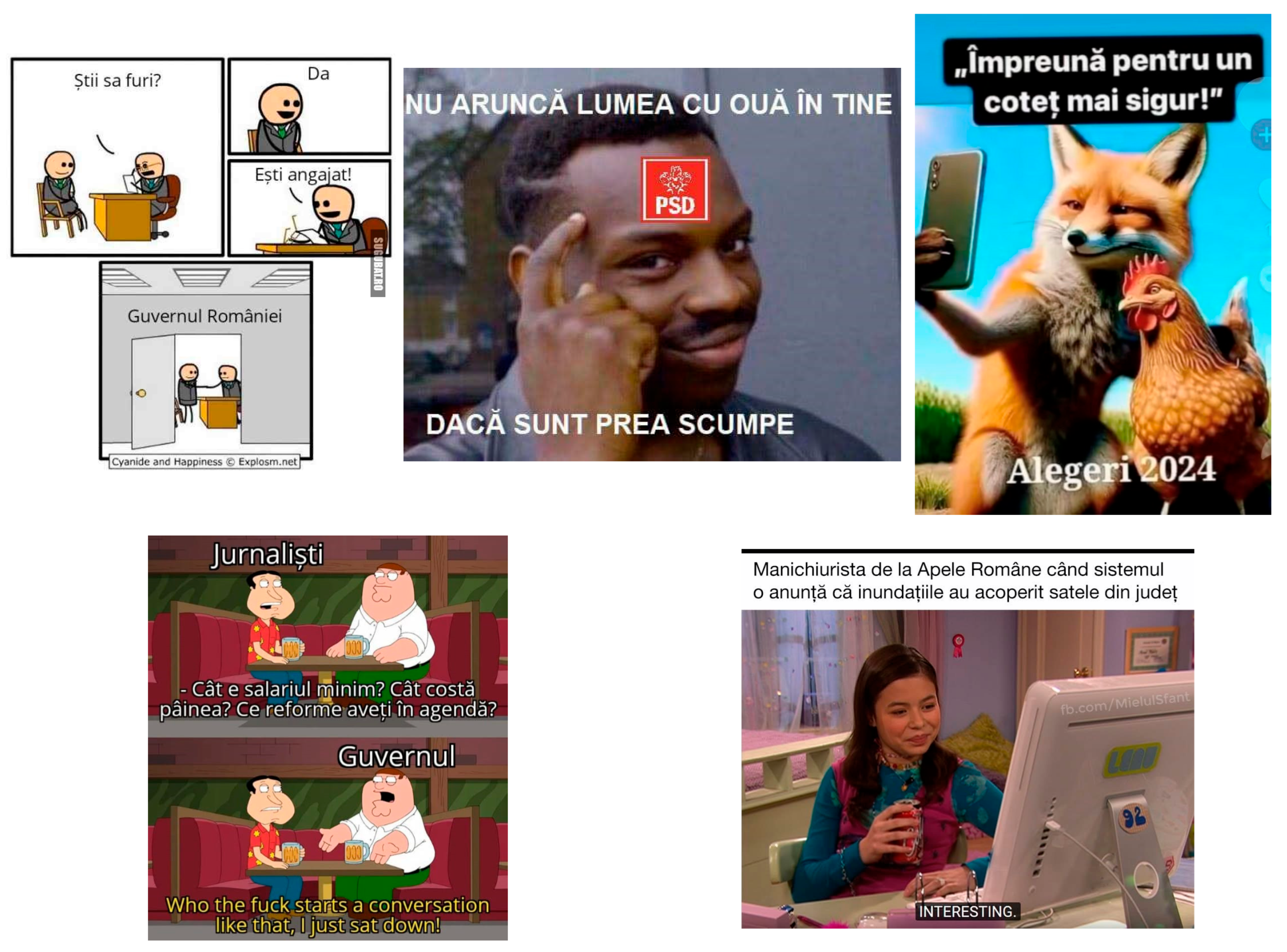
Several examples illustrate this pattern clearly. One meme stages a job interview in a public institution where the only “qualification” implied is the ability to engage in corrupt practices. The concluding line, “Ești angajat!”, reduces the scene to a familiar ironic commentary: corruption is treated not as a hidden behaviour but as an expected part of institutional functioning. Another meme adapts the fox-and-chicken template, showing a fox taking a campaign selfie while holding a frightened hen and promising “a safer coop.” The image relies on a simple but effective visual analogy for election cycles in which accountability and opportunism are difficult to distinguish.
Other items in the corpus follow the same logic of understated critique. A meme using the “forehead thinker” template places the PSD logo on the character’s face with the caption: “People won’t throw eggs at you if they’re too expensive.” The humour comes from framing political cynicism as a form of calculated reasoning, while also acknowledging public fatigue. Another example features Peter Griffin, re-labelled as “Guvernul,” responding irritably to questions about wages or reforms: “Who the fuck starts a conversation like that, I just sat down!” The scene portrays a government that reacts with avoidance rather than engagement. A similar tone appears in a meme showing a ministry employee casually reading about severe floods while drinking soda. The neutral caption, “Interesant,” highlights indifference as a form of institutional failure rather than intentional harm.
Across these examples (
Figure 7), the villain role remains consistent: it is not a figure of dramatic opposition, but a representation of everyday dysfunction. The memes simplify this role into recognisable images of institutional passivity, inefficiency or self-interest, allowing viewers to interpret the critique immediately and without additional explanation.
In contrast to the villain, the hero in Romanian memes rarely resembles the classical version of the role. The heroic figure usually appears in a reduced or altered form: uncertain, unprepared, ironic or simply passive. This aligns with broader discussions of the contemporary or postmodern hero, whose capacity for transformation is limited and trajectory tends to repeat rather than progress. Romanian digital storytelling maintains this lowered register. Qualities traditionally associated with heroism—authority, decisiveness or masculine confidence—are quickly undercut by humour or by everyday constraints. The resulting figure is not a restorer of order but an accidental participant in small, situational dramas.
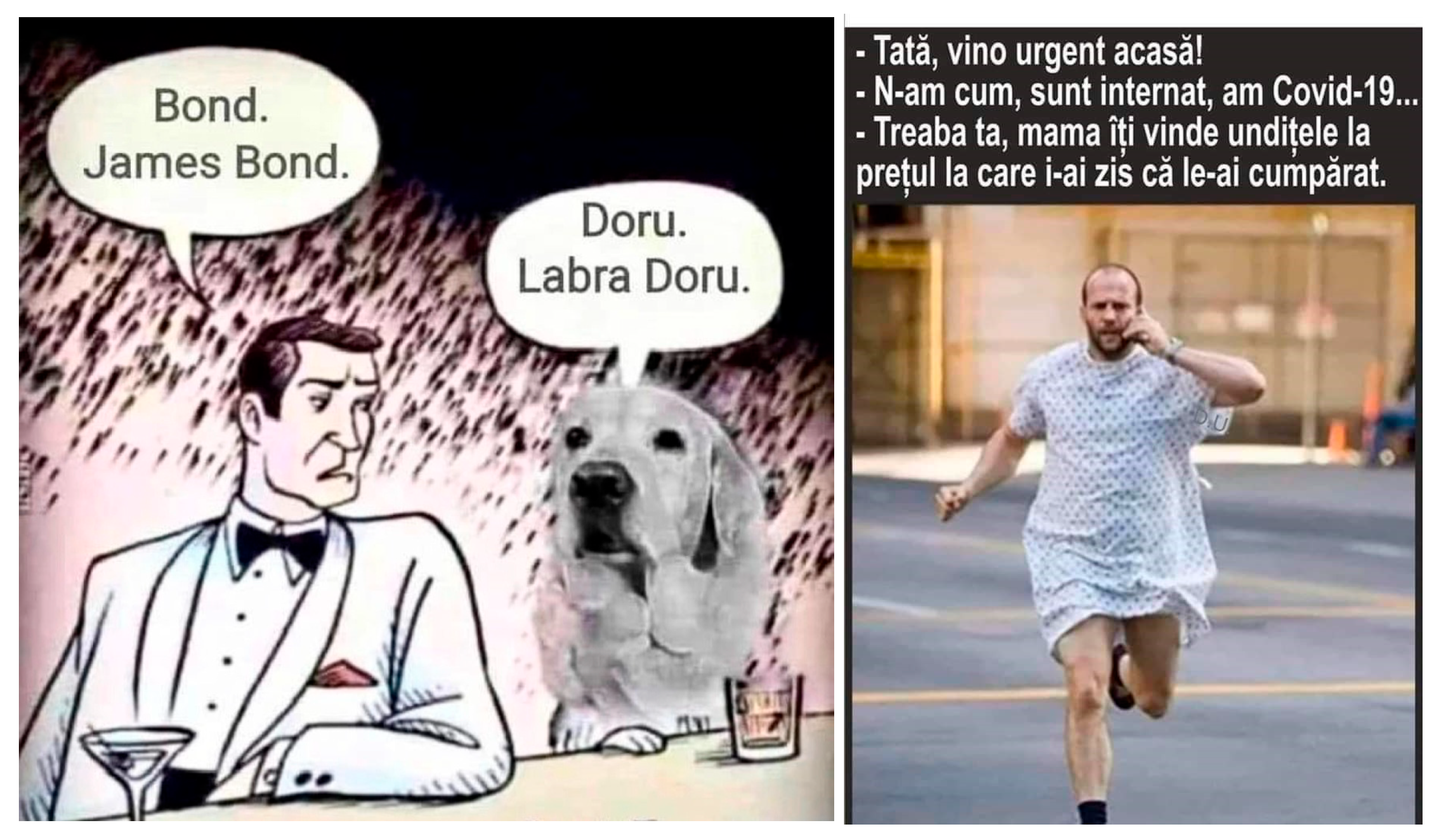
Much of the humour comes from the mismatch between the framing and the actual stakes. In one meme that parodies James Bond, the confident spy figure is interrupted not by danger but by a dog introducing itself as “Doru. Labra Doru,” reducing the heroic pose to a simple wordplay. A similar mechanism appears in a meme where Jason Statham flees a hospital room after learning that his wife plans to sell his fishing rods for the price he claimed to have paid. His exaggerated reaction plays on a familiar domestic scenario, turning a minor deception into a brief, humorous episode of misplaced urgency. In both cases (
Figure 8), the heroic role is reinterpreted as an everyday response rather than an exceptional one, reinforcing the idea that Romanian memes rely on small, recognisable situations rather than grand narrative arcs.
One of the most frequent roles in the corpus is the victim, positioned within the familiar landscape of institutional inefficiency or everyday absurdity. This figure is usually an ordinary citizen who appears tired, sceptical or ironically self-aware. Their status as a victim does not stem from personal failure but from the limitations of the system around them. Their reactions range from mild resignation to visible frustration, almost always expressed through dark humour or understated irony.
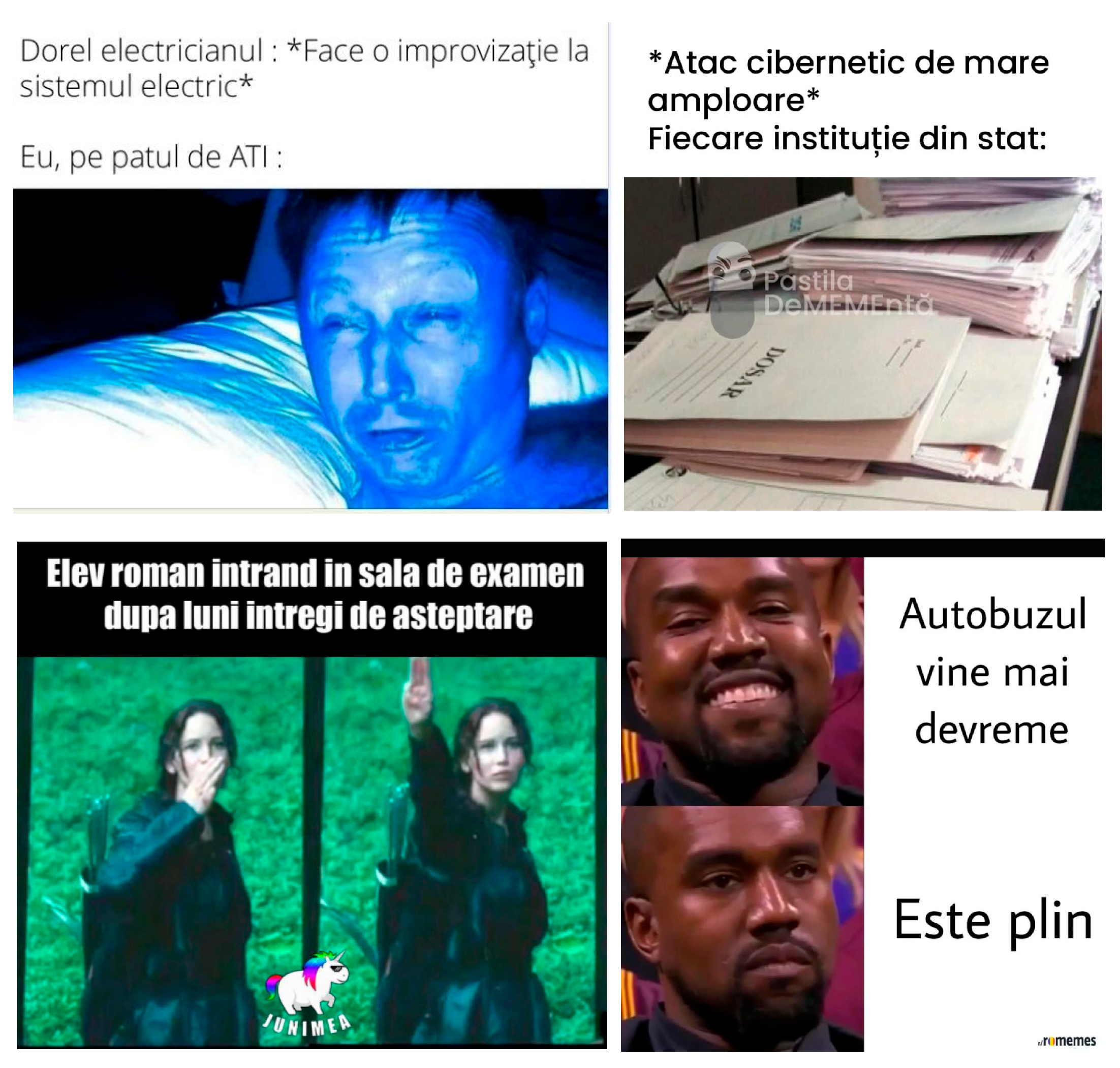
Several examples illustrate this pattern. One meme uses the recurring figure of Dorel, the well-known symbol of the unskilled worker, to comment on hospital malfunctions and the individual’s lack of control in the face of structural problems. Another item highlights the persistence of bureaucratic habits in the digital age: while other institutions worry about cyberattacks, Romania remains “protected” by the paper file, which functions as a long-standing emblem of inefficiency. The difficulties faced by students waiting for their baccalaureate scheduling are depicted through an exaggerated reference to Katniss Everdeen’s salute in The Hunger Games, framing routine procedural delays as a kind of symbolic trial. Everyday public transport also generates its own situations: a bus that arrives early is too crowded to board, and a train running only fifteen minutes late becomes a moment worth noting, especially when contrasted with contexts where punctuality is strictly enforced.
Across these examples (
Figure 9), the victim’s role captures a familiar combination of inconvenience, endurance and humour. Romanian memes make these small situations visible by presenting them as shared experiences rather than isolated anecdotes, reinforcing how everyday frustrations shape public life and how humour becomes a way of navigating them.
The trickster, although not explicitly defined in Propp’s system, becomes an important role in this cultural setting. This figure often represents the meme creator or the internal ironist—the one who bends templates, deliberately mismatches captions, and introduces intertextual references with a sense of playful disruption. The trickster can act both as narrator and as commentator, drawing attention to the construction of the meme itself and using humour to question the boundaries of the story being told.
Two examples illustrate this mechanism (
Figure 10). In the first, students “from the last desk” are portrayed as full-scale carpenters, an intentional exaggeration that plays on the stereotype of their restlessness and tendency to damage classroom furniture. The second meme reframes disciplinary issues by pairing misbehaviour with the Joker dance, turning what would normally be a correctional moment into an ironic celebration. In both cases, the creator shapes the narrative through deliberate misalignment and exaggeration, highlighting the gap between official expectations and the everyday realities of school culture.
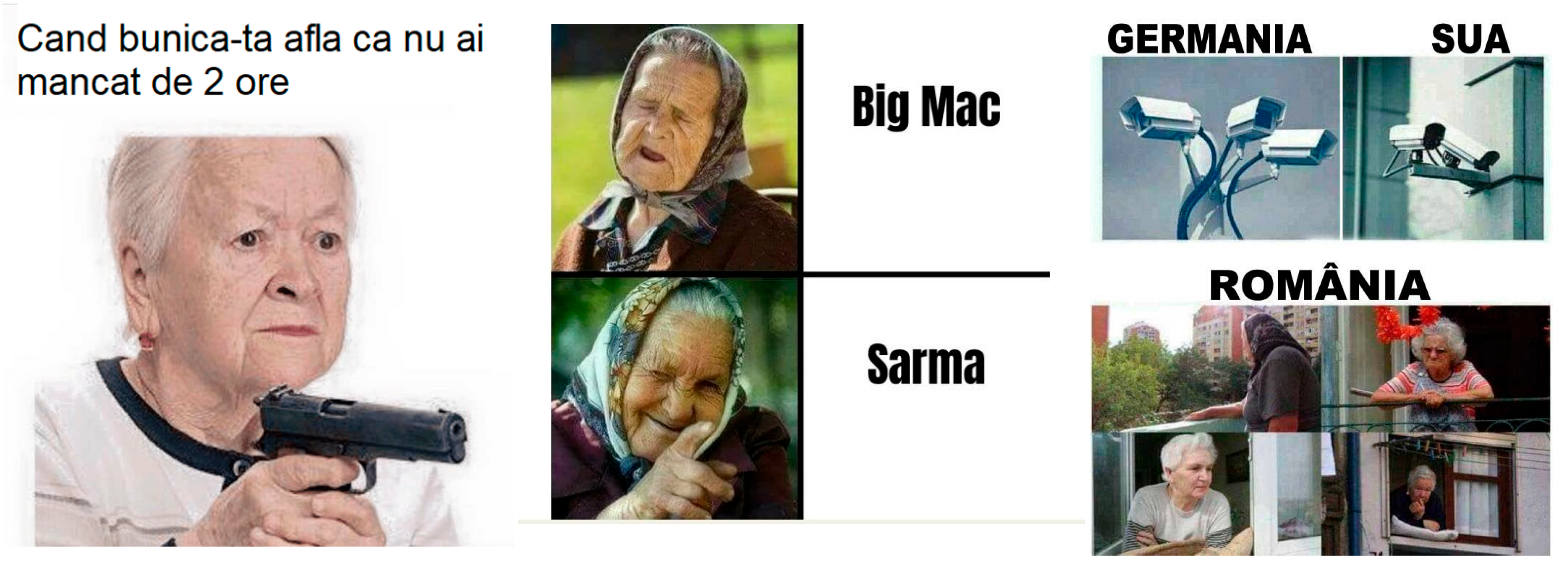
In contrast to these faltering masculine figures, the domestic guardian—the Romanian “bunicuța”—appears as the donor figure who stabilises the cultural landscape (
Figure 11). In the memetic ecosystem, she functions as a hybrid presence, displaying both care and control.
Far from being a simple nostalgic cliché, she operates as a cultural regulator whose authority is both affectionate and uncompromising. Her arsenal—the rolling pin, the mock pistol, the ever-present sarmale—condenses a familiar blend of tradition, humour and soft discipline. Through her, collective identity is anchored in the everyday rituals that define Romanian cultural memory.
These role distributions matter culturally because they show how Romanian memes organise evaluation. The mapped archetypes do not simply populate scenes; they also make agency, blame, and credibility immediately legible in a socially recognisable way. The villain concentrates diffuse frustration into a readable agent, while the slacker or accidental hero reflects lowered expectations of efficacy and a preference for endurance over transformation. The domestic guardian, by contrast, stabilises identity through everyday moral authority, turning routine practices into cultural anchors. Taken together, these roles suggest that Romanian memetic storytelling functions less as narrative resolution and more as narrative positioning: it sorts experience into familiar moral and affective alignments that can be shared, recognised, and repeated.
6.2. Thematic Clusters
If we extract, at corpus level, the prominent narrative arcs that each correspond to broader cultural scripts, there are three recurring narrative structures. In the citizen vs. system scenario, the core tension pits the powerless individual against an indifferent institution. Memes in this cluster expose the gap between expectation and bureaucratic reality, mapping political alienation and a deeply internalised structural cynicism. Another thematic cluster belongs to the heroism of the domestic, that turn daily life into small arenas of resistance, humour, and memetic creativity. The domestic sphere becomes the space where values are defended and survival gains dignity. The tone blends nostalgia with irony, reframing routine gestures as quiet acts of cultural preservation. A third main theme, with many iterations, is that of institutionalised stupidity, where incompetence is not exceptional, but ritualised. Dorel, the emblematic worker who “repairs” everything into collapse, embodies systemic absurdity. Incompetent, dim-witted politicians generate, through stupid, incoherent actions, chaos, disaster and systemic failure.
These thematic clusters support the central claim that Romanian memes function as condensed cultural diagnostics. Far from merely humorous, they reflect collective emotional scripts and identity negotiations grounded in a post-communist historical experience. Seen in this light, the narrative logic of Romanian memes naturally expands beyond character patterns into a broader terrain where memory, affect and cultural residue matter just as much as plot. Once one accepts that memes trade in fragments, it becomes easier to see how they also trade in temporal fragments: past worlds compressed into icons, socialist atmospheres repurposed as punchlines, and childhood artefacts revived as tools of critique. In other words, the same mechanisms that condense narrative also condense memory.
This is where nostalgia becomes relevant—not the idealised or sentimental version, but the ironic, culturally familiar form that Romanian digital culture uses with considerable precision. As
Bardan (
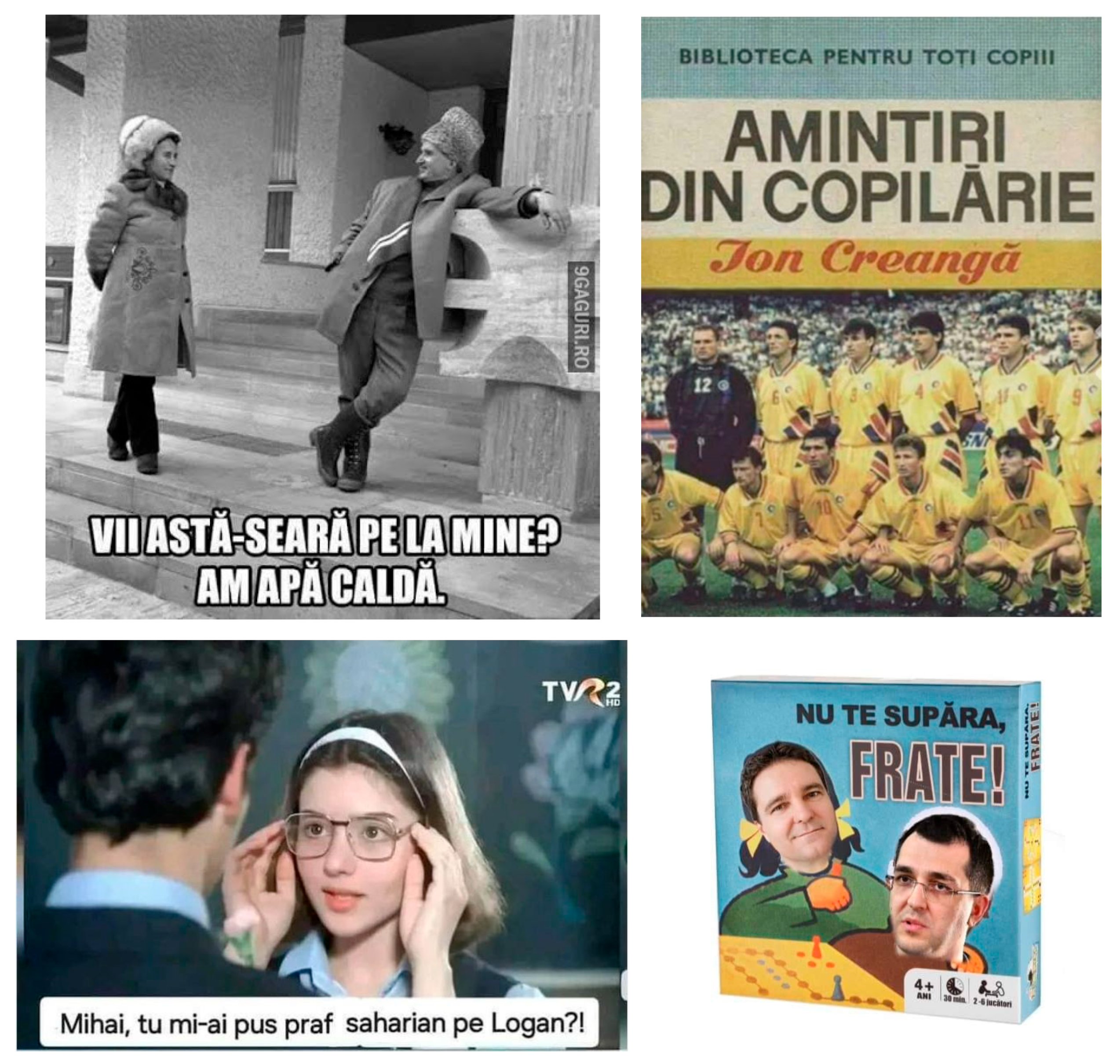
2020) notes, nostalgia in post-socialist Romania resurfaces whenever collective frustration seeks symbolic compensation, slipping between longing and satire depending on the emotional weather of the present. Memes in the RoMEMESv2 corpus operate within this exact logic: they recycle socialist-era images, objects and atmospheres not to idealise them, but to stabilise meaning in a present that feels structurally unstable, appealing to a restricted audience, as illustrated in
Figure 12.
The connection to nostalgia becomes clearer at this point. It is not the sentimental or idealised version of nostalgia, but a more ironic, culturally specific form that Romanian digital spaces use frequently. This effect appears because the narrative patterns in the memes often overlap with the ways in which certain memories are already organised in public discourse. Visual elements from the past—black-and-white family scenes, 1980s school settings, or the familiar style of state television—are brought back not for emotional restoration, but as stable reference points that help anchor meaning. Han’s work on “red memory” shows how digital environments reuse selected ideological and emotional fragments from the past, turning them into accessible, popular narratives that comment on the present (
Han 2024). Romanian memes work through a comparable logic of symbolic reuse. They do not return to communism as such; instead, they selectively mobilise its imagery and its cues to highlight ongoing frustrations, ironies or contrasts.
In this sense, the narrative structure supports a form of reflective, often ironic nostalgia, where the past becomes a tool for commentary rather than a source of comfort. Romanian memes draw on this framework to represent cultural stagnation, systemic distrust and everyday endurance. Their impact does not rely on narrative progression, but on the familiarity of the structures they evoke. They present recognisable situations in a different, usually humorous frame, creating short cultural narratives that resonate through repetition rather than development.
7. Conclusions
This study examined Romanian internet memes as narrative and cultural constructs, focusing on how they distil social experience, affect and commentary into abbreviated multimodal forms. Using a mixed-method approach that combined qualitative analysis with sentiment indicators from the RoMEMESv2 corpus, the research showed that memes in Romanian digital culture rely on stable narrative cues—roles, scenarios and affective frames that allow rapid interpretation despite their reduced format.
From a quantitative perspective, negative sentiment remains a dominant feature of the corpus, particularly in political memes where irony and systemic critique converge. This pattern aligns with the broader post-communist context in which civic scepticism, disappointment and institutional exhaustion are recurring elements of public discourse. The prominence of surprise as a secondary emotional marker reinforces this tendency: it reflects the routine perception of unpredictability and dysfunction rather than genuine novelty. In this environment, humour becomes not only a stylistic choice but an interpretative resource that manages emotional distance and frames criticism in socially acceptable ways.
The qualitative analysis highlighted several consistent narrative structures. Romanian memes frequently draw on familiar archetypes—systemic villains, reluctant or exhausted protagonists, domestic guardians, and peripheral observers—whose recurrence enables continuity across different templates. These roles do not build full story arcs; instead, they operate as schematic elements that help audiences decipher the underlying scenario. The narratives produced in this way do not aim for progression or resolution. They reflect cycles of coping, negotiation and everyday endurance, which is why they function effectively as concise units of cultural explanation.
Multimodality reinforces this narrative logic. The interaction between visual and textual elements guides interpretation through anchorage, contrast or relay, often producing meaning through tension rather than explicit framing. Intertextual references, regardless of whether derived from global pop culture, socialist-era imagery or local socio-cultural symbols, further anchor the memes within shared interpretative habits.
Viewed together, these findings support the view that Romanian memes function as a vernacular, process-driven form of digital folklore, defined less by genre than by patterns of collective production, variation and circulation.
This study is not without limitations, as the corpus does not provide information about circulation, authorship, or audience reception, and the qualitative sample represents only part of the available material. Future work may expand the analysis through comparative research across languages and regions, longitudinal tracking of narrative templates, or studies on how users interpret, appropriate and redistribute memetic content.
Even with these constraints, the findings indicate that Romanian memes offer a valuable perspective on contemporary forms of digital storytelling. They condense cultural memory, everyday frustrations, and shared evaluations into compact narrative fragments, and their persistence suggests that they actively shape how communities interpret and articulate their social environment.