


Abstract
The nascent yet growing interdisciplinary arena of memory studies has been gaining momentum in the past decade, especially in the Indian subcontinent. However, upon closer inspection, there remains a clear gap in the literature in the subdiscipline contextualising memory studies with Partition studies focusing on the eastern side of the subcontinent. This paper argues that despite significant strides taken towards the preservation and capturing of memories in the Punjab-Pakistan regional context, the Bengal-Bangladesh phenomenon remains largely overshadowed by the grand canonised narratives of the 1947 Indian independence or the 1971 Bangladesh Liberation, in spite of its chronic, even contemporary aftershocks. The study ultimately proposes possible future directions to fill this dearth of literature through theoretical frameworks fit to analyse and assess the ramifications of the Bengal Partition. Upcoming studies will take up the cause of the missing critical theory that can address the specifics of Bengali memories associated with partition, displacement, and subsequent life rebuilding across decades, with particular ethical attention to the last generation of survivors and eyewitnesses who are now passing away.
1. Introduction
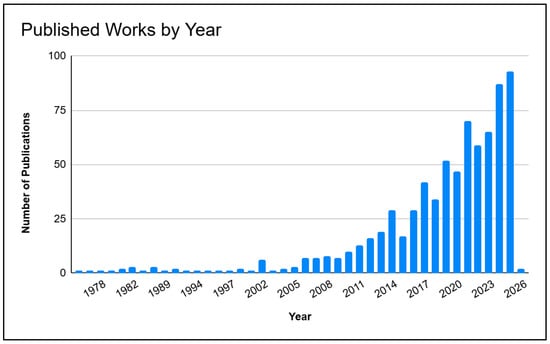
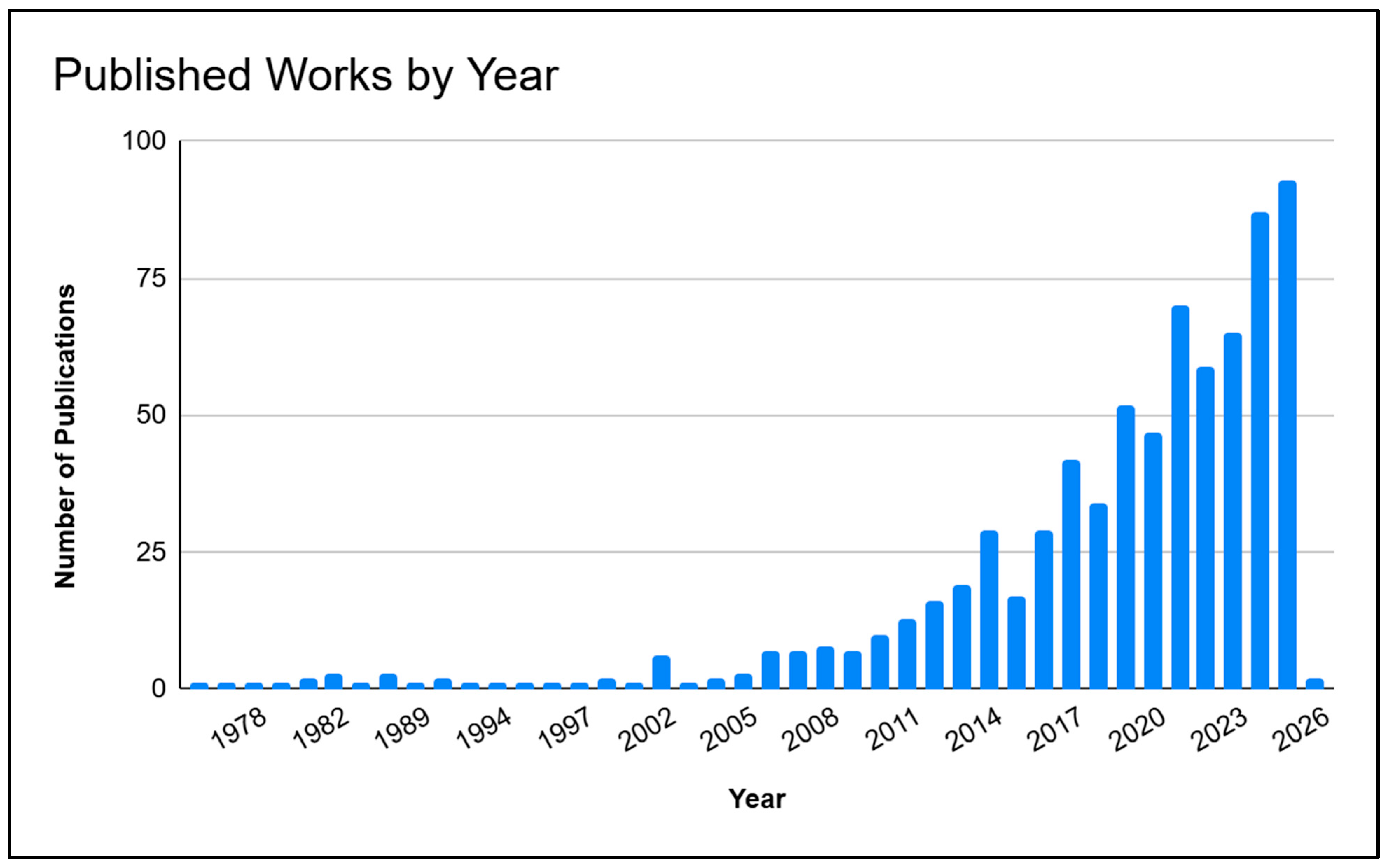
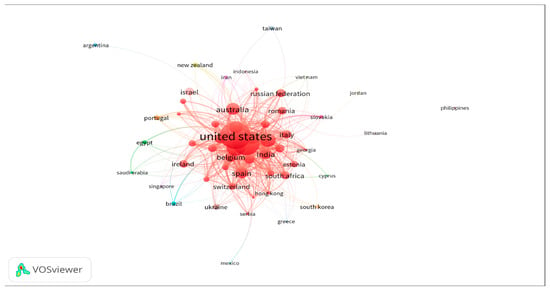
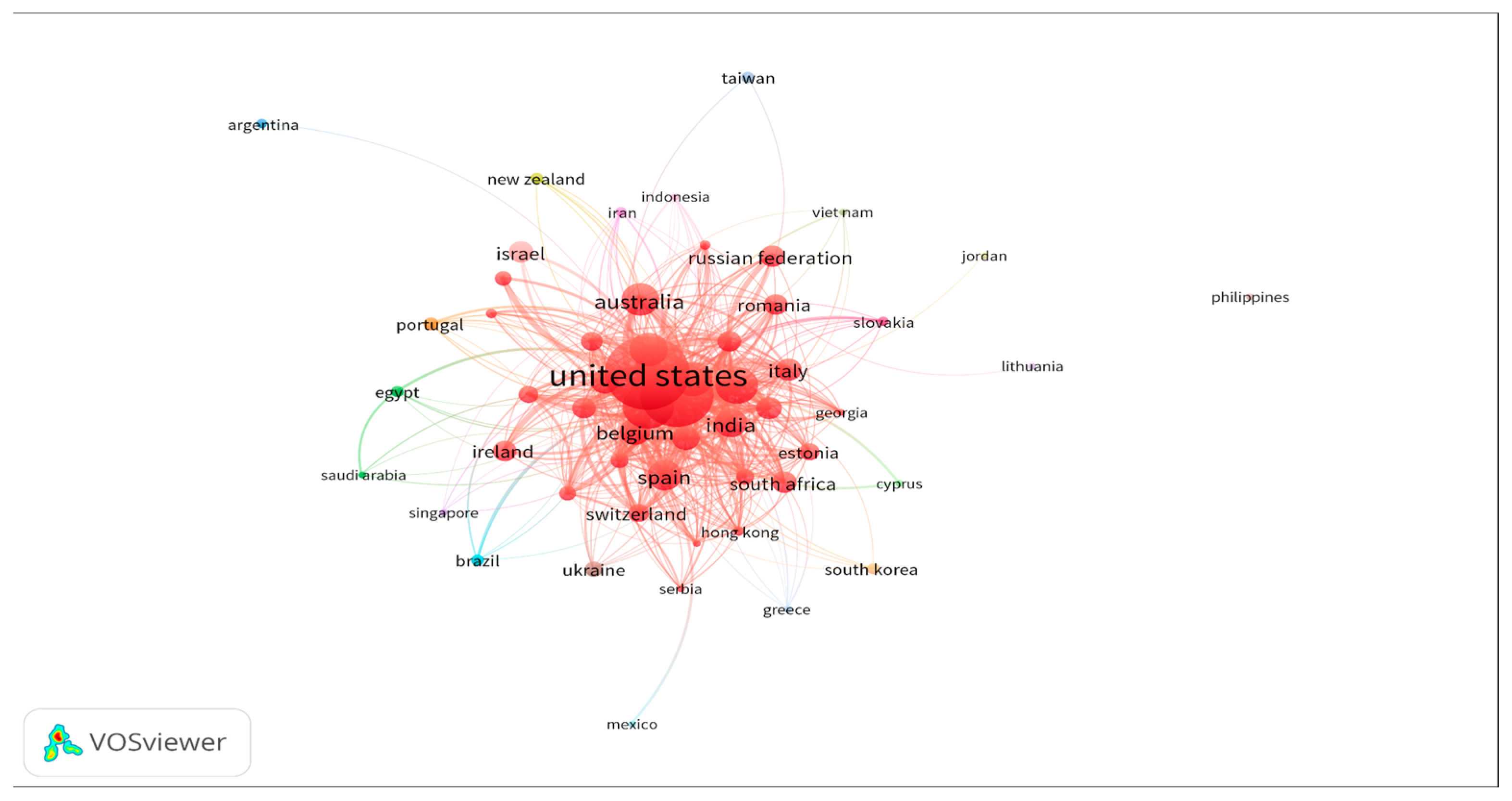
The study of memory as a social and cultural phenomenon, rather than merely an individual cognitive operation, can be traced back to the seminal work of Halbwachs, whose On Collective Memory (Halbwachs and Coser 1992) established the foundational premise that memory is embedded in social frameworks. Halbwachs argued that “the cociindividual remembers by placing himself in the perspective of the group, but…the memory of the group realizes and manifests itself in individual memories” (Halbwachs and Coser 1992, p. 40). Western schools have worked extensively on traumatic memories pertaining to displacement, dislocation, and rootlessness, especially in the context of Holocaust studies. Works such as Hirsch (2012) book The Generation of Postmemory: Writing and Visual Culture After the Holocaust are part and parcel of global memory studies discourse with theoretical interventions that remain perfectly suited and ideally applied to phenomena such as the German Holocaust. However, there does not exist an equally prominent or even equally suitable theoretical lens that can allow one to study similar instances from the Global South. This implies a significant gap in research on and around memory studies in the Global South, particularly in theoretical interventions and contextual applications. Based on the number of works published per year, a bar graph was created using Google Sheets (Figure 1), which has further substantiated that memory studies as a discipline gained traction at the turn of the millennium, but nonetheless continues to be a field dominated by Western cannons, particularly Western Europe and North America (country-wise bibliographic coupling map, Figure 2). In this scenario, it becomes paramount that memory studies not only be incorporated in discussions across South Asian nations, but also be understood and contributed to by scholarship specialising in South Asian studies that deal with themes very intimately connected and uniquely quintessential to Indian experiences immortalised in the literature. Partition studies, therefore, form an ideal ground for such research where memories are vivid and Indian in the truest sense, given its scale and spatio-temporal place. The present study, therefore, seeks a comprehensive framework of memory studies and partition literature to understand, analyse, and explore the domain-specific nuances of India, with special emphasis on Bengal, which has long struggled with the cultural amnesia of the Partition. Regional overshadowing of the Bengal experience by Punjab narratives and nationalist voices of the Liberation War has further contributed to the systemic amnesia. The present paper, therefore, argues that the Bengal Partition experience deserves its own place in mainstream discourse.
Figure 1.
Bar graph of publications by year: memory studies (source: personal research).
Figure 2.
Organisational bibliographic coupling map: memory studies (source: personal research—VoSviewer).
The year-wise publication report from Scopus indicates that the earliest papers were published in 1976–78, which aligns with the emergence of memory as a field in the latter half of the 20th Century. By the turn of the millennium, memory studies had become a comprehensive and interdisciplinary field that worked with medicine, such as psychiatry and working memory; technology, such as artificial intelligence; behavioural sciences, such as cognition and psychology; and pedagogy, such as child development and early childhood education. During the turn of the millennium, there was a slow yet definite surge in scholarly productivity surrounding memory studies. In this period, while memory boomed under the stewardship of Assmann and Czaplicka (1995); Olick (1999); Erll and Rigney (2006); and A. Assmann (2008), theorists like Massumi (1995); Ahmed (2004); and Brennan (2004) brought forth their works about the transmission of emotions through affect. The materiality of cognition also gained prominence with Brown’s (2001) postulation of thing theory. The emergence and continuity of their works prove that the Global North was steadily waking to the dawn of memory scholarship. To date, there is a steady upward trend in the number of publications, with the highest in 2025. However, on further investigation, the scenario appears much bleaker for Global South economies like India.
The organisational bibliographic coupling further reflects a Eurocentric research approach, with major institutions in the field located in the Global North, particularly universities in the United Kingdom and the United States. Institutions such as the University of Oxford, New York University, and Columbia University are the primary and most influential nodes on the map. As discussed earlier, this map also substantiates the claim that memory studies is largely restricted to the Western world, as there is little to no mention of works and institutions from the Orient. This implies that a gap exists in the dissemination and percolation of memory studies in the Global South, although there have been efforts to incorporate developing nations into the picture.
The central, most prominent node in the map of bibliographic coupling of countries is the United States, positioning it as the hub of the memory studies network, albeit densely connected to Asian, Middle Eastern, African, and Eastern and Western European countries. These include India, Singapore, Israel, Brazil, Poland, the Czech Republic, and France, among others. Cultural and literary works from the Middle East, most importantly by Palestinian authors like Toha (2022) or Iranian works like Satrapi’s graphic narratives (Satrapi 2003), examine the effects of exile, nationhood, migration, memory, and belonging in texts outside of the scholarly domain. Said’s (2000) works on exile, on the other hand, form the backbone of displacement and migration studies scholarship. On the other side of the globe, Hooks’ (1996) works on politicised memory, along with Morisson’s conceptualisation of rememory in Beloved (1987), enhanced and analysed by other scholars thereafter, form the black memory canon. Nonetheless, there remains a large body of unexplored scholarship in memory studies outside Europe and America.
2. Memories of a People: The Discipline of Memory
Although it is true that memory studies have largely been dominated by First World countries, South and Southeast Asia, Africa and West Asian countries are also contributing to scholarship in leaps and bounds. This review focuses specifically on the Indian subcontinent and the landscape of memory surrounding Indian historiography and will, therefore, discuss the South Asian advances and theoretical features of the field in relation to the broader picture of memory studies scholarship.
2.1. Foundations of Collective Memory: Halbwachs to Assmanns
The collective memory of a community is fundamentally different from history and documentation. To illustrate, Pandey argues that “collective memory is…in crucial senses ahistorical, and even anti-historical” (Pandey 2001, p. 8). Pandey’s idea of the anti-historicity of memories being a counter-narrative to history is elaborated through Assmann’s idea of communicative memories, which are sustained across generations merely by oral transmission and/or informal communication. In this regard, Assmann extended Halbwachs’ framework of collective memory through his crucial distinction between communicative memory and cultural memory in Communicative and Cultural Memory (J. Assmann 2008, pp. 109–18). Communicative memory, in Assmann’s formulation, refers to the informal, everyday recollections passed through interpersonal communication and oral history, typically spanning three to four generations. Cultural memory, by contrast, is institutionalised and canonised through commemorative practices, texts, rituals, monuments, and ceremonies. Cultural memory is designed to shape a society’s self-image through systematic engagement with history. As the Assmanns together elaborated, cultural memory serves “not only to preserve the past but also to cultivate identity and cohesion across generations” (The Concept of ‘Cultural Memory’ Explained n.d.). For Partition studies, this distinction is especially vital because the communicative memory of Bengal Partition eyewitnesses and survivors, those who experienced the tremors directly, has almost disappeared as the generation passes away, while the cultural memory of the Partition is finally, yet belatedly, being institutionalised through museums, memorials, academia, and literary works and memoirs. The 1947 Partition Archive, founded in 2008, is an important effort to capture communicative memory before it disappears by recording oral histories from survivors across the subcontinent. Nonetheless, as with all partition historiography, the Bengal experience remains underrepresented in this archive, reflecting the broader pattern of marginalisation that this study seeks to address.
Assmann went on to define cultural memory through a double delimitation that distinguishes it from both history and communicative memory: cultural memory is “a deliberately constructed memory” that is “centred around a myth dictating the identity of the community” and “transmitted by ‘specialists’ through relevant artefacts” (Dinter 2023, p. 2). Assmann’s work on forgetting adds another crucial dimension to this analysis. In her influential essay Canon and Archive (2008), Assmann distinguishes between the “canon,” the actively remembered past that a society draws upon for identity formation, and the “archive,” the stored but inactive past that awaits potential activation. The Bengal Partition, this review suggests, occupies an ambiguous position between canon and archive: it is not fully forgotten, since it continues to be remembered by refugees and their descendants, but it is not fully canonised either, since it has not achieved the institutional status of national memory. This, along the lines of Bhabha’s (2012) concept of liminal status, which constitutes the in-betweenness of identity, deserves special attention. Although Bhabha uses the concept of liminality for identity, the same can and should be applied to memory structures that occupy this peculiar space between the archived and the canonised. Such liminal identity of a phenomenon is itself a product of the political economy of Partition memory, in which certain experiences are selected for national commemoration while others are confined to the dusty shelves of personal and family memory narratives.
2.2. Cartography of Memory: Pierre Nora
The French historian Nora’s concept of lieu de mémoire or sites of memory, developed across his Les Lieux de Mémoire (Nora 1989), offers an essential framework for understanding how memory crystallises in specific material and symbolic forms. These sites function as “complex things,” that are “at once natural and artificial, simple and ambiguous, concrete and abstract,” where memory “crystallizes and secretes” (Nora 1989, p. 7). He argued that “the materialization of memory has been tremendously dilated, multiplied, decentralized, democratized.” (Nora 1989, p. 14). Nora’s framework has proven enormously influential in memory studies. According to Nora, memory and history are fundamentally antonymous forces, where memory “remains in permanent evolution, open to the dialectic of remembering and forgetting, unconscious of its successive deformations, vulnerable to manipulation and appropriation, susceptible to being long dormant and periodically revived,” while history is reconstructed, “a representation of the past” (Nora 1989, p. 8).
2.3. The Affective Turn in Memory Studies
While Halbwachs, the Assmanns, and Nora laid the cornerstones for the social and spatial dimensions of memory, the affective turn in the study of literature has drawn rising attention to the emotional and embodied dimensions of remembrance. Bernard Stiegler proposes that memory takes three forms: primary retention or “retention and protention that are constitutive of the present”, secondary retention or “rememorization of a past temporal phenomenon that could come back into presence”, and tertiary retention or “retention, which is not perception but refers back to it, and which is not a production of the imagination either since it is part and parcel of the real phenomenon of time” (Stiegler 1998, p. 246).
Ahmed’s theory of affect provides the most comprehensive framework for understanding how emotions operate as socially and materially embedded phenomena. In The Cultural Politics of Emotion (Ahmed 2014), Ahmed argues that “emotions are not simply located in the individual, but move between bodies” (p. 10), creating the very sticky effect of surfaces, bodies, and worlds that she postulates. Memory, in this affective register, is not merely cognitive retrieval but embodied re-enactment, an action with profound implications for understanding how Bengal Partition survivors carry and transmit their traumatic pasts across communities and generations. Ahmed’s concept of “affective economies” is particularly relevant here: emotions, according to Ahmed, work as a form of capital, accumulating value as they circulate between bodies, objects, and signs. The “stickiness” of affect, its tendency to adhere to particular bodies, objects, and signs, explains why certain Partition objects, such as the heirloom, the photograph, and the document, become hyper-charged with mnemonic and emotional significance (Ahmed 2004).
Ahmed’s (2006) earlier work, Queer Phenomenology, adds a phenomenological dimension that is crucial for understanding Partition memory. According to Iser, the phenomenological approach to art lays full stress on the idea that, in considering a literary work, one must take into account not only the actual text but also, and in equal measure, the actions involved in responding to that text. (Iser 1972, p. 1).
Through Ahmed’s analysis of “orientation”, the way we are directed toward certain objects and away from others, and how such habitual direction shapes what we can perceive and feel, provides a robust vocabulary for understanding what would be the “destructive plasticity” (Malabou 2012) of displacement.
2.4. Material Memory and the Mnemonic Function of Objects
The material dimension of memory has received increasing scholarly attention in recent years, moving beyond the idea of objects as mere mnemonic aids to recognising material things as co-constitutive of memory itself. This shift reflects the broader “material turn” in the humanities and literary studies, which challenges the superiority of discourse, text, and representation over the material substrates of ordinary life. For memory studies, the repercussions are much more pronounced. The material turn implies that memory does not simply reside ‘in’ objects to be retrieved but rather emerges through engagement with material things, a proposition that weaves together phenomenology, archaeology, and literary studies in interesting ways.
Malafouris’s Material Engagement Theory (MET) offers one of the most fully developed frameworks for understanding how material things participate in cognitive and psychosocial processes. In How Things Shape the Mind (Malafouris 2013), Malafouris proposes that a “cognitive process can be what happens in the interaction between a brain and a thing,” (p. 67). MET’s central concept of “metaplasticity,” explains how, the human mind is “embedded and inextricably enfolded within a plastic material culture” (p. 46), and provides a powerful model for understanding how memory is not merely stored in material objects—the family photograph, the heirloom jewellery, the land deed—but is actively constituted through ongoing engagement with them. Malafouris’s concept of the “extended mind,” derived from Clark and Chalmers’s (1998) philosophy of cognitive extension, challenges the assumption that memory is a purely intracranial phenomenon. If cognition extends beyond the brain to include the body and its environment, then memory too must be understood as distributed across this extended cognitive system. For Partition studies, this means that the refugee’s memory of home is not “in her head” alone but is distributed across the network of objects, spaces, and social practices that constituted her pre-Partition life. The loss of these material anchors—the house, the village, the landscape—is thus not merely a loss of setting but a loss of the external memory system that supported her identity and her capacity to remember. Malafouris’s framework helps explain why displacement is so profoundly disorienting: it involves not merely the loss of a place but the dismantling of an extended mnemonic system.
Brown’s thing theory complements Malafouris’s cognitive-archaeological approach with a literary-critical sensitivity to how objects exceed their functional utility to become what Brown calls “things,” entities that resist full incorporation into human meaning-making. Brown’s (2001, 2003, 2015) foundational essay thing theory and his subsequent books A Sense of Things and Other Things explore how inanimate objects allow humans to form and transform themselves. Shubhpreet Sandhu argues that, “Invoking Martin Heidegger’s “thingness”, Jacques Lacan’s “unnamable or unknowable thing”, Latour’s “Dingpolitik” or Benett’s thing power, the view of the things is that they stand for more than objects.” (Sandhu 2021, p. 405). Objects are not merely “aids to memory” in the conventional sense. Rather, in Brown’s terms, it is “the otherness of things” (Brown 2001, p. 12) that gathers around them histories, affects, and social relations that they neither fully contain nor fully disclose. Brown’s concept of “thingness,” is the moment when an object withdraws from its functional role and becomes something more, something opaque and resistant. When a survivor encounters an object from her past life after decades of separation, the object may suddenly become, borrowing from Kristeva, abject (1984), no longer fitting into the familiar categories of use and meaning. This moment of estrangement, what the Russian formalists called “defamiliarisation,” is also a moment of potential insight, when the object’s excess, its resistance to full comprehension, opens a space for the kind of memory that exceeds narrative. The affective engagement with memorabilia framework proposed in this review takes this insight seriously, attending not only to what objects “mean” in Partition memory but to what they do, how they act upon bodies and minds, and how they create effects that exceed representation.
3. Memory Studies and the Indian Partition Literature Landscape
Significant strides have been made in recent years towards combining memory studies with partition literature, exemplified by Roy’s (2019) Memories and Postmemories of the Partition of India and Kapila’s (2024) Postmemory and the Partition of India: Learning to Remember. Malhotra’s (2017) Remnants of a Separation deals with the concern of tactfully incorporating material into memories, with accounts and memories of people attached to objects, but it does not offer a theoretical framework specifically dedicated to studying this relationship among emotions, objects, and memory. However, there is a common (mis)consensus among contemporary scholars that the 1947 Partition of India, despite its permanent seismic impact on South Asia and global geopolitics, is a largely saturated field for novel research and innovation. Presently, as India deals with criticism in the name of religious fundamentalism along with national security issues involving cross-border infiltration (Chattoraj 2018), the underlying communal angles from independence-era aftershocks demand special attention. Within the country, reports of mobs lynching Bengali migrant labourers for their language and religion in a bid against illegal immigration are not uncommon (Chattopadhyay 2026). More specifically, the Delhi police issued a letter seeking translators for the ‘Bangladeshi Language’, which, in fact, is Bengali (Thakur 2025), triggering scathing responses from the opposition, which highlighted that the national language of Bangladesh is also one of the 22 scheduled languages in India. Against the titanic backdrop of the situation, it becomes increasingly imperative that scholarly attention be paid to the Bengal Partition, its aftermath, and its legacy to date. Bengal’s communal construction, coupled with the history of the Partition, makes this study not only one of theoretical intervention towards an undocumented history, but also one of immediate political urgency as a potpourri of factors, including language, religion, culture, kinship, and even food, complicate the identity politics of the region. S. Sen (2022) writes about the impact of the partition, which “left such an indelible mark in the psyche of the nations that memories keep being reproduced in films and novels even to this day”, proving that the partition of Bengal was not an isolated event in space and time but a prolonged phenomenon. Stalwarts of the field, from Butalia (1998) to Pandey (2001), have presented detailed analyses and case studies of the event, but no particular theoretical intervention that would be ideal for the uniquely South Asian refugee experience, let alone the Bengali version. Credited with bringing the common person’s memory to the table and creating a counternarrative of the Partition, Butalia also admits that there have been lacunae with respect to Bengal. She identifies “a serious gap [caused by] the omission of the experiences in Bengal and East Pakistan (Bangladesh),” while Tai Yong Tan and Gyanesh Kudaisya describe a “historiographic imbalance.” Because “accounts of partition have tended to be Punjab-centred... Bengal has not received the scholarly attention it deserves” (Mookerjea-Leonard 2017), theoretical innovation and integration remain absent from mainstream discourses in Partition studies. The scarcity of memory studies on the Bengal Partition becomes more compelling not only because of the Western canon, but more so because other parallel concepts of colonialism, slavery, displacement, Indigenous histories, and histories of partition and contested borders have been explored with due diligence. The Palestinian Nakba, for instance, has been productively studied by Sa’di and Abu-Lughod (2007), while Greenblatt (2001) has worked with literary representations of racial memory in America.
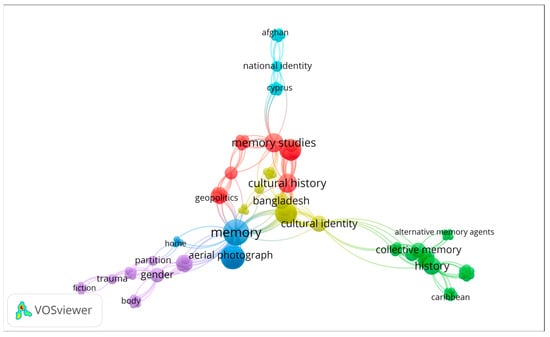
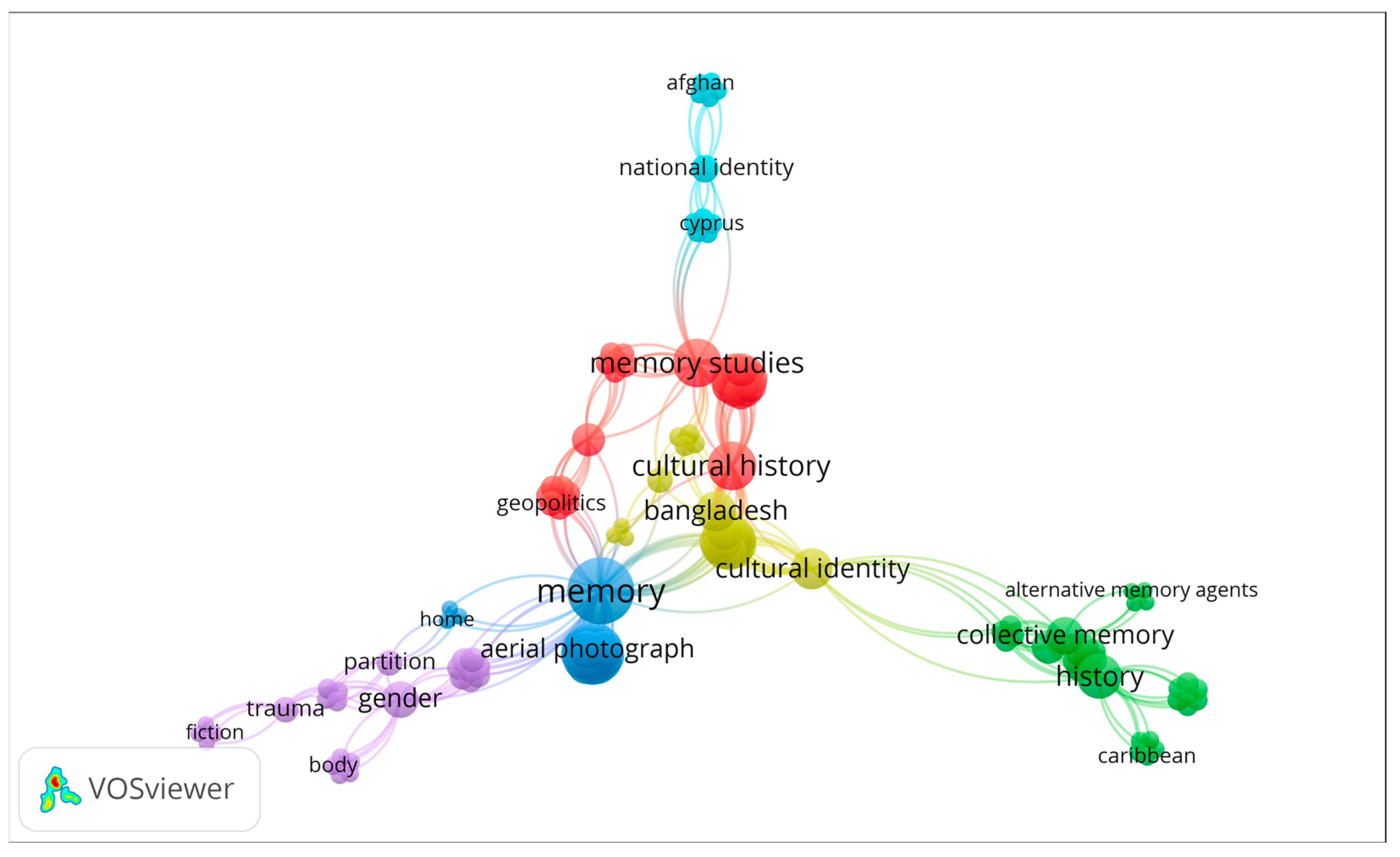
Scholarly portrayals of the Partition have largely ignored regions indirectly affected by it, such as Chhattisgarh, where the Dandakaranya refugee camps were established. Nonetheless, it is a well-accepted fact that Punjab and Pakistan have been read and written about significantly more than Bengal and Bangladesh. With popular culture, particularly Hindi and Bollywood, embracing the pathos of the Partition, there has been a noticeable emergence in the rise of music like Husna (2012) by Mishra, and movies like Ali’s recent project Main Vaapas Aunga (2026), that have garnered reasonable praise and attention in their capacity to uphold the pangs and nuances of what is known in scholarly circles as The Long Partition (Zamindar 2010). Here, a significant missing link is the Partition of Bengal in 1947, which does not find a portrayal alongside independence or the 1971 Liberation War (Figure 3) The problem is not only a lack of perspectives but also a severe dearth in assimilation of existing ones. This implies that although there has been some progress concerning the Bengal Partition, most of it has been disappointingly myopic—limited to Dalit studies (Bandyopadhyay and Chaudhury 2022), feminist discourse (Bagchi and Dasgupta 2003), or subaltern themes (Micieli-Voutsinas 2013). Affective-material transmissions of non-archival, non-canonical memory have never found the centre stage despite being one of the essential characteristics of Indian Bengali traumatic memories.
Figure 3.
Keyword co-occurrence map: Partition and memory studies (source: personal research—VoSviewer).
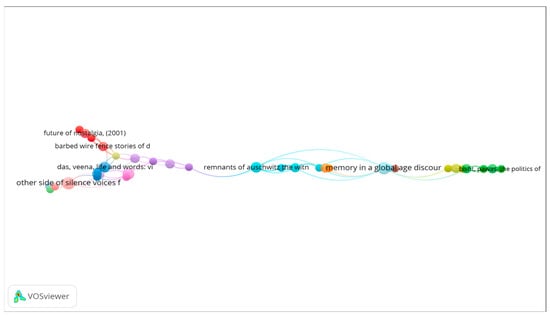
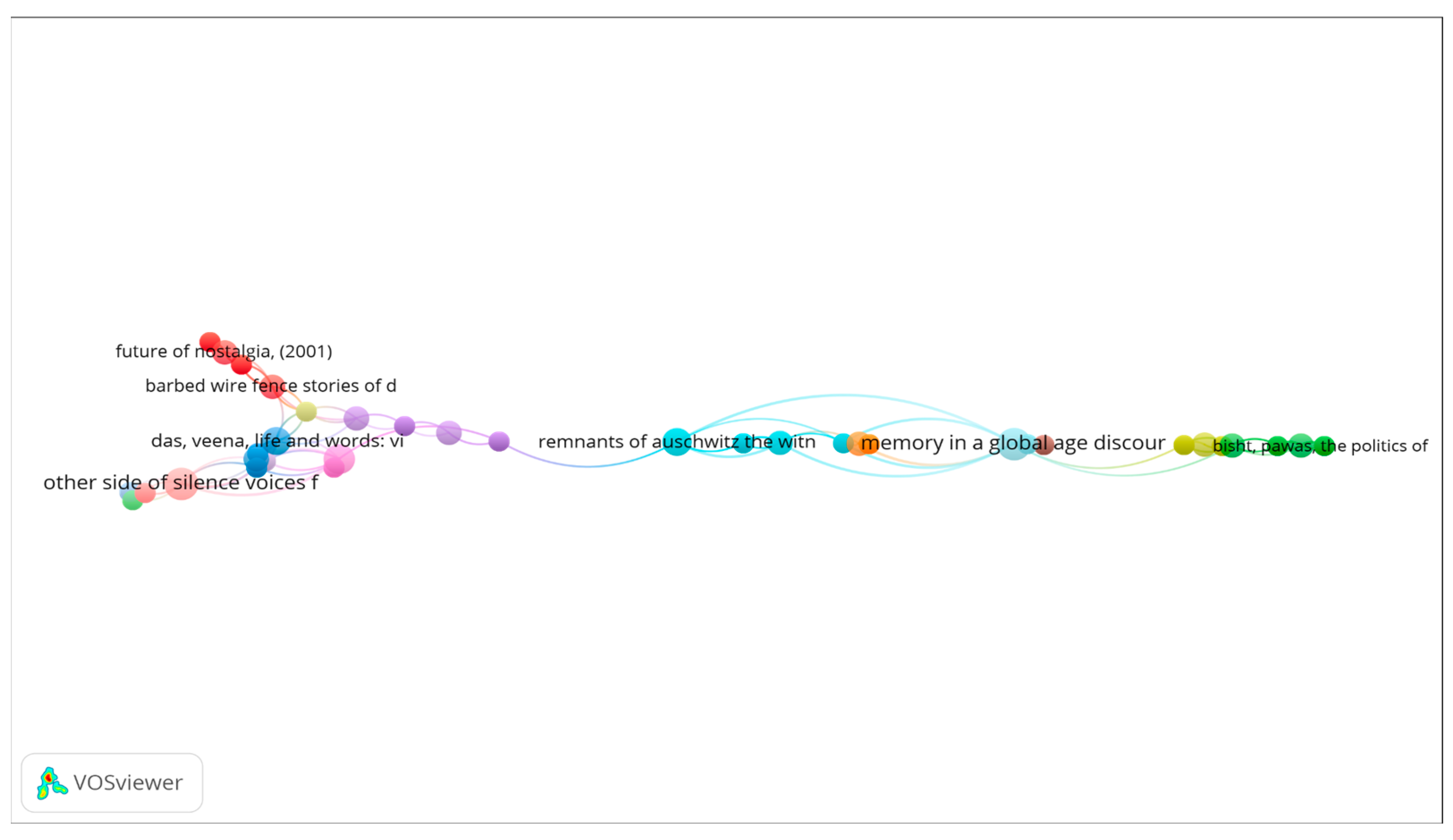
An analysis of the co-citation of references (Figure 4) clarifies the redundancy of a handful of critical commentaries and authors, from Butalia’s (1998) Other Side to Das’ (2006) Life and Words. This justifies the demand for a theoretical lens specifically and uniquely suited to the Bengal Partition experience. In this regard, it becomes paramount to understand the specifics of not only the Indian Partition in general but also the nuances of the Bengal Partition in particular. The Partition of Bengal, as discussed above, was more of a lingering, chronic affair, with a straightforward fight for survival. Even then, not everyone was in the same boat in terms of resources, capabilities, socio-political standing, and most importantly, financial power—the Namashudra community, for example, faced twofold ostracism. ‘Lower’-caste and peasant groups of East Pakistan revolted against Hindu landlords and stood by their Muslim peasant counterparts, as documented by Dhar, “‘We namahsudras would support the League. Big landlords have not done anything for us.’ Panchanan Mandal said in a forceful voice on behalf of the low caste Hindus.” (Dhar 2009, p. 46) As the communal violence ran deeper, the Namashudras had to leave the erstwhile Islamic East Pakistan and cross the border back to their previous landlords. Here they were shunned systematically, with millions of refugees being sent to the Dandakaranya forests in Central India (S. Ghosh 2018) and as far as Little Andaman in the Andaman and Nicobar Islands (U. Sen 2017), ultimately culminating in the infamous Marichhjhapi massacre of 1979 that came to mainstream discourse only after A. Ghosh’s popular and acclaimed novel, The Hungry Tide (A. Ghosh 2008). Verma explains that, “Against state silencing, literary narratives are understood as memory archives that challenge the ongoing impunity of perpetrators guilty of violence.” (Verma 2024). This makes it obvious that there is a clear demand for a fresh perspective that binds together all the intricacies of the Bengal experience.
Figure 4.
Co-citation of references map: Partition and memory studies (source: personal research—VoSviewer).
4. The Gap in Bengali Memories: Literature, Amnesia, and the Politics of Representation
The Bengal Partition occupies a peculiar position in South Asian studies: simultaneously present and absent, acknowledged and overlooked, remembered and forgotten. Debjani Sengupta characterises this condition as “cultivated aphasia,” a deliberate muteness that is “not negligence” (Sengupta 2011, p. xiv). Nandy highlights that, ‘the silence was one way known to the South Asians to start life anew and contain bitterness, a way of repairing community life, interpersonal trust and the known moral world.’ (Sengupta 2011, p. xvi) The literary and cultural production that eventually emerged from this silent avoidance reveals the distinctive character of Bengal’s Partition experience. Mukherjee adds that, after the 1947 Partition, the immense brutality suffered by the people along the western frontier of Punjab during “the transfer of population” was a singular episode. The eastern frontier in Bengal, on the other hand, experienced a protracted process of border-crossing that continued (and still does) through decades (Mukherjee 2008, p. 75).
Unlike Punjab’s Partition literature, with its emphasis on spectacular violence and sudden displacement, Bengali Partition writing tends towards something that is almost metaphysical yet at the same time psychological: a preoccupation with the ultimate loss of the homeland (desh) and a clear impossibility of returning to it, gave way to the slow erosion of a people’s way of life and livelihood. The memoirs in Chhere Asha Gram (Basu 1953) exemplify this tendency: they are filled with sensory memories of village life, the taste of Ilish Maachh curry at a river-ghat hotel, the sound of boat-songs on the Karnaphuli River, and the visual texture of paddy fields in the monsoon. These are accompanied by remarks such as, “So you have come back to desh?”, “Of course, I knew that you would come today!” and “Babu, so you have come back to the village?” (Hasan 2000, pp. 332–34). These memories are not merely nostalgic; they are what Dipesh Chakrabarty identifies as a specifically Hindu-Bengali mode of remembrance, noting “how unself-consciously this association becomes Hindu.” (Chakrabarty 2002; Hasan 2000, p. 325), where the lost homeland teems with Hindu religious and cultural heritage but excludes Muslim contributions. The essay on Dhamrai, for instance, remembers the village’s Hindu festivals, its Brahmin priests, and its Sanskrit school, but makes no mention of the Muslim neighbours who constituted a significant portion of the village’s population. This selective memory, or systemic amnesia, or perhaps even deliberate erasure, is not accidental but structured by the communal politics of the Long Partition itself. Partition transformed heterogeneously mixed populations of villages into puritan Hindu or exclusively Muslim territories.
According to Fraser, what is unique about the Bengal Partition is that… the influx of refugees across the Bengal border has never stopped, to date… it has never dried up… this unending flow of people remains an everyday reality on West Bengal’s ‘porous’ border, and has made the stories of Partition on the eastern front unending and different (Fraser 2021).
Nonetheless, the aphasia surrounding Bengal Partition studies is not merely a product of silence but a result of strategic forgetting. The 1971 Bangladesh Liberation War, with its more dramatic narrative of liberation and genocide, has progressively displaced the Partition of 1947 as the primary object of historical memory in Bangladesh, resulting in its towering feature in scholarly productions related to Bengal (Figure 5). In India, the dominance of Punjabi Partition narratives in national culture, from Bollywood films to school textbooks, as discussed through examples throughout the study, has pushed the Bengali experience to the absolute sidelines. The result is the complete erasure of the experiences of millions: 1947 is overshadowed by 1971 on the one hand and by the Punjab narrative on the other. The Bengal Partition falls into the understudied gap between these two more dominant narratives. It would not be incorrect to conclude that the Bengal Partition is now only remembered sparsely and foggily by the fast-vanishing last directly affected generation. This double displacement has rendered the Bengal Partition theoretically invisible: there is a glaring dearth in the body of critical scholarship, theoretical frameworks, and methodological traditions that would otherwise have been developed specifically to understand this unique experience. The problem now is layered, since the Bengal pathos has not received equal scholarly attention compared to Punjab; it naturally cannot boast an equally lengthy body of critical commentary and theoretical refinement. This implies that the vocabulary that is undoubtedly productive for understanding the Punjab Partition, such as trauma, collective memory, communal riots, and gendered violence, has been applied to Bengal without enough justification for its congruency. Therefore, although immensely valuable for its empirical contributions, the scholarship on Bengal has not yet developed a theoretical framework adequate to address the specificity of the Bengal experience. This study proposes that a new theoretical lens of affective engagement with memorabilia can fill this gap by providing a synthesised framework that simultaneously attends to the affective, material, mnemonic, and socio-political dimensions of the Bengal Partition.
Figure 5.
Country-wise bibliographic coupling map: memory studies (source: personal research—VoSviewer).
4.1. Survival and the New (Ab)normal of Displacement
The experience of Bengali refugees differs significantly from that of their Punjabi counterparts in its temporal structure. This prolonged temporality of displacement shaped the distinctive affective structure of the Bengali refugee experience, what Sengupta calls a “pervasive melancholia” that comes from “a cramping sense of guilt of the moral inheritance” (Sengupta 2011). The material conditions of Bengali refugee life have been documented in literary and sociological sources with a specificity that official archives rarely achieve. Ritwik Ghatak’s films, Meghe Dhaka Tara (1960), Komal Gandhar (1961), and Subarnarekha (1962), provide perhaps the most powerful visual record of these conditions. Ghatak, himself a refugee from Dhaka, described his subject as “not a ‘refugee’ problem” but “the division of a culture” (“Titas Ekti Nadir Naam”) (Ghatak 2023). Whatever the case, “it is within Partition literature that the chronicle of the pain suffered by the people of the subcontinent has been most richly preserved.” (Mookerjea-Leonard 2017, p. 17). In Meghe Dhaka Tara, the refugee colony is evoked through incidental details: the “eviction order” discussed at committee meetings, the colony subscription that goes unpaid, the makeshift open-air school where children recite multiplication tables, the father asking “Whom are we living under? Why can’t we sleep at night?” These details accumulate to create a society disintegrating under the pressure of mass displacement, where “ten years of poverty and deprivation” make even a mother “a different person” (Roy n.d.). The figure of the refugee woman occupies a primary place in both the literary and cinematic universes. In Meghe Dhaka Tara, the character Nita— nurturing, generous, exploited, dying—embodies post-Partition Bengal in its complete essence. Her poignant, heartbreaking line, “Dada, ami je banchte boro bhalobashi,” meaning, “brother, I really love to be alive,” spoken from a tuberculosis sanatorium, captures the paradox of refugee resilience: the will to survive coexists with the impossibility of flourishing. The cinematic masterpiece ends with Nita’s reverberating cries “Dada ami banchte chai… dada, ami banchbo…” or, “brother, I want to live… brother, I will live,” that crushingly puts forth the hapless determination of refugees on celluloid. In Subarnarekha, the character Sita’s question about her home reflects and refracts throughout the film and percolates to her son Binu. Here, the intergenerational transmission of homelessness becomes self-explanatory. These cinematic representations find echoes in prose accounts: Pratibha Basu’s Dukulhara depicts Bindubasini’s tragedy, “who relocates to forestall violence to her person and her family comprising her widowed daughter-in-law and two granddaughters,” (Mookerjea-Leonard 2017, p. 135) and Manik Bandopadhyay’s short story Upay follows Mallika, who kills her exploiter rather than submit to prostitution, an act of violent female agency that complicates the stereotype of the passive victim.
4.2. Mnemonics, Sites, and the Problem of Grand Canonisation
The memory of the Bengal Partition has been sustained through a diverse array of mnemonic practices—literary, cinematic, musical, architectural, and domestic—that operate both within and outside official institutions. Unlike Punjab, where the Partition Museum in Amritsar (opened 2017) now serves as a central site of commemoration, Bengal’s Partition memory has been sustained primarily through decentralised, vernacular practices: the family shrine in the ancestral village, the annual gathering of families and relatives from the same district, the folk songs of separation and longing, and the literary journals that publish Partition memoirs. This decentralised mnemonic ecology has both strengths and limitations. On the one hand, it has allowed Partition memory to remain alive and adaptive, transmitted through living practice rather than frozen in institutional forms. The Baul tradition, with its songs of spiritual longing and bodily experience, has provided a ready-made vocabulary for expressing the affective dimensions of displacement; Lalon Fakir’s songs, circulating on both sides of the border, continue to serve as what Kabir (2013) calls “trans-religious” practices. The folk songs of the bhawaiya and bhatiyali genres, with their themes of separation, longing, and the pain of distance, have been repurposed to express Partition grief. On the other hand, the absence of institutionalised commemoration has meant that Bengal’s Partition memory remains fragmentary, localised, and vulnerable to erasure. The refugee colonies of Calcutta, once vibrant communities of remembrance, have been repurposed for urban development and to accommodate a growing population.
The concept of grand canonisation—the process by which certain narratives, events, and figures are elevated to official status while others are marginalised or forgotten—illuminates this uneven distribution of mnemonic attention. In the Indian nationalist official narrative, the Bengal Partition has never achieved the canonical status of the Punjab Partition or the 1971 war. The reasons for this marginalisation are multiple: the perceived “lesser” spectacular violence of the Bengal experience, the political sensitivity of Indo-Bangladesh relations, the dominance of Punjabi narratives in Indian popular culture, the fact that Bengali Partition memoirs are still sustained primarily in the Bengali language, limiting their circulation in all-India contexts, and the gradual absorption of East Bengali refugees into West Bengali society, which rendered their distinctiveness gradually but surely less visible over time. The result is what Kabir calls “post-amnesia”: a condition where the forgetting of 1947 is itself forgotten, rendered so natural as to become invisible (Kabir 2013). Against the traumatising backdrop of such grand canonisation, the memoir of the Bengal Partition have sustained a counter-memory that resists absorption into national narratives.
4.3. The Gendered Aesthetics of Bengal Partition Literature
The feminist scholarship on the Partition, from Butalia to Bagchi and Dasgupta, has documented the gendered facets of Partition violence. However, the literature of the Bengal Partition is marked by a distinctive gendered aesthetic that distinguishes it from its Punjabi counterpart. While Punjab Partition literature tends to focus on drastic experiences of bodily violence and physical survival, Bengal Partition literature gives a central place to female figures who embody the affective dimensions of displacement. In Ghatak’s films, as discussed above, the females—Nita and Gouri in Meghe Dhaka Tara (1960), Anasuya and Shakuntala in Komal Gandhar (1961), and Sita and her mother in Subarnarekha (1962)—become archetypes of literal and symbolic sites of Partition trauma (Ghatak 2015). Their bodies, labour, sacrifice, and death all serve as vehicles for expressing the collective experience of loss. Partition memory in Bengal is carried primarily by female figures, suggesting that the frameworks for understanding this memory must also be attentive to the gendered dimensions of labour, feeling, mourning, and remembering that fall disproportionately on women. The grandmother who tells stories, the mother who preserves objects, and the daughter who inherits trauma perform various forms of affective labour to sustain memory across generations. This work is not merely emotional but material: it involves the preservation of objects, the maintenance of rituals, and the creation of domestic spaces that sustain connections to the lost homeland.
5. Conclusions and Future Directions
The Bengal Partition was, and continues to be, an event that operates simultaneously at multiple scales and through multiple registers: the individual body and the collective body politic, the material object and the abstract idea, the spoken word and the unspoken silence, and the official archive and the counter-archive of domestic practice. The Bengal Partition is not merely a historical event to be studied but a living memory that continues to shape the lives of millions of people across South Asia and its diaspora. Despite rich cultural, literary, and multimedia representation, the scholarly works surrounding the Bengal Partition and its associated survival practices have evaded adequate attention, except for recent works published after the year 2000. Even though many of these scholarly works revolve around memory, they do not contribute exclusively to the nascent body of theoretical foundations of Indian memory. This paper argues, drawing on bibliometric evidence and existing scholarship, that the domain of Bengali memories from the time of displacement to the present remains highly underexplored and understudied in mainstream discussions of Partition studies and literature. Future work in this context could carve out a niche in theoretical frameworks tailored to understanding memories in the eastern part of the subcontinent, with its unique attributes and nuanced expressions. Given Bengal’s position at centre stage of Partition memories, it is crucial to construct a framework that comprehends the material-affective dimensions of the transmission of such memories, with adequate attention paid to the eyewitnesses of the Bengal Partition who are still around.
Author Contributions
Conceptualization, S.C. and S.Y.n.G.; methodology, S.C.; software, S.C.; validation, S.Y.n.G.; formal analysis, S.C.; data curation, S.C.; writing—original draft preparation, S.C.; writing—review and editing, S.Y.n.G.; visualization, S.C.; supervision, S.Y.n.G. All authors have read and agreed to the published version of the manuscript.
Funding
This research received no external funding.
Data Availability Statement
No new data were created or analyzed in this study. Data sharing is not applicable.
Conflicts of Interest
The authors declare no conflict of interest.
References
- Ahmed, Sara. 2004. Affective Economies. Social Text 22: 117–39. [Google Scholar] [CrossRef] [Scilit]
- Ahmed, Sara. 2006. Queer Phenomenology: Orientations, Objects, Others. In Research Online (Goldsmiths University of London). Durham: Duke University Press. [Google Scholar] [CrossRef] [Scilit]
- Ahmed, Sara. 2014. The Cultural Politics of Emotion. Edinburgh: Edinburgh University Press eBooks. [Google Scholar] [CrossRef] [Scilit]
- Assmann, Aleida. 2008. Canon and Archive. In Cultural Memory Studies. Berlin: De Gruyter, pp. 97–108. [Google Scholar] [CrossRef] [Scilit]
- Assmann, Jan. 2008. Communicative and Cultural Memory. In Cultural Memory Studies. An International and Interdisciplinary Handbook. Berlin: De Gruyter, pp. 109–18. [Google Scholar] [CrossRef] [Scilit]
- Assmann, Jan, and John Czaplicka. 1995. Collective Memory and Cultural Identity. New German Critique, 125–33. [Google Scholar] [CrossRef] [Scilit] [PubMed]
- Bagchi, Jasodhara, and Subhoranjan Dasgupta. 2003. The Trauma and the Triumph: Gender and Partition in Eastern India. Mumbai: Popular Prakashan. [Google Scholar]
- Bandyopadhyay, Sekhar, and Anasua Basu Ray Chaudhury. 2022. Caste and Partition in Bengal: The Story of Dalit Refugees, 1946–1961. Oxford: Oxford UP. [Google Scholar]
- Basu, Dakshina Ranjan. 1953. Chere Asa Gram. 1 vols, Kolkata: State Central Library, Available online: https://archive.org/details/in.ernet.dli.2015.355095 (accessed on 30 August 2026).
- Bhabha, Homi K. 2012. The Location of Culture. London: Routledge. [Google Scholar] [CrossRef] [Scilit]
- Brennan, Teresa. 2004. The Transmission of Affect. Cornell: Cornell UP. [Google Scholar]
- Brown, Bill. 2001. Thing Theory. Critical Inquiry 28: 1–22. [Google Scholar] [CrossRef] [Scilit] [PubMed]
- Brown, Bill. 2003. A Sense of Things. Chicago: University of Chicago Press. [Google Scholar] [CrossRef] [Scilit]
- Brown, Bill. 2015. Other Things. Chicago: University of Chicago Press. [Google Scholar]
- Butalia, Urvashi. 1998. The Other Side of Silence: Voices from the Partition of India. Gurgaon: Penguin Books India. [Google Scholar]
- Chakrabarty, Dipesh. 2002. Remembered Villages: Representations of Hindu-Bengali Memories in the Aftermath of the Partition. In Inventing Boundaries: Gender, Politics and the Partition of India. Edited by Mushirul Hasan. Oxford: Oxford UP, pp. 318–37. [Google Scholar]
- Chattopadhyay, Suhrid Sankar. 2026. Indias Lynching Spree Targets Migrants, BJP Rhetoric 2025. Frontline, January 2. Available online: https://frontline.thehindu.com/news/india-lynching-migrant-workers/article70460576.ece (accessed on 30 August 2026).
- Chattoraj, Kuntal Kanti. 2018. Impact of Migration and Infiltration From Bangladesh to West Bengal: A Historical and Demographic Perspective. Research Journal of Humanities and Social Sciences 9: 870. [Google Scholar] [CrossRef] [Scilit]
- Clark, Andy, and David Chalmers. 1998. The Extended Mind. Analysis 58: 7–19. [Google Scholar] [CrossRef]
- Das, Veena. 2006. Life and Words. Oakland: University of California Press. [Google Scholar] [CrossRef] [Scilit]
- Dhar, Maloy Krishna. 2009. Train to India: Memories of Another Bengal. Gurgaon: Penguin Group. [Google Scholar]
- Dinter, Martin T. 2023. Introduction: What is Cultural Memory? In Cultural Memory in Republican and Augustan Rome. Edited by Martin T. Dinter and Charles Guérin. Cambridge: Cambridge UP and Assessment, p. 2. [Google Scholar]
- Erll, Astrid, and Ann Rigney. 2006. Literature and the Production of Cultural Memory: Introduction. European Journal of English Studies 10: 111–15. [Google Scholar] [CrossRef] [Scilit]
- Fraser, Bashabi. 2021. Bengal Partition Stories: An Unclosed Chapter. London: Anthem Press. [Google Scholar]
- Ghatak, Ritwik. 2015. Cinema and I. Kolkata: Dhyanbindu and Rmt. [Google Scholar]
- Ghatak, Ritwik, dir. 2023. Titas Ekti Nadir Naam. SABZIAN.BE, January 11. Available online: www.sabzian.be/film/titas-ekti-nadir-naam (accessed on 9 July 2026).
- Ghosh, Amitav. 2008. The Hungry Tide. Hyderabad: Orient Blackswan. [Google Scholar]
- Ghosh, Subhasri. 2018. In Search of ‘Home’. Südasien-Chronik—South Asia Chronicle 2017: 95–122. [Google Scholar] [CrossRef] [PubMed]
- Greenblatt, Stephen. 2001. Racial Memory and Literary History. PMLA/Publications of the Modern Language Association of America 116: 48–63. [Google Scholar] [CrossRef] [Scilit]
- Halbwachs, Maurice, and Lewis A. Coser. 1992. On Collective Memory. Chicago: University of Chicago Press. [Google Scholar] [CrossRef] [Scilit]
- Hasan, Mushirul. 2000. Inventing Boundaries: Gender, Politics and the Partition of India. Oxford: Oxford University Press eBooks. [Google Scholar]
- Hirsch, Marianne. 2012. The Generation of Postmemory: Writing and Visual Culture After the Holocaust. New York: Columbia University Press. [Google Scholar]
- Hooks, Bell. 1996. Choosing the Margin as a Space of Radical Openness. In Women, Knowledge, and Reality. London: Routledge, pp. 58–66. [Google Scholar] [CrossRef] [Scilit]
- Iser, Wolfgang. 1972. The Reading Process: A Phenomenological Approach. New Literary History 3: 279. [Google Scholar] [CrossRef] [Scilit]
- Kabir, Ananya Jahanara. 2013. Partition’s Post-Amnesias; 1947, 1971 and Modern South Asia. London: Research Portal (King’s College London). Available online: https://kclpure.kcl.ac.uk/portal/en/publications/2ea0319b-dbb3-4193-b9c5-e2f6ae2baf7d (accessed on 30 August 2026).
- Kapila, Shuchi. 2024. Postmemory and the Partition of India: Learning to Remember. Berlin and Heidelberg: Springer Nature. [Google Scholar]
- Malabou, Catherine. 2012. The Ontology of the Accident: An Essay on Destructive Plasticity. Cambridge: Polity. [Google Scholar]
- Malafouris, Lambros. 2013. How Things Shape the Mind. Cambridge: The MIT Press eBooks. [Google Scholar] [CrossRef] [Scilit]
- Malhotra, Aanchal. 2017. Remnants of a Separation: A History of the Partition Through Material Memory. Gurugram: HarperCollins India. [Google Scholar]
- Massumi, Brian. 1995. The Autonomy of Affect. Cultural Critique 31: 83–109. [Google Scholar] [CrossRef] [Scilit]
- Micieli-Voutsinas, Jacque. 2013. ‘Subaltern’ Remembrances: Mapping Affective Approaches to Partition Memory. Social Transformations Journal of the Global South 1: 27–58. [Google Scholar] [CrossRef] [Scilit]
- Mookerjea-Leonard, Debali. 2017. Literature, Gender, and the Trauma of Partition: The Paradox of Independence. Abingdon: Taylor and Francis. [Google Scholar]
- Mukherjee, Tutun. 2008. Metaphor, Memory, Myth: Recasting Partition as in Salil Choudhury, Manas Ray, Helene Cixous. Economic and Political Weekly 43: 19. [Google Scholar]
- Nora, Pierre. 1989. Between Memory and History: Les Lieux De Memoire. Representations 26: 7–24. [Google Scholar] [CrossRef] [Scilit]
- Olick, Jeffrey K. 1999. Collective Memory: The Two Cultures. Sociological Theory 17: 333–48. [Google Scholar] [CrossRef] [Scilit]
- Pandey, Gyanendra. 2001. Remembering Partition: Violence, Nationalism and History in India. Cambridge: Cambridge UP. [Google Scholar]
- Roy, Anjali. 2019. Memories and Postmemories of the Partition of India. London: Routledge. [Google Scholar]
- Roy, Rituparna. n.d. Ghatak Meghe Dhaka Tara Immortalizing the Refugee Woman on Celluloid. Available online: https://www.royrituparna.com/ghataks-meghe-dhaka-tara-immortalizing.html (accessed on 30 August 2026).
- Sa’di, Ahmad H., and Lila Abu-Lughod. 2007. Nakba: Palestine, 1948, and the Claims of Memory. New York: Columbia UP. [Google Scholar]
- Said, Edward W. 2000. Reflections on Exile and Other Essays. Cambridge: Harvard UP. [Google Scholar]
- Sandhu, Shubhpreet. 2021. Dichotomy of Objects and Things in the Age of Materiality: A Study of Bill Brown’s Thing Theory. International Journal of Creative Research Thoughts 9: 403–7. [Google Scholar]
- Satrapi, Marjane. 2003. Persepolis: The Story of a Childhood. New York: Pantheon. [Google Scholar]
- Sen, Simonti, ed. 2022. Aftermath of the 1947 Partition with Special Reference to Bengal Select Documents. Howrah: Government of West Bengal, vol. 1. [Google Scholar]
- Sen, Uditi. 2017. Memories of Partition’s ‘Forgotten Episode’: Refugee Resettlement in the Andaman Islands. South Asia Chronicle 7: 147–78. Available online: https://edoc.hu-berlin.de/server/api/core/bitstreams/03d527ef-17c3-4fdd-97d6-dc900363d3fb/content (accessed on 30 August 2026).
- Sengupta, Debjani. 2011. Mapmaking: Partition Stories from Two Bengals. Bhopal: Amaryllis. [Google Scholar]
- Stiegler, Bernard. 1998. Technics and Time, 1: The Fault of Epimetheus. Redwood City: Stanford UP. [Google Scholar]
- Thakur, Joydeep. 2025. Row as Delhi Police Refer to Bengali Language as ‘Bangladeshi’. India News. Hindustan Times, August 3. Available online: https://www.hindustantimes.com/india-news/tmc-furious-after-delhi-police-seeks-translator-for-bangladeshi-language-mahua-moitra-asks-how-dare-you-101754237590500.html (accessed on 30 August 2026).
- The Concept of ‘Cultural Memory’ Explained. n.d. Diggit Magazine. Available online: https://www.diggitmagazine.com/cultural-memory (accessed on 30 August 2026).
- Toha, Mosab Abu. 2022. Things You May Find Hidden in My Ear: Poems from Gaza. San Francisco: City Lights Books. [Google Scholar]
- Verma, Ritika. 2024. Witnessing 1984: Mnemonic Representations of Trauma, Resilience and Hope in Selected Fiction. Sikh Formations 20: 164–80. [Google Scholar] [CrossRef] [Scilit]
- Zamindar, Vazira Fazila-Yacoobali. 2010. The Long Partition and the Making of Modern South Asia: Refugees, Boundaries, Histories. New York: Columbia UP. [Google Scholar]
Disclaimer/Publisher’s Note: The statements, opinions and data contained in all publications are solely those of the individual author(s) and contributor(s) and not of MDPI and/or the editor(s). MDPI and/or the editor(s) disclaim responsibility for any injury to people or property resulting from any ideas, methods, instructions or products referred to in the content. |
© 2026 by the authors. Licensee MDPI, Basel, Switzerland. This article is an open access article distributed under the terms and conditions of the Creative Commons Attribution (CC BY) license.