


Abstract
South Korea faces a severe demographic crisis characterized by an unprecedented decline in its total fertility rate, transforming labor migration governance from routine administration into a contested policy arena. Focusing on the Employment Permit System (EPS) and Vietnamese labor flows—one of the largest sending-country cohorts—this study examines how competing policy beliefs shape migration governance and contribute to periodic policy shifts. Employing an integrated framework combining the Advocacy Coalition Framework (ACF) and Punctuated Equilibrium Theory (PET), the analysis traces policy dynamics using documentary evidence, including official statistics, bilateral memoranda of understanding (MOUs), parliamentary records, and policy white papers. The findings identify competing instrumentalist growth and nativist closure orientations that structure policy debate while varying across specific dimensions of migration governance. Policy stability has been periodically disrupted by shifts in policy image and political attention, most notably the 2012 restrictions associated with escalating non-return concerns and the post-2020 expansion of EPS admissions linked to demographic-emergency reframing. The study concludes that continued reliance on temporary migration creates an instrumentalization trap: expanding labor recruitment without corresponding changes in opportunities for long-term residence and social incorporation limits migration’s capacity to address structural demographic decline.
1. Introduction
South Korea’s total fertility rate (TFR) reached 0.72 in 2023, the lowest ever recorded in a sovereign state and less than half the OECD average of 1.51 (Statistics Korea 2024; OECD 2024). This demographic emergency has elevated labour migration governance from a routinised administrative function to a contested political arena, as successive governments grapple with structural labour shortfalls across manufacturing, agriculture, construction, and care sectors that demographic projection models indicate cannot be resolved through domestic supply or pronatalist intervention alone (Korea Development Institute 2025). Faced with these realities, the Employment Permit System (EPS)—South Korea’s principal government-to-government (G2G) temporary labour migration programme—has been subjected to escalating political demands that exceed its original labour market supply mandate.
Vietnamese migrant workers have occupied a particularly significant position in this evolving landscape. Since Vietnam’s accession to the EPS framework through bilateral memorandum of understanding (MOU) in 2004, Vietnamese nationals have consistently ranked among the two or three largest EPS sending-country groups, with annual recruitment typically ranging between 12,000 and 20,000 workers concentrated in manufacturing and agricultural sectors (Park 2016; Ministry of Employment and Labour, Republic of Korea 2023). The analytical puzzle is not why Vietnamese recruitment departed from an assumed trajectory of continuous growth, but how recruitment restrictions and subsequent reopening were negotiated within Korea’s broader temporary labour migration system. Changes affecting Vietnam must be distinguished from changes in aggregate EPS admissions: restrictions on one sending country may coexist with continued recruitment from others. The analysis therefore separates bilateral changes in access to the EPS from system-wide adjustments in admission ceilings.
This article asks: how have competing policy beliefs shaped the trajectory of South Korea’s Vietnamese migration governance, and what mechanisms explain its periodic punctuations? We argue that this trajectory is best understood through an integrated reading of the Advocacy Coalition Framework (ACF) (Weible 2018; Koebele 2019) and Punctuated Equilibrium Theory (PET) (Baumgartner and Jones 1993; True et al. 2007). The ACF illuminates the belief-driven logic of coalition conflict within the EPS policy subsystem, revealing how instrumentalist growth coalitions and nativist closure coalitions have competed for dominance over migration governance with consequences for bilateral Vietnamese–Korean relations. PET explains why this subsystem periodically experiences abrupt policy changes triggered by shifting policy images that mobilise macro-political attention beyond subsystem boundaries.
The Korean case offers three characteristics that make it theoretically productive. First, the simultaneous presence of deep ethno-nationalist beliefs about ethnic homogeneity (danil minjok) and urgent economic demands for labour creates unusually sharp coalition boundary conditions. Second, the bilateral G2G architecture with Vietnam generates measurable administrative indicators—recruitment quotas, non-return rates, province-specific suspension data—that trace the decision logic of belief-driven policy changes with a clarity rarely available in migration governance research. Third, the demographic emergency context of the 2020s provides a natural observation point for whether external shocks can overcome belief-level resistance to transformative migration governance reform.
Existing scholarship on Korean migration policy has produced rich accounts of the EPS’s institutional design (Park 2016), its ethno-national underpinnings (Kim and Kwon 2012), and the instrumentalization of Southeast Asian marriage and labour migrants (Kim and Kilkey 2018; Torneo and Yang 2015). However, no study has systematically applied process-theoretical frameworks—ACF or PET—to the dynamics of Korean migration subsystem change, leaving the mechanisms connecting belief systems, coalition conflict, and policy punctuation theoretically uncharted. This article addresses that gap. The analysis draws on documentary evidence including official EPS statistical reports, bilateral MOU texts, parliamentary committee proceedings, academic secondary literature, and government policy white papers covering the period 2003–2024. This combination of documentary process tracing and theoretical framework application enables both empirical reconstruction of the policy trajectory and analytical generalisation to the comparative migration governance literature.
The paper proceeds as follows. Section 2 develops the integrated theoretical framework. Section 3 contextualises South Korea’s demographic crisis and migration policy evolution. Section 4 describes the Korea–Vietnam EPS architecture. Section 5 and Section 6 analyse coalition dynamics and policy punctuations, respectively. Section 7 discusses the instrumentalization trap, and Section 8 concludes.
2. Theoretical Framework: Integrating ACF and PET
2.1. The Advocacy Coalition Framework
The Advocacy Coalition Framework, originating in Sabatier’s (1988) foundational contribution and developed extensively by Sabatier and Jenkins-Smith (1993), provides a meso-level account of policy change centred on belief systems, advocacy coalitions, and policy subsystem dynamics. The framework distinguishes three levels of belief organised in a hierarchical structure. Deep core beliefs represent fundamental normative commitments—about the role of the state, social order, and human nature—that are highly resistant to revision. Policy core beliefs specify preferred policy instruments and institutional arrangements within a given subsystem and are moderately resistant to change. Secondary beliefs concern empirical claims about specific programme designs, implementation details, and causal mechanisms, and are comparatively susceptible to evidence-based updating.
Advocacy coalitions form when actors sharing policy core beliefs coordinate their resources and strategies to influence policy. Coalition members may include elected officials, agency personnel, interest group leaders, researchers, and journalists who share sufficient belief convergence to act in concert, even if they represent institutionally distinct organisations (Weible 2018; Weible and Ingold 2018). Policy change occurs primarily through two mechanisms: negotiated agreements facilitated by policy brokers when coalitions reach an approximate power equilibrium, and external shocks that redistribute resources between competing coalitions, altering subsystem opportunity structures.
Weible’s (2018) analysis of instrument constituencies extends ACF reasoning by demonstrating how advocacy coalitions become attached to particular policy instruments, generating path-dependent stability even when those instruments demonstrably underperform against stated policy goals. This instrument attachment dynamic is directly observable in South Korea’s EPS: both the Ministry of Employment and Labour (MOEL) and employer associations have developed strong institutional commitments to the temporary, quota-managed G2G recruitment model, regardless of the model’s structural inability to address the permanent demographic deficit that is increasingly cited as its governance rationale. Nohrstedt et al. (2023) identify the consolidation of such instrument attachments as a key mechanism sustaining policy equilibria between punctuations, a finding with direct relevance to the Korean case.
Koebele (2020) extends ACF theory by examining how collaborative governance arrangements facilitate cross-coalition coordination. Her findings indicate that institutional platforms enabling regular interaction among coalition members with contrasting belief systems generate partial learning at the secondary belief level without requiring full belief conversion. This insight informs the analysis of the bilateral MOU framework as an administrative arena in which competing policy demands may be translated into recruitment and compliance arrangements. Bilateral administrative cooperation should, however, be distinguished from direct coordination between domestic advocacy coalitions; the latter requires evidence that actors from different coalitions participate in or shape a common process. Weible et al. (2009) further demonstrate that the ACF’s utility is strongest in settings where policy controversy is high, subsystems are institutionally complex, and belief-level conflict is sustained over long time periods—conditions that characterise Korean migration governance across the full span of EPS operation.
2.2. Punctuated Equilibrium Theory
Punctuated Equilibrium Theory, as developed by Baumgartner and Jones (1993), explains policy dynamics through the interaction of policy images and institutional venues. Sustained periods of disproportionate information processing—in which policy subsystem actors maintain stable policy understandings and institutional arrangements through selective attention to supportive evidence—alternate with moments of punctuation when negative policy images mobilise macro-political attention and override subsystem resistance to change. The critical mechanism is venue mobilisation: policy challengers who can successfully shift issue framing from technical or administrative dimensions to salient political narratives gain access to institutional arenas capable of disrupting subsystem equilibria (True et al. 2007).
The dynamics of punctuation are asymmetric: subsystems processing information in equilibrium are biased toward stability because they can suppress inconvenient signals; punctuations, once triggered, tend to overshoot because macro-political attention operates in binary terms—an issue is either politically salient or it is not. Applied to migration governance, PET predicts that administrative accumulation of compliance failures will be tolerated within subsystems until a threshold is crossed and the failure is reframed in politically salient terms (Baumgartner and Jones 1993; Brenner 2009). The theory further specifies that punctuations are more likely when subsystem monopolies over information processing are contested, when external advocates for alternative policy images have access to macro-political venues, and when the prevailing policy image has become associated with observable governance failure. All three conditions are demonstrably present in the Korean EPS subsystem at the critical junctures examined in Section 6.
2.3. Integrating ACF and PET for Migration Policy Analysis
The complementarity of ACF and PET in migration analysis lies in their respective coverage of subsystem-internal and macro-political dynamics. ACF explains the persistence of migration governance equilibria through coalition stability and belief entrenchment; PET explains how those equilibria are disrupted by venue shifts and image change. An integrated framework positions punctuations as moments when external shocks or strategic image construction generates policy image changes that alter the coalition opportunity structure within migration subsystems.
As Cairney (2012) observes, no single theoretical framework fully accounts for the complexity of policy processes; the most analytically productive approach combines complementary frameworks to illuminate different aspects of the same empirical phenomenon. Jenkins-Smith et al. (2018) similarly note that the ACF’s subsystem focus benefits from frameworks that address macro-level dynamics of issue attention and venue change, which ACF addresses only partially through the concept of external perturbations. PET’s concept of the policy image provides the missing mechanism: it specifies not only that external shocks matter but precisely why they produce subsystem restructuring—by enabling challengers to construct and disseminate negative framings that macro-political audiences find compelling and that subsystem actors cannot deflect through their usual information-processing mechanisms.
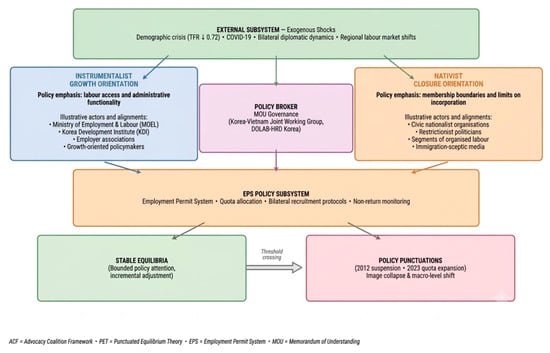
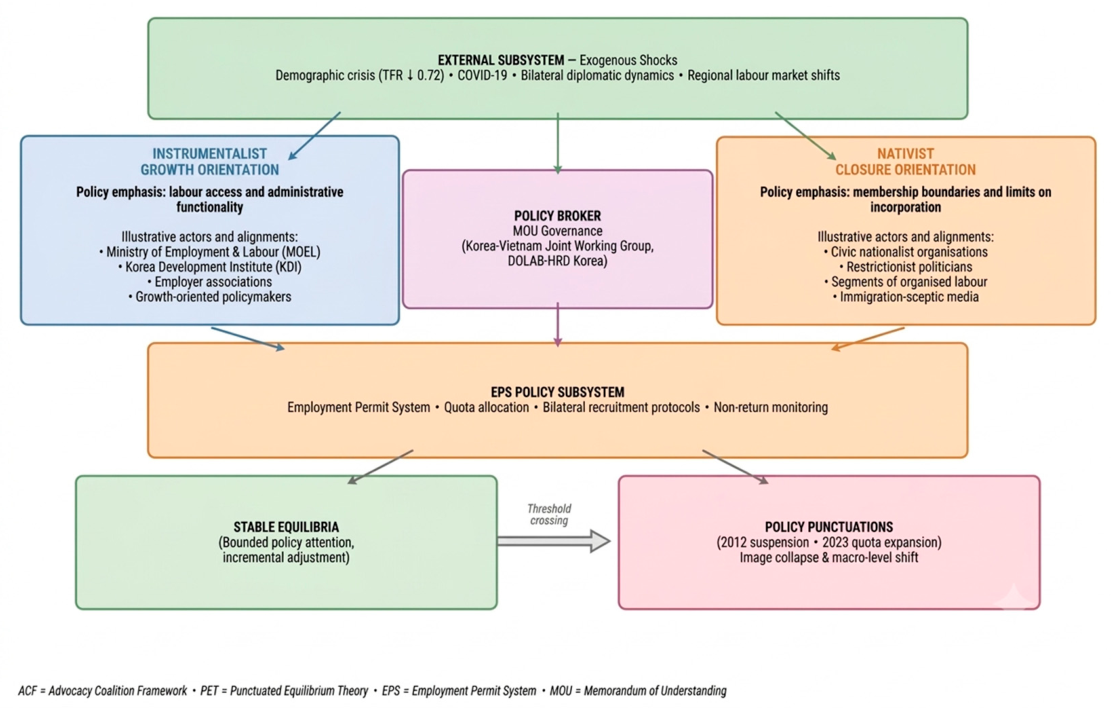
In the Korean–Vietnamese migration context, ACF provides the micro-foundational account of why the EPS subsystem maintained stable governance trajectories despite accumulating demographic pressure and administrative complexity, while PET identifies the critical episodes in which that stability was disrupted. The result is a layered explanation: belief systems structure the stable phases; image shifts and venue mobilisation trigger the punctuations; and cross-coalition coordination mechanisms (Koebele 2020) mediate between stability and change in the aftermath of punctuation (see Figure 1).
Figure 1.
Integrated ACF–PET Framework Applied to Korean–Vietnamese Migration Policy Governance. Source: Author’s own construction, based on Sabatier and Weible (2007), Baumgartner and Jones (1993), and Dunlop and Radaelli (2013). Note: The two categories represent analytically reconstructed policy orientations rather than fixed organisational coalitions; institutional affiliation alone does not establish coalition membership. Arrows indicate the direction of analytical influence and interaction among the components of the framework; the arrow labelled “Threshold crossing” indicates the transition from stable equilibrium to policy punctuation.
3. Demographic Emergency and Migration Policy in South Korea
3.1. Ultra-Low Fertility, Ageing, and the Labour Gap
South Korea’s demographic trajectory exemplifies what demographers have termed the ‘second demographic transition’ in its most extreme form. The TFR fell from 1.47 in 2000 to 1.23 in 2010, reaching 0.84 in 2020 and 0.72 in 2023—far below Japan (1.20) or Germany (1.46), and less than a third of the replacement rate (Statistics Korea 2024; OECD 2024). Simultaneously, the proportion of the population aged 65 and above rose from 7.2 per cent in 2000 to 18.4 per cent in 2023, projected to reach 46.4 per cent by 2067 (Statistics Korea 2024). The working-age population (15–64) is projected to contract by 35 per cent by 2050, generating structural deficits in precisely those sectors—manufacturing, agriculture, fisheries, and eldercare—that constitute the primary demand base for EPS migrant workers (Korea Development Institute 2025).
The labour gap is not uniformly distributed across the Korean economy. In manufacturing, the Korea Federation of Small and Medium Business estimated a shortage of approximately 150,000 workers in 2022, concentrated in the SME sector where EPS workers are the dominant foreign labour supply channel. Agricultural and fisheries sectors report vacancy rates exceeding 30 per cent in peak seasons. The care economy—including residential facilities for the elderly and in-home care services—faces a projected deficit of 440,000 qualified workers by 2030 as the population aged 80 and above doubles (Korea Development Institute 2025). These sector-specific pressures have intensified demands for expanded recruitment. Admission ceilings must nevertheless be distinguished from the administrative processes through which workers are selected, matched with employers, and admitted. A difference between planned recruitment and actual arrivals does not by itself identify the source of delay; attributing it to staffing shortages or testing capacity requires specific operational evidence.
The political response to this crisis has been characterised by a pronatalist–migration bifurcation. Successive administrations have invested an estimated 280 trillion Korean won (approximately USD 200 billion) in pronatalist incentives since 2006, with negligible measurable effect on fertility rates (Choi et al. 2024). The accumulated evidence of pronatalist failure has progressively elevated migration governance as a demographic policy instrument, particularly following the COVID-19 pandemic’s acceleration of labour shortfall visibility. However, this elevation has been contested by the belief-level constraints examined in Section 5, producing the policy dissonance that characterises South Korea’s contemporary migration governance.
3.2. From Ethnic Homogeneity to Managed Diversity
South Korea’s migration policy has been historically structured by a deep core belief in ethnic homogeneity (danil minjok), which has positioned migration governance as a temporary labour market intervention rather than a pathway to demographic renewal or multicultural transformation. This belief was institutionally reflected across multiple policy domains. The EPS itself does not provide an automatic settlement pathway, although eligible E-9 workers may transition to the E-7-4 skilled-worker status under the points-based system, providing a selective route to extended residence. Preferential residence and naturalisation arrangements are also available to certain categories such as ethnic Koreans and marriage migrants, while policy discourse has consistently framed migrant workers as ‘foreign workers’ (oegukin geullo ja) rather than potential social members (Kim and Kwon 2012; Ministry of Justice, Republic of Korea n.d.-b).
Torneo and Yang (2015) characterise the resulting policy architecture as ‘policy dissonance’: economic development imperatives demand expanded labour migration, while ethno-nationalist deep core beliefs constrain its institutionalisation as a long-term demographic strategy. This dissonance produces measurable governance contradictions—systematic underallocation of EPS quotas relative to employer demand, tolerance of irregular migration as a shadow supply mechanism, and recurrent resort to bilateral restriction rather than structural reform when policy images deteriorate. The contradiction is accentuated by the temporal mismatch between demographic urgency—which requires permanent population replacement—and the EPS design logic of temporary circular migration, which by institutional design produces no demographic dividend.
Kim and Kilkey (2018) identify an analogous instrumentalization logic in marriage migration, where the Korean state has deployed female migrants from Southeast Asia—including Vietnam—as a demographic supplement to rural population decline while denying full social citizenship to immigrant spouses. This pattern of ‘social investment beyond the nation state’ provides a structural template for understanding the instrumentalization dynamics of EPS governance examined in subsequent sections: the state consistently maximises migrant labour supply while minimising the institutional changes that would embed migration as a permanent feature of Korean demographic structure.
4. The Korea–Vietnam Migration Architecture
4.1. From Industrial Trainee System to Employment Permit System
Contemporary Korean labour migration governance emerged from two decades of institutional evolution beginning with the Industrial Trainee System (ITS) established in 1991. Formally classifying migrant workers as ‘trainees’ rather than workers, the ITS denied access to core labour rights protections while enabling SMEs to recruit low-wage labour from designated Asian sending countries. This institutional design reflected the policy core belief that labour migration should be structured as a temporary, non-rights-bearing supplement to the domestic workforce—a framing compatible with the deep core belief in ethnic homogeneity.
The ITS generated extensive documented failures: irregular status proliferation, wage theft, workplace abuse, and high non-return rates as workers sought to extend stays denied by the temporary framework. Civil society coalitions—including migrant worker NGOs, legal advocacy groups, and progressive labour unions—mobilised political attention against the ITS by portraying it as a system associated with exploitation and inadequate labour protection that required structural replacement rather than incremental reform. This mobilisation constitutes, in PET terms, a successful image construction that triggered the punctuation leading to the EPS.
The EPS was enacted through the Act on Foreign Workers’ Employment (Act No. 6967) in 2003 and implemented from August 2004. The EPS replaced the ITS with a government-to-government recruitment model operated through bilateral MOUs with sending countries, extending labour law protections to migrant workers, establishing capped sector-specific quotas, and creating non-renewable work permits of three to five years (Park 2016). This transition preserved the temporariness doctrine while significantly improving the rights architecture, consistent with Weible’s (2018) observation that instrument reform tends to reproduce core instrument logic even when substantially modifying its operational features. Instrument constituencies within MOEL and employer associations ensured continuity of the quota-managed temporary model, foreclosing settlement alternatives that would have required deep core belief revision.
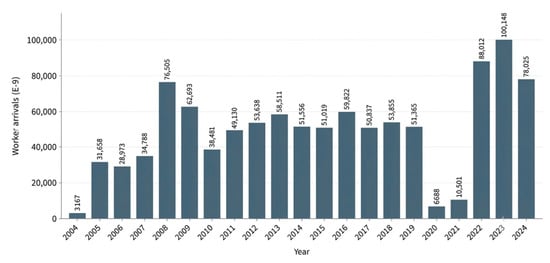
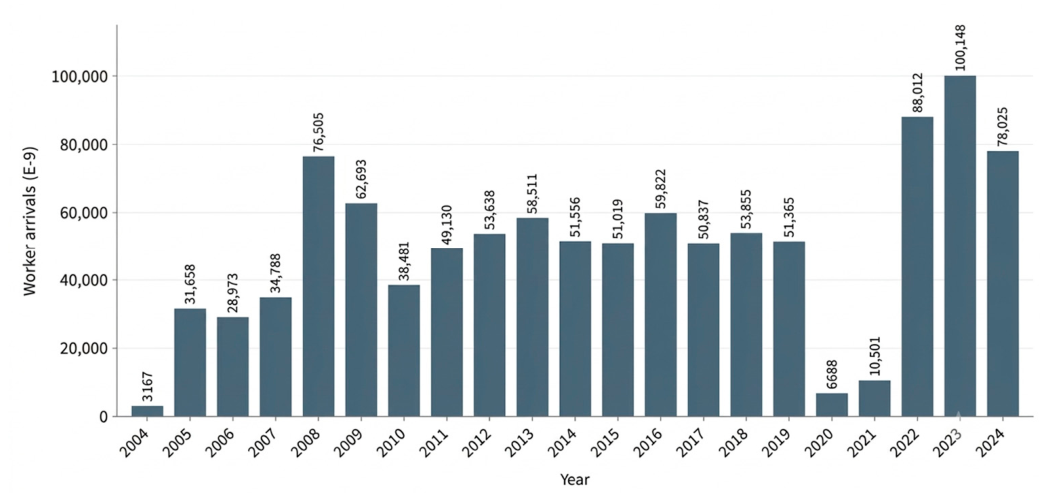
Figure 2 presents annual E-9 worker arrivals under the Employment Permit System from 2004 to 2024. Arrivals fell from 51,365 in 2019 to 6688 in 2020 and 10,501 in 2021, before rising to 88,012 in 2022 and 100,148 in 2023; the total then declined to 78,025 in 2024. These aggregate admission figures provide context for the scale and variability of the EPS, while Vietnam-specific developments are examined separately in Section 4.2.
Figure 2.
Annual E-9 Worker Arrivals under Korea’s Employment Permit System, 2004–2024. Note: Figures represent E-9 admissions for employment, including new admissions and re-admissions; H-2 workers are excluded. They are admission flows, not quotas or year-end resident stocks. Annual values for 2005–2023 are calculated by subtracting the previous year’s cumulative total from the current year’s total in the 2024 white paper; 2004 is the initial total. The 2024 value is the full-year actual figure reported in HRD Korea’s 2025 management plan. Source: Author’s calculations from Ministry of Employment and Labor and Human Resources Development Service of Korea (2024, p. 12) and Human Resources Development Service of Korea (2025, pp. 2, 16).
4.2. Vietnam Within the EPS Framework
Vietnam was one of the six initial EPS sending countries to conclude an MOU with South Korea in 2004, reflecting its established position as a labour-sending economy and the significant Korean foreign direct investment presence in Vietnamese manufacturing (OECD 2019). The Vietnamese EPS recruitment channel examined here concerns non-professional employment under E-9 status. Other employment or residence routes should be distinguished from this channel rather than presented as residual EPS flows. In particular, seasonal-worker arrangements are institutionally separate from EPS recruitment. Geographic concentration occurred in Gyeonggi Province (adjacent to Seoul), North and South Chungcheong, and Gyeongnam, clustering around Korean manufacturing and agricultural zones with high SME presence.
The bilateral EPS relationship was managed through Korea–Vietnam Joint Working Group meetings, typically convened twice annually, which served as the primary administrative forum for monitoring non-return rates, quota negotiations, pre-departure training standards, and employer compliance. Non-return rates—defined as the proportion of EPS contract completers remaining in Korea after permit expiry—became the central governance indicator in bilateral relations, formally incorporated into MOU conditionality from 2012 onward. Vietnam’s non-return rates fluctuated between 30 and 55 per cent across different sending provinces during the 2008–2012 period, considerably exceeding the bilateral threshold of 22 per cent set in the original MOU, and concentrated disproportionately in Nghe An, Thanh Hoa, Ha Tinh, and Hai Phong provinces (Ministry of Employment and Labour, Republic of Korea 2023). This provincial variation in compliance performance became the administrative trigger for the 2012 punctuation.
Non-return should not, however, be understood solely as a matter of worker compliance or unmet labour demand. Recruitment expenses and associated debts may alter the incentives surrounding job mobility and return. Hoang’s (2020) study of Vietnamese workers in Taiwan demonstrates the importance of debt in shaping migration decisions, although its findings cannot be transferred directly to the Korean EPS. In the Korean case, excessive or unauthorised recruitment charges should therefore be considered as a plausible additional mechanism: indebted workers may seek higher-paid employment or extend their stay to recover migration costs. The evidence examined here does not establish the relative contribution of this mechanism to provincial non-return rates.
Vietnam’s Office for Overseas Labour (DOLAB) and Korea’s Human Resources Development Service (HRD Korea) operated as the G2G executing agencies, creating a bilateral administrative epistemic community of labour migration professionals whose functional interests were aligned around the smooth operation of the EPS framework (Dunlop 2009). This epistemic community functioned as a stabilising mechanism within the policy subsystem, absorbing compliance tensions through bilateral administrative channels and insulating them from political escalation. Vietnamese labour migration under the EPS forms part of a broader migration relationship between Vietnam and Korea. As Table 1 shows, the number of Vietnamese nationals staying in Korea increased from 208,740 at the end of 2021 to 305,936 at the end of 2024 (Ministry of Justice, Republic of Korea n.d.-a). These figures encompass multiple categories of stay and provide demographic context for the Vietnamese case; they should not be interpreted as the size of the Vietnamese EPS workforce or as direct evidence of EPS expansion.
Table 1.
Vietnamese Nationals Staying in Korea at Year-End, 2021–2024.
5. Policy Beliefs and Coalition Dynamics in the EPS Subsystem
5.1. Deep Core and Policy Core Beliefs
The analysis distinguishes two coalition orientations without treating them as equivalent to political parties or as uniformly pro- or anti-migration. The instrumentalist growth orientation prioritises access to labour for economic and administrative purposes, while the nativist closure orientation prioritises national membership boundaries and control over migrant incorporation. Actors associated with the latter may nevertheless support substantial temporary labour recruitment. These labels identify contrasting policy orientations; membership in an advocacy coalition additionally requires evidence of shared policy core beliefs and coordination, rather than institutional affiliation alone.
Four dimensions must therefore be distinguished: admission volumes, the respective roles of government and employers in recruitment, labour-rights protection, and access to long-term residence and social integration. Agreement on temporary labour recruitment does not necessarily imply agreement on the EPS’s government-to-government architecture or on the appropriate distribution of rights and responsibilities. Conversely, support for higher admission ceilings does not by itself establish support for settlement or integration.
Secondary beliefs—more empirically tractable and hence more susceptible to updating—cluster around the measurement and interpretation of non-return rates. Non-return rates function as a critical policy indicator because they are directly observable, bilaterally attributed, and formally linked to MOU compliance conditions. An explanation centred on labour shortages and access to legal employment is insufficient on its own. Recruitment debt, workplace conditions, and restrictions on job mobility may also influence decisions to remain after permit expiry. Quota expansion consequently cannot be assumed to address all of the mechanisms producing non-return. The nativist closure coalition construes them as evidence of bilateral governance failure and migrant non-compliance, advocating punitive sending-country sanctions. The same empirical indicator thus activates entirely different causal narratives depending on the underlying belief system, illustrating the ACF’s central claim that secondary belief disputes are not resolvable through evidence alone when they are embedded in policy core belief conflict (Weible and Ingold 2018).
5.2. The Instrumentalist Growth Coalition
Support for maintaining lawful labour recruitment does not imply a uniform ordering of policy goals. Employers may emphasise timely access to workers, administrative agencies may prioritise implementation and compliance, and migrant-rights organisations may place greater weight on protection from exploitation, effective remedies, and job mobility. Their positions may overlap on particular EPS reforms without constituting a cohesive coalition on every issue. Labour-rights protection should therefore be treated as a substantive and potentially contested objective, rather than as an automatic consequence of administrative efficiency.
MOEL occupies a pivotal policy broker role within the subsystem (Sabatier 1988): as the administrative owner of the EPS architecture, MOEL has a strong institutional interest in maintaining EPS functionality against both coalition challenges. Its brokerage orientation is, however, constrained by political accountability: visible policy failures—whether defined as labour shortfalls by the instrumentalist coalition or as high non-return rates by the nativist coalition—attract macro-political attention that threatens the subsystem’s administrative autonomy. MOEL’s position involved balancing recruitment continuity, compliance concerns, and worker protection. Its resort to restriction in 2012 should therefore not be treated, without further evidence, as proof that nativist pressure displaced all other considerations.
Within the instrumentalist coalition, epistemic authority has been exercised primarily through Korea Development Institute research outputs and MOEL administrative data, which frame the labour shortage in quantitative terms incompatible with significant EPS restriction. This research community functions as the coalition’s secondary belief anchor, providing the empirical infrastructure for quota expansion advocacy. The coalition’s institutional leverage has historically been high during periods of economic growth and low unemployment, when labour demand makes the cost of restriction politically visible; it has been lower during recessions or periods of elevated domestic unemployment, when the nativist coalition’s employment displacement narrative gains wider political traction.
5.3. The Nativist Closure Coalition
The nativist closure orientation concerns the boundaries of membership and the conditions of migrant incorporation, rather than an invariant preference for fewer foreign workers. Temporary recruitment may be acceptable to actors who oppose broader settlement or integration. The strength and composition of such alignments may vary across policy episodes; conservative party affiliation alone is therefore insufficient to establish coalition membership.
This distinction is also relevant to recent expansionary initiatives. The 2024 foreign domestic-worker pilot, implemented under the E-9 framework, illustrates how support for additional temporary labour recruitment may arise in response to sectoral labour shortages without implying support for broader settlement or integration. Such initiatives therefore should not be interpreted, on their own, as evidence of a wholesale transformation of Korea’s labour migration model (Ministry of Employment and Labour, Republic of Korea 2024).
Berglund’s (2023) analysis of disruptive social movement strategies illuminates how actors within the nativist closure coalition have periodically mobilised through extra-institutional action—media campaigns highlighting overstay statistics, parliamentary petitions, and direct protests at MOEL facilities—to shift migration policy images and accelerate macro-political attention toward restrictive responses. These mobilisations correspond closely to the policy punctuations identified in Section 6, suggesting that social movement dynamics within the nativist coalition function as PET-style image entrepreneurs: constructing negative policy images, identifying sympathetic institutional venues, and generating the political attention necessary to override subsystem resistance.
The relationship between coalition orientation and policy direction is not fixed. Expansion of temporary recruitment can attract support from actors with different positions on settlement, labour rights, and employer control. The 2020–2024 episode should therefore be assessed in terms of which policy dimensions changed and which remained constrained, rather than being classified automatically as an instrumentalist victory over nativist opposition.
5.4. Bilateral MOU Governance as Cross-Coalition Coordination
The Korea–Vietnam bilateral MOU system creates an institutional platform that partially bridges coalition conflicts without resolving them. As Koebele (2020) demonstrates in collaborative watershed governance contexts, cross-coalition coordination mechanisms can generate shared administrative interests and information-sharing practices that reduce policy transaction costs even among actors with deeply conflicting belief systems. In Korea–Vietnam EPS governance, the Joint Working Group meetings, pre-departure orientation programmes, DOLAB–HRD Korea communication channels, and post-return monitoring systems create a functional space where instrumentalist growth coalition officials in both countries coordinate without engaging the nativist-driven secondary belief disputes that animate domestic coalition conflict in Korea.
This cross-coalition coordination dynamic also illustrates Dunlop’s (2009) insight that policy learning within G2G governance platforms is inherently selective: Korean MOEL officials can absorb Vietnamese labour export governance practices as technical knowledge without triggering the belief-level threat that more visible cross-coalition engagements would provoke. The result is insulated policy learning confined to secondary beliefs about administrative procedures, leaving deep core and policy core belief contests unresolved within the domestic EPS subsystem. The MOU platform thus functions as a ceiling on learning: it is highly effective at generating the secondary belief convergence that Koebele (2020) identifies as the productive upper bound of cross-coalition coordination, and structurally incapable of producing the deep core belief revision that transformative migration governance reform would require.
6. Punctuated Equilibria in Korean–Vietnamese Migration Policy
6.1. The EPS Equilibrium (2004–2011)
Following the ITS-to-EPS transition in 2004, Korean–Vietnamese migration governance entered a period of relative stability. Annual EPS recruitment from Vietnam expanded consistently from approximately 4000 workers in 2004 to a peak of approximately 18,000 in 2010–2011, bilateral administrative cooperation deepened through regularised Joint Working Group interactions, and the policy image of Vietnamese migration was characterised by administrative tractability—neither politically salient nor a major source of coalition conflict. The instrumentalist growth coalition maintained subsystem dominance, managing quota negotiations through MOEL’s administrative discretion with minimal macro-political intervention.
Several stabilising mechanisms sustained this equilibrium. The prospect of future lawful recruitment could encourage compliance, but this incentive was neither uniform nor necessarily decisive. For workers facing substantial recruitment debts, immediate earnings from continued employment could outweigh the uncertain benefits of a future recruitment opportunity. Formal recruitment arrangements should therefore not be assumed to eliminate the financial pressures associated with irregular employment or overstaying. Korea’s export-led economic growth during this period maintained high labour demand, aligning the interests of employer associations and MOEL with continued Vietnamese recruitment. The bilateral MOU framework functioned as an institutional shock-absorber: when compliance issues arose—including early signs of provincial non-return rate divergence from 2007 onward—they were managed administratively through the Joint Working Group, insulating the subsystem from political escalation consistent with the selective information processing that PET identifies as the hallmark of equilibrium periods (Baumgartner and Jones 1993). Rising non-return rates were acknowledged within bilateral administrative channels but not re-framed as a sovereignty or governance crisis, enabling continued equilibrium.
6.2. The 2012 Punctuation: Policy Image Collapse and Provincial Suspension
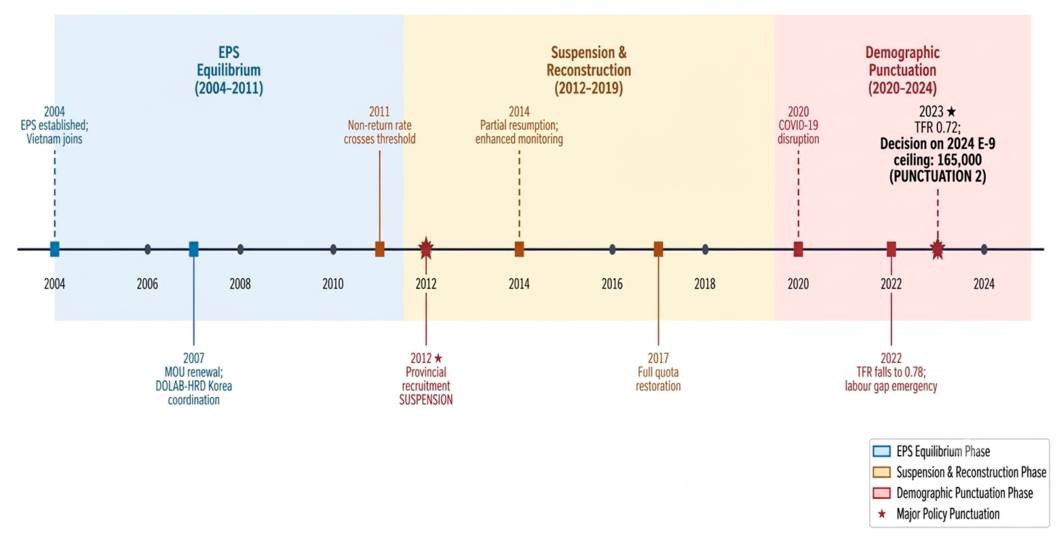
The first major policy punctuation occurred in January 2012, when MOEL announced the suspension of EPS worker selection from three Vietnamese provinces—Nghe An, Thanh Hoa, and Ha Tinh—citing non-return rates significantly exceeding the bilateral MOU compliance threshold. This suspension was subsequently extended to broader restrictions on Vietnamese EPS recruitment, representing a structural disruption of the equilibrium established in 2004.
PET analysis illuminates the triggering mechanism. Accumulated non-return rate data from these provinces had been processed within the subsystem through incremental compliance management for several years without triggering macro-political attention. However, a convergence of factors in 2011–2012 produced a venue shift: intensified media reporting on irregular Vietnamese migration—particularly narratives linking Vietnamese overstayers to irregular labour markets in the greater Seoul metropolitan area—nativist coalition parliamentary mobilisation through the National Assembly’s labour committee, and the broader political context of the 2012 National Assembly and presidential election cycles created conditions in which MOEL’s administrative management of non-return data was displaced by politically framed scrutiny. The non-return problem—previously managed as an administrative compliance issue—was reconstructed as a sovereignty and governance failure narrative, generating the macro-political attention that PET identifies as the proximate cause of punctuation.
From an ACF perspective, the restrictive response can be examined as an outcome of competing interpretations of non-return, rather than as conclusive evidence of one coalition’s victory. Enforcement-oriented actors could support suspension as a means of strengthening compliance, while concerns about abusive recruitment could provide a separate worker-protection rationale. These motivations are analytically compatible, but the evidence presented does not establish their relative influence on the 2012 decision. Nor does the adoption of restriction itself demonstrate policy failure. Evaluating its effects requires distinguishing changes in Vietnamese recruitment and return behaviour from possible substitution toward other sending countries, as well as examining recruitment costs and workers’ subsequent migration trajectories.
6.3. Reconstructing Equilibrium (2014–2019)
A new equilibrium was reconstructed through bilateral negotiation that formalised compliance conditionality as a core feature of the MOU relationship. Vietnam undertook domestic governance reforms—including enhanced pre-departure orientation curricula, collateral deposit requirements for workers from high non-return provinces, strengthened return monitoring through DOLAB, and provincial-level compliance performance assessments—in exchange for phased reinstatement of EPS recruitment quotas. A revised Korea–Vietnam EPS MOU, concluded in 2016, institutionalised these conditionality mechanisms within the bilateral architecture.
Assessment of these reforms should distinguish obligations imposed on workers from measures directed at abusive recruitment intermediaries. Pre-departure information and return monitoring do not themselves establish that excessive recruitment charges have been addressed. Enforcement against intermediaries, including licensing sanctions where applicable, concerns a different allocation of responsibility from worker-funded deposits and should be evaluated separately.
This post-punctuation equilibrium differed from its predecessor in three important respects. First, it institutionalised secondary belief revision: both coalition camps accepted enhanced bilateral administrative cooperation as a necessary feature of EPS governance, even while their policy core and deep core belief positions remained unchanged. This secondary belief convergence is precisely the outcome Koebele (2020) identifies as the productive upper bound of cross-coalition coordination: shared administrative norms are achievable; shared policy values are not. Second, conditionality redistributed the responsibilities and costs of maintaining the bilateral recruitment channel. Measures directed at Vietnam did not necessarily reduce total EPS admissions, because recruitment could be redirected toward other sending countries. Worker-funded deposits also require separate distributional analysis: although they may preserve access to recruitment while strengthening return incentives, they place financial resources at risk at the level of the individual worker. Such arrangements may therefore be more compatible with enforcement-oriented preferences than with migrant-rights objectives. Their adoption should be understood as a potentially asymmetric accommodation, rather than as evidence that both coalitions benefited equally or that the underlying causes of non-return were resolved.
6.4. The Demographic Punctuation (2020–2024)
The conditions for the second major punctuation emerged with the COVID-19 pandemic’s disruption of international mobility from March 2020, which generated acute labour shortfalls across manufacturing, agriculture, and care sectors that could not be absorbed within the EPS’s existing quota and administrative framework. Emergency measures including expedited visa processing, grace period extensions for workers whose permits expired during border closures, and temporary status adjustments were introduced in 2020–2021, representing subsystem-level responses to an extraordinary external shock rather than a punctuation in the PET sense.
The punctuating transformation came as COVID-related labour shortfalls coincided with intensifying public recognition of Korea’s fertility emergency. The fall of the TFR below 0.80 in 2020 and its accelerating decline through 2021–2023 generated an unprecedented convergence of demographic and labour market crisis narratives in elite policy discourse, transforming the policy image of labour migration from a technical labour market instrument to a potential demographic intervention. This reframing is evidenced by the explicit incorporation of migration expansion into the Yoon Suk-yeol administration’s demographic crisis response framework from 2022, the government’s November 2023 decision to raise the 2024 E-9 admission ceiling to a record 165,000, a 37.5 per cent increase from 120,000 in 2023, and the expansion of E-9 eligibility into additional sectors facing persistent labour shortages, including restaurants, forestry, and mining (Ministry of Employment and Labour, Republic of Korea 2023).
The 2023 quota expansion represents a partial policy punctuation in the PET sense: a shift in macro-political image from ‘managed labour supplementation’ to ‘demographic necessity’ has mobilised resources and political attention sufficient to override the nativist closure coalition’s resistance to quota expansion. The expansion remains, however, bounded by the deep core belief in temporariness: EPS structural features—non-renewable permits, absence of settlement pathways, sector restrictions—have not been reformed. As Choi et al. (2024) demonstrate, while public attitudes toward migration are gradually softening in the context of demographic decline, nativist deep core beliefs remain sufficiently mobilisable to constrain transformative policy reform. Whether the current expansion represents a durable equilibrium shift or a temporary macro-political override of subsystem stability remains empirically contested (see Figure 3).
Figure 3.
Policy Punctuations in South Korea–Vietnam EPS Governance (2004–2024). Source: Author’s own construction, based on Korean Ministry of Employment and Labour (MOEL) official reports, Republic of Korea–Vietnam bilateral memoranda of understanding (2004–2024), and parliamentary records of the National Assembly of the Republic of Korea.
7. Discussion: The Instrumentalization Trap
7.1. Migration as Demographic Instrument and Its Structural Limits
Boswell (2007) argues that states ‘instrumentalize’ migration when they configure migrant populations as governance tools for resolving specific public policy problems rather than as rights-bearing subjects. South Korea’s Korean–Vietnamese migration governance exemplifies this logic across multiple layers: labour market supplementation, bilateral foreign policy signalling, demographic response, and—increasingly from 2020—explicit demographic rescue. Each layer of instrumentalization reframes migration in terms of Korean state governance needs, structurally subordinating the interests and continuity expectations of migrant workers to the policy requirements of the receiving state.
The instrumentalization trap does not require both coalitions to share the same ethno-nationalist commitments. Similar institutional outcomes may arise from different motivations: actors concerned with limiting settlement may actively prefer temporariness, while actors seeking labour access may accept it as a politically feasible concession. Continued reliance on temporary recruitment therefore indicates an institutional accommodation, not necessarily convergence in deep core beliefs. Its demographic limitations should also be stated carefully. Temporary workers contribute to the resident workforce and economic activity, but higher admission ceilings alone do not ensure durable residence, family formation, or long-term demographic renewal. The central tension concerns the use of a labour-supply instrument to pursue broader demographic objectives without equivalent changes in migrants’ opportunities for sustained membership.
The PET dimension compounds this trap. When demographic shocks punctuate migration policy equilibria and trigger quota expansions, the absence of belief-level change means that institutional responses reproduce the same instrument in enlarged form. This corresponds precisely to what Taylor et al. (2021) term ‘ambiguity-driven implementation failure’: where policy objectives are internally inconsistent—demographic renewal through non-settlement migration—administrative expansion of the instrument intensifies rather than resolves the underlying problem. The political economy of this failure is self-sustaining: as the demographic crisis deepens, political pressure for observable policy action increases, driving further quota expansion within the existing temporary framework, which produces further evidence of the framework’s demographic ineffectiveness, which in turn deepens the crisis and intensifies the pressure.
7.2. Belief Rigidity and Policy Learning Pathologies
Dunlop’s (2017) framework helps identify questions about the quality of policy learning, but it should not be used to classify the 2012 restriction as an established case of autopilot failure without evidence about the decision-making process. Relevant questions include whether policymakers considered recruitment debt, abusive intermediation, and workers’ employment conditions alongside non-return statistics. Country-specific restrictions could also redirect recruitment toward other sending countries. Their effects on aggregate labour supply and irregular migration therefore require separate assessment rather than being inferred from the restriction itself.
The post-restriction arrangements raise a related question about policy learning: whether measures were selected on the basis of demonstrated effectiveness or because they offered an administratively feasible accommodation. The adoption of deposits and pre-departure measures alone cannot resolve this question. Evaluation must consider their effects on return behaviour alongside their financial burden on workers and their capacity to address abusive recruitment practices.
The 2020–2024 demographic emergency response shows emergent reflexive learning (Dunlop 2017): there is evidence at the technocratic level—in government white papers, think-tank analyses, and MOEL consultation processes—of genuinely belief-revising deliberation about the temporariness doctrine and its compatibility with demographic objectives. Policy discussions on pathways to extended residence for EPS workers in care sectors, on point-based permanent residence criteria for long-term migrant contributors, and on selective naturalisation for highly skilled workers all suggest secondary-to-policy-core belief migration within the instrumentalist growth coalition’s technocratic wing. Whether this technocratic reflection can survive macro-political coalition contestation and produce structural instrument reform is the critical empirical question for the next phase of Korean migration governance.
Dunlop’s (2009) insight that policy learning within bilateral G2G governance is inherently selective—absorbing technically consensual knowledge while insulating belief-contested questions—explains why two decades of Korea–Vietnam administrative cooperation have not generated the belief revision necessary for transformative policy change. The Korea–Vietnam EPS subsystem has demonstrably learned to manage administrative compliance; it has not learned to question whether temporary managed migration can address permanent demographic deficit.
7.3. Comparative Implications for East Asian Migration Governance
The integrated ACF–PET analysis of Korean–Vietnamese migration governance generates three comparative implications for policy-process and migration-governance scholarship. First, it demonstrates that policy punctuations in migration governance are structured by advocacy coalition belief configurations within migration subsystems, not merely by economic pressure or geopolitical events. Restriction punctuations require nativist coalitions to mobilise new political venues; expansion punctuations require instrumentalist coalitions to access macro-political attention. This asymmetry in punctuation direction reflects deeper institutional biases in Korean governance toward precautionary restriction in migration policy, an insight generalizable to other East Asian developmental states with analogous belief configurations.
Second, the case illustrates the ceiling effect of cross-coalition coordination mechanisms (Koebele 2020) in domains where deep core beliefs are strongly contested. Bilateral MOU governance has been highly effective at generating secondary belief convergence on administrative procedures, including pre-departure training standards, quota calculation methodologies, and non-return monitoring systems. It has not been able to—and by the logic of the ACF cannot—generate policy core or deep core belief revision through administrative interaction alone. This finding has implications for the design of bilateral migration governance frameworks in contexts where receiving-state deep core beliefs structurally constrain transformative reform.
Third, the demographic instrumentalization dynamic examined here is likely to intensify across East Asian developmental states experiencing ultra-low fertility. Japan and Taiwan nevertheless demonstrate that temporary labour migration regimes may incorporate selective retention pathways. Japan’s Specified Skilled Worker (SSW) system differentiates between SSW(i), which generally limits residence to a cumulative five years and does not permit family accompaniment, and SSW(ii), which allows renewable residence without a cumulative upper limit, permits family accompaniment, and may contribute toward eligibility for permanent residence. Taiwan similarly introduced its Long-Term Retention of Skilled Foreign Workers Program in 2022, enabling eligible experienced migrant workers to transition to intermediate-skilled employment without a fixed employment-duration limit and, after five years of such employment and subject to statutory requirements, to connect to the permanent-residence system. These arrangements suggest that East Asian labour migration regimes are better understood as combining temporary recruitment with selective pathways to longer-term residence rather than as uniformly preserving a strict non-settlement architecture (Immigration Services Agency of Japan n.d.).
In both cases, the belief-level interaction documented in the Korean–Vietnamese case—instrument constituencies sustaining predominantly temporary recruitment structures across punctuation episodes, cross-coalition coordination generating secondary but not deep core belief revision—appears reproduced in different institutional configurations. The political economy of migration instrumentalization in these contexts warrants sustained comparative analysis, particularly regarding the conditions under which punctuations of the deep core belief in ethnic homogeneity can be generated or whether technocratic reflexive learning (Dunlop 2017) offers a more realistic pathway to belief revision than coalition-level political competition.
8. Conclusions
This article has applied an integrated ACF–PET framework to South Korea’s Vietnamese migration governance, tracing the belief-driven dynamics of two major policy punctuations from the EPS’s establishment in 2004 to the demographic emergency expansion of 2023. The analysis identifies the 2012 provincial suspension and the 2020–2024 quota expansion as distinct punctuation types: the former driven by nativist closure coalition image mobilisation in a context of compliance accumulation; the latter by demographic emergency reframing that partially overrides nativist resistance at the macro-political level while leaving subsystem belief configurations structurally intact.
Three findings advance policy-process scholarship on migration governance. First, the instrumentalist growth coalition’s instrument attachment to the EPS temporariness model—despite its structural incompatibility with demographic renewal—demonstrates Weible’s (2018) insight that instrument constituencies reproduce policy core beliefs across punctuation episodes, constraining transformative reform even when macro-political conditions are favourable. Second, the cross-coalition coordination function of bilateral MOU governance confirms Koebele’s (2020) model while extending its ceiling-effect implications: secondary belief convergence is achievable in bilateral administrative contexts; policy core and deep core belief revision is not. Third, Dunlop’s (2017) policy learning framework provides a useful diagnostic lens for examining the quality of learning across these episodes. The available evidence cautions against definitively classifying the 2012 restriction as an autopilot failure, while the post-2020 period shows clearer signs of reflexive learning concerning the compatibility between temporary migration and demographic objectives.
For comparative migration governance scholarship, this analysis argues that a central constraint on the demographic effects of migration policy in South Korea lies in the continued institutional reliance on temporary recruitment despite growing demographic pressures for longer-term incorporation. This institutional outcome can be supported by actors with different underlying motivations and therefore does not require convergence in deep core beliefs. Transformative reform would require not only administrative adaptation but also broader political reconsideration of the boundaries of settlement and social membership. Technocratic learning within subsystem governance can generate secondary and potentially policy core belief revision among professional elites, but without macro-political venue access this learning cannot translate into structural instrument reform against nativist coalition resistance.
Future research should extend this framework in two directions. First, comparative application to Japanese, Taiwanese, and Singaporean migration subsystems—where analogous demographic trajectories and ethno-nationalist deep core beliefs may produce different coalition configurations and punctuation dynamics—would test the generalisability of the instrumentalization trap mechanism across East Asian developmental state contexts. Second, longitudinal tracking of whether the current Korean demographic punctuation generates durable belief revision or merely quota expansion within a temporariness equilibrium will be essential for assessing the theoretical contributions of the ACF–PET integration to migration policy analysis in demographically stressed governance environments.
Author Contributions
Conceptualization, H.K.; Writing—original draft, J.P.; Writing—review & editing, J.L.; Funding acquisition, H.K. All authors have read and agreed to the published version of the manuscript.
Funding
This research was funded by Keimyung University. No specific grant or funding number was assigned.
Institutional Review Board Statement
Not applicable.
Informed Consent Statement
Not applicable.
Data Availability Statement
The original contributions presented in this study are included in the article. Further inquiries can be directed to the corresponding author.
Conflicts of Interest
The authors declare no conflicts of interest.
References
- Baumgartner, Frank R., and Bryan D. Jones. 1993. Agendas and Instability in American Politics. Chicago: University of Chicago Press. Available online: https://press.uchicago.edu/ucp/books/book/chicago/A/bo6763995.html (accessed on 8 September 2026).
- Berglund, Oscar. 2023. Disruptive Protest, Civil Disobedience and Direct Action. Politics 45: 239–57. [Google Scholar] [CrossRef] [Scilit]
- Boswell, Christina. 2007. Theorizing Migration Policy: Is There a Third Way? International Migration Review 41: 75–100. [Google Scholar] [CrossRef] [Scilit]
- Brenner, Christine Thurlow. 2009. Punctuated Equilibrium and Immigration: A View from the States. Social Science Research Network. Available online: https://papers.ssrn.com/sol3/papers.cfm?abstract_id=1452382 (accessed on 8 September 2026).
- Cairney, Paul. 2012. Understanding Public Policy: Theories and Issues. Basingstoke: Palgrave Macmillan. Available online: https://search.worldcat.org/title/understanding-public-policy-theories-and-issues/oclc/760978680 (accessed on 8 September 2026).
- Choi, Sangwon, Jingyeong Song, Daeyoung Kwon, and Brian H. S. Kim. 2024. Population Decline and Public Attitudes toward Multicultural Immigration Policies in South Korea. Population, Space and Place 30: e2788. [Google Scholar] [CrossRef] [Scilit]
- Dunlop, Claire A. 2009. Policy Transfer as Learning: Capturing Variation in What Decision-Makers Learn from Epistemic Communities. Policy Studies 30: 289–311. [Google Scholar] [CrossRef] [Scilit]
- Dunlop, Claire A. 2017. Pathologies of Policy Learning: What Are They and How Do They Contribute to Policy Failure? Policy and Politics 45: 19–37. [Google Scholar] [CrossRef] [Scilit]
- Dunlop, Claire A., and Claudio M. Radaelli. 2013. Systematising Policy Learning: From Monolith to Dimensions. Political Studies 61: 599–619. [Google Scholar] [CrossRef] [Scilit]
- Hoang, Lan Anh. 2020. Debt and (Un)freedoms: The Case of Transnational Labour Migration from Vietnam. Geoforum 116: 33–41. [Google Scholar] [CrossRef] [Scilit]
- Human Resources Development Service of Korea. 2025. 2025 Foreign Workforce Bureau Management Plan. Available online: https://www.hrdkorea.or.kr/7/5/5/6/3?k=54431&pageNo=&searchType=&searchText= (accessed on 8 September 2026).
- Immigration Services Agency of Japan. n.d. Q&A on the Specified Skilled Worker System. Ministry of Justice, Japan. Available online: https://www.moj.go.jp/isa/policies/ssw/faq.html?hl=en (accessed on 4 September 2026).
- Jenkins-Smith, Hank C., Daniel Nohrstedt, Christopher M. Weible, and Karin Ingold. 2018. The Advocacy Coalition Framework: An Overview of the Research Program. In Theories of the Policy Process, 4th ed. Edited by Christopher M. Weible and Paul A. Sabatier. Boulder: Westview Press, pp. 135–71. Available online: https://www.taylorfrancis.com/chapters/edit/10.4324/9780429494284-5/advocacy-coalition-framework-overview-research-program-hank-jenkins-smith-daniel-nohrstedt-christopher-weible-karin-ingold (accessed on 8 September 2026).
- Kim, Gyuchan, and Majella Kilkey. 2018. Marriage Migration Policy in South Korea: Social Investment beyond the Nation State. International Migration 56: 23–38. [Google Scholar] [CrossRef] [Scilit]
- Kim, Junmo, and Yong-Soo Kwon. 2012. Economic Development, the Evolution of Foreign Labor and Immigration Policy, and the Shift to Multiculturalism in South Korea. Philippine Political Science Journal 33: 178–201. [Google Scholar] [CrossRef] [Scilit]
- Koebele, Elizabeth A. 2019. Integrating Collaborative Governance Theory with the Advocacy Coalition Framework. Journal of Public Policy 39: 35–64. [Google Scholar] [CrossRef] [Scilit]
- Koebele, Elizabeth A. 2020. Cross-Coalition Coordination in Collaborative Environmental Governance Processes. Policy Studies Journal 48: 727–53. [Google Scholar] [CrossRef] [Scilit]
- Korea Development Institute. 2025. KDI Economic Outlook Update. Sejong: Korea Development Institute. Available online: https://papers.ssrn.com/sol3/papers.cfm?abstract_id=5142562 (accessed on 8 September 2026).
- Ministry of Employment and Labor and Human Resources Development Service of Korea. 2024. The 20th Anniversary White Paper on the Employment Permit System. Available online: https://www.moel.go.kr/policy/policydata/view.do?bbs_seq=20241101417 (accessed on 8 September 2026).
- Ministry of Employment and Labour, Republic of Korea. 2023. 2023 Foreign Workers Employment Survey and EPS Statistical Report; Seoul: Ministry of Employment and Labour. Available online: https://www.moel.go.kr/english/main.do (accessed on 8 September 2026).
- Ministry of Employment and Labour, Republic of Korea. 2024. Applications for the Foreign Domestic Worker Pilot Service to Open for Seoul Residents from 17 July. July 16. Available online: https://www.moel.go.kr/news/enews/report/enewsView.do?news_seq=16825 (accessed on 8 September 2026).
- Ministry of Justice, Republic of Korea. n.d.-a. Foreign Resident. Available online: https://www.immigration.go.kr/moj/2412/subview.do (accessed on 4 September 2026).
- Ministry of Justice, Republic of Korea. n.d.-b. Skilled Worker Points System Visa (E-7-4). Korea Immigration Service. Available online: https://www.immigration.go.kr/immigration/1515/subview.do (accessed on 4 September 2026).
- Nohrstedt, Daniel, Karin Ingold, Christopher M. Weible, Elizabeth A. Koebele, Kristin L. Olofsson, Keiichi Satoh, and Hank C. Jenkins-Smith. 2023. The Advocacy Coalition Framework: Progress and Emerging Areas. In Theories of the Policy Process, 5th ed. Edited by Christopher M. Weible. New York: Routledge, pp. 130–60. [Google Scholar] [CrossRef] [Scilit]
- OECD. 2019. Recruiting Immigrant Workers: Korea 2019. Paris: OECD Publishing. [Google Scholar] [CrossRef] [Scilit]
- OECD. 2024. Society at a Glance 2024: OECD Social Indicators. Paris: OECD Publishing. [Google Scholar] [CrossRef] [Scilit]
- Park, Young-bum. 2016. Temporary Low-Skilled Migrant Worker Program in Korea: Employment Permit Scheme. Arbor 192: a290. [Google Scholar] [CrossRef] [Scilit][Green Version]
- Sabatier, Paul A. 1988. An Advocacy Coalition Framework of Policy Change and the Role of Policy-Oriented Learning Therein. Policy Sciences 21: 129–68. [Google Scholar] [CrossRef] [Scilit]
- Sabatier, Paul A., and Christopher M. Weible. 2007. The Advocacy Coalition Framework: Innovations and Clarifications. In Theories of the Policy Process, 2nd ed. Edited by Paul A. Sabatier. Boulder: Westview Press, pp. 189–222. Available online: https://books.google.com/books?id=P43klgEACAAJ (accessed on 8 September 2026).
- Sabatier, Paul A., and Hank C. Jenkins-Smith. 1993. Policy Change and Learning: An Advocacy Coalition Approach. Boulder: Westview Press. Available online: https://www.worldcat.org/title/policy-change-and-learning-an-advocacy-coalition-approach/oclc/26342869 (accessed on 8 September 2026).
- Statistics Korea. 2024. 2023 Vital Statistics; Daejeon: Statistics Korea. Available online: https://kostat.go.kr/board.es?mid=a10301010000&bid=204 (accessed on 8 September 2026).
- Taylor, Kristin, Stephanie Zarb, and Nathan Jeschke. 2021. Ambiguity, Uncertainty and Implementation. International Review of Public Policy 3: 8–22. [Google Scholar] [CrossRef] [Scilit]
- Torneo, Ador R., and Seung-Bum Yang. 2015. Policy Dissonance and the Challenges of Managing the Impacts of South Korea’s Industrial and Demographic Transition through Immigration. International Journal of Technology, Policy and Management 15: 95–111. [Google Scholar] [CrossRef] [Scilit]
- True, James L., Bryan D. Jones, and Frank R. Baumgartner. 2007. Punctuated-Equilibrium Theory: Explaining Stability and Change in American Policymaking. In Theories of the Policy Process, 2nd ed. Edited by Paul A. Sabatier. Boulder: Westview Press, pp. 155–87. Available online: https://search.worldcat.org/title/theories-of-the-policy-process/oclc/62890044 (accessed on 8 September 2026).
- Weible, Christopher M. 2018. Instrument Constituencies and the Advocacy Coalition Framework: An Essay on the Comparisons, Opportunities, and Intersections. Policy and Society 37: 59–72. [Google Scholar] [CrossRef] [Scilit]
- Weible, Christopher M., and Karin Ingold. 2018. Why Advocacy Coalitions Matter and Practical Insights about Them. Policy and Politics 46: 325–43. [Google Scholar] [CrossRef] [Scilit]
- Weible, Christopher M., Paul A. Sabatier, and Kelly McQueen. 2009. Themes and Variations: Taking Stock of the Advocacy Coalition Framework. Policy Studies Journal 37: 121–40. [Google Scholar] [CrossRef] [Scilit]

Disclaimer/Publisher’s Note: The statements, opinions and data contained in all publications are solely those of the individual author(s) and contributor(s) and not of MDPI and/or the editor(s). MDPI and/or the editor(s) disclaim responsibility for any injury to people or property resulting from any ideas, methods, instructions or products referred to in the content. |
© 2026 by the authors. Licensee MDPI, Basel, Switzerland. This article is an open access article distributed under the terms and conditions of the Creative Commons Attribution (CC BY) license.