


Abstract
This study analyses how Spanish digital news outlets covered the arrival of artificial intelligence in journalism and the social impact they attributed to it. That general objective is pursued through four specific research objectives rather than through hypotheses in a descriptive and exploratory design that traces the emergence and distribution of media attention, identifies dominant and omitted issue-specific frames, and assesses their association with journalistic variables. A longitudinal quantitative content analysis covers 242 news items from ten leading Spanish digital outlets, coded in their entirety rather than sampled, across the three phases of AI’s public visibility between 2022 and 2024. Coverage follows a compressed attention cycle in which enthusiasm and alarm unfold simultaneously rather than consecutively. Dominant frames centre on generative AI in the processing phase, credibility, ethics in the use of data, legal responsibility and information quality, and timeliness and accuracy as its main advantage and disadvantage. Systematically omitted are the effects of AI on the normative functions of journalism. The main source is the variable most closely associated with these patterns: expert sources broaden the range of frames, whereas the overrepresented media-sector actors narrow it. Spanish digital media thus construct AI as an operational rather than a democratic issue.
1. Introduction
Artificial intelligence (hereinafter, AI) has become a disruptive force in contemporary society, reshaping economic structures, social dynamics, and communicative ecosystems in ways still under debate (Dwivedi et al. 2021; García-Orosa et al. 2023; Păvăloaia and Necula 2023). Often situated within the framework of the “Fourth Industrial Revolution”, it marks a paradigm shift that is altering how knowledge and news are produced and disseminated (Schwab 2016; Quian and Sixto-García 2024). That shift is not an abstract horizon for the Spanish digital media environment. It is already reshaping the conditions under which news is produced and, above all, monetised, as the audience evidence discussed below indicates. The scale and speed of this transformation are evident in the rapid growth of AI investment, especially after the rise of generative tools. In 2024, private AI investment in the United States reached $109.1 billion, far above any other region, while generative AI alone attracted $33.9 billion in private investment globally (Maslej et al. 2025). These figures do not reflect a uniform process of technological diffusion. They reveal a highly uneven concentration of technological and economic power, with direct consequences for journalism, since control over AI infrastructure increasingly shapes the conditions under which information is produced, distributed, and monetised.
Among the sectors most directly affected by this transformation, journalism occupies a particularly significant position (Calvo-Rubio and Ufarte-Ruiz 2021; Lopezosa et al. 2023; Túñez-López et al. 2019, 2021). Its position is a dual one: journalism is an industry undergoing structural disruption and, at the same time, a democratic institution whose normative functions are increasingly mediated by algorithmic systems. As AI becomes embedded across domains, it generates expectations of greater efficiency and innovation while also raising fundamental questions about power, control, and inequality (Al-kfairy et al. 2024). These tensions are especially acute in journalism, where the technology not only alters professional routines but also reshapes the structural conditions under which public information is produced, distributed, and accessed. This transformation is reinforced by the integration of AI into newsroom practices, which is reshaping workflows, verification processes, and editorial routines (Newman 2026; Sonni et al. 2024). Such integration also raises a broader question: does AI reinforce or challenge the normative functions of journalism? Schudson (2008) identifies seven of them: informing the public, investigation, analysis, social empathy, public forum, advocacy, and the often ignored seventh, the defence of democracy. Nielsen (2017), in a more parsimonious democratic realist reformulation, reduces them to a single function, that of providing relatively accurate, accessible, diverse, relevant, and timely independently produced information about public affairs. Within the media sector, AI is associated with generative capacities, such as content creation and personalisation, and with analytical functions related to data processing, verification, and editorial decision-making (Ioscote et al. 2024). Its implications reach every stage of journalistic production, from information gathering to audience engagement (Sánchez-García et al. 2023).
These transformations give rise to new dilemmas involving economic sustainability and legal responsibility (Díaz-Noci 2020) and to challenges related to professional identity (Wu et al. 2019) and audience trust in automated news environments (Owsley and Greenwood 2024). These concerns are significant enough that the EU institutions have adopted a regulatory response through the Artificial Intelligence Act (Regulation (EU) 2024/1689), a risk-based framework designed to address harmful or discriminatory uses of AI (European Commission 2026).
In this context, recent evidence from Spain illustrates the scale of this transformation. According to industry data reported by Dircomfidencial based on GfK DAM audience measurement estimates, digital news traffic has declined sharply alongside the growing integration of AI into search environments, with significant drops in both unique users and, above all, page views, the metric underpinning advertising-based media models (Dircomfidencial 2026). At the same time, available industry analyses suggest that only a marginal proportion of interactions with AI systems translate into visits to news websites, pointing to a growing disintermediation of journalistic content (GfK DAM 2025). While the causal mechanisms remain under discussion, these trends indicate a shift in how audiences access information, with AI systems progressively acting as primary gateways to news content (Newman et al. 2025). Recent experiments by Google, in which news headlines are rewritten in search results, illustrate the same shift. They have sparked debate over editorial control and raised concerns among press freedom organisations about the evolving boundaries between platform mediation and editorial authority (Reporters Without Borders 2026).
Under these conditions, the question of how media themselves frame AI, and which of its dimensions they choose to highlight or ignore, becomes not merely an academic concern, but a matter with direct implications for public understanding and democratic debate. This debate entered media agendas largely after the commercial release of ChatGPT in November 2022, combining more alarmist positions with more enthusiastic ones, each seeking to establish the frames most favourable to its interests. In tracing how issues move through media agendas, Downs (1972) observed that a topic rarely remains at the centre of public attention for long. It typically follows an “issue-attention cycle”: a pre-problem phase, in which the issue exists but concerns only experts and interest groups; a phase of discovery and alarmed enthusiasm, in which a triggering event captures public attention and the belief takes hold that society can readily solve the problem; and a phase in which the costs of addressing it become apparent, followed by a gradual decline in interest and a post-problem stage. The coverage analysed here spans the first three of these phases as they apply to AI: a pre-boom phase (2022), a phase of discovery driven by the spread of generative tools (2023), and a phase of assimilation marked by the recognition of AI’s institutional, regulatory, and social costs (2024).
Thus, the general objective of this study is to analyse how Spanish digital news outlets covered the arrival of artificial intelligence in the media ecosystem, with particular attention to how its implementation and consequences are presented and to the social impact attributed to them.
Theoretical Framework: Agenda-Setting, Framing and the Media Representation of AI
Given the scope of these changes, it is necessary to clarify what is meant by artificial intelligence in this discussion. In communication research, AI has recently been conceptualised as the real-world capacity of artificial systems to perform tasks, communicate, interact, and behave in ways comparable to those of human beings (Gil de Zúñiga et al. 2024). Operationally, this capacity is realised through a broad spectrum of technologies, such as machine learning, computer vision, speech recognition, natural language processing, automated planning, expert systems, and robotics (de-Lima-Santos and Ceron 2022).
The growing centrality of AI has introduced both opportunities and challenges across economic, industrial, and social domains. Its potential benefits are often associated with enhanced productivity, greater efficiency, and economic growth (Dwivedi et al. 2023) and with the possibility of opening new affordances for journalism that were previously considered impractical (Dodds et al. 2026). At the same time, critical perspectives highlight significant risks, such as the reinforcement of structural inequalities and the deepening of digital divides, particularly in contexts with limited technological access and weaker institutional safeguards (Eubanks 2018; Jamil 2021). Concerns have also been raised regarding the opacity of algorithmic decision-making and the “black box” nature of AI systems (Pasquale 2015; Cools and Koliska 2024), which complicates accountability and public oversight, particularly in contexts of large-scale AI-generated content (Germani et al. 2024). In journalism, these tensions take shape in the labour displacement caused by the automation of routine and specialised tasks, and in the potential for social disruption through the large-scale dissemination of AI-generated disinformation (Brundage et al. 2018; Mahony and Chen 2025). The rapid uptake of generative tools has made both the uses and the risks of this technology visible within professional routines themselves (Gutiérrez-Caneda et al. 2023). These implications unfold across three interconnected levels, media organisations, journalism professionals, and audiences, which together form the analytical backbone of the present study (Peña-Fernández et al. 2023; Sánchez-García et al. 2023). Examining how these dimensions are constructed, foregrounded, or systematically omitted in Spanish digital news coverage is the concern that motivates the framing approach adopted here.
The uses of AI in journalism can also be located within the process of news production itself. Although recent accounts expand the number of stages involved, from information gathering to audience engagement (Sánchez-García et al. 2023), this study adopts the classic three-phase division of news work (Karlsson 2011): the information gathering phase, in which journalists collect or receive the raw material for news; the processing phase, in which that material is placed under journalistic scrutiny and transformed into publishable content through standardised routines and procedures; and the distribution phase, in which the resulting information is disseminated to the audience.
Against this background, how the media themselves represent AI becomes a crucial lens for understanding how its implications are publicly framed and socially interpreted (Martín-Martín et al. 2025). From an agenda-setting perspective, media coverage does not merely reflect reality but actively shapes the salience of issues, particularly in complex and uncertain contexts such as those presented by emerging technologies (Nguyen and Hekman 2024; Sun et al. 2020). Agenda-setting research has distinguished between a first level, concerned with the salience of objects or issues, and a second level, concerned with the salience of their attributes, that is, how those issues are characterised (McCombs and Shaw 1972; McCombs et al. 2014). This study does not enter the debate over whether framing constitutes the second level of agenda-setting or an independent theoretical tradition. What matters here is that media, by emphasising certain aspects of a phenomenon over others, do not only determine what audiences think about but also shape how they think about it (Entman 1993; de Vreese 2005). In the case of AI, this mediating function carries particular weight, as the technology’s social meaning is largely constructed through journalistic representation, which delineates which aspects are considered relevant, problematic, or urgent (Gómez-Calderón and Ceballos 2024).
That shaping operates through frames. Framing research has traditionally distinguished between generic frames, which recur across issues and contexts, such as conflict, human interest, or economic consequences, and issue-specific frames, tailored to a particular topic and able to capture the dimensions and interpretations specific to it (de Vreese 2005; Semetko and Valkenburg 2000). Whereas generic frames enable comparison across issues and over time, issue-specific frames afford greater analytical depth in accounting for how a given phenomenon is represented. In the case of AI, a focus on issue-specific frames captures the particular dimensions through which media constructs the technology’s social meaning, dimensions that generic frames, by virtue of their transversal character, tend to overlook. Operationally, a frame can be understood as a composite structure: “a frame consists of several frame elements, and each frame element consists of several content analytical variables” (Matthes and Kohring 2008, p. 264), an approach that anchors the study of news reporting in measurable dimensions through issue-specific frames.
Yet media agendas are inherently selective, and this selectivity produces not only dominant frames but also systematic omissions. Prior research indicates that coverage often prioritises the most visible, immediate, or conflict-driven dimensions of an issue while overlooking its structural or less tangible aspects (Harcup and O’Neill 2017), and tends toward episodic rather than thematic framing (Iyengar 1994). This process of selective emphasis, through which certain events, actors, or dimensions are routinely absent from news narratives, has been conceptualised as a constitutive feature of news production rather than an incidental one. There is a tendency towards optimistic or promotional frames that render critical dimensions invisible (Canavilhas et al. 2024), with coverage often characterised by superficiality (Ouchchy et al. 2020) and by a bias towards economic and industrial frames at the expense of a rigorous analysis of ethical and social implications. Evidence from legacy media coverage suggests that journalism tends to “freeze out” the controversial dimensions of AI, translating it into an economic promise rather than a matter of public debate (Dandurand et al. 2023). It is symptomatic that the “ethics and morality” frame remains systematically underrepresented in public debate, often subordinated to logics of technological progress or economic profitability (Zai et al. 2025). Patterns of news consumption reinforce this tendency: fragmented and incidental engagement, often described as “news snacking”, privileges brief and decontextualised formats that marginalise the more structural or abstract dimensions of complex issues (Ohme and Mothes 2025). In the coverage of AI, such omissions matter: the systematic underrepresentation of structural, democratic, or professional dimensions shapes public understanding of the technology in ways that may reinforce, rather than challenge, existing power asymmetries.
Building on this approach, recent literature has identified specific frames in news coverage of AI, including its economic impact and labour implications, regulatory and ethical concerns, and its disruptions in media and creative industries (Ittefaq et al. 2025; Nguyen and Hekman 2024). These frames not only shape public understanding but also influence the terms of policy and professional debate. AI can be framed as a technological tool, a source of risk, an economic opportunity, or as part of a broader structural transformation within the media system, with some evidence suggesting that conservative outlets tend to emphasise development and progress frames, while progressive outlets foreground ethical concerns and risks (Chang 2025). Coverage does not settle on either register: framing analyses of AI and automation report an oscillation between utopian and dystopian accounts, so enthusiasm and alarm coexist within the same body of reporting (Cools et al. 2024). This approach allows not only the identification of dominant patterns of coverage and interpretation, but also the detection of systematic omissions in the media representation of AI and an assessment of their potential implications for the social understanding of the technology.
Despite this rapidly growing body of scholarship (Parratt-Fernández et al. 2021), significant gaps remain. In particular, existing studies have focused mainly on Anglophone media contexts, though a trend towards greater geographic and cultural diversity is emerging (Sanguinetti 2025). European evidence has begun to accumulate: journalistic discourses on AI and political disinformation have been examined across quality newspapers in several European countries, Spain among them (Rivas-de-Roca et al. 2025), which offers a point of comparison for the findings reported below. Research examining how AI is framed within the Spanish media landscape remains limited, and no study to date has analysed this coverage longitudinally across the three distinct phases that have characterised AI’s public visibility since 2022: a pre-boom phase, an expansion phase driven by the emergence of generative AI tools, and an implementation phase marked by institutional and regulatory responses. While Peña-Fernández et al. (2023) identified organisations, professionals, and audiences as the key dimensions for analysing AI’s impact on journalism, how these dimensions are framed within a specific national media system remains underexplored. This study addresses that gap by adopting a framing perspective to examine not only what Spanish digital news outlets say about AI, but also what they systematically leave unsaid.
This study therefore analyses how Spanish digital news outlets covered the arrival of artificial intelligence in the media ecosystem, with particular attention to how its implementation and consequences are presented and to the social impact attributed to them. The design is descriptive and exploratory: it is guided by four specific objectives and does not set out to test hypotheses.
2. Materials and Methods
The methodological approach of this study is based on a quantitative content analysis that integrates both descriptive and explanatory dimensions. The descriptive component seeks to map how Spanish digital media frame the use of AI in communication, considering the roles of relevant actors and the processes of journalistic production. The explanatory dimension aims to identify and interpret the factors associated with these framing patterns.
The analysis is guided by four research objectives, formulated at the end of the theoretical framework and restated here so that the sections that follow can be read against them:
- RO1. To trace the emergence and the distribution of media attention to AI in Spanish digital news outlets across the three phases of the period analysed (2022–2024).
- RO2. To examine how media frame the effects of AI on the media context through different dimensions constructed on the basis of issue-specific frames.
- RO3. To identify the dominant and the omitted issue-specific frames in the coverage of AI.
- RO4. To assess how journalistic variables are associated with the prominence or omission of these frames.
The design is descriptive and exploratory. It is guided by these objectives and does not set out to test hypotheses.
The research design is longitudinal, comprising three waves of analysis that correspond to key moments in the public visibility of AI, interpreted in light of Downs’s (1972) issue-attention cycle: a pre-boom phase (2022), covering the period prior to the mainstream emergence of generative AI tools, with ChatGPT’s public release in late November marking the closing weeks of this stage; an expansion phase (2023), characterised by the rapid public diffusion and uptake of generative AI tools across professional and public domains; and an implementation phase (2024), marked by the institutional and regulatory consolidation of AI, including the adoption of the EU AI Act in 2024.
The corpus comprises ten leading general-interest Spanish digital news outlets, encompassing both legacy media and digital-native platforms: elmundo.es, 20minutos.es, elespanol.com, elpais.com, abc.es, larazon.es, elconfidencial.com, eldiario.es, okdiario.com, and elperiodico.es. The ten outlets were selected on the basis of GfK DAM audience data for 2022, 2023 and 2024, taking each outlet’s share of unique users as the criterion while preserving the balance between legacy titles and digital-native platforms. Units of analysis were retrieved using the specialised search engine MyNews. Search terms were formulated in Spanish, the language of the corpus, and subsequently translated for publication. Two search string combinations were applied: terms equivalent to “AI” and “media”, and “AI” and “journalis*”. The initial retrieval returned over 2000 items. To restrict the corpus to pieces in which AI constituted the primary or central focus, rather than a marginal mention or contextual reference, a relevance threshold of 30% was applied through MyNews’s relevance score. Preliminary testing showed that lower thresholds produced a high proportion of false positives, with AI appearing only incidentally within texts addressing unrelated topics. The 30% threshold was therefore adopted as an eligibility criterion consistent with the analytical purpose of the study: a framing analysis requires units in which the object under examination is substantively present in the text, not merely named. The resulting set was further refined through manual screening, during which items that still did not meet the substantive relevance criterion were excluded. This procedure yielded a final corpus of 242 news items, which constitutes the population of analysable units retrieved under these eligibility criteria and was therefore coded in its entirety. The corpus is thus not a sample, and no inference from a sample to a wider population is involved. Table 1 presents the ten outlets, their origin and ideological orientation, and the number of items analysed in each.
Table 1.
Media population and characteristics.
The operationalisation process relied on a set of constructs articulated through multiple dimensions, subdimensions and issue-specific frames as variables, enabling systematic and replicable coding. To capture potential differences in coverage, the analysis incorporated variables related to professional factors, including media origin (α = 1)1, media ideology (α = 1), authorship (α = 0.929), journalistic genre (α = 1) and the main source (α = 0.892).
The uses of AI are located within the process of news production itself. Although recent accounts expand the number of stages involved, from information gathering to audience engagement (Sánchez-García et al. 2023), this study adopts the classic three-phase division of news work (Karlsson 2011): the information gathering phase, in which journalists collect or receive the raw material for news; the processing phase, in which that material is placed under journalistic scrutiny and transformed into publishable content through standardised routines and procedures; and the distribution phase, in which the resulting information is disseminated to the audience. These three phases constitute the categories against which the uses of AI were coded.
Following the issue-specific framing approach outlined in the theoretical framework, the coding scheme was designed to capture the particular dimensions through which Spanish digital media construct AI, rather than generic frames applicable across issues. Coders analysed the content from the perspective of an average reader of an online newspaper. The coding instrument examined how artificial intelligence is defined within news content, considering the distinction between generative AI (α = 1), coded when items referred to systems oriented towards the creation of new content, and analytical AI (α = 0.665), coded when items referred to systems oriented towards data processing, verification, or support for editorial decision-making; its uses across the three phases of journalistic production—the information gathering phase (α = 0.908), the processing phase (α = 1), and the distribution phase (α = 1); and its relationship to the normative functions of journalism: informing (α = 0.838), acting as a watchdog (α = 1), promoting social empathy (α = 0.653), facilitating public debate (α = 1), defending marginal voices and social change (α = 1), and defending democracy (α = 0.738). Of the seven functions identified by Schudson (2008), six were operationalised as issue-specific frames; the analysis function was not coded as a separate variable, as it cannot be reliably distinguished from the informing function when journalism itself is the object of coverage.
The instrument further addressed the challenges associated with AI implementation for media organisations, journalists, and audiences: commercial viability (α = 1), legal responsibility (α = 0.922), content about people (α = 0.838), ethics in the use of data (α = 0.868), transparency of algorithms (α = 1), loss of the role as mediators (α = 1), threat of job loss (α = 1), new training needs (α = 0.787), new professional roles (α = 1), collaboration with technical staff (α = 1), credibility of the source and text (α = 1), quality of the information (α = 1), ease and enjoyment of reading (α = 1), and media literacy (α = 1). Finally, the study examined the specific advantages and disadvantages linked to AI use in journalistic production across the five qualities that, following Nielsen (2017), characterise the information journalism should provide for democracy: accuracy—advantage (α = 1) and disadvantage (α = 0.908); accessibility—advantage (α = 1) and disadvantage (α = 1); diversity—advantage (α = 1) and disadvantage (α = 1); relevance—advantage (α = 0.653) and disadvantage (α = 1); and timeliness—advantage (α = 0.838) and disadvantage (α = 1).
The figures presented in this article were produced from the results of the content analysis described above. Initial versions were generated by the authors in Microsoft Excel from the coded data, and generative AI tools (ChatGPT, OpenAI, GPT-5; Claude, Anthropic, Claude Opus 4.8) were subsequently used to redraw them and improve their graphical quality. The values displayed were not modified, and the authors checked each figure against the original data tables.
3. Results
3.1. Evolution over Time
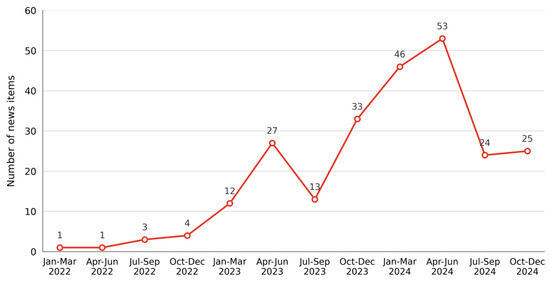
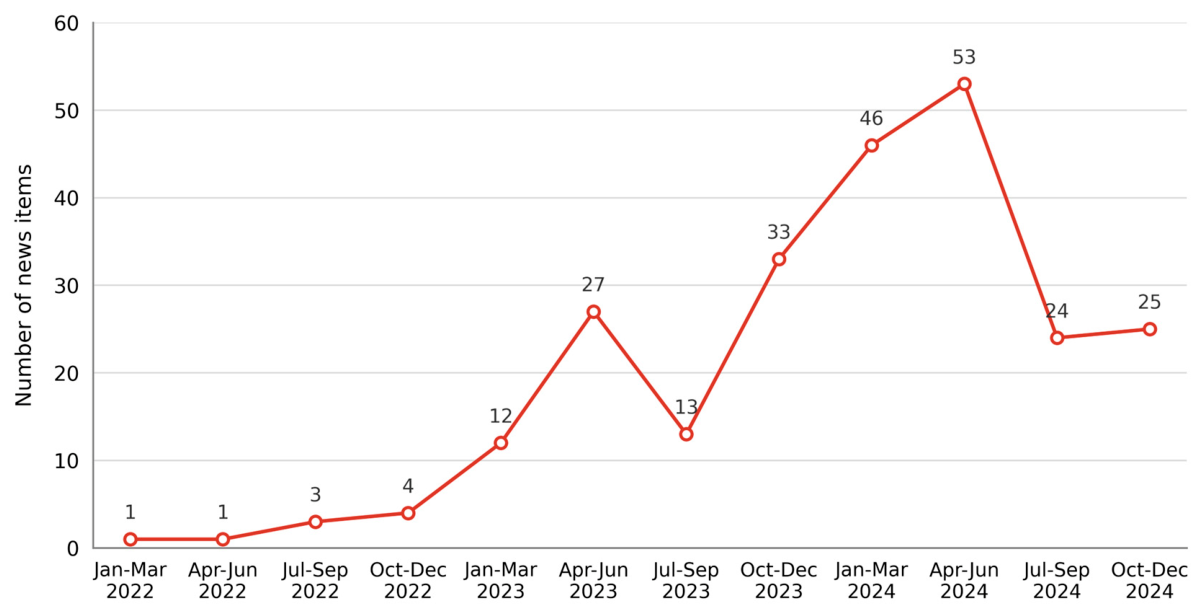
Media attention to the relationship between AI and journalism was slow to consolidate. As Figure 1 shows, coverage is barely visible in 2022, with only nine news items published over the entire year. Notably, the commercial release of ChatGPT in late November 2022 did not trigger an immediate response: none of the items published in the closing weeks of that year addresses its implications for journalism.
Figure 1.
Quarterly evolution of news coverage on AI in journalism (2022–2024). Source: own elaboration.
Coverage of AI begins to grow in early 2023, with 39 items published between January and June. The summer of 2023 marks a decline in the topic’s salience (13 items), and October 2023 becomes the starting point of a substantial increase that continues until June 2024 (132 items). A further summer period, July to September 2024, brings a renewed decline (24 items), which is followed not by a fresh rise in media salience but by a plateau over the final quarter of the analysis, October to December 2024 (25 items).
3.2. Framing AI in Journalism Through Dimensions and Variables
Once the use of AI in journalism becomes an established topic on media agendas, the frames through which the news is constructed begin to accumulate, shaping an interpretation not only of how the various forms of AI are used across the phases of journalistic production, but also of their effects on the functions of journalism; the challenges they pose for media organisations, journalists, and audiences; and the advantages and disadvantages of their use in journalistic production processes.
The first analytical dimension addresses the definition of AI itself through three subdimensions: the type of AI, its use across the phases of journalistic production, and its relationship to the normative functions of journalism. Regarding the type of artificial intelligence, it is present in 83.5% of items, with a clear focus on generative AI (81%) over analytical AI (22.7%). Its use is linked to a specific phase of the journalistic production process in 59.5% of items; here, coverage centres primarily on the processing phase (53.3%), ahead of the information gathering and distribution phases (22.3% in both cases). Finally, the relationship between AI and the normative functions associated with journalism in democratic societies is mentioned in 34.7% of items, focusing preferentially on the effects of AI on the media’s informing function (19%) and on the media’s role in defending democratic values (16.9%). Other functions, such as the media’s capacity to facilitate public debate (9.5%), the watchdog role (8.3%), the capacity to promote social empathy (3.3%), or the capacity to defend marginal voices and promote social change (2.5%), are less present. Table 2 sets out the full distribution of the frames that make up this dimension.
Table 2.
Dimension 1: AI definition frames (subdimensions and issue-specific frames).
The second dimension, which addresses the challenges2 faced by media organisations, journalists, and audiences with the arrival of AI, is strongly present in the coverage (89.3%), although a closer analysis reveals an uneven distribution of coverage across these challenges. Media attention concentrates on challenges related to the credibility of the source and text (46.3%), ethics in the use of data (45%), legal responsibility (35.1%), and the quality of the information (32.6%). To a lesser extent, coverage also addresses the loss of the mediating role (21.1%), the threat of job loss (19.8%), commercial viability (18.2%), new training needs (17.4%), the transparency of algorithms (15.3%), and media literacy (14%). Finally, a further set of challenges appears even more rarely: content about people (12.8%), new professional roles (10.7%), the ease and enjoyment of reading (8.7%), and collaboration with technical staff (5.4%). Table 3 presents the complete distribution of these challenge frames.
Table 3.
Dimension 2: AI’s challenges frames.
The third and final dimension is designed to identify the advantages and disadvantages of AI use in journalistic production and specifically its effects on the accuracy, accessibility, diversity, relevance, and timeliness of AI-generated journalistic outputs. Some advantages or disadvantages are mentioned in 55.4% of items. Among the advantages (36.4%), references relate most often to timeliness (25.2%) and accuracy (16.1%), and less frequently to accessibility (11.2%), relevance (9.9%), and diversity (9.5%). Among the items that mention disadvantages (38.8%), those related to accuracy dominate the accounts (35.5%), with far less space given to the rest: diversity (8.7%), relevance (7.4%), timeliness (5.8%), and accessibility (4.1%). Table 4 reports the distribution of advantage and disadvantage frames.
Table 4.
Dimension 3: advantage and disadvantage frames.
3.3. Relationship Between the Appearance of Issue-Specific Frames on Media Agendas and Their Relevance
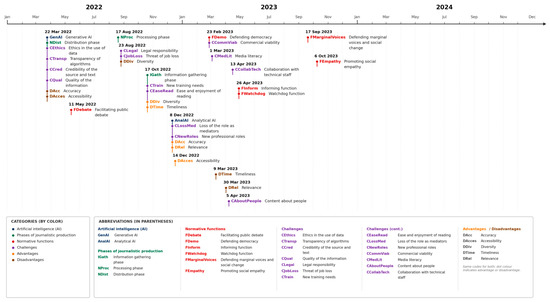
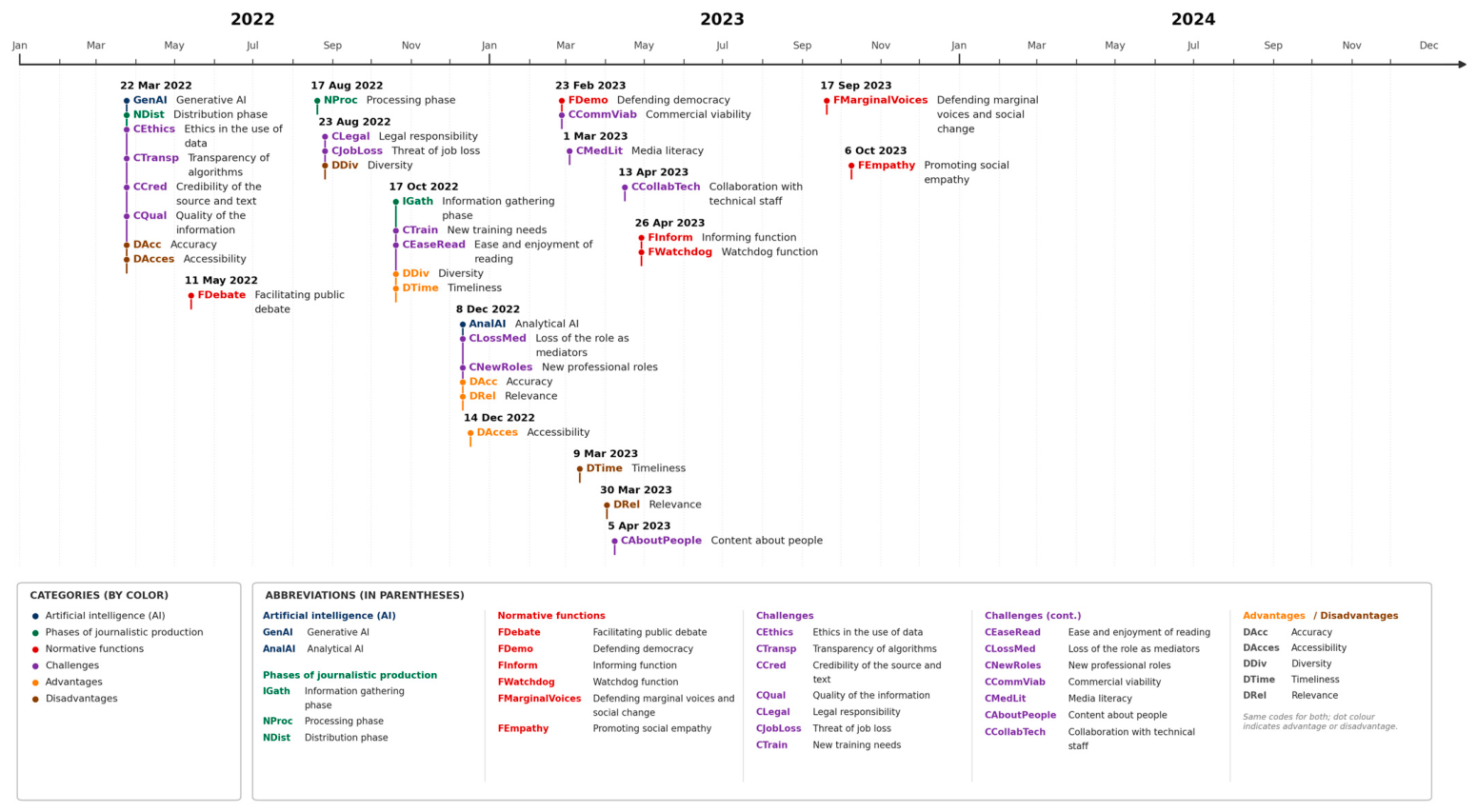
Issue-specific frames entered media agendas progressively. As Figure 2 shows, this process runs until 6 October 2023, when the final frame appears, relating to the effects of AI on the normative function of promoting social empathy. The order of incorporation is related to the ultimate salience of each frame: ranking the 35 frames both by their date of first appearance and by the number of news items in which they appear yields a moderate positive correlation (Spearman’s rs = 0.585, p < 0.001), indicating that frames entering the agenda earlier tend to achieve greater salience in the coverage.
Figure 2.
Order of first appearance of issue-specific frames and share of news items in which each frame appears (2022–2024). Note: frames first appearing on the same date are grouped vertically. Abbreviations are used next to each frame label. Source: own elaboration.
Even so, the salience of some frames does not correspond to the moment of their first appearance. On the one hand, frames such as the effects of AI on the informing function, analytical AI, and the challenges concerning the commercial viability of media establish a firm presence in the coverage despite entering the agenda later. On the other hand, a larger group of frames, although incorporated early, lose relevance relative to others: the disadvantages of AI-generated news for accessibility and diversity; the challenges concerning the transparency of algorithms, the quality of the information, and the ease and enjoyment of reading; and the effects of AI on the media’s capacity to facilitate public debate.
3.4. Association Between Journalistic Variables and the Presence or Omission of Frames
Beyond describing how the media frame the role of AI in journalism, the analysis examines whether journalistic variables are associated with the presence or omission of specific frames. To this end, it considers five variables—media origin, media ideology, authorship, journalistic genre, and main source—in relation to the most and least frequent frames in the coverage.
3.4.1. Association with Dominant Frames
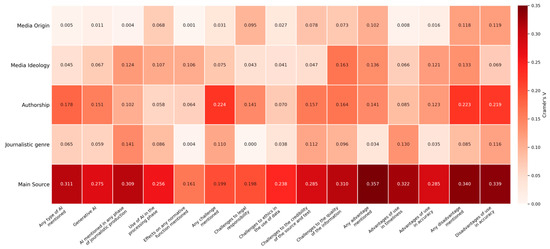
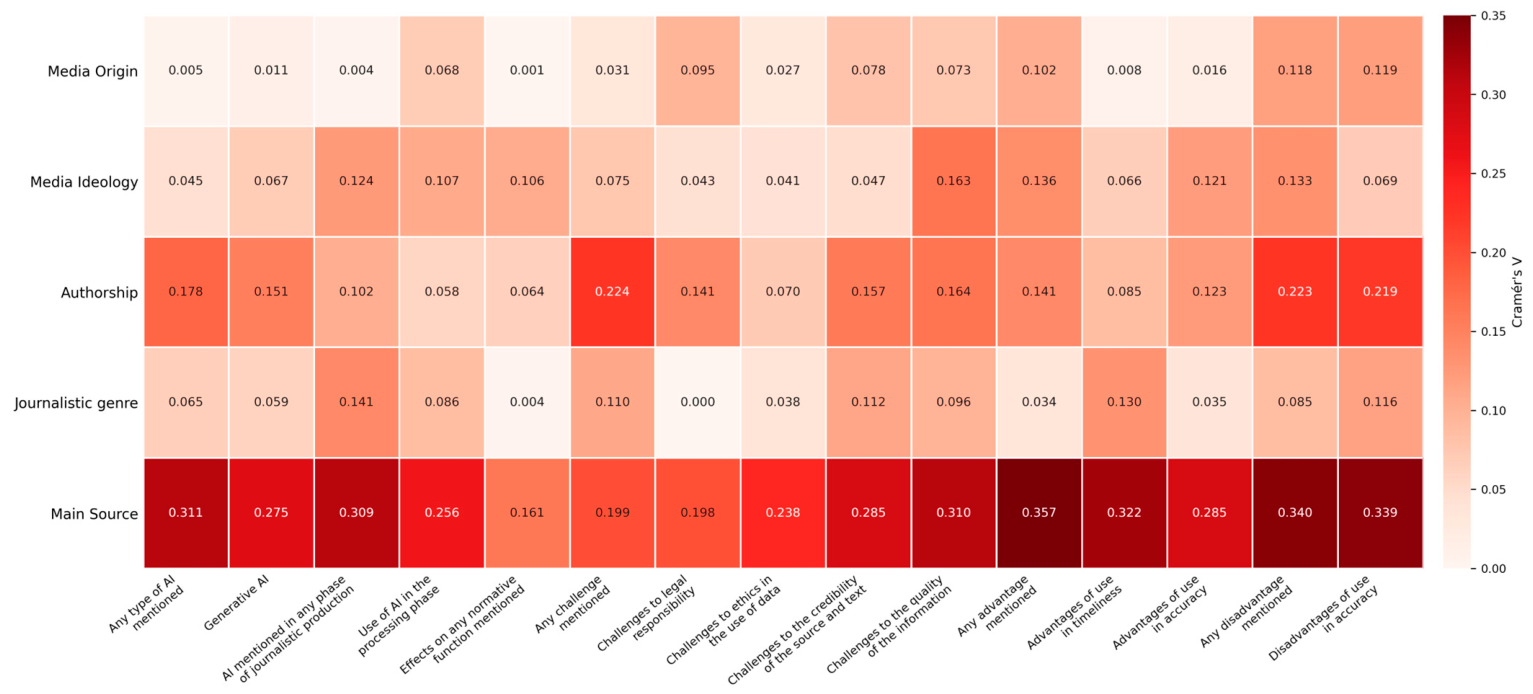
The main source is the variable most strongly associated with the presence of the dimensions, subdimensions, and issue-specific frames that dominate the coverage. The remaining variables—media origin, media ideology, authorship, and journalistic genre—show weak associations. As Figure 3 shows, the strength of association, measured through Cramér’s V, is consistently higher for the main source across the most frequent dimensions and frames.
Figure 3.
Association between journalistic variables and dominant frames (Cramér’s V). Note: Higher values indicate a stronger association (Cramér’s V).Source: own elaboration.
The main sources in the coverage of AI in journalism are media-sector actors (37%), technology companies (12.8%), other media outlets (12%), academics and independent experts (11.6%), and government bodies (9.5%). Although media-sector actors are the most frequent main source, items relying on them are less likely to feature the dominant dimensions and issue-specific frames, except for the challenges related to legal responsibility. Items whose main source is a technology company concentrate on the types of AI and the use of generative AI; on the challenges related to legal responsibility, ethics in the use of data, and the quality of the information, although they feature the challenges dimension as a whole less often; on the advantages and disadvantages of AI use in journalistic production; and on the specific disadvantage concerning the accuracy of generated content. Items drawing on other media outlets or on academics and independent experts feature almost the full range of dimensions and issue-specific frames, with two exceptions: the relationship between AI and the normative functions of journalism in the former case and the challenges related to legal responsibility in the latter. Finally, items relying on governmental sources rarely feature the dimensions and frames in depth, except for the challenges associated with the use of AI.
Authorship is also associated, although less consistently, with the salience of some dimensions and frames: the challenges dimension, the disadvantages of AI use in production processes, and the specific disadvantage linked to accuracy. In all three cases, these frames are more frequent in items signed by in-house journalists and by non-journalist contributors, and less frequent in agency items and items carrying a generic byline.
The remaining variables—media origin, media ideology, and journalistic genre—show little association with the presence of the dominant frames.
3.4.2. Association with Omitted Frames
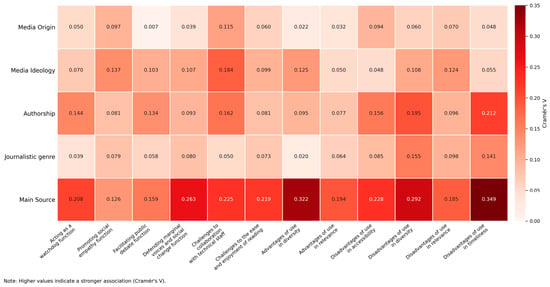
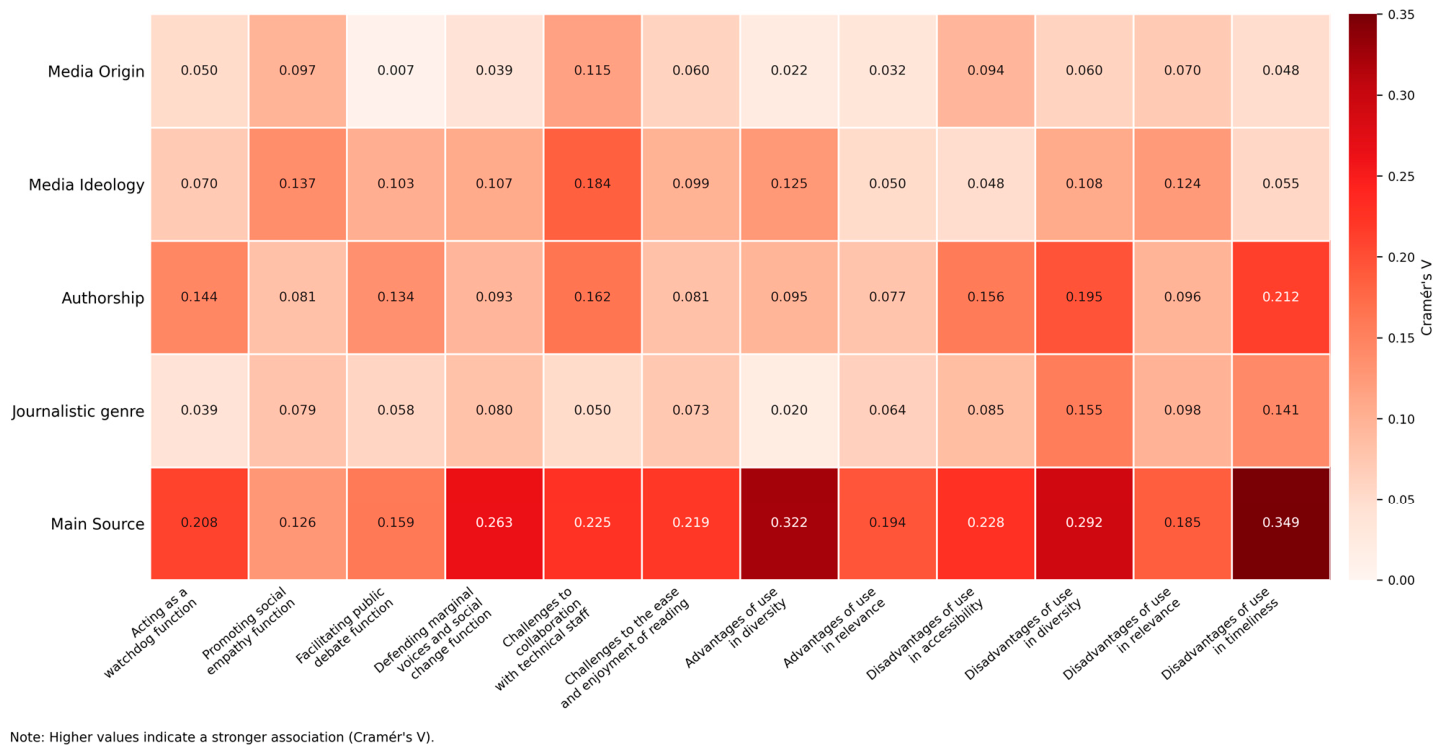
As Figure 4 shows, the main source is again the variable most strongly associated with the omission of certain frames.
Figure 4.
Association between journalistic variables and omitted frames (Cramér’s V). Note: Higher values indicate a stronger association (Cramér’s V). Source: own elaboration.
The analysis identifies which frames are least likely to appear depending on the main source of the item. Items relying on media-sector actors feature less often the challenges involving collaboration with technical staff and the ease and enjoyment of reading; the advantages relating to relevance and timeliness; and the disadvantages relating to timeliness. When the main source is a technology company, the least present frames concern the normative functions of journalism, particularly the watchdog role and the defence of marginal voices and social change; the challenges relating to collaboration with technical staff; and the disadvantage concerning the relevance of news. When the main source is another media outlet, there is a reduced presence of the watchdog function and the defence of marginal voices and social change; of the challenges relating to collaboration with technical staff, the quality of the information, and the ease and enjoyment of reading; and of the disadvantage relating to relevance. Academics and independent experts are the sources least associated with the omission of frames, with two exceptions: the defence of marginal voices and social change, and the advantages relating to diversity. Governmental sources, by contrast, are associated with the reduced presence of several omitted frames: the watchdog function; the challenges relating to the quality of the information and the ease and enjoyment of reading; the advantages concerning diversity and relevance; and the disadvantages relating to relevance and timeliness.
The remaining journalistic variables show little association with the omission of the less frequent frames. Regarding authorship, agency items and items carrying a generic byline feature less often the disadvantages of AI use for diversity and timeliness, a pattern that also extends to items signed by the outlet’s own journalists. Regarding media ideology, the analysis only shows that conservative, social-democratic, and far-right outlets give less weight to the challenges arising from collaboration with technical staff.
4. Discussion
4.1. A Compressed Attention Cycle
The results show how the arrival of AI in journalism captured media attention. Downs’s (1972) issue-attention cycle offers a useful map of the 2022–2024 period. A pre-problem stage came first, with attention to the relationship between AI and journalism confined to expert and interest-group debates outside media agendas. The stages of alarmed discovery and euphoric enthusiasm and of realizing the cost of significant progress followed, but they unfolded simultaneously rather than consecutively: coverage combined optimistic views on the capacity to solve the problem with views centred on the costs of AI’s arrival. A stage of gradual decline of intense public interest may have begun at the end of the period, as competition with other issues on a media agenda of limited space eroded the salience of the topic (Zhu 1992).
This attention was organised around a set of issue-specific frames (de Vreese 2005) that entered the media debate progressively.
To some extent, the central frames of the issue, those reaching the greatest salience over the period, entered the debate early. The dynamic is the operational translation of the very definition of framing as the selection and emphasis of certain aspects of reality over others (Entman 1993): the final salience of a frame depends not only on when it joins the debate but also on its capacity to hold attention against the rest. Some frames, however, arrived late and still won news space at the expense of frames already present. That is the case of analytical AI, of the challenges concerning the commercial viability of media organisations facing AI implementation, and of the effects of AI on the informing function that journalism performs in democratic societies. The opposite happened to the negative effects of AI-generated news on accessibility and diversity; to the challenges concerning the transparency of algorithms, the quality of the information, and the ease and enjoyment of reading; and to the effects on the normative function of facilitating public debate.
The zero-sum principle formulated for competition among issues (Zhu 1992) extends, then, to issue-specific frames. Over the period analysed, specific frames competed for media attention, and the competition operated from the outset: some frames became dominant, eroded the salience of others and, in doing so, made it harder for new frames to enter the debate. Salience transfer, this finding suggests, operates not only on issues but also on their attributes (McCombs et al. 2014). The zero-sum logic reproduces itself, on a smaller scale, in the competition among the issue-specific frames of a single issue.
4.2. AI as an Operational, Not a Democratic, Issue
Having established that the definition of AI’s effects on journalism rests on certain dominant frames and certain omitted ones, the question is which frames these are.
At the level of dimensions, the media define the role of AI in journalism primarily through the type of AI involved and the challenges associated with its arrival. Coverage addresses less often its use across the phases of news production and the advantages and disadvantages of that use. The effects of AI on the normative functions of journalism are not a central dimension of the definition of the issue. At the level of issue-specific frames, the dominant frame builds on the use of generative AI, mainly in the processing phase of news production. Around that use, coverage raises challenges concerning the credibility of the source and text, ethics in the use of data, the legal responsibility for AI-generated content, and the quality of the information, and it presents timeliness and accuracy as the main advantage and disadvantage, respectively. This dominant definition, built in operational and legally contestable terms, is consistent with the economic and industrial bias and the promotional frames identified in international coverage of AI (Canavilhas et al. 2024), and with the tendency of legacy media to cool down the controversial dimensions of the technology (Dandurand et al. 2023).
A dominant account resting on so few frames reduces the visibility of the rest, which either enter the debate late or, having entered early, fail to hold media attention. What the coverage omits is telling. The analysis reveals the omission of specific frames concerning challenges, advantages, and disadvantages but, above all, those concerning the effects of AI on the normative functions of journalism. The media “forget” the challenges of collaboration with technical staff in this new form of news production and those concerning the ease and enjoyment of reading; the advantages linked to relevance and diversity, and the disadvantages centred on diversity, relevance, timeliness, and accessibility; and the effects on normative functions such as facilitating public debate, acting as a watchdog, promoting social empathy, and defending marginal voices in the promotion of social change. Unlike the underrepresentation of the ethics frame observed in other contexts (Zai et al. 2025), in Spanish coverage, the ethics of data use holds a central position. What is omitted is not the ethical dimension but the democratic-normative one, precisely the dimension that, in Nielsen’s (2017) minimalist formulation, constitutes the one thing journalism can do for democracy. New patterns of news consumption in small doses, “news snacking”, across multiple platforms and through brief, decontextualised formats, further constrain the visibility of these frames (Ohme and Mothes 2025).
4.3. Sources That Open and Sources That Close the Debate
Once it is clear how the media report on the arrival of AI in journalism, and how some frames concentrate attention while others lose visibility, the study turns to the influences on the news production process (Shoemaker and Reese 2014) that shape the framing of the issue. Several factors have traditionally conditioned news work: the ideology of the outlet (Entman 1991; Gans 2004; Odriozola-Chéné and Pérez-Arozamena 2024), the choice between news and opinion genres (van Dijk 1988; Bednarek and Caple 2017), in-house versus external authorship (Tunstall 1971; Paterson 2007), and the digital or legacy origin of the outlet (Chadwick 2013; Hau et al. 2026). Here, however, the main source emerges as the factor most clearly associated with shifts in media attention across frames, in line with the shaping role of specialised sources observed in the coverage of AI in other national contexts (Dandurand et al. 2023).
Sources play different roles in the definition of the issue. Academics and independent experts broaden the diversity of both dominant and omitted frames. Media-sector actors, technology companies and, to a lesser extent, governmental sources concentrate on certain frames while sidelining others, dominant and omitted alike. The case of media-sector actors stands out. Although they are the most frequent source in reporting on AI, they operate as a source of presence rather than of analysis, reinforcing attention only on the challenges concerning legal responsibility, usually tied to the copyright of media organisations. Where experts widen the perspectives from which the problem can be understood, reliance on media-sector actors does not enrich the debate.
5. Conclusions
The arrival of AI in journalism as a news topic in the Spanish press can be dated to early 2023. From that point on, media interest grew, combining euphoria and alarm over the effects of the new technology on the journalistic profession, and the salience of the issue rose steadily, summer lulls aside, until the last quarter of 2024, when the first signs of declining media attention appeared (RO1). The media, in short, were slow to turn their attention directly to the effects this technology would have on their own profession.
The media thus define the issue around the use of generative AI in the processing phase of news production, with timeliness as its main advantage and accuracy as its main disadvantage. Alongside this operational definition, the challenges that coverage prioritises concern the credibility of the source and text, ethics in the use of data, the legal responsibility for AI-generated content, and the quality of the information itself (RO2).
This definition of the issue was built on competition among issue-specific frames, an uneven contest in which early entry into the media debate and the persuasive efforts of sources to push certain aspects produced a definition of the problem around a set of preferred frames. The effects of AI on the normative functions of journalism are not among them (RO3), either in the minimalist formulation centred on the informing function (Nielsen 2017) or in the broader account of the functions journalism performs in democratic societies (Schudson 2008).
This construction of the problem stems from a hierarchy of sources in contrast to other common influences on journalistic production, such as media ideology, media origin (legacy/digital media), authorship of journalistic texts, or journalistic genre (RO4). Some close the debate down, steering it toward certain frames and omitting others according to their interests; others open it up and broaden the view of AI’s effects on the media. On the first side stand sources from the media sector itself, technology companies, and governmental sources; on the second stand academics and independent experts. In this respect, sources from the journalistic sector itself, which are the most frequent, tend to focus the debate on the legal responsibility for the use of media content by the technology itself, rather than on the journalist layoffs that would be associated with the economic losses arising from the infringement of intellectual property. It is a latent issue, yet one less “headlined” than the technology itself. Reliance on media-sector actors is therefore associated with a narrower range of frames than reliance on academics and independent experts.
One further reading deserves mention, although it goes beyond what the present data can establish. The prominence of the legal-responsibility frame, combined with the dominance of media-sector sources, suggests that what is at stake in this coverage is not only a technological transformation but the economic viability of the media business and the terms on which its content is used. That the debate is framed around the rights of media organisations rather than around the position of those who produce the news is consistent with the hierarchy of sources documented here. Whether this amounts to a displacement of AI from a technological question to a political and economic one is something the frames analysed can raise but not settle, and it is taken up below as a line for further research.
It is particularly telling that, over the three years analysed, the corpus does not include a single editorial devoted to AI: none of the ten outlets studied took an institutional position on a technology that affects the core of their own activity. The scarce presence of opinion genres, channelled through expert contributors or through the audience itself in letters to the editor, reinforces the paradox: the media report on AI as if it were someone else’s affair, without owning a discussion that compromises their democratic function. This abdication of the editorial voice is consistent with the general pattern observed: coverage that privileges the operational and the legally contestable while omitting the normative dimension, even when journalism itself is the party affected. Table 5 summarises the research objectives, the main findings, and the sections in which each is addressed.
Table 5.
Research objectives, main findings and corresponding sections.
These results should be read in the light of some limitations. The analysis is confined to a single media system, the Spanish one, and to ten digital outlets, which calls for caution in extrapolating the patterns observed. Two of the variables coded yielded tentative reliability coefficients, and the findings that involve them should be read with that caveat. The relationships reported between journalistic variables and frames are associations, not causal relations. As for future research, the breadth of the frame inventory analysed here opens the way to studies that take individual dimensions as their object, such as disinformation or the tone of coverage, and examine them in depth within the Spanish context. The economic dimension of the problem, and in particular the agreements between media organisations and technology companies and their consequences for those who produce the news, calls for a design able to address it directly; the present analysis does not measure it.
Extending the period of analysis will make it possible to document the post-problem stage of the attention cycle, in which the effects of AI on journalism will return to media agendas sporadically, tied to specific events (Downs 1972). International comparison would then help establish whether the operational definition of the problem is a feature of the Spanish case or a transnational pattern. Finally, although this study examines the news message as the result of a choice of frames, and therefore as a finished product, news messages also have effects on audiences at the individual, social, and cultural levels (Riffe et al. 2019). Reception studies would thus raise the complementary question of which frames actually reach audiences.
Author Contributions
Conceptualization, J.O.-C. and R.P.-A.; methodology, J.O.-C. and R.P.-A.; software, J.O.-C.; validation, J.O.-C., R.P.-A. and J.D.-N.; formal analysis, J.O.-C.; investigation, J.O.-C. and R.P.-A.; data curation, J.O.-C.; writing—original draft preparation, R.P.-A.; writing—review and editing, J.O.-C. and J.D.-N.; visualization, J.O.-C.; supervision, J.O.-C., R.P.-A. and J.D.-N. All authors have read and agreed to the published version of the manuscript.
Funding
This research was funded by the Ministerio de Ciencia, Innovación y Universidades (Spain) through the project “Impacto de la inteligencia artificial y los algoritmos en los cibermedios, los profesionales y las audiencias” (PID2022-138391OB-I00), funded under the 2022 call for Proyectos de Generación de Conocimiento.
Institutional Review Board Statement
Not applicable.
Informed Consent Statement
Not applicable.
Data Availability Statement
The dataset generated and analyzed during the current study will be openly available in the Zenodo repository upon publication: https://doi.org/10.5281/zenodo.21488926.
Acknowledgments
During the preparation of this manuscript, the authors used ChatGPT (OpenAI, San Francisco, CA, USA, GPT-5) and Claude (Anthropic, San Francisco, CA, USA, Claude Opus 4.8) for the purpose of generating the graphs presented in the figures from the previously analyzed data tables. The authors have reviewed and edited the output and take full responsibility for the content of this publication.
Conflicts of Interest
The authors declare no conflicts of interest.
Notes
| 1 | Intercoder reliability was assessed using Krippendorff’s alpha (Krippendorff 2004). The coding procedure was refined through two pilot tests, after which two coders were retained to code the entire corpus; the codebook was revised in the process, adding a variable on media literacy. The coefficient was obtained between the two coders on the second pilot (26 items). |
| 2 | These challenges were initially organised by actor—media organisations, journalists, and audiences—although the analysis showed that they do not correspond to a single actor. |
References
- Al-kfairy, Mousa, Dheya Mustafa, Nir Kshetri, Mazen Insiew, and Omar Alfandi. 2024. Ethical Challenges and Solutions of Generative AI: An Interdisciplinary Perspective. Informatics 11: 58. [Google Scholar] [CrossRef] [Scilit]
- Bednarek, Monika, and Helen Caple. 2017. The Discourse of News Values: How News Organizations Create Newsworthiness. Oxford: Oxford University Press. [Google Scholar]
- Brundage, Miles, Shahar Avin, Jack Clark, Helen Toner, Peter Eckersley, Ben Garfinkel, Allan Dafoe, Paul Scharre, Thomas Zeitzoff, Bobby Filar, and et al. 2018. The Malicious Use of Artificial Intelligence: Forecasting, Prevention, and Mitigation. Cambridge: Apollo—University of Cambridge Repository. [Google Scholar] [CrossRef]
- Calvo-Rubio, Luis Mauricio, and María José Ufarte-Ruiz. 2021. Artificial Intelligence and Journalism: Systematic Review of Scientific Production in Web of Science and Scopus (2008–2019). Communication & Society 34: 159–76. [Google Scholar] [CrossRef] [Scilit]
- Canavilhas, João, Fábio Ioscote, and Adriana Gonçalves. 2024. Artificial Intelligence as an Opportunity for Journalism: Insights from the Brazilian and Portuguese Media. Social Sciences 13: 590. [Google Scholar] [CrossRef] [Scilit]
- Chadwick, Andrew. 2013. The Hybrid Media System: Politics and Power. Oxford: Oxford University Press. [Google Scholar]
- Chang, Mikyung. 2025. Does the Media’s Partisanship Influence News Coverage on Artificial Intelligence Issues? Media Coverage Analysis on Artificial Intelligence Issues. Social Science Computer Review 43: 564–77. [Google Scholar] [CrossRef] [Scilit]
- Cools, Hannes, and Michael Koliska. 2024. News Automation and Algorithmic Transparency in the Newsroom: The Case of the Washington Post. Journalism Studies 25: 662–80. [Google Scholar] [CrossRef] [Scilit]
- Cools, Hannes, Baldwin Van Gorp, and Michaël Opgenhaffen. 2024. Where Exactly Between Utopia and Dystopia? A Framing Analysis of AI and Automation in US Newspapers. Journalism 25: 3–21. [Google Scholar] [CrossRef] [Scilit]
- Dandurand, Guillaume, Fenwick McKelvey, and Jonathan Roberge. 2023. Freezing Out: Legacy Media’s Shaping of AI as a Cold Controversy. Big Data & Society 10: 20539517231219242. [Google Scholar] [CrossRef] [Scilit]
- de-Lima-Santos, Mathias-Felipe, and Wilson Ceron. 2022. Artificial Intelligence in News Media: Current Perceptions and Future Outlook. Journalism and Media 3: 13–26. [Google Scholar] [CrossRef] [Scilit]
- de Vreese, Claes H. 2005. News Framing: Theory and Typology. Information Design Journal 13: 51–62. [Google Scholar] [CrossRef] [Scilit]
- Dircomfidencial. 2026. Desplome del Tráfico en los Principales Medios Españoles tras la Irrupción de la IA en un Febrero Dramático. Available online: https://dircomfidencial.com/medios/desplome-del-trafico-en-los-principales-medios-espanoles-tras-la-irrupcion-de-la-ia-en-un-febrero-dramatico-20260319-0405/ (accessed on 6 May 2026).
- Díaz-Noci, Javier. 2020. Artificial Intelligence Systems-Aided News and Copyright: Assessing Legal Implications for Journalism Practices. Future Internet 12: 85. [Google Scholar] [CrossRef] [Scilit]
- Dodds, Tomás, Rodrigo Zamith, and Seth C. Lewis. 2026. The AI Turn in Journalism: Disruption, Adaptation, and Democratic Futures. Journalism 27: 530–44. [Google Scholar] [CrossRef] [Scilit]
- Downs, Anthony. 1972. Up and Down with Ecology—The Issue-Attention Cycle. The Public Interest 28: 38–50. [Google Scholar]
- Dwivedi, Yogesh K., Anuj Sharma, Nripendra P. Rana, Mihalis Giannakis, Pooja Goel, and Vincent Dutot. 2023. Evolution of Artificial Intelligence Research in Technological Forecasting and Social Change: Research Topics, Trends, and Future Directions. Technological Forecasting and Social Change 192: 122579. [Google Scholar] [CrossRef] [Scilit]
- Dwivedi, Yogesh K., Laurie Hughes, Elvira Ismagilova, Gert Aarts, Crispin Coombs, Tom Crick, Yanqing Duan, Rohita Dwivedi, John Steven Edwards, Aled Eirug, and et al. 2021. Artificial Intelligence (AI): Multidisciplinary Perspectives on Emerging Challenges, Opportunities, and Agenda for Research, Practice and Policy. International Journal of Information Management 57: 101994. [Google Scholar] [CrossRef] [Scilit]
- Entman, Robert M. 1991. Framing U.S. Coverage of International News: Contrasts in Narratives of the KAL and Iran Air Incidents. Journal of Communication 41: 6–27. [Google Scholar] [CrossRef] [Scilit]
- Entman, Robert M. 1993. Framing: Toward Clarification of a Fractured Paradigm. Journal of Communication 43: 51–58. [Google Scholar] [CrossRef] [Scilit]
- Eubanks, Virginia. 2018. Automating Inequality: How High-Tech Tools Profile, Police, and Punish the Poor. New York: St. Martin’s Press. [Google Scholar]
- European Commission. 2026. AI Act: Regulatory Framework for Artificial Intelligence. Available online: https://digital-strategy.ec.europa.eu/en/policies/regulatory-framework-ai (accessed on 6 May 2026).
- Gans, Herbert J. 2004. Deciding What’s News: A Study of CBS Evening News, NBC Nightly News, Newsweek, and Time. Evanston: Northwestern University Press. [Google Scholar]
- García-Orosa, Berta, João Canavilhas, and Jorge Vázquez-Herrero. 2023. Algorithms and Communication: A Systematized Literature Review. Comunicar 31: 9–21. [Google Scholar] [CrossRef] [Scilit]
- Germani, Federico, Giovanni Spitale, and Nikola Biller-Andorno. 2024. The Dual Nature of AI in Information Dissemination: Ethical Considerations. JMIR AI 3: e53505. [Google Scholar] [CrossRef] [Scilit] [PubMed]
- GfK DAM. 2025. Solo 1 de cada 431 Sesiones en Herramientas IA Culmina en una Visita a un Medio Digital. Available online: https://gfkespana.es/blog/impacto-ia-medios-gfkdam (accessed on 7 May 2026).
- Gil de Zúñiga, Homero, Manuel Goyanes, and Timilehin Durotoye. 2024. A Scholarly Definition of Artificial Intelligence (AI): Advancing AI as a Conceptual Framework in Communication Research. Political Communication 41: 317–34. [Google Scholar] [CrossRef] [Scilit]
- Gómez-Calderón, Bernardo, and Yaiza Ceballos. 2024. Periodismo e inteligencia artificial. El tratamiento de los chatbots en la prensa española. Index Comunicación 14: 281–300. [Google Scholar] [CrossRef] [Scilit]
- Gutiérrez-Caneda, Beatriz, Jorge Vázquez-Herrero, and Xosé López-García. 2023. AI Application in Journalism: ChatGPT and the Uses and Risks of an Emergent Technology. Profesional de la Información 32: e320514. [Google Scholar] [CrossRef] [Scilit]
- Harcup, Tony, and Deirdre O’Neill. 2017. What Is News? News Values Revisited (Again). Journalism Studies 18: 1470–88. [Google Scholar] [CrossRef] [Scilit]
- Hau, Priscilla, Steve Paulussen, and Pieter Maeseele. 2026. The Construction of a Hybrid Media Storm: A Belgian Case Study. Journalism Practice 20: 1202–20. [Google Scholar] [CrossRef] [Scilit]
- Ioscote, Fábio, Adriana Gonçalves, and Claudia Quadros. 2024. Artificial Intelligence in Journalism: A Ten-Year Retrospective of Scientific Articles (2014–2023). Journalism and Media 5: 873–91. [Google Scholar] [CrossRef] [Scilit]
- Ittefaq, Muhammad, Ali Zain, Rauf Arif, Mohammad Ala-Uddin, Taufiq Ahmad, and Azhar Iqbal. 2025. Global News Media Coverage of Artificial Intelligence (AI): A Comparative Analysis of Frames, Sentiments, and Trends Across 12 Countries. Telematics and Informatics 96: 102223. [Google Scholar] [CrossRef] [Scilit]
- Iyengar, Shanto. 1994. Is Anyone Responsible? How Television Frames Political Issues. Chicago: University of Chicago Press. [Google Scholar]
- Jamil, Sadia. 2021. Artificial Intelligence and Journalistic Practice: The Crossroads of Obstacles and Opportunities for the Pakistani Journalists. Journalism Practice 15: 1400–22. [Google Scholar] [CrossRef] [Scilit]
- Karlsson, Michael. 2011. The Immediacy of Online News, the Visibility of Journalistic Processes and a Restructuring of Journalistic Authority. Journalism 12: 279–95. [Google Scholar] [CrossRef] [Scilit]
- Krippendorff, Klaus. 2004. Content Analysis: An Introduction to Its Methodology. Thousand Oaks: Sage. [Google Scholar]
- Lopezosa, Carlos, Lluís Codina, Carles Pont-Sorribes, and Mari Vállez. 2023. Use of Generative Artificial Intelligence in the Training of Journalists: Challenges, Uses and Training Proposal. Profesional de la Información 32: e320408. [Google Scholar] [CrossRef] [Scilit]
- Mahony, Simon, and Qing Chen. 2025. Concerns About the Role of Artificial Intelligence in Journalism, and Media Manipulation. Journalism 26: 1859–77. [Google Scholar] [CrossRef] [Scilit]
- Martín-Martín, Francisco-Marcos, Sonia Blanco, and Jon Sedano. 2025. La evolución de la cobertura informativa sobre la inteligencia artificial en los Telediarios de TVE (2013–2024). Hipertext.net 31: 215–28. [Google Scholar] [CrossRef] [Scilit]
- Maslej, Nestor, Loredana Fattorini, Raymond Perrault, Yolanda Gil, Vanessa Parli, Njenga Kariuki, Emily Capstick, Anka Reuel, Erik Brynjolfsson, John Etchemendy, and et al. 2025. The AI Index 2025 Annual Report. Stanford: Stanford Institute for Human-Centered Artificial Intelligence. [Google Scholar] [CrossRef] [Scilit]
- Matthes, Jörg, and Matthias Kohring. 2008. The Content Analysis of Media Frames: Toward Improving Reliability and Validity. Journal of Communication 58: 258–79. [Google Scholar] [CrossRef] [Scilit]
- McCombs, Maxwell E., and Donald L. Shaw. 1972. The Agenda-Setting Function of Mass Media. Public Opinion Quarterly 36: 176–87. [Google Scholar] [CrossRef] [Scilit]
- McCombs, Maxwell E., Donald L. Shaw, and David H. Weaver. 2014. New Directions in Agenda-Setting Theory and Research. Mass Communication and Society 17: 781–802. [Google Scholar] [CrossRef] [Scilit]
- Newman, Nic. 2026. Journalism, Media, and Technology Trends and Predictions 2026. Oxford: Reuters Institute for the Study of Journalism. Available online: https://reutersinstitute.politics.ox.ac.uk/journalism-media-and-technology-trends-and-predictions-2026 (accessed on 8 May 2026).
- Newman, Nic, Amy Ross Arguedas, Craig T. Robertson, Rasmus Kleis Nielsen, and Richard Fletcher. 2025. Digital News Report 2025. Oxford: Reuters Institute for the Study of Journalism. Available online: https://reutersinstitute.politics.ox.ac.uk/sites/default/files/2025-06/Digital_News-Report_2025.pdf (accessed on 7 May 2026).
- Nguyen, Dennis, and Erik Hekman. 2024. The News Framing of Artificial Intelligence: A Critical Exploration of How Media Discourses Make Sense of Automation. AI & Society 39: 437–51. [Google Scholar] [CrossRef] [Scilit]
- Nielsen, Rasmus Kleis. 2017. The One Thing Journalism Just Might Do for Democracy: Counterfactual Idealism, Liberal Optimism, Democratic Realism. Journalism Studies 18: 1251–62. [Google Scholar] [CrossRef] [Scilit]
- Odriozola-Chéné, Javier, and Rosa Pérez-Arozamena. 2024. Framing Income Inequality: How the Spanish Media Reported on Disparities During the First Year of the Pandemic. Journalism and Media 5: 933–50. [Google Scholar] [CrossRef] [Scilit]
- Ohme, Jakob, and Cornelia Mothes. 2025. News Snacking and Political Learning: Changing Opportunity Structures of Digital Platform News Use and Political Knowledge. Journal of Information Technology & Politics 22: 1–15. [Google Scholar] [CrossRef] [Scilit]
- Ouchchy, Leila, Allen Coin, and Veljko Dubljević. 2020. AI in the Headlines: The Portrayal of the Ethical Issues of Artificial Intelligence in the Media. AI & Society 35: 927–36. [Google Scholar] [CrossRef] [Scilit]
- Owsley, Chad S., and Keith Greenwood. 2024. Awareness and Perception of Artificial Intelligence Operationalized Integration in News Media Industry and Society. AI & Society 39: 417–31. [Google Scholar] [CrossRef] [Scilit]
- Parratt-Fernández, Sonia, Javier Mayoral-Sánchez, and Montse Mera-Fernández. 2021. The Application of Artificial Intelligence to Journalism: An Analysis of Academic Production. Profesional de la Información 30: e300317. [Google Scholar] [CrossRef] [Scilit]
- Pasquale, Frank. 2015. The Black Box Society. Cambridge: Harvard University Press. [Google Scholar]
- Paterson, Chris. 2007. International News on the Internet: Why More Is Less. Ethical Space: The International Journal of Communication Ethics 4: 57–66. [Google Scholar]
- Păvăloaia, Vasile-Daniel, and Sabina-Cristiana Necula. 2023. Artificial Intelligence as a Disruptive Technology—A Systematic Literature Review. Electronics 12: 1102. [Google Scholar] [CrossRef] [Scilit]
- Peña-Fernández, Simón, Koldobika Meso-Ayerdi, Ainara Larrondo-Ureta, and Javier Díaz-Noci. 2023. Without Journalists, There Is No Journalism: The Social Dimension of Generative Artificial Intelligence in the Media. Profesional de la Información 32: 1–16. [Google Scholar] [CrossRef] [Scilit]
- Quian, Alberto, and José Sixto-García. 2024. Inteligencia artificial en la prensa: Estudio comparativo y exploración de noticias con ChatGPT en un medio tradicional y otro nativo digital. Revista de Comunicación 23: 457–83. [Google Scholar] [CrossRef] [Scilit]
- Reporters Without Borders. 2026. USA: Google Is Claiming an Editorial Right It Does Not Have by Rewriting News Headlines in Its Search Results. Available online: https://rsf.org/en/usa-google-claiming-editorial-right-it-does-not-have-rewriting-news-headlines-its-search-results (accessed on 8 May 2026).
- Riffe, Daniel, Stephen Lacy, Brendan R. Watson, and Frederick Fico. 2019. Analyzing Media Messages: Using Quantitative Content Analysis in Research, 4th ed. New York: Routledge. [Google Scholar] [CrossRef] [Scilit]
- Rivas-de-Roca, Rubén, Concha Pérez-Curiel, and Andreu Casero-Ripollés. 2025. Reporting AI in Political Disinformation: Journalistic Discourses in European Quality Newspapers. Journalism Practice, 1–18. [Google Scholar] [CrossRef] [Scilit]
- Sanguinetti, Pablo. 2025. La cobertura sobre IA en los medios de comunicación: Una scoping review. Revista de la Asociación Española de Investigación de la Comunicación 12: raeic12e03. [Google Scholar] [CrossRef] [Scilit]
- Sánchez-García, Pilar, Noemí Merayo-Álvarez, Carla Calvo-Barbero, and Alba Diez-Gracia. 2023. Spanish Technological Development of Artificial Intelligence Applied to Journalism: Companies and Tools for Documentation, Production and Distribution of Information. Profesional de la Información 32: e320208. [Google Scholar] [CrossRef] [Scilit]
- Schudson, Michael. 2008. Why Democracies Need an Unlovable Press. Cambridge: Polity Press. [Google Scholar]
- Schwab, Klaus. 2016. The Fourth Industrial Revolution. Geneva: World Economic Forum. [Google Scholar]
- Semetko, Holli A., and Patti M. Valkenburg. 2000. Framing European Politics: A Content Analysis of Press and Television News. Journal of Communication 50: 93–109. [Google Scholar] [CrossRef]
- Shoemaker, Pamela J., and Stephen D. Reese. 2014. Mediating the Message in the 21st Century: A Media Sociology Perspective, 3rd ed. New York: Routledge. [Google Scholar]
- Sonni, Alem Febri, Hasdiyanto Hafied, Irwanto Irwanto, and Rido Latuheru. 2024. Digital Newsroom Transformation: A Systematic Review of the Impact of Artificial Intelligence on Journalistic Practices, News Narratives, and Ethical Challenges. Journalism and Media 5: 1554–70. [Google Scholar] [CrossRef] [Scilit]
- Sun, Shaojing, Yujia Zhai, Bin Shen, and Yibei Chen. 2020. Newspaper Coverage of Artificial Intelligence: A Perspective of Emerging Technologies. Telematics and Informatics 53: 101433. [Google Scholar] [CrossRef] [Scilit]
- Tunstall, Jeremy. 1971. Journalists at Work: Specialist Correspondents: Their News Organizations, News Sources, and Competitor-Colleagues. London: Constable. [Google Scholar]
- Túñez-López, José-Miguel, César Fieiras-Ceide, and Martín Vaz-Álvarez. 2021. Impact of Artificial Intelligence on Journalism: Transformations in the Company, Products, Contents and Professional Profile. Communication & Society 34: 177–93. [Google Scholar] [CrossRef] [Scilit]
- Túñez-López, Miguel, Carlos Toural-Bran, and Cesibel Valdiviezo-Abad. 2019. Automatización, bots y algoritmos en la redacción de noticias. Impacto y calidad del periodismo artificial. Revista Latina de Comunicación Social 74: 1411–33. [Google Scholar] [CrossRef] [Scilit]
- van Dijk, Teun A. 1988. News as Discourse. London: Routledge. [Google Scholar] [CrossRef] [Scilit]
- Wu, Shangyuan, Edson C. Tandoc, Jr., and Charles T. Salmon. 2019. Journalism Reconfigured: Assessing Human–Machine Relations and the Autonomous Power of Automation in News Production. Journalism Studies 20: 1440–57. [Google Scholar] [CrossRef] [Scilit]
- Zai, Florin, Tobias Rohrbach, and Regula Hänggli Fricker. 2025. Voices and Media Frames in the Public Debate on Artificial Intelligence: Comparing Results from Manual and Automated Content Analysis. Frontiers in Communication 10: 1599854. [Google Scholar] [CrossRef] [Scilit]
- Zhu, Jian-Hua. 1992. Issue Competition and Attention Distraction: A Zero-Sum Theory of Agenda-Setting. Journalism Quarterly 69: 825–36. [Google Scholar] [CrossRef] [Scilit]

Disclaimer/Publisher’s Note: The statements, opinions and data contained in all publications are solely those of the individual author(s) and contributor(s) and not of MDPI and/or the editor(s). MDPI and/or the editor(s) disclaim responsibility for any injury to people or property resulting from any ideas, methods, instructions or products referred to in the content. |
© 2026 by the authors. Licensee MDPI, Basel, Switzerland. This article is an open access article distributed under the terms and conditions of the Creative Commons Attribution (CC BY) license.