


Abstract
This study examines how immigrants build the everyday foundations of life in the host society through food provisioning practices. Many previous studies have explored immigrant adaptation from organizational or cultural perspectives. By contrast, this study focuses on the daily procurement of familiar food. It views food provisioning as part of the ongoing process of home in the making, through which home gradually takes shape in everyday life by linking material access, social relations, and cultural continuity. The desire for familiar food is common among immigrants and reflects the habitus embodied through everyday food practices. As migrants enter a new social and material field, this habitus is continuously negotiated and adapted, giving rise to new food provisioning practices. Against this theoretical background, this study examines how these everyday practices shape immigrants’ lives in the host society. This study takes Chinese residents in Japan as research subjects. Based on a questionnaire survey of 317 Chinese residents, this study shows that fresh vegetables and fruits are perceived as particularly difficult to obtain. Some Chinese residents therefore use diverse provisioning practices, including home gardening, sharing, exchange, and small-scale sales. The study then examines cases of Chinese residents’ home gardens and small-scale commercial gardens as sites of food provisioning. The qualitative cases reveal that crop choices, cultivation methods, circulation routes, and garden scale are flexibly adjusted according to family needs, customer demand, land access, labor capacity, and seasonality. These practices enable Chinese residents to secure familiar food, organize everyday life, and develop social relations with co-ethnic residents and members of the wider local society. The findings suggest that garden-based food provisioning represents an informal, everyday pathway of integration shaped by the material and social conditions of life in Japan.
1. Introduction
In the suburbs of Japan, it is not uncommon to see Chinese residents working in vegetable gardens early in the morning. Nearby are freshly harvested vegetables that are not commonly found in large Japanese supermarket chains but are familiar ingredients on Chinese dining tables. Some of these vegetables are consumed by the growers’ own families, while others are shared with friends and neighbors, or are sold or sent to other Chinese residents in other regions of Japan. This ordinary scene raises a deeper question: why have some Chinese residents in Japan turned to home gardening, and how have garden-based practices been made possible and sustained?
Food has been regarded as an important entry point for understanding immigrants’ cultural experiences because, beyond meeting biological needs, food carries deep cultural meaning and becomes an important symbol of personal identity and group identity. As Koç and Welsh (2001) suggest, food is culturally embedded and shapes understandings of what is considered “culturally appropriate” in everyday life. Eating habits not only reflect “who one is,” but also help define cultural boundaries and express a sense of cultural belonging (Fischler 1988). At a deeper level, such eating habits can be understood as manifestations of habitus: socially acquired and embodied dispositions that shape understandings of familiar tastes, appropriate ingredients, and everyday meals (Bourdieu 1984, 1990). These dispositions may continue to influence migrants’ food practices after migration, even as they are adjusted to new material and social conditions. Consequently, food is central to memory, comfort, adaptation to the host country, and social relations within and beyond the family (Lee 2015). The sensory qualities of food, such as taste, smell, and texture, serve as material media that evoke memories of people, places, and past experiences (Kirshenblatt-Gimblett 1999). Empirical studies of overseas Chinese, Brazilian immigrants in London, and Korean residents in Osaka have shown that familiar foods and tastes are closely associated with homesickness, ethnic identity, memory, and belonging (Cho 2010; Brightwell 2012; Hwang 2002). More recent empirical research and reviews further demonstrate the deeply emotional nature of migrants’ and diasporic communities’ relationships with food. Familiar tastes may evoke memories of home, family, and earlier periods of life, while the continued preparation and consumption of traditional foods help sustain cultural identity, emotional comfort, family and intergenerational continuity, and a sense of belonging after migration (Lillekroken et al. 2024; Protassova and Yelenevskaya 2026).
Food is also embedded in the everyday construction of social relationships, and its role is especially visible within immigrant communities. Studies of migrant food practices show that eating together, growing food, and sharing familiar ingredients can help migrants establish and maintain friendships, community ties, and collective identities (Bailey 2017; Lin et al. 2020). This relational role is particularly significant in Chinese foodways, where meals, banquets, gifts, and everyday exchanges have long been intertwined with kinship, reciprocity, and the cultivation of social relations (Chang 1977; Anderson 1988; Yang 1994). For Chinese migrants, procuring and sharing familiar ingredients may therefore sustain not only familiar tastes but also culturally meaningful relationships and everyday belonging in the receiving society. Bourdieu’s concept of social capital is also relevant to this relational dimension. Social capital refers to the actual or potential resources available through durable social relationships (Bourdieu 1986). In the context of food provisioning, such relationships may provide access to land, labor, information, cultivation knowledge, and practical assistance.
Meanwhile, immigrant foodways are not rigid reproductions of homeland cuisine. Newman and Linke’s (1982) study of Chinese immigrant mothers in New York City demonstrates that food habits change selectively after immigration, illustrating the coexistence of adaptation and continuity. Similarly, studies of South African immigrants in Australia, food practices in multicultural Singapore, and migrant women in Norway show that familiar foods are preserved but at the same time adapted to local conditions such as ingredient availability, family preferences, health, and cross-cultural contact (Schermuly and Forbes-Mewett 2016; Reddy and van Dam 2020; Terragni et al. 2014). In Japan, Xie (2020) and Oh and Saito (2015) reported similar patterns of being “important yet changeable” among Chinese and Filipino women.
Parasecoli (2014) examines this “important yet changeable” dynamism from the perspective of cultural reproduction in immigrant communities. He argues that when migrants encounter unfamiliar sensory and cultural environments, they cope with dislocation and disorientation by recreating a sense of place around food production, preparation, and consumption at both personal and interpersonal levels. From Bourdieu’s theoretical perspective (Bourdieu 1990), this dynamism can be understood as a form of practice generated when an established habitus is activated within a new environment, or field. Such recreation is not a passive compromise with the new environment, but an agentic cultural practice. In this process, migrants continuously adjust ingredients, recipes, and ways of obtaining and using food through repeated contact and negotiation with the host society. Yasui (2018) similarly argues that familiarity with food does not simply exist in a new place but must be actively created by selecting and combining ingredients, knowledge, spaces, and social relations. Food-centered practices therefore not only reproduce cultural continuity but also participate in the formation and maintenance of immigrant community ties and a sense of belonging.
However, although previous studies have shown how migrants recreate familiarity, cultural continuity, and social relations through food, the concrete provisioning processes that make these practices possible have received less sustained attention. Familiar ingredients do not automatically or consistently enter migrants’ everyday lives in the receiving society; they must be repeatedly obtained through purchasing, cultivation, sharing, exchange, and circulation. This study conceptualizes these interconnected practices as food provisioning and extends the analysis from food consumption and culinary adaptation to the material and relational processes through which familiar ingredients become available.
Food provisioning constitutes three interlinked layers that operate as a dynamic process. Foremost, it is a material practice concerning how familiar ingredients are obtained, processed, and consumed, mobilizing resources such as land, seeds, labor, and time. When formal channels, such as mainstream Japanese supermarkets, fail to stably supply these cultural essentials, this material scarcity drives the process into a relational practice. To cope with such difficulties, immigrants spontaneously form informal, mutual-support networks within the community through joint cultivation, seed exchange, harvest sharing, and social media-based circulation. Through these relational activities, food connects otherwise dispersed individuals, weaving a tight network among migrant acquaintances, customers, and online communities. Ultimately, these material and relational interactions allow food to function as a cultural medium, through which immigrants successfully express, perform, and realize cultural memory, everyday continuity, and a sense of belonging in a foreign land.
This perspective is also relevant to discussions of immigrant integration. In many receiving societies, recent debates on integration have increasingly emphasized civic integration, individual responsibility, labor-market participation, and cultural adaptation (Joppke 2007; Schinkel and van Houdt 2010). Scholars have criticized such approaches for placing the burden of integration on immigrants themselves and for paying insufficient attention to the material and relational conditions through which immigrants actually build everyday lives in the host society (Phillimore et al. 2021; Phillimore 2024). To address these dimensions, Boccagni and Bonfanti’s (2023) discussion of “home in the making” offers a useful analytical perspective. It draws attention to the everyday organization of domestic space, material arrangements, routines, and social relationships through which migrants establish and sustain life in the receiving society. From this perspective, domestic spaces and their immediate extensions, including household gardens, can be examined as sites where questions of security, belonging, and cultural familiarity are negotiated. Food provisioning offers a concrete site for examining this exact dynamic. Through it, immigrants mobilize resources, negotiate access, sustain cultural continuity, and develop social relations to maintain familiar foodways in the host society. In this sense, integration is also enacted through bottom-up everyday processes shaped by immigrants’ agency, resourcefulness, and social networks.
Chinese residents in Japan provide a suitable case for examining these processes. Today, with the development of logistics, international trade, and online shopping, some Chinese food ingredients have become relatively accessible through supermarkets, Chinese grocery stores, and online platforms in Japan. However, not all ingredients needed for Chinese cooking are equally accessible. In particular, many staple fresh vegetables in Chinese cuisine remain difficult to find through mainstream Japanese retail channels. Unlike seasonings, frozen foods, or processed products, fresh vegetables cannot be stored for long periods. They must be obtained repeatedly for daily meals. This gap between stable demand and unstable access leads some Chinese residents to turn to supplementary informal channels.
Gardens therefore offer a particularly valuable site for observing food provisioning. In gardens, culturally familiar crops, access to land, household labor, harvest distribution, WeChat-based sales, customer relations, and neighborhood interactions are intertwined. Gardens provide a field in which cultural meaning, material access, and the formation of social relations can be observed together. Based on this discussion, this study focuses on Chinese residents in Japan, especially the procurement of fresh Chinese vegetables, and examines gardens as a field for observing everyday food provisioning practices.
Specifically, this study addresses three research questions. First, what is the structure of Chinese residents’ demand for Chinese ingredients in Japan? Are there differences in the perceived difficulty of obtaining different categories of ingredients, and through which main channels do they obtain these ingredients? Second, in garden-based practices, how do Chinese residents adjust crop selection, cultivation methods, and harvest distribution according to factors such as household needs, land conditions, and available labor? Third, what kinds of social relations are formed in the process of food provisioning, and how are these relations established and maintained through practices such as joint cultivation, sharing, sales, and negotiation? Through these questions, this study shows how everyday food provisioning helps migrants sustain familiar foodways, form mutual-support relations, and participate in bottom-up processes of integration in the host society.
2. Materials and Methods
This study employs a mixed-methods approach integrating a questionnaire survey and qualitative case studies of Chinese garden owners. Following a mixed-methods logic where quantitative data reveal overall trends and qualitative data deliver contextual and process-based insights (Creswell and Plano Clark 2018), the questionnaire survey identifies general patterns in Chinese residents’ daily food practices, demand for Chinese ingredients, procurement channels, and barriers in obtaining particular categories of Chinese ingredients.
The questionnaire survey was conducted from January 2025 to June 2025 via the online questionnaire platform Wenjuanxing (Changsha Ranxing Information Technology Co., Ltd., Changsha, China; https://www.wjx.cn, accessed during the data collection period from January to June 2025), and the survey link was primarily distributed through Chinese online communities for Chinese residents in Japan, including WeChat mutual-support groups, hometown association groups such as groups for Chinese residents from Zhejiang, and recruitment posts on Xiaohongshu a social networking platform operated by Xingin Information Technology (Shanghai) Co., Ltd. (Shanghai, China; https://www.xiaohongshu.com, accessed during the data collection period from January to June 2025). These online spaces served as informal communities where Chinese residents exchanged practical information about daily life in Japan, such as shopping, food procurement, childcare, local services, and mutual assistance. Accordingly, this research draws on a non-probability convenience sample and cannot represent all Chinese residents in Japan (Etikan et al. 2016). The questionnaire was designed primarily to examine everyday food practices, perceived needs for Chinese ingredients, difficulties in obtaining particular food categories, and the use of different provisioning channels. It did not collect systematic measures of household income, assets, educational attainment, or housing tenure and therefore does not permit a formal analysis of respondents’ class backgrounds. To address this limitation within the available data, the qualitative analysis uses household employment and income sources, land type, and access arrangements to describe the socioeconomic context of garden access.
To explore how hard-to-obtain Chinese vegetables are actually obtained, cultivated, shared, and circulated in everyday life, qualitative case studies of Chinese garden owners were also conducted. Field visits and semi-structured interviews were conducted between June 2025 and February 2026. The field sites covered gardens in Kanagawa, Chiba, Shizuoka, and other areas around Tokyo, where relatively large Chinese populations and access to suburban or periurban land made both home gardens and small-scale commercial gardens more visible. Interviewees were recruited through Xiaohongshu and referrals from local Chinese social networks. Each interview lasted approximately 40–60 min and covered the interviewees’ migration background, household composition, household employment, reasons for gardening, land access, vegetables grown, use and circulation of harvests, sales channels, and relationships with family members, Chinese acquaintances, customers, Japanese neighbors, landowners, and other local actors. With participants’ approval, interviews were audio-recorded and transcribed where feasible. When recording was not permitted, detailed interview notes were compiled during and immediately after the interviews. All personal names and identifiable information were anonymized throughout the study.
Survey data were analyzed using descriptive statistics, cross-tabulations, and chi-square tests to identify overall patterns and relationships between garden-based and social-network-based provisioning channels. The interview data were analyzed thematically, with attention to recurring themes such as food requirements, family life, land access, cultivation practices, circulation routes, and social relations. The qualitative cases are not treated as statistically representative or as direct follow-up cases from the survey respondents; rather, they are used to provide contextual and processual understanding of the garden-based provisioning practices identified through the survey.
3. Chinese Food Needs and Food Provisioning Channels Among Chinese Residents in Japan
This section presents the results of the questionnaire survey, “Chinese Food Consumption and Food Procurement among Chinese Residents in Japan.” A total of 317 valid responses were obtained. Conducted at the household level, the survey asked participants to answer according to their household’s food procurement and cooking practices. The questionnaire covered basic attributes, dietary orientation, perceived need for Chinese ingredients, situations in which such ingredients are needed, difficulties in obtaining different categories of Chinese ingredients, and procurement channels. Using these data, this section analyzes the daily food practices and ingredient needs of Chinese residents in Japan.
3.1. Sample Characteristics
Table 1 presents respondents’ basic characteristics. Female respondents accounted for 68.5% of the sample and male respondents for 31.5%. Because the questionnaire focused on household food procurement and cooking practices, this imbalance may partly reflect the self-selection of household members who were more familiar with or involved in these activities. The survey did not directly measure the division of these responsibilities within households, the gender composition of the sample should be understood only as a feature of this convenience sample rather than as evidence of the gender distribution of food work among Chinese residents in Japan.
Table 1.
Sample characteristics (n = 317).
Respondents were mainly concentrated in the 24–49 age groups, and mainly lived in urban areas. The predominance of urban respondents should be interpreted in light of the convenience sampling strategy, although it is also broadly consistent with the wider concentration of Chinese residents in Japan in major metropolitan areas. The sample nevertheless included respondents with varied lengths of residence, occupations, living arrangements, and family circumstances, providing an exploratory overview of Chinese households in different life situations in Japan.
3.2. Dietary Orientation, Food Attitudes, and Perceived Needs
This section analyzes the dietary tendencies of Chinese residents and their demand for Chinese ingredients, laying a foundation for exploring why ingredient procurement becomes a practical issue.
Table 2 shows that Chinese food remains central to the daily diets of many respondents. Most respondents reported a Chinese-oriented dietary pattern, and a large majority considered Chinese ingredients necessary for everyday cooking. These results suggest that the need for Chinese ingredients is not limited to festivals or special occasions, but is embedded in routine household meals.
Table 2.
Dietary orientation and perceived necessity of Chinese food ingredients.
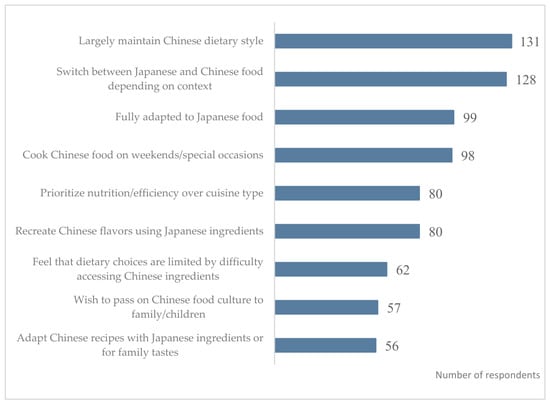
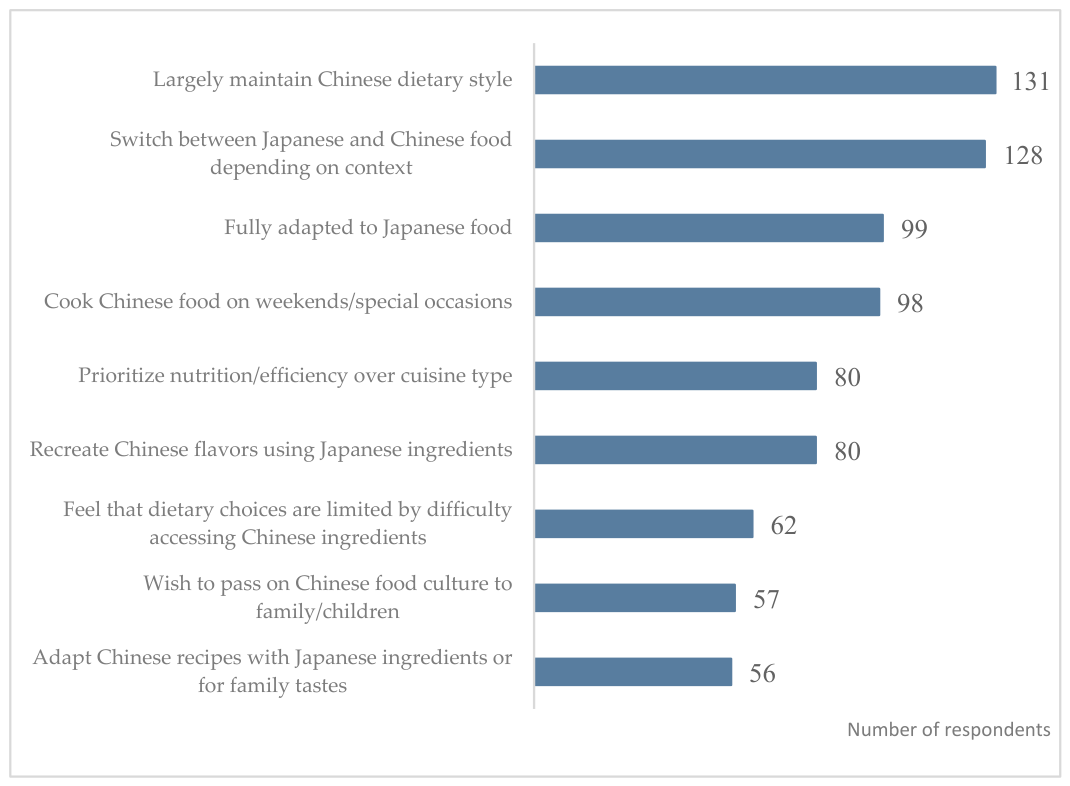
Figure 1 further illustrates that respondents do not simply reproduce Chinese food practices unchanged. Most participants adhere to a Chinese dietary style while alternating between Chinese and Japanese food according to context, using local ingredients to recreate traditional flavors, or modifying recipes to suit household preferences. These findings reveal that Chinese food practices persist through flexible adaptation to daily conditions.
Figure 1.
Food-related practices and attitudes among Chinese residents in Japan (multiple responses, n = 317).
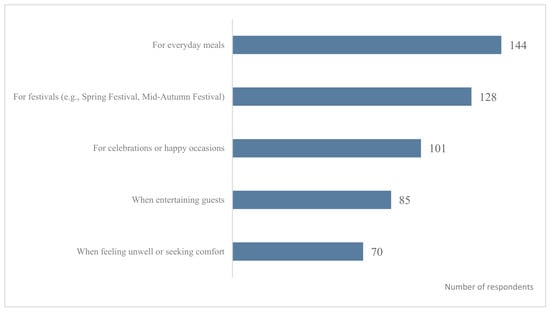
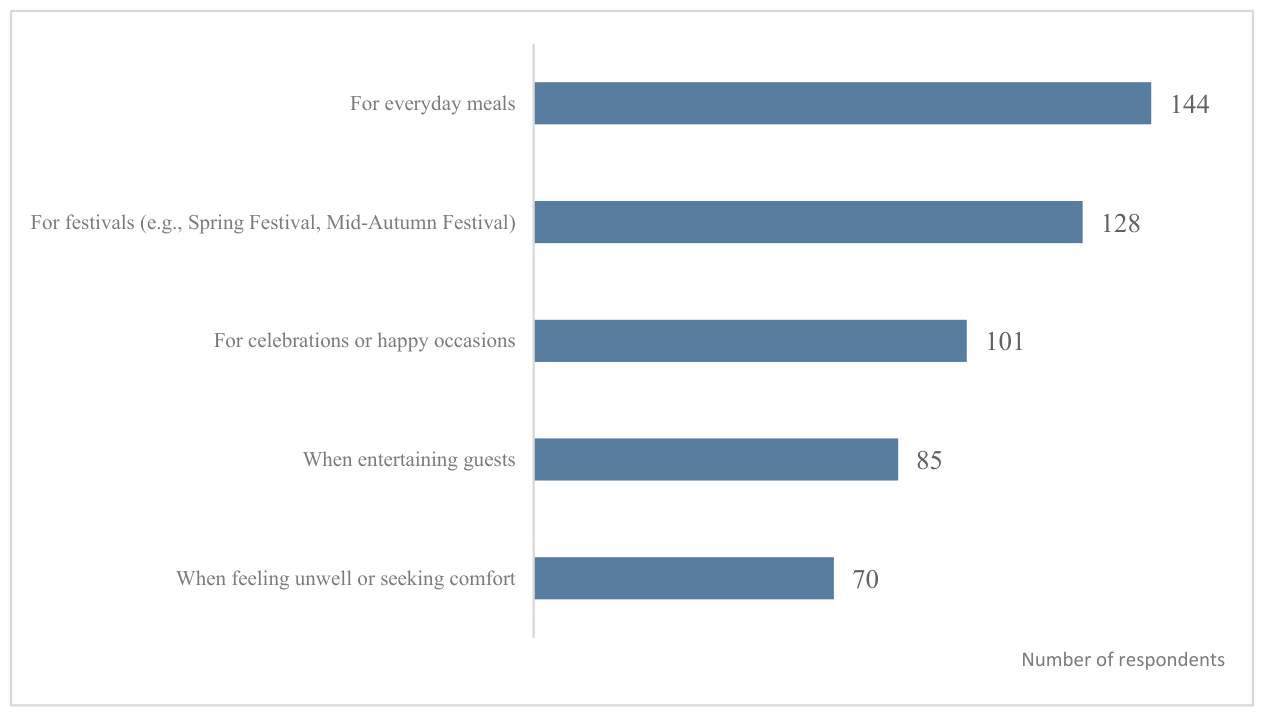
Figure 2 further confirms that the demand for Chinese ingredients is not confined to festivals or special occasions. The most frequently selected situation was everyday meals, indicating that Chinese ingredients function as routine necessities rather than occasional cultural items in respondents’ daily food practices.
Figure 2.
Situations in which Chinese food ingredients are felt to be needed (multiple responses, n = 317).
3.3. Chinese Vegetables and Fruits as Hard-to-Obtain Fresh Ingredients
Next, it will be examined which categories of Chinese ingredients are perceived as hard to acquire. In the questionnaire, respondents were asked to rank seven categories of Chinese ingredients according to difficulty. A weighted score was calculated for each category, with a higher score indicating greater perceived difficulty.
As presented in Table 3, “Chinese vegetables and fruits” received the highest weighted score, at 4.76. A total of 170 respondents ranked this category as either the most difficult or the second most difficult to obtain, accounting for 59.2% of those who ranked this item. These results confirm that, among different types of Chinese ingredients, fresh vegetables and fruits are perceived as a particularly difficult category to secure in Japan.
Table 3.
Weighted difficulty scores of Chinese food ingredients.
This difficulty goes beyond a matter of whether such ingredients are available somewhere in Japan. Compared with seasonings, frozen foods, or processed products, fresh vegetables are perishable and need to be replenished regularly for daily cooking. For this reason, Chinese vegetables require special attention as a category of food provisioning.
The questionnaire asked respondents to rank general ingredient groups instead of specific vegetable varieties. Therefore, a supplementary list, presented in Table 4, was created to define the scope of “Chinese vegetables” in this study. This term does not represent a fixed botanical classification. Instead, it is a practical, culturally defined category of fresh vegetables that Chinese residents use in daily Chinese cooking and perceive as not consistently available through mainstream Japanese retail channels. The list was developed based on the author’s field observations, vegetable sales information from Chinese grocery stores, and interview data from home gardens and small-scale commercial gardens. It is not intended as a complete inventory, but as an illustration of the types of fresh vegetables that appear in Chinese residents’ everyday procurement and gardening practices.
Table 4.
Examples of Chinese Vegetables by Seasonal Tendency.
These vegetables are rarely stocked in mainstream Japanese supermarkets. Even at Chinese grocery stores, their availability, freshness, price, and quantity often vary by region and season. This mismatch between steady demand and unstable access leads many Chinese residents to seek supplementary channels. The following section analyzes the food procurement channels adopted by Chinese residents.
3.4. Food Provisioning Channels for Chinese Ingredients
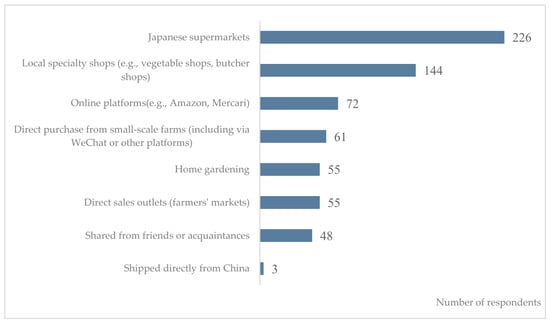
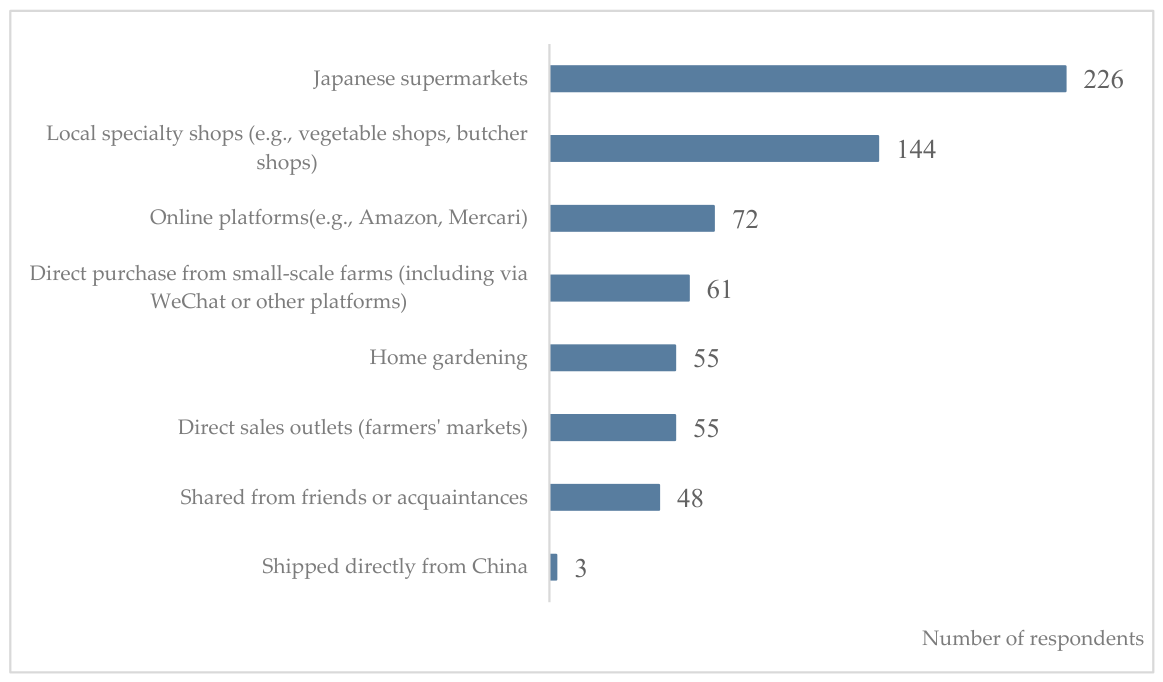
This section explores the channels through which Chinese residents in Japan procure daily food ingredients and Chinese ingredients. The questionnaire included two related items with different scopes. The first covered all channels used for daily food procurement, including both purchasing and non-purchasing methods like home gardening and sharing from acquaintances. The second targeted exclusively retail channels for buying Chinese ingredients. Given their different designs, these two sets of results should be interpreted separately rather than directly compared. Figure 3 indicates that mainstream local retail channels remain the primary source for daily groceries. Japanese supermarkets were the most commonly used channel, followed by local specialty shops such as vegetable shops and butcher shops. Meanwhile, some respondents also used supplementary channels outside ordinary retail stores, including online platforms, direct purchase from small-scale farms, home gardening, and sharing from friends or acquaintances. Home gardening was reported by 55 respondents, accounting for 17.4% of the sample. Given that most respondents lived in urban areas, opportunities for direct cultivation may be constrained by access to suitable land and space. Nevertheless, the result shows that home gardening constitutes an identifiable supplementary provisioning route. More broadly, gardens also contribute to food provisioning as sources from which other residents purchase fresh produce, an aspect examined further through the category of garden-based channels in Section 3.5. The use of these supplementary channels suggests that conventional retail channels do not fully meet all dietary needs, particularly for difficult-to-obtain fresh ingredients.
Figure 3.
Channels for procuring daily food ingredients (multiple responses, n = 317).
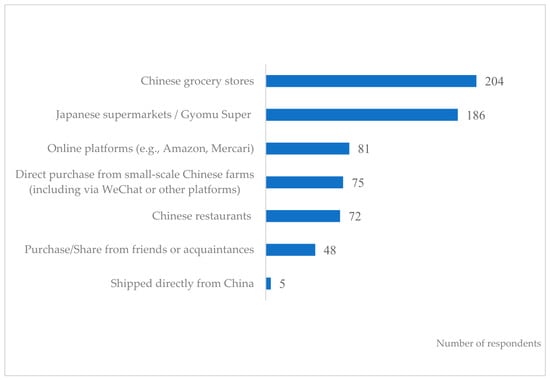
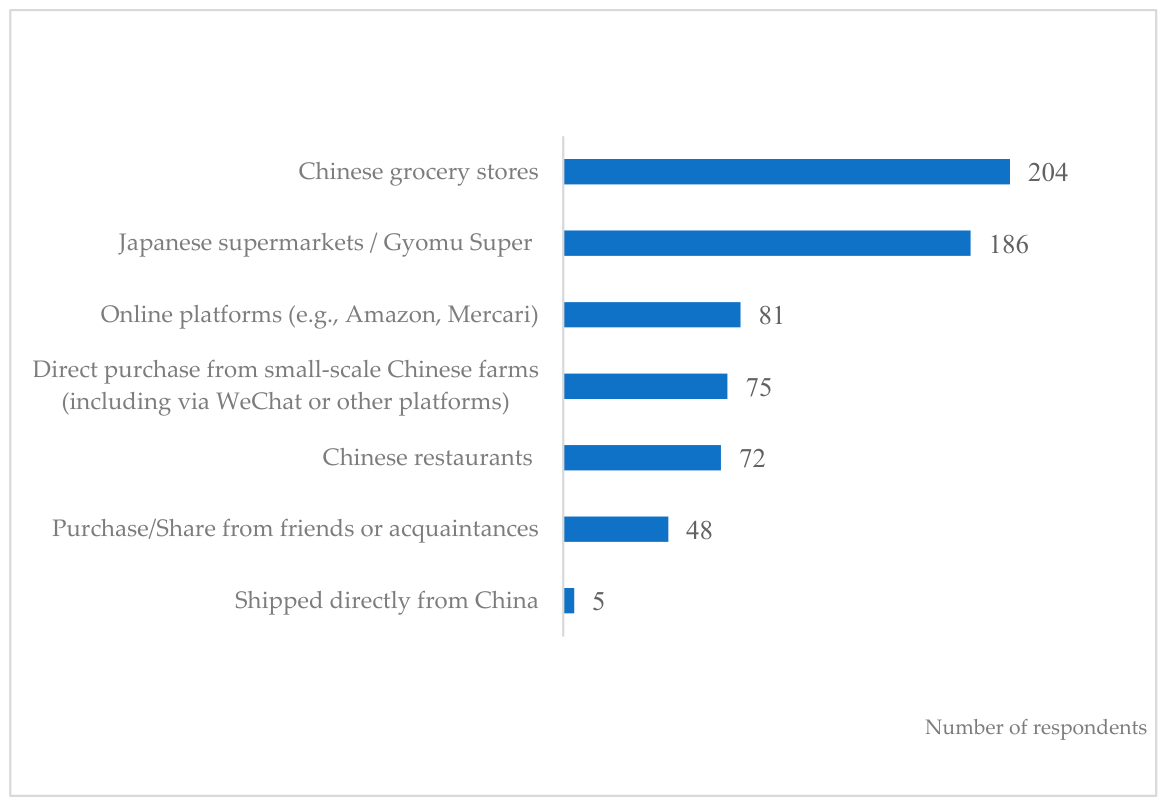
Figure 4 focuses on purchasing channels for Chinese ingredients. Chinese grocery stores emerged as the most commonly used channel, underscoring their core role in the procurement of Chinese ingredients. Respondents also turned to online platforms, Chinese restaurants, and direct purchases from small-scale Chinese-operated farms. The findings reveal that Chinese ingredient procurement relies on an integrated network of ethnic retail, digital platforms, food service establishments, and small-scale production sites.
Figure 4.
Channels for purchasing Chinese food ingredients (multiple responses, n = 317).
These results show that Chinese residents in Japan procure food through both mainstream retail channels and supplementary routes. While Japanese supermarkets and local specialty shops remain important for daily food procurement, Chinese grocery stores and online platforms are primary routes for Chinese ingredients. Small-scale farms, home gardening, and sharing from acquaintances also act as supplementary options, particularly for fresh ingredients that are difficult to obtain through stable retail channels.
This study places particular emphasis on these non-organized routes. They include coping practices such as growing vegetables for oneself. Beyond serving as alternative procurement channels, these practices foster new social connections among Chinese residents in Japan that differ from those that existed previously.
3.5. Supplementary Analysis: Garden-Based Channels and Social-Network-Based Channels
This section conducts a supplementary analysis to examine which respondents were more likely to use garden-based channels and whether garden-based channel use was associated with social-network-based channel use. Respondents were classified as garden-based channel users if they reported using home gardening, direct purchase from small-scale farms, or purchase from small-scale Chinese-operated farms. Because this category includes both home gardening and purchases from small-scale farms, it captures the use of garden-related provisioning channels rather than participation in cultivation alone. Respondents who obtained ingredients through sharing with friends or acquaintances, or through similar interpersonal routes, were classified as social-network-based channel users.
As shown in Table 5, household type, age group, and the presence of elementary-school-age or younger children were significantly associated with the use of garden-based channels. No statistically significant associations were found for length of residence in Japan, gender, or residential area. Although women accounted for a larger proportion of the sample, the proportion reporting the use of garden-based channels did not differ significantly between female and male respondents. This result concerns the use of provisioning channels and should not be interpreted as showing that gender is irrelevant to food purchasing, gardening, or other forms of household food work, which were not directly measured in the survey.
Table 5.
Chi-square test results for variables associated with garden channel use.
Table 6 and Table 7 reveal a weak but statistically significant correlation between garden-based channel use and social-network-based channel use. This does not mean that garden-based channels automatically produce social networks. Rather, it suggests that garden-based provisioning often overlaps with interpersonal practices such as sharing, referral, and exchange.
Table 6.
Chi-square Test of the Association Between Garden-based Channel Use and Social-network-based Channel Use.
Table 7.
Cross-tabulation of Garden-based Channel Use and Social Channel Use for Food Procurement.
The questionnaire results indicate that Chinese vegetables and fruits are widely regarded as hard to obtain, prompting many respondents to turn to alternative channels, including direct purchase from small-scale farms, sharing from acquaintances, and home gardening. These findings reflect consumers’ perspectives on food procurement. While the survey grouped vegetables and fruits together, the subsequent case studies focus mainly on vegetable cultivation. The analysis will now shift to the growers behind these supplementary channels, exploring who grows Chinese vegetables in household and small-scale gardens, their motivations for starting gardening, and how their vegetables reach consumers.
4. Garden-Based Food Provisioning Practices Among Chinese Residents in Japan
Previous studies on immigrant gardens and community gardening demonstrate that small-scale cultivation needs to be considered not only as food production, but also as a social and cultural practice. Research on Latino community gardens in New York, immigrant home gardens, and Vietnamese vegetable gardens in Japan has highlighted the potential of gardens to become spaces of cultural maintenance, family life, harvest sharing, agricultural knowledge exchange, and negotiation with landowners (Saldivar-Tanaka and Krasny 2004; Mazumdar and Mazumdar 2012; Seto-Suh 2017).
From this perspective, this study views gardens as dynamic hubs for food provisioning that adapt to social demands, rather than fixed agricultural or commercial units. All eight interviewees grew Chinese vegetables and shared detailed experiences regarding cultivation, consumption, sharing, exchange, or sale. The cases include home gardens mainly for self-consumption, small-scale commercial gardens, and transitional forms where home gardening gradually evolved into small-scale sales. Accordingly, home gardens and small-scale commercial gardens should not be treated as completely separate types, but as flexible forms of garden-based provisioning that are shaped by household needs, land access, labor capacity, harvest volume, and demand from others.
4.1. Overview of the Eight Garden Cases
Table 8 summarizes the basic characteristics of the eight garden cases, including place of residence, household composition, household employment and income context, type of garden, land type, access arrangements, year of starting gardening, and current garden size. The cases show variation in both land access and household socioeconomic circumstances, suggesting that opportunities for cultivation may be shaped by different combinations of property access, rental capacity, institutional procedures, and social relationships. Some participants used household-owned land, while others rented privately owned plots, obtained municipal allotments or community garden plots through application procedures, or used neighboring land free of charge through informal arrangements. This diversity of access should be understood not only in relation to the circumstances of individual households, but also within the broader context of rural and peri-urban Japan. In some localities, population aging, the decline of the agricultural workforce, and the continued presence of abandoned or underused farmland have created opportunities for land to be reused through rental or informal arrangements (Ministry of Agriculture, Forestry and Fisheries of Japan 2026).
Table 8.
Household, Employment, Land Access, and Garden Characteristics of the Eight Cases.
Previous research has documented similar arrangements. Seto-Suh’s study of Vietnamese home gardens in Japan describes cases in which migrants obtained access to farmland through informal relationships with local landholders, including the use of land without charge (Seto-Suh 2017). Previous research on Chinese home gardens in Japan has similarly shown that some older Japanese landholders, whose capacity to continue cultivation had declined, preferred to allow Chinese residents to use their land free of charge rather than leave it uncultivated (Chen 2025). These findings suggest that access to cultivation may depend not only on housing and property circum-stances or the ability to pay rent, but also on local land availability, trust, reciprocity, and relationships with landholders.
All eight cases had a stable source of household income through the interviewee’s own employment, a spouse’s employment, or both. Gardening was therefore not generally undertaken in the absence of household income, although its economic role differed across cases. In most cases, it supported household consumption or generated supplementary income, whereas Matsudo Farm had developed into a substantial source of household earnings.
4.2. Motivations for Starting Gardens: Food Needs, Family Life, and Practical Conditions
The interviewees’ reasons for starting gardens are diverse and often overlapping. Across the eight cases, three broad sets of motivations emerged: difficulties in obtaining familiar Chinese vegetables, household and care-related needs, and personal interest combined with access to usable land. These motivations were not mutually exclusive, and in several cases the functions of the gardens changed as household circumstances, land access, and opportunities for sale developed over time.
For several interviewees, the direct trigger is the difficulty of obtaining familiar Chinese vegetables. Matsudo Farm serves as a typical example. After arriving in Japan in 2019 and being unable to return to China during the pandemic, the interviewee once found two bunches of Chinese long beans in Ueno, Tokyo. Although they were no longer fresh, he recalled being “extremely happy” to buy them. This experience made him acutely aware of the difficulty of obtaining fresh Chinese long beans, as well as the existing demand among Chinese residents. He later expanded his small home garden into a full-scale farm. Other cases were less commercially oriented but stem from the same desire for familiar ingredients. In the Narita Home Garden case, the interviewee, originally from Sichuan, stated that she grew chili peppers because “we Sichuan people love spicy food,” especially varieties such as xiaomi chili and chaotian chili, which “could not be bought here.” Xiaoyao Farm also began during the pandemic, when the interviewee’s parents stayed in Japan and “wanted to eat Chinese vegetables.” The Kanagawa Rental Garden case reflected a similar motivation, as the interviewee also began cultivating Chinese vegetables for household consumption. These instances demonstrate that practical dietary needs often prompted people to take up gardening.
In other cases, gardening is closely intertwined with family life. In the Kita Ward Community Garden case, the plot enabled an elderly family member to continue a familiar activity and children to experience food production through harvesting. It has become a shared family space where family members could participate in cultivation and incorporate home-grown vegetables into everyday meals. A similar care related motivation appeared in the Guomei Organic Farm case, where gardening was partly intended to support the emotional well-being of an elderly family member.
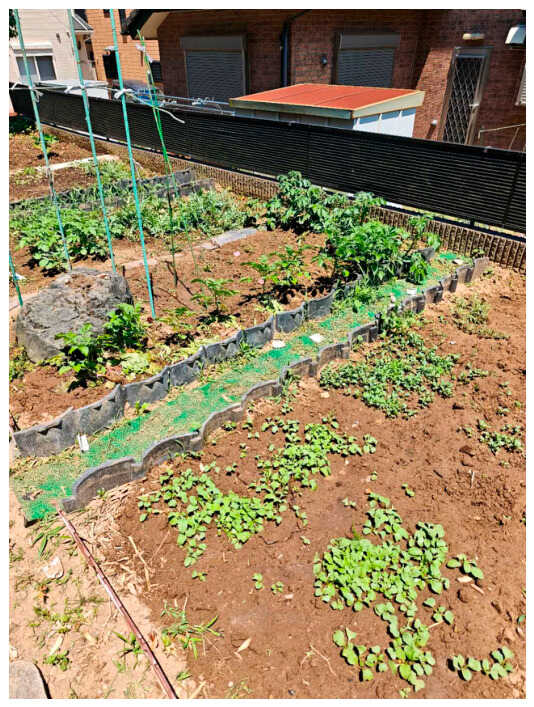
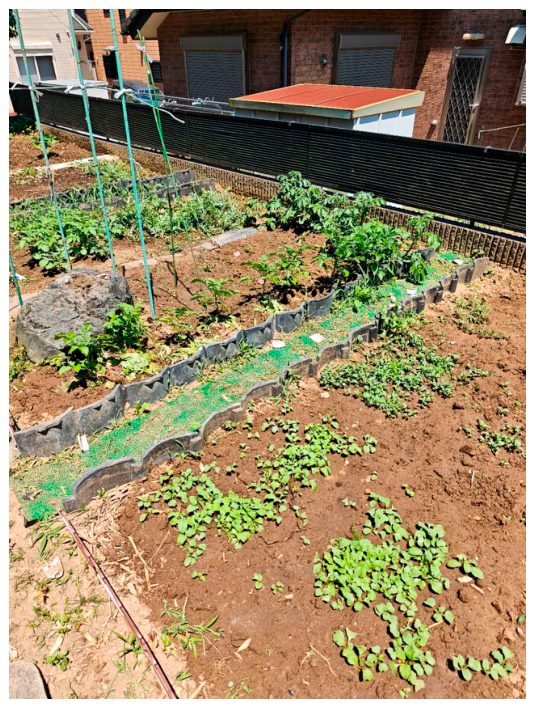
Gardening is also influenced by practical factors including food costs, childcare, work opportunities, mobility, and land access. In the Mie Rural Garden case, the interviewee recalled that vegetables seemed expensive when she first arrived in Japan. Constrained by childcare duties, she could not work full-time outside the home, while rural living granted her easy access to land. Under these conditions, gardening became a practical way to secure food and create a flexible source of income while raising children. Similarly, the Chiba Villa Garden case showed that gardening could begin for personal interest and available land rather than for food supply alone. After purchasing a detached house with a spacious land, the interviewee continued gardening as a hobby, and friends gradually began to participate because the land was too large to manage alone. As shown in Figure 5, the garden was divided into smaller sections using roof tiles, allowing the owner and several Chinese friends to manage separate plots and grow vegetables of their own choice.
Figure 5.
A section of Chiba Villa Garden. The garden was cultivated collaboratively by the owner and several Chinese friends.
The cases above show that the motivations for starting gardens were varied. In most cases, difficulty in obtaining Chinese vegetables was an important reason, but it was also connected with family members’ food preferences, elderly care, childcare, food costs, work schedules, mobility, and access to land. Even where gardening later developed into small-scale commercial activity, it did not begin as a fixed business strategy. Rather, it emerged as a practical response to the circumstances of everyday life in Japan and was gradually adjusted over time. By making use of available land, household labor, and social relationships, the interviewees found ways to secure familiar food, support family members, and organize their daily lives under local conditions. The next section examines how these initial motivations were translated into flexible practices of cultivation and harvest circulation.
4.3. Flexible Cultivation and Circulation of Chinese Vegetables
The crops cultivated correspond to the daily cooking needs outlined in Table 4. In most cases, gardeners prioritized Chinese vegetables widely used in traditional cuisine but difficult to obtain in a fresh and stable form through ordinary Japanese retail channels. Their choices were not restricted to vegetables unavailable in Japan. Some gardeners also grew vegetables commonly sold in Japanese supermarkets, while others enjoyed searching for less common seeds or seedlings in Japanese home centers to try out new crops. Overall, crop selection is driven by limited access to particular Chinese vegetables, daily culinary demands, local availability, personal interest, and the enjoyment of experimenting with unfamiliar or unusual crops.
Cultivation arrangements are adjusted based on household demands, customer requirements, land conditions, labor capacity, and harvest schedules. In Matsudo Farm, as the garden expanded, crops requiring frequent harvesting, such as long beans, cucumbers, and chili peppers, were placed on the plot closer to Tokyo, while less labor-intensive crops were grown on a more distant plot. For gardens engaged in sales, customer demand exerts a direct influence on planting plans. Xiaoyao Farm, for example, grew celtuce through a reservation system: orders were first collected via WeChat groups, and planting was arranged accordingly. In contrast, crops with volatile yields like long beans and loofah are distributed flexibly after harvesting. Guomei Organic Farm presents a similar process: the grower did not originally prioritize celtuce for personal consumption, but later cultivated it because customers said they “wanted to eat it.” These cases demonstrate that such gardens satisfy growers’ own dietary tastes while also catering to the needs of other Chinese residents in Japan.
After harvest, Chinese vegetables move through different routes according to the scale and orientation of each garden. Vegetables from small home gardens are primarily for family use. For instance, the roughly six-square-meter Kita Ward Community Garden case yielded almost entirely for home consumption. Because there was little surplus, interaction with other gardeners centered more on exchanging seeds and cultivation information than on sharing vegetables. Larger household or transitional gardens, however, produce surplus vegetables beyond the family unit. In Narita Home Garden and Mie Rural Garden, vegetables that exceeded household needs were shared with Chinese colleagues, nearby Chinese friends, or Japanese neighbors. Such sharing was not organized as a formal exchange system; rather, it emerged from the practical situation of having more vegetables than the household could consume. Transitional and small-scale commercial gardens adopt more structured distribution channels. Xiaoyao Farm relied on WeChat group reservations, Guomei Organic Farm used WeChat groups to sell seasonal Chinese vegetables, Mie Rural Garden used Japanese platforms like Mercari and PayPay Flea Market, and Matsudo Farm combined individual orders, customer referrals, Chinese grocery stores, restaurants, and online sales through intermediaries. Diverse as these channels are, they all serve the demand for Chinese vegetables that mainstream Japanese retailers fail to fully satisfy.
These practices show that garden-based provisioning was not simply a reproduction of familiar food practices outside China. By continually adjusting to land conditions, labor capacity, customer demand, and available circulation channels, growers reorganized these practices within the material and social conditions of everyday life in Japan. This process provides a concrete example of the recreation of familiarity discussed by Parasecoli (2014), in which migrants maintain culturally meaningful food practices by adapting them to a new environment. It also shows that maintaining familiar foodways and adapting to the receiving society were not opposing processes. Rather, cultural continuity was sustained through practical engagement with local land, markets, technologies, and social relationships. This may be understood as one of the everyday forms through which integration takes place: familiar food practices are not abandoned, but are reorganized through sustained engagement with the material and social conditions of life in Japan. Garden-based provisioning thus became one way through which Chinese residents incorporated familiar food needs into their everyday lives in Japan.
4.4. Social Relations Emerging Through Garden-Based Provisioning
While the above section discussed the production and distribution of Chinese vegetables, this section shifts the focus to the relationships formed around that movement, as vegetables moved through family labor, sharing among acquaintances, repeated transactions with customers, exchanges with neighbors, and negotiations over land use.
4.4.1. Intra-Family Relations: The Garden as a Space for Parent–Child Interaction and Emotional Care
In gardens, different family members may participate in food-related activities in different ways. These activities involve not only the material production of food but are also embedded in domestic work, care responsibilities, and emotional support among family members. Hochschild’s concept of “emotion work” provides a useful perspective for understanding forms of family work that often remain less visible. Emotion work refers to the efforts people make within private relationships and everyday life to manage their own or others’ feelings and to sustain affective ties and family well-being (Hochschild 1979). From this perspective, gardens can be understood as spaces where physical labor, family care, and emotional support are closely intertwined.
In the Kita Ward Community Garden case, gardening was organized through a division of work among three generations. The interviewee explained that “the daily watering and cultivation are mainly done by my mother-in-law,” while she herself helped with tasks such as setting up frames and small greenhouses. The children were mainly brought to the garden during harvests, particularly for potato digging and vegetable picking. These arrangements were practical, and also involved forms of care within the family. The mother-in-law was given an ongoing role in the household through work that was familiar to her. The children were included at moments when gardening could be enjoyable and manageable for them. In this sense, the garden brought together productive work, intergenerational care, and the less visible emotional work of maintaining each family member’s involvement.
A similar pattern appeared in the Mie Rural Garden case. The interviewee described the garden and the animals she raised as part of family life, explaining that her child enjoyed gathering eggs: “The children like collecting eggs. They come with me to the chicken coop every day, and they’re so happy when they find the eggs.” What mattered here was not only that the children learned where food came from. Their participation also depended on the mother repeatedly taking them with her, watching over them, and making space for their interest in the animals and the garden. The chicken coop, the vegetables, the geese, and the surrounding land therefore became part of the family’s daily rhythms. Through these small and repeated activities, food production was connected with care, shared enjoyment, and the making of family memories.
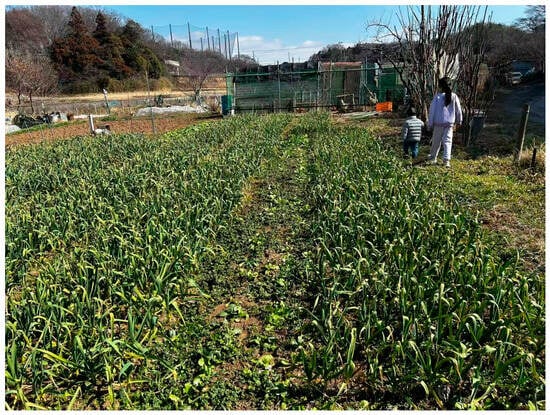
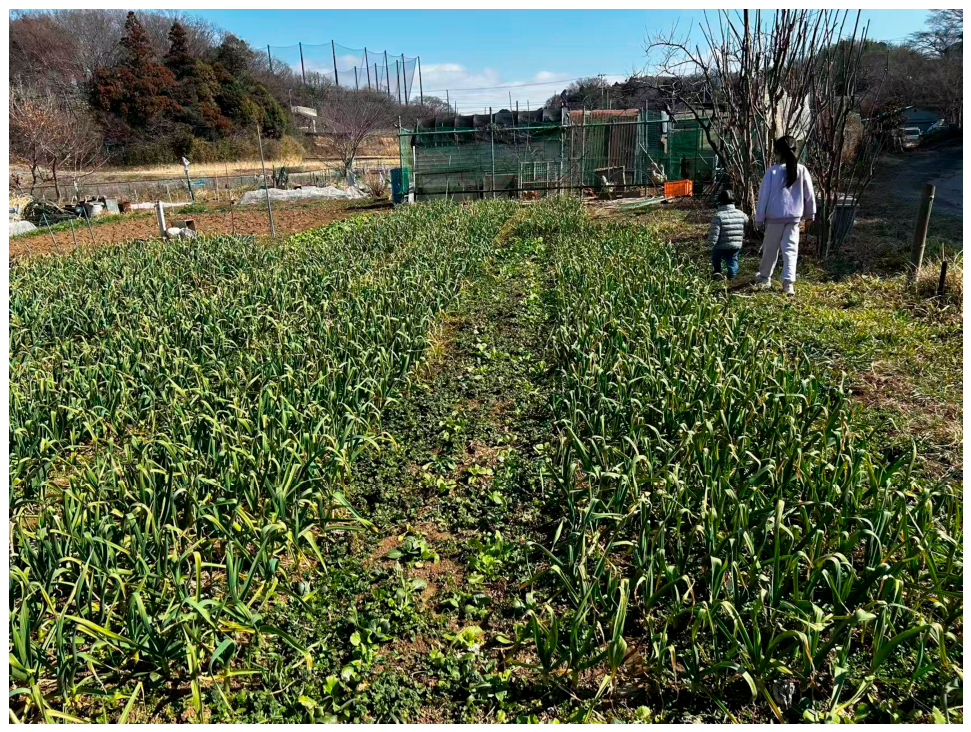
Furthermore, Guomei Organic Farm proves that gardens can become spaces for emotional care within the family. In particular, the garden was first created to contribute to the wellbeing of the mother-in-law since she had a chance to cultivate the land and enjoy time outdoors. As cultivation continued, it eventually transformed into a place of collective use where adults cultivated and managed the land, while children played, collected eggs, and joined small everyday activities. As shown in Figure 6, garlic sprouts were growing in the main plot at the time of the field visit, while chickens, ducks, and geese were kept in a fenced area at the back of the garden.
Figure 6.
A field view of Guomei Organic Farm during fieldwork.
These cases show that garden-based food provisioning not only requires sustained domestic labor but also serves as an important site of family care and emotion work. Through cultivation, harvesting, and caring for animals, family members maintain everyday household life, support older relatives in continuing familiar activities, and provide children with opportunities to participate in food production. From the perspective of integration, maintaining a stable family life, continuing familiar everyday activities, and caring for one another may constitute an important foundation for migrants as they build their lives in Japan. More broadly, garden-based practices can also be understood as an agentic response to practical constraints. In the Mie case, childcare and household responsibilities limited the interviewee’s time for full-time employment and participation in activities outside the home. Under these circumstances, the home garden enabled her to maintain the household food supply while caring for her children and to earn some supplementary income. The garden did not remove the constraints associated with childcare and household responsibilities, but it offered a relatively flexible way of organizing family life and economic activity within those conditions.
4.4.2. Co-Ethnic Connections Through Garden Practices
Beyond the household, garden practices foster connections among Chinese residents in Japan. People bond by cultivating together, sharing harvests, introducing land, exchanging information, and offering mutual support.
In this way, the evolution of Chiba Villa Garden can be seen as a transformation from an individual garden into a shared garden among Chinese friends and acquaintances. The interviewee first cultivated the land by himself, but later found the plot too large to manage alone. He explained: “The plot was just too big; I couldn’t handle it all by myself. So I tried inviting friends over. They found it fun and started coming regularly—two or three times a month. We shared the harvest together. I realized this made things easier for me, and they enjoyed it too. It worked out well.” Such ethnic bonds first emerged from the practical work of managing land, and were sustained by the shared enjoyment of planting and harvesting. Participation later expanded to “friends of friends,” with people joining in flexible ways rather than through fixed membership or obligations.
In other cases, co-ethnic connections were based on sharing surplus vegetables, access to land, and practical assistance. For instance, in Narita Home Garden, the interviewee explained that she “definitely could not finish all” the vegetables she grew, and after moving, surplus vegetables were “mainly given to Chinese colleagues at her workplace.” In Kanagawa Rental Garden, the interviewee lent a municipal garden plot to a friend while she returned to China, then discovered a larger plot through a friend’s introduction, and allowed another nearby Chinese vegetable gardener who had no harvest due to an injured leg “come and pick vegetables freely” from her field.
These cases show that co-ethnic connections around gardens were formed through practical acts of cultivating together, sharing surplus vegetables, introducing access to land, and helping one another. These relationships enabled Chinese residents not only to maintain existing ties but also to extend their networks through friends, colleagues, and acquaintances. Their significance lay in the practical resources they provided, including access to land, shared labor, food, cultivation knowledge, and assistance during temporary difficulties. This finding supports relational approaches to integration, which emphasize that migrants build their lives in receiving societies through access to social relationships and everyday resources rather than through individual adaptation alone (Phillimore et al. 2021). In the cases examined here, garden-based co-ethnic connections constituted an informal route through which Chinese residents organized and sustained their everyday lives in Japan.
4.4.3. Customer Relations: From Repeated Transactions to Trust
For gardens running small-scale sales, interactions with customers extend beyond one-time purchases. Frequent transactions, reservations, referrals, and regular communication about vegetable needs help build steady, long-term customer relationships.
Xiaoyao Farm illustrates how trust builds through long-term interactions. The interviewee shared that when she was temporarily unable to manage the garden because of surgery on her hand, her regular customers “were not anxious and did not rush me,” but waited for her to recover and resume supply. When her nephew moved to Tokyo for study, these customers helped with practical matters such as picking up keys for a rented apartment. In this case, customers were no longer only buyers, but became acquaintances who could provide everyday support.
Customer relationships also help broaden sales channels. In Matsudo Farm, the customer base first consisted of only twenty to thirty people, but gradually increased as customers introduced new customers. Chinese grocery stores also introduced him to other stores, and several customers also supported him with administrative or accounting matters. In Mie Rural Garden, a warmer bond developed over time: regular customers eventually “became my friends as they kept buying,” and the grower sometimes gave them surplus or imperfect vegetables free of charge.
Through repeated purchases, referrals, waiting, and occasional help, the sale of Chinese vegetables sometimes became a basis for trust, familiarity, and mutual support. These relationships developed gradually through regular contact around everyday food needs, and in some cases extended beyond the transaction itself. Customers not only introduced new buyers, but also offered practical help during temporary difficulties. In this sense, these customer relationships also functioned as a form of social capital by giving growers access to information, referrals, and practical assistance. In this way, small-scale sales created social ties that supported growers’ everyday lives in Japan.
4.4.4. Social Relations in Cross-Cultural Encounters
Garden-based practices also serve as a bridge between Chinese residents and people from other cultural backgrounds, especially Japanese neighbors, landowners, and gardeners of other nationalities. These connections rarely stem from deliberate cross-cultural communication; instead, they arise naturally from practical matters concerning vegetables, land, and garden rules.
Vegetables themselves become a medium for interactions with Japanese neighbors in many instances. In the Narita Home Garden case, the interviewee often shared surplus vegetables with nearby residents. One episode involving loofah is especially illustrative. At first, she thought that an elderly neighbor was bothered because the loofah had grown too large and was hanging toward the neighbor’s parking area. Later, however, the neighbor came to ask about it. It turned out that she was originally from Okinawa, where loofah is also eaten, and had been hoping to obtain some because she could not find it locally. The interviewee then gave her loofah and received fertilizer in return. Similar interactions appeared in Chiba Villa Garden, where loofah offered to Japanese neighbors was reciprocated with coffee, fruit and small gifts. At Matsudo Farm, neighbors who initially knew nothing about these vegetables gradually grew fond of them and started asking for supplies. These cases suggest that unfamiliar crops did not necessarily remain markers of cultural difference. Through sharing, explanation, and reciprocal exchange, they became ordinary objects around which familiarity and communication could develop. Similar findings have been reported in recent research on immigrant community gardening, which shows that gardens can function as spaces for intercultural learning and the formation of new social connections while migrants continue to maintain culturally meaningful food practices (Otoadese et al. 2025).
Cross-cultural interactions do not always run smoothly. The Kanagawa Rental Garden case shows how misunderstanding and negotiation could arise when gardeners of different nationalities used adjacent plots. The interviewee had reserved a garden plot for rental, but a Vietnamese gardener planted vegetables on it before the lease took effect, believing the land was unoccupied. Later, with the explanation and mediation of a neighboring Japanese gardener, both sides clarified the situation and resolved the misunderstanding. This case shows that sharing the same physical space did not automatically create mutual understanding. Interaction required the participants to explain different assumptions about land use, negotiate boundaries, and sometimes rely on mediation by others. Such misunderstandings could become barriers to ongoing relationships when they were not addressed.
Rules also shape cross-cultural interactions. In the Kanagawa Rental Garden case, the landowner decided whether to renew leases based on how well renters cultivated the land and whether they left it abandoned. In the Kita Ward Community Garden case, gardening club members abided by shared rules, including keeping plots in use and restricting children from running freely in the garden. These cases indicate that access to garden space and continued participation were conditional on meeting locally established expectations. For Chinese residents, engaging with local society therefore involved not only friendly exchange, but also learning and following rules concerning land maintenance, shared space, and appropriate behavior. Failure to meet these expectations could threaten continued access to the garden and limit opportunities for further interaction.
Cross-cultural connections grow out of ordinary garden-related practices rather than formal intercultural activities. Sharing vegetables, explaining how to eat unfamiliar crops, exchanging small gifts, negotiating land boundaries, and abiding by community rules all serve as chances for interaction. In this sense, gardens act as a medium for Chinese residents to engage with local society through practical matters of vegetables, land, and everyday rules.
This section explored garden-based food provisioning as a concrete practice through which Chinese residents in Japan secure Chinese vegetables for daily use. In response to difficulties in obtaining familiar vegetables and to different household circumstances, growers organized food provisioning by drawing on available land, household labor, digital platforms, customer demand, and social relationships. In this process, gardens provided a relatively flexible way of combining family care with household food provision, while also supporting co-ethnic assistance, customer trust, and contact with people from other cultural backgrounds. At the same time, whether these practices could develop and continue was shaped by labor capacity, conditions of access to land, misunderstandings in shared spaces, and local rules. Garden-based food provisioning can be understood as one of the everyday settings in which integration takes place.
5. Conclusions and Discussion
This study focuses on the everyday provisioning of familiar ingredients among Chinese residents in Japan, especially the recurring acquisition of fresh Chinese vegetables. In this study, food provisioning refers to the broader process through which familiar ingredients are obtained, circulated, and socially extended. The findings show that immigrant foodways are sustained through material and relational efforts that go beyond memory, taste, and recipe-level adjustments. The questionnaire survey indicates that Chinese ingredients remain important in everyday meals, while some ingredients, especially fresh vegetables and fruits, are difficult to obtain through stable retail channels. To cope with this scarcity, Chinese residents in Japan develop supplementary informal food provisioning practices through home cultivation, access to land, digital media such as WeChat, and personal networks.
These findings extend Parasecoli’s (2014) view of immigrant food practices as dynamic activities by showing how such dynamism operates through the organization of food provisioning. Garden-based provisioning makes this dynamism especially visible. Growers flexibly adjust crop choices and circulation channels in response to multiple practical conditions, allowing for vegetables to move between household consumption, social reciprocity, and embedded commercial channels. In this process, the digital infrastructure of WeChat and land are deeply intertwined. Physical gardens are rooted in specific Japanese neighborhoods, while WeChat extends co-ethnic networks beyond local boundaries and aggregates dispersed demand. As vegetables move across these different routes, the boundary between home gardens and small-scale commercial gardens becomes blurred, with some gardens shifting between self-consumption, sharing, and small-scale sales depending on harvest conditions and demand. In this sense, garden-based provisioning is a flexible everyday practice through which Chinese residents reorganize resources and social connections.
The qualitative cases further demonstrate that food provisioning is also a relational process. Gardens have been discussed in previous studies as spaces where shared practice and everyday interaction may foster convivial relations among migrants, as Shan and Walter’s (2015) study of Chinese immigrants in Canadian community gardens suggests. In the cases examined here, however, relationships did not emerge simply from shared ethnic background or from the existence of gardens themselves. Instead, they evolved gradually as Chinese vegetables circulated among households, personal networks, customers, local neighbors and landowners. Through growing, sharing, purchasing, explaining, gifting, and negotiating around these vegetables, garden-based provisioning brought family members, Chinese acquaintances, customers, Japanese neighbors, landowners, and gardeners of other nationalities into relation.
Taken together, these cases show that garden-based provisioning offers a grounded everyday space where immigrant integration actually takes place from the bottom up. Phillimore et al. (2021), in their comparison of refugee resettlement programs in Japan and the United Kingdom, argue that integration cannot be reduced either to economic self-reliance or to social contact alone. Employment can provide material stability, while social relationships may offer practical assistance, familiarity, and access to wider resources. Neither dimension alone is sufficient to sustain a complete process of integration. Phillimore (2024) further shifts attention from predetermined integration outcomes to the capabilities and opportunities people need to pursue lives they value. The garden-based food provisioning practices examined in this study provide a concrete example of this process: the continued availability of familiar food depended on growers’ ability to mobilize land, labor, digital infrastructures, and social relationships, and these resources in turn enabled Chinese residents to organize household food provision, respond to different family circumstances, and maintain everyday life in Japan. At the same time, social ties and everyday familiarity gradually developed through these material practices, including turning over the soil, searching for land, sharing unexpected bumper harvests, running small-scale sales through WeChat, and explaining unfamiliar vegetables and local rules to others. Viewed through Bourdieu’s concept of social capital, these relationships were important because they gave participants access to practical resources that were difficult to secure through individual effort alone, including land, labor, cultivation knowledge, information, customers, and assistance (Bourdieu 1986). This finding also echoes Boccagni and Bonfanti’s (2023) concept of “home in the making.” It suggests that home gradually takes shape through everyday practices, including the arrangement of living spaces, the establishment of routines, the use of familiar objects, and the maintenance of social relationships. Following this line of thought, gardens and the food provisioning practices organized around them can be understood as an extension of this process beyond the interior of the dwelling. They constituted part of the material basis through which Chinese residents re-established familiar routines, supported family life, and made everyday life in Japan easier to maintain.
Of course, this process was not always smooth. Access to and continued participation in garden spaces depended on land availability, labor capacity, social coordination, and compliance with locally established expectations. Shared spaces could generate misunderstandings over land use and boundaries, while garden rules also shaped how participants were expected to maintain their plots and use communal space. Everyday integration therefore involved not only access to resources, the development of social ties, and the formation of familiarity, but also negotiation, mediation, and adjustment.
Overall, this study makes three contributions. First, it shifts immigrant foodways research from symbolic consumption to material provisioning. Second, it shows that immigrant foodways are maintained through the reorganization of resources, practices, and relationships, rather than through recipe adaptation alone. Third, it contributes to integration studies by showing that food provisioning helps migrants secure familiar food while also forming part of the everyday process through which they organize life and establish social relations in the receiving society.
This study has several limitations, which also suggest directions for future research. The questionnaire survey is based on a non-probability convenience sample, and the number of qualitative cases is limited, so the findings cannot be generalized to all Chinese residents in Japan. Also, the survey did not systematically collect information on household income, assets, educational attainment, housing tenure, or other indicators of socioeconomic position. Although the qualitative cases provide some information on household employment and arrangements for accessing land, this study cannot systematically determine how socioeconomic circumstances shape access to garden-based food provisioning. Additionally, while the survey grouped Chinese vegetables and fruits together, the case studies centered primarily on the cultivation and distribution of vegetables. Future research may explore other fresh and perishable ingredients, along with alternative supply channels including Chinese grocery stores, online platforms, and restaurants. Comparative studies with other immigrant groups in Japan would also help clarify whether similar food provisioning practices and social relations emerge around hard-to-obtain familiar ingredients. Finally, this study identifies everyday practices and relationships through which integration may develop, but it does not assess whether these processes lead to longer-term or broader integration outcomes. Longitudinal research and comparative studies involving other immigrant groups in Japan would help clarify how such practices develop over time and whether similar processes emerge around other hard-to-obtain familiar ingredients.
Returning to the scene described at the beginning of this paper—Chinese residents working in vegetable gardens in suburban Japan—this study shows that such a scene reveals that ordinary daily work of securing food enables immigrants to build a sustainable life, maintain familiar foodways, while also creating social connections, local encounters, and forms of belonging in Japan.
Author Contributions
Conceptualization, K.C., M.F. and S.N.; Methodology, K.C., M.F. and S.N.; Formal analysis, K.C.; Investigation, K.C.; Resources, K.C.; Data curation, K.C.; Writing—original draft, K.C.; Writing—review and editing, K.C., M.F. and S.N.; Visualization, K.C.; Supervision, M.F. and S.N. All authors have read and agreed to the published version of the manuscript.
Funding
This research received no external funding.
Institutional Review Board Statement
Ethical review and approval were not required for this study because it involved a non-invasive anonymous questionnaire survey and semi-structured interviews with adult participants. No personally identifiable information is disclosed in the manuscript, and all data were anonymized before analysis. The study was conducted in accordance with the “Conduct for Responsible Research Activities” published Japan Science and Technology. (https://www.jst.go.jp/researchintegrity/shiryo/pamph_for_researcher.pdf, accessed on 3 January 2025).
Informed Consent Statement
All participants were informed of the purpose of the study, the voluntary nature of participation, their right to withdraw, and the anonymization of personal information. Informed consent was obtained from all subjects involved in the study.
Data Availability Statement
The original contributions presented in this study are included in the article. Further inquiries can be directed to the corresponding author.
Acknowledgments
The authors would like to thank all survey respondents and interview participants for their time, cooperation, and valuable insights. The first author is also grateful to her teachers, family members, and friends for their support throughout this research. She especially thanks her young daughter for accompanying her during field visits to distant garden sites.
Conflicts of Interest
The authors declare no conflicts of interest.
References
- Anderson, Eugene Newton. 1988. The Food of China. New Haven: Yale University Press. [Google Scholar]
- Bailey, Ajay. 2017. The migrant suitcase: Food, belonging and commensality among Indian migrants in the Netherlands. Appetite 110: 51–60. [Google Scholar] [CrossRef] [Scilit] [PubMed]
- Boccagni, Paolo, and Sara Bonfanti, eds. 2023. Migration and Domestic Space: Ethnographies of Home in the Making. Cham: Springer. [Google Scholar] [CrossRef] [Scilit]
- Bourdieu, Pierre. 1984. Distinction: A Social Critique of the Judgement of Taste. Translated by Richard Nice. Cambridge: Harvard University Press. [Google Scholar]
- Bourdieu, Pierre. 1986. The Forms of Capital. In Handbook of Theory and Research for the Sociology of Education. Edited by John G. Richardson. New York: Greenwood Press, pp. 241–58. [Google Scholar]
- Bourdieu, Pierre. 1990. The Logic of Practice. Translated by Richard Nice. Stanford: Stanford University Press. [Google Scholar]
- Brightwell, Maria das Graças. 2012. A Taste of Home?: Food, Identity and Belonging Among Brazilians in London. Doctoral thesis, Royal Holloway, University of London, London, UK. [Google Scholar]
- Chang, Kwang-chih, ed. 1977. Food in Chinese Culture: Anthropological and Historical Perspectives. New Haven: Yale University Press. [Google Scholar]
- Chen, Kemeng. 2025. Katei Saien o Tsūjita Zainichi Chūgokujin no Nettowāku Kōchiku to Ibunka Tekiō [Network Building and Cross-Cultural Adaptation among Chinese Residents in Japan through Home Gardening]. Shakai Bunseki 52: 31–47. [Google Scholar]
- Cho, Lily. 2010. Eating Chinese: Culture on the Menu in Small Town Canada. Toronto: University of Toronto Press. [Google Scholar] [CrossRef] [Scilit]
- Creswell, John W., and Vicki L. Plano Clark. 2018. Designing and Conducting Mixed Methods Research, 3rd ed. Thousand Oaks: SAGE Publications. [Google Scholar]
- Etikan, Ilker, Sulaiman A. Musa, and Rukayya S. Alkassim. 2016. Comparison of Convenience Sampling and Purposive Sampling. American Journal of Theoretical and Applied Statistics 5: 1–4. [Google Scholar] [CrossRef] [Scilit]
- Fischler, Claude. 1988. Food, self and identity. Social Science Information 27: 275–92. [Google Scholar] [CrossRef] [Scilit]
- Hochschild, Arlie Russell. 1979. Emotion Work, Feeling Rules, and Social Structure. American Journal of Sociology 85: 551–75. [Google Scholar] [CrossRef] [Scilit] [PubMed]
- Hwang, HyeKyoung. 2002. A Study of the Ethnic Identity of Korean Residents in Osaka City Through the Food Culture (Part 2): A Focus on the Daily Food Culture. Journal of Home Economics of Japan 53: 1097–104. [Google Scholar] [CrossRef]
- Joppke, Christian. 2007. Beyond National Models: Civic Integration Policies for Immigrants in Western Europe. West European Politics 30: 1–22. [Google Scholar] [CrossRef] [Scilit]
- Kirshenblatt-Gimblett, Barbara. 1999. Playing to the Senses: Food as a Performance Medium. Performance Research 4: 1–30. [Google Scholar] [CrossRef] [Scilit]
- Koç, Mustafa, and Jennifer Welsh. 2001. Food, Identity and Immigrant Experience. Canadian Diversity 1: 46–48. [Google Scholar] [CrossRef] [Scilit]
- Lee, Siew-Peng. 2015. Eating Solo: Food Practices of Older Hong Kong Chinese Migrants in England. Food and Foodways 23: 210–30. [Google Scholar] [CrossRef] [Scilit]
- Lillekroken, Daniela, Asta Bye, Jonas Halvorsrud, Laura Terragni, and Jonas Debesay. 2024. Food for Soul—Older Immigrants’ Food Habits and Meal Preferences After Immigration: A Systematic Literature Review. Journal of Immigrant and Minority Health 26: 775–805. [Google Scholar] [CrossRef] [Scilit] [PubMed]
- Lin, Hsien-Ming, Ching Lin Pang, and Da-Chi Liao. 2020. Home Food Making, Belonging, and Identity Negotiation in Belgian Taiwanese Immigrant Women’s Everyday Food Practices. Journal of Ethnic Foods 7: 29. [Google Scholar] [CrossRef] [Scilit]
- Mazumdar, Shampa, and Sanjoy Mazumdar. 2012. Immigrant Home Gardens: Places of Religion, Culture, Ecology, and Family. Landscape and Urban Planning 105: 258–65. [Google Scholar] [CrossRef] [Scilit]
- Ministry of Agriculture, Forestry and Fisheries of Japan. 2026. Kōhai Nōchi no Genjō to Taisaku [The Current Situation of and Measures for Abandoned Farmland]; Tokyo: Ministry of Agriculture, Forestry and Fisheries of Japan.
- Newman, Jacqueline M., and Ruth Linke. 1982. Chinese Immigrant Food Habits: A Study of the Nature and Direction of Change. Royal Society of Health Journal 102: 268–71. [Google Scholar] [CrossRef] [Scilit] [PubMed]
- Oh, Chu Hyang, and Emiko Saito. 2015. Dietary Acculturation of Filipinas Living in an Urban Area in Japan. Japanese Journal of Public Health Nursing 4: 2–10. [Google Scholar] [CrossRef] [PubMed]
- Otoadese, Destiny, Issa Kamara, and Elizabeth Onyango. 2025. Growing Roots: The Role of Collective Community Gardening in Cultural Food Insecurity and Social Integration of African Immigrants in Alberta, Canada. BMC Public Health 25: 2271. [Google Scholar] [CrossRef] [Scilit] [PubMed]
- Parasecoli, Fabio. 2014. Food, Identity, and Cultural Reproduction in Immigrant Communities. Social Research: An International Quarterly 81: 415–39. [Google Scholar] [CrossRef] [Scilit]
- Phillimore, Jenny. 2024. From Mere Life to a Good Life: Shifting Refugee Integration Policy from Outcomes to Capabilities. Refugee Survey Quarterly 43: 387–406. [Google Scholar] [CrossRef] [Scilit]
- Phillimore, Jenny, Linda Morrice, Kunihiko Kabe, Naoko Hashimoto, Sara Hassan, and Marisol Reyes Soto. 2021. Economic Self-Reliance or Social Relations? What Works in Refugee Integration? Learning from Resettlement Programmes in Japan and the UK. Comparative Migration Studies 9: 17. [Google Scholar] [CrossRef] [Scilit]
- Protassova, Ekaterina, and Maria Yelenevskaya. 2026. Diasporans’ Emotional Attitudes toward Foodways. Scando-Slavica 71: 261–80. [Google Scholar] [CrossRef] [Scilit]
- Reddy, Geetha, and Rob Martinus van Dam. 2020. Food, Culture, and Identity in Multicultural Societies: Insights from Singapore. Appetite 149: 104633. [Google Scholar] [CrossRef] [Scilit] [PubMed]
- Saldivar-Tanaka, Laura, and Marianne E. Krasny. 2004. Culturing Community Development, Neighborhood Open Space, and Civic Agriculture: The Case of Latino Community Gardens in New York City. Agriculture and Human Values 21: 399–412. [Google Scholar] [CrossRef] [Scilit]
- Schermuly, Allegra Clare, and Helen Margaret Forbes-Mewett. 2016. Food, Identity and Belonging: A Case Study of South African-Australians. British Food Journal 118: 2434–43. [Google Scholar] [CrossRef] [Scilit]
- Schinkel, Willem, and Friso van Houdt. 2010. The Double Helix of Cultural Assimilationism and Neo-Liberalism: Citizenship in Contemporary Governmentality. The British Journal of Sociology 61: 696–715. [Google Scholar] [CrossRef] [Scilit] [PubMed]
- Seto-Suh, Erina. 2017. Social Spaces Created by Vietnamese in Japan’s Vegetable Gardens: A Focus on Farmland as the Nodal Point. Contact Zone 9: 198–223. [Google Scholar]
- Shan, Hongxia, and Pierre Walter. 2015. Growing Everyday Multiculturalism: Practice-Based Learning of Chinese Immigrants Through Community Gardens in Canada. Adult Education Quarterly 65: 19–34. [Google Scholar] [CrossRef] [Scilit]
- Terragni, Laura, Lene M. Garnweidner, Kjell S. Pettersen, and Anne Mosdøl. 2014. Migration as a Turning Point in Food Habits: The Early Phase of Dietary Acculturation Among Women from South Asian, African, and Middle Eastern Countries Living in Norway. Ecology of Food and Nutrition 53: 273–91. [Google Scholar] [CrossRef] [Scilit] [PubMed]
- Xie, Chunyou. 2020. Anthropological Research on the Food Practices of Chinese Immigrant Women: A Case Study of the Dietary Habits of Families of Chinese Wives and Japanese Husbands in Hiroshima. SOKENDAI Review of Cultural and Social Studies 16: 33–54. [Google Scholar]
- Yang, Mayfair Mei-hui. 1994. Gifts, Favors, and Banquets: The Art of Social Relationships in China. Ithaca: Cornell University Press. [Google Scholar]
- Yasui, Daisuke. 2018. Shokushikō to Imin no Aidentiti: Esunishiti, Gurōbariti, Rōkariti no Kōsaku [Food Preferences and Immigrant Identities: The Intersection of Ethnicity, Globality, and Locality]. Shikōhin Bunka Kenkyū 3: 57–69. [Google Scholar]

Disclaimer/Publisher’s Note: The statements, opinions and data contained in all publications are solely those of the individual author(s) and contributor(s) and not of MDPI and/or the editor(s). MDPI and/or the editor(s) disclaim responsibility for any injury to people or property resulting from any ideas, methods, instructions or products referred to in the content. |
© 2026 by the authors. Licensee MDPI, Basel, Switzerland. This article is an open access article distributed under the terms and conditions of the Creative Commons Attribution (CC BY) license.