


Abstract
Background: Knowledge of place-based communities and the lived experiences of diverse citizens such as disabled people are key to making more inclusive sustainable communities. Yet many voices in public planning and community engagement, such as people with disabilities, neurodivergent people, children and young people, are often not heard. Method: Bringing people together requires an artful approach that amplifies diverse voices and stories while enabling solutions through knowledge exchange. In this article we share the art of designing and doing community chats as an inclusive dialogical method. The community chats used The World Café’s principles and framework adapted with inclusive processes, enabling us to explore the concept of planning inclusive communities and, importantly, solutions for them with community members with and without disabilities. Findings: In this article we firstly critique the current tensions regarding community engagement in public planning and participatory research methods, before outlining our approach. This includes outlining in detail our design approach and applied processes for maximising the participation of diverse people with disabilities and chronic illnesses. We offer critical reflections on our key lessons learnt and the non-negotiables in undertaking community chats. Conclusions: By sharing our thinking, approach and lessons learnt, we offer an inclusive adaptive approach to a popular method—the world café—that can be useful to evoke meaningful and empowering knowledge exchanges with diverse people with disabilities to help progress actions towards making communities more inclusive.
1. Introduction
For a long time now, we have known that place-based community planning and research offers a powerful foundation to expose social and spatial injustices and identify ways towards more inclusive and impactful outcomes for diverse people and communities (Westoby and Dowling 2013). Prioritising time and space for open respectful exchange and poignant conversations about concerns and injustices is significant for identifying and progressing social change and actions for more inclusive, just communities (Stafford et al. 2024). As Paul Freire noted (Freire 1972, p. 65), “without dialogue there is no communication, and without communication there can be no true education”. Authentic dialogue, which involves all forms of expression not just the spoken word, is key to hearing lived experiences (Smith-Merry 2019; O’Brien et al. 2022), uncovering collective knowledge, and identifying the change needed to build capacity and progress disability and place justice in communities (Sitter et al. 2023; Stafford and Novacevski 2026).
Despite diverse people with disabilities and place-based communities being rich sources of lived knowledges and solutions, too often top-down processes, rushed engagement, and people in power being dismissive of citizens’ role all hamper progress in driving more inclusive planning and governance (Marcuse 2015). A resurgence in human-centred planning spurred on by the global pandemic, recognises the importance of diverse groups of people and communities as being key to making change and quality of place (Manns 2021). Yet, there is a significant art in bringing people together in a way that allows diverse peoples’ knowledge, views, and stories to be heard while generating justice-oriented insights and or solutions through knowledge exchange. In this article, the lead researcher Lisa Stafford and one of the research partners, former community development lead Julie Andersson, reflect from researcher and practitioner perspectives on the art of hosting community chats. The chats were underpinned by inclusive principles and an adaptive approach of The World Café (WC) (The World Café Foundation 2015) with creative resources to explore the concept of inclusive communities and importantly the solutions and changes needed for their implementation.
1.1. Project Context
The Planning Inclusive Communities project was a four-year project funded by the Australian Research Council under DECRA fellowship with two distinct stages. The community chats were part of stage 1. The overall research project and stage 1 received full committee ethics approval that upheld the national statement of ethical conduct of human research in Australia (QUT Ethics Approval Number: 1900000898). Stage 1 utilised a qualitative parallel mixed-methods design due to its capacity to build knowledge in a way that aligns with the interpretive lifeworld approach framed by Charmaz’s (2014) grounded theory. Informed by inclusive research principles and guided by two local government partners and local advisory groups, four methods were chosen and designed to provide participants with choice of how to participate while also helping to address potential power differentials between participant groups (Carter and Bumble 2018). The four methods were: an online anonymous short questionnaire, an easy-read storyboard, one-on-one chats (in-depth interviews), and community chats (See Stafford et al. 2023, 2024). The research methods were adapted to work with COVID-19 lockdowns and changing government guidelines enforced at various times between the commencement of the fieldwork in March 2020 to December 2021 to ensure the safety of participants and fulfil government and research ethical obligations. Each of the methods was framed by the same four research questions:
- What makes an inclusive community to you?
- What helps make communities inclusive for people with disabilities?
- What does not help make communities inclusive for people with disabilities?
- What is needed to make communities better for all?
1.2. Article Structure
This article begins by providing an overview of the literature landscape in participatory planning and community engagement followed by a review of participatory research creative methods that seek to promote inclusion. The article then outlines in detail the community chat method underpinned by WC principles but informed by inclusive research concerning adaptive approaches and processes to maximise participation. The article then discusses the key insights gained through the process as researcher and research partner–practitioner. This includes reflecting on why there is an art and an ethos to doing inclusive community chats. We also reflect using the literature on the strengths and limitations, before ending with reflection on how community chats as a practice can be used more widely in research and public planning to evoke more robust knowledge exchanges to help progress actions towards making communities more inclusive.
2. Literature
2.1. Engaging Who? Unmasking Exclusion and Tokenism in Community Engagement
There has been a significant growth in the “community engagement” and participation industry over that past 10 years; however, growth has not necessarily equated to good engagement, inclusion, or place-making. There have been questions as to whether the standardisation and matrix approach has led to place meaning and knowledge being misplaced (Novacevski and Legacy 2025). The growth of community engagement has also seen an interchanging of concepts such as “public participation” and “community engagement” that has led to both confusion and a lack of clarity in objectives and outcomes (Ross et al. 2016). There has also been a dark side to this growth—where exclusion, tokenism and privileging the voices of the privileged can be perpetuated (Novacevski and Legacy 2025). Researchers have also discussed how systematic inequalities (e.g., misogyny, ableism and settler colonialism) and institutional gaslighting are occurring within community engagement in larger development and infrastructure programmes, which have kept people and communities in a cycle of unknown harm and disrupted community-led change (Legacy et al. 2024, p. 944).
The technocratic neoliberalism approach to planning and engagement has also weakened the depth of planning practitioners’ own knowledge and skills for inclusive working and planning with community and diverse members, such as people with disabilities (Caprotti 2018; Stafford et al. 2022). As Umemoto (2017, p. 298) notes,
“…one could argue that planning as a profession is faltering in part because practitioners and scholars have failed to counter the neoliberal narrative and make a stronger case for planning that puts “people over profits”, as the well-worn slogan goes”
Many voices are also simply not thought of, accessed, heard, and or given the same weight of influence as other voices in the bare-minimum engagement activities employed by the government and consultants under the guise of doing some level of engagement according to the emergent “community engagement” industry standards (Kiddle 2020). As Novacevski and Legacy (2025, p. 672) outline, participation in public planning and other engagement activities is “at risk of becoming commodified, homogenised, and abstracted from place in order to comply with participatory planning standards…”. Moves to standardise community engagement not only promote homogenisation, but shun cultural place knowledge and practices, creating unsafe spaces for First Nations individuals to engage in planning processes (Kiddle 2020). Homogenisation and standardisation also promote ableism and the silencing of disabled people’s voices (Stafford and Novacevski 2026); Salomon and Cho (2022) outlines how standard communicative planning processes like town halls alienate neurodivergent people. One-way engagement activities like tick-a-box exercises or common “have-your-say” website forms commonly used by governments often overlook and exclude a diverse range of people and groups—particularly people with cognitive disabilities (Stafford et al. 2022) and people with barriers to digital accessibility (digital literacy, internet access, data affordability) (Thomas et al. 2025). These critiques are poignant and these methods need contesting, as they are inadequate as an inclusive method to progress action towards planning more inclusive communities. As an example, this is impacted by local councils across Australia interpreting their own Local Government Acts determining what their role is and how to undertake community engagement, spanning statutory planning to other regulatory services.
2.2. Strengths and Tensions in Participatory Research Methods
Participatory research methods, founded on justice and the right to have a voice, were instrumental in the uprising against traditional methods that limited or in some instances excluded the involvement and voices of certain people and communities (Mertens 2010). As an act of deviance and activism, children’s researchers, disability researchers, Indigenous researchers, people-of-colour researchers, queer researchers and intersectional researchers created ways that push against the academic and hegemonic oppressive structures present in research methods. This saw a turn towards transformative and critical paradigms and a surge in creative participatory methods that give visibility, voice and power to marginalised people and communities (Mertens 2010). This includes methods such as activity-based interviews (Stafford 2017); performativity or performance-based research methods like dance and poetry (Fenge 2022; Hole and Schnellert 2024); and digital-based research (Sitter et al. 2023) like digital storytelling (see Article 3—co-creation of stories for change in this Special Issue). Creative methods have an immense benefit for people with disabilities, researchers and stakeholders concerning knowledge generation and generating deep emergent insights (Carter and Bumble 2018; Stafford 2017). In community-level research, participatory research has been applied to explore various life needs and solutions—climate change, food security, transport, health, etc. However, there are many considerations and critical reflections needed when deciding on participatory methods, because not all approaches progress all voices (Liebenberg 2018). We describe the key considerations and tensions that shaped the decision to include inclusive community chats as one of the research activities people could get involved in.
2.2.1. Critical Reflection 1: Creative Methods Do Not Automatically Promote the Voices of People with Disabilities
While there has been an abundance of articles discussing the power of participatory creative methods, one thing that has emerged in both practice and research is that their use does not automatically promote the inclusion and participation of diverse people with disabilities. Several methodological research articles have discussed the limitations of using creative methods with people with disabilities (Chinn and Balota 2023; Ruanggoon et al. 2023; Williamson et al. 2020). The key criticisms have included time barriers, which relate to the additional time burden involved in planning and accessing the environment to take images for some people with disabilities; this may also mean having to organise and utilise carers or paid support hours to undertake this task, which is a burden people without disabilities do not need to consider (Bumble and Carter 2021; Ruanggoon et al. 2023). Environmental Barriers relate to the physical and sensory barriers people with disabilities may encounter getting to and into environments (Ruanggoon et al. 2023). There is also the often hidden emotional and energy load of having to plan to undertake such tasks in lieu of these barriers, which is often taken for granted by people without disabilities (Stafford 2017).
Digital access barriers may also be encountered by some people with disabilities. This includes having limited access to and or experience with digital technology, which can hinder their ability to effectively use cameras, smart phones and related software (Chinn and Balota 2023). Providing a disposable camera as an alternative may create physical access barriers. Furthermore, some people may live in areas where access to the internet is limited or not available (Thomas et al. 2025). Additionally, if people are having to share/email photos, data poverty can be a major factor again due to poverty experienced by many people with disability (Bumble and Carter 2021). So, consideration is needed in how to support participation without adding another barrier or burden.
Interpretation and communication barriers are important to consider. People with intellectual, learning, cognitive, or complex psychosocial disabilities may need inclusive approaches such as photovoice and digital storytelling to support participation. However, participation instructions are often unclear or overly complex, limiting engagement (Chinn and Balota 2023; Feniger-Schaal and Geiger Shabtay 2024). Adequate time and support to communicate the meaning of images is also essential but frequently lacking (Williamson et al. 2020). Participation can be improved through tailored facilitation, communication support, and sufficient time for activities (Williamson et al. 2020; Chinn and Balota 2023).
These issues are not insurmountable or imply researchers and community practitioners should avoid creative methods, rather they highlight the need for a critical inclusive lens to be applied to ensure diverse people with disabilities are included (Williamson et al. 2020), because creative methods are a powerful means and platform to hear the voices of diverse people with disabilities (Stafford 2017). It is also critical to plan and design from the onset with affected citizens with disabilities with any inclusive creative approaches (O’Brien et al. 2022).
2.2.2. Critical Reflection 2: The Power and Limitations of World Cafés
Growth and innovations in participatory research have greatly enhanced the way we think about, design and support community and group conversations in research. Moving beyond the traditional focus group, we have seen inclusive approaches to support community conversations about experiences and issues and identify solutions/change actions to improve equity, justice and quality of life for all community members (Carter and Bumble 2018). One such method is the world café approach, which is increasingly popular in community development practice and research. The world café was first conceived in 1995 by Juanita Brown and David Isaac through serendipitous circumstances (forced small-table conversations) (The World Café Foundation 2015); it has since developed into a favourite approach to hold deep conversations about diverse community-level concerns and issues to generate more deliberative actions among community development and health sectors (Prokopovich et al. 2023). It is underpinned by seven core principles: (1) Set the Context, (2) Create a Hospitable Space, (3) Explore Questions that Matter, (4) Encourage Everyone’s Contribution, (5) Connect Diverse Perspectives, (6) Listen Together for Patterns and Insights, and (7) Share Collective Discoveries (see The World Café Foundation 2015).
More recently, inclusive participatory researchers have also taken up the WC as a research method to explore complex social-justice and community-level research questions with people with disabilities (Ruanggoon et al. 2023; Bumble and Carter 2021). As Löhr et al. (2020) found, world cafés are not only a participatory method that produces data as the dialogue and mutual learning gained from participating is of benefit to participants and researchers. Bumble and Carter (2021, p. 201) in their systematic review identified that WCs are helpful in informing policies, practices and programmes relevant to the community, but they also uniquely provide an opportunity for policymakers/decision-makers to work alongside communities through the process. Furthermore, WC promotes flexibility and adaption to hear a wide range of voices across various topics (Bumble and Carter 2021; Löhr et al. 2020).
The intent of WC as a method is to facilitate open, difficult conversations in a relaxed, café-style setting; encourage cross-pollination of ideas; harness collective knowledge through dialogical exchange; and encourage and promote strategic thinking and collaboration that seeks to promote change (The World Café Foundation 2015). However, there are some limitations of world cafés in a research context that have been described in a small but growing portion of the literature concerning its use with people with disabilities. This includes: WC should not be the only method available to people with disabilities to participate in research or community change due to being group-based (Carter and Bumble 2018; Bumble and Carter 2021); power imbalance at small tables is another concern, making it unclear whose voices are being represented in feedback (Löhr et al. 2020). In considering other’s experiences, the research project approached the design of community chats underpinned by the ethos and principles of the WC (The World Café Foundation 2015), but the format and approach was adapted to provide a more inclusive environment to maximise the participation of diverse people with disabilities. The process, rationale and reflection are discussed in the remainder of this article.
3. Method and Research Design—Community Chats as a Method
3.1. Rationale for Choosing Community Chats for Diverse Voices
As outlined at the start of this article, the transformative power of dialogue cannot be overstated. However, a key question remained: how can community-level research conversations be undertaken that facilitate the views of people with diverse disabilities and circumstances without privileging one form of expression over another? As the research aimed to understand inclusive communities, it was crucial to create space for participants to share their lived experiences and connect with others to generate ideas and actions for change. It was also recognised that inclusive participatory methods could expand opportunities for diverse voices to be heard. Hence, we decided on “community chats” (Carter and Bumble 2018) as one method that could integrate dialogical and creative expression in a place-group context but remain grounded in principles of inclusive research and the world café ethos. This approach sought to support deeper conversation and potentially collective sense-making while reducing barriers to participation.
3.2. Participants: Who Got Involved in Community Chats
Eleven two-hour community chats were conducted face-to-face with strict COVID-19 protocols in place starting in late 2020 in Gympie but predominantly occurring in 2021 and in Tasmania due to the unique border-closure situation. One chat was specific for young people, eight of the larger chats also had a visual recorder present who live-drew the themes and ideas shared during the group harvest and two of the chats were done with a hybrid method; we had people in the room and were also able to connect people online who were not able to be in the room due to personal or location circumstances. Three did not have graphic harvest due to imposed restrictions and/or availability at the time. We had a total of 71 participants involved in the chats. Ethics approval conditions prevented disaggregated data by regions and by disability type/age/gender due to identifiability issues within communities.
Participants were recruited by disseminating information through advisory groups, local government networks and non-profit organisations’ social media sites; as well as local radio and print media. Informed consent was facilitated through participant information sheets and resources including easy-read information and consent forms and short videos, along with an easy-read full website. Participants registered for chats and completed consent forms online using Qualtrics, by email, or via phone.
3.3. Planning and Designing the Community Chats—Setting the Context
The fundamental first step in planning was bringing together the research team, which included a paid lived-experience advisor, local government partners, local advisory groups which were made up of people with lived experiences and various community stakeholders appointed in 2020 through an Expression-of-Interest process and additional members included in 2021 due to alteration of the original numbers. The idea of community chats was discussed among the other methods outlined in Section 1.1 in an evolving, changing environment due to COIVD-19. Lisa as lead researcher discussed the role of group conversations and what they added to community-based research. Lisa discussed and showed the world café quick guide (See The World Café Foundation 2015) as an empowering participatory way of hosting community-based research. We then invited conversations on what works and does not in a group/place context. We also shared reflection from previous research and discussed the ways we could address known limitations to enable more people with diverse disabilities to feel like they can be involved. From this emerged the approach, questions, resources, and adaptive format.
Questions: The questions, while crafted with local government partners and advisory groups, also had to be aligned with the stage-1 research questions applied across the other three methods (one-on-one chat, easy-read storyboard, and anonymous questionnaire) as outlined in Section 1.1. The two questions were:
- Round 1: What makes communities inclusive for you? Participants were promoted to think about what helps, or what does not help you feel included (linking to stage-1 research questions 1 and 2).
- Round 2: What would you change or add to make communities more inclusive for people of all ages and all disabilities? (Links to stage-1 research questions 3 and 4).
Participants were given these questions ahead of the community chat to allow people time to prepare in advance. This is an important and recognised practice in inclusive research with diverse people with disabilities (Garratt et al. 2022; Wayland and Watharow 2025). The reasons for this include: it is responsive to participants’ diverse learning, engagement and processing needs; participants feel more comfortable and less intimidated by knowing what will be discussed; it reduces cognitive load by allowing participants time to prepare/make notes to support sharing in participatory group contexts like WC; and it can promote fairer opportunities for people to discuss ideas and experiences (Eidenskog et al. 2024; O’Brien et al. 2022; Smith-Merry 2019).
3.3.1. Selecting Location and Venues
The locations for the chats were influenced by many things. Advisory groups helped identify the key places (suburbs/towns) and venues to hold the chats to reflect diverse place needs and complexities located in the regions. It was important that community facilities were accessible (physical, cognitive and sensory). COVID-19 safety plans needed to be completed for the project and for many venues. Some physical visits to venues occurred beforehand to verify physical and acoustic access, catering and bathrooms. We found out the hard way previously that when people say venues are accessible sometimes they are not—like by providing an accessible bathroom that was incorporated into an existing toilet behind a wall you could not get to, or a room without carpet where sound bounced around making participation difficult for people who are hard of hearing and/or use hearing devices.
3.3.2. Allocating Resources Supporting Participation
Budget was allocated to support people attending a community chat if that was their preferred option. This included transport support, mostly in the form of taxi vouchers, and budget allocation for live captioners, sign-language interpreters, in our case AUSLAN—Australian sign language, other language interpreters to support people with disabilities for whom English is a second language, easy-read formats of participation information and consent and workshop material, and support for communication partners. People could express a desire for participation support on their registration and consent form. It was also checked when the venue confirmation and questions were sent to all registered members. Some people took up taxi vouchers.
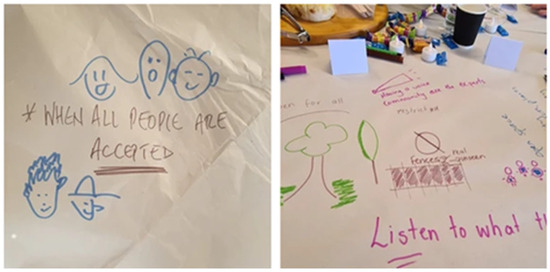
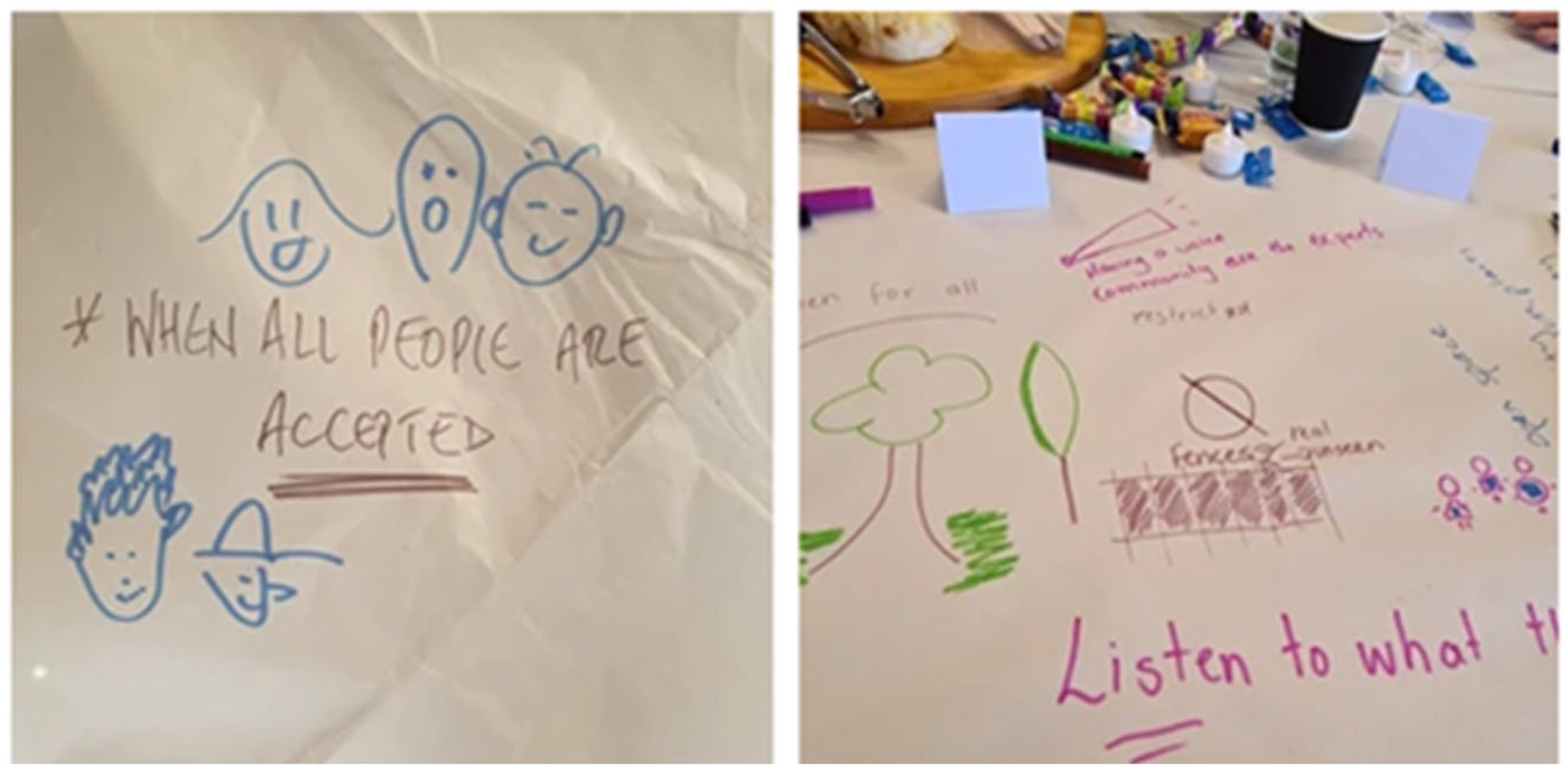
We also used different resource materials to support diverse ways people could engaged in dialogue around the two core questions. This including having available a range of materials such as photocard sets (e.g., Picture-This (2019), Reflexions (2017), and Strength Cards® (2018), all from St Luke’s Innovative Resources (2017, 2018, 2019) https://innovativeresources.org/about-us/), coloured pens and pencils, sticky notes, shapes, and butchers’ paper on the tables to help people explore each question, communicate and share experiences. (see Table 1, Figure 1 and Figure 2). Photocard sets offer a means to help express a feeling or meaning, while avoiding having to require people to bring along photos due to the known burdens surrounding time, resources, emotional load, and inaccessibility. In addition, the varying COVID-19 restrictions at the time restricted community access.
Table 1.
Creating the atmosphere: what we included on the dialogue tables.
Figure 1.
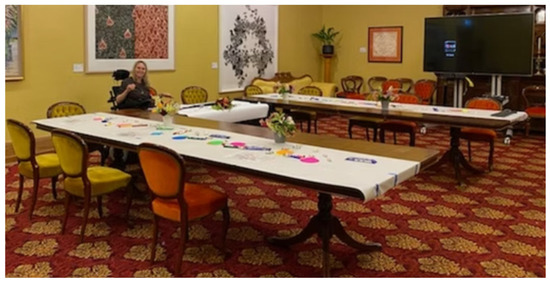
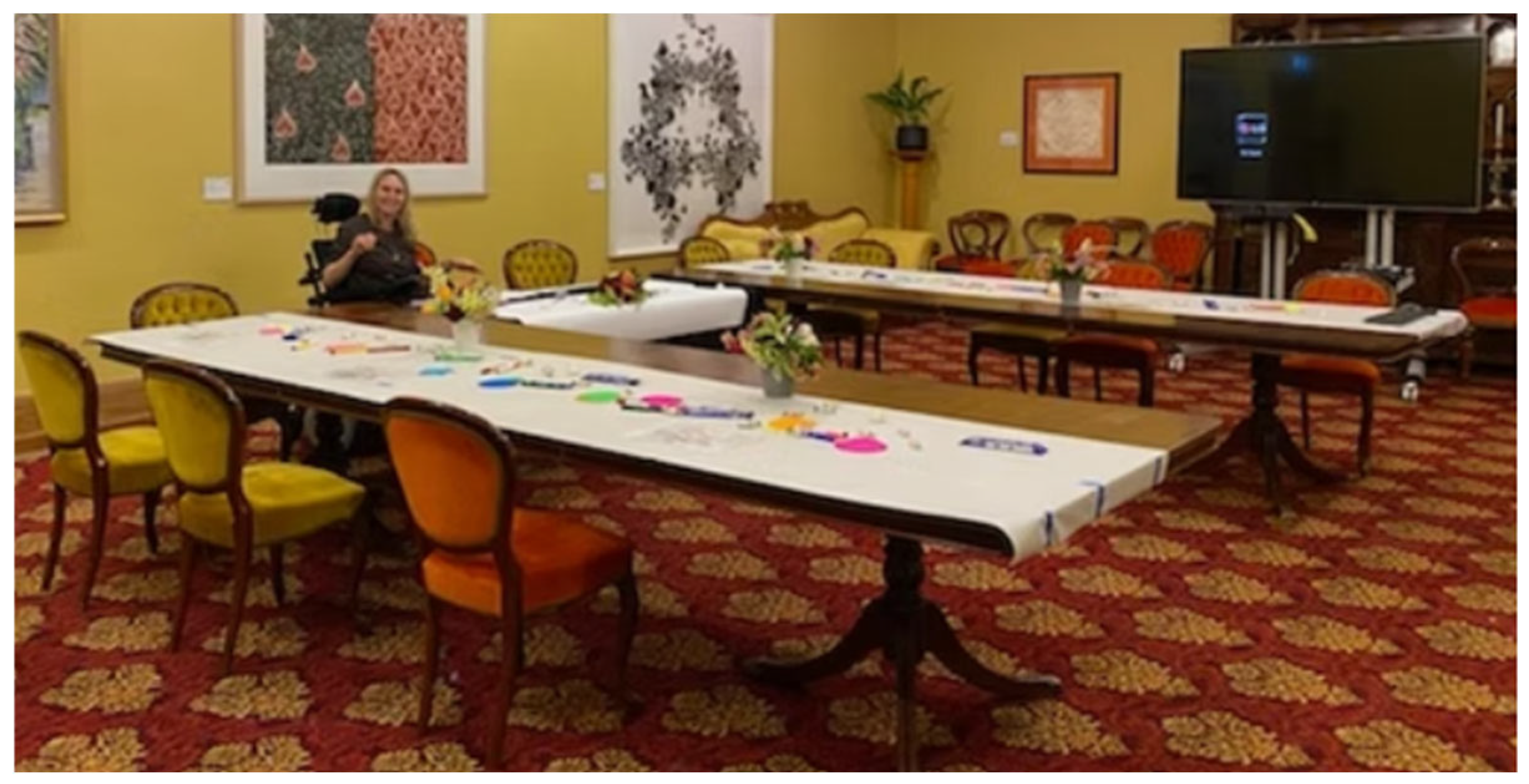
Image from one of the community chat locations illustrating the table set up in a u shape with the items described in Table 1, along with a large monitor in the background for the hybrid link and the lead researcher (Lisa) in the background.
Figure 2.
Examples of materials participants used to reflect on questions and to tell stories including using colour pens to draw words and images on butchers’ paper.
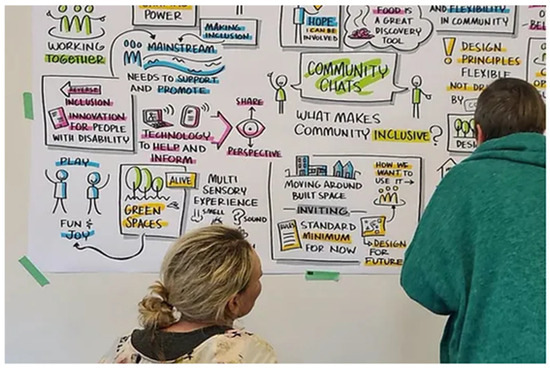
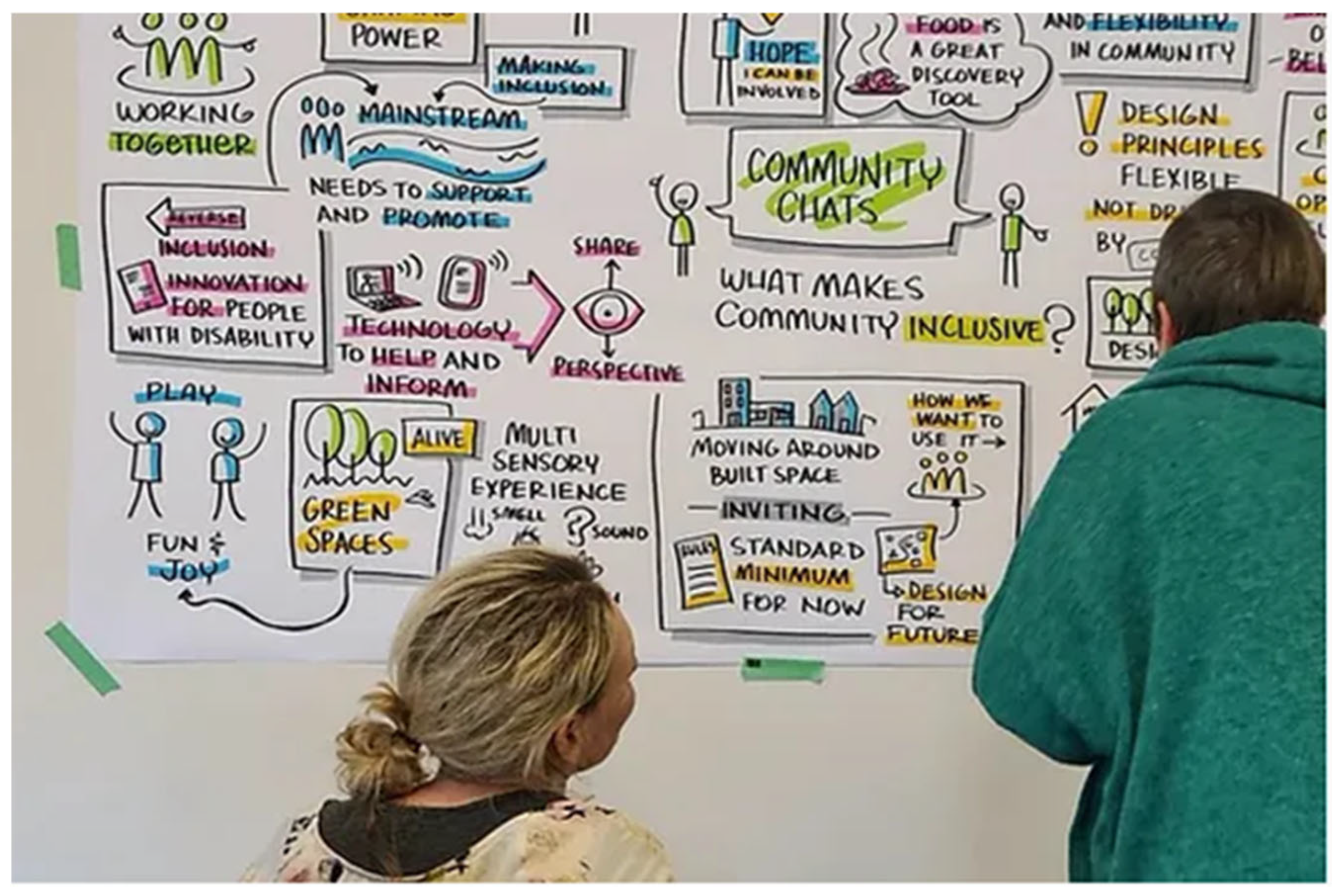
We also budgeted for a graphic/visual recorder for the community chats, in line with the group harvesting principles of the world café. Graphic recording involves capturing ideas and expressions through drawing words and images as they are spoken in the group harvest for each round (The World Café Foundation 2015) (see Figure 3). The visual recorder signed a confidentiality agreement as part of the research process.
Figure 3.
An image from one of the community chats, showing the researcher (Lisa) undertaking group harvesting with Kylie Dunne (the visual/graphic recorder). Kylie is drawing the ideas shared by participants about what makes communities inclusive directly on large paper stuck to a wall.
3.4. Setting up the Community Chats for Atmosphere and Accessibility
As The World Café Foundation (2015) clearly outlines, atmosphere matters when hosting community chats. We also knew this firsthand from previously running world café-style focus groups in the context of human services delivery. However, in COVID-19 times there were significant additional considerations that shaped the set up—including those of layout, sharing of resources and food sharing.
Layout: COVID-19 distancing rules set out by the Australian government dictated the layout; this included the spacing between people, which made the small-group tables quite large and not inclusive in terms of sensory needs (both hearing and acoustics). What we choose instead was a u-shape or semi-circle format and rooms with floor coverings (acoustic needs) to achieve the large distances required (see Figure 1). We also used portable microphone systems to aid quality of hearing in sharing conversations.
Sharing of food: Every session had food provided at the start and during the break. However, because COVID-19 restrictions were in place, we had to do food differently too—such as by ordering food through catering services and we had to provide single-person catering—like a lunch in a box or wrapped sandwiches.
Sharing resources: As everything needed to be sanitised before handling and after handling, we sought helpers from the partner and advisory group to help ensure safety protocols in the chats. Helpers signed confidentiality agreements and were assigned key roles, like wiping the microphone before handing to next person, being assigned to the food table to avoid reuse of utensils, laying out the photocards on a separate table for people to look at and select rather than participants passing across tables and sanitising the cards afterwards.
3.5. Format: How We Did the Community Chats
The community chats were underpinned by the ethos of the world café; however, the structure varied to ensure diversity in the people with disabilities that could participate. We could not have lots of rounds as this created a range of barriers to participation. Instead, our two-hour community chats were structured around two rounds of questions with an approximately 15 min break in-between for food, rest (another inclusive measure), and socialising. We also removed the table rotations in each round, to slow down the speed of conversation to allow time and space for people and groups to have time to share and support deeper conversation for each question—we discuss these benefits in the discussion.
- The Format
Welcoming Introduction: At the start of every community chat, Lisa as the lead researcher undertook an acknowledgment of country, explained the research project and outlined who was in the room and their roles, how the chat would work, and housekeeping and safety. The researcher also talked about how participation is voluntary, and at any time people can choose to leave or take a break. Lisa also reinforced the importance of only sharing what people are comfortable with sharing.
Individual Rounds:
- For each round, participants were given time to individually reflect (5 min) and think about what they wanted to share in response to the question. Participants were told to draw from their experiences, covering stories, memories, spaces, infrastructure or places. They were told they could use any of the picture cards to help convey their story/meanings.
- Then, in a small group or with the person sitting next to them, they were asked to share their explanations or thoughts they were comfortable sharing in response to the question.
Group Harvest: After 10–15 min, the lead researcher invited people to share as part of the large group key thoughts/experiences regarding the question—this is known as a group harvest; the final phase of the round. During the group harvest, ideas, differences and shared discoveries occurred in real time, revealing emerging themes (The World Café Foundation 2015). Due to the size restrictions in place, the small number of people in the chats meant every person had the opportunity to share their reflections on the question for that round—strengthening WC principles “7. listening together for patterns/insights” and “8. connecting diverse perspectives”. We used microphones to ensure hearing accessibility and to aid the accuracy of recording and capture.
Recording Insights: Responses for each question were captured through audio recording, notes by researchers, and in eight of the chats a visual/graphic recorder (Kylie Dunn) who in real time captured the key concepts and ideas shared by participants by drawing images and words (see Figure 3).
Closing: At the end of the rounds and the end of the chat, the lead researcher summarised the key themes emerging from the community chat, as well as highlighted visual recordings and reported timeframes.
3.6. Analysis and Dissemination of Emergent Meaning and Change Framework
In this project, insights from community chats were combined with data from the easy-read storyboards, anonymous questionnaires, and one-on-one conversations gathered during 2020 and 2021. The research team used Charmaz’s (2014) ground theory framework with triangulation (Denzin 2012) to undertake multiple-stage analysis starting with de-identification of the transcripts (one-on-one and community chats) and open-ended questions from the questionnaire. Individual coding of each data type was undertaken first—initial and focused coding—before moving to the merging step of the different data-type findings, through to interpretive steps and theoretical saturations. The visual data was directly considered with the narrative transcripts as participants provided their explanations of why they chose the picture/words. This inductive analytical process was assisted by the qualitative software NVIVO 12 and two coders aiding qualitative inter-rater reliability to ensure the trustworthiness of the qualitative analysis. From this synthesis and the rigorous staged coding process emerged grounded knowledge—in our case the Makings and Framework of Change. This detailed analytic process took almost nine months in 2022 to undertake given the multiple methods producing rich descriptive, dialogical and creative data. Such a process balanced out any individual response bias gained from providing questions in advance.
Communicating Emerging Knowledge
In community-based participatory research, it is critical that participants can see how emergent knowledge is shaped by their shared ideas and stories and that it is presented in formats that support advocacy for change. With the guidance of partners, advisory groups and research team members we generated various formats to describe, explain and share the new knowledge. The report and link to the video and webpage were sent to all participants who we had contact information for, noting some participants were anonymous. Examples include:
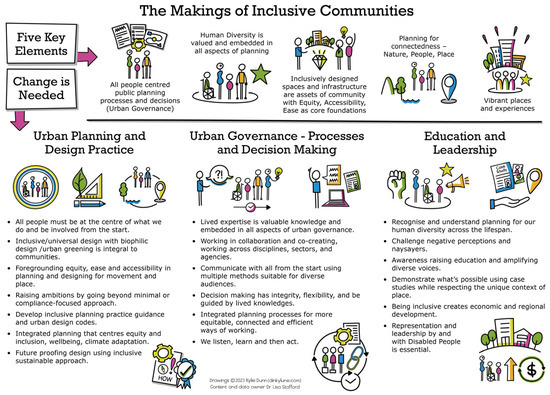
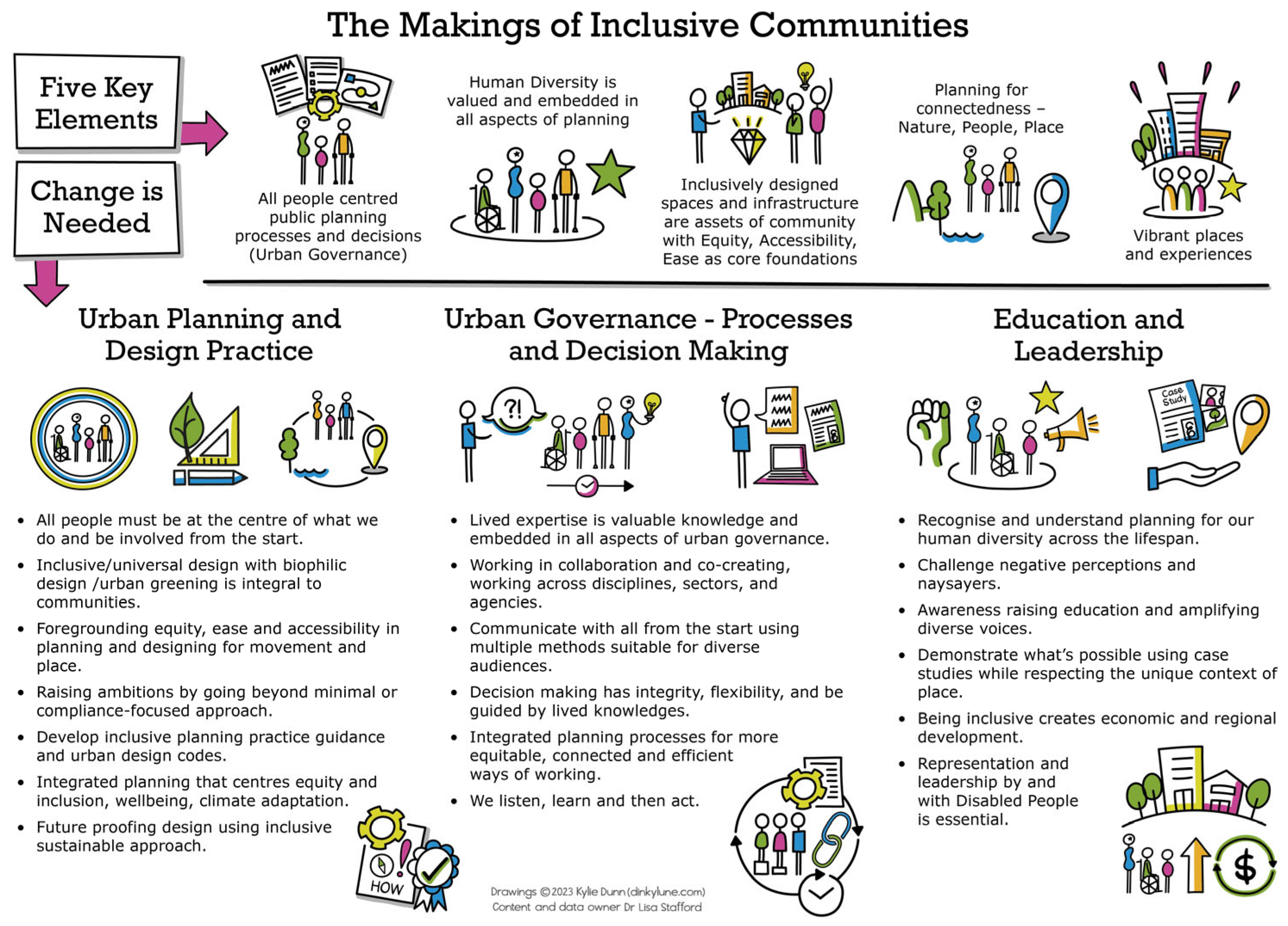
- Visualisation of the emergent grounded theory—The Making of Inclusive Communities was discovered through synthesis and analysis by the research team alongside Kylie (graphic/visual recorder). This shows the five key elements—The Makings of Inclusive Communities and Change is Needed Framework along with a plain-text summary—see Figure 4.
Figure 4.
An image of the visualisation created displaying the emergent grounded theory—The Making of Inclusive Communities. This includes the five key elements and Change is Needed Framework.
- A Short Film of Themes and Change Framework: The Makings—Planning Inclusive Communities https://youtu.be/mQfdNt_guYw, accessed on 18 June 2026.
- A Summary Report with easy-read summaries that was also added to policy observatory for ease of access for policymakers https://www.planninginclusivecommunities.com/the-makings-easy-english, accessed on 18 June 2026.
- A Celebration Event—like we hosted on International Day of Persons with Disability that displayed all the chat graphic recordings.
- An open access peer-reviewed journal article from the findings.
4. Discussion: Reflections and Learnings
Conducting this type of research requires specific skills and experience, as well as a strong commitment to critical reflection and a social-justice ethos. Much has already been written about critical reflection, including intentionality, examination of inherent bias and inclusive approaches to participation. What we add to this dialogue is a reflexive account of using community chats as a method in place-based research that is inclusive of diverse people with disabilities. We share our key learnings and discuss their significance in creating space for authentic, inclusive chats in the community and how this approach strengthens the use of dialogical and creative methods such as the world café in more inclusive ways.
4.1. Principles in Action: Art and Ethos
Undertaking inclusive community chats does require an art in order to adapt and run a world café format (Carter and Bumble 2018); however, it is the underlying ethos that shapes and determines whether participation is inclusive. The ethos includes a commitment to participation as a right for people with disabilities as outlined in the UNCRPD (2006), which is strongly reinforced in recent inclusive research reflections by O’Brien et al. (2022) and Garratt et al. (2022), along with specific works in participatory methods like WC and community chats (Carter and Bumble 2018). Enabling authentic dialogue and transformative outcomes depends on researchers valuing lived experience (Smith-Merry 2019) and community-level knowledge (Carter and Bumble 2018). Inclusion and transformative research are achieved through the enactment of key principles in practice. Without such grounding, research projects risk becoming procedural or tokenistic in nature. While much change in inclusive participatory research has been documented (See Garratt et al. 2022; O’Brien et al. 2022), it is still not an embedded practice. Thus, there is still a strong reliance on the ethos of research leaders, community practitioner leaders, and decision-makers to ensure inclusion is put into action, highlighting the importance of sharing this learning.
4.2. Facilitation Matters
Researchers do not often think of themselves as facilitators, but often what we are doing in community-based research is helping to facilitate conversational exchange around life themes that are often messy, complex and imbued with lived meaning. Being able to critically reflect with each other on what is/was or was not working early on and pivoting is a key part of a facilitator’s role. What emerged early in the community chats was the importance of creating time and space for individual reflection first, before moving to small-group then whole-group reflection. This is not a common WC practice, but one that was important for cognitive accessibility. As a facilitator, you must also be able to read the room—gauging what is needed as conversations unfold. This often involves adjusting timing, such as allowing an extra minute or so to finish, to support the communication needs of individuals or groups.
Another important part of facilitation was holding space when listening to one another (Löhr et al. 2020). This included giving each person the opportunity to take turns sharing something if they wanted to per round, which also engendered a sense of a supportive environment as they took turns. This was reinforced by one of the participants who shared in the chat that their mental health needs often meant they didn’t come to these things, but because they knew others who were coming they felt able to participate although a little overwhelmed. However, it needs to be acknowledged that this is not everyone’s experience—some people will not feel comfortable in a group context (Löhr et al. 2020). Turn-taking can also help mitigate dominant voices to ensure all voices were heard, something Carter and Bumble (2018) also found important in their community chats. Providing time, space and holding space is critical for people with diverse disabilities and health needs. Many people with disabilities fear not being listened to based on their previous experiences (Carter and Bumble 2018). In our reflections, what gets in the way of authentic inclusive community research is undervaluing the importance of time and space and the amount needed for dialogue and identifying needs and actions. This is not an uncommon problem, Smith-Merry (2019, p. 1949) identified one of the most crucial considerations to support inclusive research is communication and timely preparation.
4.3. An Analytical Framing Is Needed
Having an analytical framing with world cafés or in our case community chats is important in upholding research rigour and social justice. The framing of Mertens’s (2010, 2021) transformative paradigm and using mixed methods guided by Charmaz’s (2014) grounded theory analytical framework provided the opportunity to put participatory inclusive principles into practice, while remaining grounded and aware. Charmaz’s grounded theory approach was important and necessary in terms of authenticity to the insights, while at the same time providing the rigour demanded in participatory inclusive research (Smith-Merry 2019). With regard to the provision of questions ahead of time to participants, there are concerns about response bias in the outcomes; however, this is contested strongly for three reasons. Reason 1: Like most research situated in the transformative paradigm this project is underpinned by ontology and epistemology that recognises subjective realities and people’s own interpretive meaning of their experiences (Mertens 2010). Reason 2: Rehearsing or feeling prepared by having questions in advance aligns with the social-justice tenets of the transformative paradigm—emancipating the voices of marginalised people (Mertens 2021). Reason 3: Having a rigorous methodological and analytic framework in place enables the synthesis of all data insights, while addressing bias. Bias always exists in research; the danger is when it is not acknowledged and there is no methodological or analytic framework in place to guide the process of interpretation (Smith-Merry 2019).
4.4. Narrative and Visuals Powerfully Convey Lived Meaning
As the literature on visual methods and photovoice methods has shown over decades, images and photos are powerful ways to help tell and share meanings particularly about everyday phenomena (Williamson et al. 2020). But as outlined earlier, requiring people to go out and take pictures even accompanied can be an added burden, and in some cases can be too hard for many (Chinn and Balota 2023; Ruanggoon et al. 2023; Williamson et al. 2020)—hence utilising photo packs in the chats. Even though photo packs are not the exact photo taken by people, they offer an important aid to help people convey meanings and experiences (Stafford et al. 2021). In the community chats, it was often observed that for many people photos/images sparked thoughts and evoked memories that helped them put words to their thoughts. This was essential in enabling people to express themselves in ways that may not have been possible through more traditional methods. In one situation a participant had photos of a lamb and of fire, they described their memories of significant historical fire which evoked others who also experienced it to share on those memories, which also led to key meanings of community emerging. We also observed that for some people they were hesitant at first to engage with the photos, but with time and observing others using them, we found by round two most used the picture cards to share and reflect.
It also never lost its appeal to see people’s responses to the group harvest—where experiences, ideas and solutions were live-drawn and captured by the visual/graphic recorder Kylie Dunn. While graphic harvesting has been written about by WC researchers (Kelly 2005), through this research experience the benefits of graphic/visual recording of group harvest for people to connect experiences and ideas generated by the group were clear. We observed the process provided immediate feedback that participants were heard, while also allowing them to add anything that was missing, or change anything they felt was not captured as intended. It also provided people an immediate record of what was generated. The project reinforced that using creative approaches, when considered through an inclusive lens, helps support diverse voices to be heard (Mertens 2021).
4.5. Setting Up Community Chats for Inclusive Success
The success of community chats depends on the extent to which they consider and address the multidimensional nature of accessibility. For us this meant considering cognitive, sensory, and physical accessibility simultaneously. There is extensive guidance on inclusive research practice (see Garratt et al. 2022; O’Brien et al. 2022), applying inclusive practices in community engagement (Carter and Bumble 2018), and also individual country strategies/guides (see example Australian Human Rights Commission 2021). As such, we have chosen to highlight some of the key rationales for the adaptive actions undertaken that uphold the WC ethos but also reflect inclusive principles in community chats, which can strengthen the participation of diverse people with disabilities. These are presented in Table 2 below. The important thing to note is that group environments may never be comfortable for some regardless of how well they are designed or facilitated (Löhr et al. 2020) and that providing multiple ways to participate is a must for inclusion, as was done in this project.
Table 2.
Summary of some key adaptive actions to enhance inclusion in community chats.
4.6. Implementation in Practice
Local governments and other organisations need to invest in the work—this includes financial resources, skilled personnel, and policies and procedures that support inclusive participatory planning. Endorsement and champions are needed to move away from tick-a-box approaches that are too often seen dominating public planning that exclude many voices (Novacevski and Legacy 2025). Inclusive participatory methods also should not be limited to large projects of significance, but all projects that impact the community as a matter of course. This is a radical shift of mindset where governments and organisations choose to invest their resources and planning time into achieving good outcomes that are inclusive of all.
4.7. Limitations
The COVID-19 pandemic played havoc with our plans; just as we went to commence fieldwork, the global shutdown took place, and everything was put on hold. Varying restrictions were in place in Australia over the two-year period (2020 to 2022). This included different border closures with restrictions of travel between the states in Australia, making research difficult across the participating regions of Clarence and Greater Hobart in Tasmania and the Gympie Region in Queensland (approximately three hours north of the capital city Brisbane), both separated by 2581 km and across the Bass Strait—a body of water approx. 250 km between mainland Australia and Tasmania. Tasmania had border closures in place until December 2021. This resulted in varied use of methods across areas and time delays due to different levels of restrictions imposed by the different states and evolving and changing advice over time (e.g., no gatherings to very small gatherings only, to groups then being allowed). It also resulted in an inconsistent and varied intensity of participation from local advisory groups, partners—local governments—and the research team. Research had to take a backseat at times as people needed to attend to personal, family, and community-level complexities and crises. The anxiety was real, and for some of us the risk was life-threatening. However, there was a passion and willingness to connect to have conversations—albeit spread over a year and a half. Nonetheless, we importantly acknowledge that there are many voices that have remained unheard during this project. We also need to acknowledge that the very nature of this article brings self-biases; however, holding us to account is the critical reflexivity applied during the writing of this article, along with this method being situated in the now-completed large participatory research project with the research team, partners, stakeholders and participants who were involved in the project (Stafford et al. 2023, 2024). Detailed accounts of the adaptive WC approach and actions provide further transparency but also the means for other people to learn from and apply these methods in their projects—although hopefully in very different conditions.
5. Conclusions
Dialogue is critical to progressing disability and place justice in our communities (Stafford and Novacevski 2026). However, how that dialogue is understood (not solely as oral exchange) and supported is critical to whether diverse voices are heard and those voices shape change. “Nothing about us without us” is a mantra widely echoed in inclusive disability research (O’Brien et al. 2022; Smith-Merry 2019) and in evolving participatory creative methods with people with diverse disabilities (Parsons et al. 2023; Ruanggoon et al. 2023; Bumble and Carter 2021). The use of community chats as a method underpinned by the principles and framework of the world café (The World Café Foundation 2015) with adaptive photo supports and inclusive practices provided an inclusive creative alternative to traditional focus groups or town halls often used for community-based research and practice.
Through this account of the approach, process and reflections of the community chats we aim to reinforce that there is a significant art in doing this work—both in approach and practice. More importantly, the underpinning ethos (including the principles, mindset, and transformative paradigm) is critical to enabling and hearing marginalised voices, such as diverse people with disabilities and mental health needs and neurodivergent people. Community chats also allow for the diverse experiences of people with and without disabilities to be shared as well as the opportunity to deeply listen to different realities on what makes communities inclusive. Combined with insights from the other stage-1 methods, this led to the emergence of key themes and the actions identified as needed for change (Stafford et al. 2023, 2024).
We want to be clear there is no one-size-fits-all approach to doing community chats. However, in research or practice, you must bring to community chats:
- An inclusive mindset that recognises dialogue is expressed in multiple ways—do not promote spoken word alone.
- An understanding that community knowledge is invaluable and central to identifying both issues and solutions. In this project this meant identifying the five key elements, as well as the framework for change needed to realise inclusive communities.
- Flexibility, including providing participants with time, space and choice in how they share and express their views in response to questions.
- A commitment to multidimensional accessibility, which should shape the planning, design and delivery of community chats, and be guided by diverse people with disabilities, advisory groups, and community stakeholders.
Inclusive community chats framed by world café principles (The World Café Foundation 2015) and inclusive creative research approaches are a powerful research method and social-justice enablers that should be considered by any community-based researcher or public planning practitioner when working with diverse people in community.
Author Contributions
Conceptualization, L.S.; methodology, L.S. and project team; formal analysis, L.S. and project team, L.S. and J.A.; writing—original and revised draft preparation, L.S. and J.A.; project administration, L.S.; funding acquisition, L.S. All authors have read and agreed to the published version of the manuscript.
Funding
This project was funded by the Australian Research Council under ARC Discovery Early Career Researcher Award (DECRA)—DE190101512.
Institutional Review Board Statement
This stage (stage 1) of the study was conducted in accordance with Australia’s national statement of ethical conduct of human research in Australia and received QUT Human Research Ethics Approval (Number: 1900000898 on 9 December 2019).
Informed Consent Statement
Informed consent was obtained from all subjects involved in the study.
Data Availability Statement
Data is unavailable due to ethical-approval restrictions.
Acknowledgments
The authors would like to extend a huge thank you to Matt Novacevski, Rosie Pretorius, and Pippa Rogers, part of the stage-1 research team; thanks to Kylie Dunn for their graphic harvest work on the project; and a heartfelt thanks to all the participants who got involved in the community chats, and for the support from Clarence City Council, Gympie Regional Council staff, Keren Franks, Corina McCarthy, Disability Voices Tasmania, Mission Australian PITC, THS-Health Promotion and Young Leaders of Tasmania, the City of Hobart Access and Inclusion Team, Queensland Disability Network, and the Members of Gympie and Clarence local advisory groups. During the preparation of this manuscript/study, Copilot Version number 2.20260319.58.0 was used for proof editing and structure refinement of the document. The authors have reviewed and edited the output and take full responsibility for the content of this publication.
Conflicts of Interest
The authors declare no conflicts of interest.
References
- Australian Human Rights Commission. 2021. Includeability: GUIDE Hosting Accessible and Inclusive In-Person Meetings and Events. Available online: https://humanrights.gov.au/__data/assets/pdf_file/0008/11312/includeability_-_guide_-_hosting_accessible_and_inclusive_in-person_meetings_and_events.pdf (accessed on 18 June 2026).
- Bumble, Jennifer L., and Erik W. Carter. 2021. Application of the World Café to disability issues: A systematic review. Journal of Disability Policy Studies 32: 193–203. [Google Scholar]
- Caprotti, Federico. 2018. Future cities: Moving from technical to human needs. Palgrave Communication 4: 35. [Google Scholar] [CrossRef] [Scilit]
- Carter, Erik W., and Jennifer L. Bumble. 2018. The Promise and Possibilities of Community Conversations: Expanding opportunities for people with disabilities. Journal of Disability Policy Studies 28: 195–202. [Google Scholar] [CrossRef] [Scilit]
- Charmaz, Kathy. 2014. Constructing Grounded Theory, 2nd ed. London: SAGE Publications. [Google Scholar]
- Chinn, Deborah, and Bogdan Balota. 2023. A systematic review of photovoice research methods with people with intellectual disabilities. Journal of Applied Research in Intellectual Disabilities 36: 725–38. [Google Scholar] [CrossRef] [Scilit] [PubMed]
- Denzin, Norman K. 2012. Triangulation 2.0. Journal of Mixed Methods Research 6: 80–88. [Google Scholar] [CrossRef] [Scilit]
- Eidenskog, Maria, Réka Andersson, and Wiktoria Glad. 2024. Workshops as a Relational Material Research Practice: Creating Space for Shared Knowledge. International Journal of Qualitative Methods 23. [Google Scholar] [CrossRef] [Scilit]
- Fenge, Lee-Anne. 2022. Using Participatory Arts-Based Approaches to Promote Inclusive Research. In Handbook of Social Inclusion. Edited by Pranee Liamputtong. Cham: Springer. [Google Scholar] [CrossRef] [Scilit]
- Feniger-Schaal, Rinat, and Anat Geiger Shabtay. 2024. Challenges and Strengths in the Use of Photovoice with People with Intellectual Disabilities. Evidence Based Nursing 27: 149. [Google Scholar] [CrossRef] [Scilit] [PubMed]
- Freire, Paulo. 1972. Pedagogy of the Oppressed. Harmondsworth: Penguin. [Google Scholar]
- Garratt, Danielle, Kelley Johnson, Amanda Millear, Shaun Picken, Janice Slattery, and Jan Walmsley. 2022. Celebrating Thirty Years of Inclusive Research. Social Sciences 11: 385. [Google Scholar] [CrossRef] [Scilit]
- Hole, Rachelle D., and Leyton Schnellert. 2024. Disability Theatre as Critical Participatory Action Research: Lessons for Inclusive Research. Social Sciences 13: 116. [Google Scholar] [CrossRef] [Scilit]
- Kelly, Susan. 2005. The Benefits of Using Graphic Recording/Graphic Facilitation. Available online: https://www.theworldcafe.com/wp-content/uploads/2015/07/graphicBenefits.pdf (accessed on 8 June 2026).
- Kiddle, Rebbecca. 2020. Engaging Communities in the design of homes and neighbourhoods in Aotearoa New Zealand. Counterfutures 9: 77–94. [Google Scholar]
- Legacy, Crystal, Chris Gibson, and Dallas Rogers. 2024. Infrastructural Gaslighting and the Crisis of Participatory Planning. Environment and Planning A: Economy and Space 56: 943–60. [Google Scholar] [CrossRef] [Scilit]
- Liebenberg, Linda. 2018. Thinking Critically About Photovoice: Achieving Empowerment and Social Change. International Journal of Qualitative Methods 17. [Google Scholar] [CrossRef] [Scilit]
- Löhr, Katharina, Michael Weinhardt, and Stefan Sieber. 2020. The “World Café” as a Participatory Method for Collecting Qualitative Data. International Journal of Qualitative Methods 19. [Google Scholar] [CrossRef] [Scilit]
- Manns, Sue. 2021. The planners’ response to COVID-19. Urban Design International 26: 310–14. [Google Scholar] [CrossRef] [Scilit]
- Marcuse, Peter. 2015. Gentrification, Social Justice and Personal Ethics. International Journal Urban and Regional Research 39: 1263–69. [Google Scholar] [CrossRef] [Scilit]
- Mertens, Donna M. 2010. Transformative Mixed Methods Research. Qualitative Inquiry 16: 469–74. [Google Scholar] [CrossRef] [Scilit]
- Mertens, Donna M. 2021. Transformative Research Methods to Increase Social Impact for Vulnerable Groups and Cultural Minorities. International Journal of Qualitative Methods 20. [Google Scholar] [CrossRef] [Scilit]
- Novacevski, Matt, and Crystal Legacy. 2025. Is the standardisation of public participation squeezing place from planning? Geographical Research 63: 671–84. [Google Scholar] [CrossRef] [Scilit]
- O’Brien, Patricia, Edurne Garcia Iriarte, Roy Mc Conkey, Sarah Butler, and Bruce O’Brien. 2022. Inclusive Research and Intellectual Disabilities: Moving Forward on a Road Less Well-Travelled. Social Sciences 11: 483. [Google Scholar] [CrossRef] [Scilit]
- Parsons, Sarah, Hanna Kovshoff, Nicola Yuill, Devyn Glass, Samantha Holt, Asha Ward, Cleo Barron, and Rebecca Ward. 2023. ‘Our Stories…’: Co-Constructing Digital Storytelling Methodologies for Supporting the Transitions of Autistic Children—Study Protocol. International Journal of Qualitative Methods 22. [Google Scholar] [CrossRef] [Scilit]
- Prokopovich, Kathleen, Lyn Phillipson, Leissa West (Pitts), Biljana Stanoevska, Jackie Street, and Annette Braunack-Mayer. 2023. Using World Cafés to engage an Australian culturally and linguistically diverse community around human papillomavirus vaccination. Health Expectations 26: 1039–51. [Google Scholar] [CrossRef] [Scilit] [PubMed]
- Ross, Helen, Claudia Baldwin, and R. W. (Bill) Carter. 2016. Subtle implications: Public participation versus community engagement in environmental decision-making. Australasian Journal of Environmental Management 23: 123–29. [Google Scholar] [CrossRef] [Scilit]
- Ruanggoon, Jirapong, Suchila Saktewin, and Patcharapa Euamornvanich. 2023. Application of the World Café Method for Learning and Providing Solutions for Disabilities. International Journal of Qualitative Research 3: 61–70. [Google Scholar] [CrossRef] [Scilit]
- Salomon, Daniel, and Minji Cho. 2022. Ableism in Community Planning: An Autistic Perspective. Planning Theory & Practice 23: 121–23. [Google Scholar]
- Sitter, Kathleen C., Brooke Allemang, Mica R. Pabia, Emma Gaunt, Ana Herrera, and Bruce Howell. 2023. Cripping Digital Storytelling: Disability, Accessibility, and Celebrating Difference. Canadian Journal of Disability Studies 12: 29–58. [Google Scholar] [CrossRef] [Scilit]
- Smith-Merry, Jennifer. 2019. Inclusive Disability Research. In Handbook of research Methods in Health Social Sciences. Edited by Pranee Liamputtong. Singapore: Springer Nature. [Google Scholar]
- Stafford, Lisa. 2017. ‘What about My Voice’: Emancipating the Voices of Children with Disabilities through Participant-Centred Methods. Children’s Geographies 5: 600–13. [Google Scholar] [CrossRef] [Scilit]
- Stafford, Lisa, and Matt Novacevski. 2026. Right-to-place and disability justice: Giving visibility to the often-unseen but integral lived elements in making communities inclusive for all bodyminds. Environment and Planning C: Politics and Space 44: 26–44. [Google Scholar] [CrossRef] [Scilit]
- Stafford, Lisa, Jo-Anne Harkin, Annie Rolfe, Judith Burton, and Christine Morley. 2021. Why Having a Voice Is Important to Children Who Are Involved in Family Support Services. Child Abuse & Neglect 115: 104987. [Google Scholar] [CrossRef] [Scilit]
- Stafford, Lisa, Leonor Vanik, and Lisa K. Bates. 2022. Disability justice and urban planning. Planning Theory & Practice 23: 101–42. [Google Scholar] [CrossRef] [Scilit]
- Stafford, Lisa, Matt Novacevski, Rosie Pretorius, and Pippa Rogers. 2023. What Makes Inclusive Communities? Planning Inclusive Communities Research Project Stage 1a Report. ISBN 978-1-922708-42-7. Sandy Bay: University of Tasmania. [Google Scholar]
- Stafford, Lisa, Matt Novacevski, Rosie Pretorius, and Pippa Rogers. 2024. The makings of disability-inclusive sustainable communities: Perspectives from Australia. Urban Governance 4: 113–21. [Google Scholar] [CrossRef] [Scilit]
- St Luke’s Innovative Resources. 2017. Reflexions Card Set (2nd Edition). 34 Laminated, Full-Colour Cards & Booklet. Authors: Russell Deal and Karen Bedford, Designer & Photographer: Tim Lane. ISBN 978 1 920945 96 1. Available online: https://innovativeresources.org/resources/card-sets/reflexions/ (accessed on 18 June 2026).
- St Luke’s Innovative Resources. 2018. Strength Cards® (Reprint). 54 Illustrated Cards & Booklet by Author Russel Deal and Designer and Illustrator Katie Jardine. ISBN 9 781 920945 305. Available online: https://innovativeresources.org/resources/card-sets/strength-cards-2/ (accessed on 18 June 2026).
- St Luke’s Innovative Resources. 2019. Picture This. (Reprint). 75 Colour Photographs & Booklet by Brent Seamer. ISBN 9781920945275. Available online: https://innovativeresources.org/resources/card-sets/picture-this/ (accessed on 18 June 2026).
- The World Café Foundation. 2015. Café to Go: A Quick Reference Guide for Hosting World Café. Available online: https://www.theworldcafe.com/wp-content/uploads/2015/07/Cafe-To-Go-Revised.pdf (accessed on 8 June 2026).
- Thomas, Julian, Anthony McCosker, Sharon Parkinson, Kieran Hegarty, Daniel Featherstone, Jenny Kennedy, Lyndon Ormond-Parker, Katy Morrison, Heather Rea, and Lauren Ganley. 2025. Measuring Australia’s Digital Divide: 2025 Australian Digital Inclusion Index. Melbourne: ARC Centre of Excellence for Automated Decision-Making and Society, RMIT University, Swinburne University of Technology, and Telstra. [Google Scholar] [CrossRef]
- Umemoto, Karen. 2017. Towards a humanist planning. Planning Theory & Practice 18: 297–302. [Google Scholar] [CrossRef] [Scilit]
- UNCRPD. 2006. Convention on the Rights of Persons with Disabilities (CRPD). Available online: https://social.desa.un.org/issues/disability/crpd/convention-on-the-rights-of-persons-with-disabilities-crpd (accessed on 8 June 2026).
- Wayland, Sarah, and Annmaree Watharow. 2025. Reflecting on ‘Doing Better’: Inclusive and Accessible Qualitative Research Methods. International Journal of Qualitative Methods 24. [Google Scholar] [CrossRef] [Scilit]
- Westoby, Peter, and Gerard Dowling. 2013. Theory and Practice of Dialogical Community Development: International Perspective, 1st ed. London: Routledge. [Google Scholar] [CrossRef] [Scilit]
- Williamson, Heather. J., Lieke van Heumen, and Ariel E. Schwartz. 2020. Photovoice with Individuals with Intellectual and/or Developmental Disabilities: Lessons Learned from Inclusive Research Efforts. Collaborations: A Journal of Community-Based Research and Practice 3: 8. [Google Scholar] [CrossRef] [Scilit]

Disclaimer/Publisher’s Note: The statements, opinions and data contained in all publications are solely those of the individual author(s) and contributor(s) and not of MDPI and/or the editor(s). MDPI and/or the editor(s) disclaim responsibility for any injury to people or property resulting from any ideas, methods, instructions or products referred to in the content. |
© 2026 by the authors. Licensee MDPI, Basel, Switzerland. This article is an open access article distributed under the terms and conditions of the Creative Commons Attribution (CC BY) license.