


Abstract
Background: The transition toward sustainable development models has increased the relevance of the circular economy (CE) as a strategy for improving resource efficiency and reducing environmental impacts. In this context, higher education may contribute to strengthening sustainability-oriented competencies and environmental awareness among university students. Methods: This study aimed to assess differences in knowledge of the circular economy, perceptions regarding higher education in circular economy education, and sustainability dimensions among university students in Peru, Colombia, and Mexico. A quantitative, non-experimental, cross-sectional design was adopted using a structured questionnaire administered to 702 university students. The analysis included descriptive statistics, the Kruskal–Wallis test, and Dunn’s post hoc comparisons. Results: The results showed significant differences among countries regarding knowledge of CE principles, sustainability initiatives, and perceptions associated with higher education in circular economy education. Peruvian students generally reported higher levels of knowledge and more positive perceptions across several indicators, whereas Mexican students presented comparatively lower scores. Differences were also identified across the environmental, social, and economic dimensions of sustainability, particularly in the economic dimension. Conclusions: Overall, the findings suggest that higher education may support the development of CE-related competencies and sustainability-oriented educational strategies within diverse Latin American contexts.
1. Introduction
Growing pressure on natural resources, climate change, and environmental degradation has intensified the need to transition toward more sustainable development models capable of balancing economic growth, social well-being, and environmental protection. Within this context, the circular economy (CE) has emerged as a strategic approach aimed at improving resource efficiency, reducing waste generation, and promoting regenerative production and consumption systems (Faggini et al. 2023; Kharat et al. 2025). Unlike the traditional linear economic model based on extraction, consumption, and disposal, the CE seeks to extend material life cycles and optimize resource use through recycling, reuse, and sustainable innovation. This transition is particularly relevant in Latin America, where economies continue to rely heavily on extractive activities and where waste management systems remain limited. For example, only 2.2% of municipal solid waste in the region is managed through formal recycling systems (Ospina-Mateus et al. 2023). In addition, the strong participation of informal sectors in waste management activities reflects persistent institutional and environmental governance challenges (Gallego-Schmid et al. 2024).
In response to these challenges, higher education institutions have gained increasing relevance as spaces for promoting sustainability-oriented competencies and supporting environmental awareness among future professionals. Universities contribute not only through knowledge transmission but also through the development of critical thinking, responsible decision-making, and innovation capacities associated with sustainability transitions. Consequently, sustainability education has become an increasingly important component of higher education systems, particularly in relation to environmental governance and sustainable development policies (Biancardi et al. 2023; Deda et al. 2022).
Although concepts such as environmental education (EE), education for sustainable development (ESD), and circular economy education (CEE) are frequently interconnected in the literature, they represent distinct educational approaches. Environmental education has traditionally focused on promoting ecological awareness and pro-environmental behavior (Kopnina 2022). In contrast, education for sustainable development adopts a broader perspective that integrates environmental, social, and economic dimensions into educational processes and decision-making (United Nations Department of Economic and Social Affairs 2023). Circular economy education specifically emphasizes competencies related to resource efficiency, regenerative systems, waste reduction, and circular production–consumption practices (Deda et al. 2022; Waite et al. 2024). While these approaches share common sustainability objectives, their conceptual orientations and practical implications differ. The limited differentiation among these concepts has generated inconsistencies in the literature and restricted the understanding of how sustainability-related competencies are internalized in educational contexts (Wardani et al. 2025).
In this study, sustainability is approached as a multidimensional construct integrating environmental, social, and economic dimensions associated with responsible resource management and long-term societal well-being. Within this framework, environmental education (EE), education for sustainable development (ESD), and circular economy education (CEE) are considered complementary but conceptually distinct educational perspectives. EE primarily emphasizes ecological awareness and pro-environmental behavior, whereas ESD incorporates broader sustainability-oriented competencies linked to social, economic, and environmental decision-making processes. In contrast, CEE specifically focuses on competencies related to resource efficiency, waste reduction, regenerative systems, and circular production–consumption models. From this perspective, higher education institutions are understood as strategic spaces for the development of sustainability-oriented knowledge, attitudes, and competencies associated with circular economy principles and environmental governance.
The study is conceptually grounded in sustainability education and circular economy education approaches, which consider higher education institutions as strategic environments for developing sustainability-oriented competencies, environmental awareness, and responsible decision-making processes. From this perspective, universities play an important role in shaping students’ knowledge and perceptions regarding circular economy principles and sustainability practices within diverse social and institutional contexts.
International evidence indicates that the incorporation of sustainability and circular economy principles into higher education remains uneven across countries and educational systems. Studies conducted in India, China, and several European countries report important limitations in students’ understanding of sustainability and CE concepts, particularly in contexts where curriculum integration remains insufficiently consolidated (Green 2022; Venugopal and Kour 2021; Virsta et al. 2020; Xie 2021). At the same time, recent studies suggest that innovative pedagogical approaches—including STEM methodologies, participatory learning, and game-based educational strategies—can strengthen sustainability competencies and environmental awareness among university students (Hamid et al. 2024; Larbi et al. 2024; Premthaisong and Chaipidech 2023; Waite et al. 2024). These findings indicate that the effectiveness of sustainability education depends not only on curriculum inclusion but also on institutional support and pedagogical implementation processes.
In Latin America, the incorporation of circular economy principles into public policy and educational systems has advanced unevenly. Countries such as Colombia and Mexico have promoted national strategies aimed at improving resource efficiency and integrating sustainability into development policies (MADS 2024; SEMARNAT 2024). Similarly, Peru has implemented initiatives associated with green growth and sustainable resource management (Ministerio del Ambiente 2016). Despite these advances, important challenges persist regarding the institutionalization of sustainability education, coordination between environmental policies and educational systems, and the effective integration of CE principles into university curricula. These differences suggest that students’ understanding of sustainability and circular economy principles may vary substantially according to national and institutional contexts.
The Sustainable Development Goals (SDGs) have further reinforced the importance of higher education in promoting sustainability-oriented competencies and environmentally responsible practices (United Nations Department of Economic and Social Affairs 2023). Universities are increasingly recognized as relevant educational spaces for promoting sustainability-oriented competencies, environmental awareness, and responsible decision-making among students (Haase et al. 2024; Kankanamge 2023). However, empirical evidence regarding how university students perceive the role of higher education in circular economy education across different Latin American contexts remains limited.
Despite growing academic interest in circular economy education, important gaps persist in the literature. Existing studies have predominantly focused on descriptive or country-specific analyses, with limited comparative evidence examining how differences in educational systems and institutional frameworks influence students’ knowledge and perceptions regarding sustainability and circular economy principles across Latin American countries (Ospina-Mateus et al. 2023; Padilla-Rivera et al. 2024; Wardani et al. 2025). Furthermore, limited attention has been paid to the relationship between circular economy education and environmental governance within higher education contexts (Gallego-Schmid et al. 2024; Waite et al. 2024).
In this regard, there remains insufficient empirical evidence regarding the extent to which higher education contributes to the internalization of circular economy principles among university students in Latin America. Understanding these differences is particularly relevant for the design of educational strategies and sustainability-oriented policies adapted to diverse institutional contexts.
These conceptual distinctions are particularly relevant for understanding how sustainability-related competencies and circular economy principles are interpreted and internalized within higher education contexts in Latin America.
Based on these conceptual perspectives, the study assumes that differences in students’ knowledge regarding circular economy principles, perceptions of higher education in sustainability-oriented education, and sustainability-related dimensions may vary across national and educational contexts. Consequently, the study proposes a set of comparative hypotheses intended to examine these differences among university students in Peru, Colombia, and Mexico.
Therefore, this study aims to assess differences in knowledge of the circular economy, perceptions regarding higher education in circular economy education, and sustainability dimensions among university students in Peru, Colombia, and Mexico. Specifically, the study examines perceptions related to the environmental, social, and economic dimensions of sustainability, as well as the perceived role of higher education in circular economy education.
Based on this objective, the following hypotheses are proposed:
H1.
Significant differences exist among university students in Peru, Colombia, and Mexico regarding knowledge of circular economy principles and sustainability-related concepts.
H2.
Significant differences exist among university students in Peru, Colombia, and Mexico regarding perceptions of the role of higher education in circular economy education.
H3.
Significant differences exist among university students in Peru, Colombia, and Mexico regarding sustainability-related environmental, social, and economic dimensions.
2. Materials and Methods
2.1. Study Design
This study adopted a quantitative approach with a non-experimental, cross-sectional, and descriptive-comparative design. Data were collected at a single point in time to analyze differences in university students’ perceptions of the circular economy (CE) and sustainability across three Latin American countries: Peru, Colombia, and Mexico.
The analytical approach adopted in this study was informed by sustainability education and circular economy education perspectives, which frame higher education institutions as relevant contexts for the development of sustainability-oriented competencies, environmental awareness, and responsible decision-making processes. These perspectives guided the definition of the analytical dimensions and the interpretation of students’ knowledge and perceptions regarding circular economy principles and sustainability practices.
The study focused on three analytical dimensions considered relevant for understanding the role of higher education in sustainability transitions: (i) the level of knowledge regarding the circular economy and sustainability, (ii) the perceived role of higher education in circular economy education, and (iii) students’ perceptions of the environmental, social, and economic dimensions of sustainability. These dimensions were analyzed to explore how higher education may contribute to the development of sustainability-related competencies and the promotion of circular economy principles within university contexts.
2.2. Participants
The sample consisted of 702 university students enrolled in higher education institutions in Peru, Colombia, and Mexico. Participants were selected through non-probabilistic convenience sampling based on voluntary participation and accessibility to the target population. This sampling strategy was considered appropriate given the exploratory and comparative nature of the study and has been widely applied in previous research examining sustainability perceptions within educational contexts.
The sample included students from diverse academic disciplines, including business administration, international business, accounting, law, economics, engineering, and marketing, allowing for the inclusion of heterogeneous academic perspectives regarding sustainability and circular economy education. Sociodemographic variables such as country of residence, gender, age group, field of study, and year of study were collected to characterize the sample and contextualize the comparative analyses (Table 1).
Table 1.
Sociodemographic characteristics of the participants.
2.3. Instruments
Data were collected using a structured questionnaire adapted from the instrument proposed by Soto-Solier et al. (2023). The questionnaire was reviewed by specialists in sustainability education and environmental management to evaluate the conceptual relevance, clarity, and contextual adequacy of the items for application within the Latin American higher education context.
The instrument included items measured on a seven-point Likert scale ranging from 1 (“Strongly disagree”) to 7 (“Strongly agree”). The questionnaire assessed three main dimensions: (i) knowledge regarding the circular economy, green growth, and SDGs; (ii) perceptions regarding the role of higher education in circular economy education; and (iii) perceptions related to the environmental, social, and economic dimensions of sustainability.
These analytical dimensions were operationalized through questionnaire items designed to evaluate students’ knowledge of circular economy principles, perceptions regarding the role of higher education in sustainability-oriented education, and sustainability-related environmental, social, and economic perspectives. The organization of the dimensions was conceptually aligned with sustainability education and circular economy education approaches discussed in the Introduction Section.
To evaluate the internal consistency of the instrument, Cronbach’s alpha coefficients were calculated for each analytical dimension. The results showed acceptable reliability levels across all dimensions, with coefficients above the recommended threshold of 0.70, indicating adequate internal consistency of the instrument (Table 2).
Table 2.
Reliability analysis of the study dimensions.
The questionnaire was adapted from previous studies related to circular economy and sustainability education and was reviewed by specialists in sustainability and environmental management to ensure conceptual consistency, content relevance, and contextual adequacy across the three countries analyzed. Given the comparative and exploratory nature of the study, construct validity was primarily assessed through expert review and internal consistency analysis. The wording of the questionnaire items was also revised to ensure linguistic clarity and cultural equivalence across Peru, Colombia, and Mexico.
Prior to data collection, minor wording adjustments were made to improve clarity and consistency across the three national contexts.
2.4. Procedure
The questionnaire was administered digitally using Google Forms and Microsoft Forms platforms. Participation was voluntary and anonymous, and confidentiality of the information was guaranteed throughout the data collection process.
Data collection was conducted during 2024. In Peru, the survey was applied between March and August, whereas in Colombia and Mexico, data collection took place between July and October. The inclusion criteria considered students who were legally adults, currently enrolled in university programs related to management, business, economics, engineering, or related fields, and willing to participate voluntarily in the study.
Once collected, the data were exported to Microsoft Excel and subjected to a data cleaning process that included the identification and correction of inconsistencies, incomplete responses, and typographical errors to ensure database quality prior to statistical analysis.
2.5. Data Analysis
Statistical analyses were performed using R version 4.6.0 (R Core Team, Vienna, Austria), via the RStudio integrated development environment (version 2026-04-24 ucrt). Initially, descriptive statistics were calculated to summarize students’ responses across the study dimensions. Subsequently, the Shapiro–Wilk normality test was applied to evaluate the distribution of the data within each country. The results indicated violations of the normality assumption (Colombia: p = 0.0001; Mexico: p = 0.0003; Peru: p = 0.0005), supporting the use of non-parametric statistical procedures.
Consequently, the Kruskal–Wallis test was employed to identify statistically significant differences among countries regarding knowledge of the circular economy, sustainability education, and perceptions of the environmental, social, and economic dimensions of sustainability. When significant differences were identified, post hoc pairwise comparisons were conducted using Dunn’s test with adjusted p-values.
Additionally, effect sizes (r) were estimated to assess the magnitude of the observed differences. Following conventional interpretation criteria, values around 0.10 were considered small effects, values near 0.30 moderate effects, and values above 0.50 large effects. Statistical significance was established at p < 0.05.
2.6. Ethical Considerations
This study was conducted in accordance with the ethical principles established in the Declaration of Helsinki (World Medical Association [1975] 2013). The research protocol was reviewed by the Research Ethics Committee of the Universidad Tecnológica del Perú (UTP) (2023) under authorization code INV-MA001 on 8 April 2023.
Due to the non-experimental nature of the study, the anonymous treatment of the data, and the absence of sensitive personal information, the committee determined that formal ethical approval was not required. Participation was entirely voluntary, and informed consent was obtained from all participants before completing the questionnaire. The confidentiality and anonymity of the collected information were strictly protected throughout the research process.
2.7. Use of Artificial Intelligence Tools
During the preparation of this manuscript, the authors used ChatGPT (OpenAI, GPT-5 architecture) for the purposes of language editing, paraphrasing, and enhancing the clarity and coherence of the academic writing. The authors reviewed, validated, and edited the generated content and take full responsibility for the content of this publication.
3. Results
3.1. Level of Knowledge Regarding the Circular Economy and Sustainability
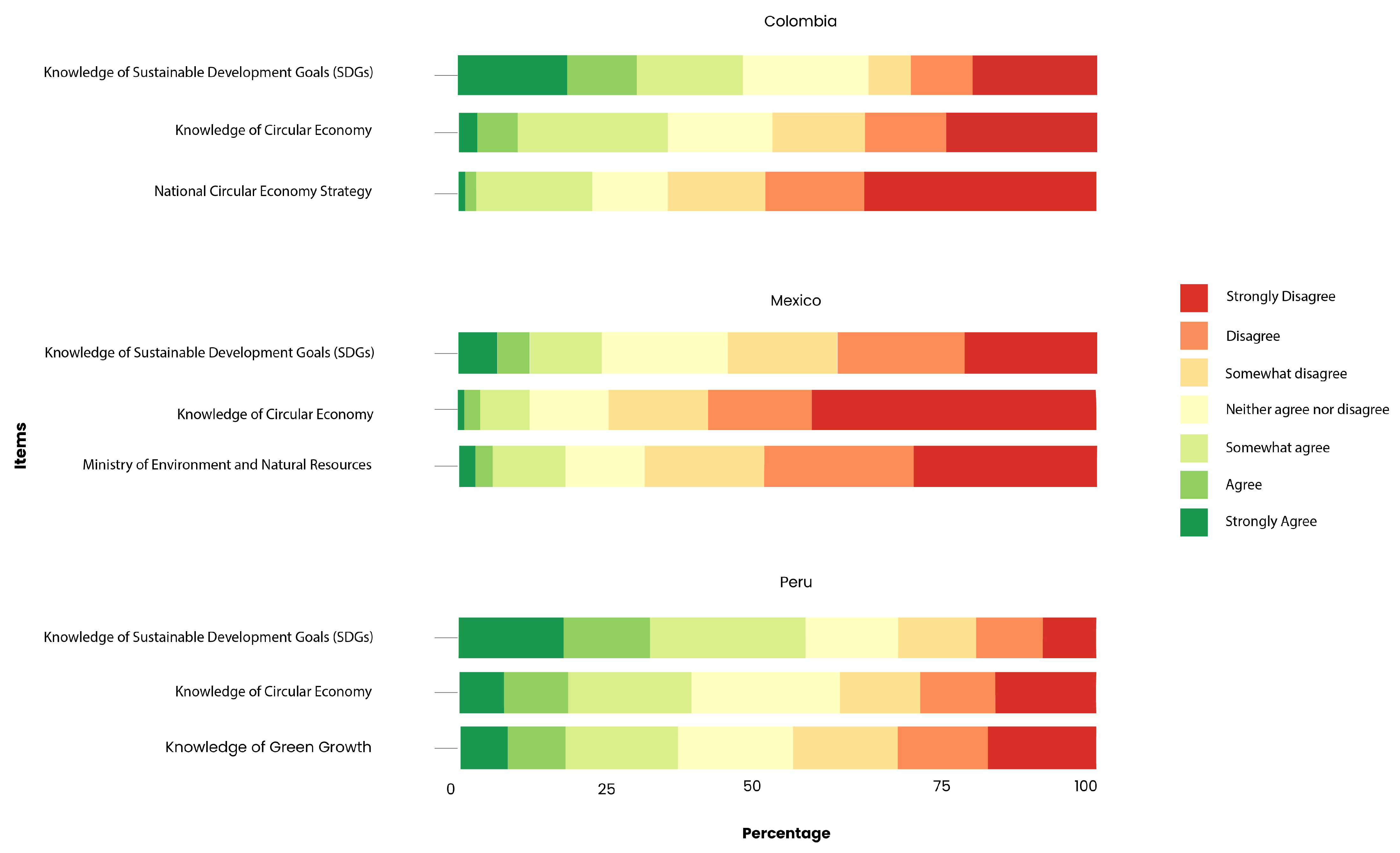
The descriptive analysis revealed differences among university students in Peru, Colombia, and Mexico regarding their level of knowledge about the circular economy (CE), sustainability initiatives, and the SDGs. Overall, students from Peru reported the highest scores across most indicators, whereas students from Mexico generally presented lower scores. Colombia showed intermediate values across the analyzed dimensions (Table 3).
Table 3.
Descriptive statistics on knowledge of the circular economy and sustainability.
Peruvian students reported higher mean scores regarding knowledge of CE principles, green growth initiatives, and the SDGs compared to students from Colombia and Mexico. In contrast, Mexican students presented comparatively lower levels of knowledge across several indicators associated with sustainability and CE-related concepts.
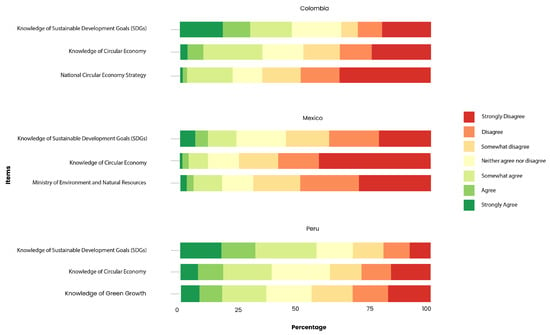
The distribution of responses showed a greater concentration of positive evaluations among Peruvian students, whereas responses from Mexico and Colombia presented comparatively higher variability. These patterns indicate differences in students’ levels of exposure to sustainability-related educational content across the analyzed countries (Figure 1).
Figure 1.
Distribution of knowledge levels regarding the circular economy and sustainability.
Overall, the descriptive findings suggest differences among countries regarding knowledge of CE and sustainability-related concepts, providing preliminary support for Hypothesis 1.
3.2. Perceptions Regarding the Role of Higher Education in Circular Economy Education
The results showed generally positive perceptions regarding the incorporation of sustainability and circular economy principles into higher education across the three countries. However, differences were identified in the extent to which students perceived these topics as effectively integrated into university education (Table 4).
Table 4.
Descriptive statistics on perceptions regarding higher education in circular economy education.
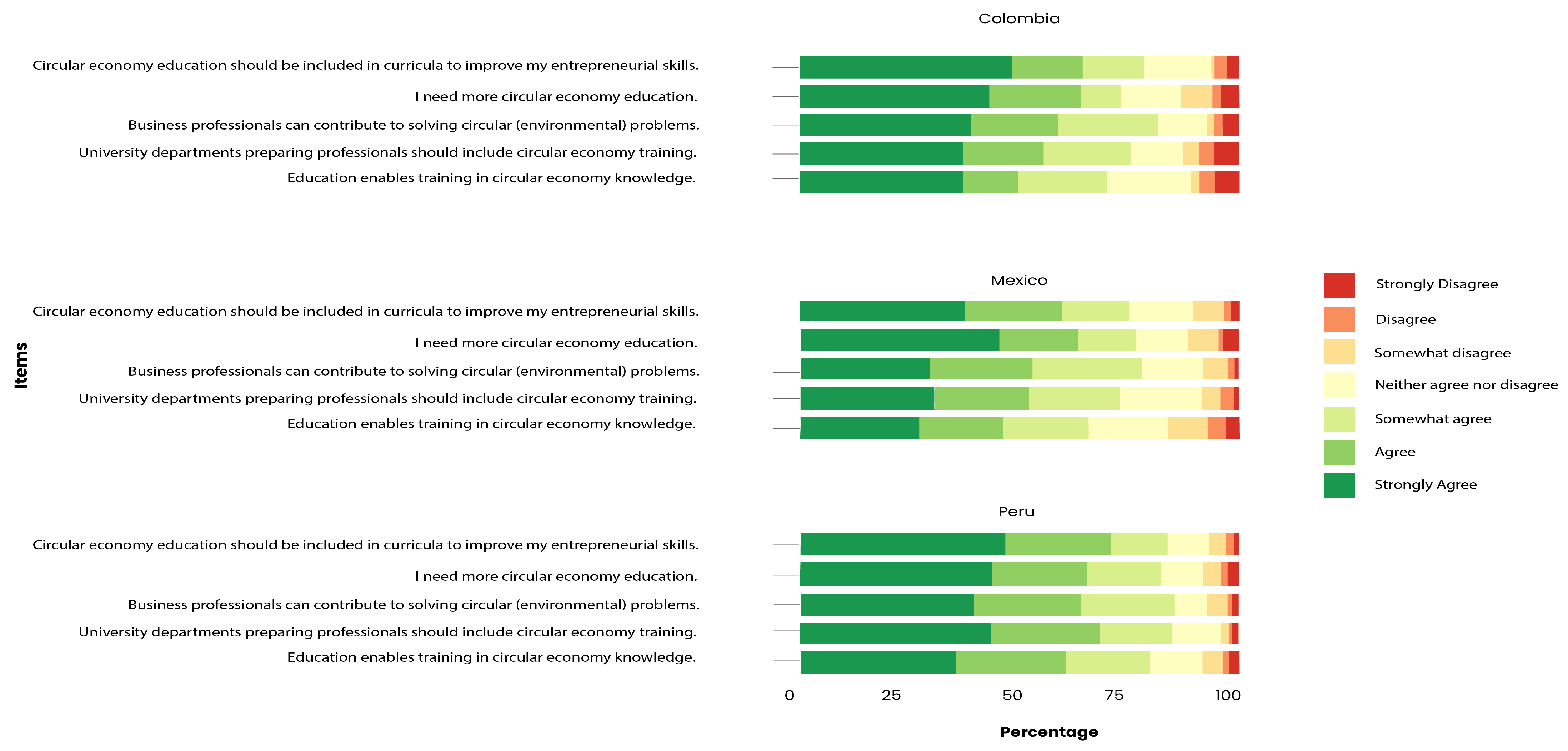
Peruvian students reported higher scores regarding the incorporation of sustainability and CE-related content into academic training. In contrast, students from Mexico presented comparatively lower scores across several indicators associated with sustainability-oriented education, whereas Colombia showed intermediate values.
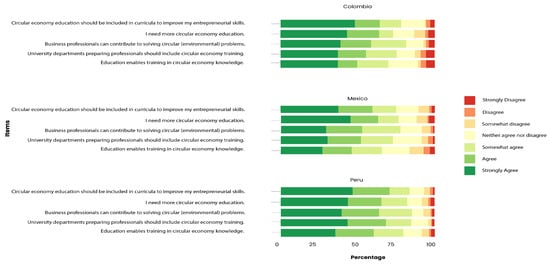
The findings also revealed differences in students’ perceptions regarding the contribution of universities to environmental awareness, sustainable decision-making, and environmentally responsible practices. Overall, the results indicate variability in how CE-related content is perceived within higher education across the analyzed contexts (Figure 2).
Figure 2.
Distribution of perceptions regarding higher education in circular economy education.
Taken together, the descriptive results provide preliminary support for Hypothesis 2, indicating differences among countries regarding students’ perceptions of the role of higher education in circular economy education.
3.3. Perceptions of the Environmental, Social, and Economic Dimensions of Sustainability
The analysis of the environmental, social, and economic dimensions showed generally positive perceptions of sustainability among university students across the three countries. Nevertheless, differences were identified in the magnitude and distribution of responses according to dimension and national context (Table 5).
Table 5.
Descriptive statistics on perceptions of sustainability dimensions.
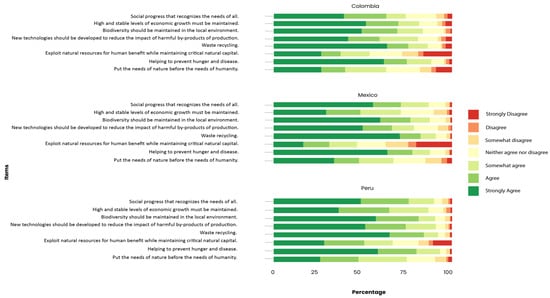
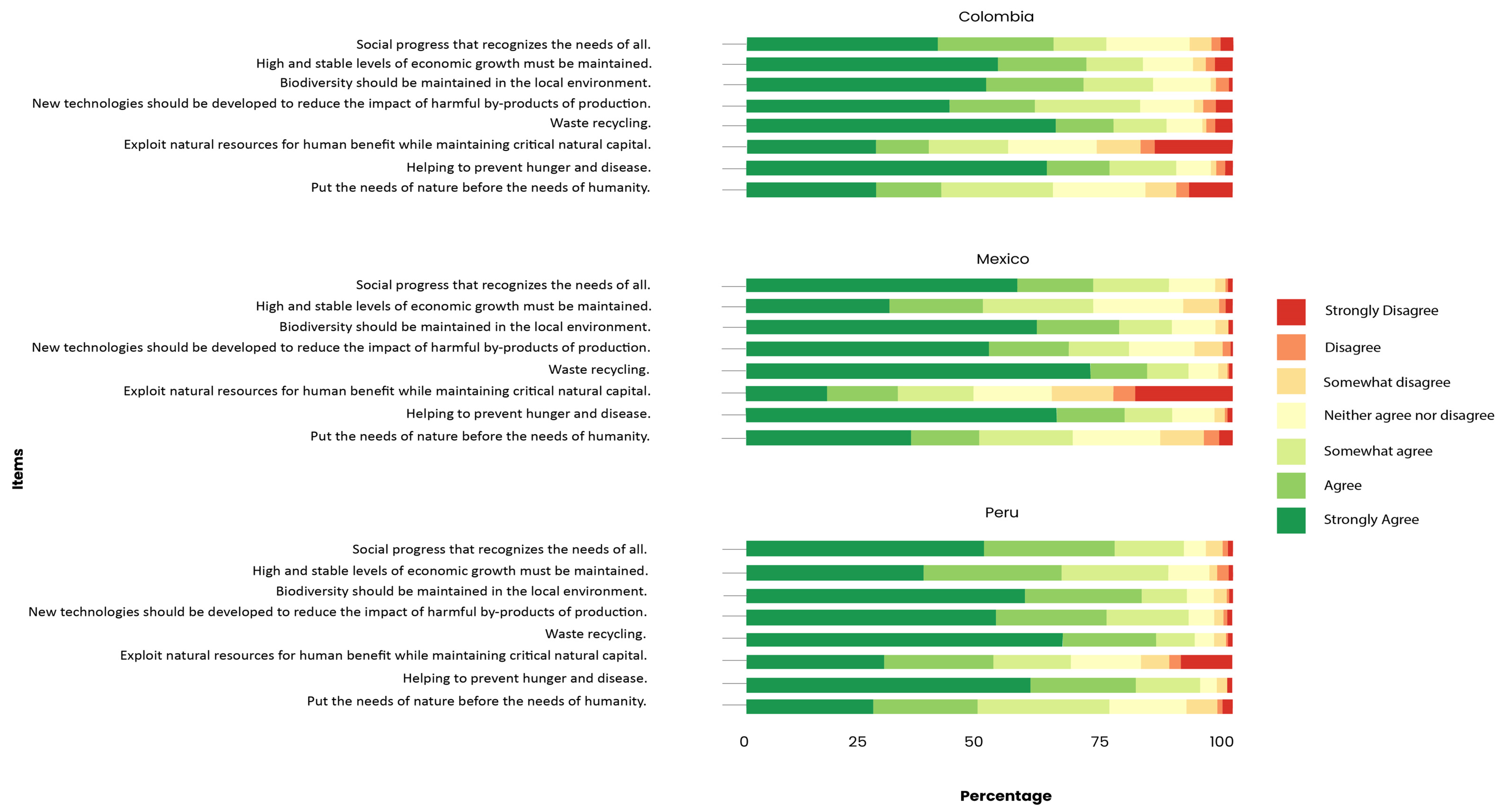
In the environmental dimension, students reported high levels of agreement regarding biodiversity conservation, recycling practices, and sustainable technologies. Peru presented the highest scores across most environmental indicators, followed by Colombia and Mexico. The social dimension also showed positive evaluations across countries, particularly regarding social well-being, equity, and collective responsibility, with comparatively more homogeneous responses across the analyzed contexts.
More pronounced differences were identified in the economic dimension. Students from Mexico reported comparatively higher levels of agreement regarding sustainable resource exploitation, whereas those from Peru presented higher evaluations concerning sustainable economic growth. In contrast, Colombia showed more moderate scores across several indicators associated with economic sustainability. Overall, the economic dimension showed greater variability in responses across countries compared to the environmental and social dimensions (Figure 3).
Figure 3.
Distribution of perceptions across environmental, social, and economic sustainability dimensions.
Taken together, the descriptive findings indicate differences among countries in the environmental, social, and economic dimensions of sustainability, providing preliminary support for Hypothesis 3.
3.4. Inferential Analysis: Differences Between Countries
To further examine the differences among countries, inferential analyses were conducted using the Kruskal–Wallis test. The results confirmed statistically significant differences across several dimensions analyzed in the study, particularly regarding knowledge of CE principles, perceptions of higher education in circular economy education, and the economic dimension of sustainability (p < 0.05) (Table 6).
Table 6.
Results of the Kruskal–Wallis test.
Subsequent pairwise comparisons using Dunn’s post hoc test identified the strongest differences between Peru and Mexico, whereas Colombia generally presented intermediate values across the analyzed dimensions. Effect size estimates indicated predominantly small-to-moderate effects, suggesting that the magnitude of differences varied according to the analyzed dimension.
Overall, the inferential analyses confirmed statistically significant differences among countries regarding CE knowledge, perceptions of higher education in CE education, and the environmental, social, and economic dimensions of sustainability. These findings provide statistical support for Hypotheses 1, 2, and 3.
3.5. Post Hoc Analysis and Effect Size
The statistical analyses supported the three hypotheses proposed in the study (Table 7).
Table 7.
Results of Dunn’s post hoc test and effect sizes.
Hypothesis 1 was supported, as statistically significant differences were identified among countries regarding students’ knowledge of CE and sustainability-related concepts. Hypothesis 2 was also supported, given the significant differences observed in students’ perceptions of the role of higher education in circular economy education. Finally, Hypothesis 3 was supported through the identification of significant differences across the environmental, social, and economic dimensions of sustainability.
Taken together, the findings indicate that students’ perceptions and levels of knowledge regarding CE and sustainability vary across the analyzed Latin American contexts.
4. Discussion
The findings revealed significant differences among university students in Peru, Colombia, and Mexico regarding knowledge of the CE, sustainability initiatives, and the SDGs. Peruvian students generally reported higher levels of knowledge across most indicators, whereas Mexican students presented comparatively lower scores. These results are consistent with previous studies, indicating that the incorporation of sustainability and CE principles into higher education remains uneven across countries and institutional contexts (Green 2022; Venugopal and Kour 2021; Xie 2021). The observed differences may reflect variations in curriculum integration, institutional support, and the degree to which sustainability-related topics are incorporated into university education in each country.
The results also showed differences in students’ perceptions regarding the role of higher education in circular economy education. Students from Peru reported comparatively more positive evaluations concerning the incorporation of CE-related content into academic training, whereas lower scores were observed among students from Mexico. These findings are consistent with studies suggesting that universities may contribute to strengthening sustainability-oriented competencies when sustainability principles are integrated into teaching practices and curriculum design (Deda et al. 2022; Waite et al. 2024). In this regard, the observed differences may reflect variations in students’ exposure to sustainability-oriented educational content and learning experiences across the analyzed contexts.
Another relevant finding concerns students’ perceptions of the environmental, social, and economic dimensions of sustainability. The environmental dimension showed comparatively high levels of agreement across countries, particularly regarding biodiversity conservation, recycling practices, and sustainable technologies. These results are consistent with previous studies reporting growing environmental awareness among university students in sustainability-related educational contexts (Hamid et al. 2024; Premthaisong and Chaipidech 2023). In contrast, the economic dimension showed greater variability across countries, particularly regarding the sustainable use of natural resources and economic growth. This pattern may reflect differences in national sustainability priorities, economic contexts, and educational approaches associated with sustainability and CE principles.
The comparatively homogeneous responses identified in the social dimension suggest that issues related to equity, collective well-being, and social responsibility may be more consistently recognized among students across the analyzed countries. Previous studies have similarly reported that social sustainability dimensions are often more broadly accepted within educational contexts than environmental or economic dimensions, particularly in Latin American settings characterized by shared social and developmental challenges (Padilla-Rivera et al. 2024).
The inferential analyses confirmed statistically significant differences among countries across several dimensions examined in the study. In particular, significant differences were identified regarding knowledge of CE principles, sustainability initiatives, and perceptions related to higher education in circular economy education. These findings suggest that students’ perceptions and knowledge of sustainability-related concepts may vary according to institutional and national educational contexts. However, the effect sizes identified in several comparisons were predominantly small to moderate, indicating that although differences exist among countries, the magnitude of these differences varies across dimensions.
Taken together, the findings suggest that higher education may contribute to promoting sustainability-oriented competencies and CE-related knowledge among university students. Nevertheless, the effectiveness of these educational processes may depend on factors such as curriculum integration, institutional support, pedagogical approaches, and the broader educational context in which sustainability-related content is implemented. In this regard, universities may support the development of sustainability-oriented educational practices and learning processes adapted to diverse higher education contexts in Latin America.
This study presents several limitations that should be acknowledged. First, the use of non-probabilistic convenience sampling limits the generalizability of the findings beyond the analyzed sample. Second, the cross-sectional design does not allow causal inferences regarding the relationship between higher education and students’ sustainability-related perceptions or knowledge levels. Third, the study relied on self-reported perceptions, which may be influenced by social desirability or subjective interpretation. Future studies could incorporate probabilistic sampling methods, longitudinal approaches, and additional institutional variables to further examine the development of CE-related competencies in higher education contexts.
Despite these limitations, the study contributes to the literature by providing comparative evidence regarding university students’ knowledge and perceptions of CE and sustainability across three Latin American countries. The findings may contribute to future research and educational initiatives aimed at strengthening sustainability-oriented competencies and the incorporation of CE-related content within higher education contexts.
5. Conclusions
This study identified significant differences among university students in Peru, Colombia, and Mexico regarding knowledge of the CE, sustainability initiatives, and the SDGs. Peruvian students generally reported higher levels of knowledge across most indicators, whereas students from Mexico presented comparatively lower scores. These findings suggest that students’ understanding of CE and sustainability-related concepts may vary according to national and educational contexts.
The results also revealed differences in students’ perceptions regarding the role of higher education in circular economy education. Students from Peru reported comparatively more positive evaluations concerning the incorporation of sustainability and CE-related content into academic training. These findings indicate that the integration of sustainability-oriented educational strategies may differ across higher education contexts in Latin America.
Regarding sustainability dimensions, the environmental dimension showed comparatively high levels of agreement across the analyzed countries, particularly in relation to biodiversity conservation, recycling practices, and sustainable technologies. In contrast, the economic dimension presented greater variability among countries, suggesting differences in how students perceive the relationship between economic growth, resource use, and sustainability.
The inferential analyses confirmed statistically significant differences among countries across several dimensions examined in the study, providing support for the proposed hypotheses. However, the observed effect sizes were predominantly small to moderate, indicating that the magnitude of these differences varied according to the analyzed dimension.
Overall, the findings suggest that higher education may contribute to strengthening sustainability-oriented competencies and CE-related knowledge among university students. Nevertheless, the effectiveness of these educational processes may depend on curriculum integration, institutional support, and the implementation of sustainability-related educational strategies within different university contexts.
Despite its limitations, this study contributes comparative evidence regarding university students’ knowledge and perceptions of CE and sustainability across three Latin American countries. The findings may inform future educational initiatives and research aimed at strengthening the integration of CE-related content and sustainability-oriented competencies within higher education contexts.
Author Contributions
The contribution to the paper is as follows: Conceptualization, S.L.V.-T., L.T.-M., Y.A.T.-O., T.G.M.-B. and D.P.D.-V.; methodology, S.L.V.-T. and L.T.-M.; investigation, S.L.V.-T. and N.P.-B.; data curation, S.L.V.-T. and N.P.-B.; formal analysis, N.P.-B., L.T.-M. and S.L.V.-T.; writing—original draft preparation, S.L.V.-T., Y.A.T.-O., N.P.-B. and L.T.-M.; writing—review and editing, all authors; project administration, S.L.V.-T. All authors have read and agreed to the published version of the manuscript.
Funding
This research was funded by the Universidad Tecnológica del Perú through the Research Projects Program, approved under Rectoral Resolution No. 0059-2023/R-UTP, Project Code P-2023-CHI-03.
Institutional Review Board Statement
The study was conducted in accordance with the Declaration of Helsinki and reviewed by the Research Ethics Committee of Universidad Tecnológica del Perú under authorization code INV-MA001 on 8 April 2023.
Informed Consent Statement
Informed consent was obtained from all subjects involved in the study.
Data Availability Statement
The datasets generated and/or analyzed during the current study are openly available in the Zenodo repository at https://doi.org/10.5281/zenodo.19675273 (accessed on 8 June 2026). The repository contains the minimal dataset necessary to replicate the analyses, along with supporting documentation to facilitate reproducibility.
Acknowledgments
The authors would like to express their gratitude to the Institutional Logistics Support Center (CALI) at the Universidad Tecnológica del Perú for the support provided during this research. We also acknowledge the voluntary participation of university students from Peru, Colombia, and Mexico. During the preparation of this manuscript, the authors used ChatGPT (OpenAI, GPT-5 architecture) for language editing, paraphrasing, and improving the clarity and coherence of the academic writing. The authors reviewed and edited the generated content and take full responsibility for the content of this publication.
Conflicts of Interest
The authors declare no conflicts of interest.
Abbreviations
The following abbreviations are used in this manuscript:
| CE | Circular Economy |
| ESD | Education for Sustainable Development |
| SDGs | Sustainable Development Goals |
References
- Biancardi, Alberto, Annarita Colasante, Idiano D’Adamo, Cinzia Daraio, Massimo Gastaldi, and Antonio Felice Uricchio. 2023. Strategies for developing sustainable communities in higher education institutions. Scientific Reports 13: 20596. [Google Scholar] [CrossRef] [Scilit] [PubMed]
- Deda, Denner, Murillo Vetroni Barros, Constança Rigueiro, and Margarida Ribau Teixeira. 2022. From Linear to Circular Ideas: An Educational Contest. Sustainability 14: 11207. [Google Scholar] [CrossRef] [Scilit]
- Faggini, Marisa, Silvia Cosimato, and Anna Parziale. 2023. The way towards food sustainability: Some insights for pasta supply chain. Economia Politica 40: 679–702. [Google Scholar] [CrossRef] [Scilit]
- Gallego-Schmid, Alejandro, Camila López-Eccher, Edmundo Muñoz, Rodrigo Salvador, Natalia A. Cano-Londoño, Murillo Vetroni Barros, Daniel Choconta Bernal, Joan Manuel F. Mendoza, Ana Nadal, and Ana Belén Guerrero. 2024. Circular economy in latin america and the caribbean: Drivers, opportunities, barriers and strategies. Sustainable Production and Consumption 51: 118–36. [Google Scholar] [CrossRef] [Scilit]
- Green, Clare. 2022. Thinking beyond the product moment: Addressing issues around ‘keeping’. Paper presented at the 24th International Conference on Engineering and Product Design Education, London, UK, September 8–9. [Google Scholar] [CrossRef] [Scilit]
- Haase, Matthias, Isabelle Wrase, and Zifei Wang-Speiser. 2024. Focus on Skills for a Circular Built Environment in a New Curriculum Development. In Creating a Roadmap Towards Circularity in the Built Environment. Edited by Luís Bragança, Meri Cvetkovska, Rand Askar and Viorel Ungureanu. Springer Tracts in Civil Engineering. Cham: Springer Nature, pp. 149–59. [Google Scholar] [CrossRef] [Scilit]
- Hamid, Norzaharah Ab, Mohamad Sattar Rasul, and Fathiyah Mohd Kamaruzaman. 2024. Identifying Strategies to Cultivate Students’ Attitude Towards Circular Economy. Journal of Technical Education and Training 16: 137–52. [Google Scholar] [CrossRef] [Scilit]
- Kankanamge, Champika Ellawala. 2023. Consumer Behavior in the Use and Disposal of Personal Electronics: A Case Study of University Students in Sri Lanka. Circular Economy and Sustainability 3: 407–24. [Google Scholar] [CrossRef] [Scilit]
- Kharat, Manoj Govind, Samridhi Kapoor, Shreyanshu Parhi, Mukesh Govind Kharat, and Shatrudhan Pandey. 2025. Operationalizing sustainability in pharmaceuticals: Green supply chain metrics for circular economy. Sustainable Futures 9: 100413. [Google Scholar] [CrossRef] [Scilit]
- Kopnina, Helen. 2022. Exploring Posthuman Ethics: Opening New Spaces for Postqualitative Inquiry within Pedagogies of the Circular Economy. Australian Journal of Environmental Education 38: 361–74. [Google Scholar] [CrossRef] [Scilit]
- Larbi, Lloyd, William K. Heve, Richard Amfo-Otu, Ishmael Lente, Gifty Kumi-Amoah, Maxwell Y. Owusu-Twum, and Kofi Sekyere Boateng. 2024. Students’ perceptions and inclination towards solid waste segregation for circular economy in krobo municipalities of ghana: Awareness, willingness and potential determinants. Journal of Material Cycles and Waste Management 26: 3621–30. [Google Scholar] [CrossRef] [Scilit]
- MADS. 2024. Estrategia Nacional de Economía Circular. Available online: https://www.minambiente.gov.co/asuntos-ambientales-sectorial-y-urbana/estrategia-nacional-de-economia-circular/ (accessed on 20 May 2026).
- Ministerio del Ambiente. 2016. La Ruta Hacia el Crecimiento Verde (p. 204). Available online: https://www.minam.gob.pe/informessectoriales/wp-content/uploads/sites/112/2016/06/La-Ruta-hacia-el-Crecimiento-Verde.pdf (accessed on 20 May 2026).
- Ospina-Mateus, Holman, Lina Marrugo-Salas, Luna Castilla Castilla, Liliana Castellón, Ana Cantillo, Luis Miguel Bolivar, Katherinne Salas-Navarro, and Ronald Zamora-Musa. 2023. Analysis in circular economy research in Latin America: A bibliometric review. Heliyon 9: e19999. [Google Scholar] [CrossRef] [Scilit] [PubMed]
- Padilla-Rivera, Alejandro, Magdalena Morales Brizard, Nicolas Merveille, and Leonor Patricia Güereca-Hernandez. 2024. Barriers, Challenges, and Opportunities in the Adoption of the Circular Economy in Mexico: An Analysis through Social Perception. Recycling 9: 71. [Google Scholar] [CrossRef] [Scilit]
- Premthaisong, Sasivimol, and Pawat Chaipidech. 2023. Encouraging Primary Students’ Environmental Awareness by Using STEM Inquiry-Based Learning. Paper presented at the 31st International Conference on Computers in Education, Matsue, Japan, December 4–8. [Google Scholar] [CrossRef] [Scilit]
- SEMARNAT. 2024. Secretaría de Medio Ambiente y Recursos Naturales|Gobierno de México. Available online: https://www.gob.mx/semarnat/que-hacemos (accessed on 20 May 2026).
- Soto-Solier, Pilar Manuela, Ana María García-López, and María Belén Prados-Peña. 2023. Teacher Training and Sustainable Development: Study within the Framework of the Transdisciplinary Project RRREMAKER. Education Sciences 13: 794. [Google Scholar] [CrossRef] [Scilit]
- United Nations Department of Economic and Social Affairs. 2023. Informe de los Objetivos de Desarrollo Sostenible 2023: Edición Especial. New York: United Nations. [Google Scholar] [CrossRef] [Scilit]
- Venugopal, Pingali, and Harwinder Kour. 2021. Integrating the Circular Economy into Engineering Programs in India: A Study of Students’ Familiarity with the Concept. Industry and Higher Education 35: 264–69. [Google Scholar] [CrossRef] [Scilit]
- Virsta, A., M. A. Sandu, A. E. Daraban, and R. M. Manea. 2020. Gaps on waste management education in schools and universities from bucharest. Journal of Environmental Protection and Ecology 21: 334–42. [Google Scholar]
- Waite, Imge Akcakaya, Aysegul Akcay Kavakoglu, Lacramioara Diana Robescu, Diana Mariana Cocarta, and Liana Ioana Vuta. 2024. Game-based learning about the circular economy in building sustainable communities: A case of international and interdisciplinary university collaboration. International Journal of Sustainability in Higher Education 25: 378–96. [Google Scholar] [CrossRef] [Scilit]
- Wardani, Dewi Kusuma, Muhammad Sabandi, Kardiyem Kardiyem, and Fransisca Rahcmawati Indira. 2025. Circular economy awareness of students in higher education: The assessment of knowledge, attitudes, and behavior. Journal of Education and Learning (EduLearn) 19: 988–97. [Google Scholar] [CrossRef] [Scilit]
- World Medical Association. 2013. World Medical Association Declaration of Helsinki: Ethical principles for medical research involving human subjects. JAMA 310: 2191–94. First published 1975. [Google Scholar] [CrossRef] [Scilit] [PubMed]
- Xie, Zhengfa. 2021. The environmental protection path of world cultural heritage sites from the perspective of circular economy. International Journal of Environmental Technology and Management 24: 493. [Google Scholar] [CrossRef] [Scilit]

Disclaimer/Publisher’s Note: The statements, opinions and data contained in all publications are solely those of the individual author(s) and contributor(s) and not of MDPI and/or the editor(s). MDPI and/or the editor(s) disclaim responsibility for any injury to people or property resulting from any ideas, methods, instructions or products referred to in the content. |
© 2026 by the authors. Licensee MDPI, Basel, Switzerland. This article is an open access article distributed under the terms and conditions of the Creative Commons Attribution (CC BY) license.