


Abstract
Currently, identity formation is undertaken in hyper-individualized virtual microsystems, such as TikTok. Here, content creators set the boundaries of adolescents’ identity exploration and construction. However, few studies have engaged with the content adolescents actively choose to follow to understand the behaviors and messages that are circulated and modeled by TikTok creators. To bridge this gap, 127 TikTok videos from accounts that a sample of 328 Romanian adolescents (Mage = 16.99, SDage = 0.78; 60.4% male) reported following were thematically analyzed. This resulted in a novel codebook that went beyond surface-level content typologies to reveal exposure to positive content, such as awareness raising, family values, and motivational videos, as well as negative content, such as age-inappropriate behaviors, materialistic values, and gender stereotypes. Results suggest that master and alternative narratives are portrayed by TikTok creators, generating tensions between conforming to norms that might be potentially harmful and following less common identity scripts.
1. Introduction
Adolescence is a core developmental period in which prior commitments and values are revised and integrated with broader social and cultural expectations (Crocetti et al. 2023), laying the foundations for adaptive transitions into adult roles (Sugimura et al. 2023). Now, this process has expanded beyond immediate physical environments, such as peer and family systems, to social networking sites (SNSs) (Negru-Subtirica 2026)—virtual microsystems with their own unique norms, activities, affordances, and interpersonal exchanges (Navarro and Tudge 2023). For this reason, Granic et al. (2020) have argued that, to disentangle the effects of SNSs on adolescents’ well-being and mental health, these must be approached through the lens of identity formation as a core developmental task.
In this sense, one platform that might be especially relevant is TikTok. It has been suggested that, because content recommendations are tailored to user data, such as their geographic location, interests, and previous interactions with user-generated content, TikTok might create echo chambers or filter bubbles (Ahmmad et al. 2025), acting as a sounding board for individuals’ identity (Ionescu and Licu 2023). Indeed, recent reports suggest that content consumption on TikTok is highly idiosyncratic because of this (Widjaya et al. 2024), underscoring the need to go beyond surface-level measures of SNS use, such as screen time and use patterns (Granic et al. 2020).
Moreover, because identity formation is an inherently social process (Crocetti et al. 2023), TikTok content creators may function as salient socializing agents (Pérez-Torres 2024), setting the boundaries of the virtual microsystems within which identity processes, such as exploration and commitment, increasingly unfold (Morita et al. 2022). This is why qualitative studies involving in-depth analyses of the content adolescents consume and engage with can provide valuable insights into the norms, behaviors, and cultural narratives propagated through social networking sites. Therefore, the main question guiding the present study was: What types of content, messages, and behaviors are adolescents exposed to on TikTok? This was addressed through a qualitative and exploratory approach, involving an in-depth thematic analysis of the TikTok accounts adolescents reported following most frequently. For this purpose, a novel methodological codebook was developed.
1.1. Identity Development Within Virtual Microsystems
According to the framework proposed by Granic et al. (2020) and Morita et al. (2022), identity formation encompasses two important facets. First, through commitment and exploration processes, adolescents revise their values and goals while integrating them with broader social norms and roles. This constitutes the subjective aspect of identity formation, which serves as a guide for interpreting and assigning meaning to lived experiences. The self-stories and life narratives that result from this meaning-making process represent the objective aspects of identity development. As highlighted by Van Doeselaar et al. (2020), building on both dual-cycle and narrative perspectives enables researchers to capture unique aspects of adolescents’ identity development. For example, while exploration and commitment have been emphasized in early (Erikson 1968; Marcia 1966) and recent theoretical models (Crocetti et al. 2008; Luyckx et al. 2006) as keys to understanding how adolescents respond adaptively to the socio-cultural contexts they are embedded in, narrative approaches offer insight into key self-defining moments and the way these are interwoven by adolescents to create coherent life stories (McAdams and McLean 2013). More importantly, beyond individuals’ personal characteristics, social agents shape adolescents’ life narratives by either validating their experiences or by exposing them to different perspectives (Morita et al. 2022). At the same time, commitment and exploration processes are bound to the norms, beliefs, and values present in the cultural systems adolescents are part of. According to Granic et al. (2020), these are propagated through master narratives—meaning-systems shared by members of a culture that guide the interpretation of what constitutes successful individual adaptation. When adolescents’ personal values and goals are in alignment with these master narratives, person–society integration is fostered. However, when self-definitions deviate from such culturally shared meaning-systems, adolescents can search for or co-develop alternative narratives that better fit with their individual values and goals.
These aspects might be especially relevant in the context of highly visual SNSs, such as TikTok, given that adolescents can now observe and interact with social agents beyond their immediate physical surroundings. It might be that, on TikTok, interpersonal and cultural influences are actually amplified, not only because of their accessibility and visibility, but also because they are accompanied by engagement metrics such as likes, views, and comments, which might act as cues for conformity or persuasion (Setty et al. 2025). For instance, neuroimaging studies conducted by Sherman et al. (2016, 2018) have shown that these quantifiable social media endorsement metrics influence both behavior and neural responses. Specifically, adolescents tended to like photos that were already popular, as indicated by higher like counts, and brain regions involved in the processing of rewards and social stimuli, as well as imitation, exhibited greater activation in response to popular content. It is possible that these metrics might act as proxies for judging the credibility, legitimacy, and social approval of online content, enabling users to align their own attitudes and behaviors with the collective consensus.
Furthermore, video-based environments like TikTok might facilitate social identification processes, as adolescents can actually see the everyday lives of content creators, making them important social referents for commitment and exploration, as well as for crafting personal narratives (Pérez-Torres 2024). Indeed, most adolescents tend to use TikTok mainly for content consumption (Bucknell Bossen and Kottasz 2020) and engage with user-generated videos more, as indicated by higher watch times and use of “likes”, than young adults (Wu et al. 2021). Relatedly, it has been highlighted that, because of its video-based nature and recommendation algorithm, TikTok is also a fertile space for filter bubbles (Ahmmad et al. 2025) and social mimesis (Zulli and Zulli 2022). Specifically, this means that adolescents tend to repeatedly engage with homogeneous content while simultaneously co-creating their own TikTok culture and jargon through the adoption and imitation of viral trends and videos (Mensonides et al. 2025).
Considering this, there is a clear need for research examining the exact content and messages adolescents expose themselves to on TikTok, as this might offer important insights into the socio-cultural values and narratives that they might explore and commit to in constructing their personal life stories (Granic et al. 2020; Morita et al. 2022). This becomes especially salient given that most studies so far have either sampled and analyzed TikTok content under specific hashtags (e.g., eating disorders, mental health services; Foster et al. 2024; Herrick et al. 2021) or have conducted interviews with adolescents without actually engaging with the content they see on TikTok (Langlais et al. 2025; Sjöström et al. 2024).
1.2. TikTok Content Creators as Referents for Identity Formation
Social interactions provide opportunities for adolescents to compare, negotiate, and reaffirm important aspects of their identity (Crocetti et al. 2023). In real life contexts, parents and peers serve as primary social referents guiding this process. Nevertheless, recent approaches to identity formation in SNSs, such as TikTok, indicate that content creators or influencers emerge as new role models (Pérez-Torres 2024). The author argues that, as creators engage in self-disclosure and expose their daily lives, adolescents can develop parasocial relationships with them through repeated exposure and engagement, ultimately fostering social identification. Indeed, there is accumulating evidence that adolescents actively reflect on what they see online, leading to attitudinal and behavioral shifts.
For example, using a cognitive mapping technique, Lajnef (2023) showed that adolescents’ identities are more susceptible to influence when content creators are highly persuasive. Furthermore, engagement in imitation behavior served as a way for adolescents to meet their social belongingness needs. This, however, might also stem from perceived norms of conformity, as highlighted by Setty et al. (2025). Specifically, interviews with adolescent girls highlighted that, as influencers portray stereotypical beauty standards, they experience ambivalence in trying to balance authentic self-expression with social acceptance needs. In a similar vein, Ezzat (2020) found that content creators influence adolescents’ self-views through perceived similarity and affinity; however, this is an active reflection process in which adolescents filter and integrate content in line with their pre-existing values and personal meanings. In this context, platforms such as TikTok become key vehicles for the portrayal and dissemination of master narratives, reaching and impacting large young audiences as they navigate the task of identity development (Granic et al. 2020). This highlights the value of qualitative approaches in understanding the specific content adolescents engage with.
2. Materials and Methods
2.1. Participants
This study is part of a larger two-wave project titled TikTok—a new playground for identity formation? An investigation of its potential benefits and pitfalls (Dodan and Negru-Subtirica 2025), which received the institutional approval from Babeș-Bolyai University (36581/25 November 2022). At the first assessment, the sample consisted of 328 adolescents, grades 10th through 12th (Mage = 16.99, SDage = 0.78; 60.4% male; age range 16–19). They were recruited through signed collaborations with two public high schools from two cities in Romania. All participants were of Romanian ethnicity and Caucasian. The majority of them (71%) reported having an average social standing within Romanian society, as measured by the MacArthur subjective social status scale for youth (Goodman et al. 2001). Low perceived social standing was reported by 25% of the students and high perceived social standing was reported only by 1.2% of them.
Only students with an active TikTok account could take part in the study. Students gave their active consent to participate in the study. Involvement was voluntary and confidential. Participants were informed about the study’s purpose and procedures verbally and through a written informed consent. They could withdraw from the study at any time without consequences. As compensation, participants automatically entered a raffle draw to win a voucher for a bookshop.
2.2. Procedures for the Thematic Analysis
2.2.1. Ethical Considerations
Following approaches from previous studies employing thematic analysis of TikTok content (Foster et al. 2024; Herrick et al. 2021), only publicly accessible TikTok accounts were analyzed, and, to protect creators’ identity, the names of their TikTok accounts were not included in the description of results.
2.2.2. Data Collection
Participants were asked to write down the usernames of TikTok accounts or creators they followed on the app, as this function heavily influences the content the algorithm recommends them (Boeker and Urman 2022). This was answered by 270 participants and yielded a total of 789 distinct TikTok accounts. Given this high number, it was decided to only retain accounts mentioned by two or more participants. Thus, 130 accounts remained and three were excluded because they were private, yielding a final sample of 127 TikTok accounts. For each TikTok account, the first pinned video was thematically analyzed following the procedures of Braun and Clarke (2006). To ensure consistency, where multiple pinned videos were available, only the first pinned video was selected. If the TikTok account had no pinned videos, the first video posted before 18 November 2024 was analyzed, because, in Romania, the presidential election took place on 24 November 2024, and it was possible that this biased the type of content local creators usually posted toward politically focused discourses. Pinned videos stay at the top of the creators’ TikTok accounts and were chosen in line with recent approaches, as creators tend to pin videos that are personally or culturally relevant (Sullivan and Wang 2024).
2.3. Plan of Analysis
TikTok videos were thematically analyzed following the guidelines described by Braun and Clarke (2006). Given the heterogeneity and diversity of TikTok content, a bottom-up, inductive approach was employed, allowing relevant themes to emerge directly from the data. Four coders were involved in the analysis and the development of the codebook. The coding process involved multiple, iterative septs. This began with an initial familiarization phase, where each coder independently watched 32 distinct TikTok videos. Each video was watched twice to allow coders to reflect on and document recurrent messages, behaviors, and themes. These independent observations informed the development of an initial standardized codebook. Through collaborative discussions and collective consensus, the coders identified, grouped, and defined emerging themes and subthemes. This was followed by a piloting trail, where each coder independently applied the preliminary codebook to a new set of 32 videos. During this process, coders also took note of any irrelevant or newly emerging themes. After this, the research team met to collectively discuss coding decisions, resolve discrepancies, and recalibrate the codebook. Once consensus was reached, each coder independently classified a new set of 32 videos. A final group discussion was conducted to ensure that consistency across coders was achieved, after reviewing and addressing coding decisions and any uncertainties that emerged from individual coding. During the analytic process, each video was independently reviewed and coded, in rotation, by three of the four coders to ensure cross validation and minimize individual coder bias.
Given their breath and complexity, videos could be included in multiple themes. Thus, coding consistency was achieved through repeated rounds of independent coding, iterative codebook refinement, and collaborative, consensus-based discussions, as recommended by Hemmler et al. (2022). Given the multifaceted nature of TikTok content, where individual videos encompassed multiple thematic categories, this consensus-based approach was preferred to percentage-based approaches (O’Connor and Joffe 2020). A detailed description of the analytic procedures and resulting codebook can be found in the Supplementary Materials A and B. The codebook developed for this study can be found on the Open Science Framework (Available online: osf.io/y5dtu).
2.4. Researcher Reflexivity
The thematic analysis was conducted within a contextualist framework, assuming that TikTok content reflects identifiable messages, behaviors, and narratives that are socially and culturally mediated (Madill et al. 2000). In this sense, all coders involved in the analysis were female emerging adults of Romanian ethnicity, with academic backgrounds in psychology or cognitive sciences. All coders owned a personal TikTok account, their familiarity with the platforms’ affordances, trends, and communication patterns, spanning four years or more. The first author had conducted prior quantitative research examining adolescents’ digital stress experiences on TikTok and their associations with self-concept clarity (Dodan and Negru-Subtirica 2025). All other research assistants were third year undergraduates, with an interest in adolescent identity formation within virtual microsystems. Given all members of the coding team shared the cultural background of participants and were situated in a developmental stage aligned with TikTok’s primary user demographics1 (Bianca and Negru 2025), this allowed for grater specificity and sensitivity in interpreting socially complex and culturally embedded TikTok messages and contents. This was doubled by iterative independent coding and collaborative discussions to minimize individual bias.
3. Results
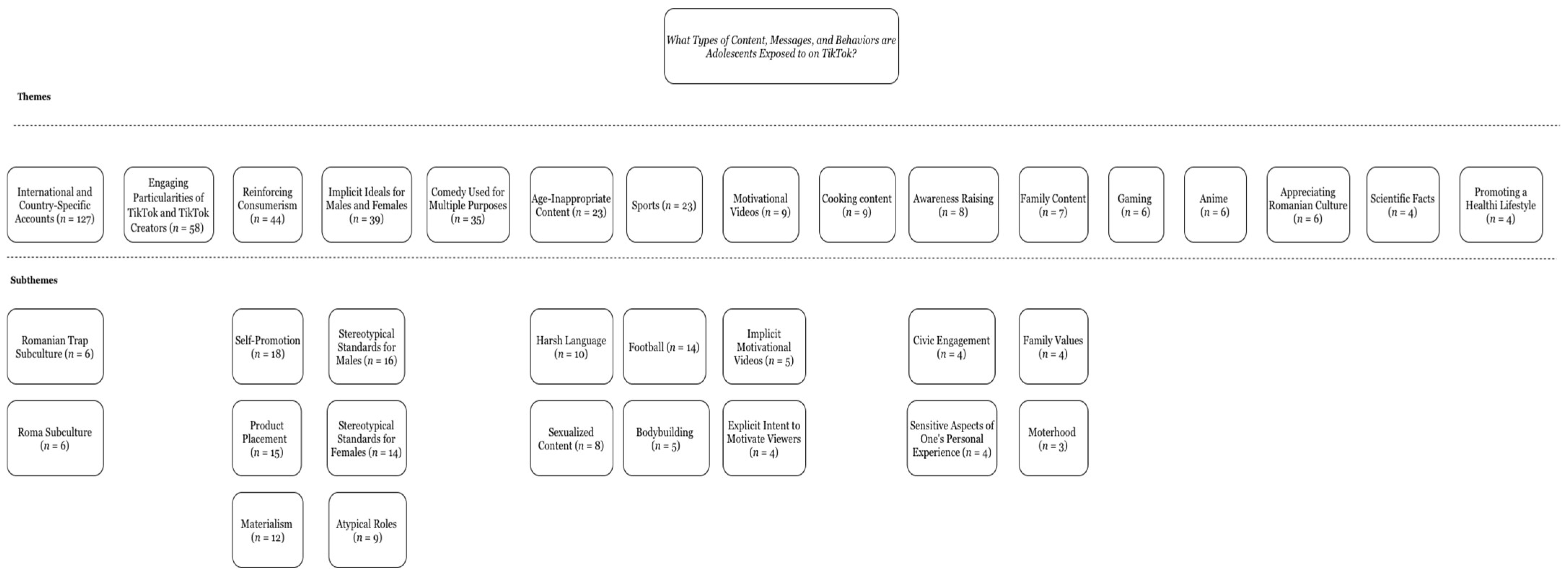
The inductive thematic analysis yielded a total of 16 overarching themes, depicted in Figure 1.
Figure 1.
Thematic Map of the Types of Content, Messages, and Behaviors Adolescents are Exposed to on TikTok.
3.1. International and Country-Specific Accounts
Given that TikTok’s recommendation algorithm uses geolocation to suggest popular content in a certain area, 71 (55.9%) of the accounts listed by participants belonged to Romanian content creators, while 56 (44.1%) of the videos were produced by foreign creators. For accounts owned by Romanian creators, two important subcultures were identified: the trap and Roma subcultures.
3.1.1. Romanian Trap Subculture (n = 6)
These creators were either singers, representative for the Romanian trap music genre, or influencers who adopted specific mannerisms and elements characteristic of this subculture. These creators were typically heavily tattooed, wearing massive gold jewelry, and very specific branded clothing items. Female creators also typically wore long nails and lashes. Moreover, in their videos, these creators used harsh language and adopted a dominating or intimidating stance, usually singing about illegal activities, violence, alcohol consumption, and objectification of women. The popularity of this genre among Romanian adolescents is evident, given that, since 2022, one of the largest trap music festivals in Europe has been held in Romania. Adolescents as young as 14 can participate in the festival, accompanied by a parent.
3.1.2. Roma Subculture (n = 6)
By using instruments traditionally used in Roma music, such as the cimbalom, accordion, and violin, with modern trap beats, these creators produced a hybrid music genre, known in Romania as “trapanele”. The subject of the music usually revolves around money, power, and opulence. Unlike trap music, this genre also addresses themes of love and suffering. Although it has been speculated in the Romanian press that some of these creators have been involved in illegal activities, others discussed their family values or appreciated displays of emotional vulnerability in men.
3.2. Engaging Particularities of TikTok and TikTok Creators (n = 58, 45.7%)
TikTok’s recommendation algorithm profiles users’ interests, inserting them into content niches such as football (e.g., #footballtiktok, #barçaontiktok), chess (e.g., #chesstok), learning (e.g., #learnontiktok, #edutok), fitness (e.g., #gymtok), and health-related content (e.g., #edutokhealth, #healthtok). In addition, viral content, such as the “#chillguy” or “Asoka” trends, enables users to create platform-specific jargon and a shared culture. Although not necessarily intended to, everything can become part of “TikTok lore & legend” as illustrated in a video in which an actress, as a non-user, learns that a scream from one of her films went viral on the platform.
3.3. Reinforcing Consumerism (n = 44, 34.6%)
This theme inevitably encompassed a large number of videos because, for content creators, TikTok is actually a business platform. Their videos are monetized, users donate money on their livestreams, and they get paid partnerships to promote other brands’ products. Thus, videos often encouraged users to acquire and engage with products and services that typically go beyond basic necessities or are associated with displays of social status. This was reflected by three subthemes: self-promotion, product placement, and materialism.
3.3.1. Self-Promotion (n = 18)
TikTok videos redirected followers to creators’ other social media outlets, such as Instagram and YouTube (e.g., “now on YouTube, link in bio”, “follow on Insta to see the story”, “Here’s a sneak peek of the YouTube vlog. Video dropping soon!”). Similarly, musicians publicized their work through TikTok by featuring fragments of their songs in short videos, leveraging the platform as a tool to increase visibility. Because TikTok monetization is contingent on viewership and follower counts, creators are incentivized to promote their work and redirect users to all their media channels to maximize audience reach and financial returns. Also, as TikTok limits video length to 10 min, creators often share teasers of longer-form content, encouraging users to access the full versions on alternative platforms such as YouTube.
3.3.2. Product Placement (n = 15)
TikTok creators also promoted their own products and services. Dentists, plastic surgeons, and fitness coaches invited viewers to book a consultation for any additional questions. The release of creators’ own books or starred-in movies was also announced to followers (e.g., “Now in cinemas. Did you buy a ticket?”). Sponsored partnerships for food, clothing, and hairstyling brands were also featured, and users were encouraged to purchase them using creators’ affiliate links (e.g., “you can order these products using the link in my bio”). In some cases, products were advertised through wholesome and inspiring stories. For example, makeup products were promoted through a discourse on self-love and acceptance. Another creator bought clothes for those in need with the money raised from selling his own coffee products.
3.3.3. Materialism (n = 12)
Here, creators displayed their material possessions as symbols of social status. In one video paradoxically titled “mini haul”, a female content creator unpacked several bags, jewelry, and clothing items from a luxury brand. Male creators depicted themselves at beachside restaurants or yacht parties, using visual symbols (e.g., “🔥💪👑”) to reinforce the idea of power. Presentations of luxury cars served the same function in these types of videos. Considering this, it is not surprising that young people endorse values such as materialism and aspire to being influencers (Tuominen et al. 2023).
3.4. Implicit Ideals for Males and Females (n = 39, 30.7%)
This theme stood out because, frequently, the way male and female content creators chose to portray themselves in their videos implicitly reflected beliefs about gender roles. Three subthemes encompassed this: stereotypical standards for males and females and atypical roles.
3.4.1. Stereotypical Standards for Males (n = 16)
Most creators were either bodybuilders or fitness coaches and frequently used branded clothing, luxury cars, or expensive vacations as markers of affluence. For example, one creator equated his designer outfit to financial success and self-sufficiency as a way to dismiss rumors about himself. Another one promoted his song hinting at sexual desirability (“they all want me to call them and to be looking for them”) while posing next to an expensive car. Physical appearance standards were also highlighted by a creator expressing his wish not to look like a “potato sack” and starting a weight loss journey. Such videos might put increasing pressure on teenage boys to conform to certain masculinity standards portrayed by the creators they follow on TikTok.
3.4.2. Stereotypical Standards for Females (n = 14)
Women’s bodies and facial features seemed to be at the forefront of the videos included within this subtheme. Creators portrayed ideal looks: they were skinny, wearing make-up to cover any imperfection, and dressed in flattering and feminine ways. A case can be made that even when a content creator broke traditional gender roles by having a career in football, she still depicted herself in uniform with a full face of makeup. It appears that women still have to follow certain beauty standards even in male-dominated fields. Young female creators usually depicted themselves in their videos either dancing, lip-syncing, or styling outfits. It becomes apparent that, even on a platform that encourages self-expression and creativity (Barta and Andalibi 2021), gender norms still weigh in on the type of content TikTok creators post.
3.4.3. Atypical Roles (n = 9)
Some videos also departed from traditional gender norms, especially in the case of men. Here, they were portrayed as more vulnerable and emotionally expressive. In such instances they openly approached subjects like love and heartbreak (e.g., “let people see how much a man can love; it is not something to be ashamed of … to love is the most beautiful thing”), expressed appreciation for their parents and children, and engaged in prosocial behaviors like charity. From this point of view, TikTok seems to be a place for authentic self-presentation (Bucknell Bossen and Kottasz 2020). In terms of physical appearance, two male creators displayed alternative and androgynous looks. For example, one of them wore items traditionally considered women’s clothing such as skirts, dresses, and heels, in response to a follower asking him to “make an outfit for every year since the beginning of time”.
3.5. Comedy Used for Multiple Purposes (n = 35, 27.6%)
Parody, irony, and humor were used to frame everyday situations in funny and relatable ways or express disagreement in a light-hearted way. However, entertainment sometimes came at the expense of others, including filming and mocking marginalized individuals and damaging property by writing “=8” next to the “4 × 4” symbol of a car. Exaggeration was also used for self-promotion, such as proving the effectiveness of a protein powered by smashing through a drywall. Gender and national stereotypes were also acknowledged through comedy, using POV (e.g., “your girlfriend is taking an Instagram story”) and skit formats (e.g., “I introduce myself as X from Romania, because that introduction opens a lot of doors for me and most of those doors are the way out”; “Romania, the Mexico of Europe. They tried to build a wall; we stole the bricks”). Variation in comedy-related videos is not surprising, since entertainment is one of the main reasons adolescents use TikTok (Bucknell Bossen and Kottasz 2020). Nonetheless, they might also be exposed to some forms of antisocial behavior.
3.6. Age-Inappropriate Content (n = 23, 18.1%)
Some videos contained behaviors that would fall under age-restricted content guidelines, such as alcohol consumption, gambling, and violence. For instance, gambling was implicitly normalized as a form of entertainment in a video where a slot machine was wrapped as a Christmas present and opened with a machete, while people were cheering and laughing. Aggressive and confrontational behavior was also framed as an acceptable strategy for resolving conflicts, as illustrated in a video in which someone challenges a mixed martial arts fighter to a physical match. Nonetheless, two subthemes took precedence over this: sexualized content and harsh language.
3.6.1. Harsh Language (n = 10)
These videos were exclusively posted by male creators. Although swear words were partially censored (e.g., omitting letters, saying only the first syllables), their meaning could be easily inferred. This was likely done to avoid the flagging and removal of videos. Profanity was used casually for comedic purposes and to express criticism toward consumer culture (e.g., inflated prices for branded items) and Romanian politicians. Such language was also prominent in videos posted by Romanian trap singers, a genre that has gained popularity among Romanian youth over the past decade. Nevertheless, “trap lyricism rarely involves anything other than money, promiscuity, and excessive lifestyles” (Langejan 2020, p. 2).
3.6.2. Sexualized Content (n = 8)
Preponderantly, these were posed by female creators (n = 6) with a focus on physical appearance. The lyrics of lip-synced songs often contained sexual innuendos, for example: “you undress me with your eyes, your mouth is watering/you scan me head to toe, you’re stuck on what you see”. In other instances, videos featured overt, uncensored displays of physical affection. It is concerning that young people seem to be exposed to ideas of sexual objectification and promiscuity, which can shape their views on romantic relationships and encourage engagement in risky behaviors (Conte et al. 2025). Videos posted by male creators also reinforce this idea, promoting sexual fetishes and the stereotype that a desirable man has many partners. Using a “point of view” (POV) video format, a young male smiles suggestively as the on-screen text reads “you have nice hands.” This probably hints at sexual practices such as asphyxiation (Sharman et al. 2025), normalizing a behavior that can be potentially harmful.
3.7. Sports (n = 23, 18.1%)
Videos under this theme featured various professional sports. These videos were either created by sports fans or specifically for the fans. For example, to help fans get to know their favorite sportsman better, famous race car drivers were asked which circuit they preferred to race on. Another creator passionate about chess made a video reacting to a match involving a chess grandmaster. Two other creators posted workout routines and tricks for using gym equipment better, which were usually directed at the general, non-professional masses. Out of all these, however, two salient subthemes emerged: football and bodybuilding.
3.7.1. Football (n = 14)
These videos make up another TikTok niche, targeted toward football enthusiasts. Videos included here were often posted by fan accounts, sharing important moments from football matches, information about the lives of famous football players, and even smartphone backgrounds fans could use for free. Other videos belonged to official accounts of famous football teams and competitions, such as FC Barcelona, Real Madrid CF, and FIFA World Cup. Creators who were football fans also posted videos from the competitions they attended live and expressed support for their favorite teams. Using a photo carousel depicting Romania’s football team and with a text overlay reading “WE ARE ALL CHEERING ON ROMANIA 🇹🇩 ❤️⚽️”, a creator expressed pride for the results obtained by the country’s team at the European football championship.
3.7.2. Bodybuilding (n = 5)
All videos within this subtheme were posted by male creators who were professionally training to compete in bodybuilding competitions. The sole purpose of these videos was to show off the creators’ physique. Most did not talk at all in the video and just adopted specific facial expressions and poses used in competitive settings to showcase their muscles.
3.8. Motivational Videos (n = 9, 7.1%)
Through their videos, some creators motivated users to overcome difficult life situations by shifting their perspective and aiming high when setting goals. In some instances, creators acted as motivational speakers, and in others, the video composition communicated the importance of aspiring to success.
3.8.1. Implicit Motivation for Viewers (n = 5)
Underlying these videos is the idea of dominance and success. One creator presented two expensive sports cars, with the overlay text reading: “competition happens at the bottom. The people at the top are collaborating”. Another male creator is filmed from behind as he raises from his chair, overlooking a party on the deck of a yacht, again reinforcing the idea of power and a high social standing. In contrast, one video emphasized the importance humbleness despite one’s accomplishments by covering the backstory of a famous football player who grew up socially disadvantaged, but even after rising to fame he was “not interested in luxuries or money”.
3.8.2. Explicit Intent to Motivate Viewers (n = 4)
The focus here was either on personal relationships, with an emphasis on accepting losing others, or on accepting and improving oneself. Two male creators normalized the experience of cutting out toxic persons, asserting things such as “if their absence brings you peace, then you did not lose anything” and “even if you miss someone, it’s ok to not want them back … only time will make you understand that you made the right choice”. A cosmetic brand personified their products as if they were girls writing in their diary about themes such as self-love and the beauty standards young girls are exposed to online: “Beauty is the most individual thing. For example, if you like someone, they seem more and more beautiful, right? So, nobody can ever rationally say you’re beautiful or not”.
3.9. Cooking Content (n = 9, 7.1%)
These videos encompassed food reviews (i.e., more commonly known on TikTok as taste testing, where individuals film their reactions while trying new foods and rating them), step-by-step tutorials on how to prepare homecooked meals, food inspiration posts (here creators usually document their meals over the day, but do not include their preparation), and professional cooking techniques such as sculpting chocolate.
3.10. Awareness Raising (n = 8, 6.3%)
Within this theme, content creators discussed socially relevant issues and modeled prosocial behaviors such as helping those in need or donating for charitable causes. At times, creators also opened-up emotionally to their followers by addressing their own hardships in life.
3.10.1. Civic Engagement (n = 4)
Here, content creators used their influence to encourage positive social changes. For example, a popular content creator in Romania posted a video helping a young man in need by buying him food and football equipment to help accomplish his dream of becoming a football player. The young man is depicted barefoot on the street and talks about his life story, saying that he grew up in an orphanage and that, while “some people look down on me, as if I am nobody, others are kind-hearted and understand my problems”. This video gained 6.3 million views. Another famous American singer acts as a model for her viewers as, on the way to the premier of a TV show, she first stops to vote. The video, captioned: “ITS TIME TO GO VOTE!!”, gained 10 million views. In another video, a Romanian content creator used his visibility on the platform to support small local businesses by asking his followers to recommend small, family-owned restaurants he could try out and feature in his videos.
3.10.2. Sensitive Aspects of One’s Personal Experience (n = 4)
Videos captured creators’ vulnerability when addressing emotionally charged personal experiences. Through a cinematic sequence of images and video fragments, one female creator documents “the secret procedure”: the medical treatment underwent in trying to conceive. This video depicts her laying in a hospital bed, being administered shots for fertility, the physical changes experienced during this process, the failed attempts and loss of the pregnancy. Another creator talks about the book she wrote about her transition journey, saying that it “covers topics I couldn’t talk about on here [TikTok]” and how she “rediscovered trans joy after extreme pain”. Another male creator criticizes content creators for cosplaying celebrities accused of sexual abuse, while disclosing a traumatic personal experience. He describes this event as life changing and painful and condemns creators for trivializing sexual abuse for content, emphasizing that such traumatic experiences should not be treated as entertainment: “being assaulted was the worst night of my life and I can’t imagine why anybody would find that kind of traumatic experience funny or good for content”.
3.11. Family Content (n = 7, 5.5%)
Videos included in this theme emphasized family values such as cherishing one’s parents and highlighted the complex emotional experiences that accompany motherhood.
3.11.1. Family Values (n = 4)
In a video captioned “I’m blessed. ❤️🙏🏽”, a male creator shares snapshots of a vacation he took his parents on. The video depicted the whole family sharing joyful moments during the vacation, sharing meals, visiting monuments, and going on walks together. At the end, a sequence of photos with the family is shared, with a text overlay reading: “the most beautiful feeling”. Another male actor showcases moments shared with his mother at a movie premiere, while reflecting on the unexpected loss of his father. Through the video caption, the creator encourages the audience to be present and cherish their parents while the still can: “If you’re lucky enough to have both your parents around […] love on, honor and protect your mom and dad”.
3.11.2. Motherhood (n = 3)
Female creators shared moments from their journey to motherhood, encompassing both positive and negative aspects. For instance, in a daily vlog format, one creator documented her experience coming home for the first time after giving birth. She confesses that this experience overwhelmed her with emotion, as she cannot stop crying since coming back from the hospital and that this was a whole new experience: “it’s like I moved into a new place, that’s what I feel like, everything in the house is new”. Another creator frames the video as a letter to her son about his future brother/sister. She shares images from the ultrasound, announcing her sister about the pregnancy, and moments spent with her family. Again, we see displays of vulnerability, when the creator is overcome with emotion and says: “our life will change again, … and we hope that this change will come in the shape of your best friend, our beloved child”. On the other hand, we also see depicted the aspects that are less frequently discussed online by influencers, such as not being able to conceive and going through the pain of losing a pregnancy.
3.12. Gaming (n = 6, 4.7%)
Videos included in this theme were created by professional gamers or streamers. Viewers watched individuals play a game in real-time and interacted with them through a chat feature provided by the streaming channel (e.g., Twitch.tv). Frequently, creators played first-person shooter games, where the game is in the forefront of the screen, but the face of the streamer also can be seen. Some creators opted to present themselves by using virtual avatars that mimic their facial expressions and gestures. These creators are usually known as Vtubers.
3.13. Anime (n = 6, 4.7%)
This content falls within one of TikTok’s niches for Anime fans, which is Japanese animation. In one instance, a creator creates a skit about how, even though some might speak different languages and not understand each other, one thing that is common ground for all is the Anime “One piece”. When one of them turns on the show on their phone all become united and stop arguing. The video caption is a direct reference to the show: “One Peace 🤝”. Another creator posted an image of a female character named Nilou from a famous Anime-style video game called Genshin Impact, captioned “Happy Birthday, Nilou!”.
3.14. Appreciating Romanian Culture (n = 6, 4.7%)
Occasionally, Romanian TikTok creators posted videos presenting particular aspects of their culture, such as traditional recipes, folk costumes, and music. For example, a female creator put a twist on the “Asoka” trend on TikTok by showcasing Romania’s national costume. Originally, this trend was named after a Hindi movie, and during the videos, female creators recreated Indian-inspired makeup looks and attires to the beat of a popular song from the movie. Another video captured the moment when Romania’s national anthem was sung at one of the country’s biggest music festivals. Creators also expressed pride in the achievements of Romanian sportsmen who represented the country in events such as the Olympic Games and football championships.
3.15. Scientific Facts (n = 4, 3.1%)
Few of the coded videos had an educational purpose. Only one video presented information from a non-medical field, in which the creator demonstrated how flame color varies based on chemical composition. Medical practitioners primarily discussed health-related practices and specific procedures, along with their associated risks (e.g., waring that the use of pore vacuums may cause skin ruptures). Their content also included smoking cessation strategies (e.g., dipping a cigarette in milk) and explanations of the physiological responses associated with nicotine withdrawal, as well as information on the stages of sleep and the effects of sleep deprivation on neural functioning.
3.16. Promoting a Healthy Lifestyle (n = 4, 3.1%)
Creators encouraged viewers to engage in healthy behaviors such as smoking cessation, going to sleep early, and losing weight in a healthy way. For example, a male creator posted a sequence of different meals, captioned “Here to help you lose weight in 2023 while enjoying the foods you love ❤️🙌🏼”. This goes against common unhealthy weight-control behaviors, such as highly restrictive diets and severely limiting calorie intake. Another creator encourages viewers to sleep 7–8 h per night and go to bed before 11 p.m., saying: “If you sleep less than 6 h per night instead of 8, you are harming yourself.” He goes on to explain the stages of sleep and its neuroprotective role.
3.17. Cross-Cutting Elements and Theme Interconnectivity
Although the emerging themes were presented as distinct categories, it is important to note that, oftentimes, TikTok videos encompassed elements from multiple themes, suggesting that adolescents are simultaneously exposed to several interrelated messages, values, and narratives. Specifically, cross-pollination across themes seemed to contribute to polarized narratives around gender expectations. For example, awareness-raising, family values, and motherhood themes and subthemes embodied feminine characteristics such as communion values, warmth, and emotional vulnerability. In contrast, videos within the sphere of sexualized content, materialism, and stereotypical female standards often emphasized physical appearance, self-objectification, and desirability. These intersecting narratives might expose adolescent girls to competing, but culturally endorsed gender ideals, making it difficult to balance other and self-oriented values. This was also the case for male adolescents. For instance, bodybuilding, trap subculture, and materialism permeated the stereotypical male standards theme, collectively reinforcing narratives geared toward dominance, prowess, and social status. At the same time, subthemes such as atypical roles and family values offered alternative portrayals of masculinity characterized by devotion and affection.
Additionally harsh language and materialism permeated multiple categories, including comedy, motivational discourse, implicit gender norms, and trap subculture. This pattern suggests that such values and behaviors might be broadly endorsed within the TikTok microsystem, potentially due to its visual emphasis, engagement-driven metrics, affordances for imitation, and viralization mechanisms. At the same time, prosocial behaviors depicted through themes such as awareness raising and family values also contrasted with the risky behaviors depicted in themes such as age-inappropriate content and comedy for multiple purposes. Together, these findings highlight that, on TikTok, adolescents do not encounter disparate forms of content and messages but rather complex webs of competing narratives around behavioral and gender norms, social status and success.
4. Discussion
By eliciting responses from TikTok’s algorithm, adolescents co-create highly individualized virtual microsystems (Navarro and Tudge 2023). Within these environments, content creators emerge as novel and important social referents, setting the boundaries of adolescents’ identity exploration and construction (Morita et al. 2022; Pérez-Torres 2024). However, despite adolescents’ heavy engagement in content consumption (Bucknell Bossen and Kottasz 2020), less is known about the actual messages, behaviors, and norms they expose themselves to on TikTok. The present study aimed to narrow this gap by thematically analyzing the TikTok accounts adolescents themselves reported following most frequently, highlighting the platform as a double-edged sword.
The standardized codebook resulted from the inductive thematic analysis represents an important contribution of this study. Beyond identifying the types of content adolescents commonly prefer to watch on TikTok, such as entertaining videos within the themes of sports, comedy used for multiple proposes, Anime, and gaming (Wu et al. 2021), the codebook focuses on the symbolic meanings and narrative features conveyed by creators in their videos, taking account of the messages, values, and behavioral models adolescents are exposed to. From this perspective, TikTok can be understood as a virtual microsystem where content creators function as important socializing agents (Pérez-Torres 2024), by portraying both master and alternative narratives which enable adolescents to position their personal values and goals within broader, socially constructed meaning systems (Granic et al. 2020).
Themes that encompass a high proportion of videos provide instantiations of master narratives. Specifically, the theme reinforcing consumerism (n = 44) mirrors the “American Dream” narrative with its videos overtly equating success and personal fulfillment to material possessions (Granic et al. 2020). Oftentimes, influencers overtly framed adolescents’ commitment and exploration toward external and materialistic standards, converging with recent findings that adolescents who frequently follow influencers on SNSs tend to report more materialism (Tuominen et al. 2023). Similarly, the theme implicit ideals for males and females (n = 39) encapsulates “Ideal Women and Man” narratives (Granic et al. 2020), where female content creators place increasing emphasis on their physical appearance and attractiveness, and male creators depict themselves as highly dominant figures, possessing social power and material resources. Again, this underlines the fact that on TikTok, not only girls but also boys are frequently exposed to normative standards, which, as highlighted by Setty et al. (2025) create tensions between adolescents’ desire for personal uniqueness and the need for conformity. Additionally, content falling within the theme of age-inappropriate behavior (n = 23) is especially concerning as, accompanied by high popularity metrics, it can create new behavioral norms that might fall outside typical socio-cultural standards, with potentially negative consequences for adolescents’ person–society integration (Granic et al. 2020; Morita et al. 2022). This aspect is also reflected in the Romanian trap subculture subtheme, as representatives of this music genre might provide new templates adolescents can use for identity development (Lajnef 2023; Pérez-Torres 2024).
However, these influences appear to be counterbalanced by positive themes such as, awareness raising (n = 8) and family content (n = 7), which could foster adolescents’ coherent integration of multiple personal and social values and goals, by modelling prosocial attitudes and behaviors. For example, communion values are emphasized when creators encourage viewers to cherish their family members and give back to the community. Similarly, identified themes also encompass alternative narratives that adolescents can subscribe to in building their identities (Granic et al. 2020). For instance, videos that encourage users to practice self-love and acceptance seem to go against the values portrayed by the implicit ideals for males and females theme. Similarly, videos within the atypical roles subtheme (n = 9) highlight, especially for adolescent boys, that emotional vulnerability and experimenting with one’s physical appearance is also socially acceptable. However, these videos seem to be less prevalent among the accounts adolescents generally follow on TikTok.
What is clear from these results is that, to the extent that adolescents identify with the content creators they follow, they are faced with the task of balancing both social and personal identities (Crocetti et al. 2023; Pérez-Torres 2024). As previous qualitative evidence highlights, influencers do create a space for exploration through their content; however, adolescents exert autonomy in deciding whether the portrayed values and norms are worth committing to and how to do this in ways that are not personally alienating (Ezzat 2020; Setty et al. 2025). This last idea is partly supported by the engaging particularities of TikTok theme. Videos within this theme hinted as specific interest niches through the hashtags used by content creators (e.g., #footballtiktok, #chesstok, #edutok, #gymtok), suggesting that personal interests and values guide adolescents’ insertion in particular social groups. This idea is also supported by the fact that adolescents displayed a preference for nationality-congruent accounts, as more than half of the creators they followed were Romanian. Last, results highlight that TikTok is a space where adolescents co-construct their own cultural niches. This is reflected by the presence of Roma (n = 6) and Trap (n = 6) subcultures which represent variations within the Romanian adolescent population, although these cultural expressions might remain marginal or underrepresented in the Romanian society at large. However, this underscores the need to move beyond monolithic conceptions of youth culture. As Navarro and Tudge (2023, p. 19345) state, “to understand and support today’s young people, we must be prepared to examine the diverse cultures and subcultures within which they live, play, and grow”.
Limitations and Directions for Future Research
This study has several limitations that should be acknowledged. While it offers insight into the values and behaviors TikTok creators model as social referents in adolescents’ identity formation, this study did not investigate how adolescents themselves perceived and made sense of the analyzed videos. Thus, our interpretation and coding of relevant themes might not fully capture adolescents’ own perceptions regarding the TikTok creators they follow. Future studies could use think-aloud procedures to investigate the personal meanings adolescents draw as they view content. As we relied on adolescents’ self-reports regarding the TikTok accounts they followed, it is possible that participants selectively reported accounts that are more socially acceptable. Future studies should capture the content adolescents are viewing on TikTok through objective means, such as mobile sensing and sequential screenshots of users’ activity on their phones. Lastly, this study analyzed only one video per TikTok account, which might not capture broad patterns of activities and messages present across creators’ overall content. However, previous evidence suggests that, to build follower engagement and rapport, creators are incentivized to maintain a consistent personal branding, adhere to audience-endorsed norms and expectations, and highlight “unique selling points” (Sullivan and Wang 2024, p. 217). For this reason, pinned videos remain valuable for exploring the values and narratives creators embody to their audiences, as these are strategically foregrounded by creators when curating their public online personas. Nevertheless, to fully understand the behaviors, norms, and values content creators portray and endorse through online discourse and self-presentation, future studies should analyze a broader range of videos from creators’ TikTok profiles.
5. Conclusions
By employing an inductive and iterative approach, this study allowed us to develop a codebook that goes beyond recurring content preferences on TikTok and identifies meaningful socio-cultural norms, expectations, values, and behaviors that content creators embody as salient social referents in adolescents’ virtual microsystems (Morita et al. 2022; Pérez-Torres 2024). It appears that, as they navigate TikTok, adolescents negotiate and co-construct their own cultural niches (Navarro and Tudge 2023), while balancing the coherent integration of personally and socially derived meanings and self-definitions (Crocetti et al. 2023).
Our findings suggest that a complex web of interrelated, but, often, polarized, narratives permeate TikTok. Narratives surrounding the meaning of success, the importance of other and self-oriented values, the nurturing yet desirable female, the dominant yet emotionally available male, and the highly successful yet generous individual might pose important challenges as adolescents try to integrate their own emerging meaning systems with broader, culturally and socially mediated, meanings, that frequently contend one another. This highlights the importance of studying social networking sites not only as entertainment platforms, but as a digitally mediated developmental context with unique affordances and social referents that may both amplify dominant socio-cultural expectations and foster alternative values and behavioral models. Longitudinal and in-depth studies are required to understand how and to what extent adolescents internalize or resist the diverse messages encountered as they navigate these virtual microsystems.
Supplementary Materials
The following supporting information can be downloaded at https://www.mdpi.com/article/10.3390/socsci15060342/s1: Supplementary Material A: Detailed Plan of the Thematic Analysis; Supplementary Material B: Themes—What Types of Content, Messages, and Behaviors Are Adolescents Exposed to on TikTok.
Author Contributions
Conceptualization, D.D. and O.N.-S.; methodology, D.D. and O.N.-S.; formal analysis, D.D. and O.N.-S.; investigation, D.D. and O.N.-S.; writing—original draft preparation, D.D. and O.N.-S.; writing—review and editing, D.D. and O.N.-S.; funding acquisition, D.D. All authors have read and agreed to the published version of the manuscript.
Funding
This research was funded by Babeș-Bolyai University through a special scholarship for scientific activity (36581/25 November 2022).
Institutional Review Board Statement
The study was conducted in accordance with the Declaration of Helsinki, and approved by the Institutional Review Board (or Ethics Committee) of Babeș-Bolyai University (protocol code 36581 and date of approval 25 November 2022).
Informed Consent Statement
Written informed consent was obtained from all individual participants who took part in the study.
Data Availability Statement
The codebook developed for this study can be found on the Open Science Framework (Available online: osf.io/y5dtu). The TikTok videos analyzed in the current study are not publicly available in order to protect the privacy and anonymity of the content creators.
Acknowledgments
The authors thank the student researchers who assisted with the coding of the TikTok videos for the thematic analysis.
Conflicts of Interest
The authors declare no conflicts of interest.
Note
| 1 | TikTok Users in Romania Audience. Start.Io. Available online: https://www.start.io/audience/tiktok-users-in-romania (accessed on 6 May 2026). |
References
- Ahmmad, Mukhtar, Khurram Shahzad, Abid Iqbal, and Mujahid Latif. 2025. Trap of Social Media Algorithms: A Systematic Review of Research on Filter Bubbles, Echo Chambers, and Their Impact on Youth. Societies 15: 301. [Google Scholar] [CrossRef] [Scilit]
- Barta, Kristen, and Nazanin Andalibi. 2021. Constructing Authenticity on TikTok: Social Norms and Social Support on the ‘Fun’ Platform. Proceedings of the ACM on Human-Computer Interaction 5: 430. [Google Scholar] [CrossRef] [Scilit]
- Bianca, Rus, and Mihaela Negru. 2025. The Relationship with Information and Media Consumption Habits of Children and Young People in Romania. Cluj-Napoca: Center for Independent Journalism. [Google Scholar]
- Boeker, Maximilian, and Aleksandra Urman. 2022. An Empirical Investigation of Personalization Factors on TikTok. Paper presented at WWW 2022—Proceedings of the ACM Web Conference 2022, Lyon, France, April 25; pp. 2298–309. [Google Scholar] [CrossRef] [Scilit]
- Braun, Virginia, and Victoria Clarke. 2006. Using Thematic Analysis in Psychology. Qualitative Research in Psychology 3: 77–101. [Google Scholar] [CrossRef] [Scilit]
- Bucknell Bossen, Christina, and Rita Kottasz. 2020. Uses and Gratifications Sought by Pre-Adolescent and Adolescent TikTok Consumers. Young Consumers 21: 463–78. [Google Scholar] [CrossRef] [Scilit]
- Conte, Giulia, Giorgia di Iorio, Dario Esposito, Sara Romano, Fabiola Panvino, Susanna Maggi, Benedetta Altomonte, Maria Pia Casini, Mauro Ferrara, and Arianna Terrinoni. 2025. Scrolling through Adolescence: A Systematic Review of the Impact of TikTok on Adolescent Mental Health. European Child and Adolescent Psychiatry 34: 1511–27. [Google Scholar] [CrossRef] [Scilit]
- Crocetti, Elisabetta, Flavia Albarello, Wim Meeus, and Monica Rubini. 2023. Identities: A Developmental Social-Psychological Perspective. European Review of Social Psychology 34: 161–201. [Google Scholar] [CrossRef] [Scilit]
- Crocetti, Elisabetta, Monica Rubini, and Wim Meeus. 2008. Capturing the Dynamics of Identity Formation in Various Ethnic Groups: Development and Validation of a Three-Dimensional Model. Journal of Adolescence 31: 207–22. [Google Scholar] [CrossRef] [Scilit]
- Dodan, Daria, and Oana Negru-Subtirica. 2025. Is using TikTok stressful? Exploring the longitudinal relationships between adolescents’ self-concept clarity and digital stress. Journal of Research on Adolescence 5: 1–13. [Google Scholar] [CrossRef] [Scilit]
- Erikson, Erik H. 1968. Identity: Youth and Crisis. New York: Norton. [Google Scholar]
- Ezzat, Hanan. 2020. Social Media Influencers and the Online Identity of Egyptian Youth. Catalan Journal of Communication and Cultural Studies 12: 119–33. [Google Scholar] [CrossRef] [Scilit]
- Foster, Molly, Hannah Frith, and Mary John. 2024. ‘I’m Still Su!C!Dal When You’re Done with the Paperwork’: An Inductive Framework Thematic Analysis of #camhs on TikTok. Journal of Child Psychology and Psychiatry and Allied Disciplines 65: 1258–69. [Google Scholar] [CrossRef] [Scilit] [PubMed]
- Goodman, Elizabeth, Nancy E. Adler, Ichiro Kawachi, A. Lindsay Frazier, Bin Huang, and Graham A. Colditz. 2001. Adolescents’ perceptions of social status: Development and evaluation of a new indicator. Pediatrics 108: E31. [Google Scholar] [CrossRef] [Scilit]
- Granic, Isabela, Hiromitsu Morita, and Hanneke Scholten. 2020. Beyond Screen Time: Identity Development in the Digital Age. Psychological Inquiry 31: 195–223. [Google Scholar] [CrossRef] [Scilit]
- Hemmler, Vonna L., Allison W. Kenney, Susan Dulong Langley, Carolyn M. Callahan, E. Jean Gubbins, and Shannon Holder. 2022. Beyond a Coefficient: An Interactive Process for Achieving Inter-Rater Consistency in Qualitative Coding. Qualitative Research 22: 194–219. [Google Scholar] [CrossRef] [Scilit]
- Herrick, Shannon S. C., Laura Hallward, and Lindsay R. Duncan. 2021. ‘This Is Just How I Cope’: An Inductive Thematic Analysis of Eating Disorder Recovery Content Created and Shared on TikTok Using #EDrecovery. International Journal of Eating Disorders 54: 516–26. [Google Scholar] [CrossRef] [Scilit]
- Ionescu, Claudiu Gabriel, and Monica Licu. 2023. Are TikTok Algorithms Influencing Users’ Self-Perceived Identities and Personal Values? A Mini Review. Social Sciences 12: 465. [Google Scholar] [CrossRef] [Scilit]
- Lajnef, Karima. 2023. The Effect of Social Media Influencers’ on Teenagers Behavior: An Empirical Study Using Cognitive Map Technique. Current Psychology 42: 19364–77. [Google Scholar] [CrossRef] [Scilit]
- Langejan, Eline. 2020. Mumbling, Shouting, and Singing: Listening to the (Non)Human Voice in Trap. Master’s thesis, Utrecht University, Utrecht, The Netherlands, August 17. Available online: https://studenttheses.uu.nl/handle/20.500.12932/37458 (accessed on 1 February 2026).
- Langlais, Michael R., Ashley Thaler, and Elizabeth West. 2025. TikTok Too Much? A Qualitative Investigation of Adolescent TikTok Use, Motivation, and Consequences. Youth and Society 57: 593–614. [Google Scholar] [CrossRef] [Scilit]
- Luyckx, Koen, Luc Goossens, and Bart Soenens. 2006. A Developmental Contextual Perspective on Identity Construction in Emerging Adulthood: Change Dynamics in Commitment Formation and Commitment Evaluation. Developmental Psychology 42: 366–80. [Google Scholar] [CrossRef] [Scilit] [PubMed]
- Madill, Anna, Abbie Jordan, and Caroline Shirley. 2000. Objectivity and Reliability in Qualitative Analysis: Realist, Contextualist and Radical Constructionist Epistemologies. British Journal of Psychology 91: 1–20. [Google Scholar] [CrossRef] [Scilit]
- Marcia, James E. 1966. Development and Validation of Ego-Identity Status. Journal of Personality and Social Psychology 3: 551–58. [Google Scholar] [CrossRef] [Scilit] [PubMed]
- McAdams, Dan P., and Kate C. McLean. 2013. Narrative Identity. Current Directions in Psychological Science 22: 233–38. [Google Scholar] [CrossRef] [Scilit]
- Mensonides, Denise, Anna van Cauwenberge, Joëlle Swart, and Marcel Broersma. 2025. TikTok as a Peer Playground: Understanding How Children in Middle Childhood Use TikTok to Shape Their Peer Relations. New Media and Society 25: 1854–74. [Google Scholar] [CrossRef] [Scilit]
- Morita, Hiromitsu, Nastasia Griffioen, and Isabela Granic. 2022. Digital Media and the Dual Aspect of Adolescent Identity Development: The Effects of Digital Media Use on Adolescents’ Commitments and Self-Stories. In Handbook of Adolescent Digital Media Use and Mental Health. Edited by Nesi, Jacqueline, Eva H. Telzer and Mitchell J. Prinstein. Cambridge: Cambridge University Press, pp. 63–84. [Google Scholar] [CrossRef] [Scilit]
- Navarro, Jessica L., and Jonathan R. H. Tudge. 2023. Technologizing Bronfenbrenner: Neo-Ecological Theory. Current Psychology 42: 19338–54. [Google Scholar] [CrossRef] [Scilit]
- Negru-Subtirica, Oana. 2026. Identity Exploration in Digital Spaces. In The Palgrave Encyclopedia of Cyberpsychology. Edited by Fullwood, Chris, Dawn Branley-Bell, Lisa Orchard, Maria Limniou and Vasilena Stefanova. Cham: Palgrave Macmillan, pp. 1–5. [Google Scholar] [CrossRef] [Scilit]
- O’Connor, Cliodhna, and Helene Joffe. 2020. Intercoder Reliability in Qualitative Research: Debates and Practical Guidelines. International Journal of Qualitative Methods 19: 1–13. [Google Scholar] [CrossRef] [Scilit]
- Pérez-Torres, Vanesa. 2024. Social Media: A Digital Social Mirror for Identity Development during Adolescence. Current Psychology 43: 22170–80. [Google Scholar] [CrossRef] [Scilit]
- Setty, Emily, Robyn Muir, and Rosie Macpherson. 2025. ‘Influence’ in the (Post-)Digital Age: Girls’ Experiences of Online Influencer Culture. New Media and Society 27: 1–19. [Google Scholar] [CrossRef] [Scilit]
- Sharman, Leah S., Robin Fitzgerald, and Heather Douglas. 2025. Strangulation During Sex Among Undergraduate Students in Australia: Toward Understanding Participation, Harms, and Education. Sexuality Research and Social Policy 22: 362–75. [Google Scholar] [CrossRef] [Scilit]
- Sherman, Lauren E., Ashley A. Payton, Leanna M. Hernandez, Patricia M. Greenfield, and Mirella Dapretto. 2016. The Power of the Like in Adolescence: Effects of Peer Influence on Neural and Behavioral Responses to Social Media. Psychological Science 27: 1027–35. [Google Scholar] [CrossRef] [Scilit]
- Sherman, Lauren E., Patricia M. Greenfield, Leanna M. Hernandez, and Mirella Dapretto. 2018. Peer Influence Via Instagram: Effects on Brain and Behavior in Adolescence and Young Adulthood. Child Development 89: 37–47. [Google Scholar] [CrossRef] [Scilit]
- Sjöström, David K., Tore de Mendonca Lindström, Sabina Kapetanovic, and Emma Claesdotter-Knutsson. 2024. Helpful or Not? A Qualitative Study on Female Adolescents’ Experience of TikTok When Recovering From Anorexia Nervosa. International Journal of Eating Disorders 57: 2217–27. [Google Scholar] [CrossRef] [Scilit] [PubMed]
- Sugimura, Kazumi, Shogo Hihara, Kai Hatano, and Elisabetta Crocetti. 2023. Adolescents’ Identity Development Predicts the Transition and the Adjustment to Tertiary Education or Work. Journal of Youth and Adolescence 52: 2344–56. [Google Scholar] [CrossRef] [Scilit]
- Sullivan, Jonathan, and Weixiang Wang. 2024. Becoming Wanghong: How Foreigners Achieve Internet Celebrity in China. East Asia 41: 201–22. [Google Scholar] [CrossRef] [Scilit]
- Tuominen, Jesse, Eero Rantala, Hanna Reinikainen, and Terhi-Anna Wilska. 2023. Modern-Day Socialization Agents: The Connection Between Social Media Influencers, Materialism, and Purchase Intentions of Finnish Young People. The Journal of Social Media in Society Spring 12: 21–48. [Google Scholar]
- Van Doeselaar, Lotte van, Kate C. McLean, Wim Meeus, Jaap J. A. Denissen, and Theo A. Klimstra. 2020. Adolescents’ Identity Formation: Linking the Narrative and the Dual-Cycle Approach. Journal of Youth and Adolescence 49: 818–35. [Google Scholar] [CrossRef] [Scilit] [PubMed]
- Widjaya, Regina, Samuel Bestvater, Aaron Smith, and Sogand Afkari. 2024. Who U.S. Adults Follow on TikTok. Available online: www.pewresearch.org (accessed on 1 February 2026).
- Wu, Yiling, Xiaonan Wang, Skylar Hong, Min Hong, Meng Pei, and Yanjie Su. 2021. The Relationship Between Social Short-Form Videos and Youth’s Well-Being: It Depends on Usage Types and Content Categories. Psychology of Popular Media 10: 467–77. [Google Scholar] [CrossRef] [Scilit]
- Zulli, Diana, and David James Zulli. 2022. Extending the Internet Meme: Conceptualizing Technological Mimesis and Imitation Publics on the TikTok Platform. New Media and Society 24: 1872–90. [Google Scholar] [CrossRef] [Scilit]
Disclaimer/Publisher’s Note: The statements, opinions and data contained in all publications are solely those of the individual author(s) and contributor(s) and not of MDPI and/or the editor(s). MDPI and/or the editor(s) disclaim responsibility for any injury to people or property resulting from any ideas, methods, instructions or products referred to in the content. |
© 2026 by the authors. Licensee MDPI, Basel, Switzerland. This article is an open access article distributed under the terms and conditions of the Creative Commons Attribution (CC BY) license.