
Article

Role Strain and Systemic Barriers: A Qualitative Study of Somali Refugee Mothers in the United States

1
College of Humanities & Social Sciences, Utah Valley University, Orem, UT 84058, USA
2
College of Social Work, University of Utah, Salt Lake City, UT 84112, USA
*
Author to whom correspondence should be addressed.
Soc. Sci. 2026, 15(6), 343; https://doi.org/10.3390/socsci15060343

Submission received: 25 February 2026 / Revised: 24 April 2026 / Accepted: 18 May 2026 / Published: 22 May 2026
(This article belongs to the Section Family Studies)

Abstract

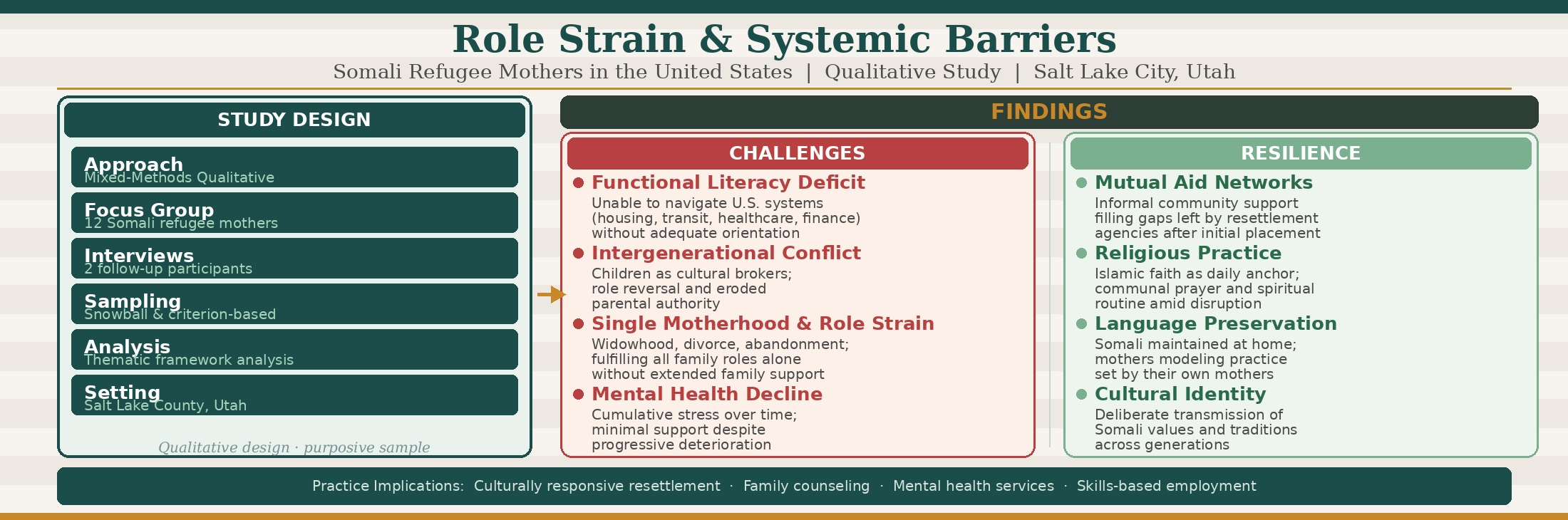
Somali refugee mothers navigating parenting in the United States face compounding challenges that extend well beyond the initial resettlement period. This study employed a multi-method qualitative design, including utilizing a focus group and follow-up key informant interviews with Somali refugee mothers. Thematic framework analysis identified three overarching domains of challenges and resilience. First, a pervasive deficit of functional literacy, defined as the practical capacity to navigate American institutional systems, emerged as the primary stressor, superseding material poverty as a barrier to daily functioning. Second, significant intergenerational tensions were documented, including role reversal between mothers and children, erosion of parental authority, and breakdown of the traditional expectations that adult children provide financial and social support to aging parents. Third, single motherhood amplified all other stressors, producing progressive role strain and mental health decline in the absence of extended family support. Despite these challenges, participants demonstrated substantial resilience through informal mutual aid networks, religious practice, and deliberate cultural and linguistic preservation. Findings have direct implications for the design of culturally responsive resettlement programming, family counseling services, and mental health interventions for Somali refugee populations.
Keywords: Somali refugees; family adjustment; cultural adaptation; resettlement; immigration; United States Somali refugees; family adjustment; cultural adaptation; resettlement; immigration; United States
Graphical Abstract