


Abstract
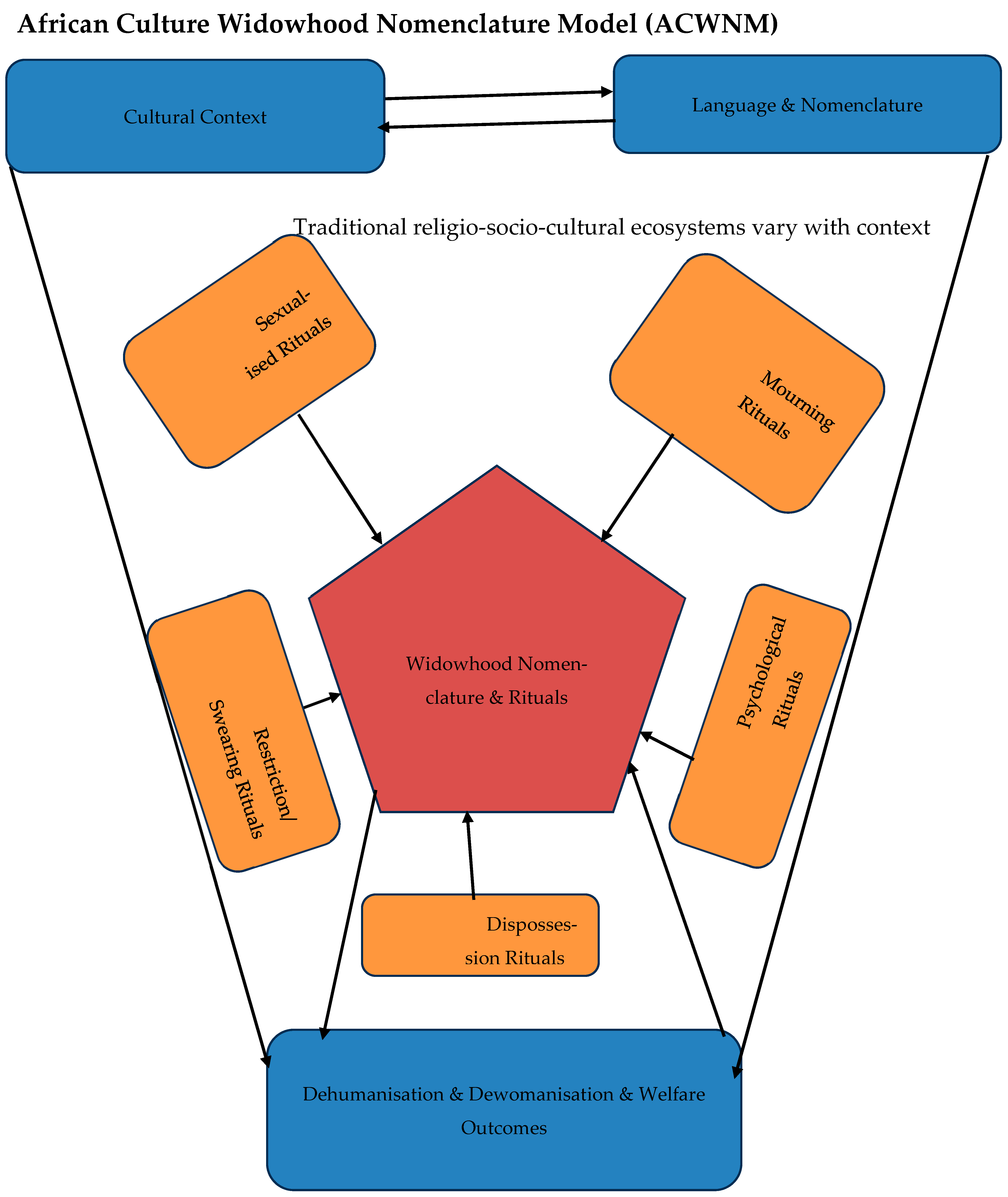
Globally, the effects of widowhood on the welfare, health, financial security and education of the widow’s children in many contexts have been the subject of much research. This paper aims to uncover the nexus among culture, gender and language on widowhood dignity and welfare among four chosen African ethnic groups in South Africa and Zimbabwe. The widowhood phenomenon is culture-bound and value-laden as it signposts the reality of existence in the linguistic and cultural contexts in which it is created and operationalised. Through Kimberlé Crenshaw’s 1989 intersectional theory, this paper provides an in-depth, inductive qualitative investigation of the implications of culture, gender, language, and especially the nomenclature that African communities ascribe to the widowed, which in turn stigmatises widowhood. Two (2) South African and two (2) Zimbabwean ethnic groups were purposefully chosen for the multiple case study approach. Grounded theory is the coding framework and analysis technique. The coding starts off with picking key words, phrases and sentences and axial coding which is a higher level in which related data are grouped into sub-themes, themes and global themes. The search revealed that widowhood language, culture and nomenclature denote gendered, culturally contested spaces in which the widowed women especially face dehumanising and dewomanising rituals. The results gathered fall into five broad categories, namely, sexualised widowhood mourning rituals, psychological and emotional widowhood torture rituals, ritualised widowhood dispossession, swearing, movement and space restriction widowhood rituals. The rituals affirm the ascribed socially depressed widowed status implied in the stigmatising nomenclature. The paper recommends redefining widowhood in terms of humanising and womanising language, cultural rituals and nomenclature in the context of equality before the law. Such a move prevents discrimination against the widowed that unintentionally violates their constitutionally espoused right to equality.
Keywords:
culture; gender equality; gendered space; widowhood; humanisation; womanisation; empowerment theory 1. Introduction
Through Kimberlé Crenshaw’s 1989 intersectional theory lens (Bastia et al. 2023), this paper examines the effects of various linguistic naming and cultural rituals performed on widows and the resultant effect on widowed welfare and dignity in two South African and two Zimbabwean ethnic groups. Shoko and Matlabe-Danke (2024) noted that, in developed countries and nearly all developing nations, women are more likely than men to outlive their spouses because of life expectancy differences, (wo)men’s culturally differentiated behaviours and because women tend to marry slightly older men. Thus, the intersectionality and intricacy of religio-socio-cultural and linguistic nomenclature and widowhood continue to trap the widowed.
1.1. Background to the Study
Due to their shared borders, the cultural linguistic nomenclature and practices of four ethnic groups in South Africa and Zimbabwe are compared. Two of these four ethnic group communities are domiciled in both countries and they share cross-border languages. Therefore, the majority of the officially recognised languages in Zimbabwe (ZORLs), Sotho, Ndebele, Tswana, Shangani (Xitsonga), Xhosa, English and Venda, are also official languages of South Africa (The Government of Zimbabwe 2013; The Constitution of the Republic of South Africa 1996). The two neighbouring countries, therefore, share two languages, Ndebele and Sotho, which are spoken by the selected ethnic groups.
The institutional mandate of the South African Commission on Gender Equality (CGE) is to advance, uphold, safeguard and enhance gender equality through public education initiatives and research. In order to promote gender equality in South Africa (SA), the Commission on Gender Equality uses its authority to uphold, look into, lobby and advise on gender issues. It also makes sure that state agencies, businesses, and civil society organisations follow and put into practice pertinent laws and policy frameworks (Magudu and Mahlakoana-Motapi 2013). Contrary to the popular view, Gaidzanwa (1985) highlighted that widows in Zimbabwe maintain their dignity and only lose it when they remarry.
Widows are still women and human beings with full constitutional rights from both countries and hence deserve equality like any other citizen. There is a need to expand the church pastoral role since widows are assumed to be typically feeling sorrow as well as pain, loneliness, anger, and despair due to changes in interpersonal interactions (Kaveny 2005). The situation is likely to be worsened by the dehumanising and dewomanising cultural and linguistic rituals that negatively codify and stigmatise the widowed. Communities are therefore encouraged to support governments and religious initiatives to reverse the negative widowhood codification and stigmatisation. Sulumba-Kapuma’s (2018) study on widowhood reveals that a widow is referred to as an “umfwile”. “Umfwile” means that she carries death with her. Such nomenclature negatively codifies and stigmatises widows. Furthermore, the scholar highlighted that a widow’s purity ends with spousal death and, in that regard, it unnecessarily justifies cleansing rituals. The cultural rituals, stigmatisation and nomenclature, together with other contextual factors, intersect in leading to negative widowhood labelling and subsequently a self-fulfilling prophecy in which widows accept and exist in the culturally recreated negativity.
1.2. Naming in an African Context
Despite its cultural uniqueness, variances, and pluralistic nature, the naming phenomenon is ubiquitous (Olatunji et al. 2015). It conveys a balance of power (Braden 2018) within the context in which it is coined and operationalised. Intersecting cultural narratives, values and attitudes toward the stated phenomenon have an impact on it (Mangena and Waliaula 2021). Newborn babies’ names in Ghana indicate the day, time and circumstances of the child’s birth (Appiah 2010). Thus, it is undoubtedly clear that naming of any kind, be it that of a new baby or a transitional life stage, has never been neutral in African contexts (Mangena 2023), hence the functional approach to naming (Faloju and Fadairo 2020). Thus, intersecting cultural, gender and linguistic communities’ widowed nomenclature variables mirror the community’s widowhood perception.
1.3. Contextualising Widowhood Naming in African Culture and Ethnic Groups
Pena-Longobardo et al. (2021) noted with concern that widowhood may substantially impact personal health in comparison to those who stay married. The results show that widows are more likely to have poorer physical and mental health risks. Similarly, it was observed that widows’ poor health conditions were associated with increased mortality risks, declining family resources, loneliness and declining life quality. Every bereaved person experiences tension, worry and grief during spousal death, though intensity rates vary and may depend on personal situational and societal beliefs (Fjærestad et al. 2011). If the deceased was the provider for the family, the widow’s pain is exacerbated as a result of anticipated deprivation, subordination and cultural shame (Sulumba-Kapuma 2018). The purification practices make it abundantly evident that widowhood is linked to sexual impurity, which in turn stigmatises widows and justifies the need for sexual cleansing (Buthelezi and Ngema 2021; Ajiboye 2016; E. M. Baloyi 2016).
As evidence of the depressed status of widows, Sossou (2002) indicated that several laws, contemporary administrative practices, religious and customary policies, behaviours and attitudes related to widowhood violate regional and international human rights charters and declarations. For instance, the practice of stigmatising widowhood violates the International Declaration on the Elimination of Violence against Women, the Social, Political and Economic Charters and the 1979 UN Women’s Convention on the Elimination of All Forms of Discrimination against Women. Saluun et al. (2019) asserts that widows suffer from psychological oppression, which is a severe control over one’s sense of self. Therefore, many mourning traditions desexualise widows by imposing taboos and dressing standards (Bremmer and Van Den Bosch 1995) as well as nomenclature that stigmatises them. In a related context, among the Baule of Cote d’Ivoire (Etienne 1986), the widow and her small children must “be returned” to her kinsmen, which robs her of her status. In South Africa, widowhood is a more severe kind of deprivation, oppression and humiliation (Magudu and Mahlakoana-Motapi 2013; Tshaka et al. 2023), with children occasionally changing or quitting school in the process. Widows were historically considered a disadvantaged minority even in modern industrialised countries like the United Kingdom, according to the IMF Policy Research Talk, World Bank (2017). Contrary to the other observations, Mabunda and Ross (2023), highlighted that grieving rituals in South African cultures are meant to honour the deceased and encourage the widow’s healing. However, scholars noted with concern that widows in African cultures observe a mourning duration of twelve months and partake in funeral, burial and post-burial rituals, undergoing cleansing as well as movement restrictions (Khosa-Nkatini 2022; Pazzack and Imam 2015; Mabunda and Ross 2023). Potash (1986), on the contrary, argues that widowhood may sometimes be a permanent status by choice in which widows may gain more power, freedom and no more hardships as compared to married women. This means that it is not always the case that widowhood and vulnerability go hand in hand.
1.4. Gender and Constitutional Provisions in South Africa and Zimbabwe
The two countries are premised on egalitarian provisions anchored on the Sustainable Development Goals (SDGs) and specifically Sustainable Development Goal 5 (SDG5) to do with gender equality. First, all South Africans are guaranteed equal treatment under the SA Bill of Rights. It forbids unjust discrimination based on sex, gender and race. The Bill of Rights emphasises the necessity of taking action to advance equality. Similarly, Section 80(3) of the Zimbabwean Constitution forbids any laws, customs, traditions, or cultural practices that violate women’s rights. In Section 26, the Zimbabwean Constitution forbids forced marriages. Furthermore, in Section 56, the Zimbabwean Constitution states that both men and women are entitled to equal treatment, which includes equal chances. Section 56 further offers a robust foundation for safeguarding and advancing the rights of wo/men as well as boys and girls. All people are equal under the Zimbabwean Constitution, which also forbids discrimination based on gender and sex. Additionally, Section 246(a) calls for the creation of national institutions whose job is to keep an eye on matters pertaining to gender equality in order to guarantee that it is upheld by the Constitution. It is against this background that the paper sets out to uncover implications of widowhood nomenclature and cultural rituals on the dignity and welfare of widows and their children.
1.5. Theoretical Framework: Intersectionality Theory
This paper is informed by Kimberlé Crenshaw’s 1989 intersectional theory, which serves as a lens in screening cultural rituals and linguistic nomenclature related to widowhood. The concept of “intersectionality” relates how variables like ethnicity, gender, class and sexual orientation are intricately intertwined in trapping humanity (Simon 2022). The relationship accounts for underprivileging, discriminating against and disadvantaging some sections of society in the guise of culture. The intricacy of relatedness suits the purpose of accounting for religio-cultural and linguistic layers that trap and restrict widows from enjoying their constitutional equality. Intersectionality sheds light on the social status of widows in the context of the society in which the phenomenon is created and operationalised. Since widowhood is a social construct that communities cast in accordance with their belief system, the intricate interactions between the cultural, economic, social and legal elements influence how they are viewed. The fact that widowhood traditional religio-cultural rituals and linguistic nomenclature are social constructions means that they are reversible if need be. The deficiency associated with widowhood that is associated with customary rules, poor legal knowledge and high legal costs denies widows access to justice and the very laws designed to protect them. Widows usually suffer property grabbing that leaves them too financially handicapped to approach the courts (Makanga 2022). They still believe that, if the rituals are not followed, the dead will turn against them (Shoko 2007) and that the processes and procedures held bring closure to the surviving spouse (Taringa and Chirongoma 2023b).
2. Research Methodology
Taking a leaf from Murray and Beglar (2009), the section begins the methodology by stating the goal of the paper, which is to identify the intersectionality of traditional religio-cultural rituals, linguistic nomenclature, widowhood dignity and wellbeing. The section sets out to explore the research approach, design, data collection tools and procedures that the research paper depends on.
2.1. Qualitative Approach
The paper adopts a qualitative approach whose primary goal is to explain the what and why of the phenomenon under investigation. It aims to comprehend the socio-cultural circumstances and processes that underpin different behavioural patterns (Nieuwenhuis 2016). Interpretations and meaning making are central to the qualitative research paradigm (Morgan and Sakler 2012). Its focus is on the way the participant widows in this case, of the Shona, Ndebele, Sotho, and the Tonga tribes, construct their environment and interpret their experiences regarding widowhood. In this instance, the paper explores in depth the phenomenon of widowhood naming and rituals in African societies and their effect on the dignity and welfare of widows. The qualitative paradigm, sometimes referred to as relativist and constructivist in nature, adopts a postmodernist stance that several realities can be created by various individuals in social sciences rather than a single, unchanging truth in physical sciences (Nieuwenhuis 2016).
2.2. Case Study Design
Taking a leaf from Bryman and Bell (2007), we cannot examine everyone doing everything everywhere, therefore we chose to use a multiple case study incorporating intrinsic, collective, comparative and descriptive case study principles. Four linguistic and cultural ethnic groups were purposefully selected as a reasonable sample to give insights into the widowhood phenomenon.
2.3. Sample Selection and Sampling Procedures
Borrowing from Morgan and Sakler (2012), the study used a small sample of three groups of four linguistic and tribal groups and twelve (12) data-rich key informants. The informants, two widowed participants and a language and cultural researcher for each of the four purposively sampled languages, were interviewed through focus group discussions. The participants were interviewed electronically to collect rich data that allows for a detailed description of the widowhood phenomenon regarding implications of widowhood nomenclature and rituals on their dignity and welfare. This paper’s sample was purposeful and deliberate since it only included language and cultural researchers who oversee the language and culture units at Midlands State University National Language Institute (MSUNLI) and the widowed. There are indigenous language and culture experts from each of the languages who make up the sample. The study provides interpretation based on detailed descriptions and makes use of qualitative datasets (Creswell 2009). The focus group was conducted via Android WhatsApp version texts and audio recordings that were later transcribed.
2.4. Data Collection
Interviews and document analysis guides were the two data generation strategies employed in this study. According to Nieuwenhuis (2016), the goal of qualitative interviews is to observe phenomena from the participants’ point of view. This aligns with the paper’s objective, which was to learn about the widowhood traditional religio-cultural rituals and naming phenomenon through a two-way dialogue with participants. Addressing the issue according to ntersectionality theory was especially useful to elicit the participants’ thoughts, beliefs, viewpoints, opinions, and behaviours. Interview-based empirical data were supplemented by textual analysis of policy provisions as espoused in the SDGs, national constitutions and gender policies.
2.5. Data Analysis: Grounded Theory
The research paper uses grounded theory as a coding system and an analytical technique. It is inductive since it begins with data excerpts from participants and uses that evidence to develop a theory (Nieuwenhuis 2016). This was useful because it enables themes to emerge from the data rather than having pre-set categories into which obtained data is forced. Consequently, this allowed for theorising of the intersectionality of the traditional religio-cultural rituals, linguistic widowhood naming phenomenon, and widowhood dignity, welfare and children’s education in some ethnic and linguistic groups in South Africa and Zimbabwe.
2.6. Ethical Considerations
The study adhered to ethical standards relevant to this kind of research. Permission from the appropriate community authorities was requested, and thankfully, one of the authors was a member of the widowhood research group during the time of research. Participants were made aware of the study’s goal. Additionally, language names, rather than the participants’ real names from Zimbabwe and South Africa, were used to guarantee confidentiality. Participants gave their consent and were informed that they could withdraw from the study at any moment if they no longer wanted to participate.
3. The Presentation, Analysis, Interpretation and Discussion of Findings
Five themes emerged from the data and are outlined in the ensuing sub-sections.
3.1. Tribal Widowhood Naming Codes
A Tonga widower said that mukamufu is the Tonga term for a widower. To be mukamufu implies having lost a wife. If the widower is cleansed in accordance with culture, it indicates that he has merely lost a wife and is free to remarry someone who may or may not be related to his deceased wife. The Tonga language and culture researcher added that muka is the spouse of mufu, the dead. When a Tonga widower’s wife passes on, he is not entitled to inherit kitchenware. The daughters inherit those items, but the widower would get a plough and some cattle.
A Tonga widow said that, in Tonga culture, a widow is also called mukamufu. Mukamufu, as noted before, means one whose spouse is dead. It denotes that the woman is still married, but to a deceased husband. A Tonga language and culture researcher explained that the widow remains married to the husband’s family even when the husband is deceased. The Tonga widower said, in Tonga culture, a widow should be married to the nephew or the elder or younger brother of the deceased husband, from the maternal side. A widow only inherits kitchen utensils and property that are deemed feminine. Other properties are inherited by the matrilineal relatives of the deceased husband.
A Shona widower said that, in Shona culture, a widower is called a tsvimborume (bachelor). The Shona language and culture researcher said that, in Shona, the noun “tsvimbo” (walking stick) is symbolically a divine tool used in installing chiefs even today. It is a symbol of power that denotes “good governance”. The Shona language and culture researcher further said that this is implied in the idiom, “anotonga netsvimbo” (rules with a walking stick), which means that the leader is lenient and just. This can be compared to an autocratic leader as implied in the idiom, “anotonga nedemo” (rules with an axe), which implies cruelty. The Shona language and culture researcher added that, culturally, even in Shona inheritance, no amount of wealth can be equated to inheriting “tsvimbo” (walking stick). Some beneficiaries may get any amount of wealth, but the one who gets “tsvimbo” (walking stick) is symbolically the most favoured.
In contrast, the widow said, in the Shona culture, a Shona widow is called shirikadzi (female bird). The Shona language and culture researcher added that some types of “shiri” (birds) in Zimbabwe are a nuisance for small grain farmers, such that farmers would find ways to safeguard their crops through scaring them away or trapping them with urimbo (sticking gum). The widower said, however, that there are different types of birds. Some are associated with witchcraft, like owls. Other birds are believed to communicate fortuitous messages to communities, or bring bad omens, carry ancestral messages, or spiritually guide humanity through their sounds or just their physical appearance or in dreams.
A widower said that, in the Sotho culture, a widower is called msokhadi. For the Sotho widower, the mourning period lasts for seven days. Thereafter, he may be culturally cleansed and allowed to remarry. A Sotho widow said that mtholakhali/mosali (di) oa sebodua is the name given to a widow. The name implies that she lost her husband in the context of Sesotho culture. The noun, sebodu, literally means something that smells. According to Sotho culture, a sebodu’s mourning duration lasts 12 months (one year). The duration is longer than that of a widower in case she may have been left pregnant. If this is not adhered to, she may risk giving birth to a child of the deceased with her new husband.
A Sotho language and culture researcher said a Sotho widow blocks her ears with cotton wool until her deceased husband is buried. She does not bathe until the burial of her deceased husband. Immediately after the burial, she bathes with dirty water. The Sotho language and culture researcher added that a widow is covered with a cloth from head or shoulders to toes. If the deceased husband had multiple wives, the first wife sits near the upper part of the deceased husband’s coffin while the rest of the co-wives are at the lower part of the coffin. After the burial of her husband, the widow(s) are taken for patrolling around the homestead with the deceased husband’s sisters beating metals in the widows’ ears telling them, “Your husband is deceased. Do you know your husband is deceased? Did you hear that your husband is deceased?” After the patrolling ritual, the deceased husband’s sisters chew pumpkin and watermelon seeds, spitting in the faces of the widows. The widows do not cook food for anyone. They eat from old or broken plates, which are dumped after the funeral.
A Ndebele language and culture researcher said that, among the Ndebele, a widower is called umfelwa. In Ndebele, the noun “umfelwa” is derived from the term “ukufa”, meaning “death”. Literally, umfelwa means “one who has lost his partner”. The Ndebele widow is called umfelokazi. The Ndebele language and culture researcher added that the term is a derivative of “umfelwa” (widower). The suffix “-kazi” is added to denote a female. When a husband of any married woman dies, the widow is called umfelokazi and she loses her place completely in her second family unless she remarries one of her brothers-in-law by a practice called ukungenwa. If the widow remains unattached, she is viewed with suspicion. The term “umfelokazi” therefore carries the stigma of a woman who is viewed as having a bad omen in the community, particularly during the mourning period.
From the above narrative scenarios, there are five key beliefs about widowhood that emerge. First, there is differential naming for the Shona, Ndebele and Sotho, which resonates with the tribe’s perceived balance of power that skews in favour of the male gender. This contrasts with the Tonga tribe that uses the same nomenclature for both widows and widowers. The interesting thing about the Tonga nomenclature is that, with the same nomenclature and structural and social system, widows and widowers are treated differently. Treatment is skewed in favour of the male gender despite Tonga being matriarchal, unlike all other tribal groups that are patriarchal. Secondly, the treatment of the widowed right from the announcement of spousal death points to labelling, stigmatisation and de(hu/wo)manisation as well as desexualisation, especially of widowed women. They are automatically named. A series of rituals follows, and status is lost while privacy is invaded in the guise of culture. Thirdly, the observance of inheritance implicates women and hence bunches widows together with the deceased spouse’s property. The fourth dimension is to do with the agency criteria in which the widowed woman is still tied to the deceased as if still married, with a lengthened mourning duration, while the widowed man has a shortened mourning duration. Generally, considering the four sampled tribal groups, widowhood is a transitional period in spousal relationship loss, punctuated by loss of status, spousal emotional and psychological support upon death and loss of constitutionally espoused rights that are violated in the guise of cultural rituals. The negative connotation implied in widows’ naming among the Shona, Ndebele and Sotho illustrates the cultural indictment of a widow as she is implicated in the death of her deceased spouse. The widowed nomenclature resonates with Sulumba-Kapuma’s (2018) research though it concentrated only on widows from Malawi. In this case, a widow is called an “umfwile”, meaning someone carrying death. Furthermore, the study partially resonates with the observation that women are also more likely to remain unmarried after spousal death, owing to a skewed sex ratio among older adults and men’s greater desire to remarry (Shoko and Matlabe-Danke 2024).
3.2. Widowhood Rituals in the Context of National, Regional and International Conventions and Statutes
When asked about implications of naming and rituals on national, regional and international conventions and statutes, the Ndebele researcher said the nomenclature implies a give and take that favours the widower. The names idiomatically depress the status of the widowed, hence differentiating them from other men and women. The Shona researcher said widowers are privileged by giving them a weapon (symbolically) while underprivileging widows through making them vulnerable victims (birds) that can be scared away, hunted, or linked with witchcraft. The Sotho researchers added that the naming stigmatises widows and justifies the violation of their dignity and welfare in the guise of cleansing. This is opposed to a widower whose trauma is generally believed to last a week, as opposed to a year for the widow. The Tonga researcher added that a widower is instructed to remarry and start afresh, while the widow has two choices: either to continue in marriage with either the brother or nephew of the deceased husband or to get back to her kinsman with her children.
As indicated above, from ethnic ascribed naming codes, even in the case of the Tonga tribe where the same technical widowhood nomenclature is used, it is clear that culture, religion, and general interaction recognise that widowers have lost their wives and hence would need to remarry. However, culturally, widows are expected to remain married to their deceased husbands’ families. This expectation binds them to another husband within those families in the form of the late husband’s nephew or younger or elder brother. The finding adds more evidence to Taringa (2019) and Taringa et al. (2019) that there is lobola entrapment in such expectations. Furthermore, the widows are denied their freedom of choice on whom to remarry as well as the enjoyment of their constitutional right proclaimed in the equality of men and women. Widows are believed to be impure, such that they need men to be cleansed, while widowers need either cattle or a goat. The cleansing rituals for widows, unlike those for widowers, are sexualised as they infringe on the widowed women’s sexual rights (Shumbamhini 2020). Only men who are either relatives or siblings of the deceased or those approved by the community as professional cleansing agents are perceived as pure and hence used as cleansing agents for widowed women. Such experiences call for women’s empowerment so that they feel that they can survive outside marriage (Zoroba 2012). In all other ethnic groups considered in this research paper, including the Tonga that use the same technical nomenclature for widow(er), a widow is inherited by the deceased husband’s brothers and nephews from either the maternal or paternal side. The widows’ experiences further confirm the finding by Taringa (2018) that, in Shona culture, to be male is to be privileged, advantaged and empowered, while to be female is to be underprivileged, disadvantaged and disempowered.
It can be argued that inheriting a widow is commodifying her. The associated rituals and nomenclature result in humiliation and a depressed status of the widowed woman in public, which in turn negatively affects her children. Widowhood rituals are sexualised such that widows are sometimes subjected to psychological torture (Nyangweso 2017; M. E. Baloyi 2017; Sulumba-Kapuma 2018). Those cleansing rituals indicate that widowhood in women is associated with impurity that requires sexual activities for cleansing (Ajiboye 2016; E. M. Baloyi 2016; M. E. Baloyi 2017). Subsequently, E. M. Baloyi (2016) condemns the act of sexual cleansing as dehumanising, dewomanising and a means to subject widows to subordination and oppression. However, it should be mentioned that these same rituals prepare widowers to remarry after their wives’ deaths while restricting widows’ remarriage as well.
3.3. Ritualised Widowhood Phenomenon and Dignity and Welfare of Widow(er)s
When asked about the justification for widowhood cleansing processes and procedures, the Ndebele researcher said that rituals are for the good of both the widowed spouse and the deceased. While it cleanses the widowed and gives a sense of closure, it gives the deceased a culturally decent send-off with no chances of getting back. The Shona researcher agreed with the Ndebele researcher and added that, when the deceased is a family member, it cannot be handled the same as a child. Those rituals are part of consoling the widowed so that they get closure and ensuring that the deceased finds rest. Similarly, the Sotho researcher said it is a procedure that is conducted to fulfil death, funeral and burial practices. The Tonga researcher differed and added that it is meant to deter the would-be offender who may kill their spouses. Culturally, there are widowhood rituals that both widow(er)s undergo for cleansing in African cultures after spousal death. Since death rites are social constructs, communities have socially agreed dress codes, colours, mourning duration observances, taboos and practices that the widow(er)s follow. The rituals are culturally meant to give the widow(er)s and their families closure after losing loved ones (Taringa and Chirongoma 2023a, 2023b). There are also agreed beneficiaries for the deceased’s estate and various processes that are followed, varying from one ethnic community to the other. The rituals and procedures are believed to be spiritual such that, if the widow(er)s and their families do not adhere to them, the deceased may cause harm to the living (Shoko 2007). It is probably this spiritual belief that makes communities continue adhering to such funeral, burial and post-burial rites despite the fact that they sometimes violate the rights of wo/men and children (Taringa and Chirongoma 2023b).
3.4. Sexualised Widowhood Mourning Rituals
When they were asked about the justification for the sexualised widowhood mourning rituals, the Ndebele researcher said the widowhood ritual of inheritance is not sexualised. The widow may observe a mourning period, put on mourning attire and have the choice to continue in the family or stay alone, or leave the family, depending on the age of the widowed and their children. The Shona researcher also agreed with the Ndebele researcher on mourning duration observance and mourning attire. The researcher said Shona widows have choices to leave, stay with their children, or even leave for their kinsmen, depending on age and the circumstances of the widowed and their children. The Shona researcher added that widowed women, especially, were not supposed to take a bath before spousal burial and are required to put on a sanitary tampon even when not necessary. The Sotho researcher said the widowed would wait for a year, during which they would make sure she had not been pregnant by the deceased. The Tonga researcher said that in widowhood it is culturally required to bed a brother or nephew of the deceased husband or a community’s approved cleanser in a house while the public surrounds the house to witness. According to the Sotho researcher, for the entire mourning duration, Sotho widows are expected to wear clothing covering the whole body from head or shoulders to toes. Shona wear dark colours and cover their heads with a doek, according to the Shona language and culture researcher. This discovery is supported by Manala (2015), who also discloses that widowed women feel compelled to dress in black. Nonetheless, in South Africa, Hancox and Feldman (2013) found that widows wear mourning garments of various hues based on their churches, family traditions and customs. According to E. M. Baloyi (2016), sexual cleansing is a kind of oppression and subjugation for widows and is dehumanising and dewomanising. The results established that widows in some cultures are forced to refrain from bathing, stay indoors and shave their hair while they are in mourning (Nyangweso 2017; E. M. Baloyi 2016; Makgahlela and Sodi 2016; Modise 2016; Sulumba-Kapuma 2018) which partially agrees with Sotho, Shona and Ndebele cultures but not Tonga culture. In certain instances, widows are kept indoors with their deceased husband’s body for a number of hours and are supposed to drink the water that washed the body (M. E. Baloyi 2017). According to Nyangweso (2017) and Saluun et al. (2019), death is a tragedy that tests the emotional and spiritual intelligence of every person, including men. This causes more suffering for the bereaved. According to Sulumba-Kapuma (2018), based on several accounts provided by widows, their narrations underscore the difficulties and suffering that the widows experience apart from mourning their spouses.
3.5. Psychological and Emotional Torture of Widowhood Rituals
When asked about the implications or psychological and emotional effects of rituals, the Sotho widow said the Sotho widow does not bathe before the husband’s burial. Her first bath after burial is in muddy water. Also, the Sotho widow does not cook. She eats from very old or broken plates that are then discarded after the burial of her deceased husband. However, the widower had no such condition in all the ethnic communities considered for this study. In all ethnic communities selected for this research paper, save for the Tonga people, a widow who had been the first wife sits near the head while the co-wives would sit near the lower limbs. As part of their cleansing rites, Tonga widows are forced to have sexual intimacy with strangers or family members, particularly the deceased’s brothers (Nyangweso 2017; M. E. Baloyi 2017; Sulumba-Kapuma 2018). Widows are sometimes handed over to the so-called professional village cleansers for rites of sexual purification. The Tonga widower stays outside the homestead and begs for food from the homestead. He has no access to kitchen utensils. Such experiences are psychological and emotional torture. This finding seems to sharply refute the biased finding that widows are more dehumanised by the funeral, burial and post-burial customs than widowers are (Gbenga 2011). Tonga widowers are also traumatised through being forced out of their homestead and treated like beggars by their family members, who deprive them of access to kitchen utensils.
3.6. Ritualised Widowhood Dispossession and Swearing
When asked to comment on the implications of property grabbing, the Shona language and culture researcher said it is just a ritual, they do not loot. If the relatives refuse to take the deceased’s belongings, they may cause harm to the family. The widower interjected and said some relatives are just greedy and that they loot goods. Some simply want the widow through lust. The Ndebele widow also added that it is daylight robbery in the guise of culture. The Tonga language and culture researcher said other properties are inherited by the matrilineal relatives of the deceased husband. The Tonga widow said, “they make a widowed man destitute in no time that I was forced to remarry immediately so that I can start having utensils”. The Tonga researcher said widows swear that they have surrendered everything. The Shona researcher agreed and added that the Shona widow crosses a walking stick swearing that she has not bedded any other man. Such swearing is a violation and an invasion of the widow’s privacy. This resonates with the property grabbing from widows that Dube (2019, 2022) condemned and suggested that effort should be made towards rethinking widowhood in the legal framework context (Koumatouo-Yemata and Socpa 2025). The result partially confirms the finding that “man’s in-laws request a list of all of his assets, including bank accounts, holdings, investments and other properties” (Nzewi 1989). In order to demonstrate that she has not withheld any pertinent information regarding her husband’s fortune, the widow must also take an oath (Nzewi 1989). The patrilineal sisters of the deceased husband continue to have a strong hold on family affairs among the Igbo, which gives them almost total authority over the women their brothers marry, claims Njaka (1975), which is the same as the Tonga ones. Bisconti et al. (2004) observed a high level of loss, “When the deceased is a man and husband, it is even worse when the deceased was the breadwinner; the level of mourning and yelling tells many stories, especially with the widow crying, looking devastated and hopeless”. The feeling may be a result of fear of undergoing humiliating, dehumanising and dewomanising cultural widowhood cleansing rituals under the guise of culture.
3.7. Movement and Space Restriction Widowhood Rituals
When widow(er)s were asked about the likely possibility of the widowhood rituals curtailing movement and space for the widowed, the Shona widow said, “I was humiliated on radio when someone sent a text me to my inbox that I should take time to mourn my spouse when I wanted assistance on my spouse’s burial arrangement”. The Ndebele widow said, “I was called to my boss’ office and she warned me to respect my deceased spouse through observing the recommended mourning duration”. She insisted that there are taboos and mourning procedures that are followed in relation to movement and space widowhood restriction rituals. The Tonga widower said, “I had to vacate the home upon the death of the wife in exclusionary conditions that are similar to those of a leper or a beggar. I stayed outside the homestead. I begged for food from my homestead as I had no access to the kitchen utensils”. This current study, therefore, established various traditional and cultural naming codes that are associated with movement and space restriction. The Shona widow said Shona widows are expected to sit where the coffin of their deceased husband is until burial. If the deceased was polygamous, the senior wife would sit near the head while co-wives sit near the legs of the deceased. Culturally, they are restricted movement-wise since it is a taboo to leave the deceased husband’s coffin unattended. The Sotho researcher said Sotho widows are taken around the homestead with the sisters-in-law sounding metal in their ears. The space-related restriction ritual finding partly resonates with other African communities in which widows are viewed as a sign of bad luck and are therefore relegated to the backseat of cars, buses and even family gatherings. The finding may be partly contrary to some African nations, including Tanzania, where widowers continue to live their lives as they did before the loss (Ajiboye 2016; E. M. Baloyi 2016; M. E. Baloyi 2017; Sulumba-Kapuma 2018). Most of the movement and space-related rituals have no equivalence to a widower who may be seated outside, sleeps outside and sometimes drinks beer and socialises with colleagues, except the Tonga widower who is expected to leave the homestead. This may be partly the reason for the finding that, compared to widows, bereaved widowers are more likely to remarry, have more freedom to socialise and have their movements unhindered by taboos (Owen 1994). Many widows’ need for male company and sex is not acknowledged, unless in a negative context (Muller 1986). This only occurs after twelve months during which the relatives of the deceased ensure that widows are not pregnant by the deceased husband, hence the observation by Hancox and Feldman (2013) that widows follow a time of grief that can last up to twelve months. This is aligned with the view that the rituals disempower and affect the welfare and dignity of widows and widowers in some cases, as well as the children under their custody.
The widowhood phenomenon is complex and it needs multi-stakeholder, intersectoral and community involvement. It is not solely a traditional religio-cultural factor. It is influenced by economic factors and legal provisions, as summarised diagrammatically below.
4. Concluding Analysis
Widowhood is a complex phenomenon that is nested in a religio-socio-cultural ecosystem in which Shona, Ndebele and Sotho widows are degraded. Depending on the context, widowhood nomenclature, restrictions and entrapment vary. While differential nomenclature in Shona, Ndebele and Sotho desexualises and psychologically and emotionally tortures the widowed women, the Tonga widow is expected to bed a prescribed man while people are witnessing, which is even more humiliating.
5. Lessons Learnt
Based on the findings of this research paper, three learning points need to be adhered to in the cultures of the selected community and other related communities with similar cultures:
- There is a need to rethink the traditional conception of widowhood rituals and nomenclature in line with widows’ welfare, dignity and their constitutionally enshrined rights. This requires both genders to be treated fairly and without discrimination.
- Widowhood rituals and nomenclature within and across cultures are socially constructed and hence may be deconstructed and reconstructed in line with national, regional and international conventions and statutes.
- Naming in itself is labelling and stigmatisation that signposts a community’s attitude towards the name and may lead to a self-fulfilling prophecy that people may be reduced and live up to degrading labels.
Author Contributions
Conceptualization, B.T. and W.L.C.; methodology, B.T. and W.L.C.; validation, B.T. and W.L.C.; formal analysis, B.T. and W.L.C.; investigation, B.T. and W.L.C.; resources, B.T. and W.L.C.; data curation, B.T. and W.L.C.; writing—original draft preparation, B.T. and W.L.C.; writing—review and editing, B.T. and W.L.C.; visualization, B.T. and W.L.C.; supervision, B.T. and W.L.C.; project administration, B.T. and W.L.C.; funding acquisition, B.T. and W.L.C. All authors have read and agreed to the published version of the manuscript.
Funding
This research received no external funding.
Institutional Review Board Statement
The study was conducted in accordance with the Declaration of Helsinki, and approved by UNISA College of Education Ethics Review Committee (90167260/44/mc and 13 June 2018).
Informed Consent Statement
Informed consent was obtained from all subjects involved in the study. Written informed consent has been obtained from the participants to publish this paper.
Data Availability Statement
The corresponding author confirms that the data supporting the findings of this study are available within the article. Raw data were generated at Midlands State University National Language Institute. Derived data supporting the findings of this study are available from the corresponding author on request.
Conflicts of Interest
The authors declare no conflicts of interest.
References
- Ajiboye, Tolulope. 2016. What It’s Like to Be a Widow in Africa. Gender & Behaviour 9: 4052–72. [Google Scholar]
- Appiah, Bernard. 2010. African Names: A Guide for Editors. Mullica Hill: Council for Science Editors. [Google Scholar]
- Baloyi, Elijah M. 2016. Theological Reflections on Sex as a Cleansing Ritual for African Widows. Alternation 23: 201–16. [Google Scholar]
- Baloyi, Magezi E. 2017. Gendered character of barrenness in an African context: An African pastoral study. In Die Skirfling 51: e1–e7. [Google Scholar] [CrossRef] [Scilit]
- Bastia, Tanja, Kavita Datta, Katja Hujo, Nicola Piper, and Matthew Walsham. 2023. Reflections on intersectionality: A journey through the worlds of migration research, policy and advocacy. Gender, Place & Culture 30: 460–83. [Google Scholar] [CrossRef] [Scilit]
- Bisconti, Toni L., Cindy S. Bergeman, and Steven M. Boker. 2004. Emotional Well-Being in Recently Bereaved Widows: A Dynamical Systems Approach. The Journal of Gerontology Series B 59: 158–67. [Google Scholar] [CrossRef] [Scilit] [PubMed]
- Braden, Kathleen. 2018. Pre-Slavic minority languages and geographic names in northwest Russia. In Handbook of the Changing World Language Map. London: Springer Nature, pp. 1–17. [Google Scholar] [CrossRef] [Scilit]
- Bremmer, Jan, and Lourens Van Den Bosch. 1995. Between Poverty and the Pyre: Moments in the History of Widowhood. London: Routledge. [Google Scholar]
- Bryman, Alan, and Emma Bell. 2007. Business Research Methods, 2nd ed. Oxford: Oxford University Press. [Google Scholar]
- Buthelezi, Zanele Gladness, and Thandiwe Nonkululeko Ngema. 2021. A figurational analysis of the role of the church in handling issues of widowhood amid COVID-19 in northern KwaZuluNatal, South Africa. Pharos Journal of Theology 102: 1–19, ISSN 2414-3324. [Google Scholar]
- Creswell, John W. 2009. Research Design: Qualitative, Quantitative, and Mixed Methods Approaches, 3rd ed. Thousand Oaks: Sage Publications. [Google Scholar]
- Dube, Misheck. 2019. Social Recourse for Grabbed Property: The Widows’ Experiences in Binga District, Zimbabwe. Journal of Social Sciences and Humanities 16: 1–15, ISSN:1823-884X. Available online: https://www.researchgate.net/publication/334561163_Social_Recourse_For_Grabbed_Property_The_Widows’_Experiences_In_Binga_District_Zimbabwe (accessed on 22 January 2026).
- Dube, Misheck. 2022. Isolation and its impact on widows: Insights from low-resourced communities in Binga District, Zimbabwe. Social Sciences 11: 298. [Google Scholar] [CrossRef] [Scilit]
- Etienne, Mona. 1986. Contradictions, constraints, and choice: Widow remarriage among the Baule of Ivory Coast. In Widows in African Societies: Choices and Constraints. Edited by Potash Betty. Stanford: Stanford University Press. [Google Scholar]
- Faloju, John Olubunmi, and Opeyemi Yusuf Fadairo. 2020. Name as a designate of culture in traditional and contemporary Yoruba society of Nigeria. South African Journal of African Languages 40: 40–46. [Google Scholar] [CrossRef] [Scilit]
- Fjærestad, Anita, Pål Kristensen, Atle Dyregrov, and Signe Hjelen Stige. 2011. Grief trajectories among bereaved parents after the 2011 Utøya terror attack: A qualitative analysis. Death Studies 47: 847–60. [Google Scholar] [CrossRef] [Scilit]
- Gaidzanwa, Rudo B. 1985. Images of Women in Zimbabwe Literature. Harare: College Press. [Google Scholar]
- Gbenga, Emmanuel A. 2011. Widowhood Practices and the Rights of Women: The Case of SouthWestern Nigeria 2011. Master’s thesis, Institute of Social Studies, Hague, The Netherlands. [Google Scholar]
- Hancox, D., and K. Feldman. 2013. Integral Mission and Shalom: Shalom for Widows—An Exploratory Study from South Africa. Lima: 6th Global Consultation. [Google Scholar]
- IMF Policy Research Talk, World Bank. 2017. Divorce, Widowhood and Women’s Welfare in Africa Dominique. Washington: van de Walle Development Research Group, World Bank. [Google Scholar]
- Kaveny, M. Cathleen. 2005. The Order of Widows: What the Early Church Can Teach Us About Older Women and Health. Care, Christian Bioethics 11: 11–34. [Google Scholar] [CrossRef]
- Khosa-Nkatini, Hundzukani P. 2022. Patriarchal nature of mourning from an African perspective. HTS Teologiese Studies/Theological Studies 78: A7753. [Google Scholar] [CrossRef] [Scilit]
- Koumatouo-Yemata, Verdiane, and Antoine Socpa. 2025. Rethinking Widowhood in Western Cameroon: Serving or Enslaving the Widow? International Journal of Research and Innovation in Social Sciences (IJRISS) ix: 8841–51. [Google Scholar]
- Mabunda, Yibanathi Pearl, and Eleanor Ross. 2023. Experiences of Black South African widows regarding mourning rituals following the death of their spouses: Upholding cultural practices or violating human rights? Death Studies 47: 328–38. [Google Scholar] [CrossRef] [Scilit] [PubMed]
- Magudu, Bulelwa, and Lieketseng Mohlakoana-Motopi. 2013. Widowhood and Vulnerability: The Right to Gender Equality for Widows in South Africa. In A Society Free from Gender Oppression and Inequality, February Policy Briefing. Johannesburg: Commission of Gender Equality. [Google Scholar]
- Makanga, Rhoda N. 2022. Lived Experiences of Widows in Kabula Ward, Bungoma County, Kenya. Ph.D. dissertation, University of Nairobi, Nairobi, Kenya. [Google Scholar]
- Makgahlela, Mpsanyana W., and Tholene Sodi. 2016. Cultural conceptions of a bereavement-related illness in a South African indigenous community. Journal of Psychology in Africa 26: 541–45. [Google Scholar] [CrossRef] [Scilit]
- Manala, Matsobane J. 2015. African Traditional Widowhood Rites and their Benefits and/or Detrimental Effects on Widows in a Context of African Christianity. HTS Teologiese Studies/Theological Studies 71: 1–9. [Google Scholar] [CrossRef] [Scilit]
- Mangena, Tendai. 2023. Theorising multiple place names in Southern Africa. In Place Naming, Identities and Geography. London: Springer Nature, pp. 259–75. [Google Scholar]
- Mangena, Tendai, and Solomon Waliaula. 2021. Multicultural nature of names and naming in African cultures: The case of Kenya and Zimbabwe. In Names and Naming. London: Springer Nature, pp. 421–36. [Google Scholar]
- Modise, Leepo J. 2016. Liberation Theology as Doing Theology in Post-apartheid South Africa: Theoretical and Practical Perspectives. In African Theological Reflections: Critical Voices on Liberation, Leadership, Gender and Eco-Justice. Edited by Fransica H. Chimhanda, Victor M. S. Molovi and Itumeleng Daniel Mothoagae. Theological Reflections on Sex as a Cleansing Ritual for African Widows 215. Pretoria: Unisa Press. [Google Scholar]
- Morgan, Brandon, and Rony H. Sakler. 2012. Sampling and Research Paradigms. In Complete Your Thesis or Dissertation Successfully: Practical Guidelines. Edited by J. G. Maree. Cape Town: Juta and Company Ltd. [Google Scholar]
- Muller, Jean Claude. 1986. Where to live? Widows’ choices among the Rukuba. In Widows in African Societies: Choices and Constraints. Edited by Betty Potash. Stanford: Stanford University Press. [Google Scholar]
- Murray, Neil, and David Beglar. 2009. Inside Track: Writing Dissertations and Theses. London: Pearson Longman. [Google Scholar]
- Nieuwenhuis, Jan. 2016. Qualitative Research Designs and Data-Gathering techniques. In First Steps in Research, 2nd ed. Edited by Kobus Maree. Pretoria: Van Schaik Publishers, pp. 72–103. [Google Scholar]
- Njaka, Elechukwu Nnadibuagha. 1975. Igbo Political Institutions and Transition. Oakland: California University Press. [Google Scholar]
- Nyangweso, Mary. 2017. Religion, Human Rights, and the African Widow. Peace Human Rights Governance 1: 365–91. [Google Scholar]
- Nzewi, Esther. 1989. Widowhood practices: A female perspective. In Widowhood Practices in Imo State: Proceedings of the Better Life Programme for Rural Women Workshop, Owerri, Nigeria, August 6–7. Oweri: Better Life Programme for Rural Women. [Google Scholar]
- Olatunji, Abdulganiy, Moshood Issah, Yusuf Noah, Abdel Y. Muhammed, and Abdul-Rasheed Sulaiman. 2015. Personal name as a reality of everyday life: Naming dynamics in select African societies. Journal of Pan African Studies 3: 72–90. [Google Scholar]
- Owen, Margaret. 1994. The world of the widow. People and the Planet 3: 2–17. [Google Scholar]
- Pazzack, Adam Peter, and Haruna Abdallah Imam. 2015. Facts from fiction, myths from reality, widowhood rites in an African Society: A Barbaric tradition or a consolidation of African values? Studies in Social Sciences and Humanities 3: 220–33. [Google Scholar]
- Pena-Longobardo, Luz Maria, Beatriz Rodríguez-Sanchez, and Johan Oliva-Moreno. 2021. The impact of widowhood on wellbeing, health, and care use: A longitudinal analysis across Europe. Economics and Human Biology 43: 101049. [Google Scholar] [CrossRef] [Scilit] [PubMed]
- Potash, Betty, ed. 1986. Widows in African Societies: Choices and Constraints. Stanford: Stanford University Press. [Google Scholar] [CrossRef] [Scilit]
- Saluun, Patricia Mwuese, Luther Anum Timin, Rosaline Mnguhenen Sokpo, and Sarah Terwase Shittu. 2019. The challenges of widowhood in the Nigeria contemporary society: The role of the church. International Journal of Arts and Humanities 4: 159–67. [Google Scholar]
- Shoko, Ratidzai, and Sizakele Matlabe-Danke. 2024. Beyond the Veil: Voices of Young Widows in South Africa. Social Sciences 13: 677. [Google Scholar] [CrossRef] [Scilit]
- Shoko, Tabona. 2007. Karanga Indigenous Religion in Zimbabwe: Health and Well-Being. Ashgate: Ashgate Publishing Limited. [Google Scholar]
- Shumbamhini, Mercy. 2020. Widowed Women in Africa Denied Basic Human Rights. Global Sisters Report. Project of National Catholic Report. Available online: https://www.globalsistersreport.org/social-justice/widowed-women-africa-denied-basic-human-rights (accessed on 22 January 2026).
- Simon, Toni. 2022. Intersectionality. In Inclusive Teaching and Learning—Glossary. Edited by Julia Frohn. Berlin: Humboldt-Universität zu Berlin. Available online: https://hu.berlin/fdqi-en-glossary (accessed on 22 January 2026).
- Sossou, Marie Antoinette. 2002. Widowhood practices in West Africa: The silent victims. International Journal of Social Welfare Blackwell 11: 201–9. [Google Scholar] [CrossRef] [Scilit]
- Sulumba-Kapuma, Gertrude Aopesyaga. 2018. Widowhood Within the Malawian Context: A Pastoral Care Model. Unpublished Ph.D. thesis, Department of Practical Theology, Faculty of Theology, University of Pretoria, Pretoria, South Africa. [Google Scholar]
- Taringa, Beatrice. 2018. Gender Representation in Zimbabwe Ordinary Level 2010–2015 ChiShona Prescribed Literature Texts. Ph.D. thesis, Department of Curriculum and Arts Education, University of Zimbabwe, University of Zimbabwe Publications, Harare, Zimbabwe. [Google Scholar]
- Taringa, Beatrice. 2019. Lobola and Femininity of Entrapment in ChiShona Literature. In Lobola (Bride Wealth) in Contemporary Southern Africa: Implications for Gender Equality. Edited by E. Chitando and L. Togarasei. Berlin/Heidelberg: Springer International Publishing, pp. 129–46. [Google Scholar]
- Taringa, Beatrice, and Sophia Chirongoma. 2023a. Karanga-Shona funeral and post-burial rites in the COVID-19 Era: A case study of the vaDuma in Bikita, Zimbabwe. In Zimbabwe in the Post-COVID-19 Era: Reflections, Lessons and the Future of Public Health. Abingdon: Taylor & Francis, pp. 53–70. [Google Scholar]
- Taringa, Beatrice, and Sophia Chirongoma. 2023b. Unpacking and repackaging the Shona funeral and post-burial rites in the context of the novel Coronavirus (COVID-19) in Zimbabwe. In Religion and COVID-19 Vaccination in Zimbabwe. London: Routledge, Abingdon: Taylor & Francis, pp. 43–69. [Google Scholar]
- Taringa, Beatrice, Vitalis Nyawaranda, and Liveson Tatira. 2019. Re-writing the feminist script: An exploration of women with wings in ChiShona literature prescribed for ordinary level learners. Zimbabwe Journal of Educational Research (ZJER) 31: 1–13. [Google Scholar]
- The Constitution of the Republic of South Africa. 1996. Statutes of the Republic of South Africa: Constitutional Law No. 108 of 1996; Pretoria: The Government of Republic of South Africa.
- The Government of Zimbabwe. 2013. Constitution of Zimbabwe Amendment No.20; Harare: Fidelity Printers.
- Tshaka, Akhona, Pius Tanga, and Zintle Ntshongwana. 2023. Socio-economic challenges experienced by widows and support provided by social workers in Raymond Mhlaba Local Municipality in Eastern Cape, South Africa. Southern African Journal of Social Work and Social Development 35: 1–21. [Google Scholar] [CrossRef] [Scilit]
- Zoroba, Melody. 2012. The Socio-Economic Challenges Faced by Widows in Urban Zimbabwe: A Study of Ward 34 in Mufakose High Density Surbub in Harare. Harare: University of Zimbabwe. [Google Scholar]
Disclaimer/Publisher’s Note: The statements, opinions and data contained in all publications are solely those of the individual author(s) and contributor(s) and not of MDPI and/or the editor(s). MDPI and/or the editor(s) disclaim responsibility for any injury to people or property resulting from any ideas, methods, instructions or products referred to in the content. |
© 2026 by the authors. Licensee MDPI, Basel, Switzerland. This article is an open access article distributed under the terms and conditions of the Creative Commons Attribution (CC BY) license.