


Abstract
Retirement wealth is a core indicator of financial security, autonomy, and inequality in later life. This paper examines how cohort, institutional context, and social class interact to shape retirement wealth, focusing on Generation X. Gen X occupies a critical but understudied position in the life course between peak earning years and full retirement; they also came of age during a major restructuring of the U.S. economy that shifted financial risk from institutions to individuals. I compare Gen X retirement wealth to that of adjacent cohorts, evaluating how different asset and debt types contribute to cohort differences in retirement readiness. I also examine intra-cohort inequality by wealth class. Findings suggest that retirement wealth inequality is especially severe among those nearing and exiting the labor force. The analyses highlight how long-term economic security is socially structured and historically contingent—making retirement wealth a powerful lens for understanding inequality across time and class.
1. Introduction
Retirement wealth—the assets owned by a household that is nearing or at the end of the working years—is one of the most consequential financial outcomes in adult life. It determines the timing of retirement as well as the resources available for daily living, housing, healthcare, and long-term care in the final stages of the life course (Butrica et al. 2010; Conley and Thompson 2013; Levy 2015; Smith 2007). Adequate savings are essential for security, autonomy, and social connectedness and can affect physical and mental health and life expectancy (Cornwell et al. 2008; Crosnoe and Elder 2002; Rowe and Kahn 1998; Schoeni and Ofstedal 2010). In addition to meeting basic needs, retirement wealth can expand social influence through philanthropy and volunteer work, support second careers or entrepreneurial ventures, and provide a foundation for intergenerational support and mobility (Eagle et al. 2017; Gimmon et al. 2018; Pfeffer and Killewald 2018; Tang 2015). Yet retirement savings are not evenly distributed. They reflect the cumulative effects of decades of employment, wages and benefits, financial decisions, public policy, and market fluctuations (Devlin-Foltz et al. 2016; Hanna et al. 2016; Killewald et al. 2017; Pfeffer et al. 2013). As such, retirement wealth offers a revealing lens for understanding how inequalities are produced through the interaction of various processes across the life course.
Cohort position, institutional context, and social class are likely to play particularly important roles in shaping inequality in retirement wealth. Cohort position influences the conditions under which people enter adulthood, make financial decisions, and navigate labor markets. For example, those who begin their working lives during periods of economic expansion, labor stability, and growing educational opportunities encounter fundamentally different opportunities than those who come of age during periods of wage stagnation, deunionization, or economic retrenchment (Artis and Pavalko 2003; Keister et al. 2019; Kwon et al. 2010; Stockard et al. 2009). Institutional context also matters, and the major restructuring of retirement systems that occurred in the U.S. in recent decades provides a useful example (Atchley and Robinson 1982). Federal and state legal changes reduced reliance on defined benefit pensions in favor of defined contribution plans; at the same time, home equity and private savings have taken on new importance compared to their role in previous generations (Schmidt 2024; Vanderhart 1993), and household economic security has become more directly linked to fluctuations in financial markets (Krippner 2005, 2012; Shuey and O’Rand 2004). These changes have shifted risk from institutions to individuals and exacerbated disparities between those with access to financial instruments that build retirement wealth and those without (Lin and Tomaskovic-Devey 2013; Lin and Neely 2020). The U.S. has also experienced intensifying class stratification as wealth becomes increasingly concentrated at the top of the distribution (Hansen and Wiborg 2019; Keister and Lee 2024; Pfeffer and Killewald 2018). Together, these forces shape who is able to build retirement wealth and who faces insecurity in later life—and their intersection offers crucial insight into the reproduction of inequality over the life course.
Generation X (Gen X) provides a unique timely opportunity to study the intersection of individual and contextual forces in creating retirement wealth in the U.S. Importantly, this issue has not been addressed in previous research. Born between 1965 and 1980, Gen X includes early members who came of age in the late 1980s and 1990s and later members who entered adulthood around the turn of the millennium. As they near the end of their working years, Gen X occupies a critical yet understudied liminal stage of the life course in which career, saving, and debt histories converge to shape retirement outcomes. Unlike Baby Boomers—whose early careers benefited from strong labor protections, secure pensions, rising home values, and improving educational and occupational opportunities for women—Gen X faced wage stagnation, declining unions, and a rise in individual retirement accounts (Keister and Deeb-Sossa 2000; Valentine et al. 2012; Zagorsky 1999). Gen X spent their prime working years during a period of intensifying wealth inequality in which the top one percent increasingly captured gains from financial and housing markets. At the same time, Gen X predates Millennials, who entered adulthood during the Great Recession and have been the focus of much recent research on economic precarity and delayed life-course transitions (Bialik and Fry 2019; Kaplan 2020; Rodriguez 2023). Gen X is also important due to their temporal location in the restructuring of key institutions: they were the first full cohort to experience the shift from collective to individualized retirement planning, the financialization of the U.S. economy, and the commodification of housing and higher education—but without the buffer of public systems that supported prior generations or the scholarly attention directed at their successors. Early and late Gen Xers may differ substantially, with the former more exposed to unstable, post-industrial labor markets, and the latter more fully embedded in the neoliberal economy.
This study fills this important gap in the literature on wealth inequality and cohorts by examining how cohort, institutional context, and social class have interacted to shape retirement savings for America’s Generation X. As Gen X enters the retirement window—some already retiring, others on the cusp—it provides a timely opportunity to assess how well this cohort is prepared for life after work. I address three specific questions: (1) How does the financial position of Generation X compare to that of adjacent cohorts—early and late Baby Boomers and Millennials—across measures of retirement wealth? (2) How do different forms of wealth—such as home equity versus financial assets—contribute to Gen X households’ retirement wealth? (3) How does retirement wealth vary within Gen X by class, defined as position in the wealth distribution (i.e., top one percent, next nine percent, remaining ninety percent)? I use data from the 1989–2022 Survey of Consumer Finances (SCF) to assess these questions. The SCF is ideal for this study because it has detailed coverage of household assets and debt holdings and a unique sample of high-income, high-wealth households that ensures coverage of all households. Theoretically, this study highlights how historical timing, institutional exposure, and market expansion shape long-term financial outcomes; empirically, it demonstrates how these forces intersect with class to structure retirement wealth. The empirical findings contribute significant new information about the retirement readiness of an understudied but currently relevant cohort.
2. Retirement Wealth and Inequality
Retirement wealth refers to the assets of individuals age 45 and older, those in the liminal stage between midlife and full retirement, as well as those who have exited the labor force (Devlin-Foltz et al. 2016; Hanna et al. 2016). This phase of life is particularly consequential: financial priorities, goals, and planning shift toward retirement. Consistent with individuals’ changing focus, institutional benchmarks—such as eligibility for catch-up contributions and early retirement benefits—also take effect, typically beginning around age 50 (French 2005; Hanna et al. 2016). Importantly, retirement wealth includes a variety of resources that have different effects on later-life financial security. Net worth (total assets less total debts) is an important indicator of overall accumulated resources. Financial assets, or total monetary assets, reflect household investment capacity and liquidity and tend to be concentrated at the top of the wealth distribution. Within financial assets, quasi-liquid retirement accounts—such as IRAs, 401(k)s, and other employer-sponsored plans—are designed to fund retirement and often signal long-term financial security. Nonfinancial assets, such as home equity and business assets, are important indicators of financial security and provide stability later in life (Poterba et al. 2011). Debt—such as debt on real estate and consumer debt—can erode asset gains and constrain financial flexibility. Together, these components of retirement wealth reflect not only the resources available in later life but also the long-term inequalities that shape the ability to accumulate and preserve them.
Wealth is highly concentrated in the United States (Aladangady et al. 2023; Keister and Lee 2024), and retirement wealth—often the central goal of saving during the working years—is particularly unequally distributed. The Gini coefficient for net worth has ranged from 0.79 to 0.86 between 1989 and 2022, with the Gini for financial asset inequality ranging from 0.84 to 0.88 over that period. The top one percent of wealth holders have consistently held between 30% and 35% of the total household net worth, and thresholds for inclusion in this group rose from $12 million to $13 million between 2019 and 2022 (Bhutta et al. 2020; Keister and Lee 2024; Killewald et al. 2017; Yavorsky et al. 2023).
Although wealth tends to increase with age, including through retirement (Love et al. 2008), this growth is far from evenly distributed. Those who begin their working years with greater financial resources benefit disproportionately from investment returns and tax advantages and are better positioned to withstand and recover from economic shocks such as financial downturns, job loss, and medical emergencies (Keister and Lee 2024; Pfeffer et al. 2013; Wolff 2016). These advantages can compound over time, creating growing divergence in wealth trajectories (Hanna et al. 2016; Korom et al. 2017; Pfeffer and Killewald 2018). For those with fewer resources, even modest setbacks can disrupt accumulation, especially in the absence of employer-provided benefits or public support (Devlin-Foltz et al. 2016; French 2005). As a result, assets owned at or near retirement reflect an amplification of long-standing inequalities—making retirement wealth a particularly revealing measure of accumulated (dis)advantage.
3. Cohort, Institutional Context, and Social Class
Inequality in retirement wealth reflects multiple overlapping individual and structural processes, but cohort position, institutional context, and social class are likely to be particularly consequential. Cohort position captures the long-term effects of structural and life-course processes, including shifting educational and employment opportunities, exposure to financial market fluctuations, and changing institutional and policy environments (Artis and Pavalko 2003; Berger 1985; Connelly 1986; Keister et al. 2019). Because asset accumulation unfolds over time, the behaviors and states that contribute to asset accumulation and indebtedness are historically contingent, and cohort location plays a critical role in these processes. Birth cohorts are differentiated not only by age but by the institutional and economic environments they encounter at formative life stages, including entry into the labor market, the timing of first births and first home purchases, and the onset of retirement saving (Artis and Pavalko 2003; Forest et al. 1995; Kwon et al. 2010; Stockard et al. 2009). For example, those who began their careers in the postindustrial economy, under declining union coverage and rising asset prices, faced very different wealth-building conditions than those who entered adulthood during the postwar expansion (Easterlin et al. 1993). Thus, retirement wealth reflects not only individual effort but also the timing of institutional change in the lives of particular cohorts.
Although cohort timing shapes when individuals encounter key turning points in the life course, institutional context determines the systems that organize and define those encounters—including options for funding retirement, who bears financial risk, and what resources are available for long-term security. Starting in the 1980s, the U.S. retirement system began a significant transformation in which collectively managed, defined benefit pension plans have been phased out and replaced by individualized, defined contribution accounts such as 401k and 403b plans (Lin and Tomaskovic-Devey 2013; Tomasckovic-Devey and Lin 2013). Defined contribution plans place nearly all responsibility for wealth building—and the risks associated with investing and asset accumulation—on households. The timing of this change coincided with the financialization of the U.S. economy and the commodification of housing, higher education, and healthcare, a process that magnified inequalities and reinforced the advantages of those with financial literacy, stable employment, and inherited wealth (Krippner 2005; Lin and Tomaskovic-Devey 2013). Together, class, cohort, and institutional context generate stark and enduring differences in households’ abilities to accumulate the resources necessary for retirement—making retirement wealth a revealing and socially consequential site for analyzing inequality.
The effects of cohort timing and institutional change, however, are not uniform across the population; they are filtered through social class. Individuals’ positions in the wealth distribution fundamentally shape how they experience and respond to these broader structural forces. Class position shapes not only how much wealth households are able to accumulate but also the types of assets they own and the risks and returns those assets generate (Hansen and Wiborg 2019; Keister 2014; Pfeffer and Killewald 2018). Higher-wealth households are better able to invest in financial instruments with higher potential returns—such as stocks, mutual funds, and business assets—whereas lower-wealth households tend to hold a greater share of their wealth in low-return or less liquid assets, such as checking accounts or durable goods (Keister 2014). As a result, wealth itself can generate inequality, amplifying class-based disparities over time. Cohort dynamics also structure opportunities to build wealth across the life course. Because economic institutions and policy regimes vary historically, members of different birth cohorts face distinct structural conditions as they navigate education, employment, housing purchases, marriage and fertility decisions, and retirement resources. Cohorts entering adulthood during periods of economic expansion and strong labor protections, for instance, tend to fare better in wealth accumulation than those coming of age during recessions, financial deregulation, or labor market uncertainty.
3.1. Understanding Life-Course and Cohort Patterns
Two approaches are useful for understanding cohort and related age differences in wealth accumulation. First, understanding cohort differences is useful because they add historic and contextual detail: people born around the same time move through the life course under shared institutional regimes and macro conditions. Cohorts are imprinted by the policy mix and market environment they face as they enter school, work, and housing markets—pension structures, union strength, tuition costs, credit availability, interest rates, housing prices, and the volatility of financial markets all vary in ways that cohorts experience together. Even at the same age, adjacent cohorts can diverge because they passed through pivotal gateways (college, first job, first mortgage) in different eras. Period shocks (recessions, crises, asset booms) touch everyone, but cohorts differ in how exposed they are when shocks hit and in the tools they have to respond. By retirement, these imprinting and exposure differences are likely to have created systematic cohort patterns that affect who invested, how they invested, and how markets increased or diminished those investments.
In this paper, generation is conceptualized in a cohort-based, structural sense rather than as a cultural or experiential identity. While some approaches emphasize shared meanings, values, or subjective generational consciousness, my focus is on how individuals born in different periods encountered distinct institutional environments across the life course. A cohort-based perspective is particularly appropriate for studying retirement wealth because asset accumulation unfolds over decades and reflects exposure to pension regimes, housing markets, financialization, and labor-market conditions rather than contemporaneous experiences or self-identified generational membership. The generational boundaries used here therefore serve as analytic tools for capturing differences in timing with respect to major institutional changes, rather than as claims about shared identity or homogeneity within cohorts. This approach follows a long tradition in life-course and stratification research that treats generations as historically situated birth cohorts whose trajectories are shaped by shifting opportunity structures. Consistent with this, I also follow prior academic research in defining cohort boundaries.
Second, a life-course perspective treats wealth as the product of linked trajectories—education, work, family, housing, and health—that unfold in sequence and accumulate advantages or disadvantages over time. Timing matters: the same event (e.g., a job loss, a home purchase, a market boom) has different implications depending on when it occurs in a person’s career or family stage. Similarly, linked lives also matter: partners, children, and kin networks shape saving, risk-taking, and transfers. Across these pathways, small early differences compound through feedbacks; stable jobs support homeownership; home equity enables investing; investing grows future capacity to absorb shocks. The result is cumulative advantage (and disadvantage): later-life wealth reflects the layering of opportunities and constraints experienced across decades, not merely short-run income.
3.2. Generation X and Adjacent Cohorts
Generation X (born 1965–1980) occupies a distinctive—and often overlooked—position in the landscape of retirement wealth. Gen X was the first full cohort to enter adulthood under conditions of economic restructuring, institutional retrenchment, and individualized financial responsibility. Early Gen Xers came of age during the decline of stable industrial employment, reduced worker bargaining power, and the erosion of internal job ladders; late Gen Xers entered a labor market already reshaped by neoliberal reforms, financial deregulation, and a rise in precarious work. During Gen X’s working years, defined benefit pensions gave way to defined contribution plans, shifting long-term risk onto workers and tying retirement security more tightly to individual earnings and investment returns. They faced wage and salary stagnation, driven by weakened unions, technological change that reduced demand for certain wage work, and rising import penetration that placed downward pressure on wages and employment in many sectors. As Gen X moved through their working years, income and wealth inequality reached record levels, with the top of the distribution capturing most gains while middle- and lower-wealth households saw real wages decline. Although household incomes rose modestly in the 1990s, Gen X earnings lagged those of previous cohorts at the same age, and their median net worth grew only slightly from the mid-1990s to the early 2010s. The 2007–2009 financial crisis brought heavy losses, and slow job and investment recovery created a notable challenge to wealth accumulation for Gen X. At the same time, this generation was navigating a rapidly financializing economy in which housing, education, and healthcare were increasingly treated as commodified assets rather than public goods, making Gen X a crucial lens for understanding how class and institutional context shape long-term financial security in the absence of robust public safety nets.
By contrast, early Baby Boomers (born 1946–1954) entered adulthood during a postwar economic order marked by strong labor protections, widespread unionization, and employer-sponsored pensions. However, they also came of age as the labor share of the national income began to decline and union membership fell, reducing bargaining power and contributing to wage stagnation. Women’s labor force participation increased for early Boomers, and many delayed fertility, yet their median income was not substantially higher than their parents at comparable ages (Wolff and Gittleman 2014). Late Boomers (1955–1964) entered a less stable labor market with further erosion of job security, but they retained partial access to earlier institutional supports, particularly in housing and retirement. Their incomes improved modestly in the tight labor market of the 1990s, yet peaked at midlife before declining. Boomers as a whole saw some wealth gains during the 1990s as stock ownership and participation in mutual funds and defined contribution retirement plans expanded, but these gains were unevenly distributed and especially fragile for younger Boomers. The 2007–2009 financial crisis eroded their housing and investment values just as many were nearing or entering retirement, leading to substantial losses—particularly among the late Boomers—and underscoring how cohort timing, institutional change, and macroeconomic shocks intersect to shape retirement wealth.
Millennials (born 1981–1996) are too young to be considering retirement but are a useful comparison case for understanding patterns of asset ownership. Members of this cohort came of age during and after the Great Recession, entering adulthood in a labor market characterized by historically high unemployment, stagnant or declining real wages, and a rapid expansion of precarious and contingent employment. This cohort faced unprecedented levels of student debt as higher education costs rose sharply and public funding declined, delaying household formation, homeownership, and wealth accumulation. Housing affordability crises in many metropolitan areas, coupled with tighter mortgage lending standards after the financial crisis, contributed to historically low homeownership rates for young adults. At the same time, Millennials’ access to employer-sponsored retirement plans—especially defined benefit pensions—was more limited than for any prior cohort, leaving them reliant on defined contribution accounts, individual savings, and investment returns that were often modest in the years following the recession. Although some Millennials benefited from the post-2010 recovery in housing and equity markets, these gains accrued disproportionately to those who already had assets, reinforcing existing inequalities. For much of the cohort, high debt burdens, delayed labor market entry, and weak wage growth have constrained opportunities to build retirement wealth, positioning Millennials at the start of midlife with less financial security than both Boomers and Gen X had at comparable ages.
3.3. Cohort Effects
In broad terms, retirement wealth is likely to follow a simple cohort ordering. Older Boomers accumulated assets under stronger unions, more secure defined benefit pensions, and earlier, cheaper housing markets; late Boomers retained some of those supports while also riding the 1990s equity boom and long housing appreciation. Gen X formed saving habits as pensions shifted to individual accounts, tying retirement wealth more tightly to market exposure; those timing advantages—especially in the 2010s housing and equity run-ups—are likely to show up most in retirement accounts and home equity. Put together, cumulative advantage and institutional timing imply a step down in overall wealth from early Boomers to late Boomers to early and late Gen X, with room for late Boomers to surpass early Boomers and for early Gen X to meet or exceed early Boomers on retirement assets specifically. That is,
Hypothesis 1A.
Overall retirement wealth is likely to follow a simple cohort ordering: highest for Early Boomers, followed by other generations.
However, when cohorts are placed on the same footing by age, the ordering of wealth is shaped less by who is older in the dataset and more by the regimes each cohort carried through midlife. Late Boomers reached peak saving years amid the 1990s equity boom and long housing upswing, positioning them to overtake Early Boomers at equivalent ages. Early Gen X—and increasingly Late Gen X—built portfolios under defined contribution plans, wider market participation, and strong post-2010 asset appreciation, so at the same ages, they match or surpass Boomers, especially in retirement accounts and home equity.
Hypothesis 1B.
When cohorts are compared at the same ages, the cohort ranking in wealth likely changes, with Late Boomers exceeding Early Boomers, Gen X surpassing Boomers, and Millennials remaining lowest.
3.4. Institutional Context
Cohort patterns are unlikely to be uniform across asset classes. In particular, the forms of wealth that are most closely linked to institutional change—retirement accounts and home equity—are likely to vary most sharply across generations. Older cohorts accumulated significant wealth in defined benefit pensions and early, inexpensive housing markets, while Gen X and Millennials built portfolios dominated by defined contribution plans and mortgage-based assets. As financial markets expanded and housing appreciation accelerated after 2010, Gen X—particularly late Gen X—benefited from compounding gains in these areas, even as they continued to trail Boomers in total net worth. By contrast, Millennials entered adulthood later in the housing cycle, faced tighter credit standards, and had limited access to employer-sponsored retirement plans, leaving them with smaller balances in both components. These contrasts suggest that the most visible cohort differences are likely to emerge in retirement assets and home equity rather than in other forms of wealth. That is, I expect the following:
Hypothesis 2A.
Cohort differences are likely most pronounced in retirement assets and home equity.
Cohorts socialized under the post-1980s credit regime—especially Late Gen X—likely developed distinct borrowing patterns shaped by shifting institutions, market conditions, and financial norms (Szinovacz et al. 2015). As the defined benefit system gave way to defined contribution plans, housing increasingly became a central vehicle for long-term saving and retirement, encouraging households to take on larger mortgages and rely on appreciation to build wealth. Declining interest rates, expanding access to mortgage credit, and the normalization of refinancing further reinforced these patterns, allowing Gen X to sustain higher loan-to-value ratios at midlife than earlier cohorts. At the same time, consumer credit norms changed: the 2008 financial crisis ushered in tighter lending standards, new regulations, and a cultural shift away from carrying credit-card balances. The rise of debit and automatic payment systems, alongside credit-scoring incentives that penalize high utilization, promoted a pay-in-full orientation and substitution toward lower-cost installment credit. Together, these institutional and behavioral changes produced a high-mortgage, low-revolving debt profile that distinguishes Gen X from Boomers and increasingly characterizes Millennials as well. Thus, at comparable ages,
Hypothesis 2B.
Gen X are likely to have higher mortgage debt than Baby Boomers but lower revolving credit balances. Millennials are likely to resemble Late Gen X, having high mortgage debt but low revolving balances.
Income captures the ability of a household to make financial decisions in a given period; it shapes how many dollars a household can deploy for saving, debt repayment, and investment in any given year. It follows that much of the variation attributed to period shocks will decline once current income is controlled. Yet income alone cannot capture the institutional conditions under which cohorts learned to convert those dollars into wealth. People who entered adulthood under different conditions face distinct financial incentives and barriers, even if they earn the same wage today. Those architectures shape decisions about home buying, retirement-account participation, refinancing, and asset withdrawal, creating divergent paths of accumulation, risk management, and recovery from shocks. For Gen X, the dominance of defined contributions and marketized borrowing created opportunities and challenges that differed from those faced by Baby Boomers, who relied on defined benefit pensions and regulated credit. Thus, while controlling for income likely removes much of the variation generated by shifting economic tides, the cohort-specific legacies of institutions, norms, and timing leave behind a persistent imprint on retirement wealth. That is:
Hypothesis 2C.
Once income is taken into account, much of the period difference in retirement wealth likely shrinks, but meaningful cohort differences likely remain.
3.5. Social Class
Cohort differences in retirement wealth do not exist in isolation; they are layered onto deep class stratification that shapes how institutional and macroeconomic forces play out across the wealth distribution. Class structures both the capacity and the strategy of accumulation: those in the top one percent are able to use financial markets, tax advantages, and portfolio diversification to transform capital income into self-perpetuating gains, while households in the middle and lower tiers rely more on housing, pensions, and savings plans that are sensitive to employment stability and interest rates. Over time, these class-specific mechanisms interact with cohort timing in ways that can alter rankings of wealth. Generation X, in particular, occupies a privileged position in this intersection. Having built portfolios during the expansion of defined contribution plans, mortgage securitization, and two major asset booms—in housing in the 2000s and equities in the 2010s—Gen X households at every class level benefited from historically favorable appreciation windows and the growing normalization of financial participation. Even those outside the elite increasingly held retirement accounts and entered housing markets early enough to ride subsequent gains, while the affluent leveraged sophisticated investment vehicles introduced during this period. Boomers, by contrast, accumulated substantial assets under earlier institutional regimes but saw real erosion from pension decline, market crashes, and the timing of the Great Recession relative to retirement. Millennials, still early in their accumulation trajectories, lack both the compounding years and the institutional exposure that generated these gains. The result is that Gen X—particularly as it reaches the retirement window—appears advantaged not only in absolute terms but within each class tier, reflecting the compounding of favorable timing, financial market integration, and asset appreciation across the distribution.
Hypothesis 3A.
Gen X likely exceeds Boomers and Millennials in levels of retirement wealth across the wealth distribution.
Although class rank shapes access to wealth-generating resources, it is at the top of the distribution that cohort timing most powerfully interacts with institutional change. The upper tail of Gen X entered its peak earning and investing years just as the post-2010 asset boom transformed financial markets, amplifying returns on equities, real estate, and private business ownership. This group was uniquely positioned to exploit those conditions: they were financially literate, well networked, and deeply embedded in the culture of financialization that rewarded portfolio risk-taking and market engagement. Boomers of comparable rank had already realized much of their lifetime appreciation before these record gains, with many shifting into asset preservation rather than accumulation as the expansion unfolded. By contrast, Gen X’s elite were still actively leveraging credit, equity, and entrepreneurship during a decade of historically high returns. The diffusion of hedge funds, venture capital participation, and passive index investing further widened advantages within the cohort’s top tier, allowing them to convert favorable timing into exponential gains. The outcome is a sharp accentuation of cohort inequality at the top: where the structure of opportunity met both the appetite and capacity for risk, Gen X’s affluent segment captured an unusually large share of the wealth created in the financialized era.
Hypothesis 3B.
Cohort gaps are likely largest at the top of the distribution.
3.6. Data and Sample
I use data from the pooled 1989–2022 waves of the Survey of Consumer Finances (SCF) (Aladangady et al. 2023). The SCF is uniquely well-suited for this study because it is the only nationally representative household survey in the United States that provides reliable information on those in the top one percent of the income and wealth distributions, including details on retirement savings (Devlin-Foltz et al. 2015). The SCF includes detailed measures of both income (including specific sources) and wealth (including the composition of assets and debts), along with the demographic characteristics necessary to examine variation across cohorts and classes.
The SCF is conducted every three years by NORC at the University of Chicago for the Federal Reserve Board and is designed as a repeated cross-sectional survey using a dual-frame sample. The SCF includes nationally representative area-probability sample of U.S. households which captures the income, wealth, and demographic characteristics of the general population. In addition, the SCF includes a list sample—drawn from Internal Revenue Service Statistics of Income (SOI) tax records—which oversamples high-income and high-wealth households. This design ensures accurate representation of the highly skewed upper tails of the income and wealth distributions. The SCF’s unit of analysis is the Primary Economic Unit (PEU), defined as the economically dominant person or couple in a household and all other individuals who are financially interdependent with them. For simplicity, I refer to PEUs as households. All monetary values are in 2022 dollars, and all analyses are weighted using SCF-provided sample weights. The pooled dataset includes 58,148 households.
3.7. Dependent Variables
I analyze five household wealth outcomes using an Inverse Hyperbolic Sine (IHS) transformation of all variables to handle skew. Net worth is total household assets minus total debts. Assets include all financial assets such as cash accounts, investments, and other financial assets as well as tangible assets such as real estate and business assets Debts include all liabilities including mortgages, consumer credit, student loans, and other debts. Retirement assets is a subset of assets including defined contribution plans, Individual Retirement Accounts (IRAs), Keogh accounts, and other dedicated retirement accounts. Home equity is the current market value of the primary residence minus all outstanding mortgage debt on that property. Home equity, of course, is different from financial assets because it cannot be easily converted to cash. However, home equity is a critical component of wealth for most American households. In addition, housing wealth is important because it represents a central store of wealth, collateral, and financial security for U.S. households—particularly under retirement systems that increasingly rely on private assets rather than guaranteed benefits. For these reasons, I provide separate analyses of housing wealth. I also provide separate estimates for business assets, defined as the current value of all private business assets. I include these estimates because, as with housing wealth, business assets have become increasingly important for households that are now increasingly responsible for funding their own retirements.
I also study two debt categories: debt on the primary residence and credit card balances. Debt on the primary residence captures the degree to which a household is leveraged and offers information that is important for understanding preparation to live in retirement; households that carry high mortgage debt into later life may have less flexibility to draw on housing wealth, face greater vulnerability to interest-rate or housing-market shocks, and experience more constrained cash flow. Credit card balances offer insight into the household’s balance sheet liquidity and short-term financial strain; persistent revolving balances often indicate reliance on high-cost credit, limited ability to smooth consumption, and heightened exposure to economic shocks even among higher-income households. I do not provide detailed estimates for other forms of debt (e.g., student loans) because these are relatively rare; however, my net worth variable includes all debts. In multivariate models, I apply the inverse hyperbolic sine (IHS) transformation to each variable after scaling dollars to thousands because these distributions are highly skewed and include zeros. All dollar values are in 2022 dollars converted using the Consumer Price Index (CPI).
3.8. Independent Variables
My primary independent variables are indicators of birth cohort membership, defined in a manner consistent with previous academic research on cohorts. I distinguish three cohorts: Generation X, subdivided into an early group born in 1965–1972 and a late group born in 1973–1980; Baby Boomers, subdivided into an early group born in 1946–1954 and a late group born in 1955–1964; and Millennials, defined as those born in 1981–1996. I exclude respondents from older cohorts (the Greatest Generation and earlier) and younger cohorts (Generation Z). The older cohorts have experienced substantial attrition through mortality and have become too small for reliable analysis, while the younger cohorts are not yet far enough along in their life course to have accumulated significant wealth.
3.9. Control Variables
Demographic and socioeconomic controls capture compositional differences that may mediate or confound age–period–cohort patterns. Race/ethnicity is coded as White (reference), Black, Latino, and Other. Education is five mutually exclusive categories: less than high school, high school graduate, some college, bachelor’s degree, and advanced degree. Marital status is a dichotomous indicator for married/partnered; more detailed marital controls did not change the substance of the results. I control for the number of children in the household. I verified the robustness of this variable using a 0/1 any-children indicator and found no substantive difference in the results. I also controlled for household income using its IHS transform (in thousands), which captures contemporaneous resources that are closely linked to wealth accumulation. Table 1 shows descriptive statistics for variables. Ideally I would also control geographic location, but geographic indicators are not available in the SCF.
Table 1.
Descriptive Statistics.
3.10. Analyses
I use both descriptive statistics and multivariate regression models to examine cohort differences in retirement wealth. In the descriptive analyses, I summarize key financial indicators for the full sample and by birth cohort, providing both mean and median values to capture the effects of skewed wealth distributions. I present these in two sets of figures: (1) overall cohort trends and (2) trends stratified by position in the wealth distribution (top one percent, next nine percent, and bottom 90 percent). These descriptive figures establish the baseline patterns in net worth and retirement assets, as well as their evolution over time.
For the multivariate analyses, I estimated hierarchical age–period–cohort (HAPC) models using linear mixed effects for repeated cross-sections. Because age, period, and cohort are perfectly linearly dependent (cohort = period − age), including all three as fixed effects in a single model creates an identification problem, making it impossible to estimate their independent effects without additional constraints or modeling assumptions. Age is entered as a fixed effect (centered at 60 with a quadratic term). Survey period is included as a set of fixed categorical indicators. Birth cohort is modeled as a random intercept. Analyses are restricted to respondents ages 45–75 in Boomer early (1946–1954), Boomer late (1955–1964), Gen X early (1965–1972), and Gen X late (1973–1980) cohorts. This specification partitions variation into life-cycle (age), macro-temporal (period), and generational (cohort) components while allowing for compositional controls at the individual/household level. I estimate HAPC models for my four dependent variables; I include results for net worth models in Appendix A. Other results are consistent with those. I restricted the analytic sample to ages 45–75 to focus on retirement-relevant wealth.
Evidence to evaluate the hypotheses is shown in the following Figures:
- Hypothesis 1A—Figure 1;
- Hypothesis 1B—Figure 2; all HAPC regression models;
- Hypothesis 2A—time trends in all figures, especially Figure 2; HAPC regression models for retirement assets and home equity;
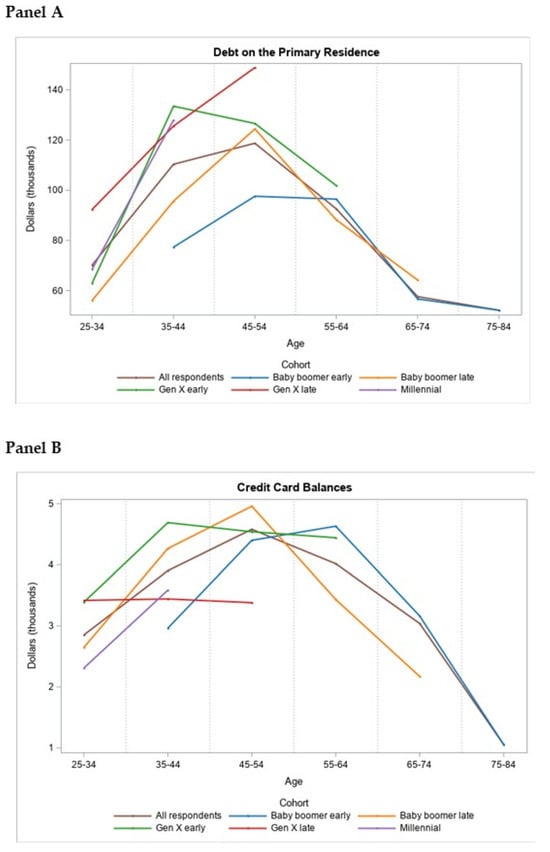
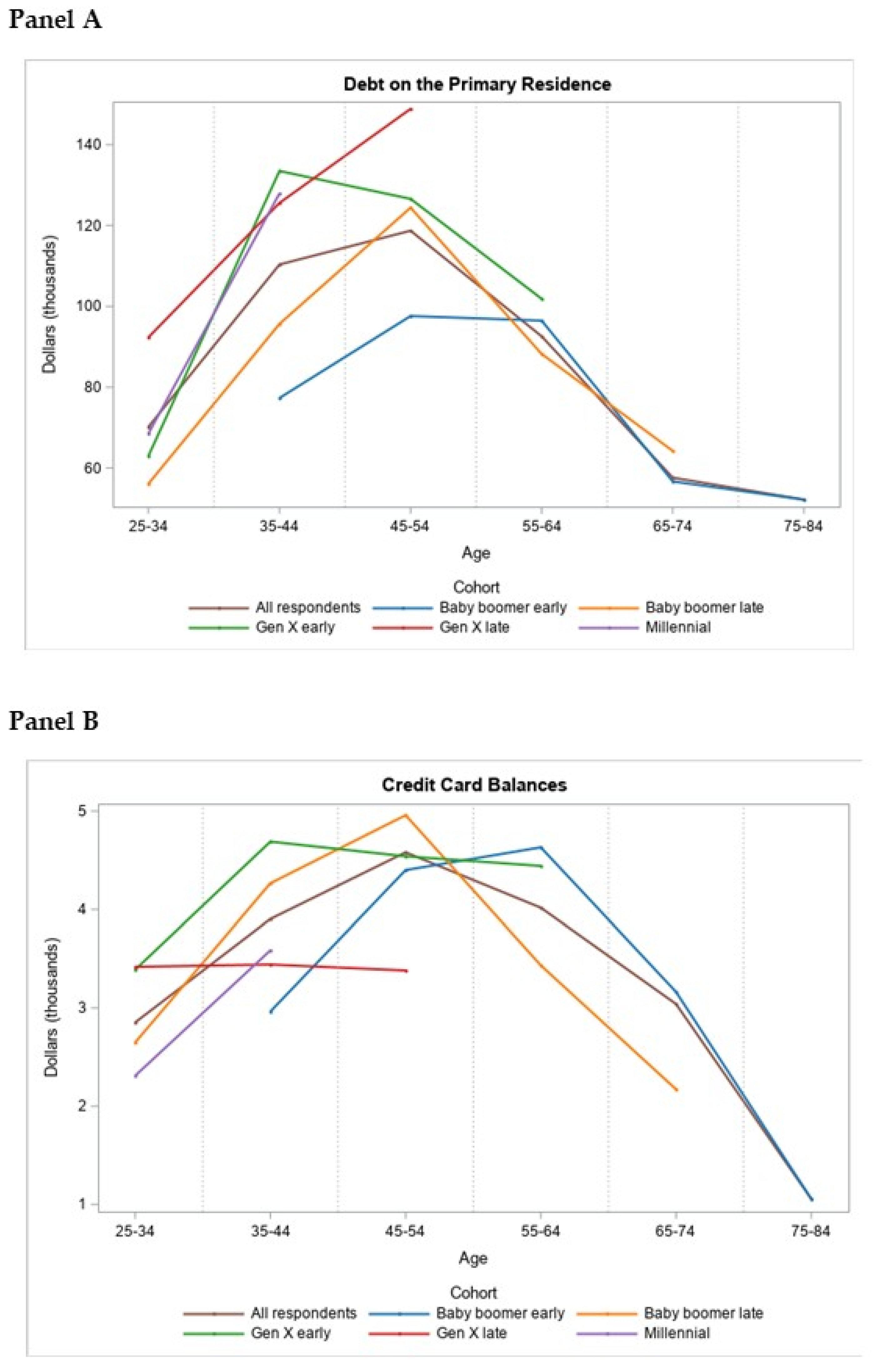
- Hypothesis 2B—time trends in all figures, especially Figure 3; HAPC regression models for debt on the primary residence and credit card balances;
- Hypothesis 2C—time trends in all figures, especially Figure 5; all HAPC regression models;
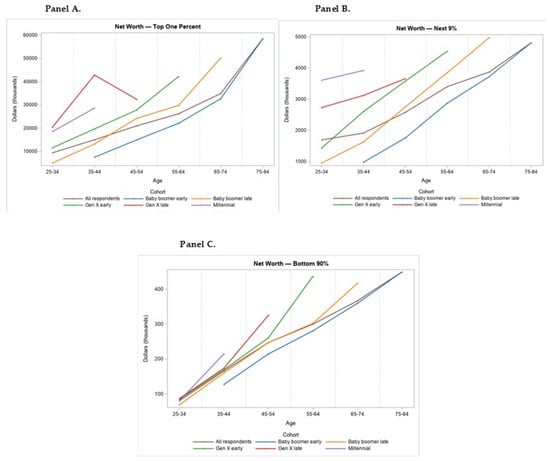
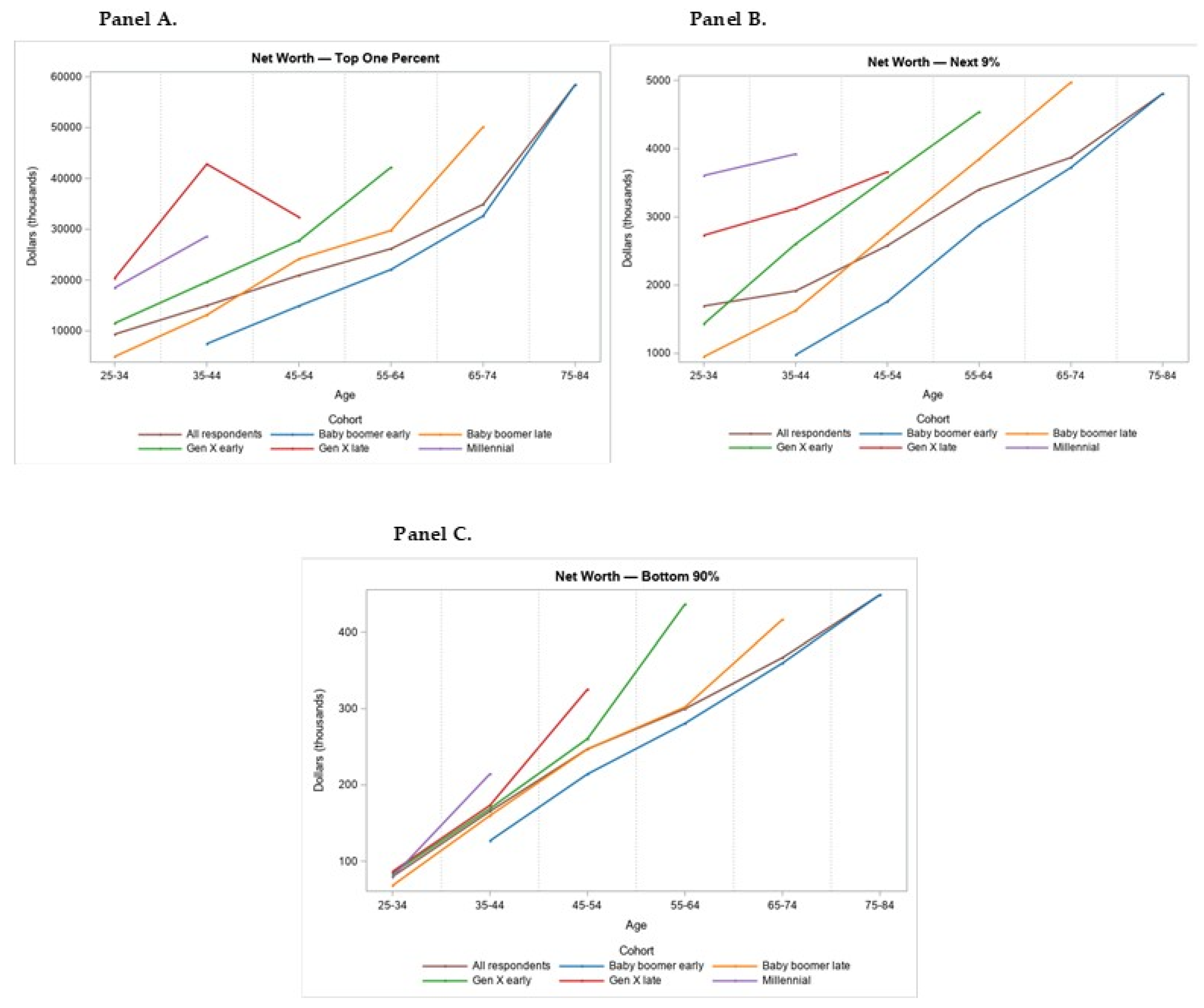
- Hypothesis 3A—Figure 4; all HAPC regression models;
- Hypothesis 3B—Figure 4; all HAPC regression models.
4. Results
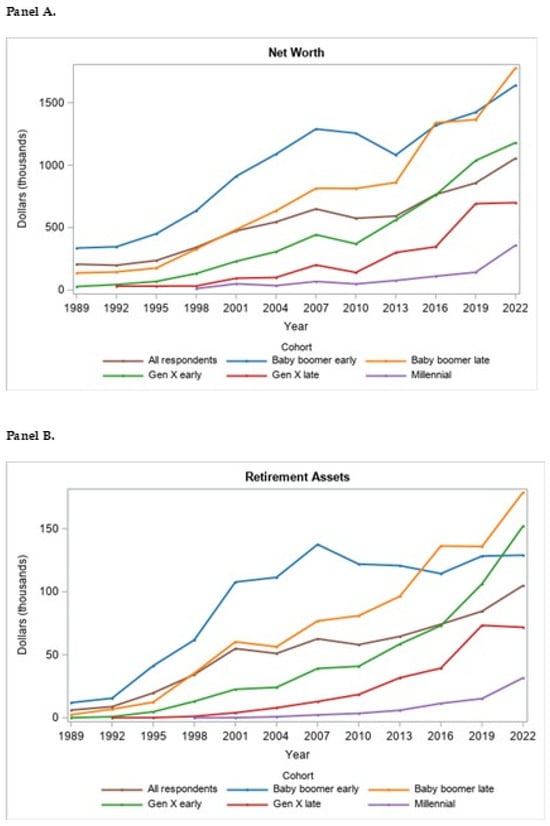
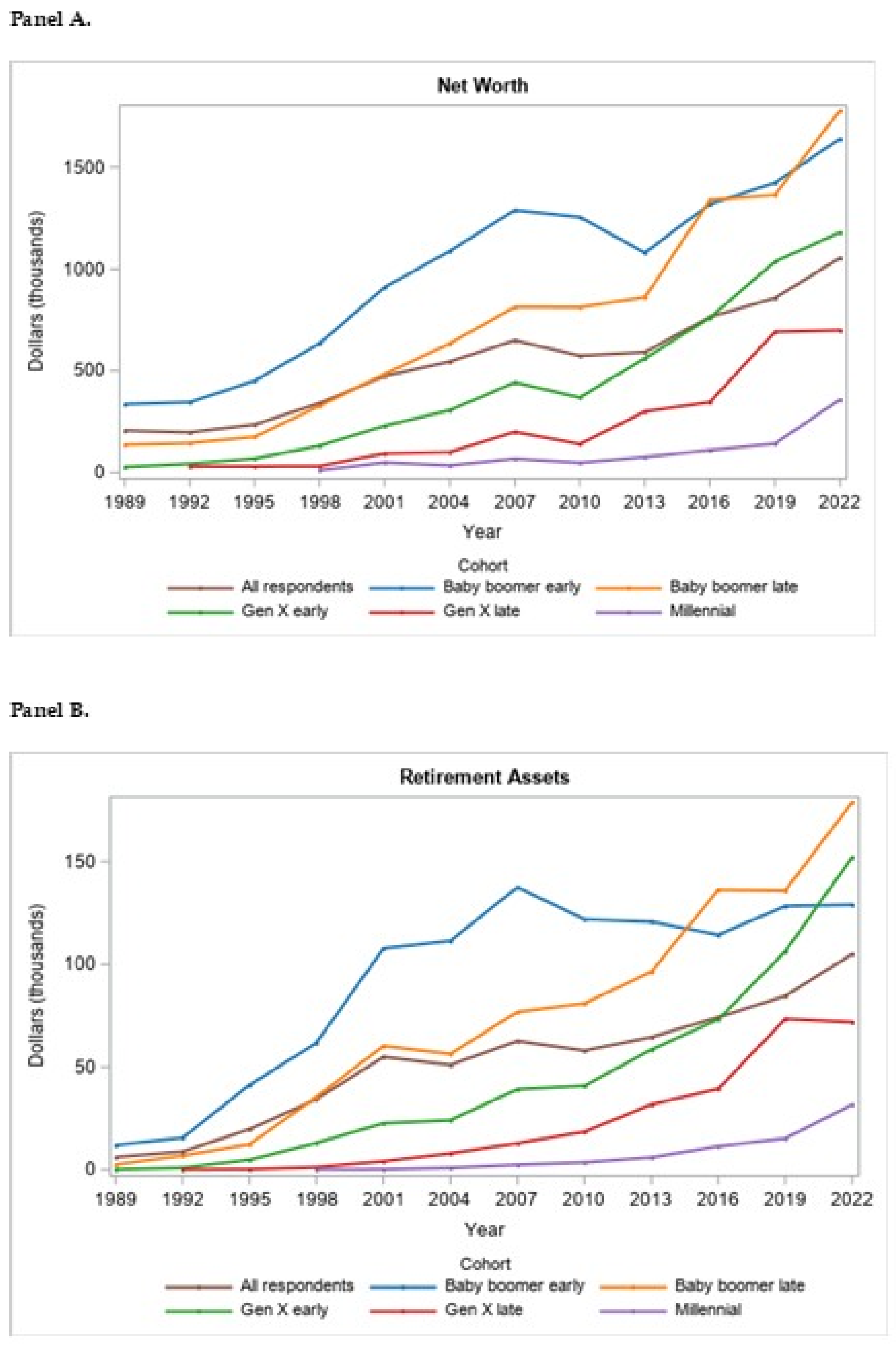
The results provide strong support for the hypotheses. Figure 1 presents descriptive trends in net worth and retirement assets by birth cohort, summarizing mean levels of accumulated wealth for Baby Boomers, Generation X, and Millennials. This Figure captures broad cohort differences in overall resources and in assets most directly tied to retirement preparation. Consistent with Hypothesis 1, the descriptive patterns show a clear cohort ordering in retirement wealth that reflects the interaction of cumulative advantage and institutional timing. Early and late Baby Boomers have the highest levels of net worth, reflecting their access to defined-benefit pensions, earlier entry into homeownership, and long periods of asset appreciation. Generation X follows closely behind, with early Gen X matching or exceeding early Boomers in retirement assets despite lower overall net worth, a pattern consistent with Gen X’s greater reliance on defined-contribution plans and exposure to post-2010 housing and equity market gains. Millennials trail all older cohorts across both measures, reflecting their younger age profile and more limited exposure to sustained asset accumulation. Together, these descriptive results provide preliminary support for Hypothesis 1A, indicating that cohort differences in retirement wealth align closely with the institutional and market conditions under which each generation accumulated assets.
Figure 1.
(A,B) Changing Net Worth and Retirement Assets.
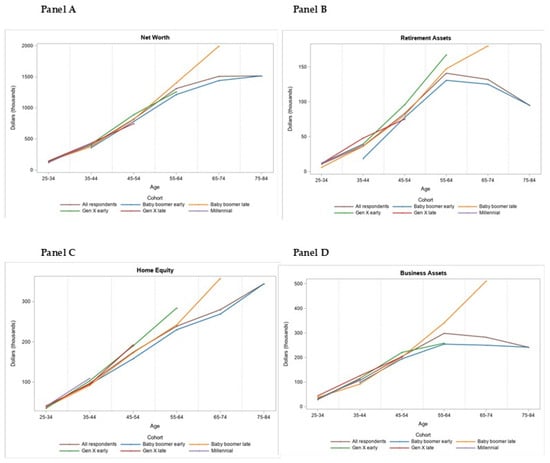
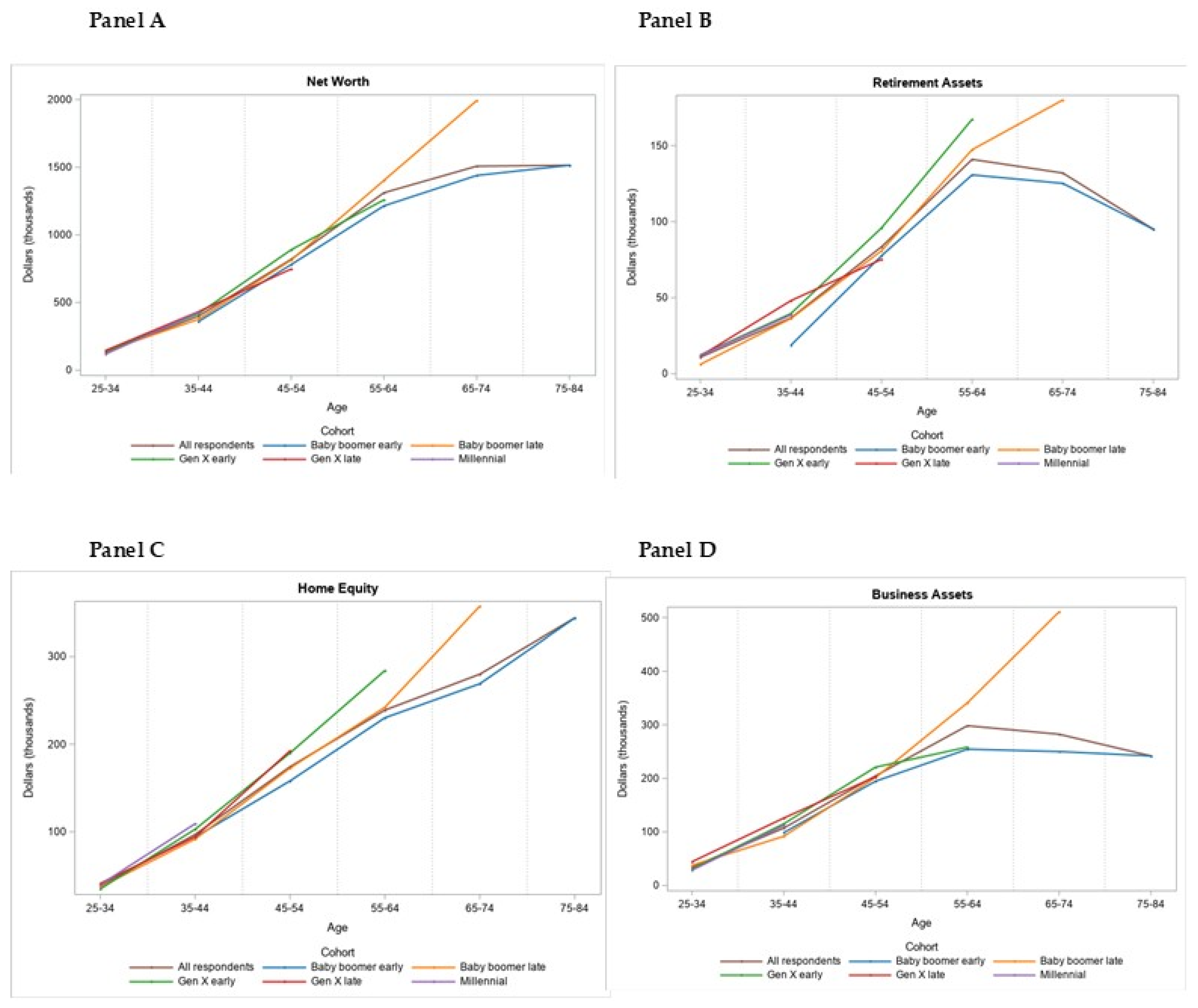
However, these cohort differences change once cohorts are compared at the same points in the life course. Whereas Figure 1 presents overall cohort differences in net worth and retirement assets, Figure 2 and Figure 3 illustrate cohort differences by age and also disaggregate net worth into specific asset and debt components. When age is held constant, the ordering of retirement wealth reflects less the simple fact of who is older in the dataset and more the institutional and market regimes that shaped cohorts’ accumulation trajectories through midlife (Hypothesis 1B). In these age-adjusted comparisons, Late Boomers surpass Early Boomers in both net worth and retirement assets, consistent with their exposure to the 1990s equity boom and prolonged housing appreciation during peak saving years. Early Generation X—and, in more recent survey waves, Late Generation X—closely match or exceed Boomers at comparable ages, particularly in retirement assets and home equity. These patterns reflect Gen X’s greater reliance on defined-contribution plans, broader participation in financial markets, and exposure to strong post-2010 asset appreciation during midlife. Millennials remain substantially behind all older cohorts at comparable ages, underscoring their more limited opportunity for sustained accumulation. Together, these age-adjusted results provide clear support for Hypothesis 1B, demonstrating that cohort rankings in retirement wealth shift once differences in age composition are accounted for.
Figure 2.
(A–D) Cohort Trends in Asset Ownership.
Figure 3.
(A,B) Cohort Trends in Debt.
Notably, cohort patterns vary across asset classes, with the largest differences emerging in the components of wealth most directly shaped by institutional change. As shown in Figure 2 panels A–D, cohort disparities are especially pronounced for retirement assets and home equity, consistent with Hypothesis 2A. At comparable ages, Generation X—particularly Late Gen X—holds higher levels of retirement assets than Baby Boomers, reflecting their greater reliance on defined-contribution plans and sustained exposure to post-2010 equity market growth. A similar pattern appears for home equity: Gen X households accumulated housing wealth during periods of rising prices and declining interest rates, positioning them to benefit from appreciation during midlife. By contrast, Millennials exhibit substantially lower levels of both retirement assets and home equity at comparable ages, consistent with delayed labor market entry, constrained access to employer-sponsored retirement plans, and later exposure to housing markets. Together, these age-adjusted patterns indicate that cohort differences in retirement wealth are driven less by uniform gaps across all asset types and more by sharp contrasts in retirement accounts and housing wealth, providing strong descriptive support for Hypothesis 2A.
Debt patterns further underscore how institutional context shaped cohort-specific balance sheets. As shown in Figure 3 panels A and B, Generation X—especially Late Gen X—carries higher levels of mortgage debt at comparable ages than Baby Boomers, consistent with the central role of housing as a vehicle for saving and wealth accumulation under the post-1980s credit regime. Gen X households entered housing markets under conditions of expanding mortgage credit, declining interest rates, and widespread refinancing, allowing them to sustain higher loan-to-value ratios through midlife. At the same time, Gen X exhibits lower revolving credit-card balances than Boomers at comparable ages, reflecting tighter post-crisis lending standards and shifting consumer credit norms that discouraged persistent high-cost borrowing. Millennials display a similar high-mortgage, low-revolving debt profile, though at lower overall levels of homeownership and debt exposure. Together, these age-specific debt trajectories provide strong support for Hypothesis 2B, indicating that cohort differences in debt are structured by institutional change and are most evident in the contrast between long-term mortgage leverage and short-term revolving credit.
The multivariate age–period–cohort models underscore the importance of income and race in shaping observed cohort differences in retirement wealth. As expected, adding current household income to the HAPC models substantially reduces period-level variation in retirement wealth and improves overall model fit, indicating that part of the apparent effect of macroeconomic conditions operates through contemporaneous income and returns. However, cohort differences remain statistically and substantively meaningful even after income is held constant. Net of age, period, income, and demographic controls, Generation X—particularly Early and Late Gen X—continues to differ from Baby Boomers in levels and composition of retirement wealth. These results support Hypothesis 2C and suggest that income alone cannot account for cohort differences in retirement preparedness. Instead, the persistence of cohort effects net of income indicates that long-term exposure to distinct institutional arrangements—such as the shift to defined-contribution pensions and marketized borrowing—left durable imprints on wealth. In addition, the models show that within each cohort (especially Gen X), Black and Latino households hold significantly less retirement wealth than White households even after education, family structure, and income controls—indicating durable racialized barriers in accumulation pathways under the restructured system. Appendix A Table A1 and Table A2 include HAPC model details.
In addition, Gen X is advantaged relative to Boomers and Millennials within each wealth class, suggesting that cohort differences in retirement wealth are not merely compositional artifacts of who is older in the pooled sample but are produced through the interaction of cohort timing with class-structured accumulation processes (Hypothesis 3A). Figure 4 illustrates this pattern by presenting age-specific trajectories in total net worth separately for the top one percent, the next nine percent, and the bottom ninety percent, which makes it possible to compare cohorts among households that occupy similar positions in the wealth hierarchy. Across tiers, Gen X—including Early Gen X—generally matches or exceeds the levels observed for Boomers at comparable ages, while Millennials remain lowest, consistent with their earlier position in the accumulation process. This within-tier advantage aligns with the theoretical expectation that class structures both the capacity and the strategy of accumulation and that cohorts are differentially positioned to exploit (or be constrained by) shifting institutional arrangements. For Gen X, midlife exposure to defined-contribution retirement systems, market expansion, and post-2010 asset appreciation appears to have translated into higher wealth levels within rank strata, even as aggregate cohort comparisons can obscure these differences. Although Figure 4 focuses on net worth, parallel age-by-class patterns appear for retirement assets, home equity, and business assets, indicating that the cohort-by-class interaction operates through multiple balance-sheet channels rather than a single component.
Figure 4.
(A–C) Cohort and Class Differences in Wealth.
The results also indicate that cohort differences are most pronounced at the top of the wealth distribution, consistent with Hypothesis 3B, where institutional timing and class position interact most powerfully (Figure 4 panels A–C). Among households in the top one percent, Generation X—particularly Early and Late Gen X—exhibits markedly higher levels of net worth at comparable ages than Baby Boomers, consistent with their concentration in survey waves following the post-2010 asset boom. This pattern reflects not only higher asset valuations but also the fact that Gen X elites were still in active accumulation phases during a period of exceptionally strong returns in equities, housing, and private business assets. By contrast, Boomers at similar ranks appear increasingly oriented toward asset preservation rather than expansion, having realized much of their appreciation earlier in the life course. The resulting divergence suggests that cohort timing amplified class advantage at the top, allowing Gen X’s upper tail to convert favorable market conditions into disproportionate gains.
The patterns in Figure 4 highlight an important compositional dynamic that helps reconcile what might otherwise appear contradictory across descriptive results. In the aggregate, Late Generation X appears less wealthy than older cohorts, a pattern driven in part by their younger average age in the pooled SCF sample and by their greater representation in the lower tiers of the wealth distribution relative to Boomers. Because overall cohort means combine households at different ages and at different points in the wealth hierarchy, they reflect not only accumulation processes but also the distribution of cohort members across ranks and stages of the life course. Once wealth is disaggregated by class position, however, a different picture emerges. Within each stratum—the top one percent, the next nine percent, and the bottom ninety percent—Late Gen X often exhibits higher mean wealth than adjacent cohorts. This within-rank advantage reflects two reinforcing forces. First, observations for Late Gen X within these strata are disproportionately drawn from more recent survey waves, when asset prices, housing values, and financial portfolios were substantially higher, inflating wealth levels at any given rank. Second, even within wealth strata, cohorts differ in their age composition: Late Gen X households observed in upper ranks are often concentrated at prime earning and asset-growth ages, whereas earlier cohorts appear at younger or later points in the life course in earlier periods. Together, these compositional and timing effects generate a classic decomposition pattern in which Late Gen X can appear disadvantaged in overall averages while simultaneously outperforming older cohorts within comparable wealth positions. Far from being inconsistent, these results underscore the importance of disentangling cohort, age, and class processes when assessing inequality in retirement wealth.
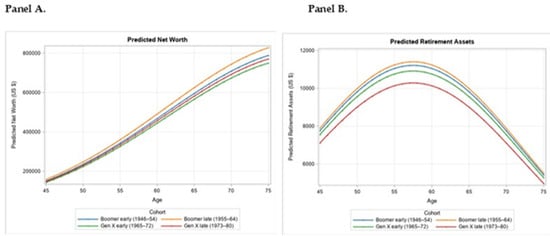
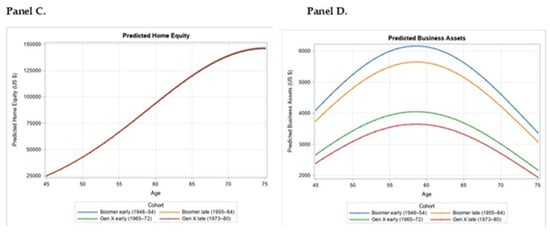
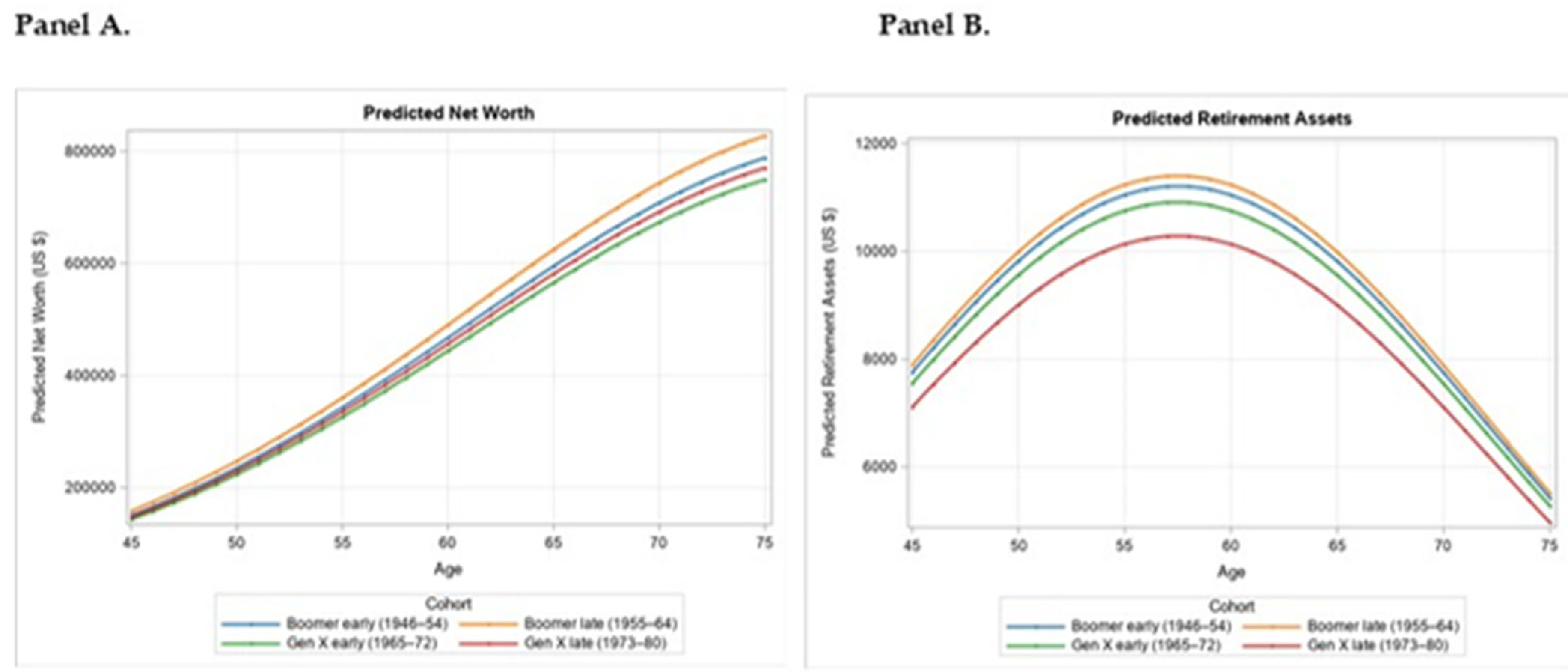
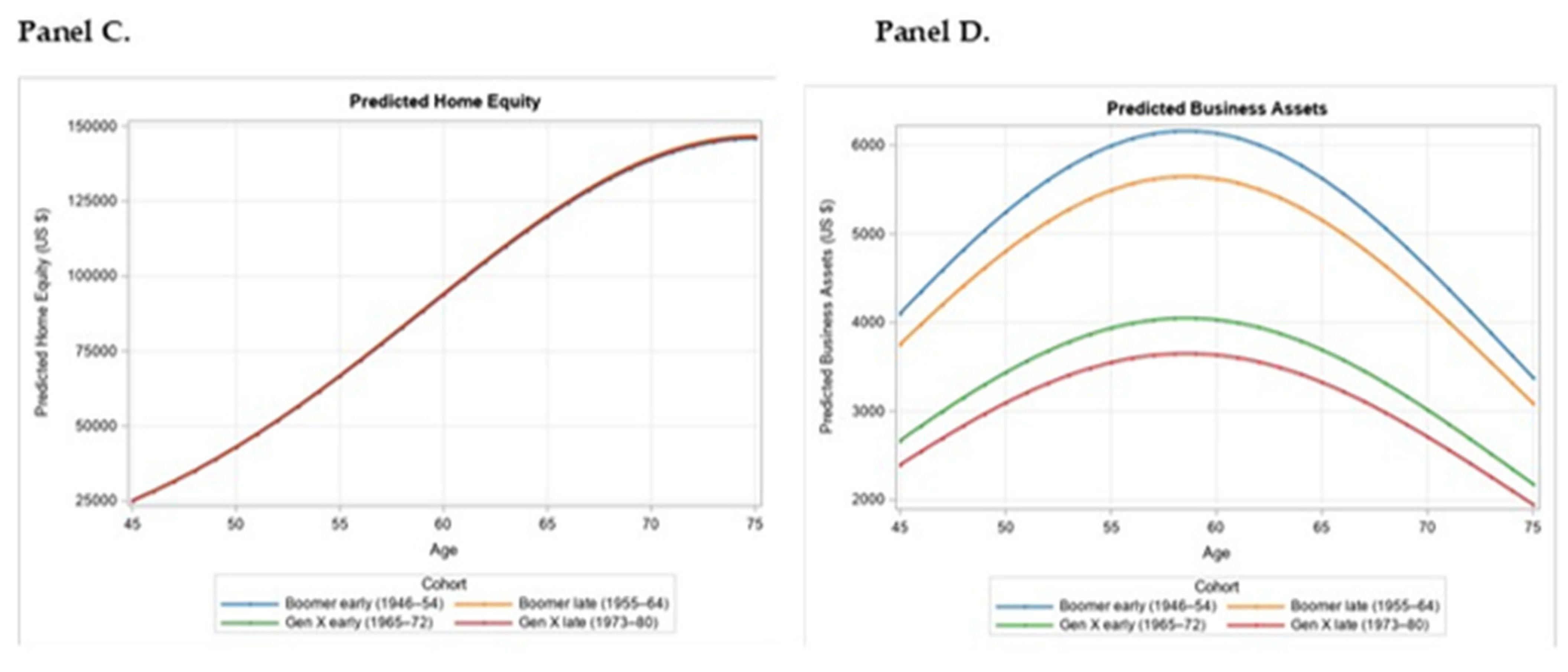
To assess whether these patterns reflect compositional differences or more durable cohort effects, Figure 5 panels A–D presents predicted values of net worth and key asset components derived from the hierarchical age–period–cohort models. These predictions hold constant age, income, race, education, marital status, and family structure, allowing cohort differences to be evaluated net of contemporaneous resources and demographic composition. The predicted trajectories closely mirror the descriptive patterns shown in Figure 1, Figure 2, Figure 3 and Figure 4. Generation X—particularly Early and Late Gen X—continues to match or exceed Baby Boomers at comparable ages in net worth and in assets most closely tied to retirement security, while Millennials remain substantially lower. The persistence of these differences in predicted values indicates that the observed cohort patterns are not artifacts of age composition or income inequality, but instead reflect enduring cohort-specific accumulation processes. In other words, even when households are made observationally similar on key socioeconomic dimensions, cohort timing continues to shape retirement wealth, consistent with the argument that institutional context leaves lasting imprints on how resources are converted into assets over the life course.
Figure 5.
(A–D) Predicted Net Worth and Assets Controlling for Demographics. Notes: Data are from the 1989–2022 Survey of Consumer Finances. Values are predicted from Hierarchical Age -Period-Cohort (HAPC) regression models using multilevel mixed effects including age as a fixed effect (centered at 60 with a quadratic term), survey period and birth cohort as cross-classified random intercepts. Model control for education, marital status, race, number of children, and total household income. Model details shown in the appendix.
5. Discussion and Conclusions
Retirement wealth is a central mechanism through which inequality becomes consequential in later life. It shapes not only the timing of retirement but also the degree of autonomy older adults have in meeting routine needs, managing health risks, maintaining housing stability, and sustaining social participation (Butrica et al. 2010; Conley and Thompson 2013; Levy 2015; Smith 2007). In a context where employment-based protections have weakened and public systems are routinely framed as insufficient, private assets function as the de facto infrastructure of old-age security more than they did in previous generations (Atchley and Robinson 1982). This makes retirement wealth especially useful analytically: it is a stock of accumulated resources that condenses decades of labor-market returns, family transitions, institutional access, and market exposure into a single indicator of late-life advantage and vulnerability. Generation X is a particularly revealing cohort through which to study these processes. Now entering the retirement window, Gen X was socialized in an era when individualized retirement saving and expanded consumer credit, with housing and financial markets positioned as key vehicles for household security. Yet Gen X has attracted little attention in aging research, in part because scholarly attention has gravitated toward Boomers’ retirement transitions and Millennials’ precarity. This study focused on Gen X to study how cohort timing, institutional context, and class position combine to structure retirement wealth and its distribution.
In particular, I studied cohort differences as historically situated life-course processes rather than as simple generational rankings. Using SCF data spanning 1989–2022, I documented cohort patterns in net worth and key components of retirement wealth and then re-estimated these patterns at comparable ages. I then extended the descriptive evidence with hierarchical age–period–cohort models that partition life-cycle dynamics from macro-temporal shocks while also testing whether cohort differences persist net of contemporaneous income and other compositional characteristics. Finally, I focused on class issues by disaggregating patterns within wealth ranks—top one percent, next nine percent, and bottom ninety percent—because institutional change does not affect all households uniformly; it is filtered through unequal access to wealth-generating assets, differential exposure to risk, and class-specific strategies of accumulation and preservation. Taken together, this approach allows the analysis to identify not only whether cohorts differ, but how and why those differences emerge across asset types and across positions in the wealth hierarchy.
The findings reveal a coherent set of patterns that speak directly to the life-course and stratification literatures. First, cohort differences in retirement wealth are strongly shaped by institutional timing: when cohorts are compared at similar ages, Gen X often matches or exceeds Boomers in the components of wealth most directly linked to the restructured system—retirement accounts and housing wealth—consistent with Gen X’s greater reliance on defined contribution plans and their midlife exposure to post-2010 asset appreciation. Second, debt profiles underscore that retirement wealth is produced through balance-sheet configurations, not simply through saving. Gen X’s higher mortgage debt at comparable ages reflects the institutional repositioning of housing as a primary wealth-building vehicle and the normalization of leverage under expanded mortgage markets, while their lower revolving credit balances align with post-crisis shifts in credit standards and repayment norms. Third, the multivariate results show that contemporaneous income accounts for an important share of period-level variation but does not erase cohort differences, suggesting that cohorts carry durable institutional imprints that structure how resources are converted into assets, how shocks are absorbed, and how recovery unfolds. Fourth—and crucially for aging research—these patterns are stratified sharply by class position. Cohort differences are not merely compositional; they operate within wealth ranks, and they are most pronounced at the top of the distribution, where Gen X’s upper tail appears especially well positioned to translate favorable market timing into outsized gains. At the same time, these cohort and class dynamics unfold alongside persistent racial stratification: Black and Latino households hold markedly less retirement wealth net of income and education, indicating that the restructured retirement system continues to reproduce racialized barriers to accumulation even when households appear similar on key socioeconomic indicators. In combination, these results underscore a broader point: cohort timing matters, but it matters most when it interacts with class-structured access to markets, risk, and returns.
Several limitations should be acknowledged, both substantively and methodologically. The SCF provides exceptional measurement of wealth—especially at the top of the distribution—but its repeated cross-sectional design limits the ability to observe within-household trajectories and the sequencing of life events that often shape retirement readiness. The HAPC framework helps separate age, period, and cohort components in a way that is well suited to repeated cross-sections, but it cannot fully recover the micro-dynamics of accumulation or the heterogeneity of pathways within cohorts. In addition, while this study focuses on assets and debts central to retirement preparedness, it cannot directly incorporate non-market resources that matter greatly in later life—health shocks, caregiving obligations, neighborhood context, and differential access to public benefits—which may amplify or moderate the financial patterns observed here. Finally, Millennials are necessarily treated as a comparison cohort rather than a cohort approaching retirement; their patterns should be interpreted as early-life-course balance-sheet profiles that may evolve as they age into peak saving years.
Even with these limitations, the results have implications that extend beyond cohort description. They show that retirement wealth is best understood as the cumulative outcome of historically specific institutional arrangements operating through class-structured mechanisms of accumulation. Generation X illustrates how the shift toward individualized responsibility does not simply increase dispersion; it reorganizes the routes through which households build security, elevating the importance of market participation, housing leverage, and portfolio exposure while leaving those without stable access to these channels increasingly vulnerable. The cohort’s within-rank advantages—paired with pronounced divergence at the top and persistent racial gaps—suggest that the contemporary retirement regime is simultaneously producing new forms of advantage and reinforcing older lines of stratification. This is particularly consequential because it highlights retirement wealth as a core axis through which population aging becomes stratified: the experience of aging is not only a function of demographic change, but of the institutional pathways that sort cohorts into very unequal late-life economic futures. As Gen X moves further into retirement, their trajectories provide an early view of what later-life inequality looks like when security is tied more tightly to markets, when risk is individualized, and when class position determines not just how much wealth households hold, but also how effectively they can convert historical timing into a durable advantage.
Funding
This research received no external funding.
Institutional Review Board Statement
Not applicable.
Informed Consent Statement
Not applicable.
Data Availability Statement
No new data were created or analyzed in this study.
Conflicts of Interest
The author declares no conflict of interest.
References
- Aladangady, Aditya, Jesse Bricker, Andrew C. Chang, Sarena Goodman, Jacob Krimmel, Kevin B. Moore, Sarah Reber, Alice Henriques Volz, and Richard A. Windle. 2023. Changes in U.S. Family Finances from 2019 to 2022: Evidence from the Survey of Consumer Finances; Washington, DC: Board of Governors of the Federal Reserve System.
- Artis, Julie E., and Eliza K. Pavalko. 2003. Explaining the Decline in Women’s Household Labor: Individual Change and Cohort Differences. Journal of Marriage and Family 65: 746–61. [Google Scholar] [CrossRef] [Scilit]
- Atchley, Robert C., and Judith L. Robinson. 1982. Attitudes toward Retirement and Distance from the Event. Research on Aging 4: 299–313. [Google Scholar] [CrossRef] [Scilit]
- Berger, Mark C. 1985. The Effect of Cohort Size on Earnings Growth: A Reexamination of the Evidence. Journal of Political Economy 93: 561–73. [Google Scholar] [CrossRef] [Scilit]
- Bhutta, Neil, Jesse Bricker, Andrew C. Chang, Lisa J. Dettling, Sarena Goodman, Joanne W. Hsu, Kevin B. Moore, Sarah Reber, Alice Henriques Volz, Richard A. Windle, and et al. 2020. Changes in U.S. Family Finances from 2016 to 2019: Evidence from the Survey of Consumer Finances. In Federal Reserve Bulletin; Washington, DC: Board of Governors of the Federal Reserve System. [Google Scholar]
- Bialik, Kristen, and Richard Fry. 2019. Milenniel Life: How Young Adults Today Compare with Prior Generations. Available online: https://www.pewresearch.org/social-trends/2019/02/14/millennial-life-how-young-adulthood-today-compares-with-prior-generations-2/ (accessed on 6 March 2025).
- Butrica, Barbara A., Daniel P. Murphy, and Sheila R. Zedlewski. 2010. How Many Struggle to Get by in Retirement? The Gerontologist 50: 482–94. [Google Scholar] [CrossRef] [Scilit]
- Conley, Dalton, and Jason Thompson. 2013. The Effects of Health and Wealth Shocks on Retirement Decisions. Federal Reserve Bank of St. Louis Review 95: 389–404. [Google Scholar] [CrossRef] [Scilit]
- Connelly, Rachel. 1986. A Framework for Analyzing the Impact of Cohort Size on Education and Labor Earnings. Journal of Human Resources 21: 543–62. [Google Scholar] [CrossRef] [Scilit]
- Cornwell, Benjamin, Edward O. Laumann, and Philip Schumm. 2008. The Social Connectedness of Older Adults: A National Profile. American Sociological Review 73: 185–203. [Google Scholar] [CrossRef] [Scilit] [PubMed]
- Crosnoe, Robert, and Glen H. Elder, Jr. 2002. Successful Adaptation in the Later Years: A Life Course Approach to Aging. Social Psychology Quarterly 65: 309–28. [Google Scholar] [CrossRef] [Scilit]
- Devlin-Foltz, Sebastian, Alice M. Henriques, and John Sabelhaus. 2015. The Evolution of Retirement Wealth; Finance and Economics Discussion Series 2015-009; Washington, DC: Board of Governors of the Federal Reserve System.
- Devlin-Foltz, Sebastian, Alice M. Henriques, and John Sabelhaus. 2016. Is the U.S. Retirement System Contributing to Rising Wealth Inequality? RSF: The Russell Sage Foundation Journal of the Social Sciences 2: 59–85. [Google Scholar] [CrossRef] [Scilit]
- Eagle, David, Lisa A. Keister, and Jen’nan Ghazal Read. 2017. Household Charitable Giving at the Intersection of Gender, Marital Status, and Religion. Nonprofit and Voluntary Sector Quarterly 47: 185–205. [Google Scholar] [CrossRef] [Scilit]
- Easterlin, Richard A., Christine M. Schaeffer, and Diane J. Macunovich. 1993. Will the Baby Boomers Be Less Well Off Than Their Parents? Income, Wealth, and Family Circumstances over the Life Cycle in the United States. Population and Development Review 19: 497–522. [Google Scholar] [CrossRef] [Scilit]
- Forest, Kay B., Phyllis Moen, and Donna Dempster-McClain. 1995. Cohort Differences in the Transition to Motherhood: The Variable Effects of Education and Employment before Marriage. Sociological Quarterly 36: 315–36. [Google Scholar] [CrossRef] [Scilit]
- French, Eric. 2005. The Effects of Health, Wealth, and Wages on Labour Supply and Retirement Behaviour. Review of Economic Studies 72: 395–427. [Google Scholar] [CrossRef] [Scilit]
- Gimmon, Eli, Ronit Yitshaki, and Shira Hantman. 2018. Entrepreneurship in the Third Age: Retirees’ Motivation and Intentions. International Journal of Entrepreneurship and Small Business 34: 267–88. [Google Scholar] [CrossRef] [Scilit]
- Hanna, Sherman D., Kyoung Tae Kim, and Samuel Cheng-Chung Chen. 2016. Retirement Savings. In Handbook of Consumer Finance Research. Edited by Jingjian Xiao. New York: Springer. [Google Scholar]
- Hansen, Marianne Nordli, and Øyvind Nicolay Wiborg. 2019. The Accumulation and Transfers of Wealth: Variations by Social Class. European Sociological Review 35: 874–93. [Google Scholar] [CrossRef] [Scilit]
- Kaplan, Elaine Bell. 2020. The Millennial/Gen Z Leftists Are Emerging: Are Sociologists Ready for Them? Sociological Perspectives 63: 408–27. [Google Scholar] [CrossRef] [Scilit]
- Keister, Lisa A. 2014. The One Percent. The Annual Review of Sociology 40: 347–67. [Google Scholar] [CrossRef] [Scilit]
- Keister, Lisa A., and Hang Young Lee. 2024. Global Financial Shocks and American Elites: Income and Wealth of the One Percent in the United States, 1989–2022. American Behavioral Scientist 45: 233–51. [Google Scholar] [CrossRef] [Scilit]
- Keister, Lisa A., and Natalia Deeb-Sossa. 2000. Are Baby Boomers Richer Than Their Parents? Intergenerational Patterns of Wealth Ownership in the U.S. Journal of Marriage and the Family 62: 569–79. [Google Scholar]
- Keister, Lisa A., Richard A. Benton, and James W. Moody. 2019. Cohorts and Wealth Transfers: Generational Changes in the Receipt of Inheritances, Trusts, and Inter Vivos Gifts in the United States. Research in Social Stratification and Mobility 59: 1–13. [Google Scholar] [CrossRef] [Scilit]
- Killewald, Alexandra, Fabian T. Pfeffer, and Jared N. Schachner. 2017. Wealth Inequality and Accumulation. Annual Review of Sociology 43: 379–404. [Google Scholar] [CrossRef] [Scilit]
- Korom, Philipp, Mark Lutter, and Jens Beckert. 2017. The Enduring Importance of Family Wealth: Evidence from the Forbes 400, 1982 to 2013. Social Science Research 65: 75–95. [Google Scholar] [CrossRef] [Scilit]
- Krippner, Greta R. 2005. The Financialization of the American Economy. Socio-Economic Review 3: 173–208. [Google Scholar] [CrossRef] [Scilit]
- Krippner, Greta R. 2012. Capitalizing on Crisis: The Political Origins of the Rise of Finance. Cambridge, MA: Harvard University Press. [Google Scholar]
- Kwon, Illoong, Eva Meyersson Milgrom, and Seiwoon Hwang. 2010. Cohort Effects in Promotions and Wages: Evidence from Sweden and the United States. Journal of Human Resources 45: 772–808. [Google Scholar] [CrossRef] [Scilit]
- Levy, Helen. 2015. Income, Poverty, and Material Hardship among Older Americans. RSF: The Russell Sage Foundation Journal of the Social Sciences 1: 55–77. [Google Scholar] [CrossRef] [Scilit]
- Lin, Ken-Hou, and Donald Tomaskovic-Devey. 2013. Financialization and U.S. Income Inequality, 1970–2008. American Journal of Sociology 118: 1284–329. [Google Scholar] [CrossRef] [Scilit]
- Lin, Ken-Hou, and Megan Tobias Neely. 2020. Divested: Inequality in Financialized America. New York: Oxford University Press. [Google Scholar]
- Love, David A., Michael G. Palumbo, and Paul A. Smith. 2008. The Trajectory of Wealth in Retirement. Federal Reserve Board Finance and Economics Discussion Series (FEDS). Available online: https://www.federalreserve.gov/econres/feds/the-trajectory-of-wealth-in-retirement.htm (accessed on 1 January 2025).
- Pfeffer, Fabian T., and Alexandra Killewald. 2018. Generations of Advantage: Multigenerational Correlations in Family Wealth. Social Forces 96: 1411–42. [Google Scholar] [CrossRef] [Scilit] [PubMed]
- Pfeffer, Fabian T., Sheldon Danziger, and Robert F. Schoeni. 2013. Wealth Disparities before and after the Great Recession. Annals of the American Academy of Political and Social Science 650: 98–123. [Google Scholar] [CrossRef] [Scilit] [PubMed]
- Poterba, James, Steven Venti, and David Wise. 2011. The Composition and Drawdown of Wealth in Retirement. Journal of Economic Perspectives 25: 95–118. [Google Scholar] [CrossRef] [Scilit]
- Rodriguez, James. 2023. Sorry Millennials, You’re Never Getting a Good Home. Business Insider. Available online: https://www.businessinsider.com/millennials-house-home-real-estate-mortgage-rates-rent-debt-boomers-2022-9 (accessed on 4 March 2026).
- Rowe, John W., and Robert L. Kahn. 1998. Successful Aging. New York: Pantheon. [Google Scholar]
- Schmidt, Steven. 2024. Finding a Home During the Affordable Housing Crisis: How Social Ties Shape Renters’ Housing-Search Outcomes. American Socioligical Review 90: 142–69. [Google Scholar] [CrossRef] [Scilit]
- Schoeni, Robert F., and Mary Beth Ofstedal. 2010. Key Themes in Research on the Demography of Aging. Demography 47: S5–S15. [Google Scholar] [CrossRef] [Scilit] [PubMed]
- Shuey, Kim M., and Angela M. O’Rand. 2004. New Risks for Workers: Pensions, Labor Markets, and Gender. Annual Review of Sociology 30: 453–77. [Google Scholar] [CrossRef] [Scilit]
- Smith, James P. 2007. The Impact of Socioeconomic Status on Health over the Life-Course. Journal of Human Resources 42: 739–64. [Google Scholar] [CrossRef] [Scilit]
- Stockard, Jean, Jo Anna Gray, Robert O’Brien, and Joe Stone. 2009. Race Differences in Cohort Effects on Non-Marital Fertility in the United States. Social Forces 87: 1449–79. [Google Scholar] [CrossRef] [Scilit]
- Szinovacz, Maximiliane E., Adam Davey, and Lauren Martin. 2015. Did the Great Recession Influence Retirement Plans? Research on Aging 37: 275–305. [Google Scholar] [CrossRef] [Scilit]
- Tang, Fenguan. 2015. Retirement Patterns and Their Relationship to Volunteering. Nonprofit and Voluntary Sector Quarterly 45: 910–30. [Google Scholar]
- Tomasckovic-Devey, Donald, and Ken-Hou Lin. 2013. Income Dynamics, Economic Rents, and the Financialization of the U.S. Economy. American Sociological Review 76: 538–59. [Google Scholar] [CrossRef] [Scilit]
- Valentine, Villa M., Steven P. Wallace, Sofya Bagdasaryan, and Maria P. Aranda. 2012. Hispanic Baby Boomers: Health Inequities Likely to Persist in Old Age. The Gerontologist 52: 166–76. [Google Scholar] [CrossRef] [Scilit]
- Vanderhart, Peter G. 1993. A Binomial Probit Analysis of the Home Equity Decisions of Elderly Homeowners. Research on Aging 15: 299–323. [Google Scholar] [CrossRef] [Scilit]
- Wolff, Edward N. 2016. Household Wealth Trends in the United States, 1962 to 2013: What Happened over the Great Recession. RSF: The Russell Sage Foundation Journal of the Social Sciences 2: 24–43. [Google Scholar] [CrossRef] [Scilit]
- Wolff, Edward N., and Maury Gittleman. 2014. Inheritances and the Distribution of Wealth or Whatever Happened to the Great Inheritance Boom? Journal of Economic Inequality 12: 439–68. [Google Scholar] [CrossRef] [Scilit]
- Yavorsky, Jill E., Lisa A. Keister, Yue Qian, and Sarah Thebaud. 2023. Separate Spheres in the New Gilded Age: The Gender Division of Labor in the Financial Elite. Social Forces 102: 609–32. [Google Scholar] [CrossRef] [Scilit]
- Zagorsky, Jay L. 1999. Young Baby Boomers’ Wealth. Review of Income and Wealth 45: 135–56. [Google Scholar] [CrossRef] [Scilit]

Disclaimer/Publisher’s Note: The statements, opinions and data contained in all publications are solely those of the individual author(s) and contributor(s) and not of MDPI and/or the editor(s). MDPI and/or the editor(s) disclaim responsibility for any injury to people or property resulting from any ideas, methods, instructions or products referred to in the content. |
© 2026 by the author. Licensee MDPI, Basel, Switzerland. This article is an open access article distributed under the terms and conditions of the Creative Commons Attribution (CC BY) license.