


Abstract
This study investigates gender differences in conceptual understanding, confidence, and calibration among 369 Turkish university students completing the Force Concept Inventory (FCI). Using accuracy scores, confidence ratings, and bias indices as complementary measures, we examined how male and female students differed in both their conceptual reasoning and their self-evaluative judgments. The results show that male students achieved significantly higher accuracy scores than female students (M = 56.79 vs. 49.96), though the effect size was small, indicating modest conceptual differences. Confidence differences were more pronounced: male students reported substantially higher confidence (M = 68.17) than female students (M = 54.44), representing a moderate effect. Bias scores further revealed that male students exhibited greater overconfidence (M = 11.38), while female students were more likely to underestimate their performance (M = 4.47). Item-level analyses showed that gender differences were concentrated in well-documented areas of conceptual difficulty, including Newton’s first law and gravitation. These patterns align with international findings and suggest that gender differences in physics arise from a combination of conceptual challenges and metacognitive tendencies rather than large performance disparities. The findings highlight the importance of integrating confidence calibration, reflective metacognitive practices, and targeted conceptual support into introductory physics instruction to reduce gender-based differences in learning outcomes.
1. Introduction
Assessing one’s own knowledge and ability—often termed confidence—is a vital metacognitive skill in science education (Kaltakci-Gurel 2023; Rachmatullah and Ha 2019; Sharma and Bewes 2011; Testa et al. 2020). Generally, higher confidence positively correlates with improved science academic achievement (Sharma and Bewes 2011; Sreenivasulu and Subramaniam 2014; Stankov et al. 2012) and greater motivation towards science (Chen and Zimmerman 2007). However, students frequently misjudge their actual abilities, resulting in either overconfidence or underconfidence.
The concept of calibration, rooted in psychology research since the 1970s, focuses on the alignment between an individual’s confidence ratings and the accuracy of their test responses (Echternacht 1972; Stankov and Crawford 1997). Utilizing confidence ratings can enhance test reliability and discourage random guessing by assigning higher credit to correct, highly confident answers. Good calibration signifies that a student’s confidence matches their correctness, while miscalibration is a mismatch (Baker and Fogarty 2004; Lundeberg et al. 1994). The bias score quantifies this mismatch: a positive score indicates overconfidence (overestimating performance), a negative score indicates underconfidence, and zero represents perfect calibration. Overconfidence, often linked to strongly held misconceptions in content areas like Newtonian mechanics in physics, can negatively impact decision-making, impede effective self-regulation, and lead to lower achievements (Dunlosky and Rawson 2012; Potgieter et al. 2010; Rachmatullah and Ha 2019).
Beyond its use as a self-assessment tool, confidence data is also valuable in test development, helping to identify problematic test items (Caleon and Subramaniam 2010; Hasan et al. 1999; Hull et al. 2022; Kaltakci-Gurel et al. 2017; Leppavirta 2012; Potgieter et al. 2010). While confidence research has been widely used in psychology, its application in science education has been less frequent, although notable studies have utilized it to explore misconceptions, and the relationship between confidence, understanding, and the effects of gender (Lundeberg et al. 1994, 2000; Rachmatullah and Ha 2019; Sharma and Bewes 2011; Stankov and Lee 2014), culture (Lundeberg et al. 2000; Rachmatullah and Ha 2019; Stankov and Lee 2014), and instruction (Lippiello et al. 2025; Testa et al. 2023).
Recent studies show that calibration bias is influenced by factors such as socioeducational context, content, instruction, and gender. Specifically, female students often display underconfidence compared to their male counterparts, even when performance is comparable or superior (Hyde et al. 1990; McMurran et al. 2023; Rainsford and Foster 2025; Testa et al. 2023), similar to findings regarding self-efficacy (Kalender et al. 2020; Marshman et al. 2018). Conversely, female students in developing countries (Bianchini 2017; Rachmatullah and Ha 2019) or single-sex classrooms (Gillibrand et al. 1999; Haussler and Hoffmann 2002) have been observed to be well-calibrated or even overconfident. Therefore, the results for gender comparisons seem to differ according to context, content, or culture, which signifies the importance of further exploration in this regard.
Improving students’ calibration is a desirable educational objective as it offers several benefits: it discourages guessing, reduces over- and underconfidence, promotes self-checking and higher-level reasoning, and fosters the self-awareness necessary for effective learning and targeting weaknesses (Foster 2022; Kaltakci-Gurel 2023; Lippiello et al. 2025). Furthermore, consistent confidence assessment contributes to sustainable assessment by focusing on the long-term improvement of self-assessment skills, particularly in university students (Gardner-Medwin and Curtin 2007).
Developed by Hestenes et al. (1992), the Force Concept Inventory (FCI) is a 30-question multiple-choice instrument used to gauge students’ understanding of Newtonian physics. Available via PhysPort (2025), it has been widely employed by researchers for several purposes such as assessing the effectiveness of teaching methods (Caballero et al. 2012; Hake 1998) and exploring issues of equity within physics courses (Buncher et al. 2025; Good et al. 2019; Traxler et al. 2018). While Hestenes et al. (1992) originally proposed that the FCI covers six areas of Newtonian forces, subsequent studies generally suggest it examines five underlying factors (Eaton and Willoughby 2018; Morley et al. 2023).
Although the FCI has been widely used in physics education research, it has also been the subject of longstanding critiques concerning potential gender bias and measurement invariance, particularly at the item level (Madsen et al. 2013; Traxler et al. 2018; Henderson et al. 2019; Morley et al. 2023). Recent studies, however, suggest that while some items exhibit differential functioning, the overall structure of the FCI demonstrates acceptable invariance across gender groups, supporting cautious interpretation of group-level comparisons (Morley et al. 2023; Buncher et al. 2025).
Taken together, prior research demonstrates that confidence judgments and calibration measures can provide valuable insight into students’ physics understanding; however, this literature remains fragmented. Studies using the FCI have predominantly emphasized performance gaps, often reporting gender differences in scores without systematically examining how confidence and calibration shape these outcomes (Docktor and Heller 2008; Madsen et al. 2013; Traxler et al. 2018). Conversely, studies focusing on confidence calibration in physics and related STEM domains frequently employ different instruments or limited item sets, making it difficult to integrate their findings with large-scale conceptual inventories such as the FCI (Hasan et al. 1999; Potgieter et al. 2010; Hull et al. 2022). As a result, it remains unclear whether observed gender differences reflect conceptual understanding, metacognitive self-evaluation, or their interaction. Addressing this gap requires an integrated analytical approach that simultaneously examines accuracy, confidence, and calibration within a single, established assessment framework.
Prior research that focused on investigating gender differences in scores on physics concept inventories, particularly the FCI, has produced mixed findings (Buncher et al. 2025; Docktor and Heller 2008; Henderson et al. 2019; Osborn Popp et al. 2011; Traxler et al. 2018), and no study has yet been conducted on a Turkish university sample.
While the national context of this study provides an important empirical setting, its primary contribution lies not in documenting country-specific differences per se, but in advancing how gender disparities in physics learning are conceptualized and interpreted. Prior research has largely examined gender differences through performance gaps on conceptual inventories, often treating confidence as a secondary or correlational construct (Docktor and Heller 2008; Madsen et al. 2013; Traxler et al. 2018). In contrast, the present study adopts a multidimensional metacognitive framework that simultaneously examines accuracy, confidence, and calibration (bias) within a single, widely used conceptual instrument. This approach builds on and extends earlier work demonstrating that confidence judgments can reveal misconceptions and self-evaluation biases not captured by correctness alone (Hasan et al. 1999; Potgieter et al. 2010; Hull et al. 2022). By embedding confidence judgments directly into the FCI and analyzing these measures at both test and item levels, the study moves beyond performance-only comparisons and highlights how gender differences may arise through patterns of self-evaluation and metacognitive monitoring rather than large differences in conceptual understanding. The Turkish university context is therefore positioned as a theoretically informative case, enabling examination of whether well-established calibration patterns, such as male overconfidence and female underconfidence, reported previously (Lundeberg et al. 1994; Stankov and Lee 2014; Testa et al. 2023) persist across different educational trajectories and sociocultural settings, thereby contributing to ongoing discussions about the generalizability of findings in physics education research.
Therefore, this study aims to contribute to this area by modifying a well-known conceptual test in mechanics (i.e., the FCI) to include a confidence self-assessment for each item. The inclusion of confidence ratings was intended to support the interpretation of students’ conceptual understanding rather than to alter the construct measured by the FCI. The FCI items were administered and scored in their original form, and confidence judgments were collected as a parallel metacognitive measure and analyzed separately from accuracy scores. A comparison of the results based on gender within a Turkish university freshman context is then presented, investigating the potential associations related to gender on performance in the FCI and confidence levels across the test as a whole and its individual items.
In the present study, three related but conceptually distinct constructs are examined: accuracy, confidence, and calibration bias. Accuracy refers to the proportion of correct responses on the FCI. Confidence denotes students’ self-reported certainty regarding their responses, operationalized through item-level confidence judgments. Calibration bias (hereafter referred to as bias) represents the signed discrepancy between confidence and accuracy, where positive values indicate overconfidence and negative values indicate underconfidence. The term miscalibration is used descriptively to refer to systematic mismatches between confidence and accuracy but does not constitute a separate measured variable in the analyses.
Within a metacognitive framework, confidence judgments and confidence–accuracy discrepancies are commonly interpreted as indicators of metacognitive monitoring, defined as learners’ evaluative awareness of the correctness or quality of their own performance (Wang et al. 2021; Zohar and Barzilai 2013). In this view, overconfidence and underconfidence reflect systematic patterns in monitoring accuracy rather than motivational dispositions or stable traits. Research across educational contexts has shown that monitoring accuracy is consequential for learning, as it shapes students’ study decisions, persistence, and responsiveness to feedback (Stankov and Lee 2014). Recent longitudinal work further conceptualizes confidence calibration as a form of procedural metacognition, demonstrating that confidence–performance relations vary across domains and over time without necessarily mirroring achievement differences (Sheldrake 2016; Sheldrake et al. 2022). In physics education, confidence judgments embedded in conceptual assessments have similarly been used to examine monitoring during problem solving, revealing that confidence and accuracy may diverge systematically even when conceptual performance gaps are small (Testa et al. 2023; Kaltakci-Gurel 2023). Accordingly, the present study examines accuracy, confidence, and calibration on the FCI as complementary indicators of conceptual understanding and metacognitive monitoring within a specific instructional context.
The main objective of the study is to investigate the gender differences, if any, in confidence, accuracy, and bias scores in a well-known conceptual test, the FCI. The study will also seek answers to the following research questions:
- (1)
- Is there any difference between female and male undergraduate students’ performance in the FCI?
- (2)
- Is there any difference between female and male undergraduate students’ confidence levels in the FCI?
- (3)
- How do male and female students compare in terms of accuracy, confidence, and bias scores when assessed with the FCI?
2. Methods
2.1. Research Design
This study adopted causal comparative research design to examine gender-based differences in accuracy, confidence, and calibration as naturally occurring group characteristics. As is typical of causal-comparative designs, no experimental manipulation or control of potentially confounding variables, such as prior physics preparation, instructional exposure, or academic background, was undertaken (Frankel et al. 2012). Consequently, the results are interpreted as comparative differences between groups rather than as evidence of causal relationships. This design allows for examination of gender-related patterns within an authentic educational context while acknowledging inherent limitations in causal interpretation.
Because the data are cross-sectional and observational, the reported gender differences are interpreted as associations observed at a single time point rather than as evidence of causal relationships.
All participants were enrolled in a single course section taught by the same instructor; therefore, no clustering by course section or instructor was present, and adjustment for clustering effects was not required.
2.2. Participants
Data of this study were obtained from 369 first year undergraduate students enrolled in the General Physics I course at a state university in Türkiye. The sample consisted of 185 (50.1%) male and 184 (49.9%) female students (aged 19–21) as shown in Table 1.
Table 1.
Sample of the Study.
2.3. Data Collection Tool
The Force Concept Inventory (FCI) was developed by Hestenes et al. (1992) to assess conceptual understanding in physics. The original FCI contains 29 multiple-choice items covering mechanics and kinematics. The latest version of the FCI, released in 1995 (PhysPort 2025), has 30 questions, fewer ambiguities, and a smaller likelihood of false positives than the original version. This 30-item version was used recently.
In the present study, a subset of 18 items was selected from the 30-item FCI, using the Turkish version adapted by Temizkan (2003). These items were specifically selected based on their alignment with the content and learning objectives of the General Physics I course in which the assessment was administered. Items addressing topics not covered or only minimally addressed in the course were excluded to avoid construct-irrelevant variance. This item selection was not intended to represent the full construct domain of Newtonian mechanics assessed by the complete FCI. Accordingly, interpretations of accuracy, confidence, and calibration are restricted to the conceptual domains represented by the selected items. Each FCI item was paired with an item asking students for their confidence in answering the item correctly. The FCI was administered after completion of instruction in the General Physics I course, and the results therefore represent post-instruction conceptual understanding. Informed consent was obtained from participants to adhere to ethical standards. The test administration took one lecture hour for participants to complete.
2.4. Data Analysis
The independent samples t-tests were used to answer the first two research questions to uncover the differences between male and female students in confidence and FCI scores. To better understand the strength of any observed differences, Cohen’s d was used to quantify mean differences and interpreted using conventional benchmarks (0.20 small, 0.50 medium, 0.80 large) following Cohen (1988). Chi-Square analyses were also performed to determine if there were statistically significant gender differences in the scores related to accuracy, confidence, and bias on the FCI items separately. For the strength of any observed differences, effect size metrics were also calculated. Specifically, the phi coefficient (ϕ) was used for 2 × 2 contingency tables. Following Cohen’s (1988) guidelines, the magnitude of the effect size was interpreted as small (ϕ ≈ 0.10), medium (ϕ ≈ 0.30), or large (ϕ ≈ 0.50). Item-level statistical analyses were conducted for exploratory purposes to examine patterns of gender-related differences across specific FCI items. Given the multiple comparisons involved, no formal correction for Type I error inflation was applied. Accordingly, item-level significance tests are interpreted cautiously, with greater emphasis placed on effect sizes and consistent patterns across items rather than on individual p-values.
The data were gathered, recorded, and then analyzed. For data analysis, three scores were generated as accuracy score, confidence score, and bias score. First, the accuracy score was derived from a typical multiple-choice assessment measuring conceptual understanding in mechanics. Each correct response was coded as “1,” while each incorrect response was coded as “0.” The accuracy score was calculated by dividing the sum of correct scores by the total number of items on the test and then multiplying by 100 to obtain a percentage correct. Secondly, the confidence score was derived from student confidence ratings. Confidence ratings were dichotomized (unconfident = 0, confident = 1) to indicate whether students reported being confident or unconfident in their responses. This binary operationalization was adopted to support a clear distinction between confident and non-confident responses when examining calibration and bias patterns, particularly in relation to guessing behavior and the identification of misconceptions. Similar binary or certainty-based confidence approaches have been widely used in physics education research to examine response certainty and confidence–accuracy alignment (Hasan et al. 1999; Potgieter et al. 2010). While this approach facilitates straightforward interpretation of confidence–accuracy relationships, it necessarily reduces variability and does not capture finer gradations of metacognitive judgment. The confidence score was calculated by dividing the sum of student ratings by the total number of items on the test and then multiplying by 100 to obtain a percentage.
Lastly, the bias score was calculated as the difference between the confidence score and the accuracy score (Bias score (%) = Confidence score (%) − Accuracy score (%)). Typically, a positive bias score suggests overconfidence, and a negative score suggests underconfidence. For descriptive purposes, bias scores were categorized into underconfidence, good calibration, and overconfidence using threshold values adopted from prior confidence calibration studies (Rachmatullah and Ha 2019; Stankov and Lee 2014). These thresholds were selected to allow conceptual alignment with existing literature rather than to establish empirically optimized cut-points for the present sample. No data-driven procedures were conducted to validate these categories within this specific context. Accordingly, bias classifications are used descriptively to summarize calibration tendencies and should not be interpreted as definitive or diagnostic classifications as follows:
- (i)
- bias scores exceeding 30% were classified as “very high”;
- (ii)
- bias scores between 20% and 30% as “high”;
- (iii)
- bias scores between 10% and 20% as “moderate”; and (iv) bias scores ranging from −10% to 10% were considered to reflect “normal confidence” or “good calibration”.
2.5. Content Validity and Reliability Analysis of the FCI
The preliminary version of the Force Concept Inventory (FCI) was reviewed by two experts specializing in physics and physics education to support alignment with the objectives of the General Physics I course and to examine item clarity. The expert review focused on face validity and providing limited content validity evidence, rather than establishing formal or comprehensive validation. Experts independently matched each item to relevant physics concepts and learning outcomes using a coding sheet and provided quantitative and qualitative feedback on the clarity, appropriateness, and language of the items. Initial agreement between experts’ classifications was examined using percent agreement. For items where discrepancies occurred, the experts discussed their evaluations and reached consensus through deliberation, resulting in full agreement on the final item classifications. Based on this consensus and alignment with course objectives, 18 FCI items were selected for inclusion in the test analysis. Accordingly, the content validity evidence provided by this review is limited in scope and is acknowledged as a methodological limitation of the study.
Cronbach’s alpha coefficient was calculated to establish the internal consistency of the test scores, assessing the reliability of the FCI as a measurement tool. Cronbach’s alpha reliability of 18-item FCI was found 0.762 and some items with corrected item-total correlations below 0.20 (items 15, 16, 19 and 20) were excluded from the test, and the reliability analysis was re-performed with the remaining 14 items. This procedure was applied for analytic purposes only and was not intended to modify the FCI as a measurement instrument. The resulting 14-item set is therefore treated as a context-specific analytic subset rather than as a revised version of the FCI. No claims are made regarding equivalence to the full 30-item inventory or its established construct structure. Consequently, interpretations of accuracy, confidence, and calibration are restricted to the conceptual domains represented by the retained items, and this further reduction in construct breadth is acknowledged as a limitation of the study. The Cronbach’s alpha reliability coefficient for the 14-item FCI was calculated as 0.773. Therefore, the internal consistency estimates indicate that the accuracy scores derived from the selected FCI items show acceptable reliability for descriptive and comparative analyses within the present sample.
The present study does not assume that the reduced-item subset preserves the original factor structure or full construct validity of the FCI. Evidence for factor structure and construct validity established for the complete 30-item FCI cannot be assumed to generalize to reduced item sets, particularly when items are selected based on course alignment and post hoc reliability screening. Accordingly, the reduced-item instrument is treated as a context-specific analytic subset, and no claims are made regarding equivalence to the full FCI or its underlying factor structure. Interpretations are therefore limited to the conceptual domains represented by the retained items.
Measurement invariance across gender was not formally tested in the present study. Although recent work has demonstrated acceptable measurement invariance for the full 30-item FCI across gender groups (Morley et al. 2023; Buncher et al. 2025), such evidence cannot be assumed to extend to reduced or course-aligned item subsets. Because the present analysis employed a context-specific subset of FCI items selected based on instructional alignment and post hoc reliability screening, formal invariance testing was beyond the scope of this study. Accordingly, gender comparisons are interpreted descriptively, and any observed differences should be understood as group-level patterns within this measurement context rather than as definitive evidence of latent construct differences.
3. Results
The presentation of results is organized around the study’s theoretical focus on conceptual understanding and metacognitive calibration. Rather than emphasizing individual statistically significant comparisons, the results highlight overall patterns in accuracy, confidence, and bias that are relevant for understanding gender-related differences in physics learning and self-evaluation. Effect sizes and consistency of patterns across items are therefore emphasized alongside significance testing.
3.1. Descriptive Analysis of the Students’ FCI Scores
Accuracy, confidence, and bias scores obtained from the FCI were calculated for each participant, and the descriptive results by gender are tabulated in Table 2. Accuracy scores and confidence scores for 14-item FCI were computed as percentages. Accordingly, bias scores (confidence–accuracy %) for each participant were calculated. Skewness and kurtosis values are frequently utilized to evaluate the normality of data distribution. The literature suggests that a distribution can be deemed approximately normal if skewness and kurtosis is between −1.0 and +1.0 (Pallant 2016). Accordingly, the accuracy, confidence, and bias scores for FCI were within acceptable ranges for skewness and kurtosis, suggesting that these variables are normally distributed.
Table 2.
Descriptive Statistics for Accuracy, Confidence and Bias Scores.
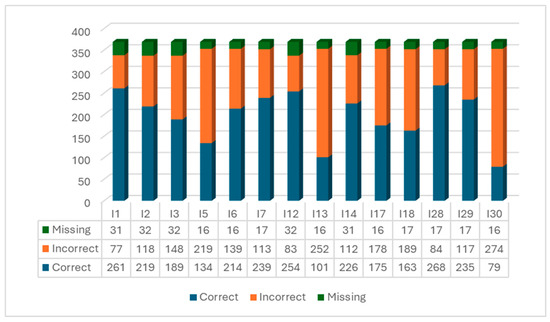
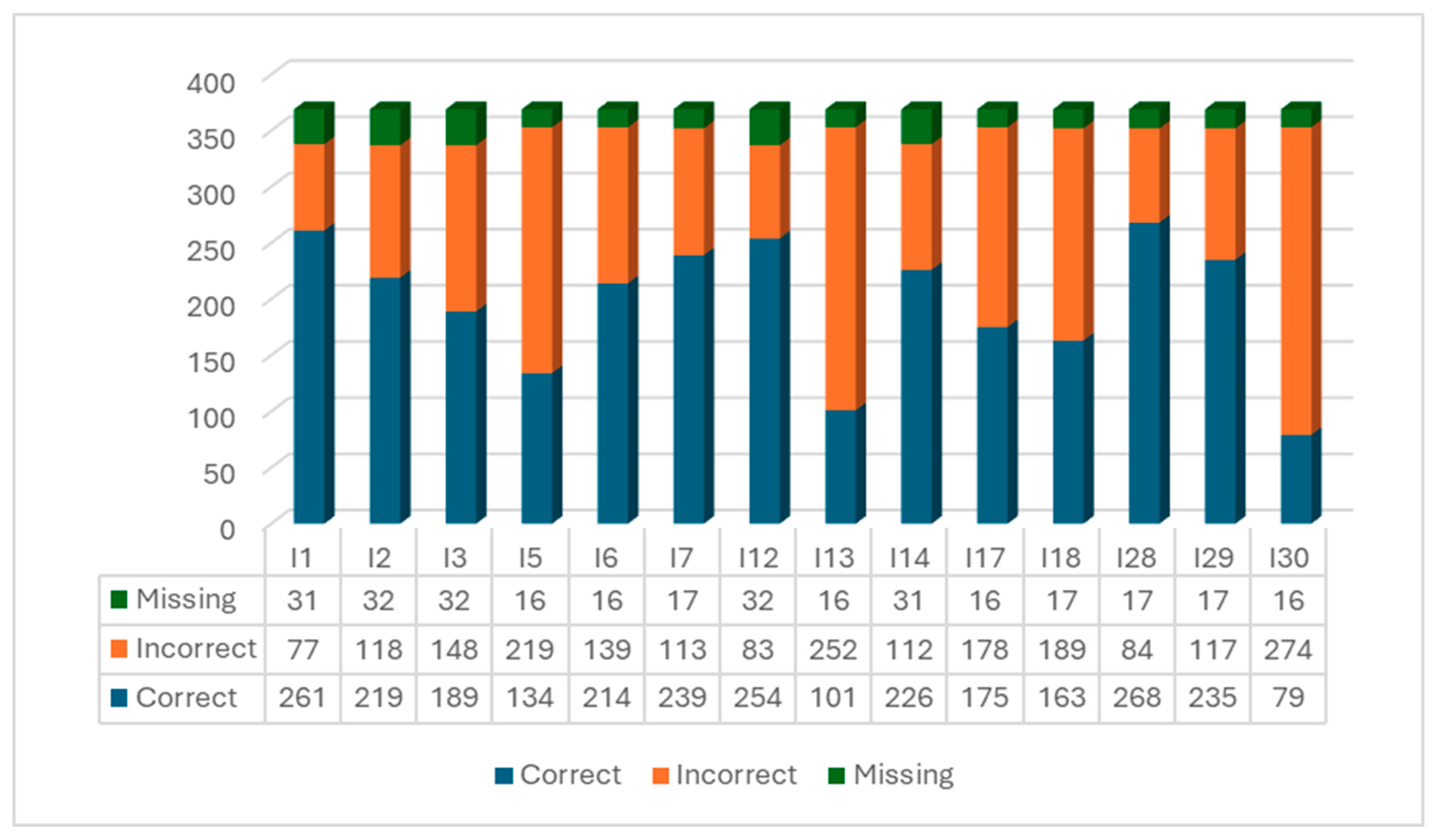
The frequency of participants’ correct and incorrect responses in each FCI item is illustrated in Figure 1. Lowest number of correct responses was obtained from I30 (context of “Gravitation”) and highest from I28 (context of “Newton’s third law”). Missing responses were present at the item level but were limited in number (less than %10). Missing data were treated as missing and were excluded on a pairwise basis for item-level analyses. Participants were retained in the dataset provided that they completed a sufficient portion of the assessment, and no participants were excluded entirely due to missing responses. Accordingly, sample sizes vary slightly across item-level analyses depending on response completeness. This approach was adopted to maximize data use while minimizing unnecessary participant exclusion.
Figure 1.
Frequency of correct, incorrect and missing answers for each item of the FCI.
To guarantee that the test performs effectively and that score interpretations are valid for the research context, an item analysis was conducted. This analysis served to evaluate the psychometric properties of the individual test items. The outcomes of this item analysis are summarized in Table 3.
Table 3.
Results of the FCI’s Item Analysis.
As summarized in Table 3, item discrimination analyses indicated that all FCI items functioned adequately in distinguishing between higher- and lower-performing students, supporting their inclusion in the assessment (the acceptable minimum item-total correlation threshold typically set between 0.10 and 0.20). Overall, the pattern of discrimination values suggests that the selected items are effective for differentiating levels of conceptual understanding within the sample.
Item difficulty analysis further showed that the assessment was appropriately balanced, with items spanning a range (0.23 to 0.78) from more challenging to more accessible. Standard interpretive guidelines suggest that difficulty levels between 0.40 and 0.60 are classified as “typical.” At the test level, the overall difficulty profile corresponds to a typical level of challenge for students enrolled in the course. When examined by gender, only minor variations in item difficulty patterns were observed, indicating broadly comparable levels of item challenge for female and male students. Finally, the bias score that was derived by calculating the difference between the confidence score and the accuracy score was categorized according to Stankov and Lee (2014) and Rachmatullah and Ha (2019)’s categorization. Table 4 shows the percentages of the distribution of overconfidence, normal confidence and underconfidence.
Table 4.
Confidence Level Percentages According to Bias Scores.
As summarized in Table 4, students displayed varying calibration patterns, with overconfidence observed more frequently than underconfidence across the sample. Gender-based differences were evident in these patterns: male students tended to exhibit higher levels of overconfidence and lower levels of underconfidence than female students, while female students showed a more balanced distribution between overconfidence and underconfidence. These findings indicate that calibration differences are driven more by patterns of confidence misalignment than by large shifts in overall calibration levels.
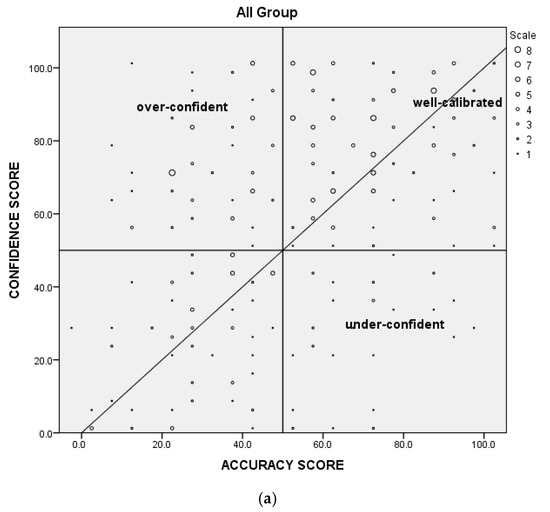
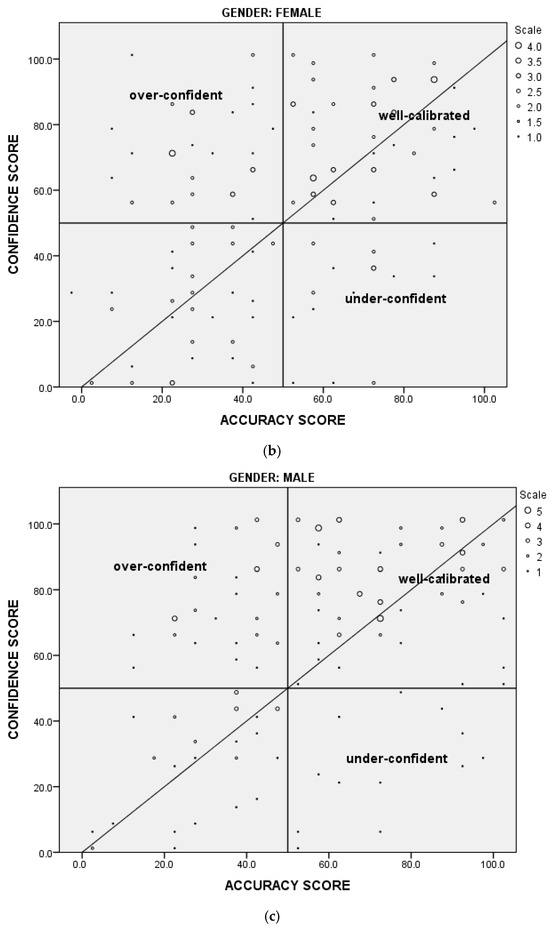
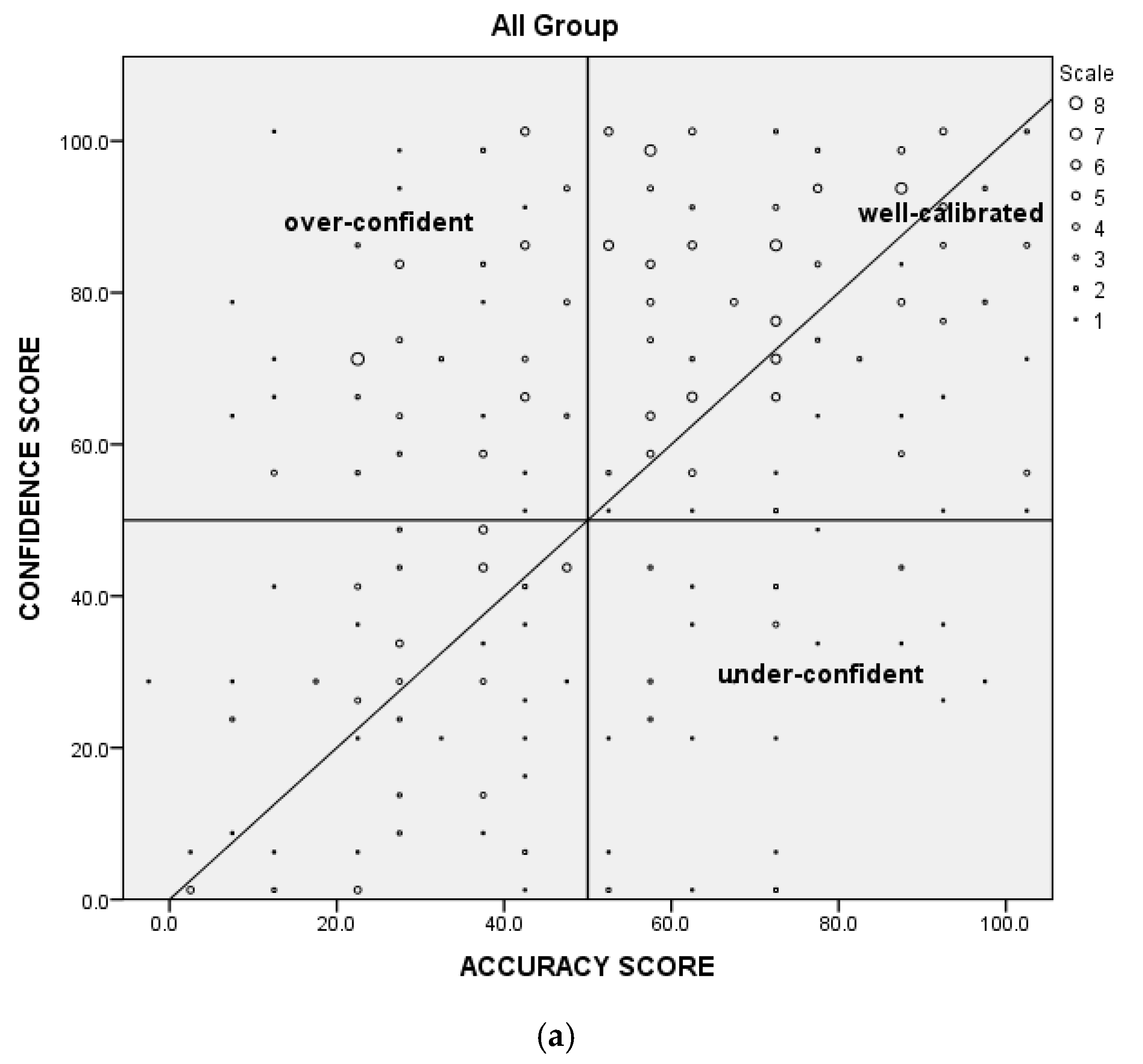
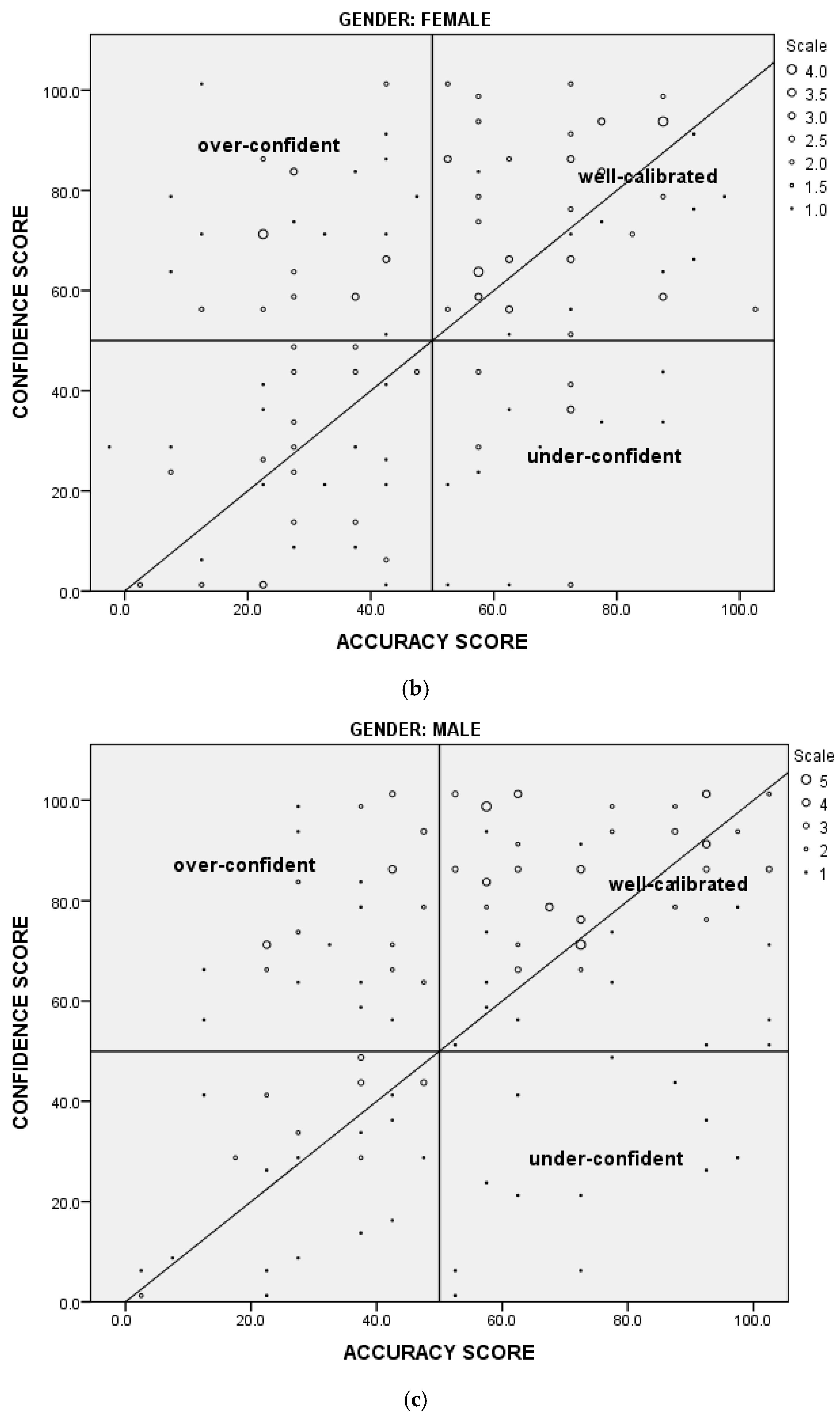
Confidence assessment involves pairing a student’s self-reported confidence level with their actual test score to gauge how well these measures align. Research indicates that when confidence ratings are accurate (well-aligned with performance), students tend to achieve better results. Conversely, misaligned confidence ratings can actively hinder the learning process (Lippiello et al. 2025). In a two-dimensional graph where confidence and performance are the axes, good calibration is achieved when a student’s score falls close to the bisector, meaning their self-assessment accurately reflects their outcome (Foster 2016; Lippiello et al. 2025). Overconfident students are situated in the upper-left area (high confidence with poor performance), while underconfident students are in the lower-right area (low confidence with good performance).
Figure 2 visualizes the relationship between student confidence and performance on the FCI, showing the results for the entire group (Figure 2a) as well as for female (Figure 2b) and male (Figure 2c) students separately. For the whole group, there was a moderate correlation between FCI accuracy scores and confidence scores (Pearson’s r = 0.444, p < 0.001). This correlation remained moderate for both females (Pearson’s r = 0.395, p < 0.001) and males (Pearson’s r = 0.463, p < 0.001).
Figure 2.
Correlation between accuracy score and confidence score in the FCI for all group (a), for females (b) and for males (c).
As shown in Figure 2, confidence and accuracy showed a clear positive association across the entire group indicating that students who demonstrated stronger conceptual understanding also tended to report higher confidence. This pattern was consistent for both female and male students, with comparable strength of association across groups. Overall, the results suggest a stable relationship between confidence and performance that does not differ markedly by gender.
Because confidence and accuracy were measured within the same assessment context, the observed correlations may partially reflect shared method variance; therefore, these associations are interpreted descriptively rather than as evidence of independent or causal relationships.
3.2. Inferential Analysis of the FCI Scores for Gender Comparisons
Independent samples t-tests were conducted to compare confidence, accuracy, and bias scores between female and male students (Table 5). A statistically significant difference was observed in confidence scores between females (M = 54.44, SD = 30.00) and males (M = 68.17, SD = 28.02), t = −4.54, p < 0.001, with a moderate effect size (Cohen’s d = 0.47).
Table 5.
Independent Samples t-test Results for Gender Differences.
A statistically significant difference was also found in FCI accuracy scores between females (M = 49.96, SD = 24.46) and males (M = 56.79, SD = 25.52), t = −2.63, p = 0.009. However, the associated effect size was small (Cohen’s d = 0.27), indicating limited practical significance.
Similarly, a significant difference was observed for FCI bias scores, with females (M = 4.47, SD = 30.31) scoring lower than males (M = 11.38, SD = 27.82), t = −2.28, p = 0.023; this difference was also associated with a small effect size (Cohen’s d = 0.24).
Overall, while statistically significant gender differences were identified across confidence, accuracy, and bias measures, the magnitude of these differences was small for accuracy and bias and moderate for confidence, suggesting that gender-related differences are more pronounced in confidence judgments than in conceptual understanding or calibration.
The Chi-square test was employed to determine if a statistically significant association exists between gender and categorical response types, such as the proportion of correct and incorrect answers. Chi-square analyses were conducted at the item level to descriptively examine gender-related differences in response patterns. Given the categorical nature of the data and the exploratory purpose of these analyses, chi-square tests were used as an initial screening tool. However, some items yielded sparse response distributions, resulting in low expected cell counts. Accordingly, item-level chi-square results are interpreted cautiously, with greater emphasis placed on effect sizes and consistency of patterns across items rather than on isolated significance tests. Item-level significance tests are reported descriptively and are interpreted in conjunction with effect sizes and consistency across items. Table 6 presents the results of this Chi-square analysis, including the gender-based percentages for correct and incorrect responses in each FCI item.
Table 6.
Percentages of Correct and Incorrect Responses Regarding Gender and Results of Chi-Square Test.
As shown in Table 6 Chi-square analyses indicated statistically significant gender differences in response types for seven individual FCI items (I2, I6, I7, I13, I14, I17, and I30). However, the corresponding phi coefficients (ϕ = 0.11–0.212) reflect small effect sizes, indicating limited practical significance. Accordingly, these item-level differences are interpreted as modest and localized rather than as evidence of substantively meaningful gender differences. When considered across the full set of items, the overall distribution of correct and incorrect responses did not differ meaningfully between female and male students.
To analyze participants’ confidence, the percentage of confident responses for each item was determined separately by gender. A Chi-square test was subsequently conducted to check for differences in these proportions between male and female participants. These results are presented in Table 7.
Table 7.
Percentages of Confidence Regarding Gender and Results of Chi-Square Test.
As presented in Table 7, Chi-square analyses identified statistically significant gender differences in confidence on five individual FCI items (I7, I12, I14, I17, and I30). However, the corresponding phi coefficients (ϕ = 0.138–0.232) indicate small effect sizes, suggesting limited practical significance. Accordingly, these findings are interpreted as modest, item-specific variations in confidence rather than as evidence of substantively meaningful gender differences. When considered across the full set of items, the overall distribution of confident and unconfident responses did not differ meaningfully between female and male students, indicating that the observed differences are localized rather than systematic.
4. Discussion
This study investigates the possible gender differences in conceptual physics understanding by examining Force Concept Inventory (FCI) performance within a Turkish context, with particular attention to accuracy, confidence, and bias scores. The interpretation of these findings is necessarily bounded by the study’s methodological constraints, including the use of a reduced and modified subset of FCI items, the absence of measurement invariance testing, and the cross-sectional, non-experimental design. Accordingly, the results are interpreted as descriptive and exploratory patterns within a specific instructional context rather than as evidence of generalizable or causal mechanisms. From an educational perspective, the observed patterns suggest that gender differences in physics may be expressed less through large disparities in conceptual understanding and more through differences in confidence calibration and self-evaluation, which has implications for assessment practices and instructional feedback.
The most direct performance indicator, accuracy, revealed that male students scored significantly higher than female students, with mean scores of 56.79 for males and 49.96 for females. Although this difference reached statistical significance, the effect size was small (Cohen’s d = 0.273), indicating that gender-related disparities in correctness exist but are not large. This aligns with international studies showing similar small performance gaps across many cultural settings (Docktor and Heller 2008; Traxler et al. 2018). However, direct comparability with these studies should be approached cautiously, as the present study employed a reduced, course-aligned version of the FCI rather than the full validated instrument. The item-level analyses reinforce this interpretation, as only 7 out of 14 items showed significant gender differences and even these differences exhibited low phi coefficients (ϕ = 0.11–0.21). These items correspond to conceptual domains such as Newton’s first law and gravitation—areas consistently identified as challenging in prior research (Leppavirta 2012; Planinic et al. 2010), suggesting that the observed gender differences are tied to the intrinsic conceptual difficulty of selected physics topics rather than broad gender-specific deficits.
According to the results, confidence scores showed a clearer gender distinction than accuracy scores. Male students reported a mean confidence score of 68.17, compared to 54.44 among female students, representing a statistically significant difference with a moderate effect size (Cohen’s d = 0.473). This pattern may imply that gender differences in self-evaluative beliefs are more pronounced than differences in conceptual understanding. Female students’ consistent underestimation of their performance parallels findings from international research documenting lower physics self-efficacy and confidence among women, independent of achievement level (Hyde et al. 1990; Testa et al. 2023). In the present study, confidence differences mirrored accuracy differences: items with significant performance gaps often showed confidence gaps in the same direction. Yet, the confidence gap was proportionally larger, indicating that confidence may not be fully reducible to correctness within this measurement context, rather than functioning as a mere reflection of accuracy.
Bias scores, representing calibration between confidence and accuracy, revealed additional differences. Male students exhibited higher average bias scores (M = 11.38) than female students (M = 4.47), with a small effect size (Cohen’s d = 0.273). This result may imply that male students were more likely to be overconfident, while female students tended toward underconfidence. The distribution analysis strengthens this conclusion: 50% of male students were overconfident compared to 41.1% of female students, while 30.4% of female students were underconfident compared to 15.8% of males. These calibration patterns echo previous findings showing gendered tendencies in confidence judgments, where male students often report higher certainty regardless of correctness and female students exhibit more conservative self-evaluations (Lippiello et al. 2025; Stankov and Lee 2014). While consistent with established trends, these findings should be interpreted as indicative of relative tendencies rather than as evidence of stable or causal metacognitive traits.
Taken together, these findings highlight that gender differences in physics learning cannot be reduced to correctness alone. The relative magnitudes of accuracy, confidence, and calibration gaps suggest that conceptual and metacognitive factors may interact in shaping gender disparities. The fact that confidence and calibration differences were larger than accuracy differences underscores the importance of examining affective and self-regulatory processes alongside conceptual performance. Moreover, the overlap between items showing accuracy gaps and confidence gaps suggests that students’ subjective judgments may be influenced by domain-specific or contextual conceptual difficulties, a pattern also observed in previous confidence-performance studies. At the same time, because confidence and accuracy were measured within the same assessment context, shared method variance may contribute to these associations and limits strong claims about underlying mechanisms. Together, these results indicate that gender disparities in FCI outcomes in Türkiye reflect a multidimensional pattern involving knowledge, self-evaluation, and calibration accuracy.
The item-level patterns in this study offer deeper insight into how gender differences manifest across specific conceptual domains of Newtonian mechanics. Although significant differences were found on only half of the analyzed items, those items were not random but clustered around well-known zones of conceptual difficulty. Items such as I2, I6, I7, I13, I14, I17, and I30, which showed significant gender differences in accuracy and items I7, I12, I14, I17 and I30 in confidence, are precisely the items that prior research has identified as requiring higher levels of abstract reasoning, force-interaction analysis, or gravitation. Prior studies have similarly identified these domains as producing the widest gender gaps internationally (Planinic et al. 2010; Docktor and Heller 2008). However, given the reduced item set and exploratory nature of the item-level analyses, these patterns should not be interpreted as definitive evidence of topic-specific gender effects.
The confidence patterns at the item level reinforce this interpretation. Items with significant accuracy gaps were often the same items on which male students reported higher confidence and female students reported lower confidence. The moderate differences in confidence, compared to the small differences in accuracy, indicate that self-evaluative processes amplify or extend conceptual gaps. For example, on items such as I14 and I17, male students not only achieved higher correctness rates but also expressed substantially higher confidence, whereas female students reported lower confidence even when correct. While this pattern is consistent with international confidence calibration studies (Testa et al. 2023; Kaltakci-Gurel 2023), interpretations invoking epistemic authority or internalized disciplinary norms remain speculative, as such constructs were not directly measured in the present study.
The higher prevalence of overconfidence among male students and underconfidence among female students mirrors findings from studies such as Stankov and Lee (2014). A noteworthy aspect of these findings is that effect sizes across accuracy, confidence, and bias measures remained small to moderate. This suggests that gender differences, while statistically significant, do not indicate large conceptual or metacognitive divides between male and female students. Rather, these patterns plausibly reflect cumulative influences of physics identity, self-efficacy, stereotype threat, and prior preparation discussed in the literature, but not directly tested within the present study. Thus, the observed gender patterns should not be interpreted as innate differences. These interpretations should be further tempered by the absence of socioeconomic and broader contextual variables in the present study, such as students’ prior educational opportunities or institutional resources, which are known to intersect with gender in shaping physics learning experiences and may partially account for the observed patterns.
Overall, the combined results of accuracy, confidence, and calibration underscore that gender differences in Newtonian physics are multifaceted. The Turkish data are broadly consistent with international patterns reported in the literature but claims of alignment should be interpreted at the level of general pattern similarity rather than equivalence, given differences in instrument modification, analytic scope, and design quality. Within these limits, the study contributes context-specific descriptive evidence regarding the role of confidence and calibration alongside conceptual accuracy.
The findings of this study have several important implications for physics instruction, assessment design, and gender equity initiatives in the Turkish context, but these implications should be interpreted cautiously given the study’s descriptive and non-interventional design. The presence of small but statistically significant gender differences in accuracy suggests that conceptual disparities exist, yet their limited magnitude does not support deficit-oriented interpretations of female students’ abilities. Instead, consistent with prior research (Docktor and Heller 2008; Planinic et al. 2010), these patterns align with a systemic perspective in which gender differences in mechanics performance are shaped by prior exposure, confidence norms, and learning environments rather than inherent aptitude.
The more pronounced differences in confidence and calibration relative to accuracy highlight the potential relevance of metacognitive processes in physics learning. While the present study did not test instructional interventions, prior research suggests that structured reflection, confidence rating activities, and explicit metacognitive prompts may support more accurate self-evaluation and engagement (Testa et al. 2023). In this light, instructional approaches that integrate opportunities for students to compare predicted and actual performance, such as low-stakes assessments with confidence judgments, may warrant further investigation, particularly in conceptually demanding areas of mechanics where misconceptions are known to persist (Planinic et al. 2010).
These findings also suggest that FCI results may be most informative when interpreted within a broader framework that considers confidence and calibration alongside conceptual accuracy, rather than as standalone indicators of mastery. From a broader equity perspective, the observation that confidence and calibration gaps exceeded accuracy gaps indicates that academic self-perception may represent an important dimension of gendered participation in physics. Consequently, initiatives aimed at increasing female participation in physics and related STEM fields may benefit from approaches that explicitly address self-efficacy and epistemic confidence, especially during the transition into university-level physics. However, the effectiveness of such approaches within the Turkish context remains an open empirical question requiring targeted, intervention-based research.
5. Conclusions
This study examined gender differences in FCI accuracy, confidence, and bias scores among Turkish university freshmen, revealing a pattern that is statistically significant yet modest in magnitude. Male students scored higher than female students in accuracy indicating that while gender differences in conceptual understanding exist, they are relatively small and localized to specific conceptual domains. These differences appeared most clearly on items addressing Newton’s first law, interacting forces, and gravitation—conceptual domains widely identified as challenging in the prior literature—which suggests that the observed disparities reflect the inherent difficulty of core mechanics ideas rather than widespread gender-based differences in ability. Confidence differences were more pronounced than accuracy differences, with male students reporting substantially higher confidence compared to female students. This indicates that gender differences extend beyond conceptual correctness and into metacognitive self-assessment. The stronger effect size for confidence implies that female students may experience greater uncertainty in their physics reasoning, while male students may express stronger epistemic assurance even when performance is comparable. These confidence gaps, larger than the accuracy gaps, suggest that metacognitive variables play a central role in shaping students’ engagement and success in introductory physics.
Overall, the findings suggest that gender differences in FCI outcomes arise from the interplay of conceptual difficulty and metacognitive tendencies rather than from inherent performance gaps. The Turkish results parallel international findings while providing context-specific insight into how confidence and calibration shape learning in introductory university physics. Based on these results, efforts to reduce gender disparities in physics should focus not only on strengthening conceptual understanding but also on supporting students’ metacognitive development, confidence calibration, and self-efficacy—factors shown to influence physics learning outcomes at least as strongly as content mastery itself.
Although this study provides a detailed analysis of gender differences in FCI accuracy, confidence, and bias scores in a Turkish university context, several limitations should be acknowledged when interpreting its findings. First, the sample was limited to a single institutional context, which restricts the generalizability of the results. University-level introductory physics students in Turkey may vary significantly in terms of prior physics preparation, exposure to problem-solving practices, and high school learning environments. Because prior research has shown that differences in preparation can meaningfully influence FCI performance (Docktor and Heller 2008; Planinic et al. 2010), the gender differences observed here may partly reflect institutional or regional characteristics rather than nationwide trends. Second, the study relied exclusively on the reduced FCI and accompanying confidence ratings as the measurement tools. While the FCI is a well-validated instrument with extensive international use, it assesses only a specific subset of Newtonian mechanics concepts and not all items from the inventory included in the study. Misconceptions and reasoning patterns outside the FCI framework were not captured, which limits the scope of interpretation. Additionally, confidence ratings were based on self-report, making them susceptible to cultural norms regarding modesty, assertiveness, and self-expression. Third, the cross-sectional design limits the ability to determine whether the observed gender differences are stable over time or sensitive to instructional interventions. Because the study did not track students longitudinally, it cannot be used to determine whether confidence and calibration differences diminish, persist, or intensify as students progress through physics coursework. Fourth, while the item-level analysis provided valuable insight into where gender differences were most concentrated, the study did not incorporate qualitative data that could help explain why these conceptual and metacognitive differences occur. Interviews, written explanations, or think-aloud protocols could provide a richer understanding of the reasoning strategies students use on items where gender gaps are largest. Fifth, dichotomizing confidence ratings may discard meaningful variance in metacognitive judgment and limit sensitivity to nuances in calibration. Future studies could extend this work by applying the same confidence-calibration framework to the full FCI to examine whether similar patterns emerge across the complete construct domain. Future research incorporating qualitative data may provide a more nuanced understanding of the origins and persistence of gender disparities in physics learning.
Author Contributions
Conceptualization, D.K.-G. and K.O.; methodology, D.K.-G. and K.O.; software, D.K.-G.; validation, D.K.-G. and K.O.; formal analysis, D.K.-G. and K.O.; investigation, D.K.-G.; resources, D.K.-G.; data curation, D.K.-G.; writing—original draft preparation, D.K.-G.; writing—review and editing, D.K.-G. and K.O.; visualization, D.K.-G. and K.O.; supervision, D.K.-G.; project administration, D.K.-G. All authors have read and agreed to the published version of the manuscript.
Funding
This research received no external funding.
Institutional Review Board Statement
The study was conducted in accordance with the Declaration of Helsinki and approved by the Institutional Review Board of Kocaeli University (protocol code 2015/039 and date of approval: 15 January 2015).
Informed Consent Statement
Informed consent was obtained from subjects involved in the study.
Data Availability Statement
Data available upon reasonable request.
Conflicts of Interest
The authors declare no conflicts of interest.
Abbreviations
The following abbreviations are used in this manuscript:
| FCI | Force Concept Inventory |
| F | Female |
| M | Male |
| df | Degrees of freedom |
| St. Dev. | Standard deviation |
| f | Frequency |
References
- Baker, Sandra F., and Gerard J. Fogarty. 2004. Confidence in cognition and intrapersonal perception: Do we know what we think we know about our own cognitive performance and personality traits? In Proceedings of the 39th Australian Psychological Society Annual Conference: Psychological Science in Action, Sydney, NSW, Australia, September 29–October 3. Melbourne: Australian Psychological Society, pp. 24–28. Available online: https://research.usq.edu.au/download/4afe1c5de2566c0310333d85f02d2723c59ca858e6b0da86c738a55f09183f1b/163552/APS_2004_conference_paper.pdf (accessed on 15 August 2025).
- Bianchini, Julie A. 2017. Equity in science education. In Science Education. Edited by Keith S. Taber and Ben Akpan. Rotterdam: Sense Publishers, pp. 455–64. [Google Scholar]
- Buncher, John B., Jayson M. Nissen, Ben V. Dusen, and Robert M. Talbot. 2025. Is the Force Concept Inventory biased across the intersections of gender and race? Physical Review Physics Education Research 21: 10137. [Google Scholar] [CrossRef] [Scilit]
- Caballero, Marcos D., Edwin F. Greco, Eric R. Murray, Keith R. Bujak, M. Jackson Marr, Richard Catrambone, Matthew A. Kohlmyer, and Michael F. Schatz. 2012. Comparing large lecture mechanics curricula using the Force Concept Inventory: A five thousand student study. American Journal of Physics 80: 638–44. [Google Scholar] [CrossRef] [Scilit]
- Caleon, Imelda S., and Ramanathan Subramaniam. 2010. Do students know what they know and what they don’t know? Using a four-tier diagnostic test to assess the nature of students’ alternative conceptions. Research in Science Education 40: 313–37. [Google Scholar] [CrossRef] [Scilit]
- Chen, Peggy, and Barry Zimmerman. 2007. A cross-national comparison study on the accuracy of self-efficacy beliefs of middle-school mathematics students. The Journal of Experimental Education 75: 221. [Google Scholar] [CrossRef] [Scilit]
- Cohen, Jacob. 1988. Statistical Power Analysis for the Behavioral Sciences, 2nd ed. Hillsdale: Erlbaum. [Google Scholar]
- Docktor, Jennifer, and Kenneth Heller. 2008. Gender differences in both Force Concept Inventory and introductory physics performance. In AIP Conference Proceedings. College Park: American Institute of Physics, vol. 1064, pp. 15–18. [Google Scholar] [CrossRef] [Scilit]
- Dunlosky, John, and Katherine A. Rawson. 2012. Overconfidence produces underachievement: Inaccurate self-evaluations undermine students’ learning and retention. Learning and Instruction 22: 271–80. [Google Scholar] [CrossRef] [Scilit]
- Eaton, Philip, and Shannon D. Willoughby. 2018. Confirmatory factor analysis applied to the force concept inventory. Physical Review Physics Education Research 14: 10124. [Google Scholar] [CrossRef] [Scilit]
- Echternacht, Gary J. 1972. The use of confidence testing in objective tests. Review of Educational Research 42: 217–36. [Google Scholar] [CrossRef]
- Foster, Colin. 2016. Confidence and competence with mathematical procedures. Educational Studies in Mathematics 91: 271–88. [Google Scholar] [CrossRef] [Scilit]
- Foster, Colin. 2022. Implementing confidence assessment in low-stakes, formative mathematics assessments. International Journal of Science and Mathematics Education 20: 1411–29. [Google Scholar] [CrossRef] [Scilit]
- Frankel, Jack R., Norman E. Wallen, and Helen H. Hyun. 2012. How to Design and Evaluate Research in Education, 8th ed. New York: McGraw-Hill Comp. [Google Scholar]
- Gardner-Medwin, Tony, and Nancy Curtin. 2007. Certainty-based marking (CBM) for reflective learning and proper knowledge assessment. Paper presented at the REAP International Online Conference on Assessment Design for Learner Responsibility, Glasgow, UK, May 29–31. [Google Scholar]
- Gillibrand, Eileen, Peter Robinson, Richard Brawn, and Albert Osborn. 1999. Girls’ participation in physics in single sex classes in mixed schools in relation to confidence and achievement. International Journal of Science Education 21: 349–62. [Google Scholar] [CrossRef] [Scilit]
- Good, Melanie, Alexandru Maries, and Chandralekha Singh. 2019. Impact of traditional or evidence-based active-engagement instruction on introductory female and male students’ attitudes and approaches to physics problem solving. Physical Review Physics Education Research 15: 20129. [Google Scholar] [CrossRef] [Scilit]
- Hake, Richard R. 1998. Interactive-engagement versus traditional methods: A six-thousand-student survey of mechanics test data for introductory physics courses. American Journal of Physics 66: 64–74. [Google Scholar] [CrossRef] [Scilit]
- Hasan, Saleem, Diola Bagayoko, and Ella L. Kelley. 1999. Misconceptions and the certainty of response index (CRI). Physics Education 34: 294–99. [Google Scholar] [CrossRef] [Scilit]
- Haussler, Peter, and Lore Hoffmann. 2002. An intervention study to enhance girls’ interest, self-concept, and achievement in physics classes. Journal of Research in Science Teaching 39: 870–88. [Google Scholar] [CrossRef] [Scilit]
- Henderson, Rachel, John Stewart, and Adrienne Traxler. 2019. Partitioning the gender gap in physics conceptual inventories: Force concept inventory, force and motion conceptual evaluation, and conceptual survey of electricity and magnetism. Physical Review Physics Education Research 15: 10131. [Google Scholar] [CrossRef] [Scilit]
- Hestenes, David, Malcolm Wells, and Gregg Swackhamer. 1992. Force concept inventory. Physics Teacher 30: 141–58. [Google Scholar] [CrossRef] [Scilit]
- Hull, Michael M., Alexandra Jansky, and Martin Hopf. 2022. Does confidence in a wrong answer imply a misconception? Physical Review Physics Education Research 18: 20108. [Google Scholar] [CrossRef] [Scilit]
- Hyde, Janet S., Elizabeth Fennema, and Susan J. Lamon. 1990. Gender differences in mathematics performance: A meta-analysis. Psychological Bulletin 107: 139–55. [Google Scholar] [CrossRef] [Scilit]
- Kalender, Z. Yasemin, Emily Marshman, Christian D. Schunn, Timothy J. Nokes-Malach, and Chandralekha Singh. 2020. Damage caused by women’s lower self-efficacy on physics learning. Physical Review Physics Education Research 16: 10118. [Google Scholar] [CrossRef] [Scilit]
- Kaltakci-Gurel, Derya. 2023. Exploring pre-service teachers’ conceptual understanding and confidence in geometrical optics: A focus on gender and prior course achievement. Education Sciences 13: 452. [Google Scholar] [CrossRef] [Scilit]
- Kaltakci-Gurel, Derya, Ali Eryilmaz, and Lillian C. McDermott. 2017. Development and application of a four-tier test to assess pre-service physics teachers’ misconceptions about geometrical optics. Research in Science & Technological Education 35: 238–60. [Google Scholar] [CrossRef] [Scilit]
- Leppavirta, Johanna. 2012. Assessing undergraduate students’ conceptual understanding and confidence of electromagnetics. International Journal of Science and Mathematics Education 10: 1099–117. [Google Scholar] [CrossRef] [Scilit]
- Lippiello, Stefania, Marta Carli, and Ornella Pantano. 2025. The Relationship between Performance and Confidence in the Secondary-School Version of the Test of Calculus and Vectors in Mathematics and Physics. International Journal of Science and Mathematics Education 23: 2997–3020. [Google Scholar] [CrossRef] [Scilit]
- Lundeberg, Mary. A., Paul W. Fox, Amy C. Brown, and Salman Elbedour. 2000. Cultural influences on confidence: Country and gender. Journal of Educational Psychology 92: 152–59. [Google Scholar] [CrossRef]
- Lundeberg, Mary A., Paul W. Fox, and Judith Punćcohaŕ. 1994. Highly confident but wrong: Gender differences and similarities in confidence judgments. Journal of Educational Psychology 86: 114–21. [Google Scholar] [CrossRef]
- Madsen, Adrian, Sarah B. McKagan, and Eleanor C. Sayre. 2013. Gender gap on concept inventories in physics: What is consistent, what is inconsistent, and what factors influence the gap? Physical Review Physics Education Research 9: 20121. [Google Scholar] [CrossRef] [Scilit]
- Marshman, Emily, Z. Yasemin Kalender, Timothy J. Nokes-Malach, Christian Schunn, and Chandralekha Singh. 2018. Female students with A’s have similar physics self-efficacy as male students with C’s in introductory courses: A cause for alarm? Physical Review Physics Education Research 14: 20123. [Google Scholar] [CrossRef] [Scilit]
- McMurran, Meaghan, David Weisbart, and Kinnari Atit. 2023. The relationship between students’ gender and their confidence in the correctness of their solutions to complex and difficult mathematics problems. Learning and Individual Differences 107: 102349. [Google Scholar] [CrossRef] [Scilit]
- Morley, Alicen, Jajson M. Nissen, and Ben Van Dusen. 2023. Measurement invariance across race and gender for the force concept inventory. Physical Review Physics Education Research 19: 20102. [Google Scholar] [CrossRef] [Scilit]
- Osborn Popp, Sharon E., David E. Meltzer, and Colleen Megowan-Romanowicz. 2011. Is the Force Concept Inventory Biased? Investigating Differential Item Functioning on a Test of Conceptual Learning in Physics Documents. New Orleans: American Educational Research Association. Available online: https://physicseducation.net/talks/FCI_DIF_AERA_2011.pdf (accessed on 10 April 2025).
- Pallant, Julie. 2016. SPSS Survival Manual: A Step-by-Step Guide to Data Analysis Using SPSS, 6th ed. London: Allen & Unwin. [Google Scholar]
- PhysPort. 2025. Force Concept Inventory. Available online: https://www.physport.org/assessments/assessment.cfm?A=FCI (accessed on 15 January 2025).
- Planinic, Maja, Lana Ivanjek, and Ana Susac. 2010. Rasch model based analysis of the Force Concept Inventory. Physical Review Special Topics—Physics Education Research 6: 10103. [Google Scholar] [CrossRef] [Scilit]
- Potgieter, Marietjie, Esther Malatje, Estelle Gaigher, and Elsie Venter. 2010. Confidence versus performance as an indicator of the presence of alternative conceptions and inadequate problem-solving skills in mechanics. International Journal of Science Education 32: 1407–29. [Google Scholar] [CrossRef] [Scilit]
- Rachmatullah, Arif, and Minsu Ha. 2019. Examining high-school students’ overconfidence bias in biology exam: A focus on the effects of country and gender. International Journal of Science Education 41: 652–73. [Google Scholar] [CrossRef] [Scilit]
- Rainsford, Eletta, and Colin Foster. 2025. Confidence Assessment, Calibration, and Gender. International Journal of Science and Mathematics Education 23: 4073–98. [Google Scholar] [CrossRef] [Scilit]
- Sharma, Manjula Devi, and James Bewes. 2011. Self-monitoring: Confidence, academic achievement and gender differences in physics. Journal of Learning Design 4: 1–13. Available online: https://eric.ed.gov/?id=EJ940644 (accessed on 15 January 2025). [CrossRef] [Scilit]
- Sheldrake, Richard. 2016. Confidence as motivational expressions of interest, utility, and other influences: Exploring under-confidence and over-confidence in science students at secondary school. International Journal of Educational Research 76: 50–65. [Google Scholar] [CrossRef] [Scilit]
- Sheldrake, Richard, Tamjid Mujtaba, and Michael J. Reiss. 2022. Implications of under-confidence and over-confidence in mathematics at secondary school. International Journal of Educational Research 116: 102085. [Google Scholar] [CrossRef] [Scilit]
- Sreenivasulu, Bellam, and Ramanathan Subramaniam. 2014. Exploring undergraduates’ understanding of transition metals chemistry with the use of cognitive and confidence measures. Research in Science Education 44: 801. [Google Scholar] [CrossRef] [Scilit]
- Stankov, Lazar, and Jihyun Lee. 2014. Overconfidence across world regions. Journal of Cross-Cultural Psychology 45: 821–37. [Google Scholar] [CrossRef] [Scilit]
- Stankov, Lazar, and John D. Crawford. 1997. Self-confidence and performance on tests of cognitive abilities. Intelligence 25: 93–109. [Google Scholar] [CrossRef] [Scilit]
- Stankov, Lazar, Jihyun Lee, Wenshu Luo, and David J. Hogan. 2012. Confidence: A better predictor of academic achievement than self-efficacy, self-concept and anxiety? Learning and Individual Differences 22: 747–58. [Google Scholar] [CrossRef] [Scilit]
- Temizkan, Derya. 2003. The Effect of Gender on Different Categories of Students’ Misconceptions About Force and Motion. Unpublished Master’s thesis, Middle East Technical University, Ankara, Türkiye. [Google Scholar]
- Testa, Italo, Arturo Colantonio, Silvia Galano, Irene Marzoli, Fabio Trani, and Umberto Scotti di Uccio. 2020. Effects of instruction on students’ overconfidence in introductory quantum mechanics. Physical Review Physics Education Research 16: 10143. [Google Scholar] [CrossRef] [Scilit]
- Testa, Italo, Silvia Galano, and Oreste Tarallo. 2023. The relationships between freshmen’s accuracy of self-evaluation and the likelihood of succeeding in chemistry and physics exams in two STEM undergraduate courses. International Journal of Science Education 45: 358–82. [Google Scholar] [CrossRef] [Scilit]
- Traxler, Adrienne, Rachel Henderson, John Stewart, Alexis Papak, and Rebecca Lindell. 2018. Gender fairness within the Force Concept Inventory. Physical Review Physics Education Research 14: 10103. [Google Scholar] [CrossRef] [Scilit]
- Wang, Hong-Syuan, Sufen Chen, and Miao-Hsuan Yen. 2021. Effects of metacognitive scaffolding on students’ performance and confidence judgments in simulation-based inquiry. Physical Review Physics Education Research 17: 20108. [Google Scholar] [CrossRef] [Scilit]
- Zohar, Anat, and Sarit Barzilai. 2013. A review of research on metacognition in science education: Current and future directions. Studies in Science Education 49: 121–69. [Google Scholar] [CrossRef] [Scilit]

Disclaimer/Publisher’s Note: The statements, opinions and data contained in all publications are solely those of the individual author(s) and contributor(s) and not of MDPI and/or the editor(s). MDPI and/or the editor(s) disclaim responsibility for any injury to people or property resulting from any ideas, methods, instructions or products referred to in the content. |
© 2026 by the authors. Licensee MDPI, Basel, Switzerland. This article is an open access article distributed under the terms and conditions of the Creative Commons Attribution (CC BY) license.