
From Guardianship to Autonomy: Mobility, Freedom, and Gender Role Negotiation Among Saudi Women Sojourners in Canada
Abstract
1. Introduction
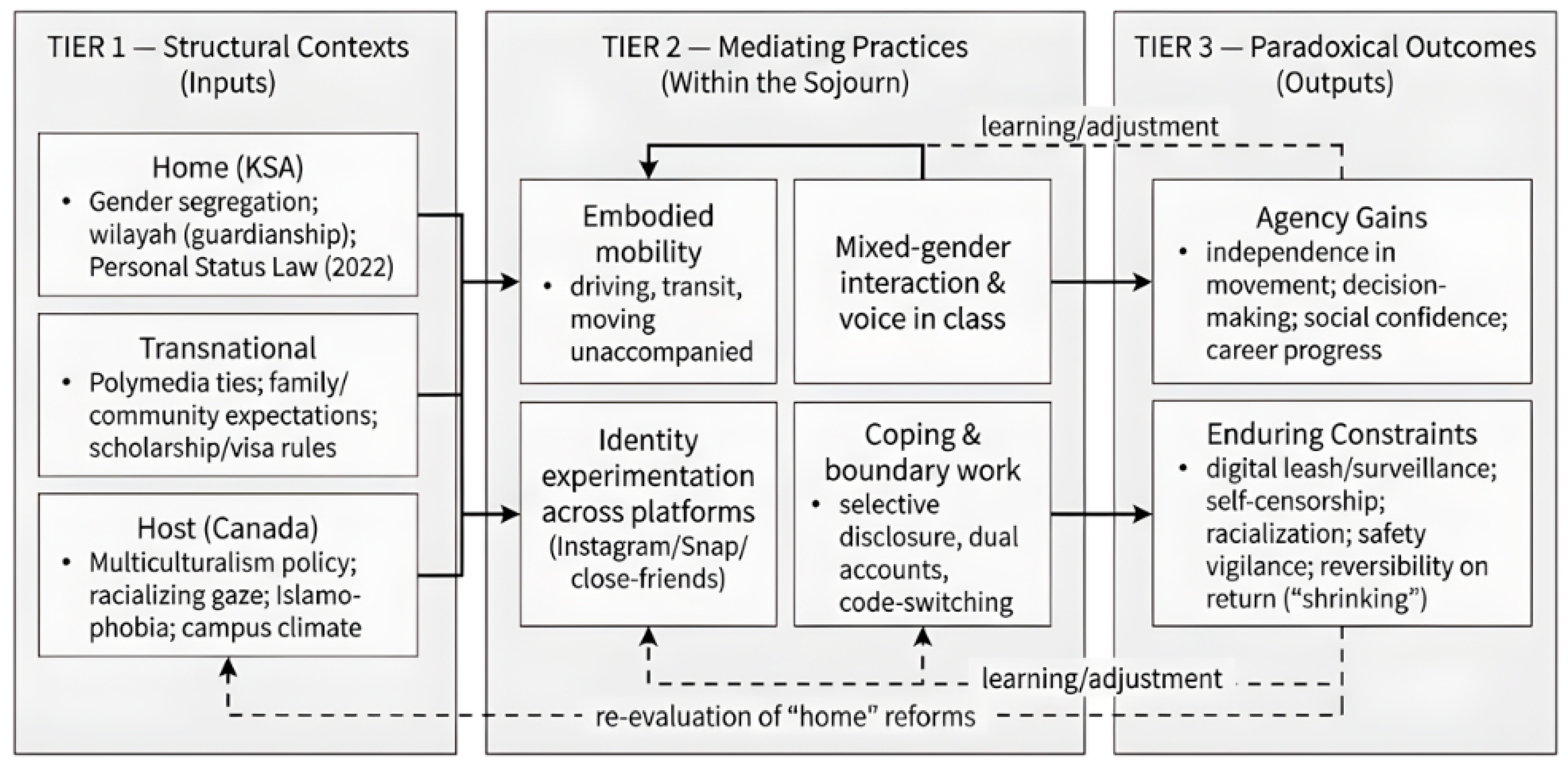
2. Theoretical Framework
2.1. The Saudi Gender Regime in Transition
2.2. Theorizing the Sojourn: Mobility, Liminality, and Adaptation
2.3. Transnational Feminism and Intersectionality
3. Methods
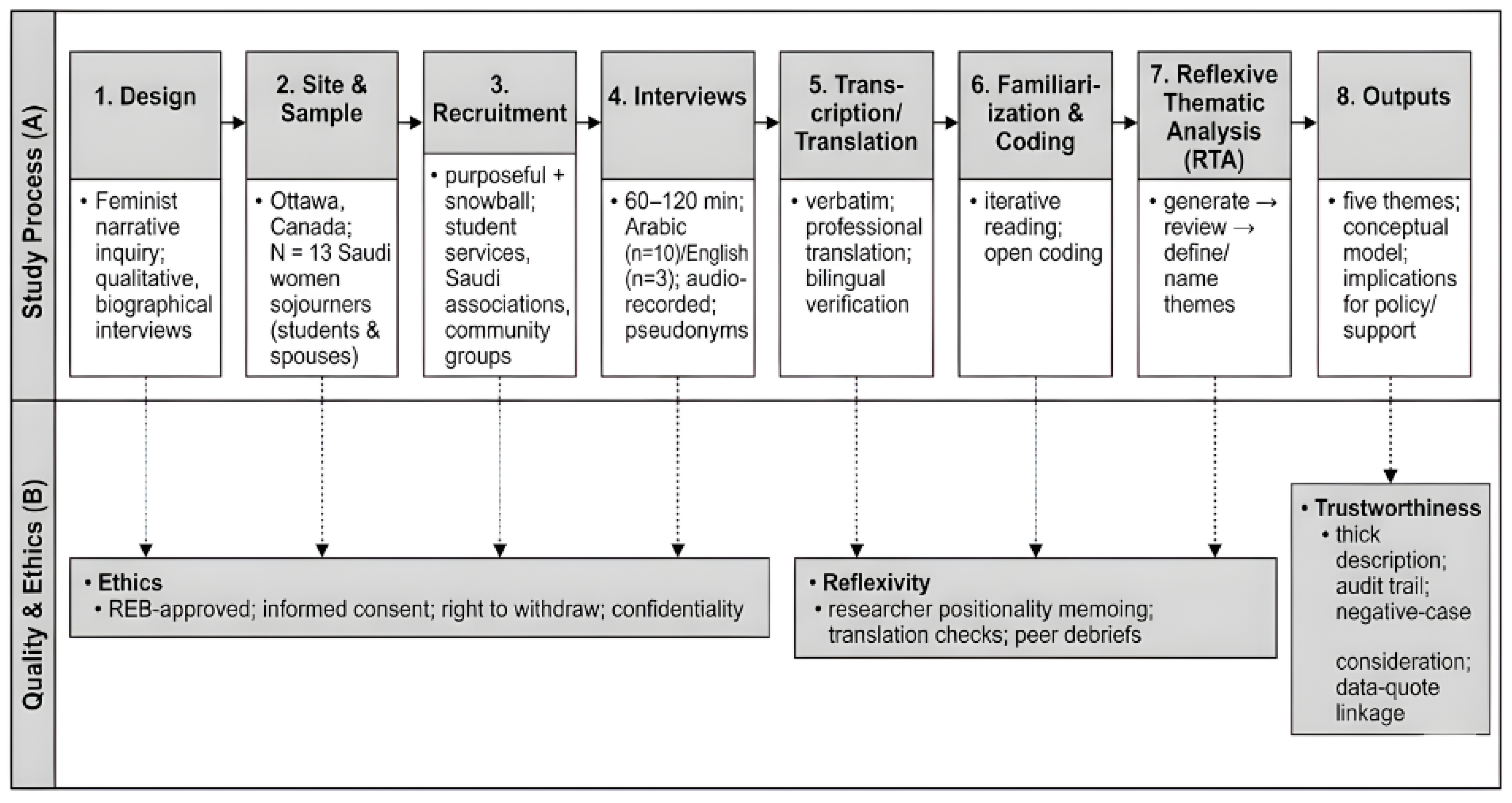
3.1. Epistemological Stance: Feminist Narrative Inquiry
3.2. Participant Recruitment and Sample
3.3. Data Generation
“Tell me the story of your life in Saudi Arabia before you decided to come here.”“What do you remember about your first few weeks in Canada?”“Can you tell me about a time here when you felt you could do something you couldn’t do at home?”“When you think about returning, what do you imagine your life will be like?”
3.4. Ethical Considerations and Researcher Reflexivity
3.5. Analytic Strategy
- Familiarization: Deep immersion in the transcripts and audio recordings, reading and re-reading the data while noting initial observations and reflections.
- Coding: Systematic, line-by-line coding of the entire dataset to identify meaningful features and segments related to our research questions (e.g., instances of autonomy, conflict, coping).
- Generating Initial Themes: Clustering codes into preliminary themes. Here, a theme is understood as an interpretive pattern or story that captures something significant about the data in relation to our questions.
- Reviewing Themes: Refining the themes by checking them against the coded data and the full dataset to ensure each theme was coherent internally and distinct from others, and that together they provided a compelling narrative of the data.
- Defining and Naming Themes: Articulating the essence of each theme by defining its scope and focus and assigning it a descriptive name (often using a striking quote from participants, as in our Section 4).
- Writing: Weaving together the analytical narrative and illustrative quotes for each theme to produce the final report (the findings and discussion of this article).
4. Findings and Theoretical Analysis
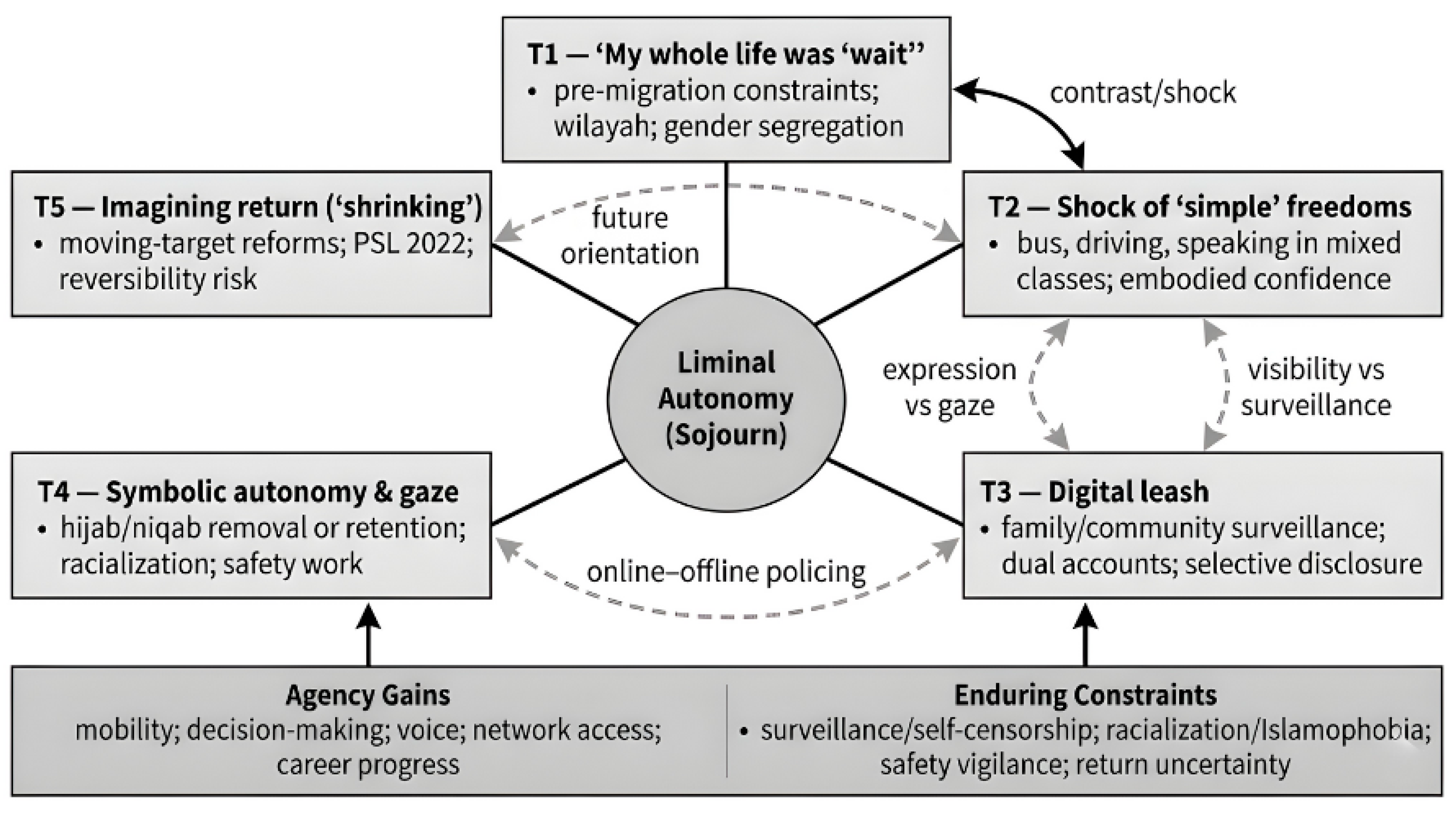
4.1. “My Whole Life Was ‘Wait’”: Pre-Migration Life Under Guardianship
“In Riyadh, I couldn’t even go to the supermarket alone. My driver, my husband, my father. My whole life was ‘wait.’ Waiting for a man to take me somewhere. Waiting for a man to finish his coffee so we could leave. Waiting for permission. Here… I just go. The going is… it’s everything. I didn’t realize how much of my life was just… waiting.”(Fatima, 35, sojourner spouse)
“Before, my brother, who is five years younger than me, had to… ‘give permission’ on the [Absher government] app if I wanted to travel. I have a PhD scholarship. He failed high school. It’s… it was… humiliating. It’s not about him—he is a good kid—but… the system. It makes you feel… not like an adult. Not real.”(Lina, 27, master’s student)
“It wasn’t… bad, you know? It’s just normal. My family is not so strict, but of course you cannot just meet a friend for coffee. You plan. You ask. You are… driven. You don’t just… walk. The idea of just walking out the door… it didn’t exist.”(Reem, 22, undergraduate student)
4.2. The Shock of “Simple” Freedoms: Embodied Autonomy in Canada
“The first time I took the bus. Alone. At night. My heart was… thumping. I was terrified. I was holding my pepper spray. I was sure I was doing something wrong, that I would be… I don’t know. But I was also… I felt so powerful. I got home and I just… cried? It was just a bus! [laughs] But it wasn’t. It was the first time in my life I moved my own body from A to B without a man’s permission or a man’s car.”(Reem, 22)
“Driving. I have an Ontario license. In Saudi, I campaigned for years [for the right to drive]. I was one of the women… well, I was quiet, but I was there. Now… I drive my son to school. I go to the grocery. It feels… normal. But I know it is not. I know what this ‘normal’ cost us. Every time I turn the key, I remember.”(Mariam, 41)
“Mixed classes. The first time the professor (male) asked me a question, I… I froze. I was so used to being invisible. In my Saudi university [women’s campus], I was the top of my class. I was… loud! But here… I am not used to a man I am not related to… asking my opinion. Here, I have to have an opinion. It took a year for my voice to… come back.”(Lina, 27)
4.3. The “Digital Leash”: Transnational Surveillance and Relational Autonomy
“My family trusts me. But my mother… she calls on WhatsApp video. ‘Show me the room, yalla.’ She wants to see I am alone. She wants to see what I am wearing. She will say, ‘Why is it dark? Are you outside?’ It’s… not trust. It’s… love, but it’s a heavy love. I cannot just… be.”(Aisha, 25)
“My social life? I have two. My Snapchat for my cousins… I am studying in the library, very boring. My ‘close friends’ story on Instagram… maybe I am at a café, music, friends… boys and girls. I am not doing anything haram [forbidden], but… it’s just… easier to be two people. Why make them worry? Why make them talk?”(Reem, 22)
“We call it the ‘Saudi CIA’ [laughs]. The other Saudi students. Who is watching who? Who will report back to whose family? ‘Oh, I saw Lina at a coffee shop with a man.’ ‘Oh, I saw Reem’s hair.’ I felt this more in my first year. This judgment… it followed us here.”(Lina, 27)
4.4. “Am I Canadian or Am I Saudi?”: Symbolic Autonomy, Hijab, and Islamophobia
“In Riyadh, I wear niqab. Here, I wear niqab. My family… they thought I would take it off. ‘It will be hard for you,’ they said. But here, I feel it is… my choice. It is my jihad [struggle]. It is my identity. But people… they look. They are afraid. Or they are angry. One man yelled at me, ‘Go back to Saudi Arabia!’ I… I was raised in Canada [as a child], but… they see this [gestures to niqab] and I am not Canadian. It is… tiring.”(Hessa, 29)
“I took off my hijab. I started… second year. My family does not know. I feel… guilty. 100%. But I also… I just wanted to feel the wind in my hair. I just wanted to… blend in. And then I feel guilty for wanting to blend in! [laughs] It’s… complex. Am I a bad Muslim? Am I… ‘West-toxified’? Or am I just… me?”(Aisha, 25)
“Here, I am ‘free’ to be a Muslim. But I am also… a ‘problem’ for being a Muslim. In Saudi, I am just… a woman. Here, I am a Muslim woman. A ‘Middle Eastern woman.’ I am a stereotype. People ask me… ‘Oh, you can talk? You are so… articulate.’ It is… racist. I gain the freedom to drive, but I get… this. It’s a trade.”(Fatima, 35)
4.5. “Will I Have to Shrink Again?”: Imagining Return and Vision 2030
“My biggest fear… is that I will go back and… I will shrink. That all this… bigness… I feel here… this voice I have found… will just get… quiet. Because it’s easier to be quiet there. That is what I am afraid of. Will I have to shrink again?”(Mariam, 41)
“It’s… strange. My friends in Riyadh are going to concerts, they are driving… my life there now would be so different. Maybe… maybe I didn’t need to leave to be free? But… I read about the new law… It feels like… one step forward, five steps back. They give you the car, but they… still own you in the house.”(Lina, 27)
“The [Vision 2030] reforms are for… they are economic. They want women to work… so they let them drive. It is not… a change of mentality. It is… strategy. Here, the freedom… it is in the mentality. Even with the racism… the idea is that I am equal. At home, the idea is still that I am… ‘protected’.”(Hessa, 29)
5. Conclusions
5.1. Core Contributions
5.2. Implications for Future Practice
5.3. Limitations and Future Research
Funding
Institutional Review Board Statement
Informed Consent Statement
Data Availability Statement
Conflicts of Interest
References
- Aguilar, Filomeno. 2018. Ritual passage and the reconstruction of selfhood in international labour migration. Sojourn: Journal of Social Issues in Southeast Asia 33: S87–S130. [Google Scholar] [CrossRef] [Scilit]
- Alkhalaf, Khulud, Alean Al-Krenawi, and Salman Elbedour. 2024. Reverse culture shock among Saudi students returning from the US to their homeland. Journal of International Students 14: 741–59. [Google Scholar] [CrossRef] [Scilit]
- Al-Rasheed, Madawi. 2021. The Son King: Reform and Repression in Saudi Arabia. Oxford: Oxford University Press. [Google Scholar]
- Amnesty International. 2022. Saudi Arabia Codifies Male Guardianship and Gender Discrimination. Research Report. London: Amnesty International. [Google Scholar]
- Asiri, Hajer. 2025. “I Have Returned Home”: Understanding the Re-Entry Experience of Saudi Female Scholars After Completing Their Doctoral Studies in the United States. Master’s thesis, California State University, San Bernardino, CA, USA. [Google Scholar]
- Berry, Ward. 1997. Immigration, acculturation, and adaptation. Applied Psychology 46: 5–34. [Google Scholar] [CrossRef] [Scilit]
- Braun, Victoria, and Virginia Clarke. 2019. Reflecting on reflexive thematic analysis. Qualitative Research in Sport, Exercise and Health 11: 589–97. [Google Scholar] [CrossRef] [Scilit]
- Braun, Victoria, and Virginia Clarke. 2021. Thematic Analysis: A Practical Guide. Thousand Oaks: Sage. [Google Scholar]
- Crenshaw, Kimberlé. 1991. Mapping the margins: Intersectionality, identity politics, and violence against women of color. Stanford Law Review 43: 1241–99. [Google Scholar] [CrossRef] [Scilit]
- Elbushra, Azharia Abdelbagi, Adam Elhag Ahmed, Nagat Ahmed Elmulthum, and Ishtiag Faroug Abdalla. 2025. Nexus of Women’s Empowerment and Economic Growth in Saudi Arabia. Sustainability 17: 7949. [Google Scholar] [CrossRef] [Scilit]
- Glick Schiller, Nina, and Noel Salazar. 2013. Regimes of mobility across the globe. Journal of Ethnic and Migration Studies 39: 183–200. [Google Scholar] [CrossRef] [Scilit]
- Human Rights Watch. 2016. “Boxed In”: Women and Saudi Arabia’s Male Guardianship System. New York: Human Rights Watch. [Google Scholar]
- Jamilah, Maryam, and Rika Isnarti. 2024. Pioneering Change: Women’s Economic Empowerment under Saudi Vision 2030. Sawwa: Jurnal Studi Gender 19: 19–36. [Google Scholar] [CrossRef] [Scilit]
- Kim, Young Yun. 2001. Becoming Intercultural: An Integrative Theory of Communication and Cross-Cultural Adaptation. Thousand Oaks: Sage. [Google Scholar]
- Kim, Young Yun. 2017. Cross-cultural adaptation. In The International Encyclopedia of Intercultural Communication. Edited by Young Yun Kim. Hoboken: Wiley, pp. 1–14. [Google Scholar] [CrossRef] [Scilit]
- Lefdahl-Davis, Erin Marie, and Kristin Perrone-McGovern. 2015. The cultural adjustment of Saudi women international students: A qualitative examination. Journal of International Students 5: 148–67. [Google Scholar] [CrossRef] [Scilit]
- Le Renard, Amélie. 2014. A Society of Young Women: Opportunities of Place, Power, and Reform in Saudi Arabia. Stanford: Stanford University Press. [Google Scholar]
- Mahmood, Saba. 2005. Politics of Piety: The Islamic Revival and the Feminist Subject. Princeton: Princeton University Press. [Google Scholar]
- Merton, Robert. 1972. Insiders and outsiders: A chapter in the sociology of knowledge. American Journal of Sociology 78: 9–47. [Google Scholar] [CrossRef] [Scilit]
- Mishler, Elliot. 1986. Research Interviewing: Context and Narrative. Harvard: Harvard University Press. [Google Scholar]
- Mustafa, Rami, and Salah Troudi. 2017. Saudi women in research literature: A critical look. International Journal of Social Science and Humanity 7: 282–86. [Google Scholar]
- Polkinghorne, Donald. 1988. Narrative Knowing and the Human Sciences. Albany: SUNY Press. [Google Scholar]
- Sheller, Mimi, and John Urry. 2006. The new mobilities paradigm. Environment and Planning A 38: 207–26. [Google Scholar] [CrossRef] [Scilit]
- Turner, Victor. 1967. The Forest of Symbols: Aspects of Ndembu Ritual. New York: Cornell University Press. [Google Scholar]
- Ward, Colleen, and Antony Kennedy. 1999. The measurement of sociocultural adaptation. International Journal of Intercultural Relations 23: 659–77. [Google Scholar] [CrossRef] [Scilit]



| Pseudonym | Age (Range) | Marital Status | Sojourner Status | Time in Canada | Identifier | Field of Study/Work |
|---|---|---|---|---|---|---|
| Lina | 25–30 | Single | Master’s Student | 1.5 years | Hijab | Engineering |
| Fatima | 30–35 | Married (with children) | Spouse of Professional | 4 years | Hijab | Homemaker |
| Reem | 20–25 | Single | Undergraduate Student | 3 years | None | Political Science |
| Hessa | 25–30 | Married | PhD Student | 2 years | Niqab | Islamic Studies |
| Mariam | 40–45 | Divorced (with children) | PhD Student | 5 years | Hijab | Education |
| Aisha | 25–30 | Single | Master’s Student | 2 years | None (formerly Hijab) | Public Health |
| Noura | 30–35 | Married (with children) | Spouse of Student | 3 years | Hijab | Homemaker |
| Salma | 20–25 | Single | Undergraduate Student | 2.5 years | None | Biology |
| Yasmin | 25–30 | Married (no children) | Master’s Student | 1 year | Hijab | Business Administration |
| Dana | 35–40 | Married (with children) | PhD Student | 3 years | Hijab | Computer Science |
| Lojain | 20–25 | Single | Undergraduate Student | 4 years | None | Communications |
| Amara | 30–35 | Divorced | Professional (Temporary) | 6 years | None | Finance |
| Safiya | 20–25 | Married (no children) | Spouse of Student | 8 months | Niqab | Homemaker |
Disclaimer/Publisher’s Note: The statements, opinions and data contained in all publications are solely those of the individual author(s) and contributor(s) and not of MDPI and/or the editor(s). MDPI and/or the editor(s) disclaim responsibility for any injury to people or property resulting from any ideas, methods, instructions or products referred to in the content. |
© 2026 by the author. Licensee MDPI, Basel, Switzerland. This article is an open access article distributed under the terms and conditions of the Creative Commons Attribution (CC BY) license.
Share and Cite
Shahbar, H. From Guardianship to Autonomy: Mobility, Freedom, and Gender Role Negotiation Among Saudi Women Sojourners in Canada. Soc. Sci. 2026, 15, 163. https://doi.org/10.3390/socsci15030163
Shahbar H. From Guardianship to Autonomy: Mobility, Freedom, and Gender Role Negotiation Among Saudi Women Sojourners in Canada. Social Sciences. 2026; 15(3):163. https://doi.org/10.3390/socsci15030163
Chicago/Turabian StyleShahbar, Honaida. 2026. "From Guardianship to Autonomy: Mobility, Freedom, and Gender Role Negotiation Among Saudi Women Sojourners in Canada" Social Sciences 15, no. 3: 163. https://doi.org/10.3390/socsci15030163
APA StyleShahbar, H. (2026). From Guardianship to Autonomy: Mobility, Freedom, and Gender Role Negotiation Among Saudi Women Sojourners in Canada. Social Sciences, 15(3), 163. https://doi.org/10.3390/socsci15030163