


Abstract
Perinatal mental health (PMH) conditions are the most common complications of pregnancy and the first postpartum year. Adverse childhood experiences (ACEs) are increasingly recognized as important contributors to PMH, particularly postpartum depression and anxiety (PPD/A). This study examines a broad range of ACEs—including parental mental illness and substance use, incarceration, death, divorce, discrimination, economic hardship, and forced migration—to assess their influence on PPD/A. Using a modified explanatory sequential mixed-methods design, phase I included an online survey of racially, ethnically, and socioeconomically diverse U.S. women (n = 306) who delivered a live infant in the past year. Hierarchical regression showed that while ACEs initially predicted PPD/A, this association was no longer significant when social support, material hardship, and discrimination were added to the model. These current life circumstances emerged as stronger direct predictors of PPD/A than ACEs. In phase II, purposive and stratified sampling identified participants with ACE scores ≥ 4 for interviews (n = 22). Qualitative findings identified social support, financial security, work flexibility and choice, and time for self-care as central protective factors in adjustment to motherhood when these resources aligned with mothers’ individual needs and values. Results can inform clinical counseling, ACEs screening, and policies to strengthen PMH support.
1. Introduction
Perinatal mental health (PMH) conditions are the most common complications of pregnancy and the first year postpartum (Fawcett et al. 2019; Gavin et al. 2005). PMH encompasses not only depression and anxiety, but also a broad range of mental health challenges that can arise throughout the perinatal period (Howard and Khalifeh 2020), with the World Health Organization (WHO) recognizing PMH as a significant public health concern (World Health Organization 2025). A cross-sectional analysis of the 2018–2022 national restricted-use mortality file identified suicide, homicide, and overdose as the leading causes of pregnancy-related death (Wallace and Jahn 2025). Moreover, untreated PMH costs an estimated 14.2 billion dollars per year in the United States (U.S.) (Luca et al. 2019). Women may be at increased risk for developing a PMH condition due to psychiatric history, socioeconomic disadvantage, limited social support, trauma exposure in birth or sexual abuse, military service, neonatal intensive care unit (NICU) admission, disability, and immigration status (Agrawal et al. 2022; Alhusen et al. 2023; Chaudron et al. 2010; Falah-Hassani et al. 2015; Gregory et al. 2025; Johansen et al. 2020; Miller et al. 2022; Wosu et al. 2015). Additionally, a meta-analysis of 33 studies revealed that gestational diabetes, having boy infants, and epidural anesthesia use were also identified as risk factors for perinatal depression (Liu et al. 2022). In addition to experiencing symptoms such as persistent sadness, lack of interest, sleep disturbances and low self-esteem, mothers with postpartum anxiety (PPA) and/or postpartum depression (PPD) may be at increased risk for a preterm birth, a baby with low birth weight, and negative developmental outcomes for the child (Grote et al. 2010; Koutra et al. 2017; Liu et al. 2022). Additionally, untreated PPD may impact the health of other children in the home and the partner relationship (Valdes et al. 2023).
Adverse childhood experiences (ACEs) were first linked to health outcomes in adulthood through a landmark study by Kaiser-Permanente and the CDC, led by Felitti and colleagues (1998). They defined ACEs as early life stressors occurring before age 18, including physical, sexual, and psychological abuse, neglect, and family dysfunction (Felitti et al. 1998). Adults were given a questionnaire to tally the number of adverse experiences they encountered by 18 years of age. While ACEs scores of four or higher identify the potential for negative health outcomes, it is important to note that not all events impact individuals equally (Alhowaymel et al. 2023). Higher ACEs have since been linked to multiple chronic health conditions, including psychological disorders, substance abuse, obesity, cardiovascular disease and cancer (Felitti et al. 1998; Kalmakis and Chandler 2015). Additionally, research examining ACEs and their associations with other outcomes in non-Western contexts remains limited (Basto-Pereira et al. 2022; Ceccarelli et al. 2022). Given their significant impact on long-term health, ACEs have become a key focus of research on maternal health and well-being (Choi et al. 2018; Choi and Sikkema 2016).
A study done by Prentice et al. showed that women with PPD are more likely to have high-risk ACE scores than the general population (Prentice et al. 2022). A 2025 study indicated that maltreatment ACEs carry the greatest risk for PMH concerns, more specifically emotional neglect as a high predictor of PPD, physical abuse as a predictor of perinatal bipolar disorder, and sexual abuse as a predictor of PPA (Souch et al. 2025). ACEs may play a role in PPD/A development through several hypothesized mechanisms: structural brain changes in stress-responsive regions that alter emotional regulation and stress reactivity across the life course, disrupted relationship functioning and attachment patterns that challenge cognitive and emotional responses and complicate the transition to motherhood, and economic trajectories whereby childhood adversity increases the likelihood of material hardship that persists into adulthood and the perinatal period (Metzler et al. 2017; Sperlich et al. 2017; Shonkoff et al. 2012).
Encouragingly, while ACEs increase the risk of maternal mental health concerns, trauma-informed care and strengthened support during and after pregnancy may reduce these effects (Mackle et al. 2023; Racine et al. 2021). Research shows that higher levels of perceived postpartum support are associated with reduced negative mental health outcomes and an increase in mother–infant bonding (Cho et al. 2022; Mann et al. 2010; Schwab-Reese et al. 2016; White et al. 2023; Zhang and Jin 2016). However, it should be noted that the experience of receiving social support is individual, shaped by personal preferences and cultural norms, and may come through a variety of avenues (Leahy-Warren et al. 2011). Cultures vary in the presentation of family support (Volling et al. 2019). In some cultures, families provide both physical and psychological support to mothers and their families (Xiao et al. 2019). Other cultures that are more individualistic emphasize self-reliance and limited family support (Hofstede 1980). Collectively, these findings emphasize the need for proactive interventions to ensure perinatal women and parents, especially those with increased risk factors, receive tailored and culturally sensitive support from both informal and formal networks.
Material hardship, or the inability to afford basic needs like food, housing, and medical care, is less studied in the perinatal period (Health Resources and Services Administration 2023). A 2018 study found that over half of pregnant women reported some form of material hardship, which was strongly linked to elevated depression and anxiety (Katz et al. 2018). Unmet basic needs and financial stressors may be a critical driver of PMH and risks to maternal and child well-being (Cantrell et al. 2025).
Finally, a large body of research demonstrates that perceived discrimination has a profound negative impact on health problems during pregnancy and beyond (Bécares and Atatoa-Carr 2016; Masters et al. 2024; Williams et al. 2019). Discrimination is not only a risk factor for adverse outcomes; such as preterm birth, low birthweight, small gestational age, and hypertensive disorders of pregnancy (van Daalen et al. 2022), but it is also consistently linked to perinatal depression (Masters et al. 2024; Segre et al. 2021). Experiences of racial discrimination are deeply embedded in the historical and cultural contexts of racialized communities. These historical and cultural legacies shape contemporary exposures to discrimination, influencing social determinants of health (Clement and Fay 2021). Racism also directly impacts health services and resources, including access to care (Clement and Fay 2021). The cumulative effects of systemic discrimination, bias, and associated trauma contribute to chronic psychosocial stress and distrust of medical systems, ultimately leading to poorer health outcomes and shorter life expectancies (Forde et al. 2019; Hudson et al. 2016). In a 2023 latent class analysis, both Black and White participants who reported general discrimination were at greater risk for postpartum depressive symptoms (PPDS) compared to those who did not report discrimination (Doherty et al. 2023). Studies further suggest that the effects of discrimination may intersect with socioeconomic disadvantage, as Ertel et al. (2012) found that while a more affluent cohort of Black women reported higher rates of racism, elevated depressive symptoms were only observed in the financially disadvantaged cohort. Additionally, research suggests that racial/ethnic discrimination is also predictive of prenatal depressive symptoms among Hispanic mothers (Walker et al. 2012). Lastly, participants who reported being upset by racial discrimination had almost three times greater odds of experiencing PPDS (Weeks et al. 2022). Findings suggest discrimination is a critical social determinant of PMH, while social support and resilience may play protective roles, buffering against some of these adverse effects (Masters et al. 2024).
This study employs a combined theoretical framework of life course theory and liberation health social work to examine PPD/A. Life course theory posits that early ACEs can affect later health through latent effects (critical period exposures), pathway effects (reinforcing negative trajectories), and cumulative effects (compounding risks over time) (Elder et al. 2003; McCloskey and Pei 2022). The liberation health social work model explicitly centers the sociopolitical environment by situating PPD and PPA within interconnected personal (e.g., ACE history), cultural (e.g., racism, sexism, classism, mental health stigma), and institutional (e.g., for-profit healthcare, lack of paid parental leave) factors (Martinez and Fleck-Henderson 2014; McCloskey and Karandikar 2018).
Social support, experiences of discrimination, and material hardship were chosen as moderators for examination because they are associated with PMH outcomes in the literature. Although research specific to discrimination, material hardship, and PPD/A is in its infancy, they represent noteworthy and potentially modifiable factors that can significantly alter the life course and be targeted for prevention and intervention. This framework is essential for interpreting these variables, as cross-cultural research demonstrates that parenting beliefs and practices are culturally embedded, influencing how adversity, including ACEs, is experienced, interpreted, and managed (Kotchabhakdi et al. 1987; Thai 2024). Culture shapes both the likelihood of ACE exposure—through systemic inequities that disproportionately subject marginalized communities to childhood adversity—and the pathways linking ACEs and current social conditions to PPD/A, including differences in coping mechanisms, help-seeking behaviors, symptom expression, and access to protective resources. Rather than viewing discrimination, social support, and material hardship solely as individual-level phenomena, this framework recognizes them as shaped by broader systems of oppression. Examining these moderators will help elucidate whether their presence or absence results in differing PPD/A outcomes for mothers with and without ACEs.
This study examines how ACEs, social support, material hardship, and experiences of discrimination influence PMH. The following research questions were studied:
- Are ACEs associated with PPD/A?
- Do material hardship, experiences of discrimination, or social support moderate the association between ACEs and PPD/A?
2. Materials and Methods
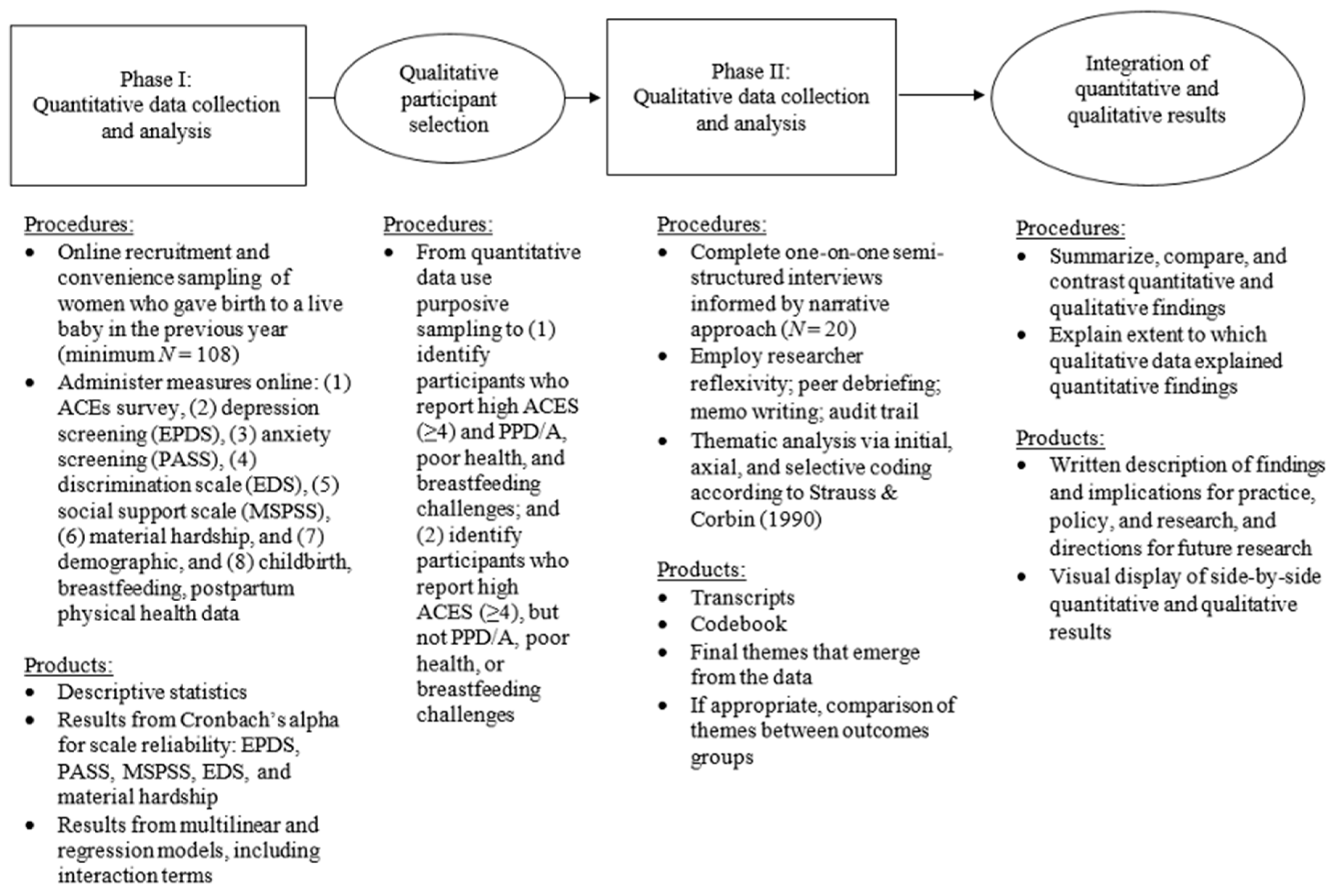
The current study emerged from a larger project focused on examining an association between ACEs and four postpartum outcomes: (a) PPD; (b) PPA; (c) postpartum physical health; and (d) breastfeeding challenges. The study used a modified mixed methods explanatory sequential design—quantitative data were collected in phase I, followed by qualitative data collection in phase II (see Figure 1; Creswell and Plano Clark 2018). A minimum of 108 participants was required to achieve power of 0.90 (α = 0.05) and to detect a small effect size (Cohen’s f 2 = 0.15). Sample size was determined using G Power (version 3.1, Kiel, Germany) a free statistical power analysis program (Faul et al. 2009).
Figure 1.
Modified mixed methods explanatory sequential design study diagram (Strauss and Corbin 1990).
Study procedures were approved by a university Institutional Review Board. Non-probability convenience sampling was used to recruit phase I quantitative participants using four modalities: (a) ResearchMatch and StudySearch (online databases of study volunteers); (b) a Facebook page created for the purposes of the study and paid Facebook advertisements; (c) sharing electronic announcements and flyers with various online Facebook groups aimed at providing emotional support and information to perinatal women from diverse racial, ethnic, and socioeconomic backgrounds; and (d) emailing the lead researcher’s contacts who served women in the perinatal period. Women were eligible for the study if they (1) were ≥18 years of age, (2) resided in the US, (3) were not currently pregnant, and (4) gave birth to a live newborn within the previous 12 months.
In phase I, 306 participants completed an online survey, and using these data, purposive and stratified sampling was used in phase II to invite a strategically selected and diverse subset of participants (n = 22) with ACEs scores of four or greater to individual interviews. This included eleven participants in the “high” adverse outcomes group, who experienced three or four negative outcomes (i.e., PPD, PPA, poor postpartum physical health, and/or breastfeeding challenges), and eleven participants in the “low” adverse outcomes group, who experienced zero or one negative outcome(s).
Individuals with two adverse outcomes were excluded from phase II recruitment to more easily discern differences between potential risk and protective factors influencing the extremes in outcomes. Incentives included a USD 10 electronic gift card for those who completed the online survey, and a USD 30 gift card for the interview. Interviews, which were approximately 60 min in length, were conducted via telephone from June to July 2019. One of the authors conducted all interviews, which were recorded and later transcribed verbatim by an IRB-approved professional transcription service. To ensure qualitative rigor and trustworthiness, we employed memo writing, reflexivity practices, peer debriefing, negative case analysis, and maintained detailed audit trails (Morse 2015). Researchers kept independent records of coding decisions and analytical reflections. Recognizing that researcher positionality—including the first author’s identity as a White doctoral student—could influence participant comfort and data interpretation, we engaged in ongoing reflexive practices, including regular supervision with a qualitative expert, use of semi-structured interviews allowing participants to guide content, and vigilant attention to potential biases throughout analysis (Dodgson 2019).
Dependent Variable: PPD was measured using a one-time questionnaire, Edinburgh Postnatal Depression Scale (EPDS), with 4-point Likert-type, 10-items (Cox et al. 1987). PPA was measured using a one-time questionnaire, the Perinatal Anxiety Screening Scale (PASS), with thirty-one 4-point Likert-type items (Somerville et al. 2014). The EPDS and PASS were selected due to their strong psychometric properties, perinatal specificity, and widespread use in both research and clinical settings. The EPDS and PASS are screening tools that assess risk for PPD/PPA rather than providing an assessment or clinical diagnosis. Accordingly, study findings refer to elevated depressive or anxiety symptom risk and were not based on psychiatric diagnosis. The Cronbach’s alphas for the EPDS and PASS were 0.89 and 0.96, respectively.
Independent Variable: The ACEs survey included the 10 core questions from the original CDC-Kaiser Permanente ACE Study (Felitti et al. 1998), plus six additional ACEs questions specific to experiences of discrimination, community violence, war, deportation, migration, and economic hardship developed by the National Survey of Children’s Health and the World Health Organization (CAHMI 2018; World Health Organization 2020). This expanded measure was selected to provide a more comprehensive and culturally relevant assessment of childhood adversity. The standard ACEs measure has been critiqued for inadequately capturing adversities disproportionately experienced by racially, ethnically, and socioeconomically marginalized communities (Cronholm et al. 2015). By including community and context-level adversities, this broader conceptualization recognizes that ACEs are patterned by structural inequities and provides increased understanding of how community and environmental factors influence outcomes. The retention of the ACE score of 4+ as a clinical cut-off was maintained based on established research demonstrating dose–response relationships between ACE exposure and health outcomes (Felitti et al. 1998). While we acknowledge that the meaning and impact of specific ACEs may vary across cultural contexts, the expanded measure better captures the range of adversities relevant to our diverse sample than the original 10-item scale alone.
Moderator variables: Material hardship, social support, and discrimination were conceptualized as binary moderators to help elucidate whether or not the presence or absence of these factors would result in differing outcomes for mothers with ACEs. This moderation framework allowed us to identify which subgroups or social contexts show different patterns of association. Dichotomization also facilitated interpretation of multiple interaction terms, allowing clearer communication of how risk and protective factors operate in combination.
Material hardship. Material hardship, a family’s ability to meet its basic needs in the previous 12 months, was measured using 10 questions informed by the work of Mayer and Jencks (1989) which was later validated for use in the Survey of Income and Program Participation and The Fragile Families and Child Wellbeing Study (Neckerman et al. 2016). Example questions include the following: “did you not pay the full amount of rent or mortgage payments,” “did you borrow money from friends or family to help pay bills,” and “were you ever hungry, but didn’t eat because you couldn’t afford enough food?” A final score is calculated as a proportion of yes responses (yes = 1; no = 0). Material hardship was then turned into a binary variable (no experiences of material hardship = 0; 1 or more experiences of material hardship = 1). The material hardship scale demonstrated acceptable internal consistency in this sample (α = 0.77).
Social support. Social support was measured using the 12-question Multidimensional Scale of Perceived Social Support [MSPSS] (G. D. Zimet et al. 1988). Sample items include the following: “There is a special person with whom I can share my joys and sorrows;” “My family tries to help me;” and “I can count on friends when things go wrong.” Item responses include a 7-point scale ranging from very strongly disagree (1) to very strongly agree (7). Tallying the items and dividing by 12 gives a mean score. For this study, the mean MSPSS score was then dichotomized (a score of 0–5.0 = low social support (0); a score of 5.1 or higher = high social support) (G. Zimet 2016). The Cronbach’s alpha for the MSPSS was 0.95.
Discrimination. The Everyday Discrimination Scale (short version; EDS) provided a valid and reliable 5-item measure of the frequency of perceived discrimination experienced based on any reason (e.g., ancestry, gender, race, religion, sexual orientation, etc.) (Sternthal et al. 2011). Questions include: “In your day-to-day life how often have any of the following things happened to you? You receive poorer service than other people at restaurants or stores;” “people act as if they are afraid of you;” and “you are threatened or harassed.” Respondents answer using a 6-point scale, from never (0) to almost every day (5). A total EDS score was calculated by adding item responses. The variable was then dichotomized to represent differences between infrequent and chronic discrimination (a score of 0–5 = low discrimination; a score of 6 or higher = high discrimination). The EDS demonstrated good internal consistency (α = 0.82).
Control Variables: Covariates included participant age, race, marital status, history of depression, anxiety, and chronic physical health problems, parity/number of births, age at first birth, infant feeding type, type of birth, and history of child’s admission to neonatal intensive care unit.
Data Analyses
Quantitative Data: Data analyses for the quantitative data were completed using the Statistical Pack for the Social Sciences (SPSS) Version 24 (IBM Corp., Chicago, IL, USA) software. Given the limited amount of missing data (n = 3 cases), listwise deletion was used. We conducted descriptive statistics and assessed the assumptions required for regression analysis, including normality, linearity, multicollinearity, and homoscedasticity, and also calculated Cronbach’s alpha for each measure to evaluate scale reliability. All continuous variables were mean centered and interaction terms were created using ACEs with each potential moderator to test for interaction effects. Two multiple linear regression models were performed (one for each outcome) to examine the association between ACEs and PPD/A. Hierarchical entry was used and control variables were entered first, followed by ACEs, material hardship, social support, and discrimination, and lastly, the interaction terms, to examine the incremental contribution of predictors.
Qualitative Data: For the qualitative data, transcripts were uploaded into NVivo Pro 12 for Windows software (QSR International, 2018) for analysis. Participant demographics and characteristics were also entered into the program to create descriptive data points using the case classifications feature. The high-adverse-outcomes group data were coded first to establish a comprehensive coding framework, followed by low-adverse-outcomes group data. Thematic analysis via the use of open, axial, and selective coding was used to analyze the data (Saldaña 2015). After initial review of the transcripts, open coding allowed for general identification of key categories and concepts related to the research questions that arose from the data. Next, in axial coding, these codes were compared and contrasted, and subcategories were identified and refined. Lastly, in selective coding, the final coding themes were identified. Qualitative and quantitative data were compared, contrasted, and integrated to explore similarities and differences. Codes were refined to ensure they accurately captured participants’ meanings across cultural contexts. The integrated data were summarized using a visual side-by-side comparison—a joint display—to examine if and how the phase II qualitative themes aligned or diverged from the phase I quantitative results, and to make final conclusions about how well the qualitative data explained and gave context to the quantitative findings (Creswell and Plano Clark 2018).
3. Results
3.1. Descriptive Statistics
In phase I, mothers’ average age was 31.06 years, and the majority (89.21%) reported being married or partnered. Those identifying as White (66.34%) were the majority, followed by Black/African American (16.34%). See Table 1 for full demographics.
Table 1.
Phase I participant demographics (N = 306).
Table 2 displays the independent, dependent, and moderator variable scale scores. The mean ACEs score was 3.26. Over 80% of the sample reported at least one ACE. A high ACEs score (≥4) was recorded for 41.83% (n = 128) of the sample. Over a quarter of the sample (26.80%) screened positive for PPD and 41.83% screened positive for PPA. The majority reported good–excellent physical health (92.81%), 72.22% of those who attempted breastfeeding reported difficulty doing so, 24.34% reported lower levels of social support, 35.29% reported experiencing discrimination, and 46.73% met the criteria for material hardship.
Table 2.
Phase I independent, dependent, and moderator variable scores (N = 306).
3.2. Multiple Linear Regression
See Table 3 for the hierarchical linear regression model results reported by block entry. The second model (control variables and ACEs score) explained 22.91% of the variance in outcomes for PPD, F(13, 290) = 6.63, p ≤ 0.001; 29.10% of the variance in outcomes for PPA, F(13, 289) = 9.13, p ≤ 0.001; and demonstrated that ACEs were positively associated with PPD (β = 1.29, p ≤ 0.001) and PPA (β = 0.27, p ≤ 0.05). Each additional ACE increased EPDS scores by approximately 1.3 points and PASS scores by approximately 0.3 points. Mothers with 4+ ACEs could then score 1–2 points higher (on PASS) and 5+ points higher (on EPDS), elevating the probability of having a positive screen. However, the effect of ACEs disappeared in model 3 when the three moderator variables were added—all of which were statistically significant predictors of PPD/A. Attenuation of ACE effects after adjustment likely reflects mediation or over-adjustment, not diminished importance of ACEs. Social support, discrimination, and material hardship explained an additional 14% of PPA variance and 19% of PPD variance beyond ACEs alone. Both final regression models (model 4) were statistically significant and fit the data well. The final block results explained 42.8% of the variances in outcomes for PPD, F(19, 284) = 11.19, p ≤ 0.001, and 43.5% of the variance in outcomes for PPA, F(19, 283) = 11.48, p ≤ 0.001. No interactions were found. Discrimination (β = 8.93, p ≤ 0.001, 95% CI [3.13, 14.72]; β = 3.61; p ≤ 0.001, 95% CI [1.75, 5.47]), material hardship (β = 9.47, p ≤ 0.001, 95% CI [3.90, 15.04]; β = 2.54; p ≤ 0.01, 95% CI [0.74, 4.34]), and social support (β = 5.83, p ≤ 0.01; β = 2.72; p ≤ 0.001, 95% CI [1.40, 4.03]) were all statistically significant predictors for PPD and PPA. In other words, each instance of discrimination or material hardship was associated with an approximately 9-point increase in EPDS scores, while low social support was linked to a 6-point increase in EPDS scores. The cumulative effect of having all three risk factors (discrimination, material hardship, and low social support) was a potential increase of 9 points on the PASS. These results highlight the significant impact of these risk factors on PMH. A prior history of depression and anxiety was also a significant predictor of PPD/A. Additionally, mothers identifying as Black or African American (β = −5.77, p = 0.02) and Asian or Native American (β = −10.05, p = 0.02) were less likely to meet the criteria for PPA when compared to White mothers. Differences by race/ethnicity were presented as exploratory due to small cell sizes.
Table 3.
Hierarchical linear regression analyses for postpartum anxiety (N = 303) and depression (N = 304).
3.3. Qualitative Findings
See Table 4 for a summary of sample characteristics of the 22 individuals who participated in interviews. Data are organized by outcomes groups. The groups were quite similar in terms of age, race, relationship status, US region of residence, education, income, and employment, but differed in terms of the number of negative perinatal health-related experiences. Four primary themes emerged from the data, including (a) social support; (b) economic factors; (c) work-related factors; and (d) self-care practices. See Table 5 for themes, description of themes, and example quotes.
Table 4.
Phase II participant characteristics by outcomes group (n = 22).
Table 5.
Qualitative themes and sample quotes.
Social support. Participants with high adverse outcomes frequently noted that inadequate social support contributed to their postpartum struggles. Participants described a lack of connection with family and friends and/or troubling isolation. Some said others did not understand their situation and needs or it was more difficult to socialize because of childrearing demands. Conversely, participants with few adverse outcomes reported social support in the form of helpful partners, assistance with household chores and childcare, and emotional connection were instrumental in their positive postpartum adjustment.
Economic factors. Participants in the high-adverse-outcomes group reported substantial financial stress that contributed to prenatal and postpartum stress. Some participants said it was too costly to pay for childcare when compared to their income. Overall, participants doing well emotionally were less likely to identify financial concerns.
Work-related factors. In both groups, most participants reported efforts to balance work and family life and the desire to work less outside the home. In contrast, some mothers found returning to work rewarding, noting that it enabled them to support their family financially and regain a sense of confidence. Participants with postpartum mental health struggles reported difficulty in returning to work more often than those in the low-adverse-outcomes group. Participants felt distracted by their family-related needs while at work, including child care arrangements, breastfeeding, children’s illnesses, limited sleep, and the desire to spend more time with their children.
Self-care practices. Participants in both groups reported prioritizing sleep, exercise, healthy eating, and/or hobbies improved their overall health. Participants in the high-adverse-outcomes group noted more frequently than those in the low-adverse-outcomes group that a lack of time and support were barriers to good physical and mental health. These participants reported longing for rejuvenating activities, time with other adults, and time alone. Additionally, some reported feeling guilty for wanting time to themselves. Participants in the low-adverse-outcomes group spoke of caring practices—both the presence and absence of self-care—less often than those in the high-outcomes group. However, some reported that they made an effort to engage in self-care by prioritizing their individual interests and health behaviors.
4. Discussion
Using a comprehensive measure of ACEs and a fairly diverse sample of perinatal mothers, we found a statistically significant relationship between mothers’ ACEs and PPD/A. This finding aligns with several prior studies that have also found an association between ACEs and PPD/A (Prentice et al. 2022; Shin et al. 2021). However, in our study, when the moderating variables of social support, discrimination, and material hardship were added to the regression model, the direct effect of ACEs on PPD/A was no longer significant; simultaneously, these three variables emerged as significant direct predictors, explaining more variance in PPD/A than did ACEs. Contrary to our hypothesis, no interaction effects were found between ACEs and each moderator variable, indicating that social support, discrimination, or material hardship did not moderate the ACEs and PPD/A relationship. Instead, the quantitative findings suggest that social support, material hardship, and discrimination may operate as independent risk or protective factors for PPD/A, potentially representing pathways through which early adversity influences PMD. Having adequate social support, financial security, choice in working, a supportive and flexible work environment, and the time and capacity for self-care may serve as key protective factors influencing mothers’ PMH and adjustment to motherhood. Both the quantitative and qualitative findings align with prior research that found inadequate social support (Feinberg et al. 2022; Inekwe and Lee 2022), experiences with discrimination (Rodriguez et al. 2019; Weeks et al. 2022), and low socioeconomic status (Cooke et al. 2025; Szurek-Cabanas et al. 2024) are associated with an increased likelihood of poor PMH outcomes.
The qualitative findings largely supported the results of our quantitative analysis by corroborating the significance of social support (lack of supportive relationships, feelings of isolation) and material hardship (financial stress, little choice in working) to mothers’ PMH (Feinberg et al. 2022; Inekwe and Lee 2022; Cooke et al. 2025). It should be noted that cultural norms may shape the expectation and availability of support in motherhood. While some cultures may emphasize, “it takes a village,” others may experience social isolation as a result of migration, acculturation, or displacement thus experiencing more PMH (Anderson et al. 2017; Reupert et al. 2022). Our qualitative findings diverge from our quantitative findings regarding the influence of discrimination. While discrimination was significantly associated with PPD/A in our final regression model, participants rarely mentioned discrimination during interviews. Possible reasons for this include that participants did not experience discrimination, participants were not directly asked about experiences with discrimination, participants may have been uncomfortable discussing discrimination and bias due to cultural norms, and participants may have been hesitant to discuss discrimination with an interviewer who may have been perceived as more privileged (e.g., White racial identity, involvement in academia).
Our findings support life course theory and liberation health social work, illuminating the influence of various personal (e.g., ACEs, self-care), cultural (e.g., lack of social support and parenting in isolation), and institutional factors (e.g., financial insecurity related to lack of paid parental leave and work-related factors) on health outcomes over the life course. The results of our quantitative analysis, in particular, also invoke consideration of a kind of ranking of priorities similar to Maslow’s hierarchy of needs (Maslow 1943). In the context of Maslow’s theory, social support, discrimination, and material hardship would represent essential human needs of safety and belonging that are required for resiliency, healthy well-being, and reaching one’s full potential. In this way, struggles related to social support, discrimination, and material hardship may serve as current and more acute experiences of trauma that take prominence over past traumas—which still may be influential, but do not necessarily require immediate attention for survival. Further, it is possible that inadequate social support, discrimination, and material hardship are particularly traumatic for women at this stage in the life course as they are not only managing their own needs but are often primarily responsible for the needs of others as well, including partners and children.
4.1. Implications
Our results may inform preconception and perinatal counseling regarding the potential influence of ACEs and social and economic factors on PMH. Based on our results, healthcare providers may consider screening their perinatal patients for ACEs (Flanagan et al. 2018) and assessing for social support and risk factors such as financial insecurity, material hardship, and experiences of discrimination. Discussions about these topics may also facilitate connecting patients with mental health treatment and other supportive resources, if needed. Practitioners may also consider educating patients on the importance of self-care and social connection for mental health and employing a trauma-informed approach, which may assist in normalizing mothers’ PMH experiences as results or byproducts of various adverse experiences rather than individual pathology (Siverns and Morgan 2019). It is important to develop culturally responsive interventions that recognize the diversity of experiences, avoiding assumptions that uniform models of ‘support’ or ‘self-care’ apply across all cultural groups, and instead tailoring approaches to the needs of each individual.
Our results also support the implementation of policies and programs aimed at better supporting the mental health of perinatal women. Specifically, our findings suggest policies and programs such as universal federal paid parental leave in the US, living wage ordinances, affordable housing, increased access to high-quality, affordable education, and large-scale efforts to dismantle institutionalized discrimination may positively influence perinatal mental health outcomes. Though there is a need for more longitudinal research on the effects of parental leave policies on PMH outcomes, existing US-based research suggests that paid and longer maternity leave is associated with improved postpartum health and mental health, including reduced likelihood of PPD (Aitken et al. 2015; Chatterji and Markowitz 2008; Dagher et al. 2014). Further, European studies have found paid maternity leave policies may not only improve postpartum mental health—particularly for first-time and low-income mothers—but also positively affect mental health into older age and allow for increased social and economic participation (Avendano et al. 2015; Butikofer et al. 2018). Research has also shown that increased household income, increased access to education, conditional cash transfer programs, improved housing conditions, and housing vouchers are associated with higher levels of mental well-being, particularly among marginalized groups (Williams and Purdie-Vaughns 2015). Additionally, our study results support the consideration of innovative community-driven interventions to improve perinatal mental health, which show promise in improving mental health outcomes through purposeful, grassroots efforts to improve social and environmental conditions in areas with increased health disparities (National Academies of Sciences and Medicine 2017). Importantly, these interventions must be culturally responsive and tailored to the social and cultural contexts of diverse perinatal populations to maximize their effectiveness and equity.
Longitudinal research is needed to examine how ACEs, social support, discrimination, and material hardship influence maternal mental health trajectories across the life course and whether outcomes differ for mothers with versus without these experiences. Future studies should also explore the cultural, historical, and social contexts shaping how adversity, mental health, and support are understood and experienced—including how cultural norms influence motherhood expectations, how specific ethnic or immigrant groups face unique challenges, and how culturally rooted coping strategies foster resilience and self-care. Additionally, research should elucidate the mechanisms (latent, pathway, or cumulative effects) linking these variables to maternal mental health outcomes.
4.2. Limitations
The findings of this study should be considered within the context of limitations. The potential for recall bias exists as participants retrospectively reported ACEs, along with their perinatal experiences, via self-report and are subject to memory inaccuracies. Likewise, symptoms of PPD/A were based on symptom scales and not through receiving a clinical diagnosis. While the scales capture women who may be at risk for PPD/PPA, we could not infer if participants met the formal diagnostic criteria for PPD/PPA. Lastly, results from the qualitative interviews may not be generalizable due to the relatively homogeneous sample. Recruitment via online platforms and social media likely yields a sample that is socioeconomically skewed and culturally specific, potentially limiting applicability to women from other cultural, linguistic, or socioeconomic backgrounds. Further, the clinical significance of specific ACE thresholds may vary across cultural contexts and populations. Future research with larger and more diverse samples could examine gradient effects and enhance the external validity of these findings.
5. Conclusions
PMH are the most common complications of pregnancy and the first year postpartum which may be complicated by ACEs. Adverse childhood experiences may affect symptoms of PPD/A due to motherhood triggering memories and a review of one’s own childhood experiences. The transition to motherhood may challenge cognitive and emotional responses that may be identified as PPD/A. The study employed a modified explanatory-sequential mixed-methods design, with 306 participants completing an online survey and, subsequently, 22 of them taking part in qualitative interviews. The quantitative findings suggest that ACEs can serve as predictors of PPD/A, but social support, material hardship, and discrimination may have greater impact on PMH. The results of the qualitative analysis suggest that having adequate social support, financial security, choice in working, a supportive and flexible work environment, and the time and capacity for self-care may serve as key protective factors influencing mothers’ PMH and adjustment to motherhood, particularly when aligned with their cultural needs. The findings can be used to inform clinical practices including counseling for preconception and perinatal conditions, screening of perinatal patients for ACEs and assessing for both protective and risk factors, and guiding policy decisions to better support the mental health of perinatal women.
Author Contributions
Conceptualization, R.M. and K.G.; Data curation, R.M.; Formal analysis, R.M.; Funding acquisition, R.M.; Methodology, R.M., K.G., M.S., K.T. and K.R.; Writing—drafting, review & editing, K.G., R.M., M.S., K.T. and K.R. All authors have read and agreed to the published version of the manuscript.
Funding
This work was supported by The National Association of Social Workers Foundation and Council on Social Work Education via the Jane B. Aron and Social Work HEALS Doctoral Fellowship, supplemented by the New York Community Trust Foundation and Postpartum Support International via the Susan A. Hickman Research Award. In using Study Search, an online listing of research studies that seek volunteers at The Ohio State University, this dissertation was also supported by Award Number Grant UL1TR002733 from the National Center for Advancing Translational Sciences. The content is solely the responsibility of the author and does not necessarily represent the official views of the National Center for Advancing Translational Sciences or the National Institutes of Health.
Institutional Review Board Statement
The study was conducted in accordance with the Declaration of Helsinki, and approved by the Behavioral and Social Sciences Institutional Review Board at The Ohio State University (protocol code 2019B0128 and date of approval 16 April 2019).
Informed Consent Statement
Informed consent was obtained from all subjects involved in the study.
Data Availability Statement
The datasets presented in this article are not readily accessible. Analyses are ongoing, and the dataset contains sensitive participant information that was not covered by the consent for broad sharing.
Conflicts of Interest
Author Rebecca McCloskey is employed by the company Mighty Crow Media, LLC. Rebecca McCloskey declares a potential conflict of interest as she received grant funding for this dissertation work from The National Association of Social Workers Foundation, Council on Social Work Education, the New York Community Trust Foundation, Postpartum Support International, and The Ohio State University. The funding supported research expenses, including recruitment, participant incentives, transcription services, and qualitative data analysis assistance. The remaining authors declare that the research was conducted in the absence of any commercial or financial relationships that could be construed as a potential conflict of interest.
References
- Agrawal, Iris, Ashok M. Mehendale, and Ritika Malhotra. 2022. Risk factors of postpartum depression. Cureus 14: e30898. [Google Scholar] [CrossRef] [Scilit] [PubMed]
- Aitken, Zoe, Cameryn C. Garrett, Belinda Hewitt, Louise Keogh, Jane S. Hocking, and Anne M. Kavanagh. 2015. The maternal health outcomes of paid maternity leave: A systematic review. Social Science & Medicine 130: 32–41. [Google Scholar] [CrossRef] [Scilit] [PubMed]
- Alhowaymel, Fahad M., Karen A. Kalmakis, Lisa M. Chiodo, Nicole M. Kent, and Maha Almuneef. 2023. Adverse childhood experiences and chronic diseases: Identifying a cut-point for ACE scores. International Journal of Environmental Research and Public Health 20: 1651. [Google Scholar] [CrossRef] [Scilit] [PubMed]
- Alhusen, Jeanne L., Rosemary B. Hughes, Genevieve Lyons, and Kathryn Laughon. 2023. Depressive symptoms during the perinatal period by disability status: Findings from the United States Pregnancy Risk Assessment Monitoring System. Journal of Advanced Nursing 79: 223–33. [Google Scholar] [CrossRef] [Scilit] [PubMed]
- Anderson, Fraser M., Stephani L. Hatch, Carla Comacchio, and Louise M. Howard. 2017. Prevalence and risk of mental disorders in the perinatal period among migrant women: A systematic review and meta-analysis. Archives of Women’s Mental Health 20: 449–62. [Google Scholar] [CrossRef] [Scilit]
- Avendano, Mauricio, Lisa F. Berkman, Agar Brugiavini, and Giacomo Pasini. 2015. The long-run effect of maternity leave benefits on mental health: Evidence from European countries. Social Science & Medicine 132: 45–53. [Google Scholar] [CrossRef] [Scilit]
- Basto-Pereira, Miguel, Maria Gouveia-Pereira, Cicero Roberto Pereira, Emma Louise Barrett, Siobhan Lawler, Nicola Newton, Lexine Stapinski, Katrina Prior, Maria Suely Alves Costa, Jocélia Medeiros Ximenes, and et al. 2022. The global impact of adverse childhood experiences on criminal behavior: A cross-continental study. Child Abuse & Neglect 124: 105459. [Google Scholar] [CrossRef] [Scilit]
- Bécares, Laia, and Polly Atatoa-Carr. 2016. The association between maternal and partner experienced racial discrimination and prenatal perceived stress, prenatal and postnatal depression: Findings from the growing up in New Zealand cohort study. International Journal for Equity in Health 15: 155. [Google Scholar] [CrossRef] [Scilit] [PubMed]
- Bütikofer, Aline, Julie Riise, and Meghan M. Skira. 2018. The impact of paid maternity leave on maternal health. American Economic Journal: Economic Policy 13: 67–105. [Google Scholar] [CrossRef] [Scilit]
- Cantrell, Sarah J., Rebecca M. Pearson, and Alessandra Prioreschi. 2025. Maternal perspectives on poor mental health and the impact on mother-infant relationships. Journal of Reproductive and Infant Psychology, 1–18. [Google Scholar] [CrossRef] [Scilit]
- Ceccarelli, C., E. Prina, O. Muneghina, M. Jordans, E. Barker, K. Miller, R. Singh, C. Acarturk, K. Sorsdhal, P. Cuijpers, and et al. 2022. Adverse childhood experiences and global mental health: Avenues to reduce the burden of child and adolescent mental disorders. Epidemiology and Psychiatric Sciences 31: e75. [Google Scholar] [CrossRef] [Scilit]
- Chatterji, Pinka, and Sara Markowitz. 2008. Family leave after childbirth and the mental health of new mothers. The Journal of Mental Health Policy and Economics 15: 61–76. [Google Scholar]
- Chaudron, Linda H., Peter G. Szilagyi, Wan Tang, Elizabeth Anson, Nancy L. Talbot, Holly IM Wadkins, Xin Tu, and Katherine L. Wisner. 2010. Accuracy of depression screening tools for identifying postpartum depression among urban mothers. Pediatrics 125: e609–17. [Google Scholar] [CrossRef] [Scilit]
- Child and Adolescent Health Measurement Initiative (CAHMI), Data Resource Center on Child and Adolescent Health Website. 2018. Guide to Topics & Questions Asked. National Survey of Children’s Health 2016. Available online: http://childhealthdata.org/learn/NSCH/topics_questions/2016-nsch-guide-to-topics-and-questions#sqI (accessed on 10 September 2025).
- Cho, Hahyeon, Kyeongmin Lee, Eunji Choi, Ha Na Cho, Boyoung Park, Mina Suh, Yumie Rhee, and Kui Son Choi. 2022. Association between social support and postpartum depression. Scientific Reports 12: 3128. [Google Scholar] [CrossRef] [Scilit] [PubMed]
- Choi, Karmel W., and Kathleen J. Sikkema. 2016. Childhood maltreatment and perinatal mood and anxiety disorders: A systematic review. Trauma, Violence, & Abuse 17: 427–53. [Google Scholar] [CrossRef] [Scilit]
- Choi, Karmel W., Renate Houts, Louise Arseneault, Carmine Pariante, Kathleen J. Sikkema, and Terrie E. Moffitt. 2018. Maternal depression in the intergenerational transmission of childhood maltreatment and its sequelae: Testing postpartum effects in a longitudinal birth cohort. Development and Psychopathology 31: 143–56. [Google Scholar] [CrossRef] [Scilit]
- Clement, Amelia, and Kathryn Fay. 2021. 136 Disparities in state-mandated third trimester testing for syphilis. American Journal of Obstetrics & Gynecology 224: S93. [Google Scholar]
- Cooke, Adriana, Negin Nasiri, Shiny Aroan Jayakumar, and Shahid Bakhsh Rangrej. 2025. A systematic review of the effect of socioeconomic status on the prevalence of postpartum depression (PPD). International Journal of Psychology 60: e70063. [Google Scholar] [CrossRef] [Scilit]
- Cox, John L., Jeni M. Holden, and Ruth Sagovsky. 1987. Detection of Postnatal Depression: Development of the 10-item Edinburgh Postnatal Depression Scale. British Journal of Psychiatry 150: 782–86. [Google Scholar] [CrossRef] [Scilit]
- Creswell, John W., and Vicki L. Plano Clark. 2018. Designing and Conducting Mixed Methods Research, 3rd ed. Thousand Oaks: SAGE. [Google Scholar]
- Cronholm, Peter F., Christine M. Forke, Roy Wade, Megan H. Bair-Merritt, Martha Davis, Mary Harkins-Schwarz, Lee M. Pachter, and Joel A. Fein. 2015. Adverse Childhood Experiences: Expanding the concept of adversity. American Journal of Preventive Medicine 49: 354–61. [Google Scholar] [CrossRef] [Scilit] [PubMed]
- Dagher, Rada K., Patricia M. McGovern, and Bryan E. Dowd. 2014. Maternity leave duration and postpartum mental and physical health: Implications for leave policies. Journal of Health Politics, Policy and Law 39: 369–416. [Google Scholar] [CrossRef] [Scilit]
- Dodgson, Joan E. 2019. Reflexivity in qualitative research. Journal of Human Lactation 35: 220–22. [Google Scholar] [CrossRef] [Scilit]
- Doherty, Emily A., Kathleen Cartmell, Sarah Griffin, Moonseong Heo, Liwei Chen, Jessica L. Britt, and Amy H. Crockett. 2023. Discrimination and adverse perinatal health outcomes: A latent class analysis. Preventing Chronic Disease 20: e96. [Google Scholar] [CrossRef] [Scilit]
- Elder, Glen H., Monica Kirkpatrick Johnson, and Robert Crosnoe. 2003. The emergence and development of life course theory. In Handbook of the Life Course. Edited by Jeylan T. Mortimer and Michael J. Shanahan. New York: Springer, pp. 3–19. [Google Scholar]
- Ertel, Karen A., Tamarra James-Todd, Kenneth Kleinman, Nancy Krieger, Matthew Gillman, Rosalind Wright, and Janet Rich-Edwards. 2012. Racial discrimination, response to unfair treatment, and depressive symptoms among pregnant black and African American women in the United States. Annals of Epidemiology 22: 840–46. [Google Scholar] [CrossRef] [Scilit] [PubMed]
- Falah-Hassani, Kobra, Rahman Shiri, Simone Vigod, and Cindy-Lee Dennis. 2015. Prevalence of postpartum depression among immigrant women: A systematic review and meta-analysis. Journal of Psychiatric Research 70: 67–82. [Google Scholar] [CrossRef] [Scilit]
- Faul, Franz, Edgar Erdfelder, Axel Buchner, and Albert-Georg Lang. 2009. Statistical power analyses using GPower 3.1: Tests for correlation and regression analyses. Behavior Research Methods 41: 1149–60. [Google Scholar] [CrossRef] [Scilit]
- Fawcett, Emily J., Nichole Fairbrother, Megan L. Cox, Ian R. White, and Jonathan M. Fawcett. 2019. The prevalence of anxiety disorders during pregnancy and the postpartum period: A multivariate Bayesian meta-analysis. The Journal of Clinical Psychiatry 80: 18r12527. [Google Scholar] [CrossRef] [Scilit]
- Feinberg, Emily, Eugene Declercq, Annette Lee, and Candice Belanoff. 2022. The relationship between social support and postnatal anxiety and depression: Results from the Listening to Mothers in California survey. Women’s Health Issues 32: 251–60. [Google Scholar] [CrossRef] [Scilit]
- Felitti, Vincent J., Robert F. Anda, Dale Nordenberg, David F. Williamson, Alison M. Spitz, Valerie Edwards, Mary P. Koss, and James S. Marks. 1998. Relationship of childhood abuse and household dysfunction to many of the leading causes of death in adults. The Adverse Childhood Experiences (ACE) study. American Journal of Preventive Medicine 14: 245–58. [Google Scholar] [CrossRef] [Scilit] [PubMed]
- Flanagan, Tracy, Amy Alabaster, Brigid McCaw, Nicole Stoller, Carey Watson, and Kelly C. Young-Wolff. 2018. Feasibility and acceptability of screening for adverse childhood experiences in prenatal care. Journal of Women’s Health 27: 93–911. [Google Scholar] [CrossRef] [Scilit] [PubMed]
- Forde, Allana T., Danielle M. Crookes, Shakira F. Suglia, and Ryan T. Demmer. 2019. The weathering hypothesis as an explanation for racial disparities in health: A systematic review. Annals of Epidemiology 33: 1–18. [Google Scholar] [CrossRef] [Scilit]
- Gavin, Norma I., Bradley N. Gaynes, Kathleen N. Lohr, Samantha Meltzer-Brody, Gerald Gartlehner, and Tammeka Swinson. 2005. Perinatal depression: A systematic review of prevalence and incidence. Obstetrics and Gynecology 106: 1071–83. [Google Scholar] [CrossRef] [Scilit]
- Gregory, Kayleigh A., Madelyn J. Hill, Mastano Dzimbiri, and Ashley L. Merianos. 2025. Exploring the perspectives of healthcare professionals on the most significant health disparities observed in perinatal settings: A qualitative study. Midwifery 145: 104366. [Google Scholar] [CrossRef] [Scilit]
- Grote, Nancy K., Jeffrey A. Bridge, Amelia R. Gavin, Jennifer L. Melville, Satish Iyengar, and Wayne J. Katon. 2010. A meta-analysis of depression during pregnancy and the risk of preterm birth, low birth weight, and intrauterine growth restriction. Archives of General Psychiatry 67: 1012–24. [Google Scholar] [CrossRef] [Scilit] [PubMed]
- Health Resources and Services Administration, Maternal and Child Health Bureau. 2023. Material Hardship Among Children, 2022. National Survey of Children’s Health Data Brief. U.S. Department of Health and Human Services. Available online: https://mchb.hrsa.gov/sites/default/files/mchb/data-research/nsch-data-brief-2022-material-hardship.pdf (accessed on 5 September 2025).
- Hofstede, Geert. 1980. Culture and organizations. International Studies of Management & Organization 10: 15–41. [Google Scholar] [CrossRef] [Scilit]
- Howard, Louise M., and Hind Khalifeh. 2020. Perinatal mental health: A review of progress and challenges. World Psychiatry 19: 313–27. [Google Scholar] [CrossRef] [Scilit]
- Hudson, Darrell L., Harold W. Neighbors, Arline T. Geronimus, and James S. Jackson. 2016. Racial discrimination, john henryism, and depression among African Americans. Journal of Black Psychology 42: 221–43. [Google Scholar] [CrossRef] [Scilit]
- Inekwe, John Nkwoma, and Evelyn Lee. 2022. Perceived social support on postpartum mental health: An instrumental variable analysis. PLoS ONE 17: e0265941. [Google Scholar] [CrossRef] [Scilit]
- Johansen, Sara L., Ben A. Stenhaug, Thalia K. Robakis, Katherine E. Williams, and Mark R. Cullen. 2020. Past psychiatric conditions as risk factors for postpartum depression: A nationwide cohort study. The Journal of Clinical Psychiatry 81: 18405. [Google Scholar] [CrossRef] [Scilit]
- Kalmakis, Karen A., and Genevieve E. Chandler. 2015. Health consequences of adverse childhood experiences: A systematic review. Journal of the American Association of Nurse Practitioners 27: 457–65. [Google Scholar] [CrossRef] [Scilit]
- Katz, Jennifer, Hugh F. Crean, Catherine Cerulli, and Ellen L. Poleshuck. 2018. Material hardship and mental health symptoms among a predominantly low income sample of pregnant women seeking prenatal care. Maternal and Child Health Journal 22: 1360–67. [Google Scholar] [CrossRef] [Scilit]
- Kotchabhakdi, N. J., P. Winichagoon, S. Smitasiri, S. Dhanamitta, and A. Valyasevi. 1987. The integration of psychosocial components in nutrition education in northeastern Thai villages. Asia Pacific Journal of Public Health 1: 16–25. [Google Scholar] [CrossRef] [Scilit]
- Koutra, Katerina, Theano Roumeliotaki, Andriani Kyriklaki, Mariza Kampouri, Katerina Sarri, Maria Vassilaki, Panos Bitsios, Manolis Kogevinas, and Leda Chatzi. 2017. Maternal depression and personality traits in association with child neuropsychological and behavioral development in pre-school years: Mother-child cohort (Rhea Study) in Crete, Greece. Journal of Affective Disorders 217: 89–98. [Google Scholar] [CrossRef] [Scilit]
- Leahy-Warren, Patricia, Geraldine McCarthy, and Paul Corcoran. 2011. Postnatal depression in first-time mothers: Prevalence and relationships between functional and structural social support at 6 and 12 weeks postpartum. Archives of Psychiatric Nursing 25: 174–84. [Google Scholar] [CrossRef] [Scilit] [PubMed]
- Liu, Xueyan, Shuhui Wang, and Guangpeng Wang. 2022. Prevalence and risk factors of postpartum depression in women: A systematic review and meta-analysis. Journal of Clinical Nursing 31: 2665–77. [Google Scholar] [CrossRef] [Scilit]
- Luca, Dara Lee, Nellie Garlow, Colleen Staatz, Caroline Margiotta, and Kara Zivin. 2019. Societal Costs of Untreated Perinatal Mood and Anxiety Disorders in the United States. Princeton: Mathematica Policy Research. Available online: https://www.mathematica.org/publications/societal-costs-of-untreated-perinatal-mood-and-anxiety-disorders-in-the-united-states (accessed on 10 September 2025).
- Mackle, Tracey, Lucía Colodro-Conde, Therese de Dassel, Anastasia Braun, Adele Pope, Elizabeth Bennett, Alka Kothari, George Bruxner, Sarah E. Medland, Sue Patterson, and et al. 2023. ‘Echoes of a dark past’ is a history of maternal childhood maltreatment a perinatal risk factor for pregnancy and postpartum trauma experiences? A longitudinal study. BMC Pregnancy Childbirth 23: 397. [Google Scholar] [CrossRef] [Scilit] [PubMed]
- Mann, Joshua R., Jana Mannan, Luis Antonio Quiñones, Allyson A. Palmer, and Myriam Torres. 2010. Religion, spirituality, social support, and perceived stress in pregnant and postpartum Hispanic women. Journal of Obstetric, Gynecologic, and Neonatal Nursing 39: 645–57. [Google Scholar] [CrossRef] [Scilit]
- Martinez, Dawn Belkin, and Ann Fleck-Henderson, eds. 2014. Social Justice in Clinical Practice: A Liberation Health Framework for Social Work. New York: Routledge. [Google Scholar]
- Maslow, Abraham Harold. 1943. A theory of human motivation. Psychological Review 50: 370–96. [Google Scholar] [CrossRef] [Scilit]
- Masters, Claire, Jessica B. Lewis, Ashley Hagaman, Jordan L. Thomas, Rogie Royce Carandang, Jeannette R. Ickovics, and Shayna D. Cunningham. 2024. Discrimination and perinatal depressive symptoms: The protective role of social support and resilience. Journal of Affective Disorders 354: 656–61. [Google Scholar] [CrossRef] [Scilit]
- Mayer, Susan E., and Christopher Jencks. 1989. Growing up in poor neighborhoods: How much does it matter? Science 243: 1441–45. [Google Scholar] [CrossRef] [Scilit] [PubMed]
- McCloskey, Rebecca J., and Fei Pei. 2022. Associations between mothers’ adverse childhood experiences, material hardship, and breastfeeding challenges in the United States. Journal of Human Lactation 38: 651–60. [Google Scholar] [CrossRef] [Scilit]
- McCloskey, Rebecca J., and Sharvari Karandikar. 2018. A liberation health approach to examining challenges and facilitators of peer-to-peer human milk sharing. Journal of Human Lactation 34: 438–47. [Google Scholar] [CrossRef] [Scilit]
- Metzler, Marilyn, Melissa T. Merrick, Joanne Klevens, Katie A. Ports, and Derek C. Ford. 2017. Adverse childhood experiences and life opportunities: Shifting the narrative. Children and Youth Services Review 72: 141–49. [Google Scholar] [CrossRef] [Scilit]
- Miller, Laura J., Sandy Rowlands, Laura Esposito, Margaret Altemus, and Jennifer L. Strauss. 2022. The Veterans Health Administration Reproductive Mental Health Consultation Program: An innovation to improve access to specialty care. Journal of General Internal Medicine 37: 833–36. [Google Scholar] [CrossRef] [Scilit]
- Morse, Janice M. 2015. Critical analysis of strategies for determining rigor in qualitative inquiry. Qualitative Health Research 25: 1212–22. [Google Scholar] [CrossRef] [Scilit]
- National Academies of Sciences, Engineering, and Medicine. 2017. Communities in Action: Pathways to Health Equity. Edited by Alina Baciu, Yamrot Negussie, Amy Geller and James N. Weinstein. Washington: National Academies Press. [Google Scholar] [CrossRef] [Scilit]
- Neckerman, Kathryn M., Irwin Garfinkel, Julien O. Teitler, Jane Waldfogel, and Christopher Wimer. 2016. Beyond income poverty: Measuring disadvantage in terms of material hardship and health. Academic Pediatrics 16: S52–S59. [Google Scholar] [CrossRef] [Scilit] [PubMed]
- Prentice, Danielle M., Banan W. Otaibi, Christy Stetter, Allen R. Kunselman, and Serdar H. Ural. 2022. The association between adverse childhood experiences and postpartum depression. Frontiers in Global Women’s Health 3: 898765. [Google Scholar] [CrossRef] [Scilit] [PubMed]
- Racine, Nicole, Chloe Devereaux, Jessica E. Cooke, Rachel Eirich, Jenney Zhu, and Sheri Madigan. 2021. Adverse childhood experiences and maternal anxiety and depression: A meta-analysis. BMC Psychiatry 21: 28. [Google Scholar] [CrossRef] [Scilit] [PubMed]
- Reupert, Andrea, Shulamith Lala Straussner, Bente Weimand, and Darryl Maybery. 2022. It Takes a Village to Raise a Child: Understanding and Expanding the Concept of the ‘Village’. Frontiers in Public Health 10: 756066. [Google Scholar] [CrossRef] [Scilit]
- Rodriguez, Angela C. Incollingo, Christine Dunkel Schetter, Alexandra Brewis, and A. Janet Tomiyama. 2019. The psychological burden of baby weight: Pregnancy, weight stigma, and maternal health. Social Science & Medicine 235: 112401. [Google Scholar] [CrossRef] [Scilit]
- Saldaña, Johnny. 2015. The Coding Manual for Qualitative Researchers. Thousand Oaks: SAGE. [Google Scholar]
- Schwab-Reese, Laura M., Ellen J. Schafer, and Sato Ashida. 2016. Associations of social support and stress with postpartum maternal mental health symptoms: Main effects, moderation, and mediation. Women & Health 57: 723–40. [Google Scholar] [CrossRef] [Scilit] [PubMed]
- Segre, Lisa S., Brooke T. Mehner, and Rebecca L. Brock. 2021. Perceived racial discrimination and depressed mood in perinatal women: An extension of the domain specific stress index. Women’s Health Issues 31: 254–62. [Google Scholar] [CrossRef] [Scilit]
- Shin, Sunny H., Gabriela Ksinan Jiskrova, Tiffany Kimbrough, Karen Tabb Dina, Elizabeth Overall Lee, and Carl E. Ayers. 2021. Maternal adverse childhood experiences and postpartum depressive symptoms in young, low-income women. Psychiatry Research 296: 113679. [Google Scholar] [CrossRef] [Scilit]
- Shonkoff, Jack P., Andrew S. Garner, Committee on Psychosocial Aspects of Child and Family Health, Committee on Early Childhood, Adoption, and Dependent Care, and Section on Developmental and Behavioral Pediatrics, Benjamin S. Siegel, Mary I. Dobbins, Marian F. Earls, Andrew S. Garner, Laura McGuinn, John Pascoe, and David L. Wood. 2012. The lifelong effects of early childhood adversity and toxic stress. Pediatrics 129: e232–46. [Google Scholar] [CrossRef] [Scilit] [PubMed]
- Siverns, Kate, and Gareth Morgan. 2019. Parenting in the context of historical childhood trauma: An interpretive meta-synthesis. Child Abuse & Neglect 98: 104186. [Google Scholar] [CrossRef] [Scilit] [PubMed]
- Somerville, Susanne, Kellie Dedman, Rosemary Hagan, Elizabeth Oxnam, Michelle Wettinger, Shannon Byrne, Soledad Coo, Dorota Doherty, and Andrew C. Page. 2014. The Perinatal Anxiety Screening Scale: Development and preliminary validation. Archives of Women’s Mental Health 17: 443–54. [Google Scholar] [CrossRef] [Scilit]
- Souch, Alistair J., Ian R. Jones, Katherine H. Shelton, and Cerith S. Waters. 2025. Adverse Childhood Experiences (ACEs) and childbearing and perinatal mental health outcomes in a clinical sample of women. Journal of Affective Disorders 391: 120038. [Google Scholar] [CrossRef] [Scilit]
- Sperlich, Mickey, Julia S. Seng, Yang Li, Julie Taylor, and Caroline Bradbury-Jones. 2017. Integrating trauma-informed care into maternity care practice: Conceptual and practical issues. Journal of Midwifery & Women’s Health 62: 661–72. [Google Scholar] [CrossRef] [Scilit]
- Sternthal, Michelle J., Natalie Slopen, and David R. Williams. 2011. Racial disparities in health: How much does stress really matter? Du Bois Review 8: 95–113. [Google Scholar] [CrossRef] [Scilit]
- Strauss, Anselm, and Juliet M. Corbin. 1990. Basics of Qualitative Research: Grounded Theory Procedures and Techniques. Thousand Oaks: Sage Publications, Inc. [Google Scholar] [CrossRef] [Scilit]
- Szurek-Cabanas, Rocío, Ginés Navarro-Carrillo, Celia Andrea Martínez-Sánchez, Juan Carlos Oyanedel, and Dolores Villalobos. 2024. Socioeconomic status and maternal postpartum depression: A PRISMA-compliant systematic review. Current Psychology 43: 27339–50. [Google Scholar] [CrossRef] [Scilit]
- Thai, Andrea. 2024. Exploring Sociocultural Influences on Maternal Mental Health: Impacts, Challenges, and Interventions. Los Angeles: UCLA: Center for Community Engagement. Available online: https://escholarship.org/uc/item/9kx164x7 (accessed on 10 September 2025).
- Valdes, Elise G., Lora Sparkman, Rola Aamar, Leigh Steiner, Jack M. Gorman, Vicki Ittel, Johnny J. Bethea, and Christopher Reist. 2023. Improving maternal mental health: Assessing the extent of screening and training about peripartum depression. The Journal of Maternal-Fetal & Neonatal Medicine 36: 2155042. [Google Scholar] [CrossRef] [Scilit]
- van Daalen, Kim Robin, Jeenan Kaiser, Samuel Kebede, Gabriela Cipriano, Hassan Maimouni, Ekiomoado Olumese, Anthea Chui, Isla Kuhn, and Clare Oliver-Williams. 2022. Racial discrimination and adverse pregnancy outcomes: A systematic review and meta-analysis. BMJ Global Health 7: e009227. [Google Scholar] [CrossRef] [Scilit]
- Volling, Brenda L., Natasha J. Cabrera, Mark E Feinberg, Damon E Jones, Brandon T. McDaniel, Siwei Liu, David Almeida, Jin-Kyung Lee, Sarah J. Schoppe-Sullivan, Xin Feng, and et al. 2019. Advancing research and measurement on fathering and children’s development. Monographs of the Society for Research in Child Development 84: 7–160. [Google Scholar] [CrossRef] [Scilit]
- Walker, Janiece L, R Jeanne Ruiz, Juanita J Chinn, Nathan Marti, and Tiffany N Ricks. 2012. Discrimination, acculturation and other predictors of depression among pregnant Hispanic women. Ethnicity & Disease 22: 497–503. [Google Scholar]
- Wallace, Maeve E., and Jaquelyn L. Jahn. 2025. Pregnancy-associated mortality due to homicide, suicide, and drug overdose. JAMA Network Open 8: e2459342. [Google Scholar] [CrossRef] [Scilit]
- Weeks, Fiona, Jasmine Zapata, Angela Rohan, and Tiffany Green. 2022. Are experiences of racial discrimination associated with postpartum depressive symptoms? A multistate analysis of pregnancy risk assessment monitoring system data. Journal of Women’s Health 31: 158–66. [Google Scholar] [CrossRef] [Scilit] [PubMed]
- White, Lauren K., Sara L. Kornfield, Megan M. Himes, Markolline Forkpa, Rebecca Waller, Wanjikũ F. M. Njoroge, Ran Barzilay, Barbara H. Chaiyachati, Heather H. Burris, Andrea F. Duncan, and et al. 2023. The impact of postpartum social support on postpartum mental health outcomes during the COVID-19 pandemic. Arch Womens Ment Health 26: 531–41. [Google Scholar] [CrossRef] [Scilit]
- Williams, David R., and Valerie Purdie-Vaughns. 2015. Social and behavioral interventions to improve health and reduce disparities in health. In Population Health: Behavioral and Social Science Insights; Edited by Robert M. Kaplan, Michael L. Spittel and Daryn H. David. Rockville: Agency for Healthcare Research and Quality/Office of Behavioral and Social Science Research, pp. 51–64. [Google Scholar]
- Williams, David R., Jourdyn A. Lawrence, Brigette A. Davis, and Cecilia Vu. 2019. Understanding how discrimination can affect health. Health Services Research 54: 1374–88. [Google Scholar] [CrossRef] [Scilit] [PubMed]
- World Health Organization. 2020. Adverse Childhood Experiences International Questionnaire (ACE-IQ). Available online: https://www.who.int/publications/m/item/adverse-childhood-experiences-international-questionnaire-(ace-iq) (accessed on 10 September 2025).
- World Health Organization. 2025. Perinatal Mental Health. Available online: https://www.who.int/teams/mental-health-and-substance-use/promotion-prevention/maternal-mental-health (accessed on 10 September 2025).
- Wosu, Adaeze C., Bizu Gelaye, and Michelle A. Williams. 2015. History of childhood sexual abuse and risk of prenatal and postpartum depression or depressive symptoms: An epidemiologic review. Archives of Women’s Mental Health 18: 659–71. [Google Scholar] [CrossRef] [Scilit] [PubMed]
- Xiao, Xiao, Fei-Wan Ngai, She-Ning Zhu, and Alice Yuen Loke. 2019. The experiences of early postpartum Shenzhen mothers and their need for home visit services: A qualitative exploratory study. BMC Pregnancy and Childbirth 20: 5. [Google Scholar] [CrossRef] [Scilit]
- Zhang, Yanjun, and Shenghua Jin. 2016. The impact of social support on postpartum depression: The mediator role of self-efficacy. Journal of Health Psychology 21: 720–26. [Google Scholar] [CrossRef] [Scilit]
- Zimet, Gregory. 2016. Multidimensional Scale of Perceived Social Support (MSPSS)-Scale Items and Scoring Information. Available online: https://www.researchgate.net/publication/311534896_Multidimensional_Scale_of_Perceived_Social_Support_MSPSS_-_Scale_Items_and_Scoring_Information (accessed on 10 September 2025).
- Zimet, Gregory D., Nancy W. Dahlem, Sara G. Zimet, and Gordon K. Farley. 1988. The Multidimensional Scale of Perceived Social Support. Journal of Personality Assessment 52: 30–41. [Google Scholar] [CrossRef] [Scilit]

Disclaimer/Publisher’s Note: The statements, opinions and data contained in all publications are solely those of the individual author(s) and contributor(s) and not of MDPI and/or the editor(s). MDPI and/or the editor(s) disclaim responsibility for any injury to people or property resulting from any ideas, methods, instructions or products referred to in the content. |
© 2026 by the authors. Licensee MDPI, Basel, Switzerland. This article is an open access article distributed under the terms and conditions of the Creative Commons Attribution (CC BY) license.