1. Introduction
The South African academic landscape comes from imperialism, white supremacy and legalised racism, which privileged white people along racial, gender and economic lines. Higher education institutions were typically white, patriarchal and Eurocentric. Since 1994, higher education institutions have had to implement transformative policies to become more inclusive towards non-white members of South African society (
Mahabeer et al. 2018;
Msiza et al. 2023). To break away from the white colonial and apartheid landscape, higher education institutions became more inclusive and diverse, but still had challenges, specifically with the inclusivity of black women. In support,
Zerai et al. (
2023) posit that frameworks of inclusion in an increasingly neoliberal and patriarchal higher education context partially support black women’s academic careers but do not do nearly enough to promote practices that expedite their academic success. Research indicates that black women, in particular, are at the receiving end of discriminatory and oppressive systems that are prevalent within higher education (
Mahabeer et al. 2018;
Msiza et al. 2023).
Furthermore, a marginalising institutional culture, high teaching workloads, a lack of mentorship and promotion trajectories, and expectations to support students and colleagues emotionally contribute to compromised physical and mental health, as well as non-optimal working conditions (
Zerai et al. 2023). As a response to these discriminatory structures and institutional culture, the ‘Feminist Decoloniality as Care’ (FemDAC) study group was formed to counter these perpetuating conditions against black women. As a decolonial process, FemDAC seeks to understand coloniality, its pervasiveness and its perpetuation in the organisation of the current world order (
Khoo et al. 2020). The study group was funded through the Andrew Mellon Foundation. The grant number is G-1807-06023 with the project name: ‘Neoliberalism, Gender and Curriculum Transformation in Higher Education: Feminist Decoloniality as Care’.
The concept of feminist decoloniality argues against modernity, which organises the world ontologically in terms of atomic, homogenous, separable categories (
Lugones 2010). Thus, the feminist critique by non-white women challenges feminist universalism, which centres on the claim that the intersection of race, class, sexuality, and gender exceeds the categories of modernity (
Lugones 2010). Feminist decoloniality, therefore, employs a particular focus on the decolonial theory that critiques Western hegemony in knowledge production (
Lugones 2008,
2010). Knowledge production within universities is debated both at epistemological and ontological levels. Furthermore, “concerns about epistemic injustice apply to what is categorised, constructed and perceived as knowledge (thinking) as well as to the distinct ways in which knowledge is disseminated (talking)” (
Khoo et al. 2020, p. 55). This critical tension is embedded in a history of maligning the marginalised ‘other’ (which in this paper are black women) and rendering them voiceless. The long-silenced history of black women in general and within academia is well documented. Women in South Africa, as suggested by
Lewis and Baderoon (
2021), have “always spoken through action, creativity and words” (
Lewis and Baderoon 2021, p. 1); as such, this paper presents components of action, creativity and words by the FemDAC group.
Senior academics concerned about the plight of early career black women in the academy, who face numerous challenges, decided to create a platform to support them. As previously mentioned, some of the challenges black women academics were facing included an institutional culture that was hostile to their presence; very high student numbers and teaching workloads; lack of mentorship; racism and gender bias, to name a few. In their own words, these academics also professed to experiencing social and academic trauma due to being trapped by competing demands and feeling unseen, unsupported, stifled, and incapacitated (
Moletsane et al. 2023).
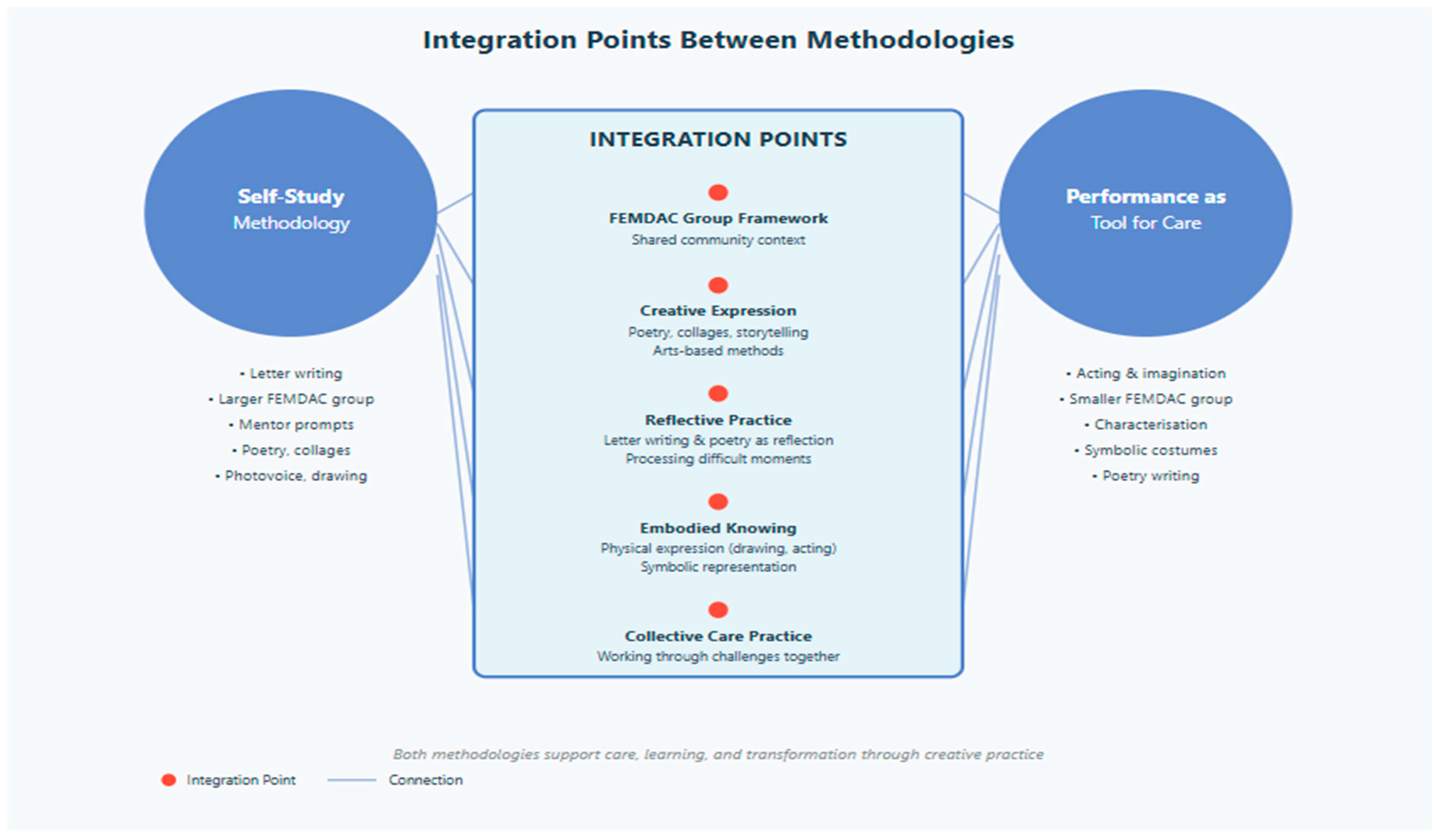
This paper presents reflections from four black women academics on their process of creating a theatrical performance about their experiences in higher education and the complexity of care. This resulted in the reverberations of failure and rupture, at times, during the performance-making process. The four black women academics who offer reflections are part of a bigger FemDAC research group of the South African cohort. Between 2019 and 2021, the cohort of black women who are part of a larger research group, FemDAC, in South Africa were prompted by mentors and facilitators to write letters on three things: (1) To write to their younger selves and reflect on their current career as black academics, (2) To describe their understanding of gender equality and equity within academia as black academic women, and (3) To reflect on their COVID-19 experiences.
In a letter written by one of the FemDAC collaborators, participant 1 articulated academic trauma as follows:
“I’ll start by saying that it’s not an easy journey, most of the time you have to constantly prove yourself… as someone who exists. Your visibility is mostly left hanging…You get used to the coldness in the air and convince yourself that this is how things are. But actually you are just being ignored”.
The reflections varied from each participant. However, the three prompts were a way of bringing to the fore, the challenges of black women academics. The more senior black women academics, therefore, founded FemDAC to practise decoloniality by supporting and empowering black women in the academy. The element of care was added as it was apparent that the progression of black women academics in the academy was being hampered by the uncaring, wounding, hostile and exclusionary culture that permeates academia.
FemDAC was a five-year research project and collaboration among black women academics from five public universities, three in South Africa and two in the United States of America. It adapted principles of decolonial theory to research, teaching, and practice conducted by colleagues in the social sciences and arts worldwide. An essential focus of FemDAC’s work was the application of arts-based research methods, including the creative arts, which led to the selection of letter writing, collages, photo-voice drawing and a theatrical performance as data collection and analysis methods for our specific study group.
For black women to collectively write letters about their academic experiences, they must employ methods of embodied narratives that draw on theories of the flesh and Black feminist thought within feminist studies. Black women needed to own their stories in the parameters of the neoliberal university and the ‘everydayness’ of being a black woman. Throughout the process, this was evident in the act of narrating our narratives and observations. Madison states that “theories of the flesh mark black feminists’ primary ways of knowing, but the second level of knowledge, is what
Collins (
1986) calls “specialised knowledge” and what hooks calls abstract, critical thought. All this initiates a balancing act to present alternative ways of producing and validating knowledge (Collins “social construction” (
Collins 1990, p. 298;
Madison 1993, p. 214)).
Collins (
1990) further explains that black feminist thought encompasses a way of seeing all systematic oppressions as an overall framework, rather than beginning with gender and then adding more contributing factors of oppression, such as race and gender. Instead, it unearths the various intersections of systematic oppressions as lived experiences, drawing on social theory. Black feminist thought is then rooted in the ordinary lived experiences of struggles, survival, communal wisdom and creativity. She draws on various scholars, such as Nick Giovanni, to demonstrate that poetry writing is about reflecting a specific moment and hooks to explicate that ‘black famous thought’ is about creating a scholarship that is accessible, multifaceted, and conscientious. She further states that creativity permits imagination and freedom.
For this work (for us), these different ways of making knowledge happen within a space that consists of a collective agreement of creativity, imagination, joy, ‘radical openness’ (
Hooks 2015) and critical reflexivity.
Collins (
1990) views creativity, performance, and writing that reflect on black women’s experiences as providing alternative ways of knowing. The need to dare ask and explore the stories that reside within us as black academics, and whether it is possible to implore notions of care as we journey together, is a form of resistance to the epistemologies that exist in the neoliberal university. We dream of an “epistemological shift” (
Tuck 2009, p. 419). Similar to
Hooks (
2015) and
Madison (
1993), we seek ways of humanising ourselves as academics, teachers, and students by speaking, performing, and reflecting on our experiences.
Therefore, FemDAC offers a space of ‘liminality’, highlighting the process by which black women must devise and script their embodied experiences, including ‘theories of flesh’ (
Madison 1993) and ‘black feminist thought’ (
Collins 1990), to reflect on the oppressions they experience.
Msiza et al. (
2023) describe the space of liminality as a space of ‘retreat’and safety for black academics after they have faced exploitation, ageism, classism, sexism and bullying… from the dominant space (
Msiza et al. 2023, p. 17).
Collins (
1990, pp. 543–44) aligns with
Msiza et al. (
2023), when she explains that oppression does not only relate to racism and sexism alone but is an ‘interlocking of systems of power’. She uses hooks’ matrix of ‘political domination’ to emphasise how institutions, ideologies, and interpersonal engagements collectively structure oppression.
However, the institution, as a dominant space, is described through power relations, which influence how different identities occupy and experience space (
Puwar 2004;
Msiza et al. 2023). Many experiences of black women are through interactions within the dominant space that often leave them wounded and seeking retreat to spaces of liminality. Ultimately, the FemDAC group provided a space of retreat and fostered an environment of reflection, venting, crying, and ‘moving in silence’. bell hooks, on speaking truth and the black experience, states that moving in silence into speech is for the oppressed, the colonised, the exploited and those who stand and struggle side by side; a gesture of defiance that heals, making new life and new growth possible (
Hooks 1989, p. 3). Furthermore, hooks advocates for self-transformation, which should challenge the oppressed, to engage in ongoing critical self-examination and a reflection on feminist practice. When engaged in collective discussions, the introspection at the individual level provided a space for critical feedback, strengthening our efforts to change and transform ourselves with tools for self-critique and self-evaluation.
Collins (
1990) draws on Audre Lorde to articulate that it is essential for black women to not only focus on changing the various subjugative circumstances but also identify the internalised oppression rooted within each one of us. In this, they become self-agents of knowledge creation that is nuanced and rigorous. It is essential to note that for us, this rigour and complexity as South African black academic women is in the awareness that
Collins (
1990),
Madison (
1993) and
Hooks (
2015), who are from the Global North, can be integrated with the critical reflections of the Global South, thus creating a decolonial feminist (
Lugones 2008,
2010) framework that challenges the detached patriarchal Neo Liberal Universities structures.
Collins (
2000) postulates an ethics of care in her articulation of Black Feminist Epistemology, which is interconnected with our decolonial approach to care. However, Feminist Decoloniality as Care is situated contextually within the historical and current academic shift in the South African landscape, where students and academics are grappling with decoloniality and decolonisation as a means of accelerating the post-apartheid transformation mandate. Furthermore, this political shift attempts to disrupt the neoliberal agenda and policies that sustain coloniality and apartheid residues in South Africa. It is then essential to be part of a collective movement of decolonisation that harnesses local knowledge and resistance, particularly from the lived experiences of black women in the Global South.
We were introduced to the FemDAC project because we struggled to find our feet as black female academics. We struggled with office distractions due to administrative work, emails, non-academic meetings, uneven workloads, fundraising for research, and grant applications. The politics of supervision and the lack of succession plans linked to mentorship contributed to these struggles. The ‘survival of the fittest’ is linked to obtaining a PhD and ‘publishing or perishing’. As highlighted by
Mupuvayenda and Masikane (
2023, p. 30), “Institutional violence/negligence is disabling, and sometimes fatal for black PhDs, adding to our lamented statistical minority in academia”.
The ‘us’ and ‘them’ syndromes create hostile environments, including withholding information from black academics. For some, it was the struggle of having PhDs and publications, especially those written on the subject matter of race. One of our group members found that she was either blatantly ignored or had her writing critiqued methodically because of her positionality. She said that many of the comments, or the lack thereof, left her feeling quite debilitated as an academic. Overall rejection from publications had a significant impact on productivity, particularly in the context of research publications. She further said that being a black female academic in a neoliberal and liberal university stifled her creative process.
The introduction to the FemDAC decoloniality project was the answer to her woes, as it promised a caring, safe, and nurturing environment in which to heal and develop as an academic. Participating in this FemDAC performance-based project was an opportunity to share her experiences with women academics in similar positions and learn from the experiences they shared. FemDAC’s emphasis on care as part of its vision particularly appealed to many members. The need to heal cognitively and emotionally was heavy despite its invisibility and the absence of language to articulate it.
Unlike the reflections of South African black feminist scholars,
Magoqwana et al. (
2020), who highlight the invisible labour that is a direct result of black women academics being “forced to care”, our paper is concerned with the absence of care and the instances of care that emanate from the theatrical performance. This happens amidst growing internalisation and embodiment of the structures and ways of being that permeate the academy. Another significant aspect of FemDAC was, therefore, to record, document and confront explicit racial discrimination, sexism, classism, and silencing that is explicitly experienced by black women within South African higher education (
Msiza et al. 2023). Although the paper reflects on a theatrical performance, the entire work encompasses stories of other black women who, within the context of the FemDAC collective, have reflected on their embodied experiences and woundedness in higher education through letter writing. The letter writing captures the individual moment for reflection; the collective reading of the letters transcends to collective reflection, and the workshopped theatrical performance adds a further layer to a space for critical feedback. Thus, we attempted to strengthen and make collective struggles and solutions to the abovementioned challenges.
In many ways, the letter-writing process that stems from the individual process of introspection and self-reflection emphasises the dimension of moving in silence. The letters were read within the FemDAC community, providing a critical feedback space. The letters were further workshopped in the FemDAC community and performed in various public places. The transcending layers from the individual to community and critical engagement offer a space of radical standing, where the politics of location are necessary for people in their liminality to counter the hegemonic cultural practices and have their own space to express themselves (
Hooks 1989).
3. Poetics of Rupture: Towards Languaging the Process
In the moments of rupture, described as an interplay between violence and woundedness, we found a praxis of care through artistic reflection. As a result, it reflects the experiences of black women academics in higher education. The rapture within the group took place during the development of the performance research. We were initially a group of five women. The dynamics in the group were that two of the ‘performances’ had completed their doctoral studies. One of them was a permanent staff member at UKZN, the other was a postdoctoral fellow for the FemDAC project. The postdoctoral fellow was also an international scholar, not from South Africa, but a woman of colour from Europe. The postdoc fellow led the performance, and in her leadership, she often embodied a patronising attitude, which created clashes with the other performers.
In the process of preparing the performance under her leadership, multiple levels of wounding occurred. The confrontations created artistic disagreements, power dynamics, and vulnerability, both in personal emotions and character work. There were further clashes between vision and execution of the performance. The director of the performance, Pumelela Nqelenga, devised a task for each performer to create reflections from the charged atmosphere through poetic expressions. Practising to make theatre about our woundedness revealed ways in which decoloniality as care, as praxis, can emerge. Our process is mirroring. The production itself became a praxis of care within the complexity of coexisting with academic woundedness and fatigue from experiencing the endless mutation of white supremacy and patriarchy.
The immediate rapture that took place through poetic expression, after intense moments in the rehearsal, was captured aloud to capture the visceral language of conflict. In performance, the body remembers tensions differently than the mind rationalises in later reflections. The various fragments of dialogue, through meetings, physical sensations, the build-up of relationships within the group, and the unspoken subtext, all became poetic ‘rawness’. The poetic expression, although reflected individually, becomes entwined in a complex collective voice, where the characterisation showcases a simultaneous ‘voice’—and this multiplicity of perspectives becomes part of the poetic expression’s richness. Being creative holds us accountable and gently reminds us that the oppressor can be within the oppressed, thus articulating the “double-consciousness” that
Du Bois (
1903) highlights. Knowing and learning about the concepts that describe one’s complex oppressions does not necessarily negate the inevitable embodied experience of it. In the rehearsal process, the inevitable comes as a shock and presents a challenging play that demands interventions of care, breathing, isolation, and meditation. The represented realities are no longer concealed in the play but are also revealed in reality, and somehow, there is a knowing that the status quo can no longer continue. When our ‘sister’ from Europe was asked to leave the group following escalating disagreements, the rupture exposed a crucial paradox: rehearsal spaces which were designated as ‘safe’ were mirroring the very dynamics of academic spaces we sought refuge from. Yet, unlike in academic settings, where we often endure indifference or hostility to our well-being, the rehearsal room allowed us to name toxicity and enact removal. This symbolic severing became generative, compelling us to interrogate what safe space actually means, who maintains it, and at what cost. The act of breaking away catalysed an internal reckoning with our sense of ownership, agency, and the boundaries we must actively defend rather than passively hope for. The performance that emerged, then, was not separate from but
constituted by this confrontation. Each gesture onstage carried the weight of our constant negotiation with how black womanhood is scrutinised, contested, and forced to justify itself within academic frameworks that claim inclusion while practising erasure and exclusion. The rehearsal process revealed that on the other side of care lies black-on-black violence as an embodied reality.
3.1. Rehearsal of Decolonial Care
Rehearsing can be a journey of failure and self-discovery, revealing what was previously unknown. It is the preparation and the making of the final performance. In our rehearsal process, care—as we know it and as we dream it—emerges through the practice of creating space within academic dominance. The process of care manifested in the performers as a way to enable their vulnerability to play within the dangerous and narrow academic corridors and flat screens of Zoom. This process of care was visible in the characterisation, poetry writing and the ability of the academic performers to step into improvisational play. The improvisation allowed for the formation of characters and the writing of the poems. There is a throughline of the play’s structure, which is not necessarily bound to a particular traditional scripting moment. The script is alive, fluid and dynamic as it appears in the improvisational play. There are both intangible and tangible makings in the play. With each rehearsal and conference theme, the performance has been tweaked to fit in. In the rehearsal process, the actors respond to the impulses and relationships of the characters. The elements of playing and improvisation harness our relationships. We intuitively know when and how to let go of our egos and surrender to whatever the rehearsal moment requires, whether attentiveness, stillness, a cry, or even frustration about the space not having enough chairs. The various conference performance presentations have allowed the characters to grow and find their centre without the judgement of others, but as a means of being true to shedding light on the academic experience, which is underscored with humour. In all of these theatrical factors, the act of care also emerges and grows in response to the needs of the actors, characters, and audience.
This playfulness allowed us to bring the characters of Professor Juba, Professor Dlamini-Bazel, Ms Mokoena, and Ms Lovedale to life. It is in this playfulness that care started to develop. It takes courage to continue playing and creating within the reality of failure and rupture. The characters are created from wounding experiences, and therefore, further care is required to capture the essence of the characters that exist as ‘fool’ (a play on the words for “full”) professors and aspiring academics who come to the academy with an idealistic impression of it. The enactment of the characters offers the performers and audience an opportunity to see the neoliberal university’s dramatic and complex existence against the backdrop of capitalism and white supremacy. In the improvisation of these characters’ interaction, something insidious comes forth. The characters comment on the teaching, new academic staff workloads, the treatment of academic staff, ambitions for professorship, throughput, woundedness in work relations, and the bureaucratic use of policies as the ultimate structure and solution. As a result, the scene about the graduation celebration reveals the gaps and performativity of academic achievements.
The poems became a tool to mediate the interplay between the reality of the performers, which was to be represented by their characters in the play. The poems became the tapestry of the playtext, and as emphasised by Lorde: “A poem grows out of the poet’s experience, in a particular place and a particular time, and the genius of the poem is to use the textures of that place and time without becoming bound by them. Then the poem becomes an emotional bridge to others who have not shared that experience. The poem evokes its own world” (
Rowell and Lorde 2000, p. 55). Lorde indicates that poetry does not exist outside of a vacuum. For us, the poetry offered deep reflections and emotions about existing in academia and began to weave the moments in the rehearsals that existed with the poetics of rupture.
The language of the playtext is multilingual and poetic. This scripting process, formed through improvisational play, became a way of unearthing and rediscovering the language of both woundedness and care, which we had previously found hard to articulate. The body can possess the ability to know its truths, whether visceral, hidden, or unknown to one’s consciousness, but it seems to engage in a language of memory and feeling. The improvisational words uttered by characters and poetry written by the authors in response to the academic dissonance displayed by the characters, indicate that remembering means not forgetting the experience of woundedness and care. The performance provided us with the language to name the series of moments that languaged the experiences of black women academics. “The power of naming often goes hand in hand with the act of claiming and control, and this is as true of the arts of indigenous populations as it is of their knowledge of ecology and medicine…. I am constantly looking for ways to trigger both archival memories and memories of the repertoire” (
Bala 2017, p. 341). Bala affirms the naming of the performance process, which permits us to name, claim and control the truth stored in our bodies and minds. In their moment of rupture, one of the performers named and controlled their truth by reflecting through poetry directed at their child. The character of Ms Mokoena used this poem to reflect her plight and fear of institutional violence. Both performer and character thus recite part of the poem as follows:
You do not want to end up like me
Where your vision is blurry, and you cannot see
Take care of yourself X3
You do not want to end up in pain
Where you literally feel like you’re going insane
Take care of yourself X3
Do not let them make you lose your way
It is a very heavy price to pay
My dearest daughter, you need to find your voice
Otherwise, you will find yourself having no choice
Take care of yourself X3
In the performance, she says the poem while sitting on a chair and fighting off two silent characters who cover her with books. The books are symbolic of knowledge and the toxic nature that academia suffocates one with. The image connotes administrative injustices and endless workloads that can never be ‘finished’/’completed’. She even tries to stand up and walk away, but they pin her down on the chair and desk and bury her with books and papers. The knowledge-making found in the books and endless administrative duties weigh down the character, and she surrenders as she continues to lament: “Take care of yourself”.
3.2. Elevating One’s Voice of Care
In the poem,
Motloung (
2022), the performer of the character, Ms Mokoena, addresses the sheer woundedness that surfaced during the process of creating the performance. Speaking to her daughter through the poem indicates her role as a black woman academic, and extends to her motherhood. Motherhood is associated with caring for someone. The poem warns her daughter not to go through the pain she has experienced. “
My dearest daughter, you need to find your voice. Otherwise, you will find yourself having no choice” (
Motloung 2022). She offers the act of finding one’s voice as a strategy for self-care. This moment raises the following questions: Why would someone born with a voice need to find it? How did her voice get lost? What are the implications of losing and finding one’s voice? These questions echo what bell hooks states:
When I say that these words emerge from suffering, I refer to the personal struggle to name, have been working to change the way I speak and write, to incorporate in the manner of telling a sense of place, of not just who I am in the present but where I am coming from, the multiple voices within me. I have confronted silence and inarticulateness, that location from which I come to voice—that space of my theorising (
Hooks 2015, p. 16).
Hooks (
2015) statement offers a framing of the duality of meaning carried in this poem about finding one’s voice when buried in books and a copious amount of administrative duties that do not necessarily humanise the experience of being an academic. In Motloung’s poem, there is an emphasis on agency and preparation to care for herself in the face of inevitable harm. The words ‘
remember’ and ‘
care’ are repeated, conveying caution and urgency for care, and rewriting the lineage of the absence of care.
Motloung (
2022) offers her daughter a baton of alertness in this poem. In the context of the work, the daughter represents the personal space; however, we know that there is no clear binary between care in the professional and personal space, as experienced by black women.
Motloung’s poem also showcases Babalwa Magoqwana’s role as a uMakhulu (an elderly African woman) within an institution of indigenous knowledge (
Magoqwana 2018). Rather than asserting a Western academic understanding of institutionalised woundedness, Motloung’s poetry echoes the centuries of oral history, as conveyed through songs, folk tales, and embodied wisdom that women carried and disseminated in South African society. This positions her as a legitimate institution of knowing and further blurs the lines between informal and formal institutions of knowledge (
Magoqwana 2018). Motloung’s poem not only laments the political economy of higher education concerning the black woman’s body, but it further complicates a neo-liberal patriarchal structure that deems productivity to be superior to the individual’s wellness.
In her rendition of her poem,
Mbele (
2022), on the other hand, reflects on how her Makhulu taught her how to wear dresses. “
Makhulu taught me to wear layers of clothing as a woman of Omanyano. Layers of clothing. Stocking, petticoat, starched skirt, blouse, bibi brooche and hat”. She says this sentence with the child-like voice of a proud little girl. This regimen of clothing and liturgy in the Methodist church in this poem begins to resemble the red gowns worn at graduation ceremonies in South Africa. This tradition of dressing up for a gathering is part of her lineage. Even coming to the university with academic aspirations, wearing graduation gowns reminds her of the spiritual endeavours of her Makhulu and offers a paradoxical view of the colonised being, as it begins to engage with previous colonial spaces, such as universities and churches, which were once sites of erasure of their humanity. “
The colonial being comes to the university, but the university does not come to them”. It may seem that the university is a space of aspiration and progress but through the lived experience of black women academics, it is also a reminder of how the inherent colonial violence is still present in academic transformation. The presence of the bodies of black academic women will not necessarily cancel the inherent colonial violence. This disheartenment is internalised, but there is hope that, somehow, the future will have epistemic and ontological justice. Thus, we carry this paradoxical genealogy of hope, which can be seen as delusion, in our bodies even as we embody the performance and attempt to care. It is this hope that can offer movement in the reality of stagnation.
3.3. Performance as a Conduit and Holder
Over time, performing this play to different audiences has offered us laughter at our silly and wounded encounters. The amusement of the hurtful instances that have passed generates relief from the feelings of surviving them. To consider feelings as not stagnant, but rather a flow through the body in performance, where one is transforming and mutating to what is required to breathe and survive, not necessarily to thrive. At times, there have been moments of realisation, deep sadness, joy and confusion whilst embodying the characters and delivering the poems. “Performing pain and seeing beauty is a challenging condition of the ‘now moment’ that points to the troubling appeal of pain or the ‘lure of tragedy’” (
Mahali 2014, p. 15). Mahali alludes that performance requires the performers to be present in the multidimensions of story and reality—the ability to be present offers multiple existences, thoughts and emotions. For us, this blending ability of performance consisted of what we, the performers and director, used to portray the experiences of black women academics in their resentment and resistance to institutional violence. The intention was not to centre pain in the performance but to hold the complexity of the black experience.
3.4. Collaboration Interventions for Wellness
Patriarchy can reside in both women and men (
Johnson 2004). Claiming decolonial feminism as a movement and practice does not necessarily make one avoid the reverberation of patriarchy within and amongst us. Woundedness and pervasive patriarchal tendencies infringed on the process of making the performance. This called for taking deep breaths, practising meditation, stepping away from virtual and real performance spaces, and debriefing on each other’s wellness. Mahali et al. affirm the collaboration in wellness and care, especially in the Global South (
Mahali et al. 2018). The collaborative nature of ensemble work made space for the care to be relational. During the process of making the play, the realities, truths and vulnerability in the collaborations permitted us to ask ourselves what it means to practice decolonial care when introspection reveals that the beast that is black-on-black violence, patriarchy, and white supremacy is not that far away but within us. It felt like a trap to face the challenges of the performance, caring with no preparations or immediate tools to mend, care for, and heal the gaping wounds.
The act of care was not a pathological endeavour or a point of arrival, but an act of leaning into reclaiming unburdened and unsacrificial collaborative care as a tool of resistance.