


Abstract
Women experiencing intimate partner violence may disclose abuse to personal contacts, approach institutions, or use both. We examined the frequency, correlates, and combinations of these responses in Ecuador. The 2019 National Survey on Family Relationships and Gender-Based Violence against Women provided data on 4475 married or cohabiting women aged 15 years or older reporting current-partner violence. Survey-weighted latent class analysis identified groups with similar combinations of six types of personal and institutional contact among 2346 women who reported at least one type. A separate survey-weighted logistic regression examined characteristics associated with disclosure or institutional contact. Across the full sample, 49.34% reported neither. Latent class analysis suggested three profiles among women who identified a source. Focused informal disclosure (41.09%) usually involved one category of personal contact, while diversified network response (55.41%) involved broader personal networks and some institutional contact. Multisector institutional response (3.49%) combined police or emergency services, justice services, and personal contacts. These percentages describe the latent class sample. The multisector institutional response profile represented 1.74% of the full sample and had the highest prevalence of several violence indicators and consequences. Physical and repeated violence were associated with higher odds of any response, and rural residence with lower odds. In a secondary comparison, institutional contact was more common among separated or divorced women reporting former-partner violence than among women in ongoing unions (22.84% versus 9.69%). The profiles show how personal networks remain involved across different levels of institutional contact. Longitudinal research should examine which combinations sustain assistance and improve safety.
1. Introduction
Intimate partner violence (IPV) is a persistent public health problem with consequences for physical and mental health, safety, and daily life (García-Moreno et al. 2015). For many women, deciding whether to disclose abuse or seek assistance involves trust, material dependence, stigma, and expectations about how relatives or institutions will respond. Help-seeking unfolds within social relationships and service systems rather than along a single, predictable path (Liang et al. 2005; Sagot 2005; Lelaurain et al. 2017).
1.1. Responses to Partner Violence in Ecuador
Violence against women remains widespread in Ecuador, with marked social and geographic differences in prevalence (Edeby and San Sebastián 2021). The present study draws on the 2019 National Survey on Family Relationships and Gender-Based Violence against Women (Encuesta Nacional sobre Relaciones Familiares y Violencia de Género contra las Mujeres, ENVIGMU). The National Institute of Statistics and Censuses (Instituto Nacional de Estadística y Censos, INEC) first conducted ENVIGMU nationally in 2011; the 2019 survey was its second round (Instituto Nacional de Estadística y Censos (INEC) 2019a).
The institutional setting changed between the two survey rounds. A 2013 reform transferred responsibility for new domestic-violence cases from the Women and Family Police Stations (Comisarías de la Mujer y la Familia) to specialized judicial units as those units began operating in each jurisdiction (Consejo de la Judicatura 2013). The 2018 Comprehensive Organic Law to Prevent and Eradicate Violence against Women (Ley Orgánica Integral para Prevenir y Erradicar la Violencia contra las Mujeres, LOIPEVM) established a national system coordinating prevention, care, protection, and reparation across institutions (Asamblea Nacional del Ecuador 2018). ENVIGMU fieldwork followed this reform, but the reported contacts were not dated and may have preceded it; these data cannot estimate the effect of the law.
Before ENVIGMU, national evidence on responses to partner violence came from the 2004 Demographic and Maternal and Child Health Survey (Encuesta Demográfica y de Salud Materna e Infantil, ENDEMAIN), a nationally representative reproductive health survey of women aged 15–49. In their Ecuador analysis, Bott et al. (2012) examined 809 women aged 15–49 who had ever married or cohabited and had experienced physical or sexual partner violence during the previous 12 months. They found that 35.7% told family or friends and 8.2% sought institutional help. Differences in eligible populations, partner definitions, reference periods, violence measures, and response questions preclude a direct trend comparison with 2019. ENDEMAIN nevertheless showed a large gap between informal disclosure and institutional contact.
Additionally, research in Ecuador shows how barriers arise when women consider or use formal services. In focus groups with 21 service users in Quito, the national capital, women described inadequate information, costs they could not afford, and schedules that conflicted with work or childcare. Some also had to visit several offices, repeat their accounts, and contend with harmful provider attitudes (Sabina and Pérez-Figueroa 2019). Comparable barriers have been documented across Spanish-speaking Latin America at interpersonal, organizational, systemic, and cultural levels (Carney 2024).
Studies in rural Ecuador describe additional obstacles. In Chimborazo, a province in the central-southern Andean highlands, reporting procedures fit local conditions poorly and information about them did not circulate adequately (Alvarado-Vélez et al. 2024). On the rural coast, Friederic (2014) documented how expanded legal rights came up against the social and economic constraints women faced when responding to violence.
1.2. Comparative Evidence and Help-Seeking Frameworks
The predominance of informal disclosure over institutional contact is not unique to Ecuador. Analyses of survey data from 31 and 24 countries found informal disclosure much more common than institutional reporting (Goodson and Hayes 2021; Palermo et al. 2014). Studies from Canada, New Zealand, Mexico, and India likewise found that women turned more often to informal contacts than to formal services, although the form of violence and its social setting shaped both whether women sought help and whom they approached (Ansara and Hindin 2010; Fanslow and Robinson 2010; Frías 2022; Kanougiya et al. 2022). In the New Zealand study, disclosure did not necessarily lead to useful assistance (Fanslow and Robinson 2010).
A close regional benchmark is the Mexican National Survey on the Dynamics of Household Relationships (Encuesta Nacional sobre la Dinámica de las Relaciones en los Hogares, ENDIREH). Using its 2016 round, Frías (2022) linked institutional help-seeking to violence dynamics in a sample including ongoing and dissolved relationships. The 2021 survey distinguishes disclosure from institutional support and complaints to authorities; its formal-response estimates concern physical or sexual violence by a current or most recent partner (Instituto Nacional de Estadística y Geografía (INEGI) 2022). These distinctions matter when comparing populations and forms of response.
What happens after disclosure often depends on the reactions of relatives and friends. Some offer childcare, temporary housing, or encouragement to contact a service; others minimize the violence, blame the woman, or urge her to stay (Sylaska and Edwards 2014). Supportive reactions may ease later help seeking, while pressure to reconcile, divided loyalties, or limited knowledge about domestic violence may deepen vulnerability (Evans and Feder 2016; Frías and Agoff 2015; Goodkind et al. 2003).
Liang et al. (2005) understood help seeking as a process rather than a single decision. Their framework distinguishes recognizing an experience as a problem, deciding whether to seek assistance, and choosing whom to approach, without assuming that these steps occur in a fixed order. The Latin American ‘critical path’ developed by Sagot (2005) similarly locates these decisions within material circumstances, relationships, and encounters with institutions. Research on stigma and other barriers further shows how anticipated social consequences, gender norms, shame, and access to services can alter that path (Lelaurain et al. 2017; McCleary-Sills et al. 2016; Overstreet and Quinn 2013).
Response channels are categories of people or institutions involved in disclosure or institutional contact, such as relatives, friends, police, or justice services. Latent class analysis allows these channels to be studied as recurring combinations rather than as unrelated outcomes or as separate informal and formal categories (Nylund-Gibson and Choi 2018). Earlier person-centered research has identified profiles ranging from limited family disclosure to broad informal networks and multisector service use (Ben-Porat 2020; Cheng et al. 2022; Hu et al. 2021). Nurius et al. (2011) compared help-seeking and protective actions across biopsychosocial profiles, whereas Macy et al. (2005) modeled contact with individual service sectors. Other applications have focused on the selection of a source or on barriers to help-seeking rather than on the combination of sources (Cho et al. 2020; Scheer et al. 2023). Using Nigerian survey data, Alade et al. (2025) identified four profiles, from family-centered help seeking to predominantly formal and broadly distributed contact.
1.3. Study Question and Contribution
National surveys show how often Ecuadorian women disclose violence or approach an institution, while local qualitative studies in Quito and rural communities help explain how encounters with services encourage or discourage further contact (Sabina and Pérez-Figueroa 2019; Friederic 2014; Alvarado-Vélez et al. 2024). The remaining question concerns how the contacts used by the same woman fit together in a national sample. We ask: among married or cohabiting women in Ecuador who report current-partner IPV, how common are informal disclosure and institutional contact, which combinations of channels occur, and which sociodemographic and violence characteristics are associated with either disclosure or institutional contact? As a secondary objective, we describe violence and its consequences across the identified profiles. Building on earlier latent class studies (Alade et al. 2025; Cheng et al. 2022; Hu et al. 2021), we distinguish different forms of informal response and their overlap with institutional contact while retaining women who reported neither response in the overall analysis.
2. Materials and Methods
2.1. Data and Survey Design
Data came from the public-use files of the 2019 National Survey on Family Relationships and Gender-Based Violence against Women (ENVIGMU). The National Institute of Statistics and Censuses (INEC) surveyed women aged 15 years or older in private households throughout urban and rural Ecuador. The lower age limit followed the INEC target population, including eligible adolescents aged 15–17; there was no upper age limit. Temporary residents of collective dwellings, residents of floating dwellings, and people without shelter were outside the survey universe (Instituto Nacional de Estadística y Censos (INEC) 2019b). Trained women interviewers administered the questionnaires in person from 1 July through 31 August 2019 (Instituto Nacional de Estadística y Censos (INEC) 2019a).
Under the three-stage design, INEC selected primary sampling units within strata, initially drew eight occupied dwellings per unit with prespecified replacements when necessary, and selected one eligible woman per household using a Kish table, a procedure for randomly selecting one eligible household member. After replacements, the field sample included 2605 primary sampling units. Of the 19,161 selected women, 17,211 completed the survey, equivalent to 89.82% coverage. The public-use weight adjusts for selection and nonresponse and supports national, urban–rural, and provincial estimates (Instituto Nacional de Estadística y Censos (INEC) 2019b).
INEC procedures included an explanation of confidentiality and recorded agreement to continue. Data collection took place in private; when privacy could not be secured, field staff could reschedule or move the session. Training covered participant and staff safety, responding to distress, self-care, and procedures for security incidents (Instituto Nacional de Estadística y Censos (INEC) 2019a). Our analysis used de-identified public-use records, with no participant contact or access to direct identifiers (Instituto Nacional de Estadística y Censos (INEC) 2019c).
Although ENVIGMU was conducted in both 2011 and 2019, changes to the questionnaire require harmonization before the two rounds can be compared. In 2011, questions about responses to current-partner violence followed a 16-act violence battery, combined talking and requesting help in the informal-response question, and asked about institutional approaches by the respondent. The 2019 questionnaire used 23 acts and separate disclosure and institutional-contact questions, including approaches initiated by others (Instituto Nacional de Estadística y Censos (INEC) 2012, 2019d). We therefore analyzed response profiles in 2019.
2.2. Analytic Sample
The current-partner module covered 10,590 married or cohabiting women. We classified a respondent as having experienced current-partner IPV if she reported that at least one of 23 acts had occurred once, a few times, or many times during the current relationship. The acts covered psychological violence and controlling behavior; interference with money, property, documents, or other assets; physical violence; and sexual violence. This definition identified 4477 women. Two lacked data on the subsequent disclosure and institutional-contact questions, leaving 4475 women in the initial analysis. The primary analysis describes women who were still married or cohabiting with that partner at the time of the survey.
The latent class analysis included women who reported an informal disclosure or an institutional approach made by themselves or someone they knew and named at least one source. Although 2376 women reported disclosure or institutional contact, 30 selected no source from the follow-up lists. They remained in the prevalence estimates but could not contribute information about combinations of channels. The latent class sample therefore contained 2346 women.
2.3. Measures
2.3.1. External Response and Response Channels
We defined an external response as informal disclosure, institutional contact, or both, using two questions from the current-partner module concerning problems with the current husband or partner. These questions did not impose a 12-month reference period or date the contacts. One asked whether the respondent had told anyone she knew about problems experienced with her husband or partner. The other asked whether she, a relative, or someone she knew had approached an institution for information, support, or care. We coded an affirmative answer to either question as an external response. Although we sometimes use ‘help seeking’ as shorthand, the measure also includes informal disclosure and contact with an institution initiated by someone other than the respondent; it does not establish whether assistance was received or whether it was useful or safe. For separate descriptive comparisons, another question asked whether the respondent, a relative, or someone she knew had gone to report an incident. The follow-up distinguished complaints accepted by authorities from attempted reports they declined to accept, so we refer to this measure as a reporting attempt rather than a filed complaint.
We grouped reported personal and institutional contacts into six categories, termed response channels, and coded whether each category was identified. The three informal channels were parents, other relatives, and nonfamily contacts. The last category combined friends or coworkers, neighbors, religious figures, and other known people. The three institutional channels were police or ECU 911, the national 9-1-1 emergency coordination service in Ecuador; justice services, comprising prosecutors, judicial units, courts, the historical Women and Family Police Stations (Comisarías de la Mujer y la Familia), and the Public Defender; and other formal services, comprising community or municipal authorities, health facilities, shelters, care centers, nongovernmental organizations, foundations, and other institutions. The survey asked for specific sources only after an affirmative answer to the corresponding disclosure or institutional-contact question. When that initial answer was negative, we coded the corresponding source indicators as zero. The two initial questions determined which source lists were asked, so they were not used as additional class indicators.
The justice indicator retains both historical and newer institution names because a reported contact may predate the 2013 transition; it does not distinguish the performance of these institutions. Each source indicator records a category of contact, not the number of people approached. We also summarized reasons for no disclosure and no institutional contact separately. The survey recorded a main reason for nondisclosure and allowed up to three reasons for no institutional contact. Table S1 provides the questionnaire items and coding definitions.
2.3.2. Sociodemographic and Household Characteristics
Sociodemographic measures included age, education, self-identified ethnicity, region, urban or rural residence, marital or cohabiting status, relationship duration, and number of children. Personal spending money indicated whether the woman reported having money for her own expenses. Partner-only decision-making indicated that the partner alone controlled at least one of five matters: whether she could work or study, leave home, use money she earns or has available, buy something for herself, or choose her appearance.
Justification of IPV indicated agreement that a husband or partner may mistreat a woman if she disobeys, inadequately cares for the children or home, is unfaithful, spends household money, or buys something without consulting him. Agreement with any of these five statements was coded positive; the open-ended “other reason” response was excluded. Attribution to partner alcohol or drug use indicated whether the woman identified this use as a reason for the abuse. These binary indicators identify recorded affirmative responses; Table S1 provides the coding and treatment of missing answers.
2.3.3. Violence Experiences and Reported Consequences
Violence domains followed INEC definitions: psychological violence and controlling behavior comprised items 1–8 and 15, including insults, humiliation, threats, monitoring, and restrictions; economic and patrimonial violence, items 9–14, concerned money, assets, belongings, and documents; physical violence, items 16–20, included physical assaults and attacks or threats with weapons; and sexual violence, items 21–23, included forced sex, unwanted sexual acts, and forced sex without protection (Instituto Nacional de Estadística y Censos (INEC) 2019a). Each domain was positive if at least one constituent act occurred once, a few times, or many times during the current relationship; the domains could overlap. Repeated violence indicated the response “many times” for at least one act, rather than a numerical count. Past-year violence indicated any act reported for the previous 12 months.
For the class descriptions, women reported consequences they attributed to partner problems or aggression, without a fixed 12-month reference period. Emotional or somatic consequences covered emotional symptoms and physical complaints, including appetite changes, fear, low mood or insomnia, and headaches; family or household consequences concerned problems with children, an injured relative, or a household death. Physical or reproductive consequences included injuries, disability, hospitalization, and pregnancy-related or sexual health problems. Each consequence composite indicated any affirmative constituent item; a negative value required at least one valid negative and no affirmative answer, while entirely missing or not-applicable responses were excluded. Separate measures captured interruption of work, study, or household tasks; restrictions on activities, forgone care, or economic losses; and ever considering suicide because of partner conflict. Table S1 gives the complete item mappings. The questionnaire bypassed the first consequence battery after certain unsuccessful reporting attempts, so its available-case denominators are affected by routing.
2.4. Statistical Analysis
For married or cohabiting women reporting current-partner violence in Ecuador, the analysis addressed three connected questions: how often women disclosed violence or had institutional contact, which combinations of contacts formed distinct profiles, and which characteristics were associated with any external response. We then described women within each profile and examined whether institutional contact differed between women in current and former unions. Stata 19 was used for the analysis.
2.4.1. Estimating Disclosure and Institutional Contact
We first estimated the prevalence of informal disclosure, institutional contact, and their overlap. All percentages and 95% confidence intervals (CIs) incorporate the individual survey weight, primary sampling unit, and stratum. Taylor linearization was used for standard errors, treating women reporting IPV as a subpopulation of the full survey.
2.4.2. Identifying Latent Response Profiles
We then used latent class analysis to identify groups with similar combinations of the six categories of personal and institutional contact (response channels) defined in Section 2.3.1. These groups, called latent classes or profiles, were estimated from the observed contacts rather than defined in advance. We fitted one- through six-class models by maximum pseudo-likelihood. Survey weights were normalized to a mean of 1, making their sum equal to the analytic sample size (Asparouhov 2005; Patterson et al. 2002). This rescaling preserves relative weights and point estimates.
Because every woman in the class analysis had named at least one response channel, we used a zero-truncated model, which excludes the all-zero response pattern. Let xi denote the six binary channel indicators for woman i and Si = 1 indicate at least one named channel. Within class c, each θ parameter gives the probability for a channel before truncation, and q is the probability of an all-zero pattern. The zero-truncated component is
We estimated a mixture of these components by maximizing the weighted log-likelihood below, where wi is the survey weight and is its normalized value:
Here C is the number of classes, π denotes the class proportions among women with at least one named channel, and N = 2346. The class proportions sum to 1. The conditional probabilities indicate how likely a woman in each profile was to report each channel. They are calculated by dividing each Bernoulli parameter by one minus the all-zero probability for its class. Supplementary Methods provide the model-selection equations.
Each model was estimated from 50 random starts. Selection considered the Akaike information criterion (AIC), Bayesian information criterion (BIC), sample-size-adjusted BIC (aBIC), consistent AIC (CAIC), class size, and substantive interpretability (Nylund et al. 2007; Nylund-Gibson and Choi 2018). Entropy and average posterior probabilities described how clearly the profiles were separated. Bivariate residuals assessed whether pairs of channels remained associated within classes (Visser and Depaoli 2022). A preliminary seven-indicator model separated friends or coworkers from other nonfamily contacts. Residual association between those indicators motivated their combination in the primary model. Additional specifications retained them separately and divided the rare formal channels into more specific categories.
Confidence intervals for class shares used 300 Rao-Wu rescaled bootstrap replicates, sampling primary sampling units within the full stratified survey and matching class labels across replicates before calculating percentile intervals (Rao and Wu 1988). Supplementary Methods report the checks on repeated estimation and convergence.
2.4.3. Characteristics Associated with Any External Response
A separate survey-weighted logistic regression examined characteristics associated with reporting any disclosure or institutional contact. It included the sociodemographic and household measures, attribution to alcohol or drug use, four violence domains, repeated violence, and past-year violence described in Section 2.3.2 and Section 2.3.3. The model compared women with and without an external response across the current-partner violence sample; class membership was not the outcome. Four women lacked a valid relationship-duration value, leaving 4471 observations for the adjusted model.
Let Ri indicate any disclosure or institutional contact, zi contain these covariates, and wi denote the individual survey weight. The logistic model was
Coefficients maximize the survey-weighted Bernoulli log-likelihood over complete analytic records, and adjusted odds ratios are exp(β). Design-based standard errors retain the full survey strata and primary sampling units through subpopulation estimation. Tests were two-sided, with 0.05 as a reference threshold; interpretation considered the magnitude and confidence interval of each association.
2.4.4. Describing Women Within Each Latent Class
The latent class model estimated the probability that each woman belonged to each profile. We multiplied these probabilities by the survey weights when summarizing age, violence, and reported consequences. Each woman therefore contributed more to the profiles that closely matched her reported contacts, rather than being placed entirely in a single group. Supplementary Methods explain how this weighting differs from methods that also adjust for bias caused by imperfect classification (Vermunt 2010; Bakk and Vermunt 2016). Reporting attempts were included among the descriptive correlates, not among the indicators defining the classes.
To express class shares relative to all 4475 women in the analytic sample, we multiplied each estimated class proportion by the survey-weighted proportion who named at least one channel. Women reporting neither response and those reporting a response without naming a source remained separate observed categories outside the class model.
2.4.5. Comparing Responses in Current and Former Unions
Women who contacted institutions may have separated from their partner and would therefore be absent from the current-union sample. To assess how this restriction affects the estimated prevalence of contact, we compared responses among women in ongoing unions with those of separated or divorced women reporting violence by their last partner. We applied the corresponding 23-act battery and the same response definitions in the former-partner module; widows were excluded. Of 1599 women reporting former-partner violence, 1597 had both response questions observed. We compared survey-weighted estimates for this group, the primary sample, and their combined population of 6072 women. We also compared observed joint contact with police or ECU 911 and justice services. This measure captures use of both institutional channels directly, without assigning former-partner respondents to the latent classes. Confidence intervals for differences accounted for the design covariance between groups. Supplementary Methods and Table S2 provide the definitions and eligibility checks.
2.5. Use of Generative Artificial Intelligence (AI)
During preparation of the manuscript, the authors used OpenAI ChatGPT (Astra 6.0) and Codex for assistance with code development and language editing. The authors checked the analyses, interpretations, citations, and final text and take responsibility for the manuscript.
3. Results
3.1. Sample Characteristics and Prevalence of External Responses
The weighted prevalence of intimate partner violence (IPV) by the current partner was 40.38% among married or cohabiting women surveyed in Ecuador in 2019. The analysis of responses to that violence included 4475 women. About half had basic education or less, and a little over one third lived in rural areas. Psychological or controlling violence was reported by 96.29% of women and physical violence by 49.48%; 22.41% reported economic and patrimonial violence, 11.88% reported sexual violence, and 35.71% said that at least one act had occurred many times (Table 1).
Table 1.
Selected Characteristics of Women Reporting Current-Partner IPV and Prevalence of Any External Response, Ecuador, 2019.
An external response (informal disclosure, institutional contact, or both) was recorded for 50.66% of women (95% CI [48.28, 53.04]). Informal disclosure accounted for most of these responses: 49.46% (95% CI [47.08, 51.84]) had told someone they knew, whereas 9.69% (95% CI [8.42, 10.96]) had institutional contact and 7.96% (95% CI [6.82, 9.10]) had a reporting attempt, whether or not authorities accepted the complaint. Institutional contact rarely occurred on its own. Overall, 40.97% reported disclosure only, 1.20% institutional contact only, and 8.49% both. The remaining 49.34% reported neither (Table 2).
Table 2.
Observed Response Categories and Reported Contact Types, Ecuador, 2019.
Among women who had told no one, 49.9% said that what happened was not important enough to disclose, and 24.8% cited shame as the main reason. Women reporting no institutional contact could select as many as three reasons. The most common were considering the incident unimportant (46.6%), reconciling or reaching an agreement with the partner (36.3%), shame (35.1%), not wanting the violence to become known (29.6%), not knowing how or where to seek help (25.7%), and believing that an institutional approach would be useless (23.6%).
Family contacts were most common among the 2346 women who named at least one personal or institutional source. Other relatives were named by 54.11% and parents by 46.10%, while 34.37% named a nonfamily informal contact. Formal sources appeared much less often: 12.35% named justice services, 7.97% police or ECU 911, and 4.70% a community, health, shelter, nongovernmental, or other formal service (Table 2).
3.2. Latent Class Profiles of Response
Latent class analysis suggested three profiles in the sample of 2346 women who named at least one personal or institutional source: diversified network response, focused informal disclosure, and multisector institutional response. BIC and CAIC favored three classes, aBIC favored four, and AIC continued to decline through six (Table 3). The maximum bivariate residual was 2.24. Entropy was 0.581, and the overall average posterior probability was 0.774. The bootstrap intervals for class shares were 0.95–7.95% for multisector institutional response, 18.99–66.80% for diversified network response, and 29.02–77.79% for focused informal disclosure.
Table 3.
Fit Statistics for Zero-Truncated Latent Class Models, Ecuador, 2019.
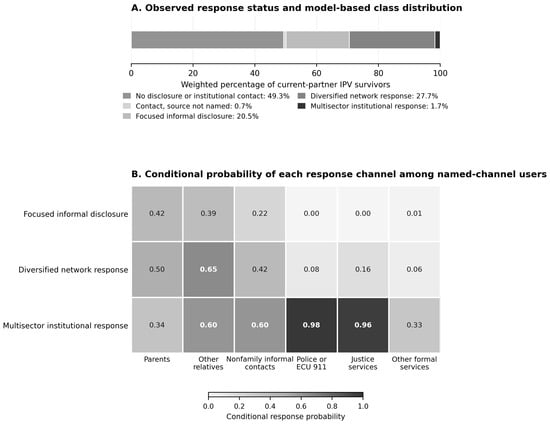
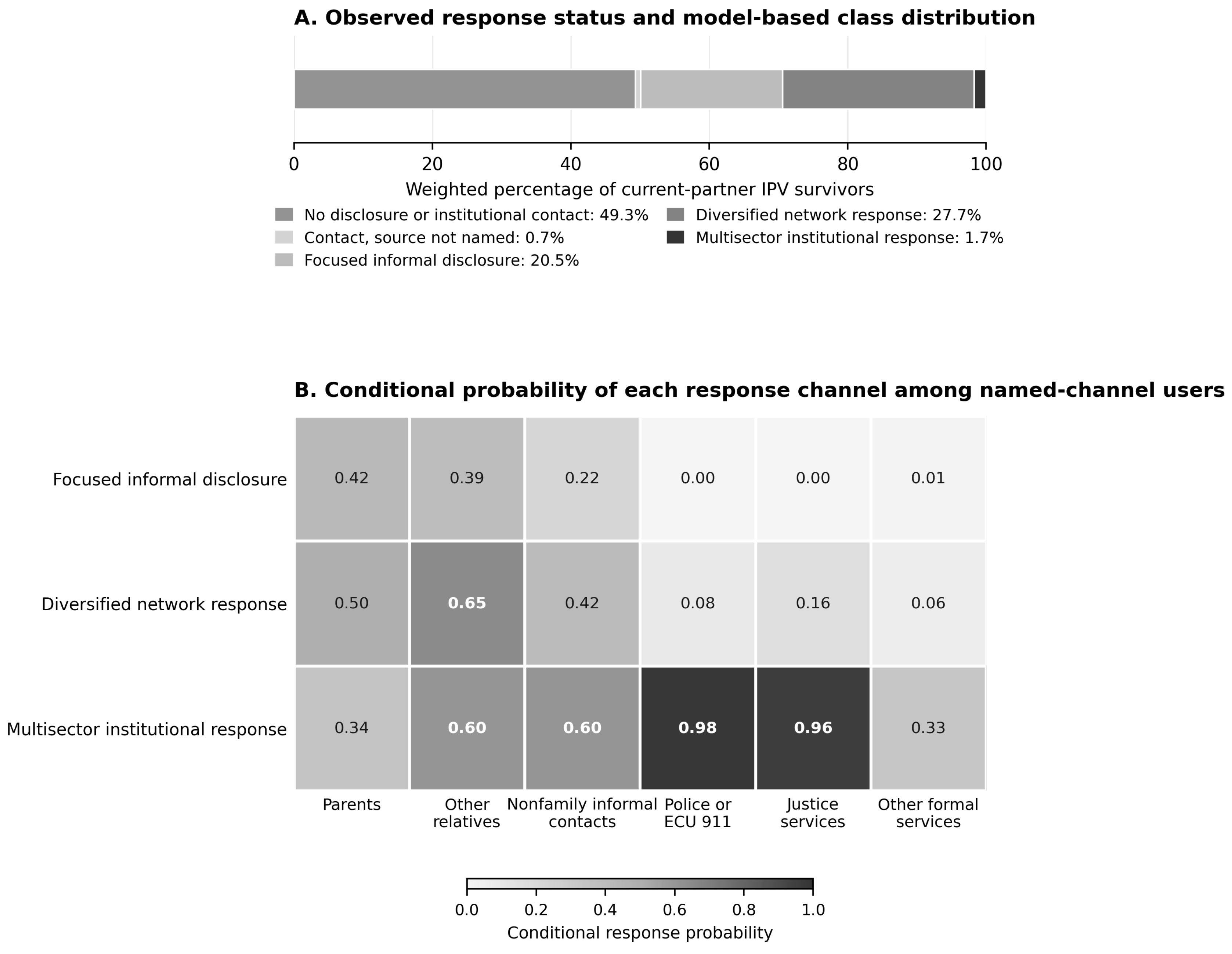
Diversified network response was the largest profile, accounting for an estimated 55.41% of women identifying a contact category, and mainly involved personal ties. Conditional response probabilities were 0.65 for other relatives, 0.50 for parents, and 0.42 for nonfamily contacts. Formal channels appeared less often: 0.16 for justice services, 0.08 for police or ECU 911, and 0.06 for other formal services (Table 4).
Table 4.
Selected Three-Class Solution: Class Size, Classification, and Conditional Response Probabilities, Ecuador, 2019.
Focused informal disclosure had a model-estimated share of 41.09% among women included in the latent class analysis. Contacts were concentrated among parents (0.42), other relatives (0.39), and nonfamily informal contacts (0.22), without one category of relative defining the class. Contact with police and justice services was effectively absent, and the probability of naming another formal service was 0.01. The recorded response usually involved one category of personal contact.
The multisector institutional response profile, estimated at 3.49% of women identifying a contact category, was defined by near-universal contact with police or ECU 911 (0.98) and justice services (0.96). The probability of naming another formal service was 0.33. Most women in this class also named someone in their personal network: probabilities were 0.60 for nonfamily contacts, 0.60 for other relatives, and 0.34 for parents.
Across the full sample of 4475 women, 49.34% reported neither disclosure nor institutional contact, and 0.75% reported a response without naming a source. After the latent class proportions among women who identified a contact category were projected to the full sample, focused informal disclosure accounted for 20.51%, diversified network response for 27.66%, and multisector institutional response for 1.74% (Figure 1).
Figure 1.
Observed External-Response Categories and Latent Contact Profiles, Ecuador, 2019. Note. The sample comprises 4475 married or cohabiting women aged 15 years or older reporting current-partner IPV. A response channel is a category of personal contact or institution. Contacts were not restricted to the previous 12 months. Panel A shows survey-weighted percentages of this full sample. No disclosure or institutional contact and a response without a named source are observed categories. The three profile shares were projected to the full sample by multiplying each model-estimated share by the weighted proportion identifying at least one contact category. Panel B shows within-profile probabilities for the 2346 women who identified at least one contact category; probabilities need not sum to 1 because women could identify several categories. Nonfamily contacts include friends or coworkers, neighbors, religious figures, and other known people. Justice covers prosecution, courts, judicial units, former Women and Family Police Stations, and the Public Defender; other formal services cover community, health, shelter, nongovernmental, and other institutions. Percentages may differ slightly from 100 because of rounding. IPV = intimate partner violence; ECU 911 = the national emergency coordination service. Source: 2019 National Survey on Family Relationships and Gender-Based Violence against Women.
BIC favored three classes in both alternative specifications: one separated friends or coworkers from other nonfamily contacts, and the other also divided rare formal channels into more specific categories. In the first specification, a four-class model reduced residual dependence and distinguished an additional profile involving friends or coworkers.
3.3. Characteristics Associated with Disclosure or Institutional Contact
The logistic regression examined disclosure or institutional contact among married or cohabiting women reporting current-partner violence. Women who reported neither response formed the comparison group. Violence characteristics had the largest adjusted associations with this outcome (Table 5). Physical violence was associated with nearly three times the odds of a response (adjusted odds ratio [aOR] = 2.90, 95% CI [2.29, 3.67]). The corresponding estimates were 2.50 for psychological violence (95% CI [1.55, 4.02]) and 1.56 for violence that had occurred many times (95% CI [1.22, 1.98]). Attributing the abuse to partner alcohol or drug use was also associated with higher odds (aOR = 1.26, 95% CI [1.02, 1.56]). Women with secondary education had higher odds than women with basic education or less (aOR = 1.36, 95% CI [1.05, 1.76]). The estimate for postsecondary education was similar but did not meet the 0.05 threshold (aOR = 1.43, 95% CI [1.00, 2.06], p = 0.051). Rural residence was associated with lower odds (aOR = 0.76, 95% CI [0.62, 0.94]). Economic and patrimonial violence showed no clear adjusted association (aOR = 1.18, 95% CI [0.89, 1.56]).
Table 5.
Survey-Adjusted Logistic Regression of Any External Response, Ecuador, 2019.
The association with sexual violence reversed after adjustment. Before adjustment, 54.72% of women reporting sexual violence had an external response, compared with 50.11% of other survivors. After adjustment for the other model covariates, including physical, repeated, psychological, and economic violence, sexual violence was associated with lower odds (aOR = 0.61, 95% CI [0.40, 0.92]). This coefficient compares women who were similar on several overlapping dimensions of violence; it does not show that sexual violence reduces help-seeking. The reversal may reflect barriers specific to disclosure, the adjustment for overlapping forms of violence, or both. Age, ethnicity, region, union type, relationship duration, number of children, personal spending money, partner-only decision-making, justification of violence, and past-year violence showed no clear adjusted association with the outcome.
3.4. Violence and Other Correlates of the Latent Class Profiles
Table 6 describes the 2346 women who identified a contact category, using their estimated membership probabilities to summarize violence and other characteristics within the three contact profiles identified in Section 3.2. Women in the multisector institutional response profile reported the highest prevalence of several violence indicators and consequences. Physical violence was present in 88.22% of this class and repeated violence in 79.38%, compared with 54.68% and 34.39%, respectively, in focused informal disclosure. Economic and sexual violence, as well as attribution of the abuse to partner alcohol or drug use, were likewise most prevalent in this profile, followed by diversified network response and focused informal disclosure.
Table 6.
Posterior-Weighted Characteristics and Consequences by Latent Class, Ecuador, 2019.
Differences were also pronounced for reporting attempts (74.89% in multisector institutional response and 1.51% in focused informal disclosure) and physical or reproductive health consequences (76.16% and 26.22%, respectively). Interrupted activities, social restriction or economic loss, and suicidal ideation were most prevalent in the multisector institutional response class as well. Rural residence followed the reverse pattern, increasing from 20.75% in the multisector institutional response profile to 33.98% in focused informal disclosure.
3.5. Responses Among Separated or Divorced Women
To examine the implications of restricting the primary sample to ongoing unions, we compared institutional contact among women in current and former unions. Institutional contact was reported by 22.84% of separated or divorced women with former-partner violence (95% CI [19.38, 26.31]), compared with 9.69% ([8.42, 10.96]) among married or cohabiting women reporting current-partner violence (Table S2). The unadjusted difference was 13.16 percentage points ([9.52, 16.80]). Observed joint police or ECU 911 and justice contact was also more common, at 5.79% ([3.93, 7.65]) versus 2.00% ([1.39, 2.61]). The estimated prevalence of institutional contact among women in current and former unions combined was 13.82% ([12.40, 15.25]).
4. Discussion
This study examined how married or cohabiting women in Ecuador who reported current-partner violence responded through personal networks and institutions. Using the 2019 National Survey on Family Relationships and Gender-Based Violence against Women (ENVIGMU), we estimated how often women disclosed abuse or had institutional contact, examined characteristics associated with any such response, and used latent class analysis to identify common combinations of personal and institutional contacts. Nearly half of the full analytic sample reported neither disclosure nor institutional contact. The class analysis suggested three profiles among women who identified at least one contact category. Focused informal disclosure usually involved one category of personal contact, while diversified network response included a broader range of personal contacts and occasional justice contact. The multisector institutional response profile combined police or emergency services, justice agencies, and personal contacts but represented only 1.7% of the full analytic sample.
The dominance of informal disclosure is consistent with earlier evidence from Ecuador and other countries (Bott et al. 2012; Palermo et al. 2014; Goodson and Hayes 2021). The overlap between personal and institutional contacts fits the understanding of help seeking developed by Liang et al. (2005) and Sagot (2005), in which responses are shaped by social relationships and encounters with institutions.
Women who had told no one most often cited the perceived unimportance of the incident or shame. Women reporting no institutional contact also mentioned privacy, uncertainty about where to go, and doubt that an institution would help. Ethnographic research in rural Ecuador describes how formal rights coexist with shame and very limited possibilities for leaving a violent relationship (Friederic 2024). A systematic review from the United States likewise found barriers related to awareness, access and resources, feared consequences of disclosure, personal concerns, and failures within service systems (Robinson et al. 2021).
The profiles also differed in the violence and consequences women reported, with the highest prevalence of several indicators in the multisector institutional response profile. Person-centered studies have similarly linked broader or more formal response profiles to severe violence or psychological distress (Ben-Porat 2020; Cheng et al. 2022). In Nigerian survey data, prior sexual violence predicted a predominantly formal profile (Alade et al. 2025), and studies using other designs have connected violence severity and dynamics with the type and extent of service use (Domenech del Rio and Sirvent Garcia del Valle 2019; Duterte et al. 2008; Leone et al. 2007).
Although 74.9% of the multisector institutional response class had a reporting attempt, the indicator does not identify who initiated it or whether the case advanced. ENVIGMU did ask follow-up questions about complaint acceptance, subsequent proceedings, and outcomes, but those items were not part of the binary measure used here. Research on specialized courts in Ecuador underscores this distinction: women may enter court seeking immediate safety rather than a conviction, and court entry does not ensure resolution (Tapia Tapia 2021).
In the diversified network response profile, informal disclosure extended beyond family. Reported contacts included relatives as well as friends, coworkers, neighbors, religious figures, or other known people, while most women had no police or justice contact. Hu et al. (2021) similarly distinguished reliance on family and friends from wider source use in China. In a service-engaged sample from the southwestern United States, Cheng et al. (2022) identified a broad network profile that used other formal services while avoiding the legal system. People outside the family may provide practical assistance, temporary accommodation, or someone with whom to speak privately. Programs centered only on relatives would miss much of the network reported by women in this study.
Rural residence was associated with lower adjusted odds of any external response and was least prevalent in the multisector institutional response class. Distance, transport, service hours, language, privacy in small communities, and uneven local coverage are plausible explanations. Research elsewhere has connected rural disadvantage with service availability, access, and quality, patterns of resource use, and assessments of justice-system responses (Edwards 2015; Peek-Asa et al. 2011; Shannon et al. 2006).
Ecuadorian studies describe several of these conditions directly. Research in rural Imbabura documented long distances, transport costs, unclear procedures, and an intermittent state presence (Boira et al. 2016). The absence of a clear adjusted association with ethnicity should not be read as evidence of equal access. A national estimate can conceal geographic isolation and protection gaps documented in rural and Indigenous settings, including gaps in both state and Indigenous justice systems (Boira et al. 2016; Salgado Álvarez 2009).
4.1. Implications for Policy and Practice
Because disclosure most often occurred within personal networks, response efforts need to reach those networks as well as public institutions. Relatives, friends, coworkers, and neighbors need practical guidance on listening without blame, protecting confidentiality, and discussing options without pressuring a woman to reconcile or report. Public institutions nevertheless retain responsibility for safety and protection.
Once an institution becomes involved, referrals and follow-up need to work across agencies. International guidance calls for confidential first-line support, trained staff, workable referrals, and coordination across sectors (García-Moreno et al. 2015; Stewart et al. 2015). Ecuadorian studies describe inflexible administrative practices, distrust of institutions, unresolved court cases, inadequate police intervention, and weak protection measures (Boira et al. 2017; Tapia Tapia 2021). Under these conditions, a referral may become another obstacle. With her consent, a direct introduction to the next provider may be more useful than a list of telephone numbers, provided that follow-up does not create an additional safety risk.
Rural service planning should address the access barriers documented in Ecuador (Alvarado-Vélez et al. 2024; Boira et al. 2016). Local assessment should determine whether transport support, mobile or secure remote access, extended hours, multilingual staff, or carefully governed local partnerships are appropriate.
Evidence on service models remains limited. A community intervention in Quito was associated with improved health, self-esteem, and social support, although stronger evaluation designs are needed (Sabina et al. 2023). Using 2003–2004 prevalence and cost inputs, Roldós and Corso (2013) estimated the economic burden associated with IPV injuries in Ecuador at approximately US$109 million in 2012 dollars. Future evaluations should follow completed referrals and safety outcomes rather than count contacts alone.
4.2. Strengths and Limitations
The 2019 Ecuadorian survey allowed us to examine overlapping personal and institutional contacts while retaining women with no recorded response as an observed group. Latent class analysis distinguished patterns within informal responses that would be obscured by a single help-seeking indicator. Survey weights, repeated estimation, alternative specifications, and the survey bootstrap supported the assessment of these profiles.
The cross-sectional data do not establish when contacts occurred relative to violence or separation, or whether they changed subsequent harm. The response measure records contact rather than the quality or duration of support. Recall and reluctance to discuss violence may also have produced underreporting.
The class analysis excluded 30 women who reported a response without naming a source, representing 1.47% of women with either response after weighting. Pooling less common contacts supported estimation while limiting distinctions among particular personal ties and services. The additional friends-or-coworkers profile described in Section 3.2 illustrates how these distinctions can depend on the grouping of indicators.
Class assignment was less clear for women whose contacts resembled more than one profile, and confidence intervals around class shares were wide. The probability-weighted descriptions in Table 6 may understate differences between profiles. Questionnaire routing also excluded some women with unsuccessful reporting attempts from the first consequence battery, so those comparisons apply to respondents with observed answers.
Institutional contact was more common among separated or divorced women, so the primary estimate understates contact in the combined population; the composition of latent profiles may differ as well. The sensitivity analysis documents this difference without establishing whether contact preceded separation or correcting selection into ongoing unions. The findings concern violence within current or last married or cohabiting unions and do not cover all relationship histories or populations.
5. Conclusions
We examined the prevalence, correlates, and combinations of external responses to current-partner violence among married or cohabiting women in Ecuador. Nearly half reported neither disclosure nor institutional contact. Latent class analysis of women who identified personal or institutional contact categories distinguished focused informal disclosure, diversified network response, and a small multisector institutional response profile combining personal contacts with police and justice services. The former-partner comparison showed higher institutional contact among separated or divorced women. These patterns suggest two complementary priorities: helping relatives and other trusted contacts respond without blame or coercion and maintaining continuity of support as women move between institutions. Longitudinal research should examine how combinations of contacts relate to separation, continued support, and subsequent safety.
Supplementary Materials
The following supporting information can be downloaded at: https://www.mdpi.com/article/10.3390/socsci15110768/s1, Table S1: Questionnaire measures and coding; Table S2: Reported responses by union status; and executable code with aggregate results for the union-status sensitivity analysis (file name: socsci-15-00768_Stata_Replication).
Author Contributions
Methodology, D.S.-O.; writing—original draft, M.F.-H.; writing—review and editing, S.J.-A., P.A.-M., A.C.-F., P.V.-G., A.C.-C. and M.F.-H. All authors have read and agreed to the published version of the manuscript.
Funding
This research received no external funding.
Institutional Review Board Statement
Not applicable.
Informed Consent Statement
Before each interview, the selected woman received an explanation of privacy and confidentiality and authorized the interviewer to continue. The available survey documentation does not state whether consent was written or whether parental or guardian consent procedures applied to respondents aged 15–17. This study analyzed de-identified public-use records.
Data Availability Statement
The ENVIGMU 2019 public-use respondent files, questionnaires, methodological documentation, and published indicators are available from Ecuador’s National Institute of Statistics and Censuses at https://www.ecuadorencifras.gob.ec/violencia-de-genero/ and through the National Archive of Statistical Data and Metadata (Archivo Nacional de Datos y Metadatos Estadísticos, ANDA; study 919). We used the married/union respondent file and combined violence-indicator file for the primary analysis, together with the separated/widowed module for the union-status sensitivity analysis from the official Stata archive: https://www.ecuadorencifras.gob.ec/documentos/web-inec/Estadisticas_Sociales/Violencia_de_genero_2019/BDD_ENVIGMU_2019_STATA.zip. All these files were accessed on 20 April 2026.
Conflicts of Interest
The authors declare no conflicts of interest.
References
- Alade, Omolola Titilayo, Forough Farrokhyar, Sheila Ann Sprague, Anita Acai, and Mohit Bhandari. 2025. Help seeking for intimate partner violence in a resource-constrained setting: A latent class analysis of the Nigerian demographic health survey dataset. PLoS ONE 20: e0334905. [Google Scholar] [CrossRef] [Scilit]
- Alvarado-Vélez, Julio A., Danny I. Silva-Conde, Gabriela Yosua Medina-Garcés, and Vinicio Mejía-Chávez. 2024. Justice for rural women: An exploratory analysis of institutions and mechanisms to access justice in Chimborazo, Ecuador. Heliyon 10: e28234. [Google Scholar] [CrossRef] [Scilit]
- Ansara, Donna L., and Michelle J. Hindin. 2010. Formal and informal help-seeking associated with women’s and men’s experiences of intimate partner violence in Canada. Social Science & Medicine 70: 1011–1018. [Google Scholar] [CrossRef] [Scilit]
- Asamblea Nacional del Ecuador. 2018. Ley Orgánica Integral para Prevenir y Erradicar la Violencia contra las Mujeres; Registro Oficial, Suplemento 175. Quito: Asamblea Nacional Republica del Ecuador. Available online: https://www.asambleanacional.gob.ec/sites/default/files/private/asambleanacional/filesasambleanacionalnameuid-29/Leyes%202013-2017/361-errad-violencia-contra-mujeres-18-08-2017/ro-contra-violencia-mujer.pdf (accessed on 15 January 2026).
- Asparouhov, Tihomir. 2005. Sampling weights in latent variable modeling. Structural Equation Modeling: A Multidisciplinary Journal 12: 411–34. [Google Scholar] [CrossRef] [Scilit]
- Bakk, Zsuzsa, and Jeroen K. Vermunt. 2016. Robustness of stepwise latent class modeling with continuous distal outcomes. Structural Equation Modeling: A Multidisciplinary Journal 23: 20–31. [Google Scholar] [CrossRef] [Scilit]
- Ben-Porat, Anat. 2020. Patterns of service utilization among women who are victims of domestic violence: The contribution of cultural background, characteristics of violence, and psychological distress. Journal of Interpersonal Violence 35: 3167–87. [Google Scholar] [CrossRef] [Scilit]
- Boira, Santiago, Lucia Tomas-Aragones, and Nury Rivera. 2017. Intimate partner violence and femicide in Ecuador. Qualitative Sociology Review 13: 30–47. [Google Scholar] [CrossRef] [Scilit]
- Boira, Santiago, Pablo Carbajosa, and Raquel Méndez. 2016. Miedo, conformidad y silencio. La violencia en las relaciones de pareja en áreas rurales de Ecuador. Psychosocial Intervention 25: 9–17. [Google Scholar] [CrossRef] [Scilit]
- Bott, Sarah, Alessandra Guedes, Mary M. Goodwin, and Jennifer Adams Mendoza. 2012. Violence Against Women in Latin America and the Caribbean: A Comparative Analysis of Population-Based Data from 12 Countries; Washington, DC: Pan American Health Organization. Available online: https://stacks.cdc.gov/view/cdc/22295 (accessed on 15 January 2026).
- Carney, Jessica R. 2024. A systematic review of barriers to formal supports for women who have experienced intimate partner violence in Spanish-speaking countries in Latin America. Trauma, Violence, & Abuse 25: 526–41. [Google Scholar] [CrossRef] [Scilit]
- Cheng, Shih-Ying, Karin Wachter, Andrea Kappas, Megan Lindsay Brown, Jill Theresa Messing, Meredith Bagwell-Gray, and Tina Jiwatram-Negron. 2022. Patterns of help-seeking strategies in response to intimate partner violence: A latent class analysis. Journal of Interpersonal Violence 37: NP6604–32. [Google Scholar] [CrossRef] [Scilit]
- Cho, Hyunkag, Dasha Shamrova, Jae-Bum Han, and Polina Levchenko. 2020. Patterns of intimate partner violence victimization and survivors’ help-seeking. Journal of Interpersonal Violence 35: 4558–82. [Google Scholar] [CrossRef] [Scilit]
- Consejo de la Judicatura. 2013. Resolución 057-2013: Normas para el funcionamiento de las Unidades Judiciales de Violencia contra la Mujer y la Familia y las Comisarías de la Mujer y la Familia. Consejo de la Judicatura, June 18. Available online: https://fsweb.funcionjudicial.gob.ec/www/pdf/resoluciones/2013cj/057-2013.PDF (accessed on 15 January 2026).
- Domenech del Rio, Ines, and Elena Sirvent Garcia del Valle. 2019. Influence of intimate partner violence severity on the help-seeking strategies of female victims and the influence of social reactions to violence disclosure on the process of leaving a violent relationship. Journal of Interpersonal Violence 34: 4550–71. [Google Scholar] [CrossRef] [Scilit]
- Duterte, Erin E., Amy E. Bonomi, Mary A. Kernic, Melissa A. Schiff, Robert S. Thompson, and Frederick P. Rivara. 2008. Correlates of medical and legal help seeking among women reporting intimate partner violence. Journal of Women’s Health 17: 85–95. [Google Scholar] [CrossRef] [Scilit]
- Edeby, Agnes, and Miguel San Sebastián. 2021. Prevalence and sociogeographical inequalities of violence against women in Ecuador: A cross-sectional study. International Journal for Equity in Health 20: 130. [Google Scholar] [CrossRef] [Scilit]
- Edwards, Katie M. 2015. Intimate partner violence and the rural–urban–suburban divide: Myth or reality? A critical review of the literature. Trauma, Violence, & Abuse 16: 359–73. [Google Scholar] [CrossRef] [Scilit]
- Evans, Maggie A., and Gene S. Feder. 2016. Help-seeking amongst women survivors of domestic violence: A qualitative study of pathways towards formal and informal support. Health Expectations 19: 62–73. [Google Scholar] [CrossRef] [Scilit]
- Fanslow, Janet L., and Elizabeth M. Robinson. 2010. Help-seeking behaviors and reasons for help seeking reported by a representative sample of women victims of intimate partner violence in New Zealand. Journal of Interpersonal Violence 25: 929–51. [Google Scholar] [CrossRef] [Scilit]
- Friederic, Karin. 2014. Violence against women and the contradictions of rights-in-practice in rural Ecuador. Latin American Perspectives 41: 19–38. [Google Scholar] [CrossRef] [Scilit]
- Friederic, Karin. 2024. From distress to anger to shame: Gender violence, empowerment, and emotional states in Ecuador. Feminist Anthropology 5: 81–95. [Google Scholar] [CrossRef] [Scilit]
- Frías, Sonia M. 2022. Intimate partner violence dynamics and help seeking among Mexican women: Results from a 2016 national household survey. Journal of Interpersonal Violence 37: 2681–704. [Google Scholar] [CrossRef] [Scilit]
- Frías, Sonia M., and María Carolina Agoff. 2015. Between support and vulnerability: Examining family support among women victims of intimate partner violence in Mexico. Journal of Family Violence 30: 277–291. [Google Scholar] [CrossRef] [Scilit]
- García-Moreno, Claudia, Kelsey Hegarty, Ana Flavia Lucas D’OLiveira, Jane Koziol-McLain, Manuela Colombini, and Gene Feder. 2015. The health-systems response to violence against women. The Lancet 385: 1567–79. [Google Scholar] [CrossRef] [Scilit]
- Goodkind, Jessica R., Tameka L. Gillum, Deborah I. Bybee, and Cris M. Sullivan. 2003. The impact of family and friends’ reactions on the well-being of women with abusive partners. Violence Against Women 9: 347–73. [Google Scholar] [CrossRef] [Scilit]
- Goodson, Amanda, and Brittany E. Hayes. 2021. Help-seeking behaviors of intimate partner violence victims: A cross-national analysis in developing nations. Journal of Interpersonal Violence 36: NP4705–27. [Google Scholar] [CrossRef] [Scilit]
- Hu, Ran, Jia Xue, Kai Lin, Ivan Y. Sun, Yuning Wu, and Xiying Wang. 2021. The patterns and influencing factors of help-seeking decisions among women survivors of intimate partner violence in China. Journal of Family Violence 36: 669–81. [Google Scholar] [CrossRef] [Scilit]
- Instituto Nacional de Estadística y Censos (INEC). 2012. Encuesta Nacional sobre Relaciones Familiares y Violencia de Género contra las Mujeres, noviembre 2011: Manual del encuestador; Quito: INEC. Available online: https://anda.inec.gob.ec/anda5/index.php/catalog/94/related-materials (accessed on 15 January 2026).
- Instituto Nacional de Estadística y Censos (INEC). 2019a. Encuesta Nacional sobre Relaciones Familiares y Violencia de Género contra las Mujeres (ENVIGMU): Metodología; Quito: INEC. Available online: https://www.ecuadorencifras.gob.ec/documentos/web-inec/Estadisticas_Sociales/Violencia_de_genero_2019/Documento%20metodologico%20ENVIGMU.pdf (accessed on 15 January 2026).
- Instituto Nacional de Estadística y Censos (INEC). 2019b. Metodología del Diseño Muestral de la Encuesta Nacional sobre Relaciones Familiares de las Mujeres, Año 2019; Quito: INEC. Available online: https://www.ecuadorencifras.gob.ec/documentos/web-inec/Estadisticas_Sociales/Violencia_de_genero_2019/Metodologia%20de%20Disenio%20Muestral%20ENVIGMU.pdf (accessed on 15 January 2026).
- Instituto Nacional de Estadística y Censos (INEC). 2019c. Encuesta Nacional sobre Relaciones Familiares y Violencia de Género contra las Mujeres (ENVIGMU): Guía de Usuarios de Base de Datos; Quito: INEC. Available online: https://www.ecuadorencifras.gob.ec/documentos/web-inec/Estadisticas_Sociales/Violencia_de_genero_2019/Guia_de_usuario-ENVIGMU.pdf (accessed on 15 January 2026).
- Instituto Nacional de Estadística y Censos (INEC). 2019d. Encuesta Nacional sobre Relaciones Familiares y Violencia de Género contra las Mujeres: Formularios; Quito: INEC. Available online: https://www.ecuadorencifras.gob.ec/documentos/web-inec/Estadisticas_Sociales/Violencia_de_genero_2019/Formularios%20ENVIGMU.zip (accessed on 15 January 2026).
- Instituto Nacional de Estadística y Geografía (INEGI). 2022. Encuesta Nacional sobre la Dinámica de las Relaciones en los Hogares 2021 (ENDIREH): Principales resultados. Aguascalientes: INEGI. Available online: https://www.inegi.org.mx/contenidos/programas/endireh/2021/doc/endireh2021_presentacion_ejecutiva.pdf (accessed on 15 January 2026).
- Kanougiya, Suman, Muthusamy Sivakami, Nayreen Daruwalla, and David Osrin. 2022. Prevalence, pattern, and predictors of formal help-seeking for intimate partner violence against women: Findings from India’s cross-sectional National Family Health Surveys-3 (2005–2006) and 4 (2015–2016). BMC Public Health 22: 2386. [Google Scholar] [CrossRef] [Scilit]
- Lelaurain, Solveig, Pierluigi Graziani, and Grégory Lo Monaco. 2017. Intimate partner violence and help-seeking: A systematic review and social psychological tracks for future research. European Psychologist 22: 263–81. [Google Scholar] [CrossRef] [Scilit]
- Leone, Janel M., Michael P. Johnson, and Catherine L. Cohan. 2007. Victim help seeking: Differences between intimate terrorism and situational couple violence. Family Relations 56: 427–39. [Google Scholar] [CrossRef] [Scilit]
- Liang, Belle, Lisa Goodman, Pratyusha Tummala-Narra, and Sarah Weintraub. 2005. A theoretical framework for understanding help-seeking processes among survivors of intimate partner violence. American Journal of Community Psychology 36: 71–84. [Google Scholar] [CrossRef] [Scilit]
- Macy, Rebecca J., Paula S. Nurius, Mary A. Kernic, and Victoria L. Holt. 2005. Battered women’s profiles associated with service help-seeking efforts: Illuminating opportunities for intervention. Social Work Research 29: 137–50. [Google Scholar] [CrossRef] [Scilit]
- McCleary-Sills, Jennifer, Sophie Namy, Joyce Nyoni, Datius Rweyemamu, Adrophina Salvatory, and Ester Steven. 2016. Stigma, shame and women’s limited agency in help-seeking for intimate partner violence. Global Public Health 11: 224–35. [Google Scholar] [CrossRef] [Scilit]
- Nurius, Paula S., Rebecca J. Macy, Ijeoma Nwabuzor, and Victoria L. Holt. 2011. Intimate partner survivors’ help-seeking and protection efforts: A person-oriented analysis. Journal of Interpersonal Violence 26: 539–66. [Google Scholar] [CrossRef] [Scilit]
- Nylund, Karen L., Tihomir Asparouhov, and Bengt O. Muthén. 2007. Deciding on the number of classes in latent class analysis and growth mixture modeling: A Monte Carlo simulation study. Structural Equation Modeling: A Multidisciplinary Journal 14: 535–69. [Google Scholar] [CrossRef] [Scilit]
- Nylund-Gibson, Karen, and Andrew Young Choi. 2018. Ten frequently asked questions about latent class analysis. Translational Issues in Psychological Science 4: 440–61. [Google Scholar] [CrossRef] [Scilit]
- Overstreet, Nicole M., and Diane M. Quinn. 2013. The intimate partner violence stigmatization model and barriers to help-seeking. Basic and Applied Social Psychology 35: 109–22. [Google Scholar] [CrossRef] [Scilit]
- Palermo, Tia, Jennifer Bleck, and Amber Peterman. 2014. Tip of the iceberg: Reporting and gender-based violence in developing countries. American Journal of Epidemiology 179: 602–12. [Google Scholar] [CrossRef] [Scilit]
- Patterson, Blossom H., Chauncey Mitchell Dayton, and Barry I. Graubard. 2002. Latent class analysis of complex sample survey data: Application to dietary data. Journal of the American Statistical Association 97: 721–41. [Google Scholar] [CrossRef] [Scilit]
- Peek-Asa, Corinne, Anne Wallis, Karisa Harland, Kirsten Beyer, Penny Dickey, and Audrey Saftlas. 2011. Rural disparity in domestic violence prevalence and access to resources. Journal of Women’s Health 20: 1743–49. [Google Scholar] [CrossRef] [Scilit]
- Rao, Jon N. K., and Chien-Fu J. Wu. 1988. Resampling inference with complex survey data. Journal of the American Statistical Association 83: 231–41. [Google Scholar] [CrossRef]
- Robinson, Sarah R., Kristen Ravi, and Rachel J. Voth Schrag. 2021. A systematic review of barriers to formal help seeking for adult survivors of IPV in the United States, 2005–2019. Trauma, Violence, & Abuse 22: 1279–95. [Google Scholar] [CrossRef] [Scilit]
- Roldós, María Isabel, and Phaedra Corso. 2013. The economic burden of intimate partner violence in Ecuador: Setting the agenda for future research and violence prevention policies. Western Journal of Emergency Medicine 14: 347–53. [Google Scholar] [CrossRef] [Scilit]
- Sabina, Chiara, and Diego Pérez-Figueroa. 2019. ‘Hay que tener suerte’: Gender-based violence service provision in Quito, Ecuador. Health and Human Rights 21: 295–07. Available online: https://www.hhrjournal.org/2019/12/09/hay-que-tener-suerte-gender-based-violence-service-provision-in-quito-ecuador/ (accessed on 15 January 2026).
- Sabina, Chiara, Diego Pérez -Figueroa, Laurent Reyes, Eduardo Campaña Medina, Eluzinete Pereira de Souza, Lisa Markovits, Andrea Carolina Oña Jacho, and Gissel Katherine Rojas Bohorquez. 2023. Evaluation of integrative community therapy with domestic violence survivors in Quito, Ecuador. International Journal of Environmental Research and Public Health 20: 5492. [Google Scholar] [CrossRef] [Scilit]
- Sagot, Montserrat. 2005. The critical path of women affected by family violence in Latin America: Case studies from 10 countries. Violence Against Women 11: 1292–318. [Google Scholar] [CrossRef] [Scilit]
- Salgado Álvarez, Judith. 2009. Violencia contra las mujeres indígenas: Entre las «justicias» y la desprotección. Posibilidades de interculturalidad en Ecuador. Anuario de Acción Humanitaria y Derechos Humanos 6: 61–72. [Google Scholar] [CrossRef] [Scilit]
- Scheer, Jillian R., Margaret Lawlace, Cory J. Cascalheira, Michael E. Newcomb, and Sarah W. Whitton. 2023. Help-seeking for severe intimate partner violence among sexual and gender minority adolescents and young adults assigned female at birth: A latent class analysis. Journal of Interpersonal Violence 38: 6723–50. [Google Scholar] [CrossRef] [Scilit]
- Shannon, Lisa, Tk Logan, Jennifer Cole, and Karen Medley. 2006. Help-seeking and coping strategies for intimate partner violence in rural and urban women. Violence and Victims 21: 167–81. [Google Scholar] [CrossRef]
- Stewart, Donna E., Raquel Aviles, Alessandra Guedes, Ekaterina Riazantseva, and Harriet MacMillan. 2015. Latin American and Caribbean countries’ baseline clinical and policy guidelines for responding to intimate partner violence and sexual violence against women. BMC Public Health 15: 665. [Google Scholar] [CrossRef] [Scilit]
- Sylaska, Kateryna M., and Katie M. Edwards. 2014. Disclosure of intimate partner violence to informal social support network members: A review of the literature. Trauma, Violence, & Abuse 15: 3–21. [Google Scholar] [CrossRef] [Scilit]
- Tapia Tapia, Silvana. 2021. Beyond carceral expansion: Survivors’ experiences of using specialised courts for violence against women in Ecuador. Social & Legal Studies 30: 848–68. [Google Scholar] [CrossRef] [Scilit]
- Vermunt, Jeroen K. 2010. Latent class modeling with covariates: Two improved three-step approaches. Political Analysis 18: 450–69. [Google Scholar] [CrossRef] [Scilit]
- Visser, Marieke, and Sarah Depaoli. 2022. A guide to detecting and modeling local dependence in latent class analysis models. Structural Equation Modeling: A Multidisciplinary Journal 29: 971–82. [Google Scholar] [CrossRef] [Scilit]

Disclaimer/Publisher’s Note: The statements, opinions and data contained in all publications are solely those of the individual author(s) and contributor(s) and not of MDPI and/or the editor(s). MDPI and/or the editor(s) disclaim responsibility for any injury to people or property resulting from any ideas, methods, instructions or products referred to in the content. |
© 2026 by the authors. Licensee MDPI, Basel, Switzerland. This article is an open access article distributed under the terms and conditions of the Creative Commons Attribution (CC BY) license.