


Abstract
Human trafficking is a cross-border governance challenge in which criminal justice, migration management, victim protection, and regional cooperation intersect. This article examines how formal anti-trafficking commitments are translated into operational coordination in Guatemala, El Salvador, and Honduras. Using a document-led comparative qualitative design, the study analyses 75 coded official and regional records, supplemented by three key-informant interviews and freedom-of-information evidence. The findings identify a layered architecture combining trinational agreements, regional platforms, bilateral channels, and domestic institutions. These arrangements support recurring coordination, shared standards, referral and repatriation routines, capacity building, and information-governance initiatives, but their durability and system-level traceability vary across countries. The article introduces functional but fragile regionalism as a conceptual contribution to explain how institutional density can sustain anti-trafficking cooperation without producing uniform consolidation. The comparison shows that the critical variation lies not in whether formal mechanisms exist, but in how deeply coordination is embedded in national mandates, personnel, resources, administrative routines, and information systems. The findings contribute to debates on human trafficking, transnational organized-crime governance, and cross-border institutional cooperation.
1. Introduction
Human trafficking is simultaneously a human-rights violation, a criminal-justice problem, a migration-governance challenge, and a cross-border coordination problem. The transnational character of recruitment, movement, exploitation, return, investigation, and prosecution requires states to coordinate across agencies and jurisdictions while preserving victim protection and due process. Contemporary research increasingly emphasizes that anti-trafficking effectiveness depends not only on adopting international commitments but also on institutional competence, bureaucratic capacity, and coordination across levels of governance (Blanton et al. 2020; Rahman 2025; Lannier 2026). Regional cooperation against transnational organized crime likewise depends on mechanisms capable of connecting national authorities without necessarily creating a centralized supranational structure (Legrand and Leuprecht 2021; Cubides-Cardenas et al. 2025).
Guatemala, El Salvador, and Honduras offer a particularly demanding setting in which to examine these dynamics. Prevention, victim identification, repatriation, criminal investigation, migration management, and legal cooperation may cross national borders, while authority over these functions remains distributed among ministries, prosecutors, migration agencies, victim-protection bodies, and regional platforms. The analytical problem is therefore not simply whether anti-trafficking institutions exist, but how a dense and overlapping architecture becomes operational and whether coordination remains durable and traceable across institutional boundaries.
Official records show that anti-trafficking cooperation in the Northern Triangle is formalized across several institutional layers. In 2021, El Salvador’s National Council against Trafficking in Persons, Guatemala’s Secretariat against Sexual Violence, Exploitation and Trafficking in Persons (SVET), and Honduras’s Interinstitutional Commission against Commercial Sexual Exploitation and Trafficking in Persons (CICESCT) signed a trinational cooperation agreement with technical participation from the International Centre for Missing and Exploited Children (MJSP 2021). El Salvador later described this arrangement to the Inter-American Commission on Human Rights as a trinational agreement for strengthening capacities related to trafficking and cybercrime (State of El Salvador 2022). In 2024, the three states also signed a biometric and citizen-security cooperation agreement that contemplated information exchange and coordinated responses to transnational crime, including trafficking and migrant smuggling (Secretaría de Seguridad de Honduras 2024).
This institutional density sharpens the theoretical puzzle. The subregion combines multilateral treaty obligations, trinational agreements, regional platforms such as the Regional Coalition against Trafficking in Persons and Smuggling of Migrants (CORETT) and the Regional Conference on Migration (CRM), bilateral prosecutorial channels, and national anti-trafficking systems. Yet institutional density does not automatically produce a single chain of authority, harmonized case information, or comparable evidence on cross-border trajectories. Research on regime complexity explains why overlapping institutions coexist, while network-governance and cross-border enforcement scholarship explains how actors coordinate across organizational boundaries (Alter and Meunier 2009; Gómez-Mera 2016; Provan and Kenis 2008; Legrand and Leuprecht 2021).
This article argues that anti-trafficking cooperation in the Northern Triangle is best understood as layered and polycentric governance. Formal instruments and regional networks are complementary rather than substitutive. Regional venues connect and operationalize authority that remains legally anchored in national institutions. CORETT, CRM, bilateral channels, and trinational agreements provide standards, convening capacity, technical guidance, and recurring interaction, while domestic agencies retain responsibility for implementation, prosecution, protection, migration status, and data production.
The article introduces functional but fragile regionalism as a conceptual contribution. Functional refers to recurrent and observable outputs and processes, including agreements, shared guidelines, focal-point interaction, referrals, repatriation procedures, joint operations, capacity building, and data-coordination mechanisms. Fragile does not mean institutionally absent or necessarily donor-dependent. It refers to uneven institutional embedding: the durability, transferability, and evaluability of cooperation vary according to whether national systems stabilize focal points, core resources, staff continuity, mandate clarity, and interoperable information practices. The concept is developed to explain the intermediate condition in which regional cooperation is demonstrably active but remains unevenly institutionalized across national settings. This emphasis is consistent with recent anti-trafficking scholarship showing that formal mechanisms can coexist with fragmented implementation and coordination challenges (Rahman 2025; Lannier 2026).
The study asks three questions. RQ1: How is anti-trafficking cooperation institutionally layered across trinational, regional, bilateral, and domestic governance venues in Guatemala, El Salvador, and Honduras? RQ2: Through which network mechanisms are formal instruments translated into recurrent cross-border coordination? RQ3: Why does the durability and traceability of cooperation vary across national institutional settings despite participation in shared regional arrangements? The article is positioned primarily as a contribution to comparative regional and governance scholarship, using anti-trafficking as a substantively important cross-border policy field; it also contributes to anti-trafficking research by explaining how institutional coordination is organized across overlapping venues. Empirically, it maps an under-documented governance architecture. Conceptually, it uses the comparison to develop functional but fragile regionalism as an explanation for how institutional density can coexist with uneven consolidation. The central governance constraint is therefore not the absence of formal anti-trafficking cooperation but the uneven domestic embedding of overlapping cross-border mechanisms.
2. Conceptual Framework: Layered Governance, Network Translation, and Institutional Embedding
2.1. Regime Complexity and Institutional Layering
Regime-complexity research rejects the assumption that transnational governance is normally organized through a single coherent institution. Rules and organizations overlap across legal levels and policy domains, creating both redundancy and choice (Raustiala and Victor 2004; Alter and Meunier 2009; Keohane and Victor 2011; Abbott and Snidal 2000). Such complexity can fragment accountability and produce competing mandates, but it can also supply alternative channels when one venue is slow, narrow, or politically blocked. Human trafficking exemplifies this pattern because criminal law, migration governance, victim protection, consular coordination, and international cooperation are governed through partially overlapping regimes (Gómez-Mera 2016, 2017).
The documentary evidence indicates that institutional layering is a more accurate description of the Northern Triangle than institutional absence. The 2021 trinational agreement, the 2024 biometric-security agreement, CORETT’s strategic and operational plans, CRM repatriation and consular guidance, bilateral prosecutorial cooperation, and national protocols do not form a single hierarchy. They perform different functions and operate through different authorities. The central issue is therefore how these layers are connected in practice and whether their coexistence generates complementarity, redundancy, or gaps.
2.2. Network Governance as a Translation Mechanism
Network-governance scholarship explains how coordination can occur when legal authority is distributed rather than centralized. Networks rely on recurring interaction, focal points, professional ties, shared procedures, and mutual adjustment across organizational boundaries (Rhodes 1996; Provan and Kenis 2008; Slaughter 2004). Research on transgovernmental enforcement networks further shows that cross-border networks can serve as distinct governance mechanisms for responding to illicit transnational markets and organized crime (Legrand and Leuprecht 2021). Their durability, however, depends on governance structure, legitimacy, administrative capacity, and the ability to preserve relationships beyond individual officeholders.
In the Northern Triangle, networks frequently translate formal commitments into administratively usable practices. CORETT’s Strategic Plan 2018–2027 specifies regional objectives, indicators, monitoring, and institutional-strengthening functions; its 2023–2025 Operational Action Plan routinizes regional activities; and its regional action guides address prevention, investigation and prosecution, survivor protection, and international cooperation (CORETT 2018, 2023, 2024). CRM materials add consular, repatriation, and migration-protection procedures (CRM 2007; CRM 2014). The relevant role of networks is therefore not to replace formalization, but to connect legal commitments, administrative authorities, and technical practices.
2.3. Regionalism, Organized-Crime Governance, and Polycentric Coordination
Latin American regionalism has long been characterized by institutional proliferation, overlapping projects, and limited supranational authority. Malamud and Gardini (2012) describe segmented and overlapping regionalism; Riggirozzi and Grugel (2015) emphasize regional governance as public-policy coordination beyond classical trade integration; and Lubbock and Vivares (2022) highlight the multiplicity and contradictions of contemporary Latin American regionalism. Central American scholarship similarly locates persistent SICA governance problems in institutional design, intergovernmental control, veto players, and decision rules rather than simply in the number of regional bodies (Santos Carrillo 2018; Vargas Céspedes and Viales Hurtado 2025; Nájera and Ordóñez 2025).
This regionalism literature intersects with a growing concern about transnational organized-crime governance in the Western Hemisphere. Recent work emphasizes that responses to illicit cross-border markets require regional cooperation, legal coordination, intelligence or information exchange, and institutional stability (Cubides-Cardenas et al. 2025). Human trafficking is especially revealing because criminal-justice objectives coexist with migration, protection, and human-rights obligations. The resulting governance architecture is therefore polycentric: different venues exercise partial coordination functions without monopolizing authority.
Recent trafficking research also underscores that the relationship between human trafficking, migrant smuggling, and organized criminal activity varies across institutional and geographic settings. Anguita-Olmedo (2025) shows how trafficking and migrant smuggling can converge around criminal actors and migration pressures, while Giménez-Salinas (2024) demonstrates the heterogeneity of roles within trafficking organizations. The present study examines the complementary institutional-response side of that problem: how states and regional bodies organize cross-border coordination when enforcement, victim protection, migration governance, and information systems are distributed across multiple authorities.
CORETT itself emerged from earlier CRM-linked coordination, while SG-SICA documents interaction between CORETT and the Central American Security Commission/SICA (SG-SICA 2024). The case raises a comparative question extending beyond trafficking: under what institutional conditions does polycentric cross-border governance become durable and traceable rather than merely active?
2.4. Functional but Fragile Regionalism
This article introduces functional but fragile regionalism as an analytic construct developed from the dialog between regime-complexity, network-governance, and regionalism scholarship and the comparative evidence examined here. It describes a governance configuration in which overlapping formal agreements, regional platforms, bilateral channels, and domestic institutions jointly generate recurrent coordination, while the durability, transferability, and traceability of that coordination vary with the degree of domestic institutional embedding. The concept differs from regime complexity because it focuses on the operational consequences of overlap; from network governance because it treats domestic institutionalization as a condition of network durability; and from transgovernmental-network accounts because the relevant architecture includes not only direct official-to-official ties but also regional venues, formal agreements, victim-protection systems, migration authorities, and external technical partners.
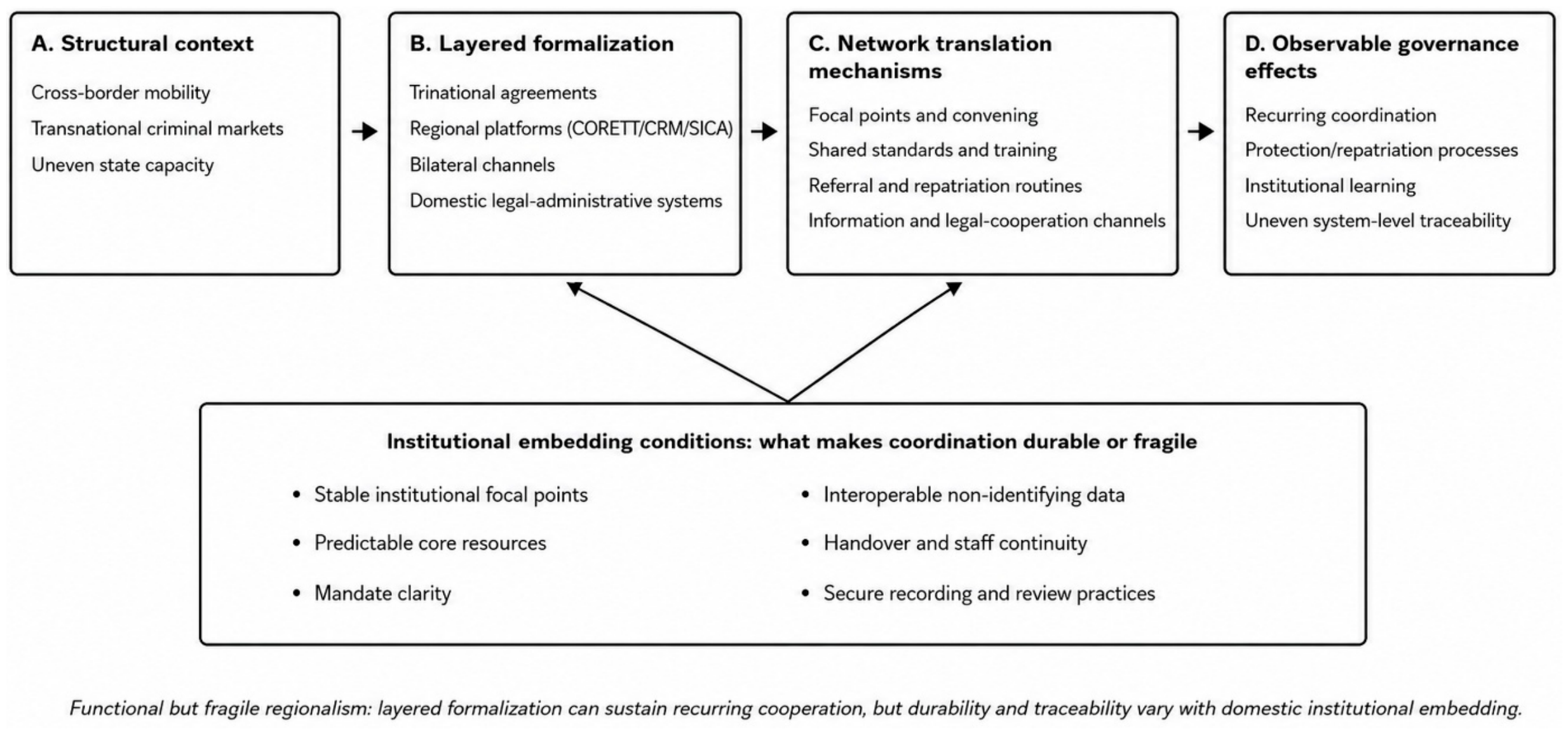
The concept generates three observable expectations. First, cooperation should be visible across multiple institutional layers rather than concentrated in one venue. Second, shared regional participation should be associated with recurring outputs and processes—standards, meetings, referrals, repatriation procedures, training, or information exchange—even when legal authority remains national. Third, cross-country differences in durability and traceability should be consistent with variation in domestic institutional embedding, particularly data architecture, recurring coordination mechanisms, staff continuity, resource bases, and mandate clarity. These are interpretive and conditional expectations rather than claims of causal identification. Figure 1 summarizes this analytical model and the institutional conditions that distinguish durable from fragile coordination.
Figure 1.
Layered formalization, network translation, and functional but fragile regionalism. Formal instruments and regional platforms coexist across several levels. Network mechanisms translate this layered architecture into recurring coordination, while domestic institutional embedding conditions shape durability and system-level traceability. Source: Authors’ elaboration.
3. Materials and Methods
3.1. Research Design and Case Logic
The study uses a document-led comparative qualitative design centered on anti-trafficking cooperation mechanisms in Guatemala, El Salvador, and Honduras. The primary documentary window is 2021–2026, with earlier instruments retained only when they remained operative or were necessary to establish the institutional baseline. The unit of analysis is the cooperation mechanism through which institutions coordinate prevention, protection, repatriation, investigation, prosecution, legal cooperation, information exchange, training, or resource mobilization.
The cases are compared structurally rather than as separate country histories. All three states share UNTOC/Palermo obligations and participation in CORETT and CRM, but they differ in domestic coordination structures, information systems, territorial reach, and institutional renewal. This shared regional environment with differing domestic configurations provides the comparative leverage for assessing institutional embedding.
3.2. Documentary Corpus and Selection Protocol
The documentary search was conducted as a structured institutional audit of official national, regional, and intergovernmental repositories, including SVET, CICESCT, Salvadoran justice and migration authorities, CORETT, CRM, SICA-linked bodies, and multilateral archives. Searches combined institutional names with terms related to trafficking, cooperation, agreements, protocols, repatriation, mutual legal assistance, prosecution, information systems, data, observatories, and migrant smuggling. Records were excluded when they duplicated a coded instrument, lacked a verifiable issuing institution, reproduced media coverage without additional primary information, or fell outside the analytical dimensions of cooperation architecture, implementation, resourcing, continuity, and information governance. The last documentary verification was completed on 20 August 2026.
The corpus contains 75 coded official and regional records. For descriptive transparency, these comprise 10 formal cooperation instruments (eight agreements, one letter of intent, and one cooperation arrangement); eight strategies or plans; 18 protocols, guides, manuals, administrative procedures, or indicator instruments; 21 annual, state, accountability, performance, or other reporting records; five information-system or data-portal records; 10 coordination mechanisms, meetings, plenaries, or operational records; and three other institutional, budget, or enforcement records. Documents were retained when they established a legal or administrative cooperation mechanism, documented recurrent interinstitutional or cross-border coordination, provided evidence about resources, continuity, or information governance, or reported observable outputs relevant to the analytical categories.
The corpus was organized across national, bilateral, trinational, and regional levels. Supplementary Material S1 provides the complete source-level register, including institution, year, document type, legal character, cooperation function, participating actors, observable outputs and processes, funding or external support, continuity, data architecture, transparency/traceability, evidence grade, and source URL.
3.3. Interviews and Freedom-of-Information Evidence
The documentary analysis is supplemented by three completed semi-structured key-informant interviews: CICESCT in Honduras, SVET in Guatemala, and the Procuraduría General de la República (PGR) in El Salvador (CICESCT Institutional Representative 2026; SVET Institutional Representative 2026; PGR Institutional Representative 2026). The underlying study issued 18 invitations (11 public institutions and seven civil-society or international organizations), but only these three yielded completed interviews. The retained research record does not support a systematic reconstruction of the reasons for non-participation, so no motives are attributed to nonresponse. The initial outreach was intended to broaden institutional perspectives rather than establish a fixed interview quota; consequently, the three completed interviews are not treated as representative or saturated and do not independently satisfy the comparative design. They are used only to clarify institutional division of labor, administrative practice, and coordination mechanisms and to test documentary interpretations. Freedom-of-information requests in El Salvador were directed to the Supreme Court of Justice, the Directorate General of Migration and Immigration, the National Council against Trafficking in Persons, and the Office of the Attorney General. Because FOI evidence is available only for El Salvador, it functions as a within-case diagnostic of information governance rather than a symmetric three-country source.
3.4. Coding and Evidence Grading
The analysis combined deductive and inductive thematic coding (Braun and Clarke 2006; Saldaña 2021). Deductive categories captured institutional level, legal character, cooperation function, recurrence, resource base, data architecture, traceability, output/process/outcome status, and domestic institutional embedding. Inductive coding captured recurring adaptations and tensions, including external technical support, administrative turnover, bilateral channels, joint operations, and gaps between formal data-system design and demonstrated traceability. Because the coding served structured qualitative comparison and claim auditing rather than frequency-based content analysis, transparency is provided through the codebook, full evidence register, evidence grades, and claim–source verification matrix rather than an intercoder-reliability statistic.
Claims were graded conservatively. Level A evidence is directly documented in an official law, agreement, protocol, report, public statistical system, or FOI response; Level B is independently supported by more than one source type; Level C is institutionally reported but not independently verified; and Level D is unsupported inference and is excluded or explicitly qualified. Protocols, meetings, training activities, or information systems are treated as outputs or processes rather than proof of improved prosecution or victim-protection outcomes. Table 1 summarizes the evidence streams and inferential boundaries, while Table 2 provides the structured cross-case comparison used in Section 4.
Table 1.
Evidence base and analytical role.
Table 2.
Comparative institutional architecture.
4. Results
The results are organized around the three observable expectations derived from functional but fragile regionalism: layered formalization, network translation into recurrent coordination, and cross-country variation in domestic institutional embedding. Table 2 provides the comparative baseline, while the subsequent subsections trace how these dimensions appear across the three cases.
4.1. Formalization Without Centralization: A Layered Anti-Trafficking Architecture
The first finding overturns the premise that Northern Triangle cooperation operates in the absence of dedicated trinational formalization. In July 2021, the three national anti-trafficking bodies—El Salvador’s CNCTP, Guatemala’s SVET, and Honduras’s CICESCT—signed a cooperation agreement intended to strengthen joint action against trafficking and related exploitation, with ICMEC participating as a technical partner (MJSP 2021). El Salvador subsequently reported the existence of this trinational agreement to the IACHR (State of El Salvador 2022). In 2024, the security ministries of the three countries also signed a biometric and citizen-security agreement that provides for information exchange and coordinated action against transnational crime, including trafficking and migrant smuggling (Secretaría de Seguridad de Honduras 2024).
This trinational formalization should be distinguished from other legal layers. The United Nations Convention against Transnational Organized Crime and its Trafficking in Persons Protocol provide binding multilateral foundations for criminal cooperation and victim protection but do not create a Northern Triangle regional authority (United Nations General Assembly 2000a, 2000b). The 1997 Treaty for the Execution of the Plan Trifinio, by contrast, institutionalizes a Guatemala–El Salvador–Honduras trilateral body for cross-border territorial and development governance, not for anti-trafficking policy (Comisión Trinacional del Plan Trifinio n.d.).
These instruments do not create a centralized trinational authority. Instead, they sit alongside wider regional and bilateral arrangements. CORETT’s ten-year strategic plan, regional strategies, 2023–2025 operational plan, and four implementation guides provide common policy and technical infrastructure (CORETT 2018, 2023, 2024). CRM contributes consular and repatriation standards, while bilateral prosecutorial cooperation connects national justice institutions directly. The result is formalization without centralization: several instruments institutionalize cooperation, but no single organization controls the entire policy chain.
Different venues specialize in different functions: regional platforms standardize and convene; trinational agreements target selected transboundary problems; bilateral channels connect prosecutors or security authorities; and national systems deliver protection, prosecution, migration administration, and data production. This layered formalization establishes the first element of functional but fragile regionalism: cooperation is institutionally dense and functionally differentiated, but authority remains distributed rather than centralized.
4.2. CORETT, CRM, and SICA as Connective Regional Infrastructure
CORETT is the most consistently documented anti-trafficking-specific regional platform in the corpus, but it operates within a broader ecosystem rather than as an autonomous regional authority. Its Strategic Plan 2018–2027 defines prevention, integral victim attention, prosecution, and institutional strengthening as strategic axes and includes monitoring and accountability components (CORETT 2018). Its 2023–2025 Operational Action Plan establishes recurring activities, while regional guides translate policy objectives into operational recommendations for prevention, investigation and prosecution, survivor assistance, and international cooperation (CORETT 2023, 2024).
CRM provides a second connective layer. Its publications include guidance for foreign ministries, repatriation procedures for vulnerable migrants and children, and common indicators in consular settings (CRM 2007; CRM 2014). SG-SICA documents collaboration between CORETT and the Central American Security Commission/SICA (SG-SICA 2024), and regional meeting records show repeated exchange of strategies and information among member states. These linkages reveal a nested rather than linear regional architecture.
Network governance in this setting operates through translation. Formal agreements acquire practical meaning through focal points, manuals, recurring meetings, professional training, and referral routines, while prosecutorial powers, migration status, victim certification, and formal mutual legal assistance remain located in legally competent national institutions. This translation function constitutes the functional side of the proposed concept: regional infrastructure connects national authorities and makes recurring coordination possible without replacing them.
4.3. Operational Convergence in Protection, Referral, and Repatriation
Guatemala’s interinstitutional protection protocol codifies referral, confidentiality, follow-up, and reintegration responsibilities and explicitly links protection to a separate repatriation framework involving foreign-affairs coordination (SVET 2022). Honduras’s Immediate Response Team (ERI) is embedded within CICESCT and coordinates medical, psychological, social, and legal assistance with justice, security, migration, and child-protection institutions; official reports document recurring joint operations and thousands of multidisciplinary services (CICESCT 2023, 2024). In El Salvador, PGR interview evidence identifies legal and psychosocial accompaniment and interinstitutional referral practices (PGR Institutional Representative 2026), while DGME procedures document a formal migration-status pathway for trafficking victims (DGME 2022).
The interviews were used here as diagnostic evidence of how this division of labor operates in practice rather than as stand-alone proof of outcomes. The SVET representative emphasized that formal mutual legal assistance falls outside SVET’s mandate and instead belongs to prosecutorial or foreign-affairs authorities, while describing regional training and dialog as mechanisms that connect national actors (SVET Institutional Representative 2026). The CICESCT representative described the Immediate Response Team as the bridge between repatriation and multidisciplinary legal, medical, psychological, and social assistance (CICESCT Institutional Representative 2026). The PGR representative described legal and psychosocial accompaniment and interinstitutional referrals after return, including coordination with civil-society and humanitarian actors where relevant (PGR Institutional Representative 2026). These accounts are used to interpret, not substitute for, the official documentary record.
The comparison shows convergence in function despite divergence in organizational design. Each state has institutionalized some combination of referral, assistance, migration or consular action, and safe return, while regional guidance supplies common reference points across different bureaucracies. This is a second indicator of functionality: recurrent protection and repatriation practices are observable across cases even though the institutions responsible for delivering them differ. The pattern parallels broader anti-trafficking research showing that formalized referral and coordination mechanisms can bridge fragmented actors while remaining limited by national implementation differences (Lannier 2026).
At the same time, the evidence is substantially weaker for cross-border prosecution outcomes. Formal mutual legal assistance remains the responsibility of prosecutors, judicial authorities, or foreign ministries rather than anti-trafficking lead agencies and should be distinguished doctrinally from victim-assistance or repatriation mechanisms (Boister 2012). The corpus documents investigative and prosecutorial cooperation mechanisms, but it does not provide harmonized data on MLA requests, extradition success, or evidentiary transfer across the three countries.
4.4. Divergent Information-Governance Trajectories
All three countries possess formal information-governance structures, but these structures differ in maturity, coordination design, public visibility, and demonstrated capacity for case traceability. Guatemala’s CIT includes a bimonthly statistical-data table involving the Public Prosecutor’s Office, judiciary, PGN, and specialized police, while SVET maintains public statistical and observatory functions drawing on administrative records (SVET n.d.). This is evidence of recurring interinstitutional statistical coordination, although it does not by itself establish full cross-border interoperability.
El Salvador presents a different pattern. The Special Law against Trafficking in Persons mandates a National Information System, coordinated by the Ministry of Justice and Public Security’s Directorate of Information and Analysis, and an indicator framework exists for standardized reporting (MJSP 2019; Presidencia de la República de El Salvador 2016). Yet the FOI trail examined in this study moved across CSJ, DGME, CNCTP, and FGR because different institutions controlled different parts of the requested information. The evidence therefore supports a design–traceability gap rather than the absence of a data architecture.
Honduras shows an institutional-upgrading trajectory. The 2022 national report described development of a national information system; in 2025 CICESCT formally launched the National Information System and Observatory on Trafficking in Persons with support from UNODC and UNICEF, explicitly designed to collect, process, analyze, and follow cases (CICESCT 2022, 2025). This progression provides evidence of institutional change over time, although the system is too recent for this study to evaluate its long-term performance.
The comparative implication is that data-system presence is not a binary variable. The relevant dimension is institutional maturity: whether legal design is matched by recurring coordination, interoperable practices, public observability, and the ability to follow a case across institutional stages. Information governance therefore exposes the fragile side of the proposed concept: all three states possess formal structures, but the maturity and traceability of those structures differ markedly. Table 3 synthesizes these trajectories by distinguishing formal system design from interinstitutional coordination, public visibility, and demonstrated system-level traceability.
Table 3.
Information-governance comparison.
4.5. Functional but Fragile Regionalism: Uneven Institutional Embedding
The Northern Triangle’s regional architecture is functional in a specific and observable sense. Across all three countries, the common pattern is participation in the 2021 trinational arrangement, the 2024 security-cooperation layer, CORETT and CRM, and institutionalized protection or return pathways. These shared mechanisms generate agreements, recurring meetings, technical guidance, training, joint operations, referral procedures, repatriation protocols, and information-system initiatives. Functionality therefore refers to recurrent administrative coordination, not to uniform institutional design or demonstrated policy impact.
Fragility, however, is uneven and should not be reduced to donor dependence. The documentary record shows substantial domestic institutionalization. Guatemala publicly tracks program budgets and physical targets; Honduras experienced a major national budget increase that funded regional offices and victim-service expansion; El Salvador maintains statutory coordination and prosecutorial structures (SVET n.d.; State of Honduras 2025; FGR 2024). International organizations and external partners remain important for technical assistance, modernization, training, and some regional activities, but the evidence does not justify treating every cooperation-supported activity as externally dependent.
The cross-country variation lies in how these shared mechanisms are embedded domestically. Guatemala displays the most visible recurring statistical coordination and public observatory architecture, coupled with formal protection and repatriation protocols. El Salvador combines a statutory national information-system design with distributed information custody, producing the clearest design–traceability gap in the evidence examined here. Honduras shows the strongest recent institutional-upgrading trajectory—expanded territorial presence, recurring plenary governance, and the 2025 information-system and observatory launch—but the recency of these reforms limits longitudinal evaluation. Thus, similarity is concentrated in formal participation and protection functions, while variation is concentrated in information maturity, observability, and institutional continuity.
The more defensible form of fragility lies in uneven embedding. Regional mechanisms remain vulnerable when focal-point relationships are not backed by institutional handover, when specialized functions are dispersed across mandates without integrated reporting, when a data system exists formally but does not make cross-institutional trajectories observable, or when new systems have not yet accumulated a track record. Conversely, repeated plenaries, annual reporting obligations, multi-year strategic plans, formal protocols, budgeted national units, and statutory data systems reduce person-dependence and make cooperation more transferable across political cycles.
This interpretation also survives alternative explanations. National institutions, not CORETT alone, drive much of the observed activity; bilateral agreements can sometimes be more operationally direct than regional venues; external actors finance or support important initiatives; and confidentiality legitimately limits case-level data exchange. These conditions define the polycentric character of anti-trafficking governance: cooperation operates through interdependence among venues that possess different legal powers, resources, and information capacities.
5. Discussion
The findings recast the anti-trafficking governance problem from institutional absence to the relationship between institutional density and institutional embedding. This is the central theoretical payoff of functional but fragile regionalism. The functional dimension is evidenced by layered formalization, recurring network translation, and operational convergence in protection and repatriation; the fragile dimension appears in uneven information-system maturity, traceability, handover capacity, and continuity across national settings. Overlapping venues can therefore specialize productively, but the interfaces among them remain potential points of coordination failure.
Network mechanisms matter because they translate layered formalization into practice. CORETT and CRM create shared administrative languages, guidance, meetings, and professional ties, while domestic institutions supply legal authority and implementation capacity. This finding is consistent with research on cross-border enforcement networks, which emphasizes the importance of networked mechanisms in governing illicit transnational markets (Legrand and Leuprecht 2021), and with recent work showing that multi-level anti-trafficking mechanisms can connect fragmented stakeholders while still reproducing implementation gaps (Lannier 2026).
The comparison also reinforces the importance of state and institutional capacity. Rahman (2025) finds that institutional competence is strongly associated with anti-trafficking policy compliance, while Blanton et al. (2020) identify bureaucratic and fiscal capacity as consequential for state responses to trafficking. The Northern Triangle evidence adds a meso-level mechanism to this literature: institutional capacity shapes whether regional commitments become embedded in recurring domestic routines, data practices, staff continuity, and mandate coordination.
For transnational organized-crime governance, the study demonstrates why regional cooperation cannot be evaluated solely by counting agreements or joint initiatives. Human trafficking sits at the intersection of criminal enforcement and victim protection. A cooperation system may be active while still offering limited end-to-end traceability across referrals, repatriation, investigation, prosecution, and information systems. Regional governance is therefore better evaluated through the institutional interfaces that connect these functions.
Functional but fragile regionalism identifies this intermediate condition and provides the article’s main conceptual contribution. It applies where a cross-border policy problem generates repeated bureaucratic interaction, formal agreements exist at more than one level, national authorities retain implementation power, and regional platforms generate common practices but cannot guarantee uniform implementation, durability, or traceability. The concept is therefore primarily a contribution to governance and regionalism scholarship, while offering anti-trafficking research a vocabulary for distinguishing active cooperation from deeply institutionalized cooperation. Its portability should be tested cautiously in other cross-border policy fields and regional settings.
5.1. Policy Implications
The evidence does not support making a new treaty the default recommendation. The more immediate problem is institutional interoperability across an already dense architecture. First, the three states and regional platforms should maintain institutional rather than purely personal focal points, with formal handover procedures and regularly updated maps of competent authorities for protection, repatriation, investigation, and mutual legal assistance.
Second, information governance should move toward minimum cross-border interoperability rather than unrestricted data sharing. A common non-identifying dataset for cross-border referrals, repatriations, legal-cooperation requests, and case stage—subject to legal and confidentiality safeguards—would make regional performance more traceable while respecting victim protection and prosecutorial secrecy.
Third, regional platforms should distinguish core recurrent functions from project-funded innovation. Convening, maintenance of guidance, basic monitoring, and institutional memory require predictable baseline support, while international cooperation can continue financing experimentation, technology upgrades, training, and expansion.
5.2. Limitations and Research Transparency
The study is strongest for institutional architecture, documented outputs, and recurring processes, and weaker for case-level outcomes. Only three of 18 interview invitations yielded completed interviews; the retained record does not permit systematic attribution of reasons for nonresponse. The interviews are therefore supplementary diagnostic evidence and do not support claims of saturation, representativeness, or balanced elite sampling. FOI evidence is concentrated in El Salvador, documentary transparency varies by country, and national anti-trafficking lead bodies do not necessarily control formal mutual legal assistance or prosecutorial data.
The corpus relies heavily on official institutional sources, which can reflect organizational self-presentation, selective reporting, and differences in transparency capacity. Cross-source triangulation, negative cases, FOI evidence, and conservative outcome claims reduce but do not eliminate this source bias. The existence of laws, plans, protocols, or information systems does not prove full implementation. These inferential limits are addressed through explicit evidence grading and by separating formal design, documented process, and demonstrated outcome.
The complete 75-record documentary evidence register, including coding fields and official source URLs, is available as Supplementary Material S1. Public laws, reports, strategies, protocols, and institutional webpages remain available from the issuing institutions. Interview material and FOI correspondence are not publicly deposited where redistribution or confidentiality constraints apply. Future research should test the proposed framework longitudinally and in other trafficking corridors, including whether more deeply embedded information systems and institutional handover routines are associated with more durable cross-border coordination and more reconstructable case trajectories.
6. Conclusions
This article examined how anti-trafficking cooperation is organized in Guatemala, El Salvador, and Honduras when multiple formal instruments and regional venues coexist without a centralized regional authority. The 75-record documentary corpus shows that the governance architecture is dense: trinational agreements, CORETT and CRM instruments, bilateral channels, and domestic systems all contribute to cooperation.
The central finding is that formalization and institutional consolidation are not the same thing. The regional architecture produces recurring coordination, shared standards, joint operational practices, referral and repatriation routines, and increasingly formalized information systems. Yet the durability and evaluability of those processes vary with domestic institutional embedding—especially stable routines, data governance, resources, mandate coordination, and institutional memory.
Functional but fragile regionalism captures this combination as a conceptual distinction between recurrent cooperation and uneven institutional consolidation. For anti-trafficking policy and transnational organized-crime governance, the key question is not merely whether cooperation mechanisms exist, but whether they are embedded deeply enough in domestic institutions to remain durable, traceable, and transferable across political and bureaucratic cycles. The Northern Triangle comparison shows that shared regional participation can coexist with materially different levels of information maturity, observability, and institutional continuity.
Supplementary Materials
The following supporting information can be downloaded at: https://www.mdpi.com/article/10.3390/socsci15100702/s1, Supplementary Material S1, Documentary Evidence Register and Coding Framework (75 coded official and regional records, codebook, and comparative evidence summary).
Author Contributions
Conceptualization, Y.S.F.B. and C.A.E.M.; methodology, Y.S.F.B. and C.A.E.M.; validation, Y.S.F.B. and C.A.E.M.; formal analysis, C.A.E.M.; investigation, Y.S.F.B.; resources, Y.S.F.B. and C.A.E.M.; data curation, Y.S.F.B. and C.A.E.M.; writing—original draft preparation, Y.S.F.B. and C.A.E.M.; writing—review and editing, Y.S.F.B. and C.A.E.M.; visualization, C.A.E.M.; supervision, C.A.E.M.; project administration, C.A.E.M. All authors have read and agreed to the published version of the manuscript.
Funding
This research received no external funding.
Institutional Review Board Statement
The study was conducted in accordance with the Declaration of Helsinki, and approved by the Research Ethics Committee of Universidad Salvadoreña Alberto Masferrer (USAM) (protocol code CEI-USAM-2026-020 and date of approval 20 January 2026). The study involved adult institutional representatives participating in their professional capacities; no trafficking victims were interviewed and no personal victim-level data were collected or analyzed.
Informed Consent Statement
Participation was voluntary and conducted under prior institutional authorization. The interviewees were adult institutional representatives participating in their professional capacities. No trafficking victims or other vulnerable participants were involved. The consent procedure was conducted in accordance with the protocol approved by the Research Ethics Committee.
Data Availability Statement
The 75-record documentary evidence register, coding fields, and source URLs are provided in Supplementary Material S1. Public laws, reports, strategies, protocols, and institutional webpages are available from the issuing institutions. Interview material and freedom-of-information correspondence are not publicly deposited where redistribution, confidentiality, or legal restrictions apply.
Conflicts of Interest
The authors declare no conflicts of interest.
References
- Abbott, Kenneth W., and Duncan Snidal. 2000. Hard and Soft Law in International Governance. International Organization 54: 421–56. [Google Scholar] [CrossRef] [Scilit]
- Alter, Karen J., and Sophie Meunier. 2009. The Politics of International Regime Complexity. Perspectives on Politics 7: 13–24. [Google Scholar] [CrossRef] [Scilit]
- Anguita-Olmedo, Concepción. 2025. The Convergence of Trafficking and Migrant Smuggling in West Africa: Migration Pressure Factors and Criminal Actors. Social Sciences 14: 447. [Google Scholar] [CrossRef] [Scilit]
- Blanton, Robert G., Shannon Lindsey Blanton, and Dursun Peksen. 2020. Confronting human trafficking: The role of state capacity. Conflict Management and Peace Science 37: 471–89. [Google Scholar] [CrossRef] [Scilit]
- Boister, Neil. 2012. An Introduction to Transnational Criminal Law. Oxford: Oxford University Press. [Google Scholar]
- Braun, Virginia, and Victoria Clarke. 2006. Using Thematic Analysis in Psychology. Qualitative Research in Psychology 3: 77–101. [Google Scholar] [CrossRef] [Scilit]
- CICESCT. 2022. Informe Nacional 2022. Tegucigalpa: Comisión Interinstitucional contra la Explotación Sexual Comercial y Trata de Personas. Available online: https://cicesct.gob.hn/wp-content/uploads/2026/02/Informe-Anual-CICESCT-2022.pdf (accessed on 20 August 2026).
- CICESCT. 2023. Informe Nacional 2023. Tegucigalpa: Comisión Interinstitucional contra la Explotación Sexual Comercial y Trata de Personas. Available online: https://cicesct.gob.hn/wp-content/uploads/2024/11/Informe-Nacional-CICESCT-2023.pdf (accessed on 20 August 2026).
- CICESCT. 2024. La CICESCT atiende a 3799 víctimas rescatadas del delito de Trata de Personas en el 2024. November 21. Available online: https://cicesct.gob.hn/la-cicesct-atiende-a-3799-victimas-rescatadas-del-delito-de-trata-de-personas-en-el-2024/?amp=1 (accessed on 20 August 2026).
- CICESCT. 2025. La CICESCT y la UNODC lanzan el Sistema Nacional y Observatorio sobre la Trata de Personas en Honduras. April 30. Institutional press release reproduced by Hondudiario. Available online: https://www.hondudiario.com/2025/04/30/la-cicesct-y-la-unodc-lanzan-el-sistema-nacional-y-observatorio-sobre-la-trata-de-personas-en-honduras/ (accessed on 12 August 2026).
- CICESCT Institutional Representative. 2026. Interview by the authors. Semi-structured institutional interview. Tegucigalpa, Honduras. February 10.
- Comisión Trinacional del Plan Trifinio. n.d. Marco Jurídico. Available online: https://www.plantrifinio.int/marcojuridico/ (accessed on 20 August 2026).
- CORETT. 2018. Plan Estratégico 2018–2027 y Plan Operativo 2018–2019. Coalición Regional contra la Trata de Personas y el Tráfico Ilícito de Migrantes. Available online: https://www.coalicioncorett.com/_files/ugd/001469_e616a0375a174342a566ab53669b955e.pdf (accessed on 20 August 2026).
- CORETT. 2023. Plan Operativo de Acción 2023–2025. Coalición Regional contra la Trata de Personas y el Tráfico Ilícito de Migrantes. Available online: https://www.coalicioncorett.com/_files/ugd/001469_b5270cca7f9044f2b423ea3b78c921a0.pdf (accessed on 20 August 2026).
- CORETT. 2024. Guías de Actuación Regional para una Respuesta Coordinada Frente a la Trata de Personas. Coalición Regional contra la Trata de Personas y el Tráfico Ilícito de Migrantes. Available online: https://www.coalicioncorett.com/materiales-tp?lang=en (accessed on 20 August 2026).
- CRM. 2007. Lineamientos regionales para la protección especial en casos de repatriación de niños, niñas y adolescentes víctimas de trata de personas. Conferencia Regional sobre Migración. Available online: https://crmsv.org/index.php/node/229 (accessed on 20 August 2026).
- CRM. 2014. Manual de actuación en materia de trata de personas para las Secretarías y Ministerios de Relaciones Exteriores de Centroamérica y México. Conferencia Regional sobre Migración. Available online: https://publications.iom.int/es/books/manual-de-actuacion-en-materia-de-trata-de-personas-para-las-secretarias-y-ministerios-de (accessed on 12 August 2026).
- Cubides-Cardenas, Jaime, Christian Esteban Hernández-Alvarado, Jonnathan Jimenez-Reina, and Andrés Felipe Roncancio-Bedoya. 2025. Regional cooperation against transnational organized crime: Challenges and opportunities in the Western Hemisphere. Frontiers in Political Science 7: 1657969. [Google Scholar] [CrossRef] [Scilit]
- DGME. 2022. Trámite de Prórroga de Permanencia de Residencia Temporal para Víctimas de Trata de Personas: Instructivo F-29. San Salvador: Dirección General de Migración y Extranjería. Available online: https://www.migracion.gob.sv/wp-content/uploads/2022/01/F.29-PRORROGA-RESIDENCIA-TEMPORAL-PARA-VICTIMAS-DE-TRATA-V6.pdf (accessed on 1 September 2026).
- FGR. 2024. Informe de Labores 2023–2024. San Salvador: Fiscalía General de la República. Available online: https://www.fiscalia.gob.sv/wp-content/uploads/2024/07/Informe-23-24-1.pdf (accessed on 20 August 2026).
- Giménez-Salinas, Andrea. 2024. Female Offenders in Human Trafficking: Analyzing Roles in a Spanish Sample. Social Sciences 13: 605. [Google Scholar] [CrossRef] [Scilit]
- Gómez-Mera, Laura. 2016. Regime Complexity and Global Governance: The Case of Trafficking in Persons. European Journal of International Relations 22: 566–95. [Google Scholar] [CrossRef] [Scilit]
- Gómez-Mera, Laura. 2017. The Global Governance of Trafficking in Persons: Toward a Transnational Regime Complex. Journal of Human Trafficking 3: 303–26. [Google Scholar] [CrossRef] [Scilit]
- Keohane, Robert O., and David G. Victor. 2011. The Regime Complex for Climate Change. Perspectives on Politics 9: 7–23. [Google Scholar] [CrossRef] [Scilit]
- Lannier, Salomé. 2026. Coordinating multi-level responses to human trafficking: The role and limits of national referral mechanisms. Trends in Organized Crime. [Google Scholar] [CrossRef] [Scilit]
- Legrand, Tim, and Christian Leuprecht. 2021. Securing cross-border collaboration: Transgovernmental enforcement networks, organized crime and illicit international political economy. Policy and Society 40: 565–86. [Google Scholar] [CrossRef] [Scilit]
- Lubbock, Rowan, and Ernesto Vivares. 2022. The Reconfiguration of Twenty-First Century Latin American Regionalism: Actors, Processes, Contradictions, and Prospects. Globalizations 19: 519–35. [Google Scholar] [CrossRef] [Scilit]
- Malamud, Andrés, and Gian Luca Gardini. 2012. Has Regionalism Peaked? The Latin American Quagmire and Its Lessons. The International Spectator 47: 116–33. [Google Scholar] [CrossRef] [Scilit]
- MJSP. 2019. Memoria de Labores 2018–2019. San Salvador: Ministerio de Justicia y Seguridad Pública. Available online: https://www.seguridad.gob.sv/wp-content/uploads/download-manager-files/Memoria%20de%20Labores%202018-2019.pdf (accessed on 12 August 2026).
- MJSP. 2021. Firman Importante Convenio Contra la Trata de Personas. San Salvador: Ministerio de Justicia y Seguridad Pública, July 1, Available online: https://www.seguridad.gob.sv/firman-importante-convenio-contra-la-trata-de-personas/ (accessed on 20 August 2026).
- Nájera, Rubén E., and Johnathan Ordóñez. 2025. El fenómeno de la silla vacía en el Sistema de la Integración Centroamericana: El problema de la toma de decisiones en los procesos de integración. Revista Centroamericana de Administración Pública 87: 13–32. [Google Scholar] [CrossRef] [Scilit] [PubMed]
- PGR Institutional Representative. 2026. Interview by the authors. Semi-structured institutional interview. San Salvador, El Salvador. February 10.
- Presidencia de la República de El Salvador. 2016. Reglamento de la Ley Especial contra la Trata de Personas. Decreto Ejecutivo No. 61, October 25. San Salvador: Presidencia de la República de El Salvador. Available online: https://www.jurisprudencia.gob.sv/DocumentosBoveda/D/2/2010-2019/2016/10/BD02A.PDF (accessed on 12 August 2026).
- Provan, Keith G., and Patrick Kenis. 2008. Modes of Network Governance: Structure, Management, and Effectiveness. Journal of Public Administration Research and Theory 18: 229–52. [Google Scholar] [CrossRef] [Scilit]
- Rahman, Md Saidur. 2025. Exploring institutional competence for effective anti-trafficking policy compliance. Social Sciences & Humanities Open 11: 101633. [Google Scholar] [CrossRef] [Scilit]
- Raustiala, Kal, and David G. Victor. 2004. The Regime Complex for Plant Genetic Resources. International Organization 58: 277–309. [Google Scholar] [CrossRef] [Scilit]
- Rhodes, Roderick Arthur William. 1996. The New Governance: Governing without Government. Political Studies 44: 652–67. [Google Scholar] [CrossRef] [Scilit]
- Riggirozzi, Pía, and Jean Grugel. 2015. Regional Governance and Legitimacy in South America: The Meaning of UNASUR. International Affairs 91: 781–97. [Google Scholar] [CrossRef] [Scilit]
- Saldaña, Johnny. 2021. The Coding Manual for Qualitative Researchers, 4th ed. London: SAGE. [Google Scholar]
- Santos Carrillo, Francisco. 2018. Gobernar sin gobierno la integración centroamericana. Apuntes para una reforma del SICA. Revista Centroamericana de Administración Pública 74: 67–94. [Google Scholar] [CrossRef] [Scilit] [PubMed]
- Secretaría de Seguridad de Honduras. 2024. Honduras, Guatemala y El Salvador firman convenio de cooperación en biometría y seguridad ciudadana. June 24. Available online: https://seguridad.gob.hn/honduras-guatemala-y-el-salvador-firman-convenio-de-cooperacion-en-biometria-y-seguridad-ciudadana/ (accessed on 20 August 2026).
- SG-SICA. 2024. Avanzan en agenda de trabajo conjunta entre la Comisión de Seguridad de Centroamérica y la CORETT. April 12. Secretaría General del Sistema de la Integración Centroamericana. Available online: https://www.sica.int/noticias/avanzan-en-agenda-de-trabajo-conjunta-entre-la-comision-de-seguridad-de-centroamerica-y-la-corett_1_133877.html (accessed on 12 August 2026).
- Slaughter, Anne-Marie. 2004. A New World Order. Princeton: Princeton University Press. [Google Scholar]
- State of El Salvador. 2022. Informe del Estado de El Salvador a la Comisión Interamericana de Derechos Humanos. Washington: Organization of American States. Available online: https://www.oas.org/es/CIDH/docs/anual/2022/notas/SLV_nota_1.pdf (accessed on 20 August 2026).
- State of Honduras. 2025. Respuestas de Honduras a la lista de cuestiones relativa a su segundo informe periódico. CMW/C/HND/RQ/2. Geneva: United Nations. Available online: https://documents.un.org/api/symbol/access?l=es&s=CMW%2FC%2FHND%2FRQ%2F2&t=pdf (accessed on 12 August 2026).
- SVET. 2022. Protocolo de Coordinación Interinstitucional para la Atención y Protección a Víctimas de Trata de Personas. Guatemala: Secretaría contra la Violencia Sexual, Explotación y Trata de Personas. see the corresponding 2022 protocol entry. Available online: https://data.unwomen.org/global-database-on-violence-against-women/country-profile/Guatemala/measures (accessed on 12 August 2026).
- SVET. n.d. Trata de Personas: Comisión Interinstitucional contra la Trata de Personas y Mesa de Datos Estadísticos. Ciudad de Guatemala: Secretaría contra la Violencia Sexual, Explotación y Trata de Personas. Available online: https://svet.gob.gt/tratadepersonas/ (accessed on 20 August 2026).
- SVET Institutional Representative. 2026. Interview by the authors. Semi-structured institutional interview. Guatemala City, Guatemala. February 10.
- United Nations General Assembly. 2000a. Protocol to Prevent, Suppress and Punish Trafficking in Persons, Especially Women and Children, Supplementing the United Nations Convention Against Transnational Organized Crime. Annex II to A/RES/55/25. November 15. Available online: https://www.refworld.org/legal/agreements/unga/2000/23886 (accessed on 12 August 2026).
- United Nations General Assembly. 2000b. United Nations Convention against Transnational Organized Crime. A/RES/55/25. November 15. Available online: https://digitallibrary.un.org/record/427192 (accessed on 12 August 2026).
- Vargas Céspedes, Jean-Paul, and Ronny Viales Hurtado. 2025. Regionalismo e integración: El proceso de integración centroamericana 2010–2020. Revista Centroamericana de Administración Pública 87: 33–68. [Google Scholar] [CrossRef] [Scilit] [PubMed]

Disclaimer/Publisher’s Note: The statements, opinions and data contained in all publications are solely those of the individual author(s) and contributor(s) and not of MDPI and/or the editor(s). MDPI and/or the editor(s) disclaim responsibility for any injury to people or property resulting from any ideas, methods, instructions or products referred to in the content. |
© 2026 by the authors. Licensee MDPI, Basel, Switzerland. This article is an open access article distributed under the terms and conditions of the Creative Commons Attribution (CC BY) license.