


Abstract
The ideals of community and collective action are key tenets of the environmental justice (EJ) movement. Yet the pervasive grind culture that underpins capitalist societies makes it challenging to embrace these core values. EJ convenings are organized by a variety of entities, including grassroots organizations, government agencies, environmental non-governmental agencies, and academic institutions, and often reflect the tone of the organizing entity. This work explores the impact of a community and academic partnered EJ summit in addressing ecological grief (eco-grief) and ecological anxiety (eco-anxiety), supporting collective action, and attending to healing justice. We interviewed thirteen participants who attended the 2024 Pittsburgh Environmental Justice Summit using semi-structured, open-ended questions. Drawing on insights from lived experiences with the environment and environmental harms, we sought to understand how participants perceived EJ, health, and healing, as well as the role of summits and community efforts in shaping these perspectives. Emotional impacts like eco-grief, eco-anxiety, and intergenerational trauma were other common themes established through the interviews. Despite negative emotions being more commonly expressed than positive emotions, hope emerged as the most widely expressed theme. The summit was viewed as a space for reflection, support, establishing new contacts, and promoting growth and resilience. The results underscore the importance of integrating emotional and psychological aspects into EJ frameworks as well as the value of community-based approaches that combine EJ and healing practices to foster resilience, promote equitable health outcomes, and cultivate hope through collective action and support.
1. Introduction
Environmental harm, including climate disasters, has serious physical and mental health impacts on people and communities. Certain communities, including individuals of color and low-income groups, face an increased burden of exposure and, as a result, consequences of environmental harms, leading to higher rates of physical and mental health illnesses, including cancer, respiratory diseases, depression, and anxiety (Beard et al. 2024; Cianconi et al. 2023). By centering the voices of people and drawing on lived experiences, this article aims to understand common environmental challenges, associated physical and mental health effects, and the role of collective efforts in promoting healing and achieving justice.
Historically marginalized communities, including people of color and low-income groups, face a higher burden of environmental harms and loss (Mohai et al. 2009). These groups are more likely to live in harmful environments compared to white counterparts, which further increases their exposure to environmental risks, leading to higher rates of disease and distress (American Public Health Association 2019; Mohai et al. 2009; Mohai et al. 2009; American Public Health Association 2019). Environmental racism is defined as “any policy, practice, or directive that differentially affects or disadvantages (whether intended or unintended) individuals, groups, or communities based on race or color (Bullard and Wright 1993).” Environmentalism is one of the many social movements focused on protecting the environment and taking actions to mitigate the harmful effects on the environment, mainly caused by human activities (Mertig and Dunlap 2001). However, EJ focuses specifically on the structural inequities that lead to disproportionate environmental burdens for marginalized communities, coupled with lesser access to environmental benefits. The main goal of EJ is to address environmental injustices and ensure the health and well-being of all communities, which is a fundamental human right (Lewis 2012).
Exposure to pollution and harmful environmental conditions can lead to physical and mental health issues in all age groups, including children. Common physical health effects include cancer, respiratory diseases, cardiovascular illnesses, and developmental and neurological disorders (Cianconi et al. 2023; Cohen et al. 2017; Hamra et al. 2014; Landrigan et al. 2018; Lanphear et al. 2005). Vulnerable populations, children, and low-income groups are more susceptible to the harmful effects of living in hazardous environmental conditions. Existing health disparities, biological factors, and daily life conditions that influence health make individuals more vulnerable to the harmful health consequences.
Any changes in surrounding environments that threaten or degrade people’s living conditions can harm both physical and psychological health (Albrecht 2011; Cianconi et al. 2023). Beyond physical health, environmental factors and relationship with one’s environment deeply influence emotional and mental health: positive experiences foster emotional resilience, while negative experiences contribute to stress and anxiety. Various factors associated with these experiences, like coping with stressful physical health conditions, loss of environment and species, and exposure to harmful environments, can significantly affect the mental health of families and communities (Albrecht 2011; Beard et al. 2024; Cunsolo and Ellis 2018). More research is needed to understand the mental health challenges associated with dealing with physical health issues and the generational effects of environmental struggles.
Vulnerable and displaced populations share a higher burden of climate-related mental health issues including substance abuse, depression, anxiety, post-traumatic stress disorder (PTSD), and suicide (Ahmed et al. 2021; Cianconi et al. 2020; Cruz et al. 2020; Shomuyiwa and Lucero-Prisno 2025). Persistent climate harm and constant exposure to negative environmental factors can intensify grief. Cunsolo and Ellis defined this as ecological grief resulting from the experience of actual or anticipated ecological losses (Cunsolo and Ellis 2018). A pilot study including individuals from the Fernald Community Cohort, with high exposure to uranium, found a direct relationship between residential proximity to the uranium processing site, cancer diagnosis, and ecological grief (Fitzpatrick et al. 2024). The study also found that cancer diagnosis was the strongest predictor of ecological grief in this cohort.
Loss of species, climate degradation, and adverse environmental conditions can also impact the way people live, leading to stress, anxiety, grief, and worry about the future (Albrecht 2011; Comtesse et al. 2021). Environmental philosopher Glenn Albrecht defines this pain caused by loss of solace in one’s home environment as solastalgia (Albrecht 2005; Albrecht et al. 2007). A related concept, eco-anxiety is an emotional response that refers to anxiety about environmental changes and related problems, leading to overwhelming distress and worry about future generations (Albrecht 2011; Cianconi et al. 2023). Eco-anxiety can occur from past experiences of environmental harm or from anticipating future problems or threats. This overwhelming feeling of anxiety can sometimes lead to physical symptoms, including loss of appetite, panic attacks, and sleep disturbances (Albrecht 2011; Cianconi et al. 2023; Clayton and Karazsia 2020; Panu 2020). A study by Vercammen et al. (2023) in young individuals aged 16–24 in the UK found that socio-psychological responses to climate change, including anger over inaction and lack of control, were associated with higher climate distress (Vercammen et al. 2023). However, research also shows that eco-anxiety may cause people to take pro-environmental actions. Carasso Romano et al. (2025) found that eco-anxiety and pro-environmental activity are positively correlated at both the person and group levels (Carasso Romano et al. 2025). Eco-paralysis reflects a more severe form of distress related to environmental harm. In this state, the anxiety about the environment becomes so much to bear that it suppresses action. Studies show that education and awareness help relieve feelings of eco-paralysis. Improved education, even among the environmentally anxious individuals, can reduce feelings of eco-paralysis and instead transition these feelings towards action (Innocenti et al. 2023a, 2023b).
EJ communities are disproportionately exposed to hazardous environmental conditions. However, these communities often lack equal participation in the decision-making processes surrounding environmental policies, resulting in less power in the fight against environmental injustices (Mohai et al. 2009). Developing healthy coping strategies to address the effects of environmental harm requires a thorough understanding and consideration of the physical and mental health impacts of environmental damage. Communities facing environmental injustices must often overcome significant challenges due to a lack of adequate support from systems of power and are underrepresented in policy and decision-making processes (Harrington et al. 2022; Ruffin 2011), which can create and exacerbate the existing environmental harm and its physical and mental health effects. Addressing environmental injustices is crucial for seeking justice for historical harm, breaking the cycle of trauma and health hazards faced by generations, and ensuring that everyone has equal access to healthy environmental conditions (Bullard and Wright 1993).
Within the scope of EJ, we can think about several types of justice that communities may seek. These types—recognition, procedural, distributive, restorative, and transformative—provide a comprehensive understanding of injustice and community response, yet they often fall short of addressing the cumulative psychological and physical impacts imposed by chronic environmental harms. Specifically, while these frameworks address systemic inequities, they often overlook the profound human cost associated with the decades-long struggle for environmental change. Healing justice arose in response to this critical gap and includes a holistic approach required to heal from the history of intergenerational trauma and violence (Kindred Southern Healing Justice Collective n.d.). The conceptualization of healing justice was formalized in 2007 with the Kindred Southern Healing Justice Collective, arising in response to the harms caused by racism, violence, and oppression against communities of color and other marginalized groups. This framework aims to address trauma at both the individual and collective levels, emphasizing interdependence with people, communities, and the environment (Kindred Southern Healing Justice Collective n.d.; Peck 2020). This work examines how healing justice can serve as a facilitator for transformative justice by creating intentional spaces for healing that are antithetical to traditional spaces held by capitalist structures, as responsive to environmental injustices.
Healing activities in climate and EJ movements require a multidimensional approach (Just Healing Collective 2014). At its core, healing justice links human health and collective trauma directly to the state of the Earth (Peck 2020). By leveraging traditional and local practices—including collective meditation, community gardening, and grief rituals—healing justice establishes a community-led health infrastructure (Peck 2020). This strategy moves beyond individual coping mechanisms to create a collective resistance against systemic neglect (Peck 2020). One barrier this work faced is the lack of understanding and acceptance of healing as part of EJ work (Just Healing Collective 2014). However, the notion that healing must wait until structural harm ceases is an assumption that can lead to individual burnout and eventual collapse (Cunsolo and Ellis 2018; Peck 2020). Instead, healing justice reframes healing as an essential act of resistance that builds the collective capacity and endurance necessary to sustain prolonged struggles (González-Hidalgo et al. 2022). For this reason, semi-structured interviews in this study aim to understand prior knowledge and use of healing practices in relation to EJ.
This work explores community perceptions of environmental risk among attendees at the inaugural Environmental Justice Summit: Reflections, Connections, and Collective Action in the Pittsburgh Area. The three-day summit took place in Homewood, the Hill District, Hazelwood, and Clairton—Pittsburgh region neighborhoods with known EJ concerns. The summit featured academic symposium formats including panels and plenary speakers, as well as sessions promoting collective action and healing justice. Attendees included academic, government, non-profit, and community partners. The main goals were to connect environmental justice scholars and practitioners, offer healing events for those affected by environmental injustices or working in EJ spaces, and build a community of practice to address environmental injustices.
2. Materials and Methods
We conducted semi-structured interviews with participants who attended the inaugural 2024 Pittsburgh Environmental Justice Summit to explore their existing perceptions of EJ and healing justice, and to understand how the summit shaped their understanding, attitudes, and involvement in EJ initiatives. Interviews were conducted over a five-week period in the fall of 2024, several months after the summit. Participants were approached in person, via email, or by phone to participate in a 30-min interview. A total of thirteen participants, including six from non-profit organizations, five from academia, one from philanthropy, and one from government, who indicated their willingness to be interviewed, were scheduled at a time and in a format convenient for them. Participants were asked pre-scripted, open-ended questions. The interviews were structured into seven sections to understand the various factors influencing EJ efforts (Appendix A). Through these open-ended interviews, we sought to understand how past experiences, historical injustices, racism, and discrimination affect emotional health and the hopes of future generations. We also examined how these factors shaped their views and responses to environmental injustices and systems of power. Finally, we explored how their perspectives changed before and after attending the summit, and how the experience supported their journey of healing and empowerment. The University of Pittsburgh determined this study to be an exempt test, survey, interview, or observation (identifiable), for which limited IRB review was conducted via expedited review (STUDY 24070040).
2.1. Interview Framework
To provide context for EJ work, interviews began by asking participants about their neighborhood and length of residence, as zip code is a strong predictor of health outcomes (Drewnowski et al. 2007; Khan 2024). We used the PennEnviroScreen (2024) EJ mapper, which combines demographic, social, and environmental indicators, to assess cumulative EJ burden in each area. Participants were also asked about their prior understanding of EJ, involvement in related community efforts, and whether they had considered healing as part of EJ before attending the summit.
Subsequent questions explored personal experiences with nature, intergenerational trauma, and emotional impacts, as well as perceptions of community engagement, social isolation, and local practices. We examined barriers to change, including emotional, social, and resource-related ones, and invited participants to reflect on the summit’s takeaways, future goals, and the role of such events in fostering collective action and healing. For the complete list of semi-structured interview questions, please refer to Appendix A.
2.2. Qualitative Data Analysis
The interviews were audio-recorded for qualitative data coding and analysis. Data was coded with qualitative software (Atlas.ti version 25) and analyzed for thematic responses. We applied a total of 54 codes to the transcript data. From those codes, we analyzed records to identify central themes, co-occurring codes, and other qualitative trends within the data.
Thematic analysis (Boyatzis 1998; Guest et al. 2012; Joffe 2011) was used to develop a list of codes that identified the major conceptual categories in the data. Initially, two qualitative research specialists at the Qualitative Data Analysis Program from the University of Pittsburgh’s University Center for Social and Urban Research) read through a subset of the interview transcripts (4 of 13) and independently identified the major themes.
After consulting with the research team, the code lists were merged into a single codebook and refined through three rounds of test coding. Intercoder reliability was assessed using Krippendorff’s c-Alpha-binary statistic (Krippendorff 2011; Zapf et al. 2016) as implemented in Atlas.ti 25. Dual coding was conducted until Krippendorff’s c-Alpha-binary statistic above 0.80 was reached by the coders. The themes expressed in the interviews were classified into a total of 54 codes and 8 code groups. The interviews were coded as segments, with multiple codes applied to individual segments based on content. In total, the two coders overlapped on 4 of the 13 transcripts. After each round of coding, the research team adjudicated disagreements in code applications, and invalid code applications were removed from the Atlas.ti data files before consolidation into a single set for all the transcripts.
In parallel, participant responses were coded for seven emotions: anger, fear/anxiety, sadness, skepticism, hope, joy, and conviction. These were grouped into positive (hope, joy, conviction) and negative (anger, fear/anxiety, sadness, and skepticism) categories. Each response was classified as positive- or negative-dominant based on the higher summed total (Sze 2005).
2.3. Geospatial Data Analysis
EJ status was determined using the PennEnviroScreen 2024 dataset (PA DEP GIS n.d.), which designates block groups as EJ areas (EJAREA = yes) based on combined population and pollution burden indicators. We extracted neighborhood poverty percentage from the POVERTY field in the same dataset and grouped it into three bands (<20%, 20–40%, >40%) to reflect natural breaks in the distribution of neighborhood poverty values across participant locations and to support comparison across low-, moderate-, and high-poverty contexts. Due to incomplete spatial matching of some participant locations to PennEnviroScreen block groups, poverty classification was available for only a subset of the sample (n = 9). We developed descriptive summaries and used Spearman correlations to assess patterns between emotional expression, EJ designation, and poverty (Douglas et al. 2019; Pearsall and Pierce 2010).
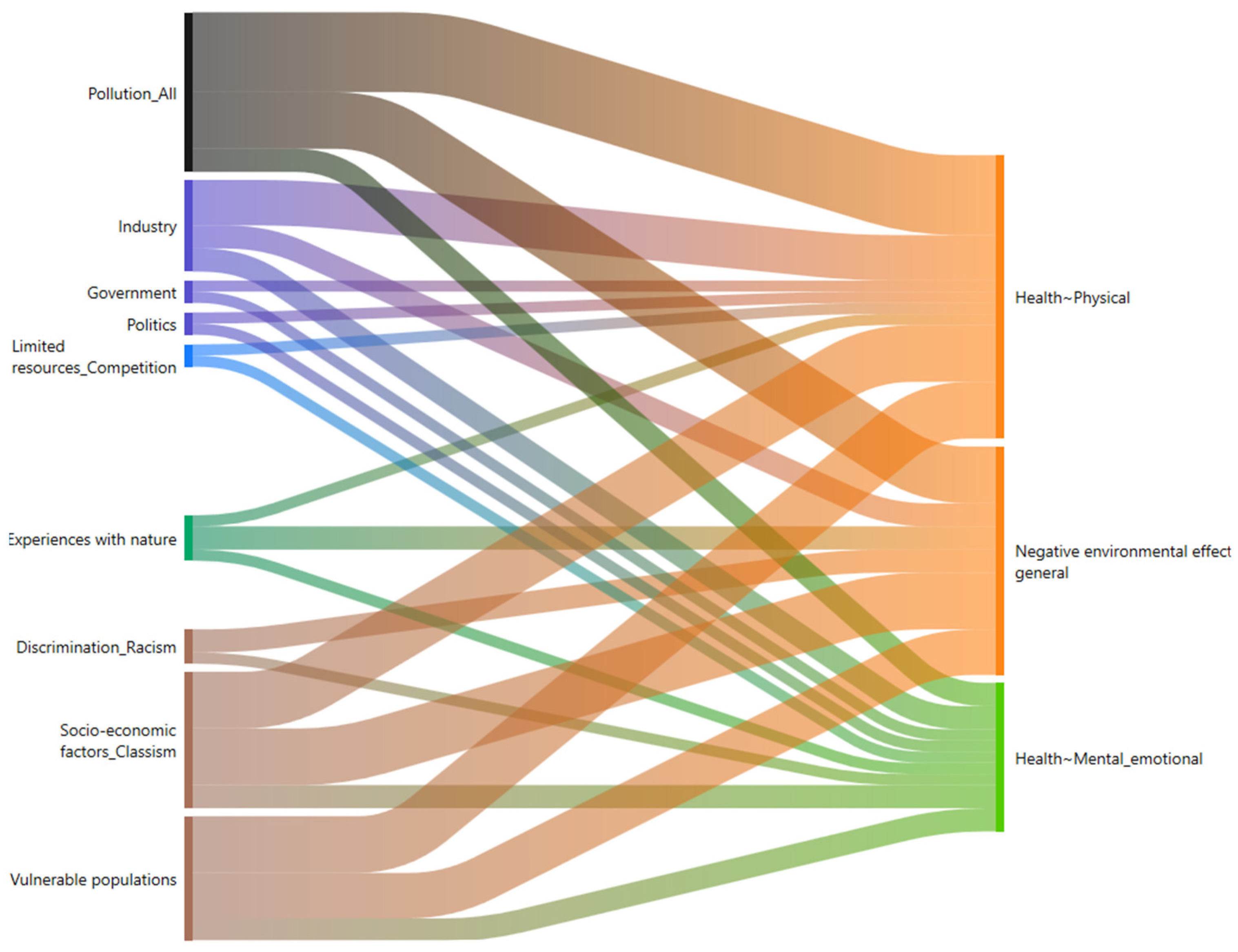
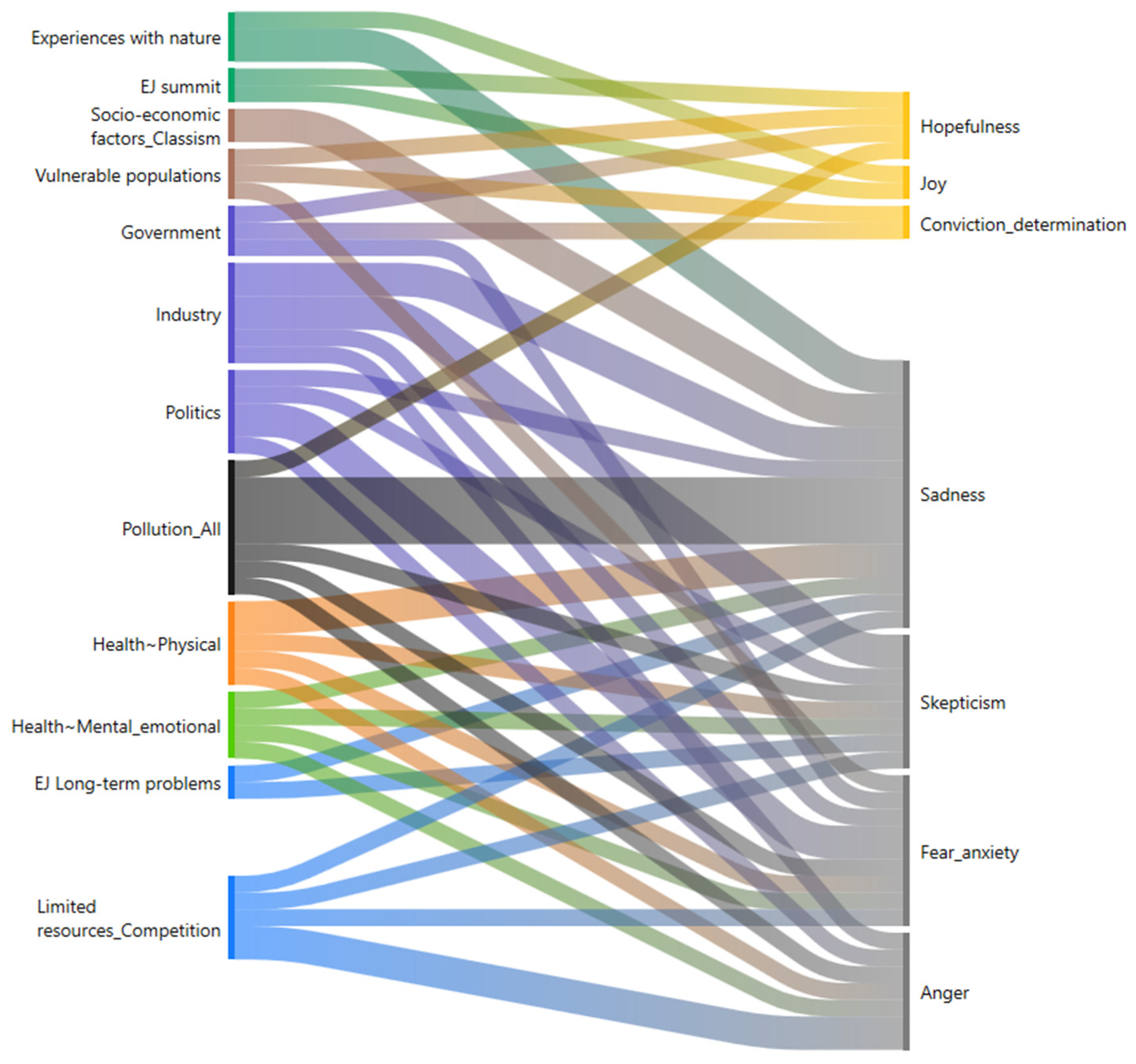
Using the coded data from the interviews, we performed code co-occurrence analysis in Atlas.ti to generate two Sankey diagrams showing commonly occurring themes related to health effects and those related to emotions. These included seven main code groups: (1) politics, government, and industry; (2) affected populations, which included references to racism and discrimination, mental, emotional, and physical health, socioeconomic factors such as classism, and vulnerable groups; (3) pollution, which covered air, water, and land pollution, geographic factors related to pollution, sources of pollution, and general mentions of pollution; (4) experiences and perspectives of interviewees, including their interactions with nature; (5) organizations and communities, with attention to issues such as limited resources and competition; (6) EJ general topics, including negative environmental effects and long-term environmental justice concerns; (7) emotions, including positive expressions such as hopefulness, joy, conviction, and determination, and negative emotional references including sadness, skepticism, fear, anxiety, and anger. The diagramming was done to understand how often different ideas are expressed together by analyzing the frequency of co-occurring codes. The thickness of the flow represents the strength of the relationship between the two codes, which is the frequency of co-occurrence of the two codes within each segment, across all the participants.
3. Results
Of the thirteen interviews conducted, six participants worked in the non-profit sector, five participants in academia, one in philanthropy, and one in government. Geospatial analysis revealed that three participants live in census block groups identified as environmental justice areas. Participants were assigned names corresponding to the Greek alphabet to maintain confidentiality of their responses. Table 1 shows participant assigned name, work sector, and EJ area status.
Table 1.
Interview Participants Work Sector and EJ Residence Status.
Across the interview responses, participants expressed negative emotions more frequently than positive emotions (16 of 30 total coded emotion expressions; 53.3% vs. 14 of 30; 46.7%); still, hope was the most widely expressed emotional theme, providing early insight into the potential for convenings to support healing justice and transformative justice. Spending time in nature and outdoors was associated with joy, happiness, and peace (joy: n = 4). Frequently expressed negative emotions were sadness (n = 7), grief, anxiety (fear/anxiety: n = 4), and anger (n = 3), mostly related to environmental loss and social and political barriers. The most frequently voiced physical health issue was cancer, either directly by the participants or their families. Overall, participants viewed the summit as a space for collective healing, sharing knowledge, forming new connections, and fostering hope.
3.1. Introductions and Neighborhood Residency
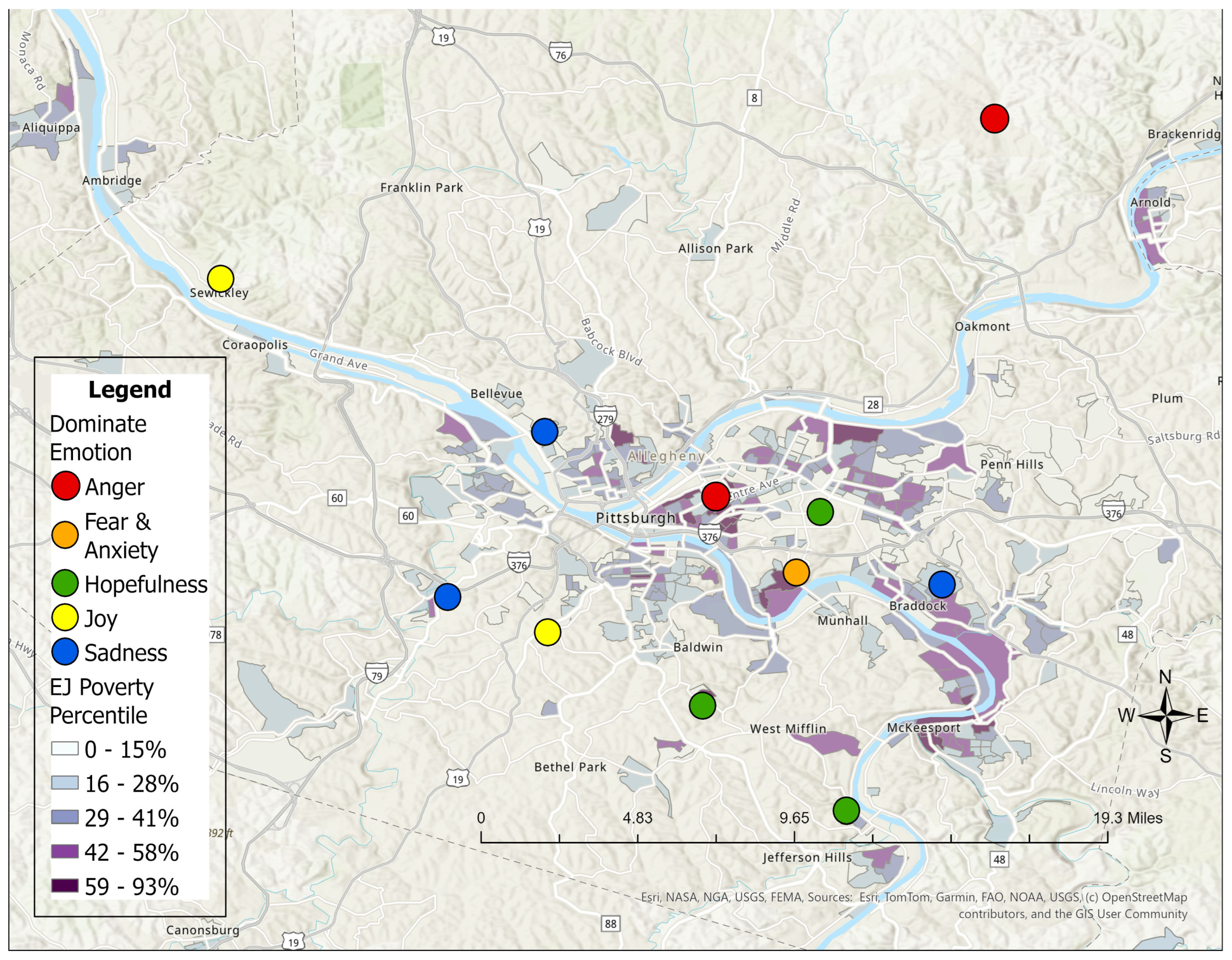
Participants resided in neighborhoods across the Pittsburgh, Pennsylvania region, spanning both EJ and non-EJ block groups. Of the 13 total participants, 11 had complete address and emotion data and were eligible for spatial mapping; one participant did not provide a mappable address, and one participant had no coded emotional responses and was therefore not represented in the mapped data. Three participants lived in EJ-designated neighborhoods, while ten lived in non-EJ neighborhoods. All three responses from EJ neighborhoods were negative-dominant, whereas outside EJ areas, positive-dominant emotions were more common (8 of 10).
Across the sample, the most frequently expressed emotions were hope (n = 9) and sadness (n = 7), followed by fear/anxiety and anger. Participants expressed skepticism in several of their responses, but it never emerged as a dominant emotion; therefore, it is not represented in the mapped data. Table 2 provides a summary of dominant emotions expressed for participants in EJ areas versus non-EJ areas. The summary of EJ areas status and positive vs. negative dominant emotion expression is shown in Table 2.
Table 2.
Emotional dominance by Environmental Justice (EJ) Status.
Neighborhood poverty levels also varied: of the nine participants for whom neighborhood poverty values could be spatially assigned, two participants lived in low-poverty neighborhoods (<20%), five in medium-poverty (20–40%), and two in high-poverty (>40%) [52]. Four participants could not be classified by poverty band due to incomplete or unmatched spatial data. Across poverty bands, emotion responses (counts) differed by neighborhood context. In low-poverty neighborhoods, positive-dominant responses outnumbered negative ones (2.0 vs. 1.0 on average). In medium-poverty neighborhoods, negative-dominant emotions were more frequent (2.0 vs. 0.6). In high-poverty neighborhoods, negative emotions also outweighed positive ones (2.0 vs. 1.5). Mean positive and negative counts for each poverty band are shown in Table 3.
Table 3.
Mean Positive and Negative Emotion Counts by Poverty Band.
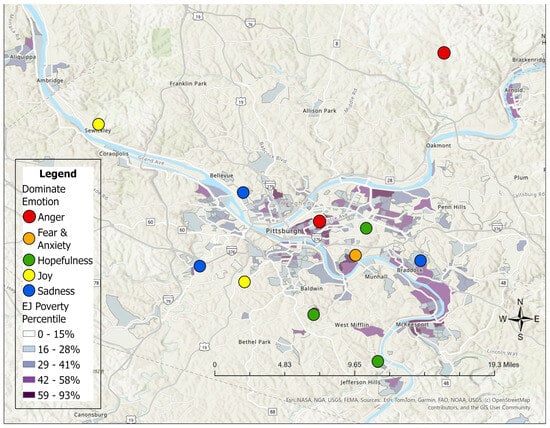
Several outlier cases were observed. Conviction and anger emerged as dominant emotions in a non-EJ neighborhood where other participants expressed different dominant emotions. While the data size is too limited to conduct statistical analysis of distribution, we do see preliminary patterns of negative emotions expressed more often for participants residing in areas with higher EJ poverty percentiles than from those in lower poverty percentile areas. We also see positive emotions of ‘joy’ and ‘hopefulness’ expressed as the dominant emotion by participants in lower poverty percentile areas (Figure 1).
Figure 1.
Dominate Emotion Expressed and EJ Poverty Percentiles.
3.2. Pre-Summit Impressions of Environmental Justice and Healing
All thirteen participants had experience with or awareness of environmental harm and EJ before the summit. Although their familiarity with EJ work varied, everyone had some connection to EJ, mainly through personal or family experiences with environmental injustices, from a professional positionality, or by already being engaged in activities, research, and community efforts related to EJ. Participants were involved in a range of efforts, including addressing the impacts of air pollution, engaging in urban farming, greening vacant lots, and organizing around fracking and air quality issues.
Although all thirteen participants were familiar with EJ work, only eight of them reported having explicitly considered healing as a component of EJ efforts before the summit. One person expressed, “I’ve learned from watching other people who have experienced environmental injustice that joy and community are critical for healing wounds of exploitation (Alpha).” Another person shared how conversations about healing are often not appreciated in professional discussions, emphasizing the need to shift the dialogue to include a heart-centered perspective in environmental problem-solving.
Others viewed healing as theoretical or abstract and focused more on the operational changes. Some individuals practiced healing as part of their personal journey, such as spending time in nature and connecting with people, but not as part of their EJ work. One person said, “While the ideological stance has always been embedded in my training and practice and while that was a part of my personal journey, I never actually pointed a finger at it (Mu).” Another person shared, “I have thought more in terms of addressing environmental harm, but I hadn’t thought so much about healing in those terms (Nu).”
Many appreciated the summit for shedding light on the importance of healing from a practical lens and how it helped create a space for collective healing. Participants valued having a dedicated space to practice community healing within an EJ framework and were inspired to envision healing practices within this framework. As one person shared, “The explicitness around viewing healing was very novel to me, so I felt really inspired by that (Zeta).” Another shared, “In my previous work, I’ve thought about it theoretically but really had not engaged in many spaces like the ones hosted by the [Pgh] EJ Summit (Theta).”
3.3. Past Experiences, Environmental Injustices, and Loss
Participants shared deeply personal experiences with nature and the environment from their childhood, involving stories of joy, loss, and grief. Some individuals grew up spending time in nature and green spaces, which created joy, happiness, and peace, and were seen as a space of emotional and spiritual connection. One person shared, “I grew up in Oregon, a very beautiful environment. So, my associations with nature were always positive, a place of renewal, spiritual connection, and beauty (Nu).” Another person shared, “My feelings were just a sense of wonder and peace, and those early connections with nature, I think, set the groundwork for a lot of what became my life’s work, and so you can’t overstate the impact of that as a child (Theta).” Over the years, tainted with feelings of loss and sorrow at the destruction or pollution of these natural areas, the memories gradually faded away, representing sadness and solastalgia. Others remembered concrete neighborhoods, with little greenery, like one person who reflected on their time in Brooklyn, New York, “It was just cement hardscape, that was my first impression as a child. It was devastating when all the buildings were torn down. Black businesses, black homes. That’s environmental urban renewal. That’s my idea of environment; it has always been negative, and it’s all been done to impoverish people. It’s done to us (Gamma).” Another expressed, “It’s not just about the air that we breathe or the water that we drink. It’s not having access to basic needs as well (Lambda).”
3.4. Physical Health Impacts of Environmental Harms
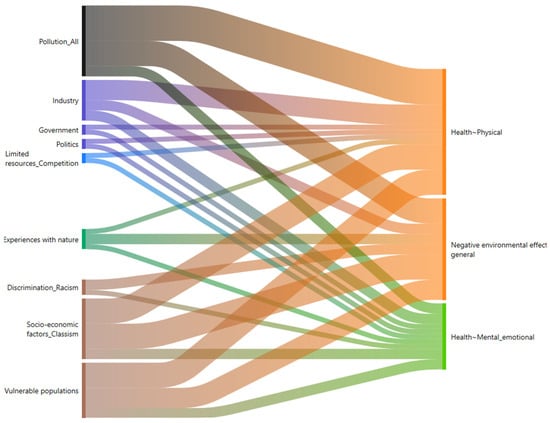
Of the thirteen participants, eight reported serious physical health issues affecting themselves or their family members, which were primarily associated with exposure to harmful environments. The first Sankey diagram was created to show the commonly occurring themes associated with physical health, mental and emotional health, and general negative environmental effects. Pollution and vulnerable populations often co-occurred with physical health issues (Figure 2). These included exposure to coal mines, logging, pollution in rivers from paper mills, building a sewage treatment plant next to a pool, and fracking wells. Cancer was among the most common health conditions mentioned, with participants reporting family members who had either died of cancer or were currently living with it. One person shared, “Cancer is hitting us. It’s like a plague in the Black community. White community seems to be more informed about health and environmental issues. Meanwhile, my community is still catching up and primarily focused on day-to-day survival, often unaware of how these environmental factors can affect our health (Gamma).” Other physical health issues mentioned included asthma and nosebleeds in adults and children.
Figure 2.
Sankey of Health Impacts and Co-Occuring Themes.
Some participants expressed that their communities were exposed to harmful environmental pollutants, often without their knowledge or awareness of the consequences of these exposures. Stories of racism and injustices faced by vulnerable populations, leading to severe physical health issues, often came up in these discussions. One person shared,
“For me growing up, I did not [know], or I was not taught, or was not familiar with the harms that were being done. Even though I had relatives, my dad, my grandfather, my uncles who worked in the polluted industry, I didn’t know about the harms. Because my dad worked in the industry, we had a roof over our head. We were able to eat. But at the same time, it wasn’t until later that I knew that the jobs that my relatives had were the most dangerous jobs. So that’s another part of the racism that comes into play. They had more of the dangerous jobs. And it wasn’t until five years ago that I started to do this work in environmental justice. And even though I lived here, I haven’t really put two and two together. You know, possibly my health was being affected, my children’s health (Lambda).”
3.5. Emotional Health Impacts of Environmental Harms—Change to Emotions, Both Positive and Negative
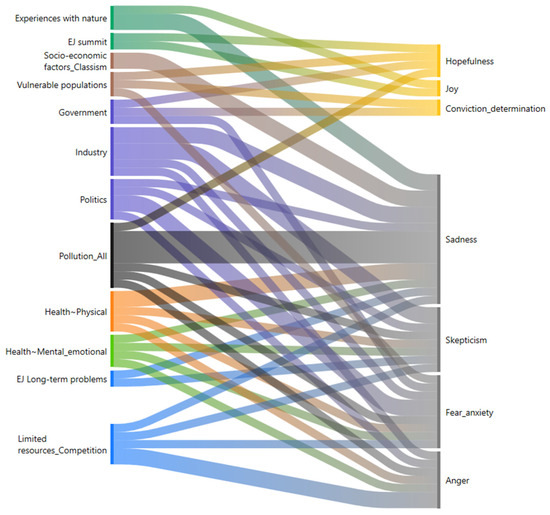
In our interviews, mental health was related to various themes expressed but was only expressed in a negative context. The second Sankey diagram shows the commonly occurring themes associated with various emotions expressed by the participants throughout the interviews (Figure 3).
Figure 3.
Sankey of Emotions Expressed and Environmental Concerns.
Pollution, vulnerable populations, and socio-economic factors frequently co-occur with mental health issues (Figure 3). The team classified negative emotions into four categories: anger, sadness, skepticism, and anxiety. Positive emotions were classified into three categories: hopefulness, joy, and conviction and determination. We used sadness as the primary code for representing ecological grief when it was expressed in the context of environmental concerns. Grief was evident in personal stories of loss, illness, and the anticipation of future threats. We identified four categories through which eco-grief was expressed: (1) experienced environmental losses; (2) anticipated future events; (3) preventable harm and systemic neglect; (4) intergenerational trauma (Table 4).
Table 4.
Categories and Examples of Ecological Grief.
We used emotions of fear, worry, and anxiety in the context of environmental concern to represent feelings of eco-anxiety. Participants expressed eco-anxiety in four categories: (1) anxiety due to lived experiences with climate harm, (2) anxiety related to future generations, (3) anxiety related to political and institutional struggles, and (4) stress or burnout that came from limited results in working towards change (Table 5).
Table 5.
Examples of Ecoanxiety.
Through the interviews, participants frequently referenced emotions of anger, which we recoded as eco-anger. Eco-anger was expressed by interviewees due to repeated experiences with environmental harm and injustice, systemic barriers in EJ work, limited resources and competition, and government inaction regarding climate injustices. Participants mainly expressed skepticism regarding long-term problems related to industry, politics, pollution, and EJ (Figure 3). Participants also expressed skepticism toward institutions and systems of power that have historically ignored or taken an opposing stand on environmental harm. One person shared,
“You might be surprised by how deeply embedded industrial interests are into the fabric of this governance and leadership, and so there needs to be more, I think, connection and respect for the communities that actually are impacted the most. Universities now are required to work with communities so that they can land large grants. And it’s not invisible to the communities that there’s even more of a quid pro quo happening, like, “Oh, we want to work with a community and help them,” and then what the feeling is, like, “so that we can check that box to get a big federal grant because the grants are requiring that.” So, there’s actually a lot of skepticism in the communities that are impacted about large institutions. So that needs to be addressed. There’s trust issues that need to be sorted out (Delta).”
Positive emotions were categorized as: hopefulness, joy, and conviction or determination. Joy was described in moments of success, experiences with nature, through inspiration drawn from the work of others, and when witnessing collective action at the Pgh EJ Summit. As one person said, “The main memory I have is taking walks in the woods with my father. I think about it, I live in a wooded area now, and so whenever I take walks, it takes me back to that very happy memory (Beta).” Emotions grouped in positive and negative bundles are shown in Figure 3 with their co-occurring environmental conditions codes.
Some participants were firmly convinced and determined to create change, viewing their work as a moral duty to advocate for affected communities. As one person expressed,
“It’s important to ensure that people of color can understand this process without feeling overwhelmed or thinking it’s out of reach for them. I’m excited to see how far we can go. Despite feeling intimidated, I’m determined to submit a piece of art that represents our Black community, particularly because we are a heavily impacted community that often doesn’t have a voice. I feel a strong sense of obligation to represent my community because I have gained the knowledge and support necessary to do so (Gamma).”
Despite the cumulative predominance of negative emotions over positive ones throughout the interviews, hope was the most widely expressed emotion. People saw hope in small wins, such as improved knowledge on environmental health, stronger collaborations, and collective efforts to address environmental injustices and harms. As one person shared, “I’m very scared, very sad and very frustrated. At the same time, I’m also very inspired by the work that a lot of people are doing to right the ship (Eta).” Example quotes expressing hope are shown in Table 6.
Table 6.
Selected Quotes Referencing Hope.
3.6. Future Generations
When asked about their feelings regarding the environment and future generations, interviewees shared both negative and positive outlooks on the future. Many found hope due to increased awareness, education, and community engagement. One person shared, “When you know better, you do better (Alpha),” and another person shared, “I think students today are very much more in tune with the needs in the community, I think there is a large group of students and faculty that are much more likely to want their work to have real impact. I would say in the last five to ten years, the effort to have a true, genuine collaboration partnership impact in the community has changed and has gotten better (Kappa).”
Negative associations with the future were grounded in lived experiences, increased health effects related to environmental hazards, unaddressed historical harms and inequities, and a lack of trust in systems of power. One person shared,
“I constantly worry about children. I get really worried about food insecurity for future generations. I get extremely worried about mass displacement. I mean, there are tons of injustices when we think about climate justice. I’ve been actually introduced to multiple people in my current neighborhood that are my age or early 30s with cancers that you typically see in people that are 70 or older, so I do think that there’s a lot of compound impacts with pollution that we are not studying as a nation. So, I do think that has a lot to do with all the chemicals that I grew up with (Gamma).”
Another person shared,
“I love kids, but I’m child free by choice because I do not want to bring a new carbon machine into the world. I do not want to add burden to the earth. But also, I’m worried about what the new generation or our future generation, my friends’ kids, and so on, they’ll have to endure because the really polluted earth that we are leaving behind for them (Mu).”
They emphasized the importance of knowledge, awareness, and collaborative efforts in seeking justice for historical harm and protecting future generations. One person shared,
“I think that we need to think about ways that future generations can feel that they have an understanding, a scientific understanding, of choices that they can make in their lives to live in a way that protects them and supports healthy and happy lives. And I think it’s really important for us to demonstrate for future generations that companies in particular and government agencies sometimes too will not be that we have to be our own backstop when it comes to protecting ourselves, our physical health, and our mental health too, really (Alpha).”
3.7. Community Engagement, Social Isolation, Local Practices
Most of the participants, nine out of thirteen, described feeling connected to their community, three said they felt mixed, and one felt disconnected from the broader structures of the community. Coming together through shared experiences, support, and cultural activities helped foster a sense of community connection. One person said, “I definitely feel more connected to my community. Climate disasters, like Hurricane Helene, make me feel more connected to my community because I can see how people support each other. I’m able to participate in that mutual support and sustainability effort and self-reliance effort (Alpha).” Another person shared, “I feel connected to my community, primarily from a community perspective with my children, I would say. And that’s really where that connection probably lives, through my kids and their school and their activities (Nu).” For others, connections came through work. One person shared, “Working on some of the issues locally has really been powerful for me personally. I feel more connected to my work, to the communities, and the intersections (Theta).” Another person shared, “I like the community where I volunteer, and I have an outlet that I feel is helping with environmental justice and climate justice. So, I feel like that helps me a lot mentally (Epsilon).” When asked about local customs or traditions that helped people feel more connected to the community and the environment, participants shared stories of coming together through food, sports, church, and collective environmental efforts. Additional quotes on community and connection are provided in Table 7.
Table 7.
Example Quotes on Community and Connection.
While most of the participants felt connected to their community, some felt disconnected from their communities mainly due to neglect and a lack of support. Volunteering and collective efforts were also mentioned as ways to help mitigate feelings of disconnection from their communities. One individual shared her experience of feeling detached from the broader city but finding comfort by volunteering with a local nonprofit. Connections with community members and activists who offered support and encouragement helped her pursue her passion and build her own community, where she felt connected. Another person shared, “This community and its civic elites have been dismissive of, disconnected from, and even antagonistic toward these kinds of impacts and conversations and efforts on not just a policy level, but even just a communications level and even at a level of empathy and sympathy. This is one of the hardest cultures and societies that one can be in because of its deep industrial ties and ongoing industrial connections that its civic elites have with polluting industry (Delta).”
3.8. Barriers and Facilitators to Change
Common barriers in EJ work included a lack of institutional accountability and limited access to adequate resources. Others described struggling with insufficient funding and a lack of support from systems of power, as well as competition among organizations. Racism, discrimination, and the exploitation of vulnerable populations were common challenges mentioned in EJ communities. As one person explained, “When all of these groups are competing for the same pots of money, it can really unleash a pretty horrible sense of competition, when in reality, we could, in a better world, cooperate and learn from each other (Delta).”
Some mentioned a lack of awareness as a challenge to EJ work. As one person shared,
“There is still a challenge with education, both within and outside of environmental justice communities. Within, to identify as such and to use that understanding and identification that we are an environmental justice community to advocate for, resources and capacity, and then eventually really prepare for some of those past harms [to be remedied]. And then, outside of environmental justice communities, a real reckoning with what environmental justice is and what it means for so many people, I think, still remains a challenge in the field (Theta).”
Politics, government inaction, and interference from industries, as well as limited resources and funding, and competition among organizations, were frequently mentioned as obstacles in this work. Participants described a disconnect between communities and private and public organizations, as well as a lack of empathy. This disconnect can create a sense of neglect towards surrounding communities and rural areas. The history of exploitation, neglect, and inaction has left many communities feeling used, leading to mistrust in institutions and systems of power. These issues can make it challenging to establish and implement partnerships and collaborations.
Despite the number of barriers expressed, participants also shared facilitators to EJ work. Growth in the number of nonprofit organizations, stronger support from organizations, and development of targeted programs addressing environmental concerns were described as positive facilitators for EJ work. Some described how greater involvement from community members in collective efforts helped create momentum. Greater interest from students and academic institutions also helped facilitate EJ efforts. Some reported that increased awareness and dialogue on climate change and its harms compared to previous generations have helped people understand the importance of EJ work and engage in activities that protect their environment. One person reflected on how changes in daily life, such as rising temperatures and the absence of snow in Pittsburgh, had led many people to begin questioning and thinking critically about the changes around them.
3.9. Post-Summit Takeaways, and Impact
“I will say when I was about to attend the summit, I was not in the best headspace because I was hitting a lot of roadblocks. And then after [attending], I’ve been like, oh my goodness, everybody’s doing all this great work. Everyone’s fighting the fight. Okay, let’s get back to work (Zeta),” one person shared. All the participants interviewed described positive experiences with the summit and saw it as a source of inspiration and renewed energy. They also appreciated sharing space with others who have the same vision and are dedicated to this field. One person shared, “It helped me feel like I was finding my people. It’s nice to be in a room with people who get it and understand why you do what you do, people who are supportive (Iota).” Participants shared that the summit helped to create a space for community healing by incorporating healing into EJ efforts. One participant reflected, “I did a lot of learning and gained a lot of inspiration for the types of work happening that my organization and I can support. I appreciated some of the leaders and their everyday work in the healing space and healing practices with environmental consciousness. That was really inspirational (Kappa).” Another said, “I was ready to get back to work after going to that. And I told all of my colleagues about it (Zeta).”
The summit also helped members create meaningful connections and understand action and focus areas. Participants stated that the panel discussions and shared stories helped create hope and strength, and connections through the summit helped in seeking funding opportunities, forming collaborations with organizations, and engaging with various community-driven initiatives. One participant explained, “I was able to tap into some additional organizations that were either directly involved in the summit or attended the summit and met people that I’ve started following on social media, if nothing else, just to better understand what’s going on. One of those in particular is the Black Appalachian Coalition. I was not aware of that organization before the summit, and now I’m able to pay attention to what they’re doing and events that they might be having and ways that I might be able to support and participate in their work (Eta).” Another participant shared, “I was inspired and impressed, it gave me a clearer sense of the places I could be useful (Nu).”
4. Discussion
Similarly to previous research (Albrecht 2011; Landrigan et al. 2018), the results of this study show that exposure to unfavorable environmental conditions can impact both physical and emotional aspects of life. The most common physical health issue reported was cancer; others included asthma, nosebleeds, and fibromyalgia. Emotional health was only expressed in a negative context. Negative emotional health codes represented eco-grief, solastalgia, eco-anger, eco-anxiety, and eco-paralysis. Even though negative emotional themes were more common than positive ones, hope was the most widely expressed emotion throughout the interviews. Many shared how the summit helped create a space to heal and find hope through shared experiences and healing practices.
In our study, we observed several mentions of racism, discrimination, and neglect, alongside pollution and adverse health effects. Pollution and vulnerable populations co-occurred, primarily with physical health effects. They were also associated with other negative environmental impacts and mental health issues, showing how individuals of color and low-income communities have higher exposure to harmful environments and, as a result, also share a higher burden of physical and mental health effects. Some shared how certain communities, including those of color and low-income groups, suffer from neglect, increased exposure to harmful conditions, and high rates of physical health illnesses, including high cancer rates in black communities. This supports several previous studies suggesting that minority groups, and people of low socio-economic status, face a higher burden of exposure to environmental harms and impact (Beard et al. 2024). A population-based study in Flint, Michigan on the effect of water crisis showed higher rates of physical and mental health issues in black and low-income communities. This included higher rates of physical health issues like skin rashes and hair loss, and emotional health issues, including depression, anxiety, and trauma (Ezell and Chase 2021). Cancer related to environmental factors is also highest in communities of color and low-income groups (Larsen et al. 2023). In our study, the most common emotion expressed in reaction to pollution was eco-grief, which we coded as sadness. Participants shared how multiple family members, and sometimes generations, have been exposed to harmful environments and suffer from higher rates of cancers and toxic exposures. Government inaction, neglect, and systemic issues further exacerbated existing challenges.
Both physical and mental health are important for overall health and well-being. The pain and suffering that individuals and families go through as a result of physical health impacts, like cancers, can have severe mental health impacts. In this way, physical health issues can lead to distress and further amplify psychological illnesses. Physical illness can make people more vulnerable to mental illness, and mental illnesses can further affect physical illness, leading to a cycle of disease and distress. Sometimes, families have to cope with these effects for generations, unable to escape these harmful consequences, which pose further challenges due to continued exposure and other systemic, social, and political barriers. A study by (Petrova et al. 2021) found that individuals with cancer reported higher rates of physical comorbidities and psychological distress compared to controls. In individuals with cancer, each additional comorbidity was associated with 9% higher odds of reporting high psychological distress (Petrova et al. 2021).
In our study, we observed that nature was associated with positive experiences of joy, peace, and spiritual connection, and negative experiences of grief and sorrow. These findings show the connection between humans and the environment, illustrating how positive experiences with nature can create positive emotions like joy and peace, yet change over time to pain and grief due to the negative transitions associated with their home environments. This shows how damage to home environments can leave lasting physical and mental health impacts, highlighting the importance of reviving and protecting one’s home environment. During the summit, the facilitators incorporated healing and grounding practices, asking people to collectively connect and experience what they feel as they touch the grass and soil, reviving and respecting the land and the people who have stayed there to keep it safe and thriving. Participants were also invited to reflect on their experiences and the sensations they evoked by the surrounding sounds and the silence. This practice was meant to help people connect with each other and with nature, and to develop and feel the peace and strength that come from being in touch with the natural environment.
The results of this study show that participants’ emotions were multifactorial and often overlapping. Ecological grief, expressed as sadness, emerged as the most commonly reported negative emotion, mentioned seven times across four participants. Similarly to previous research (Cunsolo and Ellis 2018), participants described sadness when reflecting on past experiences of environmental loss and injustice, and when anticipating future threats. In our study, grief was also tied to intergenerational trauma, and experiences of others within their communities. These findings reflect how deeply emotions are embodied, how they remain in people’s bodies and minds and can be experienced every time they revisit past experiences. Many expressed grief due to preventable harm and systemic neglect, and from going up against systems of power that disregard or sometimes take an opposing stance concerning the health of minorities and vulnerable populations. Decades of such social and political issues can not only impact people and communities, but also lead to feelings of powerlessness, hopelessness, and skepticism in institutions and organizations. Clark (2020) says that across the world, more and more people are suffering from what he calls the ‘anthropocene horror’. This is the horror experienced in relation to the changing environmental conditions globally. As opposed to ecological grief which may lead to reflection and action, anthropocene horror has a paralyzing experience, leading to inaction. This shows how emotions can be a mobilizing or a suppressing factor (Clark 2020). This means seeking justice for past experiences, helping communities rebuild trust in institutions where it has been lost, creating a healthy environment for everyone, and instilling hope. Healing practices can help address emotional trauma and support transition through past lived experiences, developing hope and inspiring change.
Importantly, the mapping analysis showed that emotional expression was patterned by structural context rather than evenly distributed across place. In EJ-designated neighborhoods, participants were more often negative-dominant, reflecting the lived weight of environmental burden and systemic neglect. By contrast, participants from non-EJ and lower-poverty neighborhoods more often expressed positive-dominant emotions such as hope and joy, suggesting that relative material stability and reduced exposure to injustice can foster more affirming affective states. Skepticism, while present in the data, never emerged as a dominant response and therefore was not displayed on the map. This absence is meaningful: it suggests that skepticism was overshadowed by stronger affective states such as grief and anger in more burdened areas, and by hope in less disadvantaged neighborhoods. These contrasts indicate that ecological emotions function as markers of inequality—grief, anger, and anxiety clustering where disadvantage is greater, and hope surfacing where communities perceive greater security—while skepticism lingers more diffusely, reflecting mistrust without fully shaping participants’ dominant narratives. Taken together, the findings argue for interpreting emotional responses not only as individual expressions but also as reflections of structural inequities embedded in place.
In this study, we found that having experienced environmental harms and injustices also contributed to worry, anxiety, and raising concern for future generations. Political and institutional barriers, along with limited results, amplified feelings of stress, sometimes even leading to burnout. Eco-anger was frequently expressed when talking about preventable harms, systemic neglect, and governmental inaction. Anger coincided with grief when talking about generational harms, institutional failure, and challenges in doing EJ work. We found that anger and anxiety coexisted with hope and emotional exhaustion, showing that it can be a mobilizing factor and a source of burnout. This shows how anger and frustration can be possible sources of motivation to act on climate change when linked with perceptions of injustice. Even amidst anxiety and worry, many expressed conviction to bring about positive change. Even those expressing pessimism against governments or institutions showed hope in small wins. This is where summits like this can be very impactful by showing that through collective efforts and healing, we may be able to transform sorrow into meaning while strengthening emotional resilience.
The summit provided a space to heal and gain new connections for future collaborations and projects. Many found joy, connection, hope, and strength after attending the summit. This demonstrates the potential of summits and collective efforts to empower individuals and communities and help in overcoming the emotional and structural hurdles that stand in the way of action and change. Integrating healing practices into EJ frameworks can help to deal with the psychological harm caused by environmental injustices. Incorporating healing measures into EJ frameworks can also increase the effectiveness of interventions. Since past experiences can determine future response, understanding community needs through lived experiences serves to anchor effective public health practice strategies.
Participants expressed that going up against systems of power made it difficult to carry out work to achieve EJ and promote health in their communities. Factors like this can lead to skepticism, hopelessness, and burnout, all of which can negatively affect emotional well-being. However, many found hope due to increased education and awareness, genuine partnerships, and collective actions. There is less research on the coping mechanisms people use when experiencing such negative emotions, including what makes people experience hope and what factors lead to hopelessness. Many accept these negative emotions as part of this journey and learn to develop strategies to overcome the emotional and structural challenges to be able to continue their work. A study by Giæver and Russell (2025), who interviewed thirty environmental activists to understand their emotional regulation mechanisms, identified two strategies: action taken to heal, and healing to sustain action. This demonstrates how summits and gatherings like this can help create a space to heal from past experiences, while also enabling participants to gain hope and sustain action (Giæver and Russell 2025). By creating a space to share one’s own story, and listen to others’ experiences, healing practices can help to develop a sense of collective being, reflect on past experiences, and leverage one’s experiences to understand people, and contribute to society and the community through empathy. The Pgh EJ Summit implemented this approach by creating a space for collective healing alongside the EJ work. The results of this study show the effectiveness of summits and gatherings to inspire collective action and promote healing in EJ communities. This approach can inform the development of targeted strategies and help close persistent gaps in EJ practices. This includes seeking justice for historical harms and preventing future harms so that subsequent generations are not impacted by these harmful exposures and health effects. More research is needed on the interaction between physical and mental health impacts associated with environmental harms, generational effects of environmental harms and injustices, mainly in vulnerable populations, and practices that help to foster healing and eliminate stress and burnout. This is essential to develop coping strategies to overcome emotional challenges and maintain overall well-being.
This analysis has several limitations. The sample size was small (n = 13), which limits the generalizability of findings and means the results reflect the perspectives of a select group of summit participants rather than a broader population. Because this was a convening of individuals already engaged in EJ work, responses may not represent the experiences or emotions of other community members. The mapping analysis was conducted at the neighborhood level and relied on publicly available EJ designations from PennEnviroScreen 2024 which uses many common EJ indicators in addition to having some context-specific to Pennsylvania that may not translate to other states or settings. Despite these limitations, the analysis provides important exploratory insights into how emotional expression relates to structural inequities, EJ status, and neighborhood poverty.
5. Conclusions
This study underscores the interconnected nature of physical and emotional health impacts of environmental injustices and how these burdens can persist across generations. Beyond documenting harm, the findings point to the transformative potential of collective spaces, such as community summits, in fostering healing, resilience, and hope. These convenings not only provide opportunities for emotional restoration but also strengthen networks and promote collective advocacy and action. Moving forward, integrating healing practices into environmental justice frameworks and policy interventions can help address structural inequities and support community well-being. Future research should explore strategies to sustain emotional resilience, reduce burnout, and bridge the gap between environmental health science and community-centered approaches.
Author Contributions
Conceptualization, T.N.; methodology, T.N., C.B., D.W. and M.A.; validation, T.N., C.B. and M.A.; formal analysis, C.B., T.N. and M.A.; investigation, C.B. and M.A.; resources, T.N.; data curation, C.B.; writing—original draft preparation, C.B., T.N., M.A. and D.W.; writing—review and editing, C.B., T.N., M.A. and D.W.; visualization, C.B. and M.A.; supervision, T.N.; project administration, T.N.; funding acquisition, T.N. All authors have read and agreed to the published version of the manuscript.
Funding
This research received no external funding.
Institutional Review Board Statement
The study was conducted in accordance with the Declaration of Helsinki, and approved by the Institutional Review Board of the University of Pittsburgh (STUDY 24070040 approved on 3 September 2024.
Informed Consent Statement
Informed consent was obtained from all subjects involved in the study.
Data Availability Statement
The data presented in this study are available on request from the corresponding author due to privacy concerns for study participants.
Conflicts of Interest
The authors declare no conflict of interest.
Abbreviations
The following abbreviations are used in this manuscript:
| APHA | American Public Health Association |
| CDC | Centers for Disease Control and Prevention |
| EJ | Environmental Justice |
| EJI | Environmental Justice Index |
| EPS | Eco-Paralysis Scale |
| HEAS | Hogg Eco-Anxiety Scale |
| IRB | Institutional Review Board |
| PADEP | Commonwealth of Pennsylvania, Department of Environmental Protection |
| GIS | Geographic Information System |
Appendix A. Semi-Structured Interview Questions
| EJ SUMMIT INTERVIEW QUESTIONS |
| Section 1: Introductions, EJ Background 1a. Could you please share your name and physical address: 1b. How long have you/your family stayed here? (in the area or at the specific address) Section 2: Pre-Summit Impressions of EJ and Healing 2a. What were your views on Environmental Justice before the summit? 2b. Have you thought about healing as a component of EJ prior to the summit? 2c. Have you or anyone in your family been involved in any community work/organizations that supports environmental or justice focused issues? Section 3: Past Experiences, Intergenerational Trauma, Emotional and psychological impact, Eco-anxiety, Eco-paralysis 3a. Can you share a memory or memories that you have connected to the environment? What feelings come to mind when you think of this memory? 3b. Have you or your family experienced any loss and/or injustices due to environmental issues? 3c. How have these environmental experiences affected you on a personal and emotional level? 3d. How do you feel about environmental issues and their impact on future generations? Section 4: Community Engagement, Social Isolation, Local Practices 4 a. Would you say you feel more connected or isolated from your community? 4.a.i. How has this [isolation/connection] affected your efforts to contribute to environmental justice and healing? 4.a.ii. How has feeling [isolated/connected] impacted your efforts to contribute to environmental justice and healing? 4 b. Are there any local customs or traditions that help you feel more connected to the community and the environment? Section 5: Barriers to Change- Emotional, social, and resource 5a. Have you tried to address environmental concerns in your community? 5.a.i. If so, what challenges do you face in terms of resources and support when trying to address the environmental risks in your community? 5b. What, if any, positive changes have you seen in your environment? Section 6: Future Goals and Post Summit Takeaways 6a. Has the summit inspired you to take any actions/new initiatives towards environmental justice and healing? 6b. Did you meet anyone at the summit who has influenced your views on EJ? If so, how have they inspired you? 6d. What needed resources or future activities do you think would best help to achieve environmental justice and emotional healing in this area? Section 7: Final Thoughts and Closing Are there any other final thoughts around environmental justice and healing that you’d like to share with us? |
References
- Ahmed, Ayman, Nouh Saad Mohamed, Emmanuel Edwar Siddig, Talha Algaily, Suad Sulaiman, and Yousif Ali. 2021. The impacts of climate change on displaced populations: A call for action. The Journal of Climate Change and Health 3: 100057. [Google Scholar] [CrossRef] [Scilit]
- Albrecht, G. 2005. ‘Solastalgia’. A New Concept in Health and Identity. PAN: Philosophy Activism Nature. Available online: https://search.informit.org/doi/pdf/10.3316/informit.897723015186456 (accessed on 29 September 2025).
- Albrecht, Glenn. 2011. Chronic environmental change: Emerging ‘psychoterratic’ syndromes. In Climate Change and Human Well-Being. Edited by Inka Weissbecker. New York: Springer, pp. 43–56. [Google Scholar]
- Albrecht, Glenn, Gina-Maree Sartore, Linda Connor, Nick Higginbotham, Sonia Freeman, Brian Kelly, Helen Stain, Anne Tonna, and Georgia Pollard. 2007. Solastalgia: The distress caused by environmental change. Australasian Psychiatry: Bulletin of Royal Australian and New Zealand College of Psychiatrists 15: S95–S98. [Google Scholar] [CrossRef] [Scilit]
- American Public Health Association. 2019. Addressing Environmental Justice to Achieve Health Equity. Available online: https://www.apha.org/policy-and-advocacy/public-health-policy-briefs/policy-database/2020/01/14/addressing-environmental-justice-to-achieve-health-equity (accessed on 29 September 2025).
- Beard, Sharon, Kenda Freeman, Maria L. Velasco, Windy Boyd, Toccara Chamberlain, Alfonso Latoni, Denise Lasko, Ruth M. Lunn, Liam O’Fallon, Joan Packenham, and et al. 2024. Racism as a public health issue in environmental health disparities and environmental justice: Working toward solutions. Environmental Health: A Global Access Science Source 23: 8. [Google Scholar] [CrossRef] [Scilit]
- Boyatzis, R. E. 1998. Transforming Qualitative Information: Thematic Analysis and Code Development. Available online: https://psycnet.apa.org/record/1998-08155-000 (accessed on 12 April 2025).
- Bullard, R. D., and Beverly H. Wright. 1993. Environmental justice for all: Community perspectives on health and research. Toxicology and Industrial Health 9: 821–41. [Google Scholar] [CrossRef] [Scilit]
- Carasso Romano, Gal Hagit, Rotem Sippori, and Sharon Soroker. 2025. Examining the relationship between ecological anxiety and pro-environmental behavior: Personal and collective actions. Frontiers in Psychology 16: 1505564. [Google Scholar] [CrossRef] [Scilit] [PubMed]
- Cianconi, Paolo, Batul Hanife, Francesco Grillo, Sophia Betro, Cokorda Bagus Jaya Lesmana, and Luigi Janiri. 2023. Eco-emotions and psychoterratic syndromes: Reshaping mental health assessment under climate change. The Yale Journal of Biology and Medicine 96: 211–26. [Google Scholar] [CrossRef] [Scilit]
- Cianconi, Paolo, Sophia Betrò, and Luigi Janiri. 2020. The impact of climate change on mental health: A systematic descriptive review. Frontiers in Psychiatry 11: 74. [Google Scholar] [CrossRef] [Scilit] [PubMed]
- Clark, Timothy. 2020. Ecological grief and anthropocene horror. American Imago 77: 61–80. [Google Scholar] [CrossRef] [Scilit]
- Clayton, Susan, and Bryan T. Karazsia. 2020. Development and validation of a measure of climate change anxiety. Journal of Environmental Psychology 69: 101434. [Google Scholar] [CrossRef] [Scilit]
- Cohen, Aaron J., Michael Brauer, Richard Burnett, H. Ross Anderson, Joseph Frostad, Kara Estep, Kalpana Balakrishnan, Bert Brunekreef, Lalit Dandona, Rakhi Dandona, and et al. 2017. Estimates and 25-year trends of the global burden of disease attributable to ambient air pollution: An analysis of data from the Global Burden of Diseases Study 2015. The Lancet 389: 1907–18. [Google Scholar] [CrossRef] [Scilit]
- Comtesse, Hannah, Verena Ertl, Sophie M. C. Hengst, Rita Rosner, and Geert E. Smid. 2021. Ecological grief as a response to environmental change: A mental health risk or functional response? International Journal of Environmental Research and Public Health 18: 734. [Google Scholar] [CrossRef] [Scilit]
- Cruz, Joana, Piran C. L. White, Andrew Bell, and Peter A. Coventry. 2020. Effect of Extreme Weather Events on Mental Health: A Narrative Synthesis and Meta-Analysis for the UK. International Journal of Environmental Research and Public Health 17: 8581. [Google Scholar] [CrossRef] [Scilit]
- Cunsolo, Ashlee, and Neville R. Ellis. 2018. Ecological grief as a mental health response to climate change-related loss. Nature Climate Change 8: 275–81. [Google Scholar] [CrossRef] [Scilit]
- Douglas, Jason A., Andrew Subica, L. Franks, G. Johnson, and Cheryl Grills. 2019. Participatory Mapping for Community Empowerment and Health Equity. Available online: https://www.researchgate.net/publication/344693198_Participatory_Mapping_for_Community_Empowerment_and_Health_Equity (accessed on 15 July 2025).
- Drewnowski, Adam, Colin D. Rehm, and David Solet. 2007. Disparities in obesity rates: Analysis by ZIP code area. Social Science & Medicine 65: 2458–63. [Google Scholar] [CrossRef] [Scilit]
- Ezell, Jerel M., and Elizabeth C. Chase. 2021. A Population-Based Assessment of Physical Symptoms and Mental Health Outcomes Among Adults Following the Flint Water Crisis. Journal of Urban Health 98: 642–53. [Google Scholar] [CrossRef] [Scilit]
- Fitzpatrick, Sarah, Rachael D. Nolan, Jeffrey S. Hallam, and Susan M. Pinney. 2024. Ecological grief in the Fernald Community Cohort: A pilot study. PLoS Mental Health 1: e0000049. [Google Scholar] [CrossRef] [Scilit]
- Giæver, Fay, and Sally Russell. 2025. ‘Courage without the certainty of a happy ending’: The emotion regulation of environmental activists. Social Movement Studies 24: 636–51. [Google Scholar] [CrossRef] [Scilit]
- González-Hidalgo, Marien, Daniela Del Bene, Irene Iniesta-Arandia, and Concepción Piñeiro. 2022. Emotional healing as part of environmental and climate justice processes: Frameworks and community-based experiences in times of environmental suffering. Political Geography 98: 102721. [Google Scholar] [CrossRef] [Scilit]
- Guest, Greg, Kathleen MacQueen, and Emily Namey. 2012. Applied Thematic Analysis. Thousand Oaks: SAGE Publications, Inc. [Google Scholar] [CrossRef] [Scilit]
- Hamra, Ghassan B., Neela Guha, Aaron Cohen, Francine Laden, Ole Raaschou-Nielsen, Jonathan M. Samet, Paolo Vineis, Francesco Forastiere, Paulo Saldiva, Takashi Yorifuji, and et al. 2014. Outdoor particulate matter exposure and lung cancer: A systematic review and meta-analysis. Environmental Health Perspectives 122: 906–11. [Google Scholar] [CrossRef] [Scilit] [PubMed]
- Harrington, James M., Stephanie Hawkins, Michelle Lang, Wanda M. Bodnar, Claudia Alberico, Leslimar Rios-Colon, Keith E. Levine, Reshan A. Fernando, Suryakant Niture, Tamara Terry, and et al. 2022. The Need for a Diverse Environmental Justice Workforce: Using Applied Research to Understand the Impacts of Harmful Environmental Exposures in Vulnerable and Underserved Communities. Research Triangle Park: RTI Press. [Google Scholar] [CrossRef] [Scilit]
- Innocenti, Matteo, Alessio Perilli, Gabriele Santarelli, Niccolò Carluccio, Doris Zjalic, Daniela Acquadro Maran, Lorenzo Ciabini, and Chiara Cadeddu. 2023a. How Does Climate Change Worry Influence the Relationship between Climate Change Anxiety and Eco-Paralysis? A Moderation Study. Climate 11: 190. [Google Scholar] [CrossRef] [Scilit]
- Innocenti, Matteo, Gabriele Santarelli, Gaia Surya Lombardi, Lorenzo Ciabini, Doris Zjalic, Mattia Di Russo, and Chiara Cadeddu. 2023b. How Can Climate Change Anxiety Induce Both Pro-Environmental Behaviours and Eco-Paralysis? The Mediating Role of General Self-Efficacy. International Journal of Environmental Research and Public Health 20: 3085. [Google Scholar] [CrossRef] [Scilit] [PubMed]
- Joffe, Helene. 2011. Thematic Analysis. In Qualitative Research Methods in Mental Health and Psychotherapy: A Guide for Students and Practitioners. Edited by David Harper and Andrew R. Thompson. Chichester: John Wiley & Sons, Ltd., pp. 209–23. [Google Scholar]
- Just Healing Collective. 2014. Healing Justice Practice Spaces: A How-To Guide. Available online: https://justhealing.files.wordpress.com/2012/04/healing-justice-practice-spaces-a-how-to-guide-with-links.pdf (accessed on 15 July 2025).
- Khan, S. U. 2024. Zip Code Health Disparities: Mapping Cardiovascular Inequities at the Neighborhood Level. Methodist DeBakey Cardiovascular Journal 20: 6–14. [Google Scholar] [CrossRef] [PubMed]
- Kindred Southern Healing Justice Collective. n.d. Our History. Available online: https://kindredsouthernhjcollective.org/our-history/ (accessed on 1 October 2025).
- Krippendorff, Klaus. 2011. Computing Krippendorff’s Alpha-Reliability. Available online: https://repository.upenn.edu/entities/publication/034a6030-c584-4d14-9d3d-7b7e8d16df20 (accessed on 12 April 2025).
- Landrigan, Philip J., Richard Fuller, Nereus J. R. Acosta, Olusoji Adeyi, Robert Arnold, Niladri Nil Basu, Abdoulaye Bibi Baldé, Roberto Bertollini, Stephan Bose-O’Reilly, Jo Ivey Boufford, and et al. 2018. The Lancet Commission on pollution and health. The Lancet 391: 462–512. [Google Scholar] [CrossRef] [Scilit]
- Lanphear, Bruce P., Richard Hornung, Jane Khoury, Kimberly Yolton, Peter Baghurst, David C. Bellinger, Richard L. Canfield, Kim N. Dietrich, Robert Bornschein, Tom Greene, and et al. 2005. Low-level environmental lead exposure and children’s intellectual function: An international pooled analysis. Environmental Health Perspectives 113: 894–99. [Google Scholar] [CrossRef] [Scilit] [PubMed]
- Larsen, Kristian, Ela Rydz, and Cheryl E. Peters. 2023. Inequalities in environmental cancer risk and carcinogen exposures: A scoping review. International Journal of Environmental Research and Public Health 20: 95718. [Google Scholar] [CrossRef] [Scilit]
- Lewis, Bridget. 2012. Human rights and environmental wrongs: Achieving environmental justice through human rights law. International Journal for Crime, Justice and Social Democracy 1: 65–73. [Google Scholar] [CrossRef] [Scilit]
- Mertig, Angela G., and Riley E. Dunlap. 2001. Environmentalism, new social movements, and the new class: A cross-national investigation. Rural Sociology 66: 113–36. [Google Scholar] [CrossRef] [Scilit]
- Mohai, Paul, David Pellow, and J. Timmons Roberts. 2009. Environmental Justice. Annual Review of Environment and Resources 34: 405–30. [Google Scholar] [CrossRef] [Scilit]
- PA DEP GIS. n.d. Geographic Information Systems (GIS) Mapping Tools. Available online: https://www.pa.gov/agencies/dep/data-and-tools/gis (accessed on 29 July 2025).
- Panu, Pihkala. 2020. Anxiety and the Ecological Crisis: An Analysis of Eco-Anxiety and Climate Anxiety. Sustainability 12: 7836. [Google Scholar] [CrossRef] [Scilit]
- Pearsall, Hamil, and Joseph Pierce. 2010. Urban sustainability and environmental justice: Evaluating the linkages in public planning/policy discourse. Local Environment 15: 569–80. [Google Scholar] [CrossRef] [Scilit]
- Peck, Krysten. 2020. What It Means to Center “Healing Justice” in Wellness. Transformharm.org. Available online: https://transformharm.org/hj_resource/what-it-means-to-center-healing-justice-in-wellness/ (accessed on 1 October 2025).
- Petrova, Dafina, Daniel Redondo-Sánchez, Miguel Rodríguez-Barranco, Antonio Romero Ruiz, Andrés Catena, Rocio Garcia-Retamero, and María-José Sánchez. 2021. Physical comorbidities as a marker for high risk of psychological distress in cancer patients. Psycho-Oncology 30: 1160–66. [Google Scholar] [CrossRef] [Scilit] [PubMed]
- Ruffin, John. 2011. A renewed commitment to environmental justice in health disparities research. American Journal of Public Health 101: S12–S14. [Google Scholar] [CrossRef] [Scilit] [PubMed]
- Shomuyiwa, Deborah Oluwaseun, and Don-Eliseo Lucero-Prisno. 2025. Climate change trauma and collective dissociation: Unraveling the impact on mental health and advocating for collective action. Global Mental Health (Cambridge, England) 12: e5. [Google Scholar] [CrossRef] [Scilit]
- Sze, J. 2005. Street science: Community knowledge and environmental health justice. Environmental Health Perspectives 113: A558. [Google Scholar] [CrossRef] [Scilit]
- Vercammen, Ans, Tassia Oswald, and Emma Lawrance. 2023. Psycho-social factors associated with climate distress, hope and behavioural intentions in young UK residents. PLoS Global Public Health 3: e0001938. [Google Scholar] [CrossRef] [Scilit]
- Zapf, Antonia, Stefanie Castell, Lars Morawietz, and André Karch. 2016. Measuring inter-rater reliability for nominal data—Which coefficients and confidence intervals are appropriate? BMC Medical Research Methodology 16: 93. [Google Scholar] [CrossRef] [Scilit] [PubMed]

Disclaimer/Publisher’s Note: The statements, opinions and data contained in all publications are solely those of the individual author(s) and contributor(s) and not of MDPI and/or the editor(s). MDPI and/or the editor(s) disclaim responsibility for any injury to people or property resulting from any ideas, methods, instructions or products referred to in the content. |
© 2026 by the authors. Licensee MDPI, Basel, Switzerland. This article is an open access article distributed under the terms and conditions of the Creative Commons Attribution (CC BY) license.