


Abstract
This study examines the publication performance of the Czech Republic, Poland, Hungary, and Slovakia across 24 social science disciplines indexed by Scopus from 2019 to 2023. Using data from Scopus, SciVal, and Scimago, we analyzed regional journal statuses, disciplinary backlogs, journal biases, and publication excellence. Our results show that Poland and the Czech Republic lead in journal and publication counts, whereas Hungary and Slovakia lag behind significantly. Four disciplines—e-learning, human factors and ergonomics, life-span and life-course studies, and social work—had minimal or no publications, highlighting their marginalization. We found a high internal bias in publication practices, notably in Poland and Hungary, which raises concerns considering the Norwegian list standards. While Poland and the Czech Republic show a higher proportion of excellent publications, the overall number of high-quality articles remains low, and publications by the Big Five publishers are exceedingly limited. This analysis underscores the need for strategic policy interventions to enhance research quality and international collaboration to improve the scientific standing of the Visegrad countries.
1. Introduction
Measuring and evaluating publication performance raises complex issues at the regional and national levels (Demeter 2017; Sasvári et al. 2019; Deutz et al. 2021). Scientometrics, the field that studies the quantitative aspects of science, particularly citation analysis, aims to address these questions by “measuring science,” specifically the publication productivity of researchers (Mingers and Leydesdorff 2015; Liu and He 2023). This includes ranking both researchers and journals (Garfield 1979) through metrics such as journal impact factors, the performance of research teams, and the use of internationally recognized databases like Scopus or other classification methods (Dobos et al. 2021).
However, database-based ranking systems have several controversial features. Vilaça and Palma (2013) highlight potential biases associated with high author productivity and the limitations of quantitative methods in scientific ranking. De Rijcke and Rushforth (2015) further argue that this could lead to misusing performance indicators, raising concerns about their reliability and validity. Such biases and methodological uncertainties challenge a nuanced assessment of scientific excellence, which, despite lacking a uniform definition, is generally described as the evaluation of research performance and knowledge impact (Mingers and Leydesdorff 2015). Rosenfled et al. (2023) outline criteria for what makes a study, journal, or author visible and “excellent,” often based on citation metrics, such as the number of highly cited publications in each discipline, regular appearances in prestigious journals, and other citation-related factors (Lei and Sun 2020).
Measuring excellence, however, raises several issues. In the social sciences, unlike in the natural and life sciences, assessing research that enriches interdisciplinary knowledge is particularly challenging (Rivera et al. 2024). Historical, linguistic, economic, science policy, and funding factors may marginalize certain regions, placing them on the periphery of the scientific community and affecting their rankings and assessments of excellence (Vinkler 2007; Demeter 2017; Sasvári et al. 2019; Linkov et al. 2021). Another concern is scientific “internal bias,” where the proportion of researchers from domestic institutions is disproportionately represented in journals published within that country. This practice diverges significantly between domestic journals known for internal bias and international journals that offer a more global discourse. The following question arises: how much does a journal, with most of its authors from the same institution, contribute to enriching the international literature compared to an international journal with a diverse authorship?
This study examines excellence, ranking specificity, internal bias, and scientific performance at the regional level through the publication performance of four countries: the Czech Republic, Poland, Hungary, and Slovakia, collectively known as the Visegrad countries. The choice of this region is based on two main reasons. First, scientometric comparisons of the Visegrad countries are closely related to economic, integration, and competitiveness studies (Kowalska et al. 2018). Second, although previous research has examined the scientific productivity of these countries in specific subject categories or general terms (Dobos et al. 2021; Szuflita-Żurawska and Basińska 2021), no comprehensive study has focused on the social sciences as a whole.
Our research seeks to answer four main questions:
- RQ1. What are the regional publication trends in scientific performance in the Visegrad countries?
- RQ2. Which social science disciplines are the Visegrad countries lagging behind in or marginalizing?
- RQ3. To what extent do regional journals listed in Scopus practice internal bias?
- RQ4. How many publications of excellence have been produced in the region within the social sciences and each subject category?
In addition to presenting and analyzing data reflecting these issues, the research also proposes solutions to enhance the visibility of scientific publications, helping journals and researchers in the Visegrad countries improve their positions in scientific rankings.
2. Materials and Methods
For our research, we used the classification system used by the Scopus database and data from SciVal and Scimago. The use of these three datasets is based on the fact that Scopus is one of the world’s most renowned high-quality data-storing systems, making it a trusted source for scientometric endeavors (Baas et al. 2020). By leveraging data from Scopus, this research also employed SciVal, a pertaining data analysis set which delivers robust analytics to facilitate comprehensive analysis of research performance, collaboration patterns, and research trends (Hao 2021). This platform and its functionality are particularly advantageous for evaluating research productivity and impact. Lastly, this paper also used data from the Scimago dataset, a freely and openly accessible tool which details data regarding journals indexed in Scopus and provides additional metrical tools for a more thorough performance evaluation examination (Andalia and Contreras 2010).
Scopus has broken down the social sciences (a total of 7815 journals in 2023) into the following disciplines:
This research also considered the following indicators when examining the four questions.
- Domestic journal status: Journals published in a given Visegrad country.
- Indicator of Excellence: Articles with a high impact on a given subject category published by journals that excel in terms of impact factor (IF), number of citations, and h-index based on the Scopus indexing database. To determine excellence, we used the Scimago Journal Rank (SJR) value, a highly reliable metric tool based on citation weighting schemes; citation networks; and centrality, which indicates that a publication in each discipline was among the papers in the top 1% in terms of citations during the study period, i.e., it is highly relevant in the discipline and related discourse (see RQ4).
- Internal Bias: An indicator that shows the proportion of articles by domestic authors that appear in a domestically published journal. We have segmented internal bias into three categories—low, medium, and high rates—of internal bias, according to the fact that the more domestic authors publish in a domestic journal, the more internalized the journal is. As an indicator of internal bias, we focus on the extent to which journals from the Visegrad countries listed in Scopus serve to promote international scientific discourse (RQ3). This paper proposes the following internal bias rates:
- Low internal bias rate: 0–33%;
- Medium internal bias rate: 34–66%;
- High internal bias rate: 67–100%.
- The Big Five publishers: The Big Five publishers are the five most prominent and most commercially impactful academic journal publishers: Elsevier, Sage, Springer Nature, Taylor & Francis, and Wiley (Butler et al. 2023). The implementation of the Big Five as a separate indicator is vital because these publishers publish more than half of the scientific journal literature indexed in the Web of Science (Larivière et al. 2015), making it instrumental to specifically examine them in terms of the visibility of the Visegrad countries in these journals.
- Linguistic indicator: As each Visegrad country has its own official language, we have also included the language in which the journal accepts papers as a separate indicator. This assesses the internal bias from a linguistic standpoint, asking which languages can be used to submit a manuscript to the journals (RQ3). This inquiry also allows us to draw conclusions about the impact on visibility.
- Correlation: The variation in publication performance, especially for domestic and international publications, was also analyzed using a correlogram according to the following categories:
- −0.399 correlation value: weak correlation;
- 0.4–0.699 correlation value: medium correlation;
- 0.7—correlation value: strong correlation.
The period of the studies is five years, from 2019 to 2023. The five-year period is suitable for obtaining an in-depth picture of changes in publication performance in Visegrad countries regarding changes in publication practices (RQ1).
The following definition will be used throughout the study for better readership and interpretation of the findings (Table 1).
Table 1.
Categorisation of journals.
3. Results
The analysis by subject category reveals that the Czech Republic and Poland lead in the number of Scopus-indexed journals published in the region. Poland boasts the highest number of Scopus-indexed journals across nearly every subject category. Hungary and Slovakia show similar numbers of journals.
Regarding research trends and subject category performance (RQ1 and RQ2), a significant finding is that certain subject categories in the region show marked underperformance by the Visegrad countries. Specifically, these categories include e-learning, human factors and ergonomics, life cycle and career studies, and social work. Despite these disciplines being represented in the Scopus database with a total of 228 Scopus-indexed papers, they are not featured in any of the publications from the Visegrad countries. This marginalizes and isolates researchers in these subject areas within the region, forcing them to publish their research outside of it (RQ2). This finding is particularly notable given the substantial increase in publications in these disciplines, which are crucial for understanding the impact of the COVID-19 pandemic. For instance, research indicates a rapid rise in international publications, especially in the field of e-learning (Dehnad and Abdekhoda 2023; Brika et al. 2022), a trend that has bypassed the region under study (Table 2).
Table 2.
Number of domestic journals in the Visegrad countries in 2023.
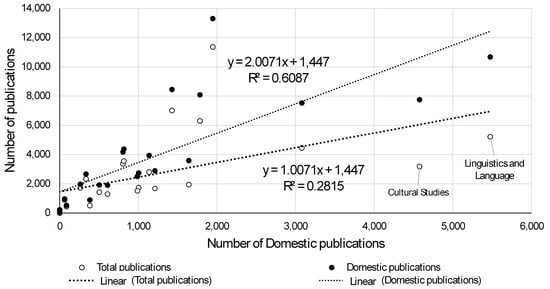
In the context of publication trends (RQ1), a notable learning phenomenon is observed. In subject categories with a significant presence of domestic journals, there is a discernible trend where domestic researchers are gradually transitioning from publishing primarily in domestic journals to publishing more frequently and in greater volume in international journals. This shift is evident as the growth rate of domestic publications lags behind that of international publications, especially as the number of domestic journals increases. The learning process can be outlined in three stages as follows:
- Visibility: Initially, domestic researchers published a proportionate amount in domestic journals within the regional “science market” and other venues.
- Development: As the number of domestic journals expanded, there has been an increase in international publications. Domestic researchers learned to navigate publishing in domestic journals within specific subject categories or in social sciences more broadly.
- Internationalization: In subject categories where domestic journals are prevalent, domestic researchers progressively increased their presence in international journals. As the number of domestic journals grows, the rate of growth in international publications outpaces that of domestic publications. Thus, domestic researchers first gain experience publishing in domestic journals before extending their reach to international journals (Figure 1).Figure 1. Relationship between the number of domestic journals and the number of domestic and total publications by discipline. Moreover, it is critical to accentuate that domestic journals are not lesser quality either but rather a first step in the internalization of the research of Visegrad countries. To underline this, the SJRs of domestic journals was examined for the year 2023.
Nonetheless, it is important to clarify that these stages are conceptualized based on aggregated publishing patterns observed across the Visegrad countries, rather than being directly derived from an individual-level longitudinal analysis of researchers’ careers over time. The progression we describe reflects general trends in how publication outputs shift from domestic to international journals across disciplines and countries, but it is not intended as a strict, empirically derived model from individual trajectories. These stages are inferred from macro-level trends in the data, where we observe an overall increase in international publications alongside the growth in domestic journal output.
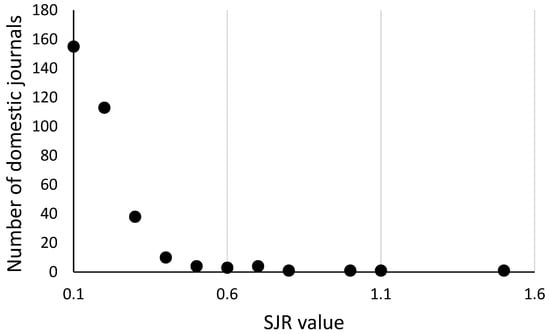
The mean SJR across all journals is 0.20, and while the majority cluster around lower SJR values, there are noteworthy exceptions. For instance, two journals in the dataset have an SJR above 1.0, with the highest being 1.455 (Studies in Second Language Learning and Teaching, Poland), indicating the presence of high-quality domestic journals such as Scientometrics, which are well-recognized internationally. Furthermore, the analysis demonstrates a concentration of journals in the range between 0.1 and 0.3, suggesting that these journals contribute significantly to local scientific discourse rather than the international discussion. Importantly, the presence of high-SJR journals such as Scientometrics (Hungary, co-produced with Springer) challenges any oversimplified categorization of domestic journals as inferior. Such prestigious domestic journals maintain international relevance and contribute to global academic conversations, affirming that the operationalization of domestic journals includes a range of quality, from stepping-stone platforms to internationally recognized outlets (Figure 2).
Figure 2.
Distribution of the number of domestic journals by their SJR value. Source: Own edit based on Scimago data.
A strong correlation is observed between the number of domestic and international publications within this framework. Specifically, higher domestic publications within a discipline correlate with increased international publications. Furthermore, the language indicator analysis reveals significant insights:
- There is a strong correlation (0.949) between domestic publications in domestic languages (national languages) and those in non-domestic languages.
- A weak correlation (0.347) exists between domestic publications in domestic languages and international publications.
- A moderate correlation (0.561) is noted between publications in non-domestic languages and international publications.
In the context of the learning phenomenon described, domestic researchers who primarily publish in domestic languages within domestic journals are increasingly likely to publish in non-domestic languages, notably English, in these same domestic journals (stage 2). As for publications in non-domestic languages, the process of internationalization (stage 3) becomes apparent, where domestic researchers are shifting away from domestic languages towards foreign languages in their articles. This learning process extends beyond publishing practices to encompass significant linguistic dimensions. Essentially, domestic journals serve as a stepping-stone for domestic researchers, providing an avenue to familiarize themselves with indexed journal publishing norms; transition to writing in non-domestic languages, particularly English; and ultimately engage in international scientific communication (Table 3 and Figure 1).
Table 3.
Correlation between publication languages and publication trends.
Regarding the learning process and the language issue, it was crucial for us to examine the languages in which publications are accepted in domestic journals. We specifically analyzed the language of publications across the 24 disciplines of domestic journals. This inquiry is significant because several domestic journals in the Visegrad countries allow articles to be published not only in English but also in other European languages such as German, French, Spanish, and Bulgarian.
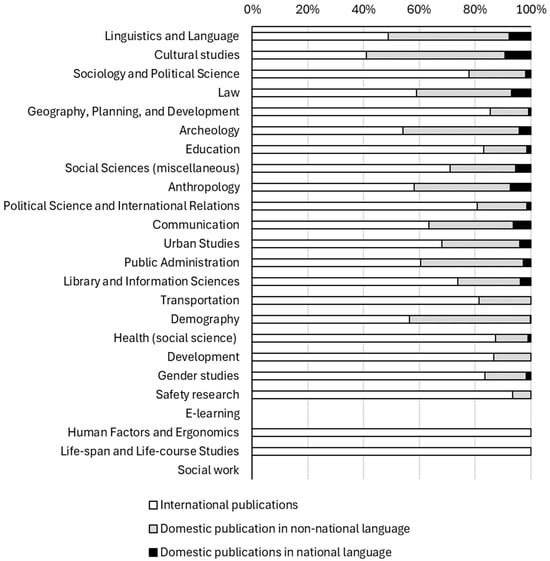
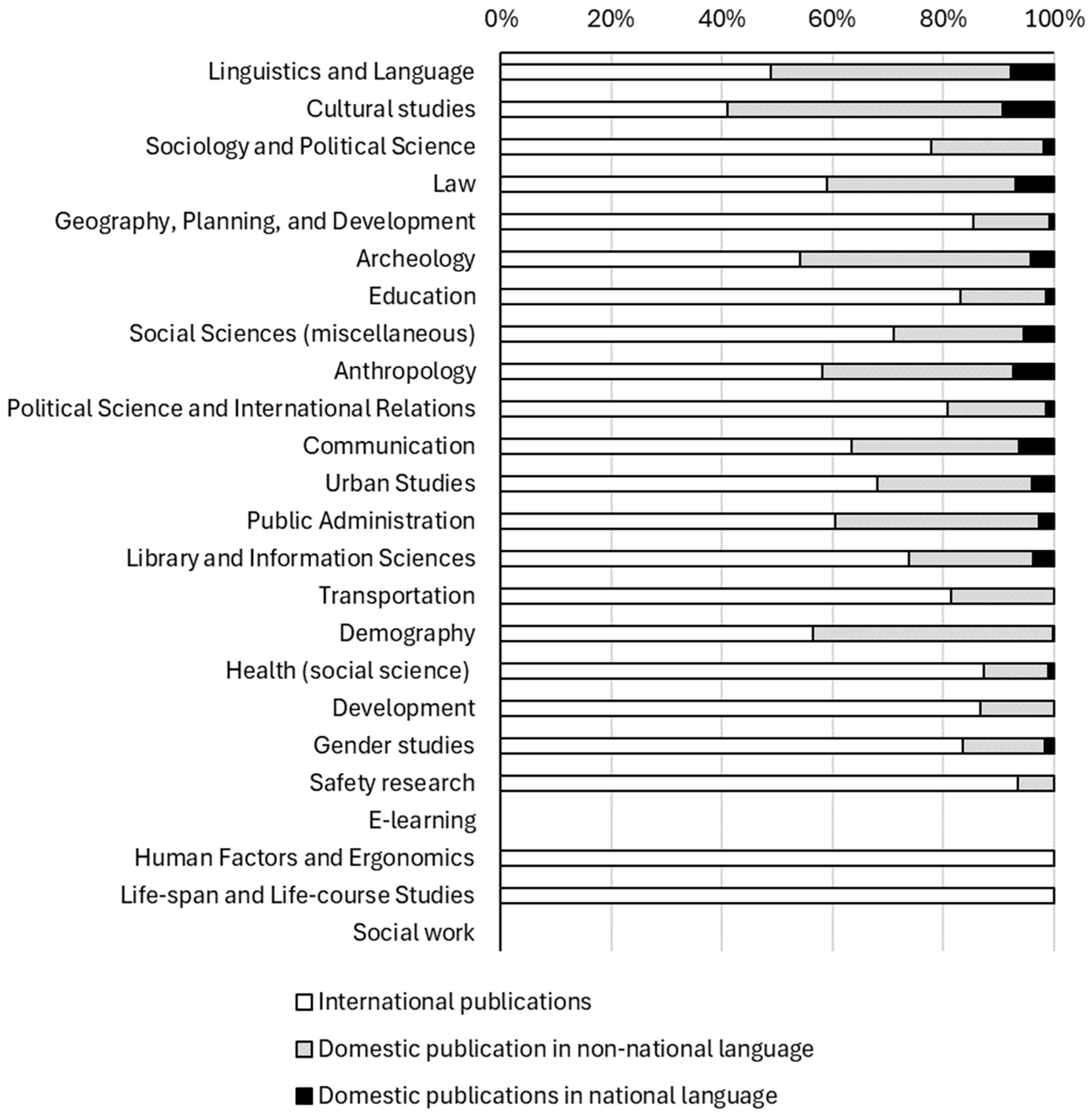
Our findings underscore that the number of publications in domestic languages within domestic journals is consistently lower across all disciplines. Conversely, the number of domestic publications in foreign languages often approaches or equals the number of international publications, particularly evident in fields like language and linguistics, cultural studies, and archaeology. Notably, geography, planning, and development emerge as disciplines where international publications outnumber domestic publications nearly tenfold (Table 4 and Figure 3).
Table 4.
Overview of linguistic trends and divergences in publications in the Visegrad countries between 2019 and 2023.
Figure 3.
Bar chart concerning the proportion of domestic (in domestic and non-domestic language) and international publications. Source: Own editing based on Scopus and Scimago data.
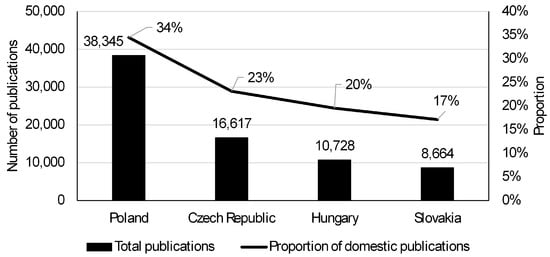
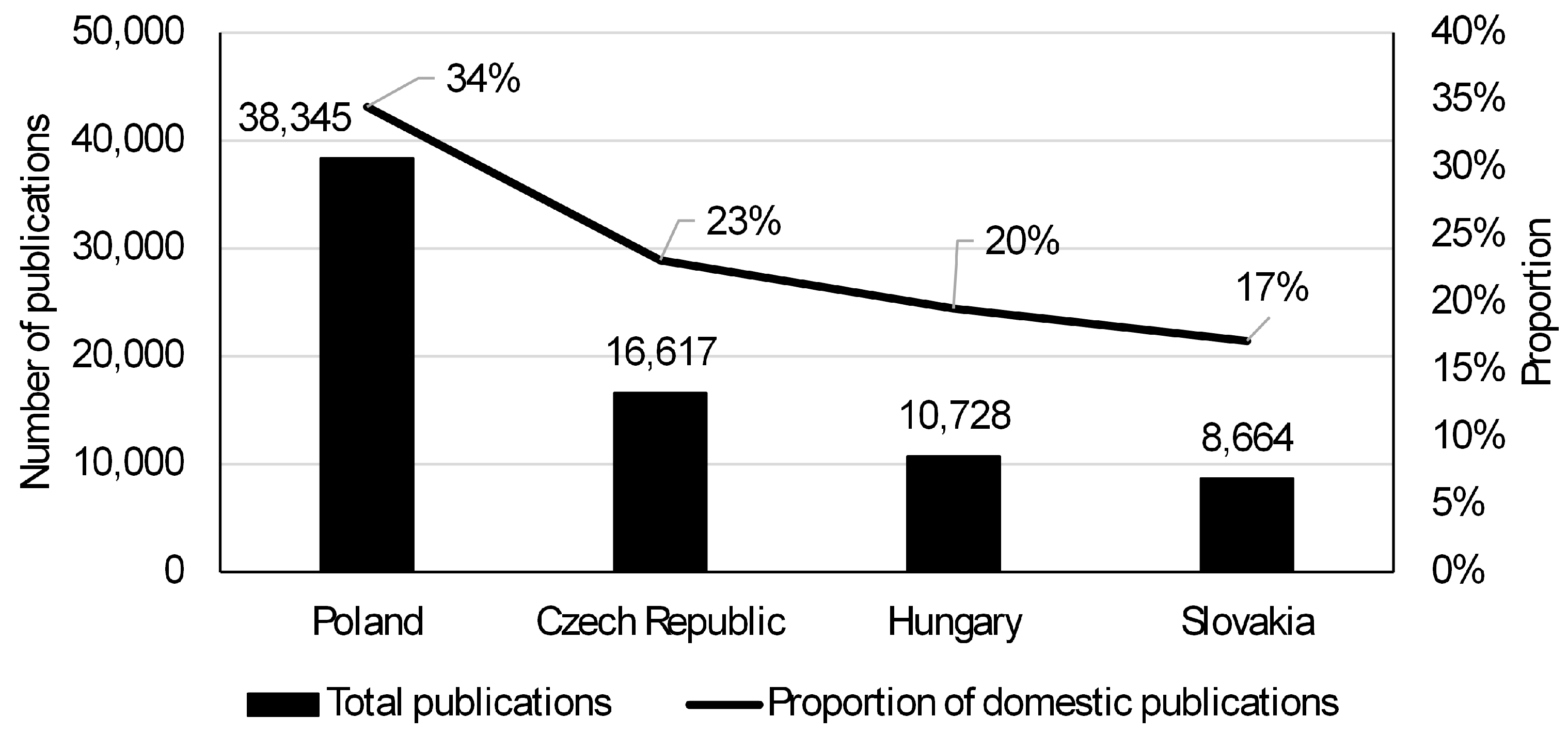
In relation to publication trends, another significant finding is that researchers in Poland contribute as much to Scopus-indexed social science journals as their counterparts in the rest of the region (RQ1). Figure 3 illustrates this comparison. Additionally, there is an indication of internal bias in Polish journals; more than one-third of Polish publications are published in domestic journals (RQ3).
Furthermore, Slovakia stands out as the most internationally oriented country in the region in terms of publications, with less than one-fifth of its publications appearing in Slovak journals (Figure 4).
Figure 4.
Number and share of total and domestic publications in social sciences by country, 2019–2023. Source: Own editing based on Scival and Scimago data.
The number of journals and the number of publications diverge regionally. While cultural studies and language and linguistics remain prominent topics in the publications of Visegrad researchers, the subject category of geography, planning, and development has the highest number of publications. Concerning the issue of marginalization of subject categories (RQ2), it is a striking result that e-learning and social work are not only invisible in journals but also utterly invisible in the publications of researchers in the region, as there are no publications in these fields (Table 5).
Table 5.
Number of published publications by discipline between 2019 and 2023.
In relation to publication phenomena and the marginalization of specific subject categories (RQ1 and RQ2), it is also important to highlight gender studies. A total of three journals (one Czech and two Polish) are published in the region in this discipline, with 519 publications by researchers from the region over five years, making it one of the least internally biased disciplines in the Visegrad region (RQ3) alongside demography and security studies. The specific highlighting of gender studies is also important because in the region (including Romania (Tăriceanu 2022)), especially in Hungary, there have been several moves to marginalize gender studies, which have significantly discouraged domestic research in this field (Pető 2020) (Table 6).
Table 6.
Share of published publications by discipline between 2019 and 2023.
Regarding the diversity of domestic publications by subject category, Poland and the Czech Republic are the most diverse, i.e., they publish the most publications in terms of subject category. At the same time, Hungary and Slovakia show similar results in terms of both publication diversity and discipline popularity (the only exception being demography) (Table 7).
Table 7.
The proportion of domestic publications by discipline between 2019 and 2023.
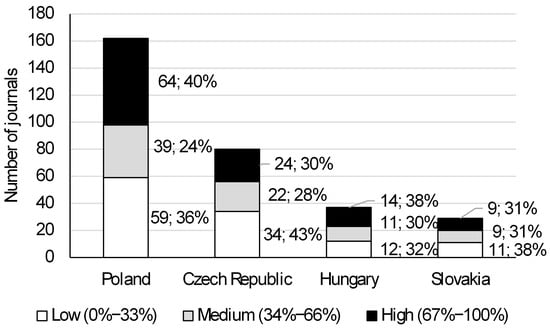
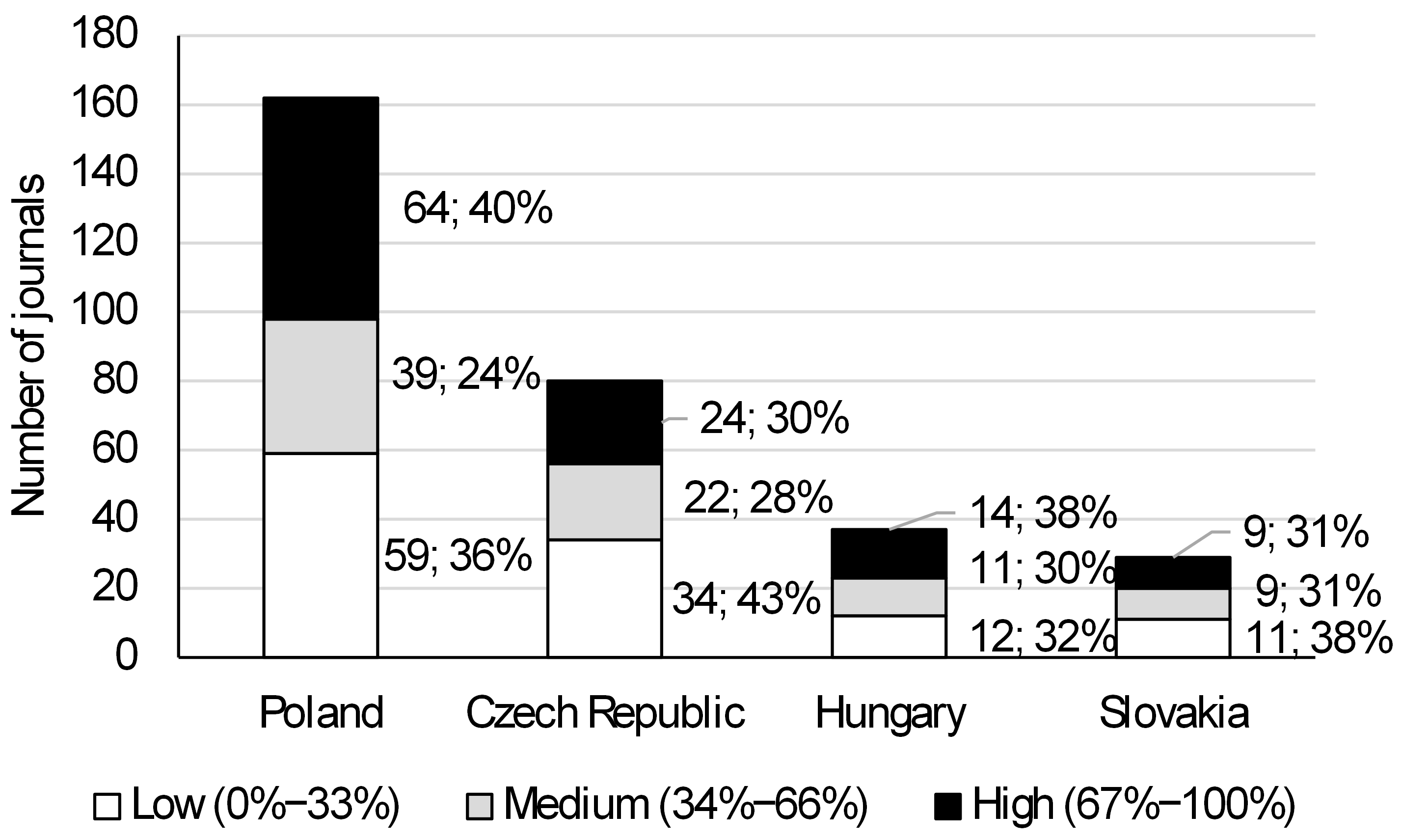
In terms of internal bias (RQ3), it can be concluded that, regardless of the number of journals, a significant proportion of domestic journals have at least medium internal bias. It should be underlined that although Poland has the highest number of Scopus-indexed social science journals (162), it shows a greater tendency towards internal bias, especially in the high internal bias category. Hungary and Slovakia show a similar pattern of internal bias, with a relatively balanced representation across disciplines. Concerning regional population comparison, the Czech Republic stands out in the number of journals (10.67 million inhabitants and 82), while Hungarian journals perform the worst according to this criterion (9.64 million inhabitants and 37 journals).
The role of the Norwegian Register for Scientific Journals (Norwegian list) for Hungary should also be underlined in the context of inland circulation. The Norwegian list is a journal classification register utilized in Norway and adopted in Hungary for journals that are not published domestically. This list was developed by the Norwegian Association of Higher Education Institutions in 2004 to categorize journals into tiers based on their reliability (Aarstad 2010). Journals are classified in three categories: 0 (non-scientific journals), 1 (scientific journals), and 2 (leading/top scientific journals) (Aarstad 2010). Journals classified in category 0 are deemed substandard, failing to meet editorial, authorship, or other essential criteria. Specifically, for authorship, the Norwegian list mandates that no more than two-thirds of the authors of a single journal publication may belong to the same institution. Hungarian journals concerned in this respect are particularly advised to invite publications by international researchers (Figure 5).
Figure 5.
Domestic journal impact in the Visegrad countries for social sciences in 2023. Source: Own edits based on Scopus and Scimago data.
As for excellence (RQ4), the Czech Republic and Poland stand out over a five-year horizon with nearly fourfold and threefold increases, respectively. Hungary underperforms compared to the other countries in the region and has only been able to increase the number of excellent publications over five years by a minimal margin (Table 8).
Table 8.
Change in excellence (SJR percentile (publication year) * = 1%) for Visegrad countries between 2019 and 2023.
Specifying the results in Table 6, it can be seen that Poland leads the excellence ranking in the area of social sciences except in a few subject categories. Although the leading role of cultural studies and language and linguistics can also be seen here, archaeology, and sociology and political science have a lead in terms of excellent publications in the region. Furthermore, although language and linguistics is the leading subject category regarding the number of journals and publications in Visegrad, it is only the sixth most excellent category. Despite the rigorous measures taken in Hungary against gender studies, the country produced the highest number of excellent publications in the region (Table 9).
Table 9.
Excellence (SJR percentile (publication year) * = 1%) by discipline for the Visegrad countries between 2019 and 2023.
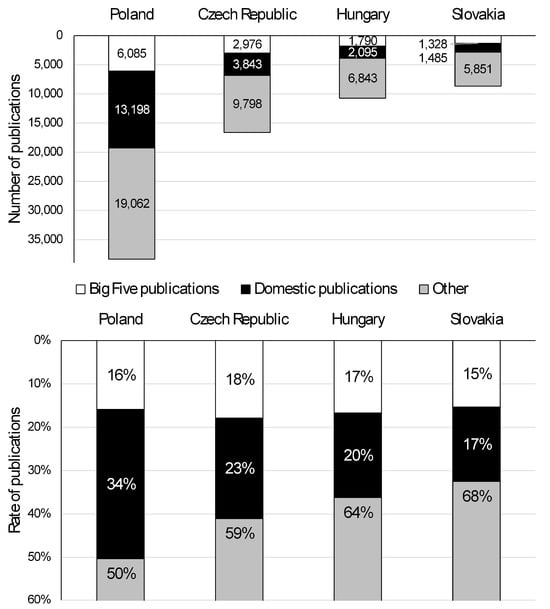
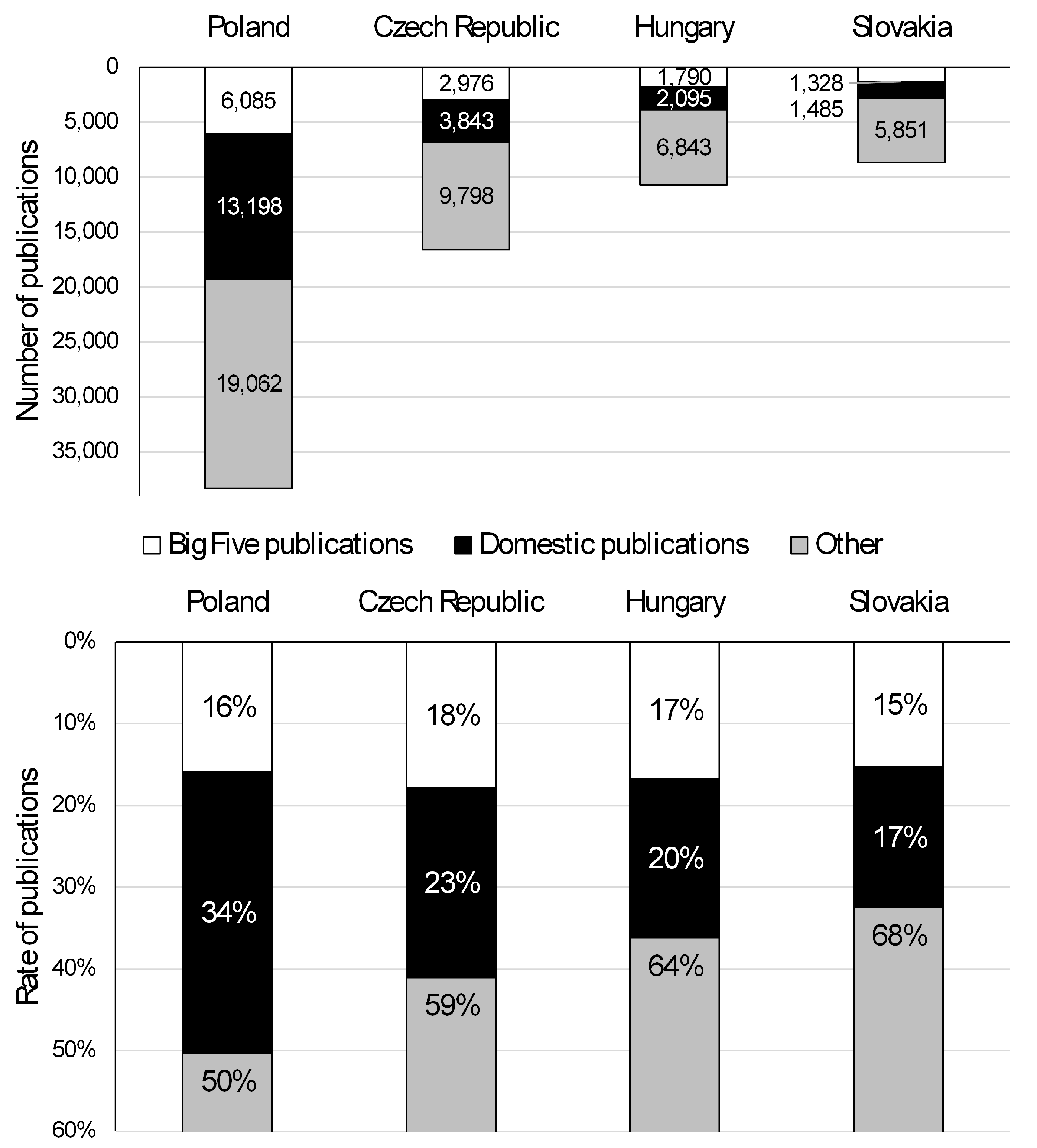
The countries of the region show similarities in terms of the number of publications in the Big Five, i.e., the most significant and most widely published academic journals (15–18%). Overall, the Big Five represent a fraction of the total number of publications (Figure 6).
Figure 6.
Number and distribution of communications by publisher in the Visegrad countries between 2019 and 2023. Source: Own editing based on Scival and Scimago data.
4. Discussion
This study’s scientometric analysis of the Visegrad countries (Poland, Czech Republic, Hungary, and Slovakia) in the realm of social sciences reveals significant insights into the regional academic landscape, addressing publication performance, internal biases, and the broader context of scientific excellence. This study demonstrates an apparent disparity in publication performance among the Visegrad countries. Poland and the Czech Republic are at the forefront, boasting the highest number of Scopus-indexed journals and publications.
4.1. Challenges and Trends (RQ1)
Despite the quantitative achievements, the qualitative aspect of publications from the Visegrad countries presents challenges. The overall number of high-impact, highly cited publications remains low. Poland and the Czech Republic, while leading in quantity, also show a relatively better performance in terms of the quality of publications. This disparity highlights a critical need for these countries to not only focus on increasing publication numbers but also enhance the quality and global relevance of their research outputs. This study also identifies significant gaps in specific social science disciplines where the Visegrad countries are notably underperforming. Fields such as e-learning, human factors and ergonomics, life-span and life-course studies, and social work are almost absent in the research output in the region. This underperformance is particularly concerning given the global surge in these disciplines, especially in the context of the COVID-19 pandemic, which underscored the importance of e-learning and human factors.
In terms of publication trends (RQ1), Poland and the Czech Republic stand out in the region in terms of both the number of Scopus-indexed journals, the number of publications in such journals, and the number of excellent publications. Hungary and Slovakia show similar scores, but both countries lag significantly behind Poland and the Czech Republic in the three categories mentioned above. While domestic journals play a key role in the development of social sciences in the Visegrad countries, the expansion of disciplines interpreted in terms of the number of journals also increases the number of international publications, i.e., domestic journals serve primarily as an entry point for international publication. The results are also worth reviewing in terms of population. In this context, Poland’s “leadership” should come as no surprise; it has 36.82 million inhabitants, compared to 10.67 million in the Czech Republic, 9.64 million in Hungary, and 5.43 million in Slovakia. However, the Czech Republic stands out, with a population almost 3.5 times smaller than Poland’s but with a high number of both journals and publications.
4.2. Marginalized Areas (RQ2)
Our analysis reveals that the Visegrad countries (Poland, Czech Republic, Hungary, and Slovakia) are significantly underrepresented in several key social science disciplines. Using data from Scopus, we found that certain fields, such as e-learning, social work, and human factors and ergonomics, showed no publications from any of the four countries during the study period from 2019 to 2023. This absence is striking, especially given the global rise in these disciplines, particularly in the context of the COVID-19 pandemic, where fields like e-learning became critically important. Similarly, there were minimal contributions in life-span and life-course studies and safety research, with Hungary and Slovakia especially underrepresented in these areas. Even in more established fields such as communication and gender studies, the Visegrad countries lag behind global trends. For instance, gender studies, an increasingly prominent area of research worldwide, had only three publications across the entire region, with no contributions from Hungary or Slovakia. This gap is particularly significant given the political constraints in Hungary, where recent government policies have restricted the study of gender.
The marginalization of these disciplines seems to reflect broader issues related to regional investment in research. Fields like e-learning and social work, which are vital for addressing current societal challenges, particularly in the post-pandemic world, are largely neglected in the academic and funding priorities of the Visegrad countries. In contrast, disciplines such as linguistics and language and cultural studies have received far more attention, as evidenced by the relatively higher number of publications in these areas. For example, there are 93 domestic journals in linguistics and language and 76 in cultural studies, compared to none in e-learning and social work. While there are 68 globally indexed journals in e-learning and 55 in social work, none are published domestically within the Visegrad region. Similarly, human factors and ergonomics, a field with 48 globally indexed journals, saw no contributions from domestic scholars.
This underrepresentation highlights the need for strategic policy interventions to address the gaps in emerging and underfunded disciplines. Increased funding, institutional support, and international collaboration are essential to bring research in these marginalized fields in line with global trends and ensure that the Visegrad countries contribute meaningfully to the international academic community. Addressing these disparities will be crucial for enhancing the visibility and impact of the region’s research output. Concerns may also be expressed over extensive and highly controversial governmental policies set forth in countries like Hungary specifically targeting and arbitrarily outcasting important areas like gender studies.
4.3. Internal Bias and Excellence (RQ3 and RQ4)
In terms of internal bias (RQ3), the countries of the region show basic similarities. In this respect, the publication and publication trends in Hungary seem to be the most pronounced, while regional divergences are not significant. Generally speaking, Visegrad journals mostly publish the work of domestic authors, thus enriching the domestic scientific discourse rather than the international one in the respective disciplines. This is also supported by the fact that journals that fall into the low-indexed category and publish more publications also tend to have higher SJR values (RQ4). This statement can be illustrated by the two highest indexed journals in the region, Studies in Second Language Learning and Teaching, published in Poland, and Scientometrics, published in Hungary. These journals are the only ones with SJR values higher than 1.0 among all the journals published in Visegrad, while the internal bias for these journals is extremely low. However, Scientometrics also excels in being the journal with the highest number of publications in the region (324), i.e., it is not only open to international authors but also publishes their papers regularly and systematically. The linguistic dimension of internal bias is also critical. The preference for publishing in domestic languages further isolates regional research from the international community, thereby reducing its accessibility and impact. This linguistic insularity underscores the need for domestic journals to adopt more inclusive language policies that encourage submissions in widely used international languages, particularly English.
In terms of excellence (RQ4), the countries of the region have poor scores. On the one hand, there is a low number of excellent publications in the countries of the region, but there is a positive change and development in Poland and the Czech Republic in particular, while in Hungary, the results for excellence show a stagnating trend. On the other hand, the number of Big Five publications is particularly low in the four countries of the region, with none of the countries having at least one-fifth of the number of publications published by the largest publishers. That said, it is important to reiterate the Czech Republic’s outstanding record for excellence, especially in light of the RQ1 discourse. An analysis of excellent publications shows that the Czech Republic has the fastest-growing number of excellent publications over the period (373%), compared to only 138% in Hungary, which has the lowest population of excellent publications in the region. It is also worth underlining that the Czech Republic has the highest proportion of journal publications published by Big Five publishers (Figure 5). It can, therefore, be concluded that the Czech Republic, although lagging behind Poland in terms of population, is ahead in social science scientific performance thanks to a scientific policy that promotes international and excellent publishing (Stanzer 2024).
4.4. Implications for Regional Science Policy
As a result of the four research questions, it can be concluded that the Scopus-indexed social science activity in the region is mostly in domestic journals, with the visibility of publications over a five-year horizon being mainly domestically relevant and regional. The goal of achieving international visibility may be hampered by the internally biased nature of the domestic journals and publications and the partial or complete marginalization of certain popular disciplines.
In order to improve the results assessed in the four questions, the following suggestions are made:
- Increase international collaboration and reduce internalization: to increase international visibility, reducing internalization in the region should be a priority, and more research by international authors should be published. To achieve this, domestic journals should “attract” international authors in the first place, and the number of publications on specifically domestic scientific issues (which are less cited in the international scientific community) should be reduced. For Hungary, in particular, it would be explicitly justified to reduce the number of domestic journals in order to meet the criteria of the Norwegian list of journals published in Hungary. As can be seen from the above graphs, internationalization is also proportional to the increase in excellence, so it would be particularly important to publish works by foreign authors in the region. In this latter respect, it may be advisable to involve international editorial board members who can contribute to improving the quality of journals and help to invite international authors. For example, for journals with a high internal bias, it may be worthwhile to publish thematic issues specifically dedicated to international authors, even by inviting renowned, highly cited authors.
- Keep up with the development of subject categories: On the one hand, useful regional results can be published by researchers in the region on the issues raised by these disciplines. On the other hand, as these are “emerging” disciplines and increasingly popular (Sobral 2021) in terms of number of publications, some researchers can more easily stand out at the regional level. For example, this trend has started in Indonesia, where it has been shown that the number of publications in the e-learning discipline has been growing at an outstanding rate even before COVID-19 (Iskandar et al. 2021), so it may be worthwhile for domestic researchers to publish more in this discipline, especially given the experience of the pandemic. As a first step, it may be advisable to participate in international collaborative networks in these disciplines, which would provide opportunities for researchers in the region to participate in global projects and publications and then apply this knowledge at the regional level in more detail for the Visegrad countries. This recommendation also entails fostering research in emerging disciplines. Prioritizing funding and support for emerging and globally significant disciplines, such as e-learning and human factors, can help the Visegrad countries align with global research trends. This focus can also stimulate innovation and research productivity in underrepresented areas.
- Advance the ranking of excellence: researchers in the region should be supported to publish with Big Five publishers and to have their research published in top journals. Developing the necessary support is essential to achieve this goal; as Stanzer’s (2024) study and the data above show, in countries where research is supported and encouraged, journals will be indexed higher and higher. In terms of incentives, we propose two aspects. On the one hand, it would be worthwhile to start mentoring schemes (even for PhD students), which could help to increase the number of publications, accelerate the learning-to-publish process discussed above, and even improve the chances of winning grants in the discipline (Schriever and Grainger 2019). On the other hand, there would also be an explicit need to support and encourage highly cited domestic researchers to publish in already highly indexed journals to help domestic journals advance where possible. To cite an old yet important idiom, the countries examined should support and prioritize quality over quantity. While increasing the number of publications is important, there must be a parallel emphasis on enhancing the quality of research. Mentorship programs for early-career researchers and incentives for publishing in high-impact international journals can drive this qualitative improvement.
5. Conclusions
The analysis of the Visegrad countries’ social sciences publication performance presents a complex picture of regional academic productivity and challenges. The disparity between Poland and the Czech Republic, which lead in the number of journals and publications, and Hungary and Slovakia, which lag significantly behind, underscores the uneven landscape of scholarly output within the region. This variance highlights the necessity for targeted policy interventions to elevate the underperforming nations’ research profiles. Poland and the Czech Republic’s leadership is attributed to their robust academic infrastructures and supportive research policies, fostering a conducive environment for scholarly activities. In contrast, Hungary and Slovakia’s lag indicates a pressing need for strategic investment in research and development. Addressing these disparities requires a multifaceted approach, emphasizing both the quantity and quality of publications. Despite Poland and the Czech Republic’s better performance in high-impact publications, the overall number of such articles remains low across the Visegrad countries, necessitating a focus on enhancing research quality and global relevance.
This study identifies significant gaps in specific social science disciplines, particularly in e-learning, human factors and ergonomics, life-span and life-course studies, and social work. The near absence of publications in these fields is alarming, given their global importance and the increasing research trends, especially post-COVID-19. This underperformance not only isolates researchers in these disciplines but also limits the region’s contribution to global scientific discourse. Moreover, the internal bias in publication practices, particularly in Poland and Hungary, poses a challenge to the internationalization of research. The tendency to publish predominantly domestic authors in domestic journals limits the visibility and impact of regional research on the global stage. This bias, coupled with the linguistic insularity of publishing in domestic languages, further isolates the Visegrad countries’ research output. Encouraging submissions in widely used international languages, particularly English, and reducing internalization are critical steps towards enhancing international collaboration and visibility. This study also highlights the importance of publishing in journals managed by the Big Five publishers, which dominate the global academic landscape. The low representation of Visegrad countries in these journals underscores the need for strategic support and incentives for researchers to publish in high-impact international journals. Mentorship programs for early-career researchers and initiatives to attract international authors and editorial board members can significantly improve the quality and visibility of domestic journals.
To advance in the ranking of excellence, the Visegrad countries must prioritize quality over quantity in research output. Strategic policies supporting high-impact research and fostering international collaborations are essential. For instance, reducing the number of domestic journals in Hungary to meet the Norwegian list’s criteria and encouraging the inclusion of international researchers in domestic publications can enhance the region’s scientific standing.
To conclude, the Visegrad countries exhibit a promising yet uneven landscape in social sciences publication performance. By addressing the identified challenges and implementing targeted policy interventions, these countries can enhance their scientific excellence and contribute more significantly to the global academic community. This holistic approach will not only elevate the regional research profile but also foster a more inclusive and impactful scientific environment. The recommendations provided, including increasing international collaboration, focusing on emerging disciplines, and advancing publication excellence, offer a roadmap for achieving these goals.
6. Limitations
One limitation of this study is the use of proprietary datasets, specifically Scopus, SciVal, and Scimago, which can restrict the replication of our results and sharing of the raw data in line with Open Science practices. We chose these platforms because of their global recognition, comprehensive coverage, and robust indexing standards. We acknowledge this limitation and have taken steps to increase transparency by providing a thorough, step-by-step explanation of our methodology. Researchers with access to these platforms can replicate our analysis by following the process we describe.
We recognize and promote the value of open-access databases such as OpenAIRE, OpenAlex, and Dimensions, which are becoming increasingly important in the scientometric community. While these open databases could be considered for future research, and we have tried to replicate the dataset using these databases, our investigation concluded that they are yet to offer the same level of data granularity and coverage as Scopus, particularly in specific regional and disciplinary contexts. We encourage future studies to explore the use of these alternative databases, especially as they continue to develop, in order to align more closely with Open Science principles and increase the replicability and accessibility of research data.
Author Contributions
Conceptualization, P.S. and G.F.L.; Methodology, P.S. and G.F.L.; Software, P.S.; Validation, P.S.; Data curation, P.S.; Writing—original draft, G.F.L.; Writing—review & editing, G.F.L. All authors have read and agreed to the published version of the manuscript.
Funding
Péter Sasvári: TKP2021-NKTA-51 has been implemented with the support provided by the Ministry of Culture and Innovation of Hungary from the National Research, Development and Innovation Fund, financed under the TKP2021-NKTA funding scheme. Gergely Ferenc Lendvai: Supported by the Rosztoczy Foundation.
Institutional Review Board Statement
Not applicable.
Informed Consent Statement
Not applicable.
Data Availability Statement
The original contributions presented in the study are included in the article, further inquiries can be directed to the corresponding author.
Conflicts of Interest
The authors declare no conflict of interest.
References
- Aarstad, Jarle. 2010. When agents become principals: The possible perversion of the incentive based compensation in the Norwegian Academia. The Innovation Journal 15: 1–7. [Google Scholar]
- Andalia, Rubén Cañedo, and Alberto Juan Dorta Contreras. 2010. SCImago Journal &Country Rank, A Platform For Performance Evaluation Of Science According To Documentary Sources And Countries. ACIMED 21: 310–20. [Google Scholar]
- Baas, Jeroen, Michiel Schotten, Andrew Plume, Grégoire Côté, and Reza Karimi. 2020. Scopus as a curated, high-quality bibliometric data source for academic research in quantitative science studies. Quantitative Science Studies 1: 377–86. [Google Scholar] [CrossRef] [Scilit]
- Brika, Said Khalfa Mokhtar, Khalil Chergui, Abdelmageed Algamdi, Adam Ahmed Musa, and Rabia Zouaghi. 2022. E-Learning Research Trends in Higher Education in Light of COVID-19: A Bibliometric Analysis. Frontiers in Psychology 12: 1–10. [Google Scholar] [CrossRef] [Scilit] [PubMed]
- Butler, Leigh-Ann, Lisa Matthias, Marc-André Simard, Philippe Mongeon, and Stefanie Haustein. 2023. The oligopoly’s shift to open access: How the big five academic publishers profit from article processing charges. Quantitative Science Studies 4: 778–99. [Google Scholar] [CrossRef] [Scilit]
- Dehnad, Afsaneh, and Mohammadhiwa Abdekhoda. 2023. Mapping the Publications of e-learning during the COVID-19 Pandemic: A Bibliometric Analysis. Journal of Scientometric Research 12: 35–43. [Google Scholar] [CrossRef] [Scilit]
- Demeter, Marton. 2017. The Core-Periphery Problem in Communication Research: A Network Analysis of Leading Publication. Publishing Research Quarterly 33: 402–20. [Google Scholar] [CrossRef] [Scilit]
- De Rijcke, Sarah, and Alexander Rushforth. 2015. To intervene or not to intervene; is that the question? On the role of scientometrics in research evaluation. Journal of the Association for Information Science and Technology 66: 1954–58. [Google Scholar] [CrossRef] [Scilit]
- Deutz, Daniella Bayle, Thea Marie Drachen, Dorte Drongstrup, Niels Opstrup, and Charlotte Wien. 2021. Quantitative quality: A study on how performance-based measures may change the publication patterns of Danish researchers. Scientometrics 126: 3303–20. [Google Scholar] [CrossRef] [Scilit]
- Dobos, Imre, Anna Urbanovics, and Péter Sasvári. 2021. A visegrádi négyek, Ausztria és Románia gazdaságtudományi publikációs teljesítményének összehasonlító elemzése. Területi Statisztika 61: 739–68. [Google Scholar] [CrossRef] [Scilit]
- Garfield, Eugene. 1979. Citation Indexing, Its Theory and Application in Science, Technology, and Humanities. Hoboken: Wiley. [Google Scholar]
- Hao, Ruoyang. 2021. Evaluation and Analysis on Library and Information Sciences of Chinese Universities Based on SciVal. Journal of Modern Information 41: 144–50. [Google Scholar]
- Iskandar, Akbar, Badrun Kartowagiran, Mansyur Mansyur, Nurmawati Nurmawati, and Lusiana Wulansari. 2021. Indonesian Research Output on Online Learning/e-Learning Publication using the Scopus Database: A Scientometric Analysis. Library Philosophy and Practice 2021: 1–7. [Google Scholar]
- Kowalska, Anna, Jaroslav Kovarnik, Eva Hamplova, and Pavel Prazak. 2018. The Selected Topics for Comparison in Visegrad Four Countries. Economies 6: 50. [Google Scholar] [CrossRef] [Scilit]
- Larivière, Vincent, Stefanie Haustein, and Philippe Mongeon. 2015. The Oligopoly of Academic Publishers in the Digital Era. PLoS ONE 10: e0127502. [Google Scholar] [CrossRef] [Scilit]
- Lei, Lei, and Yunmei Sun. 2020. Should highly cited items be excluded in impact factor calculation? The effect of review articles on journal impact factor. Scientometrics 122: 1697–706. [Google Scholar] [CrossRef] [Scilit]
- Linkov, Václav, Kieran O’Doherty, Eunsoo Choi, and Gyuseog Han. 2021. Linguistic Diversity Index: A Scientometric Measure to Enhance the Relevance of Small and Minority Group Languages. SAGE Open. [CrossRef] [Scilit]
- Liu, Yang, and Hailong He. 2023. Scientometrics of Scientometrics Based on Web of Science Core Collection Data between 1992 and 2020. Information 14: 637. [Google Scholar] [CrossRef] [Scilit]
- Mingers, John, and Loet Leydesdorff. 2015. A review of theory and practice in scientometrics. European Journal of Operational Research 246: 1–19. [Google Scholar] [CrossRef] [Scilit]
- Pető, Andrea. 2020. Feminist Stories from an Illiberal State: Revoking the License to Teach Gender Studies in Hungary at a University in Exile (CEU). In Gender and Power in Eastern Europe, 1st ed. Edited by Katharina Bluhm, Gertrud Pickhan, Justyna Stypinska and Agnieszka Wierzcholska. Cham: Springer, pp. 35–44. [Google Scholar] [CrossRef] [Scilit]
- Rivera, Reynaldo Gustavo, Carlos Orellana Fantoni, Eunice Gálvez, Priscilla Jimenez-Pazmino, Carmen Karina Vaca Ruiz, and Arturo Fitz Herbert. 2024. Using scientometrics to mapping Latin American research networks in emerging fields: The field networking index. Scientometrics 129: 2309–35. [Google Scholar] [CrossRef] [Scilit]
- Rosenfled, Ariel, Ariel Alexi, Liel Mushiev, and Teddy Lazebnik. 2023. The Academic Midas Touch: An Unconventional Scientometric for Evaluating Academic Excellence. arXiv. [CrossRef] [Scilit]
- Sasvári, Péter, András Nemeslaki, and László Duma. 2019. Exploring the influence of scientific journal ranking on publication performance in the Hungarian social sciences: The case of law and economics. Scientometrics 119: 595–616. [Google Scholar] [CrossRef] [Scilit]
- Schriever, Vicki, and Peter Grainger. 2019. Mentoring an early career researcher: Insider perspectives from the mentee and mentor. Reflective Practice 20: 720–31. [Google Scholar] [CrossRef] [Scilit]
- Sobral, Sónia Rolland. 2021. Two Decades of Research in e-Learning: A Deep Bibliometric Analysis. International Journal of Information and Education Technology 11: 398–404. [Google Scholar] [CrossRef] [Scilit]
- Stanzer, Damir. 2024. Scientists from small countries on the hunt for scientometric figures—Global indicators and local finances. Croatian Medical Journal 65: 73–75. [Google Scholar] [CrossRef] [Scilit] [PubMed]
- Szuflita-Żurawska, Magdalena, and Beata A. Basińska. 2021. Visegrád countries’ scientific productivity in the European context: A 10-year perspective using Web of Science and Scopus. Learned Publishing 34: 347–57. [Google Scholar] [CrossRef] [Scilit]
- Tăriceanu, Alina. 2022. Promoting Gender Studies in Romania—Working in a Difficult Context. In Overcoming the Challenge of Structural Change in Research Organisations—A Reflexive Approach to Gender Equality, 1st ed. Edited by Angela Wroblewski and Rachel Palmén. Leeds: Emerald Publishing, pp. 124–41. [Google Scholar] [CrossRef] [Scilit]
- Vilaça, Murilo Mariano, and Alexandre Palma. 2013. Diálogo sobre cientometria, mal-estar na academia e a polêmica do produtivismo. Revista Brasileira De Educação 18: 467–84. [Google Scholar] [CrossRef] [Scilit]
- Vinkler, Peter. 2007. Correlation between the structure of scientific research, scientometric indicators and GDP in EU and non-EU countries. Scientometrics 74: 237–54. [Google Scholar] [CrossRef] [Scilit]

Disclaimer/Publisher’s Note: The statements, opinions and data contained in all publications are solely those of the individual author(s) and contributor(s) and not of MDPI and/or the editor(s). MDPI and/or the editor(s) disclaim responsibility for any injury to people or property resulting from any ideas, methods, instructions or products referred to in the content. |
© 2024 by the authors. Licensee MDPI, Basel, Switzerland. This article is an open access article distributed under the terms and conditions of the Creative Commons Attribution (CC BY) license (https://creativecommons.org/licenses/by/4.0/).