


Abstract
This article explores how historic avant-garde works can be considered as aesthetic technologies or time machines conditioning an audience to experience the future differently. Rather than revisiting well-known Western scholars, it turns to perhaps lesser known “Cold War” theorists and critics: Polish art scholar Andrzej Turowski, Yugoslavian–Croation literary scholar Aleksandar Flaker, and Russian–Estonian semiotician Juri Lotman. In rather different ways, these thinkers considered avant-garde works as artefacts that, in an audience’s phenomenological encounter with them, model and yield different experiences of the future. In the closing section of the article, Gerrit Rietveld’s model for the Rietveld Schröder House in Utrecht is discussed. Rietveld’s model reminds us that theoretical speculation should always be accompanied also by historical contextualization, in part because many of the historic avant-garde’s projected futures are now also futures anterior, the history of which might further shed light on the avant-garde’s actual futurity.
1. Introduction
Juri Lotman once noted that “each generation has a language for describing yesterday and principally lacks a language for tomorrow”.1 If that is still the case today—and the at times fatalistic despair driving many of my graduates appears to suggest this is very much so—then “the avant-garde”, the cultural phenomenon that especially in the early 20th century was so adamantly concerned with projecting alternative futures, may well have a few things in store for us still. Championing the new and endowing art and cultural practices with the radical potential of ushering in different views of community, the early 20th-century historic avant-garde (including the movements of Cubism, Expressionism, Futurism, Dadaism, Constructivism and Surrealism) indeed has frequently been said to display an overall “futurism”, that is, a futural if not utopian, thrust filling the very lack Lotman thought typical of “each generation”.2 Given the now “widespread consensus that we are living at the end—of democracy, liberalism, capitalism, a cool planet, the Holocene, civilization as we know it” (Demos 2023, p. 9)—, this generic futurism endows the historic avant-garde with renewed appeal; this too, I notice among my students: each year, more sign up for my elective courses on the avant-garde. For, as T.J. Demos has recently noted as well, the avant-garde, starting perhaps with “Russian [sic] Futurism”, in hindsight presents itself to us as a reservoir of creative modeling techniques, aesthetic technologies, if you will, that generate different futures, in the plural, some of which might appear dated futures anterior to us now, while others perhaps still evoke horizons worth marching toward (Demos 2023, p. 25).
Rather than focus on what the variety of other futures presented by the early 20th-century avant-garde looks like, in this article, I wish to address the question of how at all works by that avant-garde arrive at projecting possible futures in our encounter with them. For, despite the complacent view that the historic avant-garde’s nose pointed to the future, and despite there being no dearth of studies that qualify this avant-garde as futuristic or utopian, there exists no consensus on how or why the great variety of historic avant-garde art works, from Cubist papiers-collés and Dada readymades to non-objective abstract works and Neusachlich photodocumentaries, would themselves generate other futures. This lack of consensus in part explains why in recent years some have gone on to suggest that many historic avant-garde works hover perhaps more toward a presentist “regime of historicity”, that is favor not the future over the past and the present but the present over the past and the future.3 Indeed, if we peel off the rhetorical and discursive material that frequently accompanied avant-garde works (the manifestos and other texts that primed an audience to expect something resembling having come from the future) and also scrape off the highly volatile, if not revolutionary, political and cultural contexts from which many avant-gardists emerged with futural intentionality, then it is by no means clear, as Terry Eagleton once observed polemically, “how a stoutly fashioned Constructivist rocking-chair could act as critique”, let alone how it would hint at a different future to come (Eagleton 1990, p. 227). Naturally, it is neither possible nor desirable to undo avant-garde works of their discursive and historical contexts of emergence altogether. Yet it is fair to at least briefly entertain the question of whether there is something specific about the formal make-up of avant-garde works themselves that phenomenologically conditions an audience to experience the future differently.
Of course, this is a complex issue I cannot possibly have (nor want) the last say over within the limited scope of this article, not in the least because many before me have tackled it as well. Peter Bürger, Jean-François Lyotard, Hal Foster and Peter Osborne are just a few names that might spring to mind as staples in discussions of the avant-garde as they have gained shape mainly in the West (Bürger 1984; Lyotard 1984, pp. 36–43; Foster 1996; Osborne 1995). Rather than revisiting these well known, and, I should add, rather diverse thinkers about the nature of the historic avant-garde’s utopian futural thrust, I would like to highlight here a number of “Cold War” European theorists, who do not frequently surface in discussions within the West: Polish art scholar and theorist Andrzej Turowski (1941–), Yugoslavian–Croatian literary scholar Aleksandar Flaker (1924–2010), and the already mentioned Russian–Estonian semiotician Juri Lotman (1922–1993). These thinkers dealt with aspects of the historic avant-garde in different degrees of intensity, and I cannot possibly do justice to all their findings about that avant-garde here. They are usually also not considered in tandem—although we will see that Flaker in part derived his view from the work of Lotman—because their readings of the avant-garde I will look at here, all of them developed in the 1980s, also unfolded in rather diverse contexts. To write about the avant-garde in a non-aligned country like Yugoslavia, in Soviet Estonia, or around the time of martial law in the Polish People’s Republic was a complicated and, in different ways, never unproblematic affair. This in itself makes a comparative revisitation of their work interesting, however, because like some today, it seems, Turowski, Flaker, and to a lesser extent also Lotman turned to the early 20th-century avant-garde to explore flightlines out of then contemporary predicaments.
Pushing the different contexts in which they operated into the background here, Turowski, Flaker, and Lotman can be said to share at least three assumptions about the avant-garde’s experimental or non-conformist futurity that are worth highlighting up front. First, all three infer that the historic avant-garde is first and foremost to be regarded as an artistic formation that sought to revalue and revolutionize art (understood in a broad sense, comprising different art forms and media), a goal that principally involved a radical redesign and refunctioning of art’s signifying material. Second, they each in their own way presume that the works of the avant-garde are to be taken as paradigmatic models, prototypes or projections of things to come, which also have secondary ethical and political implications. Third, they estimate that individual works are best analyzed in comparison, as works also collate to form and structure a distinct (set of) formal language(s) that further shape the futural thrust of the historic avant-garde writ large. These shared assumptions allowed Turowski, Flaker, and Lotman, who logically also shared a predilection for the Central and Eastern European avant-garde, to put forth rather different views of how avant-garde works open other futures to an audience and could potentially, at least in theory, also impact larger cultural dynamics. To the seasoned scholar or theorist of the avant-garde, their views will no doubt occasionally look familiar. The extent to which the approaches of Turowski, Flaker, and Lotman chime with those of better-known Western scholars is a matter that will have to be dealt with by others. Focusing on Turowski, Flaker, and Lotman in isolation here, my aim is in part to help wrest scholarly authority out of the hands an exclusively Western frame of reference. The future, after all, belongs to the many, not the few. Further, to shift gears in this respect, to also open ourselves up to the future-oriented perspectives of scholars beyond the West might go some way toward a more inclusive study of the avant-garde as well.
2. The Avant-Garde as Reist and Phenomenological Utopia
In a mid-1980s essay, culled from his Habilitation, that seems to directly tackle the above quoted quip by Terry Eagleton—”how [could] a stoutly fashioned Constructivist rocking-chair act as critique?”—Andrzej Turowski, a groundbreaking scholar of the avant-garde in Poland, distinguished between two different linguistic or formal models of utopia developed by the historic avant-garde’s many artistic experiments.4 To some degree, Turowski upheld, avant-garde works, even and especially those that push an aesthetic of non-objective abstraction, always tend to add either to a reist or to a phenomenological utopian formal language. For the reist utopian model Aleksander Rodchenko and the Productivists of the Institute of Artistic Culture (INKhUK) can be taken as emblematic. While Eagleton may have a point when he claims that an individual Constructivist rocking-chair alone does not usher in a different view of the future, the conjoined set of objects set forth by Rodchenko and others does add up to a future-oriented formal language that is built on the assumption of patience and moderation: by gradually replacing one object after another in the public and private space, these avant-garde works suggest the entirety of society could be given a different shape one day. Indeed, by letting go of the idea of art’s relative autonomy and transforming the artist into an artisan producing objects, by designing kiosks with advanced communications technologies, colorful cookie wrappers, furniture that could be changed to meet people’s various needs or film titles that suggested an organic link between two edited film sequences, Rodchenko and other reist utopians produced structures that meant to change not only the relations between people and the material world but above all the associations between people. This operation, art’s transformation of the sensible as well as the social through the introduction of new objects, recalls a suggestion Friedrich Schiller uttered shortly after the French Revolution in the third letter of Über die ästhetische Erziehung des Menschen (1795), namely that the role of the artist is to replace all the elements of the social clock, one by one, without that clock itself ever stuttering or coming to a halt. Thus, seeking to install new types of social relations, every aesthetic (no longer artistic) work set forth here rather explicitly conditions us to experience a different social future.
By contrast, the avant-garde’s phenomenological utopian language, for which Turowski considers Kasimir Malevich’s works exemplary, attempts to condition an audience to experience a utopian future in a different manner. Idealist rather than materialist, works adding to this second and far more diverse formal language offer “a means to transcend the object, to identify it as a marker of human thought” (Margolin 1997, p. 10). Malevich, El Lissitzky, and also their students at the Popular Art Institute (UNOVIS) in Vitebsk, fleshed out works that sought to embody ideals rather than introduce utilitarian objects. Instead of letting go of art’s relative autonomy and in line with many others in the Centre and West of Europe, they yielded works that could condition their audience to experience an alternative future through the projection of utopian states of being. When confronted with one of Malevich’s planits, for instance, that is a design for an abode in outer space ushering in a life beyond gravity, or with a Proun of El Lissitzky, that is a seemingly two-dimensional work that protrudes into three-dimensional space, we are propelled into a future state that will announce itself, presumably, after a radical breach or break has occurred. Having us imaginatively relate to such other states, each work adding to a phenomenological utopian language thus always presents itself as a unique, singular and finite, aesthetic or (pre)conceptual paradigm, as in and of itself being a model of a new life to come. Yet, taken together, such works too make the avant-garde an eminently futuristic undertaking.
Turowski’s theoretical pair of reist and phenomenological utopian languages could easily be transposed onto the historic avant-garde more generally. To some degree indeed almost all works of the avant-garde could be said to hover in between these two extreme positions, the majority no doubt moving closer to Turowski’s phenomenological variant. Yet Turowski’s pair is not without its problems. One might object, for instance, that his phenomenological utopianism displaces the problem by situating the futurity of the avant-garde’s work not in that work itself but in the encounter or relation between that work and an audience. This is not to say that this philosophically phenomenological relation or encounter would not be important to bring into play—it is key, in fact. But what facets or aspects of works’ signifying material prime an audience in that encounter for the experience of a futural thrust is not dealt with in depth by Turowski. This is problematic, as every work of art, avant-garde or other, could be said to always present us with a different (however recognizable or implausible) world not (yet) in existence, thereby always imaginatively propelling us into a different temporality as well. Why a utopian temporality, literally, a uchrony or no(where)-time, would of necessity be future-oriented, moreover, is also not so clear. Could it not also be past-oriented, non-temporalized, cyclical, …? Aleksander Flaker, who formulated his view on the avant-garde’s inherent futural thrust around the same time as Turowski, took these questions in a very different direction.
3. The Avant-Garde as Optimal Projection
Paying close attention to the semiosis, to the artistic techniques, procedures and protocols unleashed on signifying material by the historic avant-garde, Flaker came to the conclusion that there is nothing utopian at all about the work of the historic avant-garde, in that this work is as a rule concerned with projecting a possible movement toward the future rather than with fixing a static reified and impossibly reachable state. Parting ways with critics like Turowksi who commonly characterize the avant-garde as utopian, Flaker accentuated the processual or project-like nature of the historic avant-garde works. Like Turowski, he saw the avant-garde as being a formation primarily geared at a radical transformation of art’s signifying material. The avant-garde in Flaker’s view was principally concerned with overcoming the reality of tradition and convention in art, and to this aim unleashed a whole battery of artistic protocols which all added to what Flaker saw as the avant-garde’s overall defining cultural or communicative function: optimal projection.
For us, the concept of “optimal projection” does not carry the same meaning as that of “utopia”. “Utopia”, already with its original semantics, signifies a “place”, that is, a “land” that does not exist, whereas the texts that have shaped utopia have invariably signified it as a closed, delimited space with an ideal social structure, putting it at loggerheads with actual social relations. […] “Optimal projection” does not signify an ideally structured place; it does not seek to define it either, but signifies moving as choosing the “optimal variant” in overcoming the reality. […] In essence, in its representative texts, the avant-garde is the opposite of utopia and rejects every attempt at creating an ideal, pursuing its own, individual poetic thought, always anew, and thereby modifying its strategy accordingly.5
Flaker drew on Juri Lotman’s notion of the “‘optimal variant’ as the principle characterizing science and art in the epoch of the [historic] avant-garde”,6 that is, the principle by which an artist in this case selects or decides to go for the best-suited and realizable formal options virtually available within a given sign system to break with its traditional codes. Crucially, Flaker thereby also saw the historic avant-garde as always developing within situated and specific contexts, operating within localized sign systems that at once set clear limits and delimitations to be transgressed (for instance through abstraction or the readymade) and house signs that could be rearranged or rearticulated in radically unconventional ways (as in the case of collage or assemblage). Approaching the work as being principally an act that thinks its performative effects within a situated present, Flaker’s “notion of optimal projection highlighted the constructive principle of avant-garde texts, their ‘orientation towards the future in the name of which it is possible to reevaluate the past and deny the present’, i.e., ‘to perform an aesthetic revaluation associated with the social functions of the moral, ethical and social revaluation of the whole system of life relations’.”7 Indeed, abolishing the stasis of convention in art by having it effectively move into hitherto uncharted terrain, the primary function performed by an avant-garde work, namely to revalue the status of art in a given context or sign system, was joined by more encompassing revaluations of morality, ethics and politics (Flaker 1982, p. 133). An avant-garde work in itself always being in process, an unfinished structure open to new significations, it always also invites more encompassing interpretations that go beyond the merely artistic. Yet here too the historic avant-garde never sought closure, Flaker upheld, but remained anarchic, always looking for the next way out. Contrary to Peter Bürger, whom Flaker also referenced (Flaker 1982, p. 135), the Croatian literary historian also noted that the avant-garde thereby never “failed”. Quite the opposite, it was rather successful at its future-oriented projective undertaking, so much so that some critics eventually came to see it as inherently deranging and dangerous.
In sum, for Flaker an avant-garde work presents itself to us as opening a different future not so much by staging a fixed future state but through a semiological experiment that reorders and transgresses the organization and rules driving the situated language of art. Much like Turowski, Flaker thereby paid heed to the phenomenological encounter between the work and its audience—Flaker frequently stressed that an audience can only appreciate avant-garde works when it is aware of the (local) artistic traditions and conventions that animate them; Miško Šuvaković sums up well: “avant-garde artworks […] are made by transgressing, critiquing, and destroying the boundaries of media, disciplines, and genres of art.” (Šuvaković 2024, p. 100) Yet perhaps in more detail than Turowski, he thereby also looked at those work-immanent aspects conditioning that audience to experience a different future. Thrusting us into a world of aesthetic possibility, making us experience materially actualized aesthetic potentialities hitherto left virtual, the avant-garde work not only projects us forward but also makes us aware of an equally real potential for social and political change. Similar insights took center-stage in Lotman’s reflection. Yet dormant in Lotman’s work is perhaps a third and final way in which we could say that avant-garde works make us experience the possibility, if not the imminent actuality, of a different future.
4. The Avant-Garde as Semiotic Explosion
Juri Lotman, who founded the influential Moscow–Tartu School of Semiotics already in the mid-1960s, is perhaps the most widely known figure I discuss here. His late work, developed from the 1980s to his death in 1993, is especially worth revisiting in some detail here.8 In this late phase that unfolded as the USSR disintegrated, Lotman became interested in history and historiography and more specifically in what he called explosive processes that in the dynamics of cultures lead to sudden changes. Succinctly presenting, and of necessity oversimplifying, his insights allow us to frame the futurity of avant-garde works in a still different manner. For where Flaker objected to static (utopian) readings of the avant-garde and instead accentuated the non-utopian movement of the avant-garde’s futural and open-ended project, Lotman suggested that it is perhaps above all by the arrest of progress, by breaking with the gradual or expected course of things, that avant-garde works always point to a different realizable future.
Lotman’s view of history built on his earlier notion of the semiosphere, understood as the semiotic space required for sign systems and communication to exist. Cultures, Lotman upheld, live and evolve by the grace of an ever dynamic heterogeneous system of functionally differentiated or asymmetric languages or codes that forgo any specific text, speech or artwork. This semiosphere makes cultural communication “polyglot”, that is, information circulating in one language or code always needs to be “translated” to enter another. A semiosphere’s inherent heterogeneity and polyglossia thereby also make cultural communication essentially dialogic, as all languages and codes operative in a culture or social space are always entangled and affected by each other, together forming a “symphonic orchestra” of sorts (Lotman 2019, p. 108), a constantly moving and evolving body of signs that (i) produces the self-image and boundaries of a culture as well as everyone in (and outside of) it and that (ii) describes, refunctions and resignifies the world as it in turn constantly changes.
Starting in the mid-1980s, Lotman began to entertain how the ever dynamic and dialogic concept of the semiosphere could be combined with historiography and history. In a broad sense, he observed, semiotic change occurs in either of two ways. On the one hand, it often presents itself through gradual processes that are predictable, following a cause–effect logic, and that develop across a unilinear and unidirectional historical timeline. However ingenious they may be, for instance, technological advances as a rule logically translate new insights from science, thereby not actually breaking with or fundamentally innovating culture, rather changing it gradually (Lotman [1992] 2009, p. 7). On the other hand, change at times also occurs through explosive and unpredictable processes that suspend unilinear development and that temporarily open a virtual semiotic space in which several possible futures at once become available and in which unpredictable semiotic events may occur. This is not so much a single event, then, but the arrival of a “cluster of unpredictable possibilities” that were “previously outside the boundaries of the given culture” (Lotman [1992] 2013, pp. 135, 69); an explosive process thereby suspends the laws of causality, fracturing continuity with the past and presenting the future to us as undecidable.
Semiotic explosions are a “natural” or “organic” aspect of the dynamic of semiosis, Lotman claimed; these semiotic “earthquakes” are bound to happen—we just do not know when and can observe their occurrence only afterwards when we do not find ourselves in the middle of them.9 Their occurrence is also contingent and subject to interpretation (Lotman 2019, p. 117). Explosive processes typically unfold on a small scale, usually at the margins of a culture, in the dialogue between languages, and less so in a culture as a whole, when the “translation of the untranslatable” imposes itself: “it is precisely the translatability of the untranslatable, which produces a high degree of tension, creating the conditions for an explosion” (Lotman [1992] 2013, p. 84). Rarely do explosions resignify or perturb entire semiospheres, but that does occur, too, Lotman noted, for example when social antagonisms come to push extant oppositions and contradictions inherent to semiotic systems to the brink of total collapse.
Explosive processes, Lotman noted, are not to be reduced to single or short-term events. They can have relative longevity, especially when they pertain to culture as a whole. Be that as it may, they always come in three stages. The first is the unexpected opening of a space of indeterminacy and undecidability: various possible but unrealized futures present themselves that call a halt to gradual predictable processes. The second and, to the humanist Lotman, crucial stage is that of the conscious choice between possible future routes offered by an explosive cluster. The transition between these two stages Lotman defined clearly: “the selection of one of these [‘unpredictable possibilities’] is determined by neither the laws of causality nor those of probability: at the moment of explosion these mechanisms are wholly inactive. Future choice comes about by chance. Consequently, it possesses a very high level of informativity” (Lotman [1992] 2009, p. 14). During this stage of chance and choice, cultural memory, convention, and tradition are found wanting, and a high degree of complexity, an excess of information, imposes itself. Yet this stage also “transforms chance into freedom” (Lotman 1997, p. 13) in that it asserts the human capacity to alter culture in a fundamental fashion. Finally, this choice leads to the phase of the actualization of a single event, which in hindsight presents itself to us as a historical fact, albeit it one that also invites us to revalue the past itself, because the new, interrupted and dislocated present we find ourselves in is now no longer the logical outcome of the past as known before.
The level of generality and abstraction mounted by Lotman’s late work can seem a bit daunting, but when we turn to his favorite examples, namely art and literature, things do become more concrete. “The history of art”, Lotman noted, is usually “presented at the end [of comprehensive history courses]” (Lotman 2019, p. 118). Yet we would be better served to put it up front for at least two reasons, he upheld. First, not unlike Flaker, Lotman implied that art and literature—so not only avant-garde art and literature—constantly make us privy to the freedom of choice experienced during explosions, as art and literature always thrust us into virtual spaces of “possibility of previously impossible rearrangements and interlacings”. In the art form of literature, for example, a writer can bring into play any type of functionally differentiated language or code from a semiosphere and in a work of fiction draw out relations, parallels and paradoxes between them that bring forth their mutual porosity and, even, dissolution but also create words and images for what was previously considered as untranslatable, inexistent or unseen:
The power of [the] artistic image [often] lies in the fact that it is constructed on the basis of similarity to nonequilibrium processes. The more evident it is that one is speaking of different things, the more artistic energy is expended on discovering connections that would make the different seem the same and the incomparable alike, that is, on establishing a relationship of similarity. […] The power of artistic influence is built on our capacity to experience something that is different as the same, that is, to substitute relationships of difference, on the one hand, and relationships of identity, on the other, with isomorphic relationships. This transforms art […] into the ultimate force of knowledge generation, the summit of man’s mastery over the mysteries of the surrounding world.(Lotman 2019, p. 125–27)
Or as he put it elsewhere: “If history is a window onto the past, then art is a window onto the future.” (Lotman [1992] 2013, p. 168) Hence, while Flaker upheld that the avant-garde, through optimal projection, generates a movement forward in the world, Lotman claimed that this is in fact the case for most if not all art and writing, as they constantly make us experience variants and options that could lead to novelty in culture more broadly: “Insofar as any core shift in the foundations of historical movement requires a state of explosion, that is, a certain fluidity in the basic structures of a culture that until then had been frozen”, art and literature always transform us from “frozen and passive participants in a process” into a state where we “acquire the freedom to intermingle and interact.” (Lotman 2019, p. 118) Art and literature, Lotman thus inferred, are ideally placed to help us gauge explosive constellations, and to assist us, if not, to train us, in navigating them with an eye on the future.
Dormant in his reflection on the nature of explosions lies a second reason why we might be well-served to put the history of art up front—and here the avant-garde does come in. For, as Lotman also averred, it is not so much the movement forward that is defining of the future-orientedness of explosions but the cut or break that precedes the opening of various futures. It is ultimately this unexpected break that sets everything in motion and allows subjects to become active agents of change. This moment of “detonation”, the “bomb” that causes an explosive process, as it were opens a space in culture that is outside to it. In other words, what triggers an explosion is always something wholly estranging. As Amy Maldeker has shown convincingly, Lotman’s late work, while parting ways with formalist and structuralist models, remained fundamentally indebted to the formalist notion of estrangement or ostranenie in this respect, presenting it as the perceptual or phenomenological precondition for an explosive semiotic process to be set in motion. For it is only when the phenomenal world that we thought we knew is shown to us as fundamentally strange, when the familiar is turned radically unfamiliar, that a rupturing space for resignification opens itself up (Mandelker 2006, pp. 59–83). This explains why Lotman paid so much attention to the margins and marginalized in cultures. Yet it also leads us straight back to the historic avant-garde, of course. For the latter’s formal experimentalism, its works’ constant estrangement of both everyday conventions and traditional codes of art and writing, are widely considered to have deeply impacted the formalist notion of ostranenie. Hence, while Lotman in his late work did not present a theory of the avant-garde as such—examples of avant-garde writers or artists are in fact scarce in this late work—it nonetheless was infused with avant-garde aesthetics and poetics. Art, and perhaps especially historic avant-garde art, conditions us to experience different futures because of its constantly estranging breaks with the cultural past, Lotman implied. Amounting to a veritable arsenal of semiological bombs, historic avant-garde works in Lotman thus derive their futurity not so much from making us witness to multiple possible futures but from breaking up a culture’s linear axis of time and estranging us from the one future to which an audience thought it was gradually heading.
5. By Way of Conclusions
There can be no conclusion to this comparative reading other than the observation that, on different scales and in different ways, Turowski, Flaker, and Lotman allow us to read historic avant-garde works as potentially paradigmatic future-inducing models, prototypes or projections. In their own speculative way, they each present avant-garde works as time machines that confront us with impossible (future) temporalities, move us forward into an ever-open and open-ended future, or make us privy to an estranging arrest of time altogether.
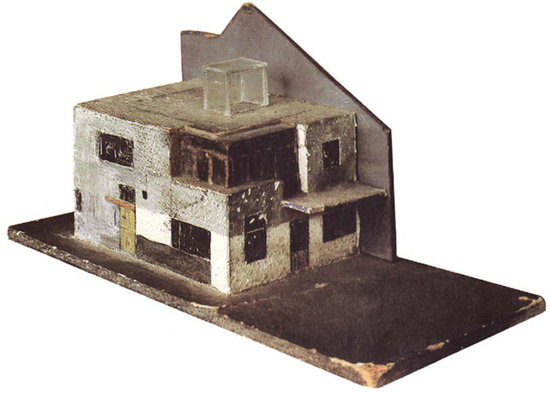
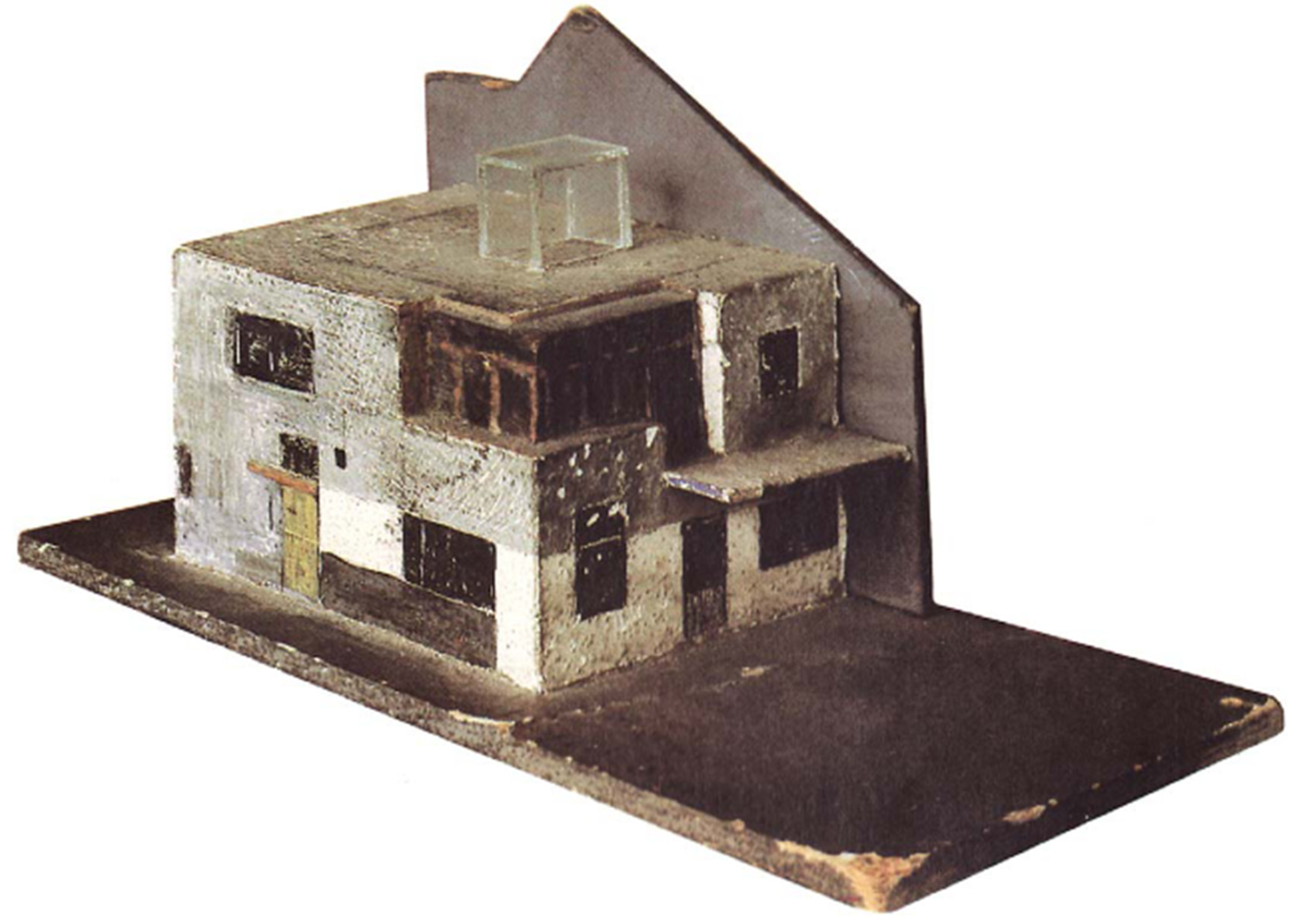
It is not unlikely that Gerrit Rietveld (1888–1964), the famous De Stijl designer and architect, engaged in similar reflections when in the early 1920s he produced his model for the Rietveld Schröder House. One of the architectural feats of Dutch Constructivism, the Rietveld Schröder private home in Utrecht has been widely studied. The architectural maquette Rietveld made of this house (see Figure 1), however, presents us with one of the more puzzling artefacts from the archives of Constructivism. Usually described as an intermediary sketch, a provisional or weak design, it certainly does not resemble the delicate, agile and mobile living module the Rietveld Schröder House would eventually become. It is difficult to grasp why at all Rietveld opted for a solid mass model from wood—a cardboard version would certainly have represented the house in a much more recognizable fashion. Yet Rietveld appears to have had various reasons for devising the model in this way. Indeed, while cardboard and its refined modeling techniques were familiar and available to Rietveld (Emmons and Mindrup 2008, pp. 44–52), he knowingly chose not to use cardboard and instead opted for a massive wood design, firstly, because he wanted to be able to touch and put pressure on the structure of his design in the process of creation (wood here being more apt than cardboard). As El Lissitzky observed as well about Rietveld: “He does all with models, feeling things with his hands; and therefore his product is not abstract.”10 Secondly, his aesthetic at this point also avoided the term “form”—it being associated with personal “style”; or, as Theo van Doesburg put it, with “a formulaic predetermined type” (van Doesburg 1974, p. 142)—and instead set out to create a new, prototypical architectural “mass”, and here, again, wood mass might have seemed more suitable to Rietveld. These considerations demonstrate that the materiality of Rietveld’s model—while visually representing the actual Schröder House inappropriately—certainly gave a most fitting shape to the immaterial ideas or paradigmatic concepts he was working with, a shape that was not in contradiction with how the Rietveld Schröder House would eventually become. Yet the model also reminds us that it is always desirable and in fact essential to return to the historical contexts from which avant-garde works emerged. Indeed, while it is worthwhile to speculate about how avant-garde works condition us to experience the future differently, Rietveld’s model resists such speculation and necessitates that we return to the very precise moment of its inception. By all accounts a time machine in its own right—at once a design for a reist utopian abode; a projection, albeit perhaps not optimal, of a realizable architectural construction; and an estranging object breaking up the present—it cannot be separated from the actual future to which it pointed, the situated context of the eventually built Rietveld Schröder House. If, as Turowski, Flaker, and Lotman allow us to suggest, the historic avant-garde conditions us to experience a different future for all and not the few, that future by now also has acquired a history of its own; the avant-garde’s future often has already happened, become anterior. Attending to the history of such futures perfect might offer still further insight into the actual futurity of avant-garde works.
Figure 1.
Gerrit Rietveld, Schröder House maquette (1923–1924), carved and painted wood, cardboard, glass, 10 × 22 × 10 cm. Centraal Museum Utrecht © Sabam Belgium, 2026.
Funding
This research received no external funding.
Institutional Review Board Statement
Not applicable.
Informed Consent Statement
Not applicable.
Data Availability Statement
Data sharing is not applicable. No new data were created or analyzed in this study.
Conflicts of Interest
The author declares no conflict of interest.
Notes
| 1 | (Lotman 1992, p. 4). Translation quoted from (Torop 2005, p. 164). |
| 2 | See among others (Poggioli 1968). Compare Marjorie Perloff’s (1986). |
| 3 | Hartog (2003). Compare, among others, Maria Stavrinaki’s (2016) study and Fähnders (2002). |
| 4 | (Turowksi 1986). In 1983, Turowski presented his postdoctoral habilitation, Wielka utopia awangardy. Artystyczne i społeczne utopie w sztuce rosyjskiej 1920–1930 (The Great Utopia of the Avant-Garde. Artistic and Social Utopias in Russian Art 1920–1930) at the Institute of Art History of Adam Mickiewicz University, Poznań. A year later he would move to France. |
| 5 | (Flaker [1982] 1984b, pp. 68–69). Quoted in translation from (Šuvaković 2024, p. 100). |
| 6 | (Flaker [1982] 1984b, p. 68). Quoted in trans. by and from (Erjavec 2015, p. 262). Compare also (Flaker 1984a, pp. 107–13). |
| 7 | (Sretenović 2020, p. 52), quoting (Flaker [1982] 1984b, p. 66). |
| 8 | Of specific interest in this respect are Lotman’s studies (Lotman 1990, [1992] 2009, [1992] 2013). As Danielle Monticelli has observed, Lotman’s view comes to us in a scattered fashion, and in the present article I am much indebted to her majestic synthesis of Lotman’s late work (Lotman 2020, pp. 184–202). |
| 9 | On the “natural” character of explosions, see (Rordíguez Higuera 2024, pp. 545–61). |
| 10 | (Lissitzky 1926, pp. 877–81); quoted in translation by J.E. Kurland from (Brown 1958, p. 58). |
References
- Brown, Theodore. 1958. The Work of G. Rietveld Architect. Utrecht: Brauna en Zoon, p. 58. [Google Scholar]
- Bürger, Peter. 1984. Theory of the Avant-Garde. In Theory and History of Literature. Translated by Michael Shaw. Foreword by Jochen Schulte-Sasse. Minneapolis: University of Minnesota Press, vol. 4. [Google Scholar]
- Demos, T. J. 2023. Radical Futurisms. Ecologies of Collapse, Chronopolitics, and Justice-to-Come. London: Sternberg Press. [Google Scholar]
- Eagleton, Terry. 1990. The Ideology of the Aesthetic. Oxford: Blackwell, p. 227. [Google Scholar]
- Emmons, Paul, and Matthew Mindrup. 2008. Material Models and Immaterial Paradigms in the Rietveld Schröder House. Journal of Architectural Education 62: 44–52. [Google Scholar] [CrossRef] [Scilit]
- Erjavec, Aleš. 2015. Conclusion: Avant-Gardes, Revolutions, and Aesthetics. In Aesthetic Revolutions and Twentieth-Century Avant-Garde Movements. Edited by Aleš Erjavec. Durham: Duke University Press, pp. 255–86. [Google Scholar]
- Fähnders, Wolfgang. 2002. ‘Zeit und Raum sind gestern gestorben‘. Über ‘Präsentismus‘ in der europäischen Avantgarde. In Zwischen-Bilanz. Eine Festschrift für Joachim Paech zum 60. Geburtstag. Edited by Frank Furtwängler. Konstanz: KOPS. n.p. Available online: http://nbn-resolving.de/urn:nbn:de:bsz:352-opus-8362 (accessed on 2 December 2023).
- Flaker, Aleksandar. 1982. Notes sur l’étude de l’avant-garde. Revue de Littérature Comparée 56: 125–37. [Google Scholar]
- Flaker, Aleksandar. 1984a. Optimalna projekcija. In Pojmovnik Ruske Avangarde. Zagreb: Grafički zavod Hrvatske, pp. 107–13. [Google Scholar]
- Flaker, Aleksandar. 1984b. Poetika Osporovanja: Avangarda i književna Ljevica [The Poetics of Challenge: The Avant-Garde and the Literary Left]. Zagreb: Školska knjiga, pp. 68–69. First published 1982. [Google Scholar]
- Foster, Hal. 1996. The Return of the Real: The Avant-Garde at the End of the Century. Cambridge: MIT Press. [Google Scholar]
- Hartog, François. 2003. Régimes D’historicité. Présentisme et Expériences du Temps. Paris: Seuil. [Google Scholar]
- Lissitzky, El. 1926. Architecture, House Culture. Stroitel’ Naia Promyshlennost 12: 877–81. [Google Scholar]
- Lotman, Juri. 1990. The Universe of the Mind. A Semiotic Theory of the Mind. Translated by Ann Shukman. Bloomington: Indiana University Press. [Google Scholar]
- Lotman, Juri. 1992. Лoтман, Юрий М. От редкoллегии. Труды пo Знакoвым Системам (Sign Systems Studies) 25: 3–4. [Google Scholar]
- Lotman, Juri. 1997. Culture as Subject and Object of Itself. Trames 1: 7–16. [Google Scholar] [CrossRef] [Scilit]
- Lotman, Juri. 2009. Culture and Explosion. Edited by Marina Grishakova. Translated by Wilma Clark. Berlin: Mouton de Gruyter. First published 1992. [Google Scholar]
- Lotman, Juri. 2013. The Unpredictable Workings of Culture. Edited by Igor Pilchikov and Silvi Salupere. Translated by Brian James Baer. Tallinn: Tallinn University Press. First published 1992. [Google Scholar]
- Lotman, Juri. 2019. Culture, Memory and History. Essays in Cultural Semiotics. Edited by Marek Tamm. Translated by Brian James Baer. Cham: Palgrave/MacMillan, p. 108. [Google Scholar]
- Lotman, Juri. 2020. Thinking the New After the Fall of the Berlin Wall: Juri Lotman’s Dialogism of History. Rethinking History 24: 184–202. [Google Scholar] [CrossRef] [Scilit]
- Lyotard, Jean-François. 1984. The Avant-Garde and the Sublime. Translated by Lisa Liebmann. Artforum 22: 36–43. [Google Scholar]
- Mandelker, Amy. 2006. Lotman’s Other: Estrangement and Ethics in Culture and Explosion. In Lotman and Cultural Studies: Encounters and Extensions. Edited by Andreas Schönle. Madison: The University of Wisconsin Press, pp. 59–83. [Google Scholar]
- Margolin, Victor. 1997. The Struggle for Utopia: Rodchenko, Lissitzky, Moholy-Nagy, 1917–1946. Chicago: University of Chicago Press, p. 10. [Google Scholar]
- Osborne, Peter. 1995. The Politics of Time: Modernity and Avant-Garde. London: Verso. [Google Scholar]
- Perloff, Marjorie. 1986. The Futurist Moment. Avant-Garde, Avant Guerre, and the Language of Rupture. Chicago: University of Chicago Press. [Google Scholar]
- Poggioli, Renato. 1968. The Theory of the Avant-Garde. Translated by Gerald Fitzgerald. Cambridge: Harvard University Press, Cambridge: Belknap Press, pp. 68–74. [Google Scholar]
- Rordíguez Higuera, Claudio Julio. 2024. How to Detonate a Semiotic Bomb: The Dynamics of Lotmanian Explosion in the Semiosphere. Language and Semiotic Studies 10: 545–61. [Google Scholar] [CrossRef] [Scilit]
- Sretenović, Dejan. 2020. Red Horizon: Avant-Garde and Revolution in Yugoslavia 1919–1932. Novi Sad: Kuda.org, p. 52. [Google Scholar]
- Stavrinaki, Maria. 2016. Dada Presentism. An Essay on Art and History. Translated by Daniela Ginsburg. Stanford: Stanford University Presss. [Google Scholar]
- Šuvaković, Miško. 2024. European Avant-Gardes between International and Global. In The European Avant-Garde—A Hundred Years Later. Edited by Polona Tratnik. Leiden: Brill, pp. 99–123. [Google Scholar]
- Torop, Peeter. 2005. Semiosphere and/as the research object of semiotics of culture. Σημειωτκή—Sign Systems Studies 1: 159–73. [Google Scholar] [CrossRef] [Scilit]
- Turowksi, Andrzej. 1986. Conceptualisation et materialization dans l’art non-objectif. In Les Abstractions I: La Diffusion des Abstractions. Saint-Etienne: Unversité de Sainte-Étienne, pp. 73–81. [Google Scholar]
- van Doesburg, Theo. 1974. Towards Plastic Architecture. In Theo van Doesburg. Edited by Joost Baljeu. New York: Macmillan, p. 142. [Google Scholar]
Disclaimer/Publisher’s Note: The statements, opinions and data contained in all publications are solely those of the individual author(s) and contributor(s) and not of MDPI and/or the editor(s). MDPI and/or the editor(s) disclaim responsibility for any injury to people or property resulting from any ideas, methods, instructions or products referred to in the content. |
© 2026 by the author. Licensee MDPI, Basel, Switzerland. This article is an open access article distributed under the terms and conditions of the Creative Commons Attribution (CC BY) license.