


Abstract
In this article, I will use the ecological approach to explore the recent videos of Pınar Öğrenci. I will focus on two works: Aşît—The Avalance (2022) and Cemetery of the Nameless (2025). In the latter work, there is a complex examination of the interplay between the precarious paths taken by refugees and the climate change crisis. She also explores the multiple layers of history and memorialization in sites that have been scarred by genocide. In Cemetery of the Nameless (2025), Pınar establishes an analogy between missing bodies and the contamination of the water of Lake Van. However, this connection is not linear and there is no direct cause and effect; Lake Van was meant to be a transit zone for the refugees, not a cemetery. I will argue that the function of analogy is in its suggestion of comparisons, rather than the establishment of equivalence. Öğrenci thereby puts the analogy to work in a dual manner—it both amplifies and concentrates our attention. We listen to the narratives of migration while looking at the scenes caused by climate change. The image broadens the horizon of the narrative, and the voice sucks the gaze into a dark hole. In this manner, Öğrenci’s art of witnessing, which both combines and separates voice and image, amplifies and concentrates the transfer of information. I will also frame this commentary on the artworks with a broader discussion on the politics of care and memorialization.
Wars, migration and climate change are pressing down on us. The genocide in Gaza. War in Ukraine. These events are bringing news of unspeakable horrors at specific sites and inspiring racist outbursts across multiple fronts. The impact of climate change on the Global South and the rates of demographic decline in the Global North is generating unprecedented spirals of interdependency. The grotesque sight of suffering around the world leaves no one immune. Violence in one place is dredging forth traumatic memories from other places. This context has radical implications for the way we approach art and culture. Where do we stand on these issues? How does this impact the way we see images?
To rethink the ecological and geo-political crisis of our times, scholars in the humanities must first abandon the colonialist fantasy that there is a fixed standard and final vantage point from which the world of art can be surveyed. A new kind of intimate engagement is necessary. John Berger often contemplated the ways the surrounding infiltrates the interplay between perception and memory. He was conscious of the tension between the intellectual effort to organise thought through linear stages of development and the emotional work of radial association. Rather than representing memory as a belated construct of past experiences, Berger claimed that perception and memory occur simultaneously. In his collaboration with Jean Mohr in Another Way of Telling, he illustrated the looping form and simultaneous experience of memory in a long quotation from the memoir of a Palestinian author written in the early 1970s:
Never shall if forget Nadia’s leg, amputated from the top of the thigh. No! Nor shall I forget the grief which had moulded her face and merged into its traits for ever. I went out of the hospital in Gaza that day, my hand clutched in silent derision on the two pounds I had bought with me to give to Nadia. The blazing sun filled the streets with the colour of blood. And Gaza was brand new, Mustafa! You and I never saw it like this. The stones piled up at the beginning of the Shajiya quarter where lived had a meaning, and they seemed to have been put there for no other reason but to explain it. This Gaza in which we have lived and with whose good people we had spent seven years of defeat was something new. It seemed to me just a beginning. I didn’t know why I thought it was just a beginning. I imagined that the main street that I had walked along on the way back home was only the beginning of a long, long road leading to Safad. Everything in this Gaza throbbed with sadness which was not confined to weeping. It was a challenge; more than that, it was something like reclamation of the amputated leg. (Ghassan Kanafani, quoted in Berger and Mohr 1982, p. 117).
More recently, Michael Rothberg, in his pathbreaking book Multidirectional Memory (Rothberg 2009), also reminded us that memory does not sit still. It is shaped by local situations and driven onwards by transnational forces. It carries and embeds echoes from other sources. Its movement is a spiral form that is simultaneously cascading, gathering, and dropping elements. It is consolidated by alliances and expanded by connections. In short, memory is neither linear nor mono causal.
Reflecting on her own emergent status as an expert on French theory, Gayatri Spivak disavowed the conventional stance of authority (Spivak 2016). She did not see herself as the master surveyor, but rather as someone who had entered a field and could speak with it, not on it. This was a strategy she admired in the work of Jacques Derrida who held back on destroying that which he was deeply engaged in deconstructing. While responding to the request to ‘talk’ about her origin story, Spivak chose not to look back at the staging of her experiences with a critical distance. She deployed the stance of critical intimacy, a way of implicating herself as she teased out the threads that shaped her life (Spivak 1992).
I am leaning on Berger, Spivak and Rothberg to situate my own approach towards Pınar Öğrenci, an artist with whom I share much in common. I first witnessed Öğrenci’s work at documenta fifteen (18 June–25 September 2022). The controversy over antisemitism that shrouded that event obscured the aims of the directorial team and the effort of the various collectives. The broader attempt to inject an ecological approach into aesthetic experience and the articulation of a transnational perspective in curatorial bridge building were both seriously curtailed (Papastergiadis 2023, pp. 293–310; Papastergiadis 2024). The directorial team of documenta fifteen were part of an art collective from Indonesia called ruangrupa. They worked under two noble principles—devolve power by inviting collectives to invite other collectives, and to exercise the Indigenous eco-philosophy of lumbung on the widest possible scale. Lumbung is an Indonesian term that refers to the communal process of sharing resources, transmitting knowledge, and redistributing responsibility (ruangrupa and Papastergiadis 2021). I was invited to speak at the closing events. By then, many of the collaborative activities that had been initiated by the collectives had run their course. The documentation and traces that were left behind were suggestive. However, to fully grasp the impact of these projects, I am sure that you had to be there. This elevation of the ephemeral presents a challenge to the art historical imperative to judge the formal quality of an artwork. The sheer diversity of cultural reference points presents a further challenge to the lexicon of critical evaluation. Documenta had been transformed from being a display cabinet of finished artistic products to becoming akin to what Hakim Bey called The Temporary Autonomous Zone (Bey 2011). It was with these thoughts mulling once again in my head that I climbed the grand entrance to Hessiches Landemuseum in Kassel. Before I entered the first room, I could hear a familiar and enchanting melody. Behind the curtain in the main room, there was a projection of the film Aşît—The Avalance (2022) by Pınar Öğrenci. I will come back to discuss this film later in this article. But for now, let me introduce the artist.
Pınar Öğrenci is a Kurdish artist, whose hometown of Van is close to the Pontus region in Turkey, where my maternal ancestors originated. She was accused of terrorism and after her court case and punishment in prison, she left Turkey. Since then, she has been based in Berlin and lived for short periods in numerous European cities. There is a quiet cosmopolitan vibration in all her work. It reaches out in solidarity with other migrant and oppressed communities but also attends to the bonds that connect people to the animals, rivers, stones and mountains of their place. This eco-cosmo-politics is difficult to grasp in full. No discipline is fully equipped with tools to capture its radial energy. Using personal narratives and speculative historical ruminations, I put my own complicities on the line. However, to focus exclusively on the personal dimensions of Öğrenci’s visual practice is to miss a vital point. She returns to the traumas in her places of origin but also holds back her voice. What unfolds is a perspective that combines a geo-political critique of regimes and an ecological sensitivity to the matter that our bodies and this world have in common.
In 1988, I visited Van. I was heading towards Trabzon, the city from which my maternal ancestors fled in 1923. Prior to Van, I visited with Erika Tan in Diyarbakir. Two young brothers dressed in three-piece dark suits insisted on showing us the view from each of the gates that surrounded this fortress city. “Maşallah!” they shouted with joy, and raced us to the next cardinal point. By the end of the day, Erika and I were delirious with headaches and vomiting. That night, a trainee doctor who spoke English with a stutter was summoned to our hotel. He had been dispatched to serve his military duty in the local Kurdish prison, probably the same prison that Pınar Öğrenci was detained in in 2015. He inserted a saline drip into our arms and then went down to the lobby to play tavla (backgammon) with the hotel manager who had nothing else to do.
After the wrenching experiencing of dehydration in Diyarbakir, a plunge in the light blue water of Lake Van seemed irresistible. Yet, entering it was like wading in a soapy bath. Lake Van is rich in volcanic sodium and it clings to your skin. I swam like a dog.
The city of Van sits at an elevation of 1726 m and is surrounded by the snow-peaked Süphan and Artos mountains. The city is situated on the southeast corner of a saline soda-rich lake. It is now a mainly Kurdish city but was a major city in the Armenian Kingdom before it was conquered by the Byzantines, Seljuks, Mongols and Ottomans. Van is approximately 100 km from the border between Turkey and Iran. It has also become a key site on the transit route for the refugees and migrants fleeing from the East to the West.
In the middle of Lake Van is the island of Akdamar, which has the remains of a medieval Armenian Church. The exterior of the church is adorned by vibrant friezes. The interior is a ruin. There was a small group of French Armenian and Jewish tourists on the island the day I swam out there. A mother and daughter were swimming near the rocks that I was sitting on. The daughter emerged with her hair dry and in a bob and a warm smile. The elderly mother was struggling to get her grip. I went closer to offer my hand. She extended hers, and for a split second, I flinched and recoiled as if I had been zapped. Three of her fingers were missing and there was a blue tattoo on the inside of her forearm. It carried the number given to her in the concentration camp.
I had seen these stigmata on the arms of men, who, on a hot day, had rolled up the sleeves, and waited patiently for the tram to arrive. I grew up St. Kilda, which has one the largest populations of Holocaust survivors. Each glimpse of these tattoos is always a shock.
When I arrived in Van, I discovered that it was one of the scenes of the Armenian genocide. The old town had been razed. The Armenians were either exiled or executed. The new town of Van was almost entirely built after 1915. Walking towards the old citadel, I could see no trace of the past. The ground was covered in lush green grass. From a horizontal perspective, everything was flat and silent. However, having scrambled up the old city walls, I looked down. Suddenly, the remains of the older urban grid were visible. To the west were the modern concrete buildings with their protruding antennas, and directly below me the murmuring footprints of the old Armenian city. The slight cuts into the earth made an unmistakeable scar of where a house, chimney or path once existed. The grass had grown over the forgotten and demolished buildings, but the contours were ineradicable. It was like staring at the fingerprints of a lost body.
To the east of the walls, the fields and forest appeared lush and dense. Goats and sheep ambled with ease. It was a haunted idyll. I was heading to Trabzon, the city my grandmother was exiled from, and this was a fitting preparation. The region in which Öğrenci’s films are shot share a frontier with my maternal ancestors. There are common historical references and shared traumas. The landscape is thick with stories of violence and despite the sustained efforts to wipe away the traces of genocide and displacement, there is a haunting spectre.
At the turn of the twentieth century, the Ottoman Empire was at the edge of collapse. Minorities were demanding autonomy and the ideology of ethnic purity was at the core of an emergent Turkish Nationalism. These dominant nationalist myths depicted minorities as a threat to national unity. The Armenian genocide began in 1915. Less than a decade later, the Pontians were also massacred and sent on death marches. The nation state of Turkey was forged through these blood-soaked reprisals and defensive over-reactions. The collusion of the Kurds then and their repression now only furthers the story of complicity and contradictions. Öğrenci’s outlook does not presume a clean vantage point. She does not claim a position from which perpetrators and victims can be definitively distinguished. History is loaded with multiple stories. In each story, other stories are nested—some are heading in one direction, but others inspire counter-narratives. Any attempt to identify a start or capture the whole is bound to fray. Where does one begin when no story is sufficient? Clearly the nationalist stories have failed; what other ways can we approach this landscape?
The opening scene of Pınar Öğrenci’s recent film, Cemetery of the Nameless (2025), depicts a text with the artist’s statement declaring that the need to bury the dead is part of the ethics of death. In Sophocles’ tragedy, Antigone also thrust this challenge to King Creon. In the civil war of Thebes, her two brothers, Eteocles and Polynices, killed each other. Creon decreed that Polynices was a traitor and should be left to rot in the open, while Eteocles received the full funeral rites. Antigone was aghast and defied the authority of the sovereign. Her defence was based on the sacred law that required, irrespective of status or deeds, all people must be buried for their souls to reach the underworld.
In 2020, a boat carrying more than 80 people sank in the middle of Lake Van. Only 61 bodies were recovered. The rest, it is assumed, are trapped at the bottom of the lake. Öğrenci’s film Cemetery for the Nameless (2025) oscillates between an ethical duty towards the dead and the state’s abrogation of care. The narrator in Öğrenci’s film sums up the state’s bloodless perspective: if refugees and migrants have entered illegally, then they have no rights to protest about abuses, and, as such, even in death, they remain invisible. By contrast, the thrust of Öğrenci’s film is an act of witnessing, it is forging a counter-perspective, one that defies the state’s effort to expunge the visibility of the refugee and instead offers a form of ethical memorialization.
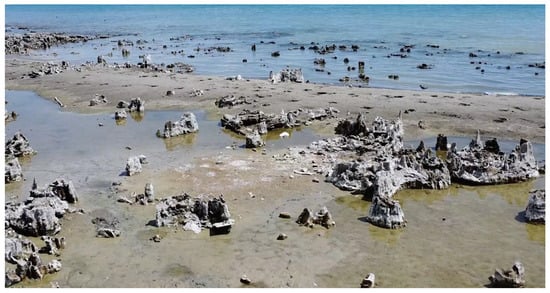
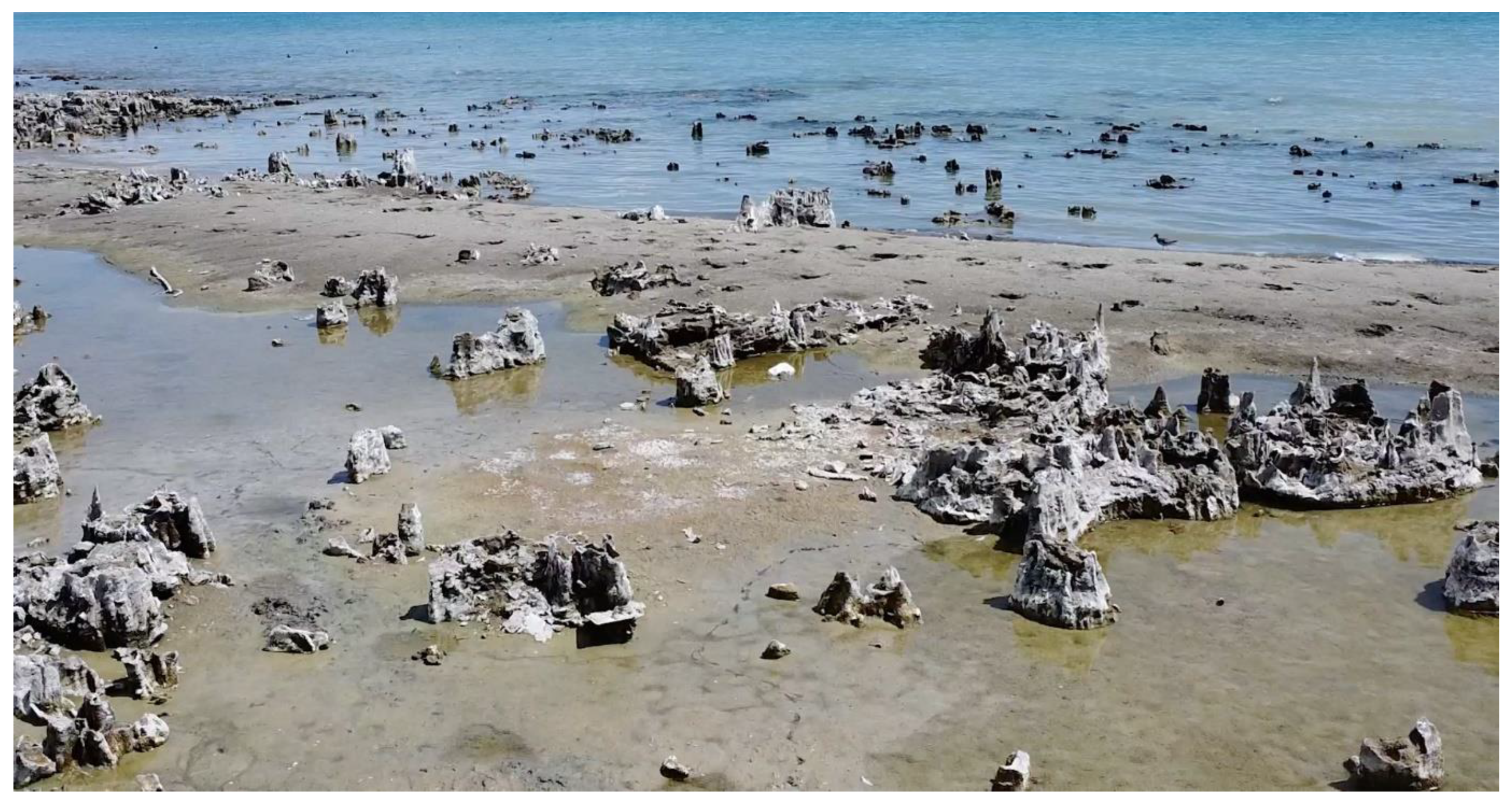
Even though my memory of Lake Van is vivid and feels close despite the passage of many years, the appearance of the lake in Cemetery of the Nameless is unrecognisable to me Figure 1. The water is still apparently thick with sodium, but it is now also murky and brackish. The shoreline has shrunk, and the soft yellow sand has turned a slime green-grey. Off camera, we hear the desperate shriek of birds, as if they are fighting each other for their last meal. The ubiquitous plastic bags are here as well, swaying in the long grasses—some are frayed like pathetic flags while others are still ripe, and when the wind catches them, their stomachs bloat.
Figure 1.
Film still of Cemetery of the Nameless by Pınar Öğrenci, 2025 (courtesy of the artist).
The aerial footage from a drone also reveals the trace lines of old rivers. They are either drained or dribbling. From above, they appear like the marbled veins on a dead man’s corpse. Öğrenci inserts another statement informing us that due to global warming and environmental factors, microbialites have begun appearing on the shoreline. These rocky spires, which are formed from the mixing of carbon in the sodic water and the calcium in fresh water, which were previously covered by the sea. They now protrude along the cracked mud surface that resembles a lunar desert landscape.
These images are accompanied by a narrator’s voice who tells the story of the migrants and refugees who lost their lives in the lake and the efforts of their family to reclaim their bodies. The voice is gentle and compassionate. He speaks in English with a lilting Kurdish accent. A second narrator recounts the ordeals of the journey: the exploitative costs, the risks of being mauled by wild animals, the exposure to hypothermia along the perilous crossing of the snow-capped mountains, the skirmishes with border guards, and then the tragedy of the boat sinking in Lake Van. Many of the bodies were eventually found but only few could be identified and repatriated. The unclaimed bodies were buried in a nameless cemetery with a concrete headstone marked by a number in an asbestos wash.
Between 2016 and 2021, I was engaged to track the Refuge Program at Arts House in Melbourne (Pledger and Papastergiadis 2021). This unique programme of artist-led events brought together diverse communities, emergency service responders, and health and urban experts. Artists recognised that new lines of communication needed to be formed. They also appreciated that rescue signals were easily misinterpreted and that the conventional provision of rescue services may not be sufficient in the climate disasters of the future. Over the five years that I followed the programme, I witnessed a variety of artistic strategies that aimed to expose the communication blockages that the personnel from emergency services encountered, draw on the latent survival skills held within a multicultural society, and create new frameworks where knowledge could be exchanged.
Öğrenci’s video is also socially engaged, but its form of witnessing is not in the spirit of direct intervention or collaboration. It engages us along a more oblique plane, one that combines but also separates the acts of listening and looking. We hear accounts from journalists and activists as the camera scans the lake. There is no voice for the leeching of the lake. There is no image of the migrants and refugees. The silence of climate change hovers alongside the absence of the bodies of the dead refugees.
Öğrenci’s video presents us with an analogy between voice and image. Image and voice stand together in their similitude and difference. This analogy is striking. When the voice advances on the screen, the image appears to recede—it is as if one is making space for the reception of the other.
What do we see and hear in the analogy between the rotting water networks of Lake Van and the vicious paths that migrants and refugees are forced to take?
One is visible, the other is invisible.
One is audible, the other is silent.
A voice narrates the tragic story of migration. But the migrant as the subject is invisible.
The drone camera scans the lake from above, revealing a mute scene of devastation.
At the end of the video, the camera enters Lake Van. It steers around the spirals formed by excessive sodium. The Lake speaks for the first time. We hear bubbles. A series of statements by Öğrenci also appear as text in the middle of the screen. These words probe the possibility of bodies and stories being stacked at the bottom of the Lake. Öğrenci’s subtitles suggest that the minerals in the microbialites have mingled with the calcified bones of the refugees. Finally, Öğrenci concludes that the brownish colour on the surface of the sea is a symbol of the bodies leaving the abyss. As the camera navigates around the bubbling microbialites, Öğrenci claims that she is exploring the boundaries of companionship: “diving inside” is the probe to explore the “solidarity with the people and the lake” (Öğrenci 2025). These gothic underwater monuments are presented as if they were muttering a requiem to both the dead refugees and the dying of this Earth.
The analogy between missing bodies and the contamination of the water establishes a connection between migration and climate change, but this connection is not linear and there is no direct cause and effect; Lake Van was meant to be a transit zone for the migrants, not a cemetery. The value of analogy is in its suggestion of comparisons, rather than the establishment of equivalence. Öğrenci thereby puts the analogy to work in a dual manner—it both amplifies and concentrates our attention. We listen to the narratives of migration while looking at the scenes caused by climate change. The image broadens the horizon of the narrative, and the voice sucks the gaze into a dark hole. In this manner, Öğrenci’s art of witnessing, which both combines and separates voice and image, amplifies and concentrates the transfer of information. While listening to secondary reports on the tragedy of migrants, we learn how they were forced to flee, extorted throughout their journeys, and then killed by negligent guides. At the same time, we are also looking at a lake whose river sources are clogged and its once sandy beaches are reduced to mud swamps. But these voices that she assembles are not witnesses. They are attempting to make sense of a tragedy from the bare evidence that remains. The experience of the refugee is rendered mute. Of course, there are many powerful testimonies such as Behrouz Boochani’s novel (Boochani 2018), but the point of the silence is to register the incommensurability between trauma and language. As Simone Weil noted, “if survivors find a voice, then it is a miracle more powerful than the image of Jesus walking on water” (Weil 1952).
Öğrenci wrestles with this tension between the testimony of belated reporters and the residual traces of unspeakable events. Her attention to the tension between image and words both amplifies as it zooms out to follow the arc of the narrative and concentrates as it also zooms in to register the blurring of elements in and around the lake. In every bubble, we see the macro factors of climate change and the calcium from the bones of the dead migrants make micro deposits, contributing to the murmuring microbialites.
The combination of image and text in Öğrenci’s films also heightens our attention to the complex weaving of past and present. Local incidents are linked to global forces. The movement of refugees towards the Global North is related to the uneven impact of climate change in the Global South. Traumatic memories from one genocide are reactivated by the presence of another. Öğrenci’s use of visual montage and formal analogies between image and text are effective techniques to both engage a comparative understanding of specific memories and probe broader reflection on the general operation of memory. How does memory hold competing stories? What makes one story resonate more powerfully at a given point?
John Berger’s portrayal of the journey of migrants from the peasant villages in the south to the industrial cities of the north of Europe also provides us with an account of how migration disturbs the normal condition of memory. In one seminal passage, he chronicles the way migrants block memories of the past. Berger notices the way migrants overly concentrate on the immediate tasks at hand and thereby create a circle around the present. It is, he notes, as if they are in prison. He concludes that the migrant’s memory is trapped in the condition of bereavement:
A life has come to an end. For that life or towards it no more initiatives are possible. There is only the stillness of death. Perhaps the stillness suggests peace, but at first its fixity is terrible. And the fixity acts retrospectively. None of the life which is over can now be changed. The bereaved goes back to live again his part in that life. If he could re-live it as he originally lived it, he would be able to experience the still open possibilities of the life now ended. But when the bereaved return to the past, they can never entirely forget what has prompted their return: they go back to the past to foretell a death. The past is robbed of its future, which is now the present. To the extent that the bereaved wants to go on sharing the past life with the dead person, his own past becomes fixed. It is then as though the elements of the past line the circumference of the circle, and the future elements withdraw, losing any immediacy. I have nothing to live for now. (Berger 1975, p. 177).
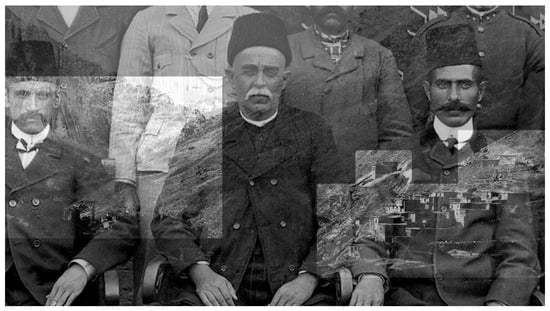
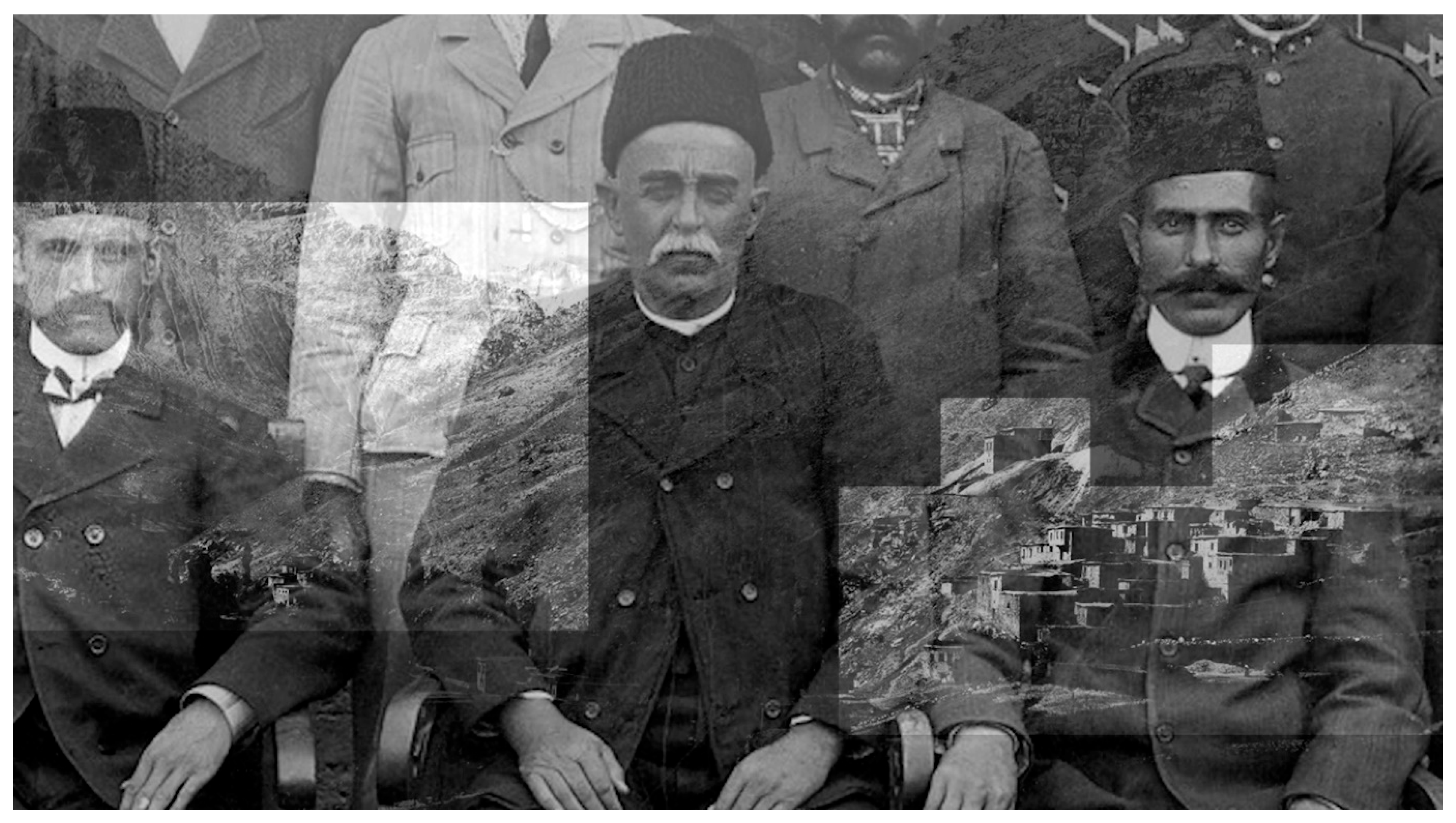
I now want to return to Aşît—The Avalance (2022), the film I saw at documenta fifteen. In this film, Öğrenci also switches the perspective between past and present and poses questions on the border between the visible and the invisible. She does this by overlaying old photographs of the town Moks with current images. Moks is a small town in Eastern Turkey near Lake Van. It is set between rugged mountains and for most of the year, it is inaccessible. It is the hometown of Pınar Öğrenci’s father. He left Moks and settled in the majestic city of Van.
At the beginning of Aşît—The Avalance, the narrator tells the viewer that towards the end of his life, Öğrenci’s father wanted to visit Moks for the last time. This statement is followed by a series of a close-up images: a carving of symmetrical Christian crosses that echo the contours of a rough stones, the advance of a flock of sheep whose faces almost rub up to the camera’s viewpoint and fill the screen.
The colour of the sheep’s heavy coats reflects the colours of the mist, snow, and the occasional pocket of dark brown earthen gravel. There is no authorial voice announcing the story of early occupants. However, their presence is suggested by the mounds that remain after the structures of houses and churches are no longer standing.
Öğrenci’s style of filming is slow. Her use of montage produces a palimpsest where the ghosts of past lives and the anxieties in the contemporary infrastructure are posed side by side. The oscillation is not confrontational, it is elegiac. The ambience is evoked through a combination of long shots and close-ups. In the winter, the heavy snow slows all connections with the outside world. “I followed the slowness of the town” (Öğrenci 2025). The camera moves subtly from the picturesque to the tired views of the military. An armoured vehicle seems to be parked around each corner. Slitted sentinels and mounted machine guns stand as stark reminders of state control. However, unlike the wrinkled and well-weathered town’s people of Moks, the soldiers appear like well-groomed but utterly bored bureaucrats. Their presence is ominous, but we never see into their gaze. They have protective armour and shiny weapons, but they also seem to lack conviction. They are conscripts counting their hours in sterile offices.
The politics of this film is not shaped by a moralistic binarism, where the victims are virtuous and the recent occupants are blithe usurpers. It has a finer poetry that allows for a different range of spaces. The cruel militaristic architecture of the state does not determine the tender meaning of the newcomer’s home. The recollection of the razed Armenian signs of life does not cancel the validity of the present efforts to live. The new Kurdish inhabitants seem to only have the faintest knowledge what happened before their arrival. For instance, we hear them recall the names given to the sheep by their predecessors. They admit to repeating stories that they do not fully understand and embracing the melody of foreign songs.
While filming in the tea rooms of Moks, Öğrenci brings the camera close to the faces and hands of the men. The attention to the sensual fondling of cigarettes and lined physiognomy is familial to me. I am tempted to call out “Theio”—uncle. I also recall certain gestures, such as the reluctance of the elders to remove their coats even when they sit by the fire. The hands and eyes are in fierce concentration with the chess boards. A young boy is mimicking the gestures and speed of the masters. Playing slow is worse than losing. The manoeuvres in chess are veiled; the point of attack must not be revealed until it is executed. Sacrifice is part of winning and the control of territory is dynamic. The narrator informs us that the name for chess is also prisoner. Pieces are moved and the enemy is taken with a thumping gusto. My favourite version of tavla is also called prisoner. The flow is more linear rather than lateral. However, there is a similar need to smell timing. When an ascendent momentum is gained, the rounded stones or chips are slapped down with a percussive triumph.
The metaphor of prisoner for both chess and tavla extend beyond the tactics and aim of the game. The game is played with such force and conviction because it resonates with other aspects of life and politics. The grid is expressive of trapped options, and the moves are luminous indicators of survival. There is always a tension between the limits of the board and the freedom to choose your move. A good player is always calculating the odds. But a great player also knows that maths is not enough to determine when a risk is worth taking. Knowing when to be evasive, when to be cunning, and knowing that not everything is knowable are also needed. This is when the game becomes as curious and as delightful as the art of making something out of nothing. Öğrenci adds, “chess is a metaphor of the political fears and uncertainties in Turkey, everyday people construct a game on a board, then the next day they re-construct it, the game is never ending, but for a player to win he must also remember his opponents past moves, and guess his future movement, if you have this kind of knowledge, then maybe there is hope that the Armenians, Kurds and Turks can live together. (Öğrenci 2024)”.
Öğrenci’s camera switches from panoramic vistas to close ups. The iconic image of the video is the S-shaped line of men, with shovels on their shoulders, marching up the snow filled mountain, singing with gusto and intent on clearing a path. The scene is shot from a high point in the pass. The delight in the manual effort is in stark contrast with the mechanical thrusting and scooping of tractors, and more in keeping with the spirit captured by Francis Alys’ When Faith Moves Mountains (2002). Alys invited five hundred volunteers to accompany him up a sand dune in Peru and shovel in unison until the slope was shifted by a few inches. His slogan for that film was “maximum effort, minimum result”. In both the sand of Mexico and the snow of Moks, there is a Sisyphean task but in Moks, the absurdity has a bittersweet twist. There is a momentary feeling of rejuvenating pleasure—a path is opened. However, alongside the feeling of relief is the recognition that the path cannot last. In Moks, the act of digging is a metaphor of excavating traumatic histories.
In addition to close studies of the townspeople of Moks in the cafes, the camera also zooms in on the rivers. We listen to them trickle and squint at the sparkle of melting snow. Then the camera jumps to a close up of an old man carving chess pieces out of soft birch wood. We witness the grafting of trees, harvesting of nuts, and the way weavers tap their instruments. All this appears to be done as it was done for centuries before.
At one level, little has changed from the age of empire to the modern state. But all the people in these traditional scenes are old and lonely. In Europe, the few remaining peasants are bachelors. In Moks, the “women are not visible they are in villages at the top of the mountains” (Öğrenci 2025). The grandchildren are nowhere to be seen in the grandmother’s kitchen. The long process of depeasantization is shrinking the horizon. The pain of this rupture cannot be avoided the moment we hear the voice of Hayrik Mouradian. He sings of festive moments and of exiles finding their way home. Hayrik Mouradian escaped the Armenian genocide. He and his family fled when he was a child. As Öğrenci noted: “His name in Armenian meant father … he spent his life recalling and discovering the Armenian folk songs of his region … I chose this music because music takes you to a place directly … it has no boundaries, it builds connections” (Öğrenci 2024). Music sears memory and hope into your soul.
What kind of solidarity is being evoked through the mournful soundwaves across the mountains and the trickling bubbles from the microbialites in the lake? The mingling of atoms from the bones of the refugees with the sodium on the lake, the naming of sheep from near and distant lands, the playing of common games, the residual paganism in various monotheistic religions, the melodies that have no home and yet make the songs of exile feel that a reunion is possible—these aspects in Öğrenci’s video summon a form of cosmopolitanism that resonates in the smallest regions of the gut and stretches our consciousness beyond the realm of cultural and geographic boundaries.
There is nothing territorial in Öğrenci’s approach towards her subjects. The stories of the town are presented with intimacy and affection but without Öğrenci asserting a nostalgic yearning to return and reclaim the place. Lake Van is a contested territory. Massacres, displacements and resettlements have all occurred on this site. Through the text on her screen we read Öğrenci’s acknowledgement that the Kurds were part of the destruction of the city in 1915 and their silence fill her with lament: “I feel like I was part of the guilt” (Öğrenci 2025). Öğrenci’s historical reckoning does not seek to identify singular causes and unique victims. The Kurds were incorporated into the Ottoman army and were thereby complicit in the slaughter of Armenians. Some of the people who drowned in Lake Van were Kurdish villagers that were killed by the Turkish army. Öğrenci layers these histories together in a soft and elegiac manner. We are told that Öğrenci’s father wanted to make one final return to Moks. However, the journey to his village was difficult. Once again, the winter was heavy and the asphalt road had not been completed. It was too dangerous to return. Her father died before the road opened. Aşît was intended, in part, as a memorial but it is not sentimental. In neither Cemetery of the Nameless nor Aşît do we see Öğrenci’s face or hear her voice. Her position transpires through the multiple vantage points and various voices that she has selected to stage a narrative about the ‘multidirectional memories’ of trauma Figure 2.
Figure 2.
Film still of Aşît—The Avalance by Pınar Öğrenci, 2022 (courtesy of the artist).
I have approached Öğrenci’s artwork from a personal angle as a means of handling the stigmata of genocide that has been passed down by my own family and the indignation that I feel at the sight of the grotesque abuse of life in Gaza. I did not witness the slaughter of my ancestors and my grandmother’s exile from Trabzon. However, the stories that have been transmitted through my family affect the way I witness the brutal ravaging of Palestine. Cemetery of the Nameless is, for Öğrenci, also an artistic response to the brutality in Gaza. Through the “bitter” optic of the film, she reclaims the possibility of “sharing stories with lost bodies, reflecting on the destruction of human ethics and communing with the non-human” (Öğrenci 2025). I cannot discern how much the stories from my grandmother have attuned me to the suffering of others. However, the videos by Öğrenci, which are situated close to a part of my ancestral lands, also provides a conceptual space to feel my way through the traumatic layers of solidarity and knowledge that have accrued within and across each instance of colonial violence.
This transversal optic is also an antidote to the provincialization of victimhood. The desire to proclaim that the violence to ‘my’ people was unprovoked and its scale was unprecedented not only opens the endless disputes of origin and causation, but it is used as a justification for the excesses of retaliation and a vengeful spiral into a death cult. The arguments and counterarguments being thrust by Israeli settlers and Hamas is ghoulish. My solidarity is with people like Öğrenci. Through her videos, I can see a different kind of cosmo-politics. It links people and places, stories and songs, lakes and animals, the atoms in our bodies and the undulating movement of soundwaves throughout the cosmos. It is in companionship with this cosmos that I trust we will also move towards Claire Farago’s goal of reframing the understanding of art and culture by prioritising connectivity to all of nature over the exceptionalism of humanity (Farago 2025, p. 5).
Funding
This research recieved no external funding.
Institutional Review Board Statement
Not applicable.
Informed Consent Statement
Not applicable.
Data Availability Statement
No new data were created.
Conflicts of Interest
The author declares no conflict of interest.
References
- Berger, John. 1975. A Seventh Man. Harmondswoth: Penguin. [Google Scholar]
- Berger, John, and Jean Mohr. 1982. Another Way of Telling. London: Writers and Readers. [Google Scholar]
- Bey, Hakim. 2011. The Temporary Autonomous Zone, Ontological Anarchy, Poetic Terrorism. New York: Autonomedia. [Google Scholar]
- Boochani, Behrouz. 2018. No Friend But the Mountain. Sydney: Picador. [Google Scholar]
- Farago, Claire. 2025. Writing Borderless Art History: Human Exceptionalism and the Climate Crisis. New York: Routledge. [Google Scholar]
- Öğrenci, Pınar. 2024. Interview: Avalanche as Metaphor. Available online: https://www.youtube.com/watch?v=sdUan3Dtz3k&t=169s (accessed on 9 April 2026).
- Öğrenci, Pınar. 2025. email correspondence with the author.
- Papastergiadis, Nikos. 2023. The Crisis of Cultural Difference in Europe and the New Racism. Estetica: Studi e Ricerche XIII: 293–310. [Google Scholar]
- Papastergiadis, Nikos. 2024. Responses to Charles Esche, The First Exhibition of Twenty-First Century, Lumbung 1 (documenta xv). Australia and New Zealand Journal of Art 24: 15–28. [Google Scholar]
- Pledger, David, and Nikos Papastergiadis. 2021. In the Time of Refuge. Available online: https://arts.unimelb.edu.au/__data/assets/pdf_file/0005/3941321/In-the-Time-of-Refuge-2021.pdf (accessed on 9 April 2026).
- Rothberg, Michael. 2009. Multidirectional Memory. Stanford: Stanford University Press. [Google Scholar]
- ruangrupa, and Nikos Papastergiadis. 2021. Living Lumbung: The Shared Practice of Art and Life. e-flux Journal. Available online: https://www.e-flux.com/journal/118/395154/living-lumbung-the-shared-spaces-of-art-and-life (accessed on 9 April 2026).
- Spivak, Gayatri C. 1992. Asked to Talk about Myself …. In Third Text. Summer. vol. 19, pp. 9–18. [Google Scholar]
- Spivak, Gayatri C. 2016. Critical Intimacy: An Interview with Gayatri Chakravorty Spivak. Los Angeles Review of Books. Available online: https://lareviewofbooks.org/article/critical-intimacy-interview-gayatri-chakravorty-spivak/ (accessed on 9 April 2026).
- Weil, Simone. 1952. Gravity and Grace. London: Routledge. [Google Scholar]
Disclaimer/Publisher’s Note: The statements, opinions and data contained in all publications are solely those of the individual author(s) and contributor(s) and not of MDPI and/or the editor(s). MDPI and/or the editor(s) disclaim responsibility for any injury to people or property resulting from any ideas, methods, instructions or products referred to in the content. |
© 2026 by the author. Licensee MDPI, Basel, Switzerland. This article is an open access article distributed under the terms and conditions of the Creative Commons Attribution (CC BY) license.