


Abstract
This article examines the influence of tradition, particularly Orthodox thought and icons, on the “Russian” and Soviet avant-garde. This field of research was systematically initiated in the 1990s and continues to this day, as evidenced, among others, by recent articles in the Arts Journal. The present article contributes to this field by broadening the perspective, which has overwhelmingly focused on art. The step towards architecture is taken with a case study on the famous Soviet architect Ivan Leonidov. The article positions him in the context of contemporary debates on icons led by theorists Evgeniy Trubetskoy, Pavel Florensky and Nikolay Tarabukin, but also in connection with the emergence of Suprematism, which was introduced by Kazimir Malevich and further developed by El Lissitzky. Leonidov’s geometric bodies, which dynamically “float” in space, prove to be relevant to “Russian”/Soviet aesthetic interpretations of icons and “Russian”/Soviet artistic forms of expression. Just as the icon aimed at bringing believers closer to God, or Suprematism sought to reveal to the masses a higher spiritual or scientific truth, Leonidov’s architecture offered a metaphysical spectacle for a corresponding universalist goal: the creation of a pan-humanist utopia.
1. Introduction
This article studies the work of Ivan Leonidov, one of the most prominent representatives of the Soviet architectural avant-garde. The aim is to highlight the influence of the Orthodox tradition on his work, focusing on his early creative phase, although the analysis can also apply to later designs, such as those in the City of the Sun folio. The article deepens the discourse around the influence of the Orthodox icon on the “Russian” and Soviet avant-garde art.1 This discourse has its roots in the 1960s and Camilla Gray’s book The Russian Experiment in Art: 1863–1922; however, it only gained momentum at the turn of the century, when a multitude of related publications appeared.2 In short, the article reveals that the Orthodox tradition has had a decisive influence not only on artists but also on architects. The choice of Leonidov is no coincidence. The aesthetic uniqueness of his work has long captured the attention of scholars in the Soviet Union, Russia and the West. Publications about Leonidov started in the 1960s and since then have continued to appear in the 21st century. It is precisely this rich research background that enables the article to present an even deeper reading of his work.3
2. Leonidov in Historiography
Leonidov never built any buildings and did not leave any theoretical treatises behind.4 His surviving competition entries and press releases suggest a Marxist-materialist approach to architecture, but it seems that they were merely tailored to the revolutionary jargon of early public debate and, in particular, the functionalist Constructivism of the OSA group to which Leonidov belonged. These comments may also have been a means of balancing the radical nature of his proposals and the associated questions of feasibility and practicality. Be that as it may, statements by people in his immediate circle point out that behind the scenes, Leonidov treated his architecture in a more complex manner. His son Andrey is the most outspoken in this regard. His accounts are included in the first comprehensive monograph on Leonidov, Catherine Cooke’s Ivan Leonidov: The Complete Works from 1988 and in a lesser-known German-language book, Hans-Peter Schwarz and Bernhard Schneider’s Ivan Ilich Leonidov: La Citta del Sole, which focuses on the City of the Sun folio and was published a year later. In these books, Andrey corroborated the information presented by Selim Khan-Magomedov in the early 1970s that Leonidov’s first encounter with art was of a religious nature (Aleksandrov and Khan-Magomedov 1971).5 As a teenager, he worked as an apprentice to an icon painter and it was the latter who convinced Leonidov’s parents to let Ivan Ilych move to Tver to study painting (Schwarz and Schneider 1989). According to Andrey, icon painting and church architecture had a profound influence on his father’s understanding of creativity—he saw it as a quest for a higher world (Figure 1 and Figure 2).6 Beyond his son, close colleagues recognized Leonidov’s spiritual inclinations. In the 1988 monograph, Mikhail Makotinskiy, who had worked with Leonidov in the 1930s, explained that the latter understood the Soviet typology of the Workers’ Club as the equivalent of a modern church. As a result, Leonidov chose the location and designed the building accordingly (Makotinsky 1988).
Figure 1.
Ivan Leonidov, design for the Palace of Culture in the Proletarskiy District, Moscow, 1930. Ground plan of the Mass Activities Department.
Figure 2.
Fiery Ascension of Elijah, Northern School, second half of the 16th century.
Interestingly, a few years before the publication of these testimonies, when references to the influence of the icon and church architecture on Leonidov were still limited to one-sentence notes,7 an article appeared that attempted to establish a developed argument about how exactly Orthodox tradition shaped Leonidov’s most famous building, the Lenin Institute.8 The article was titled “The Lenin Institute: Leonidov’s Icon of the Future.” The author, architect Peter Anders, argued that the aesthetic of the Institute meant to celebrate its function of communicating political and scientific ideas to the masses and the way this happened was through a spiritual experience. Anders was not the first to claim that Leonidov’s work had spiritual qualities. A year before, a similar remark appeared in the well-known book Modern Architecture Since 1900 by architectural historian William J. R. Curtis.9 The difference is that for Anders, the metaphysical quality was not achieved through a rootless modern language à la Le Corbusier, but that the “visual lightness” and “spatial hovering,” that Curtis observes actually drew on the “Russian” tradition of the icon and the church.
Anders builds his argument on the position of the Russian-Jewish and leading artist of the “Russian”/Soviet avant-garde, Naum Gabo. Alongside Gray, Gabo was one of the first to point out the relationship between “Russian” Symbolism, “Russian”/Soviet avant-garde art and the “Russian” icon.10 According to Anders, in the fifth lecture of his 1959 collection Of Divers Arts, Gabo recognized three main characteristics in the medieval “Russian” icon: spirituality, social function, and the abstraction of the formal content. The first characteristic corresponds to the main task of the icon, namely to convey a sense of otherworldliness in order to elevate the viewer to a state of grace. The second corresponds to the functional role of the icon to convey theological information to the audience. The third corresponds to the basic elements of the composition, namely the lines, shapes, and colors, which became the means for icon painters to express their creativity, as the subject matter of the icon is limited and follows strict compositional principles that cannot be altered.
Anders also outlines Gabo’s claim that these characteristics were carried on into modern “Russian” art. He reiterates the argument that Malevich, and before him the symbolist Mikhail Vrubel, were inspired by the abstraction of the icon. Gabo, and in turn Anders, do not elaborate on the characteristic of idealism, but if we turn to the original lecture and the paragraphs leading up to Gabo’s discussion of Vrubel and the reference to Malevich, we find his claim that those “fundamental, idealistic, and abstract concepts” were reborn in modern “Russian” art (Gabo 1962). As far as the social function of the icon is concerned, Anders repeats Gabo’s points about the Wanderers. Τhis artistic group was founded in 1870, but they were not inspired by the abstraction of the icon. In fact, they painted in a bluntly realistic manner, which ran counter even to the then-established styles of neoclassicism and Romanticism. The themes were also different from those of the other two movements: instead of idealized historical events or imaginary scenes, they depicted the hard everyday life of the “Russian” peasantry. The figures and simplicity of the peasants also inspired them to make modern, i.e., lifelike and pared-down interpretations of religious themes.11
In the next phase of the argument, Anders claims that the triptych that Gabo recognizes in the medieval “Russian” icon, and consequently in “Russian” modern art, found its way also into architecture and specifically the Lenin Institute (Figure 3). The author first addresses the social function of the building, claiming that it has a didactic-utilitarian role, exactly like the icon had in “Russian” society. This vast library and research center would become the epicenter of education for the new Soviet society. Anders then goes on to address the idealism of the building. He argues that Soviet society did not abruptly disengage from Christianity. Instead, Marxist materialism adopted some of the aspects traditionally associated with religion. Specifically, after the Revolution, science and political ideology became a single concept and this unification took over the role of a secular faith. As a result, buildings meant to promote education started to function as the new “temples” of Soviet society. Anders calls the Lenin Institute “a symbol of a new spiritualism based on science” and “the counterpart of a monastery or church” (Anders 1983, p. 22). The point here is not that the building had a literal religious function, like, e.g., a Comtean temple of Positivism, but that it was designed to satisfy society’s need for spirituality by aestheticizing the fusion of science and political thought. Connecting this idea to the characteristic of abstraction, Anders explains that artists and architects like Leonidov, having already internalized the religious character of “Russian” art, used their creativity to celebrate the human intellect rather than God. The means employed for this purpose was a language traditionally used to confer loftiness on Orthodox imagery and religious structures—it was now reinterpreted to celebrate the educational function of the Institute.
Figure 3.
Ivan Leonidov, Lenin Institute, Moscow, 1927. Perspective drawing.
The final phase of Anders’s argument relies on analyzing this abstract language and indicating the similarities with the icon and church. He recognizes three main common characteristics—geometricity, dematerialization, and frontality—and makes an allusion to a fourth one, that of dynamism/movement. Specifically, he writes that the pure volumes of the Lenin Institute are meant to represent the elevated function of the building. They are inspired by the clear geometric forms found in the Russian churches and icons which in Orthodox theology symbolize divinity and the opposite of the organic forms of mortal life. Anders introduces a quote from the religious philosopher, political figure and art historian Prince Evgeniy Trubetskoy to support this assertion. The quote comes from the Prince’s analysis of the churches of St. John the Baptist in Yaroslavl and St. Basil the Blessed in Moscow, but he also attributed architectural qualities to the medieval “Russian” icons due to their ordered, symmetrical, and, as we shall see, geometric nature. He writes: “This architecture is also a sermon: it preaches the new style of life that is to replace the bestial style; it presents a positive, lofty alternative to biologism and its unlimited power over the low orders and over man;”(Trubetskoi 1973, p. 29).12 Trubetskoy was a White conservative who opposed not only the Bolsheviks, but also the form that modern art had taken with the proto-avant-garde movements of Symbolism and Art Nouveau.13 This fact makes Anders’s reference extremely insightful, as until that point, scholars had regarded Leonidov’s work as influenced exclusively by the “revolutionary” ideologies in art and politics.
The second characteristic, dematerialization, refers to the extensive use of glass and trusses/cables in the building. For Anders, the latter elements are understood as outlines of volumes that have already dissolved, while the glass-clad volumes represent an earlier stage of this process. Anders defines this impression conveyed by the building as a “spiritualization” of form, symbolizing the immateriality of knowledge, but also the sublimity of the building’s educational function. The author argues that the skeletonized appearance of the Lenin Institute is directly reminiscent of the Russian icon language, where radiating lines are used to represent divine energy (Figure 4). For Anders, this interpretation is also supported by the fact that Leonidov drew his designs in white ink on black drawing paper, alluding to the hagiographers who, on occasions, render lines on the icon with luminous paint. As for the third feature, frontality, Anders notes that despite its ensemble layout, the institute has a clearly defined front that faces Moscow from the hill on which it was envisioned. The significance of the front, Anders claims, is underscored by the fact that the building’s volumes do not have clear rear or side façades, which is also the reason why the model was never photographed from behind or from the side. He posits that Leonidov used the same two-dimensional and frontal nature of icon painting, which supposedly makes the artifact, and consequently the building, more communicative to the viewer.
Figure 4.
Transfiguration of Christ, Theophanes the Greek, 15th century. In addition to the radiating lines, we observe the unnatural relationship between the figures and the ground that conveys a sense of floating.
Fourthly and finally, Anders points out that the weightlessness that the lightly structured Lenin Institute conveys is a characteristic that can also be found in the icon. Yet, he does not go into further detail. Elsewhere, however, he interprets the effect of movement as symbolical of knowledge. Specifically, he notes that the positions of the individual volumes of the Institute appear to be organized according to a Cartesian system, but on closer inspection they are interrupted at their point of origin by a large circular platform and are slightly displaced parallel to their expected axial positions (Figure 5). For Anders, this shifted alignment conveys a sense of swirling that, along with the building’s weightlessness, is meant to symbolize a universe in motion. Anders argues that Leonidov wanted architecture to reflect the recent groundbreaking scientific discoveries, especially Albert Einstein’s relativity theory and Herman Minkowski’s theory of the fourth dimension, which proved that static space is an illusion and reality is formed by a space-time continuum.
Figure 5.
Ivan Leonidov, Lenin Institute, 1927. Ground plan.
Anders’s analysis is particularly important because it allows us to move beyond the previous vagueness in observations about the spirituality of Leonidov’s work: The parallels to icon language can provide an explanation of why qualities such as “visual lightness” and “spatial elevation,” that Curtis mentions, can lend “sacral meaning” to a building (Curtis 1982, p. 211). On the other hand, Anders’s discussion of the three plus one characteristics remains brief and largely speculative. This comes as no surprise, since the discourse around the influence of the icon on the avant-garde, let alone Leonidov, was then still in a primordial state. Nevertheless, one would expect publications to delve deeper into the subject, as the discourse established itself. In the ensuing decades, however, we only find one dedicated publication, in an apparently non-peer-reviewed university journal, namely Andrey Belov’s 2014 article “Traditsii russkoi tserkovnoi arkhitektury i ikonopisi v tvorchestve Ivana Leonidova: Proekt instituta bibliotekovedeniia imeni Lenina.” We also find some related remarks in a conference paper from 2010, by architectural historian Derren Lowe entitled “Channelling the Past: The Mobilization of Tradition and Politics in Ivan Leonidov’s ‘Utopian Constructivism’.” The authors do not raise any issues that have not already been addressed—to smaller or larger extent—in Anders’s article or Catherine Cooke’s discussion of the Russian typology of the pogost in her 1995 book Russian Avant-Garde: Theories of Art, Architecture and the City.14 Perhaps the most important contribution that Lowe and Belov make to this article is that they point to another figure who was not part of Leonidov’s immediate circle and who likewise rejected both the avant-garde and the Bolsheviks, but may nevertheless have been influential: the priest and polymath Pavel Florensky.
This article pursues to further develop the background created by Anders, i.e., to present a more informed interpretation of the influence of the icon and church on Leonidov’s architectural language. The lack of any theoretical treatise or a significant discussion by Leonidov himself is why the article turns to the context. Ironically, this is a fairly exceptional methodology in the study of the architect so far. While scholars have repeatedly pointed to the obvious influence of Malevich’s Suprematism and Lissitzky’s PROUNs on the architect’s work, there has been no substantial discussion of the specifics of this influence. For example, there is extensive research documenting the influence of icons on Malevich and Lissitzky, but whether this engagement could also have been continued by Leonidov has not been addressed. Even less elaborated has been the fact that Leonidov shared the same intellectual environment with art historians who were the first to examine the icon through the lens of modern aesthetics: Trubetskoy and Florensky who were mentioned above are introduced only as names in the historiography around Leonidov. Others, such as the famous avant-garde theorist Nikolay Tarabukin, are not mentioned at all. All these early 20th century figures identified in their writings the icon’s dynamic—seemingly moving—compositions of geometric and floating figures/elements, as a spiritual spectacle that suggested the immaterial presence of God. Meanwhile, Malevich and Lissitzky applied the same principles in their art, but the spirituality behind this extra-sensory experience was not to connect the believers with God. Instead, the purpose of it was to unite the viewing masses by raising their consciousness. Interestingly, Tarabukin also attempted to reconcile the centuries-old language of icons with contemporary scientific discoveries about space and time, while Lissitzky attempted to do the same with his art. On the other hand, Florensky and Malevich showed interest in concepts of a space-time continuum found in the esoteric teachings of theosophy and the Fourth Dimension of Charles Howard Hinton and P.D. Ouspensky.
The argument of the article is that Leonidov developed this overlap between the icon, art, and science into architecture. The principles of geometry, lightness-transparency, and movement in his buildings were intended to create a metaphysical experience that would celebrate the human spirit and inspire humanity to participate into a collective endeavor to reach an ideal state. In other words, Leonidov’s architecture was not merely a symbolic language stemming from the fusion of Orthodox religion with Marxist materialism, as Anders argues. It took a more active role toward uniting the masses, or even humanity. This vision was an important feature of early Soviet political thought in general and manifested itself in the pursuit of an international proletariat. In other words, this article develops a more sophisticated theory of how the three plus one characteristics that Anders recognizes are interrelated—with the extra-sensory movement now coming to the fore—and how these connect with the idealistic (i.e., didactic and universalistic) and utilitarian character of Leonidov’s work. The examples that will be studied were all public buildings that housed scientific and creative (i.e., cultural and recreational) activities. Here, it is also important to clarify that while there is primary source evidence for Leonidov’s universalistic aspirations, the surrounding analysis of the spirituality of his buildings, i.e., how architecture prompted these universalistic aspirations, does not aim to prove beyond doubt that Leonidov actively followed the discourse on icons or that he necessarily had a deeper understanding of Malevich’s and Lissitzky’s perception of art.15 Although the evidence points in this direction, it could also be the case that he unconsciously incorporated all these influences into the development of his own language. Either way, the article will demonstrate that Leonidov’s works can be read in a way that resembles the manner in which Tarabukin and Florensky read the icon or Malevich and Lissitzky understood their canvases.
3. Overcoming Gravity: Trubetskoy, Tarabukin and Malevich
The first to talk about a dynamic/moving spectacle in the icon was none other than Trubetskoy, in the first of three public lectures that were published between 1915 and 1918. It was in “A Worldview in Painting” that he also introduced the aforementioned idea that the icon follows architectural principles—an idea that does not apply only to the general composition, but also to the figures/elements per se, due to their geometricized, flat and elongated depiction. Trubetskoy argued that the distorted figures were an example of the spiritual purification of the flesh, while the architectural rigidity that the icon conveys at first glance was a sign of this elevated state: the absence of the elasticity of the flesh. At the same time, however, he also claimed that upon closer contemplation of these immobile and thinned bodies, the viewer encounters a complex spectacle of movement that transcends the phenomenal—this is the energy of God. This interplay between stillness and motion is most evident in Tarabukin’s analysis of the theme of The Intercession of the Theotokos (Figure 6):
Figure 6.
Intercession of the Theotokos (Pokrov). Novgorod School, early 16th century. Note how the depiction of the church structures the entire composition “architecturally.” Trubetskoy mentions a 15th century icon in the Alexander III Museum (now the Russian State Museum, St. Petersburg) as a model for his analysis of the Pokrov theme, but no such icon in the current catalog dates from that century. However, given the broader analysis of the icon in his lecture, it is safe to say that he is referring to this particular example.
“These icons of the Virgin clearly disclose the joyous meaning of their picturesque architecture and symmetry. Not only the formal distribution of figures is symmetrical but also the spiritual movement that shines through their apparent immobility. Toward the Mother of God as the immovable center of the universe, the symmetrical strokes of angel wings converge from both sides. The human eyes are centered on her, and because of the immobility of the figures this convergence of all gazes in one point gives the impression of an irresistible universal turn toward the rising sun of the world. This is no longer ascetic submission to the symmetry of architectural lines but a centripetal movement toward universal joy. It is the symmetry of a spiritualized rainbow around the Queen of Heaven, as if the light that flows from her, having passed through the angelic and the human spheres, were refracted in a multitude of colors”.(Trubetskoi 1973, pp. 33–34)
Trubetskoy’s lectures were an important source of inspiration for Nikolay Tarabukin, who was the secretary of the INKhUK (Institute of Artistic Culture) between 1921 and 1924 and a member of the GAKhN (State Academy of Artistic Sciences, called RAKhN until 1925) between 1924 and 1930. Both institutions were hotbeds of the avant-garde and closely associated with the art and technical university VKhUTEMAS, where Leonidov studied. Tarabukin developed his own analysis of the icon mainly in two works: the book The Philosophy of Icons, which he wrote between 1916 and 1935, but it was not published until 1999, and in a 1920 manuscript entitled “Rhythm and Composition in Old Russian Painting.” The latter formed the basis for a series of lectures he gave at the Moscow Department of Public Education (MONO) in 1920, at the Russian Institute of Art History (RIII) in Leningrad in 1923, and at GAKhN in 1925 and 1927.16 In both the book and the
unpublished manuscript, which to my knowledge, have been actively cited have been actively cited only in two major English-language publications and only briefly (See Spira 2008 and Tarasov 2024), Tarabukin argued that the figures in the medieval “Russian” icons are arranged in a dynamic relationship to one another, that he called rhythm, as if they were floating (Tarabukin 1999). For Tarabukin, rhythm was the basis on which every icon was composed—a force that unfolds from within and sets these figures in a weightless movement:
“In order to convey spiritual refinement and liberation from the physical, the icon painter subordinates his illustrations to the music and to a sort of a dance rhythm. In the icons everything is depicted as if floating, as if not dependent on gravity. The gait is light, rhythmic. Legs barely touch the ground. The bodies are thinned and unworldly”.(Tarabukin 1999, p. 91)
According to Tarabukin, the comprehension of this extra-sensory movement was a medium that enabled the transition to a higher state. This means that the distorted figures floating rhythmically against the infinite golden background form an abstract, i.e., geometric and dynamic spectacle that transcends the actual narrative of the icon and brings the viewer closer to the immaterial essence of God. In the Orthodox tradition, this concept is also known as theosis and can be achieved through contemplative prayer. Tarabukin expressly praised the utilitarian function of icons and contrasted them with easel painting, which he regarded as an expression of subjectivism—aestheticism. This critical position anticipates the materialistic tendencies of Constructivism, namely the pursuit of a utilitarian art (i.e., the creation of everyday objects and eventually the concept of Productivism).
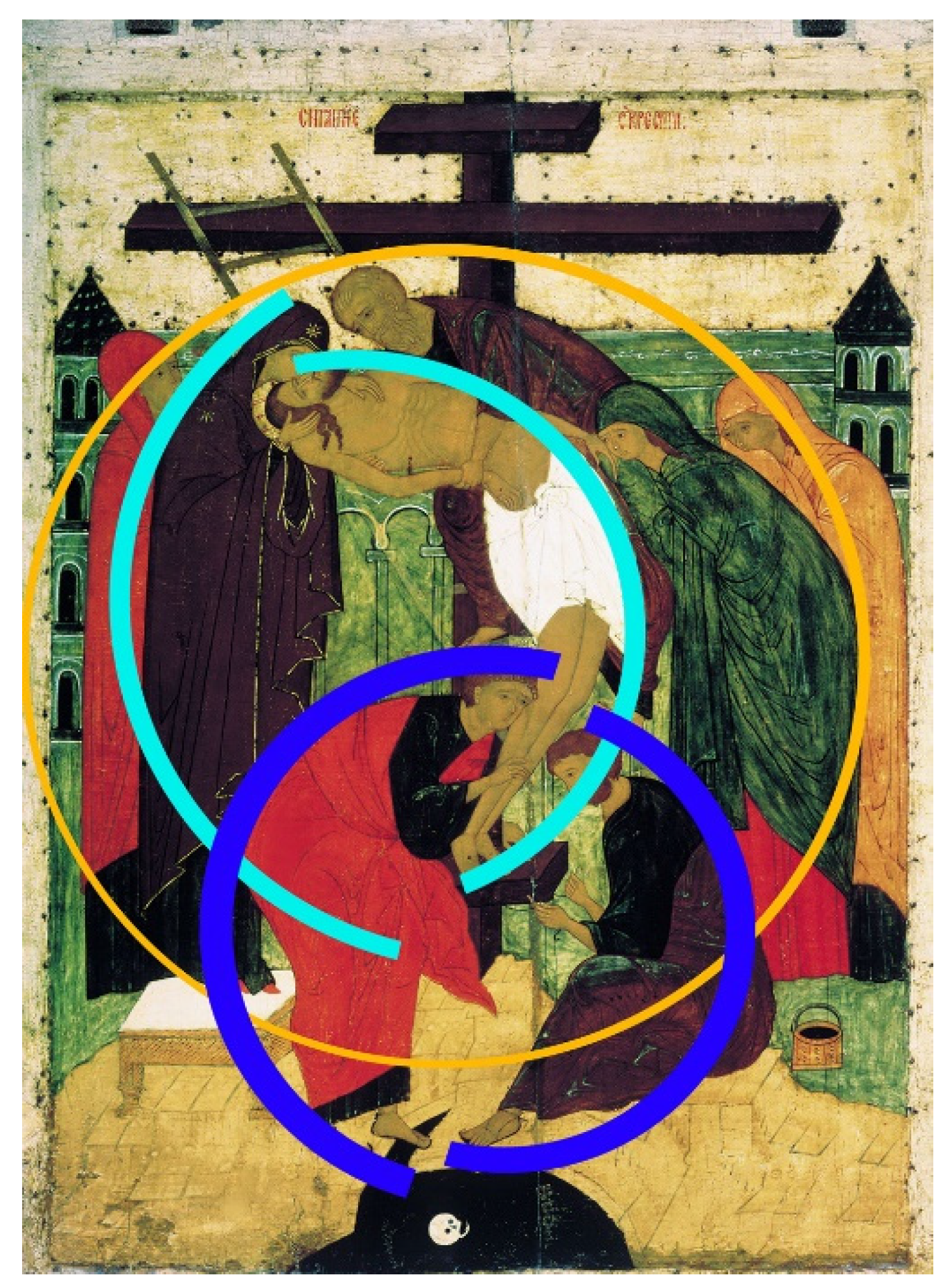
Tarabukin introduced four examples to support his hypothesis on rhythm. The Entombment of Christ, Rublev’s Trinity, Christ’s Entry into Jerusalem, and Descent from the Cross. All date from the 15th century, and in the last three Tarabukin recognizes the rhythm as being of centrifugal form (Figure 7, Figure 8 and Figure 9). Despite the obvious similarity to Trubetskoy’s writings, Tarabukin does not mention him explicitly in the manuscript, but only in the book. Another evident, but unmentioned influence was Kandinsky and his theoretical combination of music and painting. Tarabukin argued that each part of the icon composition had its own rhythm, but at the same time it was harmoniously connected to the whole—like the intervals in a musical composition.17 He even described this rhythm as a transcendent music that could be heard during the contemplative state of prayer:
“The exclusive composition and musical rhythm give the icon a detached character, so different from secular art, which derives its forms from nature. When we contemplate an icon, we contemplate another world, alien to the earthly realm, full of otherworldly sounds”.(Tarabukin 1999, pp. 123–24)
The icons below have been highlighted by the author in a way that reflects Tarabukin’s analysis of centrifugal rhythm. One may discern the fundamental geometries and how smaller rhythmic compositions relate to the overall rhythm.
Figure 7.
Trinity, Andrey Rublyov, ca. 1410 or 1420s.
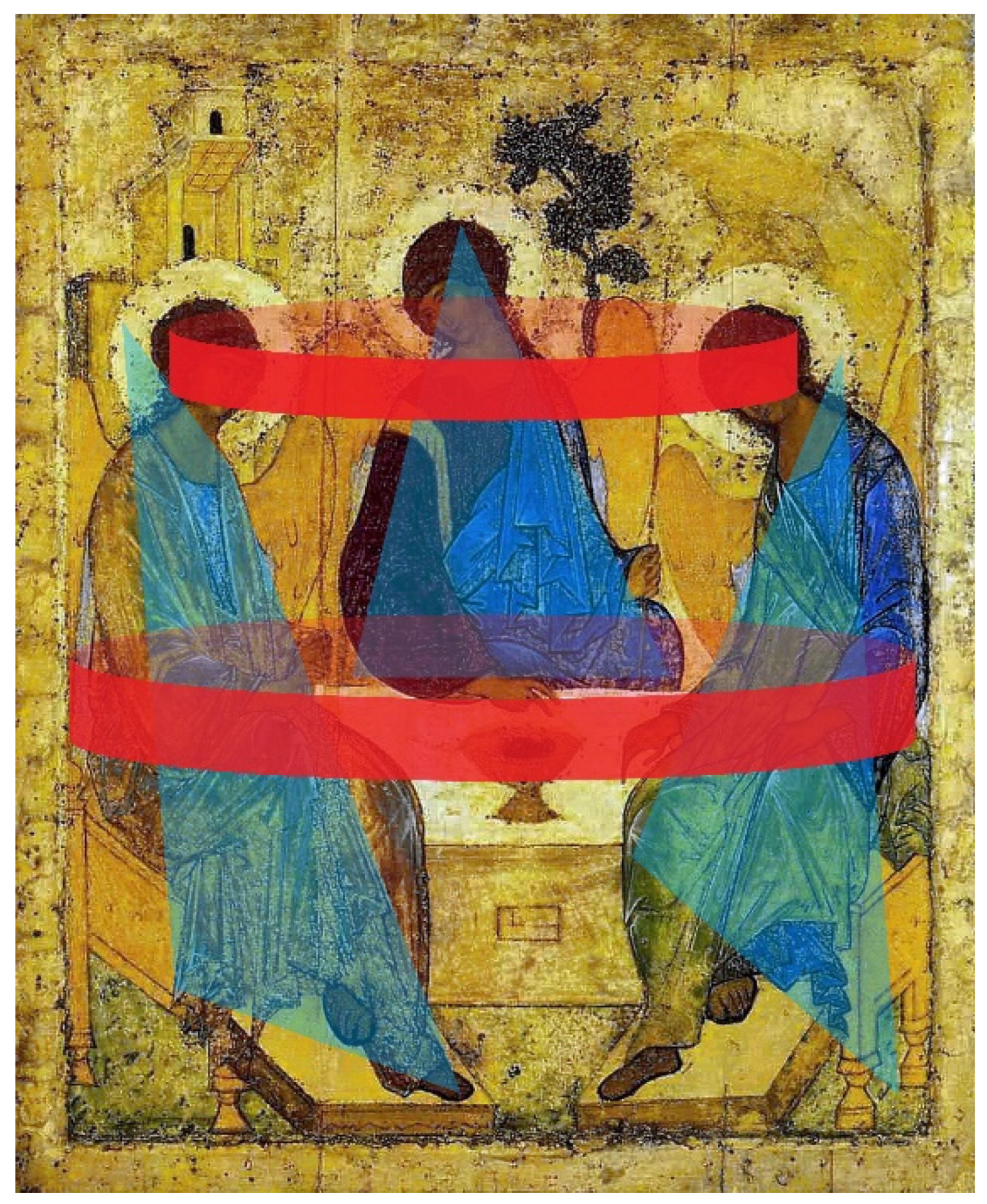
Figure 8.
Christ’s Entry into Jerusalem, Novgorod School, 15th century.
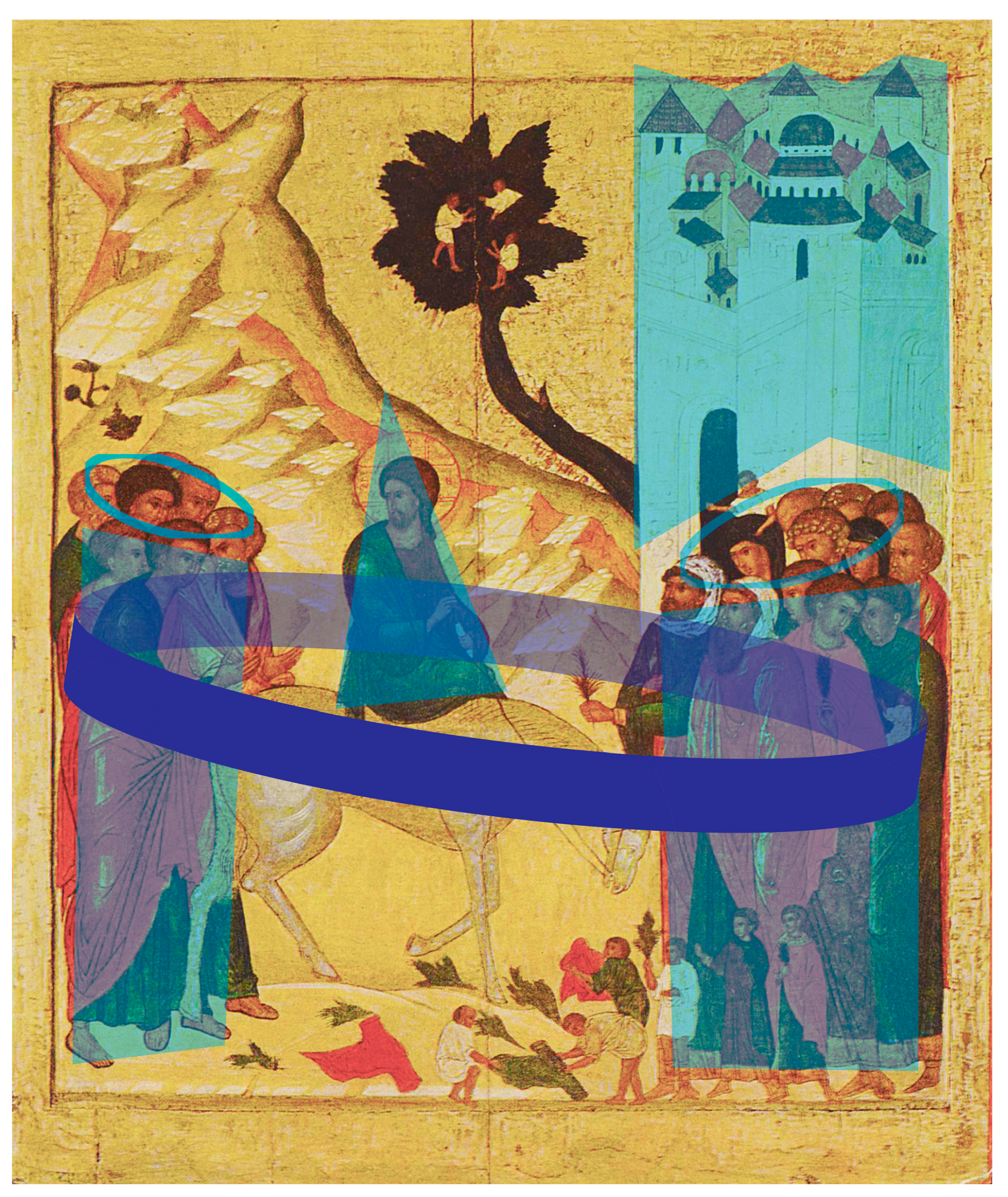
Figure 9.
Descent from the Cross, Novgorod School, late 15th century.
Importantly, Tarabukin’s writings were not simply an analysis of the icon. He regarded rhythm as a principle for the creation of a new type of Russian art that would elevate itself higher than that of the West. He formally expressed this opinion in a second book titled Toward a Theory of Painting, which he also began writing in 1916 and it was published in 1923. Research has shown that his ideas on rhythm had an impact on important artists, such as Lissitzky, well before this publication.18 Furthermore, considering Tarabukin’s effort to disseminate his ideas in the form of repeated lectures, it is not far-fetched to claim that his icon analysis was well-known in the avant-garde discourse as part of his broader theory for a new national art. One of the attendants of Tarabukin’s lectures at INKhUK was Alexandr Vesnin, who developed his own ideas on the principle of movement and was Leonidov’s studio professor.19 Leonidov studied in Moscow between 1921 and 1927 and under Vesnin’s tutelage from 1923 on, so there is no doubt that he came into contact with the specific context as a student. In other words, unlike the “hostile” Trubetskoy, who did not even engage with institutional academia and had already died by 1920, Tarabukin was an active avant-garde theorist and a highly influential one. And while he is best known for his work on the theory of Productivism, he was also among the first to address one of the most important aesthetic principles of early Soviet art and architecture. He did so by starting from the past and the “Russian” tradition.
Another figure who explored the concept of movement and engaged with the icon already before the Revolution was, of course, Malevich. In the “Last Futurist Exhibition of Paintings 0,10” from 1915, Malevich placed the famous Black Square in the way Russian icons are traditionally hung on the corner of two walls (Figure 10 and Figure 11). In the third and revised edition of what was essentially the first theoretical text of Suprematism (Malevich initially circulated the brochure, alongside a one-page manifesto as part of the exhibition, but the revised edition was published almost a year later), he further proclaimed that “The square is a living, royal infant” (K. S. Malevich 1968b, p. 38), a literary phrase used within Russian tradition in reference to the Christ child (Marcadé 2015). Shortly after the exhibition, in a letter attacking the painter and art critic Alexandre Benois for his harsh criticism of Suprematism, Malevich wrote: “I have only a single bare and frameless icon of our times” (K. S. Malevich 1968a, p. 45) and in a letter to the art critic and collector Pavel Ettinger from 1920 he added: “I see in it what people once saw in the face of God” (K. Malevich 2004, p. 125). Finally, in his 1927 manifesto Die gegestandlose Welt Malevich concluded:
Figure 10.
Last Futurist Exhibition 0.10, Petrograd, 1915–1916. Malevich’s room. The corner against which the home altar of icons would be placed was traditionally called the “red corner” (krasnyy ugol), where in older Russian, “red” was synonymous with “beautiful”.
Figure 11.
Alexey Kivshenko, Military Council at Fili, 1880. The emergency council after the Battle of Borodino, at which it was decided to abandon Moscow to Napoleon, was held in a peasant hut. Note the “red corner” with the icon of the Virgin Mary, surrounded by other icons on the adjacent walls.
“I see the justification and true significance of the Orthodox Corner in which the image stands, the holy image, as opposed to all other images and representations of sinners. […] The corner symbolises that there is no other path to perfection except for the path into the corner”.(K. S. Malevich 1976, p. 354)
This “path to perfection” was the realization of a cerebral utopia through the art of Suprematism that would satisfy all mental (i.e., intellectual, psychological), cultural, and political needs of humans. According to the expert Charlotte Douglas, Malevich’s works embody “a synthesis of psychic and organic evolution would lead to a heightened consciousness” (Douglas 2000, p. 12). Malevich named it the state of Objectlessness and connected it with an extra-sensory experience of moving geometric forms. Specifically, in the manifesto he wrote: “This was no ‘empty square’ which I had exhibited but rather the feeling of non-objectivity. […] not an ornament but the feeling of rhythm” (K. Malevich 1959, pp. 68, 76).
According to art historian and former director of the Hamburger Kunsthalle Hubertus Gaßner “the feeling of non-objectivity is evoked by the painted forms which seem to float and ascend like weightless masses of colour inside the empty pictorial space” (Gaßner 2007). For Malevich, Suprematism was the final stage in the development of art. It was no longer about aesthetic beauty, but about designing according to the principles of “weight, speed, and direction of movement” (K. S. Malevich 1968b, p. 34). The experience of geometric shapes floating against a white, infinite background allowed the viewer to reach a “higher order of reality” to use Douglas’s words (Douglas 2000, p. 12) and sounds strikingly similar to Tarabukin’s icon analysis—a dynamic spectacle that allows the believer to reach a state closer to God. Gaßner explains:
“Comprehending Suprematism as a threshold into another, spiritual world where all objectivity has dissolved into the feeling of a void filled with energy and dynamic rhythm, is in keeping with the traditional conception of the icon as a visual representation of the next world in this world. Obviously, Malevich wanted his works to be seen as modern icons”.(Gaßner 2007)
During his later years, Malevich became more direct when pointing out the impact of the icon on his work. In his “Artist’s Biography” from 1933, he wrote: “My acquaintance with icon art convinced me that the point is not in the study of anatomy and perspective, that it’s not in depicting nature in its own truth, but that it’s in the sensing of art and artistic reality through emotions” (K. Malevich 1985, p. 44). Again, we are reminded of Tarabukin’s reading of the icon as an otherworldly music, i.e., a higher reality that goes beyond the figurativeness of the depiction. Essentially, Malevich went one step further in abstracting the icon by creating pure geometric compositions from their already distorted (i.e., flat, elongated, geometricized) figures and accompanying geometric forms, as also Anatoly Lunacharsky, the Soviet Commissar for Enlightenment, observed in 1927 (Figure 12 and Figure 13).20
Figure 12.
Kazimir Malevich, Suprematist Composition, 1915.
Figure 13.
Dormition of the Mother of God, Dionysius, late 15th–early 16th century.
Given Malevich’s fame and the shared milieu of the early avant-garde, it would not be unreasonable to assume that Tarabukin also drew inspiration from the artist in his analysis of the icon or his general ideas about a new dynamic art—even if we have no hard evidence for this. Malevich, for his part, may have admitted his appreciation for the icon, but the emphasis on weightless movement and geometric forms had led scholars, before the establishment of the discourse on the avant-garde and icons, to assume that he was inspired by contemporary esoteric theories.21 More specifically, art historian Linda Dalrymple Henderson points toward the influence of British mathematician and writer Charles Howard Hinton (Henderson 2013). Hinton claimed that humans can develop a greater “space sense” if they could detach themselves from their perception of gravity and cardinal orientation (Hinton 1888, p. 4). To this end, he proposed the notion of the Fourth Dimension, which he promoted through the geometrical-mathematical concept of the tesseract, i.e., the fourth-dimensional hypercube, and the spiritual concept of being able to see three-dimensional objects beyond the limitations of perspective, i.e., from all sides at once (Figure 14). Hinton became known to the “Russian” public through the Russian philosopher P. D. Ouspensky, whose Fourth Dimension also meant attaining a “higher consciousness” and in a way, represented a further development of the spiritual part of Hinton’s theory. He described the Fourth Dimension as a state in which phenomena would no longer appear sequentially passing through time, but as if they were arranged along a spatial dimension, i.e., time literally becoming a fourth dimension (Ouspensky 1920). As a result, a person would be able to see things in the past, present and future and essentially go beyond the sense of time. In Hinton’s terms, this person would also be able to see things from all their sides by acquiring different vantage points simultaneously.
Figure 14.
Charles Hinton. Sketch from his book Fourth Dimension, 1906, which attempts to emulate the appearance of a tesseract in our three-dimensional perception.
Malevich used the term “Fourth Dimension” in several titles of his works, but the two-dimensional Suprematism can relate only to the geometric-mathematical part of Hinton’s theory. In his attempt to illustrate the concept of the tesseract, which cannot be visually grasped through our three-dimensional sensorial perception, Hinton drew parallels to how three-dimensional bodies appear when they transition to a lower dimension, i.e., how they would look on the two-dimensional surface as they penetrated it. For example, depending on the angle of approach, the cross-section of the cube may look like a polygon or even square if the cube’s approach was perfectly orthogonal to the plane (Figure 15). Similarly, the tesseract appears as a series of three-dimensional shapes as they move through time. According to Henderson, this particular mental exercise could have exerted a decisive influence on Suprematism (Henderson 2013) (Figure 16).
Figure 15.
Claude Bragdon, “Personalities: Tracings of the Individual (Cube) in a Plane,” from Man the Square: A Higher Space Parable, 1912. Besides Hinton, Bragdon, a famous American architect, also used drawings to explain the tesseract through the analogy of how cubes would look like in a lower dimension.
Figure 16.
Kazimir Malevich, Suprematism, 1915. Henderson notes that more than one copy of Bragdon’s book probably found its way to St. Petersburg, but clarifies that despite the striking similarity, Bragdon’s drawing was not the source of Suprematism. Nevertheless, it could have been one of the movement’s inspirations.
That said, however, it makes more sense to assume that Malevich drew from both the medieval artifact and these esoteric theories, and that this combination inadvertently and indirectly contributed to the aesthetic interpretation of the “Russian” icon in the modern debate.22 In practice, Malevich never acknowledged Hinton’s influence and even attacked Ouspensky in one of his texts (K. S. Malevich 1968a). Moreover, if the artist ever commented on a dimension, it was the Fifth, which he also referred to as Economy and associated both with the energy that gave his canvas form and movement, but also with the utilitarian role of his art.23 Of course, “utilitarian” was not understood here in the sense of functionalism, but as a social commitment, just as Gabo understood the icon.24 The difference was that Suprematist paintings aimed at elevating the masses to a universal level, rather than offering an experience reserved for believers. In his 1920 essay “The Question of Imitative Art,” Malevich presented his art to a call for “the unity of all humanity” and a “universal movement” (K. S. Malevich 1968e). The year before, in his essay “On New Systems in Art,” Malevich had directly linked this pan-human aspiration to the metaphysical experience of his work:
“This is what reason tells us, but, despite all reasonable, evolutionary obstacles to the unification of peoples, intuition will smash with revolution the cages of nationalities, fatherlands and nations and will destroy all metric witnesses since this is necessary for universal economic energy;”.(K. S. Malevich 1968c)
During Leonidov’s painting and architectural studies Malevich was next to Vladimir Tatlin the most well-known artist in and outside the Soviet Union and despite not being based in Moscow he promoted his art in the city through exhibitions (including at VKhUTEMAS in 1921 and at INKhUK in 1925) and lectures (at INKhUK in 1921). Contemporary colleagues and subsequently experts have pointed out the obvious similarities between Suprematism and Leonidov’s work (see, e.g., Cooke 1988, where, in addition to Gozak 1988, Nikolay Kolli, a Soviet architect and collaborator of Le Corbusier, expresses a similar observation) (Figure 17 and Figure 18). The period from 1920 to 1927, which coincided with Leonidov’s studies, was also Malevich’s most productive in terms of his literary output. Considering Leonidov’s artistic background and personal interest in the icon, one may easily hypothesize that he was also familiar with Malevich’s publications and had a deeper theoretical understanding of Suprematism—not just an aesthetic appreciation of it. Two instances point in this direction. First, like the painter, the architect strove to unite the whole world with his creations. Second, and conversely, Leonidov appreciated Malevich’s paintings but criticized his architectural experiments, namely the Arkhitekton models and Planity drawings (A. Leonidov 1988). This is also the reason why this article does not deal with Malevich’s architectural fantasies.
Figure 17.
Ivan Leonidov, Monument to Christopher Columbus in Santo Domingo, Dominican Republic, 1929. Site plan.
Figure 18.
Kazimir Malevich, Mystical Suprematism (Red Cross on Black Circle), 1920–1922. Rotated counter-clockwise.
To summarize, extra-sensory movement as a general principle has been identified as an important aesthetic characteristic in contemporary discourse. Malevich, with his interest in icons, embodied the specific concept in the form of floating geometric forms, while Tarabukin regarded rhythm as a characteristic inextricably linked to the icon tradition. Obviously, Leonidov could have utilized the concept with similar connotations: Like the Orthodox icon or Malevich’s canvas, Leonidov’s ensembles were intended to expand the sensory powers of the masses. The sense of weightless movement is enhanced here by the extensive transparency of these public buildings. The viewer is able to see the scientific/creative activities that are taking place inside these buildings around the clock. This vibrant spectacle of life unfolding becomes even more vivid during the night, when the transparent buildings are illuminated. To this whole dynamic experience, two factors contribute: the transmission of optical and audible information (radio masts, loudspeakers, projectors, etc.) and the way architecture articulates the movement of people and machines (monorail, Zeppelin docking station, etc.). In the end, it is as if the energy of the human spirit that is continuously harnessed within the buildings flows dynamically through space, setting the composition in perpetual movement. The perception of this extra-sensory movement allows the viewer to grasp the infiniteness of the human potential, just like the ever-flowing energy in the icon and the Suprematist painting celebrates the limitlessness and restlessness of God and, respectively, of the feeling of Objectlessness. Like the icon or Suprematism, Leonidov’s architecture fulfills a social function, but in this case, we are not dealing with a religious or artistic theosis. The spiritual experience of the spectacle intends to inspire the viewing masses to become part of this uninhibited élan, i.e., to participate in the scientific and creative activities in order to expand human boundaries and create a universal society of ideal people.
4. Holistic Vision: Florensky and Lissitzky
Despite the apparent similarities between the work of Malevich and Leonidov, differences exist too. As the above images illustrate, Malevich’s canvases exhibit axial movement against an infinite background, while Leonidov’s ground plans are more centralized and convey an impression of centrifugalism—as if space is circumscribed by the geometric elements.25 Moreover, in Malevich we observe strictly two-dimensional forms, whereas in Leonidov we deal with three-dimensional buildings. This apparent aesthetic divide is bridged by the contribution of Lissitzky, whom historians recognize as the second important figure to have had a major influence on Leonidov (Figure 19 and Figure 20). Architectural historians Yurij Volchok and Elena Nikulina write:
Figure 19.
El Lissitzky, Proun 1 A (Brücke), 1919.
Figure 20.
Ivan Leonidov, Sov-Kino Film Production Complex, Moscow, 1927. Axonometric drawing.
“The Suprematist legacy weaves itself into the architectural fabric [of Leonidov] as one more thread, just as Suprematism was understood and interpreted above all by K.S. Malevich and L.M. Lissitzky. This becomes particularly clear at the moment of the transition of awareness and perception of space from the flat plane to spatiality. […] In Lissitzky’s work, this manifestation of the Suprematist plan takes place in the Prouns”.(Volchok and Nikulina 2010, p. 58)
Under the tutelage of Malevich, but also influenced by Constructivism, Lissitzky developed in 1919 his own strain of Suprematism, the PROUN, an acronym for “PROyekt Utverzhdeniya Novogo” or a “Project for the Affirmation of the New.” Like Malevich’s paintings, the PROUN used simple geometric forms and emphasized weightless movement. According to art historian Victor Margolin, Lissitzky understood the PROUN as “an articulation of space, energy and forces, rather than aesthetics” (Margolin 1997, p. 68).26 Like the paintings of Malevich, the PROUN was abstract, i.e., geometric and dynamic. On the other hand, it displayed a series of novel characteristics. Lissitzky defined it as an “interchange station between painting and architecture” (Stam 1968, p. 393) and as having “the ultimate goal of creating material, utilitarian objects/buildings” (Lissitzky 1968c, p. 348). In this connection, Henderson points out:
“Lissitzky, the architect, often depicted solid geometric forms on his canvases instead of two-dimensional planes […] The axonometric perspective used […] to depict his solid forms further counters any dominant orientation and augments their dynamic potential for motion”.(Henderson 2013, p. 427)
Indeed, Lissitzky stressed, as early as 1920, the importance of the third dimension in his art, but also this of the fourth:
“The Proun advances towards the construction of a new space, and by dividing it into the elements of its first, second and third dimensions passing through time, it (the Proun) constructs a polyhedral but uniform image of nature”.(Lissitzky 1976b, p. 70)
For Lissitzky, the PROUN was inextricably linked to the interpretation of the universe after the groundbreaking scientific discoveries that had been made a few years earlier. In this way, he separated himself from Malevich’s spiritual aspirations, but also from the latter’s understanding of space and movement. In contrast to Malevich’s pre-existent and absolute space that acts as a vessel of linear movement, Lissitzky’s dynamic elements follow the theory of relativity, i.e., they shape space themselves.27 Henderson notes:
“In this relativized view he differed from Malevich who believed in an absolute «receptacle» of infinite, white space to which he added his Suprematist forms. In a PROUN, on a contrary, it is the complex interrelationships among Lissitzky’s dynamic forms that define the space. Often, impossible overlapping and intersections, as well as the tendency of forms to fluctuate back and forth, suggest that only a higher dimensional space could encompass such contradictions. In addition, curved forms add an element of non-Euclideanism, further evoking Einstein’s space-time continuum”.(Henderson 2013, pp. 427–29)
Henderson’s quote indicates one more important parameter. The fact that the PROUN introduces distorted, i.e., intersected, curved or overlapping elements, refers to the time-space continuum not only in terms of movement, but also in terms of space as Hermann Minkowski’s interrelated postulate suggests. Based on the geometric models of higher dimensions developed by Nikolay Lobachevskiy and Bernhard Riemann, Minkowski refuted the Euclidean worldview by showing that macrocosmic space, as defined by Einstein, is curved and finite, like part of an n-dimensional sphere.28 The centrifugal movement of the elements of PROUN was intended to illustrate precisely the existence of such a “spherical or arched space” (Brodsky 1980, p. 92), which not only refutes our perception of the surrounding world as static, but also its dimensionality as linear. In 1924, Lissitzky wrote:
“Perspective has comprehended space according to the concept of the Euclidean geometry as a constant three-dimensional state. It has fitted the world in a cube, […] The Euclidean conception of fixed space was destroyed by Lobatschewski, Gauss and Riemann”.(Lissitzky 1968a, p. 353)
A year earlier, he had declared: “The ‘Universal’ = Straight Line + Vertical, does not correspond with the universe, there are only curvatures and no straight lines” (Lissitzky 1976a, p. 73). In other words, Lissitzky introduced the concept of poly-perspectivity—which as we have seen, he referred to as a “polyhedral image”—into his four-dimensional compositions. Multiple perspectives, i.e., axonometric, frontal, oblique, inverse, etc., are combined to convey a sense of n-dimensional, i.e., non-linear space. Thus, in contrast to Malevich’s compositions, Lissitzky choreographs a simultaneous representation of several vantage points, denying the viewer a fixed point of view (Debelius 2004) (Figure 21 and Figure 22). He writes:
Figure 21.
El Lissitzky, Proun Vrashchenya, 1919.
Figure 22.
El Lissitzky, Proun 6, ca. 1920.
“We saw that the surface of the PROUN ceases to be a picture and turns into a structure round which we must circle, looking at it from all sides peering down from above, investigating from below. The result is that the one axis of the picture which stood at right angles to the horizontal was destroyed. Circling around it, we screw ourselves into space. We have set the PROUN in motion so we obtain a number of axes of projection;”.(Lissitzky 1968c, p. 347)
We note that for Lissitzky, poly-perspectivity was not some vague notion of liberation from the earthly rules of gravity and perspective. In concrete terms, it meant that the object(s) can be viewed simultaneously from different angles. The viewer acquires a holistic vision, as if they are moving mentally in space and perceiving the object(s) from all sides—even those that are not depicted on the canvas.29 Expert Alan Birnholz summarizes the situation as follows:
“In each of them, certain devices—tangent relationships, vigorous contrasts, thrusting diagonals—appear again and again to convey to the spectator the sense that the forms he sees are moving at the same time that the spectator begins to conceive of his own movement”.(Birnholz 1980, p. 99)
Despite the aforementioned differences between Lissitzky and Malevich, one fundamental concept remained in common: the social function of “enlightening” the masses. Lissitzky replaced the spiritual concept of Objectlessness with scientific reality, but also in this case the artwork is meant to expand the human consciousness. Like Malevich, Lissitzky abandoned the traditional concept of the spectator that complied with the sensuous and self-indulgent character of easel painting (Birnholz 1980). The fact that movement in the PROUN “occurs wholly inside the spectator’s mind” has the agitating goal to transform the spectator’s role “from passivity to participation” (Birnholz 1980, p. 100). The PROUN was essentially a “mental labor” for the proletariat (Birnholz 1980, p. 100). For Birnholz, this state of elevated consciousness resonated with the revolutionary idealism of the era—in particular with the aspirations of creating a Soviet “superman.”
Lissitzky was not as explicit as Malevich on the role of the icon as inspiration for his art. He did say, however, that the Russian icons constituted a “high standard in the history of Russian art” (Lissitzky 1968b, p. 335). Nevertheless, the obvious influence of the icon on the PROUN—particularly the principle of weightless movement has been noted by experts:
“One can well imagine Lissitzky nodding in agreement to Eugene Trubetskoi’s description in ‘A World View in Painting’ (1915) and ‘Two Worlds in Old-Russian Icon Paintings’ (1916) of the forms in Russian icons endlessly moving forward and backward with respect to the picture plane”.(Birnholz 1975, pp. 93–94)
According to Birnholz, the emphasis on an extra-sensory experience of movement allowed Lissitzky and his Russian contemporaries “to link their art to the art of the past” (Birnholz 1975, pp. 93–94). Even more aptly, art historian Alexandra Käss observes that Lissitzky’s “montage-like spatial images”—referring to the feeling of discontinuity that poly-perspectivity conveys—and “moving viewer” look strikingly similar to the ideas of Pavel Florensky (Käss 2007, p. 196).30 Käss notes that both Lissitzky and Florensky were raised with the Byzantine visual tradition and spatial experience of Orthodox church interiors, even if the former was Jewish. To explain what this experience entails, she cites the art historian Otto Demus who recognizes the following characteristics in Byzantine hagiography:
- “In Byzantium the beholder was not kept at a distance from the image; he entered within its aura of sanctity, and the image, in turn, partook of the space in which he moved. He was not so much a ‘beholder’ as a ‘participant’. While it does not aim at illusion, Byzantine religious art abolishes all clear distinction between the world of reality and the world of appearance.”
- “The beholder must wander through a single picture just as he must wander through a Byzantine church, with glance ever shifting from one culminating point to the other. He must try to read the picture discursively; then, slowly, a kinematic unity will disclose itself to his searching eyes—the highly composite unity which does not reveal itself to the first glance, just as the decorative system of middle Byzantine churches was not intended to be seen at one glance from a fixed point, but rather from a number of points arranged along certain axes and lines” (Demus 1955, pp. 4, 81).31
Although Florensky was a priest and vocal advocate of Orthodoxy, he was also a professor at VKhUTEMAS, which was founded and directed by the Soviets. He taught the course “Space Analysis in Art Objects” between 1921 and 1924, parts of which were based on his 1919 essay “Reverse Perspective.” Here, Florensky argued that the characteristic absence of linear perspective in the Orthodox icon was not a sign of artistic immaturity, but a conscious gesture to express a “higher sacred principle” (Florensky 2002, pp. 201–4). He strongly criticized linear perspective, as it had prevailed in Western art since the Renaissance, describing the single, fixed point of view as illusionistic and secular and therefore limited: it only depicted the outward appearance of things. According to Florensky, this kind of frozen and reductive presentation of reality had made man a passive observer of life, obstructing their spiritual potential and reducing their perceptive ability to naturalistic sensualism. On the contrary, the absence of perspective in the icons actively invited the viewer to a life-enhancing, transpersonal world, “beyond the possibilities of optics and into the possibilities of vision” (Spira 2008, p. 71).
Florensky clarifies that the term reverse perspective was actually a case of “poly-centric perspective” (Florensky 2002, p. 270), or what we have defined already as poly-perspectivity. This means the simultaneous representation of sides of an object, which cannot be seen from one point of view at one moment of time. Florensky defined these sides as “supplementary planes” (Florensky 2002, p. 201). According to art historian Clemena Antonova, the essay of Florensky connects poly-perspectivity to the concept of “synthetic vision,” that Florensky first introduced in his 1914 book The Meaning of Idealism: “[T]he greater reality of the artistic image is achieved through the fusion of perceptions of the object, i.e., the integration into a single apperception of what is given at different moments and, consequently, from different angles” (Florensky 2000, p. 98). The argument put forward here is that the “supplementary planes” evoke a holistic vision that allows the viewer to create an image of the whole object in their mind—similar to “see[ing] a cube, walking around it sequentially on all six sides or, conversely, turning it sequentially on all six sides” (Florensky 2000, p. 98).
Like Tarabukin’s rhythm, the reverse perspective was an aesthetic concept centered on the feeling of dynamism that underlay the medieval “Russian” icon. It also had a similar aim, namely to expand the viewer’s sensory capabilities and enable them to transcend the “’carnal’ world of the senses” (Florensky 2000, p. 114). In other words, to spiritually grasp the aforementioned “greater reality,” which is of course the immaterial essence of God. Florensky was explicit in describing that “synthetic vision” was a case of extra-sensory movement in space: “It’s a huge prejudice to think that a contemplative human being is in a state of immobility or that the object under observation is motionless” (Florensky 2002, p. 269). Antonova explains: “the result of the synthesized representation of various aspects of the object would [normally] be revealed in the process of a successive vision, i.e., as the viewer moves around the object” (Antonova 2015, p. 28). Furthermore, according to expert Nicoletta Misler, Florensky attributed to “synthetic vision” even the ability to see through opaque surfaces, that is a “transparent vision” (Misler 2002, pp. 84–85), revealing an object “as a single whole, simultaneously from the outside and from the inside” (Florensky 2000, p. 98).32 Interestingly, the idea of transparency as a synonym for poly-perspectivity was also expressed in Tarabukin’s “The Philosophy of the Icon.” Analyzing a 15th century icon of the Presentation of Jesus at the Temple, he writes (Figure 23):
Figure 23.
Presentation of Jesus at the Temple, Novgorod School, 1470–1480s.
“The real world becomes transparent as all its facets reverse at once. Here we see the outer wall of the [Solomon] Temple and above it, the dome. But it turns out that it is also the inner wall, in front of which Symeon the God-bearer stands, stretching out his arms after the Christ Child. The Temple is «turned inside out» given the simultaneous observation of its exterior. What is that? If not the «transparency» of the n-dimensional geometry?”.(Tarabukin 1999, p. 125)
Tarabukin repeatedly refers to Florensky in his book, but the latter’s influence may have been even broader than the particular citations indicate. Florensky tried to prove mathematically the existence of a parallel universe that could be reached after surpassing the speed of light. He theorized that this was the realm of God, a place beyond causality (supra-temporal/-spatial) and earthly perception (non-linear, i.e., distorted).33 For his part, Tarabukin observed that the icon’s structural patterns display great resemblance to the interpretation of the universe provided by modern physics—as if science consolidated postulations made by thousand-year-old religious intuition.34 Referring to the poly-perspectivity’s multiple converging points and the lack of depth in those icons that contain more elements than just figures against a golden background, Tarabukin wrote:
“The most significant «moment» in icon-painting is its unique solution to the «problem» of space. The icon painter does not think in a Euclidian way. He rejects perspective as a form of expression of infinite space. […] Τhis space is spherical (and not planar) and, thus, finite in one or another of its interpretations”.(Tarabukin 1999, pp. 124–25) (Figure 24)Figure 24. The Last Judgment, Novgorod School, third quarter of the 15th century. Note the distorted perspective, as if the representation is part of a sphere.
On the same page, Tarabukin adds: “The world is understood directly according to Minkowski. He says that neither space nor time exists separately; instead, the world is a space-time unit of n-dimensions” (Tarabukin 1999, p. 125). The two quotes demonstrate that Tarabukin’s theory relies on two axes. The perpetually moving elements of the icon refer to the macrocosmic four-dimensionality of Einstein’s time-space continuum, while their centrifugalism and poly-perspectivity indicate the finite, n-dimensional space of Minkowski’s sphere. Like Florensky, Tarabukin held the view that poly-perspectivity implies a supra-temporal/-spatial state—a condition that is at least theoretically plausible within the framework of the general theory of relativity (also known as, B-theory of time). He writes:
“Space in icon-painting is, of course, dynamic and has many horizons and many points of reference, which is only possible with a rotational orientation in space and if there are several moments of time combined in one. Hence, the spatial and temporal ‘shifts’ in icon painting, [i.e.,] the diversity of positions and the difference of time in the events, are unified in a supra-spatial and super-temporal sense”.(Tarabukin 1999, p. 124) (Figure 25)Figure 25. Beheading of John the Baptist, Northern School, second half of the 17th century. Three different stages of martyrdom are presented as occurring simultaneously.
At this point, we realize that Florensky’s ideas, and consequently those of Tarabukin, sound very similar to the Fourth Dimension of Hinton and Ouspensky. In her article, Antonova claims that it was theosophical ideas expressed through these two figures that inspired Florensky, although the Orthodox priest obviously rejected the modern religion. Indeed, the concept of transparent vision, or more precisely “clear vision” refers directly to the writings of Helena Blavatsky, the Russian co-founder of theosophy (see, for example, Blavatsky 1878, pp. 590–91). However, neither Hinton nor Ouspensky were theosophists in the strict sense. Furthermore, their Fourth Dimension was a more concrete theory based on geometry and spatiality, as opposed to Blavatsky’s generic notion of seeing through the opacity of the material world and connectedly being able to perceive “past, present, and future” (Blavatsky 1878, pp. 590–91). Thus, it makes more sense to think of theosophy as a background influence and the work of Hinton and Ouspensky as having a direct impact.
In turn, Florensky’s ideas on icons inspired Tarabukin, but may also have influenced Lissitzky. This could have happened either directly or via Tarabukin, whose ideas on extra-sensory movement, as mentioned above, are known to have played a role in the conception of the PROUN. We observe that in both the PROUN and the icon, space is actively shaped by the centrifugal movement of the elements, as in a space-time continuum sphere. Tarabukin writes: “The icon painter thinks in four dimensions and thus constructs a concept of spherical space, based on the two-dimensional surface” (Tarabukin 1999, p. 131). Accordingly, art historian Elisabeth Cooper English writes about the PROUN that by depicting multiple and simultaneous dynamic perceptions of volume and space on a flat surface, “Lissitzky strives to bring us closer to imagining how four-dimensional volumes and spaces might be represented in our three-dimensional perception” (Cooper English 2000, p. 173).35 Most importantly, in both icon and PROUN, in order to perceive the image in the poly-perspective manner depicted, the viewer must be in different places at the same time. Following on from the above analysis, this means that the viewer moves in space according to supra-temporal/supra-spatial conditions and ultimately gains a holistic view of the composition (Figure 26 and Figure 27).
Figure 26.
El Lissitzky, Proun 7A (Moskva), 1920. We observe overlaps, intersections, and angles that would be impossible to experience with our current sensory abilities.
Figure 27.
Nativity of Mary, master from Tver (?), 15th century. Notice how all four buildings, the staircase, and bed are shown from a different perspective.
Lissitzky taught at the architecture department at VKhUTEMAS before departing for Western Europe at the end of 1921. Earlier that year, he lectured at INKhUK, where he introduced the theoretical framework of the PROUN. Lissitzky returned to VKhUTEMAS in 1925/1926 to join the woodworking department (Derfak). The shared environment of the university, the academic proximity between VKhUTEMAS and INKhUK, and the fact that Lissitzky’s work had gained international recognition by 1925, leave no doubt that Leonidov became familiar with the PROUN and its surrounding theory at some point between 1921 and 1926. Leonidov’s student years also coincided with Florensky’s lectures there. Although the conservative Florensky was a bitter adversary of the avant-garde and its academic establishment within the VKhUTEMAS, his ideas on the icon and beyond were radical enough to inspire someone from the “opposite side,” especially someone with Leonidov’s sensibility and traditional background.36 In fact, it is well known that Florensky’s lectures drew wide attention from the students (Misler 2002, p. 78). Moreover, if we consider the overlap between the different departments as promoted by the basic curriculum (Adaskina 1992)—Florensky belonged to the polygraphy department, while Leonidov studied in the painting and architecture departments—it seems very difficult for Leonidov not to have come into contact with Florensky’s theories.37
Returning to Leonidov’s work per se, it can be argued that, similar to the four-dimensional PROUN or Tarabukin’s “spherical” icon, the centrifugal movement of his ensembles creates a finite, circumvented space. Leonidov’s compositions also suggest a correlation with the principle of holistic vision. In her aforementioned book, Cooke argues that Leonidov’s unique feature of spatially dispersed ensembles is reminiscent of the unique Russian typology of the pogost, whose independent buildings, including the churches, bell tower, warehouse, etc., form the heart of the medieval village (Cooke 1995) (Figure 28 and Figure 29). In his aforementioned article, Belov adds that the space surrounding Russian churches traditionally had the same significance as the buildings themselves. Above all, Russian churches followed a strict solid geometry thus excluding any hierarchy in the facades and creating the impression of a homogeneous composition that could be perceived as a whole (Belov 2014).38
Figure 28.
Kizhi Pogost, 17th century. Today located in the Republic of Karelia, Russian Federation. Photograph from the 1920s.
Figure 29.
Ivan Leonidov, Palace of Culture, 1930. Side view drawing.
Something similar happens in Leonidov’s case, whereby the legibility of the dispersed geometric bodies is further enhanced by their extensive transparency. Ultimately, the viewer can take in all sides of the ensemble at once by being able to read the pure geometries, but also to see through these volumes (Figure 30 and Figure 31). It is as if the viewer moves supra-spatially/-temporally in space, similar to Florensky’s synthetic vision or Tarabukin’s n-dimensional sphere. Not coincidentally, the characteristic of holistic vision in Leonidov’s work was already observed by his contemporaries. In 1931, architect Vladimir Sherbakov wrote in an otherwise scathing review of the Palace of Culture competition entry:
Figure 30.
Ivan Leonidov, Lenin Institute, 1927. Photograph of the original model.
Figure 31.
Ivan Leonidov, Club of a New Social Type, Variation A, Moscow, 1928. Bird’s-eye views providing a holistic impression of the composition.
“Each of these architectural volumes represents a single simple, clearly legible and therefore maximally monumental and expressive geometric form. The viewer can see the complex […] as a whole and retain in his memory the image of strongly contrasting volumes, each evoking movement in its own way”.(Sherbakov 1931, p. 31. Translation taken from Cooke 1988, p. 79)
It took eighty years for the next remark on this aspect of Leonidov’s work to appear, albeit again without further elaboration. Specifically, Volchok and Nikulina observe:
“It is here that Ivan Leonidov’s characteristic form-creating rule—namely that of a boundless holistic perception of space—must be noted. Leonidov’s designs are practically the first, extremely concise, almost ‘true to the letter’ interpretation of M. Heidegger’s reflections on how to conceptualize space”.(Volchok and Nikulina 2010, p. 56)
Ultimately, of the three plus one characteristics that Anders identified in the Lenin Institute, the frontality that is supposedly created by the homogeneity of the facades and conveys a sense of two-dimensionality appears to be unfounded. Leonidov’s buildings are meant to be understood as a whole rather than from a single perspective, and they form a spherical rather than a flat space.
From all the above, we conclude that, next to the extra-sensory movement, holistic vision was one more characteristic that avant-garde art was concerned with. It was likewise recognized as having emerged from the icon tradition, but also as being connected to modern physics. Leonidov, who, besides icons and contemporary art, was also interested in science, as Anders notes, seems to have utilized this particular characteristic as a second aesthetic medium for collective “spiritualization.” A state that appears to be simultaneously rationalistic and metaphysical. Of course, the holistic vision here is not intended to lead to theosis in the Orthodox sense, but neither is it merely “mental labor,” as in the PROUN: The comprehension of the universe in its real structure, i.e., four-dimensional and spherical, adds a second layer to the symbolism that underlies Leonidov’s projects. The energy of the human spirit emanating from the buildings’ scientific-creative activities not only moves the geometric bodies of the composition—illustrating the infinity of human spirit—but also involves the viewer in a spatial movement beyond the worldly laws of time and space. In this way, the human spirit emerges also as eternal, ostensibly like God and the universe.
Funding
This research received no external funding.
Institutional Review Board Statement
Not applicable.
Informed Consent Statement
Not applicable.
Data Availability Statement
No new data were created or analyzed in this study.
Acknowledgments
The article follows the BGN/PCGN transliteration of Russian, with the only simplification being the conversion of ë to yo. An exception to this rule is the names of famous figures, for which the established romanization is used, namely Wassily Kandinsky, El Lissitzky, Pavel Florensky, Anatoly Lunacharsky, but also P.D. Ouspensky. For quotations that do not originate from Russian but contain Russian words/names, as well as for non-Russian publication titles that contain Russian words/names and for already transliterated names of authors, the original romanization has been retained. The transliteration of Russian publication titles and of their authors follows the rule in the first sentence. All translations from Russian and German are by the author, unless otherwise indicated.
Conflicts of Interest
The author declares no conflicts of interest.
Notes
| 1 | In this article, the adjective “Russian” is often placed in quotation marks to indicate that a movement, general artistic creation, or the entire culture of what has historically been identified as Russia has been shaped by artists and other figures of various nationalities, not just Russians. This is a solution to the problem that from the time when Russia emerged as a distinct state after the dissolution of Kievan Rus’ and to the present day, there is no clear linguistic distinction between the dominant ethnic group and the broader creative/intellectual output of this multi-ethnic entity. The only exception is the period of the Soviet Union. In the latter case, we can actually use the adjective Russian to describe the dominant group and the adjective Soviet for the creative/intellectual output. |
| 2 | Apart from Margaret Betz’s 1977 article “The Icon and Russian Modernism”, which can be considered the first dedicated publication on the subject (Gray’s 1962 book does not deal only with the relationship between the icon and the avant-garde, but touches also on other subjects), most of the material is published after 1990 and in the following thirty plus years. We have, for example, John E. Bowlt 1991 book chapter “Orthodoxy and the Avant-Garde: Sacred Images in the Work of Goncharova, Malevich, and Their Contemporaries,” Oleg Tarasov’s 1992 article “Ikona v Russkom Avangarde 1910–1920-kh Godov,” Noemi Smolik’s 1992 dissertation Von der Ikone zum gegenstandslosen Bild. Der Maler Vasilij Kandinskij, Dmitri Sarabianov’s 1993 article “Russkiy Avant-Garde pered litsom religiozno-filosofskoy mysli” and 1998 book chapter “Kandinskiy i Russkaya Ikona,” Verena Krieger’s 1998 dissertation Von der Ikone zur Utopie: Kunstkonzepte der russischen Avantgarde, Jean Claude Marcadé’s 2000 book Malevich i Pravoslavnaia Ikonografia, Snejanka Dobrianowa-Bauer’s (ed.) 2004 catalog Als Chagall das Fliegen lernte: Von der Ikone zur Avantgarde, Spira (2008), Myroslava M. Mudrak’s 2015 book chapter “Kazimir Malevich and the Liturgical Tradition of Eastern Christianity” and 2017 book chapter “Kazimir Malevich, Symbolism, and Ecclesiastic Orthodoxy,” Maria Taroutina’s 2018 book The Icon and the Square: Russian Modernism and the Russo-Byzantine Revival, Dennis Ioffe’s 2023 article “Avant-Garde versus Tradition, a Case Study—Archaic Ritual Imagery in Malevich: The Icons, the Radical Abstraction, and Byzantine Hesychasm.” |
| 3 | The first publications we find are the 1963 article “I. I. Leonidov” by Yuriy Il’in-Adayev and the 1964 article “Ivan Leonidov” by Selim Khan-Magomedov. The first monograph appeared in Alexandrov and Khan-Magomedov (1971). Outside the Soviet borders, we encounter the first references to Leonidov in the books of Vittorio de Feo U.R.S.S. Archittetura 1917–1936 from 1963 and of Vieri Quilici Architettura Sovietica Contemporanea from 1965, but a longer discussion comes with Anatole Kopp’s 1967 book Ville et Révolution. As for the most recent important publications, we have the 2010 book by Selim Khan-Magomedov again titled Ivan Leonidov and the digital articles by Pyotr Zavadovskiy “Ivan Leonidov v Krymu. 1936–1938”, parts 1–4 from 2022, 2023 and 2025. Outside the Russian borders, we encounter the 2018 book by Luca Lanini Ivan Leonidov: ascesa e caduta, the 2009 book by Alessandro de Magistris and Irina Korob’ina (eds.) Ivan Leonidov, 1902–1959 and the 2008 book by Otakar Mačel, Maurizio Meriggi, Dietrich W. Schmidt, Jurij P. Volčok (eds.), Una Città Possibile. Architetture di Ivan Leonidov, 1926–1934, parts of which were then reproduced in Volchok and Nikulina (2010) by Adolph Stiller (ed.) Iwan I. Leonidow: ein Architekt des russischen Konstruktivismus. |
| 4 | He did realize interior designs and decorations in Moscow and Kislovodsk and most famously a landscape staircase again in Kislovodsk. |
| 5 | The same year, an essay by Khan-Magomedov on Leonidov appeared in English that repeated the statement (Khan-Magomedov 1971). |
| 6 | “Father was very much drawn to the magnificent sublimity of church architecture in particular. […] His judgements on art are closely linked to his relationship to icon-painting as an expression of a spiritual, heavenly world” (A. Leonidov 1988, pp. 23, 25). |
| 7 | Besides Khan-Magomedov, Kenneth Frampton and Vieri Quilici make brief references on the icon and the church—specifically, the St. Basil’s Cathedral in Moscow—as possible sources of inspiration for Leonidov (Frampton 1981 and Quilici 1981). |
| 8 | Since then, the article has been cited in a number of recent publications dealing with Leonidov or with the influence of the icon on the “Russian”/Soviet avant-garde art. |
| 9 | “The dream of a sort of secular equivalent of a cathedral—a collectivist emblem signifying an integrated culture—seems to have lain close to the surface of Soviet architectural imagination throughout the 1920s. But there were few individual artists equal to the imaginative challenge. One architect whose work far transcends the division between formal expression and functional necessity expressed in the OSA\ASNOVA debates was Ivan Leonidov. Like Corbusier, whom he much admired, he seems to have been able to forge a synthesis of poetry and fact, of form and function which at the same time dug to deeper levels of aspiration than the pantomime technocrats. This is clear in his proposal for a Lenin Institute of Librarianship of 1927. […] The twin themes of visual lightness and spatial hovering seem intimately connected with a content of a metaphysical sort, as if the architect was attempting to extract an almost sacral meaning from the pantheon of Soviet heroes and Marxist ideas” (Curtis 1982, p. 211). |
| 10 | The first edition of Gray’s book and the lectures of Gabo in Washington were both published in 1962. Gabo had already provided a preliminary insight into his ideas prior to his lectures, in a short article published in England during World War II. See Naum Gabo, “The Concepts of Russian Art,” World Review (June 1942): 48–53. |
| 11 | The name Wanderers came from the fact that they did not present their works in elite circles, but organized traveling exhibitions that went to the provinces where their thematic “heroes” lived. |
| 12 | Anders also introduces an icon, where Mary bears a round aureole circumscribing Child Jesus. The icon used by Anders is a famous one, called Our Lady of the Sign from Yaroslavl, produced by the Kiev School in the 12th century and follows a variant that includes two more aureoles on the upper corners circumscribing angels. These additional round elements further contribute to the icon’s geometricity. Anders refers to the central aureole as a crystal sphere, but it actually represents the womb of Holy Mary. |
| 13 | See, for example, Trubetskoy’s criticism of the Tretyakov Gallery’s purchases of contemporary art (Cohen 2008). |
| 14 | As we shall see, Cooke observes the dynamic quality conveyed by Leonidov’s ensemble-like buildings and links it to this traditional religious typology, but she does not address the theme of spirituality, which is why we cannot include her observations in the genealogy of Anders’s article and thus in the above discussion of the state of research on Leonidov. It is important to note that Lowe’s article also includes a discussion of the interrelationship between the Russian landscape and Leonidov’s work, which is extremely insightful and is a topic I will elaborate on in another article. |
| 15 | For example, the notes on Leonidov’s competition entry for a monument to Christopher Columbus in Santo Domingo clearly illustrate the universalist approach behind his architecture: “AIM: People of the nations in their millions must be told about the great man of action and his historic role in the development of modern culture. The monument must act as a condenser of all the achievements of world progress, as a dissemination point for information about the life and deeds of this man and the movements of world history. MEANS: This aim cannot be reduced to a ‘monument’ which is bounded by its means of logical impact and its small sphere of influence. The present day with its unprecedented scientific and technological progress makes it possible to expand both the aim and the means for realising it at a world scale. Radio and radio-pictures transmitted at a distance, an air- and sea-port, become condensers of the movement of world culture. Radio, radio-pictures, the air- and seaport, the cinema, a museum and so on, are means for informing the world about the life and role of this man of action and the achievements of universal progress” (I. Leonidov 1988, p. 68). In this respect, Quilici comments about Leonidov: “His universalism formed a blend of technological humanism and futurism, finds its most typical and fitting manifestations in an endless succession of themes ranging from the workers’ club to designated places of intellectual labor, from the city seen as a model to hygienics and grandeur to monuments dedicated to universal history or to humanity in general” (Quilici 1981, p. 6). |
| 16 | For more information on the lectures see the Notes (Primechaniya) in (Dunaev 1999, pp. 204–9). Dunaev and B.N. Dudochkin provide information on articles written and published by Tarabukin prior to the manuscript, which discuss some of the most important “Russian” icon collections. |
| 17 | Kandinsky writes: “Complicated rhythmic compositions, with a strong flavor of the symphonic principle, are seen in numerous paintings, wood-cuts, and miniatures of past epochs in art. One might mention here the work of old German masters, the Persians, the Japanese, the Russian Icons, and Broadsides” (Kandinsky 1946, p. 97). |
| 18 | Levinger indicates an indirect exchange of ideas between Tarabukin and Lissitzky that led to the formation of Lissitzky’s PROUN theory by 1921. Therefore, Tarabukin’s ideas must have been known in the discourse even before this year (Levinger 1989). |
| 19 | See Alexandr Vesnin’s “Credo” statement at the INKhUK debates of 1922 (Vesnin 1995). |
| 20 | “Malevich began by imitating the icon, with the holy Russian faces, which, however, while retaining the iconographic rigor, were at the same time drawn with simplified but expressive, slightly toy-like wood carvings with corresponding coloring in primitive, simple tones such as red and blue. Then Malevich moved on to an even greater roughening of his images. But at the same time, under the influence of the Cubists (Malevich was especially similar to Picabia at this time) his figures painted in two or three primary tones in his paintings began to lose their human form and turned into rods, elongated prisms, etc.” (Lunacharsky 1927, p. 12). |
| 21 | Henderson has indicated that Malevich came into contact with the theories of the Fourth Dimension through his close friend and collaborator Mikhail Matyushin (Henderson 2013). |
| 22 | According to the Byzantinist Evan Freeman, patristic theology approaches the icon from the perspective of incarnation and therefore focuses on its material depiction, while the modern discourse, as developed by Trubetskoy, Florensky, and others, focuses on the immateriality, on the idea that the icon is a medium to a higher spiritual world. Freeman claims that this interpretation was largely shaped by the influence modern art movements such as Impressionism and Symbolism on Russian thinkers (Freeman 2018). |
| 23 | Malevich develops his ideas on the Fifth Dimension/Economy as an aesthetic and social concept primarily in three essays: “On New Systems in Art,” “Suprematism. 34 Drawings,” and “The Question of Imitative Art.” (K. S. Malevich 1968c,1968d,1968e). |
| 24 | In fact, in the “The Question of Imitative Art” Malevich explicitly mentions that the icon is a relic of “a past spiritual and utilitarian life” and must be replaced by a new form of a spiritual and utilitarian expression, which is Suprematism (K. S. Malevich 1968e, p. 170). |
| 25 | In addition to Anders, Quilici and Gozak also identify the movement in Leonidov’s compositions as centrifugal. |
| 26 | “The forms with which the Proun assaults space are material, not aesthetic. In the early stages this material is—colour. In its state of energy, colour is considered to be the purest state of matter. In the rich mines of colour we took the vein most free of subjective attributes. In its perfect state, suprematism freed itself of the individualism of orange, green, blue, etc.” (Lissitzky 1968c, p. 343). |
| 27 | “In Lissitzky’s imaginary space, as in the general theory of relativity, space was not an absolute; it was generated by matter, without which it would not have existed” (Levinger 1989, p. 233). |
| 28 | Minkowski space refers to a mathematical formulation in four dimensions. However, his equations can easily be extended to create a proportional “Minkowski space” in any number (n-) of dimensions. |
| 29 | The concept of a higher vision can also be found in the works of other avant-garde artists, especially Mikhail Matyushin, who attempted to artistically expand the angle of eyesight so that it even extended behind the head, i.e., from 200° to 360°. |
| 30 | According to Käss, Florensky’s investigations go beyond geometrical space to the “imaginary” realm of perception, movement and thought. For Florensky, the artist’s field is precisely those “nodes,” where the material and the spiritual space are connected. The artist shall arrange them and, as the famous 19th-century Orthodox philosopher Vladimir Solov’yov states, become a theurge. This means a creator of an ideally imagined world of higher levels of knowledge. For Käss, Lissitzky’s anti-spiritual leanings are nothing more than a revalued version of the recognition of the artist as a creative “space- and world-binder” (Käss 2007, pp. 196–97). |
| 31 | For the translation of the quotations, I used the English edition of Demus’s book, but retained Käss’s numbered formatting. The second quotation actually comes from two different passages on different pages, a piece of information that Käss does not mention in the footnotes. Nevertheless, I have not translated Käss’s collage of passages here, but have expanded the second passage by adding the preceding sentences, as I believe this better illustrates the point being made here. |
| 32 | All quotations from Florensky’s “Smysl Idealizma” are also cited by Antonova, but have been checked here against the primary source and translated slightly differently. The primary source is a multi-volume publication of Florensky’s oeuvre and “Smysl Idealizma” is part of volume 3. This volume consists of two separate books, a fact not noted in Antonova’s footnotes. |
| 33 | “God can see all moments of time at once, and this is what His eternity consists in. Yet under certain circumstances, it may be possible for human beings to approximate this vision, even in this life. In mystical experience, for instance, one may reach the point of perceiving time and its subdivision into past, present and future ‘from high’” (Chase 2015, pp. 116–17). See also (Florensky 1974, pp. 244–45, 389). |
| 34 | The reasoning behind Tarabukin’s position, and before him, Florensky’s adheres to a worldview popular to 19th-century Orthodox philosophers in Russia that “was conditioned by the fact that medieval culture was of the «contemplative-creative» rather than the «appropriative-mechanical» type. Whereas post-Renaissance civilization posits the individual subject and the desires peculiar to it as the fulcrum of existence and therefore involves a retreat into subjectivism and self-gratification, pre-Renaissance man—the true realist—understood that «in order to desire, it is necessary first to be a reality […] among other realities». The corollary of this is the recognition of other centers of being outside the human subject” (Hutchings 1999, p. 103). |
| 35 | Of course, Tarabukin’s and English’s quotations remind us of the efforts of Hinton and Bragdon to bring the four-dimensional tesseract closer to our three-dimensional perception by working with the two-dimensional medium of drawing. |
| 36 | Käss elaborates on this intersection between Florensky and Lissitzky, identifying their ideas as parts of a Zeitgeist that could have influenced other artists as well: “The unsuspected parallels […] only become conclusive if one rejects a linear-causal history of ideas. Florensky and Lissitzky use elements that defy both a categorization into ‘Western’ and ‘Eastern’ and a labeling as avant-garde or traditional. Their parallel reflections regarding space and viewer reflect the complexity of their context in Russia around 1920. Symptomatic of place and time, Florensky and Lissitzky write and work in the field of tension between the ambiguity of the international avant-garde and Russian Orthodox tradition, in which concepts, motifs, structures and ultimately also contents can detach themselves from one context and form themselves anew in the other” (Käss 2007, p. 197). |
| 37 | The curriculum was developed by the dean Vladimir Favorsky, a friend and ideological acquaintance of Florensky (Misler 2002). |
| 38 | Belov argues that the tower and sphere of the Lenin Institute were inspired by the silhouette of Russian churches that include a west façade-frontal belltower and a large dome. Importantly, this was not a vernacular typology and was only introduced with the advent of neoclassicism in Russia. Interestingly, in the village of Babino, Leonidov’s birthplace, we find the ruins of a church that seems to belong to this typology, judging at least from better preserved neoclassical examples of the same rayon (district). Nevertheless, this information is not mentioned by Belov. See https://hram-tver.ru/index.php/khramy-tverskoj-oblasti/staritskij-rajon (accessed on 9 November 2025). |
References
- Adaskina, Natal’ia. 1992. The Place of Vkhutemas in the Russian Avant-Garde. In The Great Utopia: The Russian and Soviet Avant-Garde, 1915–1932. Edited by Anthony Calnek. New York: Guggenheim Museum and Rizzoli, pp. 283–92. [Google Scholar]
- Aleksandrov, Pavel A., and Selim O. Khan-Magomedov. 1971. Ivan Leonidov. Moscow: Stroyizdat. [Google Scholar]
- Anders, Peter. 1983. The Lenin Institute: Icon of the Future. Journal of Architectural Education 37: 20–26. [Google Scholar] [CrossRef] [Scilit]
- Antonova, Clemena. 2015. Visuality among Cubism, Iconography, and Theosophy: Pavel Florensky’s Theory of Iconic Space. Journal of Icon Studies 1: 23–32. [Google Scholar]
- Belov, Anton. 2014. Traditsii russkoy tserkovnoy arkhitektury i ikonopisi v tvorchestve Ivana Leonidova: Proyekt Instituta bibliotekovedeniya imeni Lenina. Arkhitekton: Izvestiya vuzov 46: 139–49. [Google Scholar]
- Birnholz, Alan C. 1975. Time and Space in the Art and Thought of El Lissitzky. The Structurist 15: 89–96. [Google Scholar]
- Birnholz, Alan C. 1980. El Lissitzky and the Spectator: From Passivity to Participation. In The Avant-Garde in Russia, 1910–1930: New Perspectives. Edited by Stephanie Barron and Maurice Tuchman. Los Angeles, Cambridge and London: Los Angeles County Museum of Art and The MIT Press, pp. 98–101. [Google Scholar]
- Blavatsky, H. P. 1878. Isis Unveiled: A Master-Key To the Mysteries of Ancient and Modern Science and Theology. New York: J. W. Bouton. [Google Scholar]
- Brodsky, Boris. 1980. El Lissitzky. In The Avant-Garde in Russia, 1910–1930: New Perspectives. Edited by Stephanie Barron and Maurice Tuchman. Los Angeles, Cambridge and London: Los Angeles County Museum of Art and The MIT Press, pp. 92–97. [Google Scholar]
- Chase, Michael. 2015. Pavel Florensky on Space and Time. ΣΧOΛH 9: 105–18. [Google Scholar]
- Cohen, Aaron J. 2008. Imagining the Unimaginable: World War, Modern Art, & The Politics of Public Culture in Russia, 1914–1917. Lincoln and London: Nebraska University Press. [Google Scholar]
- Cooke, Catherine. 1988. Ivan Leonidov: The Complete Works. London: Academy Editions. [Google Scholar]
- Cooke, Catherine. 1995. Russian Avant-Garde: Theories of Art, Architecture and the City. London: Academy Editions. [Google Scholar]
- Cooper English, Elisabeth. 2000. Arkhitektura I Mnimosti: The Origins of Soviet Avant-Garde Rationalist Architecture in Russian Mystical-Philosophical Intellectual Tradition. Ph.D. dissertation, University of Pennsylvania, Philadelphia, PA, USA. [Google Scholar]
- Curtis, William J. R. 1982. Modern Architecture Since 1900. London: Phaidon Press. [Google Scholar]
- Debelius, C. A. 2004. El-Lissitzky, Irrational Space, and the Proun Studies. In Recalibrating Centers and Margins. Paper presented at 91st ACSA Annual Meeting, Louisville, KY, USA, 14–17 March 2003. Washington, DC: Association of Collegiate Schools of Architecture, pp. 330–41. [Google Scholar]
- Demus, Otto. 1955. Mosaic Decoration. Aspects of Monumental Art in Byzantium. Boston: Boston Book & Art Shop. [Google Scholar]
- Douglas, Charlotte. 2000. Mikhail Matiushin and Kazimir Malevich. Experiment 6: 12–15. [Google Scholar] [CrossRef]
- Dunaev, A. G. 1999. Smysl Ikony. Moscow: Izdatel’stvo Pravoslavnogo Bratstva Sviatitelia Filareta Moskovskogo. [Google Scholar]
- Florensky, Pavel. 1974. La Colonna e il Fondamento della Verità. Translated by Pietro Modesto. Milan: Rusconi. [Google Scholar]
- Florensky, Pavel. 2000. Smysl idealizma. In Svyashchennik Pavel Florenskiy. Sochineniya v Chetirekh Tomakh. Moscow: Mysl’, vol. 3, part 2, pp. 68–114. [Google Scholar]
- Florensky, Pavel. 2002. Reverse Perspective. In Beyond Vision: Essays on the Perception of Art. Edited by Nicoletta Misler. London: Reaktion Books, pp. 197–272. [Google Scholar]
- Frampton, Kenneth. 1981. Preface. In Ivan Leonidov. Edited by Kenneth Frampton and Silvia Kolbowski. New York: Rizzoli, p. 1. [Google Scholar]
- Freeman, Evan. 2018. Flesh and Spirit: Divergent Orthodox Readings of the Iconic Body in Byzantium and the Twentieth Century. In Personhood in the Byzantine Christian Tradition: Early, Medieval and Modern Perspectives. Edited by Alexis Torrance and Symeon Paschalidis. London and New York: Routledge, pp. 137–60. [Google Scholar]
- Gabo, Naum. 1962. Lectures in the Fine Arts: On Divers Art. Edited by A. W. Mellon. New York: Princeton University Press, pp. 118–74. [Google Scholar]
- Gaßner, Hubertus. 2007. Black Square. Hommage à Malevich. artmap. Available online: https://artmap.com/hamburgerkunsthalle/exhibition/black-square-hommage-a-malevich-2007 (accessed on 20 October 2025).
- Gozak, Andrei. 1988. Artist, Dreamer and Poet. In Ivan Leonidov: The Complete Works. Edited by Catherine Cooke. London: Academy Editions, pp. 6–20. [Google Scholar]
- Henderson, Linda Dalrymple. 2013. The Fourth Dimension and Non-Euclidean Geometry in Modern Art. Cambridge and London: MIT Press. [Google Scholar]
- Hinton, Charles Howard. 1888. A New Era of Thought. London: Swan Sonnenschein & Co. [Google Scholar]
- Hutchings, Stephen C. 1999. Making Sense of the Sensual in Pavel Florenskii’s Aesthetics: The Dialectics of Finite Being. Slavic Review 58: 96–116. [Google Scholar] [CrossRef] [Scilit]
- Kandinsky, Wassily. 1946. On the Spiritual in Art. Edited by Hila Rebay. New York: Solomon R. Guggenheim Foundation. [Google Scholar]
- Käss, Alexandra. 2007. Pawel Florenski—El Lissitzky. Raumkonzepte zwischen russischer Tradition und internationaler Moderne. In Kursschwankungen: Russische Kunst im Wertesystem der europäischen Moderne. Edited by Ada Raev and Isabel Wünsche. Berlin: Lukas Verlag, pp. 191–97. [Google Scholar]
- Khan-Magomedov, Selim O. 1971. I. I. Leonidov 1902–1959. In Building in the USSR 1917–1932. Edited by Oleg A. Shvidkovsky. London: Studio Vista, pp. 124–29. [Google Scholar]
- Leonidov, Andrei. 1988. Reminiscences of my Father. In Ivan Leonidov: The Complete Works. Edited by Catherine Cooke. London: Academy Editions, pp. 21–25. [Google Scholar]
- Leonidov, Ivan. 1988. Notes on the Problem of the Monument. In Ivan Leonidov: The Complete Works. Edited by Catherine Cooke. London: Academy Editions, p. 68. [Google Scholar]
- Levinger, Esther. 1989. Art and Mathematics in the Thought of EI Lissitzky: His Relationship to Suprematism and Constructivism. Leonardo 22: 227–36. [Google Scholar] [CrossRef] [Scilit]
- Lissitzky, El. 1968a. A. and Pangeometry. In El Lissitzky. Life, Letters, Texts. Edited by Sophie Lissitzky-Küppers. London: Thames and Hudson, pp. 348–54. [Google Scholar]
- Lissitzky, El. 1968b. New Russian Art: A Lecture. In El Lissitzky. Life, Letters, Texts. Edited by Sophie Lissitzky-Küppers. London: Thames and Hudson, pp. 330–40. [Google Scholar]
- Lissitzky, El. 1968c. Proun. NOT World Visions, BUT—World Reality. In El Lissitzky. Life, Letters, Texts. Edited by Sophie Lissitzky-Küppers. London: Thames and Hudson, pp. 343–47. [Google Scholar]
- Lissitzky, El. 1976a. Letter to J. J.P. Oud, Orselina by Locarno, 26 March 1924. In EI Lissitzky. Cologne: Galerie Gmurzynska, p. 73. [Google Scholar]
- Lissitzky, El. 1976b. PROUN. In EI Lissitzky. Cologne: Galerie Gmurzynska, pp. 60–72. [Google Scholar]
- Lunacharsky, A. V. 1927. Russkiye khudozhniki v Berline. Ogonyok 30: 12. [Google Scholar]
- Makotinsky, Mikhail. 1988. He Was Very Talented. In Ivan Leonidov: The Complete Works. Edited by Catherine Cooke. London: Academy Editions, pp. 28–29. [Google Scholar]
- Malevich, K. S. 1968a. A Letter from Malevich to Alexander Benois. In Essays on Art 1915–1928. Edited by Troels Andersen. Copenhagen: Borgen, vol. I, pp. 42–48. [Google Scholar]
- Malevich, K. S. 1968b. From Cubism and Futurism to Suprematism: The New Realism in Painting. In Essays on Art 1915–1928. Edited by Troels Andersen. Copenhagen: Borgen, vol. I, pp. 19–41. [Google Scholar]
- Malevich, K. S. 1968c. On New Systems in Art. In Essays on Art 1915–1928. Edited by Troels Andersen. Copenhagen: Borgen, vol. I, pp. 83–119. [Google Scholar]
- Malevich, K. S. 1968d. Suprematism. 34 Drawings. In Essays on Art 1915–1928. Edited by Troels Andersen. Copenhagen: Borgen, vol. I, pp. 123–28. [Google Scholar]
- Malevich, K. S. 1968e. The Question of Imitative Art. In Essays on Art 1915–1928. Edited by Troels Andersen. Copenhagen: Borgen, vol. I, pp. 165–82. [Google Scholar]
- Malevich, K. S. 1976. Appendix. From the Book on Non-Objectivity. In The World as Non-Objectivity. Unpublished Writings 1922–1925. Edited by Troels Andersen. Copenhagen: Borgen, vol. III, pp. 315–58. [Google Scholar]
- Malevich, Kazimir. 1959. The Non-Objective World. Translated by Howard Dearstyne. Chicago: Paul Theobald and Company. [Google Scholar]
- Malevich, Kazimir. 1985. Chapters from an Artist’s Autobiography. October 34: 25–44. [Google Scholar] [CrossRef] [Scilit]
- Malevich, Kazimir. 2004. Kazimir Malevich to Pavel Ettinger. In Malevich o Sebe. Sovremenniki o Maleviche. Pis’ma Dokumenty Vospominaniya Kritika v 2-kh Tomakh. Edited by Irina A. Vakar and Tatiana N. Mikhienko. Moscow: RA, vol. I, pp. 125–26. [Google Scholar]
- Marcadé, Jean-Claude. 2015. The Square, the Circle, the Cross, the Black and the White or the Suprematist Emergence of the Space of the World and Complex Presentiment. Vania Marcadé. Available online: https://www.vania-marcade.com/1521/ (accessed on 20 October 2025).
- Margolin, Victor. 1997. The Struggle for Utopia: Rodchenko, Lissitzky, Moholy-Nagy, 1917–1946. Chicago: University of Chicago Press. [Google Scholar]
- Misler, Nicoletta. 2002. Beyond Vision: Essays on the Perception of Art. London: Reaktion Books. [Google Scholar]
- Ouspensky, P. D. 1920. Tertium Organum: A Key to the Enigmas of the World. Translated by Nicholas Bessaraboff, and Claude Bragdon. Rochester: Manas Press. [Google Scholar]
- Quilici, Vieri. 1981. Introduction. In Ivan Leonidov. Edited by Kenneth Frampton and Silvia Kolbowski. New York: Rizzoli, pp. 3–14. [Google Scholar]
- Schwarz, Hans-Peter, and Bernhard Schneider. 1989. Ivan Ilich Leonidov: La Citta del Sole. Stuttgart and Munich: Oktogon Verlag. [Google Scholar]
- Sherbakov, Vsevolod. 1931. Kul’turnyi Dneprostroi. Stroitel’stvo Moskvy 1: 29–34. [Google Scholar]
- Spira, Andrew. 2008. The Avant-garde Icon: The Russian Avant-Garde and the Icon Painting Tradition. Aldershot: Lund Humphries. [Google Scholar]
- Stam, Mart. 1968. El Lissitzky’s Conception of Architecture. In El Lissitzky. Life, Letters, Texts. Edited by Sophie Lissitzky-Küppers. London: Thames and Hudson, pp. 388–90. [Google Scholar]
- Tarabukin, Nikolay M. 1999. Filosofiia ikony. In Smysl ikony. Edited by A. G. Dunaev. Moscow: Izdatel’stvo Pravoslavnogo Bratstva Sviatitelia Filareta Moskovskogo, pp. 27–159. [Google Scholar]
- Trubetskoi, Eugene N. 1973. A World View in Painting. In Icons: Theology in Color. Edited by George M. A. Hanfmann. Crestwood: St. Vladimir’s Seminary Press, pp. 13–39. [Google Scholar]
- Vesnin, Alexander. 1995. Credo, Manuscript Notes of a Personal Position Statement to lnkhuk, in the Context of the ‘Art into Production’ Debates, April 1922. In Russian Avant-Garde: Theories of Art, Architecture and the City. Edited by Catherine Cooke. London: Academy Editions, p. 98. [Google Scholar]
- Volchok, Jurij, and Elena Nikulina. 2010. Dialog mit der Stadt in den Projekten von Iwan Leonidow. Der Versuch einer Rekonstruktion. In Iwan I. Leonidow: Ein Architekt des Russischen Konstruktivismus. Edited by Adolph Stiller. Salzburg: Müry Salzmann, pp. 36–59. [Google Scholar]
- Tarasov, Oleg. 2024. How Divine Images Became Art: Essays on the Rediscovery, Sudy and Collecting of Medieval Icons in the Belle Epoque. Translated by Stella Rock. Cambridge, UK: Open Book Publishers. [Google Scholar] [CrossRef] [Scilit]
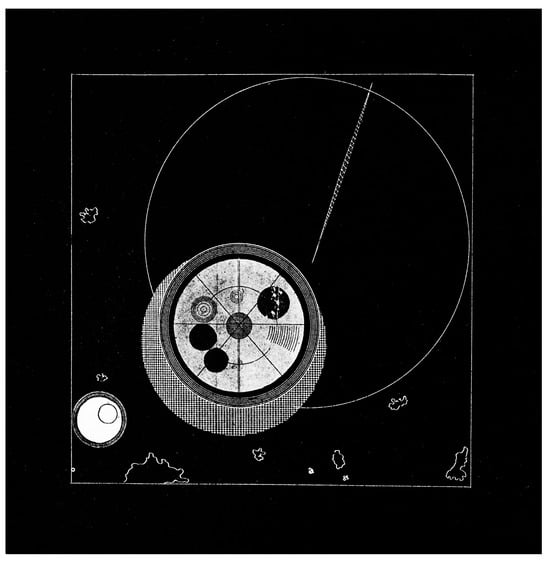
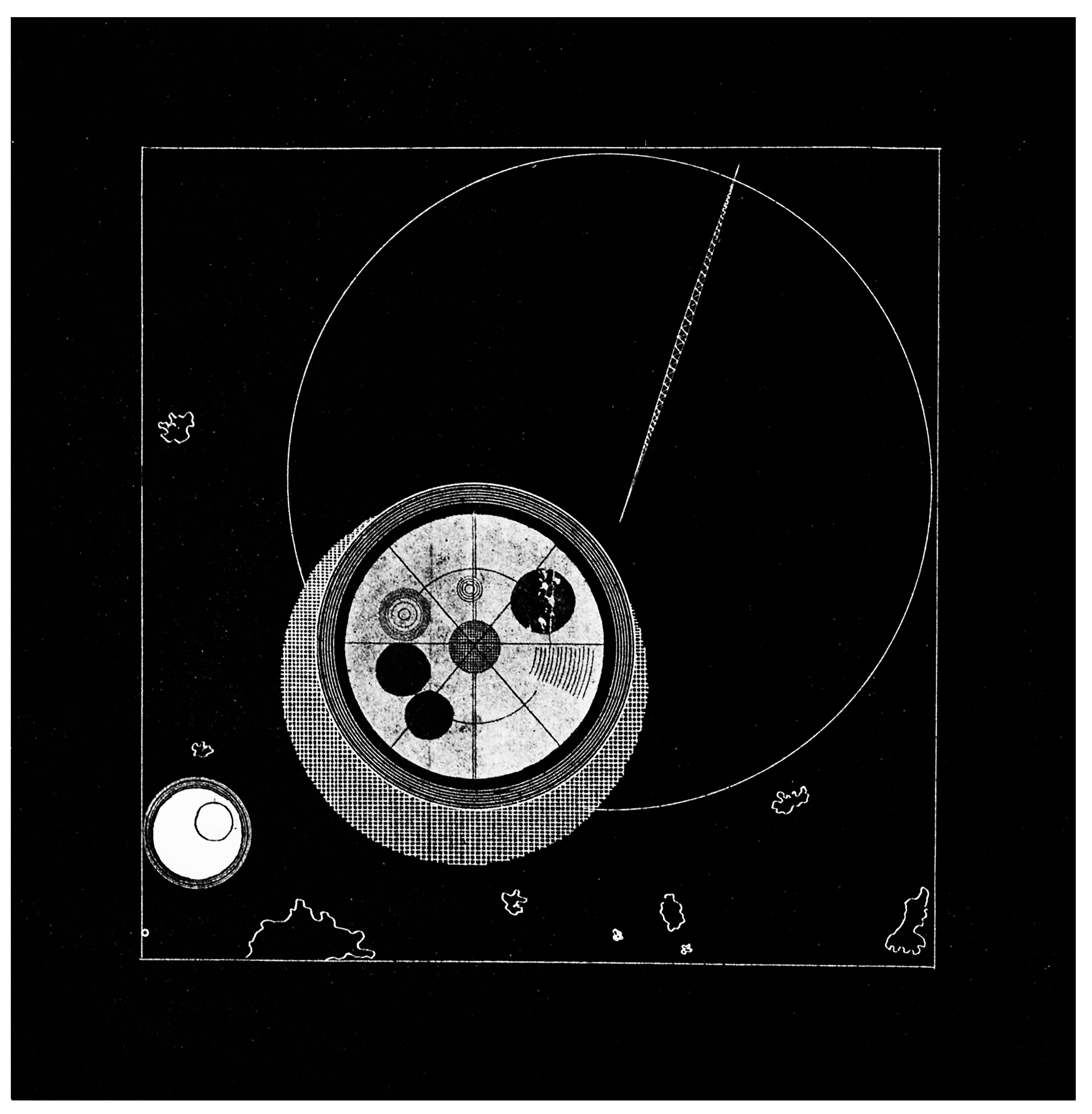
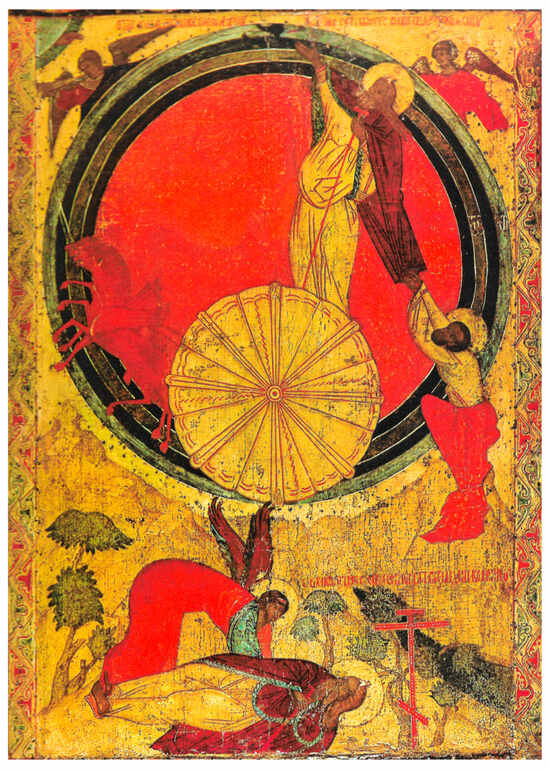
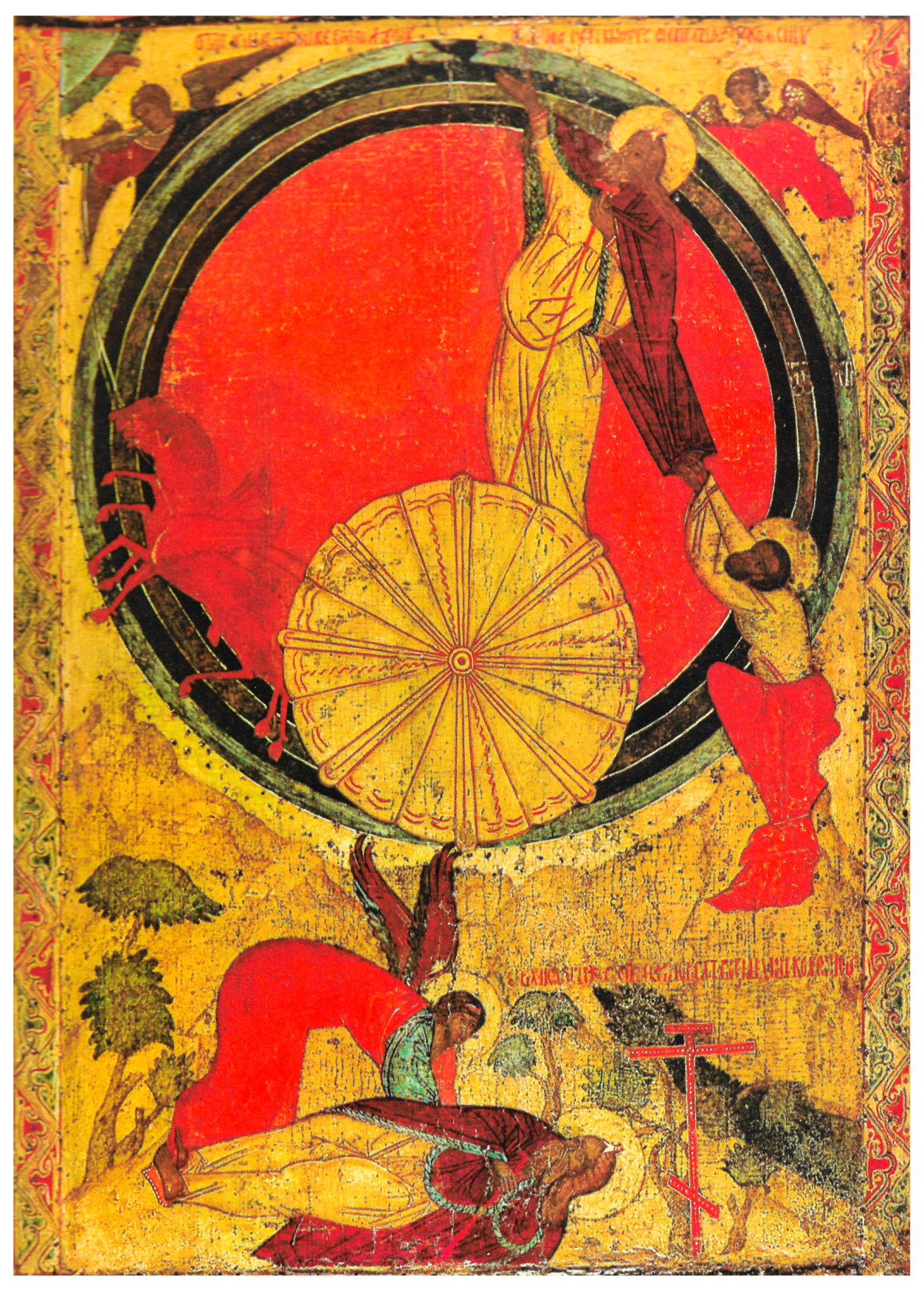
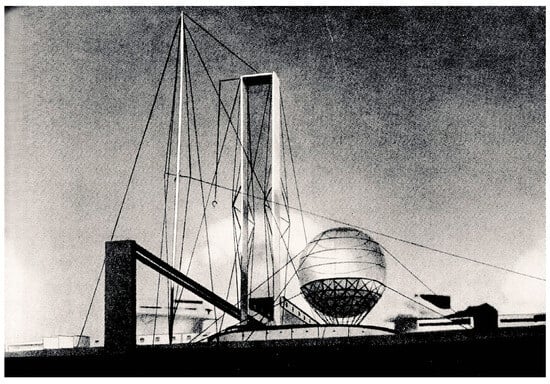
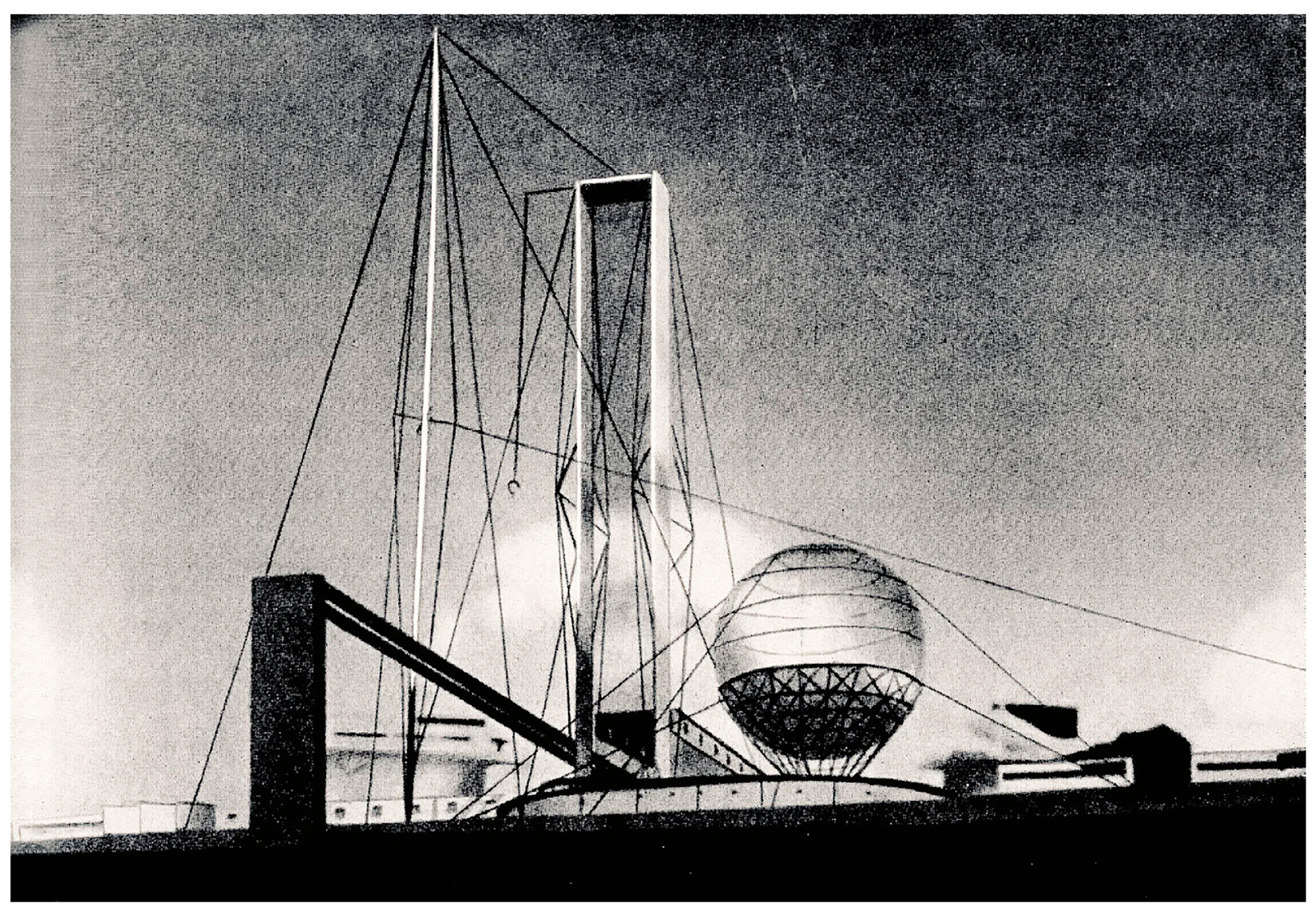
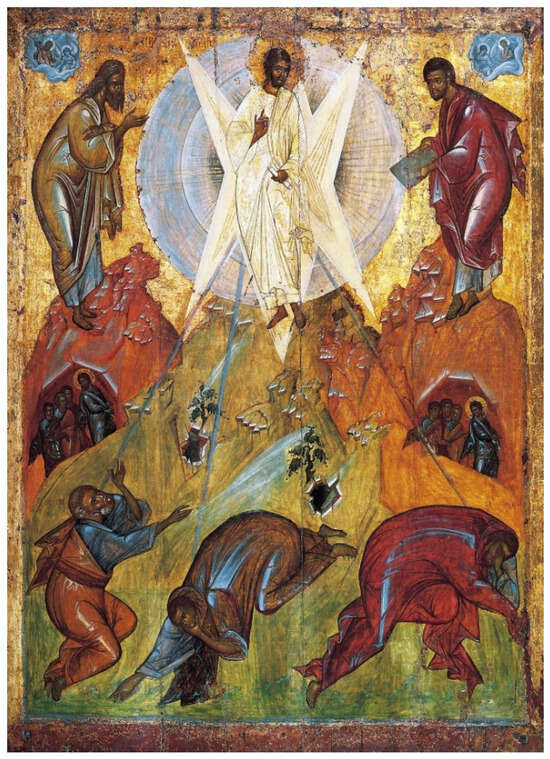
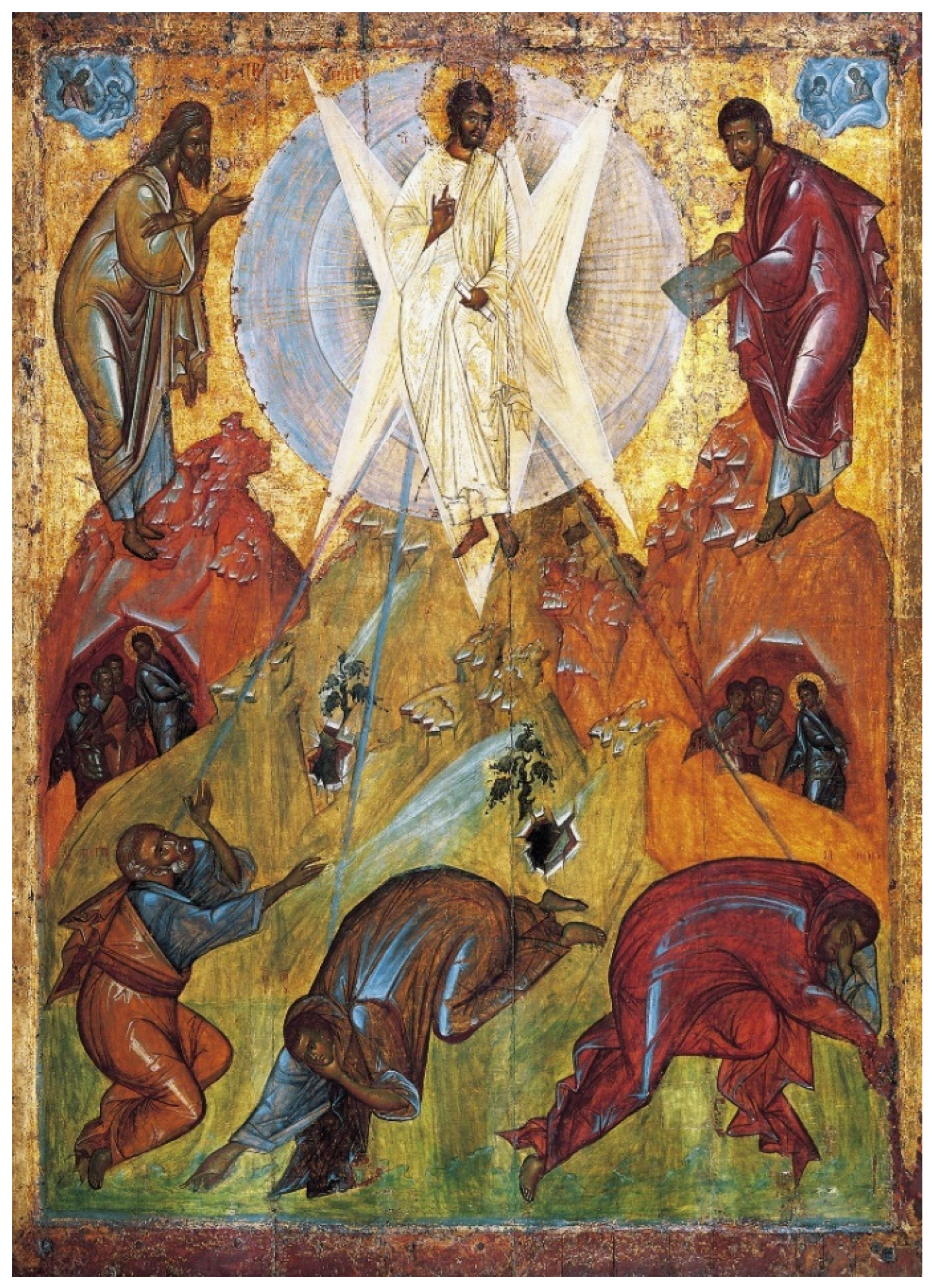
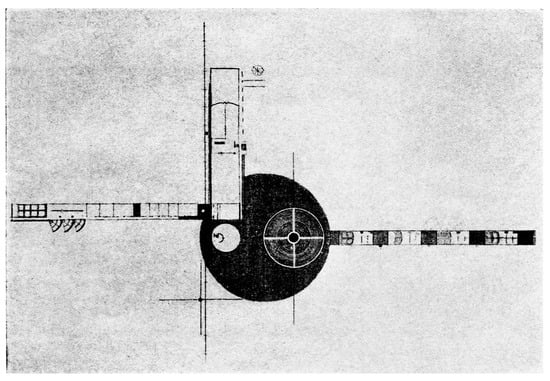
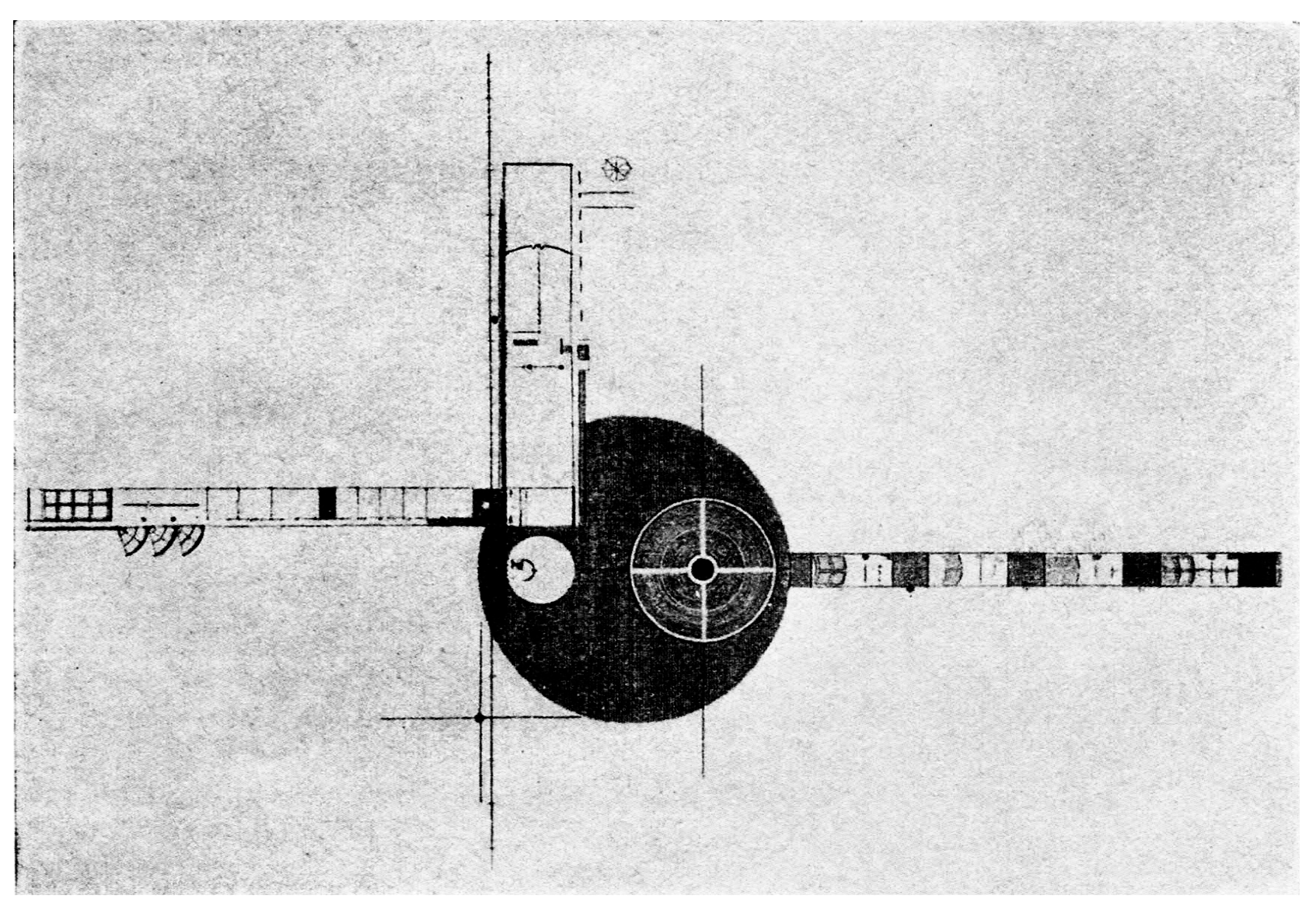
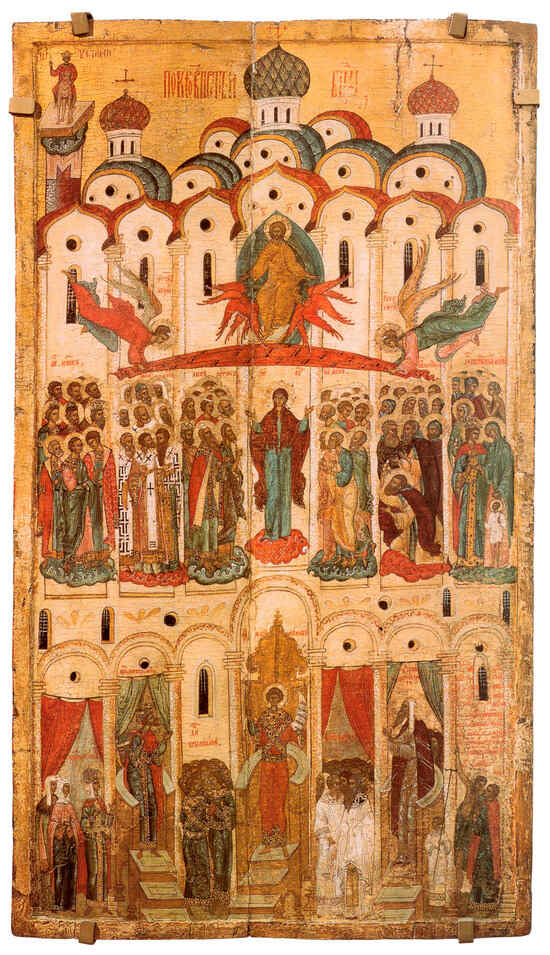
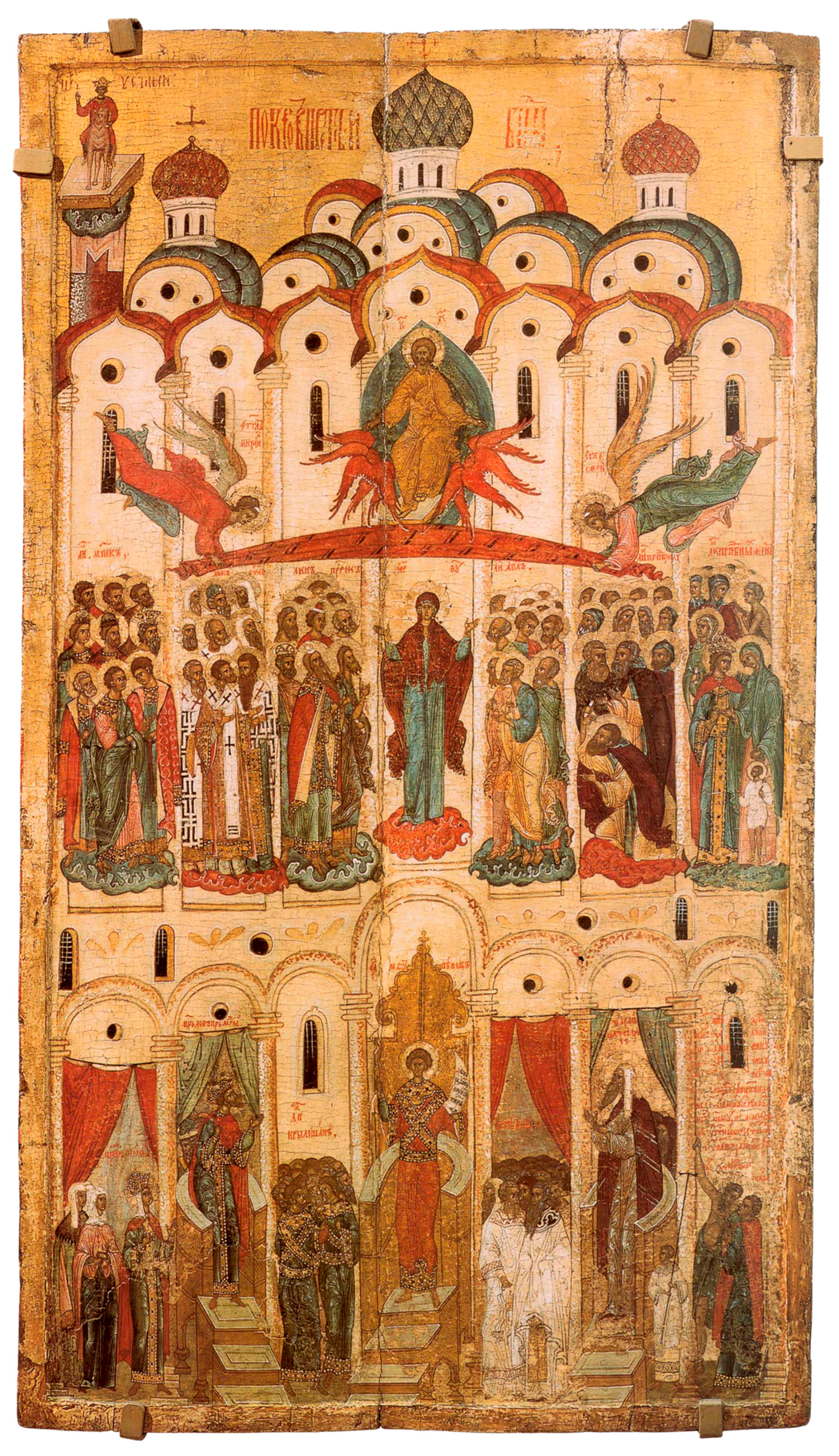
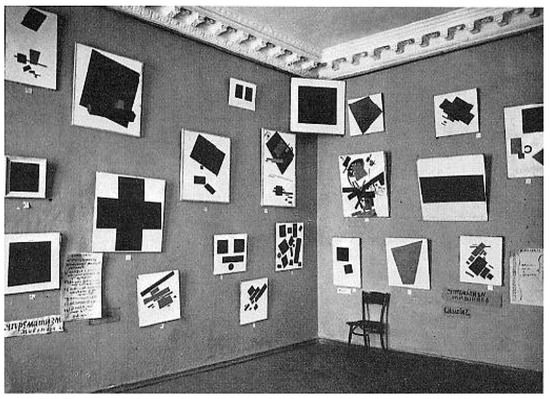
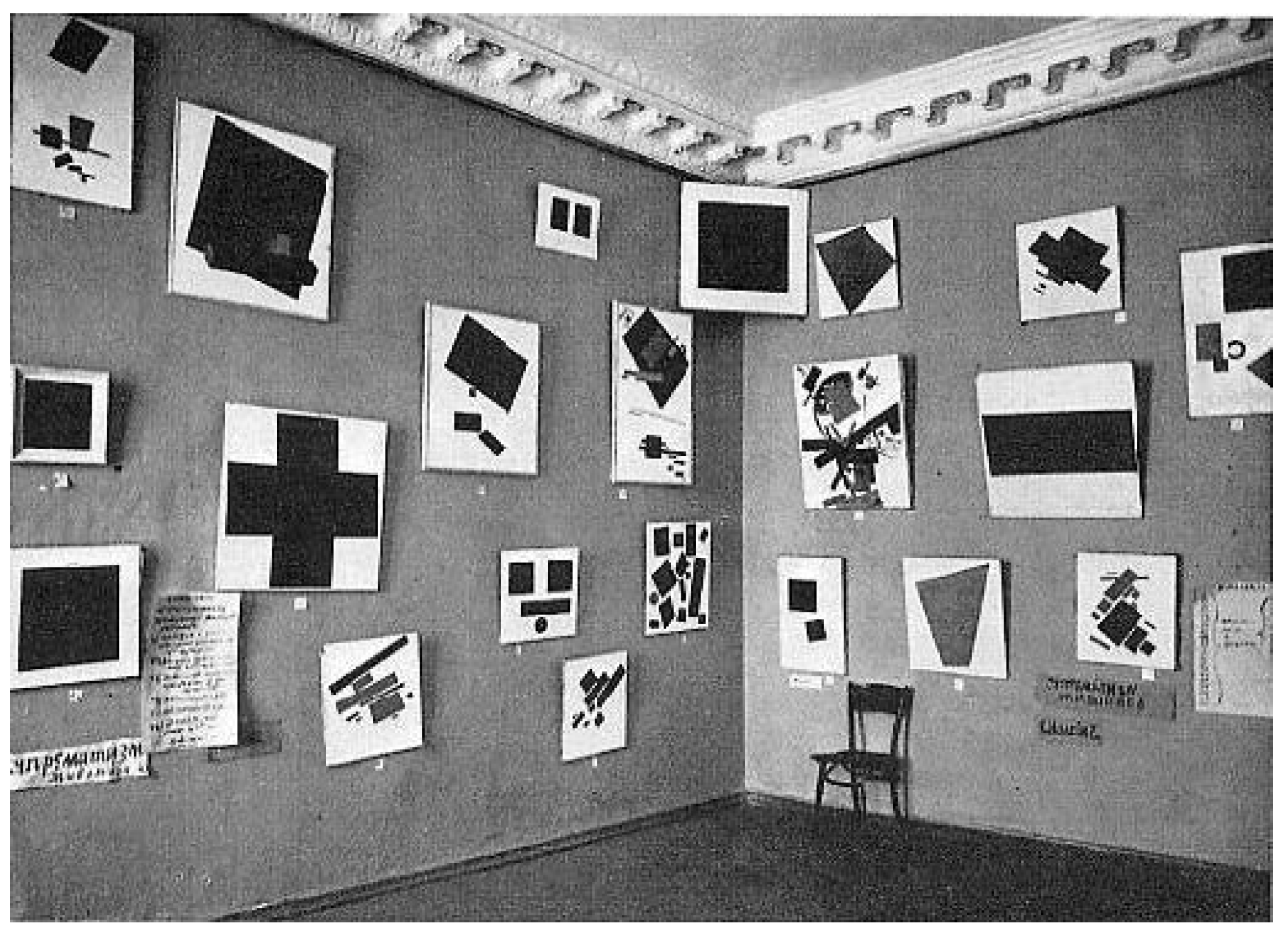
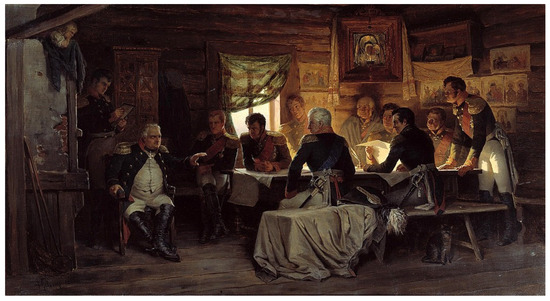
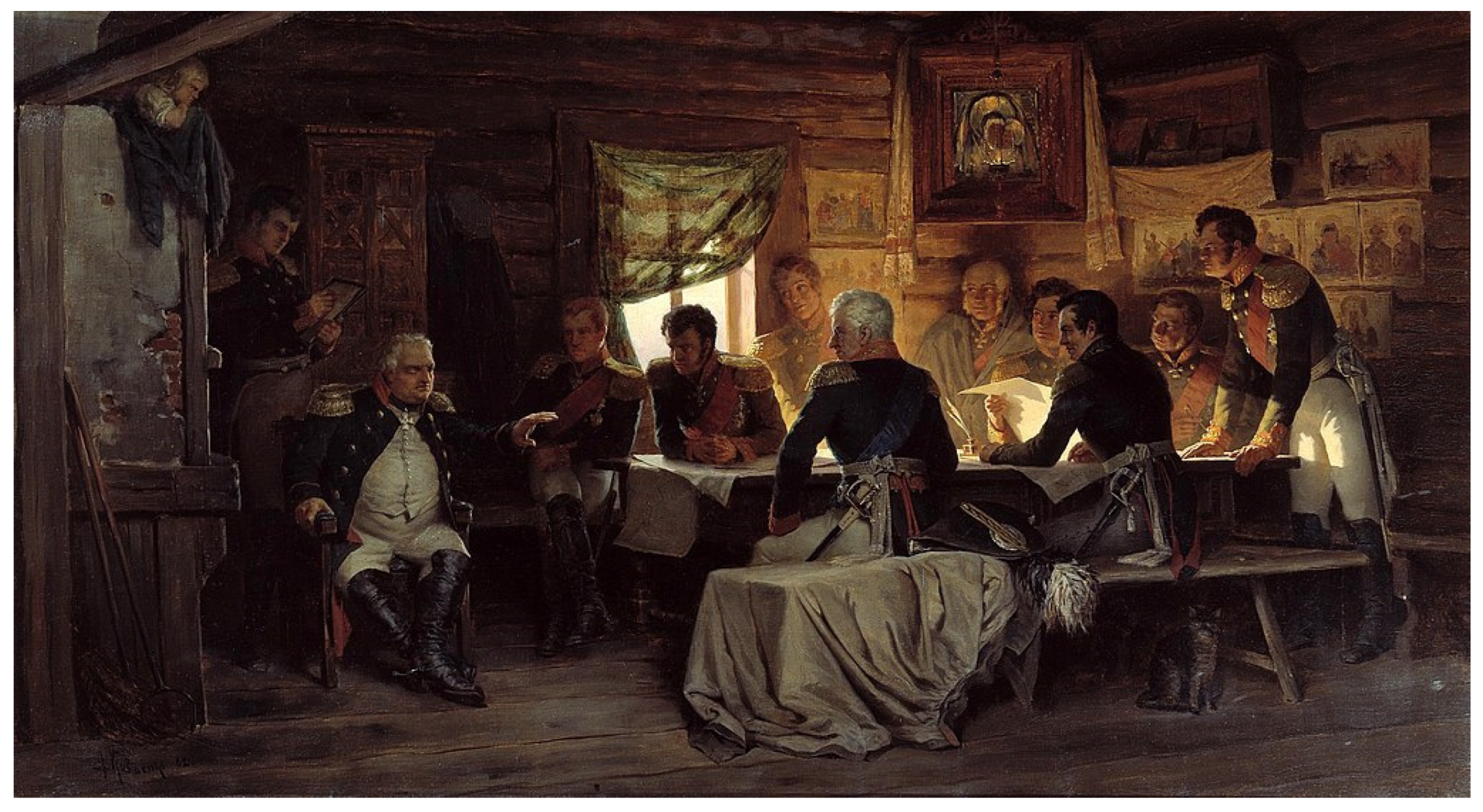
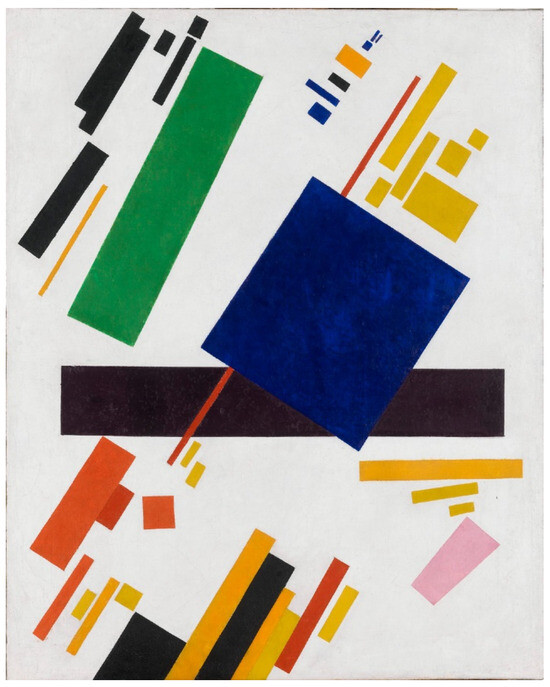
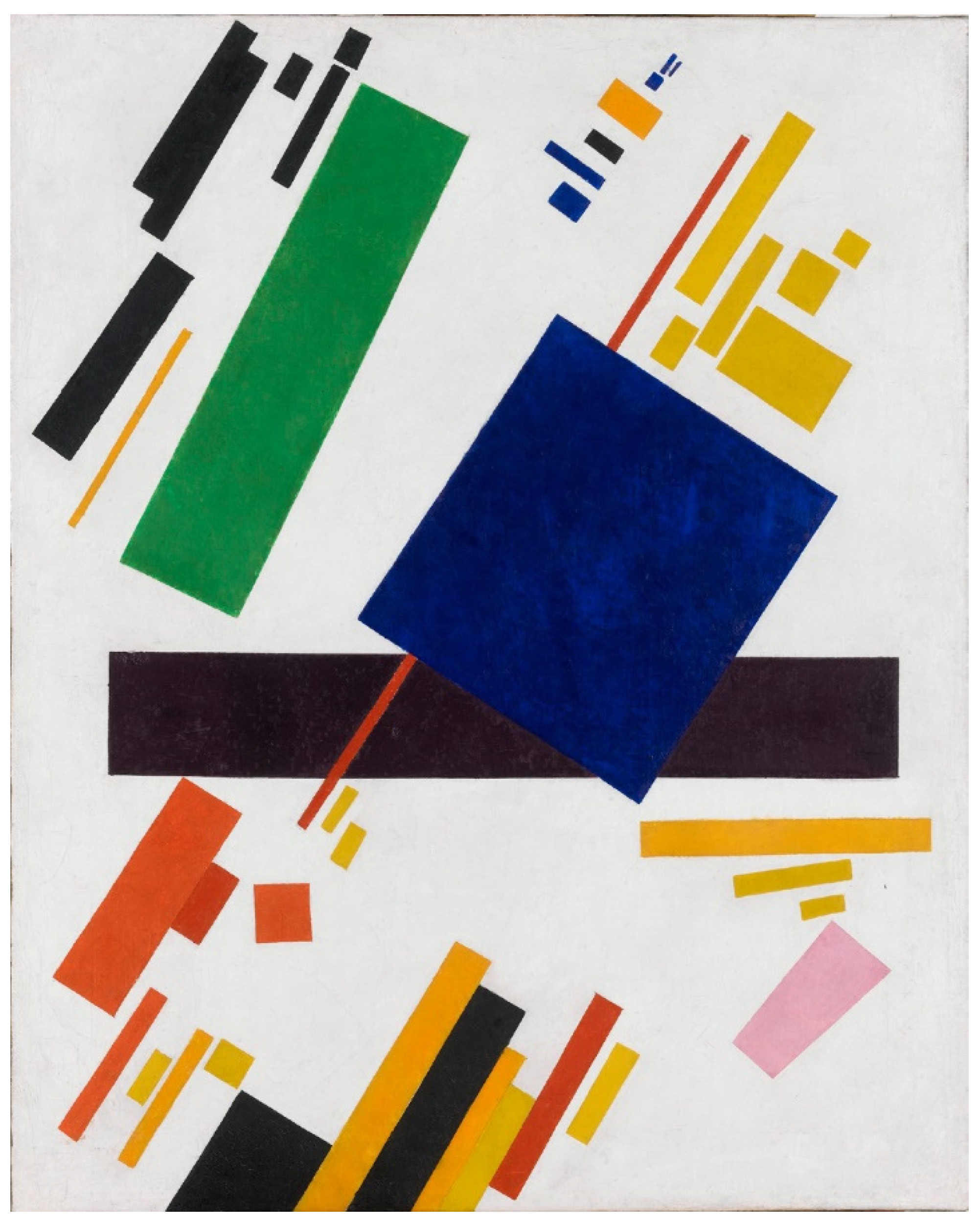
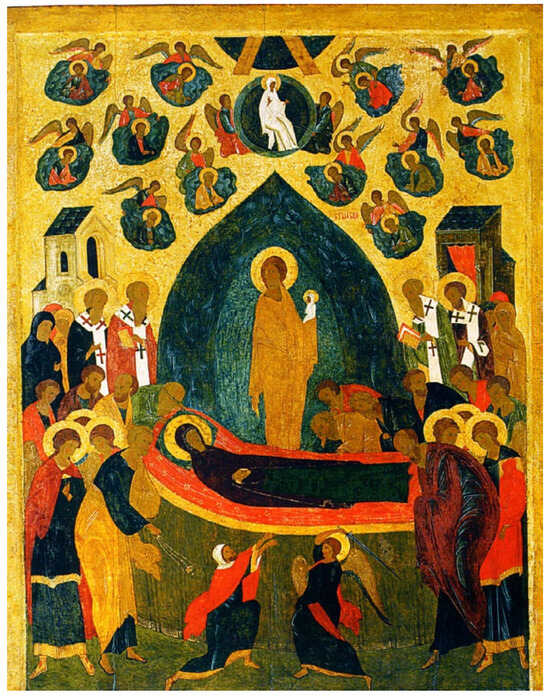
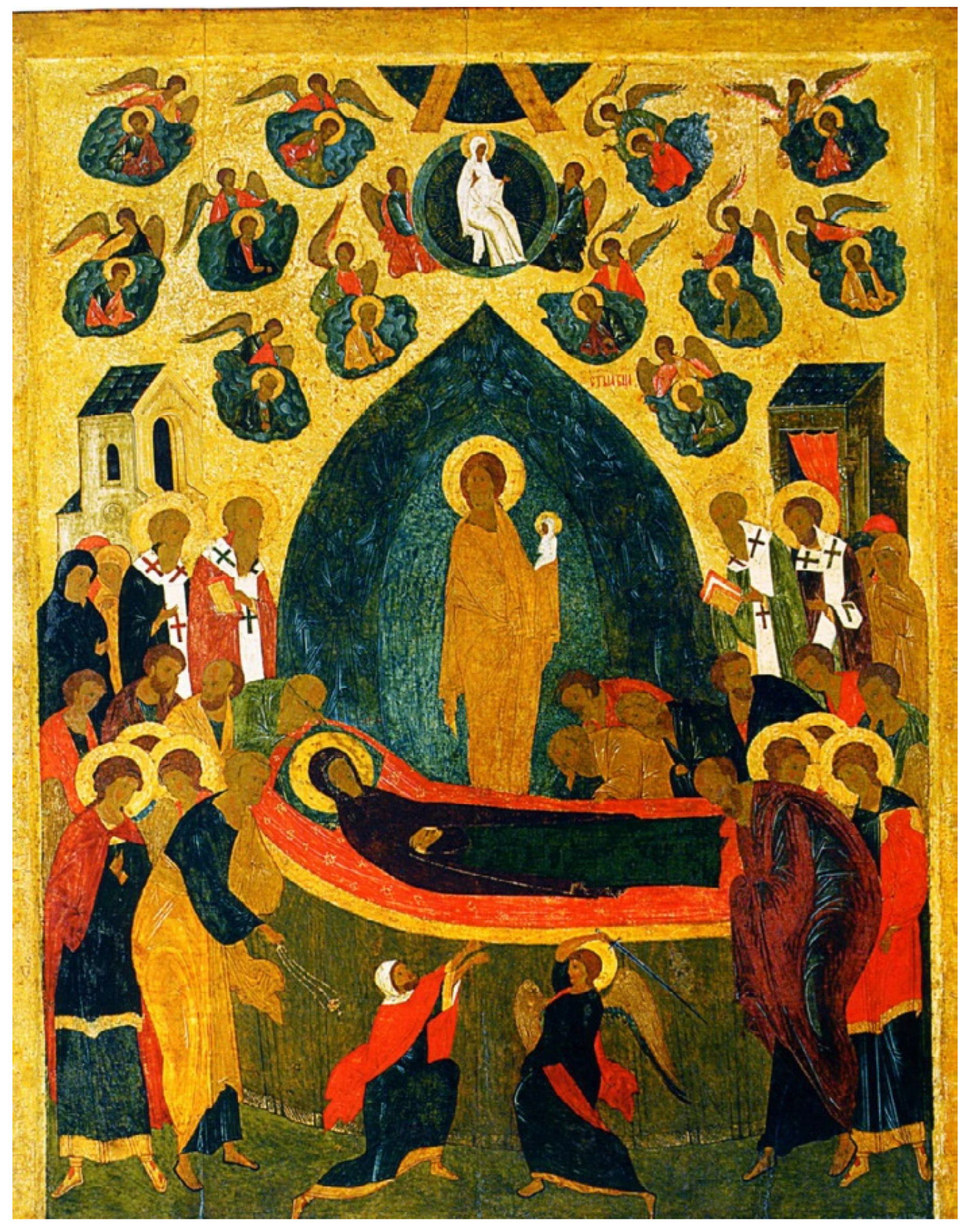
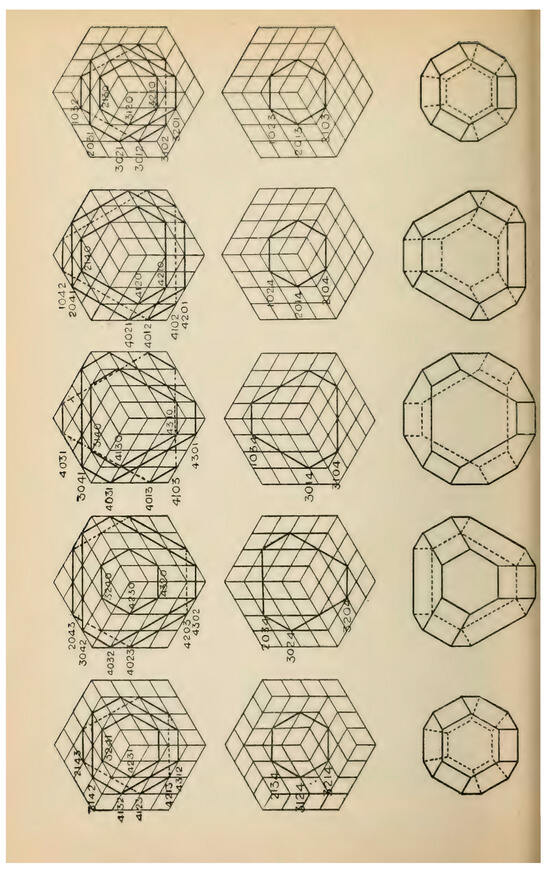
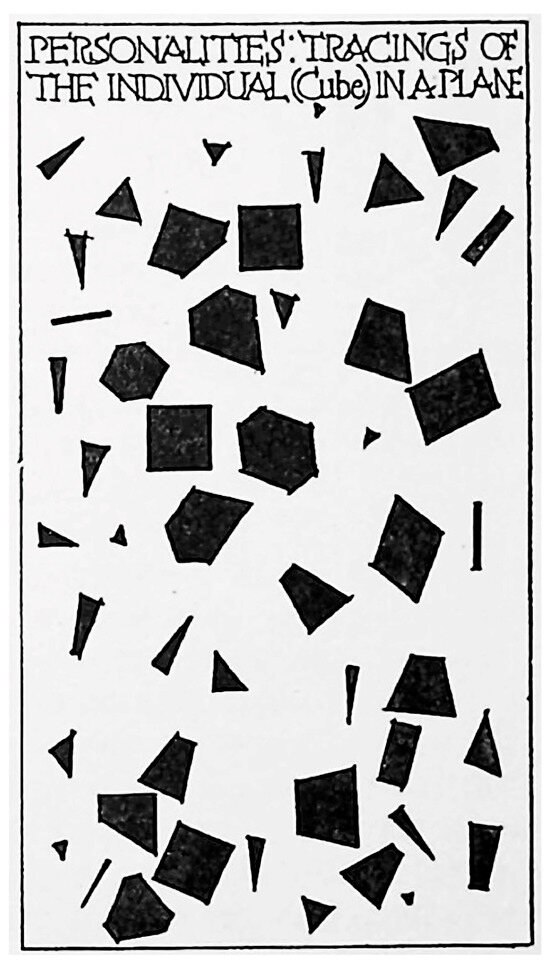
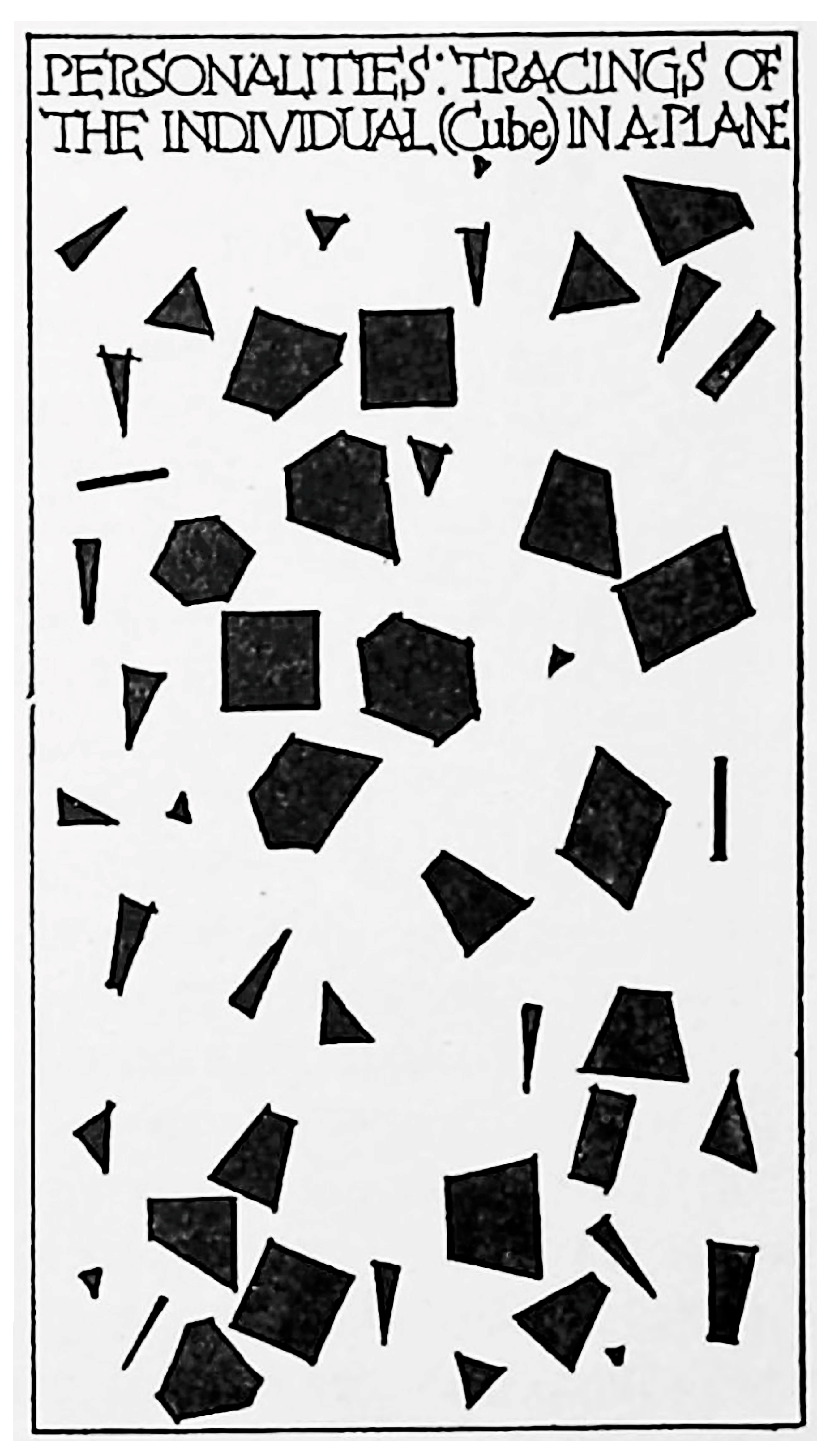
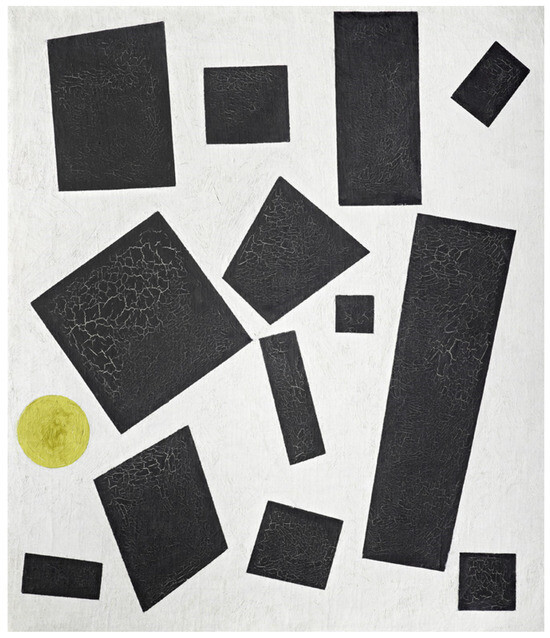
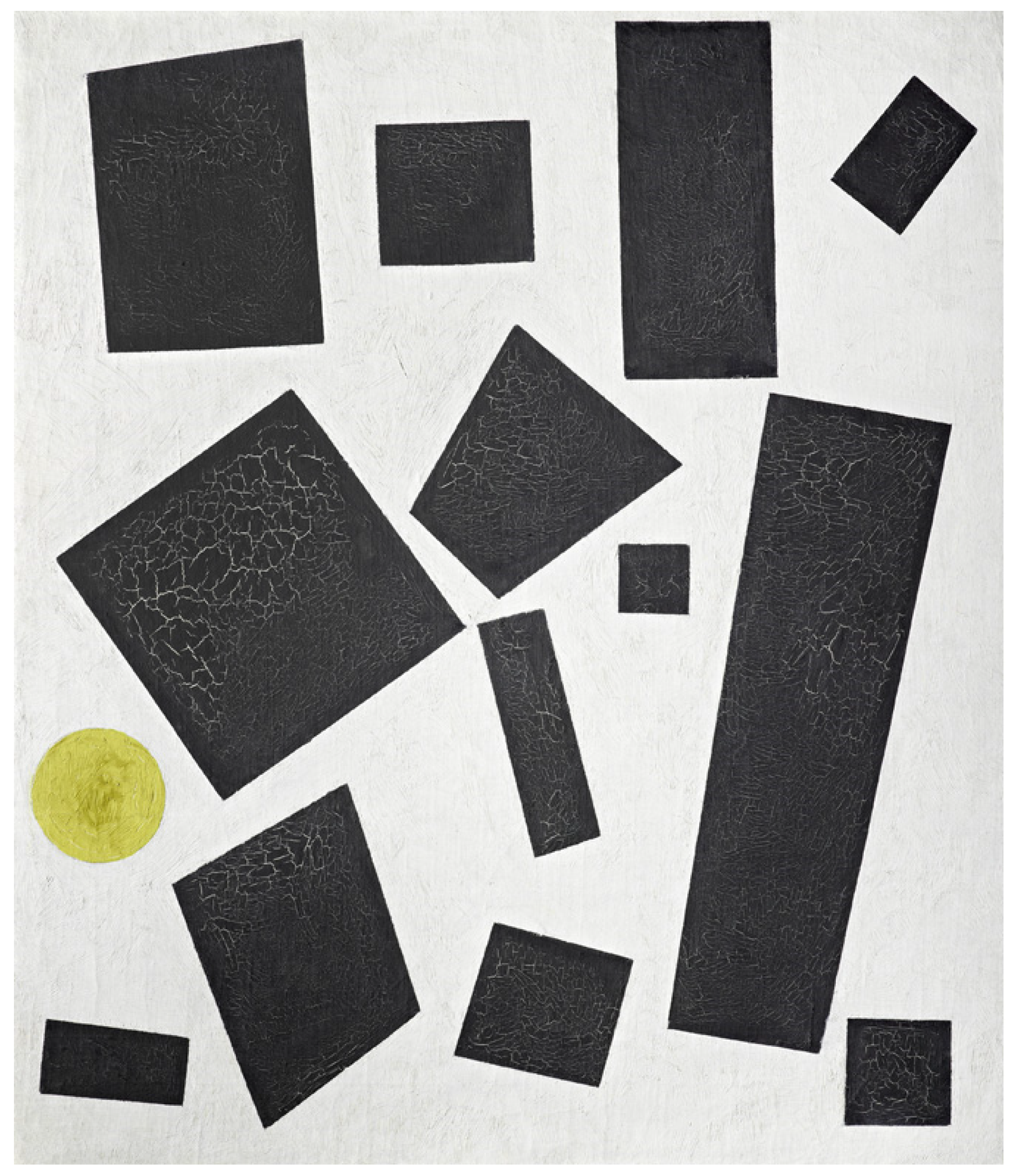
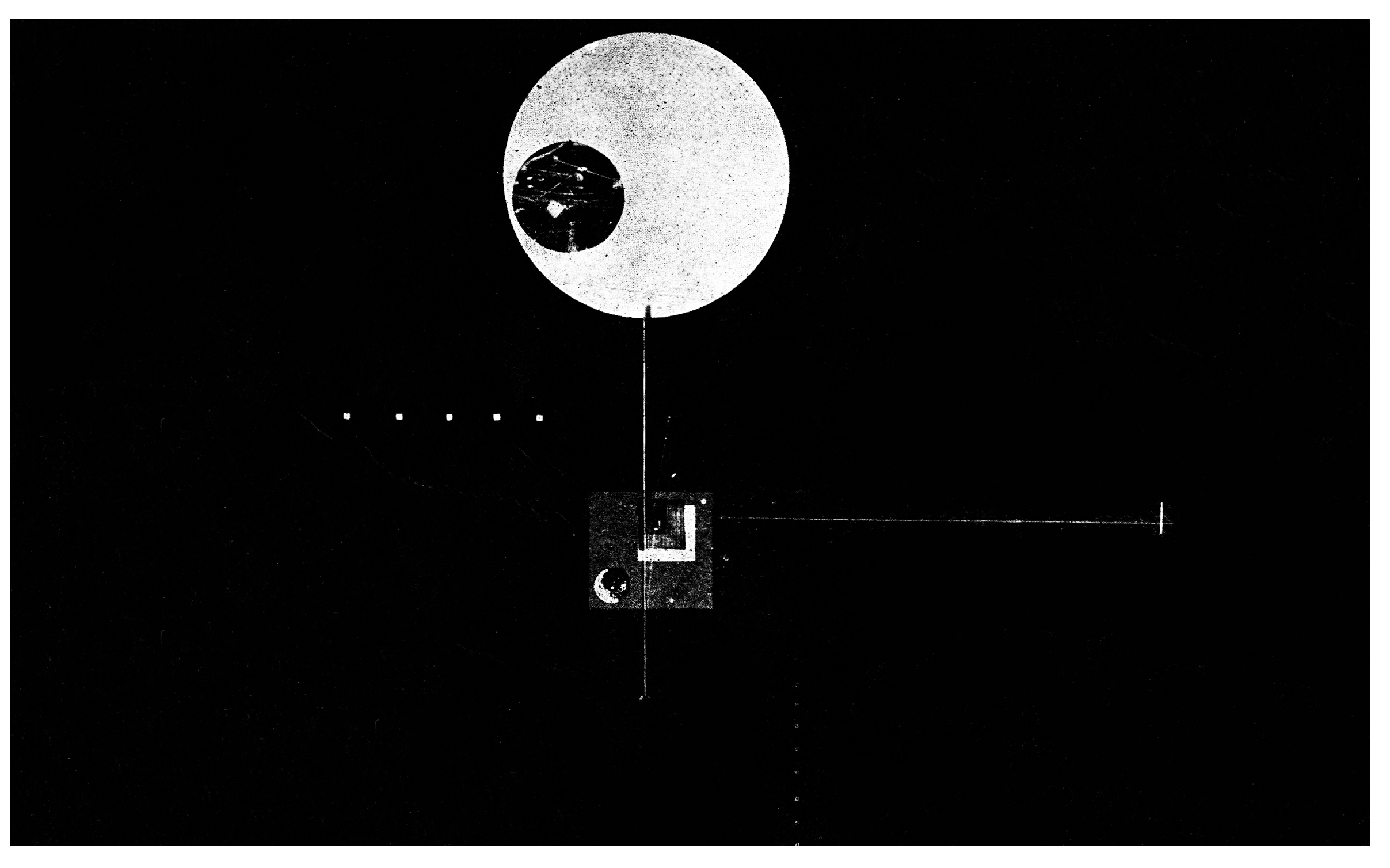
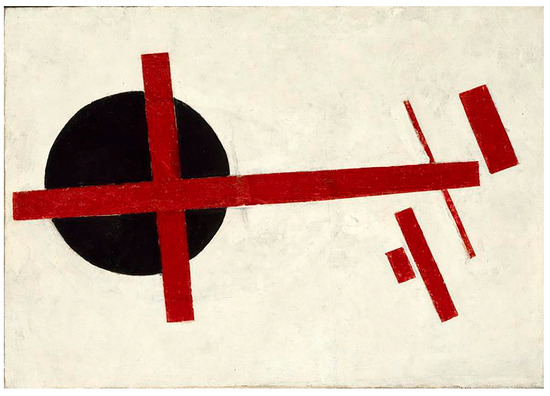
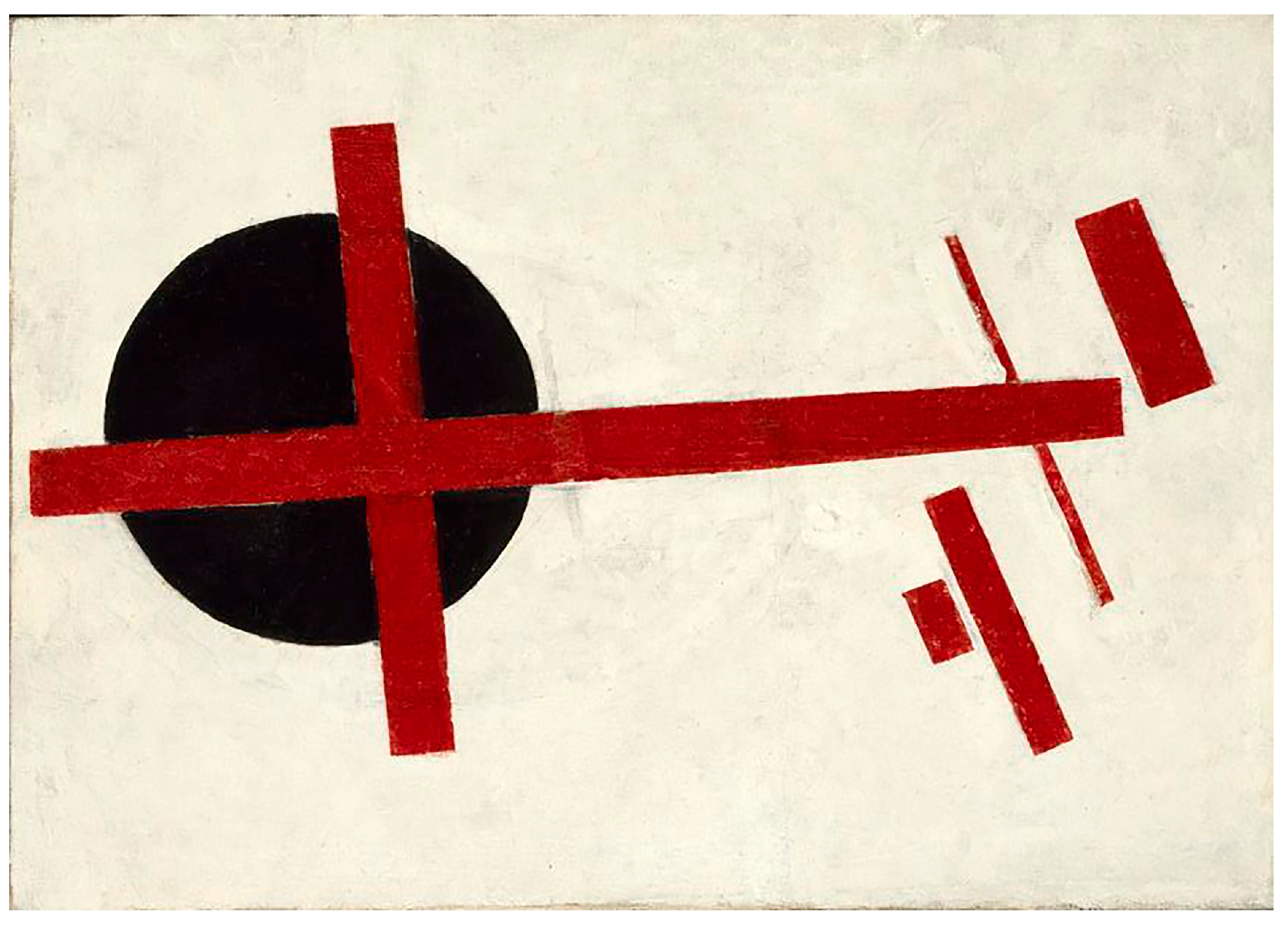
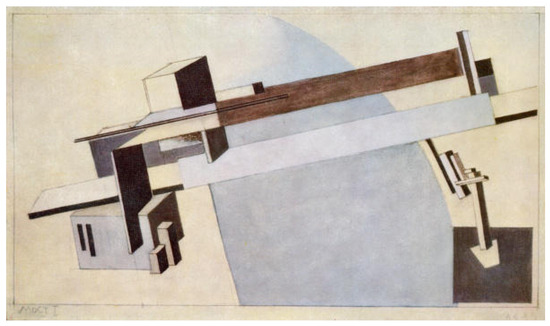
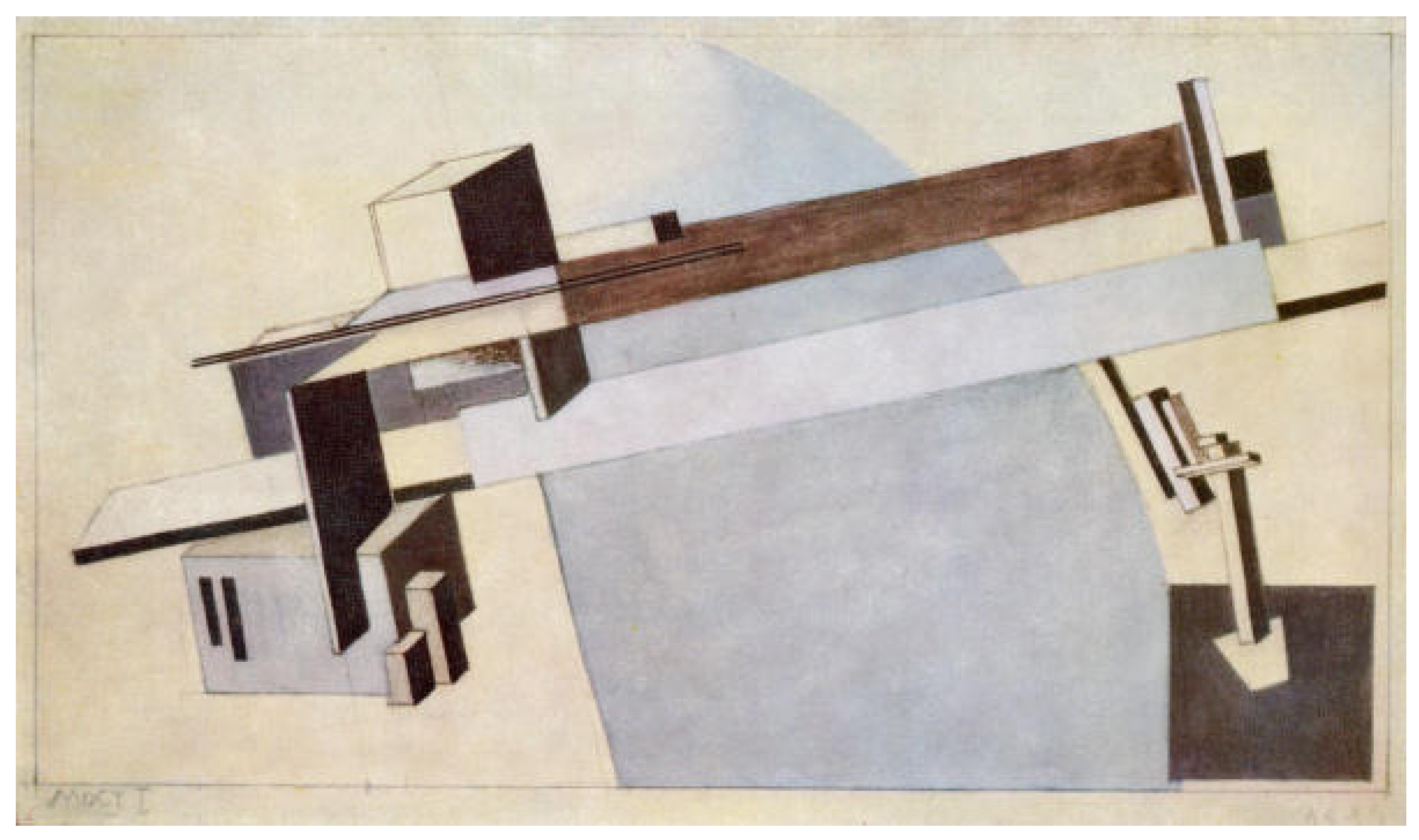
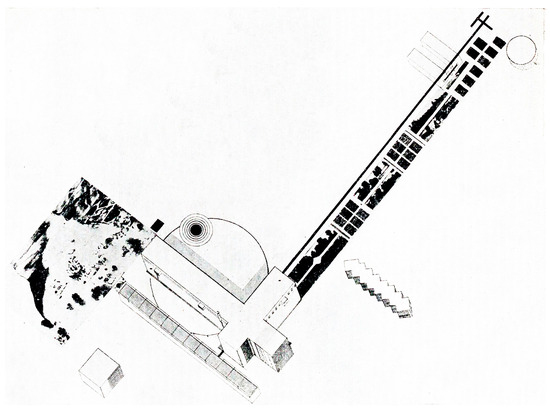
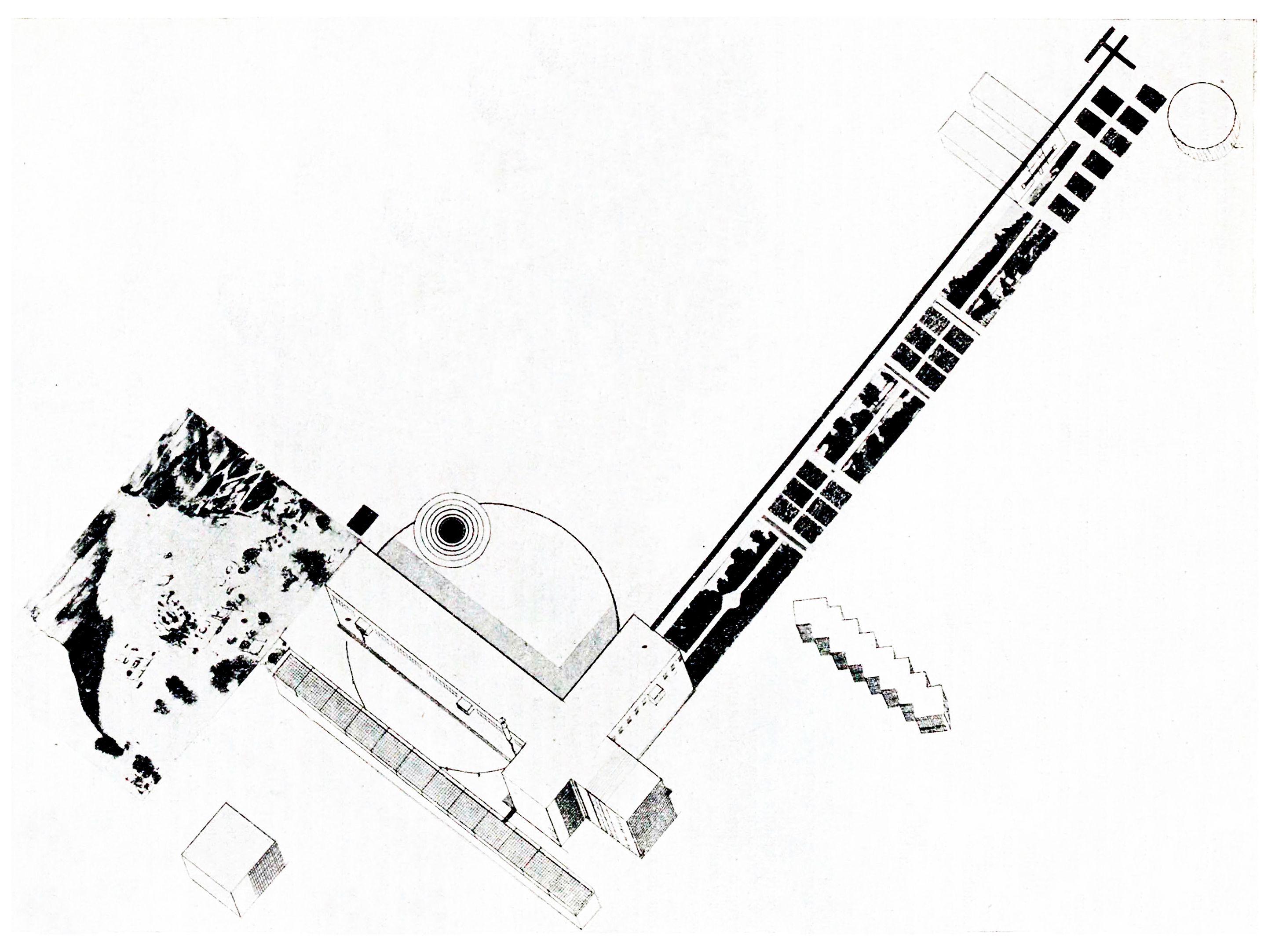
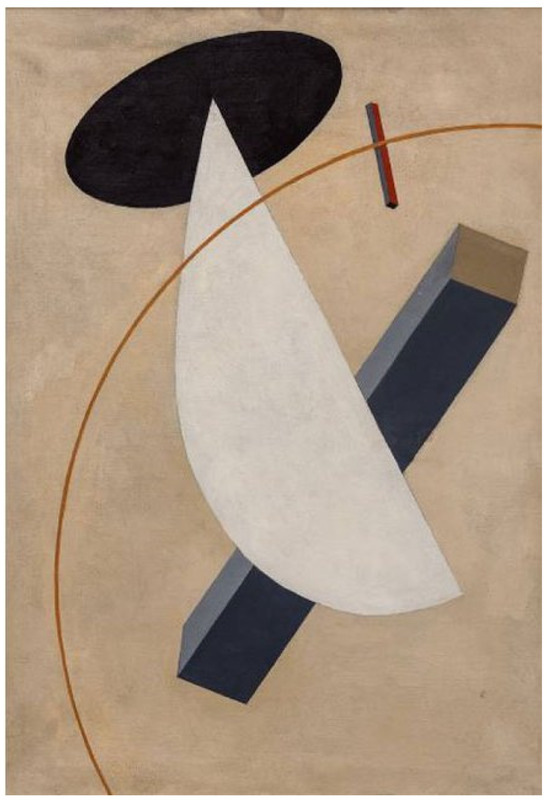
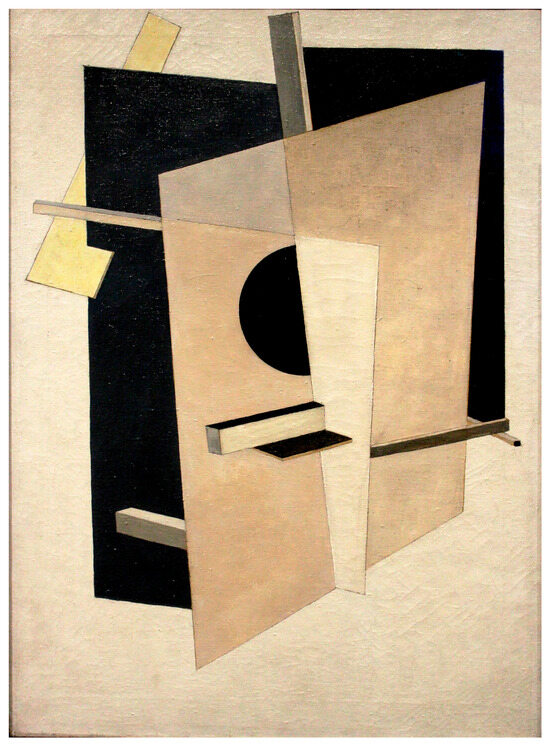
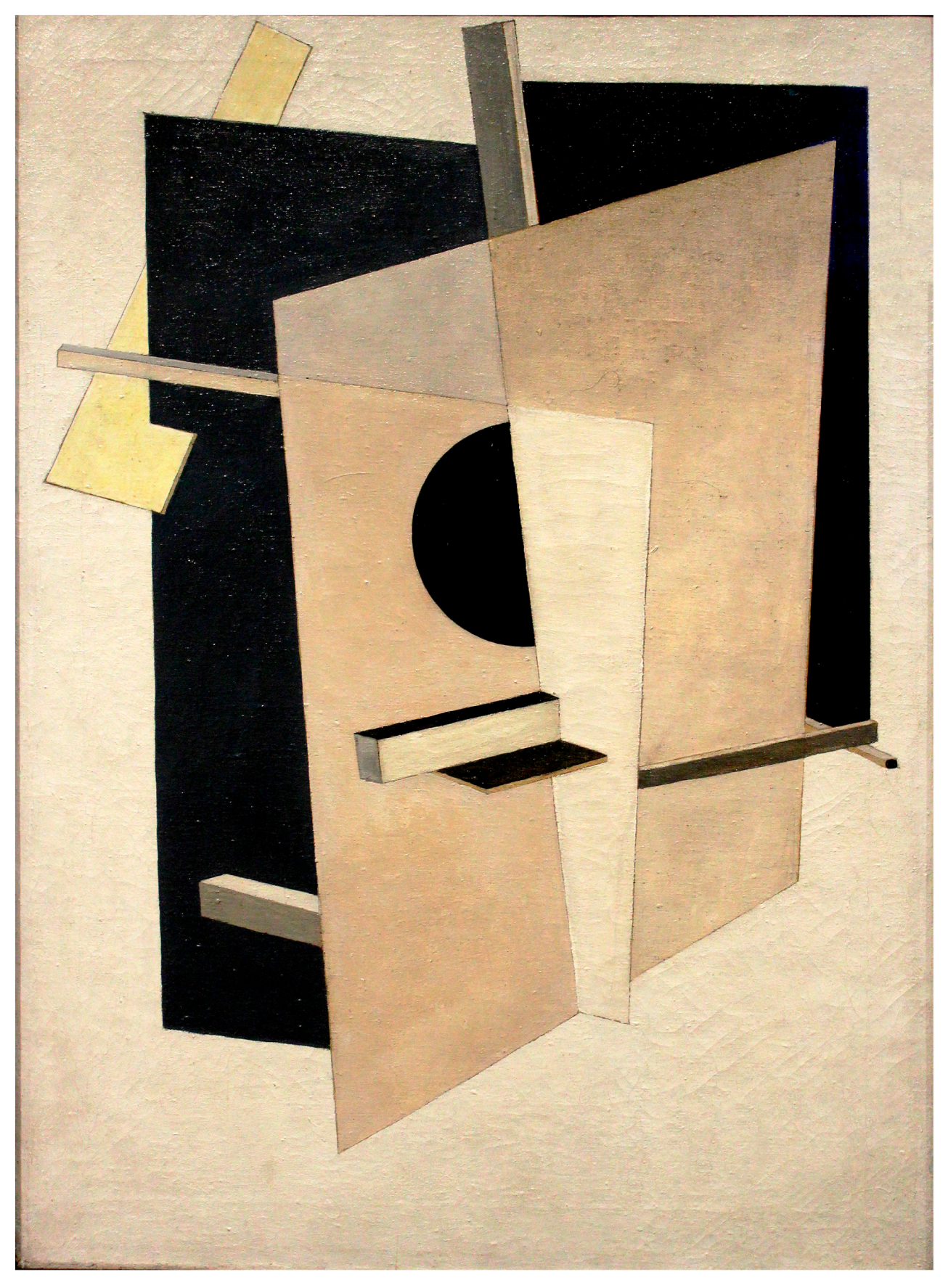
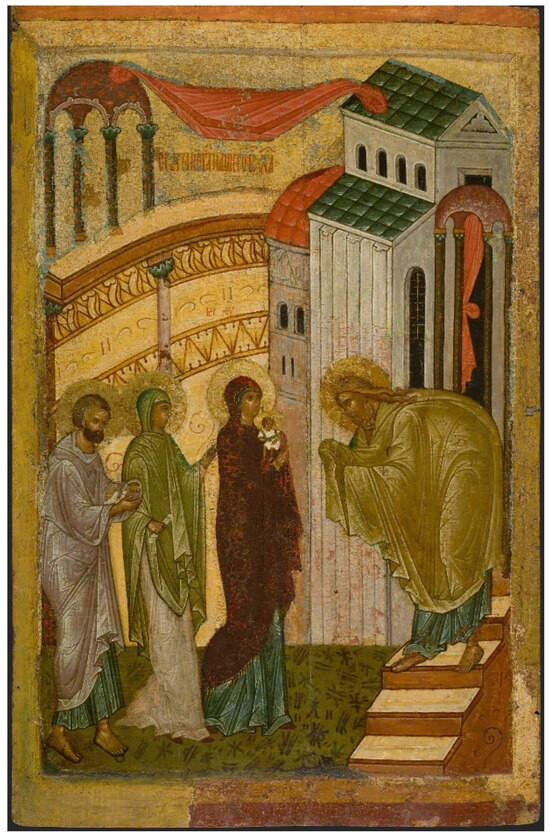
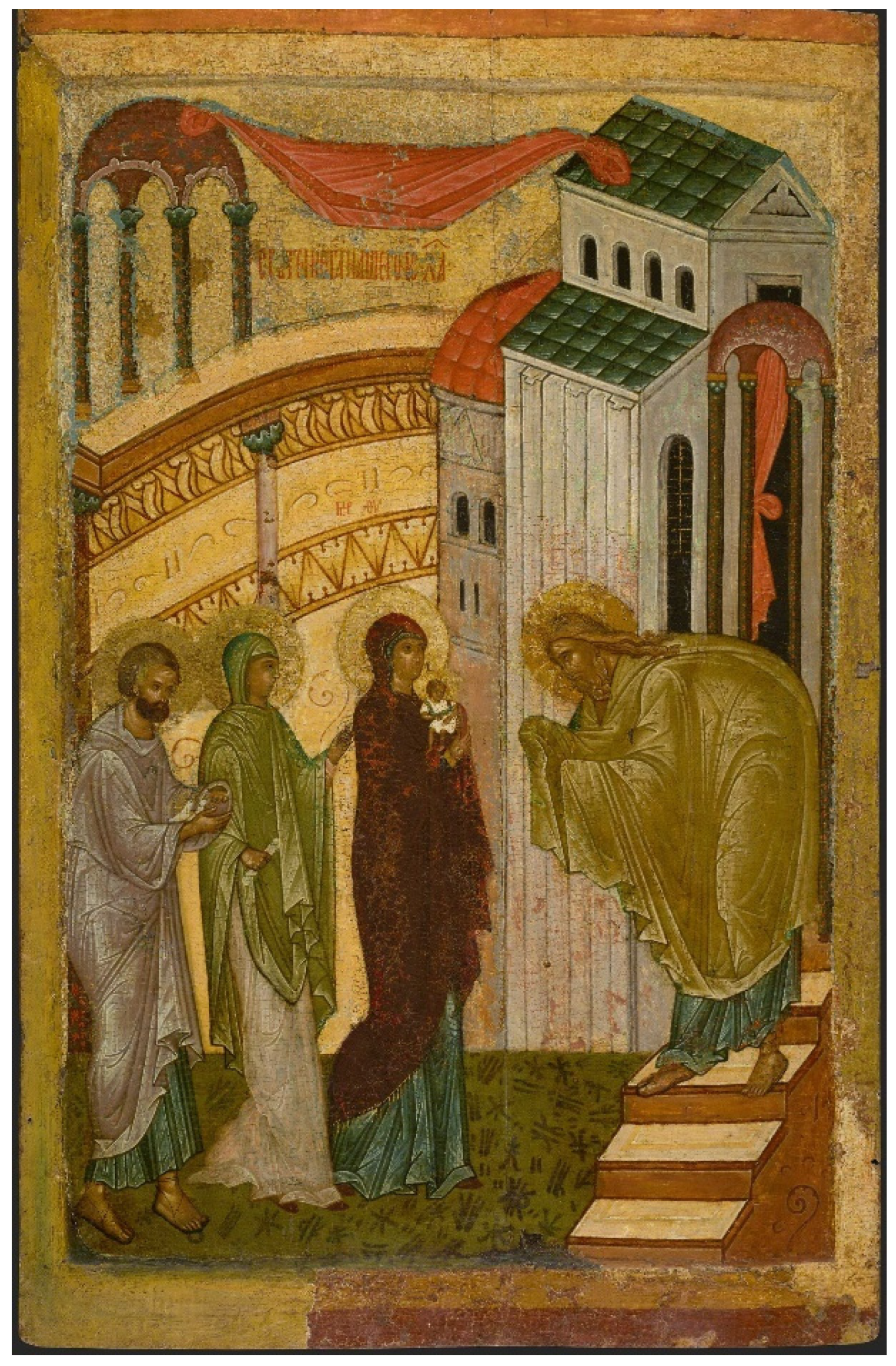
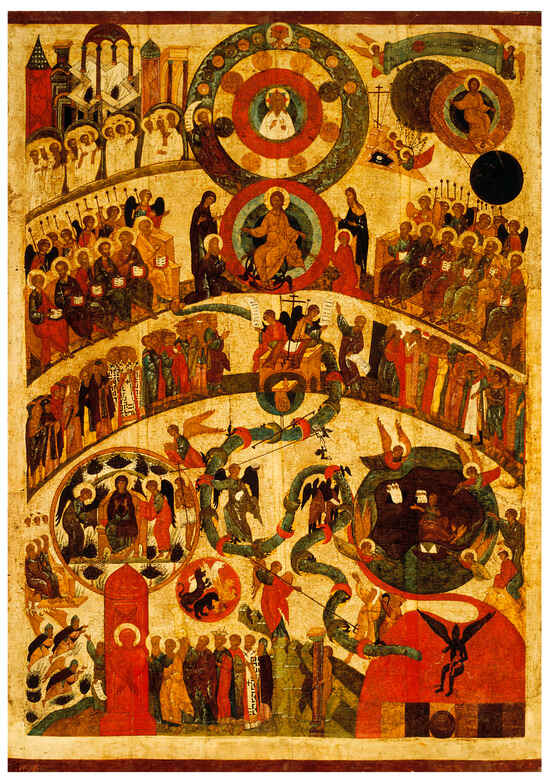
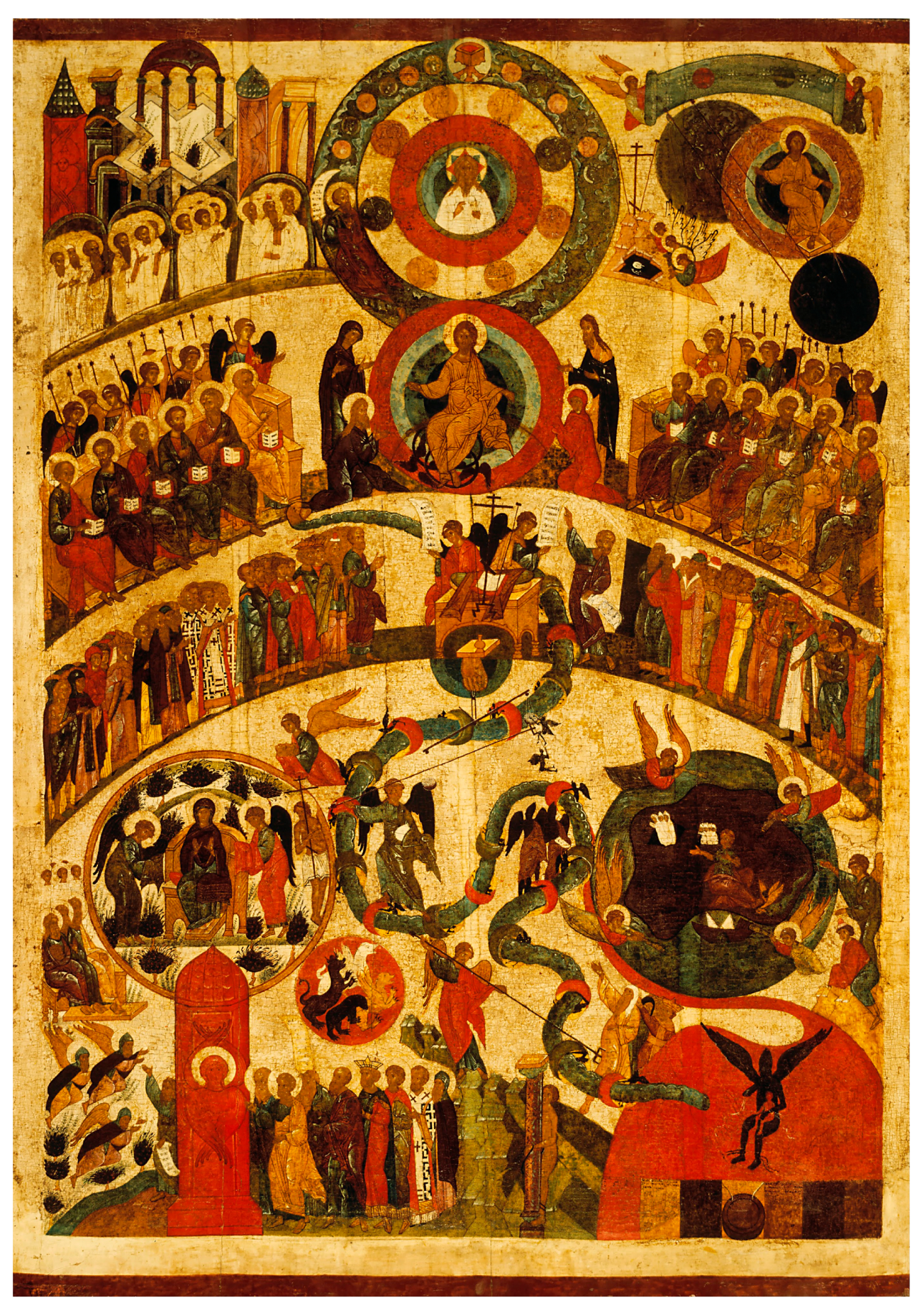
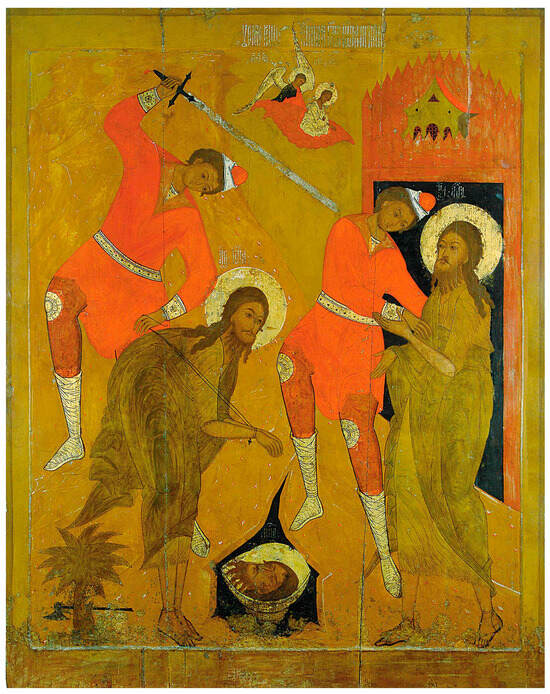
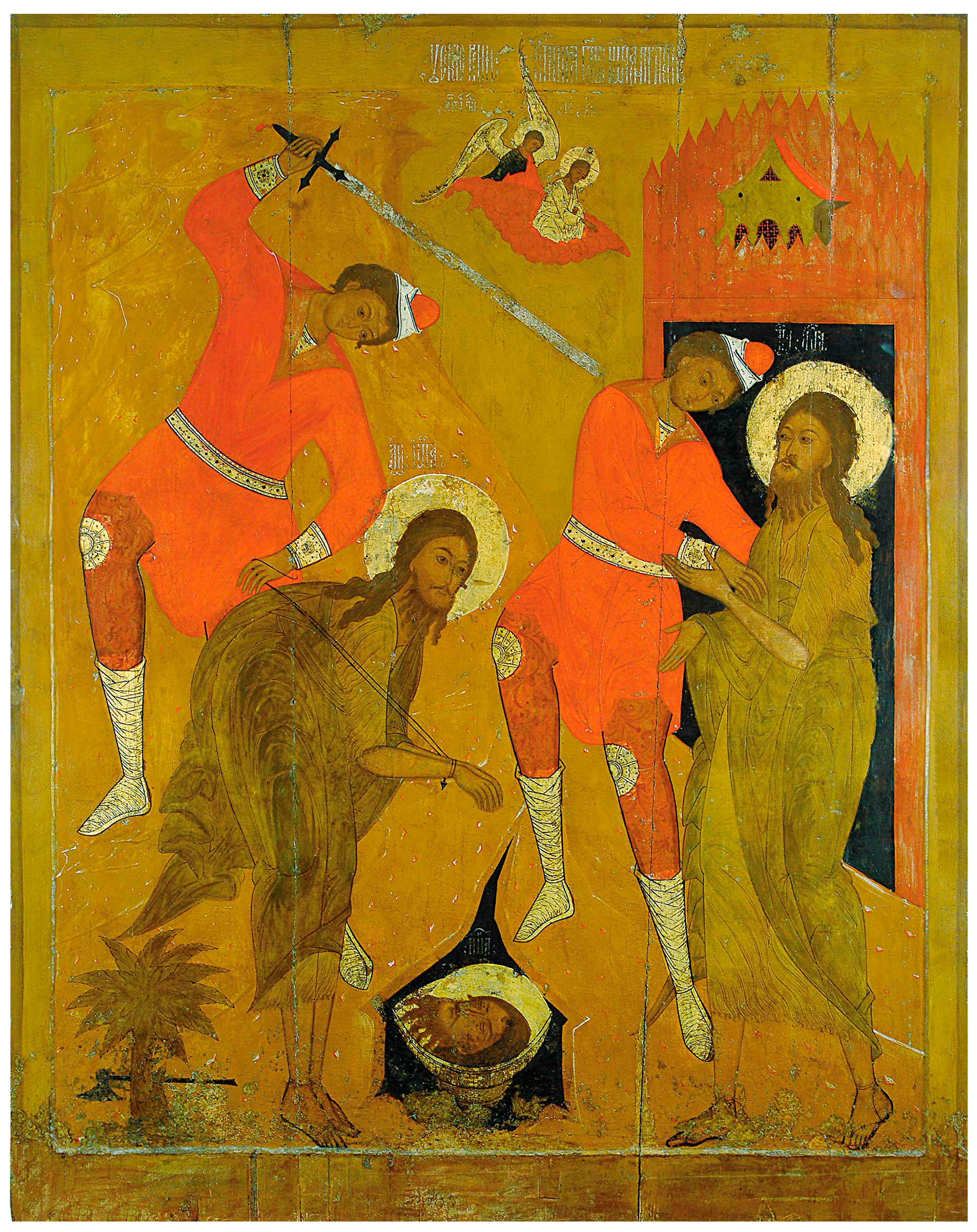
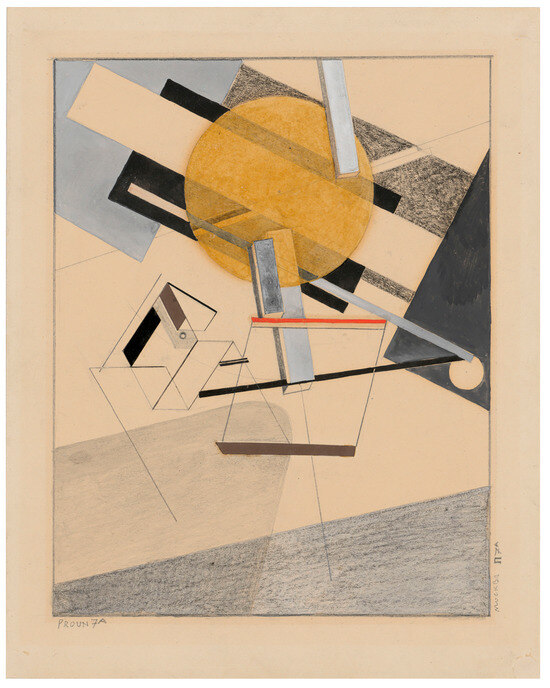
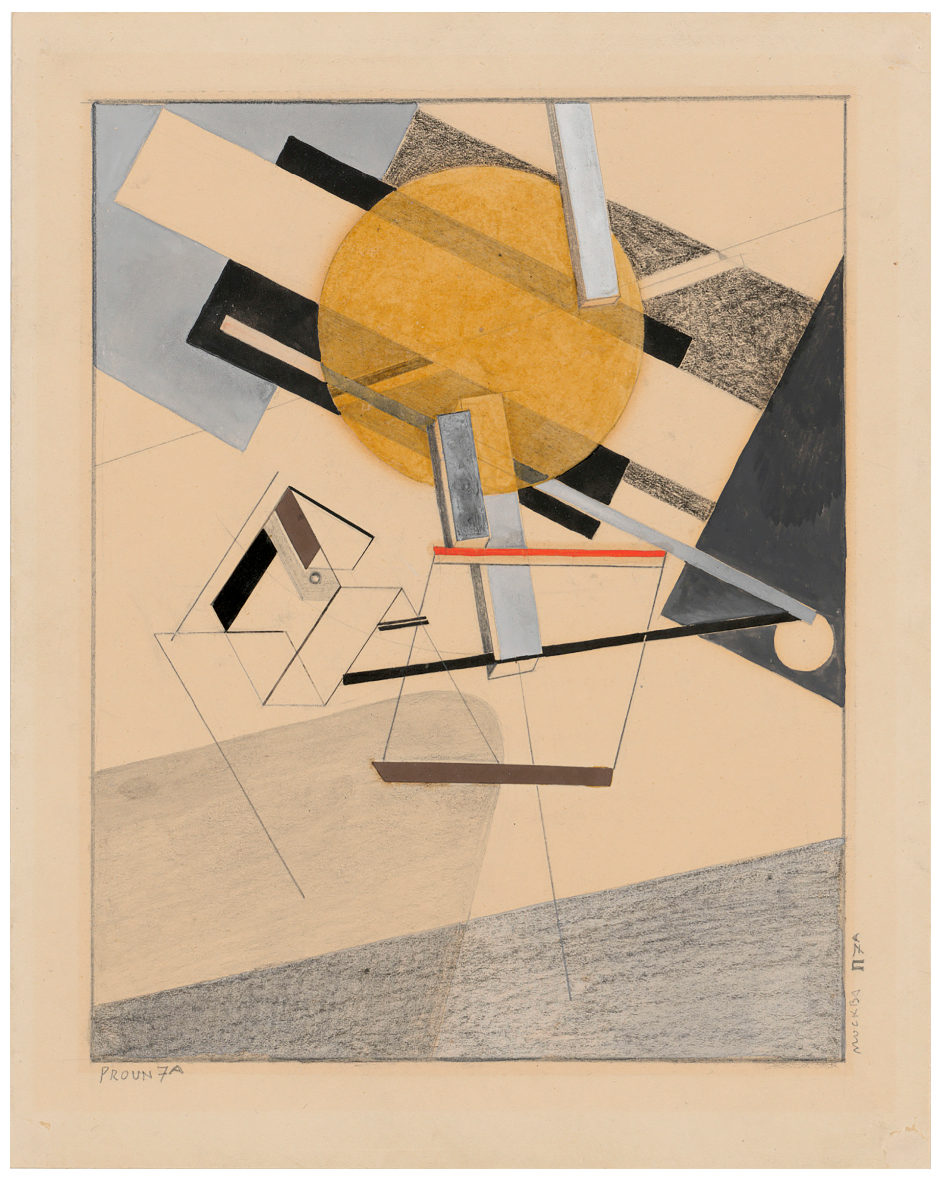
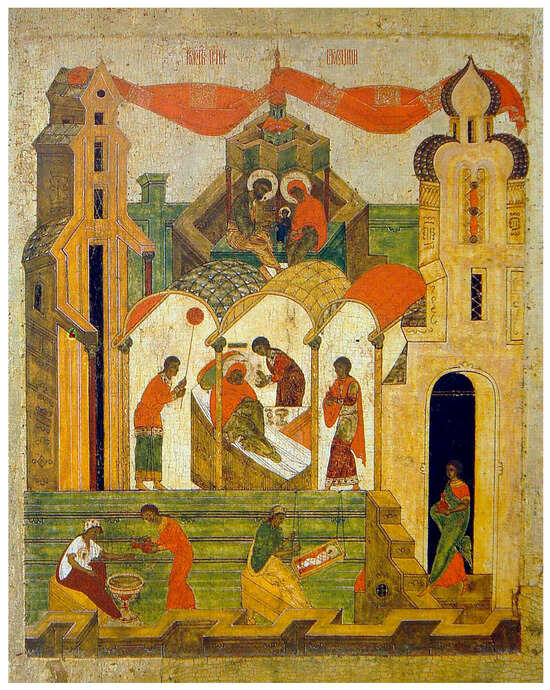
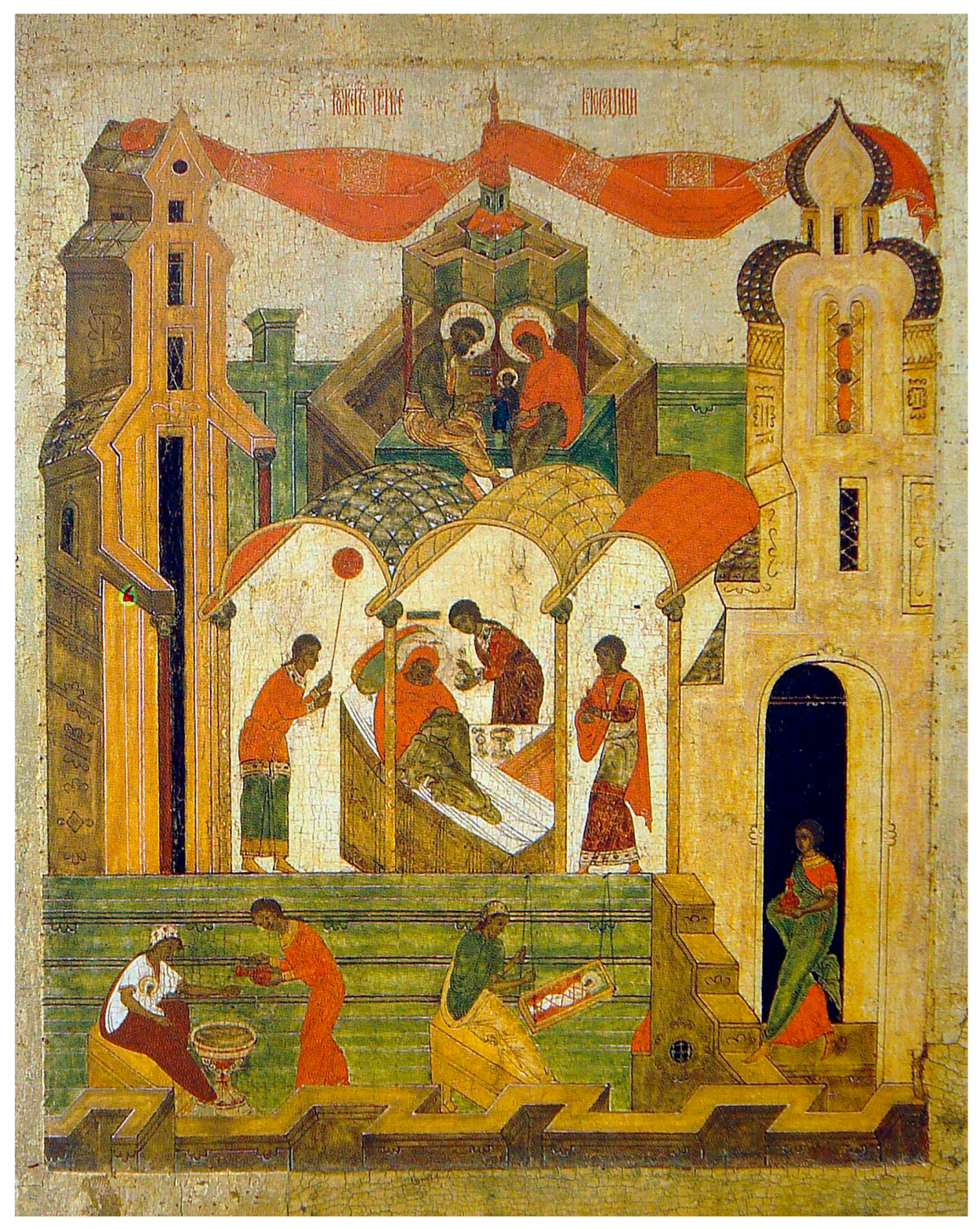
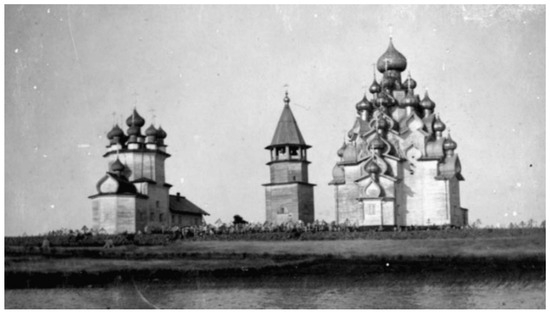
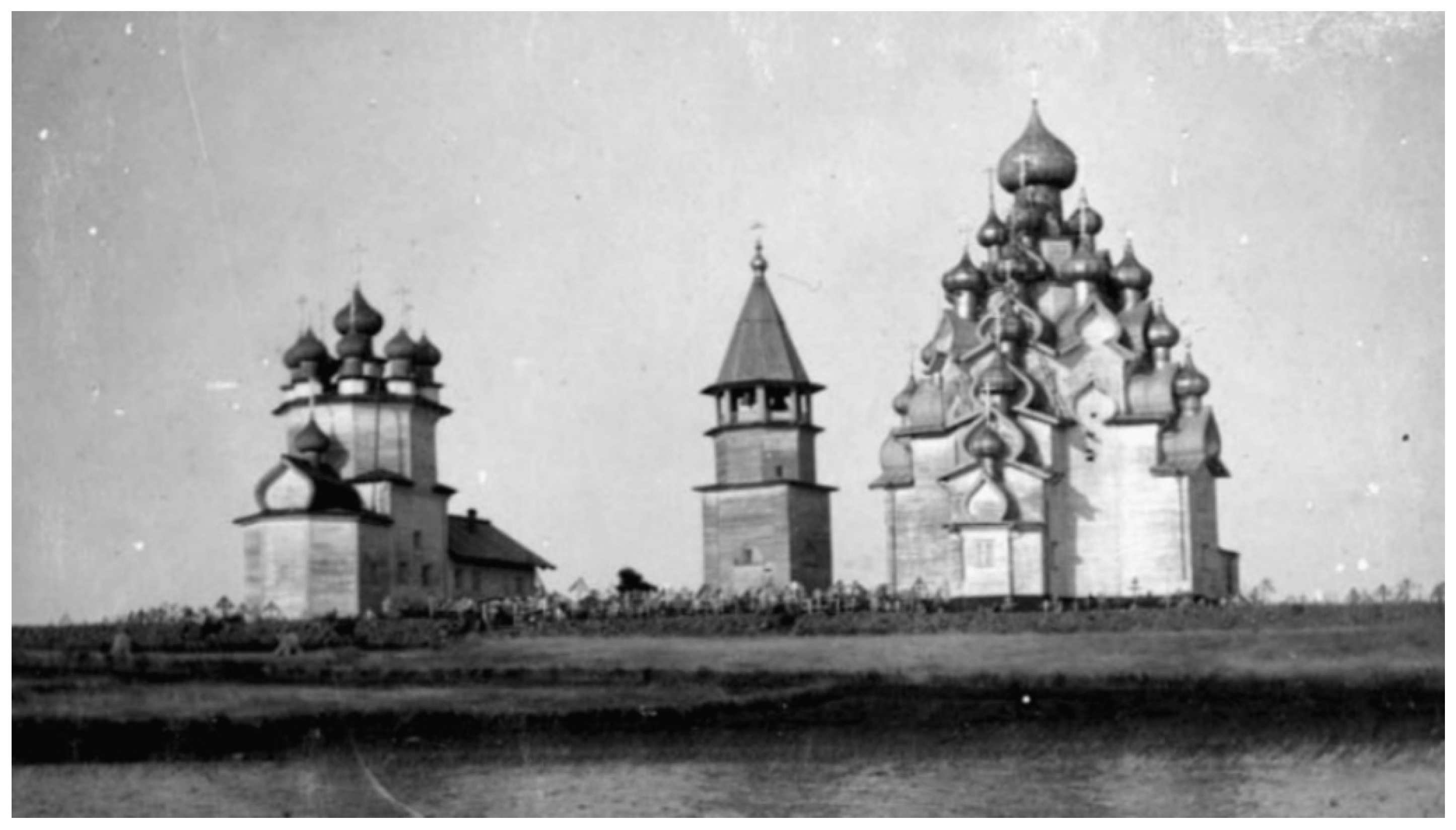
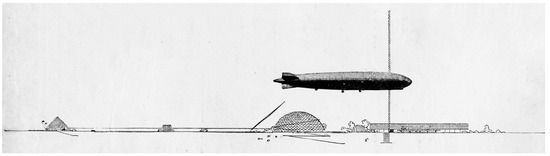
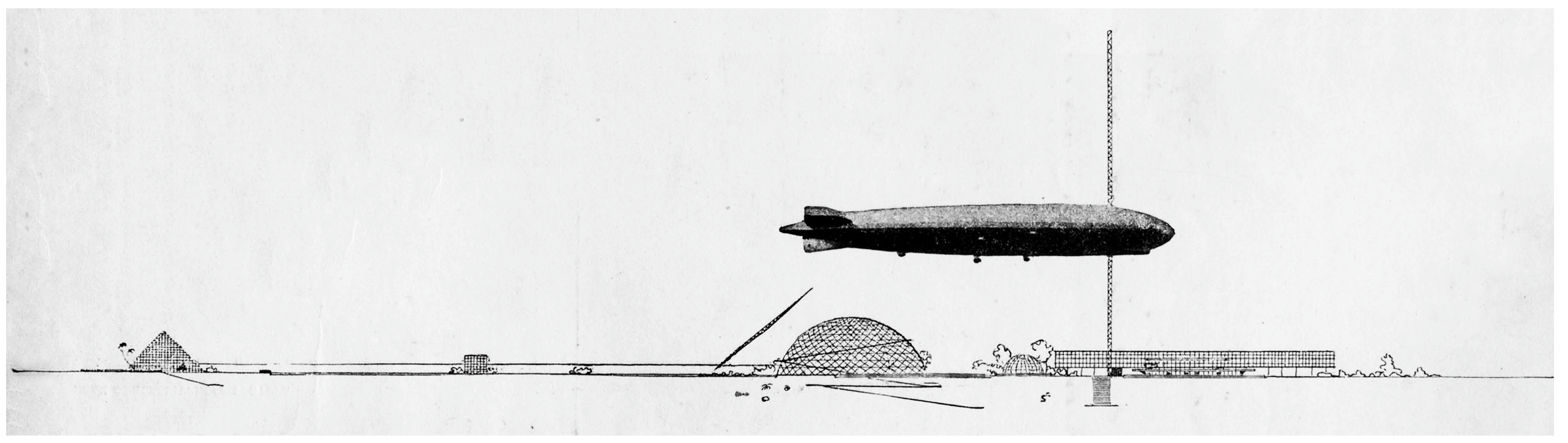
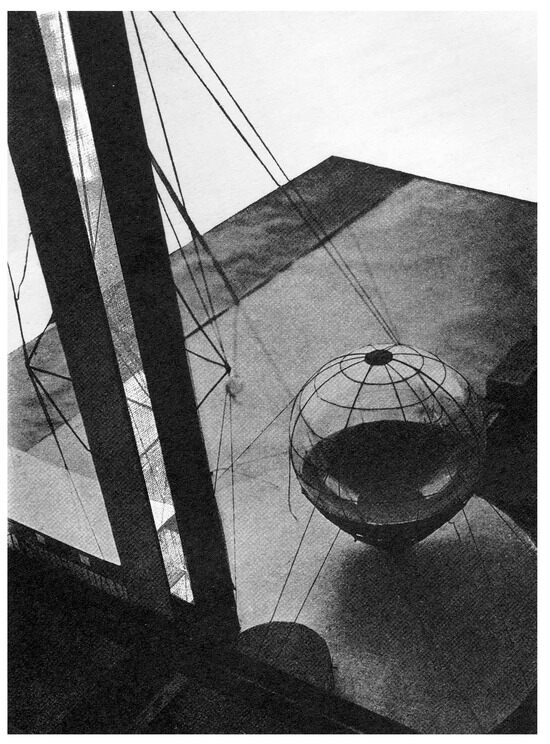
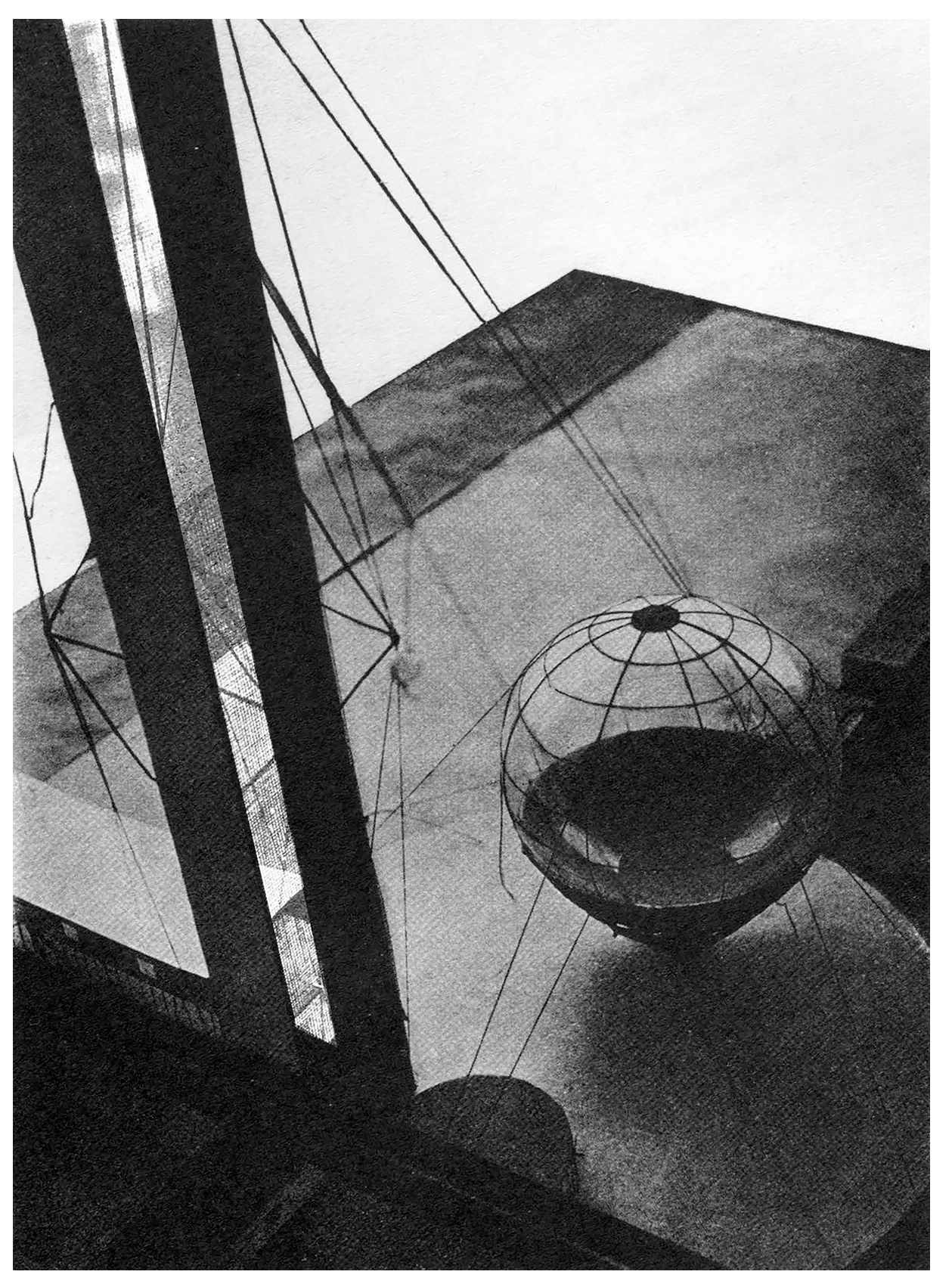
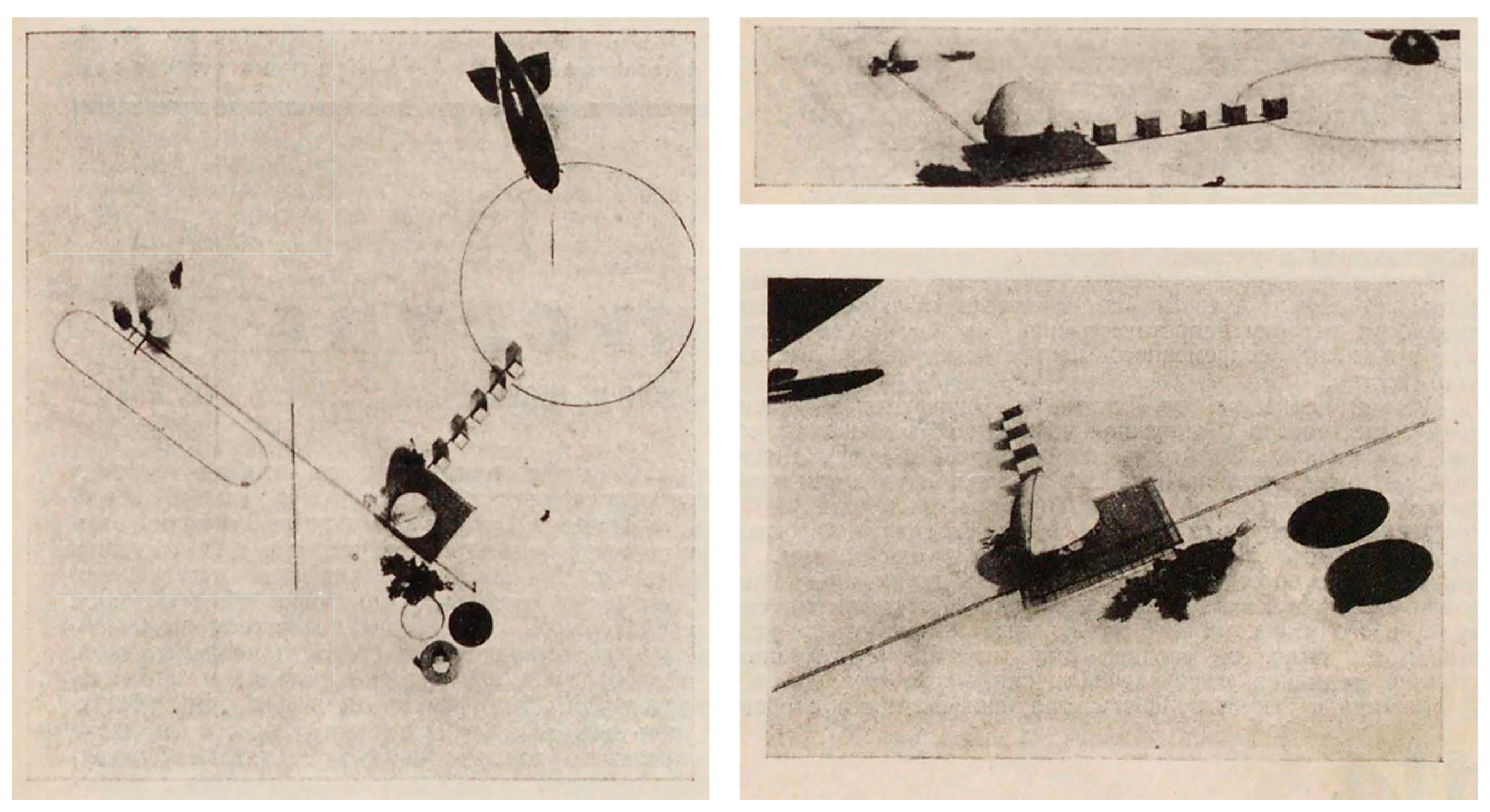
Disclaimer/Publisher’s Note: The statements, opinions and data contained in all publications are solely those of the individual author(s) and contributor(s) and not of MDPI and/or the editor(s). MDPI and/or the editor(s) disclaim responsibility for any injury to people or property resulting from any ideas, methods, instructions or products referred to in the content. |
© 2026 by the author. Licensee MDPI, Basel, Switzerland. This article is an open access article distributed under the terms and conditions of the Creative Commons Attribution (CC BY) license.