


Abstract
This article offers an art-historical interpretation of camel imagery associated with the ‘Thamudic’ (Ancient North Arabian) epigraphic horizon in the rock art of the Hail region, Saudi Arabia, focusing on the World Heritage components at Jubbah and Shuwaymis. Previous scholarship has surveyed Saudi rock art, proposed relative stylistic phases and read camel figures through associated inscriptions, but has not set out an explicit procedure for analysing how camel images are made to look the way they do. Using a purposive sample of published and openly licensed images (reference examples of recurrent styles and two multi-figure panels, from Shuwaymis and Jubbah), the study first records formal, technical and contextual features and only then proposes interpretations, reported separately and graded by confidence. The analysis suggests that stylistic variation is better read as a set of viewing strategies, from rapid emblematic recognition to slower anatomical reading, than as a chronological sequence alone. It also suggests that inscriptions were placed to frame or label camel figures, a pattern compared with documented Ancient North Arabian material. The paper concludes by clarifying ‘Thamudic’ as a scholarly label and outlining implications for heritage interpretation.
1. Introduction
Rock art is one of the oldest forms of human creativity and cultural expression, and a valuable record of the thoughts, beliefs and daily lives of past societies. As primary archaeological documents, rock images allow researchers to reconstruct aspects of history and offer insight into the customs, traditions and social behaviour of the communities that made them.
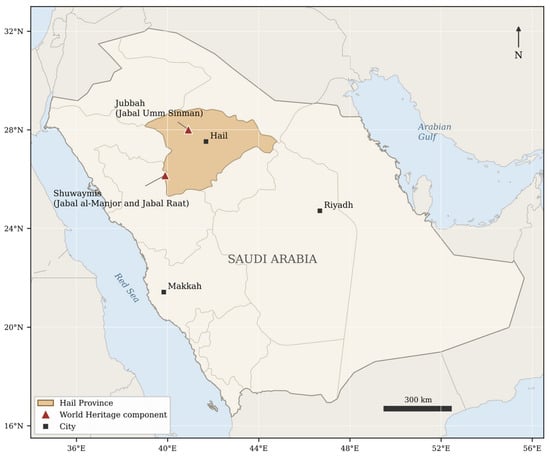
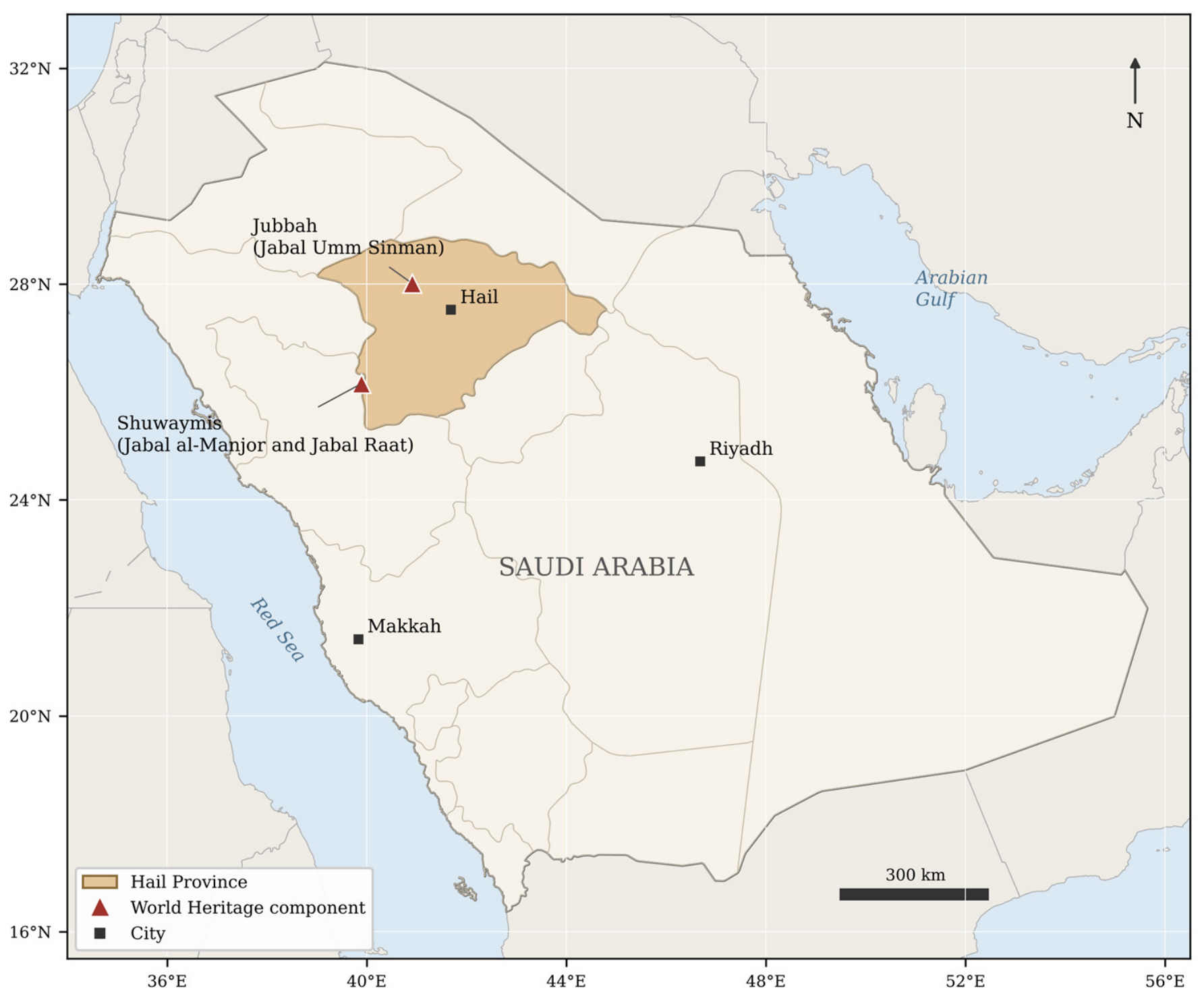
The Arabian Peninsula preserves a remarkable body of rock art, and Saudi Arabia holds one of the richest and most concentrated collections in the world (Khan 2013). Among its many significant sites, the Hail region in the north-central part of the country stands out (Figure 1). Its importance is rooted in its location at the junction of ancient trade routes. Although trade in commodities such as incense from South Arabia predates the domestication of the camel, the spread of the camel caravan around the end of the second millennium BCE transformed long-distance exchange by making direct travel across large deserts possible. The Hail region thus became a waypoint on routes connecting major cultural centres: to the south-west, the incense-producing regions of South Arabia (modern Yemen and Oman); to the north-west, the Levant and Egypt; and to the north-east, Mesopotamia.
Figure 1.
Location of Hail Province in north-central Saudi Arabia and of the two components of the World Heritage property Rock Art in the Hail Region: Jabal Umm Sinman at Jubbah and Jabal al-Manjor and Jabal Raat at Shuwaymis. Map by the authors; boundaries from Natural Earth (public domain); site coordinates from UNESCO World Heritage Centre (n.d.-b).
This role as a crossroads is potentially reflected in the stylistic diversity of the rock art itself, which suggests that the art of Hail was not an isolated phenomenon but part of a wider intercultural exchange carried by the movement of goods, people and ideas. The region’s sandstone mountains also provided durable surfaces for image-making over millennia. This concentration and quality of rock art led UNESCO to inscribe the Rock Art in the Hail Region of Saudi Arabia on the World Heritage List in 2015. The region contains approximately 146 identified archaeological sites, of which Jubbah and Shuwaymis are the most prominent.
Local tradition and much popular writing attribute this artistic legacy to the people of Thamud, who are mentioned in the Qur’an: ‘And [with] Thamud, who carved out the rocks in the valley?’ (al-Fajr 89:9; Saheeh International translation, QuranEnc.com n.d.). As discussed in Section 2.3, however, ‘Thamudic’ is a scholarly label for a large and heterogeneous group of Ancient North Arabian inscriptions and does not demonstrate authorship by the Qur’anic Thamud (Macdonald 2012; OCIANA n.d.). In this article, the term is therefore used in inverted commas for camel imagery associated with the epigraphic horizon of these inscriptions (broadly the first millennium BCE), and not as an ethnic attribution. Within the animal figures that dominate this horizon, camels are the most frequently and most vividly represented motif (Al-Juhani 2019; Al-Sayed 2019).
Despite this prominence, research has concentrated on archaeological distribution, typology, chronology and epigraphy. National surveys, notably Khan (2013), have established that camels became the dominant animal of the later rock art of Saudi Arabia and have proposed a relative sequence of stylistic phases; more recently, Al-Sharif (2025) offered an aesthetic reading of human and animal carvings at Jubbah and Shuwaymis. What is still missing is a camel-specific analysis that states its selection criteria and image sources, separates what is visible in each image from what is inferred about its meaning, and examines how camel figures interact with inscriptions on the same rock surfaces.
This study addresses that gap through three research questions:
- RQ1. Which formal and technical conventions make camel figures in the Hail corpus recognisable, and how do these conventions vary?
- RQ2. How do composition, scale and proximity to inscriptions shape what camel panels communicate?
- RQ3. Which symbolic readings are supported by these observations, and with what degree of confidence?
The focus of the article is therefore the visual analysis of camel imagery: how camel figures are made and arranged, and how they relate to inscriptions on the same surface. The ‘symbolism’ of the title refers to the readings that this analysis allows, each graded by confidence (Section 3.7). Inscriptions are analysed as part of the image: their position, orientation and extent in relation to the camel figures, compared with documented material (Section 4.4).
A secondary aim is to consider how such readings can inform public awareness, education and responsible heritage communication, in line with the cultural objectives of Saudi Vision 2030.
2. Literature Review
2.1. Saudi and Arabic-Language Scholarship
Saudi researchers have paid growing attention to the rock art of their homeland over the last decade, systematically documenting and analysing it. A review of studies published in this period identified twelve studies of Saudi rock art, nine of which concern the Hail region. Of these nine, three address the camel specifically: two examine camel engravings without reference to associated drawings, and only one considers camel imagery in both engraving and drawing. Another study demonstrated the value of Saudi rock art for developing archaeological awareness (Al-Muflih 2021).
The 2015 UNESCO inscription of the Hail rock art marked a turning point, prompting a surge of academic and public interest (Al-Juhani 2019). Al-Juhani (2019) and Al-Sayed (2019) highlighted the prominence of animal depictions, and of camels in particular, which constitute the most common subject in the Hail region. This prominence reflects the camel’s central role in Arabian society and its cultural and symbolic value, which are evident throughout Arabian poetry, legend and religious thought. Al-Dheeb (2022) and Al-Kunu (2013) give extensive accounts of the camel’s practical significance as a beast of burden, a source of food and materials, and a mount for travel and warfare. Al-Sayed (2019) and Masoud (2020) examine Thamudic inscriptions and show a more personal relationship between their writers and camels: names carved alongside camel figures, probably indicating ownership, lineage or attributes such as age or colour, turn these engravings from simple illustrations into personal records.
Most recently, Al-Sharif (2025) applied a descriptive-analytical aesthetic approach to a sample of twelve human and animal carvings from Jubbah and Shuwaymis, identifying balanced visual relationships, proportional harmony, integrated composition, and the use of exaggeration and distortion away from naturalistic proportion. That study is the closest in method to the present one, but it treats the carved repertoire as a whole rather than the camel as a motif, and does not examine the relationship between figures and inscriptions.
2.2. International Scholarship on Saudi and Hail Rock Art
Khan’s (2013) survey remains the standard English-language overview of Saudi rock art. It documents the replacement of cattle by camels as the main animal of the later assemblages as the climate became more arid, the transfer of tribal brands (wusum) from cattle to camels, and the occasional association of animal figures with Thamudic inscriptions naming their owners or riders. Khan also proposes a relative stylistic sequence, from large semi-naturalistic figures, through smaller schematised figures and outlined or stick-like figures, to highly abstract sign-like imagery, ordered by patina and superimposition. The survey is national in scope, however: it does not treat the Hail camel imagery as a corpus in its own right, does not set out a procedure for formal analysis, and discusses image–inscription relations through selected examples rather than as a compositional question. Bednarik and Khan (2015) subsequently stressed that stylistic sequences in Arabia must be tested against scientific dating.
A useful comparison comes from Jordan, where Brusgaard (2020) studied camel figures in the rock art of the Black Desert. There, camels make up about a third of all recorded figures. They are usually carved alone, with a large hump and a long, straight neck. Some are accompanied by a short inscription, usually the signature of the person who carved the image. This study is used in Section 5.3 to compare the Hail camels with a wider regional corpus.
Beyond Arabia, recent art-historical work on rock art has shown the value of analysing a single panel through explicitly stated theoretical and evidential steps. Witelson (2025), for example, revisits one South African scene through performance theory and contextual evidence. Whitley (2016) likewise stresses that the formal description of rock images and their contextual interpretation are separate operations that should be kept distinct. The present study adopts this principle but works at a smaller evidential scale: it does not attempt an ethnographic reconstruction, and it makes the limits of a photograph-based reading explicit.
Work in northwestern Saudi Arabia over the last two decades has increasingly treated rock art as part of cultural landscapes rather than as isolated pictures on stone. Systematic survey and analysis using a geographic information system (GIS) around the Jubbah palaeolake showed that many prehistoric panels overlook early Holocene water bodies and that later ‘Thamudic’ distributions can inform reconstructions of mobility and route use in the first millennium BCE (Jennings et al. 2013). Regional syntheses have emphasised that Jubbah’s long occupation history is visible through panel reuse, superimposition and shifting faunal repertoires, allowing stylistic and thematic change to be linked cautiously to environmental and socio-economic transformation (Guagnin et al. 2017). For the Hail World Heritage components (Jabal Umm Sinman at Jubbah, and Jabal al-Manjor and Jabal Raat at Shuwaymis), the UNESCO nomination documentation underscores the exceptional density of petroglyphs and inscriptions and their long time span (UNESCO World Heritage Centre n.d.-c).
These studies provide two anchors that can be tested through close visual reading. First, panels were not randomly placed: viewing positions, approach routes and the presence (or memory) of water shape what is depicted and how it is encountered. Second, ‘Thamudic’ camel imagery tends to appear within multi-period palimpsests, so the aesthetic choices visible today are often the outcome of successive carving episodes. Visual analysis must therefore attend to superimposition, differential patination and the relationship between inscriptions and animal figures, rather than treating each camel as a free-standing icon.
2.3. ‘Thamudic’ and Ancient North Arabian Inscriptions
The term ‘Thamudic’ is often used as if it denoted a single people or a unified script tradition. Epigraphic scholarship has long warned that this is misleading: ‘Thamudic’ is a nineteenth-century label applied to large numbers of Ancient North Arabian inscriptions that had not yet been properly classified, and it implies neither authorship by the tribe of Thamud nor a single chronological or geographical variety (OCIANA n.d.). The clarification is not merely terminological. It prevents a circular argument in which camel images are called ‘Thamudic’ because nearby inscriptions are, and the inscriptions are then treated as proof of a ‘Thamudic camel cult’.
Inscriptions are more productively treated as part of a panel’s communicative ecology. Short texts, names and formulae, when legible and securely associated with the same carving event, can indicate practices of marking presence, commemorating journeys or recording social relations. Digital corpora such as the Online Corpus of the Inscriptions of Ancient North Arabia (OCIANA) give searchable access to texts, metadata and images for comparative work. For the present study, the key point is methodological: inscriptions direct attention to the ‘address’ of rock art (who speaks, to whom and in what circumstances) rather than to animal figures as decoration.
‘Thamudic’ texts are usually divided into three groups, known as Thamudic B, C and D. Thamudic B is the largest group and the most common in north-central Arabia, where Hail is located (Macdonald 2000, p. 44). Most of these texts are short, and some letters are still difficult to read (Macdonald 2000, p. 44). The OCIANA corpus includes Thamudic B texts carved beside camels with riders (Al-Jallad 2025), which can be compared with the Hail panels.
2.4. Dating, Patination and the Limits of Stylistic Chronology
Any interpretation of ‘Thamudic’ imagery must be cautious about chronology. Arabian rock art chronologies have often relied on stylistic reasoning alone, whereas scientific approaches have been used to challenge rigid stylistic sequences and to argue for locally variable production histories (Bednarik and Khan 2015). For the Hail region, geochemical and microscopic study of rock varnish has shown that petroglyph production spans the Holocene and that weathering histories complicate judgements of ‘freshness’ based on appearance alone (Macholdt et al. 2018). These results do not date the camel images panel by panel; they refine the conditions for art-historical inference. Where varnish regrowth varies across a single panel, the visible surface may be a composite of several episodes. The present analysis therefore does not assign images to fixed centuries on stylistic grounds, but asks what formal conventions communicate within each panel.
2.5. Original Contribution of This Study
In short, previous studies have established the distribution, typology and relative chronology of camel imagery in Saudi Arabia (Khan 2013; Al-Juhani 2019), the content of the inscriptions associated with it (Al-Sayed 2019; Masoud 2020), the general aesthetic qualities of the Hail carvings (Al-Sharif 2025) and, for Jordan, the standard form of the dromedary in Safaitic rock art (Brusgaard 2020). This study does not revise those findings. Its novelty lies in its method and in the questions it asks of the images: in relation to the studies above, this article makes four specific contributions:
- Style as viewing strategy rather than chronology alone. The study does not propose new style categories. The four styles used here (schematic, stick, outlined and semi-realistic; Al-Juhani 2019) broadly correspond to Khan’s (2013) schematised and outlined/stick-like phases. Whereas Khan uses such categories to order images in time, this study analyses what each style makes visible and how quickly it can be read, and argues that the same panel can combine styles for communicative rather than purely chronological reasons.
- Image–inscription adjacency as a compositional relation. Khan (2013), Al-Sayed (2019) and Masoud (2020) read inscriptions mainly for their content (names, ownership, attributes). This study examines where text is placed relative to camel figures (in negative spaces, beneath bodies, around a large figure that serves as visual ground) and what that placement does to the reading of the image.
- A camel-specific Hail corpus linked to material conditions. Unlike Khan’s national survey and Al-Sharif’s (2025) study of the carved repertoire as a whole, the analysis is restricted to camel imagery in the Hail World Heritage components and relates aesthetic choices to the material conditions documented by scientific work, especially varnish contrast and possible recutting (Macholdt et al. 2018).
- An explicit, reproducible procedure. Following Macdonald’s (2012) warning against projecting fixed meanings onto ambiguous motifs, the study states its selection criteria and image sources (Section 3), records observations before interpretation, and grades each interpretation.
2.6. The Camel in Arabian Life, Legend and Scripture
Camels are among the most prominent animals of the Arabian Peninsula: a partner in survival, a measure of wealth and a cornerstone of cultural identity (Al-Dheeb 2022). Their physical adaptations allowed people to travel through harsh climatic conditions, so that the arid desert became a habitable domain for those who possessed camels. The camel provided meat, milk and leather; its hair was woven into textiles for tents and clothing; its dung served as fuel; and its strength was harnessed for agricultural labour, transport and warfare. Arab tradition also credits camels with a sense of direction, the ability to drink brackish water, and the ability to recognise poisonous plants by scent. The camel thus became deeply embedded in the socio-economic structure of Arabian society, where it came to symbolise the resilience and patience needed to survive in the desert, a status expressed in Arabic poetry and in the rock art of the peninsula.
Pre-Islamic Arabs had many legends about camels, of which only a few survive (Al-Kunu 2013). One holds that a traveller lost in the desert would turn his clothes inside out, take hold of his camel, clap his hands and call specific words into its ear as if speaking to a person, after which the camel would lead him back to his people. Others describe wild camels living in the land of Wabar, a dwelling of the jinn, and claim that when God destroyed earlier nations, their camels remained and became jinn camels, from which feral camels descend.
Camels are mentioned in the Qur’an under different names in some fifty-five places (Al-Sayed 2019). Among these narratives is the she-camel of the Prophet Salih, brought forth from the rock as a sign to the people of Thamud (Al-Kunu 2013).
These textual traditions are later than, or independent of, the engravings. They are used here as interpretive context for the cultural weight of the camel, not as evidence of what any particular engraving meant to its maker.
2.7. Camels in the Rock Art of the Hail Region
Camel domestication and the uses of camels are among the most widespread subjects in the rock art of the Hail region (Al-Juhani 2019), and camels are the most frequent animal depicted (Al-Sayed 2019). They are engraved in a range of techniques, styles and sizes. Recurrent themes described in the literature include (Al-Sayed 2019; Al-Juhani 2019):
- Motherhood and nurturing: calves suckling or standing beside their mothers.
- Hunting: camels shown as prey and as mounts used in hunting other animals.
- Grazing and herding: pastoral scenes with camels attended by herders.
- Trade and caravans: lines of camels, sometimes shown laden, interpreted as caravans.
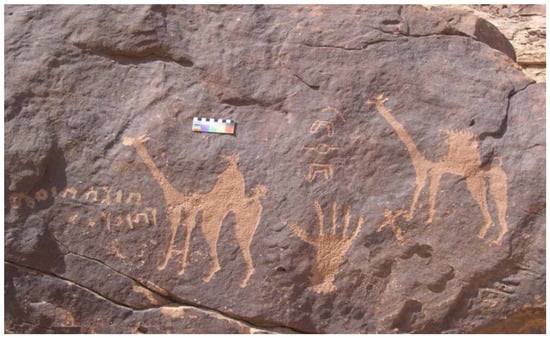
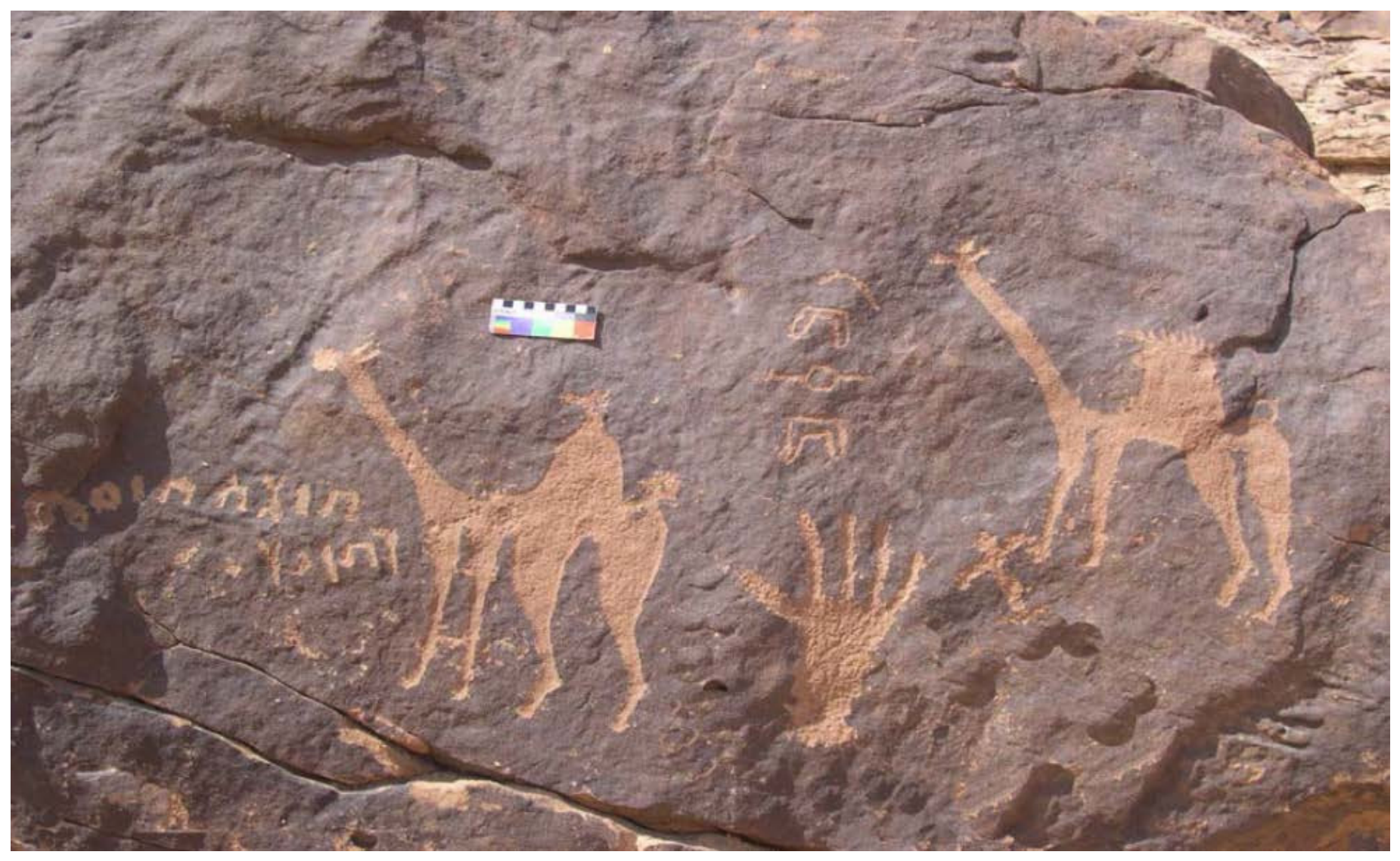
- Ownership and identity: names and phrases carved alongside camel figures, which suggest ownership, group identity or dedication (Al-Sayed 2019; Masoud 2020). The practice is widespread in Saudi Arabia, where camels are often shown with the name of their owner (Khan 2013; Figure 2).
Figure 2.
Comparative example: two camels in profile accompanied by Bedouin inscriptions, tribal symbols (wusum) and a hand motif; according to the source, the composition indicates the name of the camels’ owner. Saudi Arabia; location not specified in the source. Reproduced from Khan (2013, Figure 25), published under a CC BY 3.0 licence.
3. Materials and Methods
3.1. Research Design
The study uses a qualitative, descriptive-analytical, art-historical design. It is based on published photographs of rock art from the Hail region; it did not involve fieldwork, in situ measurement, new photography, dating or re-reading of inscriptions. Its aim is interpretive rather than statistical: the sample is chosen to illustrate the range of camel conventions and to allow close reading, not to estimate their frequency. The study follows IFRAO guidance in two respects: its terminology follows the IFRAO Rock Art Glossary (IFRAO n.d.-a), and, because it works from existing photographs without any contact with the rock, it complies with the IFRAO Code of Ethics (IFRAO 2000). The IFRAO Standard Scale, a reference card placed beside rock art when it is photographed to record size and colour (IFRAO n.d.-b), does not appear in the source photographs; measurements and colour values were therefore not used in the analysis, and future field recording should include it (Section 8).
3.2. Study Area
The study area comprises the two components of the World Heritage property Rock Art in the Hail Region of Saudi Arabia: Jabal Umm Sinman at Jubbah, and Jabal al-Manjor and Jabal Raat at Shuwaymis (Figure 1).
3.3. Corpus and Selection Criteria
Images were included if they met all of the following criteria:
- the camel is the principal motif, or one of the principal motifs, of the image;
- the image comes from the Hail region and, where the source specifies it, from one of the World Heritage components;
- the image is attributed by its source to the ‘Thamudic’ (Ancient North Arabian) horizon, either directly or by association with Ancient North Arabian inscriptions;
- the image is published in an identifiable, citable source, with sufficient resolution to read contour, interior treatment and, where present, peck marks; and
- taken together, the selected images cover each of the four styles described in the literature (Section 3.6).
Images were excluded if their source or location could not be traced, if the camel could not be distinguished securely from other quadrupeds, or if they showed evident modern graffiti or recutting.
On this basis, the analytical corpus comprises five images from the Hail region (Table 1): one reference example for each of the stick, outlined and semi-realistic styles (Figure 3, Figure 4 and Figure 5), of which the stick and outlined examples are openly licensed photographs from Jubbah (Mortel 2020a, 2020b) and the semi-realistic example is taken from the documentation published by Al-Dheeb (2022); and two multi-figure panels, a principal panel at Shuwaymis (Figure 6) and a second panel at Jubbah (Figure 7). A fifth image (Figure 2), reproduced from Khan (2013) under an open licence, is used as a comparative example of camels accompanied by an owner’s inscription; because its source does not specify its location, it is not treated as part of the Hail corpus. The schematic style is represented by the many small camel figures on the principal panel (Figure 6), so no separate reference image is used for it. The principal panel (Figure 6) was selected because (a) it combines camels of very different sizes, human figures and inscriptions on a single surface, allowing all three analytical dimensions to be examined together, and (b) it is documented in the UNESCO World Heritage image archive, which provides a stable, citable record. The Jubbah panel (Figure 7) was added so that the two World Heritage components are both represented by a multi-figure panel; it was chosen because it combines ridden and unridden camels, inscriptions and other signs on one surface, and because a high-resolution photograph of it is available under an open licence (Mortel 2020c).
Table 1.
Images analysed or reproduced, with source and reproduction status.
Figure 3.
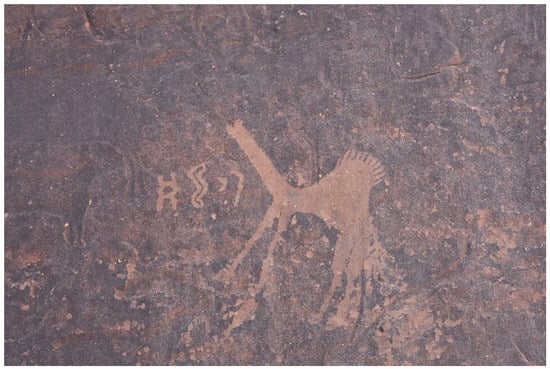
Stick-style camel facing left, with neck and legs reduced to single lines, a fringe of short strokes on its back and an Ancient North Arabian inscription beside the neck, Jubbah. Photograph: Mortel (2020a), via Wikimedia Commons, published under a CC BY 2.0 licence.
Figure 4.
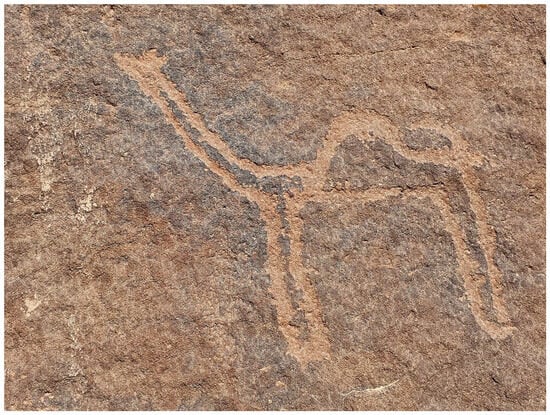
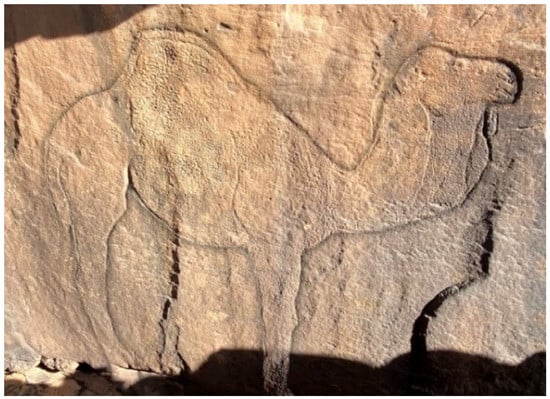
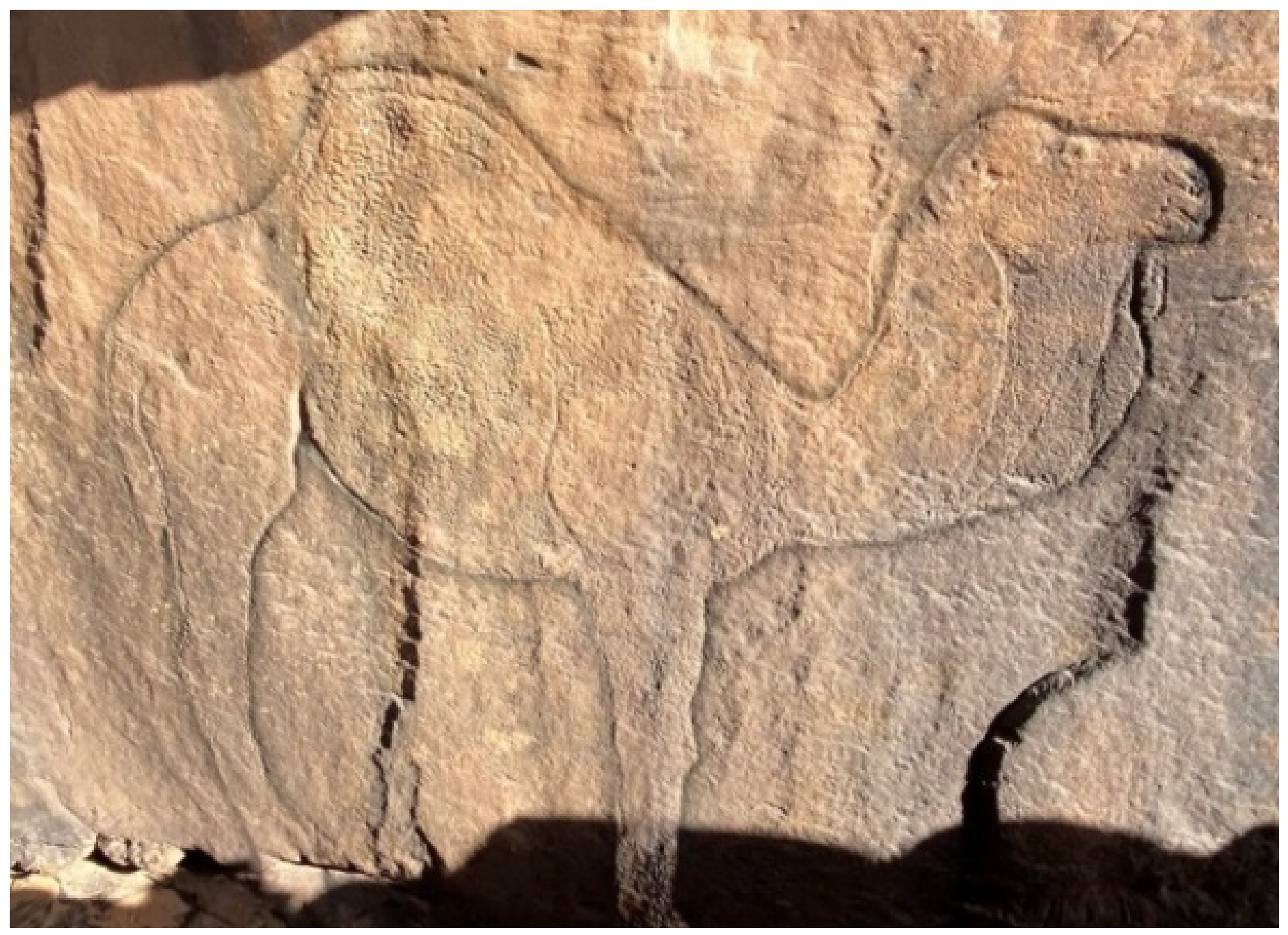
Outlined-style camel facing left, defined by a single continuous contour with an unworked interior, Jubbah. Photograph: Mortel (2020b), via Wikimedia Commons, published under a CC BY 2.0 licence.
Figure 5.
Semi-realistic camel in right-facing profile, with near-natural proportions and detail of head, legs and tail, Hail region. After Al-Dheeb (2022); reproduced with permission of the author.
Figure 6.
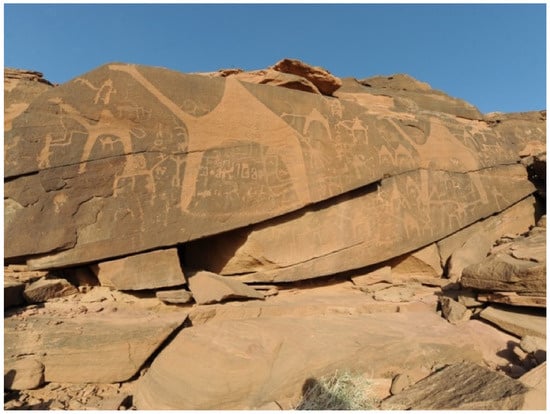
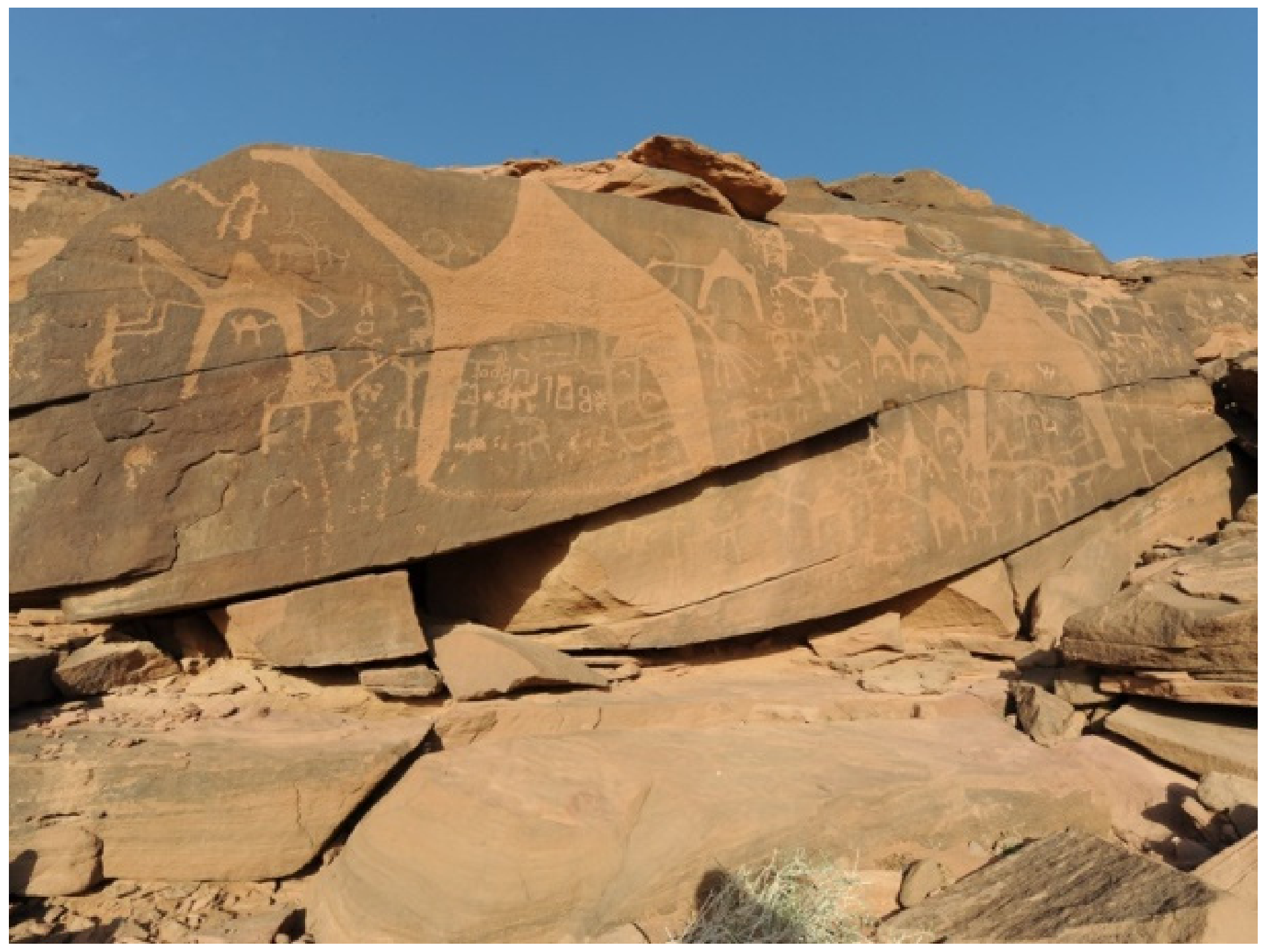
Principal panel: camel figures of various sizes, all in profile, with human figures and Ancient North Arabian inscriptions, Jabal al-Manjor, Shuwaymis. Photograph: Majeed Khan, © Saudi Commission for Tourism and Antiquities (now the Heritage Commission, Ministry of Culture). Source: UNESCO World Heritage Centre, nomination file, image 136188. Reproduced unaltered with attribution; excluded from the article’s CC BY licence.
Figure 7.
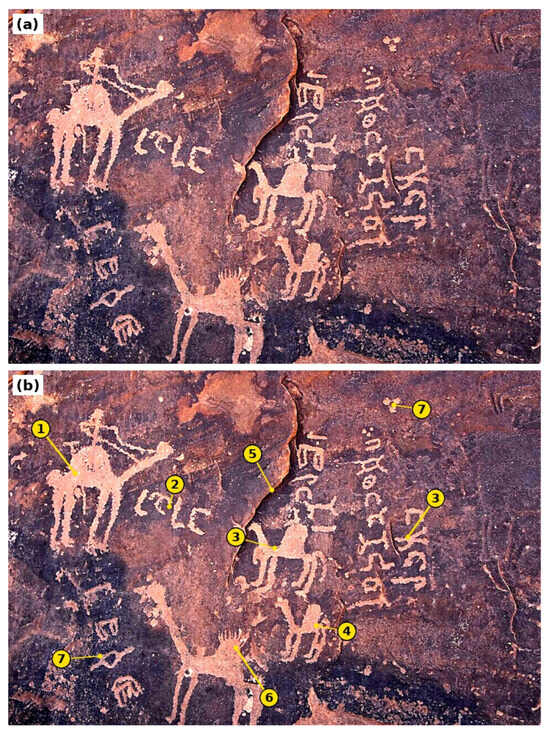
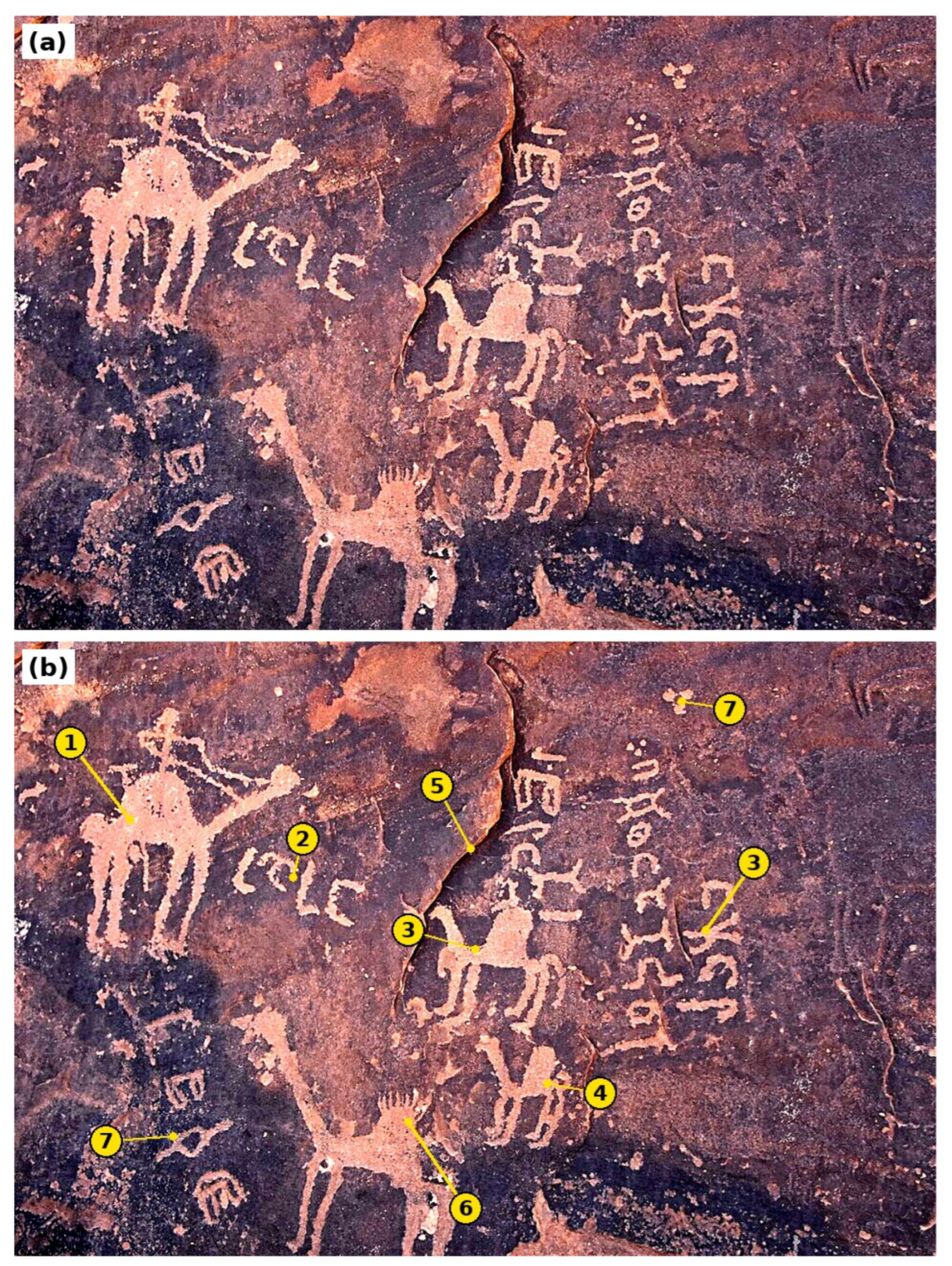
Second panel: two ridden camels with riders holding reins, each paired with an Ancient North Arabian inscription, a smaller camel, and a large camel with a comb-like sign carved across its body, Jabal Umm Sinman, Jubbah. (a) Photograph with contrast enhanced by the authors; (b) the same image annotated by the authors, with numbers corresponding to the observations Photograph: Mortel (2020c), via Wikimedia Commons, published under a CC BY 2.0 licence; adapted by the authors (contrast enhancement and annotation).
3.4. Image Sources and Reproduction Rights
Table 1 lists the source, location and reproduction status of every image used. Each third-party image is reproduced with the attribution required by its copyright holder; permission has been requested where the holder’s terms require it.
3.5. Analytical Framework
Each image was examined against three dimensions of analysis and the indicators listed in Table 2. The formal and technical dimensions describe how the camel is made; the contextual dimension describes how it relates to the rest of the surface.
Table 2.
Analytical dimensions, indicators and limits of inference.
3.6. Analytical Categories for Technique and Style
Technique and style were described with categories established in the literature, used descriptively rather than as chronological markers. Three techniques have been identified in the Hail region (Al-Juhani 2019). Because this study works from photographs, technique is described as it appears in the image (for example, a ‘pecked appearance’) unless the source reports inspection on site; lighting, digital contrast and viewing distance can all change how a line looks.
- Pecking (Arabic naqr, sometimes rendered ‘clicking’): striking the rock, directly or with an intermediate tool, to produce small marks that together form the design, either along an outline or across the body.
- Incised outlining (‘notching’): carving continuous lines around a shape so that the figure stands out from the surrounding rock; it demands effort and skill and produces a precise, durable image.
- Scratching: rubbing or scratching the surface back and forth with a hard, sharp tool, producing lighter and often broader lines; it is quicker but more superficial.
Four styles are distinguished (Al-Juhani 2019), broadly comparable to the schematised and outlined/stick-like phases of Khan (2013):
- Schematic: extreme simplification, reducing the camel to its most basic recognisable outline without anatomical detail.
- Stick: the body and limbs reduced to simple, often rectilinear lines, conveying identity and posture only (Figure 3).
- Outlined: confident, continuous contour lines defining the external silhouette of neck, hump and body, with the interior left unworked (Figure 4).
- Semi-realistic: an attempt to approximate the actual form of the animal, with closer attention to proportion and anatomical detail (Figure 5).
3.7. Procedure: Separating Observation from Interpretation
Analysis proceeded in two stages. In the first stage, only features visible in the image were recorded against Table 2, without reference to meaning. In the second stage, interpretations were proposed with reference to the comparative literature, and each was graded by confidence:
- Supported: follows from several independent observations and is consistent with comparative evidence;
- Plausible: consistent with the observations, but reasonable alternative readings remain;
- Speculative: possible, but weakly constrained by the visible evidence.
The two stages are reported in separate columns in Table 3, Table 4 and Table 5, so that readers can evaluate each interpretation against the evidence on which it rests.
Table 3.
Reference examples: observations and interpretations.
Table 4.
Principal panel (Figure 6): observations and interpretations.
Table 5.
Jubbah panel (Figure 7): observations and interpretations.
3.8. Limitations
Working from published photographs limits what can be observed: scale, depth of working and the colour of patination are affected by lighting, camera angle and reproduction, and fine superimpositions may not be visible. No direct dating was undertaken, so contemporaneity between figures, or between figures and inscriptions, is inferred cautiously and never assumed. Inscriptions were not re-read by the authors; their presence and position are recorded, and their content is cited from published readings where available. The sample is small and purposive, so the results characterise conventions rather than their frequency in the corpus. Small details of the principal panel were checked on the full-resolution image published by UNESCO. Where the image licence permits adaptation, the photograph was contrast-enhanced and annotated by the authors to make superimpositions, small signs and inscriptions easier to locate (Figure 7); Figure 6 is reproduced unaltered, as its reproduction terms require, and the position of each feature is therefore described in Table 4. Above all, the study involved no fieldwork and no first-hand comparison with the original rock surfaces, so its observations are provisional and should be verified by in situ recording following IFRAO standards. Section 4.4 analyses the inscriptions through their position, orientation and extent and through comparison with published material; letter-by-letter readings would benefit from on-site recording and palaeographic study.
4. Results
4.1. Reference Examples
Across the reference examples, the observed differences lie less in subject than in how much visual information is supplied. The stick solution (Figure 3) supplies the least, the outlined solution (Figure 4) relies on an uninterrupted contour, and the semi-realistic solution (Figure 5) supplies the most anatomical information. In Figure 3, a short inscription is placed beside the camel’s neck, whereas the outlined camel in Figure 4 stands alone on an otherwise empty surface. All figures in the sample whose back is clearly rendered show a single hump (Figure 2, Figure 4, Figure 5, Figure 6 and Figure 7); in Figure 3, the back is marked by a fringe of short strokes rather than a distinct hump. No two-humped (Bactrian) figure was identified, so all identifiable camels in the sample are dromedaries.
4.2. Principal Panel
Observation. A long, sloping rock face carries one very large camel at centre-left, with a long upward-curving neck and a fully pecked body, and at least one further large camel to its right. Numerous small camels, shown in simplified profile, and small human figures are distributed across the whole surface; several of them are placed on, or overlap, the bodies of the large camels. Short Ancient North Arabian inscriptions occupy the space beneath the body of the large camel, between its legs. The worked surfaces are lighter than the surrounding dark varnish (Figure 6; Table 4). In the full-resolution image, a human figure with raised arms stands in front of the second large camel; on the far right, a human figure holding a line stands in front of a camel; and two small camels are positioned beneath a larger one.
Interpretation. The panel is best understood as a cumulative composition rather than a single scene. The large camels dominate by scale and define the structure of the surface, while the many small figures placed on and around them, some overlapping their bodies, indicate that the surface was returned to and added to, as Guagnin et al. (2017) describe for Jubbah. The placement of inscriptions beneath the large camel’s body shows the figure being used as a frame for writing. Within this palimpsest, particular groupings invite narrative readings: small camels beside or beneath large ones as young with adults, and human figures near camels as herders or owners. Because superimposition shows that not all figures are contemporary, however, scale contrast cannot by itself be read as a mother–young relationship, and such readings are graded as plausible or speculative in Table 4.
4.3. Second Panel: Jubbah
Observation. The panel occupies a dark, heavily varnished surface crossed by a natural diagonal fissure (Figure 7). At upper left, a camel in right-facing profile has a fully pecked body and long, straight legs; a human figure sits above the hump, with a vertical element rising above it, and holds a long line that runs forward along the neck to the head. A short horizontal inscription in Ancient North Arabian script runs beside this camel, level with its body. Immediately to the right of the fissure, a second camel, facing left, also carries a rider holding a line, and a smaller camel without a rider stands below it. Two vertical columns of Ancient North Arabian letters run beside these camels on the right. At the lower left, the largest figure on the panel is a tall, left-facing camel with a long, upward-curving neck; a comb- or hand-like sign (a bar with five short strokes) is carved across its body. Several small signs, including two comb-like marks and an eye-shaped mark, lie to the left of this camel, and a small three-dot motif appears near the top of the panel. All worked surfaces are lighter than the surrounding varnish. In Figure 7b, the numbered features correspond to the rows of Table 5.
Interpretation. Unlike the principal panel, this surface is organised around ridden camels. The lines held by the riders and running to the camels’ heads are most readily read as reins or halters, which makes control of the animal, rather than herd and nurture, the visible theme. Each ridden camel is paired with its own block of text, set horizontally along the body of the first and vertically beside the second, so that the inscriptions may act as labels for individual camel-and-rider figures; following Al-Sayed (2019) and Masoud (2020), these may name riders or owners, although the texts were not re-read for this study. The natural fissure separates the two ridden camels and appears to have been used as a boundary within the composition. The sign carved across the largest camel’s body shows that, as at Shuwaymis, a large camel body served as ground for later marks, and the comb-like signs recall the tribal marks (wusum) that Khan (2013) associates with camel imagery. Table 5 sets out each reading against the observation on which it rests.
4.4. Epigraphic Observations
Table 6 lists the inscriptions found beside camel figures in the sample. For each one, it shows where the text is placed in relation to the camel, the direction of the writing, and similar examples from published studies. In every case, the text is carved close to a camel rather than elsewhere on the rock. On the Jubbah panel, the two blocks of text are written in different directions: one runs horizontally and the other in vertical columns. The texts are written in Ancient North Arabian script, most likely in the Thamudic B variety, which is the most common in the Hail region (Macdonald 2000, p. 44). Recording the texts on site would allow this identification and the reading of each text to be confirmed (Section 8).
Table 6.
Inscriptions associated with camel figures in the sample (new table).
5. Discussion
5.1. Style as a Viewing Strategy
Read against the observations, abstraction appears not as a deficiency but as a visual strategy (RQ1). The stick and schematic figures show that a minimal set of cues (arched back, elongated neck and single-hump profile) is sufficient for recognition. By reducing information, the image becomes portable: it can be repeated, inserted into palimpsests or scaled to fit available space without losing identity. This is consistent with landscape interpretations that emphasise repeated visitation and the accumulation of marks as social memory (Jennings et al. 2013; Guagnin et al. 2017). The semi-realistic figure works in the opposite direction, slowing the viewer and drawing attention to the individual animal. Simplification may also have been encouraged by the hardness of the stone and the simplicity of the tools, but the co-existence of different solutions in the same corpus suggests that the choice was also communicative.
This reframes the relationship to Khan’s (2013) phase sequence. Khan orders schematised, outlined and stick-like figures in time; the present analysis does not contest that ordering, which requires dating evidence, but shows that the same formal differences also correspond to different viewing tempos. Filled bodies slow the viewer and invite attention to anatomy; open silhouettes act as rapid, emblematic signs. Both are ‘successful’, but they imply different communicative intentions. Stylistic difference within a panel should therefore not automatically be read as a chronological difference.
5.2. Materiality and Technique
Most engravings in the Hail sandstone were produced by pecking or abrading through dark rock varnish to expose the lighter rock beneath. The contrast between varnish and fresh sandstone is therefore an outcome of surface chemistry as well as an aesthetic effect, and it matters in two ways. First, it helps explain why makers prioritised outline and silhouette: even shallow pecking produces a legible contour where contrast is strong (Table 4, no. 8). Second, visibility changes as varnish regrows. Measurements of manganese-rich varnish regrowth on petroglyphs at Jubbah and Shuwaymis show that surfaces darken over long periods (Macholdt et al. 2018), which may have encouraged later recutting to ‘refresh’ visibility. A bold contour seen today may thus reflect repeated engagement with the same figure across generations.
Technique also shapes line quality. Pecking with a hard stone produces dotted or scalloped edges; incision and abrasion sharpen contours; deeper working supports interior detail such as the eye, hump or muzzle. These differences let us distinguish images that prioritise rapid recognition (high-contrast outlines, minimal detail) from those that invite slower looking (interior texture, anatomical emphasis). The camel is thus a crafted sign as well as a represented animal, produced through material decisions that govern how it can be seen, remembered and reused.
5.3. Image and Inscription
Reading camels alongside inscriptions suggests that adjacency to writing changes how images signify (RQ2). Inscriptions anchor the marking practice in named persons and brief utterances; camel figures can then operate as ‘visual signatures’ that amplify presence or signal valued associations such as mobility, herding competence or route knowledge. On the principal panel, inscriptions occupy the space beneath the large camel’s body, between its legs (Table 4, no. 4); in Figure 3, a short inscription stands beside the neck of a stick-style camel; the comparative example in Figure 2 shows how widely camels and owners’ inscriptions were paired; and on the Jubbah panel (Figure 7), each ridden camel is given its own block of text, set horizontally along one body and vertically beside the other (Table 5, nos. 2–3). Inscriptions thus work in two ways across the corpus: as text placed within a large camel’s frame at Shuwaymis, and as labels for individual camel-and-rider figures at Jubbah. Such placement suggests that makers treated the rock surface as a page-like medium and attended to the legibility of both forms of marking. Because ‘Thamudic’ is a classificatory label rather than a people or a unified language, inscriptions are treated here as contextual cues rather than ethnic proof (OCIANA n.d.); nonetheless, their co-location with camels shows makers combining linguistic and pictorial registers on the same surface.
Comparing the Hail examples with documented material places them in a wider regional context. In the Black Desert of Jordan, camels are usually carved alone, and the inscriptions beside them are mostly signatures (Brusgaard 2020). OCIANA also records Thamudic B texts carved beside camels with riders (Al-Jallad 2025). The Hail camels share two features with this material: camels are often paired with a short text carved close to them, and every camel whose back is clearly shown has a single hump. However, the Hail panels also show two features not found in these comparisons: text carved inside the outline of a large camel (Figure 6), and several camels with riders, each with its own text (Figure 7). A larger sample is needed to know whether these differences are typical of the Hail region or simply a result of the small number of images studied here.
5.4. Landscape Setting and the Address of Camel Imagery
Jubbah is organised around sandstone outcrops that once bordered a palaeolake; Shuwaymis is characterised by cliff faces and boulder fields along wadi systems. In both, panels are encountered through movement, and sequences of images accumulate into an itinerary of looking. This matters for camel imagery because the camel is itself a figure of movement, and a camel on a prominent face can operate as a sign in space, addressed to a viewer who arrives later. Landscape work at Jubbah has shown that panel location can correlate with former water bodies and corridors of approach (Jennings et al. 2013). Not every camel is a ‘map’, but the evidence encourages a shift from asking only what the camel means to asking also to whom, and where, it is shown. Camels on highly visible vertical faces or where paths converge may announce presence or commemorate a journey; small camels within dense palimpsests may read more as part of a social archive of names, emblems and animal silhouettes that declares repeated visitation.
Environmental history provides a further frame. Regional research emphasises long-term Holocene occupation and a transition from wild fauna to scenes that foreground domesticates and managed herds (Guagnin et al. 2017; Khan 2013). Camel imagery condenses several registers against this background: adaptation to aridity, management of mobility over long distances, and the social value of animals that enable survival and exchange. Comparative work on much earlier, life-sized camel engravings south of the Nefud Desert proposes that they marked seasonal water sources while expressing access rights and group identity (Guagnin et al. 2025). Although those engravings predate the first-millennium BCE ‘Thamudic’ horizon by millennia, they illustrate a broader Arabian pattern in which camel imagery is both practical and emblematic. On this reading (RQ3), the camel in the Hail corpus may have functioned not only as an economic animal but also as a symbolic mediator linking mobility, water knowledge and social identity; this is a hypothesis for further testing rather than a conclusion of this study.
6. Contemporary Reception and Awareness Initiatives
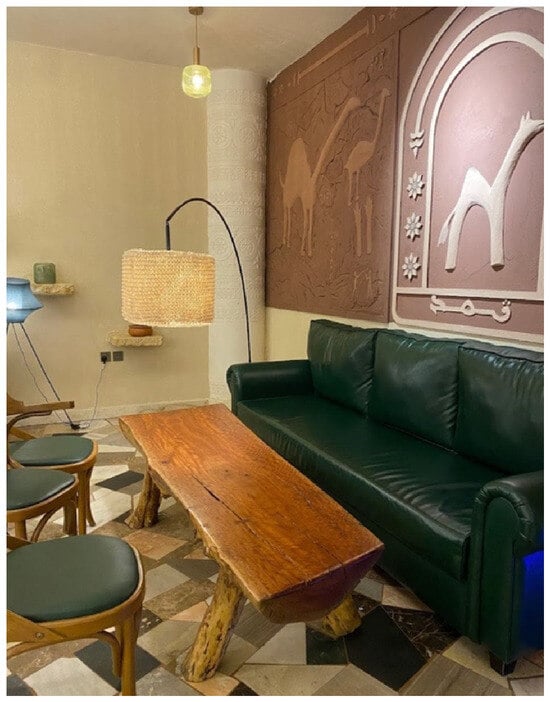
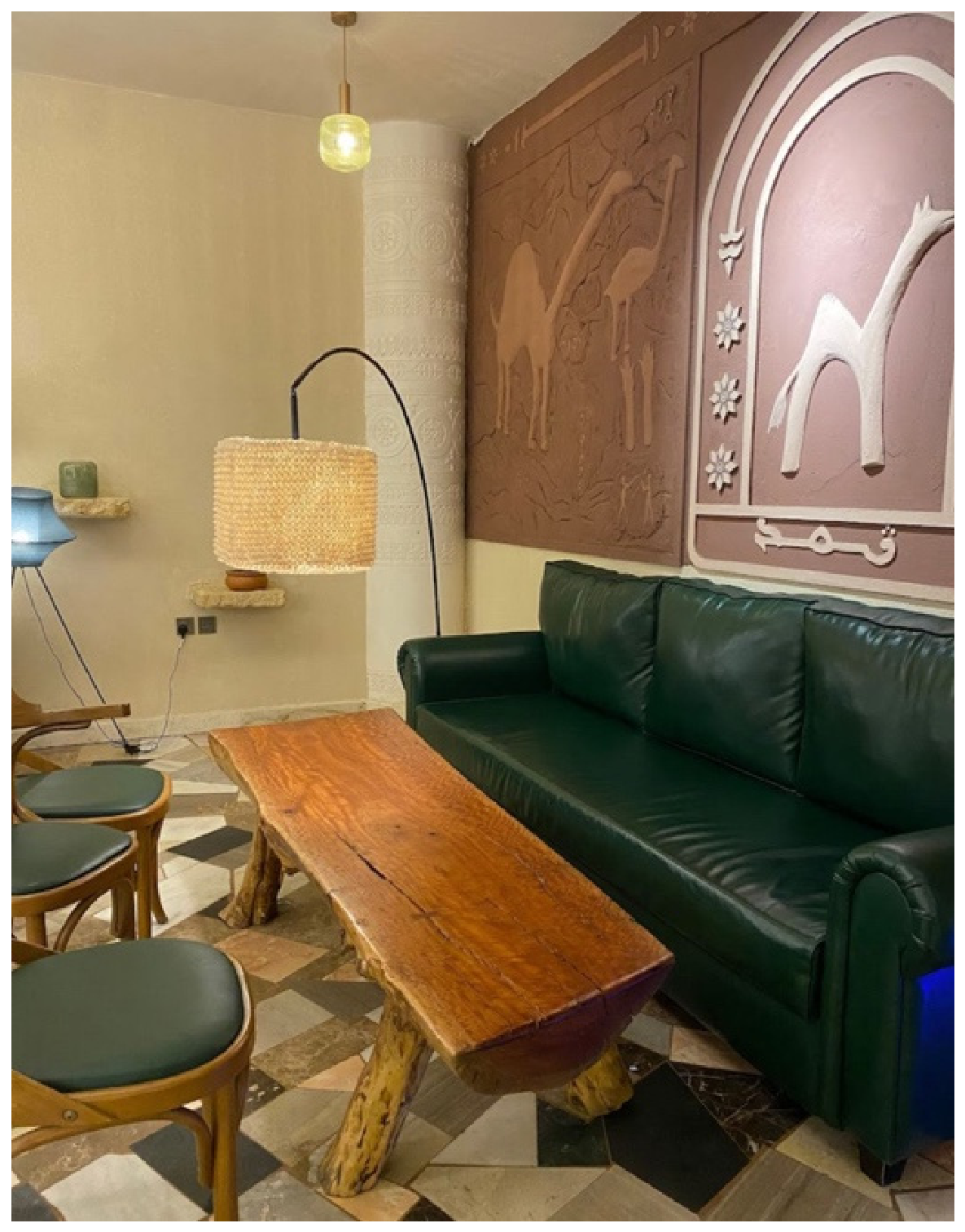
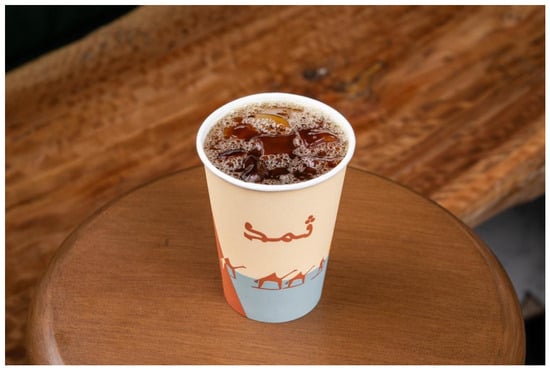
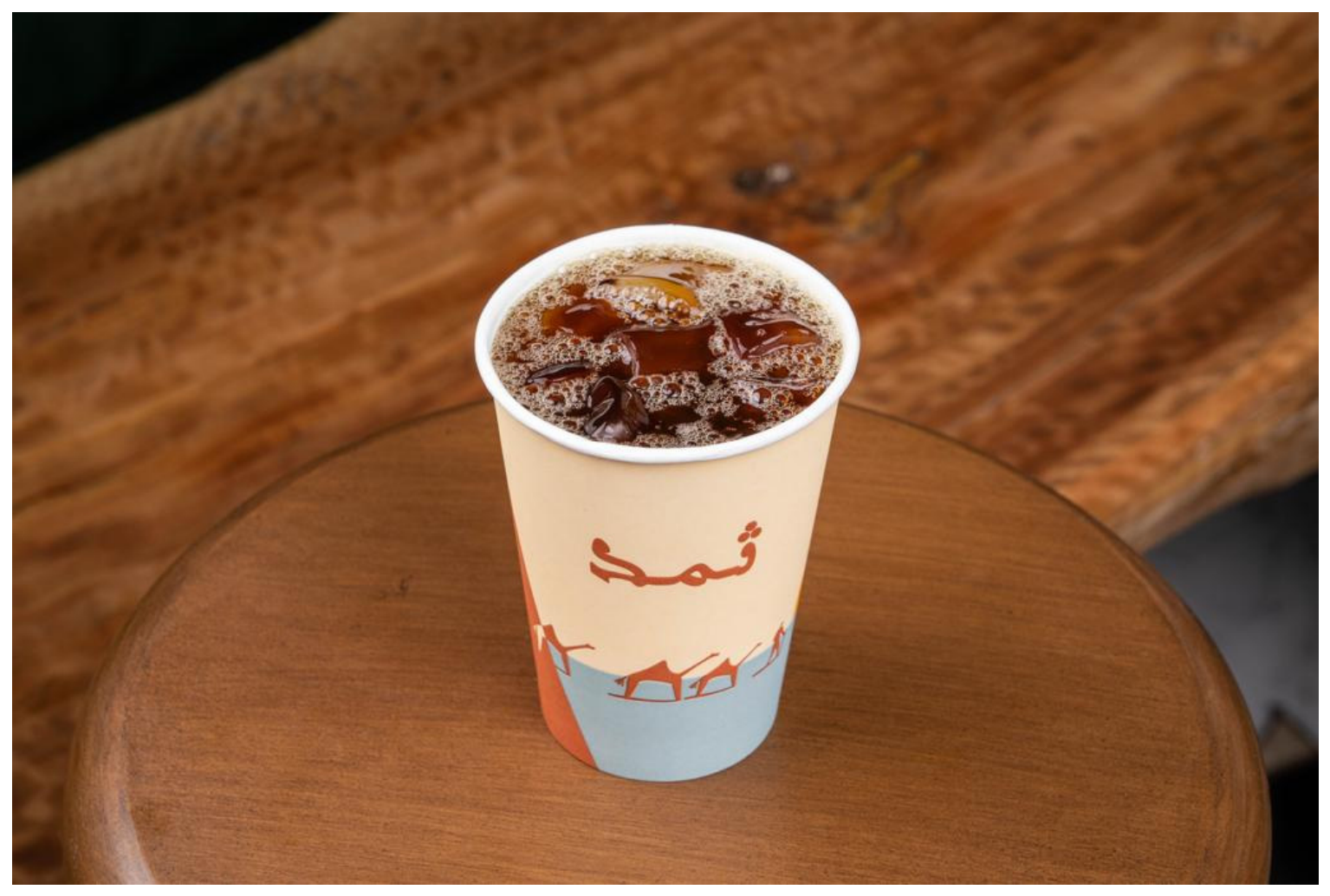
In recent years, several initiatives have drawn on the aesthetics of Hail rock art and the ‘Thamudic’ camel, in line with Saudi Arabia’s growing focus on cultural tourism. Local tour guides, such as Mamdouh bin Muzaum, use social media platforms and YouTube to document and interpret rock art sites, educating the public and creating an accessible digital record for those unable to visit remote locations. The Thamd Café project in Hail takes its name, logo, interior design and cup designs from ‘Thamudic’ motifs (Figure 8 and Figure 9), bringing an ancient visual tradition into a contemporary social space that is popular with younger generations and accessible to visitors. Officials in the Hail region have also integrated this heritage into public space: the entrance to Hail Airport is decorated with large-scale artworks of the ‘Thamudic’ camel, and Ancient North Arabian script has been used for welcome messages on one of the city’s main streets. Together, these examples show heritage being integrated into contemporary life in ways that can foster local pride, awareness and economic development through cultural tourism.
Figure 8.
Camel motifs adapted from Hail rock art in the interior of Thamd Café, Hail. Photograph by the authors.
Figure 9.
Thamd Café cup with a frieze of camel motifs adapted from Hail rock art. Photograph by the authors.
These adaptations also show why interpretive precision matters. Because the Hail sites are increasingly encountered through museums, heritage trails, branding and online media, there is a practical need for narratives that are both accessible and scholarly defensible. A clear account of what ‘Thamudic’ does and does not mean, combined with careful description of visual conventions, can help prevent simplistic ethnic attributions and present rock art as layered cultural evidence rather than a single message from the past. Public interpretation can follow the approach used here by presenting multiple plausible readings and distinguishing evidence from inference.
7. Conclusions
This study has offered a camel-specific, art-historical analysis of ‘Thamudic’ camel imagery in the Hail region, based on an explicitly defined sample of published images and a procedure that separates observation from interpretation. Using the techniques (pecking, incised outlining and scratching) and styles (schematic, stick, outlined and semi-realistic) described in the literature, it suggests that these styles can be read as different viewing strategies, from rapid emblematic recognition to slower anatomical reading, and that this variation need not be chronological alone (RQ1). Large camel bodies act as frames for inscriptions and for later figures, so that panels such as the principal panel are cumulative compositions built up over more than one episode rather than single scenes (RQ2). The Jubbah panel adds a second pattern, in which inscriptions label individual ridden camels and a natural fissure divides the composition. Within such panels, readings of herd, nurture and control are plausible for particular groupings but cannot rest on scale contrast alone (RQ3). The interpretations of ownership, symbolism and human–camel relationships offered here are therefore possible explanations, graded by confidence, rather than established conclusions.
Relative to previous work, the study does not add new style categories to those of Khan (2013) and Al-Juhani (2019). Its contribution is to analyse those categories as communicative choices, to treat image–inscription adjacency as a compositional relation, to restrict the analysis to camel imagery in the Hail World Heritage components, and to make the evidential basis of every interpretation explicit. The findings remain limited by reliance on published photographs and a small sample; in situ documentation and dating of the panels discussed would allow them to be tested.
The two-step method used here can also be applied to a much larger sample. Because each observation is recorded using the same fixed list of features (Table 2) before any interpretation is made, several researchers could use the same recording form on large photographic collections, for example, a selection of the approximately 146 recorded sites in the Hail region. Comparing their records would show whether the observations are consistent, counting the records would show how common each feature is, and mapping them with a GIS would show how the features relate to the location and visibility of each panel. The method is also not limited to camels. The same features, such as how many lines are used to form a figure, whether its outline is filled, and where text is placed beside it, can be recorded for human figures, ostriches, horses and other motifs. This would show whether the patterns found here are specific to camels or shared by ‘Thamudic’ rock art as a whole.
8. Recommendations
- Educational integration: include ‘Thamudic’ rock art and its aesthetics in national fine-arts and history curricula alongside other ancient art traditions.
- Field documentation: use 3D scanning and photogrammetry to create a high-resolution archive of significant and vulnerable panels, which would also allow analyses such as this one to be tested in situ.
- Community-led tourism: support community initiatives that integrate heritage into contemporary spaces, develop rock art trails led by trained local guides, and consider augmented-reality interpretation that presents multiple readings.
- Visual identity: consider adopting a camel motif drawn from the Hail rock art as part of the region’s tourism identity, with accurate interpretive information.
- Field verification: record the panels discussed here in situ following IFRAO guidelines, using the IFRAO Standard Scale for scale and colour calibration and non-contact methods only, and have the associated inscriptions read by a specialist epigrapher and compared with the material in OCIANA.
- Interdisciplinary research: combine scientific dating with art-historical analysis to build a more secure chronology of stylistic development.
- Scaling the method: develop a shared digital recording form based on Table 2, apply it with several independent observers across the recorded sites of the Hail region, and link the records to a GIS and to high-resolution, contrast-enhanced imagery (for example, decorrelation stretch or reflectance transformation imaging), so that superimpositions and small signs can be verified systematically.
- Other motifs: test the same two-stage procedure on human figures, ostriches and equids, to compare viewing strategies and image–inscription relations across the regional repertoire.
Author Contributions
Conceptualization, B.S.B. and A.B.; methodology, B.S.B. and A.B.; investigation, B.S.B. and A.B.; formal analysis, B.S.B. and A.B.; writing—original draft preparation, B.S.B. and A.B.; writing—review and editing, B.S.B. and A.B. Both authors contributed equally to this work. All authors have read and agreed to the published version of the manuscript.
Funding
This research received no external funding.
Institutional Review Board Statement
Not applicable. The study analysed published images of cultural heritage and did not involve human participants.
Informed Consent Statement
Not applicable.
Data Availability Statement
No new datasets were generated. The images analysed are published sources listed in Table 1; access to them is governed by their sources.
Acknowledgments
The authors thank Suleiman Al-Dheeb for permission to reproduce the image in Figure 5. During the preparation of this manuscript, the authors used ChatGPT (GPT-5, OpenAI) and Claude (Claude Opus 5.5, Anthropic) for the purposes of language editing, restructuring the text, and checking image sources and licence conditions. The authors have reviewed and edited the output and take full responsibility for the content of this publication.
Conflicts of Interest
The author declares no conflicts of interest.
References
- Al-Dheeb, Suleiman Abdul Rahman. 2022. Arabian Camels in Rock Drawings: Hail, Kingdom of Saudi Arabia. Riyadh: Al-Mufradat Publishing House. (In Arabic) [Google Scholar]
- Al-Jallad, Ahmad. 2025. GETham 2. In OCIANA: Online Corpus of the Inscriptions of Ancient North Arabia. Edited by Ahmad Al-Jallad and Michael C. A. Macdonald. Columbus: The Ohio State University. Available online: https://ociana.osu.edu/inscriptions/44105 (accessed on 13 November 2026).
- Al-Juhani, Jamila Freeh. 2019. Analytical Study of Rock Art in the Al-Malihiya Site in the Hail Region. In The Cooperation Council States in the Arab Gulf Through the Ages. Proceedings of the Nineteenth Annual Scientific Meeting of the Society of History and Archaeology. Kuwait City: Society of History and Archaeology in the GCC Countries, pp. 47–97. (In Arabic) [Google Scholar]
- Al-Kunu, Moayad Mahmoud Shehab. 2013. The Status of Camels among the Arabs before Islam. Journal of Education and Science 20: 114–24. (In Arabic) [Google Scholar]
- Al-Muflih, Al-Hanouf Abdul Rahman. 2021. The Symbolic Connotations of Rock Paintings in the Kingdom of Saudi Arabia as an Entrance to the Development of Archaeological Awareness among Female Students at King Saud University. Journal of the Emsia Association for Education through Art 25: 505–31. (In Arabic) [Google Scholar]
- Al-Sayed, Mahmoud Abdel Baset Attia. 2019. Camels in the Writings and Rock Arts, Hail. Saudi Society for Camel Studies, King Saud University 1: 38–62. (In Arabic) [Google Scholar]
- Al-Sharif, Noha Mohammed. 2025. An Aesthetic Study of the Sculptural Monuments in the Kingdom of Saudi Arabia in the Areas of Jubbah and Al-Shuwaymis. Al-Academy 117: 263–80. (In Arabic) [Google Scholar] [CrossRef] [Scilit]
- Bednarik, Robert G., and Majeed Khan. 2015. A Chronology of Saudi Arabian Rock Art. Paper presented at the Valcamonica Symposium 2015, Capo di Ponte, Italy, September 9–12; Available online: https://www.ccsp.it/web/SITOVCS2015/programma%20e%20pdf%20vari/pdf_articoli/Bednarik&Khan.pdf (accessed on 26 March 2026).
- Brusgaard, Nathalie Østerled. 2020. Depicting the Camel: Representations of the Dromedary in the Black Desert Rock Art of Jordan. In Landscapes of Survival: The Archaeology and Epigraphy of Jordan’s North-Eastern Desert and Beyond. Edited by Peter M. M. G. Akkermans. Leiden: Sidestone Press, pp. 287–304. [Google Scholar]
- Guagnin, Maria, Ceri Shipton, Faisal Al-Jibreen, Giacomo Losi, Amir Kalifi, Simon J. Armitage, Finn Stileman, Mathew Stewart, Fahad Al-Tamimi, Paul S. Breeze, and et al. 2025. Monumental Rock Art Illustrates That Humans Thrived in the Arabian Desert during the Pleistocene–Holocene Transition. Nature Communications 16: 8249. [Google Scholar] [CrossRef] [Scilit] [PubMed]
- Guagnin, Maria, Ceri Shipton, Moudhy al-Rashid, Fares Moussa, Sarah El-Dossary, Mona Bin Sleimah, Abdullah Alsharekh, and Michael Petraglia. 2017. An Illustrated Prehistory of the Jubbah Oasis: Reconstructing Holocene Occupation Patterns in North-Western Saudi Arabia from Rock Art and Inscriptions. Arabian Archaeology and Epigraphy 28: 138–52. [Google Scholar] [CrossRef] [Scilit]
- IFRAO (International Federation of Rock Art Organizations). 2000. IFRAO Code of Ethics. Adopted 14 July 2000, Alice Springs. Available online: https://www.ifrao.com/ifrao/ (accessed on 13 November 2026).
- IFRAO (International Federation of Rock Art Organizations). n.d.-a. IFRAO Glossary. Available online: https://www.ifrao.com/ifrao-glossary/ (accessed on 13 November 2026).
- IFRAO (International Federation of Rock Art Organizations). n.d.-b. IFRAO Standard Scale. Available online: https://www.cesmap.it/ifrao/scale.html (accessed on 13 November 2026).
- Jennings, Richard P., Ceri Shipton, Abdulaziz Al-Omari, Abdullah M. Alsharekh, Rémy Crassard, Huw Groucutt, and Michael D. Petraglia. 2013. Rock Art Landscapes beside the Jubbah Palaeolake, Saudi Arabia. Antiquity 87: 666–83. [Google Scholar] [CrossRef] [Scilit]
- Khan, Majeed. 2013. Rock Art of Saudi Arabia. Arts 2: 447–75. [Google Scholar] [CrossRef] [Scilit]
- Macdonald, Michael C. A. 2000. Reflections on the Linguistic Map of Pre-Islamic Arabia. Arabian Archaeology and Epigraphy 11: 28–79. [Google Scholar] [CrossRef] [Scilit]
- Macdonald, Michael C. A. 2012. Goddesses, Dancing Girls or Cheerleaders? Perceptions of the Divine and the Female Form in the Rock Art of Pre-Islamic North Arabia. In Dieux et déesses d’Arabie: Images et Representations. Edited by Isabelle Sachet and Christian J. Robin. Orient et Méditerranée 7. Paris: De Boccard, pp. 261–297. [Google Scholar]
- Macholdt, Dorothea S., Abdullah M. Al-Amri, Hussain T. Tuffaha, Klaus Peter Jochum, and Meinrat O. Andreae. 2018. Growth of Desert Varnish on Petroglyphs from Jubbah and Shuwaymis, Ha’il Region, Saudi Arabia. The Holocene 28: 1495–511. [Google Scholar] [CrossRef] [Scilit]
- Masoud, Fayez Anwar Abdel-Muttalib. 2020. The Names and Attributes of Camels in the Thamudic Inscriptions. Journal of Studies in Archaeology and Heritage 11: 1–20. (In Arabic) [Google Scholar]
- Mortel, Richard. 2020a. Camel and Thamudic Inscription, Jubbah Rock Art Site, Saudi Arabia. Photograph, Taken 28 July 2020. Wikimedia Commons, CC BY 2.0. Available online: https://commons.wikimedia.org/wiki/File:Camel_and_Thamudic_inscription,_Jubbah_rock_art_site,_Saudi_Arabia.jpg (accessed on 26 March 2026).
- Mortel, Richard. 2020b. Camel, Jubbah Rock Art Site. Photograph, Taken 28 July 2020. Wikimedia Commons, CC BY 2.0. Available online: https://commons.wikimedia.org/wiki/File:Camel,_Jubbah_rock_art_site.jpg (accessed on 26 March 2026).
- Mortel, Richard. 2020c. Petroglyphs, Jubbah Rock Art Site, Saudi Arabia (5). Photograph, Taken 28 July 2020. Wikimedia Commons, CC BY 2.0. Available online: https://commons.wikimedia.org/wiki/File:Petroglyphs,_Jubbah_rock_art_site,_Saudi_Arabia_(5).jpg (accessed on 26 March 2026).
- OCIANA (Online Corpus of the Inscriptions of Ancient North Arabia). n.d. Thamudic. University of Oxford and Ohio State University. Available online: https://ociana.osu.edu (accessed on 22 October 2026).
- QuranEnc.com. n.d. The Translation of the Meanings of the Noble Qur’an: Saheeh International. Available online: https://quranenc.com/ar/browse/english_saheeh (accessed on 2 October 2025).
- UNESCO World Heritage Centre. n.d.-a. Rock Art in the Hail Region of Saudi Arabia: Image Gallery. Image 136188. Available online: https://whc.unesco.org/include/tool_image_bootstrap.cfm?id=136188&gallery=site&id_site=1472 (accessed on 22 October 2026).
- UNESCO World Heritage Centre. n.d.-b. Rock Art in the Hail Region of Saudi Arabia: Maps. Available online: https://whc.unesco.org/en/list/1472/maps (accessed on 22 October 2026).
- UNESCO World Heritage Centre. n.d.-c. Rock Art in the Hail Region of Saudi Arabia. Nomination Documentation. Available online: https://whc.unesco.org/en/documents/182392 (accessed on 22 October 2026).
- Whitley, David S. 2016. Introduction to Rock Art Research, 2nd ed. New York: Routledge. [Google Scholar] [CrossRef] [Scilit]
- Witelson, David M. 2025. A Performance-Theory Revisit of the Conflict Scene at the Ventershoek (2927CA1) Rock Art Site. Arts 14: 44. [Google Scholar] [CrossRef] [Scilit]

Disclaimer/Publisher’s Note: The statements, opinions and data contained in all publications are solely those of the individual author(s) and contributor(s) and not of MDPI and/or the editor(s). MDPI and/or the editor(s) disclaim responsibility for any injury to people or property resulting from any ideas, methods, instructions or products referred to in the content. |
© 2026 by the authors. Licensee MDPI, Basel, Switzerland. This article is an open access article distributed under the terms and conditions of the Creative Commons Attribution (CC BY) license.