


Abstract
The integration of sculpture into architectural and public space depends not only on spatial composition but also on professional interaction and the institutional conditions of collaboration. This study aims to identify the relationships between the spatial integration of architecture and sculpture, professional interaction among their creators, and the institutional mechanisms supporting such collaboration, using Almaty as a case study. A qualitative multi-stage research design was employed, including the analysis of four contemporary sculptural works, historical and institutional analysis, examination of the official online resources of two specialized educational institutions and three professional organizations, and semi-structured interviews with 50 participants: 20 academic staff members and 30 practitioners. The spatial level was interpreted using the Expanded Field concept, while the institutional level was examined through the Triple Helix framework. The findings reveal diverse forms of spatial integration of sculpture into the urban environment and a transformation of architectural–artistic collaboration from predominantly centralized mechanisms toward a more diversified professional environment. The analysis also identifies differences between individual professional relationships and institutionalized forms of collaboration between education and professional practice. Based on the integrated findings, a conceptual model of a permanent interdisciplinary architecture–sculpture creative workshop is proposed as a potential interface connecting education, professional practice, governmental and municipal structures, and real-world urban projects.
1. Introduction
Contemporary urban environments are increasingly shaped at the intersection of architecture, art, and spatial practice. This is particularly evident in the relationship between architecture and sculpture, as contemporary sculpture increasingly extends beyond the autonomous artistic object and interacts with architecture, landscape, movement, and public space. Krauss’s concept of the Expanded Field (Krauss 1979) provided an important theoretical basis for understanding the dissolution of conventional boundaries between sculpture, architecture, and landscape. Subsequent studies have examined architecture and art as interrelated spatial practices (Novickas 2011; Duque 2014; Cucuzzella et al. 2020; Staessen et al. 2024) and explored similarities and differences in architectural and sculptural form-making (Marcos et al. 2024; Kolesnikov et al. 2026). Within the urban environment, these relationships acquire broader spatial and social significance. Public art can contribute to the transformation, perception, and identity of public spaces, although its effects depend on spatial and social context (Hall and Robertson 2001; McCarthy 2006; Ochoa 2022; Hoop et al. 2022; Cappeller 2024). Consequently, architecture–sculpture interaction can be understood not only through the resulting spatial object but also through the professional processes involved in its creation. Wróbel (2019) demonstrates the importance of dialogue, conflict, and compromise among professionals involved in artistic interventions in public space. Historical and contemporary examples of collaboration between sculptors, architects, artists, and engineers further demonstrate different forms of interdisciplinary interaction (Potts 2016; López-Bahut 2013; Campens 2022; Juarranz Serrano 2026). Thus, spatial integration should not automatically be interpreted as evidence of sustained professional or institutional collaboration. This distinction is particularly relevant in Kazakhstan. During the Soviet period, the synthesis of architecture, sculpture, monumental art, and decorative art developed within a strongly institutionalized system connected with state commissioning, education, design organizations, and creative institutions (Petrenko 2016; Rohotchenko 2019; Oržikauskas 2022; Avdieieva and Avdieieva 2019; Kuberlinov 2021). Following the transition to a market economy, this environment became more diversified, with private architectural practices, creative studios, independent professionals, and new forms of collaboration developing alongside state organizations. This transformation raises the question of how architectural–artistic collaboration is currently organized and how professional practice relates to specialized education and institutions involved in urban development. To examine these relationships, the study employs the Triple Helix framework (Etzkowitz and Leydesdorff 2000; Etzkowitz et al. 2000), which conceptualizes interaction among university, industry/professional practice, and government. In this study, it is adapted to relationships among specialized education, architectural and artistic professional practice, and governmental–municipal structures. Previous research in Kazakhstan has demonstrated both the development and limitations of university–professional partnerships (Jonbekova et al. 2020). At the same time, architectural education research emphasizes the need to strengthen connections between education and professional practice (Milovanović et al. 2026; Salama et al. 2026; Bergström 2014; Vignati et al. 2025; Madan and Mathur 2025), while live projects, design-build, and collaborative models demonstrate possibilities for involving students in real professional and urban contexts (Fowles 1984; Anderson and Priest 2012; Rodriguez et al. 2018; Smith et al. 2026). The Expanded Field and Triple Helix provide two complementary analytical perspectives. Expanded Field enables the spatial relationships of sculpture with architecture, landscape, and public space to be examined, whereas Triple Helix enables analysis of the professional and institutional relationships through which such spatial outcomes are initiated and implemented. Their integration therefore connects the spatial result of architecture–sculpture interaction with the professional and institutional conditions of its production. In the present study, however, the spatial, professional, and institutional–educational components are treated as complementary but empirically independent analytical strands. The spatial characteristics of the selected works are not used to infer the commissioning, design, or professional collaboration processes through which these works were produced. Despite substantial research on spatial relationships between architecture and art (Krauss 1979; Novickas 2011; Duque 2014; Cucuzzella et al. 2020; Staessen et al. 2024; Marcos et al. 2024; Kolesnikov et al. 2026; Hall and Robertson 2001; McCarthy 2006; Ochoa 2022; Hoop et al. 2022; Cappeller 2024), professional collaboration (Wróbel 2019; Potts 2016; López-Bahut 2013; Campens 2022; Juarranz Serrano 2026), institutional forms of artistic synthesis (Petrenko 2016; Rohotchenko 2019; Oržikauskas 2022; Avdieieva and Avdieieva 2019; Kuberlinov 2021), and education–practice relationships (Etzkowitz and Leydesdorff 2000; Etzkowitz et al. 2000; Jonbekova et al. 2020; Milovanović et al. 2026; Salama et al. 2026; Bergström 2014; Vignati et al. 2025; Madan and Mathur 2025; Fowles 1984; Anderson and Priest 2012; Rodriguez et al. 2018; Smith et al. 2026), these dimensions have largely been examined separately. The research gap lies in the limited understanding of how the spatial integration of architecture and sculpture relates to interprofessional collaboration and to institutional mechanisms connecting professional practice, specialized education, and urban governance, particularly in the context of Kazakhstan’s post-Soviet institutional transformation. Accordingly, this study examines architecture–sculpture interaction at three interconnected levels: spatial, professional, and institutional–educational. Using Almaty as a case study, it aims to identify forms of spatial interaction between architecture and sculpture, examine the professional and institutional mechanisms underlying such collaboration within the broader context of Kazakhstan, and integrate these dimensions through the Expanded Field (Krauss 1979) and Triple Helix (Etzkowitz and Leydesdorff 2000; Etzkowitz et al. 2000) perspectives. Based on the integrated findings, the study develops a conceptual model of an interdisciplinary architecture–sculpture creative workshop as a potential interface between education, professional practice, governmental–municipal structures, and real-world urban projects.
2. Results
2.1. Spatial Analysis of Architectural–Sculptural Objects
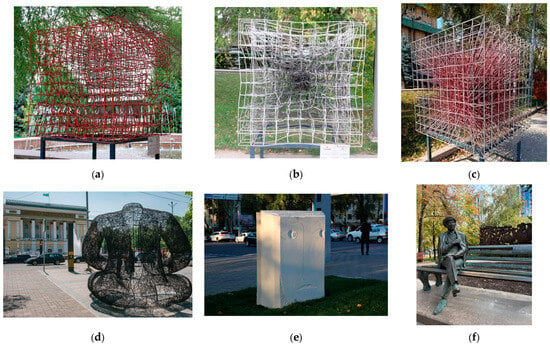
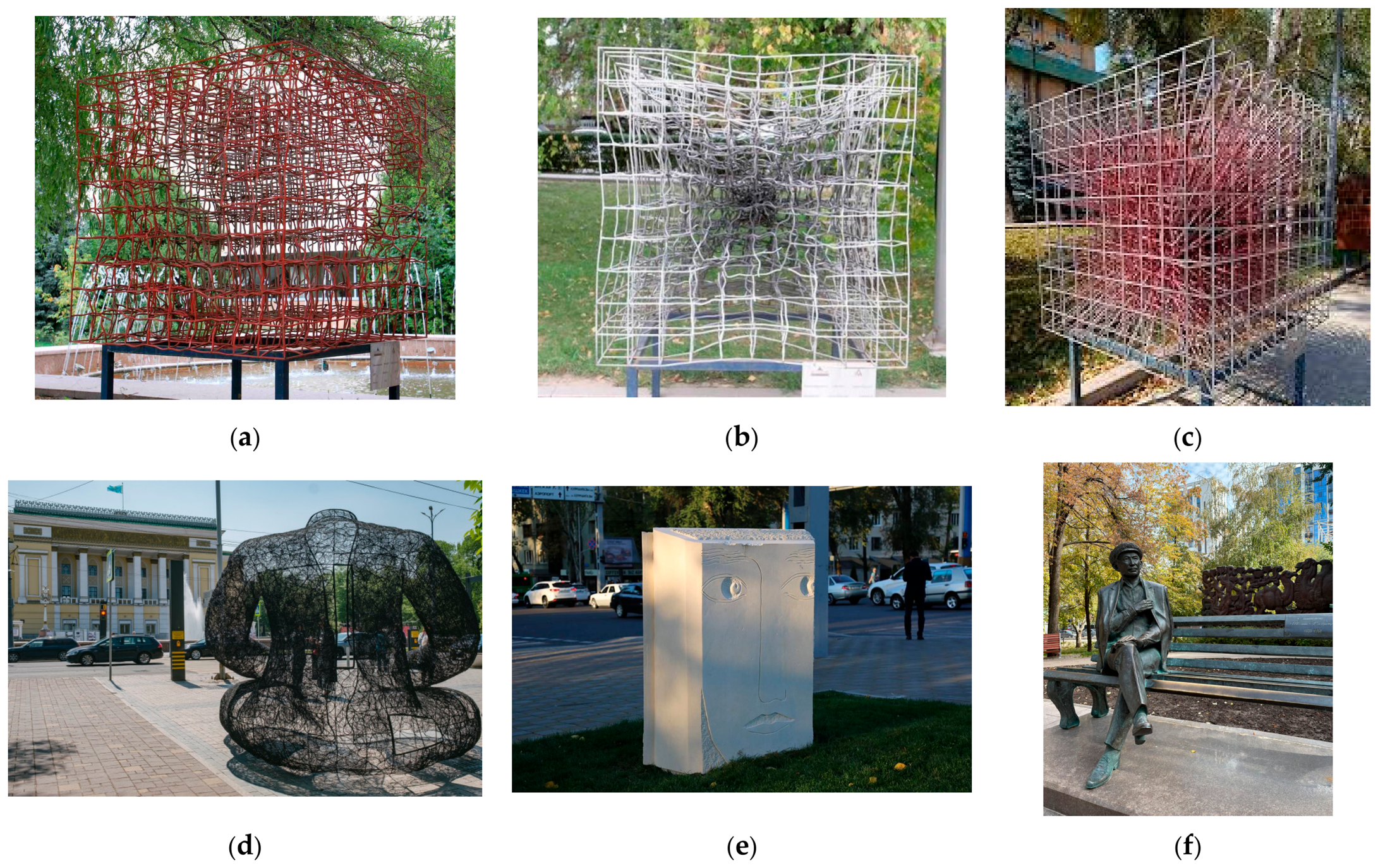
The analysis of four contemporary sculptural works in Almaty revealed different relationships between sculptural form, architectural surroundings, landscape, and public space. The selected works represent contrasting approaches to spatial organization, ranging from open geometric structures and large-scale symbolic compositions to compact figurative objects and memorial sculpture incorporating an element of urban furniture (Table 1; Figure 1). From the broader theoretical perspective provided by the Expanded Field concept (Krauss 1979), these relationships demonstrate how sculptural works can extend beyond the boundaries of an autonomous artistic object and establish visual, spatial, symbolic, or functional connections with their urban surroundings. In the selected cases, these connections are expressed through the organization of sculptural volumes, their relationship with adjacent buildings and pedestrian spaces, and opportunities for interaction with the public. The comparative analysis indicates that the integration of architecture and sculpture cannot be reduced to a single spatial arrangement. The four works demonstrate different relationships between artistic form and urban context, including geometric, compositional, symbolic, and functional dimensions. However, the presence of spatial integration does not, by itself, establish the existence of sustained professional or institutional collaboration among the participants involved in creating these works. This distinction provides the basis for the subsequent historical and institutional analysis.
Figure 1.
Selected contemporary sculptural works in Almaty: (a–c) Six Moods of the Cube, Saken Narynov; (d) Qara Shapan, Syrlybek Bekbotayev; (e) The Book, Khurshed Khusenov; (f) Monument to Shamshi Kaldayakov, Kanat Beguliyev and co-authors. Photographs by the authors.
2.2. Transformation of Architectural–Artistic Collaboration in Kazakhstan
The historical and institutional analysis demonstrated that the transformation of architectural–artistic collaboration in Kazakhstan did not represent an immediate transition from a state-regulated system to a market-based model. During the late Soviet period, professional practice, specialized education, public design institutes, and creative organizations operated predominantly within a state institutional system (Baigozhina and Dauletbayeva 2025; International Educational Corporation n.d.b; Union of Architects of the Republic of Kazakhstan n.d.). During the 1990s, these structures underwent reorganization, while private and individual forms of professional practice gradually developed (Abdrassilova and Danibekova 2021; International Educational Corporation n.d.b). From the beginning of the twenty-first century, the professional environment became more diversified and included governmental and municipal institutions, private architectural and design organizations, creative studios, professional associations, independent practitioners, and educational institutions. This transformation is summarized in Table 1.
The diversification of the professional environment did not entail the complete disappearance of state mechanisms or automatically produce sustained interinstitutional collaboration. Rather, it reflected an increase in the number of actors and organizational forms involved in architectural and artistic production. The relationships among these actors therefore require separate analysis.
Table 1.
Transformation of Institutional Conditions for Architectural–Artistic Collaboration.
Overall, the diversification of Kazakhstan’s professional environment increased the range of actors involved in architectural and artistic production but did not, by itself, establish sustained interinstitutional collaboration.
2.3. Relationships Between Educational Institutions and Professional Practice
An analysis of the official websites of five organizations—the International Educational Corporation (IEC/KazGASA), the T. K. Zhurgenov Kazakh National Academy of Arts, Astana Genplan Research and Design Institute, Almatygenplan Research Institute, and Almaty Development Centre (ADC)—identified existing forms of interaction between educational institutions and professional practice (Table 2).
Table 2.
Forms of Interaction between Educational Institutions and Professional Organizations.
The analysis identified different levels of publicly documented interaction. The IEC/KazGASA website provides information on cooperation based on contracts, memoranda, and agreements, including joint educational and research initiatives (International Educational Corporation n.d.a). The official website of the T. K. Zhurgenov Kazakh National Academy of Arts publishes lists of agreements with organizations serving as providers of professional and research practice (T. K. Zhurgenov Kazakh National Academy of Arts n.d.). The reviewed pages of Astana Genplan presented information on the organization’s urban-planning, research, and project activities; however, no specific evidence of university partnerships or student participation in professional projects was identified (Astana Genplan Research and Design Institute n.d.). More specific forms of interaction between education and professional practice were identified on the websites of Almatygenplan and Almaty Development Centre. Almatygenplan documents the participation of architecture students in pre-graduation professional practice and the involvement of students in research on the city’s architectural heritage (Almatygenplan Research Institute n.d.a, n.d.b). Almaty Development Centre reports on the Design Review 2024 competition organized with the support of KazGASA and Almatygenplan, the participation of specialists from these organizations in master classes, interaction with KazGASA through the assessment of graduation projects and preparation of a cooperation memorandum, and a professional lecture delivered to students of the T. K. Zhurgenov Kazakh National Academy of Arts (Almaty Development Centre n.d.a, n.d.b, n.d.c). These materials confirm the existence of individual agreements, events, and joint initiatives but do not establish the continuity, long-term effectiveness, or institutional sustainability of such cooperation.
Overall, the website analysis indicates that links between education and professional practice are present but vary considerably in their degree of formalization and continuity. The documented evidence primarily concerns individual agreements, professional practice arrangements, competitions, lectures, workshops, and project-based initiatives rather than a permanent mechanism connecting architectural and artistic education with the full cycle of professional project development and implementation.
2.4. Interview Results: Interdisciplinary Collaboration and Institutional Barriers
Semi-structured interviews with 50 participants, including 20 academic staff members and 30 practicing professionals, were analyzed to examine attitudes toward interdisciplinary collaboration and the conditions affecting its implementation. The analysis focused on professional engagement, funded project opportunities, student participation, and institutional mechanisms connecting architectural and artistic education with professional practice (Table 3).
Table 3.
Interview Results on Interdisciplinary Collaboration and Institutional Barriers.
Because the written interview notes summarized the principal meanings of the participants’ oral responses rather than their exact wording, the findings below are presented as anonymized group-level paraphrases and not as direct quotations. The majority of practitioners indicated that governmental bodies and private clients usually engage architects and sculptors separately, thereby limiting their collaboration during the early stages of project development. The majority of academic participants associated the limited implementation of student projects with the absence of an actual client, insufficient funding, and insufficient cooperation between educational institutions and professional practice. Participants generally proposed establishing a permanent interdisciplinary workshop in which students, academic staff, practicing architects, sculptors, and artists could work jointly on actual urban projects with the involvement of professional organizations, commissioning bodies, and potential funding sources. Most participants supported the proposed workshop as a mechanism for bringing together education, professional practice, and commissioning bodies within a coordinated project process. The findings indicate differences between academic staff and practicing professionals in their perceptions of interdisciplinary collaboration. All academic participants (100%) expressed support for collaboration among architects, sculptors, artists, and designers, compared with 56.7% of practitioners. However, support for establishing an interdisciplinary design workshop was higher among practitioners (83.3%), suggesting greater interest in a specific organizational mechanism than in general expressions of support for collaboration. This difference may indicate that practitioners responded more positively to a concrete organizational mechanism involving defined participants and links to actual projects than to a general question about interdisciplinary collaboration. However, because the interviews were brief and qualitative, this difference should be treated as an interpretation rather than as a definitive causal explanation. Financial and implementation-related constraints were more frequently identified by academic staff. The lack of funded project commissions was reported by 85.0% of academic participants and 33.3% of practitioners, while limited funding for artistic components was identified by 100% and 16.7%, respectively. These differences suggest that financial barriers are particularly prominent from the perspective of educational institutions. The limited implementation of student design proposals was identified by all academic participants (100%) and 23.3% of practitioners. This issue is illustrated by student projects developed in response to external requests for small architectural forms and recreational spaces in Almaty, Shymkent, and Aktau. Although these assignments addressed actual urban sites, the resulting proposals were not implemented. The predominance of temporary and individually initiated forms of collaboration was identified by 75.0% of academic staff and 46.7% of practitioners. Meanwhile, the need for sustained cooperation between universities and professional organizations was emphasized by 100% and 50.0% of the respective groups. These results highlight the distinction between professional contacts established through individual initiatives and institutional arrangements capable of supporting continuous collaboration. Overall, the findings suggest that interdisciplinary collaboration is constrained not only by professional interest but also by the availability of funded commissions, opportunities for project implementation, and organizational mechanisms linking education with professional practice. The relatively high level of support for an interdisciplinary design workshop provides a basis for considering a more structured model of collaboration, provided that it is connected to actual projects, appropriate funding, and clearly defined professional responsibilities.
2.5. Institutional Relationships Between Education, Professional Practice, and Public Authorities
The combined analysis of institutional relationships and interview findings revealed three interconnected groups of actors involved in architecture–sculpture collaboration: educational institutions, professional organizations, and public authorities or other commissioning bodies. Their respective roles differ in terms of knowledge production, project development, financing, and implementation. Educational institutions contribute through architectural and artistic training, conceptual design, interdisciplinary experimentation, and the involvement of students and academic staff. Professional organizations provide technical expertise, project management, regulatory coordination, and experience in implementing architectural and urban design solutions. Public authorities and private clients influence project priorities, commissioning procedures, financial resources, and decisions concerning implementation. These relationships can be interpreted through the Triple Helix framework, which emphasizes interactions among universities, industry, and government. In the Almaty context, however, the three groups do not necessarily operate as a continuously integrated system. Their interactions often emerge through individual projects, educational initiatives, professional contacts, and specific commissions. The interview results indicate that the principal institutional challenge lies in connecting educational and artistic initiatives with funded projects and implementation mechanisms. Although 85.0% of academic staff identified a lack of funded commissions, this issue was mentioned by 33.3% of practitioners. Furthermore, 75.0% of academic staff and 46.7% of practitioners identified the predominance of temporary or individually initiated collaboration. These differences suggest that educational and professional organizations encounter different constraints within the same institutional environment. A further distinction concerns the transition from conceptual design to implementation. Educational institutions may develop proposals responding to actual urban needs, but their realization depends on subsequent commissioning decisions, financial commitments, technical development, and professional responsibility. Consequently, the presence of an external client or a partnership agreement does not necessarily establish a continuous collaborative process. The findings therefore suggest that the main institutional gap is not the complete absence of connections between education and professional practice, but the limited integration of these connections into a coordinated project cycle. For architecture–sculpture collaboration, such integration would require the early involvement of artistic specialists, clearly defined responsibilities, access to funded commissions, and mechanisms connecting conceptual development with project implementation. Within this framework, a permanent interdisciplinary design workshop may be considered as a potential organizational interface between educational institutions, professional organizations, and commissioning bodies. In this study, the Expanded Field concept and the Triple Helix framework perform different analytical functions. The Expanded Field concept is used to interpret the observable spatial relationships among sculpture, architecture, landscape, and public space. The Triple Helix framework is applied to analyze the roles and interactions of educational institutions, professional organizations, and governmental, municipal, or private commissioning bodies. The spatial examples are not used as evidence of the specific institutional or professional processes through which the selected works were produced. Instead, they demonstrate the diversity of potential outcomes of architecture–sculpture integration, while the institutional analysis identifies the broader organizational conditions required for the systematic development and implementation of such projects. The two analytical strands are compared only at the interpretive stage and jointly inform the proposed workshop model. Its proposed structure and functions are presented in the following subsection.
2.6. Conceptual Model of an Interdisciplinary Architecture–Sculpture Workshop
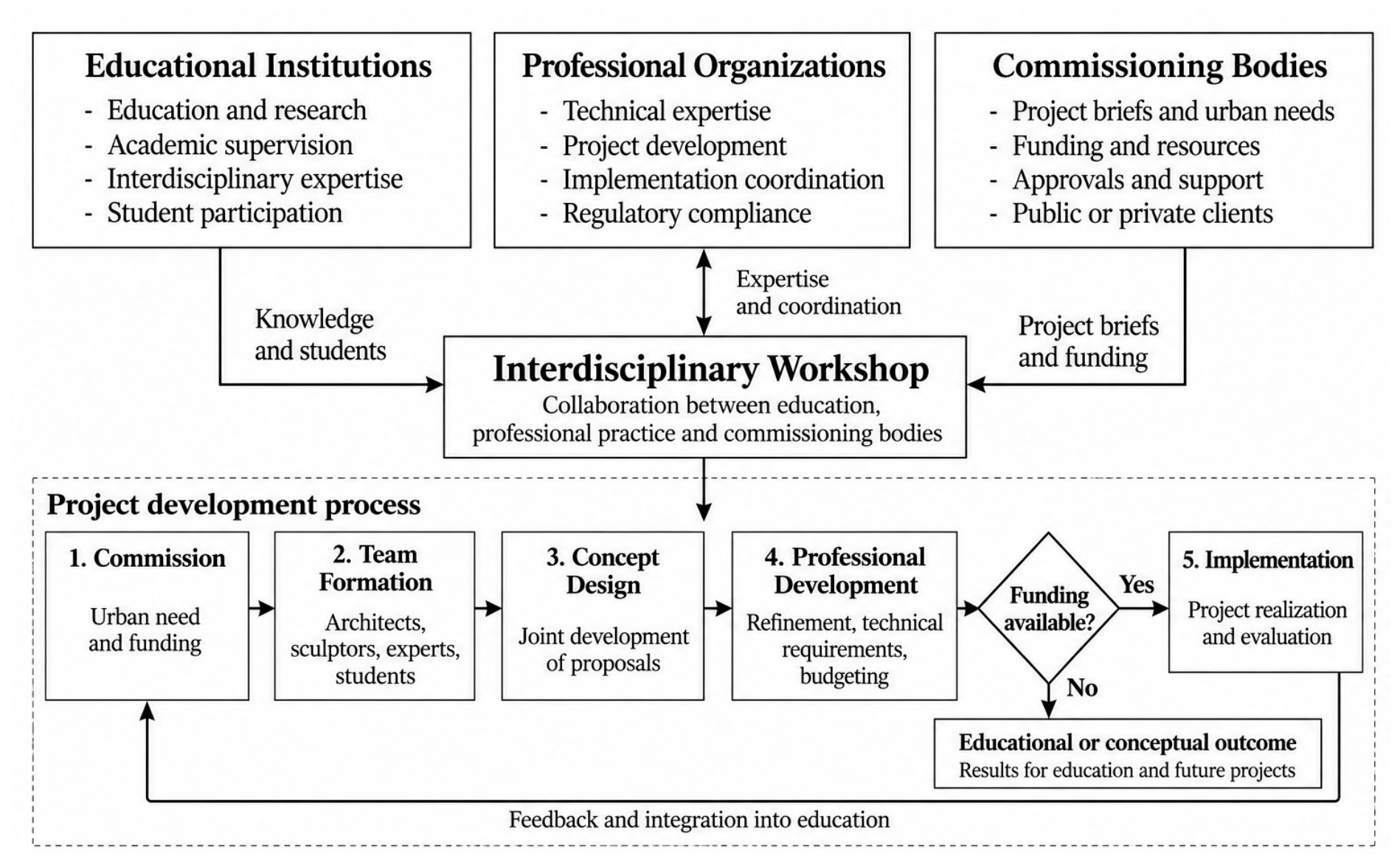
Based on the institutional analysis and interview findings, a conceptual model of an interdisciplinary architecture–sculpture workshop was developed as a potential mechanism for connecting architectural and artistic education with professional design practice. The proposed model brings together three groups of participants: educational institutions, professional organizations, and commissioning bodies. Educational institutions provide academic supervision, interdisciplinary expertise, and opportunities for student participation. Professional organizations contribute technical knowledge, project development experience, and coordination of design and implementation processes. Public authorities and private clients provide project briefs, establish implementation requirements, and determine potential funding arrangements. Unlike conventional educational workshops organized around short-term assignments, the proposed structure is intended to support continuity between conceptual development and professional project implementation. The main features of the proposed workshop were derived directly from the institutional analysis and interview findings. Table 4 shows how the principal identified barriers informed the corresponding elements of the conceptual model.
Table 4.
Relationship between the identified barriers and the features of the proposed workshop model.
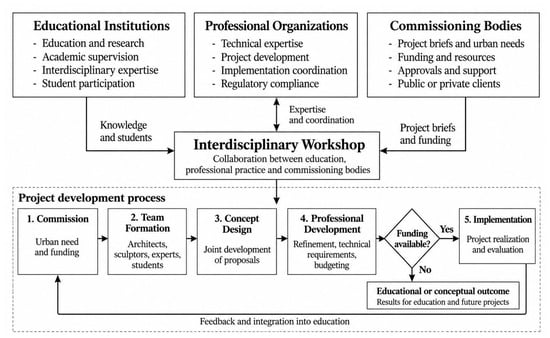
Its operation is organized around five interconnected stages (see Figure 2):
Figure 2.
Conceptual model of an interdisciplinary architecture–sculpture workshop connecting educational institutions, professional organizations, and commissioning bodies.
Project initiation: identification of an actual urban design need, a commissioning body, and potential funding.
Interdisciplinary team formation: involvement of architects, sculptors, artists, designers, academic staff, students, and relevant technical specialists.
Conceptual development: preparation and joint evaluation of architectural and artistic proposals.
Professional design development: refinement of selected proposals in accordance with technical requirements, available budgets, and implementation conditions.
Implementation and feedback: participation in project realization, where commissioned and funded, followed by evaluation and integration of professional experience into educational activities.
A central feature of the model is the distinction between educational participation and professional responsibility. Students may contribute to research, conceptual design, visualization, and selected design tasks under supervision, while authorized professional organizations retain responsibility for technical documentation, regulatory compliance, and implementation. The model also incorporates a funding-related decision point. If a project lacks an approved commission or sufficient resources, its outcomes remain educational or conceptual rather than being presented as an implemented urban intervention. This distinction responds directly to the gap identified between student design proposals and their subsequent realization.
The proposed workshop is therefore conceived not as an additional educational event but as an organizational interface capable of coordinating participants, resources, and project stages. Its potential contribution lies in creating conditions for sustained interdisciplinary collaboration while preserving the distinct responsibilities of educational institutions, professional practitioners, and commissioning bodies. Support for establishing an interdisciplinary design workshop was expressed by all 20 academic participants and by 25 of the 30 practitioners, indicating a perceived need for such an organizational mechanism among the study participants. However, the model remains a conceptual proposal derived from the institutional analysis and interview findings; it has not been independently validated or tested through an implemented project. Its practical effectiveness therefore requires future pilot implementation and empirical evaluation.
3. Discussion
The findings demonstrate that architecture–sculpture collaboration should be examined at three interconnected levels: spatial, professional, and institutional. The analysis of four sculptural works in Almaty, informed by the Expanded Field framework (Krauss 1979), revealed different relationships between sculpture, architecture, landscape, and public space, consistent with previous research on the evolving boundaries of artistic and spatial practices (Cucuzzella et al. 2020; Duque 2014; Kolesnikov et al. 2026; Marcos et al. 2024; Novickas 2011; Staessen et al. 2024). The selected works illustrate how sculptural form may contribute to the organization and perception of urban space through geometric structures, symbolic compositions, architectural-like forms, and functional elements. However, spatial integration does not necessarily imply sustained professional collaboration. As emphasized by Wróbel (2019), artistic interventions in public spaces require dialogue between creative and planning professions. The present study extends this perspective by distinguishing individual professional contacts and temporary project-based cooperation from institutionalized collaboration. The spatial characteristics of the selected works provide evidence of different forms of integration into the urban environment but do not independently establish the organizational mechanisms through which these works were created. Accordingly, the spatial analysis and the professional–institutional analysis should be understood as complementary but independent strands: the former characterizes spatial relationships, whereas the latter examines broader organizational conditions without reconstructing the production history of each selected work. The historical analysis identified a gradual transformation from a predominantly state-regulated late Soviet system, through the institutional reorganization of the 1990s, to a more diversified professional environment involving educational institutions, professional organizations, governmental and municipal authorities, private practices, and independent specialists (Abdrassilova and Danibekova 2021; Baigozhina and Dauletbayeva 2025; International Educational Corporation n.d.b; Union of Architects of the Republic of Kazakhstan n.d.). Although these relationships can be interpreted through the Triple Helix framework (Etzkowitz and Leydesdorff 2000; Etzkowitz et al. 2000), the presence of institutional actors does not automatically ensure coordinated project development. The interviews revealed a gap between professional interest and the conditions required for effective collaboration. Academic participants placed greater emphasis on the lack of funded commissions, limited implementation opportunities, and the temporary character of cooperation, whereas practitioners showed stronger support for the proposed workshop as a specific organizational mechanism. These findings indicate that educational and professional actors perceive institutional and financial barriers differently. The limited implementation of student proposals further illustrates the gap between educational experimentation and professional practice. Although students developed concepts for actual urban sites in Almaty, Shymkent, and Aktau, these projects were not implemented. This finding complements research on design studios, live projects, and university–industry collaboration (Anderson and Priest 2012; Bergström 2014; Fowles 1984; Madan and Mathur 2025; Milovanović et al. 2026; Rodriguez et al. 2018; Salama et al. 2026; Smith et al. 2026; Vignati et al. 2025) by emphasizing the importance of continuity between conceptual development and implementation. The proposed interdisciplinary architecture–sculpture workshop addresses this gap by connecting educational institutions, professional organizations, and commissioning bodies within a coordinated project process. Combining the Expanded Field and Triple Helix perspectives, the model links spatial integration with the institutional conditions of project development. The contribution of the study lies not in proposing a new spatial classification or modifying the Triple Helix framework, but in using these perspectives as complementary analytical lenses to distinguish spatial outcomes from the professional and institutional conditions of their production. This distinction extends previous studies by bringing spatial, professional, and institutional dimensions into a coordinated analytical framework while preserving their empirical independence. Its distinctive feature is the emphasis on funded commissions, professional responsibilities, and continuity from concept design to potential implementation. The workshop remains a conceptual proposal rather than an implemented and tested organizational mechanism. Its practical effectiveness therefore cannot be established from the present study and requires subsequent evaluation through actual interdisciplinary projects. The study is limited to Almaty, four selected sculptural works, five organizations, and 50 experienced specialists. The selected works illustrate contrasting forms of spatial integration but are not intended to represent all contemporary sculpture in Almaty. The selection of the four works was purposive and was intended to compare contrasting spatial relationships rather than provide a comprehensive inventory of contemporary sculpture in the city. The spatial analysis was based on on-site field observation and photographic documentation by the authors. Similarly, the interview findings are not statistically representative of the wider professional community. Future research should test the proposed model through an implemented interdisciplinary urban project, assessing institutional coordination, financing, professional collaboration, and spatial outcomes. The interviews were brief and were documented through contemporaneous written notes rather than audio-recorded verbatim transcripts. Consequently, the analysis captured the principal meanings and recurring themes in the participants’ responses but could not preserve the full wording, detail, or conversational context of each statement. These conditions limit the depth of the qualitative interpretation and do not permit detailed discourse analysis.
4. Materials and Methods
4.1. Research Design
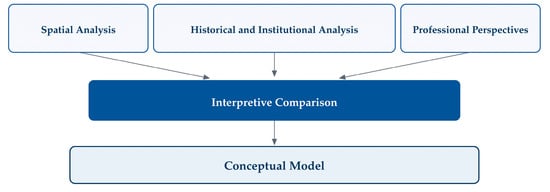
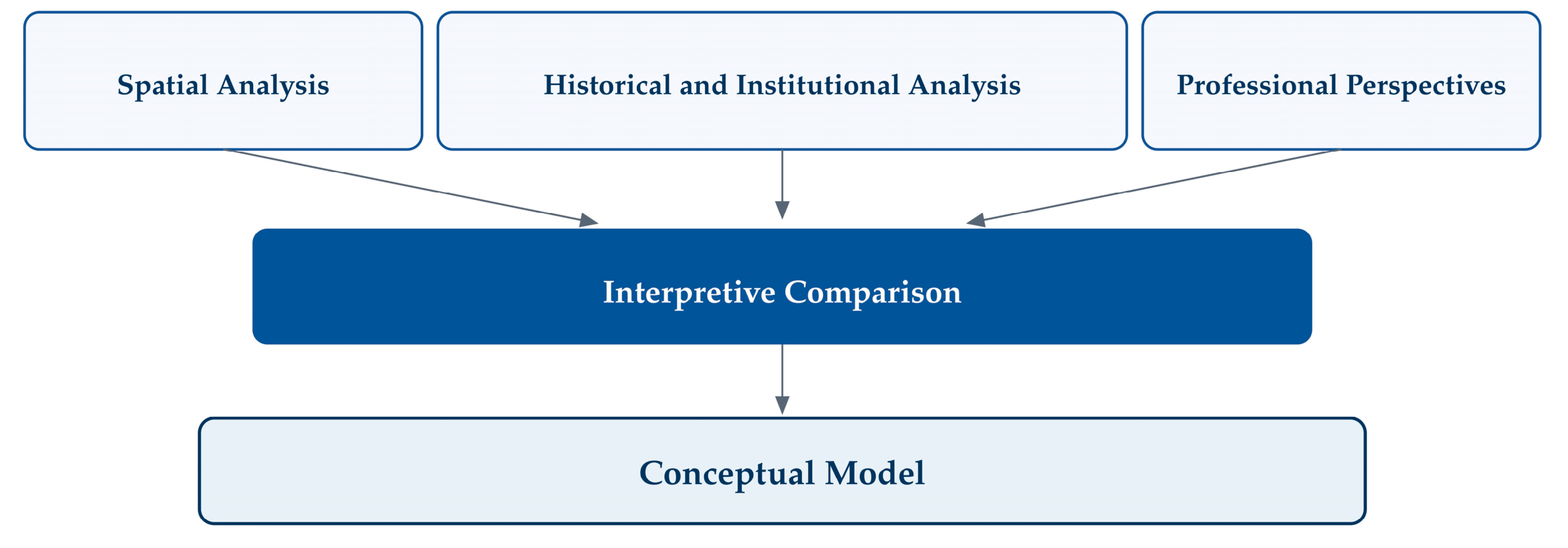
The study aimed to examine the interaction between architecture and sculpture in the contemporary urban environment of Almaty and the professional and institutional mechanisms supporting this interaction. Almaty was selected as a case study because it is a major architectural and cultural center of Kazakhstan, bringing together specialized educational institutions, professional organizations, and contemporary forms of art integration into the urban environment. A qualitative multi-stage research design was employed, comprising: (1) spatial analysis of four contemporary sculptural works; (2) historical–institutional analysis; (3) analysis of the official online resources of specialized educational and professional organizations; and (4) semi-structured interviews. The study addressed three analytical levels: spatial, professional, and institutional–educational. These levels were examined as complementary but empirically independent analytical strands. The spatial analysis characterized the observable relationships between the selected sculptural works and their architectural, landscape, and public-space settings; it did not reconstruct the commissioning, design, or professional collaboration processes associated with each work. The professional and institutional–educational strands were examined separately using historical and institutional sources, official organizational materials, and interviews. The spatial level was interpreted using the Expanded Field (Krauss 1979), while the institutional level was interpreted through the Triple Helix framework (Etzkowitz and Leydesdorff 2000; Etzkowitz et al. 2000). The three strands were brought together only at the interpretive stage to compare spatial outcomes with the broader professional and institutional conditions of architecture–sculpture collaboration and to inform the development of the conceptual model (Figure 3).
Figure 3.
Research design: complementary spatial, historical–institutional, and professional analytical strands informing the conceptual model.
4.2. Spatial Analysis
Four contemporary sculptural works in Almaty were selected for qualitative comparative analysis: Six Moods of the Cube by Saken Narynov, Qara Shapan by Syrlybek Bekbotayev, The Book by Khurshed Khusenov, and the Monument to Shamshi Kaldayakov by Kanat Beguliyev and co-authors. The selection was purposive and was guided by the location of the works in publicly accessible urban spaces, their relationships with the surrounding architectural and landscape environment, and the diversity of their sculptural forms and spatial configurations. The selected works provided contrasting examples of geometric, symbolic, figurative, memorial, and functional approaches to sculpture in public space. They also differed in their dates of creation or installation, materials, scale, artistic language, spatial organization, and commissioning or installation contexts. The sample was not intended to represent all contemporary sculpture in Almaty; rather, it was used for a qualitative comparative analysis of contrasting spatial relationships.
Information on the location, materials, spatial organization, and relationships with the surrounding environment was obtained through on-site field observation and photographic documentation by the authors. The dates of creation or installation, authorship, and commissioning circumstances were verified using the identification plaques located at the sites. Six Moods of the Cube by Saken Narynov is a series of metal spatial constructions created during the COVID-19 pandemic and installed in the open-air sculpture park of the Kasteyev National Museum of Arts in 2023. The work is located in the main entrance area of the museum at 22/1 Koktem-3 Microdistrict, Almaty. The series was donated by the artist to the museum and incorporated into its open-air sculpture park. Each element measures approximately 1.5 m in width and 1.5 m in height, based on measurements taken during the field survey. Qara Shapan by Syrlybek Bekbotayev is a woven metal sculpture installed in Almaty in 2023. It is located at the intersection of Panfilov and Kabanbay Batyr Streets, opposite the Abay Kazakh National Opera and Ballet Theatre. The sculpture measures approximately 2 m in width and 2 m in height, based on measurements taken during the field survey. The Almaty version was created for the public space with the assistance of Kazakh patrons and the support of the Almaty municipal authorities.
The Book by Khurshed Khusenov is a travertine sculpture installed in 2018 on the western side of Nazarbayev Avenue near its intersection with Abay Avenue. It was created during an international sculpture plein air and subsequently installed in the pedestrian public space. The sculpture measures approximately 0.5 m in width and 0.8 m in height, based on measurements taken during the field survey.
The Monument to Shamshi Kaldayakov by Kanat Beguliyev and co-authors was unveiled on 7 November 2019. The bronze composition, mounted on a granite base, is located in the park on the northern side of the Palace of the Republic, between the Palace of the Republic and the Kazakhstan Hotel. The composition measures approximately 2 m in length and 0.8 m in height, based on measurements taken during the field survey. The project was selected through a competition and designed as an accessible memorial composition incorporating a bench.
Rosalind Krauss’s Expanded Field concept (Krauss 1979) was used as a broad theoretical perspective for examining relationships among sculpture, architecture, landscape, and site. The study did not operationalize Krauss’s original categories—sculpture, marked sites, axiomatic structures, and site-constructions—as a strict classification system. Instead, the analysis employed author-defined descriptive characteristics to compare the observable forms of spatial integration represented by the selected works. These descriptive characteristics should not be interpreted as new or modified categories of Krauss’s Expanded Field. Accordingly, the comparative analysis examined four characteristics: (1) form-making and spatial organization; (2) relationships with architectural and landscape surroundings; (3) integration into public space; and (4) the resulting character of spatial integration. The findings are summarized in Table 5.
Table 5.
Spatial Characteristics of the Selected Sculptural Works.
The analysis was limited to the observable spatial relationships between the sculptural works and their urban settings. It did not seek to reconstruct the commissioning bodies, design processes, institutional arrangements, or professional collaborations associated with the production of each individual work. The professional and institutional strands therefore constitute complementary but independent analyses of the broader conditions of architecture–sculpture collaboration rather than case-specific reconstructions of the four selected works.
4.3. Historical–Institutional Analysis
The transformation of architectural–artistic collaboration in Kazakhstan was examined across three interconnected periods: the late Soviet period, the post-Soviet transition from 1991 to 2000, and the development of a more diversified professional environment from the beginning of the twenty-first century to the present. The year 2000 is not treated as the date of an immediate institutional change. Rather, it is used as an analytical reference point separating the first decade of post-Soviet transformation from the subsequent development of governmental, municipal, private, and independent forms of professional activity. During the late Soviet period, architectural and artistic production in Kazakhstan was organized predominantly through state commissions, public design institutes, creative unions, and specialized educational institutions. The Union of Architects of Kazakhstan, established in 1936, brought together regional branches, design institutes, scientific organizations, and state architectural bodies (Union of Architects of the Republic of Kazakhstan n.d.). Architectural education was initially provided within the Kazakh Polytechnic Institute: the first students were admitted to the architecture program in 1961, and a specialized School of Architecture was established in 1966. In 1980, the Almaty Institute of Architecture and Civil Engineering was established on the basis of the existing architectural and construction faculties (International Educational Corporation n.d.b). These documented developments demonstrate the existence of an institutionally organized system of professional practice and specialized education in Soviet Kazakhstan (Union of Architects of the Republic of Kazakhstan n.d.; International Educational Corporation n.d.b; Baigozhina and Dauletbayeva 2025). After Kazakhstan gained independence in 1991, state and professional institutions began operating under new political and economic conditions. During the 1990s, educational and professional structures underwent institutional reorganization, while private architectural practices, design companies, and independent professional activity gradually developed (Abdrassilova and Danibekova 2021; International Educational Corporation n.d.b). At the same time, state design organizations, creative unions, and specialized educational institutions continued to play important roles. From the beginning of the twenty-first century, the professional environment became increasingly diversified. Governmental and municipal organizations operated alongside private architectural and design firms, independent practitioners, creative studios, professional associations, and educational institutions (Abdrassilova and Danibekova 2021). However, the presence of a broader range of actors and organizational forms did not necessarily result in sustained interinstitutional collaboration. Research on university–industry partnerships in Kazakhstan indicates that such relationships have developed but remain affected by institutional, financial, and organizational constraints (Jonbekova et al. 2020).
The analysis focused on commissioning mechanisms, the organization of professional practice and specialized education, and forms of interaction among architects, sculptors, artists, and other creative professionals. Particular attention was paid to changes in the roles of state and municipal organizations, private architectural and design firms, independent creative studios, professional associations, and educational institutions. In this study, documented institutional changes—including the establishment and reorganization of educational institutions, the development of professional organizations, and changes in specialized education—are distinguished from the authors’ broader interpretation of architectural–artistic transformation. The transition from a predominantly centralized system to a more diversified professional environment is therefore presented as an analytical synthesis of the available sources (Avdieieva and Avdieieva 2019; Kuberlinov 2021; Oržikauskas 2022; Petrenko 2016; Rohotchenko 2019; Union of Architects of the Republic of Kazakhstan n.d.; International Educational Corporation n.d.b; Abdrassilova and Danibekova 2021; Baigozhina and Dauletbayeva 2025), rather than as evidence of the complete disappearance of state mechanisms or their immediate replacement by private forms of professional activity.
4.4. Analysis of the Educational and Professional Environment
The analysis of official websites was conducted in August 2026 and covered five educational and professional organizations: the International Educational Corporation (IEC/KazGASA), the T. K. Zhurgenov Kazakh National Academy of Arts, Astana Genplan Research and Design Institute, Almatygenplan Research Institute, and Almaty Development Centre (ADC). For each organization, the sections “About,” “News,” “Cooperation,” “Partners,” “Professional Practice,” “Projects,” “Research,” “Competitions,” “Internships,” and “Educational Initiatives” were reviewed where such sections were available.
The manual review of the websites was supplemented by a targeted keyword search restricted to the organizations’ official domains. Searches were conducted in Russian, Kazakh, and English using the following keywords and their semantic equivalents: “cooperation,” “memorandum,” “agreement,” “partnership,” “professional practice,” “internship,” “students,” “university,” “academy,” “joint project,” “research,” “competition,” “workshop,” “master class,” and “lecture.”
Only materials published on the official websites of the selected organizations and documenting a specific form of interaction between educational institutions and professional organizations were included. Eligible materials comprised signed agreements or memoranda, joint projects, professional practice or internship arrangements, competitions, workshops, lectures, research initiatives, and the participation of students or academic staff in professional activities. General statements expressing an intention to cooperate, without reference to a specific event, document, or activity, were excluded as evidence of established institutional interaction.
For each included record, the name of the organization, the exact webpage address, the type of interaction, the participating institutions or groups, the nature of the activity, and the access period were recorded. The absence of specific information on cooperation from the reviewed pages was also documented. The presence of an agreement or an individual event was treated as documentary evidence of a particular form of interaction, but not as evidence of its duration, effectiveness, or systematic character. The findings therefore describe only publicly documented institutional relationships available on the official websites at the time of the analysis.
4.5. Semi-Structured Interviews
In 2026, face-to-face semi-structured interviews were conducted with 50 experienced specialists selected through purposive sampling: 20 academic staff members from the International Educational Corporation (IEC/KazGASA) and the T. K. Zhurgenov Kazakh National Academy of Arts, and 30 practitioners from Astana Genplan Research and Design Institute, Almatygenplan Research Institute, and Almaty Development Centre (ADC). The academic group included 12 representatives of IEC/KazGASA—architects and artists who teach sculpture to architecture students—and eight sculptors from the T. K. Zhurgenov Kazakh National Academy of Arts. The difference in participant numbers reflects the larger number of students and academic staff in the architectural programs of IEC/KazGASA compared with the sculpture program of the Zhurgenov Academy, where student enrolment remains limited. The exact professional distribution of the 30 practitioners was not recorded because architectural and urban projects are undertaken by interdisciplinary teams comprising architects, sculptors, artists, designers, urban planners, and other specialists. The inclusion criterion of more than 20 years of professional experience ensured participants’ familiarity with architectural–artistic practice and institutional relationships. The sample was designed to compare educational and professional perspectives rather than achieve statistical representativeness. Participants were invited individually based on their professional experience and direct involvement in architectural, artistic, educational, or urban-planning activities. There were no refusals to participate. Interviews lasted approximately 10 min and were conducted orally in Kazakh using open-ended questions without predetermined response options. The researcher prepared contemporaneous written notes summarizing the principal meaning of each response. The interviews were not audio-recorded, and the written notes were not verbatim transcripts. The complete set of interview records was not translated into English; only the anonymized paraphrases included in the manuscript were translated. Before each interview, participants were informed about the purpose of the study, the voluntary nature of participation, their right to decline to answer any question or discontinue the interview, and the confidential and anonymous use of their responses. Each participant provided verbal informed consent, and the consent response was recorded in writing by the researcher. The English translation of the verbal informed consent script was submitted to the journal as supplementary documentation. The participants were asked the following seven questions:
- How do you assess the interaction among architects, sculptors, and artists in the development of architectural and urban projects?
- What role do state, municipal, and private commissions play in such collaboration?
- How is collaboration between educational institutions and professional organizations currently organized?
- How is specialists’ teaching activity connected with their professional practice?
- Do students participate in real projects, and are their proposals implemented?
- What organizational and financial barriers limit interdisciplinary collaboration?
- Could a permanent architecture–sculpture workshop improve collaboration between education and professional practice? The interviews focused on differences between academic and professional perspectives, particularly individual cooperation versus sustained institutional collaboration.
4.6. Data Analysis
The written records of the oral interview responses were analyzed using a combination of deductive and inductive thematic analysis. The responses were coded by two authors. They initially coded the written records independently, compared their coding results, and discussed any disagreements until consensus was reached. The deductive component was informed by the seven topics of the semi-structured interview guide, while the inductive component focused on recurring issues and perspectives identified in participants’ responses. The seven analytical categories were developed in two stages. First, the two authors used the topics of the interview guide as a preliminary deductive framework. Second, this framework was refined by comparing the initial codes with recurring issues and perspectives identified in the participants’ recorded responses. Codes with similar meanings were combined, while categories that were not sufficiently supported by the responses were excluded. The final categories were agreed upon by the two coders after discussing coding differences and reflected both the interview questions and the recurring themes identified in the data. The analysis distinguished between academic staff (n = 20) and practicing professionals (n = 30). The interview findings were organized into seven analytical categories: support for interdisciplinary collaboration; lack of funded project commissions; limited funding for artistic components of projects; limited implementation of student design proposals; predominance of temporary and individually initiated collaboration; need for sustained cooperation between universities and professional organizations; and support for establishing an interdisciplinary design workshop. For each category, the number of participants whose responses contained the corresponding theme was recorded. Repeated references to the same theme by one participant were counted only once. A value of 100% indicated that the theme was identified in the responses of all 20 participants in the academic group. Specifically, all academic participants supported interdisciplinary collaboration and identified limited funding for the artistic components of projects. These values reflect the responses of the purposively selected sample and should not be interpreted as representative of the entire professional community in Kazakhstan. For each analytical category, the frequency of responses was determined separately for academic staff and practitioners. The results were presented as absolute numbers (n) and percentages (%) calculated relative to the number of participants in each group. As participants could identify multiple issues, the analytical categories were not mutually exclusive, and their percentages did not sum to 100%. Institutional relationships were interpreted through the Triple Helix framework (Etzkowitz and Leydesdorff 2000; Etzkowitz et al. 2000), with particular attention to the distinction between individually initiated professional cooperation and institutionalized collaboration. The findings from the spatial, historical–institutional, organizational, and interview analyses were compared at the interpretive stage without treating the institutional evidence as an explanation of how the four selected sculptural works were commissioned or produced. Their combined contribution was used to identify the broader spatial, professional, and institutional requirements informing the conceptual model of an interdisciplinary architecture–sculpture workshop presented in Section 2.6. Participants’ views on the proposed interdisciplinary workshop were analyzed as part of their responses to the seventh interview question. These responses were used to identify the perceived need for the workshop and to inform its proposed functions and organizational structure. They were not treated as an independent validation or as evidence of the model’s practical effectiveness.
5. Conclusions
This study examined architecture–sculpture collaboration in Almaty through three interconnected dimensions: spatial integration, professional interaction, and institutional relationships. The analysis of four contemporary sculptural works, the historical and institutional context, and interviews with 50 specialists revealed a discrepancy between the potential for interdisciplinary collaboration and the organizational conditions required for its implementation. The spatial analysis demonstrated that sculpture interacts with the architectural and urban environment through different forms of geometric, compositional, symbolic, and functional integration. However, the presence of spatial relationships between architecture and sculpture does not necessarily indicate sustained professional collaboration or established institutional mechanisms supporting the creation of such works. The findings indicate that cooperation between architects, sculptors, educational institutions, and professional organizations remains largely dependent on individual initiatives, temporary partnerships, and available project commissions. Although participants expressed support for interdisciplinary collaboration, limited funding and the absence of sustained institutional mechanisms constrain the transition from conceptual design to implemented urban projects. The principal scientific contribution of the study lies in bringing spatial, professional, and institutional perspectives into a coordinated analytical framework while preserving their empirical independence. Building on the Expanded Field and Triple Helix approaches, the study demonstrates the importance of distinguishing the spatial integration of artistic and architectural forms from the professional and institutional relationships involved in their creation. Based on these findings, a conceptual model of an interdisciplinary architecture–sculpture workshop is proposed as a potential mechanism for connecting education, professional practice, and commissioning bodies. The model emphasizes interdisciplinary coordination, clearly defined professional responsibilities, and continuity between conceptual development and project implementation. Its practical effectiveness remains to be established through future pilot projects and empirical evaluation.
Author Contributions
Conceptualization, T.A. and D.A.; methodology, T.A. and D.A.; validation, L.N. and M.K.; formal analysis, M.M. and L.N.; investigation, T.A., M.M. and M.K.; resources, M.M. and M.K.; data curation, L.N.; writing—original draft preparation, T.A. and D.A.; writing—review and editing, D.A. and L.N.; visualization, T.A. and M.M.; supervision, D.A.; project administration, D.A. All authors have read and agreed to the published version of the manuscript.
Funding
This research received no external funding.
Institutional Review Board Statement
The study was reviewed and approved by the Ethics Council of the T. K. Zhurgenov Kazakh National Academy of Arts (Protocol No. 15, dated 10 July 2026). The study involved voluntary interviews with adult professionals concerning their professional experiences and institutional collaboration. No sensitive personal information was collected, and the findings were presented anonymously and in aggregated form.
Informed Consent Statement
Verbal informed consent was obtained from all participants before the interviews. Verbal rather than written consent was used because the interviews were brief and concerned non-sensitive professional experiences, and the collection of names or signatures was avoided to preserve participant anonymity. Participants were informed about the purpose of the study, the voluntary nature of participation, their right to decline to answer any question or discontinue the interview, and the confidential and anonymous treatment of their responses. Consent responses were recorded in writing by the researcher. An English translation of the verbal informed consent script was provided to the journal as supplementary documentation.
Data Availability Statement
The data supporting the findings of this study are available from the corresponding author upon reasonable request. Individual interview responses are not publicly available to protect participant confidentiality.
Acknowledgments
The authors express their gratitude to the academic staff and practicing professionals who participated in the study and shared their experience of interdisciplinary collaboration in architecture, sculpture, and urban design. During the preparation of this manuscript, the authors used ChatGPT (GPT-4o, OpenAI) for English-language editing and improving the clarity of the text. The authors reviewed and edited all AI-assisted output and take full responsibility for the content of the publication.
Conflicts of Interest
The authors declare no conflicts of interest.
References
- Abdrassilova, Gulnara, and Elvira Danibekova. 2021. The Transformation of Modern Architecture in Kazakhstan: From Soviet “Internationalism” to Post-Soviet Understanding of the Regional Identity. Spatium 46: 73–80. [Google Scholar] [CrossRef] [Scilit]
- Almaty Development Centre. n.d.a. Design Review 2024 Competition Launched in Almaty for Aspiring Architects and Designers. Available online: https://almatydc.kz/press/news/v-almaty-startoval-konkurs-design-review-2024-dlya-nachinayuschih-ar… (accessed on 15 August 2026).
- Almaty Development Centre. n.d.b. Environmental Issues in Almaty Were Discussed at the Zhurgenov Academy of Arts. Available online: https://almatydc.kz/en/press/news/environmental-issues-in-almaty-were-discussed-at-the-zhurgenov-academy-of-arts (accessed on 15 August 2026).
- Almaty Development Centre. n.d.c. Representatives of Almaty Development Centre Visited KazGASA. Available online: https://almatydc.kz/en/press/news/representatives-of-jsc-almaty-city-development-center-visited-the-kazakh-leading-academy-of-architecture-and-civil-engineering-kazgasu (accessed on 15 August 2026).
- Almatygenplan Research Institute. n.d.a. Almatygenplan Conducts a Large-Scale Study of the City’s Historical and Architectural Heritage. Available online: https://www.almatygenplan.kz/ru/news/istoriko-arhitekturnogo-nasledia (accessed on 15 August 2026).
- Almatygenplan Research Institute. n.d.b. Architecture Students Gain Professional Experience at Almatygenplan. Available online: https://almatygenplan.kz/ru/news/studenty-architectory (accessed on 15 August 2026).
- Anderson, Jane, and Colin Priest. 2012. The Live Education of an Architect: John Hejduk and Oxford Brookes Year One Live Projects. Journal for Education in the Built Environment 7: 50–62. [Google Scholar] [CrossRef] [Scilit]
- Astana Genplan Research and Design Institute. n.d. Official Information on the Institute’s Urban-Planning and Research Activities. Available online: https://astgp.kz/?page_id=2609 (accessed on 15 August 2026).
- Avdieieva, Maryna, and Nataliia Avdieieva. 2019. Features of Synthesis of Arts in Soviet Architecture of Ukraine of the Twentieth Century. Current Problems of Architecture and Urban Planning 55: 14–24. [Google Scholar] [CrossRef] [Scilit]
- Baigozhina, Gulnar, and Lyazzat Dauletbayeva. 2025. History of Soviet Architecture in the Kazakh SSR. Bulletin of the Karaganda University History. Philosophy Series 3: 52–60. [Google Scholar] [CrossRef] [Scilit]
- Bergström, Anders. 2014. Architecture and the Rise of Practice in Education. Architectural Theory Review 19: 10–21. [Google Scholar] [CrossRef] [Scilit]
- Campens, Angelique. 2022. Béton Brut: André Bloc and the Architecture-Sculpture Debate. Ph.D. thesis, Ghent University, Faculty of Engineering and Architecture, Ghent, Belgium. [Google Scholar]
- Cappeller, Riccarda. 2024. Artistic Interventions for Urban Innovation: Comparing New Forms of Engagement in Public Space by Two Local Initiatives. Cities 147: 104792. [Google Scholar] [CrossRef] [Scilit]
- Cucuzzella, Carmela, Jean-Pierre Chupin, and Cynthia Hammond. 2020. Eco-Didacticism in Art and Architecture: Design as Means for Raising Awareness. Cities 102: 102728. [Google Scholar] [CrossRef] [Scilit]
- Duque, Félix. 2014. Public Art and the Making of Urban Space. City, Territory and Architecture 1: 4. [Google Scholar] [CrossRef] [Scilit]
- Etzkowitz, Henry, and Loet Leydesdorff. 2000. The Dynamics of Innovation: From National Systems and ‘Mode 2’ to a Triple Helix of University–Industry–Government Relations. Research Policy 29: 109–23. [Google Scholar] [CrossRef] [Scilit]
- Etzkowitz, Henry, Andrew Webster, Christiane Gebhardt, and Branca Regina Cantisano Terra. 2000. The Future of the University and the University of the Future: Evolution of Ivory Tower to Entrepreneurial Paradigm. Research Policy 29: 313–30. [Google Scholar] [CrossRef] [Scilit]
- Fowles, Bob. 1984. Design-Build Projects in Architectural Education. Design Studies 5: 7–14. [Google Scholar] [CrossRef] [Scilit]
- Hall, Tim, and Iain Robertson. 2001. Public Art and Urban Regeneration: Advocacy, Claims and Critical Debates. Landscape Research 26: 5–26. [Google Scholar] [CrossRef] [Scilit]
- Hoop, Marie, Volker Kirchberg, Merav Kaddar, Nir Barak, and Avner de-Shalit. 2022. Urban Artistic Interventions: A Typology of Artistic Political Actions in the City. City, Culture and Society 29: 100449. [Google Scholar] [CrossRef] [Scilit]
- International Educational Corporation. n.d.a. International Cooperation. Available online: https://iec.edu.kz/en/ (accessed on 15 August 2026).
- International Educational Corporation. n.d.b. School of Architecture: Brief History of the School. Available online: https://kazgasa.edu.kz/en/school-of-architecture/ (accessed on 15 August 2026).
- Jonbekova, Dilrabo, Jason Sparks, Matthew Hartley, and Gulfiya Kuchumova. 2020. Development of University–Industry Partnerships in Kazakhstan: Innovation under Constraint. International Journal of Educational Development 79: 102291. [Google Scholar] [CrossRef] [Scilit]
- Juarranz Serrano, Angela. 2026. Pepsi Pavilion by Experiments in Art and Technology (1970): Architectural, Urban, and Interdisciplinary Impact. City, Territory and Architecture 13: 14. [Google Scholar] [CrossRef] [Scilit]
- Kolesnikov, Sergey An, Stepan O. Karslyn, and Galina A. Travkina. 2026. Synthesis of Sculpture and Architecture in the Modern Space of Russia: A Sculptor’s View. Urban Construction and Architecture 16: 123–29. [Google Scholar] [CrossRef] [Scilit]
- Krauss, Rosalind. 1979. Sculpture in the Expanded Field. October 8: 30–44. [Google Scholar] [CrossRef] [Scilit]
- Kuberlinov, Basan. 2021. Soviet Architecture, Kazakh Nationalist Sentiments and the Making of Soviet Kazakhstan, 1925–33: The Cases of Kyzylorda and the House of Government of the Kazakh ASSR in Almaty. Central Asian Survey 40: 57–75. [Google Scholar] [CrossRef] [Scilit]
- López-Bahut, Emma. 2013. Oteiza and the Construction of the Landscape: Interventions through Architecture during the 50’s. ZARCH, 104–115. [Google Scholar] [CrossRef] [Scilit]
- Madan, Amrita, and Manoj Mathur. 2025. The Evolving Relationship Between Architectural Practice and Education—1980s to 2020s: A Review. Journal of the Institution of Engineers (India): Series A 106: 965–89. [Google Scholar] [CrossRef] [Scilit]
- Marcos, Carlos L., Jorge Domingo-Gresa, and Roberta Spallone. 2024. Ideation of Form in Space: Strategies of Spatial Configuration in Sculpture and Architecture. Arte, Individuo y Sociedad 36: 415–32. [Google Scholar] [CrossRef] [Scilit]
- McCarthy, John. 2006. Regeneration of Cultural Quarters: Public Art for Place Image or Place Identity? Journal of Urban Design 11: 243–62. [Google Scholar] [CrossRef] [Scilit]
- Milovanović, Aleksandra, Mladen Pešić, Jelena Ristić Trajković, Milica Milojević, Ana Nikezić, Verica Krstić, and Vladan Djokić. 2026. A Comparative Evaluation Model for Design Studio Pedagogy: Linking Educational Objectives and Professional Readiness in Architectural Higher Education. Architecture 6: 7. [Google Scholar] [CrossRef] [Scilit]
- Novickas, Audrius. 2011. Search for New Meanings in the Expanded Field of Contemporary Architecture and Art. Journal of Architecture and Urbanism 35: 5–17. [Google Scholar] [CrossRef] [Scilit]
- Ochoa, Rita. 2022. The ‘Expo’ and the Post-‘Expo’: The Role of Public Art in Urban Regeneration Processes in the Late 20th Century. Sustainability 14: 985. [Google Scholar] [CrossRef] [Scilit]
- Oržikauskas, Gytis. 2022. The Issues of Cultural Heritagisation of Lithuanian Architectural Artworks of the Second Half of Twentieth Century. Menotyra 29: 259–73. [Google Scholar] [CrossRef] [Scilit]
- Petrenko, Sergey D. 2016. Synthesis of Monumental Art in the USSR Architecture in the Period from 1917 to 1932. Universum: Philology and Art Criticism 11. Available online: https://7universum.com/en/philology/archive/item/3907 (accessed on 18 November 2026).
- Potts, Alex. 2016. Henry Moore’s Public Sculpture in the US: The Collaborations with I.M. Pei. In British Art Studies. London and New Haven: Paul Mellon Centre for Studies in British Art and Yale University Press. [Google Scholar] [CrossRef] [Scilit]
- Rodriguez, Carolina, Roland Hudson, and Chantelle Niblock. 2018. Collaborative Learning in Architectural Education: Benefits of Combining Conventional Studio, Virtual Design Studio and Live Projects. British Journal of Educational Technology 49: 337–53. [Google Scholar] [CrossRef] [Scilit]
- Rohotchenko, Oleksii. 2019. Artistic Synthesis in Architectural Form, from the Totalitarian to Indifferent. National Academy of Managerial Staff of Culture and Arts Herald 1: 255–59. [Google Scholar] [CrossRef] [Scilit]
- Salama, Ashraf M., Madhavi P. Patil, and Selma Harrington. 2026. Global Patterns of Navigating Uncertainty in Architectural Education. Architecture 6: 49. [Google Scholar] [CrossRef] [Scilit]
- Smith, Sebastian, Karine Dupre, and Julie Crough. 2026. Architecture Live Projects: Learning from a 2-Year Action Research Study. International Journal of Technology and Design Education 36: 1793–827. [Google Scholar] [CrossRef] [Scilit]
- Staessen, Annelies, Antonio José Salvador, and Ingfrid Lyngstad. 2024. An Exploration of Artistic Expressions of Everyday Peri-Urban Landscapes as a Method of Socio-Spatial Analysis in Spatial Planning. Architecture 4: 124–47. [Google Scholar] [CrossRef] [Scilit]
- T. K. Zhurgenov Kazakh National Academy of Arts. n.d. Agreements and Memoranda with Professional Practice Providers. Available online: https://kaznai.kz/praktika-bazalary-boiynsa-kelisimsa/ (accessed on 15 August 2026).
- Union of Architects of the Republic of Kazakhstan. n.d. History of the Union of Architects of Kazakhstan. Available online: https://kazarch.kz/en/history/ (accessed on 15 August 2026).
- Vignati, Giiulia, Gianluca Pozzi, Laura Daglio, and Elisabetta Ginelli. 2025. The Practice of Design as a Vehicle for Knowledge, between University and Professional Practice. TECHNE-Journal of Technology for Architecture and Environment 30: 57–68. [Google Scholar] [CrossRef] [Scilit]
- Wróbel, Monika. 2019. Architects and Urban Planners towards Contemporary Artistic Interventions in Public Space—Opinion Survey among Warsaw’s Professional Circle. Architectus 4: 135–45. [Google Scholar] [CrossRef] [Scilit]

Disclaimer/Publisher’s Note: The statements, opinions and data contained in all publications are solely those of the individual author(s) and contributor(s) and not of MDPI and/or the editor(s). MDPI and/or the editor(s) disclaim responsibility for any injury to people or property resulting from any ideas, methods, instructions or products referred to in the content. |
© 2026 by the authors. Licensee MDPI, Basel, Switzerland. This article is an open access article distributed under the terms and conditions of the Creative Commons Attribution (CC BY) license.