


Abstract
This article discusses paintings of the stories of two Catholic saints from the early modern period to late 19th- and early 20th-century art: St. Hubert of Liège (c. 656–727) and St. Anthony of Padua (1195–1231). The text first compares the 16th- and 17th-century works to more modern ones and then proceeds to discuss the developments to produce an analysis of the changes in human–animal relations that the works reflect. In the article, I determine (1) the type of human–animal communication represented in paintings of the stories of St. Hubert and St. Anthony, (2) the ideologies and relations to nature behind them, (3) the differences in representations between the two periods and the reasons for these differences, and (4) the possible reasons behind such a revival and changes. The article maintains that the changes in the representations of the two themes were deeply entangled with philosophical and economic developments that are behind our modern views of nature.
1. Introduction
In this article, I will take up the theme of human–animal communication as it was represented in paintings of the stories of two Catholic saints from the early modern period to late 19th- and early 20th-century art: St. Hubert of Liège (c. 656–727) and St. Anthony of Padua (1195–1231).1 The reason I discuss the two legends in connection with each other is that (1) they both represent human–animal encounters with divine intervention; (2) the two legends were revived in paintings of the late 19th century after their first heyday in the 16th and 17th centuries; and (3) they look at human–animal communication from completely different angles, thus complementing each other—in one, the animal addresses its message to the human, and in the other, the human to the animals. In this article, I determine (1) the type of human–animal communication represented in paintings of the stories of St. Hubert and St. Anthony, (2) the ideologies and relations to nature behind them, (3) the differences in representations between the two periods and the reasons for these differences, and (4) the possible reasons behind such a revival and changes.
The two legends relate directly to points of contact between humans and animals. St. Hubert testified to the miracle of a crucifix (or cross) illuminating between a deer’s antlers in a forest, and St. Anthony made heretics hear God’s word after they had been astonished to see him preaching to fish. The most important example works discussing this context that I have consulted include the following: on St. Hubert, Jan Mostaert’s (c. 1475–1552/1553) St. Hubert in a Landscape, Jan Breughel the Elder’s (1568–1625) The Vision of St. Hubert (1590–1600), Jan Breughel the Elder’s and Peter Paul Rubens’s (1577–1640) The Vision of St. Hubert (1617–1620), Alexander Keirincx’s (1600–1652) A Forest Landscape with St. Hubert, Philips Wouwerman’s (1619–1668) The Conversion of St. Hubert, Paul-Jacques-Aimé Baudry’s (1828–1886) The Vision of Saint Hubert (1882), Maurice Denis’s (1870–1943) cycle The Legend of St. Hubert (1890s), Wilhelm Karl Räuber’s (1849–1926) The Vision of St. Hubert (1892), Herbert Alfred Bone’s (1854–1932) St. Hubert and the Vision above the Stag (1912), Egon Schiele’s (1890–1918) The Vision of St. Hubert (1916), and Kazimierz Sichulski’s (1879–1942) Vision of St. Hubert (1920s); on the story of St. Anthony, Grégorio Lopes’s (c. 1490–1550) The Sermon of St. Anthony to the Fish (c. 1536), Girolamo Tessari’s (c. 1480–c. 1561) St. Anthony Preaching to the Fish (c. 1535–1537), Paolo Veronese’s (1528–1588) St. Anthony Preaching to the Fish (c. 1580–1585), Alonso Cano’s (1601–1667) St. Anthony Preaching to the Fishes (c. 1630)2, Victor Wolfvoet II’s (1612–1652) St. Anthony of Padua Preaching to the Fish (1625–1652), José Benlliure y Gil’s (1855–1937), St. Anthony Preaching to the Fish, Arnold Böcklin’s St. Anthony Preaching to the Fish (1892), and Édouard Paupion’s (1854–1912) St. Anthony of Padua Preaching to the Fish (1898). I have also included Luc-Olivier Merson’s (1846–1920) similarly themed St. Francis of Assisi Preaching to the Fish (1881), despite its differing protagonist, since the quite unusual visual thematics seem to spring from a similar source.3
2. The Two Stories
St. Hubert was the eldest son of Bertrand, Duke of Aquitaine (r. 676–688). Hubert retired from court when his wife Floribanne (655–684) died while giving birth to their son, Floribert (684–746)—the son also later became a saint. According to the legend, when Hubert started to live in the forests of Ardenne, maintaining his life by hunting, one day, while hunting, he saw a crucifix between a stag’s antlers and heard the voice saying: “Hubert, unless thou turnest to the Lord and leadest a holy life, thou shalt quickly go down into Hell” (The History of St. Hubertus 2026).
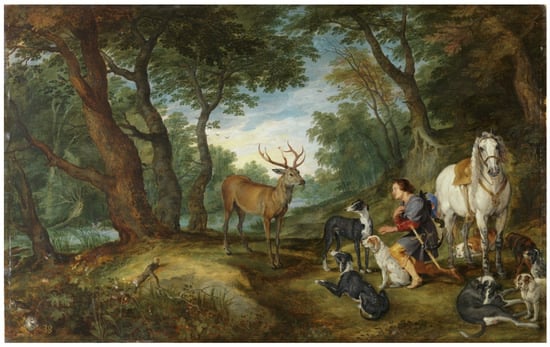
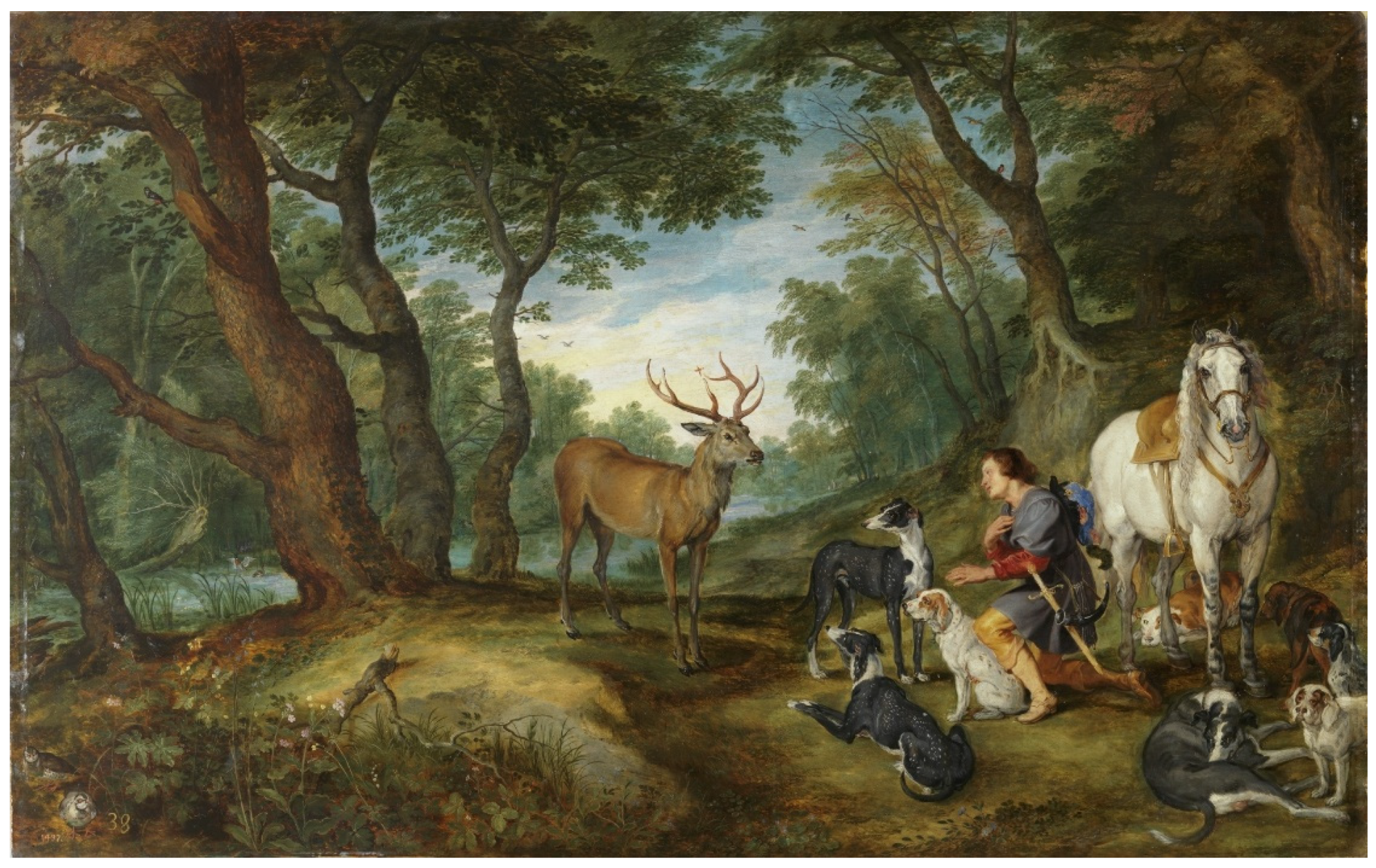
At a principal level, the story—as an older story to that of another saint, Placibus, Roman general of the army of Trajan, who had converted to Christianity after he had similarly seen a crucifix on a hunting trip between a stag’s antlers—is about divine intervention in human life. God speaks to Hubert through the animal, an aspect of the story emphasizing God’s power over the natural world and humans alike. God tells Hubert what to do: to live a life that serves the Christian community, not by sustaining only his own life through hunting but by going back to society. The details in this part of the story have been accentuated through the centuries: at the time of God’s/the stag’s intervention, mass took place in a nearby church, and in some versions, the stag lectures Hubert on how it is acceptable to hunt—a moment possibly represented in the classic Breughel–Rubens version of the story (Figure 1). The code for hunting that God/the stag pushes onto Hubert is not one about the correct ways to find nourishment but how to act as a proper Christian and to serve the common rules applied to hunting.4 After the stag’s lecture, following instructions, Hubert went to find Bishop Lambert of Maastricht (c. 636–706), whose work he would later continue as the first bishop of Liège. The stag said: “Go and seek Bishop Lambert, and he will instruct you” (The History of St. Hubertus 2026).
Figure 1.
Jan Brueghel the Elder and Peter Paul Rubens, Miracle of Saint Hubert, 1617. Oil on canvas, 63 cm × 100.5 cm. Museo Nacional del Prado, Madrid. © Museo Nacional del Prado.
The second of the stories is even more straightforward. The miracle of St. Anthony preaching to the fish is about a Franciscan monk, Anthony, frustrated by the heretics in Rimini5, to whom he had come to lecture. “Because you show yourself unworthy of God’s word, behold,” he said according to the legend, “I turn to the fishes so that your unbelief may be shown up more clearly” (Saint Anthony’s Miracles. Sermon to the Fishes 2026). The miracle arrives when the fish come to the surface of the water to become Anthony’s audience—or perhaps the audience for God’s word, channeled through Anthony. The sermon Anthony gave to the fish then started to interest the heretics; finally, they were, according to the story, deeply moved by Anthony’s speech, some bursting into tears asking for forgiveness, and the city was saved from heresy (Saint Anthony’s Miracles. Sermon to the Fishes 2026).
The religious dimension in both stories is heavy: God speaks through the stag, and Anthony’s divine message can even be heard by the fish of the sea. But what makes the depictions of the two stories interesting to us is their reflection on human–animal relations and their historicity. The way the two legends were presented in the arts did not remain wholly the same, although integral parts of the stories had to be kept in view. So, I start with a comparative analysis of some of the works mentioned earlier, those from the late 19th century and those from the 16th and 17th centuries. The analysis is entangled with questions about speaking and listening, and human subjectivity faced with God, animals, and nature.
3. Drama and Intimacy
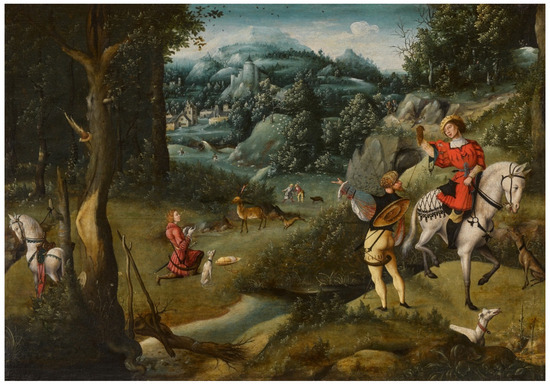
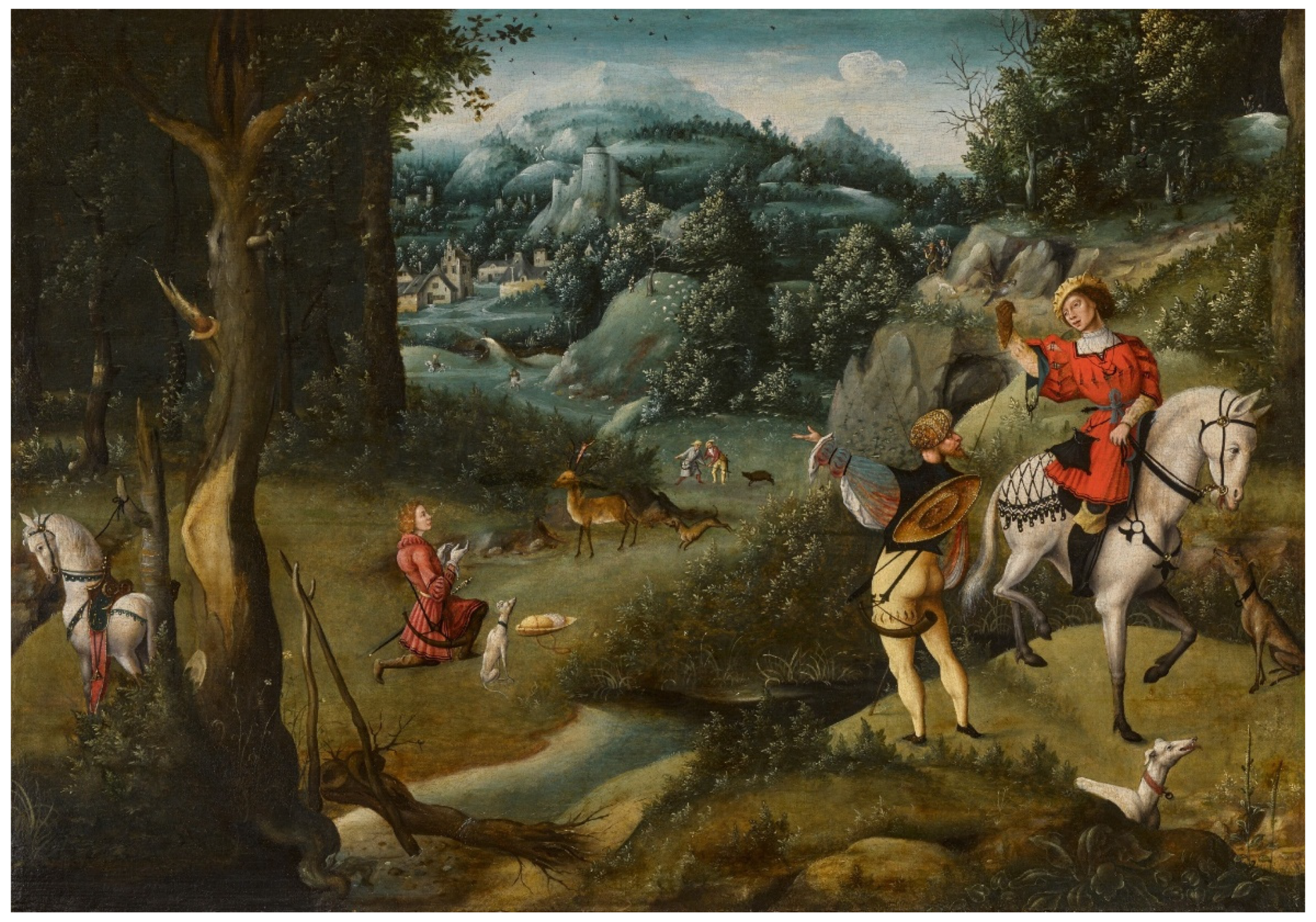
Between the classic early modern depictions of St. Hubert’s vision and the theme’s 19th-century revival, there is one notable difference. While earlier works almost exclusively were either concentrated on or composed around an intimate meeting—emphasizing the sort of conversation often described as having happened between Hubert and the animal—the 19th-century emphasizes the dramatics of the scene, the divinity of Hubert’s vision that turns his life back on its course. The 16th- and 17th-century versions varied a lot, but the same intimacy is evident in Mostaert’s 16th-century painting—where Hubert is surrounded in the forest by other people, who are oddly in the image more prominently than Hubert, not to testify to the scene but to perform their tasks6, which perhaps only accentuates the intimacy of the meeting between Hubert and the stag (Figure 2), e.g., in Wouwerman’s The Conversion of St. Hubert and Keirincx’s nowadays descriptively titled A Forest Landscape with St. Hubert.7 In the latter two, as in Breughel’s earlier version, Hubert’s dogs fill the space in the foreground of the image, while the crucifix between the stag’s antlers is barely seen. Probably, the dogs are there to remind us still that Hubert was from an aristocratic background and about the fact that he did not even, in his darkest moments, hunt like an animal or like the people of the lower classes. Hunting with a pack of dogs was a particularly aristocratic way of hunting, and it was strictly defined by the hunting laws in Dutch premises from the early 17th century (related to paintings of the era; see Koslow 1996, pp. 701–2).
Figure 2.
Jan Mostaert. Saint Hubert in a Landscape, between 1506 and 1540. Oil on panel, 56 cm × 82 cm. Private collection. @ piemag/Alamy.
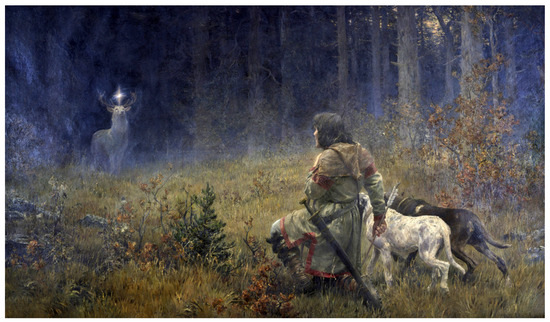
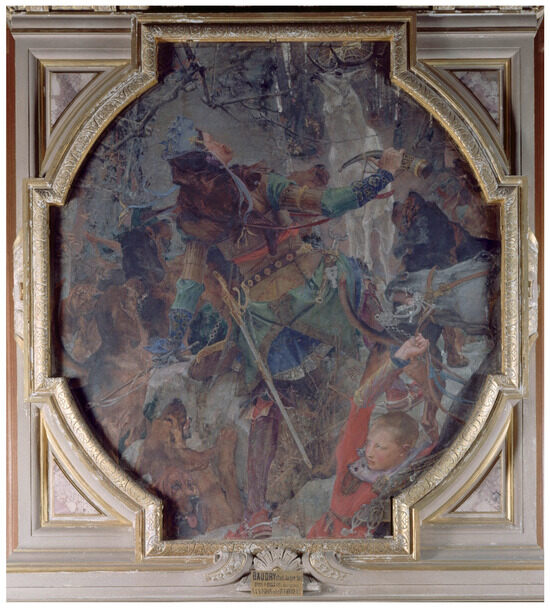
When 19th-century versions of the theme arise, a different world opens up. Whether one looks, say, at Bone’s or Räuber’s versions (where there are no other people other than St. Hubert; Räuber, Figure 3) or Denis’s cycle (where there are crowds), the crucifix (or what has been depicted in its place) glows, its miracle pulling the observer to its momentary dramatic nature, to its sacred, spiritual appearance. In Baudry’s version (Figure 4), the crucifix itself is very small below the upper frame of the picture: the godly nature of the stag’s appearance is represented as so powerful that it makes the persons surrounding it—Hubert with his animal and human companions, and probably also the viewer facing the distorted perspective—lose their balance. In the early 20th century, when the theme continued to interest some modern artists, the sacred glow of the crucifix stayed in some sense or the other, while the modern aesthetic’s and avant-garde’s distaste for the more dramatic and sentimental qualities of the earlier works was somewhat downplayed. This can be observed from later works, such as Schiele’s or Sichulski’s.
Figure 3.
Wilhelm Carl Räuber, Vision of St. Hubert, 1892. Oil on canvas, 207 cm × 355 cm. Neue Pinakothek, Munich. © Neue Pinakothek. CC BY-SA 4.0.
Figure 4.
Paul-Jacques-Aimé Baudry, The Vision of St. Hubert, 1882. Mural, 230 cm × 206 cm. Musée Condé, Chantilly. © GrandPalaisRmn (Domaine de Chantilly)/Harry Bréjat.
To start with, I would suggest that the change is isomorphic with the change in the larger paradigm, with the modern segregation of human life from nature and the natural from the divine. The dramatic tension in the miracle takes in the later centuries the upper hand in depictions, since the natural scene is unable to support it anymore, and the stag becomes a prop for the divine. In earlier centuries, the animal’s role is wholly different. The animal, the hunted, is on the same level as Hubert, the hunter—but the whole stage belongs to the theater of God. The intimate moment of Hubert’s meeting with the deer conveys, with its well-known message, that it is vain to fight against; Hell awaits. The message is thus universal, pointing towards all believers and immanent in all nature. This could not be any different from the 19th-century projections, where the message is the exceptionality of the saint as well as the situation: the dramatic miraculous moment that takes place regardless of natural laws or animal nature.
4. Two Types of Listeners
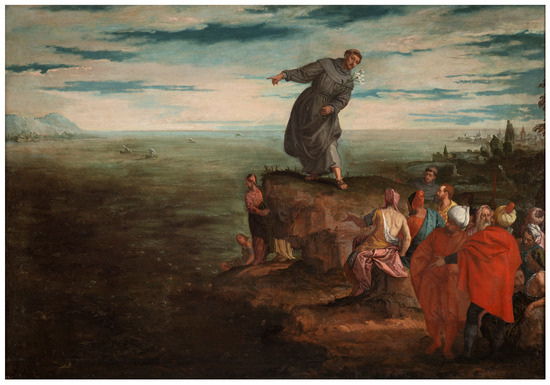
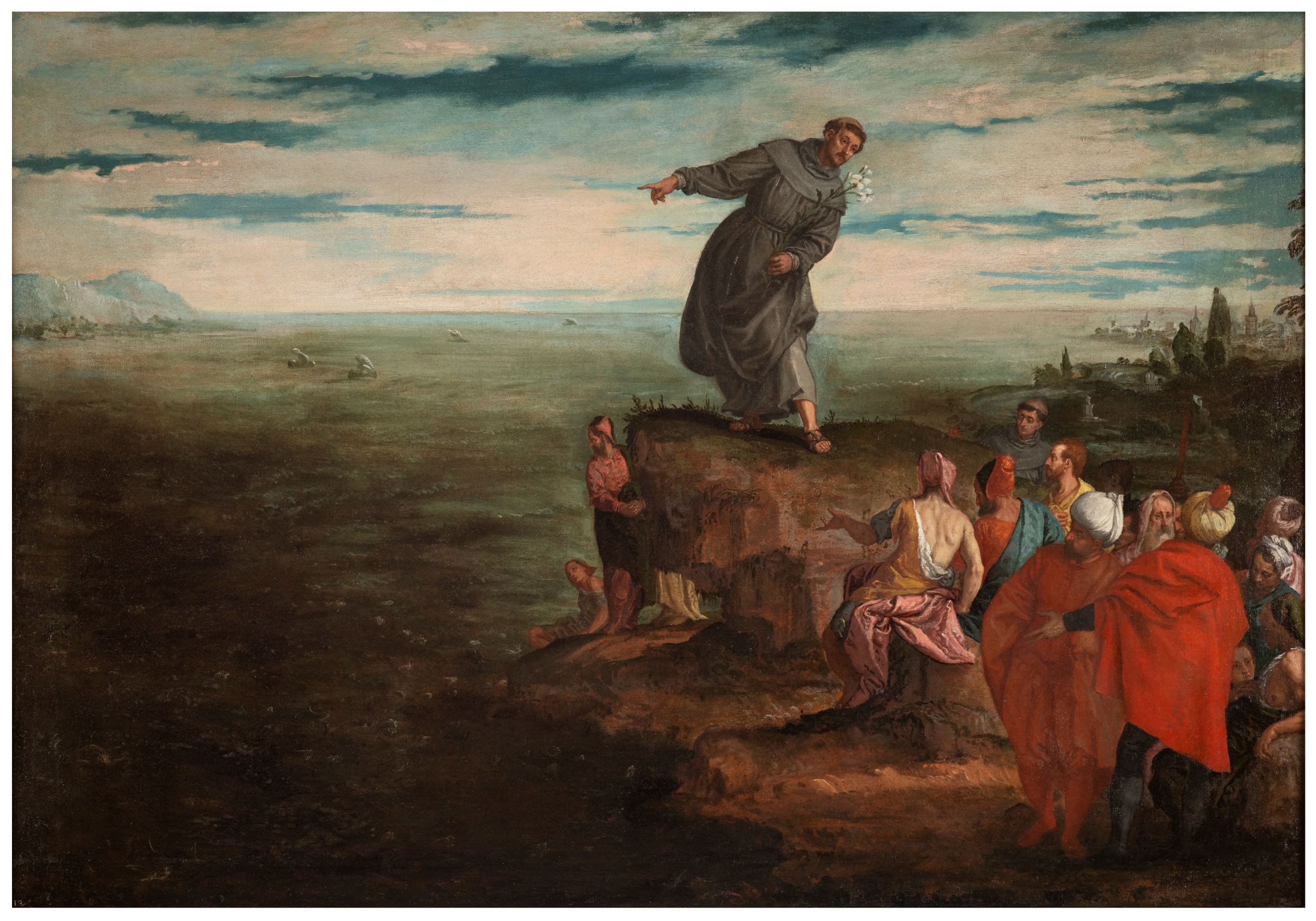
Anthony’s disappointment for the people of Rimini and the expressions of the saint were depicted by different tones. The thing that changed was more noticeably the focus of the miracle, the moment depicted. Although not without exceptions, the works from earlier centuries include, often in a very prominent role, Anthony’s human audience, the people who are gathering or who have already arrived to see and hear Anthony preaching to fish. The most important and a very influential early painting at this stage is the one by Veronese (Figure 5). During the 19th century, there were more variations; however, even when attendees are depicted in the image, as in the case of Merson’s version, they are not as actively part of the miraculous action and do not try to make contact with St. Anthony in any way similar to the gestures of the people in most earlier paintings (see, e.g., Cano’s or Veronese’s paintings, which both give rise to the scene through expressions of awe or formal religious gestures representing the spiritual or emotional states of the persons depicted).
Figure 5.
Paolo Veronese, Saint Anthony Preaching to the Fish, oil on canvas, 129 cm × 175 cm. Galleria Borghese, Rome. © Galleria Borghese.
What could one decipher from this? Images are always open to contradictory interpretations, and they do not serve only one truth. Furthermore, historical processes are not without dead ends, returns, complexities, and the like. But history also determines the directions images should take, as well as what is meaningful and even possible to say, whether by speaking or making images.8 It is possible to read the earlier images in terms of Christian dualism, the duality between humans and animals, the inclusion of only human beings under the protective wings of the Church, the congregation (Steiner 2005, pp. 112–31). Thus, the humans depicted in the images of St. Anthony preaching to the fish would be the true audience of his speech, and they would carry the true meaning of the story. In a way, this would be explained by practical reasons: the images of men were there for the believers (or those wavering in their faith) to identify themselves. An easy answer would be that for 19th-century artists, living in a world becoming increasingly secular and torn between the demands of modern art, this detail would not, in all circumstances, matter as much, and even when images were made to be held in churches, one had to search for new ways of depiction.
But the primary message and main task of the paintings, I believe, did not differ much from those in the earlier centuries—disregarding some more idiosyncratic artistic aspects, the images still tried to convince their audience of the moral and societal dimensions of the tale, similarly to the paintings made of the legend of St. Hubert; as radical as Schiele or Denis had been as modernists, they still seem to have shared a religious vocation, even to the point that Schiele had expressed ideas comparing artistic suffering to Christian martyrdom in his works.9
An additional answer touches upon a different aspect: the connection that the works held with (non-human) nature. I would suggest that the often quite comical-looking situation in which Anthony is seen preaching to the fish has its new heyday in the 19th century in pictures which either diminishes Anthony’s human audience’s role, suppresses it altogether, or shows St. Anthony addressing his speech only to the fish, also because the 19th century holds such a different view of wild non-human nature than any of the earlier centuries. The difference contains the idea that wild animal nature—separated radically from the 18th and 19th centuries onwards from the nature of domesticated companion animals—is so out of reach from the human mind, so radically different from cultured modern humans’ souls, that significant communication with it is almost wholly out of the question (Grén 2024, pp. 88–100; 2018, pp. 49–51); no wonder the end of that century’s world of art is full of esoteric spiritual leanings searching for contact with the outer sphere. The works focus, I argue, on St. Anthony’s communication with the fish, since it seems for a 19th-century mind a true miracle; for a person from Veronese’s or, say, Wolfvoet’s time, the miracle would’ve leaned more towards divine intervention that allows the heretics to hear God’s word and makes them convert to a good life, however odd God’s or Anthony’s means to achieve it.10 While 19th-century artists depicted the story of St. Hubert through dramatic tensions and effects, in contrast with the earlier intimate portraits of Hubert, his dogs, and the stag in the middle of the forest, those picturing the legend of St. Anthony often used comedy. The new era demanded different means to achieve the same effect. This includes works like Benlliure’s version, in which human subjects are pictured in the image but in a manner reminiscent of Goya’s grotesque figures, a truly different, even parodic, apprehension towards the topic without undermining the spiritual value of the work. The use of comedy thus emphasizes the human–animal difference and the separation of the moment from everyday life, the power of the miracle.
5. From God’s Creatures to Man’s Custody
If the reader accepts the principal points of my analysis, we can move forward and think about the change affecting the two image types over the centuries. The birth of the modern dualism between culture and nature has been the object of extensive studies in recent decades, and studies have also emphasized how the idea of human exceptionality, with regard to other animals, was kept alive despite the challenge that it encountered from comparative natural history, biology, and 19th-century evolutionary theories (see, e.g., Schaeffer 2007).
What we have to learn about the arrival of such a dualism, when thinking about our topic, is that the duality of human and animal nature, having its basis in Christian thinking of the nature of the divine soul, was easily developed in a more nation-centered culture, emphasizing civilized citizens and their correct manners, towards a duality between nature and culture (Elias 2000). Moreover, this led to a situation where nature was more or less intentionally represented as the other, as something distant that could at the same time be idealized and degraded—a condition seen often in works defined by romanticism—a world of innocent purity and indifferent cruelty. Many of Edwin Landseer’s famous images of animal life in the wilderness could serve as examples of the pictorial peak of these tendencies (Potts 1990, pp. 13–15; Grén 2024, pp. 99–100).
While questions of the nature of the duality between human and animal mind, the divine soul, or the rupture between (animal) nature and human culture are quite abstract by their essence, they seem to be surrounded by an understanding still profoundly theoretical and speculative, as well as oriented more practically. The development concerns the changes in understanding of ownership and custody of animals.
First, as we already noticed, in 16th- and 17th-century representations of the story of St. Hubert, the focus is often on the serenity of the scene and the intimate connection that the hunter has with the stag. The images—notably, not even in the middle of the Baroque period or in the hands of artists like Rubens—do not make a number out of the miracle; often, even the cross is hard to decipher from between the stag’s antlers, in high contrast to works from later centuries. Of course, this also has to do with the fact that most of the works’ observers were completely marinated in Christian culture and knew the stories of the local saints by heart, without the artist having to accentuate all aspects to make the story clear. But many other religious topics were treated more theatrically in Baroque arts of the Counter-Reformation and as well as in the Reformed Netherlands, for example, the ones from Christ’s life, so it does not explain the contrast. I would suggest that it was more likely the peculiar nature of the story, having its climax in the divine connection between human and animal worlds, which dictated that it needed not such dramatics. As a matter of fact, I would even say that divine intervention in Hubert’s life through the animal is the reason for downgrading the intensity of the scene. What I mean is that the images of hunts were, at the same time, produced quite intensively—by Rubens, most notably—which means that the contact points between humans and animal nature had necessarily not been at all this serene at the time, not at least by default.11 The serenity in the image type is the condition for the miracle to take place: in that moment, the world appeared as it really was, according to the Christian dogma, a world under God’s providence, like reading the Book of Nature in peace, ready to give one the divine truth at any time, if one was ready to go on one’s knees and listen. It was the man who was to be woken up from his bad habits, like the heretics of Rimini in the story of St. Anthony; the fish and the deer were doing what they had always done, living under God’s plan.
According to Nathaniel Wolloch’s analysis, in the pictorial arts, there started to be signs of a discursive shift towards a new kind of thinking, at least from the mid-17th century onward. Wolloch has written that the cows in Paulus Potter’s (1625–1654) works achieved a status which could be described as relatively new. For sure, many of the animals had previously been painted or sculpted because of their economic value, whether as luxury objects or to be hunted, eaten, etc. However, Potter’s cow paintings—and many other bovine images produced in the Netherlands during the 17th century—acquired a status of their own, since they depicted valuable cows that had an economic, exchangeable value, a value for the country where they assumedly were living. Similarly, such works acquired their own value; as Wolloch goes on to write, “bovine images evoked a distinct sense of economic prosperity” (Wolloch 2019, pp. 184–85) for the Dutch. Wolloch sees this as a precursor of the 18th-century developments in the understanding of economy and for the definitions of human–animal divisions in economic theories—mainly the theories that sprang forth from the Scottish Enlightenment. In other words, in this development was an economic theory that separated the (human) economic subjects and (animal) economic objects, with a more secularized vision, or at least a frame, of the world (ibid., passim.; on Potter, p. 193).
What followed was a new idea, easily decipherable from 18th-century animal art but quite hard to come up with in a 21st-century frame of mind. To put it provocatively: when all the world’s animals are objectified by their essence, one should assume something radically disturbing to happen. This was, however, not the case—not for a long time. If one had to describe in some ways the 18th-century main currents in animal art, the easiest way would be to describe it in terms of human pride, attention, and care of the animals under depiction. The facts about the situation, with the wheels of modern animal production starting to accelerate around cities12, tell of course a different story, but it does not change the way images displayed human–animal relationships. The relation was, at least ideally, one mutually beneficial pact, where human ownership—the economic subjectivity and exceptionality acquired from the assumed divinity of the human soul—defined human responsibilities towards the objects of their affection. It is in this sense that Alex Potts has written on 18th-century art that animals are “most commonly represented… as extensions of the social order by making them into visual signs of their owners… with an undisguised directness that would almost be unthinkable in later animal art” (Potts 1990, p. 15).
6. New Clothes, New Audience
The 19th century, in turn, witnessed an ever-increasing exploitation of animal resources for human consumption, leading to mechanized production of meat and other animal commodities, the birth of centralized modern slaughterhouses, and urban commercial marketplaces. With them came the feeling of civilized estrangement from nature and, following the success of vulgarized evolutionary theories, from man’s animal origins. The foundation of 18th-century cultures was still agrarian, but the urban mindset had already shaped the Western civilized, intellectual frame. It developed, as we already noticed, towards an idea that wild nature was ultimately beyond the boundaries of reach.
One more important thing changed during the late 19th century regarding the depictions of St. Hubert. It does not encompass all the images, but the way the saint was presented in some of them would have been indecent in previous centuries. There were practically no precedents for images in which St. Hubert, in the late 19th century, was depicted without the upper-class or aristocratic hunting clothes, which symbolized his noble origins and his identity as a saint. (Also, Placidus had always been pictured in upper-class clothes en mode at the time.) The hermit-style clothing was out of the question until the modern age. Then, it changed: in Bone’s and Schiele’s versions, this is clear, and in Räuber’s (Figure 3) painting, the aesthetics become mingled with national romanticist ideals. Many possible explanations contribute to this: the above-mentioned romanticist currents, turn-of-the-20th-century primitivisms, the fall of the visual codes of the old class-based society, and the revaluation of symbols in the changing atmosphere of late 19th-century academicism. But, counted together with a sort of revival of St. Hubert’s character in the arts and the fact that the images indeed depict an unusual, sacred moment of human–animal connection, they point to one direction: they highlight the exceptionality and otherness of St. Hubert, his self-generated estrangement from society. Additionally, they are related to an idea of a simpler life, a primitivist but melancholic haven in the countryside, amidst the vicissitudes of Western civilization. Although usually connected to another type of image and another type of art, such a primitivist ideal was a huge topic and a theoretical framework in the Western arts at the turn of the 20th century, which influenced images from one end to the other. The primitivism “signified breaking off”, writes Philippe Dagen, “from what the beaux-arts cherish and celebrate: those who were in power, their values, their worshipping of money” (Dagen 2019, p. 327). Furthermore, the solitariness of St. Hubert perhaps reflected the lonely genius of a modern artist, who had come to tell of the sacred message the new world had forgotten, as we already noted that Denis and Schiele hoped to achieve with their works.
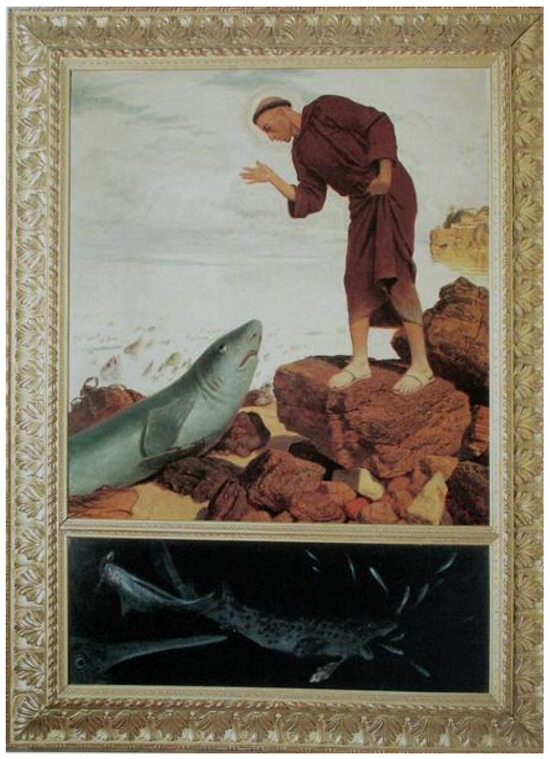
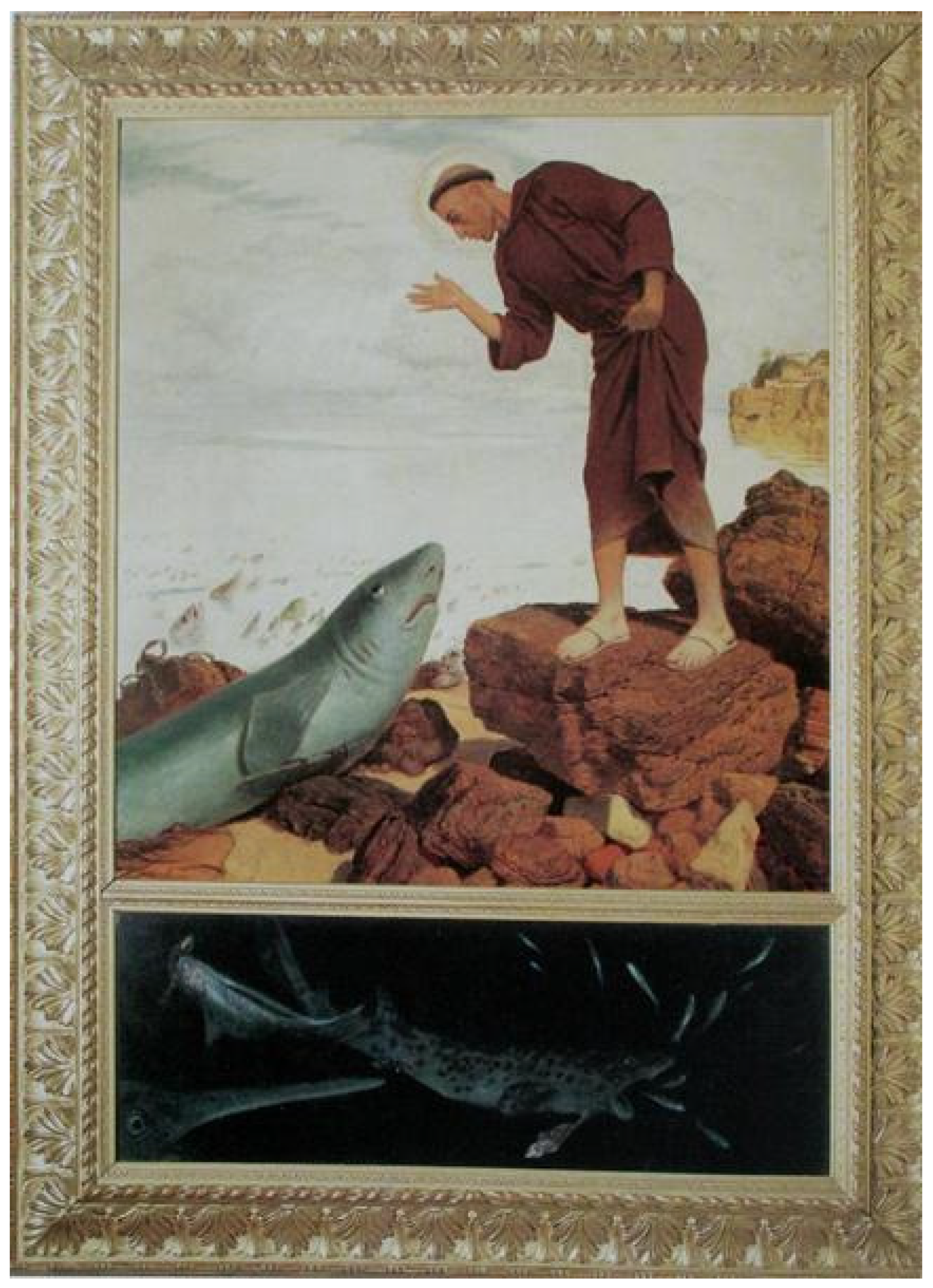
And where does St. Anthony, with his sermon to the fish, stand on this? Whence came his share in those strange images bordering on history painting and disturbingly comic symbolism in late 19th-century art? The legend must have had some new appeal when it was introduced among the German folk poems in Des Knaben Wunderhorn: Alte deutsche Lieder, edited first by Achim von Arnim and Clemens Brentano in 1806–1808, with the story having a sort of fable-like parodic quality, where the fish are like symbols of the human beings who never learn despite hearing the words of God’s messenger (von Arnim and Brentano 1980, p. 237). But, in the 19th-century pictures, the fish feel very eager to learn; they are like the last audience, the true connoisseurs. Böcklin’s work (Figure 6), as a last example, is in this sense the most powerful; it achieves its power through a tense comedic feeling, bordering on human–animal carnivalism and the credibility of the situation. It is on top of deep waters where St. Anthony is shown standing on a solid rock, waters where big fish eat the smaller ones, like in so many Darwinian visions painted during these years (see Larson and Brauer 2009) or like the violent fantasies of raw nature produced through the same century. St. Anthony puts his hope in his best student, the shark that has come to hear the word of mercy—a beastly creature without ears. The tiny human figures shown far off in the background are, I guess, uninterested in Anthony’s doings.
Figure 6.
Arnold Böcklin, The Sermon of Antonius/St. Anthony Preaching to the Fish, 1892. Oil on canvas, 152 cm × 105 cm. Private property on display at Kunsthaus Zürich. CC0.
7. Conclusions
This article started with an analysis of the paintings of the two legends and their differing representations between the early modern period and the late 19th and early 20th centuries. The analysis showed how the depictions of the story of St. Hubert changed towards the later period in terms of dramatic intensity, and how the active role of human figures other than St. Anthony himself had diminished in the paintings about his sermon to the fish and how this acted in favor of comic nuances in the works. These changes, I speculate, could have had something to do with the modern segregation of human life from nature and the separation between the natural and the divine, with natural objects turning into human property in the new age defined by modern economics. Thus, in this article, I maintain that the changes in the representations of the two themes were deeply entangled with philosophical and economic developments that are behind our modern views of nature.
This said, my aim is not to point out that the stories themselves or even our understanding of them changed essentially because of this. Evidently, when our ideas about nature and the human–animal border change, such stories also go through metamorphoses, smaller or larger ones. But this essay was more about the means through which the stories were figured. As I suggested, artists of both periods mostly tried to retain the spiritual message as the essence of the story, regardless of the processes of secularization affecting the visual means and interpretation of the works. In the same way, the images continued the complex medieval discussions behind the legends, only giving them—and the human–animal relations reflected in them—a new form.
Regarding interspecies communication between the two eras and in the depictions of the two legends in paintings, my argument would be this: both tend to lean, in the 19th-century works, towards a projection, where the exceptionality of the sacred act, the moment of the vision or the miracle of the sermon, is highlighted. This is also, I argue, the reason why the two legends enjoyed a revival; when the artistic ideal turned towards the uncorrupted, the part outside modern civilization’s commodifying influence, it needed to be supported by signs of otherness. With St. Anthony, this is obvious—speaking to the fish is truly out of the ordinary, beyond man’s everyday world. And with the stag, it is by putting the emphasis on the dramatic intensity of the moment of the vision that the viewer returns to contemplating the exceptionality of the saint. The exceptionality comes thus represented only due to St. Hubert’s relation to the stag—his momentary unrestricted connection to nature. This equates to saying that the artworks were made to get in touch with the impossible.
Funding
This research was funded by The Ella and Georg Ehrnrooth Foundation.
Institutional Review Board Statement
Not applicable.
Informed Consent Statement
Not applicable.
Data Availability Statement
The original contributions presented in this study are included in the article. Further inquiries can be directed to the corresponding author.
Conflicts of Interest
The author declares no conflicts of interest.
Notes
| 1 | From now on, St. Hubert and St. Anthony. |
| 2 | Formerly attributed to Francesco Herrera the Elder (c. 1590–1656). |
| 3 | The main character in Paupion’s work has also often been mistakenly attributed to being St. Francis. It has been noted that the idea of St. Anthony preaching to the fish probably derives from the story of St. Francis’s sermon to the birds (Andergassen 2016, p. 56). |
| 4 | Hunting was seldom a means to obtain food but a cultural practice (see, e.g., Howell 2019, pp. 446–73) related to cultural hierarchies and authority in the Christian medieval and early modern era (Howell 2019, p. 452). The “common rules applied to hunting” mentioned in the text do not refer to any single code but to any possible ethical instructions that the stag could have been understood to teach Hubert. Stories about the instructions have quite understandably varied over time and location, since ethical instructions and laws over hunting have also been numerous. |
| 5 | The location for Anthony’s sermon is Rimini in most of the accounts, derived from the Little Flowers of St. Francis, which was composed at the end of the 14th century. In earlier texts, the precise location is not given. (Semenzato 1981, pp. xxviii–xxxi; Ugolino Brother 1965). |
| 6 | Mostaert also used St. Hubert in a minor role in his portrait painting A Woman (c. 1520) in Rijksmuseum, Amsterdam. |
| 7 | Understandable also because Keirincx specialized in forest landscapes with minor human figures. |
| 8 | Here, one could invoke Michel Foucault’s ideas on epistemes and discourses, with episteme meaning the ground of the discourses, the condition of their possibility in each period. Several such epistemes can act at the same time in the same context. Foucault’s concept was introduced in Foucault (1966). The possibility of the epistemes’ coexistence is noted by Foucault (1980). |
| 9 | Famous examples are Schiele’s works Agony (1912) and Self-portrait as St. Sebastian (1914), which leaves not much to interpretation. On Denis’s famous cycle and his religious vocation, see Delannoy et al. (1999) and Bouillon (2006). |
| 10 | Also interesting in this sense is Merson’s version, where a dog stands between the preaching saint and the fish, seemingly a sort of medium between undomesticated nature and the human spiritual world. This, however, was not without predecessors in the tradition of depictions of St. Anthony and the fish: four legged-animals and birds had already acted as Anthony’s “secondary audience” in Grégorio Lopes’s paintings of the Convent of Christ Charola in Tomar, Santarém. In Lopes’s variation, the skeptical human audience (with one dog) gathered in the background as Anthony’s “tertiary audience”, evidently still not as enthusiastic about Anthony’s message as the other creatures. |
| 11 | I am referring to works such as Rubens’s extravagant images of hunts like Wolf and Fox Hunt (c. 1616) and The Lion Hunt (c. 1621). Regardless of this, hunting was also, in the same period in question, used in imagery as a symbol of peace, for various reasons, like its being “a peacetime preparation for war” to the aristocrats and officers alike (see, e.g., Plax 2017, pp. 102–19; Koslow 1996, p. 704; Grén 2024, pp. 83–88). Representations of hunting evidently also raises some ethical questions about the treatment and suffering of animals. Regardless of some of the straightforwardly theriophilic voices among those commenting on the practices of hunting critically, the questions related to it are, if possible, even harder to keep in perspective than the ones concerning animal welfare in other situations. This is because of the totally different structure of the discourse surrounding hunting in the early modern period, during which hunting was mostly seen as a positive value, something exclusively aristocratic and civilized. The ethical dimensions of the tale of St. Hubert are prominent in the legend also because the stag gives orders on how it is acceptable to hunt, and this may have contributed to the tendency in the earlier paintings to depict the moment of the tale when the conversation between the man and the animal takes place. In the 19th century, many of the positive associations of hunting were still in place, although with larger local and individual variations, but the critical voices had already made hunting a class-related societal issue or an issue of cruelty towards animals. In this sense, the representations of the story of St. Hubert are also in line with other notable paintings of hunts, since the other works had started, from time to time, to have protagonists with associations with the lower classes and the mid-19th century also gave birth to particularly dramatic and sentimental image types related to hunts. The problem, however, in interpreting the images through “pro-animal discourses” is that the same images could at the same time, in both periods in question, make critical stances against the cruelties in hunting while also propagating hunting as a noble practice or worth supporting (Palmeri 2016; Grén 2024, pp. 102–7). As can be seen later, I also suggest another source for the 19th-century habit of depicting St. Hubert not so aristocratically. |
| 12 | The roots of the development are in the 17th century, when butchering started to be moved outside central areas of big cities. See, e.g., (Griffith 2007, pp. 101–20). |
References
- Andergassen, Leo. 2016. L’iconografia di Sant’antonio di Padova dal XIII al XVI Secolo in Italia. Padua: Centro Studi Antoniani. [Google Scholar]
- Bouillon, Jean-Paul. 2006. Maurice Denis: Le Spirituel dans L’art. Paris: Gallimard. [Google Scholar]
- Brother, Ugolino. 1965. Little Flowers of Saint Francis of Assisi. Translated by Roger Hudleston. Introduction by Arthur Livingston. New York: The Heritage Press. Available online: https://ccel.org/ccel/ugolino/flowers/flowers.i.html (accessed on 28 October 2026).
- Dagen, Philippe. 2019. Primitivismes: Une Invention Moderne. Paris: Gallimard. [Google Scholar]
- Delannoy, Agnès, Marianne Barbey, Jean-Paul Bouillon, Patricia de Fougerolle, Marie-Christine Prestat, Roland de Chaudenay, and Claude d’Anthenaise, eds. 1999. Maurice Denis: La Légende de Saint Hubert: 1896–1897. Paris: Somogy. [Google Scholar]
- Elias, Norbert. 2000. The Civilizing Process: Sociogenetic and Psychogenetic Investigations. Translated by Edmund Jephcott. Malden: Blackwell. [Google Scholar]
- Foucault, Michel. 1966. Les mots et les Choses: Une Archéologie des Sciences Humaines. Paris: Gallimard. [Google Scholar]
- Foucault, Michel. 1980. Power/Knowledge: Selected Interviews and Other Writings 1972–1977. Edited by Colin Gordon. Translated by Colin Gordon, Leo Marshall, John Mepham, and Kate Soper. New York: Pantheon Books. [Google Scholar]
- Grén, Roni. 2018. The Concept of the Animal and Modern Theories of Art. London: Routledge. [Google Scholar]
- Grén, Roni. 2024. Art Historical Perspectives on the Portrayal of Animal Death: 1550–1950. London: Routledge. [Google Scholar]
- Griffith, Eva. 2007. Inside and Outside: Animal Activity and the Red Bull Playhouse, St. John Street. In A Cultural History of Animals. Edited by Matthew Senior. New York: Berg, vol. 4, pp. 101–20. [Google Scholar]
- Howell, Philip. 2019. Hunting and Animal–Human History. In The Routledge Companion to Animal–Human History. Edited by Hilda Kean and Philip Howell. London: Routledge, pp. 446–73. [Google Scholar]
- Koslow, Susan. 1996. Law and Order in Rubens’s Wolf and Fox Hunt. The Art Bulletin 78: 680–706. [Google Scholar] [CrossRef] [Scilit]
- Larson, Barbara, and Fae Brauer, eds. 2009. The Art of Evolution: Darwin, Darwinisms, and Visual Culture. Hanover: Dartmouth College Press. [Google Scholar]
- Palmeri, Frank. 2016. A Profusion of Dead Animals: Autocritique in Seventeenth-Century Flemish Gamepieces. Journal for Early Modern Cultural Studies 16: 50–77. [Google Scholar] [CrossRef] [Scilit]
- Plax, Julie Ann. 2017. J.-B. Oudry’s Royal Hunts and Louis XV’s Hunting Park at Compiègne: Landscapes of Power, Prosperity and Peace. Studies in the History of Gardens & Designed Landscapes 37: 102–19. [Google Scholar] [CrossRef] [Scilit]
- Potts, Alex. 1990. Natural Order and the Call of the Wild: The Politics of Animal Picturing. Oxford Art Journal 13: 12–33. [Google Scholar] [CrossRef] [Scilit]
- Saint Anthony’s Miracles. Sermon to the Fishes. 2026. Website of the Friars of St. Anthony of Padua. Available online: https://www.santantonio.org/en/content/saint-anthonys-miracles-sermon-fishes (accessed on 28 October 2026).
- Schaeffer, Jean-Marie. 2007. La fin de L’exception Humaine. Paris: Gallimard. [Google Scholar]
- Semenzato, Camillo. 1981. Sant’Antonio in Settecentocinquant’anni di Storia Dell’arte. Padua: Banca Antoniana di Padova e Trieste. [Google Scholar]
- Steiner, Gary. 2005. Anthropocentrism and Its Discontents: The Moral Status of Animals in the History of Western Philosophy. Pittsburgh: University of Pittsburgh Press. [Google Scholar]
- The History of St. Hubertus. 2026. Website of the International Order of St. Hubertus. Available online: https://iosh-usa.com/about-us/history-of-st-hubertus (accessed on 28 October 2026).
- von Arnim, L. Achim, and Clemens Brentano, eds. 1980. Des Knaben Wunderhorn. Alte Deutsche Lieder Gesammelt. München: Winkler Verlag. [Google Scholar]
- Wolloch, Nathaniel. 2019. The Enlightenment’s Animals: Changing Conceptions of Animals in the Long Eighteenth Century. Amsterdam: Amsterdam University Press. [Google Scholar]
Disclaimer/Publisher’s Note: The statements, opinions and data contained in all publications are solely those of the individual author(s) and contributor(s) and not of MDPI and/or the editor(s). MDPI and/or the editor(s) disclaim responsibility for any injury to people or property resulting from any ideas, methods, instructions or products referred to in the content. |
© 2026 by the author. Licensee MDPI, Basel, Switzerland. This article is an open access article distributed under the terms and conditions of the Creative Commons Attribution (CC BY) license.