


Abstract
This interdisciplinary longitudinal study shows sustained engagement in observational drawing stimulates significant brain plasticity and enhances cognitive and perceptual skills, and self-reported personal growth among undergraduate students. The study’s novel exploratory design used three data sources, including task-based functional MRI, whole-brain resting-state functional connectivity (FC), and qualitative data (questionnaire, freehand drawing task, reflective writing) to examine cognitive functions underlying training in observational drawing across two timepoints in a 16-week drawing course in an accredited studio art program. We review findings from our two prior articles that showed, after training, functional changes in brain regions involved in cognitive and motor processing, and enhanced functional connectivity within and between the cerebellar, default mode, and salience networks implicated in complex motor coordination, cognitive processing, and attentional control. We present new qualitative data to show self-reported evidence of learning to support MRI results and to gain insight into the art students’ experience. Taken together, the results of this research offer significant implications for observational drawing instruction as a low-cost, accessible intervention to target future research in brain health in aging populations and as a therapeutic application for mild cognitive impairment. Structured observational drawing instruction yields measurable cognitive and neural benefits that support perceptual and cognitive skills critical to contemporary art training and other disciplines in the current age of AI and human–AI collaboration.
1. Introduction
Observational drawing is an intellectually rich and cognitively stimulating artistic process that yields perceptual/cognitive advantages in artists and non-artists alike. Continuing research proves the essential value of observational drawing in contemporary art education and in other fields such as STEM (e.g., Brew et al. 2012; Chorpening 2014; Kantrowitz et al. 2014). The current study shows that undergraduate art students’ self-reported perceptions of training in observational drawing enhance visual perception, drawing skills, and cultivate personal growth, confidence, and a sense of achievement. Observational drawing is viable as an accessible and economical means of cognitive stimulation for a range of purposes to benefit diverse demographics that include artists and non-artists alike. In recent years, cognitive neuroscience has brought to the forefront a deeper understanding of the cognitive benefits of sustained engagement in art activities such as observational drawing. In therapeutic settings, it may serve as a low-cost, accessible intervention tailored to stimulate neural activation for mild cognitive impairment (e.g., depression, stroke). In lifelong learning, observational drawing could be employed to stimulate neuroplasticity and cultivate cognitive flexibility to delay onset of cognitive decline, foster cognitive reserve, and improve and protect lifelong brain health (e.g., Alain et al. 2019; Reed et al. 2011; Vodyanyk and Jaeggi 2025). Correspondingly, increasing use of artificial intelligence in daily life has renewed focus on cultivating human-centered habits of mind such as the cognitive skills cultivated through deliberate practice of observational drawing: creative thinking, sustained focus, perseverance and patience in problem-solving (e.g., Hetland et al. 2013).
We define observational drawing as the artistic process of translating directly observed three-dimensional (3D) subject matter into a two-dimensional (2D) depiction with individual aesthetic expression. The process of observational drawing is an iterative cycle of observing, executing, refining, and analyzing (e.g., local-to-global visual analysis, spatial encoding, and precise motor translation). Empirical research confirms sustained drawing practice enhances perceptual/cognitive abilities (e.g., Chamberlain et al. 2014, 2021; Kozbelt 2001; Perdreau and Cavanagh 2015; Schlegel et al. 2015; Tchalenko and Miall 2009).
Our prior analyses discovered functional brain activation changes as a result of training in observational drawing (Katz et al. 2021; Safai et al. 2026). Brain areas involved in cognitive processing, including attention, decision making, motor control, top-down control, visual information processing, and working memory, all functionally changed with experience. Whole-brain resting-state functional connectivity (FC) measures found that learning and continued practice of observational drawing revealed enhanced FC within and between the cerebellar, default mode and salience networks implicated in complex motor coordination, cognitive processing, and attentional control.
Despite broad awareness of its benefits, few longitudinal neuroimaging studies exist to provide evidence of neuroplasticity resulting from rigorous training in observational drawing and we are not aware of any that also incorporate the participants’ perspective through qualitative data. Our study addresses this research gap. We evaluate new qualitative data that show art students’ perceptions of their experience of rigorous training in an observational drawing class and consider the students’ perceptions of training in relation to previously reported findings from the larger study that revealed neuroplasticity in the same participants as a result of the drawing class. Specifically, we systematically tracked perceptual/cognitive and artistic development across two timepoints (T1, T2) in undergraduate art students participating in a 16-week observational drawing class.
Our approach follows a systematic approach to examining qualitative perspectives of artists’ experiences and cognitive processes enacted when drawing to support quantitative-based findings in drawing research. Our study applied baseline neuroimaging measures using high-resolution 7 Tesla (7T) functional Magnetic Resonance Imaging (fMRI), including task-based fMRI and whole-brain resting-state FC analyses. These measures tested for changes in performance, brain function and FC in young adult art students compared to matched non-art students who did not participate in the drawing class.
The task-based fMRI used four functional tasks based on cognitive processes of analytic picture observation (similar to how students analyze and render objects in traditional still life setups in the studio art classroom). Four tasks tested fundamental concepts that are part of structured training in observational drawing: light sources, tonal value, line variation, and linear perspective.
Prior to instruction, there was no difference between the two groups. Post-instruction, the art students’ performance significantly improved on the light sources (by 11.4%), line variation (by 28.7%), and linear perspective (by 19%) tasks. Significant functional brain activation differences were found in the art students for the line variation, linear perspective, and tonal value tasks. Diffuse functional changes were discovered in the art students, including the prefrontal cortex, parietal cortex, temporal cortex, and cerebellum. Brain areas involved in cognitive processing, including attention, decision making, motor control, top-down control, visual information processing, and working memory, all functionally changed with experience (Katz et al. 2021). For the resting state scans, participants were instructed to keep their eyes open and fixate on a white cross displayed on a dark background and not think of anything specific. Resting state FC measures found that learning and continued practice of observational drawing enhanced connectivity within and between the cerebellar, default mode and salience networks implicated in complex motor coordination, cognitive processing, and attentional control (Safai et al. 2026).
While the study included both groups, here we focus on the art student group to examine self-reported experiences, cognitive benefits, and artistic development concurrently with the neuroimaging measures. Qualitative instruments were embedded in regular class instruction. The studio-based class applied a scaffolded, traditionally structured, Western-based approach to teaching perceptual, cognitive, and technical skills fundamental to observational drawing. Art students completed three primary qualitative instruments as part of regular class instruction at two timepoints: (a) a three-part questionnaire, (b) a free-hand drawing task, and (c) prompt-based self-reflective writing.
We anticipated our qualitative findings would show increased self-efficacy in conceptual and technical skill-building, improvement in accurate representations, and greater self-satisfaction in developing artistic processes. We present the findings organized by five overarching themes.
2. Results
We present a synthesis of qualitative analyses (Saldaña 2016) through five themes that reveal changes in art students’ self-reported perceptual, cognitive and personal development across two timepoints in the drawing class.
2.1. Theme 1. Bridging Concept and Practice: Understanding Fundamental Drawing Concepts Through Drawing Practice
2.1.1. AEQ Part I. Vocabulary, Open-Ended Questions
Knowledge of fundamental drawing vocabulary that tested four vocabulary questions across timepoints showed “unsure” responses decreased at T2. Specifically, responses decreased by half for “shape vs. form” and “value,” and a substantially greater decline for “line quality” and “linear perspective” (Supplement Table S1). Overall, participants showed knowledge improvement in vocabulary and perceived they were more knowledgeable.
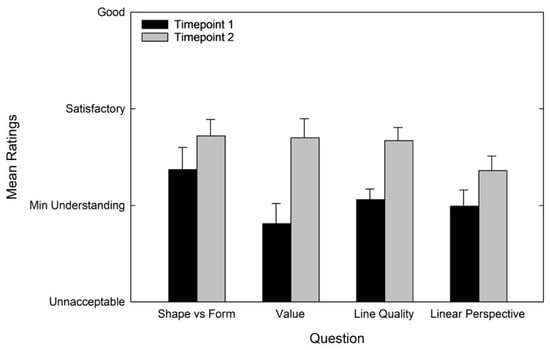
Figure 1 shows the reviewers’ mean Likert-type ratings for the vocabulary questions in the AEQ Part I at T1 and T2. Participants showed significant increases in ratings over time for Value (paired t-test, t(18) = 3.78, p < 0.01, d = 0.87), Line Quality (t(20) = 5.18, p < 0.01, d = 1.13), and Linear Perspective (t(22) = 2.14, p < 0.05, d = 0.45). The increase in reviewers’ mean ratings for Shape versus Form failed to reach significance, t(17) = 1.4, p = 0.18.
Figure 1.
Mean ratings of the reviewers for the art students for the questions in the AEQ Part 1 at T1 and T2. Error bars represent SEMs.
2.1.2. Observational Drawing Task
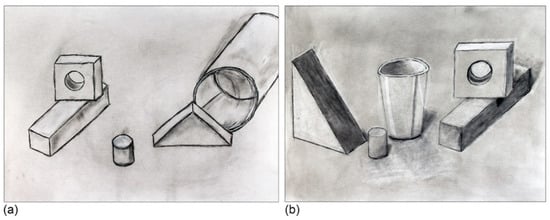
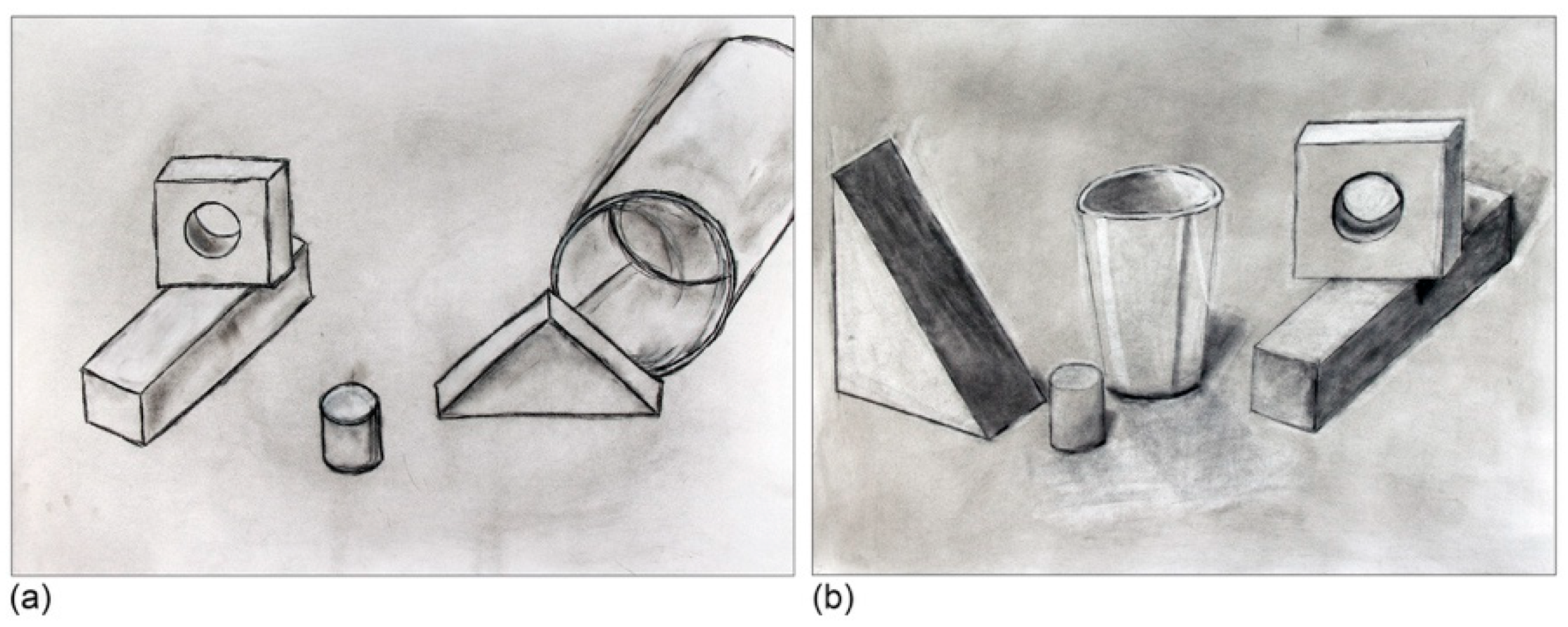
Student drawings showed universal improvement in drawing accuracy and a grasp of the drawing concepts tested in the fMRI tasks (see Figure 2 for an example). Raters’ drawing scores showed universal improvement across timepoints (reported in Katz et al. 2021).
Figure 2.
Participant Drawing Task and Raters’ Mean Score at T1 and T2. Note. (a) Art 21, T1, Mean Score 2.00; (b) Art 21, T2, Mean Score 4.33 (for additional examples, see Supplement S1).
2.1.3. Reflective Writing: Excerpts from Participants’ Self-Assessment of T1 and T2 Drawings
When comparing their timepoint drawings, student reflections showed greater self-awareness of visual language and sophistication applying the formal elements of drawing:
First drawing has poor shading that is not blended or extensive in value, there is no background, line quality is cartoonish and uniform (outlines everywhere). Final drawing has more extensive value range, played out background, and takes light into consideration. In the final drawing, depth is a focus of the drawing…shadows give the impression of depth and varied tonal range helps…I notice a way better control over shading and the grayscale, a better understanding of how to create depth…I now understand different elements that go into depicting subject matter and how to depict them with gray scale and mark making.(Art 11, T2)
I was more conscious of perspective in the latter one especially when drawing the cylinder & cup and they look better than they did before as a result.(Art 29, T2)
(Further examples are provided in Supplement S2).
2.2. Theme 2. Developing Self-Efficacy and Confidence: Self-Perceptions of Improved Drawing Methodology and Materials
2.2.1. AEQ Part II. and III. Multiple Choice Questions
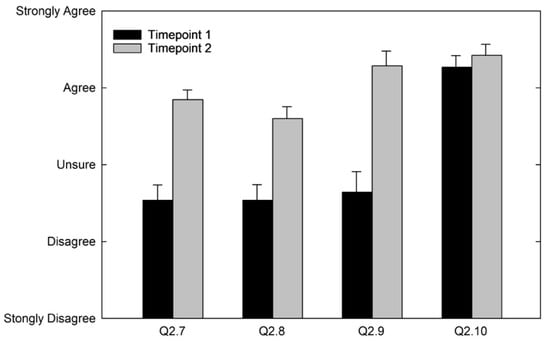
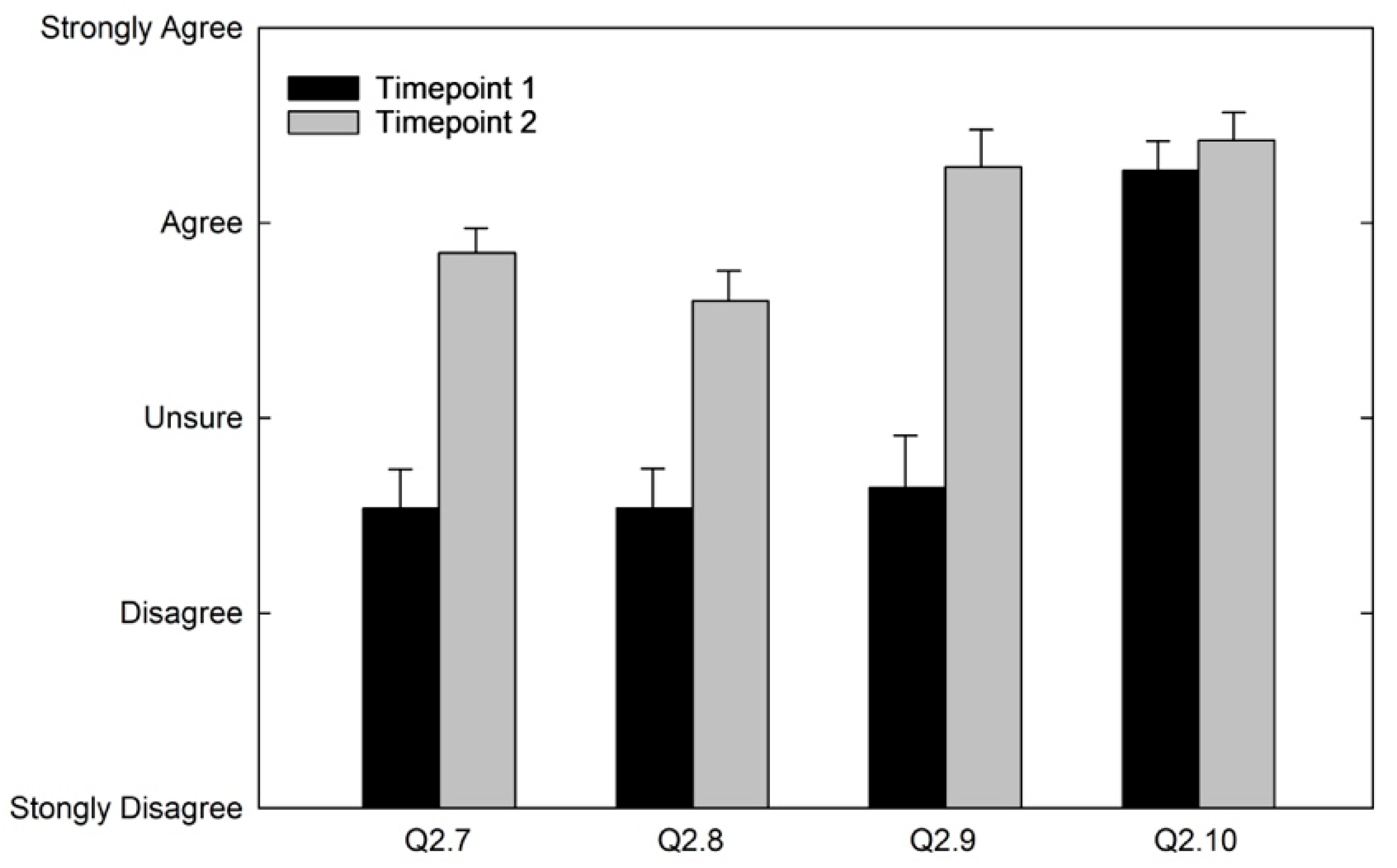
Q2.7. I am knowledgeable in the terminology of drawing.
Q2.8. I think my drawing skills are good.
Q2.9. I am confident that I can draw from life (not from looking at a photograph or imagination).
Multiple-choice questions 2.7–2.9 provided baseline measures and assessed changes across timepoints in participants’ self-confidence and perceived drawing knowledge and ability. Responses to Q2.7–2.9 were on a 5-point Likert-type scale ranging from A. strongly agree (recorded as 1) to E. strongly disagree (recorded as 5). Figure 3 shows mean scores for questions 2.7–2.9 at T1 and T2. The participants had increased scores from T1 to T2 (Q2.7: paired t-test, t(25) = 6.6, p < 0.05, d = 1.29; Q2.8: t(25) = 5.6, p < 0.05, d = 1.10; Q2.9: t(13) = 5.34, p < 0.05, d = 1.43). Increases in agreement between the first and second timepoints regarding perceived knowledge of drawing terminology and ability to draw from life imply growth in observational drawing self-efficacy.
Figure 3.
Mean scores for the art students for the questions in the AEQ Part II at T1 and T2. Error bars represent SEMs.
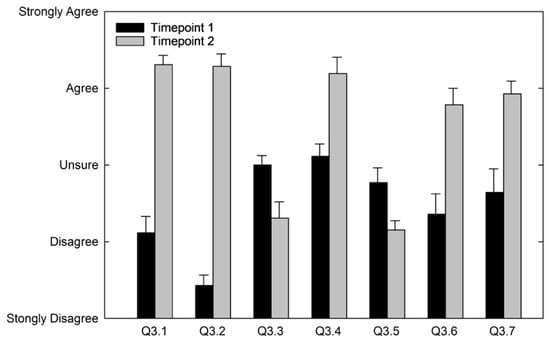
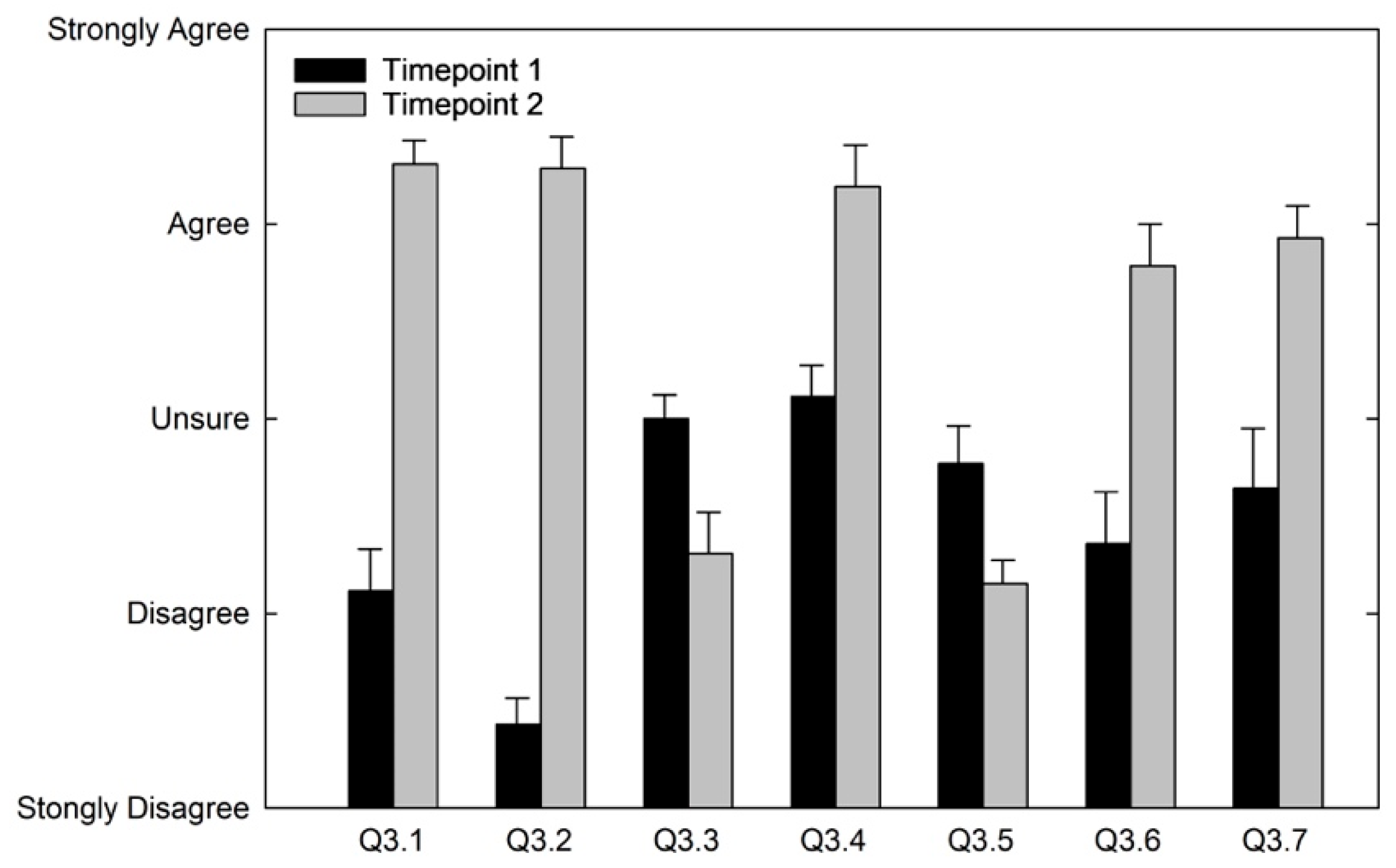
Multiple-choice questions 3.1, 3.2, 3.6 provided baseline measures and assessed changes across timepoints in participants’ perceptions of understanding and confidence in drawing methodology and materials. Responses to Q3.1, 3.2, 3.6 were on a 5-point Likert-type scale ranging from A. strongly agree (recorded as 1) to E. strongly disagree (recorded as 5).
Q3.1. I understand how to use a sighting tool to measure and determine the lines and angles of the subject matter I am drawing.
Q3.2. I understand how to use a sighting tool to determine proportions of the subject matter I am drawing.
Q3.6. I am confident drawing with a variety of mediums.
Figure 4 shows mean scores for the questions 3.1, 3.2, 3.6 at T1 and T2. Overall, the participants had changes in agreeability for all questions from T1 to T2 (Supplement Table S2). Increased agreement across timepoints for Q3.1 and Q3.2 (uses of a sighting tool) implies greater ability to use tools to analyze the visual attributes of forms.
Figure 4.
Mean scores for the art students for the questions in the AEQ Part III at T1 and T2. Error bars represent SEMs.
2.2.2. Reflective Writing: Excerpts from Participants’ Self-Assessment of T1 and T2 Drawings
Analyzing forms includes depicting circles in perspective (ellipses). For example, a student reflects:
One can clearly see where I struggled with the shape and the lines on the cup in both drawings. I feel that the forms in the second drawing were more accurate in perspective and size.(Art 06, T2)
Students showed increased confidence in the use of drawing tools and materials:
I now understand different elements that go into depicting subject matter and how to depict them with gray scale and mark-making.(Art 11, T2)
I only used vine charcoal in the first drawing because I was too scared to make super dark marks that are hard to erase. I overcame that fear in the second drawing though.(Art 01, T2)
2.3. Theme 3. Perceptual and Cognitive Shifts in Artistic Processes: Thinking Through Drawing
2.3.1. AEQ Part III. Multiple Choice and Open-Ended Question
Multiple-choice questions 3.3, 3.4, 3.5, 3.7 provided baseline measures and assessed changes across timepoints in participants’ perceptions of their artistic processes. Open-ended question 3.7b assessed changes in what art students look for when autonomously assessing their drawings in progress.
Q3.3. The best way to work on a drawing is to begin at one point on the paper and work outward from there.
Q3.4. The best way to work on a drawing is to work on the entire area of the composition all at once.
Q3.5. When I think I have made a mistake in a drawing, I prefer to start over.
Q3.7. I understand what I am looking for when I assess my drawings in progress in class; space was provided for specific examples of what they look for (Q3.7b).
Figure 4 shows mean scores for questions 3.3, 3.4, 3.5, 3.7 at T1 and T2. Overall, participants had changes in agreeability for all questions from T1 to T2 (Supplement Table S2), implying a shift in perceptual, cognitive, and metacognitive processes of drawing.
When describing what they look for when self-assessing their drawings in progress (Q3.7b), participants significantly (paired t-test, t(13) = 2.92, p < 0.05, d = 0.78) increased the number of different drawing concepts mentioned from T1 (M = 0.86, SEM = 0.33) to T2 (M = 2.58, SEM = 0.45). The increase in frequency and variety of mentions shows advanced understanding of fundamental drawing concepts applied in their artistic processes. Three categories show a notable increase in frequency of mentions, respectively: “accuracy” (from 7 to 14), “depiction of space” (from 1 to 7), and “tonal value” (from 1 to 6), (Supplement Table S3).
2.3.2. Reflective Writing: Excerpts from Participants’ Self-Assessment of T1 and T2 Drawings
Students’ T2 reflections exemplify metacognitive skills (problem-solving, perseverance, cognitive flexibility) when describing what has changed in their approach to drawing:
Keep going. Often I hit a point where I feel stuck or don’t know what to add or subtract. I’ve learned to just keep shading or using the tools because eventually something will happen that feels right/looks better. I also don’t feel as intimidated by drawing as I was.(Art 28, T2)
I remember when I drew the first drawing, I was focused on each subject separately, drawing each one by one. The latter I drew as a whole, taking into account the full composition…I started working on the drawing as a whole rather than piece by piece”.(Art 12, T2)
2.4. Theme 4. Personal Growth Through Drawing: Attitudes, Self-Esteem, Values
2.4.1. AEQ Part II and Part III. Multiple Choice and Open-Ended Questions
Q2.10. I think drawing skills are important skills to acquire.
Multiple-choice question 2.10 provided a baseline measure and assessed changes across timepoints in participants’ attitudes about the perceived importance of drawing skills.
Figure 3 shows mean scores for question 2.10 at T1 and T2. Participants showed a small but insignificant increase from T1 to T2 (Q2.10) (paired t-test, t(25) = 1.7, p > 0.1), implying participants may have valued drawing skills before taking the drawing class, and may reflect at T2 the motivation and purpose for taking the class (i.e., a pre-requisite course for advanced classes or an elective course).
Open-ended questions 3.8, 3.9, 3.11, 3.12 examined participants’ perceptions of drawing and the class experience. Responses to questions 3.11 and 3.12 are at T2 only.
Q3.8. What interests you most about learning to draw?
Q3.9. Describe what you think makes a drawing ‘good.’
Q3.11. What do you feel you have gained, if anything, through the experience of taking this drawing class?
Q3.12. What, if anything, has been most challenging for you in this drawing class?
Six descriptive categories emerged for what interested students most about learning to draw: accomplishment; rendering skills and drawing techniques; individual expression/creativity; drawing concepts; visual perception skills; and accuracy (Supplement Table S4). There was a decrease of more than half across timepoints for mentions of “rendering skills and drawing techniques” and a three-fold increase in mentions of “drawing concepts.” This implies that increased confidence in technical skill shifts focus toward conceptual representations (e.g., space, light) to achieve a specific artistic vision, e.g., “learning how to depict space & show depth on a 2D plane” (Art 07, T2). Notably, at both timepoints, the “accomplishment” and “individual expression/creativity” categories showed consistently greater frequency of mentions compared to all other categories, e.g., “…proving to myself that I am capable…” (Art32, T2).
For Q3.9, of eight descriptive categories, “accuracy” showed a substantial, three-fold increase in frequency of mentions across timepoints (Supplement Table S5) for “what makes a drawing ‘good’ including “perspective, correct proportions.” An emphasis on accuracy in the drawing class may have contributed to students’ perceptions of what makes a drawing ‘good.’
A smaller sample of art students (n = 7) responded to questions 3.11 and 3.12 at T2 only. For question Q3.11, surprisingly, two categories equally showed that 57.1% of students felt they gained “skill in drawing/accuracy” and “artistic confidence/comfort/patience.” Other categories had one or two mentions, including: “experience with drawing materials,” “observation skills,” “art skills as a whole,” and “friends” (Supplement Table S6). Despite the sample size, it is significant that students valued personal growth as much as technical and perceptual skills and may be worthwhile exploring further.
2.4.2. Reflective Writing: Excerpts from Participants’ Self-Assessment of T1 and T2 Drawings
Confidence with materials increases with experience. A participant reflects on how their drawing confidence affected their drawing approach: I was much more confident & my hand flowed through the drawing much more fluidly. (Art 28, T2)
For Q3.12 at T2, student reflections on personal challenges may reflect initial expectations of the drawing class and previous levels of drawing experience: “variation in subject matter,” “time management,” “drawing accurately,” “drawing techniques and materials,” “drawing concepts/spatial depth/background,” and “being content with my progress.” (Supplement Table S7).
2.4.3. Reflective Writing: Additional Question and Excerpts from Participants, T1 and T2
In the last two semesters of the study, art students (n = 14) responded to an additional multiple-choice question: “I am often disappointed with the outcome of my drawings” and were asked to explain their response. Responses ranged from strongly agree to strongly disagree. At T2, the percentage of students who disagreed increased to half of the participants compared to just over one-third at T1 (Supplement Table S8). Interestingly, at both timepoints, nearly one-third of art students equally agreed they were disappointed with the outcome of their drawings. Sample responses from both timepoints provide insight into artistic processes:
I just don’t feel like I am able to get what I see on paper. My skills need a lot of refining.(Art 19, T1)
I can recognize the good in the drawings I’ve done, but I’ll often find when I’m finished there’s a number of mistakes I want to fix.(Art 29, T2)
Comparing how and when nascent and experienced artists consider an artwork complete may be of interest for future studies.
2.5. Theme 5. Learning to See: More than Looking
2.5.1. AEQ Part III. Open-Ended Question
Q3.10. What will an observational drawing class help one do differently (if anything)?
In response to Q3.10, five descriptive categories emerged: “enhance visual perception skills,” “envision,” “individual expression,” “develop drawing skills,” and “miscellaneous” for anomalous responses (Supplement Table S9). Notably, “enhance visual perception skills” showed the greatest frequency of mentions across all categories at both timepoints representing nearly 80% of participants at T1 (n = 14) and > 90% at T2 (n = 22). This finding shows a high level of agreement from participants at pre- and post-instruction that observational drawing advances visual processing and perceptual acuity. Participants describe learning to see:
What interested me the most is the way that you see what you are looking at. You have to change your focus from light to dark, positive space to negative space, etc. It challenges the way you see things.(Art 01, T2)
Learning to see. I thought I knew but I didn’t understand how to really see an object and draw it. Also being able to create something just of charcoal (other tools) & my eyes.(Art 27, T2)
2.5.2. Reflective Writing: Participants’ Reflections on What Has Changed in Their Approach over the Semester (If Anything)?
I drew what I thought should be there and not what was actually there for the 1st one.(Art 07, T2)
…Now, I think I’m more thoughtful about the whole process…Now I take the time to examine what I see instead of just seeing it.(Art 21, T2)
3. Discussion
This exploratory interdisciplinary study applied qualitative assessments to track changes in undergraduate studio art students engaged in a foundation-level observational drawing class over four months. We applied baseline measures to track changes across two timepoints in art students’ drawing skills, drawing knowledge, attitudes and perceptions of their learning experiences. Analysis of a free-hand drawing task, an art experience questionnaire, and reflective writing provided compelling insight into participants’ perceptions of developing perceptual and cognitive processes in and through observational drawing.
As expected, participants’ reflections indicated that they had increased awareness of their advanced understanding of the four drawing concepts tested in the fMRI tasks (tonal value, line quality, linear perspective, and spatial depth). Correspondingly, they produced representational drawings with greater accuracy and a more nuanced use of materials. We discuss these findings through five interconnected themes, situating them within current drawing research and in relation to the behavioral and functional brain changes found in the larger study.
3.1. Theme 1. Bridging Concept and Practice: Understanding Fundamental Drawing Concepts Through Drawing Practice
Not surprisingly, observational drawing task scores showed universal post-instruction improvement. Likewise, reflective writing comparing and contrasting T1 and T2 drawings demonstrated that art students had greater comprehension of drawing concepts as a means to achieve their artistic goals (e.g., using a range of tonal value to depict form, direction of light, the illusion of spatial depth), thus showing technique and concept develop together.
At post-instruction, art students felt their drawing skills were good, and they were knowledgeable in the terminology of drawing. Vocabulary responses of “unsure” decreased significantly after completion of the drawing class for two of four vocabulary questions, and decreased somewhat less for ‘shape vs. form’ and ‘value.’ However, increased drawing task scores across timepoints combined with written self-assessments comparing their T1 and T2 drawings, demonstrate comprehensive understanding and application of tonal value. As well, participants conveyed an understanding of how to effectively translate 3D forms to 2D shapes in their compositions, thus reflecting understanding of the difference between “shape” and “form.”
3.2. Theme 2. Developing Self-Efficacy and Confidence: Self-Perceptions of Improved Drawing Methodology and Materials
Confidence with materials emerges with drawing experience, collectively engaging perceptual and cognitive processes, fine motor skills, and eye-hand coordination (Brew 2015). At T1, a strong positive correlation was found between students’ self-perceptions of their drawing skills and their confidence in drawing from life (r = 0.667, p < 0.01). After their training, they showed increased agreement across the participant group that their drawing skills were good, and that they could draw from life. Notably, no students disagreed or stated they were unsure about their ability to draw from life at T2. Participants frequently described at T1 feeling “afraid,” “insecure,” “scared,” “very timid” when using drawing materials (see Ciddi 2025). At T2, increased agreement showed they felt more confident drawing with a variety of mediums: “I’m just very happy to see so much improvement and my comfortableness with the materials.” (Art 08, T2); and, “I have learned to draw with less anxiety and with more freedom.” (Art 16, T2). All participants created preliminary thumbnail sketches for their T2 drawing task, showing planning. The sketch creates a mental map as an anchor point on which to base drawing processes, which reduces cognitive strain (Tversky and Suwa 2009).
Across timepoints, participants’ self-reported confidence and self-efficacy in observational drawing increased. Although these findings are not generalizable due to the small sample size, they suggest potential for further examination of observational drawing as a practice that may foster confidence and strengthen individuals’ trust in their own abilities in other contexts.
3.3. Theme 3. Perceptual and Cognitive Shifts in Artistic Processes: Thinking Through Drawing
Participants’ attentional strategies changed across timepoints whereby they developed their compositions globally rather than part by part. This change is supported by recent studies showing art students use global-to-local drawing strategies that prioritize the overall composition before focusing on details (Drake et al. 2024; Chamberlain and Wagemans 2015; Chamberlain et al. 2017).
Metacognitive processes are engaged throughout the act of drawing (Fayena-Tawil et al. 2011). Participants conveyed that their self-assessment strategies improved with experience, showing greater understanding of what to look for and how to respond with greater competency in handling materials. A moderate positive correlation (r = 0.525, p < 0.01) was found at T2 between improved drawing scores and students’ (increased) disagreement with the statement, “When I think I made a mistake, I prefer to start over” (Q3.5), which suggests improvement in problem-solving strategies and increased confidence in risk-taking and perseverance in students’ artistic processes. Students showed they overcame their initial fear of taking risks and developed the confidence to work through mistakes rather than starting over. Experience builds options to rework a drawing in real time and develops cognitive flexibility (e.g., shifting between detailed perceptual analysis and higher-order conceptualization) through artistic problem-solving and critical thinking. Participant Art 08 (T2) explains, “I overthink less and draw more.” Art 24 (T2) describes their change in approach, “I can work over my mistakes rather than erase them entirely.” Salazar (2013, 2014) found that, after their foundation year, art students felt they gained in risk-taking, confidence, and perseverance. Likewise, a qualitative, ethnographic study in art education by Hetland et al. (2013) described similar dispositions (perseverance and risk-taking) as studio habits of mind as “central to artistic thinking and behavior” (p. 1).
3.4. Theme 4. Personal Growth Through Drawing: Attitudes, Self-Esteem, Values
Interestingly, intrinsic motivation is mentioned most at both timepoints as an interest in learning to draw, i.e., artistic growth, creativity, confidence, personal fulfillment, valuing effort, and hard work, whereas accuracy was surprisingly mentioned least. Eisner (2002) argues that intrinsic motivation and satisfaction are important educational outcomes in the arts and may ultimately influence continued participation in the arts. Future examinations of the correlation between intrinsic motivation and developing artistic processes (e.g., Stanko-Kaczmarek 2012) could inform pedagogical approaches to teaching and learning in the arts. While accuracy was least mentioned at both timepoints as an interest in learning to draw, conversely, students perceived accuracy at both timepoints as an important quality they look for when assessing their drawings, and as a significant quality that makes a drawing ‘good’. Possibly, improvement in students’ representational drawing ability over time and the drawing class emphasis on accuracy may have influenced student perceptions.
3.5. Theme 5. Learning to See: More than Looking
When asked what a drawing class will help them do differently, participants showed at T2 nearly unanimous agreement on visual perception skills. A participant reflects, “I thought I knew but I didn’t understand how to really see an object and draw it” (Art 27, T2). In this context, learning to see develops sustained attention throughout the processes of observing, executing, refining, and analyzing. Analysis and translation of 3D forms in space to 2D engages visual cognition, requiring longer attention in order to parse visual attributes of subject matter (e.g., angles, proportions, negative spaces). In this way, “skill learning is embedded in seeing and thinking” (Sawyer 2025, p. 98).
Robust drawing research in various aspects of visual cognition (i.e., visual attention, spatial awareness, visual memory) shows its relevance to drawing accuracy and drawing expertise (e.g., Chamberlain 2018; Fava 2014; Kozbelt and Seeley 2007; Kozbelt and Ostrofsky 2018). Likewise, expert ability in assessing, viewing, and critiquing artworks relies on advanced observation and visual perception skills (Kozbelt 2017).
In the current study, participants’ self-reported improvements in perceptual and cognitive skills were corroborated by neuroimaging findings (Katz et al. 2021; Safai et al. 2026). Following the observational drawing course, the same participants exhibited functional brain changes in regions associated with cognitive processing, executive function, attentional regulation, decision-making, complex motor control and coordination, top-down control, visual information processing, and working memory.
Specifically, participants’ artwork, responses and reflections on their training experience showed: universal improvement in drawing accuracy and skill and significant knowledge improvement in relation to the four drawing concepts tested in the fMRI tasks; greater depth of understanding and syntheses of conceptual and technical approaches to drawing concepts when creating, assessing, and describing drawing processes; greater sophistication and self-perceived confidence in drawing ability, showing increased risk-taking, perseverance, patience, and cognitive flexibility in and through drawing processes and with materials; and self-perceived improvement in critical observation and visuospatial skills.
4. Limitations
Owing to the exploratory nature of the study, reflection on participant responses throughout this longitudinal study alerted researchers that more data could be collected to support and build on our research topic (Saldaña 2016). Thus, smaller subsample sizes are applied in some data collected later in the study. These smaller subsample sizes represent a potential limitation of this exploratory research, for which the overall sample size is n = 26. The reduced number of responses to select questions limits the extent to which their findings can be generalized. Nevertheless, participants’ responses underscore the value of replicating this longitudinal qualitative study with a larger sample to further investigate cognitive changes in undergraduate art students as they develop artistic processes and increase awareness of how sustained observational drawing may shape their ways of perceiving and engaging with the world.
This novel exploratory study demonstrates through qualitative analyses that structured training in analogue observational drawing is associated with self-reported gains in perceptual, cognitive, and sensorimotor skills together with pre- and post-instruction changes in functional brain activation and whole-brain connectivity consistent with neuroplasticity. This current study contributes student perspectives to the discourses of drawing that argue the experience of observational drawing by hand stimulates higher-order executive and sensorimotor functions and nurtures human-centered skills and habits of mind, including creative and critical thinking, problem solving, perseverance and sustained focus. This study reaffirms the educational value and essential role of skills developed through analogue observational drawing within an ecosystem of contemporary art training, particularly in the age of AI and increasing human–AI collaboration, while suggesting broader applications for teaching and learning in disciplines that depend on careful observation, spatial reasoning, and visual analysis, including STEM and medical fields (e.g., Anderson 2017; Brew et al. 2012; Chorpening 2014; Fava 2020; Kantrowitz et al. 2014; Lyon et al. 2018; Simmons 2021). This study suggests a tailored and structured approach to observational drawing could serve as a low-cost, accessible intervention in future brain health research that targets aging populations and cognitive reserve, and implies that a sustained drawing practice could be applied in therapeutic applications for mild cognitive impairment (e.g., Alain et al. 2019; Reed et al. 2011; Vodyanyk and Jaeggi 2025).
5. Method
5.1. Participants
The art students (N = 26); (F = 15, M = 11; Mage = 20.96, SD = 1.18) were recruited from consecutive 16-week undergraduate drawing classes (Spring 2017 through Spring 2019 semesters) taught by the same instructor. To reduce researcher bias, the drawing instructor was unaware of which art students participated in the study while enrolled in the class. Participants included students taking the pre-requisite drawing course in their major or minor as well as students from a range of majors (e.g., business, industrial, design, engineering, architecture) taking an elective course.
Participants were recruited during the first week of class. All participants gave written consent in accordance with the Auburn University Institutional Review Board. All research was approved by the Institutional Review Board at Auburn University (protocol number: 16–260 MR 1608 approved 24 August 2016). The data that support the findings of this current study are available upon reasonable request.
5.2. Observational Drawing Class
The observational drawing class was a 16-week foundations-level studio course (6 contact hours/week) in an accredited undergraduate studio art and art history program. The course emphasized accurate, expressive 2D depictions of directly observed still life arrangements using dry media. Requirements included 13–14 still life drawings, sketchbook exercises, and reflective writing on observation and artwork description. (Supplement S3 provides the syllabus).
5.3. Materials and Procedure
Qualitative measures completed at two timepoints, T1 (first week of class, pre-instruction) and T2 (last week of class, post-instruction), included:
- A three-part Art Experience Questionnaire (AEQ) (see Supplement S4)
- A free-hand drawing task based on direct observation
- Two reflective writing assignments:
- (a)
- First Forms (T1), (Supplement S5.1)
- (b)
- Compare and Contrast (T2), (Supplement S5.2)
5.4. Art Experience Questionnaire (AEQ)
Part I: vocabulary definition questions measured art students’ knowledge of fundamental drawing concepts (i.e., shape vs. form, value, line quality, linear perspective).
Part II: multiple-choice questions measured art experiences and self-perceptions of knowledge of drawing terminology and drawing skill.
Part III: multiple-choice questions measured self-perceptions of drawing methods and materials. Part III: open-ended questions queried art students’ attitudes and perceptions of observational drawing and assessment of artwork. Questions 3.10–3.12 were added in later semesters of the study to focus on specific aspects of students’ learning (sample sizes are noted in Results).
5.5. Observational Drawing Task
Freehand charcoal drawings (45.72 × 60.96 cm) were created from direct observation of identical still life groupings of 3D objects in one class period (1 h and 50 min).
5.6. Reflective Writing: First Forms T1, Compare and Contrast T2
Two hand-written reflective writing assignments guided students with prompts to self-assess their drawing skills, conceptual ability, and artistic process after completion of each drawing task: T1, First Forms provided a baseline measure; T2, Compare and Contrast assessed change across timepoint drawings.
6. Data Preparation and Analyses
6.1. Reviewers
Three senior-level undergraduate art students worked independently and anonymously (identified as K, E, and M) to: (a) rate vocabulary responses (AEQ Part I); and (b) apply a codebook to code 75 pages of reflective writing. Each reviewer received instructions via a 30-min video conference and a unique shared electronic link to a folder containing: (a) electronically transcribed vocabulary and reflective writing responses (verbatim); (b) vocabulary scoring rubric; and (c) reflective writing codebook. Reviewers were paid $10/h.
6.2. Art Experience Questionnaire (AEQ)
6.2.1. Part I Vocabulary
Vocabulary responses were rated using a rubric based on a Likert-type scale ranging from 2 = unacceptable to 5 = good. When participants entered “unsure” as their answer, they were not considered as part of the scale (but recorded as 1 = unsure).
Inter-rater reliability was assessed using a two-mixed, consistency, average-measures intra-class correlation (ICC) to assess the degree to which reviewers provided consistency in their scoring of vocabulary definitions across participants. The resulting ICC = 0.772 indicated an acceptable agreement across raters (Cicchetti 1994). Hence, mean scores across reviewers were used for subsequent analysis. (Supplement S6 provides definitions and rubric).
6.2.2. Part II and III, Multiple-Choice and Open-Ended Questions
For open-ended questions (Q3.7b, Q3.8–3.12), a thematic analysis (Braun and Clarke 2006) was conducted using an inductive approach (Creswell and Creswell 2018) whereby concepts and themes emerged from the participants’ words (Saldaña 2016; Hetland et al. 2013). The frequency of category mentions was determined for each category and timepoint.
6.3. Reflective Writing: First Forms and Compare and Contrast
Using a hypothesis-driven approach (Saldaña 2016), reviewers used a predetermined codebook (Creswell and Creswell 2018) to interpret and code reflective writing responses. Four codes assessed learning related to the fMRI task concepts. A spatial depth code and technical skills code assessed ability to communicate and render drawing concepts (e.g., why and how concepts were applied). Art students’ perceptions of self-confidence, self-efficacy, and artistic development were also examined across timepoints.
6.4. Reflective Writing Codebook
A codebook provided detailed descriptions of six codes fundamental to observational drawing concepts to guide reviewers in their interpretation and coding (Creswell and Creswell 2018), (Supplement S7).
An ICC was calculated for each of the six codes and the resulting ICCs were for Line variation = 0.837, Tonal value = 0.772, Light sources = 0.682, Technical skills = 0.675, Linear perspective = 0.689, and Spatial depth = 0.821, indicating good to excellent agreement. Hence, composite ratings across reviewers were used for subsequent analysis (see Supplement S8 for coding example).
6.5. Observational Drawing Ratings
Six practicing visual artists/educators rated the freehand observational drawing task. An ICC on agreement across raters was in the excellent range, ICC = 0.931. Hence, mean ratings across raters were used for subsequent analysis (see Katz et al. 2021), (Supplement S9 provides rubric and details).
6.6. Qualitative Thematic Framework
We conducted an inductive thematic analysis of the qualitative data to identify patterns and relationships and develop overarching themes regarding art students’ self-reported perceptual, cognitive, and artistic development across timepoints. The analysis followed an iterative process of pattern identification and final thematic synthesis. This inductive approach aimed to preserve the authenticity of students’ articulated perceptions and capture the nuances of their learning experiences. The resulting themes provide a conceptually coherent interpretive framework that serves two purposes: to evaluate the distinct yet interconnected aspects of the students’ learning experiences and provide qualitative context for the behavioral and functional brain changes reported in the larger study’s neuroimaging analyses (Katz et al. 2021; Safai et al. 2026).
Supplementary Materials
The following supporting information can be downloaded at: https://www.mdpi.com/article/10.3390/arts15110254/s1, S1: Sample of Experimental Group’s Observational Drawing Task Drawings and Raters’ Mean Score at Each Timepoint; S2: Examples of Art Student Responses Relating to Codes 1-6; S3: Course Syllabus; S4: Experimental Questionnaire; S5.1: Example of Reflective Writing First Forms (T1); S5.2: Example of Reflective Writing Compare and Contrast (T2); S6: Example of Vocabulary Definitions and Reviewers’ Vocabulary Scoring Rubric; S7: Codebook Applied in Reflective Writing: First Forms and Compare and Contrast; S8: Example of Reviewers’ interpretations and codes assigned to participant responses for First Forms (T1) and Compare and Contrast (T2) reflective writing; S9: Example Slide for Raters of Observational Drawing Task; Table S1: AEQ Part I. Vocabulary Percentage of Subjects Than Answered “Unsure” for Each Question; Table S2: Reports the difference in agreeability from timepoint 1 to 2 for each question; Table S3: Analysis of What Art Students Say They Look for When Self-assessing Their Drawings in Progress (Q3.7b); Table S4: Analysis of What Art Students Say Interests Them Most About Learning to Draw (Q3.8); Table S5: Analysis of Art Students’ Perceptions of the Qualities That Make a Drawing ‘Good’ (Q3.9); Table S6: Analysis of Art Students’ Perceptions of What They Have Gained After Taking an Observational Drawing Class (Q3.11); Table S7: Analysis of What Art Students Perceive as Most Challenging in the Drawing Class (Q3.12); Table S8: Analysis of Art Student Responses to the Statement, “I am often disappointed with the outcome of my drawings”; Table S9: Analysis of Art Students’ Perceptions of What an Observational Drawing Class Will Help One Do Differently (Q3.10).
Author Contributions
B.B. and J.S.K. designed the study. B.B., M.R.F. and L.R.S. collected qualitative and quantitative data. J.S.K. and B.B. analyzed quantitative and qualitative data. All authors have read and agreed to the published version of the manuscript.
Funding
This study was supported in part by an award from the Research: Art Works program at the National Endowment for the Arts: Grant# 1809958-38-18, Auburn University Intramural Grants Program, and College of Liberal Arts Competitive Collaborative and Interdisciplinary Research and Humanities Grant awarded to B.B. and J.S.K. The opinions expressed in this paper are those of the author(s) and do not represent the views of the Office of Research & Analysis or the National Endowment for the Arts. The National Endowment for the Arts does not guarantee the accuracy or completeness of the information included in this paper and is not responsible for any consequence of its use.
Institutional Review Board Statement
The study was conducted in accordance with the Declaration of Helsinki, and approved by the Institutional Review Board of Auburn University (protocol number: 16–260 MR 1608, approval date 24 August 2016).
Informed Consent Statement
Informed consent was obtained from all subjects involved in the study.
Data Availability Statement
The data and materials from this study are available from the corresponding authors upon reasonable request.
Conflicts of Interest
The authors declare no conflict of interest.
References
- Alain, Claude, Aline Moussard, Julia Singer, Yunjo Lee, Gavin M. Bidelman, and Sylvain Moreno. 2019. Music and Visual Art Training Modulate Brain Activity in Older Adults. Frontiers in Neuroscience 13: 182. [Google Scholar] [CrossRef] [Scilit] [PubMed]
- Anderson, Gemma. 2017. Drawing as a Way of Knowing in Art and Science. Bristol: Intellect. [Google Scholar]
- Braun, Virginia, and Victoria Clarke. 2006. Using thematic analysis in psychology. Qualitative Research in Psychology 3: 77–101. [Google Scholar] [CrossRef] [Scilit]
- Brew, Angela C. 2015. Learning to Draw: An Active Perceptual Approach to Observational Drawing Synchronising the Eye and Hand in Time and Space. Doctoral dissertation, University of the Arts London, London, UK. [Google Scholar]
- Brew, Angie, Andrea Kantrowitz, and Michelle Fava. 2012. Drawing Connections: New Directions in Drawing and Cognition Research. Paper presented at the Drawing Research Network Conference: Drawing Knowledge, Loughborough University, Loughborough, UK, September 10–11. [Google Scholar]
- Chamberlain, Rebecca. 2018. Drawing as a Window Onto Expertise. Current Directions in Psychological Science 27: 501–7. [Google Scholar] [CrossRef] [Scilit]
- Chamberlain, Rebecca, Aaron Kozbelt, Jennifer E. Drake, and Johan Wagemans. 2021. Learning to see by learning to draw: A longitudinal analysis of the relationship between representational drawing training and visuospatial skill. Psychology of Aesthetics, Creativity, and the Arts 15: 76–90. [Google Scholar] [CrossRef] [Scilit]
- Chamberlain, Rebecca, and Johan Wagemans. 2015. Visual arts training is linked to flexible attention to local and global levels of visual stimuli. Acta Psychologica 161: 185–97. [Google Scholar] [CrossRef] [Scilit] [PubMed]
- Chamberlain, Rebecca, I. Chris McManus, Nicola Brunswick, Qona Rankin, Howard Riley, and Ryota Kanai. 2014. Drawing on the right side of the brain: A voxel-based morphometry analysis of observational drawing. NeuroImage 96: 167–73. [Google Scholar] [CrossRef] [Scilit] [PubMed]
- Chamberlain, Rebecca, Ruth Van der Hallen, Hanne Huygelier, Sander Van de Cruys, and Johan Wagemans. 2017. Local-global processing bias is not a unitary individual difference in visual processing. Vision Research 141: 247–57. [Google Scholar] [CrossRef] [Scilit] [PubMed]
- Chorpening, Kelly. 2014. The problem with making in fine art: A case for the expanded teaching of drawing. Art, Design & Communication in Higher Education 13: 93–107. [Google Scholar] [CrossRef] [Scilit] [PubMed]
- Cicchetti, Domenic V. 1994. Guidelines, criteria, and rules of thumb for evaluating normed and standardized assessment instruments in psychology. Psychological Assessment 6: 284–90. [Google Scholar] [CrossRef]
- Ciddi, M.L. 2025. Analysis of attitudes of undergraduate art students toward painting workshop lessons. International Journal on Social and Education Sciences (IJonSES) 7: 195–204. [Google Scholar] [CrossRef] [Scilit]
- Creswell, John W., and J. David Creswell. 2018. Research Design: Qualitative, Quantitative, and Mixed Methods Approaches, 5th ed. Lawrenceville: Sage. [Google Scholar]
- Drake, Jennifer E., Ariana Riccio, Rebecca Chamberlain, and Aaron Kozbelt. 2024. Artists have superior local and global processing abilities but show a preference for initially drawing globally. Psychology of Aesthetics, Creativity, and the Arts 18: 357. [Google Scholar] [CrossRef] [Scilit]
- Eisner, Elliot W. 2002. The Arts and the Creation of Mind. London: Yale University Press. [Google Scholar]
- Fava, Michelle. 2014. Understanding Drawing: A Cognitive Account of Observational Process (Version 1). Doctoral dissertation, Loughborough University, Loughborough, UK. Available online: https://hdl.handle.net/2134/16404 (accessed on 1 October 2022).
- Fava, Michelle. 2020. A Decline in Drawing Ability? International Journal of Art & Design Education 39: 319–32. [Google Scholar] [CrossRef] [Scilit]
- Fayena-Tawil, Frieda, Aaron Kozbelt, and Lemonia Sitaras. 2011. Think global, act local: A protocol analysis comparison of artists’ and nonartists’ cognitions, metacognitions, and evaluations while drawing. Psychology of Aesthetics, Creativity, and the Arts 5: 135–45. [Google Scholar] [CrossRef] [Scilit]
- Hetland, Lois, Ellen Winner, Shirley Veenema, and Kimberly M. Sheridan. 2013. Studio Thinking 2: The Real Benefits of Visual Arts Education, 2nd ed. New York: Teachers College Press. [Google Scholar]
- Kantrowitz, Andrea, Seymour Simmons, III, and Kim Sloane. 2014. Making a case for drawing in the 21st century. FATE in Review, Journal of Foundations in Art: Theory and Education 2013–2014 35: 8–17. [Google Scholar]
- Katz, Jeffrey S., Martha R. Forloines, Lily R. Strassberg, and Barbara Bondy. 2021. Observational Drawing in the Brain: A Longitudinal Exploratory fMRI Study. Neuropsychologia 160: 107960. [Google Scholar] [CrossRef] [Scilit] [PubMed]
- Kozbelt, Aaron. 2001. Artists as experts in visual cognition. Visual Cognition 8: 705–23. [Google Scholar] [CrossRef] [Scilit]
- Kozbelt, Aaron. 2017. Learning to see by learning to draw: Probing the perceptual bases and consequences of highly skilled artistic drawing. High Ability Studies 28: 93–105. [Google Scholar] [CrossRef] [Scilit]
- Kozbelt, Aaron, and Justin Ostrofsky. 2018. Expertise in drawing. In The Cambridge Handbook of Expertise and Expert Performance. Edited by K. Anders Ericsson, Robert R. Hoffman, Aaron Kozbelt and A. Mark Williams. Cambridge: Cambridge University Press, pp. 576–96. [Google Scholar] [CrossRef] [Scilit]
- Kozbelt, Aaron, and William P. Seeley. 2007. Integrating art historical, psychological, and neuroscientific explanations of artists’ advantages in drawing and perception. Psychology of Aesthetics, Creativity, and the Arts 1: 80–90. [Google Scholar] [CrossRef] [Scilit]
- Lyon, Philippa, Patrick Letschka, Tom Ainsworth, and Inam Haq. 2018. Drawing pedagogies in higher education: The learning impact of a collaborative cross-disciplinary drawing course. International Journal of Art & Design Education 37: 221–32. [Google Scholar] [CrossRef] [Scilit]
- Perdreau, Florian, and Patrick Cavanagh. 2015. Drawing experts have better visual memory while drawing. Journal of Vision 15: 5. [Google Scholar] [CrossRef] [Scilit] [PubMed]
- Reed, Bruce R., Maritza Dowling, Sarah Tomaszewski Farias, Joshua Sonnen, Milton Strauss, Julie A. Schneider, David A. Bennett, and Dan Mungas. 2011. Cognitive Activities During Adulthood Are More Important than Education in Building Reserve. Journal of the International Neuropsychological Society 17: 615–24. [Google Scholar] [CrossRef] [Scilit] [PubMed]
- Safai, Apoorva, Jeffrey S. Katz, Barbara Bondy, and Gopikrishna Deshpande. 2026. Neural insights into observational drawing: A longitudinal resting state functional connectivity study using 7 t MRI. BRAIN and Cognition 192: 106376. [Google Scholar] [CrossRef] [Scilit] [PubMed]
- Salazar, Stacey McKenna. 2013. Laying a Foundation for Artmaking in the 21st Century: A description and some dilemmas. Studies in Art Education 54: 246–59. [Google Scholar] [CrossRef] [Scilit]
- Salazar, Stacey McKenna. 2014. Educating Artists: Theory and practice in college studio art. Art Education 67: 32–39. [Google Scholar] [CrossRef] [Scilit]
- Saldaña, Johnny. 2016. The Coding Manual for Qualitative Researchers, 3rd ed. Lawrenceville: Sage. [Google Scholar]
- Sawyer, R. Keith. 2025. Learning to See: Inside the World’s Leading Art and Design Schools. Cambridge: The MIT Press. [Google Scholar]
- Schlegel, Alexander, Prescott Alexander, Sergey V. Fogelson, Xueting Li, Zhengang Lu, Peter J. Kohler, Enrico Riley, Peter U. Tse, and Ming Meng. 2015. The artist emerges: Visual art learning alters neural structure and function. NeuroImage 105: 440–51. [Google Scholar] [CrossRef] [Scilit] [PubMed]
- Simmons, Seymour, III. 2021. The Value of Drawing Instruction in the Visual Arts and Across Curricula: Historical and Philosophical Arguments for Drawing in the Digital Age, 1st ed. Oxfordshire: Taylor & Francis. [Google Scholar]
- Stanko-Kaczmarek, Maja. 2012. The Effect of Intrinsic Motivation on the Affect and Evaluation of the Creative Process among Fine Arts Students. Creativity Research Journal 24: 304–10. [Google Scholar] [CrossRef] [Scilit]
- Tchalenko, John, and R. Chris Miall. 2009. Eye-hand strategies in copying complex lines. Cortex 45: 368–76. [Google Scholar] [CrossRef] [Scilit] [PubMed]
- Tversky, Barbara, and Masaki Suwa. 2009. Thinking with sketches. In Tools for Innovation. Edited by Arthur Markman and Kristin Wood. Oxford: Oxford University Press, pp. 75–84. [Google Scholar] [CrossRef] [Scilit]
- Vodyanyk, Mariya M., and Susanne M. Jaeggi. 2025. Promoting Successful Cognitive Aging Through Observational Drawing: A Feasibility Study. Research on Aging 47: 361–74. [Google Scholar] [CrossRef] [Scilit] [PubMed]
Disclaimer/Publisher’s Note: The statements, opinions and data contained in all publications are solely those of the individual author(s) and contributor(s) and not of MDPI and/or the editor(s). MDPI and/or the editor(s) disclaim responsibility for any injury to people or property resulting from any ideas, methods, instructions or products referred to in the content. |
© 2026 by the authors. Licensee MDPI, Basel, Switzerland. This article is an open access article distributed under the terms and conditions of the Creative Commons Attribution (CC BY) license.