


Abstract
Intercultural design requires designers to work with culturally situated meanings that may change as they are interpreted and materialized through visual form. Yet cultural meaning is often examined through completed artifacts, leaving the intermediate transformations through which cultural references become design material less visible. This study investigates these transformations through a qualitative analysis of eight group-based mascot design projects developed by 27 final-year Graphic Design students in Saudi Arabia for Expo 2030 Riyadh. Cultural mapping, sketches, visual iterations, intermediate proposals, and final outcomes were examined to trace relationships between cultural reference, formal development, and anticipated interpretation. The findings show that cultural references were not simply transferred into visual form but transformed through iterative design decisions, becoming redistributed across structure, surface, gesture, behavior, and relationships between characters. The study proposes situated cultural translation to describe the recursive process through which culturally embedded references are interpreted, negotiated, and materially transformed through designing. The framework provides design researchers and practitioners with an analytical vocabulary for examining how cultural meaning changes through making, supporting more critically informed approaches to intercultural design without assuming universal or controllable interpretation.
1. Introduction
Design increasingly works across cultural contexts in which visual artifacts must negotiate between locally situated meanings and audiences whose interpretative frameworks may differ substantially. This condition is particularly evident in visual communication, where symbols, colors, patterns, gestures, forms, and representational conventions can carry culturally specific associations while simultaneously circulating beyond the contexts in which those meanings were formed. Rather than functioning as neutral carriers of information, designed artifacts participate in the construction and negotiation of meaning through culturally situated processes of representation and interpretation (Hall 1997; Krippendorff 2006).
This condition challenges approaches to intercultural visual communication that assume cultural meaning can be transferred directly from one context to another. Meaning is not inherent in visual form but emerges through relationships between signs, cultural conventions, prior knowledge, and interpretation (Eco 1976; Peirce 1958). Consequently, a visual reference that is recognizable within one cultural context may acquire different associations when encountered through another. The design problem is therefore not simply how to preserve cultural identity while making it accessible to broader audiences, but how culturally situated meanings are interpreted and transformed as they become visual form.
Cultural translation provides a productive framework for examining this problem as it moves beyond the assumption that cultural meaning can be reproduced unchanged across contexts. Cultural identities and meanings are continually reconstructed through processes of negotiation, circulation, and hybridity rather than existing as stable entities prior to representation (Bhabha 1994; Kraidy 2006). From this perspective, intercultural design does not involve choosing between cultural specificity and a supposedly universal visual language. It involves negotiating how culturally embedded references are selected, reconfigured, combined, or transformed as they enter new visual and communicative relationships.
Design research, however, has paid greater attention to cultural representation and the interpretation of completed artifacts than to the intermediate transformations through which cultural meaning becomes material during designing. This distinction is important because design is not simply the execution of previously established meanings. It is a mode of constructive and reflective reasoning in which problems and possible solutions develop through iterative interaction (Cross 1982, 2006; Schön 1983). Cultural research may therefore provide designers with references and associations, but their significance can change through sketching, abstraction, combination, critique, and formal experimentation.
Examining this intermediate space requires paying attention not only to what cultural references remain visible in a final artifact but also to the design decisions through which they are interpreted and transformed. Sketches, iterations, intermediate proposals, and other traces of design activity can make aspects of this reasoning observable, revealing relationships between cultural knowledge, interpretation, and material experimentation that may disappear when analysis begins with the completed artifact (Cross 2006; Frayling 1993). Such a process-oriented perspective shifts the analytical question from what culture a designed artifact represents to what happens to cultural meaning as it becomes form.
This study examines these transformations through an undergraduate Graphic Design studio in Saudi Arabia, in which 27 final-year students worked collaboratively in eight groups to develop mascot proposals for Expo 2030 Riyadh. The project required students to engage with Saudi cultural references while considering how their visual proposals might act within an international event context. Rather than evaluating the mascots as successful or unsuccessful representations of Saudi identity, the study traces the design processes through which cultural references were researched, selected, interpreted, visually developed, and reconsidered across successive stages of the project.
The study is guided by the following research question: How are culturally situated meanings interpreted, negotiated, and transformed into visual form during an intercultural design process?
By tracing relationships between cultural research, interpretation, visual experimentation, and formal outcomes, the study develops a process-oriented account of cultural translation in design. Its contribution is twofold. Empirically, it makes visible the intermediate transformations through which cultural references become design material, transformations that are difficult to identify when intercultural visual communication is examined primarily through completed artifacts. Conceptually, it connects cultural translation with situated and iterative forms of design reasoning, contributing to broader discussions of how cultural meaning is reconstructed through visual and material practices. The analysis ultimately develops the concept of situated cultural translation to describe the recursive relationship between cultural interpretation, negotiation, and material transformation observed in the design process.
For design practice, this perspective suggests that culturally situated research should not be treated merely as a source of visual motifs to be incorporated into artifacts. Attention to intermediate design decisions can reveal how cultural meaning changes through abstraction, combination, multimodal redistribution, and iterative formal development. Making these transformations explicit can support more critically informed approaches to intercultural visual communication without assuming that designers can control or guarantee interpretation across cultural contexts.
2. Cultural Translation as Situated Design Reasoning
Design does not take place outside culture. The questions designers identify, the possibilities they recognize, and the forms through which they materialize responses are shaped by historically and socially situated systems of knowledge, value, and interpretation. Culture should therefore not be understood as an external layer subsequently applied to an otherwise neutral design process; it participates in the construction of the design situation itself, shaping what appears meaningful, appropriate, legible, desirable, or possible. Design can similarly be understood as a distinctive mode of knowing characterized by constructive and solution-focused reasoning (Cross 1982, 2006, 2018), while framing describes how designers establish relationships between problems, values, and possible courses of action (Dorst 2015). Design knowledge consequently develops through an iterative relationship between interpretation and making rather than simply preceding action.
This situated character of design becomes particularly significant in intercultural contexts. The frames through which designers interpret a design situation cannot be separated from cultural experience: what appears recognizable, appropriate, emotionally engaging, or symbolically meaningful is partly structured by culturally embedded repertoires. Culture therefore enters design not only through explicit symbols, motifs, or stylistic references, but also through assumptions concerning how visual communication acts and what constitutes meaningful form. A meaning-centred perspective further emphasizes that designed artifacts acquire significance through interpretation and use rather than through form alone (Krippendorff 2006). Designers can therefore propose conditions for interpretation but cannot fully determine the meanings that audiences will construct.
The situated character of design also has an ontological dimension. Design participates in shaping relationships, practices, and possibilities rather than merely giving material form to predetermined solutions (Escobar 2018). In intercultural visual communication, this means that designed artifacts do not simply reproduce cultural identities; they participate in constructing how those identities become visible and available for interpretation. This position places formal decisions within broader cultural and ethical relations, since choices concerning what is emphasized, transformed, simplified, or omitted contribute to particular ways of encountering cultural difference (Escobar 2018; Fry 2020).
These questions acquire particular relevance within present Saudi and Arab visual culture, where historical visual traditions coexist with global media, branding systems, digital technologies, and internationally circulating design conventions. Cultural identity in the region cannot be understood as static or singular, but is continually reformulated through relationships among heritage, modernity, globalization, and changing technological and political conditions (Keshmirshekan 2015; Lenssen et al. 2018; Shabout 2007). Arabic graphic and typographic practices similarly demonstrate continuing negotiations between inherited visual traditions and changing communicative environments (Alotaibi 2020; Boutros 2017; Huda Smitshuijzen 2001). These conditions make it problematic to approach “Western” and “Middle Eastern” visual traditions as internally homogeneous or mutually exclusive systems. Although European and North American modernist design has historically privileged principles such as simplification, systematic organization, functional clarity, and aspirations towards universal communication (Cross 2006; Margolin 2005), Arab and Islamic visual traditions encompass histories of calligraphic expression, geometric organization, ornament, repetition, rhythm, and relationships between visual form and broader cultural and symbolic systems (Blair and Bloom 1994; Grabar 1992). In ongoing practice, however, these traditions are better understood as repertoires available for interpretation within conditions of circulation, adaptation, and exchange.
2.1. Cultural Translation and Visual Meaning
If culture provides situated repertoires through which designers interpret visual problems, the relationship between cultural reference and visual form cannot be understood as one of direct correspondence. Semiotic perspectives provide a basis for explaining why. Within the relationship between sign, object, and interpretant, meaning emerges through interpretation rather than residing exclusively within the sign itself (Peirce 1958). Similarly, signs act through culturally available conventions and codes that make particular interpretations possible without guaranteeing equivalent readings across contexts (Eco 1976). A culturally recognizable object, gesture, pattern, color, or material therefore cannot be assumed to hold a singular meaning unchanged from one visual or cultural context to another.
The distinction between denotative and connotative dimensions of meaning further clarifies this problem (Barthes 1964). A visual element may remain recognizable at a denotative level while its culturally constituted associations change across interpretative contexts. Recognition and cultural interpretation are therefore related but not equivalent processes. This distinction is particularly important for intercultural visual communication: preserving the recognizability of a reference does not necessarily preserve its culturally situated meaning, just as formal transformation does not necessarily eliminate that meaning (Barthes 1964; Eco 1976; Peirce 1958).
Representation adds a further dimension because cultural meaning is not simply reflected but constructed and negotiated through representational practices (Hall 1997). Incorporating a cultural reference into a designed artifact is therefore already an act of transformation: designers select particular characteristics, establish relationships with other visual resources, determine emphasis, and reposition the reference within a new representational configuration. Cultural translation extends this perspective by drawing attention to what happens to meaning through such transformations. Rather than reproducing equivalent meanings between stable cultural contexts, translation involves negotiation and reconstruction as meanings encounter different cultural positions (Bhabha 1994). Representation and translation are therefore interconnected but analytically distinct: representation concerns how cultural meaning becomes visible, while translation directs attention towards how that meaning changes as it is interpreted and redesigned. Recent research on visual translation similarly suggests that culturally embedded values are not transferred into visual form as fixed content but are reformulated through compositional and material processes (Zhang and Mokhtar 2026).
This transformative understanding also complicates notions of cultural authenticity based on correspondence with a stable cultural source. Cultural encounters can generate hybrid forms in which meanings and identities are repositioned rather than simply combined as pre-existing cultural components (Bhabha 1994; Kraidy 2006). Hybridity is particularly relevant to current visual communication because designers already work within environments characterized by circulation, adaptation, digital media, branding, and transnational visual conventions. Cultural translation is therefore not an exceptional activity restricted to explicitly cross-cultural projects; it can be understood as an ongoing condition of design practice in which different visual repertoires are continually brought into relation. Comparable processes of visual translation have been identified in intercultural visual practice, where inherited cultural frameworks are reinterpreted through symbolic and material transformation rather than simply reproduced (Zhang and Mokhtar 2025).
2.2. From Cultural Meaning to Design Decisions
Cultural translation becomes a design problem when interpretation must be materialized through formal decisions. Recognizing that a reference carries culturally situated meanings does not determine how it should be designed. Designers must establish relationships between what a reference means, what they intend to communicate, the audiences they anticipate, and the formal possibilities available within a particular design situation. Intercultural visual communication can therefore be approached as an open-ended design problem in which cultural specificity, communicative intention, visual convention, and possible interpretation must be negotiated rather than resolved through a singular formal solution (Buchanan 1992; Dorst 2011, 2015).
Cultural interpretation consequently becomes an active component of design reasoning rather than contextual information that precedes designing. Cultural research provides potential resources, but their significance is progressively reconsidered through sketching, framing, visual experimentation, and critique. External representations allow emerging possibilities to be explored and reformulated (Cross 2006), while reflection-in-action describes how designers respond to the consequences of their own developing propositions (Schön 1983). A formal experiment can therefore alter the interpretation from which it originated: abstraction may expose an unintended association, a gesture may reposition the meaning of a symbol, or the combination of references may generate relationships that were not anticipated before visualization. Cultural translation is consequently recursive rather than a linear movement from research to representation.
2.3. Multimodality, Affect, and Intercultural Interpretation
Formal transformation can also redistribute cultural meaning across different semiotic resources. Visual meaning emerges through relationships among composition, color, salience, framing, spatial organization, gesture, texture, and other modes rather than through isolated signs (Kress and Leeuwen 2021). In character-based communication, this multimodality extends to silhouette, proportion, posture, facial expression, clothing, movement, and behavior. A culturally meaningful architectural feature may therefore cease to function primarily as architectural representation and instead inform a character’s geometry or silhouette; a pattern may become texture; calligraphic rhythm may inform line or movement; and an object associated with hospitality may be translated into gesture or relational behavior. Cultural translation can consequently occur through formal dimensions that do not function as explicit cultural symbols.
These transformations are not interpreted through semiotic processes alone. Cognition is also situated in dynamic relationships among the mind, body, and environment, and external representations can participate directly in thinking (Clark 2015). Within design practice, sketches and emerging artifacts can therefore function not merely as records of ideas but as structures through which designers perceive and reconsider possibilities. This embodied perspective complements iterative accounts of design reasoning by explaining why material experimentation can participate in interpretation itself (Cross 1982; Schön 1983).
Affect further complicates intercultural interpretation. Emotion and bodily processes participate in perception and decision-making rather than operating as secondary responses to cognition (Damásio 2005, 2021), while emotional experience is constructed through relationships among bodily states, conceptual knowledge, prior experience, and context (Barrett 2017). Responses to character qualities such as friendliness, authority, warmth, playfulness, or familiarity therefore cannot be assumed to work identically across cultural contexts. Designed artifacts can invite affective relationships through expression, proportion, posture, gesture, and other formal characteristics (Norman 2004), but designers cannot guarantee equivalent emotional interpretation across audiences.
2.4. Situated and Ethical Design
These interpretative and material transformations also carry ethical implications. If design participates in shaping the forms through which cultural identities and relationships become perceptible, formal decisions cannot be regarded as culturally neutral (Escobar 2018; Fry 2020). Simplifying, abstracting, combining, emphasizing, or omitting culturally situated material contributes to particular ways of making cultural difference visible. Critiques of design practices organized primarily around novelty, consumption, and formal production similarly call attention to relationships among design, meaning, culture, and human values (Walker 2011). Intercultural visual communication can therefore be understood not simply as a technical problem of making cultural content accessible, but as a situated practice involving responsibility for how cultural meanings are framed and transformed.
Taken together, these perspectives establish the conceptual basis for examining cultural translation as a process occurring through design rather than simply appearing in completed artifacts. Design reasoning explains how interpretation and formal possibilities develop iteratively; semiotics and theories of representation clarify why cultural meaning cannot be assumed to remain stable through transformation; multimodality shows how meaning can move across formal resources; embodied and affective perspectives foreground the situated character of interpretation; and ontological and ethical approaches draw attention to the consequences of making cultural meanings material. These perspectives provide interpretative lenses for examining the empirical material without prescribing a fixed sequence through which cultural translation must occur.
3. Findings
The analysis identified four interconnected patterns in the movement between cultural reference and visual form: the construction of a heterogeneous cultural repertoire; the transformation and redistribution of cultural references through formal development; the extension of cultural meaning beyond explicit symbols into character attributes and relationships; and the negotiation of cultural specificity in relation to anticipated interpretation. These patterns did not constitute discrete or sequential stages. They overlapped throughout the documented design processes, and emerging visual propositions could lead students to reconsider references and meanings identified earlier in the project.
3.1. Cultural Repertoires as Starting Points for Design
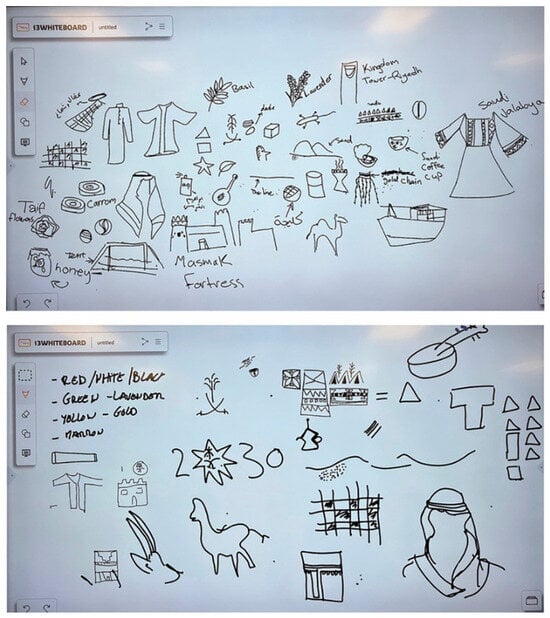
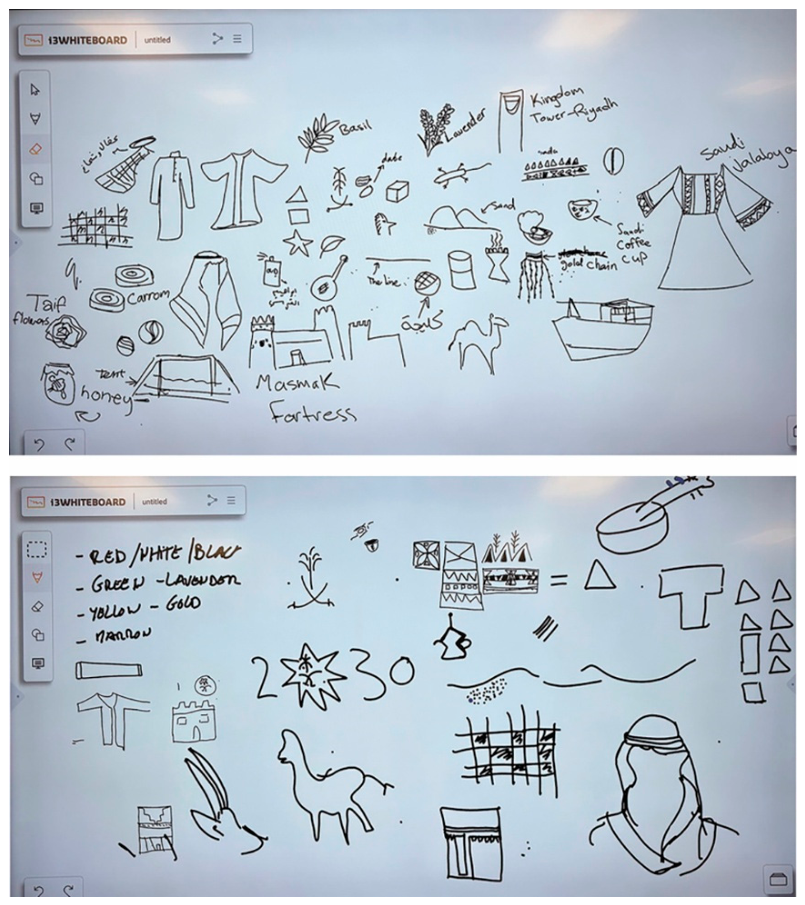
The initial cultural mapping produced a heterogeneous repertoire rather than a single or unified representation of Saudi identity. References associated with hospitality, architecture, clothing, flora, geometric and calligraphic forms, national symbolism, family, and social life appeared across the exploratory material (Figure 1). These references provided different points of departure for subsequent visual development. Rather than beginning from a predetermined definition of what a “Saudi mascot” should look like, the projects began from multiple cultural associations that could be selected, combined, or developed in different directions.
Figure 1.
Student brainstorming of cultural references and initial directions for mascot development. Source: Collaborative studio work (2025).
The repertoire also contained different levels of cultural explicitness. Some references took the form of readily identifiable objects or symbols, whereas others related to social practices, values, or broader visual traditions. Hospitality illustrates this distinction particularly clearly. It could be approached through recognizable artifacts such as the coffee cup, but also through gesture, interaction, and the relational behavior of a character. The initial cultural material therefore already contained different possibilities for visual development: cultural meaning could potentially be carried by an object, but it could also be translated through how a character appeared, acted, or related to others.
This diversity was reflected in the proposals, which approached Saudi cultural identity through different representational strategies, ranging from recognizable objects and visual traditions to family relationships and contemporary everyday life. These approaches illustrate how a shared cultural repertoire could generate distinct conceptual directions.
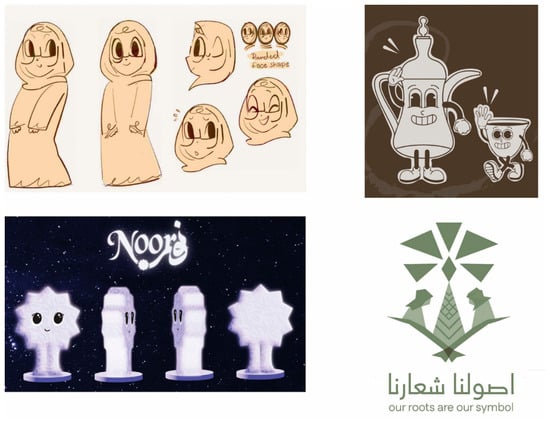
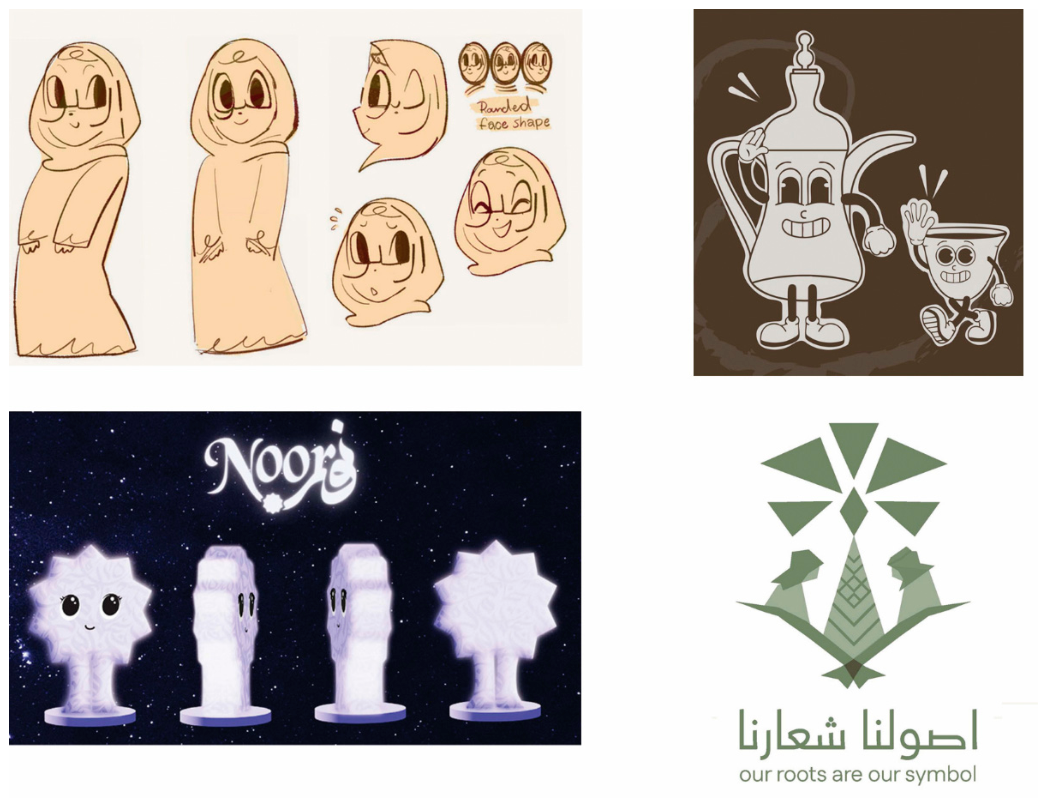
These differences became visible in the mascot proposals. Some students retained highly recognizable cultural references, while others used the initial material as a basis for greater formal transformation. The documented proposals included concepts derived from the date palm, hospitality artifacts such as the cup and teapot, star symbolism, elements of the Saudi flag, and traditional garments. Cultural references therefore entered character development through different degrees of visual correspondence with their initial source.
As Figure 2 shows, cultural references could work at different formal levels within the characters. In some proposals, the originating reference remained central to the overall silhouette or recognizable identity; in others, it was distributed across attributes such as shape, surface, clothing, color, or symbolic detail. Cultural material therefore did not function exclusively as content added to an otherwise complete character. In several proposals, it participated in the construction of the character’s formal structure itself.
Figure 2.
Selected mascot proposals showing different relationships between cultural reference and character form. Source: Student work (2025).
The presence of cultural references alone, however, did not account for the differences observed among the proposals. More revealing was what happened to those references as students began to design with them.
3.2. From Cultural Reference to Formal Transformation
Comparison between the initial cultural material and subsequent visual development showed that references rarely remained unchanged throughout the design process. Their formal characteristics were simplified, exaggerated, combined with other elements, incorporated into character anatomy, translated into pattern or texture, or shifted from explicit representation towards structural roles within the character. Across these transformations, the degree of visual resemblance between source and outcome varied considerably.
Several transformations were particularly visible across the documented work. Architectural references could be redistributed through texture or structural geometry; calligraphic references could become pattern; and culturally associated practices such as hospitality could be expressed through gesture rather than solely through recognizable objects. In these cases, the initial reference and its eventual formal manifestation did not occupy the same visual mode. What began as an object, architectural feature, or social practice could become surface, structure, movement, or behavior.
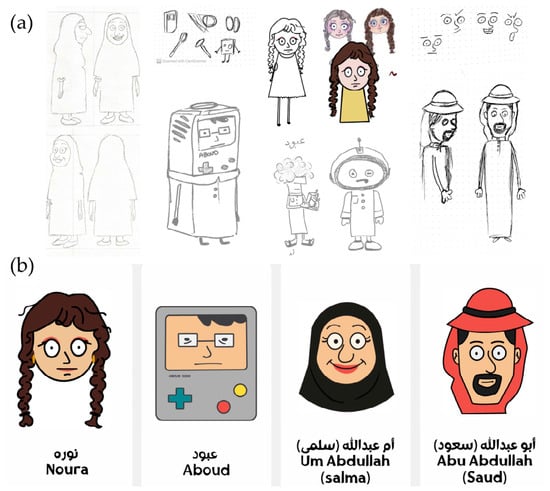
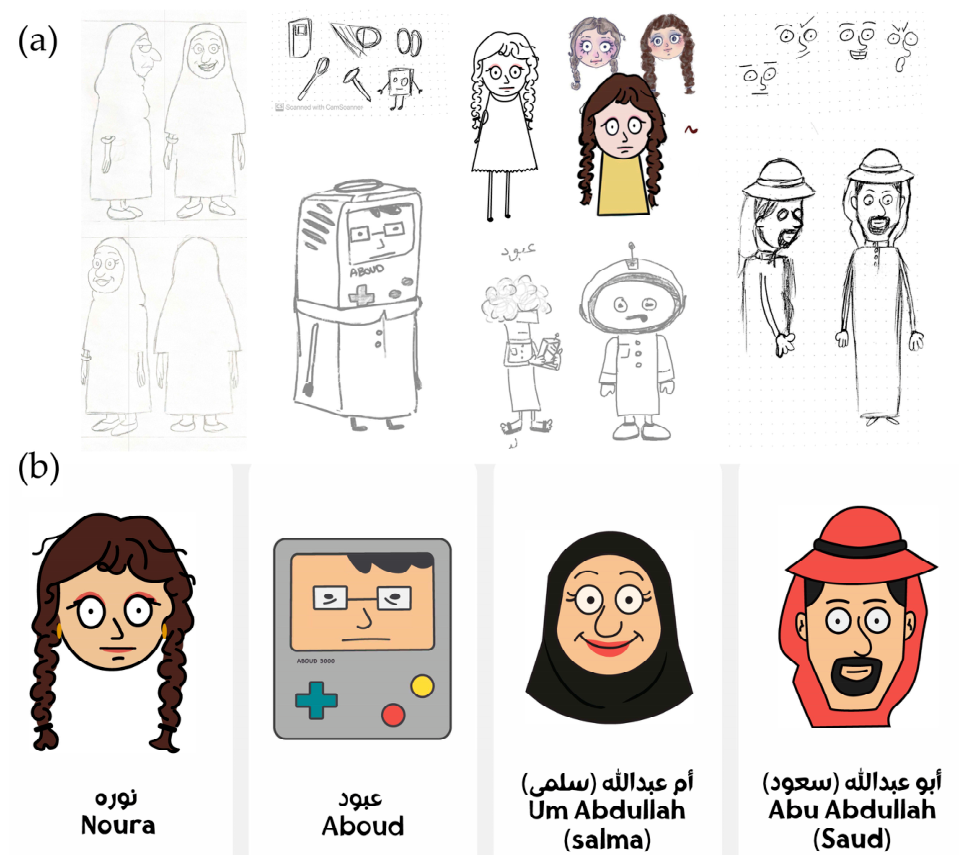
A further example of this transformation can be observed in the development of the character family presented in Figure 3. Initial explorations considered both human figures and anthropomorphized everyday objects, while the final proposal organized cultural references through four distinct characters. Elements of traditional clothing, contemporary technology, facial expression, and individual characterization were brought together within a relational configuration. This development illustrates how cultural meaning could be redistributed across character attributes and relationships rather than remaining attached to a single recognizable symbol.
Figure 3.
Visual development of a character family: (a) exploratory sketches examining human figures, anthropomorphized objects, and facial expressions; and (b) final character designs incorporating traditional and contemporary cultural references through individual visual attributes and characterization. Source: Student work (2025).
The documented processes consequently showed different degrees of transformation between source and outcome. Some proposals maintained strong visual correspondence with their originating references, while in others the source became less immediately identifiable as selected formal or conceptual characteristics were incorporated into a new character configuration. Between these positions were proposals that combined recognizable cultural cues with transformed formal characteristics. Importantly, greater abstraction did not necessarily correspond to the complete disappearance of the originating cultural reference; instead, particular characteristics could remain active through different formal resources.
3.3. Cultural Meaning Beyond Explicit Symbols
A further pattern became visible when the analysis moved beyond identifiable cultural objects and symbols. Character attributes such as posture, facial expression, proportion, gesture, surface, and relational behavior were repeatedly considered during visual development. Cultural reference was therefore expressed not only through what a mascot visibly represented, but also through how the character was configured and how it appeared to relate to others.
The analysis also revealed a distinction between cultural meaning conveyed through individual character attributes and meaning developed through relationships among characters. In the former, cultural references were expressed through clothing, silhouette, pattern, gesture, or facial expression. In the latter, cultural meaning extended to complementary roles, shared identities, and narrative configurations. The character family illustrated in Figure 3 provides an example of how traditional and contemporary references can coexist within a shared visual identity. Its individual characters combine recognizable cultural attributes with distinct personalities and visual expressions, suggesting that cultural representation can emerge from the relationships established within a group rather than exclusively from isolated symbols.
3.4. Negotiating Cultural Specificity and Anticipated Interpretation
Across the projects, formal transformation was accompanied by an ongoing negotiation between maintaining culturally specific references and anticipating how the characters might be encountered beyond the immediate cultural context. This negotiation did not produce a single formal strategy. Instead, the proposals established different relationships among recognizability, abstraction, symbolic density, character accessibility, and cultural reference.
One recurring concern involved relationships between tradition and modernity. Rather than treating these as mutually exclusive visual directions, students combined, adapted, or repositioned references associated with cultural heritage within modern character forms. Traditional garments, hospitality artifacts, architectural features, calligraphic or geometric references, and national symbols could therefore coexist with widely circulating conventions of character design and international branding.
The resulting proposals reflected different degrees of cultural explicitness, ranging from readily identifiable references to more abstracted forms in which selected cultural characteristics were embedded within broader character structures. These variations did not establish a hierarchy of effectiveness but revealed alternative strategies for negotiating cultural specificity through formal development.
Consideration of anticipated interpretation was also reflected in the development of several proposals, particularly where formal decisions concerning recognizable references, expression, gesture, or character attributes changed across successive iterations. The documented material does not provide evidence of actual audience interpretation; rather, it makes visible design decisions through which potential interpretation was considered during formal development.
3.5. Cultural Translation as an Iterative Process
Taken together, the findings show that the movement from cultural reference to visual form was not linear. Cultural material entered the process through research and cultural mapping, was selected and developed through particular design directions, underwent transformation through sketching and iteration, and could subsequently be reconsidered in relation to its cultural and communicative implications. Formal experimentation sometimes prompted further modification, while concerns about anticipated interpretation could lead to renewed abstraction, emphasis, combination, or reconfiguration.
The central empirical observation is therefore not that the projects produced a single visual language capable of reconciling Saudi and international interpretation. The available data cannot support such a claim. Rather, the documented processes provide evidence of cultural transformation through intermediate design decisions, particularly in the selection, adaptation, combination, and formal development of cultural references. These observations suggest that cultural translation can be examined through the iterative relationship between cultural interpretation and visual experimentation, without presupposing how the resulting designs would be received by different audiences. These relationships provide the empirical basis for examining cultural translation as a situated process of design reasoning in the following discussion.
4. Discussion
The findings provide a basis for reconsidering cultural translation as a process embedded within design reasoning rather than as the transfer of stable cultural content between predefined contexts. Building on perspectives of cultural hybridity and design cognition (Bhabha 1994; Cross 2006), the discussion examines how culturally situated meaning may be reconstructed through the interpretative and material actions of designing. This perspective shifts attention from cultural references as predetermined inputs towards the relationships between interpretation, negotiation, and formal transformation.
4.1. Cultural Translation as Design Reasoning
The movement observed between cultural repertoire and visual form supports an understanding of cultural translation as a mode of situated design reasoning. Design problems and possible solutions develop relationally rather than independently, while framing establishes particular relationships among situations, values, and possible responses (Cross 2006; Dorst 2011, 2015). This process also involves design judgment, through which designers navigate situations where multiple possible courses of action cannot be resolved through predetermined rules alone (Nelson and Stolterman 2014). The present findings extend these perspectives into the intercultural domain by showing that culturally situated meaning itself can become part of what is framed and reframed through designing. The initial cultural repertoire did not determine the eventual form of the mascots; rather, each reference entered the process with multiple potential characteristics and associations from which particular dimensions became significant through design decisions.
This distinction is particularly visible in the intermediate stages of design. When analysis begins with the completed artifact, cultural references may appear to have been deliberately encoded into a stable visual solution. Sketches, variations, and intermediate propositions reveal a different relationship: visual experimentation can alter how the reference itself is understood. This corresponds with reflection-in-action, in which emerging material situations contribute to the reformulation of subsequent action (Schön 1983). In the present study, however, what was being reconsidered was not only a formal or functional design problem but culturally situated meaning. Interpretation generated formal possibilities, while emerging forms could generate new interpretations. Cultural translation therefore occurred through making rather than being completed before making began.
These observations suggest that cultural interpretation and formal development act as mutually informing dimensions of design reasoning rather than as separate stages. Emerging visual propositions may induce the reconsideration of cultural references, while changes in interpretation may redirect subsequent design decisions. In this sense, the study extends established accounts of iterative design reasoning by foregrounding the reconstruction of culturally situated meaning as part of the design process itself.
4.2. From Representation to Transformation
The findings also extend the distinction between cultural representation and cultural translation developed earlier in the article. Representation participates in producing meaning rather than simply reflecting an already constituted reality (Hall 1997). The present study suggests that this production does not occur only in the completed representation; it also occurs through the formal transformations that precede it. Cultural references that began as objects, practices, architectural features, or visual traditions were variously reconstructed as texture, pattern, silhouette, structure, gesture, behavior, or relationships between characters. Cultural meaning and its eventual formal manifestation therefore need not occupy the same representational mode.
A multimodal account of visual communication helps to explain this redistribution. Meaning emerges through relationships among semiotic resources rather than residing within isolated signs (Kress and Leeuwen 2021). Cultural translation can consequently involve a movement of meaning across modes: an object may become structure, a social practice may become gesture, and a visual tradition may become rhythm, surface, or compositional organization. Related research on visual and material adaptation likewise demonstrates how cultural references can be reconfigured across media and contexts through formal transformation rather than direct equivalence (Rahmandoust and He 2026). This extends the analytical focus beyond the identification of culturally recognizable symbols towards the relationships through which cultural meaning is materially reconstructed.
From a semiotic perspective, these findings reinforce the distinction between recognizing a cultural reference and interpreting its culturally situated meaning (Barthes 1964; Eco 1976; Peirce 1958). The documented transformations suggest that the persistence of cultural meaning cannot be assessed solely through visual resemblance. Instead, attention must be directed towards which characteristics and associations are retained, reconfigured, or omitted during formal development.
Within the context of this study, cultural translation can therefore be understood as a transformation of relationships between meaning and form, rather than simply a transformation of visual form. This distinction is important for intercultural visual communication because it moves analysis beyond the question of which cultural signs are present in an artifact and towards the processes through which culturally situated meanings are materially reorganized. This process-oriented perspective contributes to visual culture research by locating cultural meaning not only in images and artifacts but also in the material and interpretative operations through which visual form emerges.
4.3. Beyond the Local–Global Binary
The findings also complicate a binary understanding of intercultural design as a negotiation between “local” cultural specificity and “global” visual universality. The mascot proposals did not emerge from two discrete visual systems that students subsequently combined. The cultural repertoire available to them was already situated within relationships among Saudi heritage, current visual culture, digital media, international character design, branding, and transnational visual conventions. This corresponds with scholarship describing Arab visual culture as developing through continuing relationships among heritage, modernity, technological transformation, and transnational circulation rather than through a stable opposition between tradition and external influence (Boutros 2017; Huda Smitshuijzen 2001; Keshmirshekan 2015; Lenssen et al. 2018; Shabout 2007).
Cultural translation and hybridity similarly challenge conceptions of cultures as internally coherent systems whose meanings remain stable through contact (Bhabha 1994; Kraidy 2006). From this perspective, the mascot proposals can be understood as emerging within already hybrid visual conditions rather than as combinations of two bounded traditions. This does not make cultural specificity irrelevant. Instead, it shifts attention towards the particular relationships constructed among cultural references, formal conventions, anticipated audiences, and emerging visual propositions.
Hybridity, in this sense, need not be understood primarily as a visible stylistic mixture. Within the processes examined, it can also be interpreted as emerging through design decisions that bring different cultural associations and visual conventions into relation. This perspective moves beyond categorizing formal elements as simply “Saudi”, “Arab”, “Western”, or “global”, directing attention instead towards how cultural references are reinterpreted and reorganized within particular design situations (Bhabha 1994; Kraidy 2006).
4.4. Affect, Embodiment, and Anticipated Interpretation
The findings further demonstrate why intercultural character design cannot be analyzed exclusively through explicit symbolism. Expression, proportion, posture, gesture, and relational behavior formed part of the students’ attempts to construct and anticipate character meaning. These dimensions introduce affect into the design problem, but their interpretation requires careful qualification. Emotional experience is shaped through relationships among bodily states, conceptual knowledge, prior experience, and context rather than being read directly from universally stable expressive signals (Barrett 2017). Affect and bodily processes similarly participate in perception and decision-making rather than functioning as secondary responses to cognition (Damásio 2005, 2021).
These perspectives help explain why expression, gesture, posture, and proportion became relevant to the students’ consideration of potential audience interpretation. However, the empirical material documents design decisions and anticipated communicative effects rather than actual audience responses. No audience testing was conducted, and the study therefore cannot establish whether the resulting character attributes would generate particular emotional interpretations across different cultural contexts. The findings instead suggest that affective and embodied dimensions formed part of the design considerations through which students attempted to negotiate cultural meaning.
4.5. Situated Cultural Translation
Taken together, these relationships support the concept of situated cultural translation as an analytical account of the design process observed in this study. Situated cultural translation refers to the recursive process through which culturally embedded references are interpreted, negotiated, and materially transformed in relation to a particular design situation. The concept shifts cultural translation from a model centred primarily on movement between cultural contexts towards the intermediate design decisions through which culturally situated meaning becomes material.
Three characteristics define the concept. It is situated because cultural references acquire significance within particular social, visual, pedagogical, and communicative contexts rather than functioning as universally stable signs (Hall 1997; Krippendorff 2006). It is transformative because culturally situated meaning is not simply transferred from source to artifact but can be reconstructed through abstraction, combination, multimodal redistribution, and formal development (Bhabha 1994; Kress and Leeuwen 2021). It is recursive because interpretation and materialization influence one another: emerging visual propositions can generate new interpretations and redirect subsequent design decisions (Cross 2006; Schön 1983).
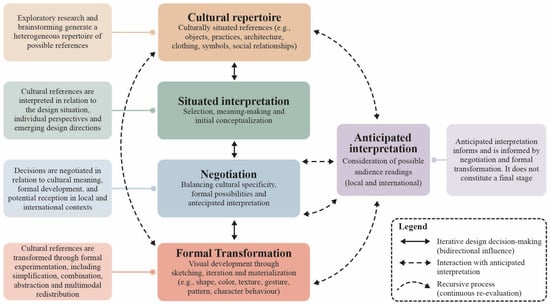
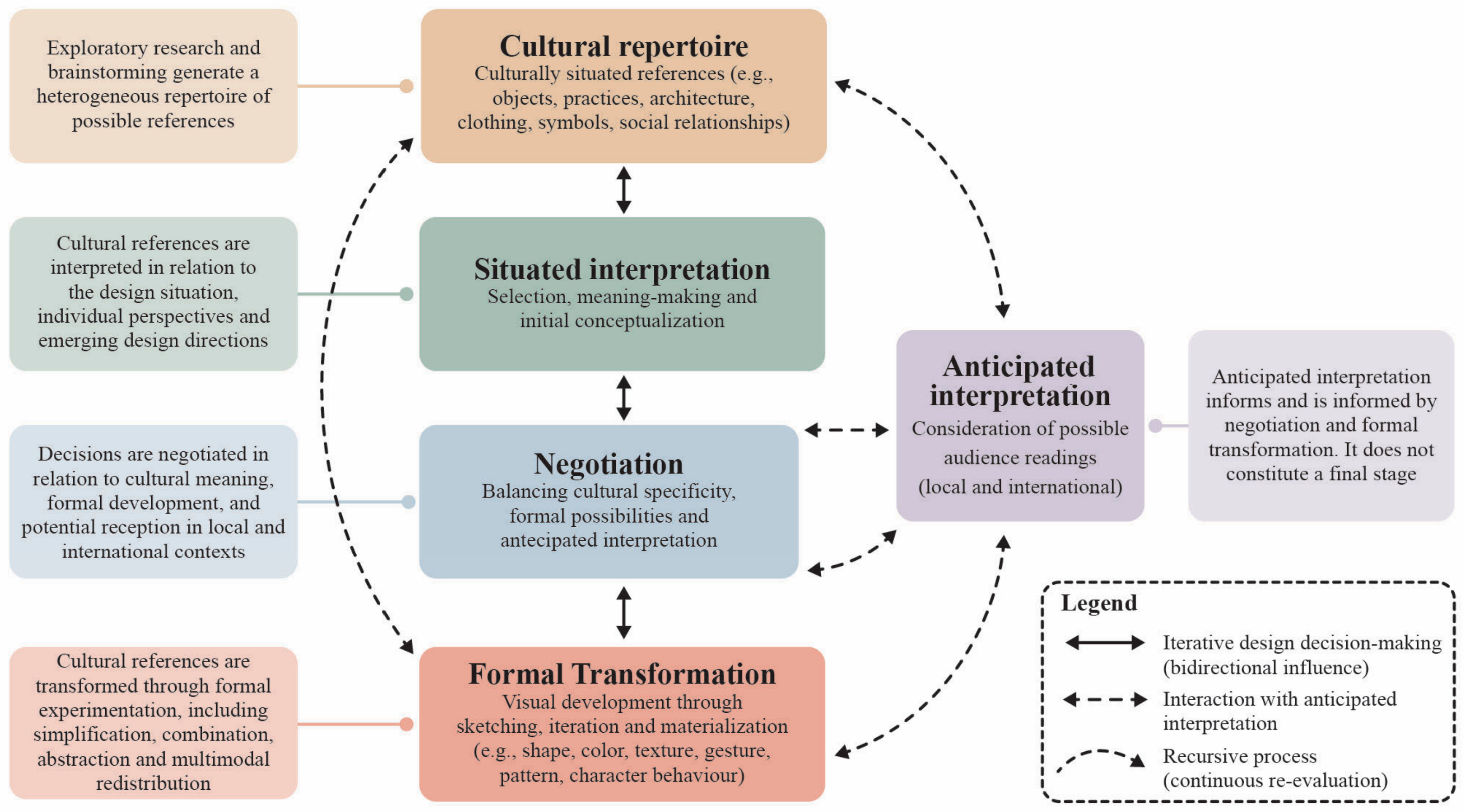
The framework presented in Figure 4 synthesizes relationships identified through the empirical analysis and their interpretation in light of the theoretical perspectives discussed earlier. The selection, adaptation, and formal development of cultural references were observable in the documented design processes, while their conceptual organization as situated, transformative, and recursive dimensions represents a theoretically informed interpretation of these findings. Within the framework, interpretation concerns the meanings attributed to cultural references; negotiation involves reconsidering these meanings in relation to design intentions, formal possibilities, and anticipated audiences; transformation refers to the reconfiguration of selected cultural characteristics; and materialization concerns their expression through emerging visual propositions. These dimensions are interconnected rather than sequential, as developing forms may prompt renewed interpretation and further negotiation. The framework should therefore be understood as a transferable analytical lens for examining intercultural design processes, rather than as a prescriptive method or an empirically validated model. Its value lies in directing attention towards the intermediate decisions through which culturally situated meaning becomes visual form.
Figure 4.
Situated cultural translation as a recursive design process. Source: Developed for this study (2025).
4.6. Ethical Implications and Interpretative Responsibility
Understanding cultural translation as design reasoning also has ethical implications. If formal decisions participate in determining which dimensions of cultural meaning become visible, implicit, transformed, or omitted, they cannot be regarded as culturally neutral. Design participates in constructing the conditions through which cultural identities and relationships become available for interpretation (Escobar 2018; Fry 2020). From this perspective, a mascot does more than contain references to an existing cultural identity; it proposes a particular way in which that identity may become perceptible.
This does not imply that designers can control how such propositions will be interpreted. Semiotic and affective perspectives suggest precisely the opposite: interpretation remains situated and cannot be guaranteed across audiences (Barrett 2017; Eco 1976). Ethical responsibility therefore lies less in controlling meaning than in recognizing the implications of the choices through which culturally situated meanings are selected, framed, transformed, or omitted. The documented design processes provide a basis for considering these ethical implications, as the selection, adaptation, and omission of cultural references can be examined not only as formal decisions but also as choices with potential consequences for cultural representation.
Situated cultural translation therefore positions intercultural design as a practice of interpretative responsibility—not a responsibility to reproduce culture unchanged, which would itself assume that culture is fixed, but a responsibility to recognize that transforming cultural references also participates in transforming the conditions through which those meanings can subsequently be encountered. This perspective connects the material operations of designing with the cultural consequences of representation while acknowledging that interpretation ultimately remains beyond the designer’s full control.
4.7. Limitations and Transferability
This study was conducted within a single undergraduate Graphic Design studio in Saudi Arabia and involved 27 final-year students working collaboratively on eight group-based mascot design projects developed in response to a shared brief. The findings should therefore be understood in relation to this specific pedagogical, cultural, and project context rather than as representative of intercultural design practice more broadly. The study does not seek statistical generalization; its contribution lies in the detailed examination of transformations made visible through a situated design process.
Although questions of potential local and international interpretation formed part of the studio critique and discussion, these discussions were not recorded or transcribed and were therefore not treated as a separate source of empirical data. In addition, no audience testing was conducted. The study consequently cannot establish whether the resulting mascots were interpreted as intended by different cultural audiences or whether particular formal strategies produced equivalent meanings or affective responses across contexts. Claims concerning intercultural interpretation are therefore limited to transformations observable in the documented design process rather than demonstrated audience reception.
A further limitation derives from the researcher’s dual role as studio instructor and researcher. While this position provided familiarity with the development of the projects, it also introduced the possibility of interpretative bias. The analysis was conducted by a single researcher, without independent coding or external validation. Although interpretations were grounded in documented visual transformations, they remain situated and cannot be regarded as independently verified.
These limitations also define the potential transferability of the study. Situated cultural translation is not proposed as a universal model or prescriptive method, but as an analytical framework whose relevance can be examined in other design situations. Its transferability therefore lies not in reproducing the cultural references or formal strategies identified in this Saudi case, but in investigating whether comparable relationships between cultural interpretation and formal transformation become observable in other cultural, pedagogical, and professional contexts.
Further research could examine how these relationships manifest across different cultural contexts, design disciplines, professional settings, and forms of visual communication. Comparative studies could investigate whether particular patterns of cultural transformation recur across design situations, while longitudinal research could examine how designers’ approaches to culturally situated meaning develop over time. Audience-based studies would provide a particularly important extension by comparing meanings anticipated during the design process with those constructed through actual intercultural encounters.
5. Materials and Methods
5.1. Research Approach and Studio Context
This study adopted a qualitative research approach centred on the analysis of design processes to examine how culturally situated meanings were interpreted, negotiated, and transformed through visual design practice. The research was conducted over one semester within a final-year undergraduate Graphic Design studio in Saudi Arabia, involving 27 students working collaboratively in eight groups. Each group developed a mascot design proposal for Expo 2030 Riyadh, creating a context in which cultural research, visual interpretation, and iterative design development could be examined through the progression of the students’ work. Rather than treating the resulting artifacts solely as final outcomes, the study approached the studio as a site in which aspects of design reasoning could become observable through relationships between making, reflection, and interpretation (Cross 2006; Frayling 1993; Schön 1983).
Mascot design provided a particularly appropriate context for this study because it combines symbolic, formal, and character-based modes of communication. Students had to consider not only which cultural references might inform their proposals, but also how those references could work through form, color, proportion, gesture, expression, pattern, clothing, and other visual resources. These elements work relationally in the construction of visual meaning (Kress and Leeuwen 2021), allowing the design process to reveal transformations that might not remain visible as explicit cultural symbols in the completed characters.
The study did not seek to evaluate the pedagogical effectiveness of the studio, measure student learning outcomes, or assess the mascots against predetermined criteria of cultural authenticity. Its analytical focus was the design process itself: specifically, the transformations occurring between cultural research, interpretation, visual exploration, and formal development.
5.2. Design Process and Data Collection
The studio process combined cultural research, brainstorming, visual development, iterative experimentation, and critical discussion. Students initially explored cultural references related to the project context before developing specific mascot proposals. Brainstorming addressed themes including Saudi identity, hospitality, and modernity, generating references associated with architecture, clothing, hospitality practices, local flora, geometric structures, calligraphic forms, symbolic elements, and other aspects of the Saudi cultural and visual environment. These references were not treated as a definitive taxonomy of Saudi culture but as the repertoire generated within the studio from which different design directions could emerge.
Following this exploratory phase, students selected and developed references through sketching and iterative character development. References were not prescribed as formal requirements, allowing students to retain, combine, abstract, transform, or abandon them according to the emerging direction of their proposals. Visual development consequently produced different degrees of correspondence between the initial cultural material and the resulting character forms. The process moved through sketches, formal variations, intermediate proposals, and critical studio discussions, during which relationships between cultural intention, formal development, and anticipated interpretation could be reconsidered as the characters evolved.
The empirical material comprised brainstorming records, visual documentation of the design process, sketches and formal variations, intermediate design proposals, and final visual outcomes. These materials were examined relationally rather than as independent sources. In particular, the intermediate visual material enabled changes between initial cultural references and subsequent formal outcomes to be traced across the design process. Final mascot proposals were therefore examined in relation to the visual and interpretative developments that preceded them, making it possible to investigate not only which cultural references remained visible but also how they changed through successive design decisions.
5.3. Analytical Procedure
The analysis followed an iterative and interpretative process combining inductive examination of the empirical material with theoretically informed interpretation. All eight group-based projects were included in the qualitative analysis, while five were purposively selected for more detailed presentation. These cases were chosen for their different approaches to representing Saudi culture and their capacity to illustrate the four interconnected patterns identified through the analysis. The visual material was interpreted by the lead researcher in relation to the theoretical framework developed earlier in the article.
The analysis proceeded in three stages. First, cultural references emerging from the brainstorming and cultural mapping materials were identified and organized according to the themes through which they had been generated and the meanings associated with them within the project. This established the repertoire of cultural material entering the design process and provided a basis for tracing how particular references subsequently developed. The purpose was not to determine whether individual references constituted definitive representations of Saudi culture, but to identify the cultural material that became available for interpretation within the documented design processes. Second, sketches, formal variations, and intermediate proposals were examined in relation to the references identified during the initial phase. Attention was directed towards transformations involving form, proportion, color, pattern, texture, gesture, clothing, symbolic attributes, and character configuration. The analysis traced whether references were retained, abstracted, combined, reconfigured, displaced across visual modes, or no longer visibly present as the proposals developed. This made it possible to examine cultural transformation beyond the continued presence or disappearance of explicit cultural symbols and to consider how meaning could be redistributed across multiple visual resources (Kress and Leeuwen 2021). Third, recurring relationships identified across the documented design processes were compared and synthesized before being interpreted in relation to the theoretical perspectives developed earlier in the article. This stage considered how the empirical transformations related to design reasoning (Cross 2006; Dorst 2015), semiotic interpretation (Eco 1976; Peirce 1958), cultural representation and translation (Bhabha 1994; Hall 1997), multimodal meaning-making (Kress and Leeuwen 2021), and embodied and affective interpretation (Barrett 2017; Clark 2015). These perspectives were used as interpretative lenses rather than as predetermined coding categories.
The analytical emphasis therefore shifted progressively from identifying which cultural references were present to examining what happened to those references through designing. Comparisons between brainstorming material, intermediate visual development, and final proposals enabled transformations to be reconstructed that would have been less visible if completed artifacts had been considered in isolation. The theoretical framework subsequently provided concepts through which the broader significance of these transformations for intercultural design could be interpreted, without determining in advance the patterns that the analysis would identify.
Interpretative credibility was supported through comparison across the different forms of material generated during the studio. Rather than relying on a single source or on the final artifacts alone, interpretations were considered in relation to the coherence between brainstorming material, visual development, and intermediate and final outcomes. This comparison provided a means of assessing whether interpretations of cultural transformation could be supported across different stages of the documented design process.
The four patterns were identified through comparisons across the eight projects, with a focus on relationships that appeared in more than one documented design process. Project-specific observations that did not occur across the material were retained as contextual examples rather than treated as independent analytical patterns.
5.4. Ethical Considerations and Researcher Position
Students were informed of the research objectives and authorized the use of their materials for academic purposes. The dual pedagogical and investigative role of the researcher was made explicit within the studio context.
The researcher’s participation in the pedagogical environment provided direct access to the progression of the projects and to the critical discussions accompanying them, while also creating a need to distinguish observable transformations from retrospective assumptions about students’ intentions. The analysis therefore prioritized relationships that could be traced through the available visual and documentary material. Cultural interpretations or intentions were not attributed to individual students where they could not be supported by the documented design process. The resulting analysis is consequently treated as an interpretation of observable transformations within situated design processes rather than as direct access to the internal intentions or cognitive states of individual designers.
The analysis was conducted by a single researcher, without independent coding or external validation. Interpretative credibility was supported by examining the consistency of observations across the documented stages of the design processes. The researcher’s dual pedagogical and investigative role, together with the absence of independent analytical validation, is acknowledged as a limitation of the study.
6. Conclusions
This study examined how culturally situated meanings become visual form through design practice, drawing on a qualitative analysis of eight group-based mascot design projects developed within a Saudi Graphic Design studio. By examining cultural research, exploratory sketches, visual iterations, and final proposals, the study identified recurring relationships between cultural interpretation and formal transformation. The findings suggest that cultural references do not simply move unchanged from research into representation but may be selected, adapted, combined, and redistributed across different visual and character-based resources through iterative design decisions.
The principal contribution of the study is the proposition that cultural translation can occur within design reasoning itself. Interpretation does not necessarily precede formalization as a completed cognitive operation; emerging visual propositions can prompt renewed interpretation of the cultural material from which they developed. The concept of situated cultural translation describes this recursive relationship between culturally situated interpretation and material transformation. Rather than prescribing how intercultural design should be undertaken, it provides an analytical vocabulary for examining the intermediate decisions through which cultural meaning becomes material.
This perspective also changes how the relationship between cultural specificity and intercultural communication can be approached. The design problem need not be framed as a choice between preserving an intact local identity and producing a universally accessible visual language. Cultural meanings and visual practices are themselves formed through circulation, hybridity, and negotiation (Bhabha 1994; Kraidy 2006). Intercultural design consequently involves working with the transformations through which cultural specificity is reconstructed rather than attempting either to preserve it unchanged or dissolve it into universality. More broadly, the framework offers a process-oriented perspective for examining how cultural meanings are reconstructed through visual and material practices, complementing approaches to visual culture that begin primarily from completed representations.
The study also has methodological implications for design research. Examining cultural mapping, sketches, iterations, and evolving visual propositions makes visible transformations that may disappear when analysis begins and ends with completed artifacts. Such attention to process also reveals the interpretative responsibility embedded in formal decision-making: choices concerning what is retained, abstracted, combined, emphasized, or omitted participate in determining how culturally situated meanings become available for subsequent interpretation. Design cannot guarantee those interpretations, but it participates in constructing the conditions through which they become possible.
Ultimately, the question is not only what culture a designed artifact represents, but what happens to cultural meaning as it becomes form. Attending to that transformation offers a way of understanding intercultural design as an iterative process of interpretation, negotiation, and materialization in which culture is neither simply reproduced nor left behind but continually reconstructed through designing.
Author Contributions
Conceptualization, S.S.; methodology, S.S.; formal analysis, S.S.; investigation, S.S.; resources, S.S.; data curation, S.S.; writing—original draft preparation, S.S.; writing—review and editing, S.S., H.A.Q. and R.B.; visualization, S.S.; project administration, S.S. All authors have read and agreed to the published version of the manuscript.
Funding
This research received no external funding.
Institutional Review Board Statement
Formal institutional ethical approval was not obtained for this study. The research involved a retrospective qualitative analysis of design artefacts produced as part of regular undergraduate coursework, without additional research interventions.
Informed Consent Statement
Students authorized the academic use of their design work produced as part of regular undergraduate coursework. Informed consent was obtained from all subjects involved in the study.
Data Availability Statement
The data supporting the findings of this study consist of student-generated design artefacts, including sketches, visual explorations, intermediate proposals, and final design outcomes. Selected materials are presented within the article. Additional materials are not publicly available.
Conflicts of Interest
The authors declare no conflict of interest.
References
- Alotaibi, Noura. 2020. The Intercorrelation Between Arabic Calligraphy and Graphic Design in Saudi Arabia. Ph.D. thesis, Middlesex University, London, UK. [Google Scholar]
- Barrett, Lisa Feldman. 2017. How Emotions Are Made: The Secret Life of the Brain. Boston: Houghton Mifflin Harcourt. [Google Scholar]
- Barthes, Roland. 1964. Elements of Semiology. New York: Hill and Wang. [Google Scholar]
- Bhabha, Homi K. 1994. The Location of Culture. London: Routledge. [Google Scholar]
- Blair, Sheila, and Jonathan M. Bloom. 1994. The Art and Architecture of Islam 1250-1800. New Haven: Yale University Press. [Google Scholar] [CrossRef] [Scilit]
- Boutros, Mourad. 2017. Arabic for Designers: An Inspirational Guide to Arabic Culture and Creativity. London: Thames and Hudson. [Google Scholar]
- Buchanan, Richard. 1992. Wicked Problems in Design Thinking. Design Issues 8: 5–21. [Google Scholar] [CrossRef] [Scilit]
- Clark, Andy. 2015. Surfing Uncertainty. Prediction, Action, and the Embodied Mind. Oxford: Oxford University Press. [Google Scholar]
- Cross, Nigel. 1982. Designerly Ways of Knowing. Design Studies 3: 221–27. [Google Scholar] [CrossRef] [Scilit]
- Cross, Nigel. 2006. Designerly Ways of Knowing. London: Springer-Verlag London Limited. [Google Scholar]
- Cross, Nigel. 2018. Developing Design as a Discipline. Journal of Engineering Design 29: 691–708. [Google Scholar] [CrossRef] [Scilit]
- Damásio, António. 2005. Descartes’ Error: Emotion, Reason, and the Human Brain. New York: Penguin Books. [Google Scholar]
- Damásio, António. 2021. Feeling & Knowing: Making Minds Conscious. New York: Knopf Doubleday Publishing Group. [Google Scholar]
- Dorst, Kees. 2011. The core of “design thinking” and its application. Design Studies 32: 521–32. [Google Scholar] [CrossRef] [Scilit]
- Dorst, Kees. 2015. Frame Innovation. Create New Thinking by Design. London: MIT Press. [Google Scholar]
- Eco, Umberto. 1976. A Theory of Semiotics. Bloomington: Indiana University Press. [Google Scholar]
- Escobar, Arturo. 2018. Designs for the Pluriverse. Radical Interdependence, Autonomy, and the Making of Worlds. Durham: Duke University Press. [Google Scholar]
- Frayling, Christopher. 1993. Research in Art and Design. In Royal College of Art: Vol. I. London: Royal College of Art. [Google Scholar]
- Fry, Tony. 2020. Defuturing. A New Design Philosophy. London: Bloomsbury Publishing. [Google Scholar]
- Grabar, Oleg. 1992. The Mediation of Ornament: The A. W. Mellon Lectures in the Fine Arts, 1989. Princeton: Princeton University Press. [Google Scholar]
- Hall, Stuart. 1997. Representation: Cultural Representations and Signifying Practices, 1st ed. London: SAGE Publications. [Google Scholar]
- Huda Smitshuijzen, AbiFarès. 2001. Arabic Typography: A Comprehensive Sourcebook. London: Saqi Books. [Google Scholar]
- Keshmirshekan, Hamid. 2015. Contemporary Art from the Middle East: Regional Interactions with Global Art Discourses. London: I.B.Tauris & Co., Ltd. [Google Scholar]
- Kraidy, Marwan M. 2006. Hybridity, or the Cultural Logic of Globalization. Philadelphia: Temple University Press. [Google Scholar]
- Kress, Gunther, and Theo van Leeuwen. 2021. Reading Images. The Grammar of Visual Design, 3rd ed. London: Routledge. [Google Scholar]
- Krippendorff, Klaus. 2006. The Semantic Turn: A New Foundation for Design, 1st ed. Boca Raton: CRC Press. [Google Scholar]
- Lenssen, Anneka, Sarah Rogers, and Nada Shabout. 2018. Modern Art in the Arab World: Primary Documents. New York: The Museum of Modern Art. [Google Scholar]
- Margolin, Victor. 2005. A world history of design and the history of the world. Journal of Design History 18: 235–243. [Google Scholar] [CrossRef] [Scilit]
- Nelson, Harold G., and Erik Stolterman. 2014. The Design Way. Intentional Change in an Unpredictable World, 2nd ed. Cambridge, MA: The MIT Press. [Google Scholar]
- Norman, Don. 2004. Emotional Design: Why We Love (Or Hate) Everyday Things. New York: Basic Books. [Google Scholar]
- Peirce, Charles S. 1958. The Collected Papers of Charles Sanders Peirce (Vol. I–VIII). Edited by Charles Hartshorne, Paul Weiss and Arthur W. Burks. Cambridge, MA: Harvard University Press. [Google Scholar]
- Rahmandoust, Majid, and Renke He. 2026. Makara Across Waters: Visual and Material Adaptation of a Mythical Motif from Indian Guardianship to Chinese Ceramic Export. Arts 15: 172. [Google Scholar] [CrossRef] [Scilit]
- Schön, Donald A. 1983. The Reflective Practitioner: How Professionals Think in Action. New York: Basic Books. [Google Scholar]
- Shabout, Nada M. 2007. Modern Arab art: Formation of Arab aesthetics. Florida: University Press of Florida. [Google Scholar]
- Walker, Stuart. 2011. The Spirit of Design: Objects, Environment, and Meaning. London: Earthscan. [Google Scholar]
- Zhang, Yuanyuan, and Mumtaz Mokhtar. 2025. Confucian aesthetics in migration: Critical strategies and visual translation in Malaysian Chinese art. Arts 14: 108. [Google Scholar] [CrossRef] [Scilit]
- Zhang, Yuanyuan, and Mumtaz Mokhtar. 2026. From Philosophy to Canvas: An Empirical Model of Confucian Visual Translation in Malaysian Chinese Art. Arts 15: 50. [Google Scholar] [CrossRef] [Scilit]
Disclaimer/Publisher’s Note: The statements, opinions and data contained in all publications are solely those of the individual author(s) and contributor(s) and not of MDPI and/or the editor(s). MDPI and/or the editor(s) disclaim responsibility for any injury to people or property resulting from any ideas, methods, instructions or products referred to in the content. |
© 2026 by the authors. Licensee MDPI, Basel, Switzerland. This article is an open access article distributed under the terms and conditions of the Creative Commons Attribution (CC BY) license.