


Abstract
This article investigates public munificence (euergetism) in the Bosporan Kingdom from the 1st century BCE to the 3rd century CE, examining how gift exchange and honorific practices operated within a long-lasting framework of Roman dependency. Analysing a corpus of 118 inscriptions—comprising tituli honorarii, public dedications, and building inscriptions—the study demonstrates that munificence served as a vital mechanism for ongoing power negotiation rather than mere court propaganda. Rulers utilised benefactions, imperial titulature, and architectural patronage to secure their “two-level sovereignty” under Roman hegemony. At the same time, municipal elites and court dignitaries employed building initiatives and honours to legitimise their social status and compete for local influence. Furthermore, the epigraphic evidence reveals clear regional divergences. While the European Bosporus remained heavily centralised around the royal court at Panticapaeum, the Asiatic cities displayed greater civic agency and institutional self-organisation. Ultimately, Bosporan euergetism represents a dynamic process of cultural glocalisation that successfully bridged Roman imperial authority, Greek civic traditions, and nomadic steppe elements to maintain internal cohesion along the Black Sea frontier.
1. Introduction
This article aims to examine one of the pivotal yet highly multifaceted dimensions of the socio-political history of the Bosporan Kingdom: the phenomenon of public munificence (euergetism), with a particular focus on its manifestations, dynamics, and structural functions from the 1st century BCE to the 3rd century CE. This chronological framework is by no means accidental, arising directly from both the region’s geopolitical developments and the state of the surviving source material. The starting point of this period is marked by the permanent integration of the Bosporan state into the sphere of Roman interests—a process initiated indirectly by the expansionist policies of Mithridates VI Eupator and sealed by the consolidation of Roman hegemony on the northern shores of the Black Sea. Conversely, the terminal point is defined by the widespread destruction of numerous Bosporan centres during the barbarian invasions of the mid-3rd century CE (Anokhin 1999, pp. 164–66; Vinogradov and Goroncharovskyi 2008, pp. 283–84). This catastrophe led to a sudden collapse of the local epigraphic habit (Figure 1), which represents an indispensable prerequisite for any investigation into ancient honorific practices.
Figure 1.
Epigraphic curve of the Bosporan Kingdom categorized by inscription type (1450 texts). Based on Halamus (2024, Fig. 14), modified with the inclusion of 18 additional inscriptions. Author: M. Halamus.
Owing to its geographical position, centuries-long political continuity, and a relatively abundant corpus of local sources (which stands in stark contrast to the peripheral interest shown by classical authors), the Bosporan Kingdom represents a highly distinctive case of a political organism that was never formally annexed or dismantled by Rome. While its political trajectory and power dynamics initially mirrored those of other dependent states—inviting some analogies to Nabataea or Herodian Judaea—over time (Halamus 2018; Ish-Shalom 2021), what Millar (1996) termed “two-level sovereignty” developed into a stable, centuries-long state of affairs unique to the Bosporus, also referred to as the Roman–Bosporan status quo (Nawotka 1989).
The dominant picture emerging from the surviving source material—unsurprisingly, given the status of the Bosporus as a “client,” or rather dependent, kingdom—is a highly hierarchical relationship structured along the axis of Roman Emperor–local monarch and, internally, the king and his subjects. This aspect is of significant interest in its own right, offering an opportunity to trace its evolution and its impact on the shaping of the local power structure. However, a closer reading of the epigraphic record can reveal a much broader and far more complex spectrum of social interactions. The Bosporan Kingdom was not an entirely monolithic socio-political entity but rather functioned as a unique contact zone. Within this space, deep-seated Greek civic traditions, the growing administrative and cultural influence of the Roman Empire, and the powerful impact of nomadic cultures from the steppe hinterland overlapped and intersected.1
Although the numerous Bosporan inscriptions are, for the most part, rather laconic regarding the circumstances surrounding the granting of honours or the specific benefactions performed for the community (as will be discussed in detail below), in such a complex, multicultural environment, euergetism must have functioned as a mechanism that went far beyond mere court propaganda. It also served as a vital instrument of power negotiation and a means of constructing a “middle ground” of mutual understanding between diverse social groups, elites, and subjects. Yet, to fully grasp this intricate exchange of material resources, civic honours, and political loyalty, one must look beyond the traditional, narrowly defined corpus of tituli honorarii. The analysis must encompass the broader local “epigraphic habit,” including building inscriptions, dedications, and even select epitaphs.
The abundant evidence of funded buildings, statues, and some financial donations, combined with the clear effort to record these acts in stone, demonstrates the profound significance of this practice. Through this language of stone, rulers, municipal elites, and local chieftains not only defined and legitimised their social standing but also competed for political influence and maintained the cohesion of a state balancing on the frontiers of the Greco-Roman world.
2. Public Munificence: Global Trends and the Shape of the Local Evidence
Public munificence or euergetism (a neologism from euergetes—benefactor) represents one of the pivotal phenomena that has occupied a central position in scholarship on the society and politics of the ancient Greco-Roman world for decades. Although voluntary donations by wealthy citizens had been described in earlier literature, the systematic academic study of this practice gained true momentum only in the second half of the twentieth century.
A breakthrough arrived with Veyne’s (1976) seminal work, Le pain et le cirque, which defined euergetism as a unilateral, oligarchic gift from the elites to a passive, depoliticised populace. Veyne viewed it as a response by notables to the processes of aristocratization and centralisation of power following the conquests of Alexander the Great; through lavish benefactions, wealthy citizens demonstrated their social superiority, purchasing prestige and honorific titles in return.
This vision was substantially revised by Gauthier (1985) in his influential monograph Les cités grecques et leurs bienfaiteurs. Gauthier demonstrated that in the Early Hellenistic period, euergetism functioned within the strictly institutionalised framework of the polis, and that the title of euergetes was initially granted primarily to deserving foreigners protecting the city’s interests, rather than to its own citizens. Only over time, as Quass (1993) further elaborated, did the exchange of benefactions for civic honours become the foundation for the consolidation of local elites and the operation of the so-called “regime of notables.”
Recent scholarship—spearheaded by scholars such as Zuiderhoek (2009), Domingo Gygax (2016), Heller and van Nijf (2017) and Heller (2020)—has prompted a further, more profound reassessment of this debate. Euergetism is no longer perceived as a unilateral act of elite grace but is instead analysed as an institutionalised form of gift exchange rooted in anthropological concepts of reciprocity. In this revised framework, the civic community was not a passive recipient but an active partner negotiating the nature and form of honours with the elites.
Contemporary scholars thus emphasise that euergetism was essentially a complex system of communication and “power negotiation.” Focusing on the evolution of the phenomenon within a longue durée perspective, they trace how local practices adapted to shifting political realities (Domingo Gygax and Zuiderhoek 2021). The generosity of wealthy individuals and the public honours conferred upon them not only legitimised economic inequality but, above all, mitigated internal social friction, ensuring the cohesion and stability of the community as a whole.
The study of euergetism, alongside related issues concerning political culture and the epigraphic habit in the specific context of the Black Sea cities—including the Bosporan Kingdom—has engaged historians and epigraphers for many years. These scholars have successfully adapted general sociological and historical theories to the unique, local realities of the Pontic region (see, e.g., Nawotka 1997, 2014; Anghel 1999–2000; Cojocaru 2016; Halamus 2017; see also selected papers in Avram 2022, pp. 449–90). A milestone in this field is Cojocaru’s (2025) latest monograph, which seeks to provide a comprehensive account of public munificence in the Pontic region. Cojocaru explicitly stresses that the role of kings and dynasts—both Bosporan and those ruling hinterland territories—constituted a fundamental and highly distinct dimension of euergetism in the Pontic area. However, while Cojocaru’s comprehensive study provides a broad pan-Pontic overview of public benefactions, this article offers a focused, in-depth investigation specifically tailored to the Roman-period Bosporan Kingdom. Building upon a systematic dataset of epigraphic evidence—encompassing not only tituli honorarii but also building inscriptions, public dedications, and a few decrees—it moves beyond traditional models of provincial monarchs’ unilateral dependence on Rome to conceptualise euergetism as a dynamic arena of ongoing power negotiation and social legitimation.
The specific nature of euergetism and its accompanying epigraphic habit in the Black Sea region during the Roman period offers a fascinating example of “glocalisation”—the synthesis of universal, Greco-Roman patterns with strong local geopolitical and cultural dynamics (Vlassopoulos 2013, pp. 226–77). The universal dimension was manifested primarily in the profound institutional and cultural transformations that swept across the ancient world under Roman rule. As in the Aegean region and Asia Minor, the Pontic cities experienced a marked concentration of executive power in the hands of a narrow elite of wealthy families during the “long Hellenistic period” and the Roman era. Traditional democratic institutions, such as the council (boule) and assembly (ekklesia, demos), formally survived, but council membership became increasingly contingent upon property qualifications, fostering a trajectory toward oligarchization (Chaniotis 2017).
At the same time, the epigraphic habit in the Black Sea area followed the broader trends of the Eastern Mediterranean. A distinct peak in epigraphic activity, fueled by elite munificence and the stability of the Pax Romana, occurred during the 2nd century and the first half of the 3rd century CE, followed by a sharp decline, among other factors, due to the barbarian invasions of the mid-3rd century CE.2 In line with the developments outlined by scholars such as Heller (2024, pp. 204–6) and Nawotka (2020, pp. 1–30), the Roman era saw long, detailed honorific decrees recounting specific benefactions gradually replaced by shorter honorific inscriptions (tituli honorarii) carved on statue bases. This “commemorative turn” meant that new monuments were primarily designed to commemorate the individuality of the honorand and attest to their personal achievements. Standard honours typical of the Greek world—such as golden crowns, public funerals, the erection of statues, and honorific titles like benefactor (euergetes), patriot (philopatris), or saviour (soter)—became widespread. In contrast, the highest divine honours (isotheoi timai) were strictly reserved for the emperor and his family (Heller 2024, pp. 209–10).
A key divergence in the epigraphic culture of the Pontic region ran along the divide between territories directly incorporated into the Roman Empire’s structures and those on its northern periphery. Western Pontic centres, such as Istros, Kallatis, Tomis, and Mesambria, were directly integrated into the Roman provincial administration of Thrace and Moesia. These cities experienced a drastic drop in the number of civic decrees in favour of concise tituli honorarii dedicated to emperors, Roman officials, and local notables, marking a complete adoption of the provincial model. Conversely, the situation differed significantly in North Pontic centres such as Olbia and Tauric Chersonesos, which remained formally outside the empire’s borders as independent poleis (Porucznik 2023, pp. 109–12; Dana 2024, p. 711). In these cities, the 1st and 2nd centuries CE brought no decline in the volume of long, traditional civic decrees, as local communities proudly maintained the rhetoric of ancestral freedom and classical democratic procedures (Chaniotis 2017, pp. 156–60).
This contrast was equally visible in the scale and nature of euergetism. While benefactors in wealthy Asia Minor erected monumental architectural complexes, the conditions of the North-Western Pontic region gave rise to a “euergetism of survival.” Due to the constant threat posed by inland tribes, local benefaction frequently assumed a military and diplomatic character, consisting of funding embassies, ransoming captives, or recruiting mercenaries (Halamus 2017, pp. 79–80). Another factor unique to the Pontic region was the presence of kings ruling over the indigenous populations, whose influence on the cities was most often based on an asymmetry of power and political coercion, even if masked by the formal rhetoric of gift-diplomacy. In the Hellenistic period, interactions with Thracian and Getic rulers often bore the hallmarks of extortion. The widely discussed decree for Protogenes of Olbia (IOSPE I2 32) details a scenario in which the city faced heavy financial demands from King Saitapharnes in exchange for peace. Likewise, in Dionysopolis, the powerful Getic king Burebista dictated terms that required mediation by the local diplomat and benefactor Akornion (IGBulg I2 13). While Akornion’s diplomatic efforts proved successful, many other cities in the region met a tragic fate and were destroyed by Burebista (Nawotka 1997, pp. 49–55).
One can also point to cases of potential mutual benefit in relations with local rulers. A decree from Mesambria honouring the Thracian king Sadalas and his ancestors records the conferral of proxenia, along with other typical privileges, and then the annual award of a golden crown worth 50 staters. Although this might superficially appear to be an extortion of tribute in exchange for peace, it was more likely an attempt by the city to secure economic advantages.3
Another notable example is the Bosporan king Eumelos and his benefactions to the citizens of Kallatis (Cojocaru 2025, pp. 112–13). Similarly, the intervention of the Mithridatid dynasty from the Kingdom of Pontus, summoned to assist against nomadic incursions, assumed the character of protection.4 Mithridates VI Eupator established control over the entire coastline, and grateful cities honoured his generals, such as Diophantos of Sinope—who saved Chersonesos from the invasion of Scythians and Taurians5—or Diogenes, who used his personal funds to ransom an imprisoned Histrian embassy.6 The practice of royal munificence towards cities by dependent kings persisted into the Roman period. A notable case illustrating an external benefaction by a client ruler—and demonstrating how a rex amicus et socius could construct his prestige policy—was the activity of Rhoemetalces III of Thrace, who is attested around 40 CE as a generous benefactor of Chios (I.Chios 220).
Against this background, the Bosporan Kingdom operated differently due to its unique history, in which monarchical rule was a permanent and structural state of affairs—a reality reflected in the epigraphic habit of Bosporan cities from the outset (Figure 1). However, one must emphasise the distinct nature of the Bosporan kings’ relationship with the Greek centres within their realm, both under the Spartocid dynasty during the Hellenistic period and under the Tiberii Iulii in the Roman era. The Greek cities of the Bosporus were neither alien entities within a “barbarian” territorial state to be exploited nor potential spoils of war to be annexed. Rather, these cities constituted an integral part and the very foundation of the Bosporan Kingdom, situated along the strait and drawing its strength from access to maritime trade. Bosporan rulers had to skillfully balance relationships with both the coastal centres and the tribes of the hinterland.
The external projection of the Spartocids cannot be separated from the internal consolidation of their realm. The territorial integration of the Kerch and Taman peninsulas—most notably through the incorporation of Nymphaion, the annexation of Theodosia, and the subjugation of neighbouring tribes—created a vast, centrally controlled agricultural hinterland. In order to monetise these agrarian surpluses, Theodosia and Panticapaeum were transformed into major export hubs oriented primarily toward the Aegean market (Müller 2010, pp. 159–63, 204–6). This expansion of trade went hand in hand with the development of an external ‘diplomacy of honours and symbols’ directed notably toward Athens, in which the Spartocid rulers had already engaged during the Classical and Hellenistic periods. By securing vital grain supplies, they built immense political capital, receiving citizenship, proxenia, golden crowns dedicated to Athena Polias, and bronze statues erected in the Athenian Agora and the Piraeus.7 In their relations with the Aegean poleis, the dynasts deliberately communicated in the civic language of a Greek city-state. Internally, because the autonomous political life of the Bosporan poleis had been largely subsumed under a centralised territorial state (leaving no room for independent civic decree-making by a boule or demos before the Mithridatic era), the royal administration itself stepped in to adopt the epigraphic habits of a polis. Royal edicts and grants of proxenia, ateleia, and politeia functioned as direct equivalents of civic decrees, regulating external trade and binding foreign benefactors to the dynasty (Cojocaru 2016).
Despite the consolidation of royal power, the Bosporan epigraphic habit expanded noticeably during the Roman period. On the one hand, it aligned with the wider trends observed in other poleis (a prevalence of short tituli honorarii, lists of names, epitaphs, and an absence of popular assembly decrees) (Heller 2020, pp. 135–38; 2024, pp. 204–6; Zuiderhoek 2021). Yet this should not be interpreted as a retreat from an earlier Hellenistic habit of issuing narrative-rich decrees documenting the activity of a boule and demos. Before the reign of Mithridates Eupator, there is no attestation of a functioning demos or boule on the Bosporus. The sparse mentions of these institutions in the early centuries CE thus reflect the gradual evolution and maturation of the kingdom’s epigraphic culture.
3. Inscriptions from the Bosporan Kingdom and Their Connection to Public Munificence
The analysed source material comprises a selection of 118 inscriptions ranging from the reign of Mithridates VI Eupator to the end of the third century CE (See Figure 2), with the latest text dated to the reign of King Tiberius Julius Teiranes (275–9 CE).8 This collection includes not only strictly honorific inscriptions (tituli honorarii),9 but also selected public dedications,10 building inscriptions,11 and three epitaphs directly concerning the Bosporan rulers (CIRB 1000; SEG 45: 1018; 56: 933). Additionally, nine texts categorized as “other” have been included, consisting of honorific inscriptions that can be interpreted as decrees (CIRB 432B; 982; SEG 41: 625; 45: 1023, a funerary oration (SEG 55: 862; 863; 59: 841), and two letters from King Aspurgus to the citizens of Gorgippia (SEG 46: 940 A and B).
Figure 2.
Classification of epigraphic material by category.
The selection was subject to some criteria. Due to the chronological scope of this study, several fourth-century CE inscriptions were excluded.12 Fragmentary inscriptions whose public nature is certain but whose precise character remains indeterminable were likewise omitted (e.g., SEG 66: 932). Furthermore, the corpus excludes epitaphs erected by thiasoi for their members, as well as numerous lists of names. Although these name lists, often poorly preserved, might originally have formed part of other texts, such as dedications, and undoubtedly fit the broader commemorative trend of the Roman period,13 they were excluded because they could not be contextualised within a concrete honorific framework.
The primary selection criterion was the representation of benefactions toward the community or interactions among the kingdom’s elite. Given the brevity of many inscriptions and the sporadic references to public institutions, the boundary between public and private documents is often blurred, making this criterion non-decisive. Crucially, however, contextualising all datable inscriptions allows the honorific practice to be embedded within the broader epigraphic habit of the Bosporan Kingdom (see Figure 3 and Figure 4).
Figure 3.
All securely dated inscriptions from the European Bosporus to at least a quarter-century (130 texts).
Figure 4.
All securely dated inscriptions from the Asiatic Bosporus to at least a quarter-century (120 texts).
The largest group consists of tituli honorarii, 45 per cent of which originate from Panticapaeum. As expected, the vast majority of tituli honorarii concern Bosporan rulers as either the granters or recipients of honours, with only a few exceptions. Typical of the ancient world, these texts are laconic, rarely detailing specific deeds and usually noting only the grant of a statue and titles. Another significant category comprises building inscriptions commemorating the construction or restoration of public structures, though most of these are from Tanais. This category of texts presents a completely different picture than the tituli honorarii, as the majority of them record the initiative and funding of various structures by influential individuals and groups—both those connected to the court and local elites (19 cases). The king also appears as an initiator, albeit significantly less frequently (7 cases).14 In the case of dedications, the largest number likewise originates from the kingdom’s capital (8 cases), though other centres are represented as well. It is worth noting that, unlike the previous two categories, this one is relatively evenly distributed over time. Due to the selection criteria mentioned earlier, most texts in this category also pertain to the ruler, attesting to his generosity toward temples and deities, or being erected on his behalf by his subjects. Interestingly, however, in several instances we see that grand acts of munificence could also stem from the initiative of other members of the kingdom’s elite (CIRB 942, 1115, 1134).
Most inscriptions, regardless of whether they explicitly honour the monarch, mention the king through a standardised eponymic formula that developed in Bosporan epigraphy. The last known occurrence of this titulature is found in the aforementioned dedication from the reign of Tiberius Julius Teiranes (275–9 CE), which opens with the standard formula: βασιλεύοντος βασιλέως Tιβεριου Ιουλιου Tειράνου φιλοκαίσαρος καὶ φιλορωμαίου, εὐσεβοῦς (“During the reign of King Tiberius Julius Teiranes, friend of Caesar and friend of the Romans, the pious”). The origins of this evolving formula date back to the reign of Cotys I in the mid-first century CE.15 While standard in public inscriptions (such as tituli honorarii and building texts), the formula was largely absent from private dedications; its occurrence varied primarily between public records of construction and personal fulfillments of vows, both of which could otherwise be dated according to the calendar (e.g., CIRB 957; 975; 1116; 1260; 1315). The combined use of the eponymic formula and the Bosporan era enables the majority of well-preserved public texts to be dated at least to a specific quarter-century.16
Most of the inscriptions examined in this paper are chance finds uncovered during demolitions or renovations, or their exact original provenance within a given city remains unknown. Naturally, in many cases, clues about their spatial context remain. These, however, are rather general: for instance, the statue bases carrying most tituli honorarii must have stood in prominent public spaces, while plaques bearing building inscriptions and some dedications were embedded into or mounted on the structures they commemorated. This was likely the case with the building inscription from Tanais recording the repair of a gate, which was probably discovered in situ (CIRB 1247). Other building inscriptions from Tanais were likewise undoubtedly placed in conspicuous locations on monumental structures, such as the marble slab bearing the tamga of Rhescuporis III recording the restoration of the city walls (CIRB 1248). The text itself can also be very revealing, as with King Aspurgus’ dedication to Heracles and Hermes, which naturally points to the gymnasium in Gorgippia as its setting (SEG 68: 493). These, however, are selective cases; therefore, detailed spatial data will not be addressed in this paper.
Nevertheless, the majority of the inscriptions can be broadly assigned to individual centres—as illustrated in Table 1—allowing us to trace general trends in the distribution of texts across the kingdom. Geographically, while Panticapaeum dominates the epigraphic record of the European part of the kingdom, the Asian side presents a different picture, characterised by greater categorical diversity and dispersion across multiple urban centres, reflecting the overall nature of the region’s epigraphic culture.
Table 1.
Inscriptions categorized by provenance.
Within the honorific material, three distinct chronological peaks are evident. The first occurs during the political instability of the late first century BCE and early first century CE, which culminated in the accession of Aspurgus (10?–38 CE) and the establishment of the Tiberii Iulii dynasty. The second peak appears in the early second century CE, coinciding with military conflicts against surrounding tribes. A similar military context underscores the third and largest peak in the late second and early third centuries CE, under the reigns of Sauromates II (173–211 CE) and Rhescuporis III (211–227 CE). Alongside these periods of warfare and dynastic transitions, which naturally stimulated the production of tituli honorarii, a steady, though smaller, stream of other inscriptions unrelated to major political or military events continued to be produced throughout the period in question.
4. The King and Rome
Responding to an appeal from Chersonesos, Mithradates Eupator dispatched his generals to defeat the Scythians at the end of the second century BCE. In doing so, they also assumed control over the crisis-ridden Bosporan Kingdom, effectively ending the reign of the Spartocid dynasty (Gajdukevič 1971, pp. 317–18; McGing 1986, pp. 52–53; Molev 1994, pp. 126–28; Saprykin 1996, pp. 145–46; Mielczarek 1999, pp. 65–66). As an integral component of Eupator’s realm, the Bosporus entered Rome’s geopolitical orbit in the course of the subsequent Mithradatic Wars. It was in distant Panticapaeum that the defeated king would ultimately end his life in 63 BCE. Before this, however, the northern coast of the Black Sea served for several decades as a vital rear base and source of resources for his military campaigns. Dating to this period—likely the 80s BCE—is the earliest titulus honorarius in the Bosporus, carved onto a statue base in Nymphaion and dedicated to the “Great King of Kings Mithridates Eupator Dionysos,” who is also called euergetes (SEG 37–668). Although the fragmentary state of the inscription obscures the identity of the dedicators, it was almost certainly erected by the local civic community. This text marks the first attested appearance of the title “king of kings” (basileus basileon) in Bosporan epigraphy. Introduced by Eupator and subsequently adopted by his son Pharnaces II, the title was later incorporated into the royal ideology of the Tiberii Iulii dynasty, remaining in occasional epigraphic use for the next three hundred years.17
Pharnaces II (63–47 BCE), allied with Rome as rex amicus et socius (App. Mith. 113), is attested in three epigraphic dedications. Two were erected in his name to Zeus and Artemis (CIRB 28–9), while the third was issued for his well-being by a priestess of the goddess Ma in Hermonassa (SEG 57: 704). In the first two texts, the king follows his father’s precedent by styling himself “Great King of Kings”—a title also used on his numismatic issues (Anokhin 2011, nos. 1301–11). The third dedication, set up by a female member of the local elite, introduces the epithet philoromaios (“friend of the Romans”). This represents the earliest epigraphic occurrence of the title in the Bosporan epigraphy; like basileus basileon, though with considerably higher frequency, it would continue to be used over the next three centuries.18
The final major inscription from this early Roman phase is a dedication by a certain Pantaleon, who, in his capacity as nauarchos (fleet commander), dedicated statues to Artemis and Poseidon (CIRB 30). The inscription contains the earliest Bosporan eponymous formula that directly magnifies the royal status: βα[σιλεύοντος βασιλέως βασiλέων] μεγάλου Ἀσάνδρου [φιλ]ορωμαίου σωτῆρος καὶ βασιλίσσης Δυνάμεως (“During the reign of the Great King of Kings Asander, philoromaios, saviour, and Queen Dynamis”). In this text, likely datable to the 20s BCE, the usurper Asander appropriates Pharnaces’ official titulature and augments it with soter (“saviour”)—another epithet that would reappear sporadically in subsequent centuries.19
As these examples illustrate, epigraphic evidence about Bosporan euergetism or the public self-fashioning of royal prestige (such as civic votive dedications) remains remarkably sparse before the reign of Augustus. Nonetheless, these early attestations are of fundamental importance, as they laid the ideological groundwork for the imperial representation of future Bosporan rulers. This epigraphic scarcity does not imply that monarchs such as Pharnaces or Asander neglected their public image; rather, it should be evaluated in the broader context of local epigraphic practice. During this period, the production of public and private inscriptions was severely limited (see Figure 1, Figure 3 and Figure 4), and royal self-representation was developed primarily through coinage.20 Notably absent from this early phase are direct epigraphic dedications erected by Bosporan rulers in honour of the Roman emperor or members of the imperial family.
This phenomenon truly began under Dynamis (20BCE?–7/8CE?) and Pythodoris, directly reflecting the systemic changes brought about by the Augustan revolution. As Ish-Shalom (2021) has observed, Rome’s dependent rulers can be broadly categorised into external kings—allied monarchs positioned largely outside the provincial administrative framework, who possessed independent dynastic legitimacy and were more prone to revolt—and provincial monarchs, who operated within the imperial orbit and owed their royal position mostly to Roman backing. A clear transition toward the latter can be observed in the Bosporus following Asander’s reign and the accession of Polemo I, an archetypal provincial monarch from Pontus.21 Augustus’ assertive policy toward the Bosporan Kingdom is evident in the coinage, the ideological renaming of major cities (Panticapaeum to Caesarea and Phanagoria to Agrippia), and the tituli honorarii set up in honour of Augustus and Livia by Polemo’s wives, Dynamis and Pythodoris (CIRB 38; 978; 1046; SEG 39: 695 = 44: 658). In these concise inscriptions on statue bases, the imperial honorands are addressed as patrons and protectors, bearing the title of euergetai, with Augustus additionally hailed as saviour and ruler of all land and sea (τὸν πάσης γῆς καὶ πάσης θαλάσσης ἄρχοντα).
Under Aspurgus, the alliance with the Empire solidified: the king travelled to Rome to secure formal recognition from Tiberius,22 and the diplomatic bond was further consolidated through his marriage to the Thracian princess Gepaepyris.23 Although none of the surviving inscriptions from Aspurgus’ reign constitutes an explicit honorific text for the emperor, Bosporan–Roman relations clearly evolved into what Millar (1996) termed “two-level sovereignty”—a structure wherein the king was supreme within his own realm, yet derived his primary legitimacy from the formal recognition of a distant emperor. The last major political crisis occurred in the 40s CE during the dynastic conflict between Aspurgus’ son, Mithridates III (VIII), and his brother Cotys I, who was actively supported by Roman forces (Tac. Ann. 12.15–21; Vinogradov and Goroncharovskyi 2008, pp. 60–71). Following Cotys’ victory, an uninterrupted Roman–Bosporan status quo prevailed for the next two centuries, in which a personal bond with the emperor served as the cornerstone of royal legitimacy.
A prominent manifestation of this special relationship was the erection of tituli honorarii by successive Bosporan kings.24 The epigraphic practice initiated by Queens Dynamis and Pythodoris was continued by later monarchs. Surviving inscriptions include dedications set up by Cotys I (45/6–67/8 CE) for Nero (CIRB 41), Rhescuporis II (68–91/2 CE) for Vespasian CIRB 1047), Rhoemetalces (131/2–153/4 CE) for Hadrian (CIRB 47), and Sauromates II for Caracalla (CIRB 52), as well as another likely dedicated to an empress (CIRB 955). In these laconic texts, the emperors and their consorts are styled as personal euergetai. Furthermore, Nero and Hadrian are honoured with the title ktistes (founder), while Vespasian is acclaimed as the lord of the entire Bosporus (κύριος τοῦ σύμπαντος Bοοσπόρου).
Erecting an imperial statue accompanied by an honorific inscription was an act of profound political significance. It served as an expression of gratitude for the grant of the right to rule over the Bosporus and for the traditional royal insignia bestowed by Rome upon client rulers, such as the sceptre and the curule chair (sella curulis).25 These regalia are frequently depicted on Bosporan bronze coinage from the reign of Cotys I onward (e.g., Anokhin 2011, nos. 1481–83). Equally significant is a title unprecedented among other reges socii, which became a permanent element of Bosporan royal titulature from Cotys I onwards: “lifelong high priest of the Sebastoi” (ἀρχιερεὺς τῶν Σεβαστῶν διὰ βίου) (Blavatskiy 1985; Braund 1984, pp. 113–14; Millar 1996, pp. 170–71). Cultivating the image of an exclusive, personal connection with the emperor not only cemented the ruler’s domestic prestige and legitimised his control over the Bosporan Kingdom and its vital ports, but also clearly distinguished him from the surrounding tribal chieftains and barbarian dynasts.
5. The King and His Subjects
The king’s distinct subordinate relationship to the emperor was both manifested and reinforced by the fact that private individuals—with very few exceptions—were not honoured with inscriptions issued in the monarch’s name. Occupying the top of the local social hierarchy while remaining subordinate solely to the Roman emperor on the global stage, the Bosporan rulers directed expressions of public gratitude and piety exclusively toward superior entities, such as the emperor or the gods (and their sanctuaries), toward corporate bodies vital to internal policy (such as civic communities and associations), or toward their dynastic peers and forebears (predominantly royal parents).
Honouring ancestors was an integral element of dynastic self-fashioning: coins were struck in honour of the king’s mother and father, and official royal titulature frequently featured the lineage formula “descendant of kings” (ἀπὸ προγόνων βασιλέων), occasionally supplemented by the specific name of the royal father. Furthermore, two surviving inscriptions were dedicated by rulers to their royal fathers, explicitly styling them as euergetai (CIRB 42; 56).
In addition to the aforementioned dedications of Pharnaces II, one should note two foundations by Aspurgus from the Taman Peninsula: a statue of Eros dedicated to Aphrodite (SEG 56: 932), and statues of Hermes and Heracles erected in the gymnasium at Gorgippia (SEG 68: 493). As noted above, this type of activity deviates from the classical model of euergetism predicated on a civic deed and an awarded privilege; nonetheless, it functioned as an essential medium for enhancing royal prestige and projecting the monarch’s presence into the public sphere. Other examples from the Asiatic part of the kingdom include an inscription issued in the name of Sauromates I (93/4–123/4 CE) recording the restoration and dedication of porticoes surrounding the temple of Aphrodite (CIRB 1045), as well as a text of Rhoemetalces from 151 CE (CIRB 976). The latter commemorates the king’s renewal of an endowment to a goddess’s sanctuary (likely also Aphrodite), originally granted by a certain Letodoros. This wealthy member of the local elite had gifted land, along with its dependent labourers (pelatai), to the temple, a donation originally recorded in stone. Over time, their numbers had dwindled, prompting the king to restore the original estate and rededicate it to the deity.
The monarch also engaged in costly monumental building activity, though this was by no means an exclusive royal prerogative. As will be shown below, the vast majority of Bosporan building inscriptions commemorate initiatives undertaken by local notables. Nevertheless, the king could hardly withdraw from this field of self-representation, as confirmed by several surviving texts. Most of these, however, are fragmentary, leaving the king’s agency reliant on epigraphic restoration. This is true of an architrave inscription from the Taman Peninsula attributed to Dynamis (SEG 66: 933), the restoration of a temple of Ares by Sauromates II in Panticapaeum (CIRB 63), and the construction of a defensive tower by Rhoemetalces in Hermonassa (CIRB 1052). Greater certainty surrounds the construction of a fortress on the Kerch Peninsula, possibly named Sauromateion; here, the builder was likely King Rhescuporis III, who sought to honour the memory of his father (CIRB 970). Other instances attest to royal architectural patronage without preserving the nature of the structure itself (CIRB 1254; SEG 36: 701). A definitive example of royal building activity remains the erection of defensive walls in Gorgippia by Sauromates I (CIRB 1122). These texts, much like those commissioned by civic notables, merely record the architectural deed itself, leaving us to hypothesise whether, and which, civic honorific decrees were enacted in response to these royal benefactions.
As noted above, the king’s exceptional status rendered his honorific relations with private individuals largely unidirectional. There were, however, rare exceptions, such as instances where the monarch commissioned an inscription for a deceased subject. Due to the fragmentary state of most surviving stones, the king’s role as dedicator is often a matter of more or less plausible restoration. No such ambiguity exists, however, in the case of the epitaph from Tanais erected by Queen Dynamis for a certain Mathianes, son of Zaidaros (SEG 45: 1018). The laconic text—Bασίλισσα Δύναμις | Mαθιανην Ζαιδαρου | [μνή]μ̣ης χάριν (“Queen Dynamis, in memory of Mathianes, son of Zaidaros”)—is accompanied by a relief depicting a Sarmatian (?) horseman. This individual was almost certainly an influential member of the local elite, perhaps a tribal chieftain who supported the queen.26
Other, more elaborate examples include verse epitaphs and funerary orations. One of these, exceptionally extensive by Bosporan standards, celebrates the valour of a fallen commander of King Sauromates I during campaigns against neighbouring barbarians (SEG 55: 862). Additionally, rare epigraphic evidence indicates that royal honours were bestowed upon living individuals. A notable candidate is an inscription from Hermonassa dating to the second half of the second century CE, in which an anonymous beneficiary is granted tax exemption in the kingdom and a lifelong priesthood in the imperial cult sanctuary (Kaisareion)—privileges that could only have been granted directly by the monarch (CIRB 1050). Another instance is a heavily damaged text recording a royal grant of one hundred oxen to a man who had achieved great renown (CIRB 57). These fragmentary and exceedingly rare epigraphic records demonstrate that royal recognition in the form of an honorific inscription was indeed possible, yet remained strictly reserved for extraordinary occasions—especially when contrasted with the prolific volume of inscriptions erected by subjects in honour of the ruler.27
Of the inscriptions examined in this paper, approximately 25% represent cases where a Bosporan elite member erected an inscription in honour of the king. The vast majority are tituli honorarii carved on the marble bases of statues dedicated to the rulers. Nevertheless, one can also distinguish six dedications which, although addressed to deities, were set up either for the king’s well-being or to commemorate a specific royal deed—namely, a military victory. The latest monument of this type is the dedication to Zeus and Hera for the welfare, rule, and victory of Tiberius Julius Teiranes and his wife (CIRB 36). Other notable examples include inscriptions honouring Sauromates I and his successor Cotys II (123/4–132/3 CE), which likewise celebrate victories over neighbouring tribes. A particularly compelling specimen is a dedication celebrating the triumphs of Sauromates II over the Scythians, the Sarmatian tribe of the Siraces, and pirates, which secured the trade routes to Pontus and Bithynia (CIRB 1237).
These dedications parallel the tituli honorarii. The latter are generally laconic, mentioning military achievements only sporadically. Chronologically, however, most of them date to the decades spanning the reigns of Sauromates I and Cotys II, as well as those of Sauromates II and his son Rhescuporis III. Consequently, they contribute significantly to two distinct peaks in the overall distribution of honorific inscriptions (Figure 5). The image of the victorious king is thus paramount, serving as a vital element of royal legitimacy. In the case of Rhescuporis II, Sauromates I, and Cotys II, the historical context points to wars waged against the Tauroscythians and likely later against the Sarmatians in the east (Vinogradov and Goroncharovskyi 2008, pp. 272–77). This is succinctly attested by the aforementioned funerary oration for one of Sauromates I’s military commanders. Under Sauromates II, the conflict likely involved neighbouring tribes and saw the Romans provide military support (Sarnowski 1991, pp. 137–45; Zubar 1993, pp. 34–37; Vinogradov and Goroncharovskyi 2008, pp. 278–81; Ivantchik 2014, pp. 189–90). Beyond epigraphic evidence, these events are reflected in bronze coin issues, such as depictions of captives kneeling before King Rhescuporis II, standard iconography of Victoria holding a wreath, and various representations of weaponry (e.g., Anokhin 2011, nos. 1484–7).
Figure 5.
Distribution of Bosporan epigraphic material categorized by type and resolved to a quarter of a century (118 texts).
From the outset, these inscriptions feature honorific titles and epithets integral to royal representation. As mentioned above, texts honouring Pharnaces II, Asander, and Dynamis employ pro-Roman titles (philoromaios, philokaisar), blending them—in the case of Dynamis—with the Mithridatic tradition. During the early Roman period, the titles euergetes and soter also emerge (e.g., for Asander and Aspurgus). Subsequently, the titles euergetes, euergetes of the fatherland, and soter remain persistently in use, alongside the occasional appearance of ktistes. These designations match or closely parallel the titles used to venerate Roman emperors, reflecting a broader trend across the Greco-Roman world (Heller 2020, pp. 206–7; Noreña 2021). For the most part, these monuments were commissioned by court-affiliated members of the Bosporan elite.
Particularly intriguing examples date to the later period, under Sauromates II and Rhescuporis III. A certain Julius Menostratos, who held the title of Chief Chamberlain (archikoitonites)—or the military post of chiliarch—erected honorific inscriptions for Sauromates II, referring to him as euergetes of the fatherland, ktistes, and his own lord (despotes) and god (theos) (τὸν ἴδιον θεὸν καὶ δεσπότην) (SEG 56: 931). The title despotes appears on its own in yet another inscription honouring Rhescuporis III (CIRB 53; Cojocaru 2025, pp. 346–49). Such epithets, elsewhere reserved almost exclusively for the Roman emperors, were applied in the Bosporus by a high-ranking dignitary to honour his ruler. This demonstrates how a local monarch, while remaining a loyal “friendly king” (rex amicus et socius), could achieve a status locally that rivalled the distant Roman emperor’s. While this remains an isolated instance, the use of despotes clearly emulates the honorific formulas addressed to the emperor from the late Principate onward (Noreña 2021, pp. 214–16).
6. The King and the Cities
A group of several inscriptions—dating to the reign of Sauromates I and later from the time of Sauromates II through the mid-third century CE—attests to the ties and diplomatic engagement between Bosporan rulers and the cities of Pontus and Bithynia. A synod of youths from Nicaea hailed King Sauromates as its ktistes and euergetes, erecting a monument in his honour (CIRB 44). Sinope (Colonia Iulia Felix), on the other hand, honoured the king in a Latin titulus honorarius inscribed on a column (CIRB 46). From a later period date three inscriptions honouring Rhescuporis III: one set up by the boule and demos of Amastris (CIRB 54), and two by Prusa and its civic assembly (demos), in which the ruler is titled euergetes (CIRB 55; 953). As is typical for most tituli honorarii, these texts offer no specific details regarding the royal benefactions bestowed upon the cities.
Nevertheless, the aforementioned dedication honouring Sauromates II celebrates his role in securing safe maritime routes to Pontus and Bithynia (CIRB 1237). Robust commercial interests undoubtedly linked the Bosporus to the southern shore of the Black Sea, placing an obligation on the monarch—as protector of the Bosporan cities—to safeguard these trade arteries. The latest surviving texts of this type include an inscription set up by a citizen of Heraclea Pontica for his euergetes, Rhescuporis V, dated to 250 CE (CIRB 250).
Seven inscriptions provide evidence of direct interactions between the ruler and civic bodies. All of these texts originate from cities in the Asiatic part of the kingdom: Agrippia (Phanagoria) and Gorgippia.28 Three inscriptions were decreed in honour of rulers by the demos, and one contains a probouleutic formula. These are concise tituli honorarii; only one, honouring Cotys II, might have originally been more extensive, though its fragmentary state precludes identifying it definitively as a civic decree. What we observe here are poleis and their institutions voting civic honours (statues, euergetes titles) for rulers from the reign of Dynamis throughout the first and second centuries CE.
These texts, however, reveal very little about specific royal deeds. As noted earlier, monarchs were commonly venerated as victorious commanders, personal benefactors (euergetai) of high-ranking notables, or active patrons of monumental building programs dedicated to civic communities—acts that often motivated the award of civic honours. Yet two letters of King Aspurgus to Gorgippia, alongside a dedication from the reign of Sauromates II, illustrate a different form of post-Hellenistic benefaction (Blavatskaya 1965 = SEG 46: 940).
In his letters to Gorgippia dated to 15 CE, Aspurgus expresses gratitude to the city for its loyalty and adherence to his directives during his embassy to Emperor Tiberius (Millar 1996, pp. 168–70; Heinen 1998). The second letter outlines a much more tangible manifestation of this gratitude: an exemption from taxes on wine and grain production. In the other inscription, a thiasos of shipowners (naukleroi) constructs a temple dedicated to Poseidon, in return for which the king grants them tax immunity on the import (or export) of grain (CIRB 1134). Thus, behind these laconic tituli honorarii lay concrete acts of royal patronage. Where benefactions did not consist of direct architectural funding or military deeds, they took the form of fiscal privileges—prerogatives exclusively granted by the king. Moreover, these documents highlight a delicate dynamic during critical moments in the consolidation of royal power, when the allegiance of urban communities was of paramount importance.
The sparse references to the boule and demos in Bosporan cities demonstrate that these institutions continued to operate within the public sphere, albeit in a severely restricted capacity (Chaniotis 2017, p. 148). The vast majority of these epigraphic attestations concern interactions with the crown, whether in an honorific context or via official royal correspondence addressed to the polis. Aside from the examples discussed above, a few fragmentary building inscriptions also attest to civic involvement. Intriguingly, nearly all of this evidence comes from the Asiatic part of the kingdom.29 This spatial concentration suggests that geographical distance from the royal capital at Panticapaeum favoured the preservation—and public display—of local elite self-organisation. Rather than manifesting genuine political independence from royal authority, however, this likely reflects the administrative self-governance of oligarchic elites in these port cities, whose primary interest lay in maintaining strong, amicable ties with the crown (Cojocaru 2025; pp. 340–55).
It is difficult to interpret this as a continuation of a rich Hellenistic tradition of civic autonomy, given that nearly all mentions of the boule and demos date securely to the Roman imperial period. A rare exception is a proxeny decree from Phanagoria for the mercenaries of Mithridates Eupator (88/87 BCE), passed under conditions of relative civic freedom (SEG 41: 625; Vinogradov 1991). Another intriguing case is Tanais, which yielded a fragmentary decree(?) from the second century BCE (SEG 58: 782). This text reinforces the hypothesis that the site (an emporion) was originally founded by Bosporan merchants rather than by the dynasts themselves, and that it initially enjoyed a measure of civic autonomy (Arsen’eva et al. 1995, pp. 216–17). Following its destruction in the late first century BCE, Tanais was rebuilt under royal auspices and thereafter functioned as a northern, multi-ethnic frontier outpost.
7. Non-Royal Munificence and Private Commemoration
The preceding sections highlight the central role of the Bosporan monarch in the kingdom’s honorific habit; however, a substantial corpus of inscriptions also attests to interactions between private individuals and civic communities without the direct involvement of the rulers.
The first category comprises tituli honorarii set up by individual notables for their peers or relatives. An illustrative example is a second-century CE column inscription from Panticapaeum (CIRB 49), dedicated by a former royal treasurer to the superintendent of the royal residence. Other cases involve the erection of a titulus honorarius and an accompanying statue in honour of a father, as seen among the governors of Gorgippia. This practice reflects both the web of mutual dependencies and the oligarchic nature of the Bosporan elite, particularly those clustered around the royal court.
Public civic bodies also honoured individuals, as demonstrated by a fragmentary decree from Tanais that mentions the proedroi of the boule and honours a certain son of Mathianes who served as the king’s tutor. He may have been a descendant of the Mathianes honoured with an epitaph by Dynamis.30 No other traces of the council of Tanais have survived, despite numerous inscriptions mentioning civic magistrates and local elites.
Another type of recognition involved various associations (thiasos) honouring their members. While many funerary inscriptions erected by thiasoi for their brethren exist, they have been excluded here (CIRB 80–108). Nevertheless, one must note an honorific (likely posthumous) inscription engraved on a gold wreath for a certain Julius Kallisthenes from Panticapaeum (SEG 55: 863). The activity of voluntary associations across the Bosporus underscores a pronounced impulse toward elite self-organisation in the cities. This is visible not only in these epitaphs but also in numerous membership lists and dedications originating predominantly from the Asiatic Bosporus31. Such practices align with the wider Roman-era “commemorative turn” and mirror the surge in other epigraphic genres, above all funerary monuments.
Public munificence also found expression in the funding of monumental building projects. While attested across the entire kingdom, the majority of these inscriptions originate from Tanais and date between 150–250 CE. This was a period of extensive refortification, as reflected in epigraphic records commemorating towers, defensive walls, and gates, as well as civil architecture such as a stoa (SEG 70–529). Here, influential notables shoulder the burden of monumental construction alongside the king, funding defensive installations as well as temples and their surrounding complexes32. Beyond demonstrating personal agency and royal allegiance, these acts served as vehicles for negotiating power and legitimising elite standing among peers and before the wider populace.
Further examples include the construction of a temple initiated by the demos of Agrippia (Phanagoria) (SEG 57: 739), notably, the erection of a sanctuary dedicated to Theos (Zeus) Bronton by the inhabitants of Kitei on the Kerch Peninsula in 234 CE (CIRB 942). In the latter inscription, a certain Julius Symmachus is named as the epimeletes (superintendent) of the works. His role extended beyond mere supervision: he established an endowment of twelve gold coins (aurei?), the interest of which was earmarked for the maintenance of the sanctuary. Although rare, this example is exceptionally valuable, as it illuminates acts of civic benefaction on a local, sub-royal level that the prevalence of royal epigraphy might otherwise overshadow.
As is typical of Bosporan epigraphy, many individuals mentioned across these inscriptions were of local, non-Greek origin. This shows that the honorific habit, like other commemorative practices, actively engaged individuals from diverse ethnic backgrounds. This applies to members of the elite spanning from early cases—such as Mathianes, mentioned above—to later examples from the early third century CE, among which a prime illustration is Herakas, son of Pontikos, the chief translator of the Alans, who supervised the construction of a public structure (CIRB 1053). The presence of a royal tamga on this inscription provides yet another striking example of how nomadic, Sarmatian elements were integrated into the epigraphic culture of the Bosporan Kingdom.33
The practice of carving these symbols onto stelae—both inscribed and non-epigraphic—reflects the formation of a shared ideological and visual platform, or a “middle ground,” among the various cultures inhabiting the northern coast of the Black Sea (Porucznik 2021, pp. 16–18, 184). Consequently, this dynamic is also corroborated by numerous examples—clearly visible in Tanais, among other sites—where inscriptions frequently record members of the local elite from groups such as the Aspourgianoi and the Tanaitai.
8. Conclusions
The phenomenon of public munificence in the Bosporan Kingdom, given the evident political and cultural constraints—namely the absence of pronounced democratic polis traditions from the Classical and Hellenistic periods—requires an alternative analytical starting point. Following Zuiderhoek (2009, pp. 113–53; 2021, pp. 230–38), this paper aims to demonstrate that even in this long-lasting political entity, there was a persistent need to legitimize one’s social standing, and that acts of munificence toward groups or individuals served as a crucial tool to achieve this. The Bosporan epigraphic record reveals that beneath this formulaic brevity lies an active dynamic of continuous power negotiation.
In contrast to standard provincial poleis—where, as Chin (2024) has demonstrated, the direct, unmediated presence of the Roman emperor and imperial arbitration accelerated oligarchic trends while fostering an open arena of elite euergetic competition—the Bosporan context was shaped by the presence of an intermediary (a king), which inevitably constrained the process of public munificence. For the monarch, the preservation of domestic stability depended heavily upon securing the active allegiance of strategically vital port cities and elite retainers. Conversely, local notables and court dignitaries utilised benefactions, building initiatives, and honorific dedications to navigate peer competition, project their personal agency, and legitimise their standing within the kingdom’s hierarchical order. Royal self-representation reflected this delicate balancing act: by integrating pro-Roman epithets, Mithridatic dynastic memory, Thracian connections, and nomadic elements—such as Sarmatian tamgas—the Bosporan rulers successfully synthesised the dual roles of protectors of coastal Greek poleis and lords capable of controlling the turbulent steppe hinterland.
While traditional civic institutions such as the boule and demos operated in a decidedly circumscribed, oligarchised capacity, the impulse toward collective organisation found potent expression in local thiasoi. This drive toward associative life formed an integral component of the broader “commemorative turn” that swept the Roman-era Eastern Mediterranean, stimulating a heightened local demand to articulate social standing in stone. Notably, this epigraphic landscape was marked by pronounced regional diversity. While the European Bosporus remained heavily dominated by Panticapaeum and centred on the royal court, the Asiatic portion of the kingdom exhibited a far more dispersed and structurally diverse epigraphic habit. Across multiple urban centres, local elites demonstrated distinct patterns of self-organisation, engaging in civic benefactions and monument building that operated alongside, yet often beyond, the immediate agency of the crown. Ultimately, public munificence in the Bosporan Kingdom emerged as a vital mechanism of institutional and cultural adaptation, enabling a frontier state to maintain social cohesion, negotiate internal authority, and bridge the worlds of the Roman Empire, civic traditions, and the nomadic steppe.
Funding
This research was funded by the SONATINA–6 grant from the National Science Centre (Poland) UMO-2022/44/C/HS3/00124 (The Bosporan Kingdom and the Impact of Rome from the times of Mithridates Eupator).
Institutional Review Board Statement
Not applicable.
Informed Consent Statement
Not applicable.
Data Availability Statement
The original contributions presented in this study are included in the article. Further inquiries can be directed to the corresponding author.
Conflicts of Interest
The author declares no conflict of interest.
Notes
| 1 | Among the numerous studies devoted to cultural interactions in the northern Black Sea region, see, e.g., Bilde and Petersen (2008); Meyer (2013); Coşkun (2021); Manoledakis (2021); Porucznik (2021). |
| 2 | On epigraphic curves on the Black Sea coast, see Halamus (2020); Porucznik (2020). |
| 3 | IGBulg I2 307. See also Balabanov (1995); Cojocaru (2025, p. 317). |
| 4 | An earlier inscription from the time of Pharnaces I (IOSPE I2 402) clearly attests to an alliance concluded between the King of Pontus and the city. |
| 5 | IOSPE I2 352; McGing (1986, pp. 50–53). |
| 6 | SEG 56: 845 = Avram and Bounegru (2006). |
| 7 | IG II3 1, 298; IG II3 1, 870; Anokhin (1999, pp. 54–67); Moreno (2007, pp. 200–8, 302–23). |
| 8 | This is the last inscription containing the pro-Roman titulature of a Bosporan ruler. Although several later texts mention the names of Bosporan rulers (e.g., CIRB 65, 66, 846, or 1112), they are no longer accompanied by previously common elements such as the tria nomina, the titles philokaisar and philoromaios, or the lifelong priesthood of the sebastoi. |
| 9 | CIRB 38–60; 901–2; 953; 955; 958; 966; 978–81; 983–4; 1046–50; 1118–21; 1240; CIRB Addenda 1, p. 936; SEG 27: 445; 37: 668; 39: 695 = 44: 658; 45: 1022; 55: 846; 56: 931; 63: 635. |
| 10 | CIRB 28–34; 36; 942; 976; 1045; 1115; 1134; 1237; SEG 32: 790; 56: 932; 57: 704; 68: 493. |
| 11 | CIRB 61–3; 970; 1052–3; 1122; 1241–58; SEG 36: 701; 56: 933; 57: 739A; 68: 496; 68: 517–9; 70: 529. |
| 12 | CIRB 64–8; 1051; 1112. |
| 13 | For the Bosporan thiasoi and list of names within the Bosporan epigraphic habit, see Harland (2014, pp. 14–39) and Zavoikina (2013). On associations in Greek cities in Roman times, see, e.g., Eckhardt (2024). |
| 14 | CIRB 63; 970; 1052; 1122; 1254; SEG 36: 701; 66: 933. Most of these texts are fragmentary, and their attribution to the king is based on reconstruction. |
| 15 | On the development of Bosporan royal titulature, see, e.g., Nawotka (1989); Halamus (2024). |
| 16 | On the development of the Bosporan era, see Leschhorn (1993, pp. 44–64). |
| 17 | The last inscription to employ this title dates to the reign of Rhescuporis III (SEG 32: 789). |
| 18 | The last inscription bearing this title is the aforementioned dedication of King Teiranes (CIRB 36). |
| 19 | The last inscription featuring this epithet, which is largely restored, dates to 222 CE (CIRB 953). |
| 20 | On the evolution of royal coinage from this period, see, e.g., Anokhin (1986); Frolova and Ireland (2002). For propaganda and political significance: Nawotka (1991–1992); Choref (2014); Coşkun (2019a, 2019b); Ballesteros Pastor (2021); Halamus (2025). |
| 21 | On the debate surrounding the events in the Bosporan Kingdom during this period and the various historical reconstructions, see the works cited in n. 27, and e.g., Saprykin (2002); Primo (2010); Coşkun (2022); Zavoikina (2023). |
| 22 | On the letter to Gorgippia and the information regarding the journey to the Emperor, see Blavatskaya (1965); Heinen (1998). |
| 23 | On the creation of networks among Roman client kingdoms, see Saprykin (2004). |
| 24 | A striking exception is a fragmentary titulus honorarius for Hadrian (CIRB 48), erected by a certain Eubios. Both the name of the emperor and that of the dedicator are reconstructed. If accepted as correct, this would be the sole instance of an inscription set up in honour of an emperor by someone other than a Bosporan ruler. |
| 25 | On these gifts, see Braund (1984, pp. 27–29, n. 39). The curule chair and sceptre were popular symbols, used, for example, by the Thracian client king Rhoemetalces I at the beginning of the century; see, for instance, RPC I, nos. 1705 and 1706. |
| 26 | Ivantchik and Tokhtas’ev (2011, pp. 170–71); cf. Coşkun (2026, pp. 3–6). Coşkun argues that the local non-Greek population was not inherently hostile to the Romans or to the claimant they backed, and that Mathianes may have been a loyal leader serving the Crown as early as Asandros’s reign. In doing so, he draws on the ideas of Heinen (2001), who pointed out the flawed understanding of the so-called “Mithridatism” among the non-Greeks of the Bosporus as an inherently anti-Roman sentiment. |
| 27 | Other fragmentary inscriptions that may have been set up in honour of subjects: SEG 59: 841; 56: 934 = 63: 604. |
| 28 | CIRB 979; 982–3; 1118. |
| 29 | The fragmentary inscription CIRB 432B from Panticapaeum, inscribed on a reused block with a later epitaph, mentions the granting of a ring by the boule and demos to an unknown recipient. While some scholars (e.g., Zavoikina 2014, pp. 320–21) see this as proof of civic institutions in the Bosporan capital, it is disputed whether the decree was enacted by Panticapaeum’s own council and assembly, as doubted by Latyshev (ad loc.) and more recently by Cojocaru (2025, p. 341). |
| 30 | Coşkun (2026) highlights the substantial gap between Dynamis and Rhescuporis II or Sauromates I, suggesting that the king mentioned in the decree should be identified as Polemo I, which places the inscription at the end of the first century BCE. |
| 31 | See note 10. |
| 32 | See note 11. |
| 33 | On royal tamgas and their role in Bosporan royal self-representation, see, e.g., Yatsenko (2001, pp. 45–60); Halamus (2024). |
References
- Anghel, Silviu. 1999–2000. Euergetai in the Greek Cities in the Black Sea during the Hellenistic Age. MarNero 4: 89–113. [Google Scholar]
- Anokhin, Vladlen Afanasyevich. 1986. Moнeтнoe дeлo Бocпopa. Kиeв: Hayкoвa дyмкa. [Google Scholar]
- Anokhin, Vladlen Afanasyevich. 1999. Иcтopия Бocпopa Kиммepийcкoгo. Kиeв: Oдигитpия. [Google Scholar]
- Anokhin, Vladlen Afanasyevich. 2011. Aнтичныe мoнeты Ceвepнoгo Пpичepнoмopья. Kиeв: Издaтeлький дoм Cтилoc. [Google Scholar]
- Arsen’eva, Tatiana M., Burkhardt Böttger, and Yuri G. Vinogradov. 1995. Griechen am Don. Die Grabungen in Tanais 1994. Eurasia Antiqua 1: 213–63. [Google Scholar]
- Avram, Alexandru. 2022. Le Pont-Euxin antique: Histoire, épigraphie, archéologie. Genève: Libraire Droz. [Google Scholar]
- Avram, Alexandru, and Octavian Bounegru. 2006. Mithridates VI. Eupator und die griechischen Städte an der Westküste des Pontos Euxeinos. In Pontus Euxeinos. Beiträge zur Archäologie und Geschichte des antiken Schwarzmeer- und Balkanraumes. Manfred Oppermann zum 65. Geburtstag von Kollegen, Freunden und Schülern. Edited by Sven Conrad, Ralph Einicke, Andreas E. Furtwängler, Henryk Löhr and Anja Slawisch. Langenweißbach: Beier & Beran, pp. 397–414. [Google Scholar]
- Balabanov, Petar. 1995. Trois inscriptions du littoral sud-est de la Mer Noire. In Studia in honorem Georgii Mihailov. Edited by Alexander Fol. Sofia: Sofia University, pp. 37–40. [Google Scholar]
- Ballesteros Pastor, Luis. 2021. The Return of the King: Pharnakes II and the Persian Heritage. In Ethnic Constructs, Royal Dynasties and Historical Geography around the Black Sea Littoral. Edited by Altay Coşkun. Stuttgart: Franz Steiner Verlag, pp. 183–98. [Google Scholar]
- Bilde, Pia Guldager, and Jane Hjarl Petersen. 2008. Meetings of Cultures in the Black Sea Region: Between Conflict and Coexistence. Black Sea Studies 8. Aarhus: Aarhus Universitetsforlag. [Google Scholar]
- Blavatskaya, Tatiana Vasilevna. 1965. Pecкpипты цapя Acпypгa. CA 2: 197–209. [Google Scholar] [CrossRef] [Scilit]
- Blavatskiy, Vladimir Dmitrievich. 1985. O кyльтe pимcкиx импepaтopoв нa Бocпope. Aнтичнaя apxeoлoгия и иcтopия 1985: 191–95. [Google Scholar]
- Braund, David. 1984. Rome and the Friendly King: The Character of Client Kingship. London and Canberra: Croom Helm. New York: St Martin’s Press. [Google Scholar]
- Chaniotis, Angelos. 2017. Political Culture in the Cities of the Northern Black Sea Region in the “Long Hellenistic Age”. In The Northern Black Sea in Antiquity Networks, Connectivity, and Cultural Interactions. Edited by Valeryia Kozlovskaya. Cambridge: Cambridge University Press, pp. 141–66. [Google Scholar]
- Chin, Marcus. 2024. Euergetism. In The Oxford Handbook of Greek Cities in the Roman Empire. Edited by Anna Heller and M. Hallmannsecker. Oxford: Oxford University Press, pp. 189–202. [Google Scholar]
- Choref, Mikhail. 2014. K биoгpaφии Acaндpa: пyть к пpecтoлy. Maтepиaлы пo иcтopии и apxeoлoгии aнтичнoгo и cpeднeвeкoвoгo Kpымa 6: 456–87. [Google Scholar]
- Cojocaru, Victor. 2016. Instituţia proxeniei în spaţiul pontic. Cluj-Napoca: Mega. [Google Scholar]
- Cojocaru, Victor. 2025. Cetăţile greceşti pontice şi binefăcătorii lor. Cluj-Napoca: Mega. [Google Scholar]
- Coşkun, Altay. 2019a. The Course of Pharnakes II’s Pontic and Bosporan Campaigns in 48/47 B.C. Phoenix 73: 86–113. [Google Scholar] [CrossRef] [Scilit]
- Coşkun, Altay. 2019b. The Date of the Revolt of Asandros and the Relations between the Bosporan Kingdom and Rome under Caesar. In Panegyrikoi Logoi. Festschrift für Johannes Nollé zum 65. Geburtstag. Edited by Margret Nolle, Peter Rothenhöfer, Gisela Schmied-Kowarzik and Hertha Schwarz. Bonn: Habelt Verlag, pp. 125–46. [Google Scholar]
- Coşkun, Altay. 2021. Ethnic Constructs, Royal Dynasties and Historical Geography around the Black Sea Littoral. Stuttgart: Franz Steiner Verlag. [Google Scholar]
- Coşkun, Altay. 2022. The Bosporan Kings in-between the Mithradatic tradition and friendship with Rome: The usurpation of Asandros revisited. In The Black Sea Region in the Context of the Roman Empire. Edited by David Braund, Angelos Chaniotis and Elias K. Petropoulos. Athens: Committee for Pontic Studies, pp. 125–47. [Google Scholar]
- Coşkun, Altay. 2026. Mathianes, Son of Zaidaros, His Anonymous Son, and New Spotlights on Queen Dynamis of the Bosporus. Gephyra 31: 1–9. [Google Scholar] [CrossRef] [Scilit]
- Dana, Madalina. 2024. The Greek Cities of the Black Sea. In The Oxford Handbook of Greek Cities in the Roman Empire. Edited by Anna Heller and M. Hallmannsecker. Oxford: Oxford University Press, pp. 703–17. [Google Scholar]
- Domingo Gygax, Marc. 2016. Benefaction and Rewards in the Ancient Greek City: The Origins of Euergetism. Cambridge: Cambridge University Press. [Google Scholar]
- Domingo Gygax, Marc, and Arjan Zuiderhoek. 2021. Benefactors and the Polis. The Public Gift in the Greek Cities from the Homeric World to Late Antiquity. Cambridge: Cambridge University Press. [Google Scholar]
- Eckhardt, Benedikt. 2024. Clubs and Associations. In The Oxford Handbook of Greek Cities in the Roman Empire. Edited by Anna Heller and Martin Hallmannsecker. Oxford: Oxford University Press, pp. 357–69. [Google Scholar]
- Frolova, Nina, and Stanley Ireland. 2002. The Coinage of the Bosporan Kingdom from the First Century BC to the First Century AD. Oxford: BAR Publishing. [Google Scholar]
- Gajdukevič, Viktor F. 1971. Das Bosporanische Reich. Berlin: Akademie-Verlag. [Google Scholar]
- Gauthier, Philippe. 1985. Les cités grecques et leurs bienfaiteurs, (IVe–Ier siècle avant J.-C): Contribution à l’histoire des institutions. Athènes and Paris: École Française d’Athènes. [Google Scholar]
- Halamus, Michał. 2017. Honorific Inscriptions and Their Pontic Recipients. Eos 104: 71–82. [Google Scholar]
- Halamus, Michał. 2018. Annexing the Near East and Long-Lasting Bosporan Autonomy. Eos 105: 221–38. [Google Scholar]
- Halamus, Michał. 2020. The epigraphic curve in the Northern Black Sea region: A case study from Chersonesos and the Bosporan Kingdom. In Epigraphic Culture in the Eastern Mediterranean in Antiquity. Edited by Krzysztof Nawotka. New York: Routledge, pp. 102–17. [Google Scholar]
- Halamus, Michał. 2024. Royal Tamga Signs and Their Significance for the Epigraphic Culture of the Bosporan Kingdom. Arts 13: 95. [Google Scholar] [CrossRef] [Scilit]
- Halamus, Michał. 2025. Golden Staters of Queen Dynamis and Her Rule over the Bosporan Kingdom. BulgNJ 3.2: 1–14. [Google Scholar]
- Harland, Philip A. 2014. Greco-Roman Associations: II. North Coast of the Black Sea, Asia Minor. Berlin and Boston: Walter de Gruyter. [Google Scholar]
- Heinen, Heinz. 1998. Fehldeutungen der ἀνάβασις und der Politik des bosporanischen Konigs Aspurgos. Hyperboreus 4: 340–61. [Google Scholar]
- Heinen, Heinz. 2001. Die Mithradatische Tradition Der Bosporanischen Könige—Ein Missverstandener befund. Studia Phoenica 16: 355–70. [Google Scholar]
- Heller, Anna. 2020. L’âge d’or des bienfaiteurs. Titres honorifiques et sociétés civiques dans l’Asie Mineure d’époque romaine (Ier s. av. J.-C.–IIIe s. apr. J.-C.). Genève: Libraire Droz. [Google Scholar]
- Heller, Anna. 2024. Civic Honours under Roman Rule. In The Oxford Handbook of Greek Cities in the Roman Empire. Edited by Anna Heller and Martin Hallmannsecker. Oxford: Oxford University Press, pp. 203–16. [Google Scholar]
- Heller, Anna, and Onno M. van Nijf. 2017. The Politics of Honour in the Greek Cities of the Roman Empire. Leiden and Boston: Brill. [Google Scholar]
- Ish-Shalom, Tal A. 2021. Provincial Monarchs as an Eastern Arcanum Imperii: ‘Client Kingship’, the Augustan Revolution and the Flavians. The Journal of Roman Studies 111: 153–77. [Google Scholar] [CrossRef] [Scilit]
- Ivantchik, Askold I. 2014. Roman Troops in the Bosporus. Old Problem in the Light of a New Inscription Found in Tanais. Ancient Civilizations from Scythia to Siberia 20: 165–94. [Google Scholar] [CrossRef] [Scilit]
- Ivantchik, Askold I., and Sergey R. Tokhtas’ev. 2011. Queen Dynamis and Tanais. In Pontika 2008: Recent Research on the Northern and Eastern Black Sea in Ancient Times. Edited by Ewdoksia Papuci-Władyka, Michael Vickers, Jarosław Bodzek and David Braund. Oxford: BAR, pp. 163–73. [Google Scholar]
- Leschhorn, Wolfgang. 1993. Antike Ären. Zeitrechnung, Politik und Geschichte im Schwarzmeerraum und in Kleinasien nördlich des Tauros. Stuttgart: Franz Steiner Verlag. [Google Scholar]
- Manoledakis, Manolis. 2021. Peoples in the Black Sea Region from the Archaic to the Roman Period. Oxford: Archaeopress. [Google Scholar]
- McGing, Brian. 1986. The Foreign Policy of Mithridates Eupator. Leiden: Brill. [Google Scholar]
- Meyer, Caspar. 2013. Greco-Scythian Art and the Birth of Eurasia. From Classical Antiquity to Russian Modernity. Oxford: Oxford University Press. [Google Scholar]
- Mielczarek, Mariusz. 1999. The Army of the Bosporan Kingdom. Łódź: Oficyna Naukowa. [Google Scholar]
- Millar, Fergus. 1996. Emperors, Kings and Subjects: The Politics of Two-Level Sovereignty. Scripta Classica Israelica 15: 159–73. [Google Scholar]
- Molev, Yevgeny Aleksandrovich. 1994. Бocпop в пepиoд эллинизмa. Hижний Hoвгopoд: Издaтeльcтвo Hижeгopoдcкoгo Гocyдapcтвeннoгo Унивepcитeтa. [Google Scholar]
- Moreno, Alfonso. 2007. Feeding the Democracy: The Athenian Grain Supply in the Fifth and Fourth Centuries BC. Oxford: Oxford University Press. [Google Scholar]
- Müller, Christel. 2010. D’Olbia à Tanais. Territoires et réseaux d’échanges dans la mer Noire septentrionale aux époques classique et hellénistique. Bordeaux: Ausonius. [Google Scholar]
- Nawotka, Krzysztof. 1989. The Attitude Towards Rome in the Political Propaganda of the Bosporan Monarchs. Latomus 48: 326–38. [Google Scholar]
- Nawotka, Krzysztof. 1991–1992. Asander of the Bosporus: His Coinage and Chronology. American Journal of Numismatics 3–4: 21–48. [Google Scholar]
- Nawotka, Krzysztof. 1997. The Western Pontic Cities History and Political Organization. Amsterdam: A. M. Hakkert. [Google Scholar]
- Nawotka, Krzysztof. 2014. Boule and Demos in Miletus and Its Pontic Colonies. Wiesbaden: Harassovitz Verlag. [Google Scholar]
- Nawotka, Krzysztof. 2020. Introduction: Epigraphic habit, epigraphic culture, epigraphic curve: Statement of the problem. In Epigraphic Culture in the Eastern Mediterranean in Antiquity. Edited by Krzysztof Nawotka. New York: Routledge, pp. 1–30. [Google Scholar]
- Noreña, Carlos. 2021. Emperors, Benefaction and Honorific Practice in the Roman Imperial Greek Polis. In Benefactors and the Polis. The Public Gift in the Greek Cities from the Homeric World to Late Antiquity. Cambridge: Cambridge University Press, pp. 201–21. [Google Scholar]
- Porucznik, Joanna. 2020. The epigraphic curve in the Black Sea region: A case study from North-West Pontus. In Epigraphic Culture in the Eastern Mediterranean in Antiquity. Edited by Krzysztof Nawotka. New York: Routledge, pp. 81–101. [Google Scholar]
- Porucznik, Joanna. 2021. Cultural Identity Within the Black Sea Region in Antiquity: (De)constructing Past Identities. Leuven: Peeters Publishers. [Google Scholar]
- Porucznik, Joanna. 2023. The Epigraphic Habit of the Northwestern Black Sea Region during the Roman Period. In Inscriptions and the Epigraphic Habit. Edited by Rebecca Benefiel and Catherine M. Keesling. Leiden and Boston: Brill, pp. 95–115. [Google Scholar]
- Primo, Andrea. 2010. The Client Kingdom of Pontus: Between Mithridatism and Philoromainsm. In Kingdoms and principalities in the Roman Near East. Edited by Margherita Facella and Ted Kaizer. Stuttgart: Franz Steiner Verlag, pp. 159–80. [Google Scholar]
- Quass, Friedemann. 1993. Die Honoratorenschicht in den Städten des griechischen Ostens. Untersuchungen zur politischen und sozialen Entwicklung in hellenistischer und römischer Zeit. Stuttgart: Franz Steiner Verlag. [Google Scholar]
- Saprykin, Sergey Yuryevich. 1996. Пoнтийcкoe цapcтвo. Гocyдapcтвo гpeкoв и вapвapoв в Пpичepнoмopьe. Mocквa: Hayкa. [Google Scholar]
- Saprykin, Sergey Yuryevich. 2002. Бocпopcкoe цapcтвo нa pyбeжe двyx эпox. Mocквa: Hayкa. [Google Scholar]
- Saprykin, Sergey Yuryevich. 2004. Thrace and the Bosporus under the Early Roman Emperors. In Scythians and Greeks: Cultural Interaction in Scythia, Athens and the Early Roman Empire (Sixth Century BC to First Century AD). Edited by David Braund. Exeter: Liverpool University Press, pp. 167–75. [Google Scholar]
- Sarnowski, Tadeusz. 1991. Barbaricum und ein Bellum Bosporanum in einer Inschrift aus Preslav. Zeitschrift für Papyrologie und Epigraphik 87: 137–45. [Google Scholar]
- Veyne, Paul. 1976. Le pain et le cirque: Sociologie historique d’un pluralisme politique. Paris: Seuil. [Google Scholar]
- Vinogradov, Yuri A, and Valeriy A. Goroncharovskyi. 2008. Boeннaя иcтopия и вoeннoe дeлo Бocпopa Kиммepийcкoгo (VI в. дo н. э.—cepeдинa III в. н. э.). Caнкт-Пeтepбypг: Издaтeльcтвo CПбГУ. [Google Scholar]
- Vinogradov, Yuri G. 1991. Φaнaгopийcкиe нaeмники. BДИ 4: 14–33. [Google Scholar]
- Vlassopoulos, Kostas. 2013. Greeks and Barbarians. Cambridge: Cambridge University Press. [Google Scholar]
- Yatsenko, Sergey Aleksandrovich. 2001. Знaки-тaмги иpaнoязычныx нapoдoв дpeвнocти и paннeгo cpeднeвeкoвья. Mocквa: Bocтoчнaя литepaтypa. [Google Scholar]
- Zavoikina, Natalia Vladimirovna. 2013. Бocпopcкиe φиacы: мeждy пoлиcoм и мoнapxиeй. Mocквa: Унивepcитeт Дмитpия Πoжapcкoгo. [Google Scholar]
- Zavoikina, Natalia Vladimirovna. 2014. Polis and monarchy in the Bosporan kingdom in 1–3 centuries AD. In Phanagoreia und darüber hinaus… Festschrift für Vladimir Kuznetsov. Edited by Nikolai Povalahev. Göttinen: Cuvillier Verlag, pp. 317–43. [Google Scholar]
- Zavoikina, Natalia Vladimirovna. 2023. Acпypг—цapь Бocпopa (9/8 г. дo н. э.–38 г. н. э.). Дpeвнocти Бocпopa 28: 149–67. [Google Scholar]
- Zubar, Vitaliy Mikhailovich. 1993. Ceвepнoe Пpичepнoмopьe и Ceптимий Ceвep. BДИ 4: 34–44. [Google Scholar]
- Zuiderhoek, Arjan. 2009. The Politics of Munificence in the Roman Empire. Citizens, Elites and Benefactors in Asia Minor. Cambridge: Cambridge University Press. [Google Scholar]
- Zuiderhoek, Arjan. 2021. Benefactors and the Poleis in the Roman Empire Civic Munificence in the Roman East in the Context of the Longue Durée. In Benefactors and the Polis. The Public Gift in the Greek Cities from the Homeric World to Late Antiquity. Cambridge: Cambridge University Press, pp. 222–42. [Google Scholar]
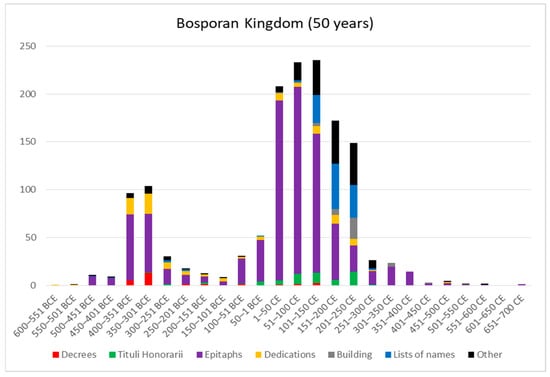
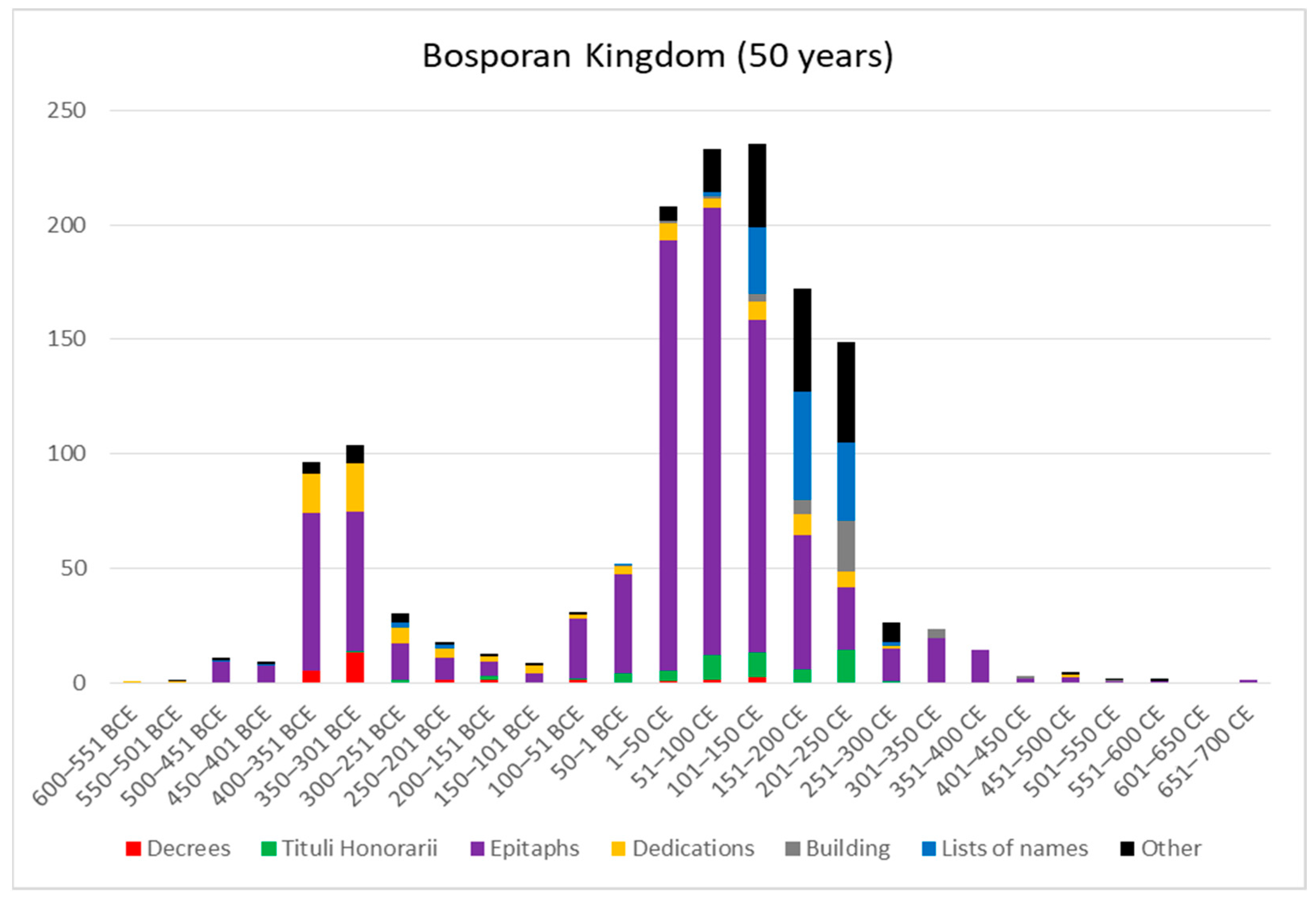
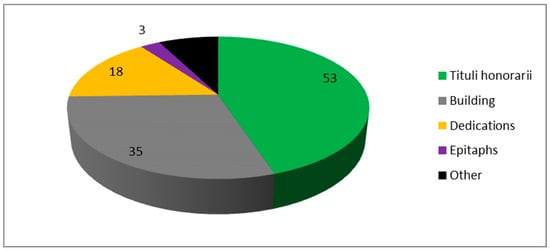
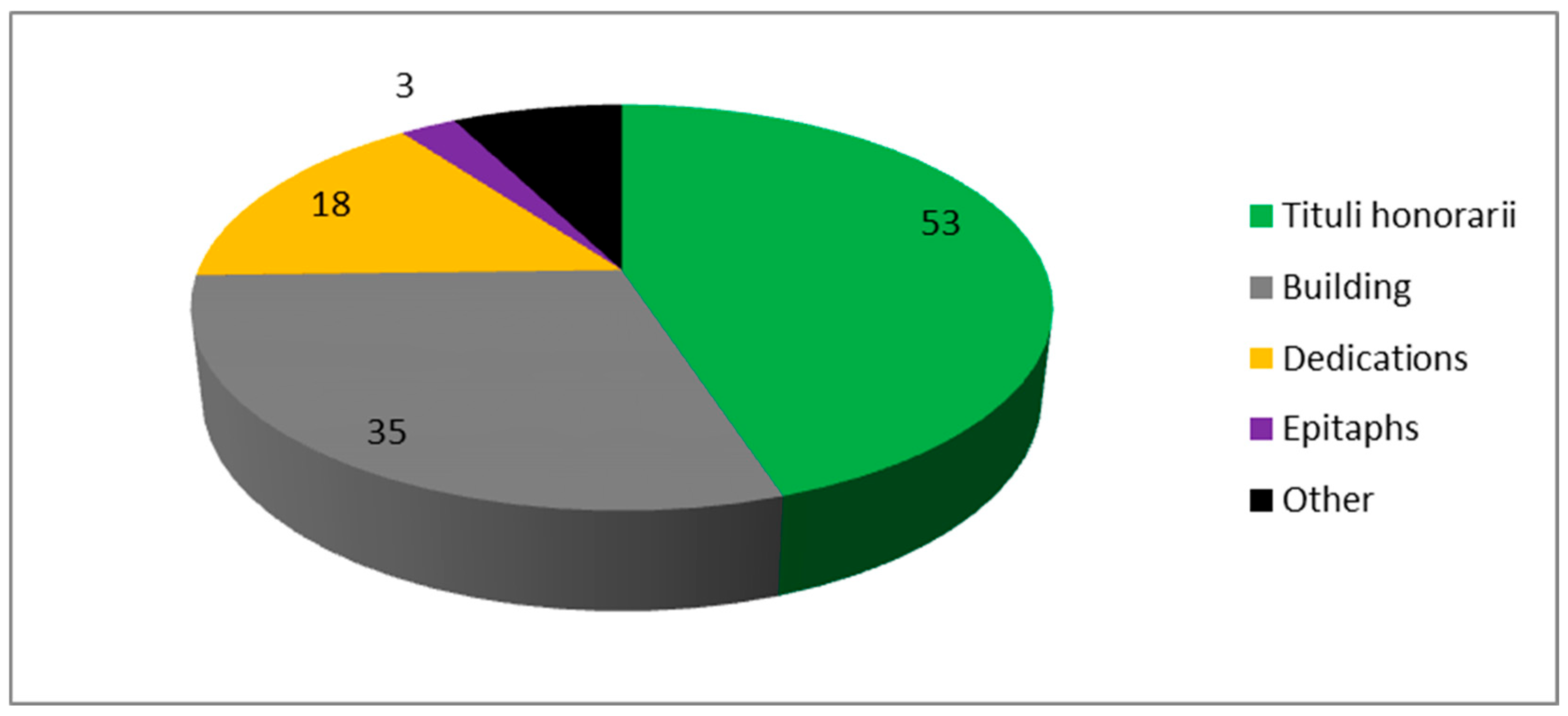
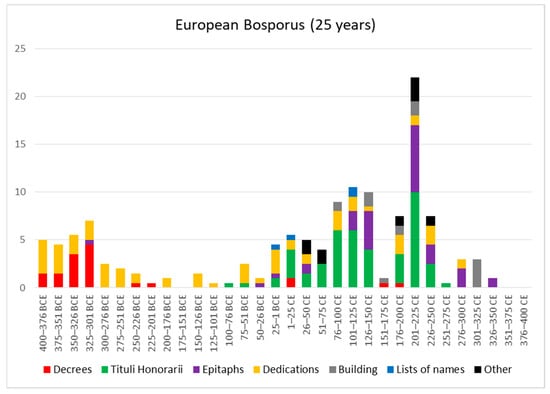
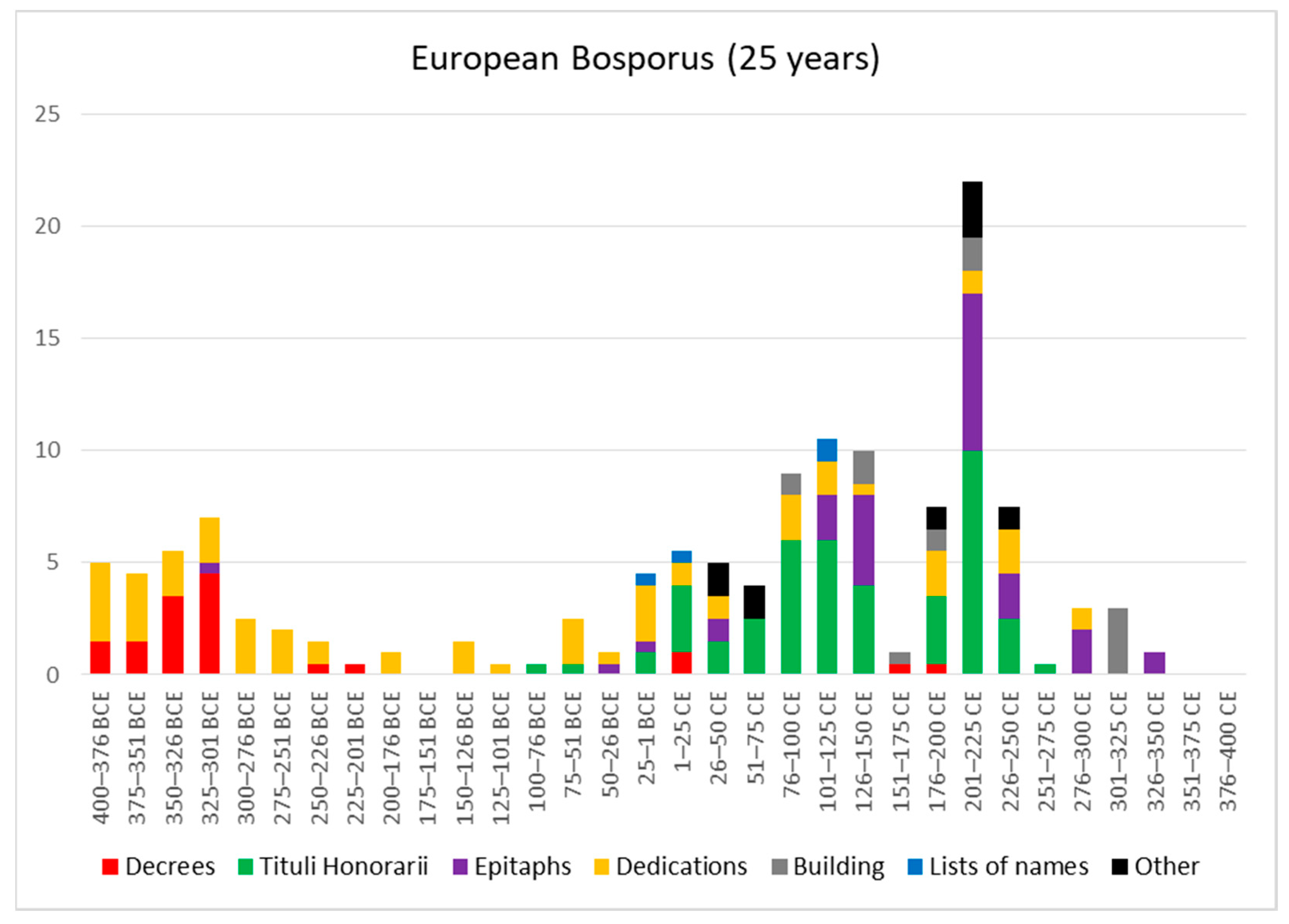
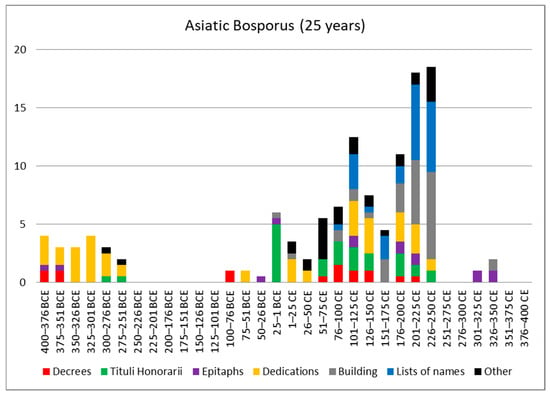
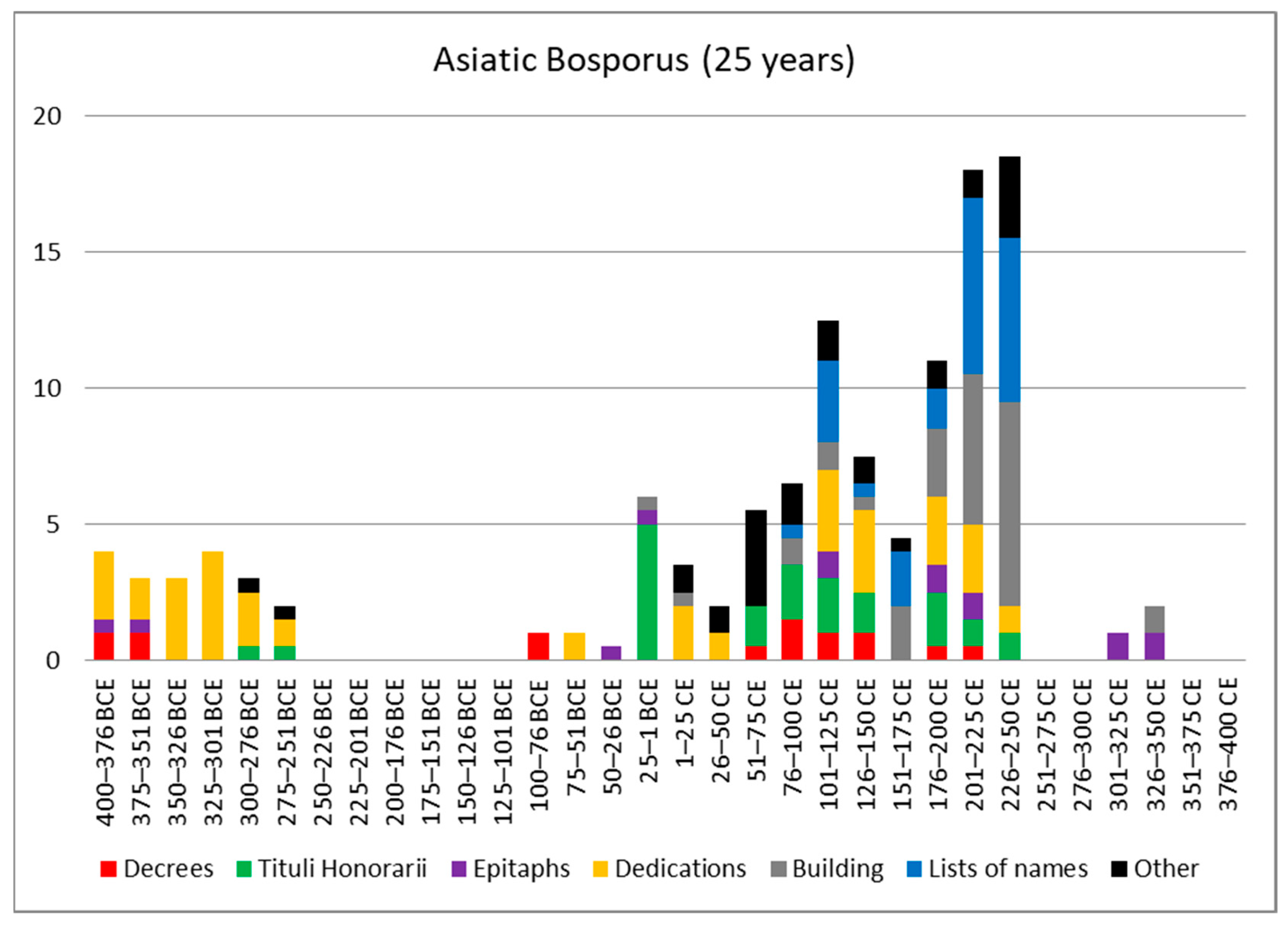
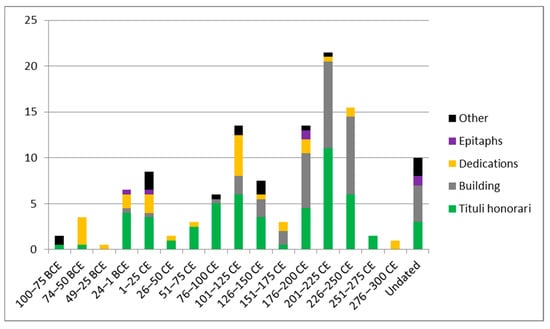
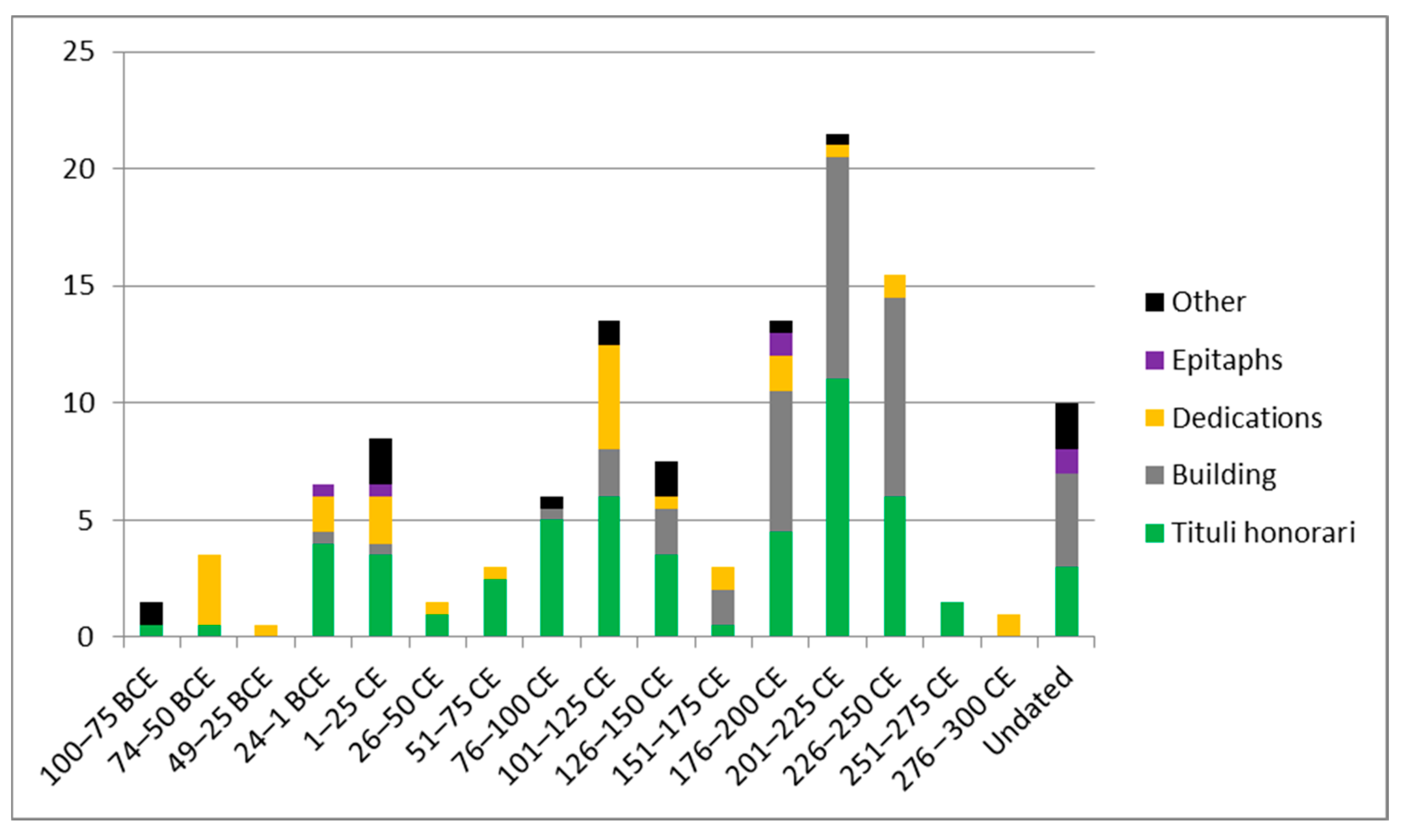

Disclaimer/Publisher’s Note: The statements, opinions and data contained in all publications are solely those of the individual author(s) and contributor(s) and not of MDPI and/or the editor(s). MDPI and/or the editor(s) disclaim responsibility for any injury to people or property resulting from any ideas, methods, instructions or products referred to in the content. |
© 2026 by the author. Licensee MDPI, Basel, Switzerland. This article is an open access article distributed under the terms and conditions of the Creative Commons Attribution (CC BY) license.