


Abstract
This article examines the Graphic Collection of the Faculty of Fine Arts in Skopje as a material record of artistic formation, institutional memory, and pedagogical heritage. It proposes the concept of the living pedagogical archive not as a replacement for established categories such as teaching collection, university collection, or institutional archive, but as an analytical framework for examining the changing relationships between pedagogical production, institutional preservation, and subsequent reactivation. The framework is articulated through four interconnected processes—preservation, transmission, production, and reinterpretation—and explored through a qualitative case study combining archival research, institutional history, visual analysis, and comparison of seven purposively selected diploma portfolios produced between 1984 and 1997. The analysis identifies contrasting relationships between diploma-period formation and subsequent professional trajectories, including continuity within printmaking, expansion across media, methodological transformation, and professional redirection. It further reconstructs the institutional networks through which different Yugoslav pedagogical traditions became locally embedded in Skopje, while distinguishing such documented genealogies from claims of direct stylistic transmission. The study argues that pedagogical collections can preserve material evidence of artistic formation that remains underrepresented in museum collections and conventional art-historical narratives. In the Skopje case, current cataloguing, digitisation, and research constitute a primarily archival and scholarly activation of this material, demonstrating how educational collections may become newly legible as sources for art history, institutional memory, and heritage formation.
1. Introduction; Beyond Preservation: Towards the Concept of the Living Pedagogical Archive
Art collections created within institutions of higher education occupy an ambiguous position between education, artistic production, and cultural heritage. Generated directly through educational practice, they record not only artistic skills and technical knowledge but also the pedagogical values and institutional frameworks through which successive generations of artists are formed. Once preserved institutionally, such collections may acquire functions beyond their original educational purpose, becoming structures through which artistic knowledge and institutional memory are preserved and transmitted. Yet they have received considerably less scholarly attention than museum collections or public archives and are frequently treated as auxiliary teaching resources rather than as historical sources in their own right (Assmann 2011; Hooper-Greenhill 1992).
This question is particularly relevant in post-socialist Southeast Europe, where art academies underwent substantial political, institutional, and educational transformations after the late twentieth century. Collections generated through their teaching activities can provide material evidence of changing artistic practices, pedagogical models, and institutional values that may not be recoverable through curricula, administrative records, or exhibition histories alone.
Against this background, the article proposes the concept of the living pedagogical archive as a framework for understanding collections generated within institutions of artistic education. The concept emphasizes the continuing relationship between preservation and pedagogical practice and is developed through four interconnected processes—preservation, transmission, production, and reinterpretation—examined below.1
This article addresses the following research questions:
How can pedagogical print collections function as material sources for reconstructing artistic formation, institutional memory, and processes of heritage formation?
What forms of continuity, transformation, displacement, and rupture become visible when diploma-period works are examined in relation to institutional histories and subsequent artistic trajectories?
How can the concept of the living pedagogical archive help articulate the changing relationships between pedagogical production, institutional preservation, and the later activation and reinterpretation of educational collections?
The study adopts a qualitative case-study approach combining conceptual analysis, archival research, institutional history, visual analysis, and heritage studies. The Graphic Collection of the Faculty of Fine Arts in Skopje is examined primarily as a historical and institutional record of artistic formation and as a collection currently undergoing archival and scholarly activation. Printmaking provides a particularly productive case because its workshop-based production, technical reproducibility, and pedagogical tradition make relationships between artistic training, material production, institutional continuity, and cultural memory especially visible.
Developed through the educational activities of the Department of Printmaking, the Graphic Collection preserves diploma-period works from successive generations and continues to expand through ongoing pedagogical production.2 A purposive corpus of seven diploma portfolios is examined not as representative of the collection as a whole, but as a set of contrasting trajectories through which different relationships between diploma-period artistic formation and subsequent professional development can be analysed, including continuity within printmaking, expansion across media, methodological transformation, and professional redirection.
The article argues that the significance of pedagogical collections lies not only in preserving student production but in making processes of artistic formation historically accessible. Its contribution is twofold: to develop the living pedagogical archive as an analytical framework for educational art collections and to explore its interpretive value through a previously under-researched institutional collection in Skopje.
2. Conceptual Framework
2.1. Archives, Memory and Collections
Archives and collections are not neutral repositories but institutional structures through which material is selected, organised, preserved, and interpreted, thereby participating in the construction of historical narratives and institutional memory. Pierre Nora’s distinction between milieux de mémoire and lieux de mémoire provides a useful point of departure: as lived environments of memory weaken, collections and archives become structures through which memory is materially preserved and represented (Nora 1989, pp. 7–13). In educational institutions, however, such collections differ from conventional commemorative archives because they remain embedded within practices that continue to generate new material.
Aleida Assmann’s distinction between storage and functional memory further clarifies this condition. Material may remain preserved beyond immediate use and subsequently be reactivated through research, teaching, exhibition, or reinterpretation (Assmann 2011, pp. 119–34). At the same time, archival preservation is necessarily selective: as Derrida emphasizes, what is retained determines what can become historically visible (Derrida 1996, pp. 1–5, 10–11), while Pearce and Hooper-Greenhill similarly demonstrate that collections acquire meaning through processes of selection, classification, and interpretation (Pearce 1993, pp. 68–117; Hooper-Greenhill 1992, pp. 167–90).
Educational art collections introduce an additional dimension to these models: their objects are generated within the institution through pedagogical practice itself. Production, preservation, and subsequent interpretation can therefore occur within the same institutional environment, making such collections simultaneously structures of memory and material records of artistic formation.
From the perspective of critical heritage studies, however, preservation alone does not transform surviving material into heritage. Heritage is better understood as a cultural process through which objects, practices, and narratives are assigned significance in the present (Smith 2006, pp. 44–48). Harrison similarly emphasises heritage as an active set of contemporary practices through which relationships between past and present are produced, rather than as a self-evident body of inherited objects (Harrison 2013, p. 14). This perspective is particularly relevant to pedagogical collections whose institutional survival may precede their explicit recognition as heritage. Their significance is therefore not intrinsic to the preserved objects alone, but emerges through processes of selection, documentation, interpretation, access, and institutional recognition.
This distinction is important for the Skopje collection. Its continuity since the mid-1980s did not automatically constitute it as recognised pedagogical heritage. Rather, its current inventorying, documentation, research, and interpretation constitute a process through which accumulated educational material becomes newly legible as evidence of artistic formation and institutional history. At the same time, such activation requires critical attention to what was preserved, what was lost, who determined retention, and which artistic trajectories consequently became historically visible.
2.2. Pedagogical Collections and Artistic Knowledge
Pedagogical collections differ from conventional archives because their objects are produced through teaching, experimentation, and artistic practice rather than acquired retrospectively. They therefore preserve completed works that provide material evidence of artistic knowledge acquired and transformed within educational contexts, although such works cannot by themselves establish the specific mechanisms through which that knowledge was transmitted.
Such knowledge cannot be reduced to theoretical instruction. Dewey’s understanding of knowing through practice (Dewey 1934, pp. 3–19, 35–57) and Polanyi’s concept of tacit knowledge (Polanyi 1966, pp. 3–25) are particularly relevant to studio education, where knowledge circulates through instruction, observation, repetition, experimentation, correction, and mentor–student interaction. Transmission does not, however, imply reproduction: students may adopt, modify, resist, or abandon what they encounter, allowing pedagogical continuity to coexist with differentiation and rupture.
Printmaking makes these processes especially visible because of its dependence on specialised equipment, sequential procedures, workshop practice, and sustained interaction between technical execution and artistic decision-making. Its reproducibility also allows impressions to remain within the institution while others circulate externally. Accumulated across successive generations, pedagogical print collections can therefore preserve material evidence of technical and artistic competence, as well as of the subsequent transformation of that competence through individual artistic practice, while requiring institutional and documentary sources to reconstruct the specific contexts of its transmission.
2.3. Teaching Collections, University Collections and Pedagogical Heritage
The concept proposed here intersects with several established categories, including teaching collections, university collections, institutional archives, and pedagogical heritage. University collections have long functioned not only as repositories of objects but as resources embedded in processes of teaching, research, and knowledge production. In art academies and faculties, this relationship is particularly complex because collections may contain works produced within the educational process itself, allowing the material generated through teaching to become, over time, evidence of the history of teaching.
An instructive comparative example is the Art Collection of the Faculty of Fine Arts of the University of Porto. As Cláudia Garradas has demonstrated, the collection consists substantially of works produced by students during their artistic training and historically functioned as a teaching collection, while its later institutional development increasingly connected preservation with teaching, research, exhibitions, and public access (Garradas 2010, pp. 67–72). This example demonstrates that the pedagogical activation of art-school collections is not in itself a new phenomenon or an unexplored conceptual territory.
The present study therefore does not use the term living pedagogical archive as a replacement for established categories such as teaching collection, university collection, institutional archive, or living archive. A teaching collection is defined primarily by its educational use; a university collection by its institutional location and function; and an institutional archive by its capacity to preserve records of institutional activity. The concept of the living pedagogical archive instead identifies an analytical perspective on the changing temporal relationships among these functions: pedagogical production, institutional preservation, historical transmission, subsequent reinterpretation, and present-day activation. It draws attention to the ways material generated through past pedagogical processes survives within an institution that continues to produce artistic knowledge and may subsequently be reactivated as evidence through research, teaching, exhibition, cataloguing, or reinterpretation.
In this sense, the “living” character of such an archive should not be understood as an inherent property of the collection. Nor does the continued physical accumulation of student works automatically make an archive living. Rather, vitality describes a relational and potentially intermittent condition produced when preserved material enters renewed relationships with present pedagogical, artistic, historiographical, or institutional practices. A pedagogical collection may therefore remain materially preserved while becoming dormant, and may later be reactivated under changed historical circumstances. The following section defines the analytical processes through which this relational condition is examined.
2.4. Towards the Living Pedagogical Archive
A living pedagogical archive is understood here not as a distinct institutional category but as an analytical condition of an educational collection in which material generated through pedagogical practice is preserved across time and can be reactivated to reconstruct, transmit, question, and reinterpret artistic knowledge and institutional memory. Its “living” character lies neither in physical survival nor in continuous accumulation alone, but in the changing relationships established between preserved material, present practices, and historical interpretation.
Four interconnected processes define this condition: preservation, transmission, production, and reinterpretation. Preservation retains material evidence of educational and artistic processes; transmission concerns the circulation of technical, methodological, and tacit knowledge; production reflects the institution’s continuing generation of the material whose history the collection records; and reinterpretation allows works initially retained as evidence of educational achievement to acquire new significance as documentation of artistic formation, pedagogical genealogy, or broader transformations in artistic practice (Assmann 2011; Polanyi 1966; Dewey 1934; Schön 1987; Pearce 1993; Hooper-Greenhill 1992).
Activation is not proposed here as a fifth process equivalent to these four dimensions. Rather, it describes the condition through which preserved material becomes operative in the present. Cataloguing, digitisation, research, exhibition, renewed teaching use, or artistic reinterpretation may activate different dimensions of the archive without necessarily activating all of them simultaneously. The distinction is important because a collection may continue to grow through pedagogical production while remaining largely dormant as an archive, just as a historically inactive collection may later be reactivated through research or curatorial practice.
Together, these four processes define the living pedagogical archive as a relational structure rather than simply a physical repository, while activation describes the conditions through which these relations become operative in the present.
Not every surviving educational collection necessarily functions in this way. Material may remain inaccessible, uncatalogued, or institutionally forgotten, while precariously preserved collections may be reactivated through research, cataloguing, digitisation, exhibition, or renewed educational use. Archival vitality therefore depends not simply on physical survival but on the relationships and practices through which preserved material becomes active again.
3. The Graphic Collection of the Faculty of Fine Arts in Skopje: Institutional and Pedagogical Context
3.1. Methodological Note: Archival Discovery and Corpus
The empirical component of this study is based on the Graphic Collection of the Department of Printmaking at the Faculty of Fine Arts in Skopje, composed primarily of works retained from successive graduating cohorts. Until the present research, the collection had not been systematically catalogued or digitised, nor addressed in published research as a near-continuous record of graduating classes. Its preliminary inventory and photographic documentation, undertaken in situ during 2025–2026 as part of an ongoing project supported by the Ministry of Education and Science of the Republic of North Macedonia, therefore form an integral part of this study. For the period 1984–1997, which provides the chronological frame for the case studies examined here, institutional records list 113 graduates, while the preliminary inventory physically identified prints or portfolio material in the collection associated with 98 of them (86.7%; see Table 1). The collection therefore provides substantial, though not complete, material coverage of successive graduating cohorts. These figures derive from a year-by-year comparison between the recorded number of graduates and the physical identification of their works during the 2025–2026 inventory.
Table 1.
Preliminary Inventory, 1984–1997.
According to established departmental practice, graduating students were required to leave at least six different prints produced within the diploma process, normally one impression from each selected edition, for the Department’s collection. The works retained were determined jointly by the student and the supervising professor. The collection should therefore not be understood as a complete record of each diploma portfolio, but as a pedagogically selected material record of diploma-period production. This selection process is methodologically significant: the archive preserves substantial evidence of artistic formation, while simultaneously reflecting decisions made within the pedagogical relationship about which works were considered appropriate for institutional retention.
As the systematic cataloguing is still underway, the present study draws on the portfolios identified and documented during the preliminary inventory conducted in 2025–2026. From this documented corpus, seven diploma portfolios were selected according to two principal criteria: sufficient material for visual analysis and the possibility of reconstructing their authors’ subsequent professional trajectories. The selection was deliberately comparative rather than representative, encompassing different relationships between diploma-period formation and later practice: continuity within printmaking, expansion across media, methodological transformation, and professional redirection. The latter is particularly important methodologically, since the corpus does not assume that pedagogical formation necessarily results in sustained artistic practice within the same field. Gordana Dautovska and Nikola Eftimov provide contrasting cases of professional redirection: Dautovska towards graphic design and visual communication, and Eftimov towards fashion and costume design. Together, these cases demonstrate that diploma-period printmaking may be continued, transformed across media, redirected into other fields, or become less visible in later professional narratives. The corpus comprises Dijana Tomić-Radevska, Violeta Čapovska, Nikola Eftimov, Gordana Dautovska, Petra Jovanovska, Slavica Janešlieva, and Oliver Musović. To avoid self-interpretation, Janešlieva’s portfolio was analysed and written independently by Ana Frangovska.
The surviving works were documented according to technique, title where inscribed, edition, and date, and analysed in relation to medium-specific handling, compositional strategies, thematic continuities, and pedagogical context. These findings were cross-referenced with biographical and exhibition records and available information on teaching and mentor–student relations. The portfolios are treated not as representative of the collection as a whole, but as analytical cases through which preservation, artistic formation, transformation, and reinterpretation can be examined in relation to the broader institutional and pedagogical context.
An important methodological distinction concerns pedagogical transmission. The surviving prints provide material evidence of acquired technical competence, compositional strategies, and artistic differentiation, but they cannot, on their own, demonstrate the specific mechanisms through which such knowledge was transmitted. Where mentor–student relationships or institutional genealogies are discussed, these are reconstructed from documented educational affiliations and available institutional sources rather than inferred solely from formal similarities between works. References to transmission in the analysis should therefore be understood as evidence of pedagogical contexts and possible trajectories of knowledge circulation, rather than as direct proof of particular acts or methods of instruction.
3.2. Formation of the Department and the Graphic Collection
The institutional history of printmaking education in Skopje predates the establishment of the Faculty of Fine Arts. In 1959, Dragutin Avramovski-Gute, educated at the Academy of Applied Arts in Zagreb, established a graphics department at the School of Applied Arts in Skopje, where printmaking developed into a structured field encompassing etching, aquatint, lithography, linocut, and woodcut (Abadjieva 1994, p. 9).
The establishment of the Faculty of Fine Arts in Skopje in 1980 institutionalised higher art education within Ss. Cyril and Methodius University. Gute became one of its founding professors, alongside Petar Mazev, Dimitar Kondovski, Rodoljub Anastasov, Dušan Perčinkov, and Petar Hadži-Boškov, while Dimitar Malidanov joined the teaching staff in 1981 (Faculty of Fine Arts 2010, pp. 11–14).
The Graphic Collection developed directly from this educational structure through the systematic retention of selected works from successive diploma portfolios. Rather than being assembled retrospectively through acquisition or later curatorial selection, its archival value accumulated gradually as material selected within the pedagogical process became evidence of earlier artistic formation. With material retained from successive graduating cohorts since 1984/85, the collection records changing technical preferences, thematic concerns, compositional strategies, and relationships between pedagogical models and individual experimentation. It thus developed simultaneously as a consequence of teaching and as material evidence of the Department’s institutional history.
3.3. Pedagogical Genealogies: Zagreb–Belgrade–Ljubljana–Skopje
The formation of the Printmaking Department at the Faculty of Fine Arts in Skopje emerged within the broader network of Yugoslav art education. Its early teaching structure brought together professors trained in Zagreb, Ljubljana, and Belgrade, creating channels through which technical knowledge, workshop practices, and different pedagogical approaches entered the newly established Faculty (Faculty of Fine Arts 2010, pp. 16–18).
Dragutin Avramovski-Gute, educated at the Academy of Applied Arts in Zagreb and already active in printmaking education in Skopje, provided the earliest institutional continuity (Anthology of Macedonian Art 1994, pp. 137–41). The Ljubljana connection was established through Dimitar Malidanov, who graduated in painting there in 1972 and completed postgraduate studies in printmaking in 1975, and Dimče Nikolov, who graduated from the same Academy in 1978 and completed his postgraduate studies in 1980 (Faculty of Fine Arts 2010, pp. 85–88). Their trajectories were complemented by professors educated in Belgrade: Zoran Jakimovski, trained in fine-art printmaking, and Kostadin Tančev-Dinka, whose background was in applied graphics and graphic design. Mirko Vujišić, the first enrolled student of the newly established Faculty and later a member of its teaching staff, marked a further stage: the emergence of a generation whose artistic and pedagogical formation had taken place within the Skopje institution itself.
These intersecting trajectories complicate any linear model of influence from established Yugoslav centres towards a peripheral Macedonian institution. Rather than reproducing a single inherited model, the Department brought different technical and methodological traditions into contact and gradually generated its own institutional continuity. As Faculty-trained graduates entered teaching, these externally acquired pedagogical traditions became locally embedded and entered subsequent cycles of teaching within the institution.
The surviving diploma portfolios provide material evidence of artistic formation within this documented institutional network. Across works produced under different but overlapping mentors, the diploma project frequently appears as a sustained thematic or compositional cycle rather than as a disconnected demonstration of technical competence. Tomić-Radevska’s Composition series, Čapovska’s Nude works, Eftimov’s Salome Cycle, Janešlieva’s Kamen zapis, Musović’s recurring Chair motif, and Jovanovska’s serial notational structures each organise technical experimentation around recurring visual or conceptual problems. Dautovska’s portfolio presents a related but different process, in which motifs developed in earlier undergraduate work are formally reduced and transformed within the diploma works.
The selected corpus is too limited to define this pattern as a distinctive “Skopje school.” Nevertheless, its recurrence supports a working hypothesis: the interaction of different Yugoslav pedagogical lineages within the Faculty may have contributed to a locally specific use of serial or thematic work as a structure through which technical competence and individual artistic vocabulary could develop simultaneously. The wider collection, once catalogued, will permit a more systematic examination of the prevalence, variation, and historical development of this tentative pattern.
The significance of these genealogies therefore lies not in demonstrating stylistic derivation from Zagreb, Ljubljana, or Belgrade, but in reconstructing the institutional pathways through which different pedagogical traditions entered, became locally embedded, and continued within the Skopje institution. In this sense, the collection materialises an institutional pedagogical memory that extends beyond individual mentor–student relationships.
3.4. Continuity Under Institutional Precarity: The Post-1991 Period
The dissolution of Yugoslavia and the independence of Macedonia in 1991 significantly altered the institutional environment in which the Faculty of Fine Arts and its Printmaking Department operated. Regional networks of artistic exchange were reconfigured, while the Department experienced a prolonged interruption in faculty renewal: according to the institutional reconstruction undertaken for this study, no new teaching staff were appointed between the early 1990s and 2006, producing a substantial generational gap between established professors and younger practitioners.
Further institutional changes followed in the 2000s. The Faculty revised its curricula in 2000 and 2002, while implementation of the European Credit Transfer System (ECTS) began in 2005/06 as part of its alignment with European higher-education frameworks (Faculty of Fine Arts 2010, p. 19). These changes coincided with renewed, although uneven, contact with contemporary European printmaking practices and technologies; their precise impact on artistic production, however, requires analysis of the broader collection.
Despite these transformations, the practice of retaining student portfolios appears to have continued. Yet material continuity was not matched by archival institutionalisation: the collection remained largely uncatalogued and undigitised, with inadequate storage, no systematic condition records, and limited environmental control.3 Its survival therefore depended less on formal archival management than on an embedded departmental practice of retaining works.
This distinction between pedagogical continuity and archival precarity is central to the collection’s history. The former enabled material to accumulate across successive generations, while the latter placed its provenance, physical preservation, and historical accessibility at continuing risk. The current inventorying, cataloguing, digitisation, and research mark a transition from accumulated institutional memory towards its deliberate activation as cultural and pedagogical heritage. At the present stage, this activation is primarily archival, research-based, and interpretive; systematic evidence of the collection’s renewed use in contemporary studio teaching has not yet been established and therefore falls outside the claims of this study. This tension between continuity and vulnerability provides the immediate historical context for the diploma portfolios examined below.
4. The Collection as a Living Pedagogical Archive: Seven Diploma Portfolios
The following case studies examine seven diploma portfolios produced between 1984 and 1997 by artists who subsequently developed sustained professional careers in visual art, design, and related fields. The portfolios are not treated as representative of the Graphic Collection as a whole, but as analytically selected cases through which different relationships between artistic formation, institutional preservation, subsequent transformation, and reinterpretation can be examined.
Presented chronologically, the portfolios make it possible to trace continuities and shifts within the pedagogical culture of the Printmaking Department across the institutional transformations outlined above. Attention is given to technique, compositional method, recurring visual devices, mentor–student relations, and the ways in which diploma-period works relate to later artistic practice. Rather than assuming linear stylistic development, the analysis considers how technical and conceptual tendencies coexist, recur, and are transformed across successive cohorts.
4.1. Dijana Tomić-Radevska—Diploma Portfolio, 1984
Dijana Tomić-Radevska graduated in 1984 from the Faculty of Fine Arts in Skopje, Department of Art Printmaking and Graphic Design, under the mentorship of Dragutin Avramovski-Gute, and subsequently developed a sustained professional practice encompassing printmaking, drawing, painting, installation, video, and design (Bojadžievska 2021, p. 25). Her diploma portfolio belongs to the earliest phase of the Department’s history and provides valuable evidence of its formative pedagogical principles.
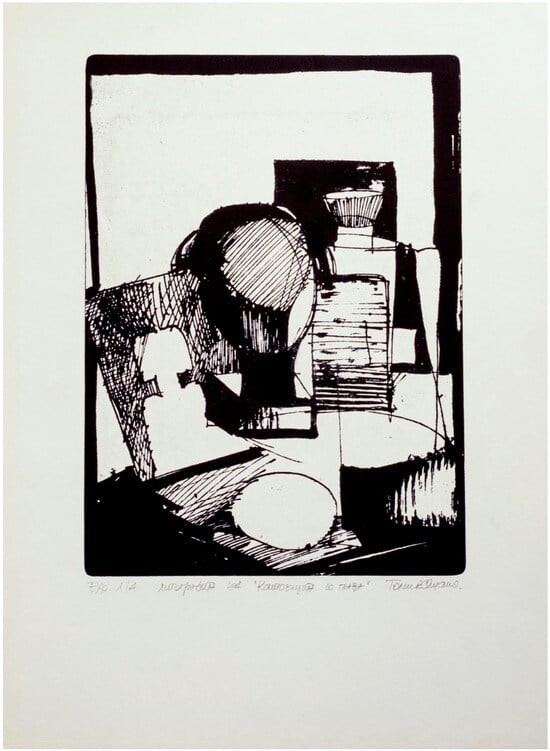
The material retained from the diploma portfolio comprises fourteen sheets in lithography, etching, aquatint, and linocut, demonstrating systematic engagement with several printmaking procedures.4 Across these techniques, two related tendencies emerge: medium-specific experimentation and a gradual transformation of representation into abstraction. In the numbered Composition series, for example, Composition IV5 retains a recognizable still-life structure, while Composition VI reduces comparable spatial relations to a predominantly geometric configuration. Similar transformations occur across other techniques, suggesting that the movement between observed form and abstraction constituted a broader working method rather than an isolated formal exercise.
Tomić-Radevska’s subsequent practice substantially expanded beyond conventional printmaking. In Interactive Album, 1998, linocut, silkscreen, relief printing, photography, and collage were combined in interactive works dependent on the viewer’s physical participation (Milevska 1998), while Circular Remembrances, 2002 employed video installation, projected family photographs, moving image, and a plaster cast to address memory, representation, and identity (Milevska 2002). These projects should not be read as predetermined outcomes of the diploma works; rather, they demonstrate how a practice grounded in graphic procedures could expand through layering, reproduction, juxtaposition, and the reorganisation of visual fragments across media.
The portfolio therefore documents both technical formation and early artistic differentiation, while its comparison with Tomić-Radevska’s later work reveals continuity not primarily at the level of medium or style, but through graphic modes of constructing and reorganising images across an increasingly intermedial practice.
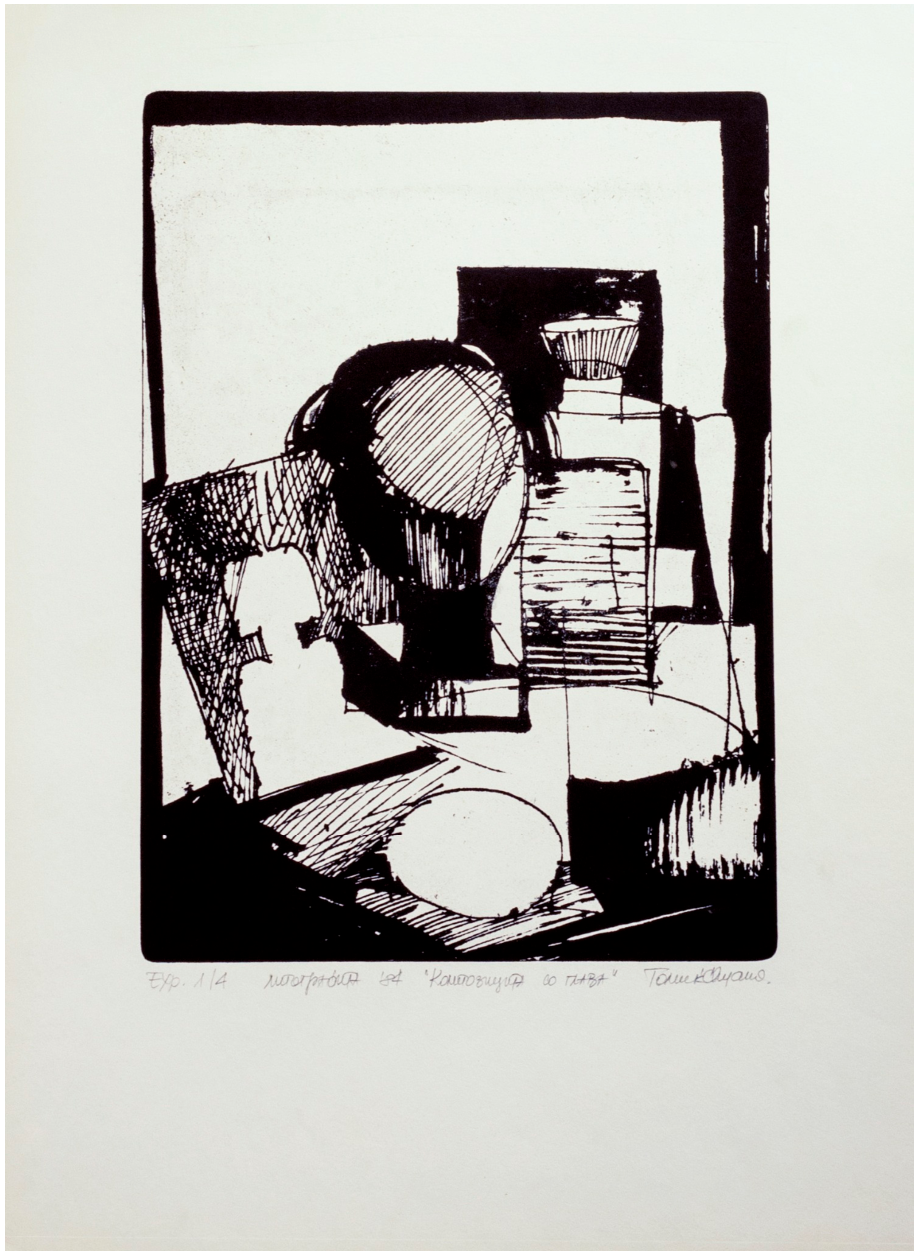
In Composition With a Head (Figure 1), the residual head motif and still-life references remain recognisable, but they are reorganised through flattened spatial planes, geometric divisions, and a reduced relation between figure and background. The work thus makes visible the movement from observed form toward abstraction that recurs across the portfolio.
Figure 1.
Dijana Tomić-Radevska, Composition With a Head, lithography, 1984 (ed. 1/4). Reproduced with permission.
4.2. Violeta Čapovska—Diploma Portfolio, 1991
Violeta Čapovska graduated from the Faculty of Fine Arts in Skopje in 1991, specialising in printmaking, having studied for three years under Dimitar Malidanov and for one year under Dimče Nikolov (Čapovska 1996, p. 11). Her surviving student works therefore provide an unusually clear material record of formation across two overlapping pedagogical relationships.
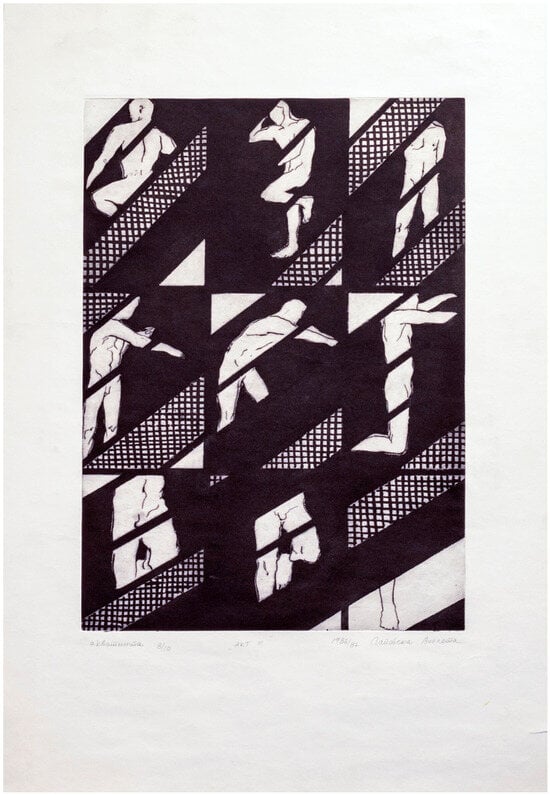
The portfolio is organised around the human body, but approaches it through fragmentation and progressive formal reduction rather than conventional figuration. The Nude series, developed during her work with Nikolov, is particularly revealing: bodily forms are reduced to partial contours, compressed silhouettes, and shifting relations between figure and ground (Milevska 1996, p. 5). Across the portfolio, the body increasingly functions less as a represented subject than as a structural device through which positive and negative space, surface, and spatial tension are investigated.
This concern did not disappear when Čapovska’s later practice expanded beyond printmaking. Her subsequent work encompasses installation, sculpture, drawing, printmaking, photography, video, and sound, frequently addressing the body, memory, displacement, and belonging.6 The relation to the diploma portfolio is therefore not one of direct stylistic continuity. Rather, the early investigation of bodily fragmentation and spatial relations provides a useful point of comparison for a later practice in which the body is increasingly articulated through material, spatial, and intermedial configurations.
Čapovska’s portfolio demonstrates how the collection can preserve both pedagogical genealogy and artistic differentiation: works produced within identifiable mentor–student relations simultaneously document the emergence of concerns that subsequently developed beyond the technical and material boundaries of printmaking.
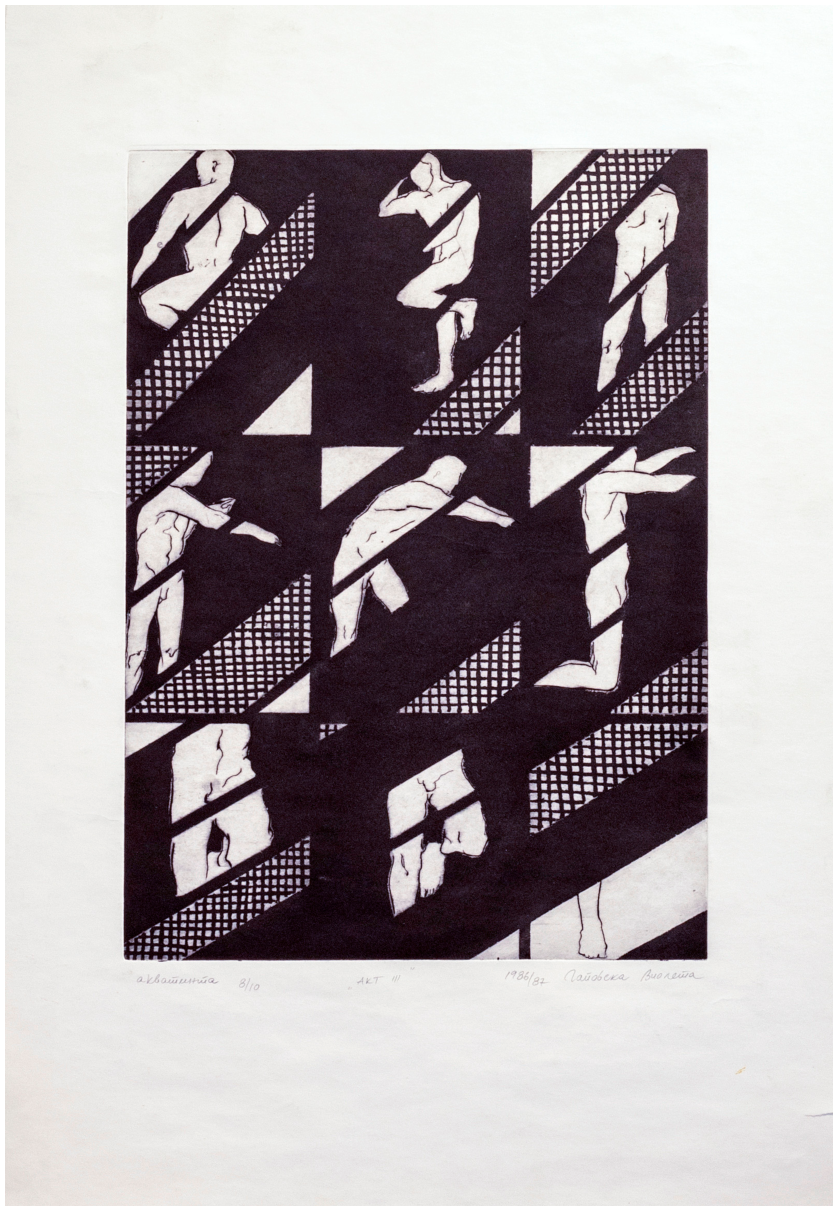
In Nude III (Figure 2), the body is compressed into partial contour and silhouette, while the contrast between aquatint areas and unprinted space destabilises the distinction between figure and ground. These visible relations support the interpretation of the body as a formal device for investigating surface, spatial tension, and compositional reduction rather than as a conventionally represented subject.
Figure 2.
Violeta Čapovska, Nude III, aquatint, 1986/87 (ed. 8/10). Reproduced with permission.
4.3. Nikola Eftimov—Diploma Portfolio, 1993
Nikola Eftimov graduated from the Faculty of Fine Arts in Skopje in 1993, in Graphic Art and Fashion Design, under the mentorship of Kostadin Tančev-Dinka (American University of Europe–FON n.d.). Although trained in printmaking, his subsequent professional trajectory increasingly shifted towards fashion and costume design, making his diploma portfolio particularly relevant as evidence of an artistic practice that later became less visible within his professional profile.
The surviving portfolio comprises ten prints organised around the thematic cycle Salome.7 Rather than illustrating the biblical narrative sequentially, Eftimov transforms selected figurative and symbolic elements through pronounced contrasts, fragmented planes, linear interventions, and shifts between positive and negative areas. Individual sheets remain autonomous while forming a coherent serial investigation in which recurring subjects are reorganised through changes in composition and graphic density. The cycle thus demonstrates how a diploma project could combine technical experimentation with sustained exploration of a shared visual and thematic problem.
Eftimov continued to participate in exhibitions of graphic art and drawing for several years after graduation, including Drawing ’94 (Association of Fine Artists of Macedonia 1994), but his practice increasingly developed towards fashion and costume design. He later pursued postgraduate studies in fashion design at the Accademia Italiana in Florence, while his professional and pedagogical interests expanded to encompass fashion as artistic and communicative practice, costume history and theory, experimental fashion techniques, menswear, photography, and related areas of design (American University of Europe–FON n.d.).
The significance of the portfolio therefore lies less in establishing continuity with Eftimov’s mature professional practice than in documenting divergence. It preserves a substantial formative engagement with printmaking that later career narratives only partially register, demonstrating the capacity of the pedagogical archive to retain artistic trajectories subsequently redirected into another disciplinary field.
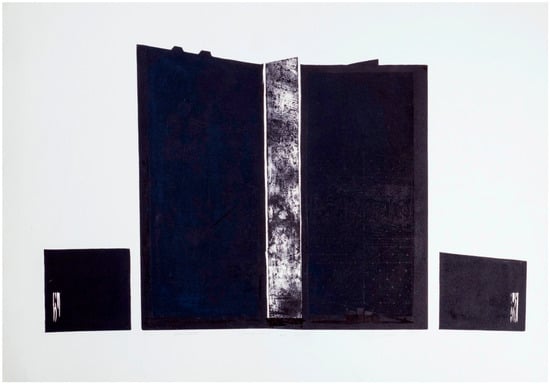
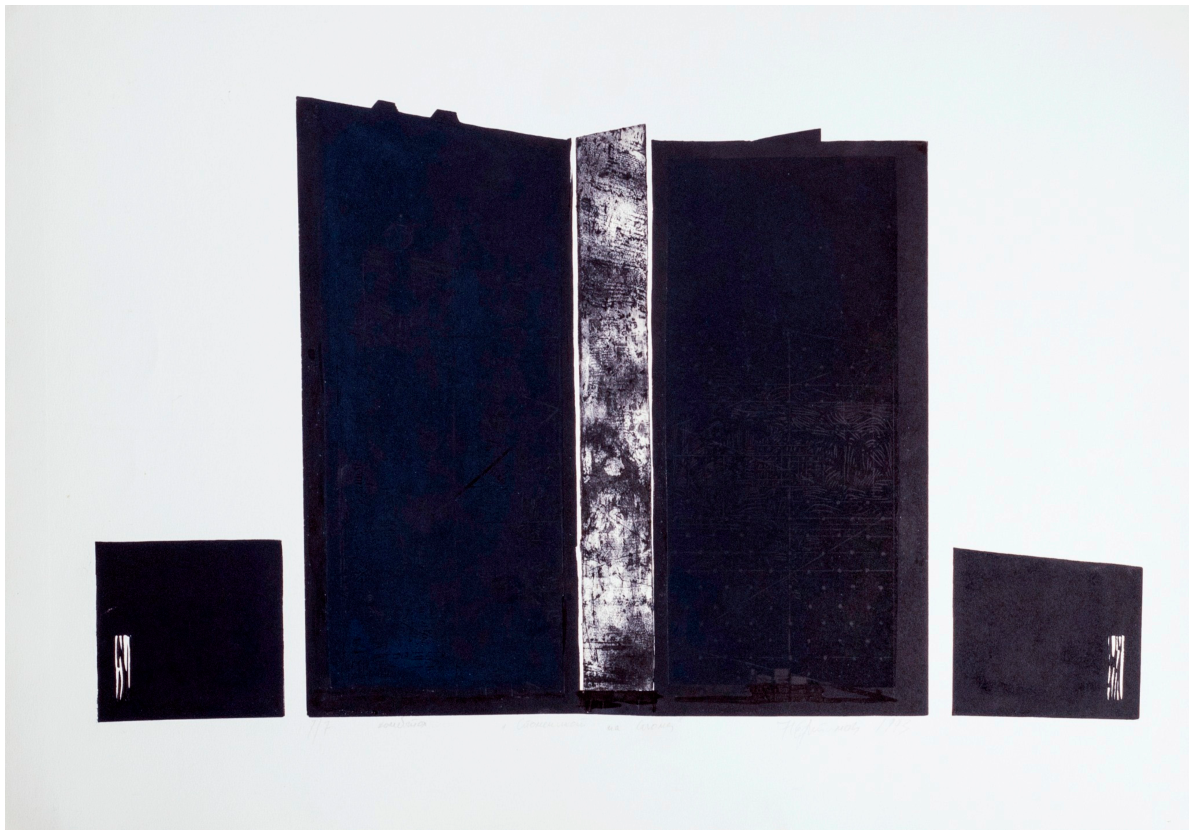
In The Monument of Salome (Figure 3), the figure is fragmented through sharply contrasted planes, linear interventions, and shifts between dark and light areas. These formal contrasts illustrate the way the Salome cycle reorganises figurative and symbolic material through graphic density and compositional variation rather than through sequential narration.
Figure 3.
Nikola Eftimov, The Monument of Salome, mixed media, 1993 (ed. 7/7). Reproduced with permission.
4.4. Gordana Dautovska—Diploma Portfolio, 1994
Gordana Dautovska completed her studies at the Faculty of Fine Arts in Skopje in 1994 under the mentorship of Dimitar Malidanov and continued to an MA at the Faculty of Fine Arts in Belgrade in 1998. Her surviving student works reveal an important distinction between the Byzantium Cycle, produced during her undergraduate studies, and the later works constituting her diploma portfolio.
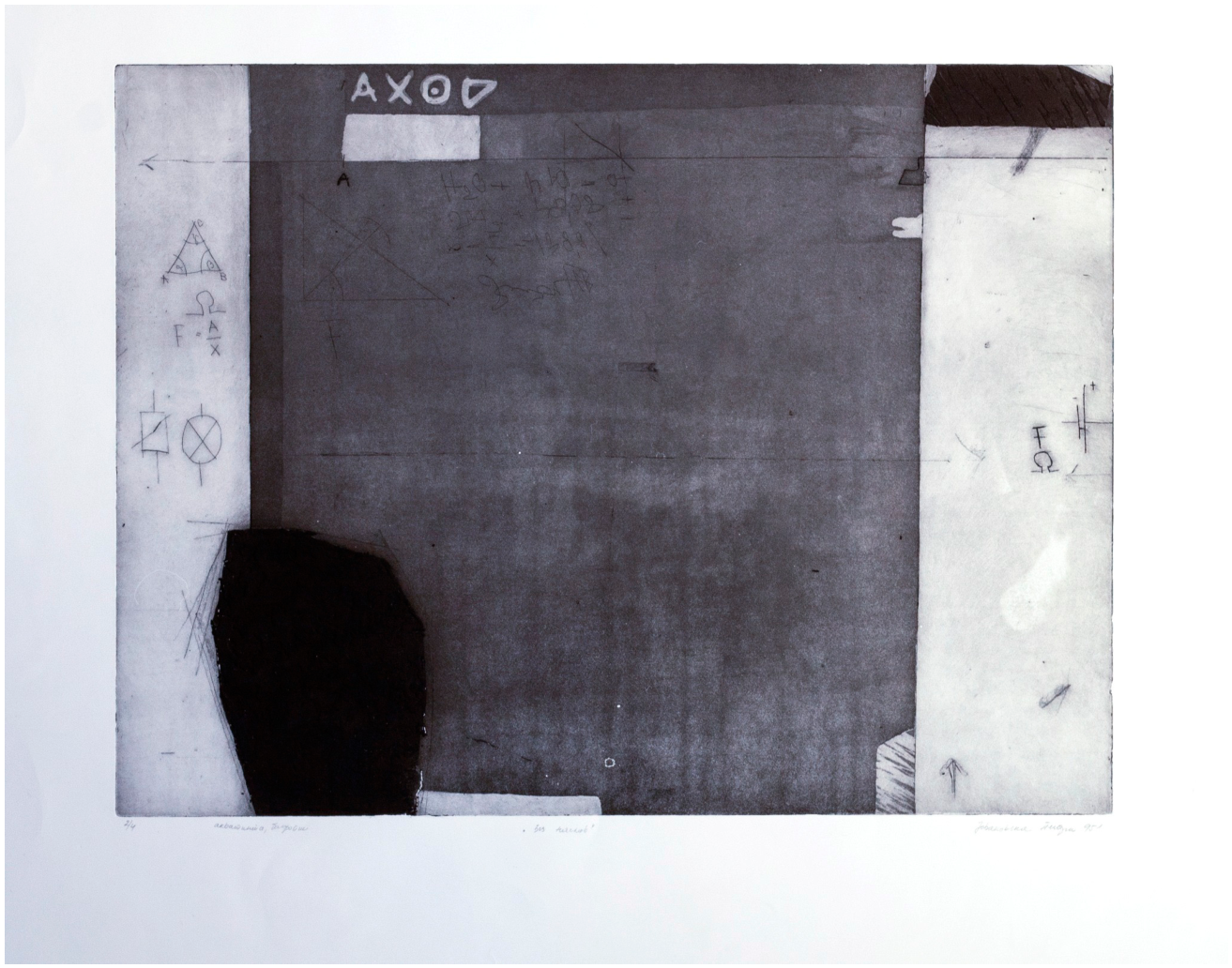
The earlier works from 1989–91 move from high-contrast relief printing towards a more layered intaglio idiom, culminating in the Byzantium Cycle, where architectural forms and cross-like signs provide a recognizable thematic framework.8 The diploma works, by contrast, substantially reduce this vocabulary: explicit iconographic references recede in favour of pale tonalities, spatial planes, repetition, and isolated signs. Certain motifs—notably the X/cross—persist, but are detached from their earlier representational context and transformed into abstract compositional elements.
This visual reduction conceals considerable technical complexity. The diploma prints involved multiple plates and extensive mechanical and chemical intervention in the matrices, yet the resulting impressions remain restrained, pale, and almost minimalist. Their apparent economy should therefore not be understood as technical simplification but as the result of highly controlled printmaking. In pedagogical terms, the portfolio is revealing precisely because technical knowledge has become absorbed into an increasingly individual visual language.
Dautovska continued to experiment beyond conventional printmaking after graduation. In 2004, Breathing (Dišenje) at Press to Exit in Skopje employed different media and spatial relations to address body, movement, perception, and space (Lokomotiva 2004). Her subsequent trajectory nevertheless differs from the other cases examined here. Following an active artistic practice during the 1990s and early 2000s, documented through exhibitions and contemporary art projects, her professional activity became increasingly oriented towards graphic design and visual communication, while autonomous printmaking became substantially less visible in her later professional profile.
Her case therefore documents a trajectory in which a technically and conceptually developed printmaking practice became progressively less visible within later professional narratives. The archival significance of the diploma portfolio lies in preserving this earlier artistic position and the considerable technical knowledge embedded within it.
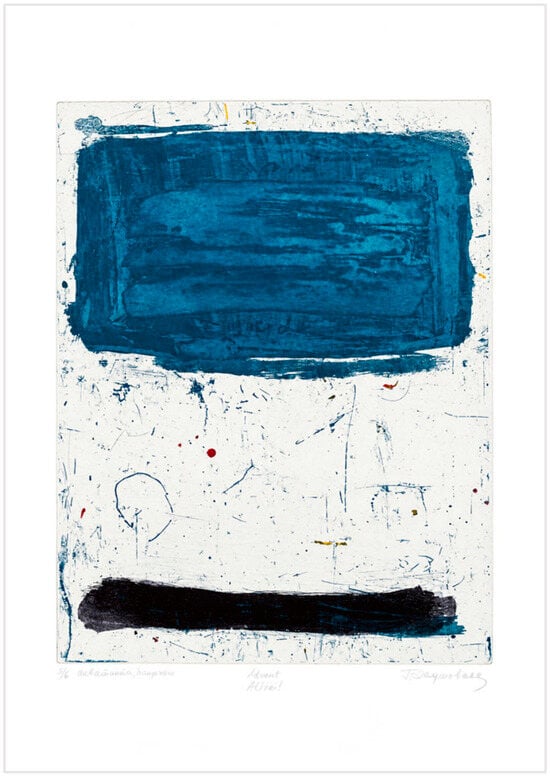
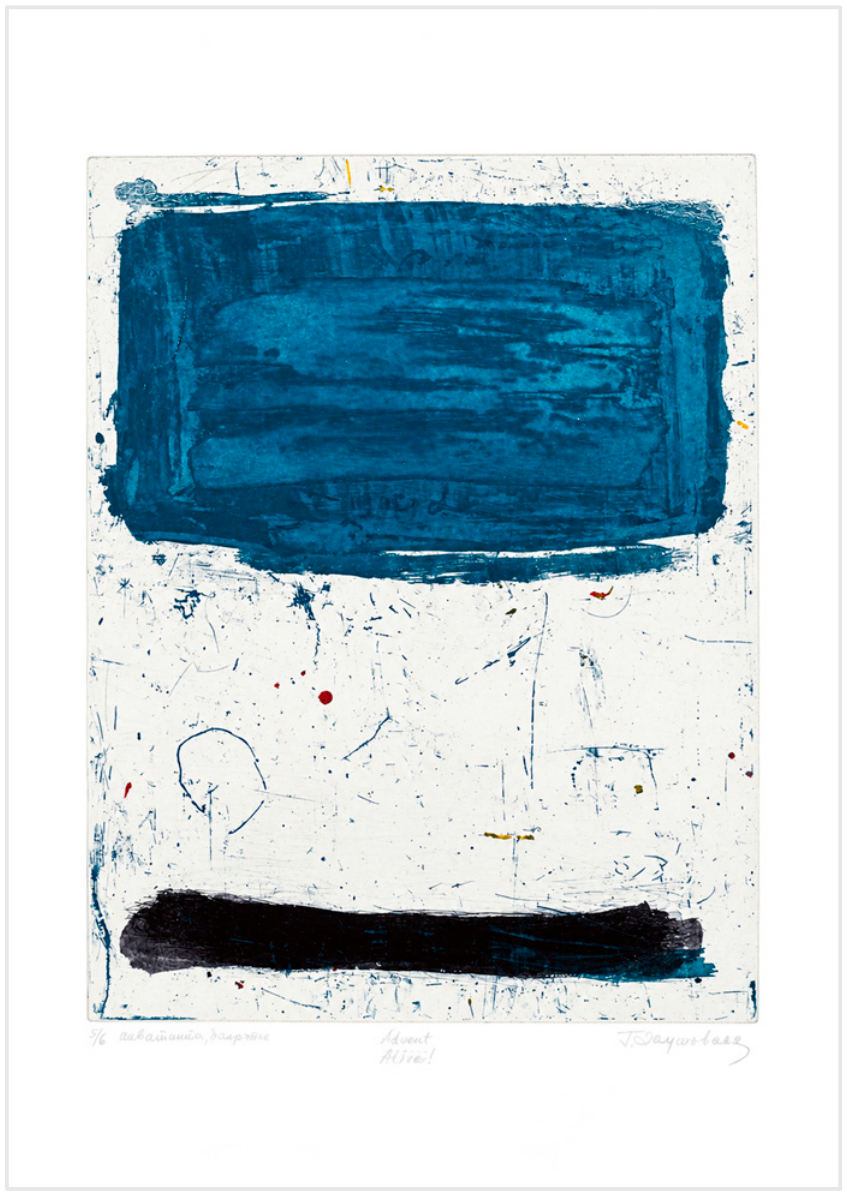
In Advent… Alive (Figure 4), pale tonal fields, layered etched and aquatint surfaces, and an isolated cross-like sign produce an impression of visual restraint and economy. The work therefore makes visible the tension between a reduced compositional vocabulary and the technically complex, multi-stage printmaking process documented in the portfolio.
Figure 4.
Gordana Dautovska, Advent… Alive, aquatint, etching, no date (ed. 5/6). Reproduced with permission.
4.5. Petra Jovanovska—Diploma Portfolio, 1995
Petra Jovanovska graduated from the Department of Printmaking at the Faculty of Fine Arts in Skopje in 1995 under the mentorship of Dimče Nikolov. Her case is particularly relevant because printmaking remained an active component of her subsequent practice while progressively entering into dialogue with other media.
The surviving diploma portfolio demonstrates a sustained engagement with repetition, serial organisation, and the relationship between individual motifs and larger compositional structures. Forms acquire meaning through recurrence and variation, establishing a working principle in which discrete elements are repeatedly reorganised into larger configurations.9
This provides a productive point of comparison with Jovanovska’s later practice. In The Circle is Closed, 2014, repeated circular units extend across prints, paintings, mixed-media works, polyptychs, and installations, allowing individual modules to function simultaneously as autonomous elements and components of larger visual structures (Frangovska 2014; Yovanovska n.d.). The comparison does not imply direct derivation from the diploma works, but demonstrates how seriality, repetition, and the relationship between part and whole remain operative across changing media.
Unlike trajectories in which subsequent professional development displaced printmaking, Jovanovska continued to participate in print exhibitions and biennials while expanding into collage, painting, digital art, installation, and mixed media (Yovanovska n.d.; MIA 2024). Her portfolio therefore represents a model of medium persistence through expansion: printmaking remains active within an increasingly heterogeneous practice, while organisational principles visible in the diploma works continue to be reformulated across media and contexts.
Figure 5 makes this organisational principle visible through the repeated and varied arrangement of individual marks and forms across the sheet. Rather than functioning as isolated motifs, these elements establish a relationship between discrete units and a larger compositional structure, anticipating the serial procedures that remain significant in Jovanovska’s later work.
Figure 5.
Petra Jovanovska, No title, aquatint and etching, 1995 (ed. 2/4). Reproduced with permission.
4.6. Slavica Janešlieva—Diploma Portfolio, 1996
Slavica Janešlieva graduated from the Faculty of Fine Arts in Skopje in 1996, at the Printmaking Department, under the mentorship of Zoran Jakimovski, and completed her MFA at the same Faculty in 1998 under Dimitar Malidanov. Her subsequent practice makes the portfolio particularly relevant for examining how concerns articulated within printmaking education can later migrate across media.
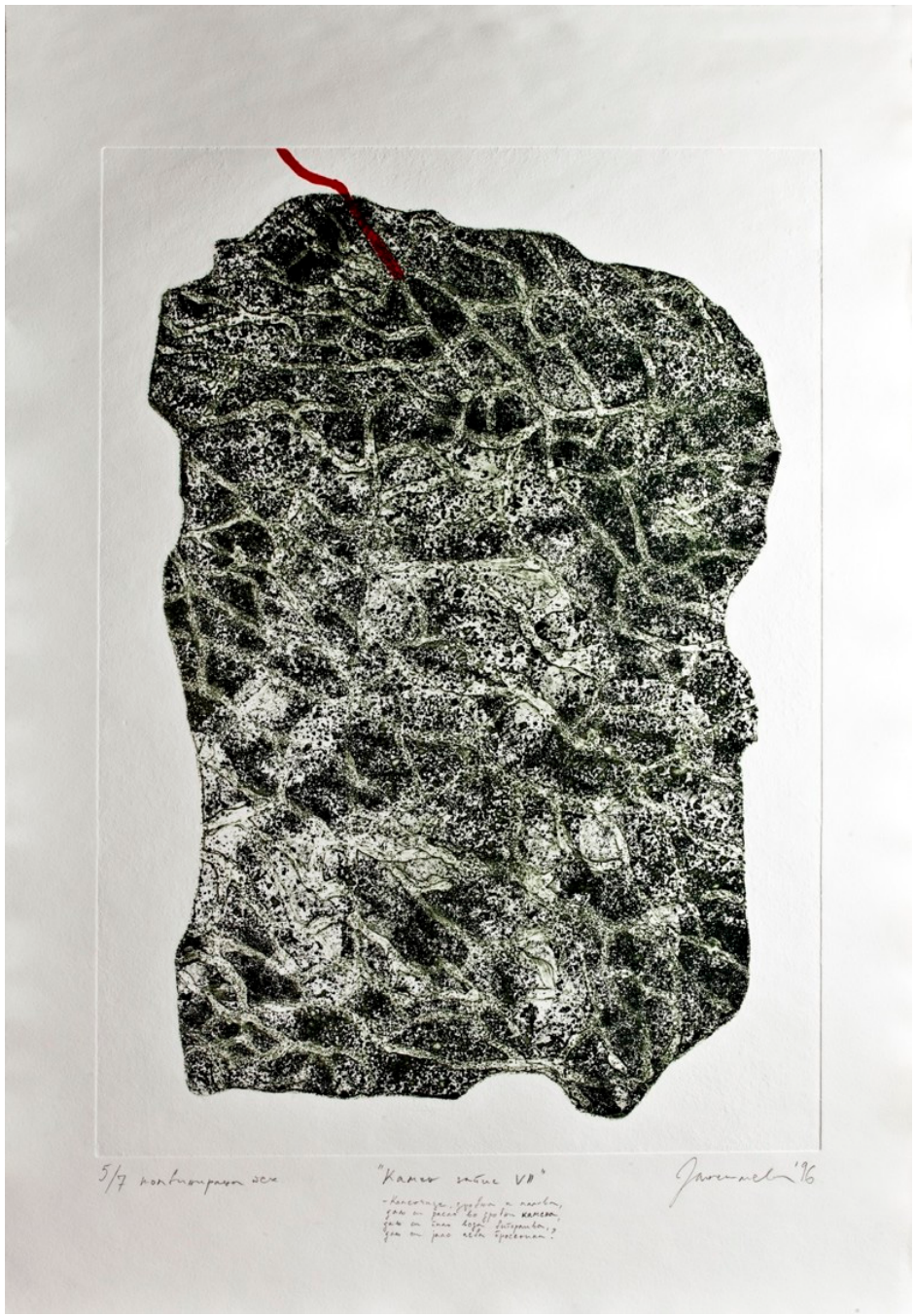
Her surviving diploma works are organised around the cycle Kamen zapis (Stone Inscription), structured through recurring signs, fragments, inscriptions, textures, and forms suggestive of archaeological or mnemonic traces. Rather than representing specific historical objects, these elements construct a visual language based on layering, repetition, fragmentation, and accumulation. The graphic surface itself functions as a site of inscription—capable of retaining, obscuring, or transforming traces—while the serial structure allows recurring elements to shift in position, density, scale, and material treatment.10
The portfolio can therefore be read as an early articulation of concerns with trace, materiality, fragmentation, and memory that were subsequently reformulated across different media. After graduation, Janešlieva expanded her practice into object, installation, drawing, photography, video, and book art, while personal archives, family histories, accumulated materials, and broader social and historical contexts became recurrent concerns (Frangovska 2024). Kamen zapis should not be understood as predicting this later development, but as documenting an early working method whose conceptual and material operations remained available for transformation beyond printmaking.
Unlike cases in which printmaking became less visible through subsequent professional redirection, Janešlieva remained within contemporary visual art while expanding beyond the medium. Her portfolio thus demonstrates continuity not as stylistic or medial persistence, but as the migration and reformulation of artistic operations across media.
Because Janešlieva is a co-author of the present study, the analysis of her diploma portfolio and its relationship to her subsequent practice presented here was undertaken independently by Ana Frangovska.
In Stone Inscription VII (Figure 6), layered marks, fragmented forms, and textured surfaces produce the impression of an inscribed or excavated field rather than a stable representational image. These visible features support the reading of the print as an early articulation of concerns with trace, materiality, fragmentation, and memory.
Figure 6.
Slavica Janešlieva, Stone Inscription VII, mixed media, 1996. Reproduced with permission.
4.7. Oliver Musović—Diploma Portfolio, 1996–1997
Oliver Musović graduated from the Faculty of Fine Arts in Skopje in 1997 under the mentorship of Zoran Jakimovski and later completed his MFA under Dimitar Malidanov. His diploma-period works occupy a distinctive position within the selected corpus because they already extend beyond a conventional understanding of the print as an autonomous image, combining graphic procedures with assemblage, appropriated photography, text, and other visual material.
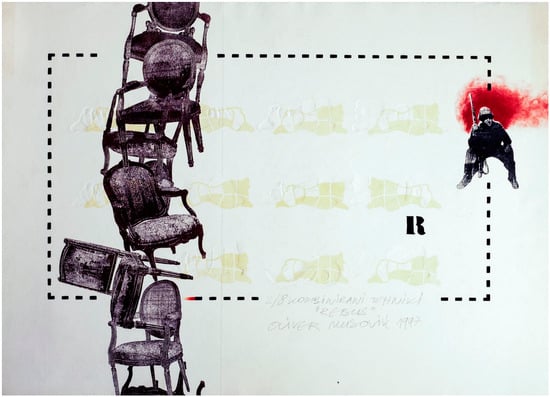
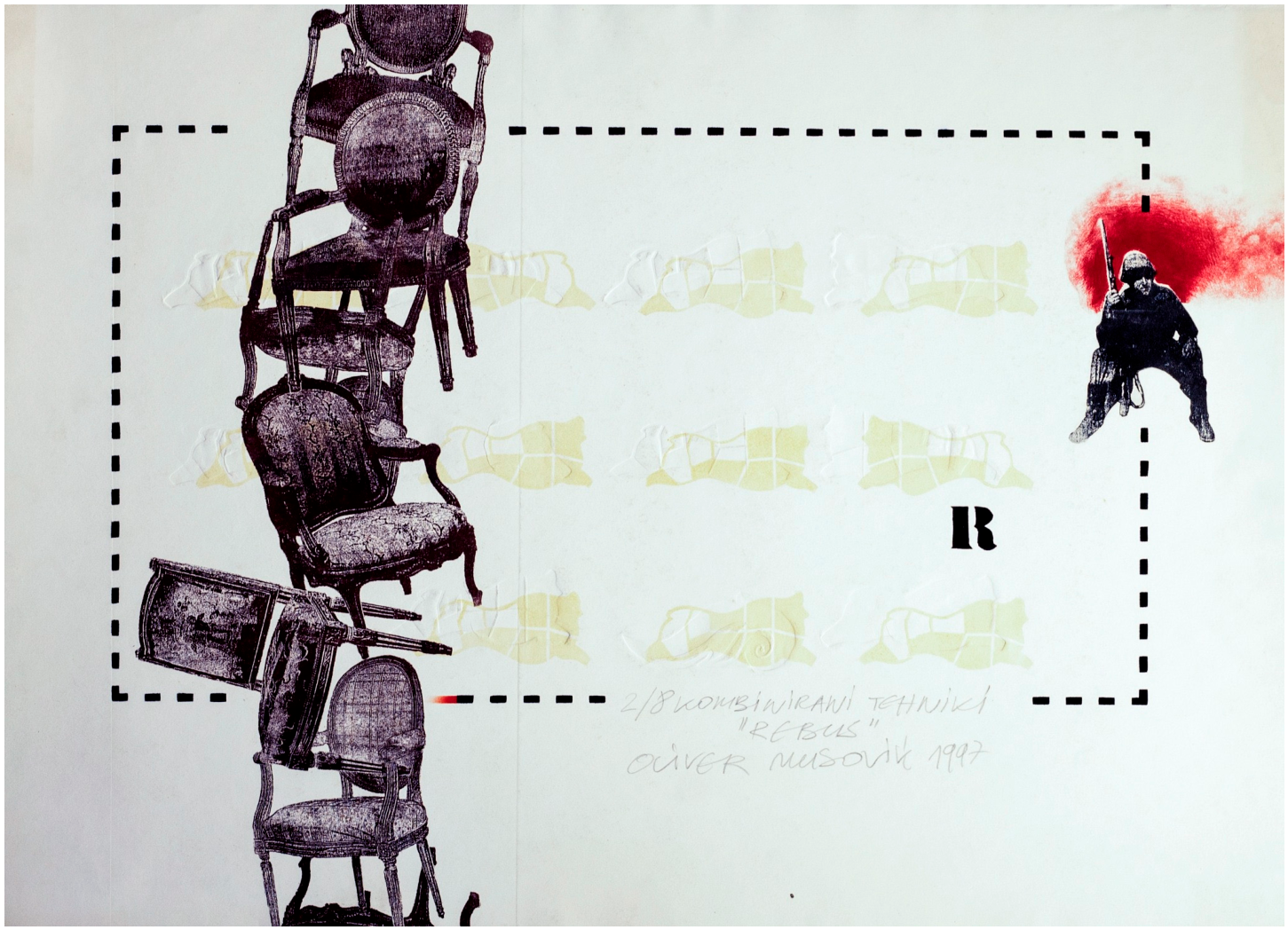
The surviving portfolio from 1996–97 is dominated by mixed-media works structured through juxtaposition and contextual displacement. Recurring elements such as the chair function less as represented objects than as mutable signs, transformed through repetition, fragmentation, and their relationship to photographic and textual elements. Titles and appropriated imagery similarly participate in the construction of meaning, producing compositions based on association rather than conventional narrative.11 Rebus, 1997, also reproduced in the Faculty’s publication Diploma Works from the FFA Collection, independently documents this mixed-media approach and the portfolio’s movement beyond medium-specific printmaking (Faculty of Fine Arts 2005, p. 13).
Musović’s subsequent practice shifted increasingly towards photography, text, installation, and curatorial work. Projects such as Driving, 2006 and Corrupted Landscapes, 2017 substantially differ from the diploma works in medium and context, while retaining comparable operations of appropriation, sequencing, and contextual displacement in addressing increasingly explicit social and political concerns (Contemporary Art Center–Skopje 2006; Musović 2017, p. 3). The comparison therefore suggests continuity not of style or medium but of method: familiar images and objects are removed from habitual contexts and reorganised to produce new relationships and meanings.
The portfolio is significant within the pedagogical archive precisely because it records this early expansion of graphic practice beyond the printed image, making visible a formative stage in which acquired printmaking knowledge was already being redirected towards broader conceptual and intermedial strategies.
In Rebus (Figure 7), the recurring chair motif enters into relation with appropriated photographic material, textual elements, and assemblage-like procedures. The interaction among these heterogeneous components demonstrates how graphic processes are expanded beyond the autonomous printed image into a composition structured by juxtaposition, contextual displacement, and associative meaning.
Figure 7.
Oliver Musović, Rebus, mixed media, 1997 (ed. 2/8). Reproduced with permission.
5. From Collection to Living Pedagogical Archive: Comparative Findings
The seven case studies demonstrate that the significance of the Graphic Collection cannot be reduced to the preservation of student works or the documentation of individual artistic biographies. Considered comparatively, the portfolios reveal different trajectories through which artistic practices formed within a shared pedagogical environment were continued, transformed, displaced, or redirected. Printmaking remains an active medium in some later practices; in others, medium-specific continuity gives way to the persistence of operations such as seriality, repetition, layering, fragmentation, appropriation, or relations between image and text. Elsewhere, the collection preserves formative practices that became less visible as professional trajectories moved into other fields.
These differences challenge a linear understanding of artistic formation in which student work is valued primarily insofar as it anticipates mature practice. The portfolios instead demonstrate that pedagogical knowledge may persist, migrate across media, be redirected into other disciplinary contexts, or become temporarily or permanently less visible. Discontinuity should therefore not be understood as a failure of artistic formation, but as one of its possible historical outcomes.
Viewed through the four processes proposed in this article, the collection’s archival function becomes more precise. Preservation retains material evidence of artistic formation that may otherwise disappear from later professional narratives. Transmission can be approached through documented mentor–student genealogies and institutional structures, while the portfolios provide material evidence of acquired technical competence and of its subsequent adaptation, transformation, or abandonment. Production is embedded in the collection’s very structure: its holdings were generated through successive educational processes rather than assembled retrospectively. Reinterpretation occurs when works originally retained as diploma-period material are revisited through cataloguing, visual analysis, comparison with later practice, and renewed pedagogical or art-historical inquiry.
The collection therefore operates simultaneously on pedagogical, institutional, and historiographical levels. It documents processes of learning and artistic differentiation; preserves evidence of the continuity and transformation of the Department; and provides access to works and artistic positions that may be absent from museum collections, exhibition histories, or later professional narratives. Its significance lies not in producing a coherent institutional canon but in preserving precisely the coexistence of continuity, transformation, divergence, and rupture.
This is particularly relevant in the post-socialist context, where institutional transformation and uneven structures of cultural documentation complicate narratives based on established centres and presumed peripheries. Rather than positioning artistic production in North Macedonia within a model of delayed Western development, the collection makes visible the specific institutional and pedagogical conditions under which artistic knowledge were formed. In this respect, the study resonates with Piotr Piotrowski’s proposition of a horizontal art history, while shifting attention from comparison between geographical centres towards the institutional infrastructures through which artistic practices are formed and historically preserved (Piotrowski 2009, pp. 49–58).
6. Conclusions
This study has examined the Graphic Collection of the Faculty of Fine Arts in Skopje not simply as a repository of student production, but as an institutional record of artistic formation. Its near-continuous preservation of diploma-period material since 1984/85 provides material evidence of changing artistic practices, technical knowledge, individual artistic differentiation, and the institutional contexts within which successive generations were formed.
The concept of the living pedagogical archive proposed here offers a framework for understanding this particular archival condition. Its value lies in recognising that educational collections are not defined by preservation alone: their historical significance emerges through changing relationships between preserved material, documented pedagogical contexts, artistic production, and renewed interpretation. The Skopje collection also demonstrates that these relationships need not produce linear continuity. Artistic knowledge may persist within the same medium, migrate across media, be redirected into other professional fields, or become less visible while remaining materially recoverable through the archive. Taken together, these findings show that pedagogical print collections can function simultaneously as structures of cultural and institutional memory, material records of artistic knowledge formed through educational practice, and resources through which pedagogical material can be activated as heritage and processes of canon formation critically reconsidered.
The study further demonstrates the historiographical potential of pedagogical collections. Works retained within educational institutions can preserve aspects of artistic formation that are absent from museum collections, exhibition histories, and later professional narratives, thereby providing alternative material for reconstructing local and regional art histories. This is particularly significant in contexts where cultural documentation has been uneven and institutional memory vulnerable to political and structural transformation.
The present research remains necessarily provisional. The Graphic Collection is still being catalogued and digitised, and the seven portfolios examined here constitute a purposive rather than representative corpus. Future systematic research on the wider collection will be necessary to examine the prevalence, variation, and historical transformation of the patterns identified through the present purposive corpus.
The collection’s future significance will therefore depend not only on its physical preservation but on its continued activation through research, teaching, exhibition, digitisation, and critical reinterpretation. Understood in these terms, the Graphic Collection demonstrates how an educational collection can become both a source for art history and an active resource for institutional memory, pedagogical heritage, and the critical reinterpretation of artistic formation.
Author Contributions
Conceptualization, A.F. and S.J.; methodology, A.F.; formal analysis, A.F. and S.J.; investigation, A.F. and S.J.; resources, S.J.; data curation, S.J.; writing—original draft preparation, A.F. and S.J.; writing—review and editing, A.F. and S.J.; visualization, S.J.; supervision, A.F.; project administration, A.F. and S.J. All authors have read and agreed to the published version of the manuscript.
Funding
This research and the article processing charge for publication were funded by the Ministry of Education and Science of the Republic of North Macedonia through the project “INNOSI—Инoвативна лабoратoрија за ситo печат: Истражување и развoј на сoвремени графички практики [Innovative Screen-Printing Laboratory: Research and Development of Contemporary Graphic Practices]” (grant/project no. 15-6171/21).
Institutional Review Board Statement
Not applicable.
Informed Consent Statement
Not applicable.
Data Availability Statement
The primary materials and inventory data examined in this study are held in the Graphic Collection of the Faculty of Fine Arts, Ss. Cyril and Methodius University in Skopje. The collection is currently undergoing systematic cataloguing and digitisation. Additional information supporting the findings of this study is available from the corresponding author upon reasonable request.
Acknowledgments
The authors would like to thank the Faculty of Fine Arts, Ss. Cyril and Methodius University in Skopje, for facilitating access to the Graphic Collection and its documentation. They also thank the artists whose works are reproduced in this article for granting permission for their reproduction.
Conflicts of Interest
The authors declare no conflicts of interest. The funders had no role in the design of the study; in the collection, analysis, or interpretation of data; in the writing of the manuscript; or in the decision to publish the results.
Notes
| 1 | The four analytical processes—preservation, transmission, production, and reinterpretation—constitute the operational framework developed in Section 2 of this article. |
| 2 | Authors’ examination, preliminary inventory, and photographic documentation of the Graphic Collection, Department of Printmaking, Faculty of Fine Arts, Ss. Cyril and Methodius University in Skopje, 2025–2026. |
| 3 | Authors’ preliminary inventory, condition assessment and photographic documentation of the Graphic Collection, Department of Printmaking, Faculty of Fine Arts, Ss. Cyril and Methodius University in Skopje, 2025–2026. |
| 4 | Authors’ examination, inventory, and photographic documentation of Dijana Tomić-Radevska’s diploma portfolio, Graphic Collection, Department of Printmaking, Faculty of Fine Arts, Ss. Cyril and Methodius University in Skopje, 2025–2026. |
| 5 | Dijana Tomić-Radevska, Composition IV, lithograph, 1984, ed. 1/5; Composition VI, lithograph, 1984, ed. 2/10. |
| 6 | Authors’ visual analysis of Violeta Čapovska’s diploma portfolio, Graphic Collection, Department of Printmaking, Faculty of Fine Arts, Ss. Cyril and Methodius University in Skopje, 2025–2026. |
| 7 | Authors’ examination, inventory, photographic documentation, and visual analysis of Nikola Eftimov’s diploma portfolio, Graphic Collection, Department of Printmaking, Faculty of Fine Arts, Ss. Cyril and Methodius University in Skopje, 2025–2026. |
| 8 | Authors’ examination, preliminary inventory, photographic documentation, and visual analysis of Gordana Dautovska’s undergraduate works and diploma portfolio, Graphic Collection, Department of Printmaking, Faculty of Fine Arts, Ss. Cyril and Methodius University in Skopje, 2025–2026. |
| 9 | Authors’ examination, inventory, photographic documentation, and visual analysis of Petra Jovanovska’s diploma portfolio, Graphic Collection, Department of Printmaking, Faculty of Fine Arts, Ss. Cyril and Methodius University in Skopje, 2025–2026. |
| 10 | Authors’ examination, inventory, photographic documentation, and visual analysis of Slavica Janešlieva’s diploma portfolio, Graphic Collection, Department of Printmaking, Faculty of Fine Arts, Ss. Cyril and Methodius University in Skopje, 2025–2026. |
| 11 | Authors’ examination, inventory, photographic documentation, and visual analysis of Oliver Musović’s diploma-period works, Graphic Collection, Department of Printmaking, Faculty of Fine Arts, Ss. Cyril and Methodius University in Skopje, 2025–2026. |
References
- Abadjieva, Sonja. 1994. Foreword. In Anthology of Macedonian Art 1894–1994. Skopje: Museum of Contemporary Art. [Google Scholar][Green Version]
- American University of Europe–FON. n.d. Nikola Eftimov. Faculty of Design and Multimedia. Available online: https://aue.mk/prof.aspx?pid=419&ln=en (accessed on 21 August 2026).
- Anthology of Macedonian Art. 1994. Антoлoгија на македoнската ликoвна уметнoст 1894–1994/Anthology of Macedonian Art 1894–1994. Skopje: Museum of Contemporary Art. [Google Scholar]
- Assmann, Aleida. 2011. Cultural Memory and Western Civilization: Functions, Media, Archives. Cambridge: Cambridge University Press. [Google Scholar]
- Association of Fine Artists of Macedonia (DLUM). 1994. Drawing ’94: 20th Exhibition DLUM–Drawing. Skopje: DLUM. [Google Scholar]
- Bojadžievska, Maja. 2021. Dijana Tomić-Radevska: Unbearable Emptiness. Skopje: Museum of the City of Skopje. [Google Scholar]
- Contemporary Art Center–Skopje. 2006. Voženje [Driving]: Oliver Musović. Paper presented at Exhibition Announcement, Gallery Kuršumli An, Museum of Macedonia, Skopje, North Macedonia, September 27–October 13. [Google Scholar]
- Čapovska, Violeta. 1996. Violeta Čapovska. Skopje: Art Gallery. [Google Scholar]
- Derrida, Jacques. 1996. Archive Fever: A Freudian Impression. Translated by Eric Prenowitz. Chicago: University of Chicago Press. [Google Scholar]
- Dewey, John. 1934. Art as Experience. New York: Minton, Balch & Company. [Google Scholar]
- Faculty of Fine Arts, Ss. Cyril and Methodius University in Skopje. 2005. Diplomski raboti od kolekcijata na FLU [Diploma Works from the FFA Collection]. Skopje: Faculty of Fine Arts. [Google Scholar]
- Faculty of Fine Arts, Ss. Cyril and Methodius University in Skopje. 2010. 30 Years Faculty of Fine Arts: 1980–2010. Skopje: Faculty of Fine Arts. [Google Scholar]
- Frangovska, Ana. 2014. Petra Jovanovska: The Circle is Closed. Exhibition Catalogue. Skopje: NI National Gallery of Macedonia. [Google Scholar]
- Frangovska, Ana. 2024. A State of Limbo: Inter Spem et Metum (Between Hope and Fear), a Project by Slavica Janešlieva. In Inter Spem et Metum: Slavica Janešlieva. Catalogue of the Pavilion of the Republic of North Macedonia at the 60th International Art Exhibition–La Biennale di Venezia. Skopje: NI National Gallery of the Republic of North Macedonia. [Google Scholar]
- Garradas, Cláudia. 2010. The Use of the Art Collection of the University of Porto in Teaching and Research. University Museums and Collections Journal 3: 67–72. [Google Scholar]
- Harrison, Rodney. 2013. Heritage: Critical Approaches. London and New York: Routledge. [Google Scholar]
- Hooper-Greenhill, Eilean. 1992. Museums and the Shaping of Knowledge. London: Routledge. [Google Scholar]
- Lokomotiva—Center for New Initiatives in the Arts and Culture. 2004. Press Release for Gordana Dautovska, Dišenje [Breathing]. Skopje: Press to Exit. [Google Scholar]
- MIA. 2024. Czech Artists Petra Jovanovska, Vít Pavlík ‘In Conversation’ at Cultural and Information Center. MIA, September 17.
- Milevska, Suzana. 1996. Violeta Čapovska. In Violeta Čapovska. Skopje: Art Gallery. [Google Scholar]
- Milevska, Suzana. 1998. Text in Interactive Album. Exhibition Catalogue. Skopje: Open Graphic Art Studio, Museum of the City of Skopje. [Google Scholar]
- Milevska, Suzana. 2002. Text in Circular Remembrances. Exhibition Catalogue. Skopje: Museum of the City of Skopje. [Google Scholar]
- Musović, Oliver. 2017. Corrupted Landscapes. Skopje: Contemporary Art Center–Skopje. [Google Scholar]
- Nora, Pierre. 1989. Between Memory and History: Les Lieux de Mémoire. Representations 26: 7–24. [Google Scholar] [CrossRef] [Scilit]
- Pearce, Susan M. 1993. Museums, Objects and Collections: A Cultural Study. Washington: Smithsonian Institution Press. [Google Scholar]
- Piotrowski, Piotr. 2009. Toward a Horizontal History of the European Avant-Garde. In Europa! Europa? The Avant-Garde, Modernism and the Fate of a Continent. Edited by Sascha Bru, Jan Baetens, Benedikt Hjartarson, Peter Nicholls, Tania Ørum and Hubert van den Berg. Berlin and New York: De Gruyter, pp. 49–58. [Google Scholar]
- Polanyi, Michael. 1966. The Tacit Dimension. Garden City: Doubleday & Company. [Google Scholar]
- Schön, Donald A. 1987. Educating the Reflective Practitioner: Toward a New Design for Teaching and Learning in the Professions. San Francisco: Jossey-Bass. [Google Scholar]
- Smith, Laurajane. 2006. Uses of Heritage. London and New York: Routledge. [Google Scholar]
- Yovanovska, Petra. n.d. CV. Available online: https://petra-yovanovska.com (accessed on 21 August 2026).

Disclaimer/Publisher’s Note: The statements, opinions and data contained in all publications are solely those of the individual author(s) and contributor(s) and not of MDPI and/or the editor(s). MDPI and/or the editor(s) disclaim responsibility for any injury to people or property resulting from any ideas, methods, instructions or products referred to in the content. |
© 2026 by the authors. Licensee MDPI, Basel, Switzerland. This article is an open access article distributed under the terms and conditions of the Creative Commons Attribution (CC BY) license.