


Abstract
This paper examines contemporary issues in building collapse and its implications for sustainable development in Nigeria. It explores whether the approach to construction by industry stakeholders is in line with the principles of sustainable development following the spate of building collapses in Nigeria. The rationale for the investigation stems from the view by scholars that construction industry stakeholders’ do not seem to consider the future in their current activities. The study establishes that the approach to construction by industry stakeholders do not match sustainable principles, and contributes to general under perforxmance of buildings. The paper recommends an overhaul of planning and implementation policies for building development regulations (e.g., building codes). The Nigerian government, as a major construction stakeholder should initiate sustainable construction measures and enforce this as best practice for the construction industry.
1. Introduction
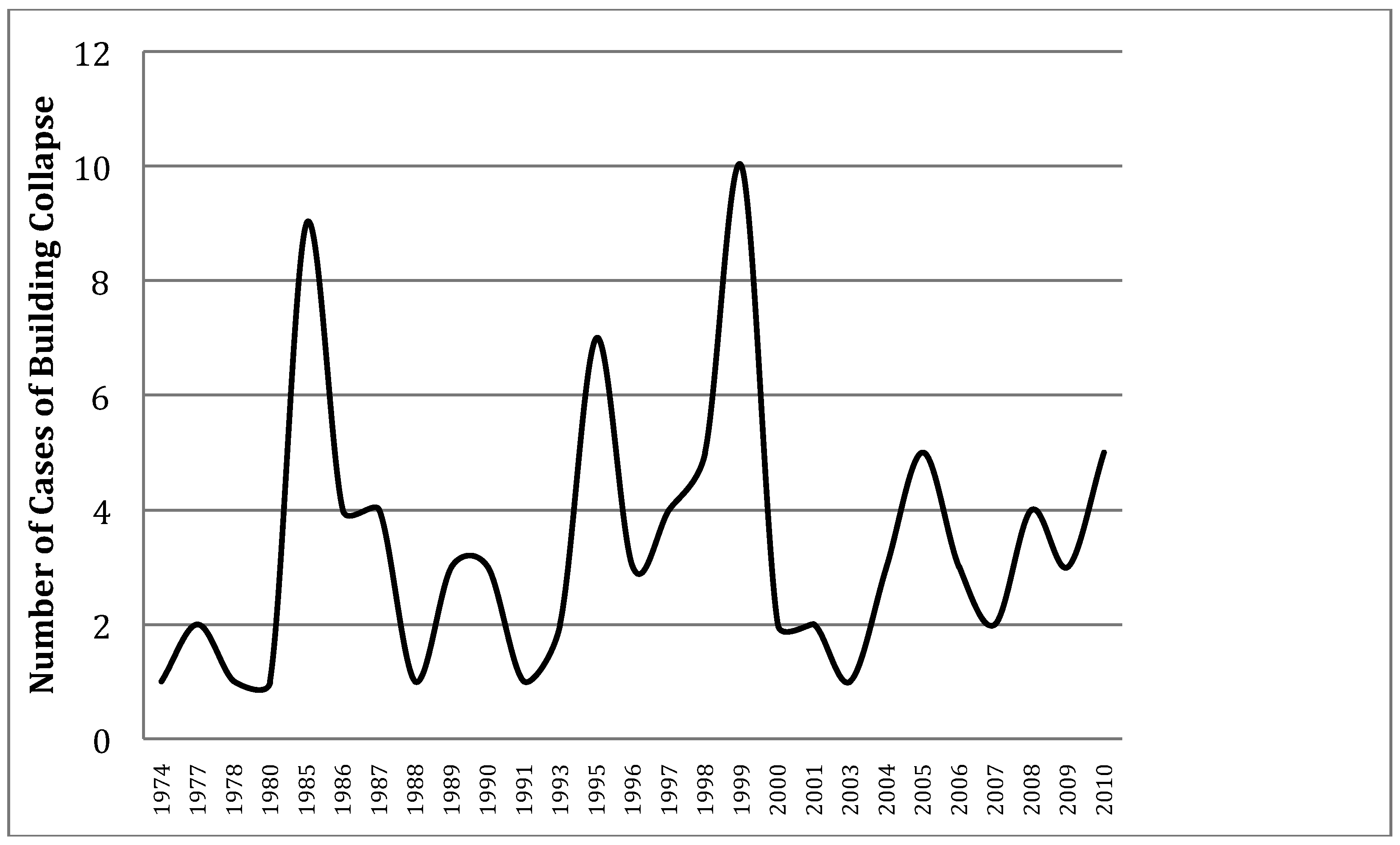
Buildings and the provision of safe and affordable homes are major contributors to sustainable development [1] and through the centuries, these have been important aspects of the socio-economic development of humans. However the contribution of buildings to Nigeria’s development has not yielded the desired potentials because of failed projects and more recently their poor functional performance. It is common to hear of incidents of building collapse in major Nigerian cities like Lagos, Port Harcourt, Abuja, Enugu and Ibadan. There were over 112 incidents of building collapse in Lagos alone between December 1978 and April 2008 [2]. Figure 1 depicts the trend in the number incidents of collapsed buildings in Nigeria from 1974 to date [3,4,5]. Figure 1 shows that there were spikes in the reported cases of building collapse in Nigeria in the years 1985, 1995, 1999, and 2005 and also suggests an upward trend in the number of cases of building collapse by the year 2010.
Figure 1.
Building collapse distributed by year of collapse in Nigeria.
Sadly however, the issues of building collapse during and after construction has failed to receive the attention it deserve from public and private clients and other construction sector stakeholders in Nigeria [6]. This is ironic because of the obvious consequences of building collapse on urban and socio-economic development [7]. Buildings that meet desired performance requirements add value to the national asset stock and enhance its Gross Domestic Product. Such buildings are sustainable because they meet the needs of the present while also contributing to future needs [8]. There is only one alternative to sustainability; unsustainability [9] which underperforming buildings portend to Nigeria’s economy. Several productive lives and properties have been lost in the various incidents of building collapse in Nigeria, and these losses, which would only truly be felt by future generations, have negatively impacted the socio-economic status of its citizenry [10].
This paper examines the contemporary issues in building collapse and their implications for sustainable construction industry development in Nigeria. To do this, the paper firstly appraises the state and severity of building collapse in Nigeria. Secondly, it reviews the principles of sustainable development in the built environment. Thirdly, it explores whether the approach to construction by industry stakeholders follow the principles of sustainable development (Do stakeholders consider the future in their current activities). Finally, it proposes how the construction industry through innovation and sustainable practices can enhance sustainable development, growth and resilience of buildings.
2. Review of the State and Severity of Building Collapse in Nigeria
Building failure is defined as an unacceptable difference between expected and observed performance [11] in a building component when that component can no longer be relied upon to fulfill its principal functions. Limited deflection in a floor which causes a certain amount of cracking/distortions in partitions could be considered a defect but not a failure. Whereas excessive deflection resulting in serious damage to partitions, ceilings and floor finishes could be referred to as failure [12], but sudden dislocation or giving way of a structure is classified as building collapse [5].
To put the issue of building collapse in Nigeria into context, the paper makes use of reported cases of collapsed buildings in Nigeria from 1974 to 2010 (compiled in Table A1). There were a total number of 91 collapsed buildings within this period. The data collected on the collapsed buildings include: location, type, date, suspected cause(s) and the number of casualties. Further, Table 1 presents data on the state and severity of building collapse in Nigeria.
Table 1.
Reported cases of building collapse (1974–2010) according to type, number of floors, geographical location and casualties [3,4,5].
Table 1 reveals that 39.7% of the reported cases of collapsed buildings in Nigeria from 1974 to 2010 are residential buildings, 14.3% are buildings used for business/professional (commercial) purposes and educational use, 12.7% are for Assembly (churches and mosques) use, and 8%, 6.3% and 4.7% are for institutional (hospitals), Mercantile buildings (shopping complexes) and for mixed and occupancy uses respectively. There were no reported cases of building collapse in factories or industrial, high hazard, storage and utility buildings. The results presented in Table 1 suggest that residential buildings are more prone to collapse in Nigeria, adding to the intractable housing shortages experienced in Nigeria [13,14,15]. Thus the potential for investment accumulation in Nigeria is being lost to building collapse.
The cases of collapsed buildings according to the number of floors are presented in Table 1. The data shows that two, three and four floor buildings collapse more frequently than taller buildings that require lifts. This might be due to the fact that buildings above five floors are not in high demand, are more expensive requiring more resources to procure.
Table 1 also gives a distribution of the number of collapsed buildings by geographical location. Lagos and Abuja located in the South West and North Central areas of Nigeria respectively are presented independent of their geographical location in Nigeria, because of their unique status of being the commercial nerve center and the Federal Capital Territory of Nigeria respectively. The data shows that 51.6% of reported cases of building collapse occurred in Lagos, 18.7% in the South Western states, 8.8% in Abuja—the Federal capital city, 6.5% in the South-South states including Port Harcourt, 5.5% in the South Eastern states, and 4.4% in both the North Western and North Central states. There was no case of building collapse reported in the North Eastern states.
The geographical spread of building collapse suggests a high prevalence in the South West including Lagos than at other parts of Nigeria. This might be due to the higher concentration of construction activities in Lagos because of its status as the commercial nerve center of Nigeria and the most populous city in sub-Saharan Africa.
The number of lives lost in building collapse incidents give an indication of the severity of the problem, and where live was not lost, physical injuries are just as severe. In 20.3% of the incidents, there was no loss of life. However any case of building failure would ultimately result in loss of productive time which does not augur well for sustainable development goals. Between one and five lives were lost in 44.4% incidents, while the worst case scenario is the loss of over 21 lives in 9.3% of incidents. This is quite significant considering that most of the affected buildings were residential dwellings.
3. Principles of Sustainable Development in the Built Environment
Sustainable Development has emerged as a paradigm for balancing environmental, social and economic goals [1], which includes the provision of safe and affordable homes [1,16]. Sustainable development offers a framework within which the appropriate combination of consumption and preservation can be sought. It is a concept of needs, an idea of limitations, a future oriented paradigm and a dynamic process of change [17].
A set of basic principles underlie virtually all the definitions of sustainable development. A sustainable city hosts a society, which is described by a set of socio-economic and environmental indicators that meet acceptable benchmark thresholds of sustainable development [18]. Thus to accomplish high-performance, low-environmental-impact buildings, it is vital to incorporate sustainable principles from the onset of any project [7]. Venegas [19] identified five key elements of built environmental sustainability to include the people, industrial base, resource base, natural environment, and the built environment. However Sev [7] noted that sustainable construction can be differentiated according to the three dimensions of sustainable development (environmental, social and economic) and must rely on three basic principles namely:
- resource management;
- life-cycle design;
- and design for human habitation.
Resource management implies the efficient use of energy, water, materials and land, and provides for the reduction, reuse and recycling of natural resources that are used in building production. Resource management yields specific design methods through the selection of durable materials [7] that could extend service lives of buildings components, thus reducing material consumption. Durable materials would also require less maintenance, reduce operating budgets [7,20] and ultimately reduce the potential for building failure.
The life-cycle design of a building during pre-building, building and post-building phases seek to balance environmental concerns with traditional issues that always affect decisions and choices made at the design phase [7]. During the pre-building phase, appropriate site selection helps in the determination of the degree of resource use and the disturbance of existing and natural systems that will be required to support a development project [21]. The use of flexible and durable designs to support future changes (cost-effectively and resource-efficiently), and the selection of sustainable materials and products that meet defined standards of compliance [22], contribute to sustainability. The sustainable design element of a building’s life-cycle affords significant opportunities for influencing project sustainability before construction operations begin on site [19]. During construction, proper planning and management of construction activities could be used to minimize site impact on the environment [7].
Human needs for safety, health, physiological comfort, physiological satisfaction and productivity, must be balanced with the carrying capacity of the natural and cultural environments by a sustainable construction industry, considering that more than 70% of people’s time are spent indoors [7]. All building systems and equipments need to be commissioned in accordance to specified parameters. Poorly commissioned buildings have a direct negative impact on the productivity of the buildings’ occupants [14].
Five elements of the principles of sustainable development that are advocated [7,19,22] and which will be explored further in this paper include: the selection of durable and sustainable materials that meet defined standards of compliance; appropriate site selection; use of flexible and durable designs; proper planning and management of construction activities; and proper commissioning of building systems and equipment before occupation.
4. Mapping Sustainable Development Principles to Construction Approach of Stakeholders
Another objective of this paper is to determine whether the approach to building construction, by construction industry stakeholders in Nigeria, follows identified sustainable principles. Considering that the incidences of building collapse negate the principles of sustainable development, this would suggest that stakeholders do not consider the future in their current activities. Construction becomes sustainable when sustainable development principles are applied in the construction industry [23]. Therefore to determine the construction approach used by stakeholders, the likely causes of the incidences of collapsed buildings presented in Table A1 are used as indicators of the construction approach used by construction industry stakeholders. Table 2 is a re-presentation of the results using the Mean Response Average formula to rank the likely causes of building collapse. The Mean Response Average formula is used because in a significant number of cases, the causes identified per case are more than one.
Table 2.
Causes of building collapse [3,4,5].
From Table 2, it is observed that the prevalent cause of building collapse is structural failure, followed by poor supervision and workmanship, the use of sub-standard materials, carelessness which could be linked to lack of competency in building techniques and supervision skills, and faulty design respectively. Other causes include rainstorms/natural causes, excessive loading and conversion and disregard for approved drawings. This data suggests that the majority of building collapses are traceable to human activity (or inactivity).
Further interrogation of the causes of building collapse from other documented sources corroborates these findings. For example, Ayininuola and Olalusi [11] note that the reasons for structural failures are due to limited knowledge of building structural behavior and unanticipated environmental phenomena. Usually designed structural reliabilities and loading conditions are lower than actual use conditions, whilst provisions are not made for subsequent conversion/modification of the structures. Further the procurement process for both private and government projects does not allow time enough for design development to mature before physical construction commences [11]. This does not discount the propensity to use local methods of construction without appropriate design codes by incompetent professionals. Other design related inadequacies within the reports include the poor soil stratum (organic clay, peat or reclaimed soil) predominant in newer development sites especially in the Lagos metropolis [11,24,25,26,27].
Carelessness and greed of project owners (especially of commercial property) and construction professionals is also reported as a cause of building collapse in Nigeria [3,11,24]. Sometimes this is attributable to the ignorance of project owners, who may be ill advised on resource utilization at the expense of realistic project deliverables [3,11,16,24,25].
The use of sub-standard materials, such as unwashed gravel, was identified by [11,24] as a cause of building collapse. For example, the properties of 90% of sandcrete blocks produced in Lagos are lower than is specified in the Federal Ministry of Works and Housing standards in Nigeria [28]. These sub-standard blocks are often times expected to perform as load bearing elements in buildings [11].
From the foregoing it can be inferred that current building construction practices are not sustainable and do not conform to basic elements of sustainable principles advocated by Sev [7], Vanegas [19] and Redclift [22]. Sustainable building principles advocate the use of durable and sustainable materials, which has not seemed to be the case in buildings constructed in Nigeria. There is also evidence to suggest that planning and management of construction activities has been unsustainable, hence the high incidences of building failure and collapse in Nigeria.
5. Implications of Building Collapse on Sustainable Development
One of the main determinants of economic growth is capital accumulation [29]. Capital accumulation refers to the increase in capital stock of a nation, which may arise from any or a combination of the following—investment in new buildings, factories, machinery and equipment which make it possible for greater national output and income to be achieved. Also, investment in social and economic infrastructure such as roads, railway, electricity, harbors, communication etc. integrates economic activity and facilitates the flow of goods and services between buyers and sellers. Finally capital accumulation includes the investment in human resources such as in formal and informal education, vocational and on-the-job training programmes, which leads to improvement of skills and higher labour productivity.
The framework developed by Sev [7] suggests that the construction sector has the potential to contribute to sustainable development and capital accumulation; the framework further highlights the environmental problems and prospects; and defines the relationship between construction activities and environmental and social problems. The relationship between sustainable development and the construction industry has become lucid, since construction is of high economic significance and has strong environmental and social impacts [7].
Figure 2 presents a causal loop diagram of a system dynamic model created to show the influence of the degree of alignment/compliance to sustainable construction principles and unsustainable practices on building collapse/performance and indirectly on capital growth/sustainable development. Systems dynamics is an approach used to understand the behavior of complex systems over time [30], dealing with internal feedback loops and time delay that affect the behavior of the entire system [31].
Figure 2.
Causal loop diagram of the study using iThink 9.1.4 Trial©.
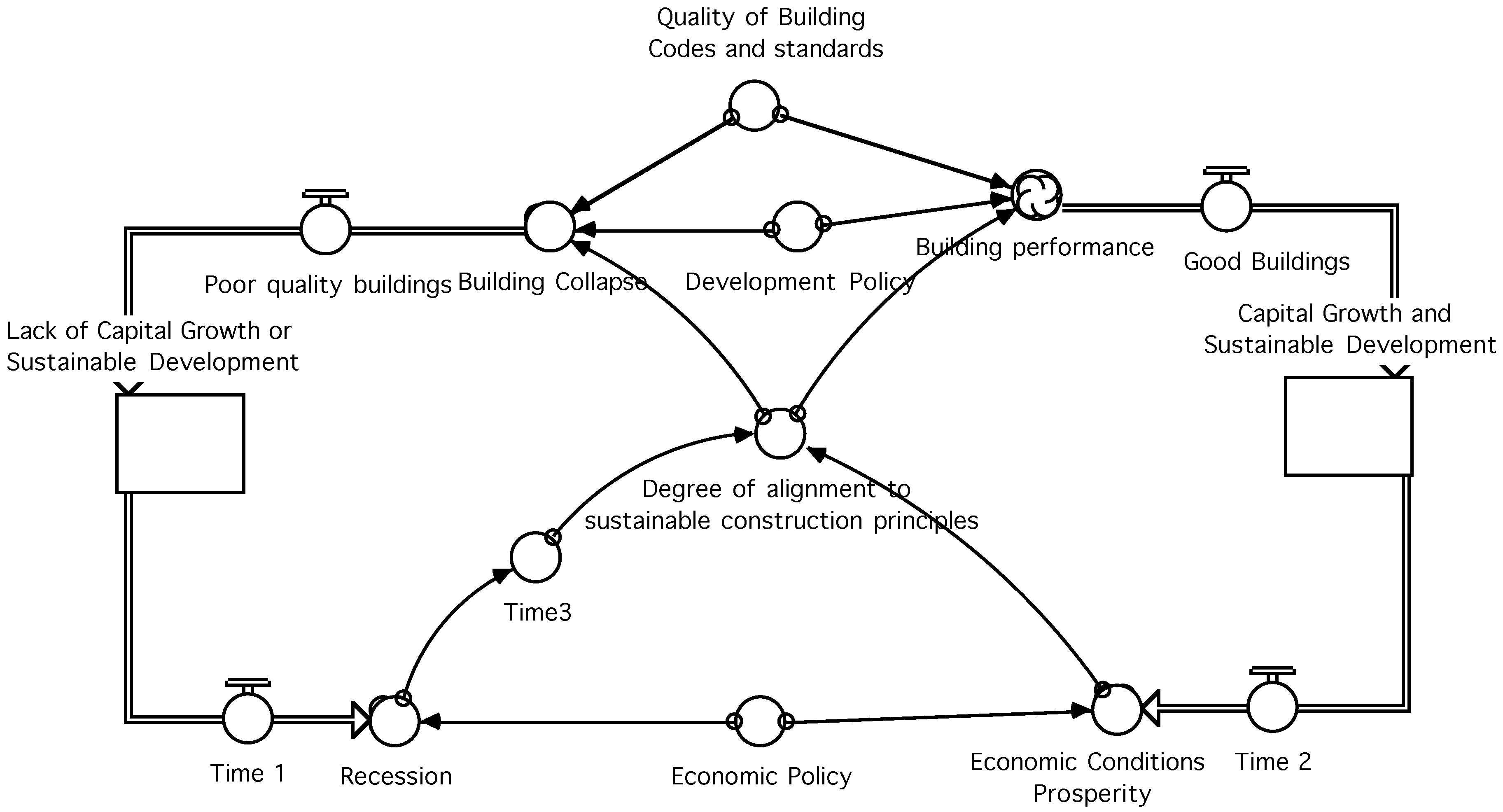
Figure 2 conveys that there are dynamic relationships between economic conditions, degree of alignment to/compliance with sustainable construction principles, building collapse/performance and capital growth/sustainable development in Nigeria. It shows that the development/economic policies enacted governments could affect the rate of building collapse and general economic conditions. The diagram also shows that there is an element of time delay in the dynamics. It takes time for the lack of economic growth to translate into recessionary economic conditions (Time 1), into wealth and prosperity (Time 2), and time for the stakeholders to adjust to the reality of the economic conditions (Time 3).
Figure 2 highlights a number of features. The first is the model’s negative and positive counteracting loops. The positive loop shows that favorable economic conditions influence the construction industry stakeholders’ alignment to and compliance with sustainable construction principles, which influences building performance, capital growth/sustainable development and, which leads to prosperity. The negative loop indicates that periods of economic recession and time, will exacerbate the lack of alignment to and compliance with sustainable construction principles by construction industry stakeholders. These negative practices coupled with poor development policies and building codes, influence the increase in building collapse, poor quality buildings and lack of capital growth/sustainable development, which leads over time to poor economic conditions.
The second feature of the loop is the role played by other variables such as quality of the building codes, and government’s development and economic policies in influencing negative or positive outcomes. Figure 3 validates the systems dynamic model presented in Figure 2. Figure 3 gives real GDP (in billions of Naira) and the GDP of construction and building in Nigeria (in 100 s of Million Naira), using 1990 constant basic prices, to illustrate the prevailing economic conditions and capital growth accumulation in Nigeria over 35 years [32]. Figure 3 also incorporates absolute numbers of the annual recorded cases of building collapse, and the degree of compliance with sustainable principles (based on the total annual number of suspected causes of building collapse that were due to human activity).
Figure 3.
Real GDP, GDP construction and building, building collapse and assessed degree of compliance to sustainable construction principles in Nigeria from 1974–2010.
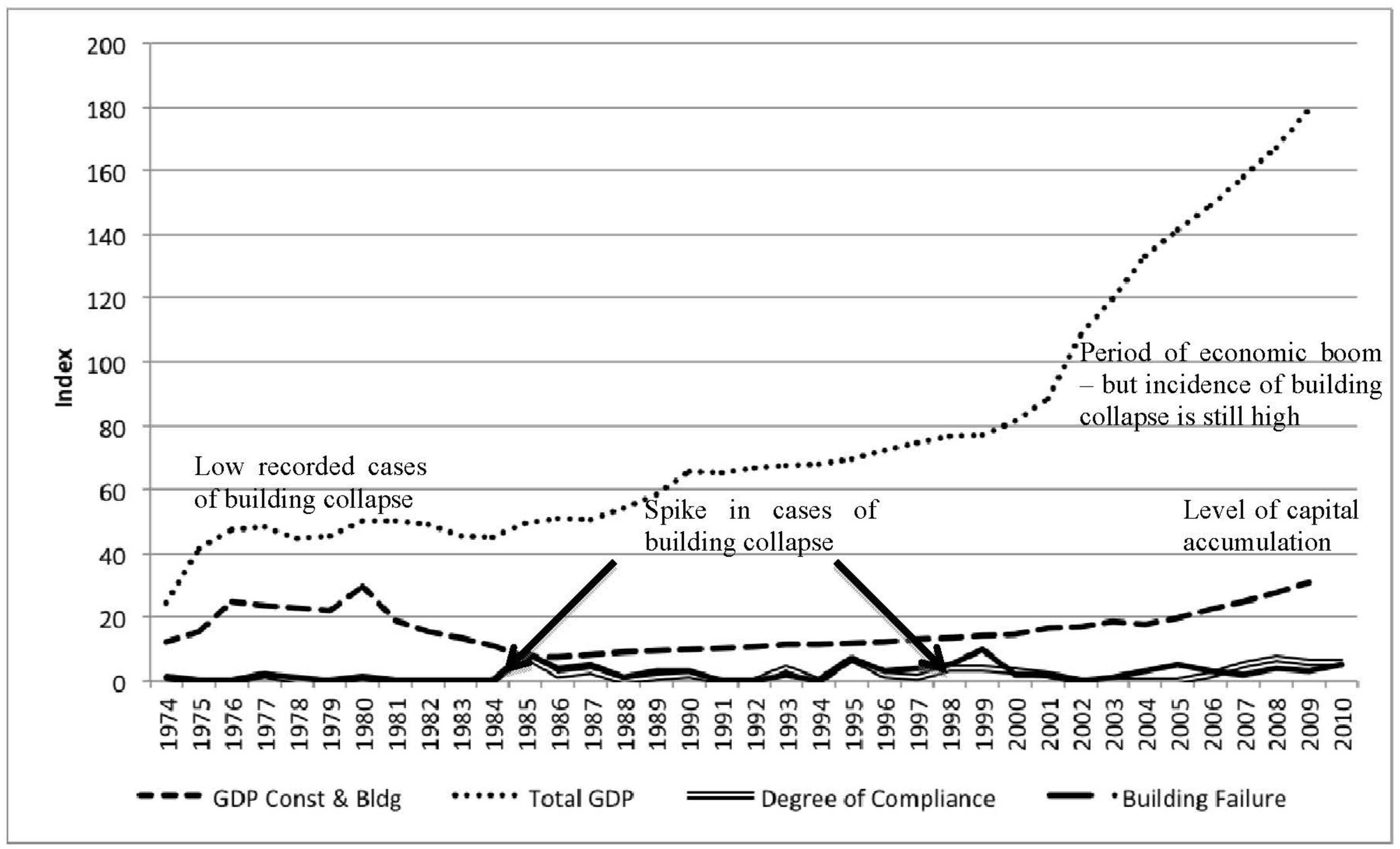
From Figure 3 the number of cases of building collapse in Nigeria spiked and remained at a high level between 1985 and 1999. Whilst practices of construction stakeholders might be a major cause of collapse, other causes might be uncovered by examining historical government policies. For example in 1985, Nigeria implemented ‘austerity measures’ sanctioned by the International Monetary Fund (IMF) after a crash in global oil prices. The implementation of austerity measures led to the devaluation of the Naira (Nigeria’s currency) by up to 12 times its value which resulted in unprecedented economic depression and hardship in Nigeria. The period from 1995 to 1999, which preceded the transition from military rule to a democratic dispensation, was marked by protests and upheavals against repressive military regimes. Consequently there was real economic hardship and further devaluation of the Naira, which could account for the poor construction industry performance records and the high incidence of building collapse.
Conversely, from available records, the periods of economic prosperity (1974–1984) were periods when the least incidents of building collapse were reported and where substantial capital growth was recorded for building and construction. Although there has been a high level of economic growth and prosperity in Nigeria from 2002 to date, this has not been translated into capital growth in building and construction. This suggests that the construction industry is trapped in a negative cycle of unsustainability even though there are favorable economic conditions. It can be rationalized therefore that at periods of economic prosperity, construction practice is sustainable while at recessionary periods, industry stakeholders tend to cut corners and underperform. For example constructors may resort to the use of sub-standard and non-compliant building materials, while project owners could engage unqualified/incompetent design and construction professionals in a bid to lower project development costs. Although contractors strive to maximize profit both in prosperous and austere times, but cost cutting strategies are likely to increase during austere periods when building construction volume is low (competition is keen and margins are lower). Going into the future, the optimistic scenario will be for the country to have construction industry stakeholders who align to and comply with sustainable construction principles during both austere and prosperous times. The most likely scenario is that construction industry stakeholders in Nigeria are already accustomed to unsustainable practices, and will be reluctant to do away with these negative practices. Consequently more cases of building collapse will be witnessed, if government does not take proactive action by ensuring and enforcing compliance with sustainable construction principles, through the enactment of high quality development policies and building codes, and through monitoring of construction projects by enforcement officials. The third scenario, which is pessimistic, is that construction industry stakeholders will continue with accustomed unsustainable practices, and government will not do anything to halt these negative practices and therefore cases of building collapse will continue far into the future.
6. Conclusions
The study examined contemporary issues around building collapse in major cities in Nigeria and their implications on its sustainable development. It also explored whether the approach to construction by industry stakeholders followed the basic principles of sustainable development. The study found, from both primary and secondary data, that incidences of building collapse were prevalent among residential buildings of less than five floors high, and that major commercial centers were worst affected by the under-performance of industry stakeholders. Building collapse in Nigeria is significant and has consequences that cut across the entire spectrum of growth and development. It deserves all stakeholders’ attention to seek means of minimizing these largely avoidable incidences.
Current construction practices are unsustainable, and not in alignment with ideal sustainability principles. Current practices have wider implications on national development goals for which construction is strategic. With the upturn of the national economy and the general boom, building failures persist. Unless there is a conscious intervention from government agencies and industry groups to stem unsustainable construction practices in Nigeria, the next time there is a downturn in the nation’s economy, building failures will worsen. Improved levels of conformance to and compliance with sustainable construction principles by construction industry stakeholders is required to abate building collapse, thereby improving capital and economic growth in Nigeria.
The paper therefore recommends an overhaul of planning and implementation policies (e.g., building codes, which set out minimum performance standards for design and construction works that are based on sustainable principles). The current National Building Code of the Federal Republic of Nigeria [33] was developed based on concerns regarding incessant collapse of buildings; the dearth of reference design standards for professionals; and the use of unqualified/incompetent professionals amongst other anomalies. However, a revision of this Code to incorporate sustainable construction now needs to be undertaken, especially for residential buildings. The development of bye-laws developed for Lagos metropolis and other big cities in Nigeria is encouraged because of their strategic level of development. Governments (federal, state and local), through respective regulatory agencies, should play significant roles in reversing the trend of building failures and collapse. There is an economic incentive to do this because of the positive influence that a healthy building stock would have on the national economy.
Appendix
Table A1.
Reported cases of building collapse in Nigeria from 1974–2010 (period of 25 years) [3,4,5].
References
- Tah, J.M.H. The role of the african diaspora in sustainable homebuilding. In Proceedings of the African Diaspora Conference, London, UK, 22 July 2006; Nwana, H.S., Tah, J.H.M., Eds.; pp. 18–26.
- Cement producers, builders seek solutions to building collapse. Available online: http://www.peoplesdaily-online.com/ (accessed on 24 January 2011).
- Chinwokwu, G. The role of professionals in averting building collapse. In Proceedings of Building Collapse—Causes, Prevention and Remedies, Lagos, Nigeria, 3–4 May 2000; pp. 12–28.
- Windapo, A.O. The threat of building collapse on sustainable development in the built environment. In Proceedings of the Sustainable Development Conference, Jos, Nigeria, 9–12 August 2006; pp. 59–65.
- Fagbenle, O.I.; Oluwunmi, A.O. Building failure and collapse in Nigeria: The influence of the informal sector. J. Sustain. Dev. 2010, 3, 268–276. [Google Scholar]
- Collapsed Building: Professionals Tackle Lagos State Government. Available online: http://www.tribune.com.ng/ (accessed on 24 January 2011).
- Sev, A. How can the construction industry contribute to sustainable development? A conceptual framework. Sustain. Dev. 2009, 17, 161–173. [Google Scholar] [CrossRef]
- Brundtland, G.H. Our Common Future; Report of the World Commission on Environment and Development; Oxford University Press: Oxford, UK, 1987. [Google Scholar]
- Bossel, H. Indicators for Sustainable Development: Theory, Method, Applications; International Institute for Sustainable Development: Winnipeg, MB, Canada, 1999. [Google Scholar]
- Olajumoke, A.M.; Oke, I.A.; Fajobi, A.B.; Ogedengbe, M.O. Engineering failure analysis of a failed building in Osun State Nigeria. J. Failure Anal. Prev. 2009, 9, 8–15. [Google Scholar]
- Ayininuola, G.M.; Olalusi, O.O. Assessment of building failures in Nigeria: Lagos and Ibadan case study. Afr. J. Sci. Technol. 2004, 5, 73–78. [Google Scholar]
- Roddis, W.M.K. Structural failure and engineering ethics. J. Struct. Eng. 1993, 119, 1539–1555. [Google Scholar] [CrossRef]
- Nubi, T.O.; Omirin, M.M.; Afolayan, A.S. Preface. In Private Sector Driven Housing Delivery, 1st; Nubi, T.O., Omirin, M.M., Afolayan, A.S., Eds.; Department of Estate Management, University of Lagos: Lagos, Nigeria, 2007; pp. 3–5. [Google Scholar]
- Adenubi, O.I.; Windapo, A.O. A study of factors affecting the affordability of urban housing in Nigeria. Construct. Res. J. 2007, 1, 26–36. [Google Scholar]
- Opoko, A.P. Housing the Nigerian urban poor: Lessons from other countries. Build. Qual. 2003, 3, 13–21. [Google Scholar]
- Howard, N. Sustainable Construction—The Data; Technical Report for Center for Sustainable Construction: Watford, UK, 2000. Available online: http://projects.bre.co.uk/sustainable /SusConstructionData.pdf (accessed on 18 July).
- Shields, O.M. Definition of Sustainable Development. In Vanguard Property and Environment; 10 July 2001; p. 24. [Google Scholar]
- Ndukwe, E.C. Sustainable cities and socio-economic development. In Proceedings of NIOB Conference, Lagos, Nigeria, 27 June 2006.
- Vanegas, J.A. Road map and principles for built environment sustainability. Environ. Sci. Technol. 2003, 37, 5363–5372. [Google Scholar] [CrossRef]
- Kim, J.J.; Rigdon, B. Sustainable architecture module. In Qualities, Use and Examples of Sustainable Building Materials; Graves, J., Ed.; University of Michigan: Michigan, MI, USA, 1998. [Google Scholar]
- Dines, N.T. Sustainable site design. In Sustainable Building Technical Manual; USA Green Building Council: Washington, DC, USA, 1996; pp. 44–52. [Google Scholar]
- Redclift, M. Sustainable development (1987–2005): An oxymoron comes of age. Sustain. Dev. 2005, 13, 209–211. [Google Scholar] [CrossRef]
- Gyadu-Asiedu, W.; Scheublinn, F.J.; van Egmond, E.L.C. Performance assessment for sustainable construction: Lest we forget about the client. Proceedings of the International Conference on Sustainable Construction, Materials and Practices (Portugal SB07), Lisbon, Portugal, 12–14 September 2007; Available online: http://www.irbdirekt.de/ (accessed on 6 May 2011).
- Rising Incidence of Building Collapse in Nigeria. Available online: http://www.Leadershiponline.com (accessed on 15 August 2008).
- Causes of Building Collapse. Available online: http://www.Building_Contractors_Secretes.com/ (accessed on 15 September 2008).
- Ekwuani, T. Sinking Buildings in Lagos. In Real Estate Development Magazine; 15 December 1989; pp. 17–27. [Google Scholar]
- Oghuma, A. Disaster at Dawn. In Newswatch Magazine; 1 September 1987; pp. 23–30. [Google Scholar]
- Windapo, A.O. A study of the quality of materials used in the Nigerian construction industry. Prof. Buil. 2006, 32, 34–38. [Google Scholar]
- FMHUD. The impact of sustainable housing delivery on the national macro economy. In Proceedings of 24th Annual Conference of Directors/Heads of Lands in the Federal and State Ministries/Parastatals, Abuja, Nigeria, 21–23 July 2004; pp. 2–4.
- Lai, C.L.; Ip, W.H.; Lee, W.B. The system dynamic model for engineering services. Manag. Serv. Qual. 2001, 11, 191–199. [Google Scholar] [CrossRef]
- Forrester, J.W. Industrial dynamics—after the first decade. Manag. Sci. 1968, 14, 398–415. [Google Scholar] [CrossRef]
- National Bureau of Statistics. Available online: http://www.Nigerianstat.gov.ng (accessed on 21 May 2012).
- Federal Republic of Nigeria, National Building Code; LexisNexis Butterworth: Cape Town, South Africa, 2006.
© 2012 by the authors; licensee MDPI, Basel, Switzerland. This article is an open-access article distributed under the terms and conditions of the Creative Commons Attribution license (http://creativecommons.org/licenses/by/3.0/).